Overcoming Mass Transport Limitations in Electrochemistry: From Fundamental Mechanisms to Advanced Optimization Strategies
This comprehensive review addresses the critical challenge of mass transport limitations in electrochemical systems, which significantly impact the efficiency and scalability of technologies from energy storage to chemical synthesis.
Overcoming Mass Transport Limitations in Electrochemistry: From Fundamental Mechanisms to Advanced Optimization Strategies
Abstract
This comprehensive review addresses the critical challenge of mass transport limitations in electrochemical systems, which significantly impact the efficiency and scalability of technologies from energy storage to chemical synthesis. We explore the fundamental mechanisms of diffusion, migration, and convection governing species transport to electrode surfaces, followed by advanced methodological approaches for enhancement including bubble-induced convection, gas diffusion electrodes, and engineered transport channels. The article provides practical troubleshooting frameworks and optimization strategies for industrial electrochemical devices, complemented by cutting-edge validation techniques and comparative analyses of system architectures. This synthesis offers researchers and engineers a multidisciplinary toolkit to overcome mass transport barriers and advance next-generation electrochemical technologies.
Understanding Mass Transport Fundamentals: Mechanisms Governing Electrochemical Efficiency
In electrochemical research, the faradaic current is a direct measure of the reaction rate at the electrode surface. This current is governed by two intertwined processes: the rate of charge transfer across the electrode interface and the rate at which reactants and products move between the bulk solution and the electrode surface, known as mass transport [1]. When mass transport cannot keep pace with electron transfer kinetics, mass transport limitations occur, capping the maximum achievable reaction rate and impacting the efficiency of electrochemical devices. Understanding and controlling the three fundamental mass transport mechanisms—diffusion, migration, and convection—is therefore crucial for advancing electrochemistry research, from optimizing drug development assays to scaling up energy storage systems [1] [2].
The Fundamental Mechanisms of Mass Transport
Diffusion
Diffusion is the spontaneous movement of a species due to a concentration gradient, driving material from regions of high concentration to regions of low concentration [1] [3]. In an electrolysis experiment, the electrode reaction itself creates these gradients; reactant concentration decreases at the electrode surface while product concentration increases [2]. The rate of this movement is quantitatively described by Fick's first law [1] [2]:
[Ji = -Di \frac{∂C_i}{∂x}]
Here, (Ji) is the flux (mol cm⁻² s⁻¹), (Di) is the diffusion coefficient (cm²/s), and (∂C_i/∂x) is the concentration gradient. The negative sign indicates movement down the concentration gradient. To predict how concentration changes over time, Fick's second law is used [2]:
[\frac{∂C}{∂t} = D \frac{∂^2C}{∂x^2}]
Diffusion often becomes the dominant and rate-limiting transport mechanism in quiet, unstirred solutions [2].
Migration
Migration is the movement of charged particles (ions) under the influence of an electric potential gradient [1]. Cations move toward the negatively charged cathode, and anions move toward the positively charged anode [4]. The contribution of migration to the total flux is proportional to the species' charge, concentration, diffusion coefficient, and the magnitude of the electric field gradient [1]. In practice, the effects of migration can complicate the interpretation of voltammetric data, as the observed current will have contributions from both faradaic processes and the capacitive charging of the double layer.
Convection
Convection is the bulk movement of fluid due to an external force, which can be either intentional (forced) or unintentional (natural) [1] [2]. Forced convection is introduced mechanically via stirring, pumping, or using a rotating electrode [2] [4]. Natural convection arises from random thermal currents or density gradients in the solution and is typically undesirable as it introduces unpredictability, especially in experiments lasting longer than 20 seconds [2]. Convection is highly effective at replenishing reactants at the electrode surface, thereby increasing the overall reaction rate.
The Combined Picture: The Nernst-Planck Equation
The total mass transport flux of a species in one dimension is described by the Nernst-Planck equation, which combines all three mechanisms [1]:
[\mathrm{J{(x,t)} = -[D (∂C{(x,t)} / ∂x)] - (zF/ RT) D C{(x,t)} + C{(x,t)}ν_{x\, (x,t)}}]
- Term 1: Flux due to Diffusion (concentration gradient)
- Term 2: Flux due to Migration (electric potential gradient)
- Term 3: Flux due to Convection (hydrodynamic velocity)
A critical goal in experimental design is to isolate the mass transport mode of interest. Contributions from migration are effectively eliminated by adding an inert supporting electrolyte (e.g., KCl) in a large excess (10-100 fold) relative to the redox-active species. This excess of inert ions shields the electroactive species from the electric field [1] [2] [3]. Contributions from convection can be minimized by working in quiet, unstirred solutions and carefully controlling external vibrations and temperature [1]. Under these controlled conditions, mass transport can be considered purely diffusional, greatly simplifying data analysis [1].
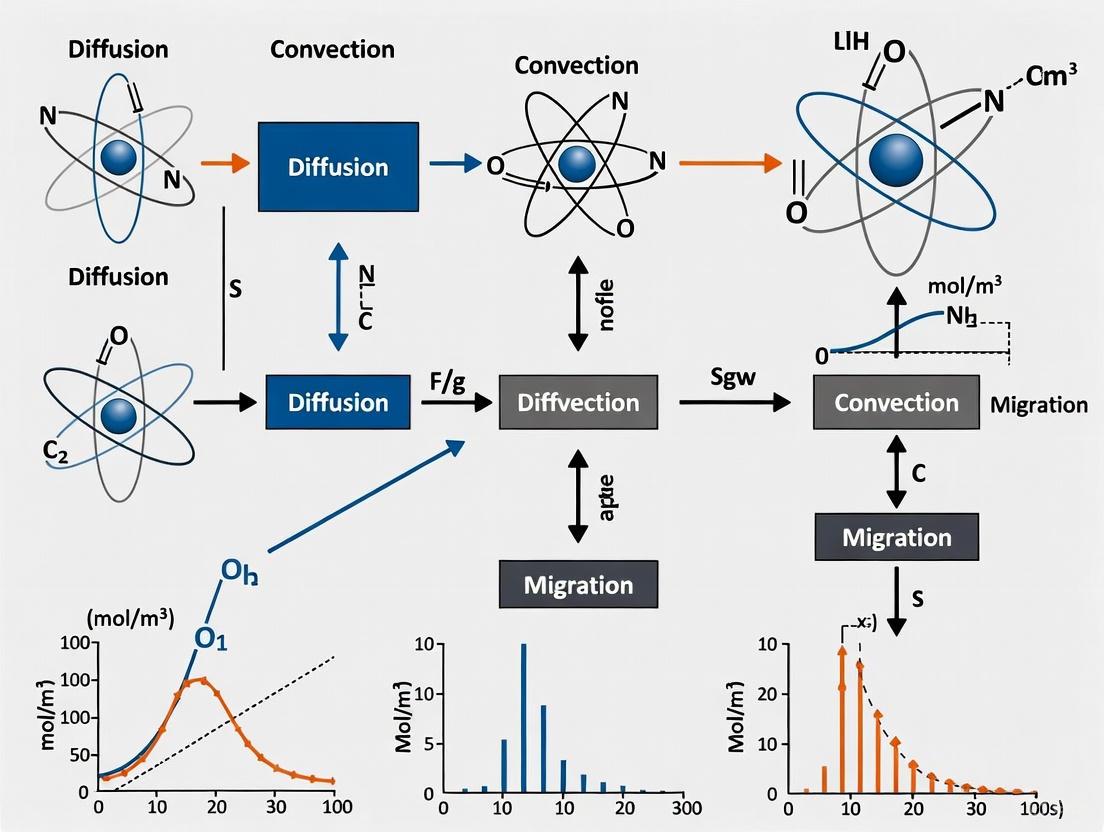
The diagram below illustrates the simultaneous action of all three mass transport mechanisms in an electrochemical cell and the primary method for controlling each one.
Troubleshooting Common Mass Transport Issues
Frequently Asked Questions (FAQs)
Q1: My cyclic voltammetry peaks are broad and the peak current is lower than theoretically predicted. What could be the cause? This is often a sign of poor mass transport or slow electron transfer kinetics. First, ensure your solution contains a sufficient concentration of supporting electrolyte (at least 100-fold excess relative to your analyte) to eliminate migratory effects [1] [3]. Second, verify that your solution is perfectly still and free from vibrations to prevent uncontrolled convection. Finally, check that your reference electrode is positioned correctly and that your scan rate is appropriate for your system.
Q2: Why does my current density plateau at high overpotentials instead of continuing to increase? This plateau represents the limiting current density ((i_{lim})), a classic signature of mass transport limitation [4]. At this point, the reaction is so fast that the concentration of the reactant at the electrode surface is effectively zero. The rate of the reaction is now entirely controlled by how quickly fresh reactant can be supplied to the surface via diffusion (and/or convection). To increase the limiting current, you can enhance mass transport, for example, by using a rotating disk electrode or increasing the flow rate in a flow cell [4].
Q3: I am studying a reaction in a flow cell, but my product selectivity changes with flow rate. Why? Changes in flow rate directly alter the convection-driven delivery of reactants. A higher flow rate brings more reactant to the catalyst per unit time, which can favor desired pathways that require high reactant concentration. Conversely, a lower flow rate may lead to reactant depletion near the catalyst surface, potentially favoring side reactions like hydrogen evolution [5]. This represents a direct trade-off between achieving a high reaction rate (high flow) and high conversion efficiency per pass (low flow) [5].
Q4: My current is unstable and drifts significantly over time (seconds to minutes) in a quiet solution. What should I do? This drift is likely caused by natural convection [2]. Small thermal gradients (e.g., from temperature variations in the lab) or density differences in the solution create random fluid motion. This is a common problem in experiments lasting longer than ~20 seconds. To mitigate this, you can better thermostat your cell, shield it from drafts, or perform your experiment more quickly. For longer measurements, it is better to intentionally introduce a well-defined, quantifiable form of forced convection (e.g., using a rotating electrode) to drown out the random natural convection [2].
Troubleshooting Guide Table
The following table summarizes common experimental issues, their likely mass transport-related causes, and recommended solutions.
| Observed Problem | Likely Cause | Recommended Solution |
|---|---|---|
| Low/non-reproducible limiting current | Insufficient convective mixing | Increase stirring rate or RDE rotation speed; use a flow cell [2] [4]. |
| Asymmetric CV waveshape, distorted currents | Significant migration effects | Add a high concentration (e.g., 0.1 M) of inert supporting electrolyte (e.g., KCl, TBAPF6) [1] [3]. |
| Current drift over time in unstirred solution | Natural convection from thermal/density gradients | Thermostat the cell; minimize external vibrations; shorten experiment duration (<20 s) [2]. |
| Low current density in CO2 reduction | Poor CO2 transport to catalyst surface (low solubility) | Switch from a planar electrode to a Gas Diffusion Electrode (GDE) to deliver CO2 in the gas phase [5]. |
| Selectivity changes with flow rate | Shift in local concentration environment at the catalyst | Systematically map selectivity vs. flow rate to find the optimal operational window [5]. |
| Model fails to converge in simulation | Unsuitable initial values (e.g., zero concentration) | Review and provide non-zero initial values for concentrations and potentials; use linearized kinetics to initialize [6]. |
Advanced Applications and Protocols
Case Study: Overcoming Mass Transport in Dilute CO2 Electrolysis
The electrochemical reduction of CO2 is a promising carbon capture and utilization technology. However, a major roadblock is the low solubility and slow diffusion of CO2 in aqueous electrolytes, which severely limits current density and product yield [5]. This is exacerbated when using dilute CO2 streams (e.g., 15% from flue gas) [7].
- Problem: Traditional planar electrodes, which rely on dissolved CO2, suffer from extreme mass transport limitations, resulting in low current densities that are commercially unviable [5].
- Solution: The field has moved to Gas Diffusion Electrodes (GDEs). In a GDE, CO2 is delivered directly to the catalyst layer in the gas phase through a porous, hydrophobic diffusion layer. This architecture creates a three-phase boundary (gas-liquid-solid) that ensures a high local concentration of CO2 at the catalytic sites, dramatically enhancing the mass transport and enabling industrial-level current densities [5].
- Advanced Protocol: Recent research by [7] demonstrates a further refinement. They constructed localized mass transport channels by functionalizing a Covalent Organic Framework (COF) on a single-atom catalyst (TfCOF-In1@Cu2O). The COF's porous structure and functional groups act as molecular channels that concentrate CO2/CO intermediates at the active sites via steric and electronic effects. This coordination between transport and kinetics allowed their electrolyzer to maintain high performance (83.5% Faradaic efficiency to C2+ products) even with a dilute 70-90% CO2 inlet, a critical step toward practical application [7].
Quantitative Analysis: Measuring the Limiting Current
The limiting current ((i_{lim})) is a direct quantitative measure of the rate of mass transport to the electrode. For a planar macroelectrode under pure diffusion control, the limiting current in a steady-state experiment (e.g., at an RDE) is given by:
[i_t = n F A D (\partial C / \partial x)]
Where:
- (n) = number of electrons transferred
- (F) = Faraday constant
- (A) = electrode area (cm²)
- (D) = diffusion coefficient (cm²/s)
- (\partial C / \partial x) = concentration gradient at the electrode surface
In a well-designed experiment, measuring (i_{lim}) allows for the determination of the concentration of the electroactive species or its diffusion coefficient.
Research Reagent Solutions
The table below lists key materials and reagents essential for controlling mass transport in electrochemical experiments.
| Reagent / Material | Function in Mass Transport Control | Typical Usage / Concentration |
|---|---|---|
| Potassium Chloride (KCl) | Supporting electrolyte; minimizes migration by providing excess inert ions. | 0.1 M - 1.0 M (≥100x analyte concentration) [1] [3]. |
| Tetrabutylammonium Hexafluorophosphate (TBAPF6) | Supporting electrolyte for non-aqueous solvents (e.g., acetonitrile). | 0.1 M - 0.5 M [3]. |
| Rotating Disk Electrode (RDE) | Provides a quantifiable, well-defined forced convection. | Rotation speed: 400 - 10,000 rpm [2]. |
| Gas Diffusion Electrode (GDE) | Overcomes solubility limits by delivering gaseous reactants (e.g., O2, CO2, H2) directly to the catalyst layer. | Used in fuel cells, flow batteries, and CO2 electrolyzers [5] [7]. |
| Microfluidic Flow Cell | Provides controlled convective flow for precise reactant delivery and product removal. | Flow rates from µL/min to mL/min [5]. |
Mastering the three pillars of mass transport—diffusion, migration, and convection—is not merely an academic exercise but a practical necessity for success in electrochemical research. By systematically diagnosing issues such as erratic currents, low limiting currents, or unexpected selectivity changes, researchers can implement targeted solutions. These include adding supporting electrolyte, controlling convection, or adopting advanced electrode architectures like GDEs. A deep understanding of these principles enables the effective troubleshooting of experiments and paves the way for innovating next-generation electrochemical devices for analytics, drug development, and sustainable energy technologies.
Foundations of the Nernst-Planck Equation
The Nernst-Planck equation is a fundamental continuity equation that describes the motion of charged chemical species (ions) in a fluid medium under the influence of three primary transport mechanisms: diffusion, migration, and convection [8] [1]. It serves as a cornerstone for modeling mass transport in electrochemical systems, extending Fick's law of diffusion to include the effects of electrostatic forces [8].
The total flux ( Ji ) of a species ( i ) is given by the following equation, which combines these three mechanisms [8] [9] [1]: [ Ji = -\underbrace{Di \nabla ci}{\text{Diffusion}} + \underbrace{ci \mathbf{v}}{\text{Advection (Convection)}} + \underbrace{\frac{Di zi F}{RT} ci (-\nabla \phi)}_{\text{Electromigration (Migration)}} ] Where:
- ( J_i ) is the flux of species ( i ) (mol·m⁻²·s⁻¹)
- ( D_i ) is the diffusion coefficient (m²·s⁻¹)
- ( c_i ) is the concentration (mol·m⁻³)
- ( \mathbf{v} ) is the fluid velocity vector (m·s⁻¹)
- ( z_i ) is the charge number
- ( F ) is Faraday's constant (C·mol⁻¹)
- ( R ) is the gas constant (J·mol⁻¹·K⁻¹)
- ( T ) is the absolute temperature (K)
- ( \phi ) is the electric potential (V)
The following diagram illustrates the coupling of the physical phenomena described by this system of equations.
For a system with multiple ion species, the Poisson equation couples the electric potential to the total charge density from all ions [9] [10]: [ \nabla \cdot (\epsilon \nabla \phi) = - \frac{F}{\epsilon0} \sumi zi ci ] This coupled system is known as the Poisson-Nernst-Planck (PNP) model [10].
Essential Research Reagents and Materials
The table below lists key reagents and materials commonly used in experiments modeled with the Nernst-Planck equation, along with their critical functions.
| Reagent/Material | Function & Importance |
|---|---|
| Supporting (Inert) Electrolyte (e.g., KCl, NaClO₄) [1] | Minimizes migration effects for electroactive species by carrying most of the current. Use in 10-100 fold excess over the species of interest. |
| High-Purity Solvents (e.g., Water, Acetonitrile) [11] | Reduces interference from electrochemical impurities that can poison electrode surfaces and alter reaction kinetics. |
| Reference Electrode (e.g., Ag/AgCl, SCE) [11] | Provides a stable, well-defined reference potential for accurate electrode potential control and measurement. |
| Ultra-pure Electroactive Species | Ensures that the measured current and transport properties are solely attributable to the species being studied. |
| Ion-Exchange Membranes (e.g., Nafion) [9] | Used in electrodialysis and fuel cells to selectively transport cations or anions, creating concentration gradients. |
Frequently Asked Questions (FAQs)
Q1: When should I use the PNP model versus a simpler model like Poisson-Boltzmann (PB)? The PNP model is a nonequilibrium framework and should be used when modeling systems with a net ion flux, such as those under an applied voltage or with significant concentration gradients [10]. The Poisson-Boltzmann equation describes an equilibrium state where ion fluxes are zero. If your system involves dynamic processes like current flow or intercalation in batteries, PNP is the appropriate choice.
Q2: How can I simplify the PNP model for a system with many ion species? For complex systems with multiple ion species, you can use a Poisson-Boltzmann-Nernst-Planck (PBNP) hybrid model [10]. This approach models the key ions of interest (e.g., Li⁺ in a battery) with the Nernst-Planck equation while treating the background electrolyte (e.g., PF₆⁻) with a Boltzmann distribution in the Poisson equation. This significantly reduces computational cost.
Q3: My experimental current doesn't match my PNP simulation. What are the most likely causes?
- Unaccounted for Side Reactions: Impurities in the electrolyte or at the electrode can cause parasitic currents [11].
- Incorrect Boundary Conditions: The boundary condition for the reaction flux is highly nonlinear and sensitive to the potential [12]. Double-check your kinetic expression.
- Overlooking Material Properties: Real-world electrode porosity, tortuosity, and surface roughness can create mass transport limitations not captured in an idealized model [13].
Troubleshooting Common Numerical Implementation Issues
Problem 1: Solver Convergence Failures with Coupled PNP Equations The strong, nonlinear coupling between the Poisson and Nernst-Planck equations can cause the solver to diverge or fail to converge.
- Solution Strategy:
- Start Simple: Begin by solving a problem with a known analytical solution or a simplified version of your model (e.g., by neglecting convection initially) [12].
- Variable Scaling: The residuals of the concentration and potential equations can differ by several orders of magnitude. Use variable scaling to bring them to a similar range [12].
- Example: Try scaling concentration variables by
1e2and potential variables by1e5and adjust as needed.
- Example: Try scaling concentration variables by
- Solver and Preconditioner: Use a robust nonlinear solver and a preconditioner designed for coupled systems. The
BoomerAMGpreconditioner from the Hypre library can be effective, but if it fails, try algebraic multigrid (AMG) or additive Schwarz method (ASM) [12].
Problem 2: Singularity or Division-by-Zero Errors These errors often occur when the concentration ( ci ) approaches zero in the migration term ( \propto ci \nabla \phi ).
- Solution Strategy:
- Initial Conditions: Ensure your initial conditions are physically realistic, with concentrations greater than zero throughout the domain.
- Boundary Conditions: Check that boundary conditions do not force the concentration to an unphysical zero value where it would cause a singularity in the equation.
Problem 3: Inaccurate or Unphysical Results (e.g., Negative Concentrations) This can arise from numerical instabilities, especially with standard finite element methods in regions with sharp concentration gradients.
- Solution Strategy:
- Stabilization Techniques: Employ numerical stabilization like Crosswind Diffusion or Streamline Upwind Petrov-Galerkin (SUPG) methods to prevent oscillations [14].
- Mesh Refinement: Ensure your mesh is sufficiently fine, particularly in boundary layers near electrodes where concentrations change rapidly.
- Jacobian Verification: Use Finite-Difference Jacobian (
FDP) checking with a direct solver (likeLU) to ensure your computed Jacobian matrix is correct [12].
The workflow below provides a logical sequence for diagnosing and resolving common PNP implementation problems.
Performance of Linear Solvers and Preconditioners for PNP Systems
The choice of solver and preconditioner is critical for efficiently solving the linear systems arising from PNP discretization. The table below summarizes typical performance based on reported experiences [15] [12].
| Solver / Preconditioner | Typical Performance for PNP | Notes & Best Use Cases |
|---|---|---|
| BoomerAMG (Hypre) | Good to Excellent | Often the best first choice for the Poisson equation and well-behaved systems [12]. |
| Algebraic Multigrid (AMG) | Good | Can work better than BoomerAMG for some problems, especially with strong convection [12]. |
| Additive Schwarz (ASM) | Moderate | May succeed where BoomerAMG fails, but can require many iterations [12]. |
| LU Decomposition | Excellent (but costly) | Guaranteed to work for small to medium-sized problems. Use for debugging and verifying Jacobians [12]. |
Best Practices for Experimental Validation
To ensure your PNP model accurately reflects physical reality, follow these protocols for experimental validation:
- Eliminate Unwanted Transport Effects: To study purely diffusion-controlled processes, add an inert supporting electrolyte in large excess (e.g., 100:1 ratio to the analyte) to suppress migration, and work in unstirred solutions to eliminate convection [1].
- Meticulous Electrolyte Preparation: Trace impurities can drastically alter electrode kinetics and transport. Use high-purity reagents, employ rigorous cleaning protocols for cells (e.g., piranha solution), and store components appropriately to prevent contamination [11].
- Characterize Electrode Microstructure: For porous electrodes (e.g., in batteries), measure key parameters like porosity, tortuosity, and specific surface area. PNP simulations that incorporate these real-world microstructures are far more predictive of performance, especially at high C-rates [13].
- Validate Across Operating Conditions: Do not calibrate your model at a single voltage or concentration. Perform experiments across a wide range of conditions (e.g., different current densities or bulk concentrations) and validate that the model can predict the system's
I-Vcurve and concentration profiles [10].
Technical Support Center
Troubleshooting Guides
Guide 1: Diagnosing Mass Transport Limitations in Electrochemical Cells
Reported Issue: Unusually low limiting current or a plateau in current density despite increasing applied potential.
Background: This is a classic symptom of mass transport limitations, where the rate of reactant supply to the electrode surface cannot keep pace with the electrochemical reaction rate. The primary resistance often originates from the concentration boundary layer [16] [17].
Troubleshooting Walkthrough:
Verify Electrolyte Composition and Concentration:
- Action: Prepare a fresh electrolyte solution with a precisely known, higher concentration of the active species.
- Expected Outcome: If the limiting current increases significantly, it confirms a bulk concentration issue.
- If Problem Persists: Proceed to step 2.
Characterize Hydrodynamic Conditions:
- Action: Systematically increase the stirring rate or flow velocity past the electrode surface.
- Expected Outcome: An increase in limiting current indicates a thick, stagnant concentration boundary layer. The relationship between current and flow rate can be used to diagnose the boundary layer thickness [16].
- If Problem Persists: Proceed to step 3.
Inspect Electrode Surface:
- Action: Use microscopy (e.g., SEM) to check for surface fouling, passivation layers, or unusual morphology that could locally alter the boundary layer.
- Expected Outcome: A clean, smooth surface should exhibit predictable boundary layer behavior. Fouling can create additional diffusion barriers.
- Protocol: Clean the electrode according to standard procedures (e.g., polishing, electrochemical cycling, or solvent cleaning) and re-test.
Underlying Principle: The mass transfer rate across the concentration boundary layer is governed by Fick's law, ( J = -D \frac{dC}{dx} ), where ( J ) is the flux, ( D ) is the diffusion coefficient, and ( \frac{dC}{dx} ) is the concentration gradient [16] [18]. Any factor that affects ( D ) or flattens the gradient (like low bulk concentration or thick boundary layers) will limit current.
Guide 2: Addressing Inconsistent Experimental Results in Flow Systems
Reported Issue: Poor reproducibility of measurements between different experimental runs or setups.
Background: Inconsistency often arises from uncontrolled or unreported variables that directly impact the concentration boundary layer, such as flow geometry, alignment, or surface conditions [18].
Troubleshooting Walkthrough:
Quantify Flow Parameters:
- Action: Calculate the Reynolds number (( Re )) for your system to characterize the flow regime (laminar vs. turbulent). Ensure it is consistent and documented for all experiments.
- Formula: ( Re = \frac{\text{velocity} \times \text{density} \times \text{characteristic length}}{\text{viscosity}} ) [19].
- Expected Outcome: Consistent ( Re ) values help ensure a reproducible velocity boundary layer, which directly influences the concentration boundary layer [18].
Control Thermal Effects:
- Action: Use a temperature-controlled cell and allow sufficient time for thermal equilibration before measurements.
- Expected Outcome: Temperature affects fluid viscosity and the diffusion coefficient ( D ), both of which alter boundary layer thickness and mass transfer [18].
Standardize System Assembly:
- Action: Create a detailed protocol for cell assembly, including the order of tightening bolts and torque specifications.
- Expected Outcome: Prevents small changes in flow channel geometry that can significantly alter the boundary layer development from the leading edge [16].
Frequently Asked Questions (FAQs)
FAQ 1: What is a concentration boundary layer and why is it critical in electrochemical research?
A concentration boundary layer is a thin layer of fluid adjacent to a surface where the concentration of a species changes from its value at the surface to the value in the bulk fluid [16]. It forms due to the diffusion of species to or from the surface, driven by concentration gradients [18]. It is critical because the mass transfer resistance is primarily confined within this layer. When the rate of electrochemical reaction surpasses the rate of mass transfer through this layer, a transport limitation occurs, limiting the maximum current (limiting current) and overall efficiency of devices like batteries, sensors, and fuel cells [20] [17].
FAQ 2: How can I reduce the thickness of the concentration boundary layer in my experiment?
The boundary layer thickness can be reduced by enhancing convective mixing, which flattens the concentration gradient. Effective strategies include [16]:
- Increasing Fluid Velocity: Higher flow rates thin the boundary layer.
- Introducing Turbulence: Using baffles, rough surfaces, or operating at higher Reynolds numbers disrupts the layer.
- Employing Active Mixing: Using stirrers or rotating electrodes directly sweeps away the depleted layer.
- Optimizing Geometry: Designing flow cells to ensure developed flow profiles and minimizing stagnant zones.
FAQ 3: How do chemical reactions at the electrode surface influence the concentration boundary layer?
Chemical reactions directly consume or produce species at the surface, thereby altering the concentration gradient—the very driving force for diffusion [16].
- Consuming Reactions: (e.g., ( O + e^- → R )) deplete the reactant at the surface, steepening the concentration gradient and effectively thinning the boundary layer.
- Producing Reactions: Generate products at the surface, which can lead to a thicker layer as species diffuse away. In complex reactions, this can lead to localized pH changes or precipitation, further modifying mass transport.
FAQ 4: What is the relationship between the velocity boundary layer and the concentration boundary layer?
They are analogous transport layers that influence each other [18]. The velocity boundary layer is where fluid velocity changes from zero (no-slip condition) at the wall to the free-stream velocity. The concentration boundary layer is where the chemical concentration changes. The flow in the velocity boundary layer is responsible for convectively transporting mass, thereby directly influencing the concentration profile. Their relative thickness is described by the Schmidt number (( Sc )), the ratio of momentum diffusivity to mass diffusivity [16].
The following table summarizes key dimensionless numbers used to characterize and correlate data for systems dominated by concentration boundary layers.
Table 1: Dimensionless Numbers for Mass Transfer Analysis
| Dimensionless Number | Formula | Physical Significance | Application in Troubleshooting |
|---|---|---|---|
| Schmidt Number (Sc) | ( Sc = \frac{\nu}{D} )ν = kinematic viscosity, D = diffusion coefficient | Ratio of momentum diffusion to mass diffusion. Predicts the relative thickness of velocity vs. concentration boundary layers [16]. | A high ( Sc ) (>1) indicates a concentration boundary layer that is thinner than the velocity boundary layer. |
| Sherwood Number (Sh) | ( Sh = \frac{k L}{D} )k = mass transfer coefficient, L = characteristic length | Ratio of convective mass transfer to diffusive mass transport. Analogous to the Nusselt number in heat transfer [16]. | The target for correlation. A higher ( Sh ) indicates more efficient mass transfer. Used to calculate the mass transfer coefficient ( k ). |
| Reynolds Number (Re) | ( Re = \frac{\rho v L}{\mu} )ρ = density, v = velocity, μ = viscosity | Ratio of inertial forces to viscous forces. Determines the flow regime (laminar or turbulent) [19]. | Dictates the hydrodynamic conditions. Used in correlations with ( Sh ) to predict mass transfer performance. |
Experimental Protocol: Determining the Mass Transfer Coefficient via Limiting Current Technique
Objective: To experimentally determine the mass transfer coefficient (( k )) in an electrochemical flow cell by measuring the limiting current of a well-known redox reaction.
Principle: For a simple, fast redox reaction (e.g., ( Fe(CN)6^{3-} + e^- \rightleftharpoons Fe(CN)6^{4-} )), the current becomes limited by the mass transport of the reactant to the electrode at sufficiently high overpotentials. This limiting current (( i{\text{lim}} )) is related to the mass transfer coefficient by: [ i{\text{lim}} = n F A k Cb ] where ( n ) is electrons transferred, ( F ) is Faraday's constant, ( A ) is electrode area, and ( Cb ) is bulk concentration [16].
Materials & Reagents: Table 2: Research Reagent Solutions
| Item | Function / Explanation |
|---|---|
| Potassium Ferricyanide (K₃Fe(CN)₆) | Electroactive species for which the limiting current is measured. |
| Potassium Ferrocyanide (K₄Fe(CN)₆) | Paired redox species to ensure reaction reversibility and stability. |
| Potassium Chloride (KCl) (1.0 M) | Supporting electrolyte to minimize migration effects and ensure current is carried by ions in solution. |
| Potassium Hydroxide (KOH) or Nitric Acid (HNO₃) | For pH adjustment to maintain solution stability and prevent ferricyanide decomposition. |
Procedure:
- Solution Preparation: Prepare a solution of 0.01 M K₃Fe(CN)₆, 0.01 M K₄Fe(CN)₆, and 1.0 M KCl in deionized water. Decorate with nitrogen to remove oxygen.
- Cell Setup: Assemble the flow cell with a smooth, polished working electrode (e.g., Pt or GC). Precisely measure the electrode's active surface area ( A ). Ensure reference and counter electrodes are properly positioned.
- Flow Rate Calibration: Set the pump to a specific, known flow rate. Allow the system to stabilize thermally and hydrodynamically.
- Electrochemical Measurement: Perform a linear sweep voltammetry (LSV) from a low overpotential to a high overpotential where the current plateaus. Record the limiting current (( i_{\text{lim}} )) from the resulting voltammogram.
- Data Collection: Repeat step 4 for at least five different flow rates, covering a range of Reynolds numbers.
- Calculation: For each flow rate, calculate the mass transfer coefficient: ( k = \frac{i{\text{lim}}}{n F A Cb} ). The resulting ( k ) values can be correlated with the flow rate (as ( Re )) to develop a system-specific mass transfer correlation of the form ( Sh = a \cdot Re^b \cdot Sc^{1/3} ).
System Visualization
The following diagram illustrates the coupled nature of transport phenomena at an electrode surface, showing the simultaneous development of velocity, concentration, and thermal boundary layers and their key influencing factors.
Diagram 1: Coupled boundary layers and governing laws at an electrode-fluid interface.
Troubleshooting Guides & FAQs
Troubleshooting Common Experimental Issues
Q1: My electrochemical cell is showing an unexplained drop in current density. What could be the cause? This is often due to mass transport limitations, where bubbles in confined spaces can block reactant access to the catalyst surface [5].
Step 1: Perform a Dummy Cell Test Disconnect the cell and replace it with a 10 kΩ resistor. Run a CV scan from +0.5 V to -0.5 V at 100 mV/s. The result should be a straight line intersecting the origin with currents of ±50 μA.
- Correct response: The instrument and leads are fine. The problem is with the cell. Proceed to Step 2.
- Incorrect response: There is a problem with the instrument or leads. Check lead continuity or service the instrument [21].
Step 2: Test the Cell in a 2-Electrode Configuration Connect both the reference and counter electrode leads to the counter electrode. Run the same CV scan. The response should resemble a typical voltammogram.
- Response is good: The issue is likely with the reference electrode. Check for a clogged frit, ensure it is immersed, and that no air bubbles are blocking the solution. If problems persist, replace the reference electrode [21].
- Response is poor: Check that all electrodes are properly immersed and that internal leads are intact. If the voltammogram is drawn out, proceed to Step 3 [21].
Step 3: Check for Bubble-Related Mass Transport Issues
- Visual Inspection: Look for visible gas bubble accumulation on the electrode surface or in confined flow channels.
- Flow Rate Adjustment: Increase the electrolyte flow rate to help sweep away bubbles and improve reactant transport [5].
- Electrode Conditioning: Ensure the working electrode surface is clean and not blocked by adsorbed species or bubbles. Recondition by polishing or electrochemical treatment [21].
Q2: How can I distinguish between kinetic and mass transport limitations in my data? Analyze the current response as a function of applied potential and flow rate.
- Kinetic Control: At low overpotentials, current density increases exponentially with applied potential.
- Mass Transport Control: At high overpotentials, the current density plateaus or even decreases, as consumption of reactant outpaces its supply. This is often signaled by a peak in the partial current density [5].
Q3: My experiments are plagued by excessive noise. What should I do? Excessive noise is often caused by poor electrical contacts or external interference.
- Check and clean all contacts to the electrodes and the instrument connector to remove rust or tarnish.
- Place the electrochemical cell inside a Faraday cage to shield it from external electromagnetic noise [21].
Quantitative Data on Mass Transport & Bubble Effects
Table 1: Performance Comparison of Electrode Configurations under Mass Transport Limitations
| Electrode Configuration | Key Characteristic | Peak CO Partial Current Density (mA cm⁻²) | Primary Limitation | Mitigation Strategy |
|---|---|---|---|---|
| Planar Electrode [5] | Relies on dissolved CO₂ in bulk electrolyte. | Low (typically < 5) | Severe CO₂ transport limitation due to low solubility/diffusivity. | Not feasible for industrial applications. |
| GDE - Ideally Wetted [5] | CO₂ transported in gas phase to catalyst. | High (see model) | More efficient gaseous CO₂ transport. | Optimize gas phase pressure and electrode hydrophobicity. |
| GDE - Fully Flooded [5] | CL flooded with electrolyte; CO₂ must phase-transfer. | ~75 (at -1.3 V vs RHE) | Aqueous phase CO₂ transport, exacerbated by Sechenov effect at high ionic strength. | Manage electrolyte hydrophobicity to prevent flooding. |
Table 2: Effect of Operational Parameters on System Performance
| Operational Parameter | Effect on Current Density | Effect on Conversion Efficiency | Recommended Action |
|---|---|---|---|
| Increased Applied Potential | Initial exponential rise, then peaks and falls due to CO₂ depletion [5]. | Decreases as mass transport fails. | Operate near, but not beyond, the peak current density. |
| Increased Electrolyte Flow Rate | Can be increased by improving transport of ions and removal of bubbles [5]. | May slightly decrease. | Increase flow to mitigate bubble blocking and enhance performance. |
| Increased CO₂ Gas Flow Rate | Increases by ensuring ample reactant supply [5]. | Decreases (trade-off between high rate and high single-pass conversion) [5]. | Balance flow to achieve target productivity and efficiency. |
Experimental Protocols
Protocol 1: Diagnosing Mass Transport Limitations in a Flow Cell
Objective: To determine if an observed performance loss is due to bubble-induced mass transport limitations.
Materials:
- Potentiostat/Galvanostat
- Custom flow cell or commercial electrochemical cell
- Working Electrode (e.g., GDE, solid metal)
- Counter Electrode (e.g., Pt wire/mesh)
- Reference Electrode (e.g., Ag/AgCl)
- Electrolyte solution
- Syringe or peristaltic pump
- Gas supply (if using GDE)
Methodology:
- Baseline Measurement: Perform a cyclic voltammetry (CV) scan or chronoamperometry at a fixed potential under standard operating conditions (e.g., low flow rate). Record the current.
- Flow Rate Dependence Test: Repeat the measurement while systematically increasing the electrolyte flow rate.
- Data Analysis: Plot the steady-state current as a function of flow rate.
- Interpretation: If the current increases significantly with flow rate, it indicates that the system is under significant mass transport limitation, likely exacerbated by bubble accumulation at lower flow rates.
Protocol 2: Quantifying Bubble-Induced Overpotential in a Confined Microfluidic Electrolyzer
Objective: To isolate and quantify the additional overpotential caused by bubble formation and trapping.
Materials:
- As in Protocol 1, with a microfluidic electrolyzer design.
- High-speed camera (optional, for visualization).
Methodology:
- Polarization Curve without Gas Evolution: Perform a linear sweep voltammetry (LSV) in a potential window where no gas-evolving reaction occurs. This serves as the "baseline" polarization curve.
- Polarization Curve with Gas Evolution: Perform an LSV in a potential window where a gas-evolving reaction (e.g., CO₂ to CO, hydrogen evolution) occurs.
- Calculate Bubble Overpotential: At a fixed current density, compare the potential required to drive the reaction with gas evolution (from step 2) to the potential required without gas evolution (from step 1). The difference is the bubble-induced overpotential.
η_bubble = E_with_gas - E_without_gas
The Scientist's Toolkit
Table 3: Essential Research Reagent Solutions & Materials
| Item | Function / Explanation |
|---|---|
| Gas Diffusion Electrode (GDE) | A porous electrode that delivers gaseous reactants (like CO₂) directly to the catalyst site, overcoming the mass transport limitations of dissolved reactants in planar electrodes [5]. |
| Ultramicroelectrode | Used in fundamental studies to characterize mass transport properties in concentrated electrolytes, as it minimizes the impact of ohmic drop and allows for steady-state measurements [22]. |
| Reference Electrode | Provides a stable, known potential against which the working electrode is controlled. A common point of failure; keep the frit clean and free of bubbles [21]. |
| Dummy Cell (10 kΩ Resistor) | A simple electronic component used to verify the proper function of the potentiostat and its leads, isolating instrument problems from cell problems [21]. |
| Flow Cell with Confined Geometry | A cell design with narrow channels that enhances control over fluid dynamics but is also highly susceptible to bubble clogging, making it ideal for studying bubble dynamics. |
Experimental Workflow & System Diagrams
Diagram Title: Electrochemical System Troubleshooting Workflow
Diagram Title: Gas Diffusion Electrode Structure & Bubble Effect
Geometric Confinement Effects in Industrial Electrochemical Reactors
FAQs: Core Concepts and Troubleshooting
This section addresses frequently asked questions about the fundamental principles and common challenges of managing geometric confinement in electrochemical systems.
Q1: What are geometric confinement effects in electrochemistry, and why are they important? Geometric confinement effects refer to the alterations in electrochemical behavior that occur when reactions take place within nanoscale or microscale spaces, such as pores, channels, or between closely spaced structures. These effects are crucial because they can significantly influence both the mass transport of reactants and products and the local reaction environment at the electrode surface. Properly leveraging confinement can lead to enhanced product selectivity, improved reaction rates, and higher energy efficiency in industrial processes like the electrocatalytic reduction of CO₂ or nitric oxide [23] [24] [25].
Q2: What are the common mass transport issues caused by confinement? Confinement primarily affects the three modes of mass transport:
- Diffusion: In confined spaces, the diffusion path of reactants to the active sites can become the rate-limiting step, especially for gaseous reactants with low solubility like CO₂ or NO [23] [2].
- Convection: Forced convection, which is often used in bulk systems to enhance mass transfer, is typically absent in confined nanostructures. This can lead to the formation of stagnant zones and poor mixing [2].
- Migration: The overlap of electrical double layers in narrow spaces can alter the local potential and ion distribution, impacting the migration of charged species [25].
Q3: We are observing a rapid drop in reaction rate in our porous electrode. What could be the cause? A rapid performance decline in a porous (confined) electrode often points to pore clogging or blockage. This can be caused by:
- Gas Bubble Entrapment: Produced gases, such as O₂ from the oxygen evolution reaction, can become trapped in nanopores, physically blocking active sites and electrolyte access [25].
- Precipitation of Products/Intermediates: The accumulation of solid or high-molecular-weight reaction products within the pores can lead to fouling and a loss of active surface area.
- Solution: Consider redesigning the electrode architecture to include larger transport channels or implementing operational strategies like periodic polarity reversal to dislodge bubbles [26].
Q4: How does confinement affect product selectivity in electrocatalysis? Confinement can dramatically alter selectivity by modifying the local chemical environment. For example, in the electrochemical CO₂ reduction reaction:
- Local pH Effect: The restricted mass transport in confined spaces (e.g., within a dense nanowire array) can hinder the diffusion of produced OH⁻ ions away from the active site. This creates a locally elevated pH, which favors the formation of C₂+ products over hydrogen gas [25].
- Concentration of Reactants: Functionalized porous coatings, such as Covalent Organic Frameworks (COFs), can act as molecular channels to concentrate dilute reactants like CO₂ at the catalyst surface, thereby boosting the rate of desired reactions [7].
Q5: In our flow electrolyzer, the conversion is low despite high applied current. Is this a mass transport issue? Yes, this is a classic sign of mass transport limitations. In a flow reactor, the flow rate determines the residence time of reactants over the electrodes.
- Problem: If the flow rate is too high, reactants pass through the cell without sufficient time to diffuse to the electrode surface and react.
- Troubleshooting: Try reducing the flow rate to increase the residence time. Alternatively, increase the electrode surface area or use electrodes with enhanced nanostructuring to improve accessibility to active sites [26].
Troubleshooting Guides
Diagnosing and Resolving Mass Transport Limitations
| Observed Symptom | Potential Root Cause | Diagnostic Checks | Corrective Actions |
|---|---|---|---|
| Low conversion or current density | Depletion of reactants in the confined zone; slow diffusion. | Measure current at different flow rates (in flow cells) or stirring rates (in batch). Electrochemical impedance spectroscopy to identify diffusion resistance. | Lower flow rate; increase electrode surface area; use a more porous electrode structure; increase operating temperature to enhance diffusion coefficients [26]. |
| Unexpected product selectivity or side reactions | Altered local environment (e.g., pH, reactant concentration) within confinement. | Use analytics (e.g., HPLC, GC) to quantify products vs. applied potential. | Engineer the confined environment (e.g., with hydrophobic coatings) to control water and ion activity; tune the pore surface chemistry [25] [7]. |
| Rapid performance decay over time | Pore clogging from gas bubbles, product precipitation, or fouling. | Post-mortem analysis of electrode (SEM/EDX); monitor cell pressure fluctuations. | Introduce a back-pressure regulator to dissolve gases; implement in-situ cleaning cycles (e.g., polarity reversal); use a pulsed potential protocol [27] [26]. |
| Large and unstable cell voltage | High ionic resistance due to long, tortuous paths in thick porous electrodes. | Measure electrolyte conductivity; perform iR compensation. | Optimize electrode thickness; ensure sufficient supporting electrolyte concentration; use a flow-through electrode design [28]. |
Quantitative Data for System Design
Table 2: Key Parameters Influencing Confinement Effects and Typical Ranges
| Parameter | Description | Typical Range / Considerations | Impact on Confined Electrochemistry |
|---|---|---|---|
| Pore Size | Diameter of the confining structure. | Micropores (<2 nm), Mesopores (2-50 nm), Macropores (>50 nm) [25]. | Determines accessibility for reactants and size-sieving selectivity; influences double-layer overlap. |
| Diffusion Coefficient (D) | Measure of a species' mobility in solution. | ~10⁻⁹ to 10⁻¹⁰ m²/s in aqueous solutions [2]. | Lower in confined spaces; defines the maximum reaction rate under diffusion control. |
| Local pH | pH at the electrode surface vs. bulk. | Can be several units higher or lower than bulk pH during high-rate reactions [25]. | Drastically affects reaction pathways and selectivity, especially for CO₂RR and HER. |
| Inter-electrode Distance | Separation between anode and cathode in a flow cell. | Typically 50-500 µm in modern flow cells [26]. | Smaller distances reduce overall ionic resistance, improving energy efficiency. |
Experimental Protocols
Protocol: Assembling a Gas-Fed Flow Cell with a Confined Electrode Architecture
Objective: To construct an electrochemical flow reactor equipped with a gas diffusion electrode (GDE) and a nanostructured catalyst layer for the reduction of dilute gaseous reactants (e.g., CO₂ or NO).
Key Reagent Solutions & Materials:
- Gas Diffusion Layer (GDL): A porous, conductive substrate (e.g., carbon paper) that allows gaseous reactants to permeate toward the catalyst layer while repelling liquid electrolyte.
- Nanostructured Catalyst Ink: A suspension containing the electrocatalyst (e.g., single-atomic In-doped Cu₂O [7]), a conductive agent (e.g., carbon black), and an ionomer binder (e.g., Nafion) in a solvent.
- Covalent Organic Framework (COF) Suspension: A functional porous material, such as TfCOF, which can be coated onto the electrode to act as a localized mass transport channel for concentrating dilute reactants [7].
- Ion-Exchange Membrane: A separator (e.g., Nafion) that prevents product crossover while allowing ion transport.
- Supporting Electrolyte: A high-concentration salt solution (e.g., 1 M KHCO₃ for CO₂RR) that provides ionic conductivity and minimizes migratory mass transport [2].
Workflow: The following diagram illustrates the key steps for preparing a confined electrode and assembling the flow cell.
Protocol: Evaluating Mass Transport Characteristics
Objective: To diagnose mass transport limitations in a confined electrode using electrochemical techniques.
Methodology:
- Cyclic Voltammetry (CV) at Multiple Scan Rates:
- Record CVs in a non-Faradaic (capacitive) potential region at progressively increasing scan rates (e.g., from 10 to 500 mV/s).
- Analysis: Plot the charging current against the scan rate. A linear relationship indicates a capacitive system where mass transport is not limiting. Deviation suggests diffusion limitations into pores.
- Chronoamperometry (CA) with Varying Stirring/Flow:
- Apply a constant potential sufficient to drive the reaction and monitor the current over time.
- Repeat the experiment at different flow rates (flow cell) or stirring speeds (H-cell).
- Analysis: If the steady-state current increases significantly with increased flow/stirring, the reaction is under significant mass transport control [26].
The Scientist's Toolkit: Essential Reagents and Materials
Table 3: Key Research Reagent Solutions for Confined Electrochemistry
| Item Name | Function / Application | Brief Explanation |
|---|---|---|
| Supporting Electrolyte (e.g., KCl, LiClO₄) | Provides ionic conductivity and shields reactants from migration effects. | A high concentration (e.g., 0.1-1 M) ensures current is carried by the electrolyte ions, simplifying mass transport to diffusion and convection only [2]. |
| Gas Diffusion Electrode (GDE) | Enables efficient use of gaseous reactants in flow cells. | The porous structure shortens the diffusion path for low-solubility gases like CO₂ and NO, overcoming a major mass transport bottleneck [23]. |
| Covalent Organic Framework (COF) | Creates localized mass transport channels. | Functionalized COFs (e.g., with -CF₃ groups) can preconcentrate dilute reactants at the catalyst surface via steric and electronic effects, improving tolerance to low-concentration feeds [7]. |
| Ion-Exchange Membrane (e.g., Nafion) | Separates anodic and cathodic compartments in a flow cell. | Prevents crossover and recombination of products, which is crucial for maintaining high Faradaic efficiency in systems with confined spaces where reactants/products might otherwise mix [26]. |
| Metal Nanocluster Catalysts | Provides high-density active sites within a confined volume. | When spaced closely together (small edge-to-edge distance), their overlapping double layers can modify intermediate adsorption energies, potentially breaking catalytic scaling relationships [25]. |
Advanced Enhancement Strategies: Engineering Solutions for Optimal Mass Transport
Troubleshooting Guides
Guide 1: Diagnosing Poor Reactor Performance or Low Current Density
Problem: My electrochemical reactor is showing unexpectedly low current density or diminished conversion efficiency.
Solution: Follow this systematic troubleshooting flowchart to isolate the issue.
Detailed Procedures:
Dummy Cell Test
- Purpose: Isolate whether the problem is with your electrochemical instrument or the reactor cell itself [21].
- Protocol:
- Turn off and disconnect your potentiostat.
- Replace the electrochemical cell with a 10 kΩ resistor.
- Connect the reference and counter electrode leads together on one side of the resistor and the working electrode lead to the other side.
- Perform a Cyclic Voltammetry (CV) scan from +0.5 V to -0.5 V at a scan rate of 100 mV/s.
- Expected Outcome: A straight line intersecting the origin with maximum currents of ±50 μA [21].
- Interpretation: A correct response points to a problem within your electrochemical cell. An incorrect response indicates an issue with the instrument or its leads [21].
Testing the Cell in 2-Electrode Configuration
- Purpose: Determine if the reference electrode is faulty, a common failure point [21].
- Protocol:
- Reconnect the cell.
- Connect both the reference and counter electrode leads to the counter electrode.
- Connect the working electrode lead to the working electrode.
- Run the same CV scan as before.
- Expected Outcome: The response should resemble a typical voltammogram [21].
- Interpretation: If a good voltammogram is now obtained, the problem lies with the reference electrode. Check for a clogged frit, ensure proper immersion, and verify no air bubbles are blocking solution access. Replacing the reference electrode is often the solution [21].
Checking for Mass Transport Limitations
- Purpose: Identify if poor reactant delivery to the electrode surface is limiting performance.
- Protocol:
- Increase Convection: If using a stirred system, incrementally increase the stirring rate. If the current density improves, mass transport is a key limitation [29].
- Analyze CV Shapes: Drawn-out or irregular wave shapes in a voltammogram can indicate issues with the working electrode surface or mass transport [21].
- Check Bubble Behavior: Visually confirm that gas bubbles are detaching efficiently from the electrode surface. Stagnant bubbles can block active sites and hinder reactant transport [30].
Guide 2: Addressing Excessive Noise and Unstable Readings
Problem: My measurements are noisy, making data interpretation difficult.
Solution: This is often related to electrical contacts or external interference [21].
- Check All Connections: Ensure all cable connections to the instrument and electrodes are secure. Loose connections are a primary cause of noise.
- Inspect Lead Contacts: Poor contacts due to rust or tarnish can cause excessive noise. Polish the contacts or replace the leads entirely [21].
- Utilize a Faraday Cage: Place your electrochemical cell inside a Faraday cage to shield it from external electromagnetic interference [21].
- Verify Electrode Condition: A faulty reference electrode can also be a source of noise. Follow the guide above to test and potentially replace it [21].
Frequently Asked Questions (FAQs)
FAQ 1: What is bubble-induced convection and why is it critical in electrochemical reactors?
Bubble-induced convection is the fluid motion created by rising gas bubbles generated at electrode surfaces during electrochemical reactions. This fluid movement is a form of forced convection that actively disrupts the stagnant diffusion layer at the electrode-electrolyte interface [31] [30]. It is critical because it enhances mass transport, ensuring reactants are efficiently delivered to the electrode and products are removed. This can lead to higher current densities, improved reaction rates, and stabilized local conditions, such as pH, by preventing the buildup of reaction products [31]. In some systems, the mass transport enhancement from bubble-induced convection can be functionally equated to that provided by mechanical stirring, as both are characterized by their Sherwood number [29].
FAQ 2: How can I enhance bubble-induced convection in my experimental setup to overcome mass transport limitations?
Several strategies can be employed to enhance its effect:
- Magnetic Fields: Applying a magnetic field can exploit magnetohydrodynamic (MHD) forces to induce convection. The Lorentz force (from the interaction of the electric current and magnetic field) and magnetic polarization forces can actively drive bubble detachment and electrolyte movement, significantly improving performance, even in microgravity environments [30].
- System Orientation: Changing the orientation of the reactor can influence how bubbles rise and drive convective loops. Optimizing the angle can maximize the beneficial sweeping effect of bubbles across the electrode surface [31].
- Electrode Design: Using structured electrodes, such as meshes, can synergize with bubble-induced convection. The structure helps in managing bubble growth and detachment, while the convection clears the pores [30].
- Controlled Gas Sparging: Introducing a separate, controlled gas flow (sparging) can generate bubbles independently of the reaction, providing a direct means to enhance convection and mixing within the reactor [32].
FAQ 3: What are the trade-offs and negative effects of gas bubbles in reactors?
While beneficial for convection, gas bubbles also present challenges that must be managed:
- Surface Blockage: Bubbles clinging to the electrode surface can block active reaction sites, reducing the electrochemically active area and increasing the true current density [31] [30].
- Increased Ohmic Loss: A layer of gas bubbles in the electrolyte increases electrical resistance, leading to higher energy consumption (ohmic loss) to maintain the same current [31].
- Flow Maldistribution: In complex reactor designs like bubble columns, excessive buoyancy-driven recirculation can cause "back-mixing," which limits conversion efficiency by reducing the effective residence time of reactants [32].
- Operational Challenges: In systems with biological components or surfactants, bubbles can cause severe foaming and clogging [33].
FAQ 4: My reactor uses a Gas Diffusion Electrode (GDE). How do bubbles and flooding affect performance?
GDEs are designed to manage a delicate three-phase (gas-liquid-solid) boundary. Two key failure modes are:
- Flooding: This occurs when the porous catalyst layer (CL) becomes fully filled with liquid. CO₂ (or other gaseous reactants) must then dissolve and diffuse slowly through the liquid phase to reach catalyst sites, severely restricting mass transport and leading to a dramatic drop in current density [5].
- Under-utilization of Catalyst: Even in a properly wetted GDE, mass transport limitations can mean that a significant portion of the catalyst layer remains inactive, with reactions concentrated near the interface where reactant concentration is highest [5]. Optimizing the GDE's porosity and creating anisotropic transport layers can help mitigate this [5].
The Scientist's Toolkit: Essential Reagents & Materials
Table 1: Key components for experimental setups investigating bubble-induced convection.
| Item | Function & Rationale |
|---|---|
| Potentiostat/Galvanostat | The core instrument for applying potential/current and measuring electrochemical response. Essential for performing CV and EIS to diagnose issues [21]. |
| Faraday Cage | A shielded enclosure to block external electromagnetic interference. Critical for reducing measurement noise, especially in sensitive low-current experiments [21]. |
| Dummy Cell | A known passive component (e.g., a 10 kΩ resistor). Used to verify the proper function of the potentiostat and leads independently of the electrochemical cell [21]. |
| Reference Electrode | Provides a stable and known reference potential for accurate control of the working electrode potential. A common source of failure; should be checked regularly [21]. |
| Gas Diffusion Electrode (GDE) | A porous electrode that enables efficient supply of gaseous reactants (e.g., CO₂). Performance is highly dependent on managing the liquid-gas balance within its structure [5]. |
| Permanent Magnet (e.g., NdFeB) | Used to apply a magnetic field to the cell. Induces magnetohydrodynamic (MHD) convection, which can enhance bubble detachment and electrolyte mixing, thereby improving mass transport [30]. |
Protocol: Utilizing a Dummy Cell for Instrument Verification
This is a foundational check for any electrochemical setup [21].
- Safety First: Ensure the potentiostat is turned OFF.
- Disconnect all cell leads from the electrochemical reactor.
- Wire the Dummy Cell: Connect the Reference and Counter electrode leads to one terminal of a 10 kΩ resistor. Connect the Working electrode lead to the other terminal.
- Configure Measurement: Turn on the potentiostat and set up a CV technique.
- Initial Potential: +0.5 V
- Switching Potential: -0.5 V
- Scan Rate: 100 mV/s
- Run and Analyze: Start the scan. The resulting I-V curve should be a straight line with a slope defined by Ohm's Law (V=IR), passing through the origin and reaching ±50 μA at the vertex potentials.
Quantitative Data on Bubble-Induced Convection Effects
Table 2: Experimental performance enhancements attributed to controlled convection.
| System Description | Intervention | Key Performance Improvement | Reference / Context |
|---|---|---|---|
| HER in Microgravity (Pt mesh) | Application of N52 permanent magnet (~0.6 T) | ~240% increase in current density (from 160.7 to 385.3 mA cm⁻²) [30] | Demonstrates magnetic convection as a solution for mass transport in buoyancy-free environments [30]. |
| HER in Microgravity (Pt foil) | Application of N52 permanent magnet (~0.6 T) | ~25% increase in current density (from 410.7 to 511.1 mA cm⁻²) [30] | Highlights the effect of electrode geometry on convection efficiency [30]. |
| CO₂ to CO Electrolysis (GDE cathode) | Maintaining "Ideally Wetted" vs. "Fully Flooded" catalyst layer | Significantly higher CO partial current density for the ideally wetted case [5] | Quantifies the severe mass transport penalty of catalyst layer flooding [5]. |
| Organic Electrosynthesis | Equalizing Sherwood number via forced or bubble-induced convection | Near-identical mass transport conditions and Faradaic efficiency [29] | Provides a unifying framework (Sherwood number) for scaling convection effects across different modes [29]. |
Visualizing the Role of Convection in Mass Transport
The following diagram illustrates how bubble-induced convection integrates into the mass transport process in an electrochemical reactor and where common issues arise.
In electrochemical CO2 reduction reaction (eCO2RR), the journey from a greenhouse gas to a value-added chemical is fundamentally limited by physics. The core problem is mass transport: CO2 has inherently low solubility and diffusion coefficient in aqueous electrolytes. In traditional systems using planar electrodes, the reaction relies on dissolved CO2, leading to a severe depletion of the reactant at the catalyst surface, especially at high current densities. This creates a thin concentration boundary layer that starves the reaction, a phenomenon known as concentration polarization. The consequence is a cap on the achievable reaction rates and a frustrating dominance of the competing hydrogen evolution reaction (HER), which consumes precious energy and reactants to produce less valuable hydrogen [34].
Gas Diffusion Electrodes (GDEs) represent a paradigm shift in reactor design, directly tackling this solubility limit. They transform the reaction interface from a simple liquid-solid boundary to a sophisticated gas-liquid-solid triple-phase interface. By delivering CO2 directly to the catalyst sites in the gaseous phase, GDEs bypass the slow dissolution and diffusion steps that plague aqueous systems. This architecture is the key to unlocking industrial-scale current densities, enabling systems to achieve performances such as a CO partial current density of 507.2 mA cm⁻² and a Faradaic efficiency of 95.1% [34]. However, this advanced design introduces new operational complexities, which this technical support center is designed to address.
FAQs: Core Principles and Problem-Solving
This section addresses the most common questions researchers encounter when designing and operating GDE-based systems.
Q1: What is the fundamental mechanism that allows a GDE to overcome CO2 solubility limits?
A GDE creates a triple-phase interface where the catalyst (solid), electrolyte (liquid), and CO2 reactant (gas) all meet. Unlike a planar electrode where CO2 must first dissolve and then slowly diffuse through the bulk electrolyte, a GDE allows gaseous CO2 to travel through a porous, hydrophobic Gas Diffusion Layer (GDL) directly to the catalyst surface, where it dissolves in a thin film of electrolyte. This drastically shortens the diffusion path and ensures a high, consistent concentration of CO2 at the active sites, thereby supporting current densities orders of magnitude higher [34] [5].
Q2: Why does my GDE's current density for CO2 reduction peak and then drop as I increase the applied potential, and how can I mitigate this?
The drop in current density after a peak (often observed around -1.3 V vs RHE, with a peak CO partial current density of ~75 mA cm⁻² in some systems) is a classic sign of mass transport limitation [5]. At higher potentials, the electrochemical reaction consumes CO2 faster than it can be replenished at the catalyst surface. The local CO2 concentration drops precipitously, favoring the HER and reducing the Faradaic efficiency for CO2 products.
Mitigation Strategies:
- Optimize Gas Flow: Increase the CO2 gas flow rate to enhance convective transport to the GDE [5].
- Manage Wettability: Ensure the catalyst layer has optimal hydrophobicity to prevent flooding, which blocks gas pathways. This can involve using PTFE treatments or hydrophobic additives [34] [35].
- Reduce Boundary Layers: Consider reactor designs like microfluidic cells or interdigitated flow fields that improve mass transfer [34].
Q3: What are the primary causes of GDE flooding, and how can I prevent it?
Flooding occurs when the porous structure of the GDE, intended for gas transport, becomes filled with liquid electrolyte. This severely restricts CO2 access to the catalyst, crashing performance.
Causes:
- Insufficient Hydrophobicity: A GDL that is not hydrophobic enough cannot repel the aqueous electrolyte.
- High Operating Pressure: Excessive liquid electrolyte pressure relative to the gas pressure can force liquid into the gas pores.
- Capillary Condensation: Water vapor can condense within the micropores over time.
- Electro-osmotic Drag: In membrane electrode assemblies, water can be dragged from the anode to the cathode, saturating the GDE [34] [36].
Prevention and Solutions:
- Hydrophobic Treatments: Treat the GDL and catalyst layer with PTFE (typically 5-30%) to create a hydrophobic surface [35].
- Pressure Balance: Carefully control and balance the pressures of the liquid electrolyte and the gaseous CO2 streams [34].
- Use a Microporous Layer (MPL): An MPL, consisting of carbon particles and a PTFE binder, creates a layer of very small pores (0.1-0.5 µm) with high hydrophobicity, which helps block liquid water while allowing gas permeation [35].
Q4: How does carbonate formation block CO2 transport, and what are the emerging solutions?
In alkaline or neutral environments, hydroxide ions generated at the cathode react with CO2 to form carbonate ions (CO₃²⁻). These carbonates can precipitate as salts (e.g., K₂CO₃ from a KHCO₃ electrolyte), physically blocking the pores of the GDE and the catalyst surface.
Emerging solutions focus on managing the local chemical environment:
- Electrolyte Engineering: Using acidic electrolytes or pulsed electrolysis conditions can suppress carbonate formation [34].
- Bipolar Membranes (BPMs): These membranes can be used to control pH at the electrode, preventing the conditions that lead to carbonate precipitation [34].
- Cation-Free or Fixed-Charge Designs: Innovative GDE designs, such as those incorporating polymer electrolytes with fixed charges, aim to eliminate the need for free cations (e.g., K⁺) that facilitate carbonate precipitation [36].
Troubleshooting Guide: From Symptom to Solution
The table below outlines common experimental observations, their likely causes, and actionable corrective measures.
Table 1: Troubleshooting Guide for GDE-based CO2 Electrolysis
| Observed Problem | Potential Root Cause(s) | Recommended Corrective Actions |
|---|---|---|
| Rapid performance decay after initial operation | Catalyst layer flooding; Salt/carbonate precipitation in pores | Verify gas and liquid pressure balance; Increase PTFE content in catalyst layer for higher hydrophobicity; Flush system with deionized water to dissolve salts [34] [35] |
| Low Faradaic Efficiency for CO, high H₂ production | Insufficient CO2 at catalyst sites (flooding, low gas flow); Catalyst surface is overly hydrophilic | Increase CO2 gas mass flow rate; Check GDE wettability - a hydrophilic surface (contact angle <90°) favors HER [34] [5] |
| Unstable cell voltage at constant current | Changing hydrophobicity due to PTFE degradation; Progressive flooding or drying | Inspect and potentially replace aged GDE; Ensure stable water management and humidification [34] |
| Low single-pass CO2 conversion efficiency | CO2 gas flow rate is too high, reducing residence time | Lower the CO2 gas flow rate, accepting a trade-off with lower maximum current density [5] |
Experimental Protocols & Performance Data
Key Experimental Workflow
The diagram below outlines a standard workflow for fabricating, testing, and diagnosing a GDE in a CO2 electrolyzer.
Performance Benchmarking and Material Properties
To guide experimental expectations and material selection, the following tables consolidate key quantitative data from the literature.
Table 2: Performance Benchmarks for CO2-to-CO Reduction using GDEs
| Catalyst System | Max CO Partial Current Density (mA cm⁻²) | Faradaic Efficiency (FE) for CO | Key Feature / Strategy | Source / Reference |
|---|---|---|---|---|
| Ni Atomic Sites | 507.2 | 95.1% | Solid-electrolyte device; High-loading catalyst | [34] |
| Ag Nanoparticles (Modeled) | ~75 (peaks at -1.3V vs RHE) | - (Model) | Fully Flooded Catalyst Layer | [5] |
| LLNL Multi-stack GDE | 200 (stable) | ~100% | Cation-free design; Polymer electrolyte composite | [36] |
| Oxide-derived Cu Nanosheets | 800 (for C₂⁺ products) | 85.1% (for C₂⁺) | Anti-swelling ionomer; AEM-based cell | [34] |
Table 3: Common Gas Diffusion Layer (GDL) Materials and Properties
| Material Type / Product | Thickness (mm) | Porosity (%) | Common Treatments | Key Characteristics |
|---|---|---|---|---|
| Toray Carbon Paper (TGPH-090) | 0.28 | 78 | PTFE (5-30%), MPL | Standard substrate; Good electrical conductivity [35] |
| Sigracet Carbon Paper (39AA) | 0.28 | 80 | PTFE, MPL | High porosity for enhanced gas diffusion [35] |
| Carbon Cloth | 0.30 - 0.40 (typical) | ~70 - 80 | PTFE | Superior water management; Enhanced mass transport at high current densities [35] |
The Scientist's Toolkit: Essential Research Reagents & Materials
Table 4: Key Materials and Their Functions in GDE Research
| Item | Function / Purpose | Example Specifications / Notes |
|---|---|---|
| Gas Diffusion Layer (GDL) | Porous substrate for gas transport and current collection; manages water. | Carbon paper (Toray) or carbon cloth; thickness: 0.17-0.40 mm; porosity: 70-80% [35] |
| Hydrophobic Agent (PTFE) | Prevents pore flooding by making surfaces water-repellent. | Often used as a dispersion (5-30% weight); requires sintering post-application [35] |
| Catalyst (Ag, Cu, etc.) | Active site for CO2 electroreduction; determines product selectivity. | Forms: Nanoparticles, nanomeshes, atomic sites; Loading: mg cm⁻² [34] [37] |
| Ionomer / Polymer Electrolyte | Provides ionic conductivity within the catalyst layer; can fix charges. | e.g., Anion Exchange Membrane (AEM) ionomers; key for cation-free designs [36] |
| Microporous Layer (MPL) | Creates a fine-pore interface between GDL and CL to improve water management. | Carbon black/PTFE mix; pore size 0.1-0.5 µm [35] |
| Anion Exchange Membrane (AEM) | Separates electrodes, allows anion transport, prevents short-circuiting. | Preferable to BPM for higher TRL in some systems [34] [36] |
Frequently Asked Questions
What is the primary goal of flow field optimization in electrochemical cells? The primary goal is to enhance mass transport of reactants to the electrode surfaces and products away from them. Efficient mass transport minimizes concentration polarization (losses), enabling higher current densities and improving the overall power density and efficiency of devices like flow batteries and fuel cells [38] [39].
How does the flow field design impact the overall performance of a flow battery? Flow field design directly affects performance by dictating how evenly reactants are distributed across the electrode surface. Inadequate design can lead to stagnant zones with poor reactant availability, increasing mass transport polarization and limiting the battery's achievable power. An optimized design ensures uniform reactant distribution, reducing these losses and allowing for more compact, cost-effective systems [38].
My experiments show high pump energy consumption. Is this related to the flow field? Yes, absolutely. Some flow fields require high electrolyte flow rates to overcome inherent resistance and ensure sufficient reactant supply, which consumes significant pumping energy. Optimization seeks a balance between enhanced mass transport and manageable pumping losses. Strategies like the "plug flow field" aim to achieve uniform distribution with lower flow resistance, thereby reducing parasitic power consumption [38].
Can I use the same flow field design for different electrochemical systems? While principles like uniform distribution are universal, the optimal design is often system-specific. Factors like the physical state of reactants (gas vs. liquid), reaction rates, and the porosity of the electrode material all influence the best choice. A design that works well for a gaseous reactant in a fuel cell may not be optimal for a liquid electrolyte in a flow battery [40].
What are the trade-offs in flow field optimization? Key trade-offs include [38] [40] [39]:
- Mass Transport vs. Pumping Losses: More aggressive flow fields improve reactant delivery but can increase pressure drop.
- Active Area vs. Flow Channels: Designs with extensive flow channels (e.g., serpentine) may reduce the electrode's active surface area.
- Performance vs. Cost & Durability: Complex designs may boost performance but can be more expensive to manufacture and may have poorer mechanical properties.
Troubleshooting Guides
Problem: Uneven Reactant Distribution and "Dead Zones"
- Symptoms: Inconsistent current density across the electrode, lower-than-expected power output at high currents, visible staining or uneven coloring on the electrode.
- Possible Causes:
- Incorrect Flow Field Selection: A parallel flow field may be prone to uneven flow distribution where electrolyte takes the path of least resistance.
- Poorly Optimized Geometry: Channel dimensions, landing areas, or overall flow path length are not suited to your system's flow rate and electrolyte properties.
- Solutions:
- Switch Flow Field Type: Consider moving from a parallel to a serpentine or interdigitated design to force electrolyte across the entire electrode area [38].
- Model and Redesign: Use computational modeling to analyze the flow distribution in your current design and identify stagnant zones. Optimize the channel geometry to promote more uniform "plug-like" flow [38].
Problem: Excessive Pressure Drop
- Symptoms: High energy demand from pumps, potential for electrolyte leakage at seals, difficulty in maintaining a constant flow rate.
- Possible Causes:
- Overly Long/Tortuous Flow Path: Serpentine flow fields, with their long, winding channels, inherently create higher pressure drops [38].
- Flow Channel Blockage: Particulate matter in the electrolyte clogging narrow channels.
- Solutions:
- Design Adjustment: For serpentine designs, consider a multi-pass or hybrid design that balances forced convection with a reduced overall path length.
- Filter Electrolyte: Implement an in-line filter to remove particulates.
- Evaluate Alternatives: If pressure drop is a critical constraint, a flow-through type design with an open structure might be more suitable, though it may require higher flow rates for good distribution [38].
Problem: Inadequate Performance at High Current Density
- Symptoms: Voltage drops sharply when high current is drawn, indicating significant mass transport limitations.
- Possible Causes:
- Insufficient Forced Convection: The flow field is not actively supplying reactants to the reaction sites fast enough to keep up with the high reaction rate.
- Solutions:
- Adopt Convection-Enhanced Designs: Implement flow fields like the interdigitated design, which forces electrolyte through the porous electrode rather than just over it, significantly enhancing mass transfer [38].
- Increase Flow Rate (with caution): Temporarily increasing the flow rate can verify if mass transport is the bottleneck. However, for a long-term solution, the flow field itself should be re-optimized to be more efficient at lower flow rates [38].
Data Presentation: Flow Field Architectures
Table 1: Comparison of Common Flow Field Architectures for Mass Transport Enhancement
| Architecture | Principle of Operation | Mass Transport Efficiency | Pressure Drop | Key Applications & Notes |
|---|---|---|---|---|
| Parallel | Electrolyte is distributed into multiple parallel channels flowing side-by-side. | Low to Moderate. Prone to uneven flow and "dead zones" if distribution is poor. | Low | Simpler systems where cost and low pumping power are prioritized over peak performance [38]. |
| Serpentine | A single, continuous, winding channel forces electrolyte over the entire electrode surface. | High. Good at expelling products (e.g., gases) and preventing stagnant areas. | High | Widely used; excellent for systems where removing gaseous products is critical, but at the cost of higher pumping power [38]. |
| Interdigitated (Convection-Enhanced) | Inlet and outlet channels are "dead-ended," forcing electrolyte to flow through the porous electrode to exit. | Very High. Creates direct convective flow through the electrode, greatly enhancing reactant delivery. | High | Ideal for overcoming severe mass transport limitations in high-power applications [38]. |
| Flow-Through (e.g., Rectangular Plug Flow) | Electrolyte is directed to flow uniformly across the electrode in a "plug" profile, minimizing shortcuts. | High. Aims for uniform residence time and minimal stagnation across the entire electrode. | Moderate | Designed to optimize the uniformity of reactant exposure and reduce concentration polarization efficiently [38]. |
Table 2: Impact of Key Operational Parameters on Mass Transport [39]
| Parameter | Change | Impact on Mass Transport & Performance |
|---|---|---|
| Flow Rate | Increase | Positive: Enhanced reactant supply, reduced concentration polarization. Negative: Increased parasitic pumping energy, potential for electrode erosion [38] [39]. |
| Electrode Porosity | Increase | Positive: Higher permeability can ease electrolyte flow through the electrode, improving transport. Negative: May reduce active surface area and mechanical strength [39]. |
| Electrolyte Concentration | Increase | Positive: Higher reactant availability in the bulk electrolyte, boosting reaction rate. Negative: Potential for increased viscosity (hindering transport) or precipitation [39]. |
Experimental Protocols
Protocol 1: Polarization Curve Analysis for Flow Field Performance Assessment
Objective: To characterize and compare the performance of different flow field architectures by measuring voltage losses (polarization) as a function of current density.
Materials:
- Single cell test fixture with interchangeable bipolar plates featuring different flow fields.
- Potentiostat/Galvanostat or specialized battery/fuel cell test station [41].
- Electrolyte reservoirs and pumps with calibrated flow control.
- Data acquisition system.
Methodology:
- Cell Setup: Assemble the electrochemical cell with the flow field to be tested, ensuring proper sealing.
- System Priming: Fill the electrolyte loops and carefully prime the cell with electrolyte to remove all air bubbles.
- Baseline Measurement: Record the open-circuit voltage (OCV) with no applied current.
- Polarization Scan: Using the galvanostat, apply a series of constant current steps (e.g., from 0 to the maximum desired current density). At each step, allow the voltage to stabilize and record the steady-state cell voltage and current.
- Data Analysis: Plot the cell voltage versus current density to generate the polarization curve. The shape of the curve reveals the dominant loss mechanisms: the initial drop indicates kinetic limitations, the linear middle region shows ohmic losses, and the sharp downturn at high current signifies mass transport limitations [39]. A superior flow field will show a less severe voltage drop in the high-current region.
Protocol 2: Limiting Current Measurement for Quantitative Mass Transport Evaluation
Objective: To quantitatively determine the mass transport limitation of a flow field design by measuring the maximum current density achievable before reactant depletion.
Materials: (Same as Protocol 1)
Methodology:
- Setup and Prime: Follow steps 1-3 from Protocol 1.
- Voltage Scan: Using the potentiostat, perform a slow linear sweep voltammetry (LSV) scan from the OCV to a voltage where the reaction is mass-transport-limited (e.g., 0 V for a common redox reaction).
- Identify Limiting Current: The resulting voltammogram will show a current that rises and then plateaus. The value of this current plateau is the limiting current (i_lim) [41].
- Comparison: A higher limiting current indicates superior mass transport capability for the tested flow field and operating conditions.
Visualization of Flow Fields and Experimental Workflow
Diagram 1: Flow Field Optimization Workflow
Diagram 2: Flow Field Architecture Concepts
The Scientist's Toolkit: Essential Research Reagents & Materials
Table 3: Key Materials and Components for Flow Field Research
| Item | Function in Research |
|---|---|
| Potentiostat/Galvanostat | The core instrument for controlling the cell's potential or current and measuring the electrochemical response. Modern versions are often integrated into "Electrochemical Workstations" [41]. |
| Bipolar Plate (with Flow Field) | The component housing the flow field architecture. It distributes electrolyte, collects current, and separates cells in a stack. Materials include graphite, composite polymers, or metals [38] [40]. |
| Porous Electrode (e.g., Carbon Felt/Paper) | Provides a high surface area for electrochemical reactions to occur and must allow for electrolyte penetration and flow. Its structure is critical for mass transport [38]. |
| Ion-Exchange Membrane | Separates the anolyte and catholyte while allowing specific ions to pass to complete the internal circuit (e.g., Nafion) [38]. |
| Reference Electrode | Provides a stable, known potential reference point in a three-electrode setup, enabling accurate measurement and control of the working electrode's potential [41]. |
A significant hurdle in electrochemical research, particularly for reactions involving dilute reactants like CO₂ from flue gas, is overcoming mass transport limitations. When the concentration of a key reactant is low, the rate at which molecules can travel to the catalytic active sites often becomes the slow, rate-determining step, bottlenecking the entire process and reducing overall efficiency [7] [42]. This challenge is central to advancing applications in carbon neutrality, where direct utilization of dilute CO₂ streams is both urgent and difficult.
Covalent Organic Frameworks (COFs) have emerged as a promising platform to address this challenge. These crystalline porous polymers are characterized by their highly ordered nanochannels, which can be engineered to facilitate the selective transport of ions, gases, and molecules [43]. By integrating COFs into electrochemical systems, researchers can create localized mass transport channels that concentrate dilute reactants at the catalyst surface, thereby reconciling the imbalance between reaction kinetics and mass transport [7]. This technical support article details how to implement and troubleshoot these advanced materials in your electrochemical research.
Frequently Asked Questions (FAQs) on COF-Based Electrodes
Q1: How do COFs actually improve mass transport for dilute reactant upgrading? COFs enhance mass transport through several coordinated mechanisms. Their ordered porous structure provides defined pathways for reactant and product diffusion. More specifically, functional groups within the pores, such as trifluoromethyl groups, can create electronic interactions (e.g., C···F effects) with gas molecules like CO₂, effectively concentrating them within the local environment of the catalyst [7]. This steric and electronic confinement works in concert to overcome the low solubility and partial pressure of dilute reactants [42].
Q2: My COF-based electrode shows low catalytic activity. What could be wrong? Low activity can stem from multiple sources. The most common issues are inadequate crystallinity of the COF layer, which disrupts uniform mass transport channels, and poor electrical contact between the COF and the underlying catalyst or current collector [44] [45]. Furthermore, if the COF layer is too thick, it can introduce excessive ion transport resistance, hindering the electrochemical reaction. Ensure your synthesis protocol yields a high-quality, crystalline COF and optimize the coating thickness.
Q3: Why is the stability of my COF electrode under electrochemical conditions a concern? While COFs can exhibit high chemical stability, their performance can degrade over long-term operation. Concerns include the chemical stability of the covalent linkages (e.g., imine bonds) under harsh electrochemical potentials and pH conditions, and pore blockage by reaction intermediates or electrolytes [45]. Selecting COFs with robust linkages (e.g., keto-enamine) and ensuring thorough washing during synthesis can mitigate these issues.
Q4: What are the key characterization techniques to confirm a successful COF integration? A multi-technique approach is essential. Key methods are summarized in the table below.
Table: Essential Characterization Techniques for COF-Based Electrodes
| Technique | Information Provided | What to Look For |
|---|---|---|
| Powder X-ray Diffraction (PXRD) | Crystallinity and long-range order | Sharp peaks matching the simulated COF pattern [7] [46]. |
| Gas Sorption Analysis | Surface area and pore size distribution | High surface area and a narrow pore size distribution [46]. |
| Electron Microscopy (SEM/TEM) | Morphology and layer structure | Visual confirmation of a porous, layered structure [7]. |
| X-ray Photoelectron Spectroscopy (XPS) | Surface chemical composition | Presence of characteristic elemental signatures (e.g., F from trifluoromethyl groups) [7]. |
| FT-IR / Solid-State NMR | Chemical bonding and linkage | Evidence of successful bond formation (e.g., imine peak at ~1610 cm⁻¹) [46]. |
Troubleshooting Common Experimental Issues
Table: Troubleshooting Guide for COF-Based Electrode Experiments
| Problem | Potential Causes | Solutions & Recommendations |
|---|---|---|
| Low Product Faradaic Efficiency | • Competitive Hydrogen Evolution Reaction (HER).• Insufficient CO₂ concentration at catalyst sites.• Catalyst poisoning. | • Use COFs functionalized with hydrophobic groups (e.g., -CF₃) to suppress water transport [7].• Verify COF pore alignment and crystallinity to ensure efficient CO₂ diffusion channels. |
| Poor Electrical Conductivity | • Inherently low conductivity of the COF.• Poor physical contact between COF and catalyst. | • Consider growing COFs directly on the catalyst surface rather than drop-casting [47].• Ensure the COF layer is thin and continuous. |
| Inconsistent COF Crystallinity | • Rapid reaction kinetics leading to amorphous phases.• Impurities in monomers or solvents. | • Optimize synthesis conditions (slower crystallization, higher temperature) [44].• Use high-purity reagents and consider chemical vapor deposition (CVD) for more uniform films [47]. |
| Electrode Performance Degradation | • COF structure collapse or dissolution.• Pore clogging by electrolytes or products. | • Select COFs with more robust chemical linkages (e.g., β-ketoenamine).• Implement a pre-operation cleaning step to remove unreacted monomers or templates. |
| Difficulty in Scale-Up | • Challenges in producing uniform, large-area COF films. | • Explore vapor deposition techniques, which can produce high-quality films in under 20 minutes and are more scalable than solution processing [47]. |
Essential Research Reagents & Materials
Table: Key Reagent Solutions for Featured Experiment: TfCOF-In1@Cu2O Electrode [7] [42]
| Reagent/Material | Function & Explanation |
|---|---|
| 1,3,5-Triformylphloroglucinol (Tp) | Aldehyde-bearing knot monomer for constructing the COF scaffold. |
| 2,2'-Bis(trifluoromethyl)benzidine (BTBD) | Amine-bearing linker monomer; provides trifluoromethyl (-CF₃) functional groups for enhanced CO₂ affinity and transport. |
| Indium (III) Chloride & Copper (II) Chloride | Metal precursors for synthesizing the single-atom In-doped Cu₂O (In1@Cu₂O) catalyst. |
| Propylene Oxide | Gelation agent used in the epoxide gelation method to prepare the In-Cu hydroxide gel precursor. |
| Mesitylene / Dioxane | Common solvent systems for the solvothermal synthesis of COFs, facilitating reversible bond formation and crystallization. |
| Nafion Solution | Ionomer binder used in catalyst ink preparation to adhere the COF-catalyst composite to the carbon paper substrate. |
Experimental Protocols & Workflows
Protocol 1: Synthesis of Trifluoromethyl-Functionalized COF (TfCOF) via Solvothermal Method
- Step 1: Reaction Setup. In a Pyrex tube, combine Tp (0.15 mmol) and BTBD (0.20 mmol) in a mixture of mesitylene/dioxane (5:5 v/v) with 0.5 mL of 6 M aqueous acetic acid as a catalyst. Sonicate for 10 minutes to achieve a homogeneous dispersion.
- Step 2: Crystallization. Flash-free the reaction tube in a liquid N₂ bath, seal under vacuum, and place in an oven at 120°C for 72 hours to allow for slow, controlled crystallization.
- Step 3: Product Recovery. After cooling, collect the resulting crystalline powder by centrifugation. Wash sequentially with anhydrous DMF and acetone to remove unreacted monomers and solvents. Finally, activate the TfCOF by drying under dynamic vacuum at 120°C for 12 hours [7].
Protocol 2: Fabrication of TfCOF-In1@Cu2O Gas Diffusion Electrode
- Step 1: Catalyst Ink Preparation. Disperse 5 mg of the synthesized TfCOF and 10 mg of the pre-synthesized In1@Cu2O catalyst powder in a solution containing 1 mL of isopropanol and 50 µL of Nafion binder. Sonicate for at least 60 minutes to form a homogeneous ink.
- Step 2: Electrode Coating. Using an airbrush or a precise drop-casting technique, uniformly apply the catalyst ink onto a hydrophobic carbon paper gas diffusion layer (GDL). Target a loading of ~1.0 mgₜₒₜₐₗ cm⁻².
- Step 3: In-situ Activation. Prior to electrolysis, electrochemically reduce the electrode at a constant potential in a CO₂-saturated electrolyte (e.g., 0.1 M KHCO₃) for 30 minutes. This critical step converts the precursor fully into the active Cu₂O phase and ensures the atomic dispersion of In [7] [42].
Advanced Technical Diagrams: Mechanism of Action
Quantitative Performance Data
The performance of the TfCOF-In1@Cu2O system highlights the effectiveness of this approach. Key quantitative results from a scaled-up electrolyzer stack are summarized below.
Table: Summary of Electrolyzer Performance with Dilute CO2 Feed [7] [42]
| Performance Metric | Value with Dilute CO₂ | Notes & Conditions |
|---|---|---|
| CO₂ Inlet Concentration Tolerance | 15% to 100% | Effective even with simulated flue gas. |
| Faradaic Efficiency for C₂₊ Products (FEc₂₊) | 83.5% | At E꜀ₑₗₗ = 3.4 V. Only a 3.4% drop vs. pure CO₂. |
| Total Current (Stack) | 81.7 A | Achieved in a 4 × 100 cm² electrolyzer stack. |
| C₂₊ Production Rate | >770 mmol/h | Measured at the stack level with dilute CO₂ inlet. |
| Operating Stability | >96 hours | Maintained current density >700 mA/cm². |
This technical support resource provides practical guidance for optimizing pressure and flow rate parameters in electrochemical systems, specifically addressing mass transport limitations. The following FAQs and troubleshooting guides are based on current research and experimental methodologies.
Flow Control Optimization Workflow
Frequently Asked Questions
What are the most common symptoms of poor flow control in electrochemical reactors?
- Increasing cell voltage during scale-up without changes in current density
- Decreased Faradaic efficiency as reactor size increases
- Unstable production rates over time despite constant operating parameters
- Spatial variations in reaction products across the electrode surface
Why does reactor performance decline during scale-up, and how can this be addressed?
Performance decline primarily stems from uneven flow distribution in larger systems [48]. In porous solid electrolyte (PSE) reactors, scaling from 4 cm² to 80 cm² electrode area caused significant voltage increases and Faradaic efficiency decreases [48]. Optimization requires:
- Flow field pattern redesign to ensure uniform distribution
- Modular stacking approach with multiple smaller units rather than single large electrodes
- Computational fluid dynamics (CFD) simulation to identify and correct flow maldistribution
How does pressure-driven flow control compare to syringe pumps for electrochemical applications?
Pressure-driven systems offer significant advantages for mass transport-sensitive applications:
Table 1: Flow Control System Comparison
| Parameter | Pressure-Driven Control | Syringe Pump |
|---|---|---|
| Response Time | <1 second (subsec) | Seconds to hours |
| Flow Stability | 0.005% stability | Motor step oscillations |
| Volume Handling | Hundreds of mL | Limited by syringe volume |
| Pulsation | Minimal pulsing | Significant pulsing |
| Applications | Mass transport-sensitive processes, droplet generation | Simple flow requirements |
What experimental practices can minimize iR drop in confined electrochemical environments?
In systems with thin electrolyte layers or meniscus configurations [28]:
- Minimize measurement path length through the resistive medium
- Increase ionic conductivity of electrolytes where possible
- Quantify iR drop using purpose-built transmission line models
- Operate at lower current densities in highly resistive environments Meniscus resistance can be over 1000 times larger than bulk electrolyte resistance, reducing charge transfer rates by 2-3 orders of magnitude [28].
Troubleshooting Guides
Problem: Declining Performance During Reactor Scale-Up
Symptoms: Increasing cell voltage, decreasing Faradaic efficiency as reactor size increases [48]
Root Cause: Uneven flow distribution in enlarged flow fields causing mass transport limitations
Solutions:
- Redesign flow field patterns based on CFD simulations
- Implement modular design with multiple smaller units (e.g., 12-unit stack with 1200 cm² total area)
- Optimize PSE microsphere properties - select materials with high surface density of sulfonic acid groups (0.08-124 meq/m² range) [48]
- Ensure proper reactor compression - apply consistent torque (5 Nm in screening reactors) for reproducible performance [49]
Problem: Unstable Electrochemical Measurements in Thin-Layer Systems
Symptoms: Inconsistent reaction rates, potential measurements not matching applied values [28]
Root Cause: Significant iR drop in confined spaces like meniscus geometries
Solutions:
- Quantify meniscus resistance using electrochemical impedance spectroscopy
- Implement IR compensation in potentiostat settings
- Modify geometry to reduce path length through resistive medium
- Use supporting electrolytes judiciously to enhance conductivity while considering downstream purification needs
Problem: Poor Reproducibility Between identical Reactor Setups
Symptoms: Variable Faradaic efficiency and cell voltage despite identical components and conditions [49]
Root Cause: Inconsistent assembly parameters, particularly compression forces
Solutions:
- Standardize assembly torque - use calibrated torque wrenches
- Implement quality control on component dimensions, particularly PSE microsphere size distribution
- Validate reactor-to-reactor reproducibility through control experiments before comparative testing
- Use standardized screening reactors with controlled compression (e.g., 3D-printed ElectroHermes reactor) [49]
Experimental Protocols
Protocol 1: Optimizing Porous Solid Electrolyte (PSE) Selection for H₂O₂ Electrosynthesis
Objective: Select PSE microspheres for optimal ion conduction and minimal energy consumption [48]
Materials:
- Candidate PSE microspheres (e.g., Dowex 50W×8, Amberlite IR 120H, Sennate D001×7, Purolite CT-175)
- Electrochemical reactor with modular design
- DI water feed system
- Oxygen/air supply
- Analytical equipment for H₂O₂ quantification (e.g., titration, spectrophotometry)
Procedure:
- Characterize PSE properties: Measure ion exchange capacity, specific surface area, surface density of sulfonic acid groups
- Pack PSE layer with consistent bulk density (~1100 mg/mL) and particle size range (300-1000 μm)
- Operate reactor at increasing current densities (e.g., 10-100 mA/cm²)
- Measure performance metrics: H₂O₂ concentration, Faradaic efficiency, cell voltage
- Calculate energy consumption per kg H₂O₂ produced
- Select optimal PSE based on lowest resistance and energy consumption
Table 2: PSE Performance Comparison Data
| PSE Type | Surface Density of SA Groups (meq/m²) | H⁺ Conduction Resistance (Rs) | Energy Consumption (kWh/kg H₂O₂) |
|---|---|---|---|
| Dowex 50W×8 | 124 | Lowest | 4.83 |
| Amberlite IR 120H | 20 | Moderate | 7.92 |
| Sennate D001×7 | 4.3 | High | 11.45 |
| Purolite CT-175 | 0.08 | Highest | 15.93 |
Protocol 2: Evaluating Flow Control Systems for Mass Transport-Sensitive Applications
Objective: Compare pressure-driven flow control versus syringe pumps for electrochemical processes with stringent mass transport requirements [50]
Materials:
- Pressure-driven flow controller (e.g., OB1 MK3+ with piezoelectric regulation)
- Syringe pump system
- Flow sensors with feedback capability
- Microfluidic device or electrochemical reactor
- Data acquisition system
Procedure:
- Set up pressure-driven system: Pressurize liquid reservoir (Falcon tube, Eppendorf, or bottle) with precision pressure controller
- Set up syringe pump system: Install appropriate syringe size for flow rate range
- Program flow rate steps (e.g., 10-100 μL/min in 10 μL/min increments)
- Measure actual flow rates using integrated flow sensors
- Record response time for flow rate changes
- Quantify flow stability and pulsation at each set point
- Evaluate performance for specific application (e.g., droplet generation, electrochemical conversion)
Protocol 3: Reactor Compression Optimization for Reproducible Performance
Objective: Determine optimal assembly compression for minimal performance variation between identical reactors [49]
Materials:
- Multi-cell screening reactor (e.g., ElectroHermes with 8 individual cells)
- Torque wrench with appropriate range
- Electrochemical components (electrodes, membranes, electrolytes)
- Potentiostat with multi-channel capability
Procedure:
- Assemble reactor with varying torque configurations:
- Configuration A: All bolts at 5 Nm torque
- Configuration B: Reduced torque on outer bolts only
- Configuration C: Assembly with only 4 bolts
- Perform identical experiments in all cells simultaneously (e.g., electrochemical hydrogenation at 20 mA/cm² for 40 minutes)
- Measure performance metrics: Faradaic efficiency, cell voltage, product yield
- Calculate coefficient of variation between cells for each configuration
- Select optimal compression that minimizes cell-to-cell variation while maintaining component integrity
The Scientist's Toolkit
Table 3: Essential Research Reagents and Materials
| Item | Function | Application Notes |
|---|---|---|
| PSE Microspheres | Provides ion conduction pathway and H₂O₂ formation zone | Select based on surface density of sulfonic acid groups; Dowex 50W×8 shows lowest resistance [48] |
| Pressure-Driven Flow Controller | Precise fluid handling with fast response | Enables sub-second flow adjustments; superior to syringe pumps for mass transport control [50] |
| Modular Electrode Stack | Scalable reactor design | 12-unit stack with 1200 cm² total area demonstrates successful scale-up [48] |
| 3D-Printed Screening Reactor | High-throughput parameter optimization | ElectroHermes design allows 8 simultaneous experiments; open-source files available [49] |
| Anion Exchange Membrane (AEM) | Facilitates ion transport between compartments | Fumasep FAA-3-PK-130 enables OH− migration in H₂O₂ electrosynthesis [49] |
| Gas Diffusion Electrode (GDE) | Three-phase interface for gas-consuming reactions | Carbon-based with catalyst layer for oxygen reduction reaction [48] |
Diagnosing and Resolving Mass Transport Barriers: Practical Implementation Guides
Frequently Asked Questions (FAQs)
Q1: What are the primary symptoms of mass transport limitations in an electrochemical cell? Mass transport limitations typically manifest as a peak in the current density response. As the applied voltage increases, the current density rises until it reaches a maximum, after which it declines. This decline occurs because the consumption rate of the reactant (e.g., CO₂ at the catalyst surface) surpasses its replenishment rate via diffusion from the bulk solution or gas phase [5]. Other symptoms include a low limiting current density and a strong dependence of the current on the electrolyte flow rate or stirring speed.
Q2: How can I experimentally confirm that my thick porous electrode is suffering from mass transport issues? A key diagnostic is to measure the performance while varying the electrode's thickness or architecture. Research on thick electrodes for batteries shows that severe performance degradation often occurs as electrode thickness increases, directly pointing to mass transport limitations. Furthermore, if increasing the specific surface area of your electrode (e.g., by using a 3D porous structure) does not yield a proportional improvement in performance, or even causes a deterioration, it is a strong indicator that mass transport is hindering access to the inner surface areas of the electrode [51] [52].
Q3: What does it mean if my current density scales linearly with the square root of the scan rate in a cyclic voltammetry experiment? A linear dependence of the peak current (iₚ) on the square root of the scan rate (v¹/²) typically indicates a diffusion-controlled (mass transport-limited) process. In contrast, a linear dependence on the scan rate (v) suggests a surface-confined, kinetically controlled process. This is a classic diagnostic for distinguishing between the two regimes.
Q4: How does the wetting state of a Gas Diffusion Electrode (GDE) affect its performance? The wetting state is critical. An "ideally wetted" GDE, where CO₂ gas can travel through pores directly to the catalyst sites, demonstrates higher CO partial current density compared to a "fully flooded" GDE. In a fully flooded scenario, CO₂ must first dissolve into the liquid electrolyte and then diffuse in the aqueous phase to the catalyst, which is a slower process due to lower CO₂ solubility and diffusivity in water, leading to more severe mass transport limitations [5].
Q5: Can an electrode have too much surface area? Yes. There is a documented trade-off between effective surface area and mass transport efficiency. In a study using nanoporous gold electrodes for DNA detection, the sensor performance (hybridization current) improved as the surface area enhancement factor increased, but only up to a point (an Enhancement Factor of ~5). Beyond this, the performance deteriorated because the thicker, high-surface-area electrode hindered the permeation of the DNA analyte, preventing it from reaching all the available capture probes inside the porous structure [52].
Troubleshooting Guides
Guide 1: Diagnosing Limiting Factors in Flow Cell CO₂ Electrolysis
Problem: Declining CO Faradaic Efficiency (FE) and current density at high applied potentials.
Investigation Protocol:
- Vary Reactant Flow Rate: Measure your current density and FE at a fixed high potential while systematically increasing the CO₂ gas mass flow rate. If the current density and FE show significant improvement, it indicates that the system is suffering from insufficient reactant supply, a classic mass transport limitation [5].
- Analyze Current-Potential Curve: Plot your partial current density for CO against the applied potential. Observe if the current density peaks and then decreases with further increases in potential. This "peak and decline" behavior is a key signature of mass transport limitations, specifically a depletion of CO₂ near the catalyst surface [5].
- Check Catalyst Layer Flooding: If performance is poor, the catalyst layer (CL) may be fully flooded. An ideally wetted CL, which allows gaseous CO₂ transport, should yield higher current densities than a fully flooded one. This can be validated by coupling experimental data with a 2D model that simulates different wetting scenarios [5].
Guide 2: Evaluating the Effectiveness of Thick or 3D Porous Electrodes
Problem: A new 3D porous electrode with high specific surface area is not delivering the expected performance improvement.
Investigation Protocol:
- Measure Electrochemical Impedance: Use Electrochemical Impedance Spectroscopy (EIS) to analyze the ion mass transfer processes within the electrode. An optimized 3D structure should show lower mass transfer resistance. Comparing EIS spectra before and after electrode modification can elucidate the reasons for improved (or degraded) mass transfer [51].
- Quantify Active Site Utilization: For a thick porous electrode, it is likely that the inner surface is not uniformly utilized. Techniques like tracer studies or post-experiment analysis can determine if the reactant is penetrating the entire electrode volume. A significant portion of the catalyst layer may remain underutilized if transport is hindered [51] [5].
- Systematically Vary Electrode Thickness: Fabricate electrodes of the same material but with different thicknesses. If the normalized performance (e.g., current per geometric area) drops as the electrode gets thicker, it is a direct indicator of mass transport limitations within the electrode architecture, as seen in studies on thick battery electrodes [53] [52].
Diagnostic Data & Experimental Protocols
The following table summarizes key diagnostic experiments and the interpretation of their results for distinguishing between kinetic and mass transport limitations.
Table 1: Key Diagnostic Experiments for Identifying Limitation Types
| Experimental Method | Protocol Summary | Observation Indicating Kinetics | Observation Indicating Mass Transport |
|---|---|---|---|
| Rotating Disk Electrode (RDE) | Measure current while varying the rotation rate (RPM) at a fixed potential. | Current is largely independent of rotation rate. | Current increases linearly with the square root of rotation rate. |
| Potentiostatic/EIS Flow Variation | Measure current density/EIS at a fixed potential while varying electrolyte flow rate. | Current/EIS spectrum shows minimal change with flow rate. | Current increases significantly or EIS arc diminishes with higher flow rate. |
| Current-Potential Curve Analysis | Perform a slow scan-rate CV or polarization curve in a flow cell. | Exponential current rise (Tafel region) at moderate overpotentials. | Current plateaus or peaks, then decreases at high overpotentials [5]. |
| Electrode Thickness Study | Fabricate and test electrodes with identical composition but varying thickness. | Performance is proportional to electrode thickness/mass loading. | Performance does not scale with thickness; thicker electrodes show lower normalized performance [53] [52]. |
Table 2: Quantifying Mass Transport Trade-offs in Nanoporous Electrodes
This table summarizes data from a systematic study on how mass transport efficiency changes with the surface area of nanoporous gold (np-Au) electrodes. The Enhancement Factor (EF) is the ratio of the electrochemically-active surface area of the np-Au electrode to that of a smooth, planar gold electrode [52].
| Surface Enhancement Factor (EF) | Sensor Performance (Hybridization Current) | Interpretation |
|---|---|---|
| ~1 (Planar electrode) | Low baseline performance | Limited probe immobilization sites. |
| Up to ~5 | Performance increases with EF | Benefit of more surface area/probes outweighs transport losses. |
| Beyond ~5 | Performance decreases with further EF increase | Pore permeation is severely limited; analytes cannot access deep probe sites [52]. |
Detailed Protocol: Quantifying Mass Transport Efficiency in Porous Electrodes
This protocol is adapted from research investigating DNA sensor performance on np-Au electrodes [52].
Objective: To determine the optimal thickness and porosity of a nanoporous working electrode by evaluating the trade-off between increased surface area and mass transport limitations.
Materials:
- Research Reagent Solutions:
- Substrates: Glass coverslips.
- Electrode Materials: Gold/Silver (Au/Ag) alloy target (e.g., Au₀.₃₆Ag₀.₆₄), Chromium (Cr) for an adhesion layer.
- Etchant: Nitric Acid (HNO₃, 70%), for dealloying.
- DNA Probe: Thiol-modified, Methylene Blue (MB)-tagged single-stranded DNA (ssDNA) capture probe.
- Backfilling Agent: 6-Mercapto-1-hexanol (MCH).
- Buffers: Phosphate Buffered Saline (PBS), Phosphate Buffer (PB).
- Target Analyte: Complementary ssDNA target.
Methodology:
- Electrode Fabrication: Sputter-deposit Au/Ag alloy onto a Cr-adhered glass substrate for varying times (e.g., 5, 10, 20, 30 min) to create films of different thicknesses. Dealloy the films in heated nitric acid to form np-Au. Optionally, thermally anneal a subset of samples to create coarser pore morphologies.
- Morphological Characterization:
- Use Scanning Electron Microscopy (SEM) to obtain top-view and cross-sectional images.
- Analyze images with software (e.g., ImageJ) to determine median pore size and film thickness.
- Electrochemical Surface Area Determination:
- Perform Cyclic Voltammetry (CV) in 0.5 M H₂SO₄.
- Integrate the charge from the gold oxide reduction peak. The charge is directly proportional to the electrochemically active surface area (ECSA).
- Calculate the Enhancement Factor (EF) for each electrode by dividing its ECSA by the ECSA of a smooth, planar gold electrode.
- Functionalization: Immobilize the thiolated, MB-tagged DNA probe onto all np-Au electrodes by overnight incubation. Backfill with MCH to create a well-ordered monolayer.
- Performance Evaluation:
- Use Square Wave Voltammetry (SWV) in PBS to measure the faradaic current from the MB reporter. This gives the "relative probe current," indicating the amount of electrochemically accessible DNA probe.
- Challenge the electrodes with specific target DNA concentrations (e.g., 250-4000 nM) for 15 minutes.
- Re-measure with SWV after hybridization. The hybridization current change is the key performance metric.
- Data Analysis: Plot the sensor performance (hybridization current change) against the Enhancement Factor (EF). The results will reveal an optimal EF value (approximately 5 in the cited study), beyond which performance declines due to mass transport limitations of the DNA analyte within the pores [52].
Diagnostic Signaling Pathways & Workflows
The following diagram illustrates the logical decision process for diagnosing the primary limitation in an electrochemical system.
Diagram 1: Diagnostic Logic for Limitation Type
Troubleshooting Guide: Electrode Performance Issues
FAQ 1: Why does my high-loading electrode exhibit poor performance at high C-rates? This is frequently caused by long-range ionic transport limitations [54]. As electrode thickness increases, the path for lithium ions to travel becomes longer. If the electrode porosity is too low, the increased tortuosity further impedes ion transport, leading to significant polarization and capacity loss at high currents [55] [54].
- Diagnosis Checklist:
- Solutions:
FAQ 2: My electrode has sufficient porosity, but the rate capability is still low. What is the cause? The problem may lie in poor short-range electronic connectivity at the particle level [54]. High porosity is beneficial for ion transport, but if the electronic percolation network between active material particles, conductive carbon, and binder is inefficient, electron transport to the reaction sites becomes the limiting factor.
- Diagnosis Checklist:
- Symptom: Performance is mediocre across all C-rates, not just high ones.
- Polarization Map: A detailed polarization analysis shows a significant share of short-range polarization (ϒs > 0.4) [54].
- Solutions:
- Optimize the conductive additive (e.g., carbon black) content and dispersion to ensure a continuous electron-conducting network.
- Explore particle coating with a conductive layer (e.g., TiO₂, carbon) to improve the intrinsic electronic conductivity at the particle surface [54].
FAQ 3: How can I quantitatively diagnose the root cause of performance limitations in my electrode? Utilize the concept of a polarographic map to deconvolute the different sources of polarization [54]. This approach uses a physics-based model to split the total cell polarization (η) into three subsets:
- Particle-level (Ωp): Solid-state diffusion and charge transfer kinetics.
- Short-range (Ωs): Quality of local electronic and ionic contacts to active material particles.
- Long-range (Ωl): Ionic and electronic transport across the electrode thickness [54]. By understanding the composition of polarization (ϒ = Ωi/Ωtotal), you can identify the dominant limitation and choose the most effective improvement strategy.
Table 1: Impact of Porosity and Pore Size on 1 mm-Thick LiFePO₄ Binder-Free Electrodes [55]
| Electrode Architecture | Areal Capacity at C/20 | Key Findings and Performance Characteristics |
|---|---|---|
| High Porosity (44%) w/ 12 μm Pores | 23.6 mAh cm⁻² | Superior performance; lower tortuosity facilitates better ionic transport. |
| High Porosity (44%) w/ 20 μm Pores | ~19 mAh cm⁻² (estimated from graph) | Good performance; larger pores may offer a good balance. |
| Low Porosity (21%) w/ 12 μm Pores | 15.8 mAh cm⁻² | Poor performance; high tortuosity severely limits mass transport. |
| Low Porosity (21%) w/ 16 μm Pores | ~11 mAh cm⁻² (estimated from graph) | Worst performance; combination of low porosity and large pores is detrimental. |
Table 2: Polarization Map for NMC622 Electrodes: Identifying Rate-Limiting Factors [54]
| C-Rate | Electrode Loading (mg/cm²) | Electrode Porosity (ε) | Dominant Polarization Source | Recommended Optimization Strategy |
|---|---|---|---|---|
| Low (C/5) | All | All | Short-range (ϒs > 0.4) | Improve electronic wiring of particles (conductive additives, coating) [54]. |
| High (5C) | Low (< 10) | All | Particle-level (ϒp > 0.5) | Enhance solid-state diffusion (smaller particles, material doping). |
| High (5C) | High (> 10) | Low (< 0.4) | Long-range Ionic (ϒl dominant) | Increase porosity to reduce tortuosity [54]. |
| High (5C) | High (> 10) | High (> 0.4) | Short-range Electronic (ϒs dominant) | Improve electronic conductivity (more conductive additive, calendering) [54]. |
Protocol 1: Fabricating Thick Binder-Free Electrodes via Spark Plasma Sintering (SPS) with Templated Porosity [55] This protocol is for creating model thick electrodes with well-defined pore architectures.
- Pore Template Preparation: Synthesize or obtain a templating agent (e.g., NaCl crystals) with the desired particle size (e.g., 2 μm or 13 μm) to define the pore size [55].
- Powder Mixture: Combine the active material (e.g., LiFePO₄/C composite) with the NaCl template particles. The weight ratio of NaCl determines the final electrode porosity [55].
- Spark Plasma Sintering:
- Place the powder mixture into a graphite die.
- Apply uniaxial pressure (e.g., 100 MPa).
- Heat under vacuum to a specific temperature (e.g., 600°C for LiFePO₄) with a fast heating rate, using a pulsed direct current.
- Hold at the temperature for a short duration (e.g., 5 minutes) to sinter the active material particles without excessive grain growth [55].
- Template Removal: After sintering, immerse the electrode in deionized water to dissolve and leach out the NaCl template, leaving behind a porous, binder-free structure [55].
- Characterization: Use micro-computed tomography (μ-CT) and image processing to visualize the 3D architecture and calculate tortuosity. Perform electrochemical impedance spectroscopy (EIS) to measure ionic resistance and tortuosity [55].
Protocol 2: Constructing a Polarographic Map for Electrode Diagnosis [54]
- Fabricate Electrode Variants: Prepare a batch of electrodes with systematic variations in key parameters like active material loading (e.g., 5 to 23 mg/cm²) and porosity (e.g., 0.2 to 0.5) [54].
- Electrochemical Testing: Perform galvanostatic discharge tests on coin cells (vs. Li/Li+) over a broad range of C-rates (e.g., 0.2C to 5C) to obtain rate capability data [54].
- Physics-Based Modeling: Use a macroscopic physics-based model of the porous electrode to simulate the experimental discharge data. The model should account for particle-level, short-range, and long-range phenomena [54].
- Polarization Deconvolution: Fit the model to the experimental data to quantitatively split the total polarization (η) into its three subsets: Ωp, Ωs, and Ωl [54].
- Map Construction: Plot the fractional contribution of each polarization type (ϒi) as a function of loading, porosity, and C-rate to create the diagnostic polarographic map [54].
The Scientist's Toolkit: Research Reagent Solutions
Table 3: Essential Materials for Electrode Architecture Research
| Material / Reagent | Function in Research | Example Application / Note |
|---|---|---|
| NaCl Crystals | Sacrificial pore-forming agent (template) | Used to create tailored porosity and pore size in SPS-fabricated electrodes [55]. |
| TiO₂ Coating | Conductive surface layer | Applied via ALD to NMC particles to reduce short-range polarization by improving electronic contact [54]. |
| Silver Nanoparticles | Catalyst material | Used in porous Gas Diffusion Electrodes (GDEs) for CO₂ reduction studies; a model system for mass transport analysis [5]. |
| Copper (II) Nitrate Trihydrate | Electrolyte for electrodeposition | Source of Cu²⁺ ions for active structural color pixels and studies involving electrochemical deposition [56]. |
Workflow and Diagnostic Diagrams
Diagram 1: Diagnostic decision tree for identifying mass transport limitations.
Diagram 2: Deconvolution of polarization sources in a porous electrode.
Frequently Asked Questions (FAQs)
FAQ 1: Why is bubble management critical in high-current-density electrochemical cells?
In gas-evolving reactions, such as water electrolysis, bubbles are vigorously produced. At high current densities, these bubbles can block active catalyst sites and clog the pathways in porous electrodes and flow channels. This blockage increases mass transport overpotentials, reduces the effective reaction area, and leads to uneven current distribution, causing performance losses and potential damage. Managing these bubbles is therefore essential for maintaining cell efficiency and stability [57] [58] [59].
FAQ 2: What are the key operational parameters that influence bubble-induced mass transport losses?
Key parameters include the operating current density, the design of the flow field, the properties of the porous transport layer, and the surface wettability of the electrodes. Higher current densities produce more gas, exacerbating blockage issues. Flow field design affects how efficiently bubbles are removed, while the porosity, permeability, and contact angle of the porous transport layer directly impact bubble nucleation, growth, and detachment [57] [60].
FAQ 3: What advanced experimental techniques are used to study two-phase flow in operating cells?
Researchers employ a range of imaging techniques, including optical, neutron, and X-ray imaging, to visually observe bubble evolution, coalescence, and flow regime transitions within operating cells. These methods are complemented by numerical simulations, such as the Volume of Fluid method, which can predict detailed flow patterns and bubble transport characteristics that are difficult to measure experimentally [57].
Troubleshooting Guides
Problem 1: Sudden Voltage Increase and Performance Instability at High Current Densities
Potential Cause: Mass transport limitations due to bubble blockage in the anode flow channel and porous transport layer.
Investigation & Verification:
- Visual Inspection: If using a cell with transparent components, observe the anode flow channel for the presence and behavior of large, stagnant gas slugs or annular flow, particularly towards the channel outlet.
- Polarization Curve Analysis: Check if the voltage rise is most pronounced at the high-current-density region of the polarization curve, which is characteristic of mass transport limitations.
- Modeling: Use a validated two-phase flow model to simulate gas volume fraction and local current density distribution, which can pinpoint areas of gas accumulation [60].
Solutions:
- Optimize Flow Field: Transition from a parallel flow field to an interdigitated or single serpentine design. These designs create forced convection that can more effectively expel bubbles from the electrode surface [57] [60].
- Modify PTL Wettability: Treat the Anode Porous Transport Layer to make it more hydrophobic. This reduces the bubble departure diameter and facilitates easier bubble detachment from the surface, preventing clogging [57] [59].
- Adjust Operating Conditions: Increase the liquid flow rate to enhance the shear force that detaches bubbles from the catalyst layer and PTL surface [61].
Problem 2: Non-Uniform Current Distribution and Localized "Hot Spots"
Potential Cause: Inefficient removal of oxygen bubbles from the anode, leading to uneven reactant supply and local resistance variations.
Investigation & Verification:
- Segmented Cell Analysis: Use a cell with segmented current collectors to directly measure the local current density distribution.
- Infrared Thermography: Map the surface temperature of the bipolar plate to identify localized heating caused by high local resistance or low reaction activity.
- Simulation: A 3D full-cell two-phase model can predict the correlation between local gas saturation, current density, and temperature [60].
Solutions:
- Implement Gradient PTL Properties: Design a PTL with a gradient in properties such as contact angle or porosity. This can establish a preferential pathway for oxygen transport away from the catalyst layer, improving uniformity [57].
- Enhance Bubble Discharge: Introduce perforations in the PTL or use patterned electrodes to disrupt continuous gas films and create dedicated venting paths for bubbles [57].
- Apply Active Bubble Removal: Consider employing external fields, such as ultrasonic agitation or magnetic forces (if using magnetic electrolytes), to actively dislodge bubbles from the electrode surface [58].
Problem 3: Poor Faradaic Efficiency and Unwanted Side Reactions
Potential Cause: Product gas bubbles blocking active sites, which can alter local pH and potential, favoring side reactions like hydrogen evolution at the anode.
Investigation & Verification:
- Gas Chromatography: Analyze the composition of the output gas to quantify the faradaic efficiency for the main product and the presence of side products.
- Electrochemical Impedance Spectroscopy: Track changes in charge transfer resistance and mass transport resistance.
Solutions:
- Optimize Catalyst Layer Morphology: Develop catalyst layers with hierarchical pore structures that provide dedicated pathways for gas escape while maintaining liquid access for the reaction.
- Control Wettability: Precisely tune the surface wettability of the electrode to balance the need for liquid reactant access and efficient gas bubble ejection. Research shows that even a small change in hydrophobic coating coverage can dramatically alter bubble departure behavior [59].
Table 1: Key Performance Indicators and Bubble-Related Parameters in PEM Water Electrolysis
| Parameter | Impact of High-Current-Density Bubble Blockage | Typical Mitigation Strategy | Quantitative Effect of Mitigation |
|---|---|---|---|
| Bubble Coverage on Electrode Wall ((A_g)) | Increases, blocking active sites and increasing overpotential. | Optimized flow field design & PTL wettability. | Serpentine flow fields show reduced downstream gas accumulation compared to parallel designs [57]. |
| Oxygen Saturation in PTL | Increases, creating a barrier for water transport to the catalyst layer. | Use of high-porosity, high-permeability PTLs. | Perforated PTLs can establish preferential oxygen transport pathways, reducing local oxygen saturation [57]. |
| Flow Regime in Channels | Transitions from bubble flow to slug/annular flow, increasing mass transfer loss. | Increased liquid flow rate & channel design. | Higher flow rates promote bubble flow regime; serpentine channels can see annular flow at the outlet [57]. |
| Local Current Density | Becomes highly non-uniform, leading to localized stress and degradation. | Gradient contact angle PTL & uniform flow distribution. | Models show significant variation in local current density downstream due to gas accumulation [57] [60]. |
| Bubble Overpotential (( \eta_{bubble} )) | Becomes a dominant portion of total overpotential at high current densities. | Combined approach of surface tuning and flow control. | Can be a major loss mechanism; mitigation strategies directly target its reduction [57]. |
Table 2: Comparison of Modeling Approaches for Two-Phase Flow Analysis
| Model Type | Key Features | Advantages | Limitations / Best For |
|---|---|---|---|
| Volume of Fluid (VOF) | Tracks the gas-liquid interface; considers surface tension and wall adhesion. | High accuracy for tracking bubble shape, coalescence, and detachment dynamics. | Computationally intensive. Best for: Detailed study of bubble transport in channels and specific PTL geometries [57]. |
| Two-Fluid Model | Treats gas and liquid as separate, interpenetrating continua. | More computationally efficient for full-cell simulations. | Relies on empirical closure relations for phase interactions. Best for: Full-cell, 3D simulations coupling electrochemistry, flow, and heat transfer [60]. |
| Single-Phase Assumption | Assumes gas and liquid share a single velocity and pressure field. | Fastest computation, simple setup. | Not applicable for high current densities (>1.0 A/cm²) where two-phase flow is dominant [60]. |
Experimental Protocols
Protocol 1: Operando Visualization of Two-Phase Flow Regimes
Objective: To directly observe and characterize the two-phase flow behavior (bubble, slug, annular flow) within the flow channels of an operating electrolyzer.
Materials:
- Proton Exchange Membrane Water Electrolyzer (PEMWE) test cell with transparent window(s) on the end plates and hollow flow field plates [60].
- High-speed camera and appropriate lighting.
- Data acquisition system for synchronized current/voltage recording.
Methodology:
- Setup: Assemble the cell with transparent components ensuring a tight seal. Connect to the test station capable of delivering the required current/voltage and flow rates.
- Operation: Set the desired operating conditions (temperature, pressure, water flow rate). Initiate electrolysis by applying a constant current density, starting from a low value (e.g., 0.2 A/cm²) and stepping up to high current densities (e.g., >2.0 A/cm²).
- Recording: Simultaneously record the voltage and use the high-speed camera to capture video of the flow dynamics within the anode flow channel, particularly at different sections (inlet, middle, outlet).
- Analysis: Post-process the video to identify flow regimes, measure bubble sizes, detachment frequencies, and velocities. Correlate changes in flow regime with recorded voltage fluctuations [57] [60].
Protocol 2: Quantifying the Impact of PTL Wettability
Objective: To systematically investigate how the contact angle of the Anode Porous Transport Layer affects bubble dynamics and cell performance.
Materials:
- Multiple PTL samples (e.g., titanium sintered felts).
- Materials for surface coating (e.g., PTFE solution to impart hydrophobicity).
- Standard PEMWE test cell and polarization curve measurement setup.
- Goniometer for measuring contact angle.
Methodology:
- Sample Preparation: Treat identical PTL samples to achieve a range of contact angles. For example, sputter-coat with different amounts of PTFE to create a gradient from hydrophilic to hydrophobic. Measure the final contact angle for each sample [59].
- Electrochemical Testing: Assemble the PEMWE cell with one of the prepared PTLs. Perform polarization curve measurements from low to high current density under constant operating conditions (temperature, pressure, flow rate).
- Data Collection: Record the cell voltage at each current density step. For selected samples, electrochemical impedance spectroscopy can be performed to deconvolute the various overpotential losses.
- Comparison: Repeat Step 2 for each PTL sample. Compare the polarization curves, focusing on the high-current-density region where mass transport losses dominate. The PTL that delivers the lowest voltage at high current density indicates an optimal wettability for bubble management [57] [59].
Research Reagent Solutions
Table 3: Essential Materials for Two-Phase Flow and Bubble Studies
| Item | Function / Relevance | Key Considerations |
|---|---|---|
| Porous Transport Layer | Provides mechanical support, transports electrons, water, and product gases. | Material: Titanium for anode. Properties: Porosity, permeability, pore size distribution, and wettability (contact angle) are critical for bubble management [57] [60]. |
| Surface Modifiers | To control the wettability of the PTL and catalyst layer. | Example: PTFE coating. Used to make surfaces hydrophobic, which reduces bubble departure size and prevents pore flooding [59]. |
| Proton Exchange Membrane | Conducts protons and separates the half-cells. | Example: Nafion N117. Thickness and conductivity affect overall cell performance and water transport [60]. |
| Catalyst Coated Membrane | The core component where electrochemical reactions occur. | Catalyst loading (e.g., Ir-based for anode, Pt for cathode) and layer structure influence activity and bubble nucleation behavior [60]. |
| Flow Field Plates | Distribute reactants and remove products. | Design: Parallel, serpentine, or interdigitated. Design drastically affects gas removal efficiency and two-phase flow regime [57]. |
Conceptual Diagrams
Bubble Management Strategy Map
Two-Phase Flow Analysis Workflow
Frequently Asked Questions (FAQs)
Q1: What is the fundamental performance trade-off I should expect when selecting ion exchange membranes?
A1: A fundamental trade-off exists between area resistance and salt flux. Membranes with lower area resistance (which minimizes energy consumption) typically exhibit higher salt flux (greater ion crossover), whereas membranes with higher area resistance show lower salt flux [62]. This inverse relationship means you must prioritize either energy efficiency or separation purity for your specific application. This trade-off behavior is consistent across individual monopolar membranes and their resulting bipolar membranes (BPMs) [62].
Q2: In Bipolar Membrane Electrodialysis (BMED), what key performance trade-off impacts economic optimization?
A2: BMED exhibits an intrinsic performance trade-off between acid/base production rate (kinetic efficiency, related to capital cost) and energy efficiency (related to operating cost) [63]. Operating at a higher current density increases the production rate of acids and bases but reduces energy efficiency (increases specific energy consumption). This trade-off is critical for techno-economic optimization, as it directly balances equipment size against electricity costs [63].
Q3: How does the pKa of a target organic acid influence the optimal BMED stack configuration?
A3: The acid's pKa significantly influences current efficiency in different configurations [64].
- For BPM-CEM configurations, current efficiency generally increases with higher pKa [64].
- For BPM-AEM-CEM configurations, the relationship is irregular, but this setup is often preferred for strong acids to prevent competitive H+ transport [64].
Table 1: BMED Configuration Selection Guide for Organic Acid Production
| Organic Acid Type | Recommended Configuration | Key Rationale |
|---|---|---|
| Strong Acids (e.g., with sulfonate groups) | BPM-AEM-CEM | Prevents leakage of H+ through the CEM, enabling higher acid concentration and current efficiency [64]. |
| Weak Acids with Low pKa | BPM-AEM-CEM | Mitigates issues from competitive H+ transport, which is more pronounced for low pKa acids [64]. |
| Weak Acids with High pKa | BPM-CEM | Offers higher current efficiency and can be a more economical choice due to a simpler membrane stack [64]. |
Q4: What are the common failure modes and performance issues in bipolar membranes?
A4: The primary challenges and failure modes in BPMs are [65]:
- Sluggish Water Dissociation Kinetics: Causes high overpotentials, especially without an efficient catalyst at the junction.
- Mass Transport Limitations: Includes co-ion crossover (competing salt ions) at low current densities and water transport limitation at high current densities, leading to a rapid voltage increase.
- Interface Durability Issues: Delamination, blistering, or ballooning at the AEL-CEL junction, often exacerbated by poor compatibility between layers or operation in the water-limited region.
Troubleshooting Common Experimental Issues
Issue 1: Rapidly Increasing Transmembrane Voltage and Performance Decay at High Current Densities
- Problem: You observe a sharp voltage rise during BPM operation at high current density.
- Diagnosis: This is likely the secondary limiting current (I_lim₂), indicating a water transport limitation [65]. The water dissociation rate at the junction has surpassed the rate at which water can permeate from the exterior solutions to replenish it.
- Solutions:
- Reduce the Current Density: Operate below the I_lim₂ threshold.
- Use Thinner Monopolar Layers: Employ BPMs with thinner AEL and CEL to facilitate faster water transport [65].
- Increase Bulk Solution Concentration/Temperature: This can enhance osmotic drive and water permeability.
Issue 2: Low Current Efficiency for Acid/Base Production in BMED
- Problem: The amount of acid and base produced is significantly less than theoretically expected.
- Diagnosis: The primary causes are parasitic ion crossover, including co-ion leakage and competing salt ion transport [63] [64].
- Solutions:
- Select Membranes with High Ionic Selectivity: This reduces co-ion crossover. A lower first limiting current density (I_lim₁) can indicate better selectivity [65].
- Optimize BMED Stack Configuration: Refer to Table 1. For instance, use a BPM-AEM-CEM configuration for strong acids to prevent H+ leakage [64].
- Optimize Operating Conditions: Adjust initial salt concentration and target acid/base concentration to find the best trade-off between production rate and energy efficiency using a performance tradeoff curve [63].
Issue 3: Physical Delamination of the Bipolar Membrane
- Problem: The anion and cation exchange layers of your BPM are separating.
- Diagnosis: This is an interface compatibility and stability failure. It can be caused by mechanical stress, poor fabrication, or operational factors that create gas bubbles or intense localized stress at the junction [65].
- Solutions:
- Use Monopolar Layers with Identical Polymeric Skeletons: This greatly enhances compatibility and interfacial adhesion, preventing delamination [65].
- Avoid Excessive Backpressure and Water Hammer: Use check valves and consider soft-start systems for pumps [66].
- Ensure Proper Fabrication: Use certified commercial BPMs or follow rigorous lab fabrication protocols (e.g., controlled pressure and temperature lamination) to ensure a robust interface [62].
Essential Experimental Protocols & Methodologies
Protocol: Methodology for Selecting AEM and CEM for BPM Fabrication
This protocol outlines a systematic approach for selecting optimal monopolar membranes to fabricate BPMs with targeted properties [62].
Objective: To select AEM and CEM pairs based on measured transport properties to predict BPM performance for applications like seawater electrolysis.
Materials and Equipment:
- Library of commercial AEMs and CEMs
- Sodium Chloride (NaCl) solution (0.5 mol/L)
- Deionized (DI) water
- H-cell diffusion setup
- Conductivity meter and probe
- Digital micrometer
- Torque wrench and BPM press plates
Procedure:
- Membrane Pretreatment: Convert all membranes to the same ionic form (e.g., Cl⁻ for AEM, Na⁺ for CEM) by soaking in 3 mol/L NaCl for 24 hours, with solution changes. Rinse in DI water for 24 hours to remove residual salt [62].
- Thickness Measurement: Measure the dry-state thickness of each membrane using a digital micrometer [62].
- Salt Flux Measurement: a. Place the membrane in an H-cell, separating a 0.5 mol/L NaCl solution from DI water. b. Monitor the conductivity of the DI water chamber over time with constant stirring. c. Calculate the moles of NaCl transported and plot against time. The slope of the linear regression is the steady-state salt flux [62].
- Area Resistance Measurement: (Implied in [62], standard practice). Using a similar cell setup, measure the electrical resistance of the membrane in the NaCl solution. Area resistance is calculated from this measurement.
- Data Analysis and Selection: a. Plot area resistance vs. salt flux for all surveyed membranes. b. Identify the trade-off curve. Select membrane pairs that align with your application's priority (e.g., lower resistance for energy efficiency vs. lower flux for purity).
- BPM Fabrication: a. Cut selected AEL and CEL to size (e.g., 2x2 cm). b. Roll the CEL onto the AEL, ensuring no bubbles or surface water between layers. c. Place the layered membrane between stainless-steel plates in a BPM press. d. Tighten bolts with a torque wrench to a specified value (e.g., 50 in lb) and heat the assembly in a water bath (e.g., 50°C for 1 hour) to form the integrated BPM [62].
Protocol: Quantifying the Kinetics-Energetics Tradeoff in BMED
This protocol describes how to generate a performance tradeoff curve to guide BMED system optimization [63].
Objective: To quantify the intrinsic trade-off between acid/base production rate (kinetics) and energy efficiency (energetics) for a given BMED process outcome.
Materials and Equipment:
- BMED stack (e.g., CEM/BM/AEM assembly)
- Feed solution (e.g., Na₂SO₄ solution)
- DC Power Supply
- Analytical equipment for acid/base concentration (e.g., titrator)
Procedure:
- Define Process Outcome: Fix the key outcome metrics, such as initial feed concentration (
C_feed,0) and the target concentration of the produced base (C_base,f) [63]. - System Operation: Operate the BMED system in constant current mode. Conduct a series of experiments where you vary operating parameters (e.g., current density, flow rate) while ensuring that the final state (e.g.,
C_base,f) is identical for all runs [63]. - Data Collection: For each experiment, record the average transmembrane mass flux of OH⁻ (or H⁺),
J_m, which represents the production rate. Simultaneously, calculate the specific energy consumption,SEC(kWh per mole of product), whereSEC⁻¹represents energy efficiency [63]. - Construct Trade-off Curve: Plot the results with
J_m(production rate) on the x-axis andSEC⁻¹(energy efficiency) on the y-axis. The resulting curve visually defines the performance frontier for your system [63].
The Scientist's Toolkit: Key Research Reagents & Materials
Table 2: Essential Materials for Ion Exchange Membrane Research
| Material / Reagent | Function / Application | Key Characteristics & Notes |
|---|---|---|
| Neosepta CMX / AMX | Commercial CEM and AEM for constructing BMED or ED cells [63]. | Widely used benchmark membranes; properties are well-documented in literature. |
| Nafion | Commercial CEM, often used as a cation exchange layer (CEL) [62]. | High conductivity; requires standard pretreatment (e.g., boiling in DI water) [62]. |
| FumaTech FBM | Commercial Bipolar Membrane [65]. | Example of a commercial BPM; used for performance comparison. |
| Neosepta BP1 | Commercial Bipolar Membrane [65]. | A common benchmark BPM; thicker (~220 µm) compared to advanced custom BPMs [65]. |
| Tokuyama BP-1E | Commercial Bipolar Membrane [64]. | Used in studies for organic acid production. |
| Poly(terphenyl alkylene) | Polymer skeleton for fabricating high-performance custom AEMs and CEMs [65]. | Enables creation of AEM and CEM with identical backbone, ensuring high compatibility in BPMs and superior mechanical properties [65]. |
| SnO₂ Nanoparticles | Water dissociation catalyst at the BPM junction [65]. | Deposited between AEL and CEL to catalyze H₂O → H⁺ + OH⁻, reducing the water dissociation overpotential. |
Performance Data and Visual Workflows
Table 3: Quantitative Performance Comparison of Select Membranes
| Membrane | Type | Thickness (µm) | Key Performance Metric | Value | Context |
|---|---|---|---|---|---|
| Custom BPM [65] | BPM | 20 | Transmembrane Voltage | 0.95 V @ 1000 mA cm⁻² | Fabricated with compatible poly(terphenyl alkylene) layers |
| Neosepta BP1 [65] | BPM | ~220 | Transmembrane Voltage | 5.40 V @ 1000 mA cm⁻² | Commercial benchmark |
| Custom BPM [65] | BPM | 20 | 1st Limiting Current (I_lim₁) | 2.71 mA cm⁻² | Indicates level of co-ion crossover |
| FumaTech FBM [65] | BPM | ~120 | 1st Limiting Current (I_lim₁) | 7.81 mA cm⁻² | Higher I_lim₁ suggests greater co-ion crossover |
| M-QCTF [67] | AEM | N/A | Cl⁻ Conductivity | 26.0 mS cm⁻¹ | Covalent triazine framework membrane |
| M-QCTF [67] | AEM | N/A | Activation Energy for Cl⁻ conduction | 13.0 kJ mol⁻¹ | Lower energy barrier for anion transport |
Membrane Selection Workflow
This diagram outlines a systematic decision-making process for selecting and configuring ion exchange membranes, moving from the fundamental trade-off to specific BMED stack design [62] [64].
Technical Support Center
Frequently Asked Questions (FAQs)
Q1: What are the most common causes of mass transport limitations in my electrochemical model, and how can I identify them?
Mass transport limitations frequently arise from high electrolyte saturation (flooding) in the gas diffusion electrode (GDE) and salt precipitation at high current densities. These issues manifest as an unexpected drop or plateau in current density at elevated potentials during simulation, deviating from expected kinetic behavior. Flooding, often driven by electrowetting (where the applied potential changes the electrode's contact angle), reduces the pathways for gaseous reactant (e.g., CO₂) to reach the catalyst sites [68]. Furthermore, at current densities exceeding 3 kA m⁻², the local concentration of electrolyte salts (e.g., K₂CO₃) can surpass solubility limits, leading to precipitation that blocks pores and degrades performance [68]. To identify these issues, monitor the local electrolyte saturation and ion concentrations throughout your GDE domain during simulation.
Q2: My 3D multiphysics model is computationally expensive. What strategies can I use to reduce simulation time?
A highly effective strategy is to adopt a hybrid modeling approach. This involves using a detailed 3D model for domains where transport phenomena are complex (e.g., gas channels, diffusion layers) and coupling it with a reduced-order 1D model for other components (e.g., catalyst layers, membrane) [69] [70]. For further speed-up, you can replace the 1D sub-model with a trained neural network surrogate. This hybrid data-driven method has been shown to reduce the computational cost of the 1D sub-model to 0.5% of its original expense while maintaining high accuracy, with root mean square errors below 0.2% [69].
Q3: How does the fabrication-related porosity in 3D-printed electrochemical devices affect my mass transport models?
Inherent porosity from fabrication methods like Fused Deposition Modeling (FDM) creates complex, unintended microchannels. This disrupts the uniform laminar flow assumptions of ideal models and can cause multiple mass transport regimes—diffusion, convection, and a transition zone—to coexist simultaneously within a single device [71]. Standard models (e.g., the Levich equation) fail to capture this, leading to inaccurate predictions. You should use adjusted analytical models that account for this porosity or employ computational simulations that explicitly model the porous structure to understand its impact on the current response [71].
Q4: How do I properly couple 1D and 3D models in a hybrid simulation?
The coupling is a bi-directional process. First, a surface and volume mesh for the 3D simulation must be generated from the 1D compartment model geometry (e.g., from swc or hoc formats) [70]. The coupling then works as follows:
- 1D to 3D: The membrane potentials calculated by the 1D simulator (e.g., NEURON) are mapped onto the surface of the 3D geometry as boundary conditions for the numerical problem [70].
- 3D to 1D: The computed intracellular ion concentrations (or other relevant quantities) from the 3D simulation are mapped back to the 1D model to update the membrane potentials [70]. This framework allows established 1D models to serve as boundary conditions for detailed 3D simulations of processes like calcium dynamics [70].
Troubleshooting Guides
Issue: Unexpected Performance Drop at High Current Densities
Problem Description: The model shows a severe performance degradation and mass transfer limitations when simulating high current density operations (e.g., > 3 kA m⁻²), which does not align with the intrinsic reaction kinetics.
| Possible Cause | Diagnostic Check | Solution |
|---|---|---|
| Electrode Flooding | Monitor the electrolyte saturation profile across the Gas Diffusion Electrode (GDE). High saturation near the catalyst layer is a key indicator [68]. | Modify GDE properties to enhance hydrophobicity. The model suggests using more hydrophobic and thinner GDEs to improve CO₂ mass transfer [68]. |
| Salt Precipitation | Check if the local concentration of ions (e.g., K⁺, CO₃²⁻) in the electrolyte anywhere exceeds the solubility limit of salts like K₂CO₃ [68]. | Review and potentially adjust the operating conditions (e.g., electrolyte concentration, current density) to prevent local supersaturation. |
Issue: Inaccurate Current Prediction in 3D-Printed Milli-Fluidic Devices
Problem Description: Simulations of 3D-printed channel band electrodes under laminar flow do not match experimental current measurements.
| Possible Cause | Diagnostic Check | Solution |
|---|---|---|
| Non-ideal Electrode Geometry | Verify if the electrode is modeled as a perfect, flat inlaid band. 3D-printing often creates bumped or recessed geometries [71]. | Use an adjusted Levich model that incorporates a geometric correction factor for non-flat electrode shapes instead of the standard model [71]. |
| Device Porosity | Determine if the mass transport is uniform. Porosity can cause simultaneous diffusion, convection, and transition regimes [71]. | Implement the "general" or "transition-specific" analytical models proposed for 3D-printed devices, which account for multiple concurrent transport regimes [71]. |
Experimental Protocols & Data
Detailed Methodology: Fabrication and Modeling of a 3D-Printed Milli-Fluidic Electrochemical Device
This protocol outlines the "print–pause–print" methodology for creating devices with integrated electrodes and their subsequent modeling [71].
Device Fabrication:
- Materials: Conductive filament (CNT/CB/PLA), clear PLA filament, Ag/AgCl paste, phosphate-buffered saline (PBS) with KCl electrolyte [71].
- Equipment: FDM desktop 3D printer (e.g., UP mini 2), 3D printing pen, potentiostat/galvanostat [71].
- Procedure: a. Begin 3D printing the device body with clear PLA. b. Pause the print at the layer where the electrodes are to be integrated. c. Use a 3D pen with conductive CNT/CB/PLA filament to manually draw the working, counter, and reference electrodes onto the paused print. d. Resume the print ("print") to encapsulate the electrodes and complete the fluidic channel [71].
- Electrode Activation: After printing, polish the in-channel electrode surfaces and perform an "in-channel" electrochemical treatment (e.g., cycling in a suitable electrolyte) to activate them [71].
Computational Modeling:
- Objective: Simulate steady-state amperometric response under laminar flow, accounting for porosity and electrode shape [71].
- Method: Use numerical simulations (e.g., Finite Element Analysis) to model mass transport.
- Validation: Replicate previous studies on micrometer-scale systems to ensure reliability [71].
- Analysis: Formulate analytical models using dimensionless design parameters derived from the simulations. The adjusted Levich model and new transition-regime models can then be applied [71].
Quantitative Data for Model Validation
The table below summarizes key parameters from a study on mass transfer limitations in a silver gas diffusion electrode for CO₂ reduction. Use this data to benchmark your own models [68].
| Parameter | Value | Impact on Performance |
|---|---|---|
| CO₂ Feed Concentration | 25-100 vol% | Lower concentrations intensify mass transfer limitations. |
| Current Density for K₂CO₃ Precipitation | > 3 kA m⁻² | Leads to performance degradation via pore blockage. |
| Main Cause of Mass Transfer Limitation | High electrolyte saturation (flooding) | Reduces CO₂ diffusion pathways to catalyst sites. |
| Recommended GDE Design | More hydrophobic, thinner | Improves CO₂ mass transfer and reduces flooding. |
The Scientist's Toolkit: Essential Materials and Reagents
| Item | Function / Explanation |
|---|---|
| Conductive CNT/CB/PLA Filament | A carbon nanotube/carbon black/polylactic acid composite used in FDM 3D printing to create integrated working, counter, and reference electrodes within fluidic devices [71]. |
| Ag/AgCl Paste | Used to form a stable pseudo-reference electrode when a true Ag/AgCl reference is not feasible, crucial for providing a stable potential in electrochemical cells [71]. |
| Phosphate-Buffered Saline (PBS) with KCl | A standard aqueous electrolyte solution used in electrochemical experiments; the KCl provides high conductivity and the buffer maintains a stable pH (e.g., 7.4) [71]. |
| Leverett Function Approach | A mathematical model used to describe the coexistence and flow of gaseous and liquid phases within the porous structure of a Gas Diffusion Electrode (GDE), critical for simulating flooding [68]. |
| Neural Network Surrogate Model | A machine learning model trained on data from a high-fidelity physical model (e.g., a 1D continuum model). It is used to replace computationally expensive sub-models in a larger multiphysics simulation, drastically reducing solve time [69]. |
Workflow and System Diagrams
Hybrid 1D-3D Simulation Workflow
High Current Density Failure Analysis
Validation Techniques and System Performance Benchmarking
Troubleshooting Guides
Troubleshooting Laser Interferometry for Electrochemical Interfaces
Table 1: Common Issues and Solutions for In Situ Laser Interferometry
| Problem Area | Specific Symptom | Potential Cause | Solution | Preventive Measure |
|---|---|---|---|---|
| Signal Quality | Fringe patterns are blurry or unstable. | Mechanical vibrations or temperature fluctuations. [72] | Place the setup on a vibration-damping optical table; enclose the system to minimize air currents. | Ensure the optical path is shielded and the laser source is stable. |
| Low signal-to-noise ratio in the interferogram. | Incoherent scattered light; low laser power or detector sensitivity. | Ensure clean optical components; optimize laser intensity and camera exposure time. | Regularly clean optical windows and align the interferometer. | |
| Electrochemical Cell & Measurement | Measured concentration field appears distorted. | Refractive index changes from unwanted convection (e.g., from temperature gradients). [72] | Use a horizontal cell configuration to minimize natural convection; allow system to thermally equilibrate. | Control environmental temperature and design cell geometry to minimize convection. |
| Discrepancy between interferometry data and electrochemical model. | The model assumes idealized conditions not met in practice (e.g., reaction inhomogeneity). [72] | Use the interferometric data to refine model assumptions and parameters for your specific system. | Employ interferometry as a ground-truth validation tool for computational models. | |
| Data Interpretation | Inability to resolve fine concentration gradients. | Spatial resolution of the setup is insufficient for the feature scale. | Use a microscope-coupled interferometer or digital holography setup to achieve micron-scale resolution. [72] | Select an interferometry configuration (e.g., Mach-Zehnder, Digital Holography) appropriate for the required resolution. |
| The signal represents a mixed contribution from multiple ions. | Laser interferometry measures the total refractive index change, which lacks species specificity. [72] | Correlate with other techniques (e.g., in situ Raman spectroscopy) for species identification. [72] | Use supporting electrolytes to simplify the ionic environment or employ a multi-modal approach. |
Troubleshooting General In Situ Characterization Experiments
Table 2: Broader Experimental Challenges in Electrochemical Research
| Problem Area | Specific Symptom | Potential Cause | Solution | Preventive Measure |
|---|---|---|---|---|
| Mass Transport | Performance drop at high current densities. | Mass transport limitations: depletion of reactants at the electrode surface. [4] [22] | Introduce convection (e.g., stirring, rotating disk electrode) to enhance mass transport. [4] [1] | Operate below the limiting current density or design electrodes/flow cells for efficient transport. [4] |
| Unreproducible current/voltage responses in quiet solutions. | Uncontrolled convection from vibrations or temperature variations. [1] | Use a robust experimental setup, control temperature, and use a Faraday cage if needed. | Perform experiments in a controlled environment and allow the system to stabilize. | |
| Cell Design & Configuration | Inaccurate potential measurement/control. | Incorrect placement of the reference electrode, leading to ohmic (iR) drop. [11] | Use a Luggin capillary to position the reference electrode close to the working electrode without causing shielding. [11] | Follow best practices for three-electrode cell design and validate with a known redox couple. |
| Unexpected reactions or catalyst poisoning. | Impurities in the electrolyte or from cell components (e.g., plasticizers, dissolved counter electrode). [11] | Use high-purity electrolytes and appropriate counter electrodes; implement rigorous cell cleaning protocols. [11] | Clean all glassware with oxidizing solutions (e.g., piranha) and store components in pure water. [11] | |
| Data Reproducibility | High variability between replicate experiments. | Unaccounted for experimental parameters (e.g., slurry viscosity, electrode calendering pressure). [13] | Strictly control and document all electrode fabrication and cell assembly parameters. [13] | Establish and adhere to a Standard Operating Procedure (SOP) for all experimental steps. |
Frequently Asked Questions (FAQs)
Q1: What is the core principle behind using laser interferometry for visualizing mass transport? Laser interferometry is a label-free, non-invasive optical technique that works by detecting changes in the refractive index of an electrolyte. Since the refractive index changes with ion concentration, the technique can capture the optical path length differences caused by concentration gradients near the electrode surface. By analyzing the resulting interference fringes or phase shifts, researchers can reconstruct a high-resolution, real-time map of the concentration field, enabling the direct visualization of diffusion layers and ion depletion/enrichment at the interface. [72]
Q2: How does laser interferometry compare to other in situ imaging techniques? Laser interferometry offers unique advantages, particularly its non-invasive nature and high spatiotemporal resolution. The table below provides a comparative summary. [72]
Table 3: Comparison of In Situ Imaging Techniques for Electrochemical Interfaces
| Technique | Spatial & Temporal Resolution | Key Advantage | Primary Limitation | Best For |
|---|---|---|---|---|
| Laser Interferometry | 0.3–10 μm; 0.01–0.1 s [72] | Label-free; full-field dynamic imaging [72] | Not species-specific; sensitive to vibrations [72] | Real-time concentration field mapping |
| Digital Holography | Sub-micron; up to 10⁶ fps (high-speed) [72] | High-resolution 3D phase imaging [72] | Complex data processing [72] | Dynamic processes like dendrite growth |
| In Situ Raman Spectroscopy | 0.3–10 μm; seconds per spectrum [72] | Molecular "fingerprinting"; chemical specificity [72] | Weak signal; slow for mapping [72] | Identifying specific chemical species and phases |
| Fluorescence Imaging | 0.2–1 μm; 0.01–0.1 s [72] | Very high sensitivity (with probes) [72] | Requires fluorescent probes that may perturb system [72] | Tracking specific ions with designed probes |
| Scanning Ion Conductance Microscopy (SICM) | 10–20 nm; seconds per frame [72] | Nanoscale resolution of topography and ion flux [72] | Very slow scanning; probe may disturb environment [72] | Correlating surface morphology with local ion activity |
Q3: What are the three main modes of mass transport in electrochemistry and how can I control them? The three modes are:
- Diffusion: Movement of species from high to low concentration. It is always present in quiet solutions. [4] [1]
- Migration: Movement of charged species in an electric field. Its contribution can be minimized by adding a high concentration of inert "supporting electrolyte" (>100x the electroactive species). [1]
- Convection: Movement of material by fluid flow (stirring, pumping, or natural convection due to density gradients). It can be controlled or eliminated by working in unstirred, vibration-free environments, or intentionally enhanced with rotating electrodes or flow cells. [4] [1] To study purely diffusion-controlled processes, use a high concentration of supporting electrolyte in a quiet, unstirred solution. [1]
Q4: My electrochemical measurements are inconsistent. What are the most common sources of error? Poor reproducibility often stems from:
- Impurities: Trace contaminants in the electrolyte or from cell components can poison electrode surfaces. Use high-purity reagents and rigorous cleaning protocols. [11]
- Uncompensated Resistance (iR Drop): This can cause inaccurate potential control, especially in low-conductivity electrolytes. Use a properly placed reference electrode with a Luggin capillary and apply post-measurement iR compensation where appropriate. [11]
- Uncontrolled Mass Transport: Unaccounted convection can lead to variable results. Ensure a stable, vibration-minimized environment for diffusion-controlled experiments. [1]
- Poorly Defined Electrode Geometry/Surface: Inconsistent electrode fabrication (e.g., slurry coating, calendering) is a major source of error. Standardize and document all material processing steps. [13]
Q5: When should I use a horizontal versus a vertical cell configuration in interferometry? The choice depends on the phenomenon you wish to study or suppress. A vertical configuration (electrode facing upwards/downwards) is more susceptible to natural convection driven by density gradients, which can distort diffusion layers. If you need to study these convective effects or the system's behavior under realistic conditions, a vertical setup may be suitable. A horizontal configuration (electrode facing sideways) minimizes the impact of gravity-driven natural convection, making it preferable for studying pure diffusion-dominated processes. [72]
Essential Experimental Protocols & Visualizations
Detailed Protocol: In Situ Laser Interferometry for Mapping Interfacial Concentration
This protocol outlines the key steps for setting up a Mach-Zehnder interferometer to visualize concentration gradients at an electrode-electrolyte interface. [72]
Research Reagent Solutions & Materials Table 4: Essential Materials for Laser Interferometry Experiments
| Item | Function | Example/Note |
|---|---|---|
| Laser Source | Provides coherent, monochromatic light for interference. | He-Ne laser or solid-state laser at a stable wavelength. |
| Electrochemical Cell with Optical Windows | Contains the working, counter, and reference electrodes. Must allow laser beam passage. | Use chemically resistant materials (e.g., quartz, glass) with high flatness. |
| Beam Splitters & Mirrors | Splits the laser beam and recombines the object and reference beams. | Precision optics with coatings matched to the laser wavelength. |
| CCD/CMOS Camera | Captures the interference fringe patterns. | High dynamic range and resolution; possible use of high-speed camera for dynamics. |
| Potentiostat/Galvanostat | Controls the electrochemical potential/current applied to the cell. | Standard electrochemical instrumentation. |
| Supporting Electrolyte | Minimizes ion migration, ensuring mass transport is dominated by diffusion. [1] | e.g., KCl, NaClO₄, at a concentration 100x that of the electroactive species. |
| Vibration Isolation Table | Isolates the interferometer from environmental vibrations. | Critical for obtaining stable, clear interference fringes. [72] |
Step-by-Step Workflow:
- System Setup: Assemble the Mach-Zehnder interferometer on a vibration-isolation table. The laser beam is split into two paths: the "object beam" which passes through the electrochemical cell, and the "reference beam" which travels through a separate, stable path. [72]
- Cell Assembly and Alignment: Fill the electrochemical cell with electrolyte and assemble the electrodes. Precisely align the optical components so that the object and reference beams overlap coherently at the camera sensor, creating a clear pattern of interference fringes. [72]
- Background Measurement: Before applying any electrochemical stimulus, capture an image of the initial interference fringe pattern. This serves as the reference state. [72]
- Electrochemical Perturbation: Initiate the electrochemical process of interest (e.g., apply a potential step to drive a Faradaic reaction). This creates concentration gradients at the electrode surface, altering the refractive index in the object beam's path. [72]
- Dynamic Image Acquisition: Use the camera to record a time-series of interference patterns during the electrochemical reaction. The fringe shifts are directly related to changes in the refractive index (and thus concentration). [72]
- Data Processing and Reconstruction: Analyze the captured interferograms. Using methods like fringe shift analysis or phase-shifting algorithms, convert the optical phase information into a 2D concentration map of the interfacial region. [72]
Diagram 1: Laser Interferometry Experimental Workflow
A Multi-Technique Framework for Addressing Mass Transport
Addressing mass transport limitations requires a holistic approach, combining characterization, control, and modeling. The following diagram illustrates how these elements connect.
Diagram 2: Framework for Addressing Mass Transport
In electrochemical research, particularly in fields like organic electrosynthesis for pharmaceutical development, overcoming mass transport limitations is critical for scaling processes effectively. Two fundamental metrics for diagnosing and addressing these limitations are the mass transfer coefficient and the limiting current density.
The mass transfer coefficient quantifies the rate at which a reactant moves from the bulk solution to the electrode surface. The limiting current density is the maximum current attainable when the reaction rate is completely limited by the mass transfer of a reactant to the electrode. When the surface concentration of the reactant drops to zero, the current can no longer increase, creating a characteristic "current plateau" on a voltage-current density curve [73]. Understanding the interplay between these metrics is essential for optimizing reaction selectivity, efficiency, and scalability.
Troubleshooting Guides
Common Experimental Issues and Solutions
Q1: My reaction selectivity drops at high cell potentials, even for well-reported reactions. What could be causing this?
A: A drop in selectivity at high potentials is often a direct consequence of exceeding the limiting current density for your desired pathway.
- Root Cause: When the applied potential is increased beyond a certain point, the current for the primary reaction cannot increase further due to mass transport limitations. The excess electrical driving force then drives competing side reactions that may have different dependencies on mass transport or potential [74]. For example:
- Diagnostic Step: Run a voltage-current density curve for your system. If the operating potential lies in a region where the current has plateaued, you are likely in the mass transfer-limited regime [73].
- Solution: Instead of increasing potential to speed up the reaction, focus on enhancing the mass transfer coefficient. This can be achieved by increasing agitation speed, switching to a reactor that promotes turbulent flow (e.g., a rotating concentric cylinder reactor), or optimizing electrolyte composition to improve diffusivity [74].
Q2: I observe different reaction outcomes and yields when switching from a standard beaker-cell to a flow reactor. Why does this happen?
A: This occurs because the reactor geometry directly controls the mass transport regime, which in turn interacts with the reaction mechanism.
- Root Cause: Different reactors foster different types of mass transport. A batch beaker with stirring provides uncontrolled, moderate convection. Specialized reactors like the Capillary Gap (CG) reactor foster purely diffusive transport, while Rotating Concentric Cylinder (RC) reactors foster fast convective transport [74]. The dependence of a reaction on mass transport is mechanism-specific.
- Diagnostic Step: Characterize your reaction in reactors designed for specific transport modes. For instance, if your yield is significantly higher in an RC reactor than in a CG reactor, your reaction is likely positively influenced by fast convective transport.
- Solution: Match the reactor type to the reaction mechanism. The table below summarizes the relationship between transport type and reactor design [74].
Table 1: Mass Transport Characteristics of Electrochemical Reactors
| Reactor Type | Mass Transport Regime | Reynolds Number (Re) | Ideal For Reaction Types That Benefit From... |
|---|---|---|---|
| Stirred Batch Cell | Uncontrolled Convection | Variable | Preliminary screening. |
| Capillary Gap (CG) | Laminar Flow, Diffusive Transport | Low Re (Laminar) | ...slow, deliberate delivery of reactant. |
| Rotating Concentric Cylinder (RC) | Turbulent Flow, Convective Transport | High Re (Turbulent) | ...high flux of reactant to the electrode. |
Q3: How can I experimentally determine the limiting current density for my system?
A: The limiting current density is directly measured from a voltage-current density curve.
- Experimental Protocol:
- Setup: Use a standard three-electrode system (working, counter, reference electrode) to control the potential accurately [75].
- Measurement: Perform a linear sweep voltammetry (LSV) experiment. Sweep the potential of the working electrode from a value where no reaction occurs to a value where the reaction is mass-transfer limited.
- Analysis: Plot the resulting current density (j) against the applied voltage (E). The curve will typically show a rapid initial increase, followed by a plateau region where the current density remains relatively constant despite increasing voltage. This plateau is the limiting current region, and the value of the current density there is your limiting current density (jlim) [73].
FAQs on Metrics and Methods
Q4: What is the fundamental relationship between the limiting current density and the mass transfer coefficient?
A: For a reactant species "O", the limiting current density (jlim) is directly proportional to its mass transfer coefficient (km), bulk concentration (cO), and the number of electrons transferred (n), as described by: jlim = n F km cO Where F is the Faraday constant. This equation confirms that to increase jlim, you must enhance km through improved reactor design or mixing.
Q5: When can I use the simple Butler-Volmer equation, and when do I need the extended version?
A: The simple Butler-Volmer equation assumes surface concentrations are equal to bulk concentrations, meaning it ignores mass transport effects. It is only valid at very low current densities, well below the limiting current [76].
- Simple Butler-Volmer:
j = j₀ { exp[αₐzFη/RT] - exp[-α꜀zFη/RT] } - Extended Butler-Volmer: You must use the extended version when operating at moderate to high current densities, as it accounts for the depletion of reactants at the electrode surface, which is a mass transport effect [76].
j = j₀ { (c<sub>O</sub>(0,t)/c<sub>O</sub><sup>*</sup>) exp[αₐzFη/RT] - (c<sub>R</sub>(0,t)/c<sub>R</sub><sup>*</sup>) exp[-α꜀zFη/RT] }
Q6: Why is the "limiting current plateau" not perfectly flat in my experiments?
A: A perfectly flat plateau is an ideal scenario. In practice, the plateau may slope upwards due to factors like heating effects at high currents, surface roughness changes, or competing side reactions that become accessible at higher overpotentials [73]. The "Gas evolution region" beyond the plateau, where oxygen bubbles form, can also cause pitting and distort the curve [73].
The Scientist's Toolkit: Essential Reagents & Materials
Table 2: Key Research Reagent Solutions and Materials
| Item | Function / Explanation | Example Use-Case |
|---|---|---|
| Potentiostat/Galvanostat | Instrument that controls the potential (potentiostat) or current (galvanostat) between working and reference electrodes and measures the resulting current or potential [75]. | Fundamental for all electrochemical experiments, including measuring current density-voltage curves [73]. |
| Three-Electrode System | Provides precise potential control. The Working Electrode is where the reaction of interest occurs; the Counter Electrode completes the circuit; the Reference Electrode (e.g., Ag/AgCl) provides a stable potential reference [75]. | Essential for accurate kinetic studies without confounding factors from counter electrode reactions. |
| Electrocatalyst (Molecular) | A molecule that mediates electron transfer between the electrode and substrate, enabling reactions at lower overpotentials and with higher selectivity. | ACT Nitroxyl: Mediates selective oxidation of alcohols to acids [74]. Nickel Complexes: Catalyze reductive cross-electrophile coupling (XEC) for C-C bond formation [74]. |
| Supporting Electrolyte | A salt (e.g., LiClO₄, TBAPF₆) dissolved in the solvent at high concentration. Its primary function is to carry current by ionic migration, minimizing the electric field in solution to focus on diffusional mass transport. | Used in almost all non-aqueous electro-synthetic systems to ensure mass transport is by diffusion, not migration. |
| Specialized Reactors | Reactors designed to provide a well-defined and controllable mass transport environment. | Capillary Gap Reactor: For diffusive-dominated transport studies [74]. Rotating Concentric Cylinder Reactor: For convective-dominated transport studies [74]. |
Experimental Protocols & Workflows
Core Protocol: Measuring a Voltage-Current Density Curve
This protocol is used to diagnose mass transport limitations and identify the operating limiting current density [73].
- Cell Setup: Assemble a standard three-electrode electrochemical cell with an appropriate working electrode (e.g., Pt, Au, Glassy Carbon), counter electrode (e.g., Pt gauze), and reference electrode (e.g., Ag/AgCl). Insert it into the reactor containing your solution (substrate, electrolyte, solvent).
- Instrument Connection: Connect the electrodes to a potentiostat.
- LSV Parameters: In the potentiostat software, configure a Linear Sweep Voltammetry (LSV) method.
- Set the initial potential to a value where no Faradaic reaction occurs.
- Set the final potential to a value sufficiently positive (for oxidations) or negative (for reductions) to drive the reaction into mass transport limitation.
- Set a moderate scan rate (e.g., 10-50 mV/s).
- Data Acquisition: Start the experiment. The instrument will automatically sweep the potential and record the current.
- Data Analysis:
- Convert the measured current to current density (j) by dividing by the geometric area of your working electrode.
- Plot j vs. applied potential (E).
- Identify the limiting current plateau region where j stabilizes. The average value in this region is jlim.
Core Protocol: Evaluating Mass Transport Dependence Using Advanced Reactors
This protocol uses different reactor geometries to probe how a reaction's performance depends on mass transport [74].
- Reactor Selection: Choose at least two reactors that foster different mass transport regimes:
- A Capillary Gap (CG) Reactor for diffusive transport.
- A Rotating Concentric Cylinder (RC) Reactor for convective transport.
- Baseline Experiment: Run your electrosynthetic reaction (e.g., alcohol oxidation, cross-coupling) in a standard stirred batch cell to establish a baseline yield and selectivity.
- Controlled Experiments:
- Run the identical reaction in the CG reactor under laminar flow conditions.
- Run the identical reaction in the RC reactor under turbulent flow conditions (achieved by rotating the inner cylinder at high rpm).
- Keep all other parameters constant (concentration, charge passed, temperature).
- Analysis:
- Compare the yield and selectivity of the product across the three reactors.
- A significant improvement in yield in the RC reactor indicates the reaction is positively influenced by fast mass transport.
- Little to no change suggests the reaction is kinetically controlled (governed by the charge transfer rate at the electrode).
Diagram 1: Mass Transport Troubleshooting Workflow
In electrochemical research, accurately modeling mass and charge transport is fundamental to designing and optimizing devices like fuel cells, electrolyzers, and batteries. A critical decision researchers face is choosing between a single-phase model, which assumes all species exist in a single state of matter, and a two-phase model, which explicitly accounts for the coexistence and interaction of multiple phases, such as gas and liquid [77] [5]. While two-phase models are generally more physiochemically rigorous, single-phase models offer significant computational advantages. This guide, framed within a thesis on overcoming mass transport limitations, helps you navigate this choice, troubleshoot common model discrepancies, and implement validated experimental protocols.
Model Fundamentals and Comparison
What Are the Core Differences?
The table below summarizes the fundamental characteristics of each modeling approach.
| Feature | Single-Phase Model | Two-Phase Model |
|---|---|---|
| Phase Representation | Assumes only one phase exists (e.g., all water as vapor), even under saturation conditions [77]. | Explicitly tracks multiple phases (e.g., liquid water and gas) and their interactions [77] [78]. |
| Computational Cost | Lower; suitable for system control and rapid optimization [77]. | Significantly higher; can be prohibitive for real-time applications [77]. |
| Physical Accuracy | Can be inaccurate when liquid phase formation is significant (e.g., high humidity) [77]. | Higher; more accurately captures phenomena like capillary action and phase change [77]. |
| Key Transport Phenomena | Models diffusion in one phase. | Models complex interactions like Darcy flow for liquid transport and phase change source terms [77]. |
When Is Each Model Appropriate?
The choice between models is not always straightforward. The following table outlines typical application boundaries based on operating conditions and research goals.
| Application Context | Recommended Model | Rationale and Caveats |
|---|---|---|
| PEMFCs at Low Relative Humidity | Single-Phase [77] | When water production is low, the single-phase assumption remains valid and offers a computationally efficient solution. |
| PEMFCs at High Relative Humidity/High Current | Two-Phase [77] | Essential to accurately predict liquid water blockage of reaction sites and membrane hydration. |
| Systems with Gas-Evolving Electrodes (e.g., Water Electrolyzers) [78] | Two-Phase | Necessary to model bubble formation, coverage of active sites, and two-phase flow pressure drops. |
| Systems with Intricate Liquid-Liquid Interfaces [79] | Two-Phase | Required to capture ion transfer dynamics and the extended interfacial width, which can be on the micrometer scale. |
| Control-Oriented or System-Level Models | Single-Phase | The lower computational cost enables real-time simulation and control algorithm development [77]. |
| Fundamental Material/Design Studies | Two-Phase | Provides deeper physical insight into local phenomena like catalyst flooding or salt precipitation [5]. |
Troubleshooting Common Model Discrepancies
FAQ 1: My single-phase model matches experimental data well at low current densities but deviates significantly at high currents. Why?
- Root Cause: This is a classic symptom of mass transport limitations that a single-phase model cannot capture. At high current densities, the rate of product generation (e.g., liquid water in a fuel cell) exceeds the rate of removal. The accumulated liquid phase blocks porous pathways in the Gas Diffusion Layer (GDL) and catalyst layer, limiting reactant access to active sites [77] [5].
- Solution:
- Switch to a two-phase model to explicitly simulate liquid water saturation and its impact on effective porosity and diffusivity.
- If committed to a single-phase approach, introduce an empirical correction factor for the diffusion coefficient that scales with current density. However, this requires extensive experimental calibration and has limited predictive power.
- Experimentally, consider modifying your GDL with a Microporous Layer (MPL) to better manage water and prevent flooding.
FAQ 2: In my gas diffusion electrode (GDE) model for CO₂ reduction, the predicted current density peaks and then falls, but my model does not match the experimental peak value. What is wrong?
- Root Cause: The peak in partial current density is due to a depletion of CO₂ near the catalyst surface, which is heavily influenced by the wetting state of the catalyst layer (CL). Your model might be incorrectly assuming a fully flooded or ideally wetted CL [5].
- Solution:
- Characterize the true wetting state of your catalyst layer experimentally.
- In your two-phase model, ensure you are correctly modeling the phase change and the Sechenov effect (the reduction of gas solubility with increasing electrolyte ionic strength), which becomes critical at high current densities [5].
- Use a 2D model instead of 1D to capture in-plane concentration gradients in the flow channel, which provides a more realistic performance prediction [5].
FAQ 3: I am modeling a water electrolyzer, and my model overpredicts the overpotential. What could be the issue?
- Root Cause: The accumulation of oxygen bubbles on the anode electrode surface decreases the active reaction area and increases activation overpotential. A single-phase model cannot capture this bubble coverage effect [80] [78].
- Solution:
- Implement a two-phase Euler-Euler model that can track the volume fraction of oxygen gas in the porous transport layer (PTL) and channels [78].
- Correlate the local current density distribution with the local oxygen volume fraction. As oxygen accumulates, the model should sharply reduce the available surface area for reaction [78].
- Experimentally and in simulations, compare different flow field designs (e.g., serpentine vs. parallel) to determine which is more effective at removing oxygen bubbles from the reaction sites [78].
Experimental Protocols for Model Validation
To ensure your models are physically meaningful, they must be validated against high-quality experimental data. Below are key methodologies.
Protocol 1: Polarization Curve Acquisition for Fuel Cell and Electrolyzer Models
This is the most fundamental experiment for validating the overall model performance across kinetic, ohmic, and mass transport-dominated regions.
- Objective: To measure the cell voltage as a function of current density under controlled operating conditions.
- Materials:
- Single-cell test station with temperature-controlled fixtures.
- Potentiostat/Galvanostat with a capable load.
- Mass flow controllers for gases.
- Humidification systems for reactant gases.
- Temperature and pressure sensors.
- Procedure:
- Activate the cell by holding it at a constant voltage or running cycles until performance stabilizes.
- Set the cell temperature, gas flow rates, back-pressures, and relative humidities to desired values.
- Operate the cell in galvanostatic mode, incrementally increasing the current density and allowing the voltage to stabilize at each step.
- Record the steady-state voltage and current density data to construct the polarization curve.
- Data for Validation: Compare your model's predicted polarization curve directly against the experimental one. The model should capture the sharp drop-off at high current densities due to mass transport limitations [77].
Protocol 2: Electrochemical Impedance Spectroscopy (EIS) for Parameter Decoupling
EIS is crucial for separating the contributions of different loss mechanisms, which is essential for calibrating model parameters.
- Objective: To measure the frequency-dependent impedance of the electrochemical system and deconvolute the charge transfer resistance, ohmic resistance, and mass transport resistance.
- Materials:
- Potentiostat with frequency response analyzer (FRA) capability.
- Same test station as in Protocol 1.
- Procedure:
- Set the cell to the desired operating point (DC current density).
- Superimpose a small AC voltage signal (e.g., 5-10 mV amplitude) over a wide frequency range (e.g., 10 kHz to 0.1 Hz).
- Measure the impedance (magnitude and phase shift) at each frequency.
- Data for Validation: The ohmic resistance from the high-frequency intercept on the real axis can be used to validate the model's membrane resistance. The low-frequency arc can provide insights into mass transport losses, helping to calibrate diffusion-related parameters in your model [81].
The Scientist's Toolkit: Essential Research Reagents and Materials
The table below lists key materials used in the experiments cited within this guide, along with their functions in the context of addressing mass transport.
| Material/Component | Function in Experimental Research |
|---|---|
| Gas Diffusion Electrode (GDE) | A porous electrode that delivers gaseous reactants (e.g., CO₂, O₂, H₂) directly to the catalyst layer, thereby mitigating mass transport limitations of dissolved gas [5]. |
| Microporous Layer (MPL) | A fine-pore layer applied to the GDL to better manage water, preventing floodging in fuel cells and improving capillary-driven water transport in electrolyzers [77]. |
| Nafion Membrane | A proton-exchange membrane whose conductivity is highly dependent on water content, making accurate two-phase modeling critical for predicting performance [77]. |
| Silver (Ag) Nanoparticles | A common catalyst for the electrochemical reduction of CO₂ to CO. Used in GDEs to study the impact of mass transport on reaction rate and selectivity [5]. |
| 1T-phase MoS₂ | A metallic phase of molybdenum disulfide with high electrical conductivity, used as an active material in supercapacitors to enhance charge transfer and reduce resistive losses [82]. |
| Iridium-Platinum Catalyst | Used as a catalyst for the Oxygen Oxidation Reaction (OOR) in water electrolyzers, with a higher exchange current density than pure platinum, reducing activation overpotential [78]. |
Decision Workflow for Model Selection
The following diagram provides a logical pathway to guide your choice between single-phase and two-phase models.
FAQs on Scale-Up and Operational Challenges
Why does my electrolyzer performance drop significantly when scaling from a 5 cm² lab cell to a 50 cm² industrial cell?
Performance loss during scale-up is often due to increased mass transport limitations and uneven distribution of reactants, current, and pressure over the larger active area. Research shows that a catalyst-coated membrane (CCM) with a 5 cm² active area can achieve 2.4 A/cm² at 1.8 V in a 50 cm² test cell, but the same CCM scaled to a 50 cm² active area sees current density drop to 1.73 A/cm² at the same voltage [83]. This is frequently caused by:
- Inhomogeneous Flow Distribution: Traditional serpentine flow fields (MEA-SR) struggle to ensure uniform reactant delivery across the entire electrode in large cells, leading to localized depletion and underutilized catalyst sites [84].
- Suboptimal Assembly Conditions: Scaling up requires meticulous re-optimization of clamping force and gasket thickness. Inappropriate clamping force can deform porous transport layers (PTLs) or cause micro-cracks in the catalyst layer, increasing resistance [83].
What are the critical differences in water quality requirements between PEM and Alkaline electrolyzers, and why?
Maintaining water purity is critical for stack health, and the requirements differ by technology [85]:
- Proton Exchange Membrane (PEM): Requires ultrapure water with conductivity ≤ 0.1 µS/cm. The system needs continuous purification via a refinement loop (1-5% of the main flow) using mixed-bed ion exchangers to remove ions like fluoride, which are released from the membrane and form corrosive hydrofluoric acid [85].
- Alkaline: Permits higher conductivity, typically 1–5 µS/cm, as it uses a concentrated potassium hydroxide (KOH) electrolyte. The primary challenge is particulate formation due to the "salting-out" effect, where impurities precipitate as hydroxides. This necessitates robust particle filtration of the entire lye stream [85].
Table 1: Key Water Quality and Treatment Parameters for Electrolyzers
| Parameter | PEM Electrolyzer | Alkaline Electrolyzer |
|---|---|---|
| Feed Water Conductivity | ≤ 0.1 µS/cm [85] | 1–5 µS/cm [85] |
| Primary Pollutant | Ions (e.g., Fluoride) | Particles (Precipitated Salts) |
| Treatment Method | Mixed-Bed Ion Exchange (Polisher) | Particle Filter (Lye Filter) |
| Stream Treatment | Side-stream (1-5% of flow) [85] | Full-stream |
How can I diagnose common faults in an electrolyzer stack operating with fluctuating renewable power?
Under fluctuating power, cell voltage analysis is a key diagnostic tool. A method using interleaved voltage detection and improved Variational Mode Decomposition (VMD) can isolate sensor faults from cell faults by removing low-frequency voltage components related to normal cell inconsistencies [86]. Subsequent analysis can identify specific issues [86]:
- Short Circuit: Manifests as a sudden, significant drop in cell voltage due to direct anode-cathode contact.
- Water Shortage/Low Clamping Pressure: Both cause a voltage increase. Water shortage dehydrates the membrane and catalyst layer, increasing ohmic resistance. Low clamping pressure increases contact resistance between stack components. These faults are distinguished by analyzing the correlation coefficient between the faulty cell voltage and a neighboring normal cell voltage.
Troubleshooting Guides
Problem: Performance Drop in Scaled-Up Stack
Symptoms: Lower than expected current density at operating voltage; voltage higher than lab-scale cell at same current density.
Investigation and Resolution Protocol:
Verify Assembly Conditions:
- Action: Check if clamping force and gasket thickness have been re-optimized for the larger active area. For rigid Titanium PTLs, the optimal clamping pressure is critical to avoid damage while ensuring good electrical contact [83].
- Expected Outcome: Proper assembly minimizes contact resistance and prevents mechanical damage to the MEA.
Analyze Flow Field Design:
- Action: Evaluate the flow field for mass transport limitations. Compare the conventional serpentine runner (MEA-SR) to advanced designs like the Full Runner (MEA-FR).
- Expected Outcome: An MEA-FR design forces electrolyte convection through the porous electrode, enhancing reactant mass transfer by up to three orders of magnitude and promoting O₂ bubble detachment, thereby reducing overpotential [84]. This can lead to a significant increase in Faradaic efficiency, e.g., from 64.9% (MEA-SR) to 91.8% (MEA-FR) at 500 mA/cm² [84].
Check Water Treatment System:
- Action: For PEM systems, verify the conductivity of the water in the refinement loop. For alkaline systems, inspect the lye filter for clogging.
- Expected Outcome: Ensuring ultrapure water in PEM and clean electrolyte in alkaline systems prevents contamination and scaling that degrade performance [85].
Problem: Voltage Anomalies Under Fluctuating Power
Symptoms: Erratic or inconsistent cell voltages when power input from renewable sources varies.
Investigation and Resolution Protocol:
Implement Interleaved Voltage Detection:
- Action: Use an interleaved voltage measurement circuit to collect voltage data from all cells. This helps distinguish between true electrolyzer cell faults and sensor malfunctions [86].
- Expected Outcome: Reliable isolation of faulty sensor readings, preventing misdiagnosis.
Preprocess Voltage Signals:
- Action: Apply Improved Variational Mode Decomposition (VMD) to the acquired voltage signals. This processing step removes low-frequency components that represent normal cell-to-cell variations [86].
- Expected Outcome: The fault signal is accentuated, allowing for earlier fault identification.
Extract Fault Features and Diagnose:
- Action: Use the Crest Factor Difference algorithm on the processed voltage data to detect abnormal changes. Once a cell fault is identified, use a correlation coefficient analysis between the suspect cell and a normal neighbor to differentiate between fault types [86].
- Expected Outcome: Accurate identification of short-circuit, water shortage, and low clamping pressure faults based on their unique voltage signatures.
Table 2: Fault Diagnosis Parameters Based on Voltage Analysis [86]
| Fault Type | Voltage Symptom | Primary Fault Feature | Correlation with Normal Cell |
|---|---|---|---|
| Short Circuit | Significant voltage drop | Very low Crest Factor | Greatly reduced |
| Water Shortage | Voltage increase | High Crest Factor | Reduced |
| Low Clamping Pressure | Voltage increase | High Crest Factor | Largely unchanged |
The Scientist's Toolkit: Essential Research Reagents & Materials
Table 3: Key Materials and Reagents for Electrolyzer R&D and Scale-Up
| Item | Function / Rationale | Key Consideration |
|---|---|---|
| Catalyst-Coated Membrane (CCM) | The core component where electrochemical reactions occur. | Hot-pressing enhances mechanical stability. Performance drops upon scale-up (e.g., 2.4 A/cm² to 1.73 A/cm²) must be accounted for [83]. |
| Porous Transport Layers (PTLs) | Facilitate transport of reactants/products and conduct current. | Titanium PTLs are common but rigid; clamping force must be optimized to avoid damage [83]. |
| Ultrapure Water Polisher | Maintains water purity in PEM systems by removing harmful ions. | Mixed-bed ion exchangers with one-time-use resins are the current best available technology for PEM refinement loops [85]. |
| Anion Exchange Membrane | Enables OH⁻ transport in AEM electrolysis. | Offers a potential alternative to PEM, potentially using less noble metals [87]. |
| Full Runner Flow Field Plate | Replaces serpentine channels to force convection through the electrode. | Enhances mass transfer flux by ~1000x and promotes bubble detachment, crucial for industrial current densities [84]. |
Conclusion
Addressing mass transport limitations requires an integrated approach combining fundamental understanding of transport mechanisms with advanced engineering solutions and precise diagnostic validation. Key insights reveal that bubble-induced convection, optimized flow fields, and nanostructured transport channels can dramatically enhance mass transfer rates while maintaining energy efficiency. The transition from idealized laboratory conditions to industrial implementation necessitates careful consideration of geometric constraints, two-phase flow dynamics, and scalable electrode architectures. Future advancements will depend on developing multi-scale models that accurately predict transport phenomena across molecular to device-level scales, creating smart electrode materials that dynamically adapt to operating conditions, and establishing standardized benchmarking protocols for fair technology comparison. As electrochemical technologies continue to evolve toward commercial viability, overcoming mass transport barriers will remain central to achieving the performance, durability, and cost targets required for widespread adoption in renewable energy storage and sustainable chemical manufacturing.
References
- 1. 3: Mass Transport Mechanisms [https://chem.libretexts.org/Bookshelves/Analytical_Chemistry/Supplemental_Modules_(Analytical_Chemistry)/Analytical_Sciences_Digital_Library/Courseware/Analytical_Electrochemistry%3A_The_Basic_Concepts/03_Fundamentals_of_Electrochemistry/B%3A_The_Electrode_Process/03_Mass_Transport_Mechanisms]
- 2. Mass Transport [https://www.ceb.cam.ac.uk/research/groups/rg-eme/Edu/mass-transport]
- 3. Transport of Molecules in Solution [https://sop4cv.com/chapters/TransportOfMoleculesInSolution.html]
- 4. 5.3 Mass Transport in Electrochemical Systems [https://fiveable.me/electrochemistry/unit-5/mass-transport-electrochemical-systems/study-guide/CbvOfVsFoEdjNje1]
- 5. Quantifying mass transport limitations in a microfluidic CO2 ... [https://www.nature.com/articles/s42004-024-01122-5]
- 6. Solving Electrochemical Models [https://doc.comsol.com/5.6/doc/com.comsol.help.battery/battery_ug_modeling.05.17.html]
- 7. Localized mass transport channels for electro-upgrade of ... [https://www.nature.com/articles/s41467-025-63178-8]
- 8. Nernst–Planck equation [https://en.wikipedia.org/wiki/Nernst%E2%80%93Planck_equation]
- 9. Nernst-Planck Equation - an overview [https://www.sciencedirect.com/topics/engineering/nernst-planck-equation]
- 10. Poisson–Boltzmann–Nernst–Planck model - PMC [https://pmc.ncbi.nlm.nih.gov/articles/PMC3122111/]
- 11. Error, reproducibility and uncertainty in experiments for ... [https://www.nature.com/articles/s41467-022-34594-x]
- 12. Solver setting for Poisson-Nernst-Planck (PNP) equations ... [https://groups.google.com/g/moose-users/c/O5dLCn-oowE]
- 13. Experimental challenges for electrochemical evaluation of ... [https://www.sciencedirect.com/science/article/abs/pii/S2352152X23021035]
- 14. The Nernst–Planck Equations Interface [https://doc.comsol.com/5.6/doc/com.comsol.help.chem/chem_ug_chemsptrans.08.126.html]
- 15. Singularity error when solving Poisson-Nernst-Planck ... [https://mathematica.stackexchange.com/questions/305321/singularity-error-when-solving-poisson-nernst-planck-equation]
- 16. Concentration Boundary Layers | Heat and Mass Transfer ... [https://fiveable.me/heat-mass-transfer/unit-9/concentration-boundary-layers/study-guide/U34ZvVA6jWTfbnXn]
- 17. Bulk mass transport limitations during high-flux hemodialysis [https://pubmed.ncbi.nlm.nih.gov/8110060/]
- 18. Thermal and concentration boundary layer [https://www.tec-science.com/thermodynamics/heat/thermal-and-concentration-boundary-layer/]
- 19. Boundary Layer [https://www.grc.nasa.gov/www/k-12/BGP/boundlay.html]
- 20. New perspectives addressing application challenges in ... [https://pubs.rsc.org/en/content/articlehtml/2025/cp/d5cp01934f]
- 21. Troubleshooting Electrochemical Cell [https://redox.me/blogs/good-measurement-practices/troubleshooting-electrochemical-cell]
- 22. Mass transport limitations in concentrated aqueous ... [https://www.sciencedirect.com/science/article/pii/S0013468623008186]
- 23. Research Progress on Different Mass Transfer Modes of ... [https://www.sciencedirect.com/science/article/abs/pii/S221334372504984X]
- 24. Electrochemistry under confinement - Chemical Society Reviews (RSC Publishing) DOI:10.1039/D1CS00789K [https://pubs.rsc.org/en/content/articlehtml/2022/cs/d1cs00789k]
- 25. The Influence of Nanoconfinement on Electrocatalysis - PMC [https://pmc.ncbi.nlm.nih.gov/articles/PMC9401583/]
- 26. A User's Guide To Flow Electrochemistry [https://www.vapourtec.com/blog/guide-flow-electrochemistry/]
- 27. How Do You Troubleshoot Problems in A Steel Reactor? - News [https://www.achievechem.com/news/how-do-you-troubleshoot-problems-in-a-steel-re-82572197.html]
- 28. Impact of mass transport on meniscus electrochemistry ... [https://pubs.rsc.org/en/content/articlehtml/2025/cp/d5cp00168d]
- 29. Understanding the effects of forced and bubble-induced ... [https://chemrxiv.org/engage/chemrxiv/article-details/65411a9fc573f893f183c73e]
- 30. Magnetically induced convection enhances water ... [https://www.nature.com/articles/s41557-025-01890-0]
- 31. Bubble-induced convection stabilizes the local pH during ... [https://pubs.rsc.org/en/content/articlelanding/2021/se/d1se00679g]
- 32. Bubble column reactor [https://en.wikipedia.org/wiki/Bubble_column_reactor]
- 33. Design, Commissioning, and Performance Assessment of ... [https://pmc.ncbi.nlm.nih.gov/articles/PMC8277169/]
- 34. A review on CO2 mass transport enhancement strategies [https://www.sciencedirect.com/science/article/abs/pii/S1385894724016553]
- 35. Gas Diffusion Layer for Low-Temperature Fuel Cells [https://www.fuelcellstore.com/blog-section/component-information/gas-diffusion-layer-information/gas-diffusion-layer-low-temperature-fuel-cells]
- 36. gas diffusion electrodes co2 electrolysis cation free - LLNL-IPO [https://ipo.llnl.gov/ipo-technologies/energy-and-environment/gas-diffusion-electrodes-co2-electrolysis-cation-free]
- 37. Gas diffusion electrode for CO2 electrolysis [https://energyville.be/en/project/gas-diffusion-electrode-for-co2-electrolysis/]
- 38. Flow field design and optimization based on the mass ... [https://www.sciencedirect.com/science/article/abs/pii/S0378775316306644]
- 39. Electrochemical Systems Optimization → Term [https://energy.sustainability-directory.com/term/electrochemical-systems-optimization/]
- 40. Flow-field design of the bipolar plates in polymer ... [https://www.sciencedirect.com/science/article/pii/S2666352X23001334]
- 41. FAQs | ScienceGears Electrochemistry & Spectroscopy ... [https://www.sciencegears.com.au/faq]
- 42. Localized mass transport channels for electro-upgrade of ... [https://www.researchsquare.com/article/rs-5984755/latest]
- 43. Mass Transport Based on Covalent Organic Frameworks [https://pubmed.ncbi.nlm.nih.gov/40215344/]
- 44. Yi Liu answers questions about 15 years of research on ... [https://foundry.lbl.gov/2020/11/16/yi-liu-answers-questions-about-15-years-of-research-on-covalent-organic-frameworks/]
- 45. Probing Defects in Covalent Organic Frameworks - PMC [https://pmc.ncbi.nlm.nih.gov/articles/PMC12557228/]
- 46. Boosting the brightness of aggregation-caused quenching ... [https://www.nature.com/articles/s41467-025-64952-4]
- 47. For this emergent class of materials, 'solutions are the problem' [https://news.rice.edu/news/2023/emergent-class-materials-solutions-are-problem]
- 48. Optimization and scaling-up of porous solid electrolyte ... [https://www.nature.com/articles/s41467-025-58385-2]
- 49. An Electrochemical Screening Reactor Kit for Rapid ... [https://pmc.ncbi.nlm.nih.gov/articles/PMC11997912/]
- 50. Microfluidic pressure-driven flow control [https://elveflow.com/microfluidic-applications/pressure-driven-flow-control/]
- 51. 3D composite electrodes design for high performance ... [https://www.sciencedirect.com/science/article/pii/S2352152X25017177]
- 52. Interplay of Effective Surface Area, Mass Transport, and ... [https://pmc.ncbi.nlm.nih.gov/articles/PMC7429308/]
- 53. Design of thick electrodes for high-performance lithium-ion ... [https://pubs.rsc.org/en/content/articlelanding/2025/se/d4se01825g]
- 54. A limitation map of performance for porous electrodes in ... [https://pmc.ncbi.nlm.nih.gov/articles/PMC8661466/]
- 55. Impact of electrode porosity architecture on ... [https://www.sciencedirect.com/science/article/abs/pii/S0378775320316876]
- 56. Active electrochemical high-contrast gratings as on/off ... [https://www.nature.com/articles/s41467-022-31083-z]
- 57. Two-phase flow evolution and bubble transport ... [https://www.sciencedirect.com/science/article/abs/pii/S0959652623031463]
- 58. Strategies for bubble removal in electrochemical systems [https://www.sciencedirect.com/science/article/pii/S2772970223000020]
- 59. Controlling bubble formation on electrodes [https://meche.mit.edu/news-media/controlling-bubble-formation-electrodes]
- 60. Simulation and experiment study on two-phase flow ... [https://www.sciencedirect.com/science/article/abs/pii/S0378775322012800]
- 61. Numerical and experimental investigation of two-phase ... [https://www.sciencedirect.com/science/article/abs/pii/S0360319908004734]
- 62. Methodology for Selecting Anion and Cation Exchange Membranes ... [https://pmc.ncbi.nlm.nih.gov/articles/PMC12070371/]
- 63. Quantifying the kinetics-energetics performance tradeoff in ... [https://www.sciencedirect.com/science/article/abs/pii/S0376738820308577]
- 64. Revisiting bipolar membrane electrodialysis for the ... [https://www.sciencedirect.com/science/article/abs/pii/S138589472410616X]
- 65. Tailoring high-performance bipolar membrane for durable ... [https://www.nature.com/articles/s41467-024-54514-5]
- 66. Reverse Osmosis Troubleshooting: 4 Common Issues [https://www.watertechusa.com/reverse-osmosis-troubleshooting]
- 67. High selectivity framework polymer membranes chemically tuned... [https://www.nature.com/articles/s41467-025-58638-0?error=cookies_not_supported&code=a16f6cf5-ed6d-4f74-81e2-4db3baae4d7b]
- 68. Modeling mass transfer limitations driven by electrowetting ... [https://www.sciencedirect.com/science/article/pii/S0378775324003811]
- 69. A machine learning driven 3D+1D model for efficient ... [https://www.sciencedirect.com/science/article/pii/S2666546824000636]
- 70. 1D-3D hybrid modeling—from multi-compartment ... [https://pmc.ncbi.nlm.nih.gov/articles/PMC4114301/]
- 71. Computational and Theoretical Methods for Mass- ... [https://www.mdpi.com/2227-9040/13/11/401]
- 72. Decoding mass transport in electrochemical systems via in ... [https://pubs.rsc.org/en/content/articlehtml/2025/lf/d5lf00212e]
- 73. Voltage-Current Density Curve - an overview [https://www.sciencedirect.com/topics/engineering/voltage-current-density-curve]
- 74. Scaling Organic Electrosynthesis: The Crucial Interplay ... - PMC [https://pmc.ncbi.nlm.nih.gov/articles/PMC12022915/]
- 75. 2.7: Electrochemistry [https://chem.libretexts.org/Bookshelves/Analytical_Chemistry/Physical_Methods_in_Chemistry_and_Nano_Science_(Barron)/02%3A_Physical_and_Thermal_Analysis/2.07%3A_Electrochemistry]
- 76. Butler–Volmer equation [https://en.wikipedia.org/wiki/Butler%E2%80%93Volmer_equation]
- 77. Comparative study of single-phase and two-phase physics ... [https://www.sciencedirect.com/science/article/abs/pii/S0378775325016180]
- 78. Two-Phase Flow Regime, Electrochemical Model [https://www.mdpi.com/2077-0375/10/12/441]
- 79. An Electrochemical Perspective on the Interfacial Width ... [https://pmc.ncbi.nlm.nih.gov/articles/PMC10399975/]
- 80. A Two Phase Model for Electrochemical Systems [https://link.springer.com/chapter/10.1007/1-4020-3498-9_30]
- 81. A simplified electrochemical model for modelling Li-ion ... [https://www.sciencedirect.com/science/article/abs/pii/S0378775320310703]
- 82. A comparative electrochemical study of 2H/1T phases of MoS ... [https://pubs.rsc.org/en/content/articlehtml/2025/ta/d5ta04052c]
- 83. Challenges in scaling up testing of catalyst coated ... [https://www.frontiersin.org/journals/energy-research/articles/10.3389/fenrg.2025.1557069/full]
- 84. Full runner electrolyzer stack for industrial-current-density ... [https://www.nature.com/articles/s41467-025-61069-6]
- 85. Keeping the water ultrapure inside electrolyzers: challenges ... [https://hydrogentechworld.com/keeping-the-water-ultrapure-inside-electrolyzers-challenges-and-solutions]
- 86. Fault diagnosis of cells in PEM electrolyzer stack under ... [https://www.sciencedirect.com/science/article/abs/pii/S0360319924051152]
- 87. Optimization of Operating Strategies in PEM and AEM Multi ... [https://www.igec25.is/papers/optimization-of-operating-strategies-in-pem-and-aem-multi-stack-electrolyzers-for-renewable-hydrogen-production]