Ohmic Losses in Electrochemical Cells: A Comprehensive Guide for Biomedical Researchers
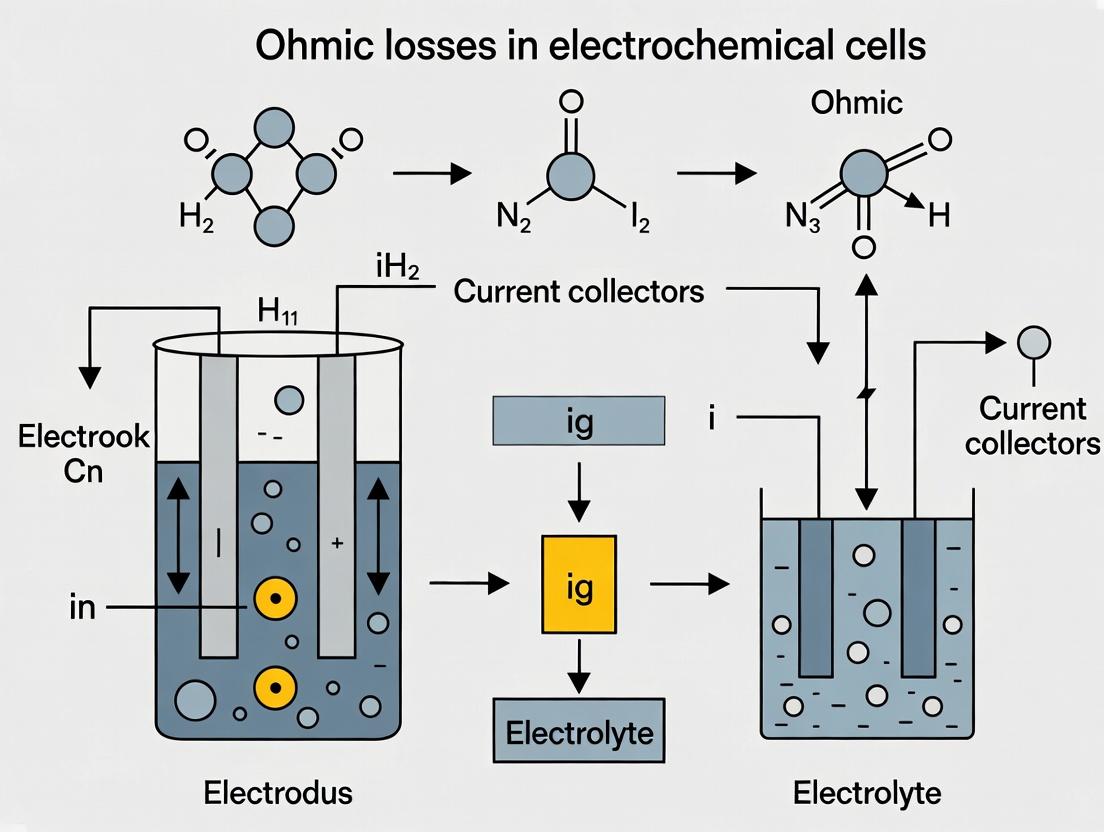
This article provides a detailed exploration of ohmic losses (iR drop) in electrochemical cells, a critical factor impacting the performance and accuracy of biosensors, biofuel cells, and electrophysiology tools.
Ohmic Losses in Electrochemical Cells: A Comprehensive Guide for Biomedical Researchers
Abstract
This article provides a detailed exploration of ohmic losses (iR drop) in electrochemical cells, a critical factor impacting the performance and accuracy of biosensors, biofuel cells, and electrophysiology tools. Covering foundational physics, measurement methodologies, practical mitigation strategies, and validation techniques, the content is tailored for researchers and drug development professionals seeking to optimize experimental design and data integrity in biomedical applications.
Understanding the Core: What Are Ohmic Losses and Why Do They Matter in Bio-Electrochemistry?
Within the broader thesis on "What are ohmic losses in electrochemical cells research," this whitepaper defines and contextualizes the fundamental concept of ohmic loss, or iR drop. It is the voltage loss due to the inherent resistance (R) of the electrolyte and cell components to the flow of ionic current (i). This loss is a primary determinant of energy efficiency and performance in electrochemical systems, from analytical sensors to industrial-scale batteries and electrophysiology in drug discovery.
Fundamental Principles and Quantitative Data
Ohmic loss is governed by Ohm's Law: Vloss = i * Rtotal. The total resistance originates from several sources, each contributing to the overall cell overpotential.
Table 1: Sources and Typical Ranges of Ohmic Resistance in Electrochemical Cells
| Resistance Source | Description | Typical Magnitude Range | Governing Factor |
|---|---|---|---|
| Bulk Electrolyte Resistance (R_elec) | Resistance to ion migration between electrodes. | 1 Ω – 10 kΩ | Ionic conductivity, electrode distance, electrolyte concentration. |
| Electrode & Current Collector Resistance (R_elec) | Electronic resistance within solid components. | 0.1 mΩ – 100 mΩ | Material resistivity, geometry, contact quality. |
| Surface Film Resistance (R_film) | Resistance from passivation layers (e.g., SEI in batteries). | 1 Ω – 500 Ω | Film composition, thickness, and ionic conductivity. |
| Charge Transfer Resistance (R_ct) | Kinetic resistance to the Faradaic reaction. Distinguished from purely ohmic loss but often measured concurrently. | 10 mΩ – 10 kΩ | Reaction kinetics, electrode material, overpotential. |
Table 2: Impact of Ohmic Loss on Common Electrochemical System Metrics
| System Type | Primary Consequence of iR Drop | Typical iR Compensation Strategy |
|---|---|---|
| High-Power Batteries | Reduced usable voltage, power loss, heat generation. | Thin separators, concentrated electrolytes, conductive additives. |
| Electroanalytical Sensors | Reduced sensitivity, distorted voltammetric peaks. | Electronic iR compensation (positive feedback). |
| Electrosynthesis | Increased energy consumption, reduced product yield. | Optimized cell design (close electrode spacing). |
| Patch-Clamp Electrophysiology | Measurement error in membrane potential. | Series resistance compensation in amplifier circuitry. |
Experimental Protocols for Characterization
Electrochemical Impedance Spectroscopy (EIS) for Deconvolution
Objective: To separate ohmic resistance (R_s) from charge transfer and diffusion resistances. Protocol:
- Setup: Use a standard 3-electrode cell (Working, Counter, Reference) with the electrolyte of interest.
- Stabilization: Hold the cell at open circuit potential (OCP) until stable (e.g., ΔV < 1 mV/min).
- Measurement: Apply a small AC perturbation (typically 10 mV amplitude) over a wide frequency range (e.g., 100 kHz to 10 mHz).
- Analysis: Fit the obtained Nyquist plot to an equivalent circuit model (e.g., Rs(RctCdl)(Zw)). The high-frequency intercept on the real axis is the ohmic solution resistance, Rs.
Current Interrupt (I-Interrupt) Method for Instantaneous iR Measurement
Objective: To directly measure the instantaneous ohmic voltage drop during operation. Protocol:
- Polarization: Apply a constant current pulse (i_app) to the electrochemical cell.
- Interruption: Use a fast electronic switch to abruptly (µs timescale) interrupt the current.
- Voltage Monitoring: Record the cell voltage with a high-speed data acquistion system. The immediate voltage jump (ΔV_inst) upon interruption is due to the disappearance of the ohmic component.
- Calculation: Calculate ohmic resistance as RΩ = ΔVinst / i_app.
Visualization of Core Concepts
Title: Voltage Distribution in an Electrochemical Cell Under Load
Title: Decision Flowchart for Ohmic Loss Measurement Techniques
The Scientist's Toolkit: Key Research Reagent Solutions
Table 3: Essential Materials for iR Drop Analysis Experiments
| Item | Function & Relevance | Example Product/Chemical |
|---|---|---|
| Supporting Electrolyte | Provides high ionic conductivity, minimizes migration overpotential, defines R_elec. | Tetraethylammonium tetrafluoroborate (TEABF4) in acetonitrile; KCl in aqueous studies. |
| Reference Electrode | Provides stable, known potential for accurate overpotential measurement in 3-electrode cells. | Ag/AgCl (aqueous), Li metal (non-aqueous), Saturated Calomel Electrode (SCE). |
| Conductivity Meter & Cell | Directly measures electrolyte ionic conductivity, the inverse of resistivity. | Benchtop conductivity meter with platinum cell. |
| Potentiostat/Galvanostat | Applies controlled potential/current and measures electrochemical response. | Equipment with built-in iR compensation and EIS capabilities (e.g., Bio-Logic, Autolab). |
| Ultra-Pure Solvent | Eliminates parasitic conductivity from impurities that can distort R_s measurements. | Anhydrous, inhibitor-free acetonitrile; Millipore-grade water (18.2 MΩ·cm). |
| Ion-Conductive Binder/Additive | For solid/composite electrodes, reduces R_elec within the electrode matrix. | Poly(ethylene oxide) with Li salts (PEO-LiTFSI); PVDF with conductive carbon. |
| iR Compensation Software/Module | Enables real-time subtraction of iR drop during voltammetric experiments for kinetic analysis. | Positive feedback or current interrupt routines in potentiostat software. |
This whitepaper examines the application of Ohm's Law (V = IR) within electrochemical systems, with a focus on quantifying and understanding ohmic losses. These losses, represented by the iR drop, are a primary source of inefficiency in cells, directly impacting potential, current distribution, and overall performance. For researchers in electrochemistry, materials science, and drug development (e.g., in electrophysiology or biosensor design), a precise grasp of these relationships is critical for cell design, data interpretation, and performance optimization.
In an ideal electrochemical cell, the measured cell potential (Ecell) under current flow is the difference between the thermodynamic potentials of the cathode and anode. However, under operational conditions (i.e., when current *I* flows), the observed voltage is diminished by various overpotentials. The most immediate loss is the ohmic overpotential (ηohm), described by Ohm's Law:
Eobserved = Ethermodynamic - ηactivation - ηconcentration - η_ohm
where ηohm = I * Ru
Here, R_u is the total uncompensated resistance of the cell, encompassing electrolyte resistance, separator resistance, contact resistances, and bubble formation. This iR drop represents energy dissipated as heat and is a key metric in cell efficiency.
The total uncompensated resistance is a sum of contributions from all cell components.
Table 1: Primary Sources of Ohmic Resistance in Electrochemical Cells
| Source | Description | Key Influencing Factors |
|---|---|---|
| Electrolyte | Ionic resistance of the solution, gel, or solid ion conductor. | Ionic conductivity, concentration, temperature, electrode distance. |
| Separator/Membrane | Resistance of porous polymer separators or ion-exchange membranes. | Porosity, tortuosity, thickness, wettability, ion selectivity. |
| Electrodes | Electronic resistance of current collectors and active materials. | Material conductivity (e.g., Al, Cu, carbon), thickness, morphology. |
| Interfacial Contacts | Resistance at junctions between materials (e.g., particle-particle). | Contact pressure, surface roughness, binder distribution. |
| Gas Bubbles | Non-conductive bubbles blocking electrode surfaces. | Current density, wettability, surface morphology. |
Experimental Quantification of R_u and iR Drop
Accurate measurement of R_u is essential for both fundamental understanding and performance reporting.
Electrochemical Impedance Spectroscopy (EIS) Protocol
EIS is the standard technique for deconvoluting R_u from other kinetic losses.
Protocol:
- Cell Setup: Assemble the electrochemical cell under study (e.g., battery, fuel cell, analytical sensor).
- Stabilization: Allow the cell's open-circuit voltage (OCV) to stabilize.
- EIS Measurement: Apply a small sinusoidal voltage perturbation (typically 5-10 mV amplitude) over a wide frequency range (e.g., 100 kHz to 10 mHz).
- Data Analysis: Plot the Nyquist plot (Imaginary Z vs. Real Z). The high-frequency real-axis intercept is interpreted as the ohmic resistance (Ru). In a typical Randles circuit model, this corresponds to the solution resistance (Rs).
- Validation: Perform EIS at different states of charge or environmental conditions to track R_u variation.
Current-Interrupt Technique Protocol
A direct, time-domain method for approximating the instantaneous iR drop.
Protocol:
- Polarization: Apply a constant current pulse (I) to the cell for a set period.
- Rapid Interrupt: Use a fast switch to abruptly halt the current (I → 0).
- Voltage Transient Capture: Record the voltage response at high sampling rate. The immediate voltage jump upon interruption is attributed to the removal of the ohmic drop.
- Calculation: Calculate Ru = ΔVjump / I. This method assumes kinetic and concentration overpotentials decay more slowly than the ohmic component.
Table 2: Comparison of R_u Measurement Techniques
| Technique | Principle | Key Advantage | Primary Limitation |
|---|---|---|---|
| EIS | AC frequency response | Deconvolutes R_u from kinetic/diffusive processes. | Requires stable system; complex data fitting. |
| Current-Interrupt | Transient voltage step | Simple, fast, in-situ measurement. | Requires very fast measurement; less precise for cells with capacitive interfaces. |
| DC Polarization | Linear V-I region (low ∆V) | Very simple; R = ∆V/∆I. | Only valid if region is purely ohmic; prone to error from other overpotentials. |
Implications of Ohmic Losses in Research
Ohmic losses have direct, critical consequences for cell operation and data integrity.
- Power Density & Efficiency: Energy loss as i^2R heating reduces round-trip efficiency and usable power.
- Current Distribution: In large-area or porous electrodes, uneven potential distribution due to iR drop leads to non-uniform reaction rates, localized heating, and accelerated degradation.
- Voltage Misinterpretation: In cyclic voltammetry or galvanostatic cycling, an uncorrected iR drop distorts peak potentials, peak separation, and apparent plateau voltages, leading to incorrect conclusions about reaction kinetics and thermodynamics.
- Sensor and Diagnostic Accuracy: In electrochemical biosensors, ohmic losses can affect sensitivity, limit of detection, and signal-to-noise ratio.
iR Compensation: Methods and Caveats
To observe the "true" interfacial potential, researchers employ iR compensation.
- Positive Feedback: Electronic circuitry (built into potentiostats) that adds a voltage equal to (I * Rcomp) to the applied potential. Critical Note: Over-compensation (Rcomp > R_u) leads to potentiostat instability and oscillation.
- Post-Experiment Correction: Manually subtracting iRu from measured data after identifying Ru via EIS or current-interrupt. This is the safest method but does not improve cell performance during operation.
- Reference Electrode Placement: Using a Luggin capillary to position the reference electrode close to the working electrode minimizes the uncompensated electrolyte resistance in the measured circuit.
The Scientist's Toolkit: Research Reagent Solutions
Table 3: Essential Materials for Ohmic Loss Studies
| Item | Function in Research |
|---|---|
| Potentiostat/Galvanostat with EIS & iR Comp | Core instrument for applying potential/current, measuring response, and performing impedance analysis and compensation. |
| Low-Resistance Reference Electrode (e.g., Ag/AgCl) | Provides stable potential with minimal additional ohmic drop. |
| Luggin Capillary | Probes and minimizes the solution resistance between working and reference electrodes. |
| High-Conductivity Electrolyte (e.g., 1M KCl, LiPF6 in EC/DMC) | Standard electrolyte for benchmarking or minimizing baseline ohmic resistance. |
| Ion-Exchange Membranes (Nafion, Celgard separators) | Model separators for studying membrane resistance contributions. |
| Conductive Carbon Additives (Super P, Carbon Black) | Used in composite electrodes to study and mitigate electronic resistance within electrodes. |
| Standard Randles Circuit Simulation Software | Used to model EIS data and extract parameters like Ru, charge transfer resistance (Rct), and Warburg impedance. |
Visualizing Core Relationships and Workflows
Title (84 chars): Relationship Between Cell Voltage Loss Components
Title (78 chars): Experimental Protocol for Measuring R_u via EIS
Title (65 chars): Components Summing to Total Uncompensated Resistance (R_u)
Within the broader research on "What are ohmic losses in electrochemical cells," ohmic resistance, often denoted as RΩ, represents a primary source of energy loss, directly impacting efficiency, power density, and heat generation. These losses are governed by Ohm's law (ΔV = I * RΩ) and manifest as an instantaneous voltage drop proportional to current. This technical guide provides a detailed breakdown of the three principal sources of this resistance: the bulk electrolyte, the various interfacial regions, and the conductive components of the cell. Understanding and quantifying these contributions is critical for researchers and engineers aiming to optimize cell design, whether for energy storage, conversion, or analytical applications in drug development and beyond.
Bulk Electrolyte Resistance
The ionic resistance of the electrolyte between the electrodes is a fundamental source. It depends on ionic conductivity (κ), electrode separation (l), and electrode area (A): Relec = l / (κ * A).
- Factors Influencing Resistance: Ion concentration, mobility, temperature, and solvent viscosity. In solid electrolytes, crystallinity, grain boundaries, and defect chemistry are dominant factors.
Interfacial Resistances
These are often the most complex and performance-limiting contributions, arising at boundaries between different materials.
- Electrode-Electrolyte Interface: Includes charge transfer resistance (kinetic) and, crucially, ionic resistance through surface layers.
- Solid Electrolyte Interphase (SEI) in Batteries: A resistive but ionically conductive layer on anode surfaces (e.g., Li, Si).
- Surface Oxides/Passivation Layers: On metals like aluminum or stainless steel in certain electrolytes.
- Current Collector-Electrode Interface: Poor physical or electrical contact introduces significant resistance, especially in composite electrodes.
- Inter-particle Contact Resistance: Within porous composite electrodes, resistance between active material, conductive additive, and binder particles.
- Membrane/Separator Resistance: In cells with membranes (e.g., fuel cells, redox flow batteries), the porous structure filled with electrolyte adds ionic resistance.
Component Contributions
The electronic resistance of all conductive components.
- Current Collectors (Foils, Grids): Function of material (Al, Cu, Ti) and thickness.
- Leads, Tabs, and External Circuitry: Often a minor but measurable contribution.
- Electrode Matrices: The effective electronic conductivity of porous electrodes, dependent on conductive additive loading and percolation.
Table 1: Typical Ohmic Resistances in Common Electrochemical Systems.
| Cell Component / Source | Typical Resistance Range | Key Variables | Measurement Technique |
|---|---|---|---|
| Aqueous Electrolyte (1M KCl) | 5 – 50 Ω·cm² | Concentration, distance (l), temperature | Impedance Spectroscopy (EIS) |
| Li-ion Battery Liquid Electrolyte | 10 – 100 Ω·cm² | Salt (LiPF6), solvent, temp, separator porosity | EIS, Current Interrupt |
| Solid Electrolyte (Ceramic) | 10 – 500 Ω·cm² | Material (LLZO, LATP), density, grain boundaries | DC Polarization, EIS |
| SEI Layer (Graphite Anode) | 20 – 200 Ω·cm² | Cycle number, electrolyte composition, temp | EIS with equivalent circuit |
| Electrode Particle Contact | 1 – 50 Ω·cm² | Binder, conductive carbon, calendaring pressure | 4-point probe, EIS on symmetric cells |
| Current Collector (Al foil, 20µm) | 0.05 – 0.1 Ω·cm² | Material, thickness, corrosion | 4-point DC measurement |
Experimental Protocols for Deconvolution
Protocol: Electrochemical Impedance Spectroscopy (EIS) for Source Separation
Objective: To separate bulk electrolyte, interfacial, and charge transfer resistances via frequency-domain analysis.
- Cell Setup: Assemble a symmetric cell (e.g., two identical electrodes) or a full cell with a reference electrode if possible.
- Stabilization: Hold the cell at a defined potential until the current stabilizes (e.g., OCV for 1-2 hours).
- Measurement: Apply a small sinusoidal voltage perturbation (typically 5-10 mV amplitude) over a wide frequency range (e.g., 1 MHz to 10 mHz). Measure the current response and phase shift.
- Data Analysis: Plot Nyquist (complex impedance) plot. The high-frequency real-axis intercept gives the bulk ohmic resistance (RΩ). Subsequent semicircles are fitted to an equivalent circuit (e.g., R(QR)(QR)) to model interfacial (SEI) and charge transfer resistances.
Protocol: Current Interrupt (CI) Method for Ohmic Drop
Objective: Direct in-situ measurement of total ohmic drop.
- Cell Polarization: Apply a constant current pulse (C-rate relevant to application) to the operating cell.
- Rapid Interrupt: Use a switch or fast potentiostat to instantaneously (µs timescale) interrupt the current.
- Voltage Transient Recording: Record the cell voltage at high sampling rate. The immediate voltage jump (∆V) at the moment of interrupt is due purely to ohmic losses.
- Calculation: Calculate total ohmic resistance as RΩ, total = ∆V / I.
Protocol: Symmetric Cell Testing for Component Resistance
Objective: Isolate contact and interfacial resistances of specific components.
- Fabrication: Create symmetric cells: e.g., Current Collector | Electrolyte | Current Collector, or Electrode | Electrolyte | Electrode.
- Measurement: Perform EIS or DC polarization on the cell.
- Deconvolution: The measured resistance represents twice the interface resistance plus the bulk electrolyte resistance. Compare with electrolyte-only measurements to extract the interfacial contribution.
Visualizations
Diagram 1: Sources of ohmic resistance in electrochemical cells.
Diagram 2: EIS workflow for ohmic resistance deconvolution.
The Scientist's Toolkit: Key Research Reagent Solutions
Table 2: Essential Materials for Investigating Ohmic Resistance.
| Item | Function/Description | Example Use Case | ||
|---|---|---|---|---|
| Potentiostat/Galvanostat with EIS | Applies potential/current and measures response over a frequency range. | Primary instrument for impedance spectroscopy and interrupt measurements. | ||
| Reference Electrodes (e.g., Li metal, Ag/AgCl) | Provides a stable, known potential reference point in a 3-electrode setup. | Isolating working electrode potentials to study specific interface resistances. | ||
| Ionic Conductivity Meter / Cell | Precisely measures bulk electrolyte conductivity (κ). | Quantifying R_elec contribution independently of interfaces. | ||
| Symmetric Cell Hardware | Cell fixtures for assembling electrode | electrolyte | electrode stacks. | Measuring interfacial and contact resistances free from counter-electrode effects. |
| Conductive Additives (Carbon Black, CNTs) | Enhances electronic percolation network in composite electrodes. | Studying and minimizing inter-particle contact resistance. | ||
| Electrolyte Salts & Solvents (e.g., LiPF6, EC/DEC) | Forms the ionic conduction medium. | Systematic study of electrolyte composition impact on R_Ω. | ||
| Binder Materials (PVDF, CMC/SBR) | Adheres active particles and conductive additives. | Investigating binder's role in electronic and ionic contact resistance. | ||
| 4-Point Probe Station | Measures sheet resistance of thin films/current collectors without lead resistance. | Quantifying electronic resistance of foils and coated electrodes. |
Within the broader thesis on What are ohmic losses in electrochemical cells research, the iR drop represents a fundamental, yet often obstructive, phenomenon. It is the instantaneous voltage loss due to the ohmic resistance (R) of the electrolyte and cell components multiplied by the current (i) flowing through the cell. This loss directly and additively masks the true electrode potential—the kinetic and thermodynamic potential difference at the electrode-electrolyte interface—which is the parameter of critical interest for understanding reaction mechanisms, catalyst performance, and material properties. This whitepaper provides an in-depth technical guide on the origin, measurement, and correction of iR drop to recover accurate electrochemical data.
Fundamentals of iR Drop and Ohmic Losses
The measured cell potential (E_measured) in a standard three-electrode potentiostatic setup is the sum of several components:
E_measured = E_working - E_reference + η_activation + η_concentration + iR_uncompensated
Where:
E_working - E_reference: The desired interfacial potential difference.η_activation: Overpotential due to reaction kinetics.η_concentration: Overpotential due to mass transport limitations.iR_uncompensated: The uncompensated ohmic drop between the working electrode and the tip of the reference electrode.
The iR_uncompensated term is an artefact of the measurement system that obscures the true electrochemical information.
Diagram 1: Composition of measured cell potential.
Experimental Protocols for iR Drop Measurement and Compensation
Accurate determination and removal of iR drop are non-trivial. Below are key methodological approaches.
Current Interrupt (CI) Method
This technique momentarily halts current flow and measures the instantaneous potential change. Detailed Protocol:
- Apply a controlled current or potential perturbation to the electrochemical cell.
- Using a fast potentiostat (switching time < 1 µs), interrupt the current flow completely for a very short duration (typically 1-10 µs).
- Record the cell potential at a high sampling rate (e.g., 10 MHz). The potential will show a sharp, instantaneous step, followed by a slower decay.
- The instantaneous voltage step (
ΔV) is attributed to the iR drop. Calculate the uncompensated resistance:R_u = ΔV / i_applied. - The potential immediately after the step is the iR-corrected potential.
Electrochemical Impedance Spectroscopy (EIS) Method
EIS provides the most robust value for R_u (often termed R_s or solution resistance).
Detailed Protocol:
- At the open-circuit potential or a relevant DC bias, apply a small sinusoidal AC perturbation (e.g., 10 mV rms) over a wide frequency range (e.g., 100 kHz to 0.1 Hz).
- Measure the impedance spectrum (Nyquist or Bode plot).
- Fit the high-frequency intercept of the impedance on the real (Z') axis in the Nyquist plot. This value is
R_u. - This
R_uvalue can be used for manual post-experiment correction (E_corrected = E_measured - i * R_u) or entered into the potentiostat's automatic compensation routines.
Positive Feedback (PF) Compensation
A dynamic, in-situ compensation method implemented within the potentiostat's feedback loop. Detailed Protocol:
- First, determine
R_uvia CI or EIS. - Enable the potentiostat's positive feedback iR compensation function.
- Input the determined
R_uvalue and a compensation percentage (typically 85-95%). Caution: 100% compensation can lead to feedback loop oscillation and instability. - The potentiostat dynamically adds a potential equal to
(compensation% * i * R_u)to the applied command signal, attempting to cancel the iR drop in real-time.
Table 1: Impact of iR Drop on Common Electrochemical Techniques
| Technique | Typical Current Range | Consequence of Uncompensated iR Drop | Common Compensation Method |
|---|---|---|---|
| Cyclic Voltammetry (CV) | µA to mA | Peak potential shifts, peak broadening, distorted shapes, inaccurate kinetic analysis. | Post-measurement correction using R_u from EIS. |
| Chronoamperometry/Potentiometry | µA to mA | Incorrect potential step application, skewed transient decay profiles. | Positive Feedback (85-95%) or post-correction. |
| Electrochemical Impedance Spectroscopy (EIS) | µA | High-frequency data distortion, incorrect fitting of R_u and double-layer parameters. |
Critical to use correct iR compensation during measurement. |
| Battery Charge/Discharge | mA to A | Overestimation of overpotential, reduced apparent energy efficiency, inaccurate state-of-charge estimation. | Typically accounted for in polarization resistance. |
Table 2: Comparison of iR Drop Compensation Methods
| Method | Principle | Advantages | Limitations | Best For |
|---|---|---|---|---|
| Current Interrupt (CI) | Instantaneous potential drop upon current cessation. | Direct measurement, conceptually simple. | Requires fast electronics, challenging in systems with large capacitance. | Batteries, fuel cells, high-current systems. |
| EIS | High-frequency real-axis intercept. | Most accurate R_u measurement, standard feature. |
Requires separate measurement; assumes R_u is constant. |
All quantitative studies, pre-experiment setup. |
| Positive Feedback (PF) | Dynamic addition of counter-potential. | Real-time correction, improves data quality. | Risk of circuit oscillation, can mask instabilities. | Routine experiments with stable systems. |
The Scientist's Toolkit: Research Reagent & Material Solutions
Table 3: Essential Materials for iR Drop Minimization and Study
| Item | Function & Rationale |
|---|---|
| Supporting Electrolyte (e.g., 0.1 M TBAPF6 in ACN) | Increases solution conductivity, thereby reducing the electrolyte resistance (R) component of iR drop. Provides inert ionic conduction. |
| Luggin-Haber Capillary | A glass probe that positions the reference electrode tip close (~2x tip diameter) to the working electrode. Minimizes the R_uncompensated by shortening the current path in the electrolyte. |
| Non-aqueous Reference Electrode (e.g., Ag/Ag+) | Essential for organic or ionic liquid systems. Prevents contamination and provides a stable potential. Low leakage models minimize junction potential drift. |
| Platinum Counter Electrode | Provides a large, inert surface area for current conduction. Prevents counter electrode reactions from becoming rate-limiting or contaminating the system. |
| Conductive Salt Additives (e.g., LiClO4 for Li-ion studies) | Specifically tailored for battery research. Reduces ionic resistance in the separator and electrode matrix without participating in side reactions. |
| Potentiostat with EIS & Fast CI | Instrument must have capabilities for accurate R_u measurement (EIS) and the electronic speed to perform valid current interrupt or dynamic compensation. |
Workflow for Accurate Potential Measurement
Diagram 2: Workflow for iR drop management.
The iR drop is not merely a technical nuisance but a central consideration in ohmic losses research. Its direct subtraction from the measured cell potential is essential to reveal the true electrode potential, which governs electrochemical kinetics and thermodynamics. A rigorous approach combining proper cell design (Luggin capillary, conductive electrolyte), accurate measurement of R_u (via EIS), and prudent application of compensation methods forms the bedrock of reliable electrochemical data. For researchers in drug development, this is particularly critical when studying redox properties of pharmaceuticals or biosensor interfaces, where precise potentials determine mechanistic interpretations.
1. Introduction: Context within Ohmic Losses Research
This whitepaper examines two critical consequences of electrochemical cell inefficiency, specifically ohmic (iR) losses, for biomedical applications. Within the broader thesis of ohmic losses research, these losses represent the voltage drop due to electrical resistance within the cell components and electrolyte. In biosensing, iR losses distort the input signal, degrading the fidelity of the analytical readout. In enzymatic biofuel cells (EBFCs), they directly convert useful electrochemical energy into waste heat, crippling power density and energy efficiency. Understanding and mitigating these losses is paramount for advancing practical biomedical devices.
2. Signal Fidelity in Electrochemical Biosensing
Electrochemical biosensors transduce a biorecognition event (e.g., antigen-antibody binding, DNA hybridization) into a quantifiable electrical signal, typically a current (amperometry) or a change in charge transfer resistance (electrochemical impedance spectroscopy, EIS). Ohmic losses introduce a significant error source by distorting the potential actually experienced at the working electrode surface (Esurface = Eapplied - iRu).
- Consequence: An uncompensated iR drop causes a shifted or broadened voltammetric peak, reduced current magnitude, and inaccurate calibration. In EIS, it can obscure the semicircle associated with the charge-transfer resistance (Rct), leading to erroneous fitting of the Nyquist plot and incorrect analyte quantification.
- Mitigation Strategies: Employing a three-electrode system with a proximal reference electrode, using supporting electrolytes at optimal ionic strength, employing micro/nano-electrodes to reduce current density, and applying positive feedback iR compensation in potentiostat circuitry.
Table 1: Impact of Solution Resistance (Ru) on Amperometric Sensor Performance
| Analyte | Target | Uncompensated Ru (Ω) | Observed Current Drop | Reported Calibration Error | Primary Mitigation |
|---|---|---|---|---|---|
| Glucose | H2O2 | ~500 Ω | ~40% at 10 mM | ±15% | Prussian Blue catalyst layer |
| miRNA-21 | [Fe(CN)6]3-/4- | >1000 Ω | Severe distortion | N/A (qualitative) | Au nanoparticle amplification |
| C-reactive protein | [Ru(NH3)6]3+ | ~200 Ω | Signal broadening | ±8% | Integrated counter/reference electrode |
3. Energy Loss in Enzymatic Biofuel Cells (EBFCs)
EBFCs utilize oxidoreductase enzymes to catalyze the conversion of biochemical energy (from glucose, lactate, etc.) into electricity. Ohmic losses here directly diminish the cell's operational voltage (Vcell = EOCV - iRint - ηact) and maximum power output (Pmax ≈ EOCV2 / 4Rint).
- Consequence: High internal resistance (Rint), dominated by ionic resistance in the hydrogel membrane and electron transfer resistance, leads to poor power density (µW/cm² to mW/cm² range) and low voltage, making integration with low-power electronics challenging.
- Mitigation Strategies: Minimizing inter-electrode distance, engineering highly conductive hydrogel matrices (e.g., with carbon nanotubes, reduced graphene oxide), using osmium-based redox polymers for efficient electron hopping, and designing 3D porous electrode architectures.
Table 2: Reported Performance Metrics of EBFCs Highlighting Ohmic Limitations
| Fuel / Enzyme (Anode) | Oxidant / Enzyme (Cathode) | Reported OCV (V) | Max Power Density (µW/cm²) | Estimated Rint (kΩ·cm²) | Key Material Strategy |
|---|---|---|---|---|---|
| Glucose / GOx | O2 / BOD | 0.68 | 850 | ~1.4 | CNT-Teflon composite electrode |
| Lactate / LOX | O2 / BOD | 0.52 | 420 | ~1.6 | Redox hydrogel (Os-complex) |
| Glucose / FAD-GDH | O2 / laccase | 0.75 | 1900 | ~0.74 | Au nanoparticle-modified carbon felt |
4. Experimental Protocols
Protocol 1: Measuring & Compensating iR Drop in a Biosensor using Chronoamperometry.
- Fabrication: Immobilize biorecognition element (e.g., antibody, aptamer) on a polished glassy carbon electrode.
- Setup: Use a standard three-electrode cell in phosphate buffer saline (PBS, 0.1 M, pH 7.4) with analyte.
- Uncompensated Measurement: Apply a suitable step potential and record the current transient. Note the initial current (iinitial).
- Determine Ru: Perform electrochemical impedance spectroscopy (EIS) at the applied DC potential from 100 kHz to 0.1 Hz. Fit the high-frequency intercept on the real axis to obtain Ru (solution resistance).
- Compensated Measurement: Enable the potentiostat's iR compensation function (typically positive feedback) using the determined Ru value (80-95% compensation to avoid oscillation). Repeat the chronoamperometry.
- Analysis: Compare the compensated iinitial to the uncompensated value. The ratio indicates the signal loss due to ohmic drop.
Protocol 2: Characterizing Internal Resistance of an EBFC via Polarization Curve.
- Cell Assembly: Assemble the EBFC with bioanode and biocathode separated by a membrane or hydrogel. Use a physiological buffer (e.g., PBS containing fuel).
- Open Circuit Measurement: Allow the cell to equilibrate for 15-30 minutes. Record the stable open-circuit voltage (OCV).
- Polarization Data Acquisition: Connect the EBFC to a programmable electronic load. Discharge the cell by stepping the current from zero to the maximum short-circuit current in small increments, allowing voltage stabilization at each step.
- Data Plotting: Plot cell voltage (V) vs. current density (j), and power density (P = V*j) vs. j.
- Rint Calculation: The linear region of the V-j plot in the mid-to-high current range is dominated by ohmic losses. The slope of this linear region equals -Rint (area-normalized).
5. Visualizations
Signal Fidelity Distortion by Ohmic Loss
Energy Loss Pathways in a Biofuel Cell
6. The Scientist's Toolkit: Key Research Reagent Solutions
| Item / Reagent | Function / Role in Mitigating Ohmic Losses |
|---|---|
| Potentiostat with iR Compensation | Instrument that applies potential and measures current; built-in positive feedback circuitry actively compensates for iR drop in real-time. |
| Redox Polymers (e.g., [Os(bpy)2(PVI)nCl] | Mediates electron transfer from enzyme active site to electrode via "electron hopping," reducing activation overpotential and interfacial resistance. |
| Carbon Nanotubes (CNTs) / Reduced Graphene Oxide (rGO) | High-surface-area, high-conductivity nanomaterials used to create 3D electrode scaffolds, enhancing enzyme loading and electrical connectivity. |
| High Ionic Strength Buffers (e.g., 0.1-1.0 M PBS) | Increases ionic conductivity of the electrolyte, directly reducing solution resistance (Ru). |
| Nafion or Chitosan Hydrogels | Proton-conducting membranes/matrices that facilitate H⁺ transport between anode and cathode, minimizing pH gradient-related resistive losses. |
| Micro/Nano-electrode Arrays | Electrodes with small dimensions (µm/nm) drastically reduce total current, thereby minimizing the magnitude of the iR drop (iR_u). |
| Ag/AgCl (in 3M KCl) Reference Electrode | Provides a stable, low-impedance reference potential; placing it close to the working electrode minimizes uncompensated resistance in the Luggin capillary. |
Measuring and Quantifying iR Drop: Techniques for Accurate Electrochemical Analysis
Within the broader thesis on What are ohmic losses in electrochemical cells research, the accurate measurement and compensation of solution resistance (iR drop) is paramount. Ohmic losses, the voltage drop due to ionic current flow through an electrolyte, distort electrochemical measurements, leading to inaccurate interpretations of kinetics and thermodynamics. This guide provides an in-depth comparison of two primary experimental techniques for iR determination: potentiostatic (potential-controlled) and galvanostatic (current-controlled) methods.
Core Principles of iR Drop and Its Impact
The iR drop (𝑉 = 𝑖 × 𝑅ₛ) is an unavoidable artifact that reduces the effective potential applied at the working electrode interface. Uncompensated iR can cause underestimation of reaction rates, distortion of voltammetric peaks, and significant errors in calculated parameters like Tafel slopes and charge transfer coefficients.
Potentiostatic Methods for iR Measurement
Potentiostatic methods involve applying a controlled potential and measuring the current response.
Current Interrupter Technique
This is a primary potentiostatic method where a steady-state current is abruptly interrupted, and the subsequent potential transient is analyzed.
Experimental Protocol:
- Setup: A standard three-electrode cell (Working, Counter, Reference) is connected to a potentiostat capable of high-speed current interruption and fast potential sampling (>100 kHz).
- Polarization: The working electrode is polarized to a potential where a steady-state Faradaic current (𝑖) flows.
- Interruption: The current is switched to zero within microseconds (typically <1 µs).
- Measurement: The working electrode potential vs. the reference is recorded at high frequency immediately before and after interruption. The potential drops instantaneously from 𝑉₀ to 𝑉₁ due to the elimination of the ohmic component.
- Calculation: Solution resistance is calculated as 𝑅ₛ = (𝑉₀ - 𝑉₁) / 𝑖.
Visualization: Potential Transient in Current Interrupter
Electrochemical Impedance Spectroscopy (EIS)
EIS measures the cell's impedance across a frequency range. The high-frequency real-axis intercept in a Nyquist plot provides 𝑅ₛ.
Experimental Protocol:
- Setup: A cell with minimized inductive and capacitive artifacts is used. The potentiostat's EIS capability is employed.
- Stabilization: The open circuit potential (OCP) is measured, or a DC bias is applied.
- Frequency Sweep: A small AC potential perturbation (5-10 mV RMS) is applied over a wide frequency range (e.g., 100 kHz to 0.1 Hz).
- Analysis: Data is fitted to an equivalent circuit model (e.g., [𝑅ₛ(𝐶ₑ[𝑅ₜ])]). The high-frequency intercept is directly read as 𝑅ₛ.
Galvanostatic Methods for iR Measurement
Galvanostatic methods apply a controlled current and measure the potential response.
Galvanostatic Pulse Technique
A double-pulse method often used to separate polarization resistance from ohmic resistance.
Experimental Protocol:
- Setup: Standard three-electrode configuration with a galvanostat/potentiostat.
- First Pulse: A small current pulse (𝑖₁) is applied from OCP for a short duration (t₁ ~ 50 µs). The initial sharp potential jump (Δ𝑉₁) is dominated by iR drop.
- Second Pulse: Immediately after, a larger current pulse (𝑖₂) is applied. The initial sharp potential jump is Δ𝑉₂.
- Calculation: Assuming 𝑅ₛ is constant between pulses, it is calculated from 𝑅ₛ = (Δ𝑉₂ - Δ𝑉₁) / (𝑖₂ - 𝑖₁).
Visualization: Galvanostatic Pulse Measurement Workflow
Comparative Analysis of Techniques
The choice between potentiostatic and galvanostatic methods depends on the system, required speed, and available instrumentation.
Table 1: Quantitative Comparison of iR Measurement Techniques
| Feature | Potentiostatic: Current Interrupter | Potentiostatic: EIS | Galvanostatic: Pulse |
|---|---|---|---|
| Primary Control | Potential | Potential (AC) | Current |
| Measured Signal | Potential Transient | Impedance Spectrum | Potential Transient |
| Speed of Measurement | Very Fast (µs) | Slow (seconds to minutes) | Very Fast (µs) |
| Key Calculated Output | 𝑅ₛ from Δ𝑉/𝑖 | 𝑅ₛ from HF intercept | 𝑅ₛ from Δ𝑉/Δ𝑖 |
| Impact on System | Minimal perturbation | Minimal perturbation (linear regime) | Significant perturbation |
| Best For | Systems with stable DC current, battery studies | Detailed interface analysis, corrosion | Systems where current control is preferred |
| Main Artifact/Challenge | Inductive ringing, double-layer discharge | Model dependence, frequency dispersion | Capacitive charging interference |
Table 2: Advantages and Disadvantages Summary
| Method | Advantages | Disadvantages |
|---|---|---|
| Current Interrupter | Direct, intuitive, very fast, minimal model dependence. | Requires fast electronics, sensitive to cell inductance and capacitive discharge. |
| EIS | Also provides full interface kinetics data (Cₑ, Rₜ), robust. | Time-consuming, requires fitting, assumes system linearity and stability. |
| Galvanostatic Pulse | Simple principle, fast, good for systems prone to potential drift. | Large current pulses may alter interface, capacitive charging can obscure iR step. |
The Scientist's Toolkit: Essential Research Reagents & Materials
Table 3: Key Reagents and Materials for iR Measurement Experiments
| Item | Function & Importance |
|---|---|
| Potentiostat/Galvanostat with EIS & Interrupter | Core instrument for applying potential/current and measuring response. Must have high bandwidth and fast response times for transient techniques. |
| Low-Resistance Reference Electrode (e.g., Luggin Capillary) | Minimizes iR drop in the reference electrode pathway, crucial for accurate potential measurement. |
| Supporting Electrolyte (e.g., 0.1 M TBAPF₆, 1 M H₂SO₄) | Provides ionic conductivity, dominates solution resistance, and minimizes migration current. Choice depends on solvent and analyte stability. |
| Non-Faradaic/Inert Electrolyte Solution (e.g., KF, KClO₄) | Used for testing and calibrating iR measurement setups in the absence of complicating Faradaic reactions. |
| Standard Redox Couple Solution (e.g., 1 mM Ferrocene) | Provides a well-characterized, reversible electrochemical reaction to validate the performance of the cell and iR compensation setup. |
| Platinum Counter Electrode | Inert, high-surface-area electrode to ensure current is not limited by the counter electrode reaction. |
| Precisely Sized Working Electrode (e.g., 2mm Glassy Carbon Disk) | Known, reproducible geometry is essential for quantifying current density and comparing results. |
| Faraday Cage | Shields the electrochemical cell from external electromagnetic interference, critical for low-current and high-impedance measurements. |
| Equivalent Circuit Modeling Software (e.g., ZView, EC-Lab) | Essential for analyzing EIS data to extract 𝑅ₛ and other parameters via fitting to physical models. |
Ohmic losses, often termed iR drop, represent a critical source of overpotential in electrochemical cells. These losses arise from the resistance to ionic current flow through the electrolyte and the resistance to electronic current flow through cell components (electrodes, current collectors, leads). The accurate determination and subsequent compensation of the iR drop are fundamental to electrochemical research, as the uncompensated resistance obscures the true kinetic potential at the working electrode. This distortion leads to significant errors in interpreting reaction kinetics, diffusion coefficients, and catalytic activity. Within the broader thesis of understanding and mitigating ohmic losses, Current Interruption (CI) stands as a foundational, hardware-based technique for its direct measurement.
Core Principle of the Current Interruption Method
The Current Interruption technique operates on a simple principle: when a steady-state current flowing through an electrochemical cell is instantaneously interrupted, the measured cell potential undergoes an instantaneous step change. This step is attributed to the immediate disappearance of the voltage drop across the purely resistive (ohmic) elements of the cell (iR). The remaining potential decays more slowly as the double layer discharges and concentration gradients relax. By measuring the potential immediately before (Vbefore) and immediately after (t → 0+) the interruption (Vafter), the ohmic drop (iR_u) can be calculated directly.
Detailed Experimental Protocol
Equipment and Cell Setup
- Potentiostat/Galvanostat: Must have a fast current interrupt capability (switch-off time < 1 µs) and high-speed data acquisition (sampling rate > 1 MS/s).
- Electrochemical Cell: Standard three-electrode configuration (Working, Counter, Reference) is essential. The reference electrode should be positioned close to the working electrode via a Luggin capillary to minimize uncompensated solution resistance, though CI will measure the remaining R_u.
- Data Acquisition System: A digital oscilloscope or the potentiostat's internal high-speed recorder is required to capture the transient potential response.
Step-by-Step Methodology
- The cell is brought to a desired steady-state condition by applying either a constant current (galvanostatic) or constant potential (potentiostatic). For iR determination, galvanostatic control is most common.
- The current interrupt function is triggered. The potentiostat electronically opens the circuit, forcing the current to zero ideally instantaneously.
- The working electrode potential versus the reference electrode is recorded at a very high sampling rate (e.g., 10-100 million samples per second) for a short period (typically 10 µs to 10 ms).
- The trace is analyzed. The potential value at the last point before interruption (I = i) and the value extrapolated to the moment of interruption (I = 0) are identified.
- The iR drop is calculated as: iR_u = V(I=i) - V(I=0 at t→0+).
Critical Consideration: The key challenge is the accurate capture of the instantaneous potential jump. Inductance in the cell and leads can cause voltage spikes, and the finite interrupt speed and sampling rate of the instrument require careful extrapolation to t=0.
Data Presentation: Key Metrics from Current Interruption Studies
Table 1: Typical Uncompensated Resistance Values in Various Electrochemical Systems
| Electrochemical System | Electrolyte | Approx. Uncompensated Resistance (R_u) | Key Challenge for CI |
|---|---|---|---|
| Aqueous 1 M H₂SO₄ | High Conductivity | 0.5 - 2 Ω | Minimal; clean iR step observable. |
| Non-aqueous Li-ion Battery | 1 M LiPF₆ in EC/DMC | 10 - 50 Ω | Inductive kick from coiled cell leads. |
| Polymer Electrolyte Membrane (PEM) Fuel Cell | Hydrated Nafion | 50 - 200 mΩ* | Capacitive discharge very fast. |
| Organic Electrosynthesis | 0.1 M TBAPF₆ in ACN | 50 - 200 Ω | Significant noise & inductive artifacts. |
| Biological Electrolyte (PBS Buffer) | Physiological Saline | 20 - 100 Ω | Complex interface can obscure step. |
Note: Area-specific resistance.
Table 2: Comparison of iR Compensation Techniques
| Technique | Principle | Measures/Compensates | Advantages | Limitations |
|---|---|---|---|---|
| Current Interruption (CI) | Instantaneous potential step upon I=0. | Direct measurement of R_u. | Conceptually simple, direct. | Requires fast electronics, sensitive to inductance. |
| Electrochemical Impedance Spectroscopy (EIS) | Fit high-frequency intercept in Nyquist plot. | Estimates R_u from model. | Measures full cell impedance. | Provides estimate, not direct in-situ measure. |
| Positive Feedback (PF) | Potentiostat adds positive feedback to cancel iR. | Actively compensates R_u. | Real-time compensation. | Risk of oscillation; requires stability. |
| Potentiostatic iR Compensation | Measures R_u via potential step, then subtracts iR. | Calculates and subtracts iR. | Common in modern potentiostats. | Often uses CI or EIS-derived R_u value. |
Visualizing the Current Interruption Process
Diagram Title: Current Interruption Experimental Workflow
Diagram Title: Potential Response During Current Interruption
The Scientist's Toolkit: Essential Research Reagents & Materials
Table 3: Key Reagents and Materials for iR Drop Studies via Current Interruption
| Item | Function in Experiment | Technical Note |
|---|---|---|
| Fast Potentiostat with CI Module | Generates steady current and performs nanosecond-scale interruption. | Switch-off time is the critical specification; <100 ns is desirable for accurate work. |
| High-Speed Digitizer / Oscilloscope | Captures the microsecond transient potential response. | Bandwidth > 10 MHz and sampling rate > 10 MS/s are typically required. |
| Low-Inductance Electrochemical Cell | Holds the electrolyte and electrodes. | Minimizes coiled wires; uses coaxial connections to reduce inductive voltage spikes (L di/dt). |
| Luggin Capillary | Places reference electrode tip near working electrode. | Reduces the solution resistance component of R_u, but the remaining value is measured by CI. |
| Non-Inductive Resistor | Used for calibrating and verifying the CI measurement circuit. | A known precision resistor (e.g., 10 Ω) substitutes the cell to test instrument response. |
| High-Purity Electrolyte Salts & Solvents | Creates the ionic conduction medium. | Purity minimizes parasitic Faradaic processes that complicate the post-interrupt decay. |
| Stable Reference Electrode (e.g., Ag/AgCl) | Provides a stable potential reference point. | Must have low impedance to respond quickly to the interrupt event. |
| Shielded Cabling | Connects cell to potentiostat. | Minimizes noise pickup during the sensitive transient measurement. |
Current Interruption remains a vital, first-principles technique for the direct determination of ohmic losses in electrochemical systems. Its value lies in its conceptual clarity and its provision of a direct, in-situ measurement of the uncompensated resistance (Ru), a parameter essential for accurate electrochemical analysis. While modern potentiostats often implement automated iR compensation routines, these frequently rely on an Ru value determined via CI or EIS. Understanding the protocol, artifacts, and limitations of the Current Interruption method is therefore indispensable for researchers engaged in the precise characterization of reaction kinetics, battery performance, fuel cell efficiency, and sensor development, forming a cornerstone of rigorous electrochemical practice.
This technical guide provides an in-depth exploration of Electrochemical Impedance Spectroscopy (EIS) for the critical separation and analysis of solution resistance (Rs) and charge transfer resistance (Rct). Framed within the broader thesis on understanding ohmic losses in electrochemical cells, this whitepaper details the principles, experimental protocols, and data analysis required to deconvolute these parameters, which is fundamental for optimizing cell performance in research, energy storage, and bio-electrochemical applications such as sensor and drug development.
Ohmic losses, also known as iR drop, represent a primary source of inefficiency in electrochemical cells. They arise from the resistance to ion flow in the electrolyte (solution resistance, Rs) and the resistance associated with the Faradaic reaction kinetics at the electrode-electrolyte interface (charge transfer resistance, Rct). Accurate deconvolution of Rs from Rct is essential for:
- Quantifying true overpotentials.
- Designing efficient electrolytes.
- Evaluating catalyst performance.
- Developing accurate cell models. EIS is the preeminent non-destructive technique for this separation, as it probes the cell's impedance across a spectrum of frequencies.
Theoretical Foundations of EIS
The Randles Equivalent Circuit
The Randles circuit is the most common model for a simple electrochemical interface. Its elements directly correspond to physical processes.
Title: Randles Equivalent Circuit Model
Frequency-Dependent Response
- High Frequency (>10 kHz): Current primarily passes through the capacitive path (Cdl). The intercept with the real axis in a Nyquist plot gives Rs.
- Medium Frequency (10 kHz - 1 Hz): Current probes the Faradaic process. The diameter of the semicircle corresponds to Rct.
- Low Frequency (<1 Hz): Current is dominated by mass transport (diffusion), represented by the Warburg element (ZW).
Experimental Protocols for EIS Measurement
Standard Three-Electrode Cell Setup
Objective: To obtain impedance data free from counter electrode effects.
- Cell Assembly: Use a glass electrochemical cell.
- Electrode Placement:
- Working Electrode (WE): The material under study (e.g., glassy carbon, Pt disk). Polish to a mirror finish before each experiment.
- Counter Electrode (CE): Inert wire (Pt or graphite) with surface area >> WE.
- Reference Electrode (RE): Stable electrode (Ag/AgCl, SCE) placed close to the WE via a Luggin capillary to minimize uncompensated Rs.
- Electrolyte: Degas with inert gas (N2, Ar) for 20 minutes to remove dissolved oxygen.
- Potential Stabilization: Hold the WE at the desired DC potential (vs. RE) for 300 seconds to reach steady-state.
- EIS Acquisition:
- AC Amplitude: Apply a sinusoidal potential perturbation of 5-10 mV RMS.
- Frequency Range: Typically from 100 kHz to 10 mHz (or 0.1 Hz for diffusion-limited studies).
- Data Density: 5-10 points per frequency decade.
- Perform measurement in potentiostatic mode.
Protocol for RsCompensation Study
Objective: To experimentally validate the extracted Rs and its impact.
- Measure a full EIS spectrum of your system as per 3.1.
- Fit the data to the Randles model using software (e.g., ZView, EC-Lab) to obtain initial Rs and Rct values.
- In a separate experiment, use the potentiostat's positive feedback iR compensation function. Apply the fitted Rs value as the compensation parameter.
- Record a new cyclic voltammogram (CV) with and without compensation. The compensated CV will show reduced peak separation and sharper waves.
- Caution: Over-compensation leads to instability and oscillation.
Data Analysis and Deconvolution
Key Quantitative Parameters from EIS
The table below summarizes the core parameters extracted from EIS data and their physical significance.
Table 1: Key EIS Parameters and Their Significance
| Parameter | Symbol | Typical Frequency Range | Physical Meaning | Relation to Ohmic Losses |
|---|---|---|---|---|
| Solution Resistance | Rs | High (>10 kHz) | Ionic resistance of bulk electrolyte. | Primary source of iR drop. Proportional to electrolyte resistivity and electrode distance. |
| Charge Transfer Resistance | Rct | Medium (1 kHz - 1 Hz) | Kinetic resistance to the Faradaic reaction. | Causes activation overpotential. Inversely proportional to reaction rate. |
| Double Layer Capacitance | Cdl | Medium-High | Capacitance of electrode-electrolyte interface. | Stores charge non-Faradically. Affects time constant (τ = RctCdl). |
| Warburg Coefficient | σ | Low (<1 Hz) | Resistance due to reactant/product diffusion. | Causes concentration overpotential. |
Workflow for Parameter Extraction
The following diagram outlines the standard process for deconvoluting Rs and Rct from raw EIS data.
Title: EIS Data Analysis and Fitting Workflow
The Scientist's Toolkit: Research Reagent Solutions
Table 2: Essential Materials for EIS Experiments in Electrochemical Research
| Item | Function & Importance | Example Specifications |
|---|---|---|
| Potentiostat/Galvanostat with FRA | The core instrument. Applies potential/current and measures the phase-sensitive response. Frequency range should extend to >100 kHz. | Biologic SP-300, Metrohm Autolab PGSTAT204 with FRA32M, Ganny Interface 1010E. |
| Faradaic Redox Probe | Provides a stable, reversible reaction to study Rct. Used for method validation and electrode characterization. | 5 mM Potassium Ferricyanide [Fe(CN)6]3−/4− in 1 M KCl. |
| Supporting Electrolyte | Provides ionic conductivity, minimizes Rs, and carries current. Must be inert in the studied potential window. | KCl, NaClO4, TBAPF6 (for non-aqueous). High purity (>99.9%). |
| Polishing Supplies | Ensures reproducible, clean electrode surface, critical for consistent Cdl and Rct. | Alumina or diamond slurry (1.0, 0.3, 0.05 µm), polishing pads, sonication bath. |
| Stable Reference Electrode | Provides a constant potential reference. Choice affects measured potential. | Ag/AgCl (3M KCl), Saturated Calomel Electrode (SCE). |
| Equivalent Circuit Fitting Software | Essential for deconvoluting and quantifying circuit parameters from complex impedance data. | ZView (Scribner), EC-Lab (BioLogic), Ganny Echem Analyst. |
Precise deconvolution of solution resistance from charge transfer resistance via EIS is a cornerstone of rigorous electrochemical analysis. Within the thesis of ohmic losses, this separation allows researchers to assign energy losses accurately to their root causes: either bulk electrolyte properties or interfacial kinetics. Mastery of the protocols and analyses detailed herein enables the optimization of electrochemical cells for applications ranging from battery design to biosensor development, directly impacting the efficiency and performance of next-generation electrochemical technologies.
Ohmic losses, or iR drop, represent a fundamental challenge in electrochemical research. This potential drop across the uncompensated resistance (Ru) of an electrolyte solution distorts the true potential applied at the working electrode surface (Eapplied = Esurface + iRu), leading to inaccurate measurements and misinterpretation of kinetic data. Traditional positive feedback (PFB) iR compensation has been a staple technique, but modern potentiostats have evolved with sophisticated real-time correction algorithms to overcome its inherent limitations, such as instability at high compensation levels.
The Evolution of Real-Time iR Compensation
Modern systems integrate PFB with digital signal processing, adaptive control, and real-time cell resistance measurement.
Table 1: Comparison of iR Compensation Techniques
| Technique | Core Principle | Maximum Stable Compensation | Key Limitation |
|---|---|---|---|
| Traditional Analog PFB | Feeds a signal proportional to current (i) and a set Rcomp back to the potential control. | ~80-85% of Ru | Becomes unstable (oscillations) as Rcomp approaches Ru. |
| Digital PFB with Stability Monitoring | Digitally calculates iR correction; monitors phase shift for oscillation prediction. | ~95% of Ru | Requires fast ADC/DAC and processing; can be sensitive to rapid Ru changes. |
| Interruptor Methods (Current Interruption) | Measures iR drop by briefly interrupting current and measuring instantaneous potential decay. | 100% (measurement, not continuous compensation) | Not continuous; provides snapshot measurements for offline correction. |
| Electrochemical Impedance Spectroscopy (EIS)-Based | Uses high-frequency impedance (Z) to determine real-time Ru. | Dynamically adjusted | Complex implementation; best for systems with slowly changing Ru. |
| Hybrid Adaptive Digital PFB | Combines digital PFB with periodic Ru checks via fast interruptions or EIS. | >95% with stability | The state-of-the-art in modern research-grade potentiostats. |
Detailed Experimental Protocols for iR Drop Analysis
Protocol 1: Determining Uncompensated Resistance (Ru) via Current Interruption
- Setup: Configure a standard three-electrode cell. Perform a cyclic voltammetry (CV) scan of a known reversible redox couple (e.g., 1 mM Ferrocene in acetonitrile with 0.1 M TBAPF6) at a moderate scan rate (100 mV/s).
- Data Acquisition: Using a potentiostat with built-in current interruptor capability, program a series of constant-current pulses.
- Interruption: At the peak of the faradaic current, trigger a current interrupt sequence (typical interruption duration: 1-50 µs). Record the potential transient at the working electrode.
- Analysis: Plot potential vs. time. The instantaneous jump at the moment of interruption (ΔE) corresponds to the iR drop. Calculate Ru = ΔE / i (where i is the current immediately before interruption). Perform this at multiple points during a CV to check for current dependence.
Protocol 2: Evaluating Potentiostat Compensation Performance
- System Characterization: Using a dummy cell (an electronic circuit simulating an electrode interface: e.g., 1 kΩ resistor in series with a parallel 10 nF capacitor and 10 kΩ resistor), measure the effective applied potential with and without compensation.
- Stability Test: Set the dummy cell Ru to a known value (e.g., 1 kΩ). Gradually increase the potentiostat's PFB % compensation from 0% to 100% while applying a potential step. Monitor the potential feedback signal for oscillations.
- Real-Cell Validation: Perform a CV of a fast electrochemical system (e.g., Ru(NH3)63+/2+ in KCl) at high scan rates (1-10 V/s). Compare peak separations (ΔEp) with and without compensation. The optimally compensated scan should yield a ΔEp closest to the theoretical 59/n mV for a reversible system.
Diagram Title: Modern Adaptive iR Compensation Workflow
Diagram Title: Positive Feedback iR Compensation Signal Pathway
The Scientist's Toolkit: Research Reagent Solutions for iR Studies
Table 2: Essential Materials for iR Compensation Research
| Item | Function & Rationale |
|---|---|
| Well-Defined Redox Couples (Ferrocene, Ru(NH3)6Cl3) | Provide a known, reversible electrochemical response with stable kinetics. Used to validate compensation accuracy by measuring peak separation (ΔEp). |
| High-Purity Supporting Electrolyte (TBAPF6, KCl) | Minimizes background current and provides known, consistent ionic strength. Low impurity levels prevent side reactions that could alter apparent Ru. |
| Non-Aqueous Solvents (Acetonitrile, DMF) | Allow for a wider range of potentials and often higher Ru values, making iR drop effects more pronounced and easier to study. |
| Ultramicroelectrodes (UME, < 25 µm diameter) | Reduce absolute current, thereby minimizing the magnitude of the iR drop (iRu). Useful for testing in high-resistance media. |
| Dummy Cell / Cell Simulator | An electronic circuit that mimics an electrochemical cell's impedance. Allows for safe, controlled testing of potentiostat compensation stability without using chemicals. |
| Luggin Capillary | A probe that positions the reference electrode tip close to the working electrode, physically reducing Ru and the required compensation level. |
| Fritted Reference Electrodes | Contain porous frits to prevent contamination of the reference element while maintaining a stable junction potential, crucial for accurate potential control. |
Bio-assays are fundamental in characterizing biological interactions, from drug-target engagement to cellular signaling. In the broader context of research on ohmic losses in electrochemical cells, the selection of a bio-assay measurement technique is critical. Ohmic losses (iR drop)—the voltage loss due to resistance in an electrochemical cell—can significantly distort measured potentials and currents, leading to inaccurate data interpretation. This guide details how to select appropriate bio-assay techniques, particularly those involving electrochemical or impedance-based readouts, to ensure measurements account for or minimize these confounding losses.
Key Measurement Techniques: Comparison and Selection Criteria
The optimal technique depends on the analyte, required sensitivity, throughput, and whether the assay is label-free or labeled. A primary consideration for electrochemical assays is managing the cell's internal resistance (Ru) to reduce iR drop.
Table 1: Comparison of Core Bio-Assay Measurement Techniques
| Technique | Typical Sensitivity | Throughput | Key Advantage | Key Disadvantage | Susceptibility to Ohmic Loss Distortion |
|---|---|---|---|---|---|
| Electrochemical Impedance Spectroscopy (EIS) | fM - pM | Low-Moderate | Label-free, real-time kinetics | Complex data modeling | High - Requires careful cell design & compensation |
| Amperometry / Voltammetry | pM - nM | Moderate | Direct electron transfer measurement | Interference from redox-active species | Very High - iR drop directly affects applied potential |
| Surface Plasmon Resonance (SPR) | nM | Moderate-High | Label-free, real-time | Bulk refractive index sensitivity | Low (Optical) |
| Fluorescence Polarization (FP) | nM | High | Homogeneous, rapid | Requires fluorescent tracer | None |
| Luminescence (e.g., TR-FRET) | pM - nM | Very High | High S/N, reduced background | Requires specific labeling | None |
| Microscale Thermophoresis (MST) | pM - nM | Low | Free-solution, label-free | Low throughput | None |
Note on Electrochemical Techniques: For amperometry and EIS, uncompensated resistance (Ru) is a major source of error. Ru must be measured (via high-frequency EIS) and compensated for electronically (positive feedback) or corrected during data analysis.
Experimental Protocols for Key Electrochemical Bio-Assays
Protocol 1: Electrochemical Impedance Spectroscopy (EIS) for Binding Kinetics
Objective: Quantify target-ligand binding on an electrode surface while correcting for ohmic losses.
Materials: Functionalized gold electrode, potentiostat with EIS capability, Ag/AgCl reference electrode, Pt counter electrode, analyte in buffer.
Procedure:
- Cell Assembly & Ru Measurement:
- Assemble 3-electrode cell with target-modified working electrode.
- In the initial electrolyte (blank buffer), run a high-frequency EIS scan (e.g., 100 kHz to 1 MHz). The high-frequency real-axis intercept in a Nyquist plot gives the solution resistance (Rs), a primary component of Ru.
- Apply potentiostat's positive feedback iR compensation to 85-90% of the measured Rs to avoid circuit oscillation.
Baseline Impedance Acquisition:
- Apply a DC bias potential near the redox probe's (e.g., [Fe(CN)6]3−/4−) formal potential.
- Perform a full EIS scan (e.g., 100 kHz to 0.1 Hz) with a small AC amplitude (10 mV). Record the charge transfer resistance (Rct).
Analyte Binding Measurement:
- Introduce increasing concentrations of the analyte ligand.
- After equilibration at each concentration, repeat the EIS scan.
- The increase in Rct is proportional to surface coverage by bound analyte.
Data Analysis:
- Fit EIS spectra to a modified Randles equivalent circuit incorporating Rs.
- Plot ΔRct vs. analyte concentration to derive binding affinity (KD).
Protocol 2: Corrected Cyclic Voltammetry for Redox-Labeled Assays
Objective: Obtain accurate redox potentials from a labeled biomolecule despite iR drop.
Materials: Redox-labeled protein/DNA, 3-electrode cell, potentiostat with active iR compensation.
Procedure:
- Determine Uncompensated Resistance:
- Use the current-interrupt or EIS method (as above) on your specific cell configuration.
Configure Compensation:
- Set the potentiostat's compensation to the measured Ru. Caution: Over-compensation causes instability.
Run Compensated Voltammetry:
- Scan potential at a moderate rate (e.g., 100 mV/s).
- The observed peak potentials (Ep) are now corrected, allowing accurate determination of the formal potential (E0').
Visualizing Experimental Workflows
Diagram Title: Technique Selection & Ohmic Loss Mitigation Workflow
Diagram Title: Detailed EIS Binding Assay Protocol
The Scientist's Toolkit: Key Research Reagent Solutions
Table 2: Essential Materials for Electrochemical Bio-Assays with Ohmic Loss Control
| Item | Function in the Assay | Notes for Ohmic Loss Management |
|---|---|---|
| Potentiostat/Galvanostat with Active iR Compensation | Applies controlled potential/current and measures response. | Must have positive feedback or current-interrupt compensation for accurate electrochemical assays. |
| Low-Resistance Reference Electrode (e.g., Miniature Ag/AgCl) | Provides stable reference potential. | Place via Luggin capillary to minimize Ru in the working electrode compartment. |
| Redox Mediators (e.g., [Fe(CN)6]3−/4−, [Ru(NH3)6]3+/2+) | Probe for EIS or voltammetric detection. | Choose mediator with fast kinetics to deconvolute kinetic and ohmic effects. |
| High Ionic Strength Buffer (e.g., PBS, TB) | Provides physiological-like conditions and conductive medium. | Critical: Increases solution conductivity, directly lowering Rs and iR drop. |
| Self-Assembled Monolayer (SAM) Forming Thiols (e.g., C6-OH, C11-EG6) | Creates a well-defined, insulating layer on gold electrodes. | Reproducible layer ensures consistent interfacial resistance, aiding data modeling. |
| Precision Microfluidic Flow Cell | Controls sample delivery for surface-based assays. | Enables use of thin-layer geometries, drastically reducing Rs. |
| Non-Faradaic Impedance Tracking Software | Monitors capacitance changes at a single frequency. | Operates at high frequency where ohmic effects dominate, requiring careful calibration. |
Selecting the right bio-assay measurement technique requires balancing sensitivity, throughput, and label requirements. For any assay with an electrochemical component, the overarching thesis on ohmic losses demands that researchers prioritize techniques and protocols that explicitly measure and compensate for uncompensated resistance (Ru). Failure to do so renders quantitative kinetic and thermodynamic data unreliable. By integrating the protocols, selection criteria, and specialized toolkit outlined here, researchers can design robust bio-assays whose results are accurate and meaningful within the broader electrochemical research landscape.
Mitigating Ohmic Losses: Strategies for Optimizing Cell Design and Experimental Setup
1. Introduction: Electrolyte Optimization in the Context of Ohmic Losses
Within electrochemical cell research, ohmic losses (iR drop) represent a significant source of inefficiency, directly reducing cell voltage and power output while increasing energy consumption and heat generation. These losses arise from the resistance to ion flow within the electrolyte and across interfaces. Optimizing the electrolyte—its composition, concentration, and conductivity—is therefore a critical strategy for minimizing iR drop and enhancing the performance of systems ranging from industrial electrosynthesis and energy storage to electroanalytical sensors used in drug development.
2. Core Principles: Conductivity, Concentration, and the Role of Supporting Electrolytes
- Conductivity (κ): The intrinsic ability of an electrolyte solution to carry an ionic current. It is the primary property to maximize for reducing bulk solution resistance (R = d/(κA), where d is distance, A is area).
- Concentration: Conductivity does not increase linearly with concentration. At low concentrations, conductivity rises with added ions. Beyond an optimal point, increased ionic interactions (e.g., formation of ion pairs) and increased viscosity reduce ionic mobility, leading to a conductivity maximum.
- Supporting Electrolyte Selection: A high concentration of inert, electrochemically stable ions is added to:
- Increase total ionic strength and conductivity.
- Minimize migration current of the analyte (by carrying most of the current).
- Control the double-layer structure and potential distribution at electrode surfaces.
- Maintain constant ionic strength for reproducible activity coefficients.
3. Quantitative Data: Conductivity of Common Electrolytes
Table 1: Specific Conductivity of Aqueous Electrolyte Solutions at 25°C
| Electrolyte | Concentration (M) | Specific Conductivity (mS/cm) | Primary Application Context |
|---|---|---|---|
| KCl | 0.1 | 12.88 | Reference standard, electroanalytical chemistry |
| HCl | 0.1 | 39.2 | Acidic media studies |
| KOH | 0.1 | 24.8 | Alkaline media studies (fuel cells, batteries) |
| LiClO₄ (in PC) | 1.0 | ~5.5* | Non-aqueous battery research |
| TBAPF₆ (in ACN) | 0.1 | ~10.1* | Organic solvent electrochemistry |
(*Approximate values in organic solvents; highly dependent on purity and water content. PC: Propylene Carbonate, ACN: Acetonitrile, TBA: Tetrabutylammonium)
4. Experimental Protocols for Electrolyte Characterization
Protocol 4.1: Measurement of Solution Conductivity
- Objective: Determine the specific conductivity (κ) of an electrolyte solution.
- Materials: Conductivity meter with temperature probe, calibrated conductivity cell (with known cell constant, K_cell), temperature-controlled bath, ultrapure water, standard KCl solution (0.01 M, κ = 1.413 mS/cm at 25°C).
- Procedure:
- Calibrate the meter using the standard KCl solution. Input the known conductivity or cell constant.
- Rinse the conductivity cell thoroughly with ultrapure water, then with the test electrolyte solution (3x).
- Immerse the cell in the sample. Ensure no air bubbles are trapped.
- Allow temperature equilibration. Record both temperature and conductivity.
- If required, calculate specific conductivity: κ = Measured Conductance × K_cell.
- Perform measurements across a range of concentrations to identify the conductivity maximum.
Protocol 4.2: Cyclic Voltammetry with iR Compensation
- Objective: Evaluate the impact of electrolyte conductivity and the effectiveness of iR compensation on electrochemical measurements.
- Materials: Potentiostat with positive feedback iR compensation capability, standard 3-electrode cell (WE, CE, RE), electrolyte solutions of varying conductivity (e.g., 0.01 M vs. 0.5 M KCl with 1 mM redox probe).
- Procedure:
- In a low-conductivity electrolyte (0.01 M KCl), run a cyclic voltammogram of a reversible redox couple (e.g., 1 mM ferrocenemethanol) at 100 mV/s without iR compensation. Note peak separation (ΔEp).
- Repeat with iR compensation enabled, carefully adjusting the compensation factor until oscillation occurs, then backing off (typically 85-95% compensation).
- Repeat steps 1-2 in a high-conductivity electrolyte (0.5 M KCl with supporting electrolyte).
- Observation: The ΔEp will be larger in the low-conductivity solution due to uncompensated iR drop. Effective compensation or a high-conductivity electrolyte will restore the theoretical ΔEp (~59 mV).
5. The Scientist's Toolkit: Key Research Reagents & Materials
Table 2: Essential Materials for Electrolyte Optimization Studies
| Item | Function & Rationale |
|---|---|
| Supporting Electrolyte Salts (e.g., TBAPF₆, LiClO₄, KCl) | Provides inert ionic conductivity, suppresses migration, controls ionic strength. Choice depends on solvent and potential window. |
| Aprotic Solvents (e.g., Acetonitrile, DMF, Propylene Carbonate) | Offers wide electrochemical potential windows, essential for studying redox events outside water's stability limits. |
| Conductivity Meter & Cell | Directly measures the ionic conductivity of solutions, enabling quantitative optimization. |
| Potentiostat with iR Compensation | The key instrument for electrochemical characterization; iR compensation function is vital for accurate data in resistive media. |
| Pseudo-Reference Electrode (e.g., Ag/Ag⁺ wire) | Used in non-aqueous systems. Must be calibrated post-experiment against an internal standard like ferrocene/ferrocenium (Fc/Fc⁺). |
| Molecular Sieves (3Å or 4Å) | For rigorous drying of organic solvents and electrolytes to remove trace water, which drastically affects conductivity and electrochemical window. |
6. Logical Framework for Electrolyte Optimization
Diagram 1: Electrolyte Optimization Decision Workflow
7. Signaling Pathway: Impact of Electrolyte Properties on Cell Performance
Diagram 2: Effect of Electrolyte Conductivity on Cell Metrics
8. Conclusion
A systematic approach to electrolyte optimization—centered on maximizing conductivity through informed solvent, concentration, and supporting electrolyte selection—is fundamental to mitigating ohmic losses in electrochemical cells. This optimization directly translates to more accurate analytical measurements, higher efficiency in synthesis and energy conversion, and more reliable data for research and development, including in pharmaceutical analysis where precision is paramount. The protocols and frameworks provided serve as a guideline for researchers to rationally design electrolyte systems tailored to their specific electrochemical applications.
This technical guide examines the critical role of cell geometry and electrode placement in minimizing ohmic (IR) losses within electrochemical cells, a core component of electrochemical research and drug development. By optimizing the working-to-reference electrode distance, researchers can significantly improve the accuracy of potential control and measurement, which is paramount for reliable data in areas such as voltammetry, impedance spectroscopy, and electrophysiology. This paper details the principles, experimental protocols, and material considerations for achieving optimal configurations to mitigate a key source of error in electrochemical analysis.
Ohmic losses, or IR drop, refer to the voltage difference caused by current (I) flowing through the resistance (R) of the electrolyte between the working electrode (WE) and the reference electrode (RE). This uncompensated resistance distorts the applied potential at the working electrode surface, leading to inaccurate measurements of kinetics, overpotential, and reaction mechanisms. In sensitive applications like studying ion channel activity in drug discovery or precise electro-synthesis, uncompensated IR drop can render data invalid. Minimizing the geometric component of this resistance—primarily the WE-to-RE distance—is a fundamental, low-cost strategy for IR drop compensation.
Principles of Resistance Path Minimization
The solution resistance Rs between two points in an electrolyte is governed by the cell geometry and solution conductivity (κ). For a simple approximation with a point-source RE and a planar WE, the resistance is proportional to the distance (L) and inversely proportional to the WE area (A) and κ.
Primary Equation: Rs ≈ L / (κ * A)
Thus, the core strategies for minimizing Rs are:
- Minimize L: Place the RE Luggin capillary tip as close as possible to the WE surface.
- Maximize κ: Use supporting electrolytes with high ionic strength.
- Optimize Geometry: Use appropriately sized electrodes and symmetric cell designs.
Quantitative Comparison of Cell Geometries
The following table summarizes key parameters and typical uncompensated resistance values for common electrochemical cell configurations.
Table 1: Uncompensated Resistance and Optimal Placement for Common Cell Geometries
| Cell Geometry & Placement | Typical WE-RE Distance (L) | Approx. Rs (in 0.1 M KCl, κ ~1.2 S/m) | Key Advantage | Primary Limitation |
|---|---|---|---|---|
| Standard 3-Electrode (Beaker Cell) | 10 - 50 mm | 80 - 400 Ω | Simplicity, versatility | High, variable Rs |
| Luggin Capillary Placement | 1 - 2 x capillary diameter | 5 - 20 Ω | Dramatically reduced Rs | Risk of shielding WE current lines |
| Coplanar/Microfabricated Chip | < 100 µm | < 10 Ω | Minimal, reproducible Rs | Requires specialized fabrication |
| Thin-Layer/Channel Flow Cell | Defined by channel height (~100 µm) | 1 - 50 Ω | Controlled hydrodynamics, low Rs | Prone to blockage, ohmic heating |
Experimental Protocols for Optimal Electrode Placement
Protocol: Establishing Optimal Luggin Capillary Distance
Objective: To position a reference electrode Luggin capillary at the distance that minimizes uncompensated resistance without distorting the current distribution at the working electrode.
Materials: See "The Scientist's Toolkit" below. Procedure:
- Cell Setup: Assemble a standard three-electrode cell with the working electrode, counter electrode, and RE with Luggin capillary. Fill with a known electrolyte (e.g., 0.1 M KCl).
- Initial Positioning: Position the Luggin capillary tip approximately 2 cm from the WE surface.
- Measurement via Electrochemical Impedance Spectroscopy (EIS): a. Apply a small AC amplitude (e.g., 10 mV rms) at open circuit potential over a high-frequency range (e.g., 100 kHz to 10 Hz). b. Obtain the Nyquist plot. The high-frequency real-axis intercept is the solution resistance, Rs.
- Iterative Optimization: a. Carefully move the Luggin capillary closer to the WE in ~0.5 mm increments. b. After each move, repeat the high-frequency EIS measurement. c. Record the Rs value versus distance.
- Final Positioning: Cease movement when Rs no longer decreases significantly, or when the capillary tip is approximately two times its outer diameter from the WE surface. Closer placement risks disturbing diffusion and current lines.
Protocol: Validating Placement with a Redox Probe
Objective: To visually confirm the impact of WE-RE distance on voltammetric data quality using a reversible redox couple.
Procedure:
- Prepare a solution of 1 mM Potassium Ferricyanide (K3[Fe(CN)6]) in 1 M KCl supporting electrolyte.
- Perform cyclic voltammetry (CV) at 100 mV/s with the Luggin capillary positioned far (>2 cm) from the WE.
- Record the CV. Note the peak separation (ΔEp), which will be significantly greater than the theoretical 59 mV for a reversible system due to IR drop.
- Reposition the Luggin capillary to the optimized distance determined in Protocol 4.1.
- Repeat the CV measurement under identical conditions.
- Analysis: Compare ΔEp. A correctly minimized distance will yield a ΔEp much closer to 59 mV, indicating reduced ohmic distortion.
Visualizing the Optimization Workflow and IR Drop Effect
Diagram 1: Workflow for optimizing RE placement to minimize IR drop.
Diagram 2: The IR drop effect distorting the applied potential.
The Scientist's Toolkit: Key Research Reagent Solutions
Table 2: Essential Materials for IR Drop Minimization Experiments
| Item | Function & Relevance to Minimizing Rs |
|---|---|
| Luggin Capillary | A glass tube extending from the RE body. Its fine tip allows close proximity to the WE without shielding, physically reducing L in Rs = L/(κA). |
| High-Purity Supporting Electrolyte (e.g., KCl, TBAPF6) | Provides high ionic conductivity (κ), directly lowering Rs. Must be inert in the studied potential window. |
| Potassium Ferricyanide K3[Fe(CN)6] | Reversible redox probe for validating IR drop compensation via cyclic voltammetry peak separation. |
| Platinum Counter Electrode | Inert auxiliary electrode with high surface area to prevent it from becoming the current-limiting resistance. |
| Potentiostat with Positive Feedback iR Compensation | Electronic circuitry that can actively subtract a calculated IR drop during an experiment. Used in conjunction with, not as a replacement for, geometric optimization. |
| Micro-positioner / Manipulator | Allows precise, vibration-free control of Luggin capillary distance to the WE surface for optimization. |
Within the broader thesis on understanding ohmic losses in electrochemical cells, the accurate measurement and control of electrode potential is paramount. Ohmic losses, or iR drop, refer to the potential loss due to the resistance of the electrolyte between the working and reference electrodes. This artifact distorts the true interfacial potential, leading to significant errors in kinetic studies, corrosion monitoring, and sensor development. The Luggin capillary is a critical apparatus designed to mitigate this error by allowing the reference electrode to be positioned in close proximity to the working electrode surface, thereby minimizing the uncompensated resistance (Ru). This whitepaper serves as an in-depth technical guide on its precise placement and function.
The Physics of Ohmic Loss and the Need for a Luggin Capillary
When current (i) flows through an electrolyte with resistance (R), an ohmic potential drop (iR) occurs. In a standard three-electrode cell, if the reference electrode tip is placed in the bulk solution, the measured potential (Emeasured) differs from the true interfacial potential (Etrue): Emeasured = Etrue ± iRu where Ru is the uncompensated resistance between the working electrode and the reference electrode tip. The Luggin capillary, a thin tube extending from the reference electrode, enables the placement of the reference sensing point much closer to the working electrode, drastically reducing Ru and the associated iR error.
Design and Construction of a Luggin Capillary
A typical Luggin capillary is fabricated from glass or other inert insulating material. Its key characteristics include:
- Tip Diameter: Small (often 0.1-1 mm) to minimize disturbance of the current distribution.
- Shape: Typically drawn to a fine tip, which can be straight, angled, or with a Haber-Luggin bend to further minimize interference.
- Fill Solution: Contains the same electrolyte as the main cell to prevent junction potential artifacts.
Protocol for Optimal Luggin Capillary Placement
Precise positioning is critical. Incorrect placement can lead to either insufficient iR compensation or shielding of the working electrode, which distorts the current distribution.
Experimental Protocol: Determining the Optimal Distance
Objective: To find the distance (d) between the Luggin capillary tip and the working electrode surface that minimizes Ru without causing current shielding. Materials: See "The Scientist's Toolkit" below. Method:
- Set up a standard three-electrode cell with a planar working electrode (e.g., glassy carbon disk).
- Fill the cell with a well-characterized electrolyte (e.g., 1.0 M KCl).
- Using a micromanipulator, position the Luggin capillary tip so it is visually just touching the working electrode surface (d=0). Record this position as the zero point.
- Retract the capillary a known distance (e.g., 1x the tip outer diameter). Electrochemically characterize the system using a known redox couple (e.g., 1 mM ferricyanide/ferrocyanide).
- Perform two key measurements:
- AC Impedance Spectroscopy: Apply a small amplitude sinusoidal potential (10 mV) over a high frequency range (e.g., 100 kHz to 10 Hz). The high-frequency real-axis intercept in the Nyquist plot provides the solution resistance (RΩ), which approximates Ru.
- Cyclic Voltammetry: Record CVs at a scan rate where the system shows reversible behavior. Observe peak separation (ΔEp).
- Repeat steps 4 & 5 for increasing distances (e.g., 1x, 2x, 3x the tip diameter).
- Analyze the data to find the distance where RΩ is minimized and ΔEp remains close to the theoretical value (59 mV for a reversible one-electron process), indicating minimal distortion.
Data Presentation: Effect of Capillary Distance on Measured Parameters
Table 1: Measured Uncompensated Resistance and Peak Separation at Various Distances (Simulated Data for 1 mM [Fe(CN)6]3−/4− in 1M KCl)
| Distance (x tip dia.) | Ru from EIS (Ω) | ΔEp (mV) | Current at +0.4V (mA) | Observation |
|---|---|---|---|---|
| 0 (Touching) | 5.2 | 85 | 0.105 | Significant shielding, distorted CV |
| 1 | 12.1 | 62 | 0.148 | Minimal shielding, optimal Ru |
| 2 | 25.7 | 60 | 0.151 | No shielding, increased Ru |
| 3 (Bulk) | 48.3 | 61 | 0.150 | Bulk placement, high Ru |
Table 2: Comparative iR Drop Error at Different Currents (for Ru = 25.7 Ω)
| Applied Current (mA) | Resulting iR Error (mV) | Impact on Potential Control |
|---|---|---|
| 0.01 | 0.257 | Negligible |
| 0.10 | 2.57 | Significant for precise kinetics |
| 1.00 | 25.7 | Severe, invalidates most data |
Logical Workflow for iR Drop Management
Diagram Title: Decision Workflow for iR Compensation Using a Luggin Capillary
The Scientist's Toolkit: Key Reagents and Materials
| Item | Function & Rationale |
|---|---|
| Luggin Capillary (Glass) | Inert conduit to bring reference electrode potential sensing point close to the working electrode. Fine tip minimizes current shielding. |
| Saturated Calomel Electrode (SCE) or Ag/AgCl | Stable reference electrode connected to the Luggin capillary. Provides a constant potential against which the working electrode is controlled. |
| Potassium Chloride (KCl), 1M or Sat'd | High-conductivity electrolyte for filling the Luggin capillary and reference electrode. Minimizes liquid junction and additional resistance. |
| Potassium Ferricyanide(III)/Ferrocyanide(II) | Reversible redox couple used as a benchmark to test cell setup, measure Ru, and verify minimal distortion from the Luggin tip. |
| Micromanipulator | Precision tool for accurately positioning the Luggin capillary tip at a repeatable, known distance from the working electrode surface. |
| Electrochemical Impedance Spectrometer | Instrument to measure solution resistance (RΩ) at high frequency, which is used to determine the uncompensated resistance (Ru). |
| Potentiostat with iR Compensation | Device capable of applying standard electrochemical techniques (CV, EIS) and featuring electronic (positive feedback) or digital iR compensation routines. |
Within the critical study of ohmic losses, the Luggin capillary is not merely an accessory but a fundamental component for rigorous electrochemical research. Its correct design and, most importantly, its precise placement are essential for obtaining accurate potential control and meaningful kinetic data. As shown, the optimal distance is a compromise between minimizing Ru and avoiding current distribution artifacts. For researchers in drug development studying metabolic processes or sensor interfaces, and for scientists quantifying corrosion or catalytic rates, mastering the use of the Luggin capillary is a non-negotiable step towards data integrity. It remains the primary physical method for iR drop mitigation, upon which all subsequent electronic compensation methods rely.
Within the broader thesis on ohmic losses (iR drop) in electrochemical cells, understanding their mitigation is paramount. The iR drop is the potential difference caused by current flow through the solution resistance between the working and reference electrodes. It distorts voltammetric measurements, shifting potentials and altering apparent kinetics. Electronic iR compensation (positive feedback) is a primary corrective tool, yet its improper application introduces significant artifacts, namely over-compensation and circuit oscillation, which can critically mislead researchers in fields like electrocatalysis, battery development, and biosensor design.
Technical Principles and Inherent Risks
Electronic iR compensation operates by adding a fraction of the measured current (scaled by an estimated solution resistance, Rest) back to the applied command potential. The core challenge is the accurate, real-time estimation of Ru (uncompensated resistance), which is frequency-dependent and can vary during an experiment.
The primary risks are:
- Over-Compensation: When Rest > Ru, the system overcorrects, creating positive feedback. This leads to artificially steep wave shapes, distorted peak currents, and can induce current runaway, falsely indicating superior electrode kinetics.
- Oscillation: The potentiostat, cell, and compensation circuitry form a feedback control loop. Excessive compensation gain or phase shifts (from cell capacitance, cable inductance) can drive this loop into instability, producing high-frequency oscillations that corrupt data.
Quantitative Data on Compensation Effects
Table 1: Impact of iR Compensation Level on Cyclic Voltammetry Parameters for a Reversible System
| % iR Compensation | Observed Peak Separation (ΔEp) | Apparent Peak Current (ip) | System Stability |
|---|---|---|---|
| 0% (No Compensation) | Widened (>59/n mV) | Lowered | Stable |
| 85% (Optimal) | ~59/n mV | Accurate | Stable |
| 100% (Full) | Artificially narrowed (<59/n mV) | Artificially high | Marginally Stable |
| 105% (Over) | Collapsed | Runaway increase | Unstable/Oscillatory |
Table 2: Common Experimental Conditions and Associated Uncompensated Resistance Ranges
| Electrochemical Cell Configuration | Typical Electrolyte | Approx. Ru Range | High-Risk Factor for Oscillation |
|---|---|---|---|
| Standard 3-electrode (aqueous) | 0.1 M KCl | 50 - 200 Ω | Low (with proper setup) |
| Non-aqueous battery research | 1 M LiPF6 in EC/DMC | 100 - 500 Ω | Moderate (due to capacitance) |
| Microelectrode in resistive media | PBS (diluted 10x) | 1 - 10 kΩ | High (requires careful tuning) |
| Thin-layer or SEI study cell | Solid-state polymer | 500 Ω - 5 kΩ | Very High |
Experimental Protocols for SafeiRCompensation
Protocol 1: Determination ofRuvia Current-Interrupt or Impedance Methods
Objective: Obtain an accurate initial estimate of Ru for compensation setting.
- Setup: Configure potentiostat with a standard redox couple (e.g., 1 mM Ferrocene in non-aqueous electrolyte or 5 mM K3Fe(CN)6 in 1 M KCl).
- Current-Interrupt Method: a. Apply a small constant current pulse (e.g., 10 µA) and measure the potential. b. Rapidly interrupt the current and record the instantaneous potential change (ΔE). c. Calculate Ru = ΔE / i.
- Electrochemical Impedance Spectroscopy (EIS) Method: a. At the open-circuit potential, apply a sinusoidal AC voltage (10 mV amplitude) from high frequency (100 kHz) to ~1 kHz. b. Fit the high-frequency intercept of the Nyquist plot on the real (Z') axis. This value is Ru (solution resistance).
- Record the value as Rest for initial compensation.
Protocol 2: Iterative, Safe Compensation Procedure to Avoid Over-Compensation
Objective: Apply compensation without inducing instability.
- Begin with compensation disabled. Record a cyclic voltammogram (CV) at a known, moderate scan rate (e.g., 50 mV/s).
- Enable compensation and set Rest to 70-80% of the value determined in Protocol 1.
- Record a new CV under identical conditions. Observe the peak separation (ΔEp) for a reversible system.
- Increase Rest in small increments (5-10 Ω) and repeat the CV.
- Stop when ΔEp approaches the theoretical value (59/n mV) OR if the CV baseline shows noise, jaggedness, or the peak current increases dramatically between steps. Never proceed past 90-95% of the initially measured Ru without rigorous stability checking.
- Validate stability by performing a scan at a higher rate (e.g., 500 mV/s). The presence of high-frequency noise indicates incipient oscillation.
Visualizing the Feedback and Risks
Diagram Title: Feedback loop of electronic iR compensation and risk pathways.
Diagram Title: Safe workflow for iterative iR compensation to prevent over-compensation.
The Scientist's Toolkit: Research Reagent & Equipment Solutions
Table 3: Essential Materials for Reliable iR Compensation Studies
| Item | Function & Relevance to iR Compensation |
|---|---|
| Potentiostat with Fully Configurable iR Comp. | Must allow fine adjustment of Rest (1 Ω resolution) and often a "bandwidth" or "phase" setting to manage oscillation. |
| Low-Resistance Reference Electrode (e.g., Luggin Capillary) | Minimizes the distance to the working electrode, reducing the primary source of Ru. Critical for accurate compensation. |
| Non-Corrosive, Conductive Electrolyte (e.g., 0.1 M TBAPF6, 1 M KCl) | Provides a stable and predictable Ru baseline for method validation and calibration. |
| Stable, Reversible Redox Probes (e.g., Ferrocene, Ru(NH3)6Cl3) | Used to diagnostically assess compensation quality via peak separation (ΔEp) in CV. |
| Faraday Cage | Shields the electrochemical setup from external electromagnetic noise, which can be amplified by the compensation circuit and mistaken for oscillation. |
| High-Quality, Shielded Cables with Low Inductance | Minimizes parasitic impedance and phase shifts that can destabilize the feedback loop and trigger oscillation. |
Electronic iR compensation is a powerful but double-edged tool in the researcher's quest to negate ohmic losses. Its limitations—specifically the acute risks of over-compensation and oscillation—mandate a cautious, iterative, and diagnostically rigorous approach. Relying on quantitative stability checks and understanding the underlying feedback control theory are essential to obtain accurate, artifact-free electrochemical data, ensuring valid conclusions in both fundamental research and applied drug or energy development.
This case study is framed within the broader thesis research question: What are ohmic losses in electrochemical cells? Ohmic loss, or iR drop, is the voltage loss due to the inherent electrical resistance of the electrolyte and cell components in an electrochemical system. In microfluidic electrochemical biosensors, particularly those designed for low-concentration protein detection (e.g., biomarkers, therapeutic antibodies), high solution resistance in low-ionic-strength buffers and geometric constraints of microchannels exacerbate ohmic losses. This compromises sensitivity, linearity, and the lower limit of detection (LOD), as the effective potential at the working electrode is reduced. This guide provides an in-depth technical analysis of strategies to characterize and mitigate ohmic loss, thereby enhancing biosensor performance.
Ohmic loss (V = i * R) is calculated by the product of the cell current (i) and the uncompensated solution resistance (Ru). In a typical three-electrode biosensor cell, Ru is dominated by the resistance between the working electrode (WE) and the reference electrode (RE). In microfluidic protein biosensors, key contributors are:
- Low Ionic Strength Buffers: Required for maintaining protein stability and binding activity, but significantly increase Ru.
- Microchannel Geometry: Long, narrow channels increase the distance between WE and RE/CE, raising resistance.
- Electrode Placement: Suboptimal positioning of the RE relative to the WE creates a large, unstable iR drop.
- Electrode Fouling: Protein adsorption can increase interfacial resistance.
The following tables summarize key experimental data from recent literature on ohmic loss effects and reduction techniques.
Table 1: Impact of Buffer Ionic Strength on Sensor Parameters
| Buffer Composition (PBS) | Ionic Strength (mM) | Uncompensated Resistance (Ru, kΩ) | Measured Peak Current (nA) | Calculated iR Drop (mV) @ WE |
|---|---|---|---|---|
| 1x PBS | ~150 | 2.1 ± 0.3 | 450 ± 20 | 0.95 |
| 0.1x PBS | ~15 | 18.5 ± 2.1 | 420 ± 25 | 7.77 |
| 0.01x PBS | ~1.5 | 165.0 ± 15.0 | 380 ± 40 | 62.70 |
Table 2: Efficacy of Ohmic Loss Mitigation Strategies
| Mitigation Strategy | Ru Reduction (%) | Signal-to-Noise Ratio Improvement | LOD for Model Protein (PSA) | Key Trade-off / Consideration |
|---|---|---|---|---|
| Integrated Planar Ag/AgCl RE | ~40% | 2.1x | 5 pM | RE stability and Cl⁻ leaching |
| Microfluidic Chaotic Mixers | ~25% | 1.5x | 10 pM | Increased fabrication complexity |
| Supporting Electrolyte Addition | ~85% | 3.5x | 2 pM | Potential protein denaturation |
| Electrode Surface Nanostructuring | ~30%* | 1.8x | 3 pM | Fouling resistance, not bulk Ru |
| Positive Feedback iR Compensation | ~95% (effective) | 4.0x | 1 pM | Circuit stability, risk of oscillation |
*Primarily reduces charge transfer resistance, improving overall cell efficiency.
Experimental Protocols
Protocol 1: Determining Uncompensated Resistance (Ru) via Electrochemical Impedance Spectroscopy (EIS)
Objective: Accurately measure the solution resistance in the microfluidic biosensor cell. Materials: Potentiostat, fabricated microfluidic sensor chip, protein analysis buffer (e.g., 10 mM PBS, pH 7.4), 5 mM K3[Fe(CN)6]/K4[Fe(CN)6] in buffer. Procedure:
- Cell Setup: Prime the microfluidic channel with the measurement buffer containing the redox couple.
- EIS Parameters: Apply the open circuit potential (OCP) as the DC bias. Set AC amplitude to 10 mV. Scan frequency from 100 kHz to 0.1 Hz.
- Data Acquisition: Record impedance spectra (Nyquist plot).
- Analysis: Fit the high-frequency intercept on the real (Z') axis in the Nyquist plot using a simplified Randles circuit model. This value is Ru (solution resistance).
Protocol 2: Evaluating iR Drop Impact via Cyclic Voltammetry (CV) with External RE
Objective: Visualize the distortion of voltammograms caused by ohmic loss. Materials: Potentiostat, microfluidic chip, buffer, redox couple, external macro-sized reference electrode (e.g., Ag/AgCl in 3M KCl agar bridge). Procedure:
- Placement: Position the external RE at varying distances (d) from the WE outlet (e.g., 0.5 mm, 2 mm, 5 mm).
- CV Measurement: For each d, run a CV scan (e.g., -0.1 to 0.5 V vs. external RE, 50 mV/s) of the redox couple.
- Observation: Note the increase in peak separation (ΔEp) and asymmetry of peaks as d increases. The effective potential at the WE is Eapplied - iRu.
Protocol 3: On-Chip Integrated Reference Electrode Fabrication & Testing
Objective: Minimize WE-RE distance to reduce Ru. Materials: Clean sensor substrate (e.g., glass/PDMS), photoresist, Ag target for sputtering, FeCl3 solution (0.1 M). Procedure:
- Patterning: Use photolithography to define RE patterns adjacent to the WE in the microfluidic channel.
- Deposition: Sputter a 100 nm Ag layer.
- Chloridation: Electrochemically or chemically chloridize the Ag in FeCl3 solution to form a stable Ag/AgCl layer.
- Stability Test: Measure the OCP of the integrated RE vs. an external stable RE in flowing buffer for 24 hours. Drift < 1 mV/hr is acceptable.
Visualizations
Diagram 1: Ohmic loss impact on biosensor signal
Diagram 2: Strategies to reduce ohmic loss
The Scientist's Toolkit: Research Reagent Solutions
Table 3: Essential Materials for Ohmic Loss Reduction Experiments
| Item | Function / Rationale | Example Product / Specification |
|---|---|---|
| Low-Noise Potentiostat | Essential for accurate EIS and CV measurements in high-resistance cells. Must have high input impedance (>1 TΩ) and capable of positive feedback iR compensation. | Metrohm Autolab PGSTAT204, Biologic SP-300. |
| Photolithography Kit | For patterning integrated planar electrodes (WE, RE, CE) to minimize inter-electrode distance. | SU-8 2000 series photoresist, MLA mask aligner. |
| Ag/AgCl Ink or Sputter Target | Fabrication of stable, low-polarization reference electrodes on-chip. | C2070429P3 (Gwent Group) Ag/AgCl ink, 99.99% Ag sputtering target. |
| Controlled Ionic Strength Buffers | Systematically study the relationship between conductivity and Ru. Prepare from high-purity salts. | PBS tablets (1x, 0.1x, 0.01x), Tris-EDTA buffers. |
| Redox Probe for Diagnostics | A well-characterized, reversible couple to diagnose cell resistance and electrode performance without protein interference. | 5 mM Potassium Ferri/Ferrocyanide [Fe(CN)6]3-/4-. |
| Inert Supporting Electrolyte | To increase buffer ionic strength without interfering with protein binding. Must be tested for biocompatibility. | 100-500 mM Potassium Chloride (KCl), Sodium Perchlorate (NaClO4). |
| Microfluidic Flow Control System | To maintain consistent reagent delivery and study flow effects on boundary layer and iR drop. | Syringe pump with low-pulsation flow, precision tubing. |
| AFM/SEM for Characterization | To verify electrode nanostructure morphology and measure true electroactive surface area. | Bruker Dimension Icon AFM, Benchtop SEM. |
Validating Measurements and Comparing Systems: Ensuring Data Reliability in Research
Ohmic losses, or iR drop, are a fundamental challenge in electrochemical cell research. They arise from the resistance of the electrolyte, electrode interfaces, and cell hardware, causing a voltage difference between the applied potential at the potentiostat and the actual potential at the working electrode surface. This uncompensated resistance (Ru) distorts voltammetric data, leading to peak broadening, decreased current, shifted potentials, and ultimately, incorrect kinetic analysis. Accurate iR compensation is therefore not an optional refinement but a prerequisite for obtaining meaningful electrochemical data. This guide details the critical validation of iR compensation protocols using well-characterized, outer-sphere redox couples as benchmarks, ensuring that the compensation applied is correct and does not introduce artifacts.
Benchmark Redox Couples: Ideal Properties and Standard Data
Benchmark redox couples for iR compensation validation must exhibit simple, reversible, one-electron transfer kinetics that are insensitive to electrode material and surface state (outer-sphere). Their well-defined theoretical behavior allows for direct comparison with experimental results. The most common are ferrocene/ferrocenium (Fc/Fc+) and hexacyanoferrate(II/III) (Fe(CN)63−/4−).
Table 1: Standard Electrochemical Parameters for Benchmark Redox Couples
| Redox Couple | Solvent / Electrolyte | Formal Potential (E°') vs. SHE* | Theoretical ΔEp at 25°C | Theoretical ipa/ipc | Key Consideration |
|---|---|---|---|---|---|
| Ferrocene | Non-aqueous (e.g., 0.1 M TBAPF6 in ACN) | ~0.64 V | 59 mV | 1.0 | Internal potential reference, often used to report potentials vs. Fc/Fc+. |
| Ferrocene | Aqueous (with solubilizer, e.g., 1% ethanol) | ~0.40 V | 59 mV | 1.0 | Requires co-solvent; not truly outer-sphere in water. |
| Potassium Ferricyanide [Fe(CN)63−/4−] | Aqueous (e.g., 0.1 M KCl, 1 M KCl) | ~0.36 V | 59 mV | 1.0 | Highly sensitive to electrode cleanliness and surface oxides. |
*SHE: Standard Hydrogen Electrode. Note: Values are approximate and depend on specific conditions.
Core Experimental Protocol for Validation
This protocol outlines the stepwise validation of iR compensation using cyclic voltammetry (CV).
A. Electrochemical Cell Setup & Preliminary Measurement
- Prepare Benchmark Solution: For non-aqueous validation, use 1-2 mM ferrocene in 0.1 M tetrabutylammonium hexafluorophosphate (TBAPF6) in acetonitrile. For aqueous validation, use 1-2 mM K3Fe(CN)6 in 0.1 M KCl or 1.0 M KCl.
- Electrode Preparation: Use a clean, polished working electrode (e.g., 3 mm glassy carbon). For Fe(CN)63−/4−, polish to a mirror finish with alumina slurry (0.05 µm), sonicate, and rinse thoroughly.
- Initial Uncompensated Scan: Record a CV at a moderate scan rate (e.g., 100 mV/s) without any iR compensation. Observe peak separation (ΔEp) > 59 mV and lowered current.
B. Determination of Uncompensated Resistance (Ru)
- Current-Interrupt or Positive Feedback Method: Use your potentiostat's built-in function to measure Ru. The current-interrupt method is generally preferred for its lower artifact risk.
- Record Ru: Perform the measurement at the open-circuit potential or near the expected E1/2 of the benchmark. Note the value (typically in Ω or kΩ).
C. Application and Iterative Validation of Compensation
- Apply Compensation: Enable the potentiostat's iR compensation (e.g., Positive Feedback, Electronic iR Comp). Input the determined Ru value. Start with a low compensation percentage (e.g., 80-85%).
- Record Compensated CV: Run a CV under identical conditions.
- Analyze Diagnostic Parameters: Measure ΔEp, peak current ratio (ipa/ipc), and peak shape.
- Iterate: Gradually increase the compensation percentage in small increments (e.g., 5%). The goal is to achieve ΔEp ≈ 59 mV without causing oscillation, peak distortion, or an ipa/ipc ratio significantly deviating from 1.0. Over-compensation is indicated by sharp "ringing" or inverted peaks on the forward scan.
D. Scan Rate Dependence Test
- Multi-Scan Rate Experiment: Once optimal compensation is found at 100 mV/s, perform CVs across a range of scan rates (e.g., 20 mV/s to 500 mV/s).
- Validate Kinetics: Plot peak current (ip) vs. square root of scan rate (v1/2). It should be linear, confirming diffusion-controlled behavior is restored. ΔEp should remain close to 59 mV across all scan rates.
Key Data Interpretation & Validation Criteria
Table 2: Diagnostic Criteria for Validated iR Compensation
| Parameter | Target Value (for Reversible Couple) | Indicator of Under-Compensation | Indicator of Over-Compensation |
|---|---|---|---|
| Peak Separation (ΔEp) | 59 - 65 mV | ΔEp >> 59 mV, increases with scan rate. | ΔEp << 59 mV, erratic peak potentials, possible oscillation. |
| Peak Current Ratio (ipa/ipc) | 1.00 ± 0.05 | Ratio may deviate from 1. | Severe distortion, often with ipa/ipc ≠ 1. |
| Peak Shape | Symmetric, Gaussian-type. | Broadened, widened peaks. | Sharp, narrow, "spiky" peaks, often with a discontinuous current. |
| Scan Rate Dependence (ip vs v1/2) | Linear, passes through origin. | Non-linearity at higher rates due to kinetic distortion. | Linear but may show scatter; instability often visible at high rates. |
Workflow for iR Compensation Validation
Diagram Title: Workflow for Iterative iR Compensation Validation
The Scientist's Toolkit: Essential Research Reagent Solutions
Table 3: Key Materials and Reagents for iR Compensation Validation Experiments
| Item | Function & Rationale |
|---|---|
| Ferrocene (Fc) | The gold-standard outer-sphere redox benchmark in non-aqueous electrochemistry. Provides a reliable reference potential (Fc/Fc+) and predictable Nernstian behavior. |
| Potassium Ferricyanide [K3Fe(CN)6] | Common aqueous benchmark. Requires meticulous electrode surface preparation, making it a sensitive probe for clean experimental conditions. |
| Supporting Electrolyte (e.g., TBAPF6, KCl) | Provides ionic conductivity, minimizes migration current, and controls the double-layer structure. High concentration (≥0.1 M) helps minimize solution resistance. |
| Polishing Kit (Alumina/Silica Slurries) | Essential for reproducible electrode surfaces. A mirror finish is critical for obtaining ideal voltammetry with Fe(CN)63−/4−. |
| Non-Aqueous Solvent (e.g., Acetonitrile, DMF) | Inert, aprotic solvent for ferrocene studies. Must be high-purity, electrochemical grade, and stored over molecular sieves to eliminate water. |
| Ag/Ag+ or Saturated Calomel Electrode (SCE) | Stable reference electrodes. Non-aqueous work often uses a double-junction or pseudo-reference electrode (e.g., Ag wire) with internal Fc/Fc+ standard. |
| Glassy Carbon Working Electrode | Standard inert electrode with a well-defined, renewable surface. Ideal for benchmarking. |
| Potentiostat with iR Compensation Capability | Must feature current-interrupt or positive feedback compensation modes. Accuracy of these circuits is fundamental to the validation. |
Ohmic losses, often termed iR drop, are a critical source of error and performance limitation in electrochemical cells. They arise from the electrical resistance (R) of the electrolyte, electrodes, and interfaces to the flow of current (i). This iR drop causes a deviation between the applied potential and the actual potential at the electrode/electrolyte interface, distorting voltammetric data and reducing efficiency in energy devices. This analysis, framed within broader research into quantifying and mitigating ohmic losses, provides a technical comparison between standard 2-electrode and 3-electrode configurations, detailing their impact on measurement accuracy and experimental design.
Core Principles and Configurations
The fundamental difference between the two configurations lies in the control and measurement of potential.
- 2-Electrode Cell: Consists of a Working Electrode (WE) and a Counter Electrode (CE). The applied potential (Vapp) is measured between the WE and the CE. The total cell current flows through the entire cell resistance (Rcell), leading to a significant, uncompensated iR drop that distorts the WE potential.
- 3-Electrode Cell: Introduces a Reference Electrode (RE) placed in close proximity to the WE. The potentiostat controls the potential between the WE and the RE (E_WE/RE) and drives current between the WE and the CE. The high-input impedance of the RE circuit means negligible current flows through it, allowing for an accurate measurement of the potential at the WE surface, independent of the iR drop in the bulk electrolyte between the WE and CE.
Experimental Protocols for Quantifying Ohmic Losses
Accurate determination of ohmic resistance (R_Ω) is essential for both system characterization and for applying iR compensation in potentiostatic circuits.
Protocol 1: Electrochemical Impedance Spectroscopy (EIS)
Objective: Measure the uncompensated solution resistance (R_u).
- Setup: Configure the cell (2- or 3-electrode) with the electrolyte and electrodes of interest.
- Stabilization: Allow the open-circuit potential (OCP) to stabilize.
- EIS Parameters: Apply a small AC perturbation (e.g., 10 mV) at the OCP over a wide frequency range (e.g., 100 kHz to 0.1 Hz).
- Data Analysis: Fit the resulting Nyquist plot. The high-frequency intercept on the real (Z') axis corresponds to the uncompensated solution resistance, R_u.
Protocol 2: Current Interrupter Method
Objective: Directly measure the instantaneous iR drop.
- Polarization: Apply a constant current (galvanostatic mode) or potential (potentiostatic mode) to polarize the cell.
- Interruption: Rapidly interrupt the current (switch to open circuit) using a fast electronic switch.
- Potential Monitoring: Record the potential transient at the moment of interruption. The immediate voltage change (ΔV) is the ohmic drop.
- Calculation: Calculate R_Ω = ΔV / i, where i is the current just before interruption.
The following table summarizes key quantitative differences and impacts of ohmic losses in the two configurations.
Table 1: Comparative Analysis of Ohmic Losses in 2-Electrode vs. 3-Electrode Configurations
| Parameter | 2-Electrode Configuration | 3-Electrode Configuration |
|---|---|---|
| Measured/Controlled Potential | Total Cell Voltage (VWE - VCE) | Working Electrode Potential vs. RE (E_WE/RE) |
| Primary Source of Ohmic Loss (iR drop) | Resistance of entire electrolyte path between WE and CE (R_cell). | Resistance in the thin electrolyte layer between WE and RE (R_u). |
| Typical R_Ω Magnitude | High (Full inter-electrode distance). | Low (Luggin capillary proximity). |
| Impact on Voltammetry | Severe distortion (peak broadening, shifting, reduction in apparent current). Peak potential shifts linearly with current and R_cell. | Minimal distortion if RE is positioned correctly. Residual R_u can be compensated electronically. |
| Primary Application Domain | Energy devices (Batteries, Fuel Cells) where total cell voltage is the relevant metric. | Fundamental electrochemistry, sensor development, electrocatalyst evaluation where accurate interfacial potential is critical. |
| iR Compensation Feasibility | Difficult; compensation requires knowledge/measurement of R_cell, which varies with SOC, temperature, and current. | Standard; Positive Feedback or Current Interruption can be applied based on measured R_u. |
| Key Data Error | The measured potential does not equal the potential at either electrode interface. | The controlled potential equals the WE interface potential, provided R_u is known and compensated. |
Visualizing the Measurement Circuits and iR Drop
Diagram 1: Circuit schematics showing ohmic loss sources.
Diagram 2: Logical flow of ohmic loss impact on data.
The Scientist's Toolkit: Essential Research Reagents & Materials
Table 2: Key Materials for Ohmic Loss Analysis Experiments
| Item | Function & Relevance to Ohmic Loss |
|---|---|
| Potentiostat/Galvanostat with iR Compensation | Instrument for applying potential/current. Built-in Positive Feedback or Current Interruption circuits are essential for active iR compensation in 3-electrode setups. |
| Luggin Capillary | A glass tube extending the Reference Electrode tip close to the Working Electrode surface. Critical for minimizing the uncompensated resistance (R_u) in a 3-electrode cell. |
| Low-Resistance Reference Electrode (e.g., Ag/AgCl w/ Vycor frit) | Provides a stable reference potential. A low-resistance junction minimizes noise and errors in potential measurement. |
| High-Conductivity Electrolyte (e.g., 0.1M - 1.0M KCl, TBAPF6 in ACN) | Standard electrolytes with known conductivity. Used to establish baseline R_u and validate cell geometry. Higher conductivity directly reduces ohmic losses. |
| Platinum Counter Electrode | Inert electrode with high surface area to ensure it is not the current-limiting factor, isolating the measured resistance to the electrolyte/WE. |
| Electrochemical Impedance Spectroscopy (EIS) Software | For modeling and fitting impedance data to extract precise R_u values from Nyquist plots. |
| Non-reactive Cell (e.g., Glass, PEEK) | Provides consistent, reproducible geometry. Material must not contaminate the electrolyte or contribute to parasitic resistance. |
| Conductivity Meter | To independently verify the specific conductivity of prepared electrolyte solutions, enabling calculation of expected theoretical cell resistance. |
Accurate extraction of kinetic parameters—Tafel slopes, rate constants, and diffusion coefficients—is fundamental to elucidating reaction mechanisms and performance in electrochemical cells. A critical, often confounding factor in this extraction is the presence of ohmic losses (iR drop), a core subject of broader thesis research on electrochemical cell losses. Uncompensated resistance (Ru) distorts current-voltage data, leading to significant errors in derived parameters. This guide details the impact of ohmic losses and provides rigorous protocols for their mitigation and correction to ensure reliable kinetic analysis.
The Impact of Ohmic Losses on Parameter Extraction
Ohmic losses arise from the resistance of the electrolyte, contacts, and separators. The measured potential (Emeas) relates to the true potential across the interface (Etrue) as: Emeas = Etrue + iRu where i is the current. This additive term corrupts all current-dependent electrochemical measurements.
1. Impact on Tafel Slope Analysis: The Tafel equation, η = a + b log|i|, where η is the overpotential and b is the Tafel slope, is used to infer the rate-determining step. An iR drop causes an underestimation of the true overpotential, flattening the apparent Tafel slope (bapp > btrue). This can lead to incorrect mechanistic conclusions (e.g., misidentifying a one-electron transfer as a multi-electron transfer).
2. Impact on Apparent Rate Constants: The standard electrochemical rate constant (k0) extracted from Butler-Volmer or Nicholson-Shain analyses is highly sensitive to iR drop. Uncompensated resistance causes an underestimation of the apparent k0, making a reaction appear slower than it is.
3. Impact on Diffusion Coefficients: Diffusion coefficients (D) calculated from voltammetric peak currents (Randles-Ševčík equation) or from chronoamperometric transients (Cottrell equation) are affected. The iR drop distorts the voltammetric peak shape and reduces the apparent peak current, leading to an underestimated D. In transient methods, it delays the current response.
Table 1: Effect of Uncompensated Ohmic Loss on Extracted Parameters
| Parameter | Extraction Method | Direction of Error (with iR drop) | Typical Magnitude of Error (for 10 Ω Ru at 1 mA) |
|---|---|---|---|
| Tafel Slope (b) | Linear fit of η vs. log|i| | Apparent slope increases | Can exceed 20-30% overestimation |
| Standard Rate Constant (k0) | Butler-Volmer fitting, Nicholson's method | Apparent k0 decreases | Can be orders of magnitude too low |
| Diffusion Coefficient (D) | Randles-Ševčík (CV), Cottrell plot | Apparent D decreases | 5-15% underestimation common |
| Charge Transfer Coefficient (α) | Tafel analysis or fitting | Becomes skewed and less accurate | Highly variable, invalidates analysis |
Experimental Protocols for Mitigation and Correction
Protocol 1: Real-Time Electronic iR Compensation (Positive Feedback)
Objective: To actively negate ohmic drop during data acquisition. Procedure:
- Determine Ru: Use electrochemical impedance spectroscopy (EIS) at the open-circuit potential. Fit the high-frequency intercept on the real axis of the Nyquist plot to obtain Ru.
- Potentiostat Setup: Enable the instrument's iR compensation function.
- Input Ru: Enter the measured Ru value.
- Set Stability Margin: Apply compensation gradually (typically 85-95%) to avoid circuit oscillation.
- Acquire Data: Perform voltammetry or amperometry with compensation enabled. Note: Over-compensation causes instability. Best for moderate currents and resistances.
Protocol 2: Post-Experiment Numerical Correction
Objective: To mathematically correct acquired I-E data. Procedure:
- Measure Ru: As per Protocol 1, Step 1.
- Acquire Uncooked Data: Record I-E data without electronic compensation.
- Apply Correction: For each data point (i, Emeas), calculate Ecorrected = Emeas - iRu.
- Re-analyze: Use the corrected (Ecorrected, i) dataset for all parameter extraction. Note: This is the most robust and universally applicable method.
Protocol 3: Use of Ultramicroelectrodes (UMEs) to Minimize Impact
Objective: To reduce the absolute iR drop by minimizing current. Procedure:
- Electrode Fabrication/Selection: Use an electrode with a characteristic dimension (radius) ≤ 25 µm (e.g., Pt, Au, or carbon fiber UME).
- Cell Configuration: Use a two-electrode configuration with a quasi-reference counter electrode to minimize resistance.
- Data Acquisition: Perform slow-scan-rate cyclic voltammetry. The steady-state, radial diffusion-limited current (ilim) is proportional to radius, not area, keeping currents (and thus iR) very low.
- Direct Analysis: Tafel plots and rate constants can often be extracted directly with negligible iR error.
Visualization of Concepts and Workflows
Title: Workflow for Ohmic Loss Correction in Kinetics
Title: Relationship Between Potentials and Parameter Error
The Scientist's Toolkit: Key Research Reagent Solutions
Table 2: Essential Materials for Reliable Kinetic Parameter Extraction
| Item | Function & Importance | Example/Brand Notes |
|---|---|---|
| Potentiostat with EIS & iR Comp | Must perform impedance (for Ru) and have stable positive feedback compensation. | Biologic SP-300, Metrohm Autolab PGSTAT, Ganny Interface 5000. |
| Ultramicroelectrodes (UMEs) | Minimize current and iR drop; enable fast kinetics study. | CH Instruments (Pt, Au), ALS Co. (carbon fiber), in-house sealed metal wires. |
| Supporting Electrolyte (High Purity) | High concentration (≥0.1 M) minimizes solution resistance; purity avoids side reactions. | TBAPF6 in organic cells, KCl/H2SO4 in aqueous; Sigma-Aldrich ≥99.99%. |
| Non-Faradaic Redox Couple | Internal reference for potential calibration and diagnostic of iR drop. | Ferrocene/Ferrocenium (Fc/Fc⁺) in organic, [Fe(CN)6]³⁻/⁴⁻ in aqueous. |
| Luggin Capillary | Positions reference electrode to minimize Ru in traditional 3-electrode cells. | Filled with electrolyte, tip placed ~2x tip diameter from working electrode. |
| Conductivity Meter / Impedance Analyzer | Independent measurement of electrolyte conductivity for Ru estimation. | Mettler Toledo, Horiba. |
| Software for Numerical Correction | For robust post-experiment iR subtraction and data fitting. | GPES/Novascope, EC-Lab, custom Python/Matlab scripts with SciPy. |
Within the broader thesis on ohmic losses in electrochemical cells, a critical and often overlooked domain is the behavior of such cells in low-conductivity media. This is directly pertinent to electrochemical research involving physiological buffers (e.g., PBS, HEPES) and complex biological fluids (e.g., blood plasma, interstitial fluid, cell lysates). Ohmic loss (iR drop), the voltage loss due to electrical resistance of the electrolyte, is profoundly exacerbated in these media. This guide details the unique challenges, measurement protocols, and mitigation strategies for conducting reliable electrochemical experiments in these biologically relevant, low-conductivity environments.
Fundamentals of Ohmic Loss in Low-κ Media
Ohmic loss (ηohmic) is defined by Ohm's Law: ηohmic = I * Ru, where I is current and Ru is the uncompensated solution resistance. In an electrochemical cell, R_u is inversely proportional to the solution conductivity (κ) and is heavily influenced by electrode geometry and placement. Physiological buffers, designed to mimic ionic strength of bodily fluids, typically have conductivities in the range of 1-2 S/m, compared to >10 S/m for concentrated aqueous electrolytes like sulfuric acid. Biological fluids can be even more complex, with variable conductivity due to the presence of biomolecules, cells, and heterogeneous structures.
Table 1: Typical Conductivity of Common Media
| Media Type | Example | Approx. Conductivity (S/m) | Primary Charge Carriers |
|---|---|---|---|
| Strong Aqueous Electrolyte | 1 M H₂SO₄ | ~50 | H⁺, HSO₄⁻ |
| Standard Phosphate Buffer | 0.1 M PBS, pH 7.4 | ~1.5 | Na⁺, K⁺, H₂PO₄⁻, HPO₄²⁻ |
| Biological Buffer | 0.1 M HEPES + 0.1 M NaCl | ~1.2 | Na⁺, Cl⁻ |
| Blood Plasma | Human Plasma | ~1.6 | Na⁺, Cl⁻, HCO₃⁻ |
| Cell Culture Medium | DMEM + 10% FBS | ~1.3 | Na⁺, K⁺, Cl⁻, HCO₃⁻ |
| Deionized Water | Ultrapure H₂O | 5.5 × 10⁻⁶ | H⁺, OH⁻ |
Experimental Challenges and Artifacts
- Exaggerated iR Drop: Low κ leads to high R_u. At moderate currents, this can result in significant, dynamically changing iR drop, distorting voltammetric waveshapes (e.g., peak separation in CVs) and leading to inaccurate estimation of kinetic parameters.
- Limited Current Density: The permissible Faradaic current before excessive polarization is inherently lower.
- Reference Electrode Stability: Placing a reference electrode in a low-conductivity medium creates a high-resistance junction, potentiating instability and drift.
- Non-Ideal Behavior: The presence of large, charged biomolecules (proteins, polysaccharides) can lead to adsorption on electrodes, further altering interfacial impedance and causing fouling.
Core Methodologies for Characterization and Mitigation
Experimental Protocol 1: Determination of Uncompensated Resistance (R_u)
Objective: Accurately measure R_u in a low-conductivity biological buffer. Method: Electrochemical Impedance Spectroscopy (EIS).
- Setup: Three-electrode cell (Working, Counter, Reference) in buffer of interest.
- Condition: Apply a DC potential at the open-circuit potential.
- AC Perturbation: Apply a sinusoidal potential wave (10 mV amplitude) over a frequency range (e.g., 100 kHz to 1 Hz).
- Analysis: Fit the high-frequency intercept of the Nyquist plot on the real (Z') axis. This value is R_u. Alternatively, use current-interrupt or positive-feedback methods in potentiostats. Key Reagents: High-purity buffer salts (NaCl, KCl, Na₂HPO₄/KH₂PO₄), degassed with inert gas (N₂/Ar) to remove dissolved O₂/CO₂.
Experimental Protocol 2: Performing Cyclic Voltammetry with iR Compensation
Objective: Obtain accurate voltammograms in low-conductivity media. Method: Positive Feedback iR Compensation.
- Measure Ru: Determine Ru via EIS or the potentiostat's automated function.
- Enable Compensation: Activate the positive feedback iR compensation function on the potentiostat.
- Set Fraction: Apply compensation gradually (70-90% of measured R_u). Critical: Avoid over-compensation, which leads to oscillation and instability.
- Run CV: Perform the voltammetric scan at a moderate rate (e.g., 50 mV/s). Validate by checking for flat baseline in a non-Faradaic region. Key Reagents: Redox probe (e.g., 1-5 mM Potassium Ferricyanide in buffer) for validation; Ag/AgCl reference electrode with porous frit.
Diagram Title: Workflow for iR Compensation in Cyclic Voltammetry
Experimental Protocol 3: Assessing Electrode Fouling in Biological Fluids
Objective: Quantify the loss of electrode activity due to biomolecule adsorption. Method: Sequential EIS and CV with a redox probe.
- Baseline: In a clean buffer with a known redox probe (e.g., [Fe(CN)₆]³⁻/⁴⁻), record a CV and an EIS spectrum. Note the charge transfer resistance (R_ct) and peak current.
- Exposure: Immerse the working electrode in the biological fluid (e.g., serum) for a set time (t = 30 min).
- Rinse: Gently rinse with clean buffer.
- Re-test: In the same redox probe solution, re-record CV and EIS.
- Analysis: Calculate the percentage increase in R_ct and decrease in peak current. Monitor changes in double-layer capacitance from EIS.
The Scientist's Toolkit: Research Reagent Solutions
Table 2: Essential Materials for Electrochemistry in Low-Conductivity Bio-Media
| Item | Function | Key Consideration for Low-κ Media |
|---|---|---|
| Potentiostat with iR Compensation | Applies potential, measures current. | Must have robust, stable positive-feedback or current-interrupt iR compensation capability. |
| Faraday Cage | Shields cell from electromagnetic noise. | Critical for low-current measurements in high-resistance media. |
| Low-Impedance Reference Electrode (e.g., Ag/AgCl with ceramic frit) | Provides stable reference potential. | Minimizes junction potential drift; use a salt bridge with supporting electrolyte if needed. |
| Microelectrodes or Ultramicroelectrodes | Working electrodes with small radii (µm). | Reduce absolute current, minimizing iR drop. Enable steady-state measurements. |
| Conductivity Meter | Measures solution conductivity (κ). | Calibrate with standard KCl solutions. Essential for reporting media properties. |
| High-Purity Buffer Salts (KCl, NaCl, PBS) | Provides defined ionic strength and pH. | Use >99% purity to minimize faradaic impurities. Degas to remove interfering O₂. |
| Chemically Modified Electrodes (e.g., Nafion-coated, SAMs) | Protects electrode surface from fouling. | Selective membranes can repel proteins while allowing analyte passage. |
| Redox Probes (e.g., Potassium Ferricyanide, Ru(NH₃)₆Cl₃) | Validates electrode performance and iR compensation. | Use reversible, stable, and bio-compatible probes at low (mM) concentrations. |
Data Interpretation and Best Practices
- Report Ru: Always report the measured Ru and the level of compensation applied for any quantitative study.
- Electrode Positioning: Minimize the distance between the working and reference electrode tips to reduce R_u. Use a Luggin capillary if possible.
- Validation: Consistently validate system performance using a simple redox couple in the buffer of interest before and after complex biological experiments.
- Modeling: Use equivalent circuit modeling of EIS data to deconvolute charge transfer resistance from solution resistance and diffusion elements.
Diagram Title: Challenge-Mitigation Logic for Low-Conductivity Media
Electrochemical research in physiological buffers and biological fluids demands rigorous attention to ohmic losses. The low conductivity of these media fundamentally alters the experimental landscape, making traditional protocols prone to significant error. By systematically measuring uncompensated resistance, applying careful iR compensation, utilizing appropriate electrode materials and geometries, and implementing antifouling strategies, researchers can obtain accurate and meaningful electrochemical data. This approach is indispensable for advancing applications in biosensing, drug metabolism studies, and the fundamental investigation of redox biology within a therapeutically relevant context.
Understanding and accurately quantifying ohmic losses (i-resistance) is fundamental to electrochemical cell research, whether for energy storage (batteries, fuel cells), corrosion studies, or biosensor development. These losses represent the voltage drop due to purely resistive components like electrolyte, contacts, and separators, directly impacting efficiency, power density, and thermal management. This whitepaper, situated within a thesis on dissecting ohmic losses, details the critical comparison of two primary experimental techniques for determining this resistance: High-Frequency Resistance (HFR) from Electrochemical Impedance Spectroscopy (EIS) and the Current Interruption (CI) method.
Theoretical Background & Core Concepts
Ohmic Resistance (RΩ): The real impedance at zero phase shift, representing voltage loss following Ohm's Law (V = I * RΩ). It is frequency-independent in theory but can be convoluted with other processes in practice.
High-Frequency Resistance (HFR) from EIS: In a Nyquist plot, the leftmost intercept on the real (Z') axis at high frequency (typically >1 kHz) is interpreted as the ohmic resistance. This assumes that kinetic and diffusion processes have time constants too slow to respond at such frequencies.
Current Interruption (CI) Voltage Response: Upon sudden cessation of current, the instantaneous voltage jump (ΔV) is attributed to the disappearance of the ohmic drop. The resistance is calculated as RΩ = ΔV / I. The challenge lies in capturing the true instantaneous jump before slower faradaic processes relax.
Experimental Protocols
Protocol for HFR Determination via EIS
- Cell Setup & Stabilization: Assemble the electrochemical cell (e.g., coin cell, 3-electrode setup). Allow the cell to reach thermal and voltage equilibrium at the desired operating point (State of Charge, temperature).
- Instrumentation Calibration: Use a potentiostat/galvanostat with EIS capability. Perform an open-circuit and short-circuit calibration to correct for system inductance and cabling resistance.
- EIS Measurement:
- Apply a DC bias equal to the cell's open-circuit voltage or operating voltage.
- Superimpose an AC sinusoidal perturbation with amplitude typically 5-10 mV (rms) to remain in linear regime.
- Sweep frequency logarithmically from a high frequency (e.g., 100 kHz to 200 kHz) down to a low frequency (e.g., 10 mHz). For HFR, focus on data >1 kHz.
- Data Analysis:
- Plot Nyquist data.
- Fit the high-frequency region (semi-circle onset or direct intercept) using an equivalent circuit model (e.g., RΩ(RctCPE)) or perform a linear regression on the data points at the highest frequencies to find the real-axis intercept.
Protocol for Ohmic Resistance via Current Interruption
- Polarization: Apply a constant current (Iapp) large enough to generate a measurable ohmic drop but within the cell's operational limits. Maintain until steady-state voltage is achieved.
- Interruption & Acquisition:
- Use a potentiostat with a high-speed current interrupt module or a fast switching circuit.
- Trigger the switch to open the circuit (interrupt current to zero) within microseconds (<1 µs).
- Simultaneously, record cell voltage at the highest possible sampling rate (≥1 MHz) using a high-impedance differential amplifier.
- Data Analysis:
- Plot voltage vs. time trace.
- Identify the immediate voltage jump at t=0. Extrapolate the voltage relaxation curve back to the interruption moment to determine ΔV.
- Calculate: RΩ, CI = ΔV / Iapp.
Comparative Data Analysis
Table 1: Comparative Summary of HFR (EIS) and CI Methods
| Feature | High-Frequency Resistance (EIS) | Current Interruption (CI) |
|---|---|---|
| Primary Measurement | Impedance spectrum (Frequency domain) | Voltage transient (Time domain) |
| Assumption | Processes with time constants >1/(2πfhigh) are inactive. | Ohmic drop vanishes instantaneously; non-ohmic processes relax slowly. |
| Key Advantage | Non-perturbative, separates other processes (charge transfer, diffusion). | Direct, intuitive, fast measurement under load. |
| Key Limitation | Choice of "high" frequency can be ambiguous; inductance artifacts. | Requires ultra-fast switching & sampling; double-layer capacitance discharge can mask jump. |
| Typical Application | Diagnostic in battery R&D, fuel cell analysis, corrosion monitoring. | In-situ resistance monitoring in operating systems, power capability studies. |
| Reported Values (Example: Li-ion Coin Cell) | 2.5 - 4.0 Ω (at 10 kHz, 25°C) | 2.8 - 4.2 Ω (with 1 µs interruption, 25°C) |
Table 2: Recent Experimental Comparison Data (from literature search)
| Cell Type | HFR from EIS (mΩ) | CI Resistance (mΩ) | Discrepancy | Postulated Cause | Ref. Year |
|---|---|---|---|---|---|
| Commercial NMC/Gr Li-ion | 85.2 @ 1 kHz | 88.7 @ 100 µs | +4.1% | Inductive loop in EIS at high-freq | 2023 |
| PEM Fuel Cell | 4.31 @ 5 kHz | 4.05 @ 10 µs | -6.0% | Capacitive coupling in CI measurement | 2024 |
| Aqueous Zn-ion | 1240 @ 10 kHz | 1560 @ 1 ms | +25.8% | Slow interruption allowing diffusion relaxation | 2023 |
| Solid-State Battery | 950 @ 100 kHz | 1120 @ 5 µs | +17.9% | Geometric capacitance effect in EIS intercept | 2024 |
Methodological Workflow Diagram
Diagram Title: Workflow for Comparing HFR and Current Interruption Methods
The Scientist's Toolkit: Essential Research Reagents & Materials
Table 3: Key Research Reagent Solutions & Materials
| Item | Function in Experiment |
|---|---|
| Potentiostat/Galvanostat with EIS & Fast CI Module | Core instrument for applying controlled potential/current, measuring response, and performing high-speed interruption. |
| High-Frequency Reference Electrode (e.g., Li-metal, Hg/HgO) | Provides stable, low-inductance reference potential for accurate 3-electrode EIS measurements. |
| Low-Resistance Electrolyte (e.g., 1M LiPF6 in EC/DMC, 0.5M H2SO4) | Standardized electrolyte to minimize inherent ohmic drop and focus on cell component resistance. |
| Precision Shunt Resistor (e.g., 100 mΩ, 1%) | Used for calibrating current measurement and verifying interrupt speed in CI setups. |
| Kelvin (4-wire) Probe Connections | Eliminates lead and contact resistance from voltage sensing, critical for accurate RΩ measurement. |
| Electrode Materials (Standardized) (e.g., NMC111, Graphite, Pt/C) | Well-characterized materials to ensure consistency and allow cross-study comparison of ohmic losses. |
| High-Speed Data Acquisition Card (≥1 MHz sampling) | Captures the microsecond-scale voltage transient during current interruption. |
| Equivalent Circuit Modeling Software (e.g., ZView, EC-Lab) | For deconvoluting EIS spectra and extracting HFR via complex nonlinear least squares (CNLS) fitting. |
Conclusion
Ohmic losses represent a pervasive and non-negligible factor in electrochemical experiments, directly influencing the accuracy of potential-controlled reactions critical to biomedical research, from drug metabolism studies to point-of-care diagnostics. A systematic approach—combining foundational understanding, accurate measurement, thoughtful cell design optimization, and rigorous validation—is essential to mitigate their effects. Mastery of iR drop correction is not merely a technical detail but a fundamental requirement for producing reliable, high-fidelity electrochemical data. Future directions involve the development of advanced in-situ compensation algorithms and the design of novel low-impedance cell architectures for next-generation implantable devices and high-throughput screening platforms, ultimately enhancing the translational power of electrochemistry in clinical research.