Ohmic Drop in Fuel Cells: Measurement, Analysis, and Mitigation Strategies for Researchers
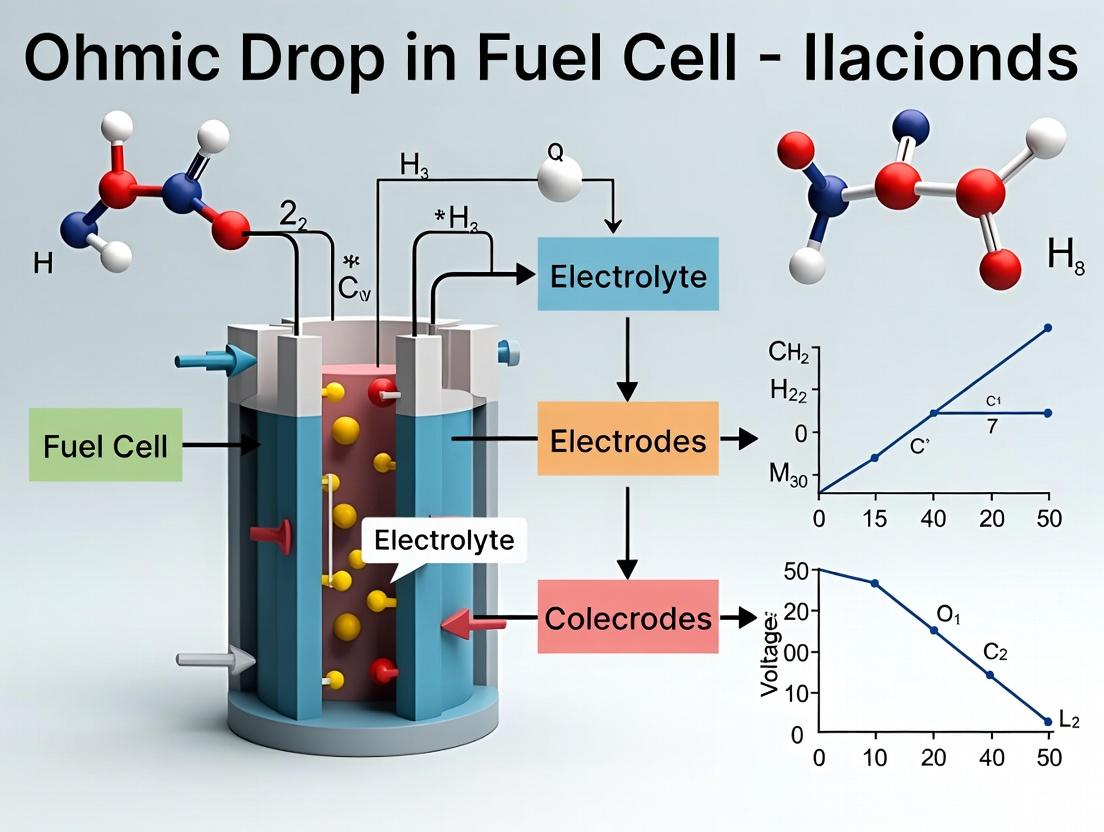
This article provides a comprehensive technical overview of ohmic drop (iR drop) in fuel cells for researchers and scientists in electrochemistry and energy technology.
Ohmic Drop in Fuel Cells: Measurement, Analysis, and Mitigation Strategies for Researchers
Abstract
This article provides a comprehensive technical overview of ohmic drop (iR drop) in fuel cells for researchers and scientists in electrochemistry and energy technology. It covers the foundational principles of ionic and electronic resistance, explores advanced measurement techniques like Electrochemical Impedance Spectroscopy (EIS) and Current Interrupt, and details modeling approaches. The content further addresses common experimental pitfalls, strategies for minimizing iR drop in testing, and comparative analysis of correction methods. By synthesizing methodology with troubleshooting, the article serves as a practical guide for obtaining accurate electrochemical performance data and optimizing fuel cell design and operation.
What is Ohmic Drop? Core Principles and Impact on Fuel Cell Performance
Within the broader thesis on the fundamentals of ohmic drop in fuel cells research, this whitepaper provides an in-depth technical guide to defining, measuring, and mitigating the voltage loss arising from ionic and electronic resistance. Ohmic drop, a key contributor to fuel cell polarization loss, directly impacts efficiency and power density. This document details core principles, experimental quantification methods, and material-based mitigation strategies for researchers and applied scientists.
Ohmic drop (or iR drop) is the potential loss due to the resistance to the flow of ions through the electrolyte (ionic resistance) and electrons through conductive cell components (electronic resistance). In fuel cells, this manifests as a linear decrease in cell voltage with increasing current density, governed by Ohm's Law (V = iR). Minimizing this loss is critical for achieving high-performance energy conversion devices.
The total ohmic resistance (R_Ω) is a sum of contributions from all cell components. The following table summarizes typical area-specific resistance (ASR) values for a standard PEM fuel cell.
Table 1: Typical Ohmic Resistance Contributions in a PEM Fuel Cell
| Component | Material (Example) | Area-Specific Resistance (ASR) [Ω·cm²] | Primary Charge Carrier | Notes |
|---|---|---|---|---|
| Polymer Electrolyte | Nafion 211 | 0.05 - 0.10 @ 80°C, 100% RH | H⁺ (Protons) | Highly humidity/temp dependent |
| Cathode Catalyst Layer | Pt/C + Ionomer | ~0.01 - 0.03 | e⁻ & H⁺ | Depends on ionomer content & porosity |
| Anode Catalyst Layer | Pt/C + Ionomer | ~0.01 - 0.02 | e⁻ & H⁺ | Depends on ionomer content & porosity |
| Gas Diffusion Layer (GDL) | Carbon Paper | 0.005 - 0.015 | e⁻ | Depends on compression, coating |
| Bipolar Plates | Graphite | 0.01 - 0.02 | e⁻ | Coated metals can be lower |
| Contact Interfaces | Various | 0.005 - 0.02 (each) | e⁻ | Highly dependent on assembly pressure |
| Total Cell ASR_Ω | Summation | ~0.10 - 0.20 | N/A | Target for high-performance cells |
Experimental Protocols for Quantifying Ohmic Drop
Electrochemical Impedance Spectroscopy (EIS)
Protocol: This is the primary method for in-situ separation of ohmic resistance from kinetic and mass transport losses.
- Cell Setup: Assemble fuel cell with standard MEA, GDLs, and fixtures. Condition at operating temperature (e.g., 80°C) and humidification.
- Polarization Curve: Record initial polarization curve (I-V) to establish baseline performance.
- EIS Measurement:
- Apply a DC current (or potential) corresponding to the desired operating point.
- Superimpose an AC sinusoidal perturbation (typically 10 mV amplitude) across a frequency range (e.g., 10 kHz to 0.1 Hz).
- Measure the real (Z') and imaginary (Z'') parts of the impedance.
- Data Analysis:
- Plot Nyquist plot (Z'' vs Z').
- The high-frequency intercept on the real axis corresponds to the total ohmic resistance (RΩ).
- Use equivalent circuit modeling (e.g., [RΩ][Rct//CPE][Rmt//CPE]) to deconvolute charge transfer and mass transport resistances.
Current Interruption (CI)
Protocol: A transient technique for direct iR drop measurement.
- Cell Polarization: Operate the fuel cell at a steady, controlled current density.
- Current Interruption: Use a high-speed switch to instantaneously (µs scale) interrupt the current flow.
- Voltage Transient Capture: Record the cell voltage response with a high-speed data acquisition system.
- Analysis: The instantaneous voltage jump upon interruption is attributed to the ohmic drop (iR_Ω). The subsequent, slower voltage rise corresponds to capacitive and kinetic relaxations.
Mitigation Strategies and Material Science
The Scientist's Toolkit: Key Research Reagent Solutions
| Item / Reagent | Function in Ohmic Drop Research |
|---|---|
| Perfluorosulfonic Acid (PFSA) Ionomer (e.g., Nafion Dispersions) | Benchmark proton conductor for PEMs and catalyst layers. Used to study ionic resistance. |
| Alternative Membrane Materials (e.g., PBI, PFIA, Hydrocarbons) | Materials for high-temperature/low-humidity operation, reducing hydration-dependant ionic resistance. |
| Pt/C Catalysts with Varied Ionomer/Carbon Ratios | For optimizing triple-phase boundaries, minimizing combined ionic/electronic resistance in catalyst layers. |
| Carbon-Based GDLs (Papers/Felts) with PTFE Coatings | Control electronic resistance & hydrophobicity; study contact resistance with flow fields. |
| Metallic Bipolar Plate Coatings (e.g., TiN, Au, Graphene) | Investigate corrosion-resistant, low-contact resistance interfaces. |
| Reference Electrodes (Reversible Hydrogen Electrode - RHE) | For half-cell studies to decouple anode/cathode overpotentials from ohmic losses. |
| Electrochemical Workstation with EIS & CI Capability | Essential for accurate resistance measurement and diagnosis. |
Visualizing Relationships and Workflows
Diagram Title: Workflow for Fuel Cell Ohmic Drop Measurement & Analysis
Diagram Title: Hierarchical Sources of Ohmic Resistance in a Fuel Cell
Within the broader thesis on the Fundamentals of Ohmic Drop in Fuel Cells, a precise understanding of the specific sources of Ohmic resistance (RΩ) is paramount. RΩ represents the voltage loss (iR drop) associated with the conduction of protons and electrons across the cell's components. This in-depth guide details the core sources of this resistance: the membrane, electrodes, interfaces, and contact points. For researchers and scientists, especially in fields like electrochemistry relevant to energy conversion, quantifying and minimizing these resistances is critical for optimizing device performance and efficiency.
Membrane Resistance
The polymer electrolyte membrane (e.g., Nafion) is a primary source of protonic resistance. It is a function of membrane thickness, hydration level, temperature, and intrinsic ionic conductivity.
- Quantitative Data Summary:
| Factor | Typical Range/Value | Impact on Membrane Resistance | Measurement Technique |
|---|---|---|---|
| Thickness (dry) | 25 μm (Nafion 212) to 175 μm (Nafion 117) | Rmembrane ∝ thickness / conductivity | Ex-situ impedance spectroscopy (2-electrode) |
| Hydration (λ: H2O/SO3H) | λ = 5 (dry) to λ = 22 (fully hydrated) | Resistance decreases exponentially with increasing λ | In-situ high-frequency resistance (HFR) |
| Temperature | 30°C to 80°C (operational) | Resistance decreases with temperature (Arrhenius behavior) | Temperature-controlled impedance |
| Proton Conductivity (σ) | 0.1 S/cm (hydrated, 80°C) | R = L / (σ * A), where L=thickness, A=area | 4-point probe/Bulk conductivity cell |
- Experimental Protocol: Ex-Situ Membrane Conductivity Measurement (4-Point Probe)
- Sample Preparation: Hydrate a membrane sample (e.g., 5 cm x 1 cm strip) in deionized water at 80°C for 1 hour.
- Setup: Clamp the sample in a 4-point probe conductivity cell. Outer two electrodes pass a known DC current (I) from a precision source meter.
- Measurement: Measure the voltage drop (ΔV) between the inner two sense electrodes using a high-impedance voltmeter. Ensure no current flows in the sense circuit.
- Calculation: Calculate resistivity ρ = (ΔV / I) * (W * T / L), where W is sample width, T is thickness, and L is the distance between inner electrodes. Conductivity σ = 1/ρ.
Electrode Resistance
Electrodes (Gas Diffusion Layers - GDLs and catalyst layers) contribute primarily to electronic resistance. This includes the bulk resistance of carbon fibers/cloth in the GDL and the resistance through the porous catalyst layer.
- Quantitative Data Summary:
| Component | Material | Typical Areal Resistance | Key Contributing Factors |
|---|---|---|---|
| Gas Diffusion Layer (GDL) | Carbon paper/felt | 5 - 15 mΩ·cm² | Compression, PTFE content, microporous layer (MPL) |
| Catalyst Layer | Pt/C, Ionomer, Pores | 10 - 50 mΩ·cm² | Ionomer distribution, Pt loading, porosity, thickness |
| Bipolar Plate (Flow Field) | Graphite/Coated Metal | 1 - 10 mΩ·cm² (interface dominated) | Material conductivity, coating integrity |
- Experimental Protocol: In-Situ Electrode Resistance via Current Interrupt
- Cell Assembly: Assemble a single fuel cell with reference electrodes if possible.
- Polarization: Operate the cell at a steady-state current density (e.g., 1 A/cm²).
- Interrupt: Use a fast current interrupt switch (µs response) to instantly set the load current to zero.
- Voltage Transient Analysis: Monitor the voltage transient with a high-speed data acquisition system. The instantaneous jump in voltage (excluding capacitive effects) is attributed to the total Ohmic loss (iRΩ). By comparing with known membrane resistance, electrode contributions can be estimated.
Interface Resistance
Interfacial resistances arise from imperfect contact and charge transfer inefficiencies between dissimilar materials. These are often the most challenging to isolate and minimize.
- Primary Interfaces:
- Membrane/Catalyst Layer Interface: Proton transfer resistance influenced by ionomer coverage and catalyst surface properties.
- Catalyst Layer/GDL Interface: Electronic contact resistance dependent on compression and surface roughness.
- GDL/Bipolar Plate Interface: A major source of contact resistance, heavily dependent on clamping pressure and surface flatness.
Contact Point Resistance
This refers specifically to the discrete points of physical contact between rough surfaces (e.g., GDL and bipolar plate ridges). Resistance is governed by the actual contact area, which is a fraction of the geometric area.
- Quantitative Data Summary:
| Interface | Typical Contact Pressure | Estimated Contact Resistance | Mitigation Strategy |
|---|---|---|---|
| GDL to Bipolar Plate | 1.0 - 2.0 MPa | 3 - 20 mΩ·cm² | Increased compression, softer GDLs, conductive coatings |
| Within GDL (Fiber-to-Fiber) | N/A | Contributes to bulk GDL resistance | Optimized sintering/PTFE binding |
- Experimental Protocol: Contact Resistance Measurement (Ex-Situ)
- Setup: Place the material stack (e.g., two pieces of GDL with a bipolar plate simulant in between) between two gold-plated copper current collectors in a press.
- 4-Wire Measurement: Use a 4-wire (Kelvin) method. Apply a known DC current through the outer collectors.
- Voltage Probe: Measure the voltage drop across the inner interface of interest using separate sense wires.
- Pressure Sweep: Measure resistance while systematically varying the clamping pressure. The intercept of the resistance vs. (1/pressure) plot estimates the intrinsic bulk resistance, while the slope relates to contact resistance.
The Scientist's Toolkit: Research Reagent Solutions
| Item | Function in Research |
|---|---|
| Nafion Membranes (e.g., 211, 212, 117) | Standard PEM for baseline proton conductivity and fuel cell performance studies. |
| High-Precision Source Measure Unit (SMU) | Provides accurate current sourcing and voltage measurement for I-V curves and resistance tests. |
| Potentiostat/Galvanostat with EIS | Electrochemical impedance spectroscopy for decoupling resistive and capacitive components. |
| Torque-Controlled Fuel Cell Hardware | Ensures precise and reproducible clamping pressure for contact resistance studies. |
| Microporous Layer (MPL) Inks | For coating GDLs to study interface optimization between catalyst layer and diffusion media. |
| Reference Electrodes (e.g., DHE, RHE) | Enables precise measurement of electrode potentials in situ to localize overpotentials. |
| Conductive Carbon Paper (e.g., Sigracet, Toray) | Standard GDL substrate for electronic resistance and two-phase flow experiments. |
| PTFE/Carbon Black Suspensions | For modifying GDL hydrophobicity and structure, affecting both ohmic and mass transport resistance. |
Sources of Ohmic Resistance: A Hierarchical Breakdown
Experimental Workflow for Isolating Ohmic Resistances
The Direct Impact of iR Drop on Polarization Curves and Power Density
Within the broader thesis on the Fundamentals of ohmic drop in fuel cells research, the direct impact of the internal resistance (iR) drop represents a critical performance-limiting phenomenon. The iR drop is the voltage loss attributable to the ohmic resistance within a fuel cell, encompassing ionic resistance in the electrolyte, electronic resistance in cell components, and contact resistances. This loss directly and predictably distorts the polarization curve, which plots cell voltage against current density, and consequently dictates the achievable power density—the key performance metric for fuel cell energy output. For researchers and scientists, including those in fields like drug development where fuel cells power critical diagnostics, a quantitative understanding of this relationship is essential for cell design, material selection, and performance optimization.
Fundamentals of iR Drop in Fuel Cell Electrochemistry
The operational voltage (Vcell) of a fuel cell is lower than its thermodynamic open-circuit voltage (EOCV) due to three primary overpotentials: activation (ηact), concentration (ηconc), and ohmic (ηohm). The ohmic overpotential, or iR drop, is described by Ohm's Law:
ηohm = i * RΩ
where i is the current density (A/cm²) and RΩ is the area-specific ohmic resistance (Ω·cm²). Therefore, the cell voltage is expressed as:
Vcell = EOCV - ηact - ηconc - iRΩ
The iR drop term is linear with current, causing a characteristic straight-line decline in the polarization curve's ohmic region. Its direct subtraction from the potential reduces the maximum power point, as power density (P = i * Vcell) is a parabolic function of current.
Quantitative Impact on Polarization & Power Curves
The following table summarizes the quantitative impact of varying ohmic resistance on key performance metrics for a representative Hydrogen PEM fuel cell (H2/Air, 80°C), based on simulated data from recent literature and standard models.
Table 1: Impact of Area-Specific Ohmic Resistance (RΩ) on Fuel Cell Performance
| RΩ (Ω·cm²) | Voltage at 1.0 A/cm² (V) | Peak Power Density (W/cm²) | Current Density at Peak Power (A/cm²) | Dominant Loss Region at High i |
|---|---|---|---|---|
| 0.10 | 0.65 | 0.92 | 1.80 | Mixed Ohmic/Concentration |
| 0.15 | 0.60 | 0.81 | 1.70 | Ohmic |
| 0.20 | 0.55 | 0.71 | 1.60 | Ohmic |
| 0.25 | 0.50 | 0.62 | 1.50 | Ohmic |
| 0.30 | 0.45 | 0.54 | 1.40 | Ohmic |
Note: Simulation assumes EOCV ~1.0V, with standard kinetic and mass transport parameters.
Experimental Protocols for iR Drop Determination
Accurate measurement of the iR drop and its components is foundational to related research.
Protocol 4.1: Current Interruption for Total iR Drop Measurement This method rapidly interrupts the cell current and measures the instantaneous voltage jump, which corresponds to the iR drop.
- Setup: Connect fuel cell to a programmable electronic load capable of current interruption (switching time < 1 µs). Use a high-speed data acquisition system (≥1 MHz sampling rate) to record voltage.
- Conditioning: Operate the cell at steady-state under desired conditions (temperature, gas flows).
- Polarization: Set the electronic load to a constant current point (e.g., 1.0 A/cm²).
- Interruption: Trigger a rapid open-circuit transition. Record the voltage transient.
- Analysis: The voltage immediately after interruption (extrapolated to t=0) minus the voltage just before interruption gives the iR drop (ΔViR). Calculate RΩ = ΔViR / i.
- Repeat: Perform at multiple current densities to verify resistance consistency.
Protocol 4.2: Electrochemical Impedance Spectroscopy (EIS) for Resistance Deconvolution EIS separates ohmic resistance from charge transfer and diffusion processes.
- Setup: Connect fuel cell to a potentiostat/galvanostat with EIS capability. Use a frequency range from 10 kHz to 0.1 Hz with a 10 mV AC perturbation amplitude.
- Biasing: Perform EIS at a specific DC current (galvanostatic mode).
- Measurement: Acquire the Nyquist plot.
- Analysis: The high-frequency intercept on the real axis corresponds to the total ohmic resistance (RΩ). The width of the subsequent arc relates to charge-transfer resistance.
Protocol 4.3: In-Situ Measurement of Membrane Resistance (H2/N2 Cell) This isolates the ionic resistance of the proton exchange membrane.
- Cell Assembly: Build a two-electrode cell with a working anode (H2) and a cathode acting as a dynamic hydrogen electrode (DHE) under N2).
- EIS Measurement: Apply a small AC signal (e.g., 10 mV) at high frequency (e.g., 1 kHz) under H2/N2 flow.
- Analysis: The measured impedance magnitude is dominated by the membrane resistance. This value is a major contributor to the total RΩ.
Research Reagent Solutions & Essential Materials
Table 2: Key Research Reagent Solutions for iR Drop Studies
| Item | Function/Description |
|---|---|
| Nafion Dispensions (e.g., D520, D2020) | Ionomer used in catalyst ink formulation to create proton-conducting paths within the catalyst layer, directly influencing ionic resistance. |
| Catalyst-Coated Membranes (CCMs) | Standardized MEA substrates with precisely controlled Pt/C catalyst loadings and ionomer content for reproducible kinetic and ohmic studies. |
| Gas Diffusion Layers (GDLs) - Sigracet, AvCarb | Carbon fiber papers/cloths with controlled porosity and hydrophobicity. Critical for electron conduction and reactant/product transport, affecting contact resistance. |
| Humidification Controllers (Gas & Membrane) | Precise control of reactant and membrane humidity is essential, as proton conductivity (and thus RΩ) is highly water-content dependent. |
| High-Conductivity Membrane (e.g., Nafion 211) | Benchmark thin membrane (~25 µm) offering low baseline ionic resistance for comparative studies. |
| Pt/C Catalysts (40-60 wt%) | Standard electrocatalyst for anode and cathode. Consistent quality ensures activation losses are comparable across experiments. |
| Toray Carbon Paper (TGP-H-060/090) | Standardized GDL material for baseline performance and resistance benchmarking. |
| Four-Point Probe Station | For ex-situ measurement of through-plane electrical resistance of GDLs, bipolar plates, and contact interfaces. |
Pathways and Relationships: A Systems View
Diagram 1: The causal impact of iR drop on fuel cell output.
Diagram 2: Experimental workflow for iR drop analysis.
This whitepaper, framed within the broader thesis on Fundamentals of Ohmic Drop in Fuel Cells Research, details the fundamental application of Ohm's Law in modeling and diagnosing fuel cell performance. The ohmic drop, a primary source of voltage loss, directly impacts efficiency and power density. Precise quantification and mitigation of this drop are critical for advancing fuel cell technology, particularly for applications demanding high reliability, such as in backup power systems for scientific infrastructure and drug development facilities.
Ohm's Law: The Core Fundamental
Ohm's Law states that the current (I) through a conductor between two points is directly proportional to the voltage (V) across the two points and inversely proportional to the resistance (R) of the conductor. V = I * R In the context of a fuel cell, this law is applied to model the voltage drop due to the ionic resistance of the electrolyte, the electronic resistance of cell components (bipolar plates, gas diffusion layers, contacts), and contact resistances between layers.
Ohm's Law in Fuel Cell Voltage Breakdown
The operational voltage (Vcell) of a single fuel cell is less than its thermodynamic open-circuit voltage (Ethermo) due to various polarization losses: Vcell = Ethermo - ηactivation - ηconc - ηohmic Where *ηohmic* is the ohmic overpotential, directly described by Ohm's Law: ηohmic = I * Rionic (for electrolyte). The total internal resistance (R_internal) is a sum of all resistances.
Table 1: Typical Contribution of Ohmic Loss to Total Voltage Loss in Common Fuel Cell Types (at 0.6 A/cm²)
| Fuel Cell Type | Electrolyte | Typical Ohmic Overpotential (mV) | % of Total Loss (approx.) | Dominant Resistance Source |
|---|---|---|---|---|
| PEMFC | Nafion | 80 - 150 | 25-40% | Ionic (Membrane Hydration) |
| SOFC | YSZ | 100 - 250 | 30-50% | Ionic (Electrolyte Thickness) |
| AFC | KOH | 50 - 100 | 20-35% | Ionic (Electrolyte Concentration) |
| DMFC | Nafion | 120 - 200 | 30-45% | Ionic (Methanol Crossover) |
Experimental Protocols for Ohmic Resistance Measurement
Accurate measurement is essential for model validation and degradation studies.
Electrochemical Impedance Spectroscopy (EIS) Protocol
Objective: Deconvolute total cell impedance to extract the high-frequency real-axis intercept, which corresponds to the total ohmic resistance (R_Ω).
- Cell Conditioning: Operate the fuel cell at desired temperature, pressure, and gas flows until steady-state performance is achieved (typically 1-2 hours).
- Setup: Connect impedance analyzer (e.g., potentiostat/galvanostat with FRA) to fuel cell terminals. Ensure cabling is appropriate for high-frequency measurement.
- Parameters: Apply a sinusoidal AC perturbation of 5-10 mV amplitude over a frequency range from 10 kHz to 0.1 Hz, at the desired DC operating point (current density).
- Data Acquisition: Record impedance spectra (Nyquist plot).
- Analysis: Fit the high-frequency region of the Nyquist plot. The real-axis intercept at the highest frequency is R_Ω. Use equivalent circuit modeling (e.g., R(RC)(RC)) for precise separation.
Current Interrupt (CI) Method Protocol
Objective: Directly measure the instantaneous voltage jump associated with ohmic drop.
- Steady-State Operation: Stabilize the fuel cell at a constant current load (I).
- Interrupt Trigger: Use a high-speed switch to abruptly (µs scale) open the circuit, halting current flow.
- High-Speed Measurement: Record cell voltage transient with a high-speed data acquisition system (>1 MHz sampling rate).
- Analysis: The instantaneous voltage rise at the moment of interrupt (after correcting for double-layer charging) is equal to I*RΩ. Calculate RΩ = ΔV_instantaneous / I.
Visualizing Ohmic Drop in Fuel Cell Analysis
Title: Voltage Loss Contributions in a Fuel Cell Polarization Curve
Title: Current Interrupt Method Measurement Setup
The Scientist's Toolkit: Key Research Reagent Solutions
Table 2: Essential Materials for Ohmic Drop Characterization Experiments
| Item | Function in Research | Key Consideration |
|---|---|---|
| Nafion Membranes (e.g., N211, N212) | Proton exchange electrolyte; primary source of ionic resistance. | Thickness, equivalent weight, pretreatment (boiling in H₂O₂, H₂SO₄, H₂O) critically affects R_ionic. |
| Catalyst Coated Membranes (CCMs) | Integrated MEAs for standardized testing. | Catalyst loading (Pt mg/cm²) and ionomer-to-carbon ratio influence electronic & ionic conduction. |
| Conductive Carbon Paper/Cloth (GDL) | Gas Diffusion Layer; provides electronic conduction and gas transport. | Hydrophobic treatment (PTFE) and microporous layer affect contact resistance with bipolar plates. |
| Graphite or Metallic Bipolar Plates | Conduct current between cells and distribute reactant gases. | Machining quality, coating (for corrosion resistance), and clamping force define contact resistance. |
| High-Frequency Impedance Analyzer | Perform EIS to separate ohmic resistance from total impedance. | Frequency range (>100 kHz), current booster capability, and cabling for 4-wire measurement. |
| Potentiostat/Galvanostat with CI | Perform Current Interrupt measurements. | Rise/fall time of internal switch (<1 µs) and sampling rate determine accuracy. |
| Reference Electrode (e.g., Reversible Hydrogen Electrode) | For half-cell studies to isolate anode/cathode contributions. | Proper placement and design are crucial for accurate potential measurement in operating cells. |
| Humidification & Temperature Control System | Control membrane hydration, a key variable for ionic resistance. | Precise dew point and temperature control are mandatory for reproducible R_Ω measurement. |
Advanced Application: Incorporating Ohm's Law into Multi-Physics Models
In computational fluid dynamics (CFD) and multi-physics models, Ohm's Law is solved in conjunction with charge conservation equations. ∇ ⋅ (σs ∇ φs) + Rs = 0 (for solid/electronic phase) ∇ ⋅ (σe ∇ φe) + Re = 0 (for electrolyte/ionic phase) Where σ is conductivity, φ is potential, and R is source term. The potential drop in each phase is computed, and the model's accuracy hinges on experimentally determined inputs for conductivity and contact resistances, validated using the protocols above.
Ohm's Law provides the foundational framework for quantifying and analyzing the critical ohmic losses in fuel cells. Through rigorous experimental protocols like EIS and Current Interrupt, researchers can extract precise resistance values for model input and degradation tracking. Mastery of these fundamentals is essential for advancing the performance and durability of fuel cell systems, with direct implications for reliable power in sensitive research and pharmaceutical manufacturing environments.
Distinguishing Ohmic Losses from Activation and Concentration Overpotentials
Within the broader thesis on Fundamentals of Ohmic Drop in Fuel Cells Research, a precise understanding of voltage loss origins is paramount. The total overpotential (η) in an electrochemical cell, such as a fuel cell, is the sum of three primary components: ohmic losses (ηohm), activation overpotential (ηact), and concentration overpotential (η_conc). Distinguishing these components is critical for diagnosing performance limitations, optimizing materials, and advancing cell design.
Theoretical Framework and Definitions
- Ohmic Losses (ηohm): Arise from the resistance to the flow of ions in the electrolyte and electrons through electrodes and interconnects. Governed by Ohm's law (ηohm = i * Rohm), it scales linearly with current density (i). Rohm is a function of material conductivity and cell geometry.
- Activation Overpotential (ηact): The voltage loss required to drive the charge transfer reaction at the electrode-electrolyte interface at a finite rate. Described by the Butler-Volmer equation and Tafel approximation at higher currents (ηact ∝ log(i)).
- Concentration Overpotential (η_conc): Results from the depletion of reactants or accumulation of products at the electrode surface under high current densities, leading to a reduction in concentration from bulk values. It becomes significant at the limiting current.
The total cell voltage is: V = Erev – ηact – ηohm – ηconc, where E_rev is the reversible thermodynamic voltage.
Quantitative Comparison of Overpotential Components
The table below summarizes the key characteristics and quantitative relationships of the three loss types.
Table 1: Characteristics of Major Voltage Loss Types in Fuel Cells
| Parameter | Ohmic Overpotential (η_ohm) | Activation Overpotential (η_act) | Concentration Overpotential (η_conc) |
|---|---|---|---|
| Primary Origin | Ionic/Electronic Resistances | Kinetics of Electrode Reactions | Mass Transport Limitations |
| Governing Law | Ohm's Law | Butler-Volmer/Tafel Equation | Fick's Law/Nernst Equation |
| Functional Dependence on Current (i) | Linear: η = i * R | Logarithmic: η ∝ log(i/i₀) | Exponential rise near i_limit |
| Typical Dominant Region | Mid-current range | Low-current range | High-current range |
| Key Mitigation Strategies | Thin, high-conductivity electrolytes; improved interconnects | High-activity catalysts; increased operating temperature | Optimized electrode porosity; improved flow field design |
Table 2: Exemplary Experimental Values from Recent Literature (H₂/O₂ PEMFC, ~80°C)
| Loss Component | Symbol | Typical Magnitude (mV @ 1 A/cm²) | Representative Measurement Method |
|---|---|---|---|
| Total Ohmic Resistance | R_ohm | ~50 – 150 mΩ·cm² | High-Frequency Impedance (or Current Interrupt) |
| Cathode Activation Loss | η_act,c | ~300 – 450 | Low-Current Extrapolation of Tafel Plot |
| Anode Activation Loss | η_act,a | ~5 – 50 | Low-Current Extrapolation of Tafel Plot |
| Concentration Loss | η_conc | ~20 – 100 (strongly design-dependent) | Analysis of Limiting Current or Low-Frequency Impedance |
Experimental Protocols for Separation and Measurement
Protocol 4.1: Current Interrupt Method for Ohmic Drop Isolation
Objective: To directly measure the internal ohmic resistance (R_ohm) of a fuel cell. Principle: Upon sudden interruption of the load current, the activation and concentration overpotentials decay relatively slowly (ms-s), while the ohmic potential drop vanishes almost instantaneously (µs). Procedure:
- Stabilize the fuel cell at a desired operating point (specific current density, temperature, gas flows).
- Using a high-speed potentiostat/electronic load with current interrupt capability, rapidly switch the circuit to open.
- Record the voltage transient at a high sampling rate (≥1 MHz).
- Extrapolate the voltage recovery curve back to the moment of interruption (t=0). The instantaneous voltage jump corresponds to i*R_ohm.
- Calculate Rohm = ΔVinstantaneous / i.
Protocol 4.2: Electrochemical Impedance Spectroscopy (EIS) for Deconvolution
Objective: To separate ohmic, charge-transfer, and mass-transport resistances via their characteristic time constants. Principle: A small sinusoidal AC potential perturbation is applied over a wide frequency range. The cell's impedance response reveals resistances and associated capacitances. Procedure:
- At a fixed DC bias (operating current), superimpose an AC perturbation (typically 5-10 mV amplitude) from high frequency (e.g., 100 kHz) to low frequency (e.g., 0.1 Hz).
- Measure the magnitude and phase shift of the current response.
- Construct a Nyquist plot (negative imaginary vs. real impedance).
- Analysis: The high-frequency intercept on the real axis gives the ohmic resistance (Rohm). The diameter of the first, high-to-mid frequency semicircle correlates with the charge-transfer resistance (Rct), related to activation overpotential. The low-frequency arc or tail is associated with mass-transport resistance (R_mt), linked to concentration overpotential.
Protocol 4.3: Tafel Analysis for Activation Overpotential
Objective: To quantify the kinetic (activation) parameters of the electrode reaction. Principle: At sufficiently high overpotential (|η| > ~50/n mV), the Butler-Volmer equation simplifies to the Tafel equation: η_act = a + b log(i), where b is the Tafel slope. Procedure:
- Record a steady-state polarization curve under kinetically controlled conditions (e.g., high purity reactants, sufficient pressure).
- Correct the cell voltage for the measured ohmic drop: Vir-free = Vmeasured + i*R_ohm.
- Plot the ηact (≈ Erev - V_ir-free) against log(i) in the low-current-density region where mass transport effects are negligible.
- Fit a straight line to the Tafel region. The slope gives the Tafel slope (b), and the intercept at log(i)=0 gives the exchange current density (i₀).
Diagrams
The Scientist's Toolkit: Key Research Reagent Solutions & Materials
Table 3: Essential Materials and Reagents for Overpotential Analysis
| Item | Function/Brief Explanation |
|---|---|
| High-Performance Potentiostat/Galvanostat | Precisely controls cell potential/current and measures response. Essential for EIS and polarization curves. |
| Frequency Response Analyzer (FRA) Module | Dedicated hardware for accurate impedance measurements over a wide frequency range. |
| High-Speed Electronic Load with Interrupt | Enables current interrupt measurements for direct ohmic drop determination. |
| Ultra-High Purity Reactant Gases (H₂, O₂, Air) | Minimizes impurity effects on catalyst kinetics and ensures reproducible activation polarization measurements. |
| Humidification System (Bubble, Membrane, etc.) | Precisely controls reactant gas dew points, critical for maintaining consistent membrane ionic conductivity (major R_ohm component). |
| Reference Electrode (e.g., Dynamic Hydrogen Electrode - DHE) | Allows separation of anode and cathode overpotentials in half-cell or full-cell configurations. |
| Nafion Membrane or Equivalent PEM | Standard proton exchange membrane; thickness and pretreatment directly impact ohmic resistance. |
| Catalyst-Coated Membrane (CCM) or Gas Diffusion Electrodes (GDEs) | Well-characterized electrodes are crucial for reproducible kinetic (activation) studies. |
| Graphitic/Fused Silica Cell Hardware | Provides electronic conductivity and flow fields while being chemically inert in various fuel cell environments (PEMFC, SOFC, etc.). |
| Electrochemical Analysis Software | For modeling equivalent circuits from EIS data, Tafel analysis, and fitting polarization data. |
How to Measure and Model iR Drop: Advanced Techniques for Accurate Data
Within the broader thesis on the Fundamentals of Ohmic Drop in Fuel Cells Research, understanding and accurately quantifying the ohmic resistance is paramount. This resistance, a primary contributor to voltage loss (ohmic drop), directly impacts fuel cell efficiency and performance. Electrochemical Impedance Spectroscopy (EIS) is the most powerful non-destructive diagnostic tool for deconvoluting the various polarization losses in electrochemical systems. Extracting the High-Frequency Resistance (HFR) from EIS data provides the most direct and critical experimental measure of the total ohmic resistance of the cell, encompassing ionic, electronic, and contact contributions. This guide details the theory and practice of HFR extraction as a cornerstone for rigorous ohmic drop analysis.
Theoretical Foundation: The Nyquist Plot and HFR
An EIS measurement applies a small sinusoidal potential (or current) perturbation across a range of frequencies and measures the current (or voltage) response. The data is commonly presented as a Nyquist plot (negative imaginary impedance vs. real impedance). For a typical fuel cell, a simplified equivalent circuit is the Randles circuit, which includes an ohmic resistor (RΩ) in series with a parallel combination of a charge-transfer resistor (Rct) and a constant phase element (CPE). In the high-frequency limit, the impedance of the capacitive/CPE element tends to zero, and the total measured impedance equals the ohmic resistance. This is the HFR.
Diagram Title: EIS Data Analysis Pathway for HFR
Experimental Protocol for EIS in Fuel Cells
Materials and Setup
- Test Station: Commercial fuel cell test station with integrated, high-precision electronic load and humidification systems.
- Frequency Response Analyzer (FRA): A dedicated FRA or a potentiostat with EIS capabilities (e.g., Gamry, Biologic, Solartron). Must be capable of >10 kHz measurement.
- Cell Hardware: Single-cell or stack fixture with current collection plates and gas flow fields.
- Membrane Electrode Assembly (MEA): The core component under study.
- Environmental Chamber: To control cell temperature precisely.
Step-by-Step Methodology
- Cell Conditioning: Operate the fuel cell at a standard operating point (e.g., 0.6V, 80°C) for several hours until performance stabilizes.
- Set Operating Point: Choose the specific current density or voltage for EIS measurement. Hold this point steadily.
- Configure EIS Parameters:
- Frequency Range: Typically 10 kHz (or higher) to 0.1 Hz. The high-frequency limit is critical for HFR.
- Perturbation Amplitude: A sinusoidal voltage signal of 5-10 mV RMS. Must ensure linear system response.
- Points per Decade: 8-10 points for a good balance of detail and speed.
- Integration Time/Number of Cycles: Set to ensure data quality at low frequencies.
- Measurement: Execute the frequency sweep under potentiostatic (controlled voltage) or galvanostatic (controlled current) mode. Record the impedance spectrum.
- Validation: Check the consistency of the HFR by repeating a high-frequency-only sweep (e.g., 10 kHz to 1 kHz). The value should be stable and reproducible.
- Post-Test: Repeat at other operating points (e.g., different current densities, humidity levels) as required for the study.
HFR Extraction Methods and Data Presentation
Methods for Determining HFR from Nyquist Data
| Method | Description | Advantages | Limitations |
|---|---|---|---|
| High-Frequency Intercept | Visual inspection or linear regression of the highest-frequency data points (typically >1 kHz) to find the intercept on the real (Z') axis. | Simple, direct, model-free. | Requires very high-frequency data; subjective if data is noisy. |
| Equivalent Circuit Fitting | Fitting the full spectrum to a physical model (e.g., Randles circuit). HFR is the value of the series resistor (RΩ). | Robust, provides additional kinetic/mass transport parameters. | Depends on model correctness; risk of over/under-fitting. |
| Real Impedance at Max Frequency | Taking the real component of the impedance at the highest measured frequency as the HFR. | Trivial to compute. | Assumes the highest frequency measured is truly in the "high-frequency limit," which may not be valid. |
Quantitative Data Representation (Example)
Table 1: HFR Values Extracted at 80°C for Different Membrane Hydration States
| Membrane Type | Relative Humidity (%) | Current Density (A/cm²) | HFR via HF Intercept (Ω·cm²) | HFR via Circuit Fit (Ω·cm²) | % Difference |
|---|---|---|---|---|---|
| Nafion 211 | 30 | 0.5 | 0.185 | 0.182 | 1.6% |
| Nafion 211 | 80 | 0.5 | 0.095 | 0.094 | 1.1% |
| Nafion 211 | 100 | 0.5 | 0.073 | 0.072 | 1.4% |
| PBI/H₃PO₄ | 0 (Anhydrous) | 0.2 | 0.210 | 0.208 | 1.0% |
Diagram Title: HFR Impact on Fuel Cell Performance
The Scientist's Toolkit: Research Reagent Solutions & Materials
Table 2: Essential Materials and Reagents for EIS/HFR Studies in Fuel Cells
| Item | Function / Relevance | Example / Specification |
|---|---|---|
| Standard Reference MEA | A well-characterized, commercially available MEA used for method validation and baseline comparisons. | e.g., Johnson Matthey or Greenerity benchmark MEAs. |
| Ionic Conductivity Standards | Calibration solutions for verifying the conductivity cell constant of test fixtures. | KCl solutions at known concentrations (e.g., 0.1 M, κ = 12.88 mS/cm at 25°C). |
| Electrochemical Interface | The system that applies perturbations and measures responses. Must have high bandwidth and low noise. | Biologic SP-300, Gamry Interface 5000e. |
| High-Frequency Load Bank | For stack or large cell testing, a load capable of modulating at high frequencies (>1 kHz) is required for accurate HFR. | Adaptive Energy or Scribner electronic loads with EIS capability. |
| In-Situ Humidity Sensors | Critical for correlating HFR with the actual water activity in the membrane and gas streams. | Sensirion or Vaisala capacitive sensors integrated into gas lines. |
| Torque Wrenches & Pressure Films | To ensure consistent and quantifiable assembly pressure, a major factor in contact resistance (part of HFR). | Calibrated torque wrench; Fujifilm Prescale pressure measurement film. |
| EIS Data Fitting Software | For equivalent circuit modeling and parameter extraction beyond simple HFR intercept. | ZView (Scribner), EC-Lab (Biologic), or equivalent open-source packages. |
This whitepaper details the Current Interrupt (CI) method within the broader research context of understanding ohmic drop in fuel cells. Ohmic drop, the voltage loss due to ionic and electronic resistances, critically impacts fuel cell efficiency and performance. The CI method is a primary technique for its in-situ, rapid, and direct measurement, providing essential data for material development and system optimization in both energy research and related electrochemical applications in drug development (e.g., biosensors).
Principles
The CI method operates on a fundamental electrochemical principle. During steady-state operation, a fuel cell's measured terminal voltage (Vterm) is the difference between its open-circuit voltage (OCV) and all internal losses: activation polarization (ηact), concentration polarization (ηconc), and the ohmic drop (i * RΩ).
Vterm = OCV - ηact - i * RΩ - ηconc
When the current (i) is abruptly interrupted to zero, the activation and concentration overpotentials decay relatively slowly due to kinetic and mass transport time constants. In contrast, the ohmic drop (i * RΩ) vanishes almost instantaneously (typically within microseconds) as it is a purely resistive phenomenon. The immediate voltage jump upon current interruption is thus directly attributable to the removal of the ohmic drop, allowing for the calculation of the area-specific ohmic resistance (ASRΩ).
Instrumentation Requirements
Precise CI measurements demand specialized instrumentation capable of high-speed switching and data acquisition.
Table 1: Core Instrumentation Specifications for CI Measurements
| Component | Critical Specification | Purpose & Rationale |
|---|---|---|
| Potentiostat/Galvanostat | Current interrupt capability with rise/fall time < 1 µs. | Must switch the cell current from steady-state to zero as abruptly as possible to isolate the instantaneous voltage change. |
| High-Speed Data Acquisition | Sampling rate ≥ 10 MS/s, high vertical resolution (≥ 16-bit). | To accurately capture the rapid voltage transient immediately following the current interruption. |
| Four-Probe Cell Setup | Separate working/current and voltage-sensing/voltage electrodes. | Eliminates lead and contact resistance from the measured voltage signal, ensuring accurate R_Ω measurement of the cell itself. |
| Shunt Resistor or Current Transducer | Bandwidth > 10 MHz, low inductance. | For precise, simultaneous measurement of the applied current. |
| Shielding & Grounding | Coaxial cables, Faraday cage if needed. | Minimizes inductive coupling and electromagnetic interference (EMI) that can corrupt fast transient signals. |
The Scientist's Toolkit: Key Research Reagent Solutions
Table 2: Essential Materials for CI Experiments in Fuel Cell Research
| Item | Function |
|---|---|
| Membrane Electrode Assembly (MEA) | Core test sample; comprises catalyst layers, proton exchange membrane (PEM), and gas diffusion layers (GDLs). |
| Nafion Membrane (or equivalent PEM) | Standard proton-conducting polymer electrolyte; primary source of ionic resistance. |
| Pt/C Catalyst Ink | Standard electrocatalyst for hydrogen oxidation/oxygen reduction reactions. |
| Toray Carbon Paper (GDL) | Provides gas diffusion, electron conduction, and mechanical support. |
| Humidified H₂ & O₂/N₂ Gases | Reactants and inert gases with controlled humidity to maintain membrane hydration, critically affecting R_Ω. |
| Electrochemical Test Cell (Fixture) | Hardware to house MEA, apply uniform pressure, supply gases, and provide electrical contacts. |
| Conductive Carbon Cloth/Paper | Used as current collectors with minimal contact resistance. |
| Ionic Conductivity Reference Solution | e.g., KCl solution, for calibrating or validating system resistance measurements. |
Experimental Protocol: Standard CI Measurement for PEMFC Ohmic Resistance
Pre-Experimental Setup
- Cell Assembly: Assemble the fuel cell fixture with the prepared MEA, gaskets, and current collector plates. Apply a standardized compression torque.
- Gas System: Connect humidifiers and mass flow controllers. Purge anode with humidified H₂ and cathode with humidified N₂ at low flow rates.
- Instrument Connection: Connect the potentiostat in a 4-wire configuration. Connect the working and counter leads to the current collectors. Connect the sense and reference leads directly to the voltage tabs on the cell, proximal to the MEA.
- Conditioning: Activate the MEA by holding at a constant voltage (e.g., 0.6 V) under H₂/N₂ or H₂/Air until performance stabilizes (typically 1-2 hours).
CI Measurement Procedure
- Set Steady-State Condition: Using the galvanostat, apply a constant current density (e.g., 0.5 A/cm²) to the cell. Allow voltage to stabilize for 60-120 seconds.
- Configure Interrupt Parameters: Program the instrument to interrupt the current to zero with a fall time < 1 µs. The interrupt duration is typically 10-100 µs—long enough to measure the voltage jump but short enough to prevent significant change in electrode state.
- Configure Acquisition: Set the DAQ to trigger on the interrupt edge. Acquire current and voltage signals at ≥ 10 MS/s for a total period of ~1 ms.
- Execute and Repeat: Execute the interrupt. Repeat the measurement at minimum 3 times at the same condition for reproducibility. Repeat the protocol across a range of current densities (e.g., 0.1, 0.2, 0.5, 1.0 A/cm²) and operating conditions (e.g., temperature, humidity).
Data Analysis
The raw voltage transient is analyzed to extract R_Ω and diagnose artifacts.
Primary Calculation
- Identify ΔV: From the high-speed voltage trace, determine the instantaneous voltage change. This is typically done by averaging the voltage over a 1-2 µs window just before the interrupt (Vpre) and a similar window 5-10 µs after the interrupt (Vpost), once the transient has settled from any inductive spike. > ΔV = Vpost - Vpre
- Calculate ASRΩ: Using the steady-state current density (jss) prior to interrupt. > ASRΩ (Ω·cm²) = ΔV / jss The geometric active area of the MEA is used to convert current to current density.
Addressing Common Artifacts
- Inductive Spike: A high-frequency overshoot due to circuit inductance. It must be excluded from the ΔV measurement by selecting the analysis window after it decays.
- Capacitive Decay: The double-layer capacitance discharges through the still-present activation resistance, causing a gradual decay after the instantaneous jump. This validates that the jump is distinct.
Table 3: Typical CI-Derived Ohmic Resistance Values for PEM Fuel Cells
| Cell Component / Condition | Typical ASR_Ω Range (Ω·cm²) at 80°C | Notes |
|---|---|---|
| Nafion 212 (Hydrated) | 0.05 - 0.07 | Represents bulk membrane resistance. Highly dependent on hydration. |
| Catalyst Layer Ionomer | 0.01 - 0.03 | Contribution from proton conduction within the catalyst layer. |
| Total MEA (Well-Humidified) | 0.10 - 0.15 | Includes membrane, ionomer, and contact resistances. |
| MEA under Low Humidity (50% RH) | 0.15 - 0.30 | Increase demonstrates humidity dependence of proton conduction. |
| GDL-Contact Resistance | 0.005 - 0.02 | Depends on compression and material. |
Advanced Analysis: Voltage Transient Deconvolution
A full transient analysis can provide insights beyond pure ohmic resistance.
The Current Interrupt method remains an indispensable, robust technique for the direct in-situ measurement of ohmic resistance in fuel cells. Its proper application, requiring careful attention to high-speed instrumentation, rigorous experimental protocol, and nuanced data analysis, delivers critical quantitative data. This data is fundamental to advancing the core thesis of ohmic drop research—enabling the development of low-resistance membranes, optimized ionomer-catalyst interfaces, and improved system designs for next-generation electrochemical devices.
Probe Placement and 4-Point Measurement Techniques for In-Situ Sensing
This whitepaper details the critical methodologies for accurate in-situ potential sensing within electrochemical energy devices, specifically fuel cells. It is a foundational component of a broader thesis investigating the Fundamentals of Ohmic Drop in Fuel Cells. The ohmic drop, or iR loss, is a primary source of efficiency loss, originating from ionic resistance in the electrolyte and electronic resistance in cell components. Precise, in-situ measurement of potential distributions is essential to deconvolute these losses, diagnose local performance issues (e.g., water flooding, reactant starvation), and validate computational models. Incorrect probe placement or measurement technique can lead to significant artifacts, misrepresenting the true internal state of the cell.
Fundamentals: 2-Point vs. 4-Point Measurement
The core challenge is separating the voltage drop of interest from the parasitic drops introduced by measurement circuitry.
2-Point (2-P) Measurement: A single pair of wires serves as both current-carrying and voltage-sensing paths. The measured voltage (Vmeasured) includes the potential of interest (Vcell) plus the iR drops in the probes, contact resistances, and lead wires (∑iRparasitic). This method is unsuitable for precise in-situ sensing where parasitic resistances can be of the same order as the cell's internal resistances.
4-Point (4-P) or Kelvin Measurement: Employs two separate wire pairs. A known current (I) is forced through the device under test via one pair (Current Leads). The resulting voltage difference is measured by a second pair (Potential Probes) using a high-impedance voltmeter that draws negligible current. Therefore, the iR drops in the potential probes and their contact points are not included in the measurement, yielding the true potential difference (Vcell) between the two probe points.
Table 1: Quantitative Comparison of 2-Point vs. 4-Point Techniques
| Parameter | 2-Point Measurement | 4-Point (Kelvin) Measurement | Implications for Fuel Cell Sensing |
|---|---|---|---|
| Measured Voltage | Vcell + ∑iRparasitic | Vcell | 4-P eliminates lead/contact resistance error. |
| Contact Resistance Error | Included | Excluded | Critical for poor ohmic contacts (e.g., to GDL). |
| Current in Voltage Leads | High (equal to cell current) | Negligible (~pA) | Prevents polarization at probe tips. |
| Wiring Complexity | Low (2 wires) | High (4 wires per segment) | Increases cell design complexity. |
| Typical Use Case | Overall cell voltage | In-situ potential distribution, area-specific resistance (ASR) | 4-P is mandatory for segmented cell studies. |
Probe Placement Strategies for In-Situ Sensing
Placement is dictated by the specific ohmic component under investigation and must minimize intrusion on cell operation.
Table 2: Probe Placement Configurations and Their Applications
| Target Measurement | Primary Probe Placement | Reference Probe Placement | Measured Quantity | Key Consideration |
|---|---|---|---|---|
| Total Cell Ohmic Loss | Cathode Flow Field Plate | Anode Flow Field Plate | Total iR (Electrolyte + Components) | Standard for AC Impedance (High Freq.). |
| Cathode Electrode Potential | Cathode Catalyst Layer (via ref. wire) | Reversible Hydrogen Electrode (RHE) in anode | Cathode Overpotential | Requires stable, non-polarizable reference. |
| Membrane/Electrolyte Resistance | Interdigitated: on either side of membrane | Interdigitated: on same side of membrane | Ionic Resistance | Probes must only contact ionically conductive phase. |
| Current Distribution (Segmented Cell) | Multiple points on bipolar plate or GDL | Common reference (e.g., anode plate) | Local current density (via Ohm's Law) | Segments must be electrically isolated. |
Experimental Protocols for Key Measurements
Protocol 1: In-Situ Measurement of Local Current Density Distribution
Objective: To map the spatial variation of current production across the active area of an operating fuel cell. Principle: Use a segmented bipolar plate. The local current through each electrically isolated segment is determined by measuring the voltage drop across a known, precision shunt resistor using a 4-point technique.
- Cell Fabrication: Integrate a cathode bipolar plate segmented into N electrically isolated elements (e.g., 5-100 segments). Each segment has independent current-carrying tabs.
- Shunt Resistor Network: Connect a high-precision, low-inductance shunt resistor (Rshunt, e.g., 1 mΩ ±0.1%) in series with the current path of each segment.
- 4-Point Wiring: For each segment:
- Solder Current Leads to the main current path before and after Rshunt.
- Solder Potential Probes directly across the terminals of Rshunt. Use twisted-pair wires.
- Data Acquisition: Use a multi-channel, synchronized, high-impedance (>10 GΩ) voltage input system. Simultaneously sample the voltage (Vseg,i) across each shunt resistor.
- Calculation: Local current for segment i: Iseg,i = Vseg,i / Rshunt. Local current density: jseg,i = Iseg,i / Aseg,i.
Protocol 2: Area-Specific Resistance (ASR) Measurement via Current Interrupt
Objective: To separate the ohmic voltage drop from the total cell voltage dynamically. Principle: A sudden interruption of cell current causes the capacitive overpotentials to decay with a finite time constant, while the ohmic drop vanishes almost instantaneously (~µs).
- Setup: Configure a potentiostat/galvanostat with a high-speed current interrupt module and a differential voltage sense unit (4-point connection to cell).
- Cell Conditioning: Operate the cell at a desired steady-state current (I0).
- Interrupt: Trigger a fast current switch from I0 to 0 A. The slew rate should be >100 A/µs.
- High-Speed Recording: Use an oscilloscope (≥1 MHz sampling) to record the cell voltage transient via the 4-point sense leads.
- Analysis: Identify the voltage jump at the moment of interruption (Δt → 0). This jump (ΔVΩ) is the ohmic loss.
- Calculation: ASR = ΔVΩ / I0. Often expressed in Ω·cm².
The Scientist's Toolkit: Research Reagent & Material Solutions
Table 3: Essential Materials for In-Situ Sensing Experiments
| Item | Function & Specification | Rationale |
|---|---|---|
| High-Purity Pt Wire (0.1mm dia.) | Reference electrode or micro-probe. 99.99+% purity, annealed. | Stable, reversible potential for H2 oxidation; minimal contamination. |
| Nafion Membrane (recast) | Electrolyte for constructing internal reference electrodes. | Ensures ionic continuity with the cell's proton exchange membrane. |
| Silver Conductive Epoxy | Attaching probes to Gas Diffusion Layers (GDLs) or segments. | Provides low-resistance, mechanically stable electrical contact. |
| Perfluorosulfonic Acid (PPSA) Ionomer | Catalyst layer binder and probe ionomer coating. | Ensures protonic access to catalyst sites and reference electrodes. |
| Electrically Insulating Epoxy (e.g., Epotek) | Potting/isolating segments and wire feedthroughs. | Prevents parasitic currents and gas leaks in segmented cell designs. |
| Precision Shunt Resistors (1 mΩ) | Current sensing in segmented cells. Ultra-low TCR (<10 ppm/°C). | Accurate current measurement with minimal added resistance or thermal drift. |
| Multiplexed High-Impedance Data Logger | Simultaneous voltage sampling across multiple channels (>1012 Ω input). | Prevents current draw from potential probes, enabling true 4-point measurement. |
Implementing correct 4-point measurement techniques and strategic probe placement is non-negotiable for accurate in-situ diagnosis of ohmic losses in fuel cells. These methodologies enable the precise deconvolution of the area-specific resistance, identification of localized performance limitations, and the collection of validation-grade data for multiphysics models. Mastery of these fundamentals, as detailed in this guide, is a cornerstone for advancing the research outlined in the thesis Fundamentals of Ohmic Drop in Fuel Cells, ultimately driving the development of more efficient and robust electrochemical energy systems.
Incorporating iR Drop into 1D and CFD Fuel Cell Performance Models
Within the broader thesis on the Fundamentals of Ohmic Drop in Fuel Cells Research, a critical technical challenge is the accurate integration of the iR drop—the voltage loss due to electrical and ionic resistances—into performance models. This whitepaper serves as an in-depth guide for researchers and scientists on implementing this key phenomenon into one-dimensional (1D) and computational fluid dynamics (CFD) frameworks. Proper incorporation is essential for predicting realistic polarization curves, diagnosing performance limitations, and informing material development for fuel cells.
Fundamentals of Ohmic Drop (iR Loss)
The overall cell voltage (V_cell) is given by: V_cell = E_thermo - η_act - η_conc - iR_ohm where E_thermo is the thermodynamic equilibrium potential, η_act is the activation overpotential, η_conc is the concentration overpotential, and iR_ohm is the ohmic loss. The total area-specific ohmic resistance (R_ohm) encompasses ionic resistance through the membrane, electrical resistances in electrodes, bipolar plates, and contact interfaces. iR drop is directly proportional to current density (i), making its accurate characterization vital at high operating currents.
Incorporating iR Drop into 1D Models
1D models, often based on aggregating layers, are used for rapid parameter estimation and fundamental analysis.
3.1 Core Methodology: The membrane's ionic resistance is frequently modeled using a humidity- and temperature-dependent conductivity (σ) relation: σ(T, λ) = (0.5139λ - 0.326) exp[1268 (1/303.15 - 1/T)] where λ is membrane water content. The resulting resistance is R_mem = t_mem / σ, with t_mem as membrane thickness. The total R_ohm is summed from all components.
3.2 Experimental Protocol for Parameterization:
- High-Frequency Resistance (HFR) Measurement: Using an electrochemical impedance spectroscopy (EIS) system or a milliohm meter, the HFR is measured in-situ at a high AC frequency (e.g., 10 kHz) where inductive and capacitive effects are minimized. This value approximates the pure ohmic resistance.
- Procedure: 1) Operate fuel cell at desired temperature, pressure, and gas humidification. 2) Apply a small AC perturbation (e.g., 10% of operating current) at high frequency across the cell. 3) Measure the real-axis intercept at high frequency to obtain HFR. 4) Repeat across a range of current densities and operating conditions to map R_ohm(i, T, RH).
- Current Interrupt Technique: An alternative method where a steady current is abruptly interrupted, and the instantaneous jump in voltage is attributed to the ohmic drop. The resistance is R_ohm = ΔV / i.
3.3 1D Model Implementation Workflow:
Diagram 1: 1D Model iR Integration Workflow (13 words)
Incorporating iR Drop into CFD Models
CFD models (3D) resolve spatial distributions of species, temperature, current, and potential, requiring iR drop to be solved within the domain.
4.1 Core Methodology: The charge conservation equation is solved in conductive media: ∇ ⋅ (σ_s ∇ φ_s) + R_s = 0 (in solid phases) ∇ ⋅ (σ_m ∇ φ_m) + R_m = 0 (in membrane/ionomer phase) where φ is potential, σ is conductivity, and R is source/sink term from electrochemical reaction. The local current density vector is i = -σ ∇φ. The iR loss manifests as the potential difference between the solid phase (electrode/bipolar plate) and the membrane phase at any point, integrated across the cell.
4.2 Experimental Protocol for CFD Validation:
- Segmented Cell Measurement: A fuel cell with a segmented flow field or current collection plate is used to map local current density distribution.
- Procedure: 1) Operate the cell under steady-state conditions. 2) Measure the individual current from each segment simultaneously. 3) Measure the local temperature (if sensors are embedded). 4) Correlate local current density with local conditions (humidity, temperature) to validate the predicted distributions from the CFD model, which inherently includes the spatially resolved iR drop.
4.3 CFD Model Implementation Logic:
Diagram 2: CFD Model Solution Procedure (10 words)
Table 1: Typical Ohmic Resistance Contributions in a PEM Fuel Cell
| Component | Typical Area-Specific Resistance (Ω cm²) | Key Dependencies | Notes |
|---|---|---|---|
| Proton Exchange Membrane (Nafion 212) | 0.05 - 0.15 | Temperature, Hydration Level (λ), Thickness | Dominant ionic resistance. Can double under dry conditions. |
| Catalyst Layer Ionomer | ~0.02 - 0.05 | Ionomer Content, Hydration | Difficult to isolate; part of electrode resistance. |
| Gas Diffusion Layer (Carbon Paper) | 0.003 - 0.01 | Compression, Porosity, coating | Primarily electronic resistance. |
| Bipolar Plate (Graphite) | < 0.01 | Material, Flow Field Design | Electronic resistance. Stainless steel can be higher. |
| Contact Interfaces | 0.01 - 0.05 | Compression Force, Surface Finish | Significant source of variability and loss. |
| Total (HFR Measurement) | 0.08 - 0.25 | All of the above | Measured at operating point (≈ 80°C, fully humidified). |
Table 2: Common Experimental Techniques for iR Drop Characterization
| Technique | Measured Quantity | Advantages | Limitations |
|---|---|---|---|
| High-Frequency Resistance (HFR) | Total Ohmic Resistance (R_ohm) | In-situ, fast, standard in fuel cell test stations. | Assumes uniform resistance; may include some capacitive effects. |
| Current Interrupt | Instantaneous Ohmic Voltage Drop (ΔV_ohm) | Direct measurement, no special equipment beyond fast DAQ. | Requires very fast voltage sampling (µs). Affected by double-layer discharge. |
| Electrochemical Impedance Spectroscopy (EIS) | R_ohm from Nyquist plot high-frequency intercept. | Can separate other processes (charge transfer, diffusion). | Complex data analysis; time-consuming at many points. |
| Segmented Cell | Local current density & potential. | Provides spatial validation data for CFD models. | Complex, expensive hardware; invasive to flow field. |
The Scientist's Toolkit: Research Reagent Solutions & Key Materials
Table 3: Essential Materials and Reagents for iR Drop Research
| Item | Function/Description | Key Consideration for iR Drop |
|---|---|---|
| Membrane Electrolyte (e.g., Nafion, PFSA, PBI) | Proton-conducting medium; primary source of ionic resistance. | Thickness, equivalent weight, humidity-dependent conductivity curves are critical inputs for models. |
| Ionomer Solution (e.g., Nafion D520) | Binds catalyst particles and provides proton conduction within the electrode. | Ionomer-to-carbon ratio directly impacts electrode ionic resistance and catalyst utilization. |
| Carbon-Supported Platinum Catalyst | Provides sites for electrochemical reactions. | Electronic conductivity of support affects electronic resistance in the catalyst layer. |
| Gas Diffusion Layer (GDL) | Manages gas/water transport and conducts electrons. | Bulk resistance and contact resistance with bipolar plates are major components of R_ohm. |
| Bipolar Plate Material (Graphite, Coated Metal, Composite) | Distributes gases, collects current, provides structural support. | Bulk electronic conductivity and surface oxide resistance directly contribute to iR loss. |
| Humidification System | Controls water activity of inlet gases. | Critically determines membrane/ionomer hydration and thus ionic conductivity. |
| Conductive Carbon Paste/Cloth | Used in experimental setups for current collection. | Minimizing external test rig resistance is essential for accurate in-situ measurement. |
| Reference Electrode (e.g., Reversible Hydrogen Electrode - RHE) | Enables half-cell potential measurement in specialized setups. | Can be used to isolate anode vs. cathode overpotentials from total iR loss. |
Best Practices for Reporting iR-Corrected and iR-Uncorrected Voltage Data
Understanding and accurately reporting voltage data is fundamental to electrochemical research, particularly in fuel cell studies where ohmic drop (iR drop) significantly impacts performance metrics. The iR drop, a voltage loss due to the ionic and electronic resistances within the cell, must be systematically accounted for to distinguish between kinetic limitations and resistive losses. This guide details the best practices for reporting both iR-uncorrected (the raw measured cell voltage, Ecell) and iR-corrected (the voltage attributed solely to electrode kinetics, Ekinetic) data, ensuring clarity, reproducibility, and accurate comparison within the scientific community.
Core Concepts and Calculation
The fundamental relationship is defined by Ohm's Law: Ecell = Ekinetic – iRΩ Therefore, Ekinetic = Ecell + iRΩ. Here, i is the current and RΩ is the total ohmic resistance of the cell. The method used to determine RΩ must be explicitly stated.
The following table illustrates the effect of iR correction on key fuel cell performance parameters under different resistance conditions.
Table 1: Impact of iR Correction on Reported Voltage and Power Density
| Current Density (A/cm²) | Measured Ecell (V) | RΩ = 0.1 Ω·cm² | Ekinetic (V) | Power (W/cm²) Uncorrected | Power (W/cm²) Corrected |
|---|---|---|---|---|---|
| 0.5 | 0.65 | 0.1 | 0.70 | 0.325 | 0.350 |
| 1.0 | 0.55 | 0.1 | 0.65 | 0.550 | 0.650 |
| 1.5 | 0.45 | 0.1 | 0.60 | 0.675 | 0.900 |
| 1.0 | 0.50 | 0.2 | 0.70 | 0.500 | 0.700 |
Experimental Protocols for Determining Ohmic Resistance (RΩ)
Accurate iR correction hinges on the precise measurement of RΩ. Below are detailed methodologies for the most common techniques.
Electrochemical Impedance Spectroscopy (EIS)
Protocol:
- Setup: Perform EIS under galvanostatic or potentiostatic control at the desired operating point (e.g., 0.5 A/cm²).
- Parameters: Apply a sinusoidal AC perturbation (typically 10 mV amplitude) over a frequency range from 100 kHz to 0.1 Hz.
- Analysis: Plot the Nyquist spectrum. The high-frequency intercept on the real (Z') axis represents the ohmic resistance, RΩ.
- Reporting: State the frequency range, AC amplitude, DC bias point, and the frequency value associated with the identified intercept.
Current Interrupt (CI)
Protocol:
- Setup: Polarize the cell to a steady-state current.
- Interruption: Instantly switch the current to zero (open circuit) using a fast electronic switch (transition < 1 µs).
- Measurement: Record the voltage transient using a high-speed data acquisition system (> 1 MHz sampling rate).
- Analysis: The instantaneous voltage jump (ΔV) immediately after current interruption is due to the removal of the iR drop. Calculate RΩ as RΩ = ΔV / i.
- Reporting: Specify the interrupt speed, sampling rate, and the algorithm used to extract ΔV from the transient.
High-Frequency Resistance (HFR) from Impedance Analyzer
Protocol:
- Setup: Similar to EIS but often simplified.
- Measurement: Use a potentiostat with HFR capability or a dedicated impedance analyzer to measure the cell impedance at a single, high frequency (commonly 1 kHz or 10 kHz).
- Analysis: At sufficiently high frequency, the impedance is purely resistive and equals RΩ.
- Reporting: State the exact frequency used for the HFR measurement.
Diagram 1: Workflow for Reporting iR-Corrected Voltage Data
Mandatory Reporting Elements
To ensure reproducibility, the following must be explicitly documented alongside any presented iR-corrected data:
- The Uncorrected Data: Always present the iR-uncorrected (Ecell) polarization curve alongside the corrected one.
- RΩ Value and Method: Report the RΩ value (in Ω·cm²) and the experimental technique used to determine it (EIS, CI, HFR).
- Detailed Methodology: Provide the full protocol for the RΩ measurement (as outlined above).
- Cell Conditioning & State: Describe the cell's conditioning history and state at the time of measurement.
- Instrumentation: Specify the potentiostat/galvanostat and data acquisition equipment used.
The Scientist's Toolkit: Essential Research Reagent Solutions
Table 2: Key Materials and Reagents for iR Drop Studies
| Item | Function in Experiment |
|---|---|
| Potentiostat/Galvanostat | Provides precise current/voltage control and measurement; essential for polarization and EIS. |
| Frequency Response Analyzer (FRA) | Module or standalone device for performing Electrochemical Impedance Spectroscopy (EIS). |
| High-Speed Data Acquisition System | Captures rapid voltage transients during Current Interrupt measurements. |
| Reference Electrode (e.g., RHE, DHE) | Enables accurate measurement of half-cell potentials, separating anode and cathode losses. |
| Proton-Conducting Membrane (e.g., Nafion) | Standard polymer electrolyte in PEM fuel cells; a major contributor to ohmic resistance. |
| Catalyst Ink Components | Ionomomer (e.g., Nafion solution) and catalysts (Pt/C) for creating the catalyst layer. |
| Galvanostatic Load Box | Allows for controlled current draw to record full polarization curves. |
| Humidification Systems | Controls the hydration of reactant gases, critically affecting membrane ionic conductivity. |
Diagram 2: Voltage Loss Breakdown in a Fuel Cell
Adherence to these best practices in reporting iR-corrected and uncorrected data is non-negotiable for rigorous fuel cell research. It allows for the deconvolution of voltage losses, enabling direct comparison of catalytic activity across different laboratories and cell designs. Transparent reporting of methodologies ensures that the field progresses on a foundation of reliable and reproducible data, advancing the fundamental understanding of ohmic drop and its implications for fuel cell performance optimization.
Minimizing Ohmic Losses: Strategies for Cell Design, Assembly, and Operation
Membrane Selection and Hydration Management for Optimal Ionic Conductivity
In fuel cell research, the ohmic drop—the voltage loss due to electrical resistance—is a critical performance determinant. A primary source of this resistance is the polymer electrolyte membrane (PEM). The membrane's ionic conductivity is not an intrinsic property but a function of its material composition and, critically, its hydration state. This guide details the scientific principles and methodologies for selecting membranes and managing hydration to minimize ohmic losses, thereby directly addressing a core component of the voltage balance equation in fuel cell operation.
Membrane Materials: Properties and Selection Criteria
The membrane must facilitate proton transport while providing mechanical stability and acting as a reactant barrier. Key material classes include:
- Perfluorosulfonic Acid (PFSA) Membranes (e.g., Nafion, Aquivion): The industry benchmark. Their conductivity is highly dependent on water content, following the well-established gel-phase model where connected hydrophilic domains form proton-conducting pathways.
- Hydrocarbon-Based Membranes: Aromatic polymers (e.g., sulfonated poly(ether ether ketone) - SPEEK) offering potential cost and durability benefits, though often with lower conductivity at equivalent thickness and relative humidity.
- Advanced Composite Membranes: Incorporate inorganic fillers (e.g., SiO₂, TiO₂) or heteropolyacids to enhance water retention, mechanical properties, and operational temperature range.
Table 1: Comparative Properties of Common Fuel Cell Membrane Materials
| Membrane Type | Example | Typical Dry Thickness (μm) | Pros | Cons | Optimal Temp. Range |
|---|---|---|---|---|---|
| Short-Side-Chain PFSA | Aquivion E87-05S | 50 | High conductivity, good chemical stability, stable at higher temps | High cost, humidity-sensitive | 60-90°C |
| Long-Side-Chain PFSA | Nafion N211 | 25 | Excellent conductivity, robust history | High cost, performance decays >80°C | 50-80°C |
| Sulfonated Hydrocarbon | SPEEK (40% sulfonation) | 30-50 | Lower cost, lower gas crossover | Lower conductivity, variable durability | 60-80°C |
| PFSA with Inorganic | Nafion-SiO₂ composite | 50-100 | Enhanced water retention, reduced fuel crossover | More complex processing, potential delamination | 80-120°C |
Hydration Management: Principles and Quantitative Effects
Proton conduction in PFSA membranes requires water molecules for the vehicular (H₃O⁺ transport) and Grotthuss (hopping) mechanisms. Water content (λ = mol H₂O / mol SO₃⁻) is a direct function of water activity (a_w ≈ Relative Humidity, RH).
Table 2: Impact of Relative Humidity on Membrane Properties (PFSA Example)
| Relative Humidity (%) | Estimated Water Content (λ) | Ionic Conductivity (S/cm) | Area-Specific Resistance (mΩ·cm²)* | Resultant Ohmic Drop (mV) |
|---|---|---|---|---|
| 20 | ~2.5 | ~0.02 | 125 | 125 |
| 50 | ~5.0 | ~0.05 | 50 | 50 |
| 80 | ~9.0 | ~0.08 | 31.25 | 31.25 |
| 100 | ~14.0 | ~0.10 | 25 | 25 |
| 120 (Pressurized Liquid Water) | ~22.0 | ~0.12 | 20.8 | 20.8 |
Calculation for a 25μm thick membrane. *Calculated at 1 A/cm² current density using Ohm's Law (V_drop = I * R).
Experimental Protocols for Characterization
Protocol 4.1: In-Situ Electrochemical Impedance Spectroscopy (EIS) for Area-Specific Resistance (ASR)
Purpose: To directly measure the membrane's ohmic resistance under operating conditions.
- Cell Setup: Assemble a fuel cell with the membrane-electrode assembly (MEA) of interest. Connect to a test station with precise control of temperature, gas flow, and humidity.
- Conditioning: Activate the MEA via standard break-in protocols (e.g., voltage cycling at constant, high RH).
- Equilibration: Set desired operating conditions (e.g., 80°C, 100% RH, H₂/air at constant flow). Hold until cell voltage stabilizes.
- EIS Measurement: Using a potentiostat, apply a small AC perturbation (10-20 mV amplitude) over a frequency range from 10 kHz to 0.1 Hz at the open-circuit voltage (OCV).
- Data Analysis: Identify the high-frequency intercept on the real axis of the Nyquist plot. This value is the total ohmic resistance (RΩ). Calculate the membrane's Area-Specific Resistance: ASR (Ω·cm²) = RΩ (Ω) × Active Cell Area (cm²).
Protocol 4.2: Ex-Situ Water Uptake and Conductivity Measurement
Purpose: To characterize the fundamental water absorption and conductivity isotherms.
- Sample Preparation: Cut membrane into strips (~1 x 4 cm). Pre-treat by boiling in 3% H₂O₂, deionized water, and 0.5M H₂SO₴, followed by rinsing.
- Hydration: Place samples in controlled humidity environments (using saturated salt solutions in desiccators) at a constant temperature (e.g., 25°C, 80°C) for ≥24 hours.
- Mass Measurement: Weigh hydrated sample (Wwet) immediately after removal. Dry completely in a vacuum oven (80°C, 24 hrs) and weigh (Wdry). Calculate λ = [(Wwet - Wdry) / W_dry] * (EW / 18), where EW is equivalent weight.
- Conductivity: Using a 4-point probe cell (e.g., BekkTech cell) connected to an impedance analyzer, measure through-plane resistance (R) of the hydrated strip. Calculate conductivity (σ) = sample thickness (d) / (R * sample width * electrode spacing).
Visualization of Hydration-Conductivity Relationship
Diagram 1: Hydration-Driven Conductivity Enhancement
The Scientist's Toolkit: Key Research Reagent Solutions
Table 3: Essential Materials for Membrane Hydration & Conductivity Research
| Item | Function & Rationale |
|---|---|
| PFSA Membrane (Nafion N211, N115) | Benchmark material for comparative studies. Different thicknesses allow investigation of transport vs. mechanical trade-offs. |
| Hydrocarbon Membrane (SPEEK Casting Solution) | Enables study of alternative, lower-cost ionomers. Can be cast to custom thickness. |
| BekkTech BT-112 Conductivity Cell | Standard 4-point probe cell for accurate ex-situ through-plane conductivity measurement. |
| Controlled Humidity Chambers (e.g., desiccators with saturated salt solutions or commercial humidity generator) | Provides precise water activity (a_w) environments for hydration isotherm studies. |
| Electrochemical Test Station with Humidification Bottles & Oven | Enables in-situ fuel cell testing under realistic, controlled temperature and humidity conditions. |
| Potentiostat/Galvanostat with EIS Capability (e.g., BioLogic, Gamry) | Critical for measuring high-frequency resistance (HFR) and performing detailed impedance analysis. |
| Saturated Salt Solutions (LiCl, MgCl₂, NaCl, K₂SO₄ for specific %RH) | Simple, reliable method for creating fixed-humidity environments in ex-situ experiments. |
| Microbalance (0.01 mg resolution) | Essential for precise measurement of water uptake (Wwet / Wdry) in hydration studies. |
Optimizing Gas Diffusion Layer (GDL) and Bipolar Plate Contact Resistance
Ohmic losses within a Proton Exchange Membrane Fuel Cell (PEMFC) constitute a significant performance-limiting factor, especially under high-current-density operation. While membrane and catalyst layer resistances are well-characterized, the interfacial contact resistance between the Gas Diffusion Layer (GDL) and the Bipolar Plate (BPP) represents a critical, often variable, and substantial component of the total ohmic drop. This guide details the principles, measurement methodologies, and optimization strategies for minimizing this contact resistance, thereby contributing directly to the broader thesis of understanding and mitigating ohmic polarization in fuel cell systems.
Fundamentals of Contact Resistance
Contact resistance arises from the imperfect mating of two surfaces. Even under compression, contact occurs only at discrete asperities, constricting current flow and creating an additional resistive component. The total resistance ((R_{total})) between BPP and GDL can be expressed as:
[ R{total} = R{BPP,bulk} + R{GDL,bulk} + R{contact} ]
Where (R_{contact}) is the sum of the resistances at the two interfaces and is highly dependent on:
- Contact Pressure: Increased pressure reduces (R_{contact}) by increasing the true contact area.
- Surface Characteristics: Roughness, flatness, and morphology of both BPP and GDL.
- Material Properties: Intrinsic electrical conductivity and mechanical compliance.
- Operating Environment: Presence of water, corrosion layers, and thermal cycling effects.
Key Experimental Protocols for Measurement
Accurate quantification of contact resistance is paramount. The most established method is the Two-Probe / Four-Probe Method using a simulated fuel cell fixture.
Protocol: Ex-Situ Contact Resistance Measurement
Objective: To isolate and measure the voltage drop across the BPP-GDL interface under controlled compression and environmental conditions.
Materials & Setup:
- Test Fixture: Two gold- or gold-plated copper current collector blocks (high conductivity, non-corroding).
- Load Frame: A hydraulic or screw-driven press with a calibrated load cell.
- Measurement System: A DC power supply or precision current source, and a high-impedance voltmeter or potentiostat.
- Samples: Bipolar plate material (coated/uncoated) and GDL samples of known area.
Procedure:
- Cut BPP and GDL samples to identical, known geometric areas (e.g., 5 cm²).
- Assemble the stack: Current Collector / BPP Sample / GDL Sample / BPP Sample / Current Collector. The symmetric arrangement cancels bulk contributions when measuring voltage between the two inner BPPs.
- Place the stack in the load frame. Apply a series of controlled compressive loads (e.g., 0.5 to 3.0 MPa).
- At each load, pass a known DC current (I) through the stack (e.g., 1 A/cm² equivalent).
- Measure the voltage drop (ΔV) directly across the inner BPP samples (excluding voltage drops in collectors and leads).
- Calculate the Area-Specific Resistance (ASR) for the interface: [ ASR_{contact} = \frac{\Delta V}{I} \times \text{Area (cm²)} \quad (\Omega\cdot cm²) ]
- Optionally, conduct tests under controlled humidity/temperature to simulate operating conditions.
Optimization Strategies and Data
Optimization targets the factors governing (R_{contact}): material selection, surface engineering, and assembly design.
Bipolar Plate Surface Modification
| Strategy | Typical Materials/Process | Reported ASR (Ω·cm²) @ 1.4 MPa | Key Advantage | Durability Concern |
|---|---|---|---|---|
| Graphitic Coatings | Amorphous carbon, graphite foil | 5 - 15 mΩ·cm² | High chemical stability, good conductivity | Delamination, wear |
| Metallic Nitrides/Carbides | TiN, CrN, NbC | 3 - 10 mΩ·cm² | Excellent conductivity & hardness | Coating defects, pinhole corrosion |
| Conductive Polymer Composites | PPy, PANI with carbon fillers | 10 - 50 mΩ·cm² | Low cost, corrosion resistant | Hydration/swelling effects |
| Precision Polishing | Mechanical/Electrochemical polishing | 8 - 20 mΩ·cm² (bare metal) | Reduces asperities, increases contact area | Re-roughening over time |
Gas Diffusion Layer Selection and Treatment
| GDL Type (Base) | Microporous Layer (MPL) | Hydrophobic Treatment | Effect on Contact Resistance | Primary Function |
|---|---|---|---|---|
| Carbon Paper (e.g., Toray TGP-H) | Common (Carbon+PTFE) | PTFE coating | Moderate-low. MPL smoothens interface. | Mechanical support, water management |
| Carbon Cloth (e.g., AvCarb 1071) | Optional | PTFE coating | Low-moderate. More compliant, better contact. | High porosity, flexible |
| Sintered Metal Fibers | Rare | Possible | Very Low (with metal BPP) | High conductivity, structural |
| Key Treatment: | Thin Film Coating: Applying nanoscale conductive coatings (e.g., graphene, carbon nanotubes) to fiber surfaces to enhance point-contact conductivity. | Reported Reduction: Up to 30-40% vs. untreated GDL. |
Assembly Pressure and GDL Compression
| GDL Material | Optimum Compression (%) | Typical Contact Pressure (MPa) | ASR Trend | Notes |
|---|---|---|---|---|
| Standard Carbon Paper | 15-25% | 1.0 - 2.0 | Decreases to plateau, then increases | Over-compaction reduces porosity, harms performance. |
| Carbon Cloth | 20-30% | 1.5 - 2.5 | Steady decrease to plateau | More tolerant to compression due to fiber weave. |
| Metal-based GDL | 10-20% | 1.0 - 1.8 | Sharp decrease, then stable | Risk of perforating membrane. |
The Scientist's Toolkit: Research Reagent Solutions
| Item | Function / Relevance |
|---|---|
| Ex-Situ Contact Resistance Fixture | A benchtop cell with calibrated current collectors and a pneumatic/hydraulic press for controlled pressure application. Essential for fundamental interface studies. |
| 4-Wire (Kelvin) Potentiostat/Galvanostat | Provides accurate current application and voltage sensing, eliminating lead wire resistance from measurements. |
| Surface Profilometer / AFM | Quantifies surface roughness (Ra, Rz) of BPP and GDL, correlating topography with contact resistance. |
| PTFE Suspension (e.g., 60 wt% in H₂O) | For in-lab hydrophobic treatment of GDL substrates. Dictates wetting behavior and indirectly influences interfacial contact in the presence of liquid water. |
| Conductive Carbon Ink (for MPL) | Laboratory preparation of Microporous Layer slurries, allowing control over carbon type, PTFE content, and porosity. |
| Physical Vapor Deposition (PVD) System | For depositing thin, conductive coatings (metallic nitrides, carbon films) onto bipolar plate substrates to study coating performance. |
| Compression Test Frame with Environmental Chamber | Enables contact resistance measurement under simulated operating conditions (temperature, humidity). |
Visualization of Concepts and Workflows
Title: Contact Resistance Optimization Logic Flow
Title: Ex-Situ Contact Resistance Measurement Stack
Understanding the fundamentals of ohmic drop is central to fuel cell performance optimization. A primary source of this resistance is the interfacial contact resistance between the Gas Diffusion Layer (GDL) and the bipolar plates. This resistance is governed by assembly pressure (clamping force), which presents a critical trade-off: insufficient force leads to high contact resistance and voltage loss, while excessive force causes GDL damage, porosity loss, and mass transport limitations. This whitepaper examines the quantitative relationship between clamping force, contact resistance, and GDL structural integrity, providing a framework for researchers to identify the optimal operational window.
Table 1: Impact of Clamping Pressure on Contact Resistance and GDL Properties
| Clamping Pressure (MPa) | Contact Resistance (mΩ·cm²) | GDL Thickness Compression (%) | Porosity Reduction (%) | Electrical Conductivity (S/m) | Primary Observed Effect |
|---|---|---|---|---|---|
| 0.5 | 15 - 25 | 10 - 15 | 5 - 8 | 200 - 250 | High interfacial resistance |
| 1.0 | 8 - 12 | 20 - 25 | 10 - 15 | 280 - 320 | Optimal balance zone |
| 1.5 | 6 - 9 | 30 - 35 | 18 - 25 | 300 - 350 | Onset of mass transport loss |
| 2.0 | 5 - 7 | 35 - 45 | 25 - 35 | 310 - 360 | Significant GDL damage, fiber breakage |
| 2.5+ | 4 - 6 | >50 | >40 | 320 - 380 | Severe degradation, pore closure |
Table 2: Material-Dependent Response to Clamping Force
| GDL Type (Base Material) | Recommended Pressure Range (MPa) | Critical Damage Threshold (MPa) | Typical Initial Thickness (µm) | Compression Recovery (%) |
|---|---|---|---|---|
| Sigracet 25BC (Carbon Paper) | 1.0 - 1.5 | ~2.0 | 235 | 85 - 90 |
| Toray TGP-H-060 (Carbon Paper) | 1.2 - 1.8 | ~2.2 | 190 | 80 - 85 |
| Freudenberg H23 (Non-Woven) | 0.8 - 1.2 | ~1.8 | 210 | 90 - 95 |
| SGL 29BA (Carbon Paper w/ MPL) | 1.0 - 1.4 | ~1.9 | 280 | 70 - 80 |
Experimental Protocols
Protocol A: Ex-Situ Contact Resistance Measurement (Modified Four-Probe Method)
- Setup: Place the GDL sample between two gold-coated copper plates acting as bipolar plate simulators.
- Load Application: Mount the assembly in a pneumatic or servo-electric test frame. Apply clamping force incrementally (e.g., 0.5, 1.0, 1.5, 2.0 MPa).
- Measurement: At each pressure, pass a known DC current (e.g., 1A) through the outer two probes. Measure the voltage drop across the inner two probes using a high-precision micro-voltmeter.
- Calculation: Calculate area-specific resistance (ASR) using Ohm's law and the known contact area.
- Replication: Repeat for 5 samples per GDL type, ensuring consistent humidity conditions (if testing under controlled RH).
Protocol B: In-Situ Fuel Cell Performance & Resistance Mapping
- Cell Assembly: Incorporate a pressure-sensitive film or discrete pressure sensors between the end plates and current collectors during single-cell (5-50 cm²) assembly.
- Clamping: Torque the assembly bolts to a target value, map the resulting pressure distribution.
- Electrochemical Testing: Perform polarization curves under standard conditions (H₂/Air, 80°C, 100% RH).
- Diagnostics: Use High-Frequency Resistance (HFR) measurement from the fuel cell impedance spectrometer to determine total ohmic resistance at each current density.
- Post-Test Analysis: Disassemble cell. Analyze GDLs via Scanning Electron Microscopy (SEM) for cracking, fiber damage, and Micro-Porous Layer (MPL) detachment. Measure thickness recovery.
Protocol C: GDL Structural Analysis Under Compression
- Mercury Intrusion Porosimetry (MIP): Measure pore size distribution of pristine and compressed GDL samples (ex-situ at target pressures).
- Through-Plane Gas Permeability Test: Using a custom fixture, measure gas flow rate under a pressure differential across the GDL at various compression levels to quantify mass transport capability.
- X-ray Computed Tomography (X-CT): Perform 3D imaging of a GDL compressed within a fixture to visualize and quantify pore collapse, fiber bending, and channel intrusion.
Research Reagent Solutions & Essential Materials
Table 3: The Scientist's Toolkit for Assembly Pressure Studies
| Item / Reagent | Function / Role in Research |
|---|---|
| Servo-Electric Test Frame | Provides precise, programmable control of clamping force and displacement for ex-situ tests. |
| Pressure-Sensitive Film | Visualizes and quantifies pressure distribution across the active area of a fuel cell assembly. |
| Four-Probe Resistance Fixture | Gold-plated contacts minimize interface resistance, enabling accurate bulk GDL+contact resistance measurement. |
| Micro-Porous Layer (MPL) Inks | Used to fabricate or repair experimental GDLs with custom MPLs to study crack formation under stress. |
| Perfluorosulfonic Acid (PFSA) Ionomer | Component of MPL ink; its concentration and distribution affect GDL stiffness and hydrophobicity. |
| Polyetrafluoroethylene (PTFE) Dispersion | Used to treat GDLs for hydrophobicity; content influences compressibility and recovery. |
| High-Frequency Impedance Analyzer | Enables in-situ measurement of fuel cell HFR, a proxy for total ohmic losses. |
Visualization: The Pressure-Performance Relationship
Diagram Title: Systems View of Clamping Force Effects on Fuel Cell Performance
Diagram Title: Workflow for Integrated Pressure-Performance Analysis
This whitepaper details the operational mitigation strategies targeting the fundamental voltage loss mechanism known as ohmic drop (or ohmic loss) in Polymer Electrolyte Membrane Fuel Cells (PEMFCs). Within the broader thesis on Fundamentals of Ohmic Drop in Fuel Cells, this section establishes that ohmic loss, governed by Ohm's Law (V_loss = I * R), is not a fixed parameter. The total cell resistance (R) is a dynamic sum of electronic, ionic, and contact resistances, all profoundly influenced by operational conditions and hardware design. Specifically, membrane ionic conductivity is a direct function of its hydration state, which is controlled by temperature, humidity, and the effectiveness of water management via flow field design. Therefore, precise control of these parameters is not merely operational optimization but a core requirement for mitigating fundamental ohmic losses and achieving high performance and durability.
Quantitative Effects of Temperature and Humidity
The ionic conductivity (σ) of a perfluorosulfonic acid (PFS) membrane like Nafion is empirically described by:
σ (S/cm) = (0.005139 * λ - 0.00326) * exp[1268 * (1/303 - 1/T)]
where λ is the water content (moles H₂O / mole SO₃⁻) and T is the temperature in Kelvin.
Table 1: Membrane Ionic Conductivity as a Function of Temperature and Relative Humidity (RH)
| Membrane Type | Temperature (°C) | RH (%) | Water Content (λ) | Ionic Conductivity (S/cm) | Area-Specific Resistance (Ω·cm²) |
|---|---|---|---|---|---|
| Nafion 212 | 60 | 50 | ~6.0 | ~0.040 | ~0.050 |
| Nafion 212 | 60 | 100 | ~14.0 | ~0.098 | ~0.020 |
| Nafion 212 | 80 | 50 | ~5.0 | ~0.056 | ~0.036 |
| Nafion 212 | 80 | 100 | ~14.0 | ~0.137 | ~0.015 |
| Nafion 211 | 80 | 100 | ~14.0 | ~0.137 | ~0.010 |
Note: Data synthesized from recent experimental studies (2021-2023). Thinner membranes (Nafion 211) show lower absolute resistance.
Flow Field Design: Mechanics and Mitigation Data
Flow field plates distribute reactants and remove products. Their design dictates local temperature, humidity, and water removal, thereby controlling membrane hydration and ionic resistance.
Table 2: Impact of Flow Field Design on Operational Parameters and Ohmic Loss
| Design Type | Key Characteristics | Impact on Hydration/Resistance | Typical Pressure Drop (kPa) | Uniformity of Current Density |
|---|---|---|---|---|
| Parallel | Simple, low pressure drop | Prone to maldistribution; uneven hydration, high local R | 1-3 | Low |
| Serpentine | Long, continuous path | Good water removal, risk of drying at inlet, high λ gradient | 10-30 | Moderate |
| Pin/Column | Array of posts | Promotes convective flow, good for water removal | 5-15 | High (under land) |
| Interdigitated | Dead-ended channels, forced convection | Forces water into GDL, excellent membrane hydration, minimizes R | 20-50 | High |
| 3D Fine Mesh | Porous metal/foam | Extremely high surface area, excellent thermal & water management | 2-10 | Very High |
Experimental Protocols for Parameter Quantification
Protocol: In-Situ Electrochemical Impedance Spectroscopy (EIS) for Ohmic Resistance
Objective: To decouple and measure the high-frequency resistance (HFR), a direct proxy for membrane ionic resistance, under varying T, RH, and flow fields. Method:
- Cell Conditioning: Stabilize fuel cell at 1.0 A/cm², 80°C, 100% RH anode/cathode for 2 hours.
- Baseline Measurement: At set conditions (e.g., 80°C, 100% RH), perform EIS from 10 kHz to 0.1 Hz at a defined current density (e.g., 0.5 A/cm²). The real-axis intercept at high frequency (~1-10 kHz) is the HFR.
- Parameter Variation:
- RH Sweep: Fix T and current. Stepwise reduce cathode and anode RH from 100% to 25% in increments, allowing 30 min stabilization at each step before EIS measurement.
- T Sweep: Fix RH and current. Stepwise increase cell temperature from 60°C to 90°C in 5°C increments, with 45 min stabilization.
- Flow Field Comparison: Repeat the above protocol in identical cells differing only in flow field architecture.
Protocol: Neutron Imaging for Spatial Water Content Mapping
Objective: To visually correlate liquid water distribution in the flow field and GDL with membrane hydration (λ). Method:
- Cell Preparation: Use specially designed fuel cell with aluminum flow fields (transparent to neutrons).
- Operational Mapping: Operate the cell at a fixed load while performing neutron radiography.
- Image Analysis: Quantify water thickness in the GDL and channel areas. Correlate regions of high water accumulation with local current density (from segmented cell kit) and inferred high λ/low R.
Protocol: Limiting Current for Oxygen Transport Resistance (Correlative)
Objective: To isolate the impact of flow field design on water-induced mass transport losses, which indirectly affect membrane hydration via product water retention. Method:
- Create Oxygen-Depleted Stream: Supply cathode with low oxygen concentration gas (e.g., 1% O₂ in N₂) at high stoichiometry.
- Perform Voltage Sweep: Scan cell voltage from OCV downwards at a slow rate (e.g., 1 mV/s) under these conditions.
- Identify Limiting Current: The current density at which the voltage sharply drops is the limiting current (ilim). The oxygen transport resistance Rtrans = (CO₂ * F) / (4 * ilim), where C_O₂ is bulk O₂ concentration.
- Compare: Perform test with different flow fields at identical T & RH. Higher R_trans indicates poorer water removal.
Diagram 1: T, RH, and Flow Field Impact on Ohmic Loss
Diagram 2: EIS Protocol for Ohmic Resistance Measurement
The Scientist's Toolkit: Key Research Reagent Solutions
Table 3: Essential Materials and Reagents for Experimental Research
| Item Name | Specification/Example | Primary Function in Research |
|---|---|---|
| PEM | Nafion 211, 212; Aquivion E87-05S | Ionic conductor. Thickness directly scales ohmic resistance. Variants test chemical/mechanical stability. |
| Catalyst-Coated Membrane (CCM) | Pt loading 0.1-0.4 mg/cm² (anode/cathode) | Standardized electrode assembly to ensure variable is not catalyst layer. |
| Gas Diffusion Layer (GDL) | SIGRACET 29BC, AvCarb GDS2230 | Facilitates gas/water transport. Microporous layer (MPL) critically affects water management. |
| Flow Field Plates | Graphite, composite, or metallic with machined channels (Serpentine, Interdigitated, etc.) | The primary experimental variable for flow field design studies. Must be conductive and corrosion-resistant. |
| Humidification System | Temperature-controlled bubbler or membrane humidifier | Precisely sets the inlet gas dew point (RH) independent of cell temperature. |
| Electronic Load & EIS Potentiostat | Commercial Fuel Cell Test Station with integrated EIS (e.g., Scribner 850e, Biologic SP-300) | Applies load and performs in-situ electrochemical diagnostics, including HFR measurement. |
| Reference Electrode | Reversible Hydrogen Electrode (RHE) placed in anode stream | Allows decoupling of anode and cathode overpotentials from total cell voltage. |
| Deionized Water | 18.2 MΩ·cm resistivity | For humidification and membrane hydration; prevents ionic contamination. |
| Test Gases | H₂ (Ultra High Purity, 99.999%), Air, N₂, O₂, diluted O₂ mixtures (1-5% in N₂) | Reactants, purges, and for limiting current diagnostics. Purity avoids catalyst poisoning. |
Understanding and quantifying the ohmic drop (iR drop) is a fundamental pillar of fuel cell research and development. The observed cell voltage (Vcell) is defined as Vcell = Eocv - ηact - ηconc - iR, where Eocv is the open-circuit voltage, ηact is the activation overpotential, ηconc is the concentration overpotential, i is the current, and R is the total area-specific ohmic resistance. An abnormal iR drop directly indicates increased resistive losses, moving the operational point away from the thermodynamic ideal and reducing efficiency and power density. This whitepaper, framed within the broader thesis on the Fundamentals of Ohmic Drop in Fuel Cells, provides a diagnostic guide for isolating the root causes of elevated iR, ranging from membrane hydration issues to interfacial contact faults.
Core Components of Ohmic Resistance and Diagnostic Indicators
The total ohmic resistance (R_total) in a Polymer Electrolyte Membrane Fuel Cell (PEMFC) is the sum of contributions from its components. The table below quantifies typical resistance values for healthy and faulty states.
Table 1: Typical Ohmic Resistance Contributions in a PEMFC
| Component | Typical Healthy Range (mΩ·cm²) | Faulty State Range (mΩ·cm²) | Primary Diagnostic Indicator |
|---|---|---|---|
| Membrane (Hydrated) | 60 - 100 (Nafion 212) | 150 - 1000+ | High-frequency resistance (HFR), Humidity sensitivity |
| Catalyst Layer Ionomer | 5 - 20 | 30 - 100 | Local electrochemical impedance |
| Gas Diffusion Layer (GDL) Contact | 2 - 10 | 20 - 200 | Compression force sensitivity |
| Bipolar Plate (BPP) Contact | 1 - 5 | 10 - 100 | Contact resistance mapping |
| BPP Bulk | < 1 (Graphite) | 1 - 10 (Corroded) | Ex-situ 4-point probe |
Experimental Protocols for iR Drop Diagnosis
In-Situ Electrochemical Diagnostics
Protocol A: High-Frequency Resistance (HFR) Monitoring
- Objective: To isolate the protonic resistance of the membrane and ionomer.
- Methodology: Using a potentiostat/galvanostat with a frequency response analyzer, apply a constant load current. Superimpose a high-frequency AC signal (typically 1-10 kHz). The real-axis intercept in the Nyquist plot from Electrochemical Impedance Spectroscopy (EIS) at high frequency is interpreted as the HFR. Monitor HFR as a function of current density, humidification, and time.
- Data Interpretation: A significant increase in HFR, especially at low current densities, strongly points to membrane/ionomer drying. A stable but uniformly high HFR suggests chronic under-humidification or membrane thinning. Fluctuating HFR can indicate two-phase flow issues.
Protocol B: Current Interrupt (CI) Measurement
- Objective: To measure total iR drop dynamically under load.
- Methodology: Operate the cell at a steady-state current. Use a fast-switching current interrupt device to abruptly (µs scale) set the current to zero. Record the instantaneous jump in cell voltage using a high-speed data acquisition system. The iR drop is calculated as ΔV = V(t=0+) - V(steady-state under load).
- Data Interpretation: Discrepancies between HFR and CI iR can indicate inductive effects or issues with electronic contacts. CI is sensitive to all ohmic losses, including contact resistances.
Protocol C: Differential Cell Resistance Mapping
- Objective: To spatially resolve contact resistance variations.
- Methodology: Use a segmented current collector or a multi-point probe setup. Measure local current density and potential simultaneously. Calculate local differential resistance (dV/di). Correlate high-resistance segments with physical features (land/channel, gasket position, bolt torque).
- Data Interpretation: Localized "hot spots" of high resistance are indicative of poor GDL/BPP contact due to uneven clamping pressure, GDL deformation, or foreign object intrusion.
Ex-Situ Material and Interface Characterization
Protocol D: Through-Plane Resistance under Simulated Compression
- Objective: To quantify the contact resistance between GDL and BPP.
- Methodology: Assemble a mock fixture with a BPP material, GDL, and a conductive piston. Use a 4-point probe method with a micro-ohmmeter to measure the through-plane resistance of the stack under a range of compaction pressures (0.5 - 3.0 MPa). Plot resistance vs. pressure.
- Data Interpretation: A curve that plateaus at a high resistance indicates poor intrinsic surface contact, potentially from hydrophobic GDL coatings or rough BPP surfaces. A steep initial drop that plateaus is normal.
Protocol E: Membrane Hydration Analysis
- Objective: To correlate membrane water content with protonic resistivity.
- Methodology: Use a humidity-controlled ex-situ conductivity cell. Measure the in-plane conductivity of a membrane sample as a function of relative humidity (20-95% RH) at a constant temperature (e.g., 80°C) via AC impedance. Calculate protonic resistivity (Ω·cm).
- Data Interpretation: Compare the hydration-dependent resistivity curve with manufacturer or literature data. A rightward shift (higher resistivity at same RH) indicates membrane degradation (sulfonic acid group loss) or contamination.
Visualization of Diagnostic Workflows
Diagnostic Decision Tree for iR Drop Root Cause Analysis (Max 760px)
Fault Pathways Leading to Abnormal iR Drop (Max 760px)
The Scientist's Toolkit: Key Research Reagent Solutions
Table 2: Essential Materials and Reagents for iR Drop Research
| Item | Function/Description | Key Application in Diagnosis |
|---|---|---|
| Nafion Membranes (e.g., 211, 212) | Benchmark proton exchange membrane with known hydration properties. | Baseline for HFR comparison; ex-situ hydration analysis. |
| Humidified Gas Supply System | Precise control of anode/cathode feed gas dew points. | Protocol A: Isolating HFR sensitivity to humidity. |
| Fast Current Interrupt Module | Provides sub-microsecond current switching capability. | Protocol B: Accurate total iR measurement under load. |
| Segmented Cell or Multi-Point Probe | Enables spatially resolved electrochemical measurements. | Protocol C: Mapping contact resistance variations. |
| Ex-Situ Conductivity Cell with RH Control | Measures membrane/ionomer conductivity as function of RH. | Protocol E: Quantifying protonic resistivity degradation. |
| Torque-Controlled Assembly Fixture | Ensures precise and reproducible clamping pressure on the cell. | Differentiating assembly faults from material faults. |
| Reference Electrode (e.g., Reversible Hydrogen Electrode) | Allows half-cell potential measurement in-situ. | Distinguishing anode vs. cathode side contact issues. |
| Electrochemical Impedance Spectrometer | Measures cell impedance across a frequency spectrum. | Protocol A: HFR extraction and detailed impedance modeling. |
Comparative Analysis of iR Drop Correction Methods and Validation Protocols
Within the broader thesis on the Fundamentals of Ohmic Drop in Fuel Cells, accurately quantifying the ohmic resistance (RΩ) is paramount. This resistance, primarily due to proton transport in the membrane and electronic contact resistances, directly causes voltage loss (ohmic drop, iR drop), impacting cell performance and efficiency. Two primary electrochemical techniques are employed for its determination: Electrochemical Impedance Spectroscopy (EIS) and the Current Interrupt (CI) method. This guide provides an in-depth technical comparison of their principles, protocols, and applicability in controlled laboratory versus dynamic real-world conditions.
Fundamental Principles & Signal Analysis
Electrochemical Impedance Spectroscopy (EIS)
EIS applies a small sinusoidal AC voltage (or current) perturbation over a wide frequency range (e.g., 10 kHz to 0.1 Hz) to a fuel cell operating at a steady-state DC point. The resulting current (or voltage) response is analyzed to compute the complex impedance Z(ω). The high-frequency intercept on the real axis of the Nyquist plot is conventionally ascribed to RΩ, as at sufficiently high frequencies, the capacitive elements are effectively short-circuited.
Current Interrupt (CI)
The CI method applies a rapid, step-change interruption of the load current, driving it to zero. The cell voltage response is monitored with high temporal resolution. Upon interruption, the voltage immediately recovers from the ohmic drop (iRΩ), followed by a slower transient related to capacitive discharging and activation processes. RΩ is calculated as RΩ = ΔV / i, where ΔV is the instantaneous voltage jump at the moment of interrupt.
Experimental Protocols
Protocol for EIS Measurement
- Cell Conditioning: Stabilize the fuel cell at the desired operating point (specific current density, temperature, gas flows, humidification) until voltage and temperature are constant (typically ≥30 minutes).
- Perturbation Settings: Apply a sinusoidal voltage perturbation with an amplitude of 1-10 mV (RMS) to ensure linearity. The frequency range should span from a high frequency where the phase angle approaches zero (e.g., 10-20 kHz) down to a low frequency (e.g., 0.01-0.1 Hz) sufficient to characterize the electrode kinetics.
- Data Acquisition: Use a frequency response analyzer (FRA) or a potentiostat with EIS capability. Perform 5-10 points per frequency decade. Record the impedance spectrum.
- Post-Processing: Plot the data on a Nyquist plot. Determine the high-frequency real axis intercept (RHF). Use equivalent circuit fitting (e.g., with a RΩ-(RctCPE) model) for validation.
Protocol for Current Interrupt Measurement
- Cell Conditioning: As per Step 1 in EIS protocol.
- Equipment Setup: Use a programmable electronic load capable of a current slew rate > 1000 A/s. Connect a high-speed data acquisition system (DAQ) with a sampling rate > 1 MHz to measure cell voltage.
- Interrupt Execution: At a steady-state current (i), trigger the load to switch to open circuit as rapidly as possible. Simultaneously record the voltage transient at the maximum available sampling rate.
- Data Analysis: Plot the voltage vs. time on a millisecond scale. Extrapolate the initial linear portion of the voltage recovery curve back to the interrupt time (t0). The voltage difference (ΔV) between the pre-interrupt steady-state voltage and this extrapolated intercept is used to calculate RΩ = ΔV / i.
Comparative Analysis: Data & Applications
Table 1: Quantitative Comparison of Core Characteristics
| Feature | Electrochemical Impedance Spectroscopy (EIS) | Current Interrupt (CI) |
|---|---|---|
| Measured Signal | AC Impedance Spectrum (Frequency Domain) | Voltage Transient (Time Domain) |
| Primary Output | Complex Impedance, Z(f) | Instantaneous Voltage Jump, ΔV |
| Ohmic Drop Extraction | High-frequency real intercept on Nyquist plot | ΔV at t0 from back-extrapolation |
| Typical Time per Measurement | 1-10 minutes | 1-100 milliseconds |
| Frequency/Temporal Resolution | Broad frequency spectrum | Sub-microsecond voltage sampling possible |
| Information Depth | Separates RΩ, charge transfer, mass transport | Primarily RΩ, limited kinetic insight |
| Linearity Assumption | Requires small-signal linearity | Inherently large-signal step |
| Susceptibility to Noise | High (requires averaging) | Low for single event, but sensitive to DAQ noise |
Table 2: Suitability in Different Operational Conditions
| Condition | EIS Performance | CI Performance | Rationale |
|---|---|---|---|
| Controlled Laboratory | Excellent. High accuracy, provides full process diagnostics. | Excellent. Fast, direct measurement. | Stable conditions ideal for both. |
| Dynamic Load Cycling | Poor. Requires steady-state; slow measurement. | Good. Can be performed at each load point if DAQ is synchronized. | CI's speed allows quasi-in-situ measurement. |
| High-Current / Low-Voltage | Challenging. Low signal-to-noise ratio. | Robust. ΔV is larger, easier to measure accurately. | CI benefits from the large iR drop it measures. |
| System-Level Stack Testing | Difficult. Stray inductance/capacitance distorts high-f data. | Preferred. Simpler hardware integration, less affected by parasitics. | CI is more practical for large, complex systems. |
| Diagnosis of Membrane Hydration | Good. Can track RΩ changes with frequency. | Good. Direct tracking of RΩ over time. | Both effective, but EIS gives additional interfacial data. |
Visualization of Methodologies
Title: EIS Measurement Workflow for Ohmic Resistance
Title: Current Interrupt Method Workflow
The Scientist's Toolkit: Essential Research Reagents & Materials
Table 3: Key Research Reagents and Materials
| Item | Function in Ohmic Drop Studies |
|---|---|
| Membrane Electrolyte (e.g., Nafion) | Proton exchange membrane. Its hydration state and thickness are primary determinants of RΩ. |
| Catalyst-Coated Membrane (CCM) / Gas Diffusion Electrodes (GDEs) | Core MEA component. Uniform catalyst layer application minimizes interfacial contact resistance. |
| High-Precision Potentiostat/Galvanostat with FRA | For controlled EIS measurements, applying AC perturbation and analyzing impedance. |
| Programmable High-Speed Electronic Load | For executing fast current interrupts and controlling DC set points. |
| High-Speed Data Acquisition (DAQ) System (≥1 MHz) | Essential for CI to accurately capture the sub-millisecond voltage transient. |
| Reference Electrode (e.g., Reversible Hydrogen Electrode) | In lab-scale cells, enables half-cell EIS to separate anode and cathode contributions to impedance. |
| Humidification & Temperature Control System | Critical for maintaining reproducible membrane hydration, a key variable affecting RΩ. |
| Equivalent Circuit Modelling Software (e.g., ZView, EC-Lab) | For deconvoluting EIS spectra to extract RΩ, charge transfer resistance, and other parameters. |
The choice between EIS and Current Interrupt for measuring the ohmic drop in fuel cells is context-dependent. EIS is the comprehensive, information-rich tool for fundamental research in laboratory settings, providing a full diagnostic picture beyond just RΩ. Current Interrupt is the robust, fast, and practical technique better suited for real-world conditions, dynamic testing, and system-level monitoring where speed and simplicity are critical. A complete research program on ohmic drop fundamentals will strategically employ both: EIS for deep, steady-state characterization and CI for tracking transient resistance changes under dynamic operating conditions.
Accuracy and Limitations of Model-Based iR Compensation in Potentiostats
Within the broader thesis on the Fundamentals of Ohmic Drop in Fuel Cells Research, understanding and mitigating internal resistance (iR drop) is paramount. The iR drop, a voltage loss proportional to current (i) and the uncompensated resistance (R), distorts electrochemical measurements, leading to inaccurate interpretations of kinetics and mass transport. Potentiostats employ iR compensation to subtract this error, with model-based methods representing a sophisticated, yet imperfect, approach. This guide critically examines the accuracy and inherent limitations of these model-based techniques, which are essential for precise characterization of fuel cell electrodes, membranes, and interfaces.
Principles of Model-Based iR Compensation
Traditional positive feedback compensation (PFC) is unstable at high compensation levels. Model-based compensation (MBC) uses an internal algorithm to estimate the uncompensated resistance (Ru) and subtract the iR component in real-time. The core model is often based on the electrochemical system's impedance or a pre-determined cell time constant. The potentiostat's firmware calculates a compensation voltage: Vcomp = i(t) * Ru(model), which is added to the set potential.
The accuracy hinges on the model's fidelity to the real electrochemical cell, which is not a pure resistor but has complex impedance Z(ω). MBC typically assumes Ru is frequency-independent, an approximation that fails in systems with capacitive or inductive elements.
Diagram 1: Model-Based iR Compensation Feedback Loop
Quantitative Accuracy: Data from Comparative Studies
Recent studies benchmark MBC against established techniques like current-interruption and electrochemical impedance spectroscopy (EIS). The following table summarizes key performance metrics.
Table 1: Comparison of iR Compensation Techniques in Fuel Cell Research
| Compensation Method | Estimated R_u Accuracy (vs. EIS) | Maximum Stable Compensation (%) | Applicable Scan Rate (V/s) | Key Artifact Introduced |
|---|---|---|---|---|
| No Compensation | N/A | 0% | Any | Severe peak potential shift, distortion. |
| Positive Feedback (PFC) | Moderate (±15%) | 70-85% | < 0.1 | Oscillations, circuit ringing. |
| Model-Based (MBC) - Default | Good (±10%) | 90-95% | < 1 | Overcompensation at high Z''. |
| Model-Based (MBC) - EIS-Tuned | Excellent (±2-5%) | >95% | < 5 | Minimal with correct time constant. |
| Current Interruption | Reference Standard | 100% (instant) | < 0.01 | Not for continuous measurement. |
Table 2: Impact of Uncompensated Resistance on Fuel Cell CV Parameters (Simulated Data for Pt/C in 0.1 M HClO₄)
| R_u (Ω) | Peak Potential Separation ΔE_p (mV) | H adsorption Charge (μC) | Apparent ECSA (m²/g) | Observed OER Onset Error (mV) |
|---|---|---|---|---|
| 0 (Fully Comp.) | 68 | 210 | 85.0 | 0 |
| 5 | 85 | 205 | 83.1 | +25 |
| 10 | 112 | 198 | 80.2 | +48 |
| 20 | 185 | 182 | 73.7 | +95 |
Detailed Experimental Protocols
Protocol 1: Calibrating and Validating Model-Based iR Compensation Using EIS
Objective: To determine the optimal Ru and cell time constant (τ) for MBC setup. Materials: Potentiostat with MBC capability, 3-electrode fuel cell test station, Pt/C working electrode, reversible hydrogen reference electrode (RHE), N₂-saturated acidic electrolyte. Procedure:
- Initial Setup: Electrochemical cell at open circuit potential (OCP) under N₂ atmosphere.
- EIS Measurement: Perform a high-frequency EIS scan (e.g., 100 kHz to 10 kHz) at OCP with a 10 mV perturbation. Fit the high-frequency intercept on the real axis to obtain Ru(EIS).
- Model Parameter Input: Enter the Ru(EIS) value into the potentiostat’s MBC algorithm.
- Time Constant Estimation: Perform a single potential step chronoamperometry experiment. Analyze current decay to estimate τ (τ ≈ time to reach 1/e of initial current).
- MBC Function Test: Run a cyclic voltammogram (CV) at 100 mV/s with MBC enabled at 90% of Ru(EIS). Gradually increase compensation level while monitoring stability.
- Validation: Run identical CVs with MBC at 85%, 90%, 95% Ru(EIS) and with current interruption. Compare hydrogen underpotential deposition (HUPd) charge and peak shapes.
Protocol 2: Assessing MBC Limitations at High Scan Rates
Objective: To probe the failure modes of MBC during transient measurements. Materials: As in Protocol 1, with high-speed data acquisition. Procedure:
- Baseline CV: Obtain a stable CV at 50 mV/s with optimized MBC from Protocol 1.
- Scan Rate Series: Record CVs from 0.1 to 5 V/s with MBC parameters fixed.
- Artifact Analysis: For each CV, calculate the non-faradaic current deviation at potentials where no faradaic processes occur. Plot this deviation vs. scan rate.
- Impedance Check: Perform a post-experiment EIS at OCP to check for changes in Ru.
The Scientist's Toolkit: Essential Research Reagents & Materials
Table 3: Key Reagent Solutions and Materials for iR Compensation Studies in Fuel Cells
| Item | Function & Specification | Critical Note |
|---|---|---|
| Ionic Conductivity Solution | High-purity HClO₄ (0.1 M) or H₂SO₄. Provides reproducible ionic resistance. | Low chloride content (<1 ppm) is essential to avoid Pt electrode corrosion. |
| Uncompensated Resistance Standard | Potassium Ferricyanide (K₃Fe(CN)₆) in concentrated KCl (e.g., 5 mM/0.1 M). Well-known outer-sphere redox couple. | Used for initial potentiostat compensation validation in a non-adsorbing system. |
| Fuel Cell Catalyst Ink | Pt/C nanoparticles (e.g., 40-60 wt%) dispersed in water/isopropanol/Nafion ionomer. | Homogeneous ink ensures a uniform porous electrode with defined, reproducible R_u. |
| Micro-reference Electrode | HydroFlex or custom-built reversible hydrogen electrode (RHE). Minimizes distance to WE to lower R_u. | Essential for accurate potential control in three-electrode fuel cell configurations. |
| Nafion Membrane | PEM (e.g., Nafion 211) for MEA studies. Major source of ohmic drop in operational fuel cells. | Must be pre-treated (cleaned, hydrated) to achieve standard and stable conductivity. |
| Electronic Load Bank | For full-cell fuel cell testing. Applies controlled current density (i), the key variable in iR drop. | Enables iR-free polarization curve measurement via current interruption. |
Limitations and Failure Modes of Model-Based Compensation
The primary limitation is the non-ideal cell model. The assumption of a pure, constant resistor is invalid during faradaic reactions, where interfacial impedance changes dynamically.
Key Failure Modes:
- Overcompensation in Capacitive Systems: At high frequencies or scan rates, the cell impedance is dominated by double-layer capacitance (Cdl). MBC using a purely resistive model injects excess correction voltage, causing instability and oscillatory current.
- Dynamic Resistance Changes: During reactions like carbon corrosion or oxide formation, Ru can change. Static models cannot track this, leading to under/over-compensation mid-experiment.
- Inductive Loop Artifacts: In full fuel cells, inductive elements from cables or porous electrodes can cause positive phase shifts. MBC algorithms can misinterpret this, resulting in catastrophic feedback.
Diagram 2: Logic of Model-Based Compensation Failure Modes
Model-based iR compensation is a powerful tool that enhances potentiostat accuracy, particularly for moderate-speed experiments like cyclic voltammetry in fuel cell catalyst screening. Its accuracy is highest when the model parameters (Ru, τ) are derived from in-situ EIS measurements of the specific cell under test conditions. However, researchers must be acutely aware of its limitations at high scan rates, with dynamically changing interfaces, and in the presence of non-resistive impedances. For definitive measurements, such as reporting kinetic current densities for the oxygen reduction reaction (ORR), MBC should be complemented and validated by a direct technique like current interruption. Within the thesis on ohmic drop, MBC represents a sophisticated correctional model whose intelligent application requires a deep understanding of the underlying electrochemical system it seeks to simplify.
Benchmarking Different Membrane Electrode Assembly (MEA) Architectures
The optimization of Membrane Electrode Assemblies (MEAs) is a critical frontier in fuel cell research, directly impacting performance and durability. This technical guide is framed within a broader thesis investigating the Fundamentals of Ohmic Drop in Fuel Cells. Ohmic losses, primarily from proton transport resistance through the membrane and catalyst layers, significantly constrain efficiency and power density. Different MEA architectures—varying in catalyst layer design, membrane type, and integration method—fundamentally alter the pathways and resistances for ion and electron transport. Therefore, systematic benchmarking of these architectures is not merely a performance comparison but a direct experimental probe into the origins and mitigation strategies for ohmic drop. This guide provides the methodologies and analytical framework for such a study, targeting researchers and scientists engaged in electrochemical energy system development.
Core MEA Architectures: Definitions and Characteristics
Three primary MEA architectures are prevalent in modern fuel cell research. Their structural differences lead to distinct interfacial contacts and ion transport networks, which are key variables in ohmic loss analysis.
1. Catalyst-Coated Membrane (CCM): The catalyst ink is directly coated onto the proton exchange membrane (PEM). This creates intimate contact between the catalyst and the membrane, typically minimizing proton transport resistance. 2. Catalyst-Coated Substrate (CCS) or Gas Diffusion Electrode (GDE): The catalyst ink is coated onto the gas diffusion layer (GDL). The GDE is then hot-pressed or assembled against the membrane. This can simplify manufacturing but may introduce higher interfacial resistance. 3. Decal Transfer Method: The catalyst layer is first cast onto a temporary substrate (e.g., PTFE film), then hot-pressed onto the membrane, and the substrate is peeled away. This aims to combine the good adhesion of CCM with the processing advantages of GDE.
Table 1: Qualitative Comparison of Core MEA Architectures
| Architecture | Proton Transport Resistance | Manufacturing Complexity | Interfacial Contact Quality | Ease of Catalyst Layer Optimization |
|---|---|---|---|---|
| CCM | Low | High | Excellent | Difficult |
| CCS/GDE | Moderate | Low | Good | Easy |
| Decal Transfer | Low | Moderate | Very Good | Moderate |
Key Benchmarking Metrics and Experimental Protocols
Benchmarking must move beyond peak power and assess parameters directly tied to ohmic and other voltage losses.
Electrochemical Characterization Protocols
A. In-Situ Polarization Curve with High-Frequency Resistance (HFR)
- Objective: To measure overall performance and separate the ohmic component of voltage loss in real-time.
- Protocol:
- Condition the MEA at a constant voltage (e.g., 0.6V) for 2-4 hours under standard operating conditions (e.g., 80°C, 100% RH, H₂/Air at 1.5/2.0 stoic).
- Perform a polarization sweep from open circuit voltage (OCV) to a lower voltage limit (e.g., 0.3V) at a slow scan rate (e.g., 5 mV/s).
- Simultaneously, use the fuel cell test station's electrochemical impedance spectroscopy (EIS) tool to measure the High-Frequency Resistance (HFR) at each operating point. HFR, typically the intercept on the real axis at ~1 kHz, represents the total ohmic resistance (membrane + contact + electronic).
- Plot i-V (current density vs. voltage) and i-R (current density vs. HFR) curves.
B. Electrochemical Impedance Spectroscopy (EIS) at Key Current Densities
- Objective: To deconvolute the ohmic resistance (RΩ), charge transfer resistance (Rct), and mass transport resistance (Rmt).
- Protocol:
- Stabilize the MEA at a specific current density (e.g., 0.2 A/cm² for kinetic region, 1.0 A/cm² for ohmic region).
- Apply a sinusoidal AC perturbation (amplitude 2-5% of DC current, typically 10% of current) across a frequency range from 10 kHz to 0.1 Hz.
- Fit the resulting Nyquist plot to a validated equivalent circuit model (e.g., RΩ-(Rct//CPE)-(Rmt//CPE)) to extract RΩ values. The difference between HFR and fitted RΩ can indicate contact resistances.
C. In-Situ Cyclic Voltammetry (CV) for Electrochemical Surface Area (ECSA)
- Objective: To normalize performance to the active catalyst area, ensuring comparisons are based on architecture, not just total catalyst loading.
- Protocol:
- Supply the cathode with inert N₂ and the anode with humidified H₂ (acting as a dynamic hydrogen reference electrode).
- Scan the cathode potential between 0.05 and 0.8 V vs. anode at a rate of 20-50 mV/s.
- Integrate the hydrogen desorption peak charge after double-layer correction. Use the known charge for a monolayer of H₂ on Pt (210 μC/cm²) to calculate the Pt ECSA.
D. Limiting Current Density for Oxygen Transport Resistance (OTR) Analysis
- Objective: To probe mass transport losses, which can be architecture-dependent due to microporous layer interactions.
- Protocol:
- Operate the cell at high potential (>0.6V) with air at the cathode.
- Systematically reduce the oxygen partial pressure by diluting air with N₂ (e.g., from 21% to 4% O₂) while maintaining constant total flow.
- At each O₂ concentration, record the limiting current. Plot limiting current vs. O₂ partial pressure; the slope is related to total oxygen transport resistance.
Ex-Situ Characterization Protocols
A. Through-Plane Proton Conductivity of Catalyst Layers
- Objective: To directly measure the proton transport resistance intrinsic to the catalyst layer architecture.
- Protocol: Use a 4-electrode cell with the catalyst layer (on an insulating substrate) sandwiched between two Pt foil electrodes. Impedance is measured in the through-plane direction under controlled humidity.
B. Interfacial Contact Resistance Measurement
- Objective: To quantify the contact resistance between the catalyst layer and membrane or GDL.
- Protocol: Use a custom two-press setup with carbon papers as current collectors. Measure the resistance of the assembly (carbon paper/sample/carbon paper) under a known compaction pressure. The difference from the resistance of carbon papers alone gives the contact resistance.
Table 2: Quantitative Benchmarking Data (Hypothetical Example for 0.1 mgₚₜ/cm², Nafion 212, 80°C, 100% RH, H₂/O₂)
| Architecture | Peak Power Density (W/cm²) | RΩ @ 1 A/cm² (mΩ·cm²) | ECSA (m²/gₚₜ) | Mass Activity @ 0.9V (A/mgₚₜ) | O₂ Transport Resistance @ 1.5 A/cm² (s/m) |
|---|---|---|---|---|---|
| CCM | 1.15 | 120 | 78 | 0.32 | 7.5 |
| CCS/GDE | 0.98 | 155 | 72 | 0.28 | 10.2 |
| Decal Transfer | 1.08 | 125 | 75 | 0.30 | 8.1 |
Visualization of Benchmarking Workflow and Ohmic Loss Origins
Workflow for MEA Architecture Benchmarking
Sources of Ohmic Drop in an MEA
The Scientist's Toolkit: Essential Research Reagents & Materials
Table 3: Key Research Reagent Solutions for MEA Benchmarking
| Item | Function in Experiments | Example Product / Specification |
|---|---|---|
| Proton Exchange Membrane | Proton conductor; core component defining ion transport resistance. | Nafion NR211, NR212; Hydrocarbon-based membranes (e.g., Fumapem). |
| Catalyst Ink Dispersion | Uniform suspension of catalyst and ionomer for coating. | Pt/C (40-60 wt%) catalyst, appropriate ionomer (e.g., Nafion D521), solvent mix (water/alcohol). |
| Gas Diffusion Layer (GDL) | Provides gas transport, water management, and electrical contact. | Sigracet 29BC, Freudenberg H23C, Toray TGP-H-060 with MPL. |
| Ionomer Solution | Binds catalyst particles and provides proton conduction pathways within the catalyst layer. | 5-20 wt% Nafion solution (e.g., D520, D1021) or hydrocarbon ionomer equivalent. |
| Reference Electrode Setup | Enables accurate cathode potential measurement for ECSA & kinetics. | Reversible Hydrogen Electrode (RHE) via a dynamic H₂ feed to the anode compartment. |
| Humidification System | Precisely controls reactant gas dew points for consistent membrane hydration. | Temperature-controlled bubbler or membrane-based humidifier. |
| Electrochemical Interface | Applies controlled loads/perturbations and measures voltage/current response. | Potentiostat/Galvanostat with EIS capabilities (e.g., BioLogic VSP-300). |
| Fixture/Test Cell | Houses the MEA under controlled pressure and temperature. | Single-cell fixture with graphite/coated metal bipolar plates and current collectors. |
This technical guide is framed within the foundational thesis on the Fundamentals of ohmic drop in fuel cells research. The internal resistance (iR) drop is a critical voltage loss mechanism in Proton Exchange Membrane Fuel Cells (PEMFCs), directly impacting efficiency and power density. This study provides a comparative analysis of iR drop phenomena between High-Temperature PEMFCs (HT-PEMFCs, operating ~120-200°C) and Low-Temperature PEMFCs (LT-PEMFCs, operating ~60-80°C), examining the fundamental material, electrochemical, and operational factors that govern ohmic losses.
Fundamentals of Ohmic Drop in PEMFCs
The total cell voltage (Vcell) is given by: Vcell = Ethermo - ηact - ηconc - iRohm, where iRohm represents the ohmic overpotential. This drop (i*R) arises from resistance to proton flow in the membrane (Rmembrane), electron flow in cell components (R_electronic), and contact resistances at interfaces. Key variables include membrane conductivity, electrode structure, and operational conditions (temperature, humidity, current density).
Comparative Analysis: HT-PEMFC vs. LT-PEMFC
Core Material and Operational Differences
| Parameter | Low-Temperature PEMFC (LT-PEMFC) | High-Temperature PEMFC (HT-PEMFC) |
|---|---|---|
| Typely used Membrane | Hydrated perfluorosulfonic acid (e.g., Nafion) | Phosphoric acid-doped polybenzimidazole (PBI) |
| Operating Temperature | 60-80°C | 120-200°C |
| Hydration Requirement | High (requires humidified gases) | Low (no water management needed) |
| Charge Carrier | H3O+ (vehicular mechanism) | H+ (hopping mechanism in H3PO4) |
| CO Tolerance | Low (<10 ppm) | High (up to 1-3%) |
| Start-up Time | Faster | Slower (heating required) |
| Resistance Component | LT-PEMFC Typical Range | HT-PEMFC Typical Range | Primary Influencing Factors |
|---|---|---|---|
| Membrane Resistance (Area-Specific) | 50 - 150 mΩ·cm² | 80 - 300 mΩ·cm² | Hydration (LT), Acid Doping Level & Temp (HT) |
| Contact Resistance | 5 - 30 mΩ·cm² | 10 - 50 mΩ·cm² | Clamping Pressure, GDL/GDL & GDL/BPP interface |
| Electronic Resistance | 1 - 5 mΩ·cm² | 3 - 10 mΩ·cm² | BPP coating, carbon corrosion |
| Typical Total iR at 1 A/cm² | 60 - 180 mV | 100 - 400 mV | Composite of all above |
Experimental Protocols for iR Drop Measurement
Electrochemical Impedance Spectroscopy (EIS) for iR Separation
Objective: To deconvolute the membrane and contact resistances from the total cell resistance. Protocol:
- Cell Conditioning: Stabilize the fuel cell at desired temperature (LT: 80°C, 100% RH; HT: 160°C, 0% RH) at 0.2 A/cm² for 2 hours.
- EIS Setup: Set potentiostat/galvanostat to operate at a defined DC current (e.g., 0.5 A/cm²). Apply a sinusoidal AC perturbation of 5-10 mV amplitude over a frequency range from 10 kHz to 0.1 Hz.
- Data Acquisition: Record the impedance spectrum (Nyquist plot). The high-frequency intercept on the real axis (Z') is taken as the high-frequency resistance (HFR), which is predominantly the ohmic resistance (R_ohm).
- Post-Test Calibration: Use a dedicated HFR meter or current interrupt method to validate the EIS-derived HFR.
In-Situ Membrane Conductivity Measurement
Objective: To isolate and quantify the membrane's contribution to iR drop. Protocol:
- Reference Electrodes: Integrate reversible hydrogen reference electrodes (RHE) on both sides of the MEA.
- Current Interrupt Method: Apply a steady current load. Interrupt the current abruptly (<1 µs) and measure the instantaneous voltage jump (ΔV). The ohmic drop is ΔV = I * R_ohm.
- Calculation: With known electrode overpotentials from RHEs, the membrane iR drop (iRmem) can be isolated: iRmem = ΔV - ηanode - ηcathode.
- Conductivity Derivation: Use iRmem, membrane thickness (l), and active area (A) to calculate conductivity σ = l / (Rmem * A).
Visualizing iR Drop Analysis Workflows
Title: Workflow for PEMFC iR Drop Measurement
Title: Components of iR Drop in LT vs HT PEMFCs
The Scientist's Toolkit: Research Reagent Solutions
| Item / Reagent | Function in iR Drop Analysis | Application Note |
|---|---|---|
| Phosphoric Acid (H3PO4), 85% | Doping agent for PBI membranes in HT-PEMFCs. Determines proton conductivity and acid retention. | Doping level (moles acid per polymer repeat unit) is critical for optimizing σ vs. mechanical stability. |
| Nafion Dispersion (e.g., D520) | Ionomer for catalyst ink and membrane fabrication in LT-PEMFCs. Ensures protonic continuity in electrodes. | Ratio of ionomer to carbon (I/C) in catalyst layer significantly impacts proton access resistance. |
| Polybenzimidazole (PBI) Polymer | Base polymer for HT-PEMFC membranes. Provides mechanical backbone for acid doping. | Intrinsic viscosity of PBI affects membrane casting quality and final thickness uniformity. |
| Carbon Paper/Cloth (GDL) | Gas Diffusion Layer. Provides electronic conduction and reactant distribution. | Hydrophobic treatment (PTFE) for LT-PEMFCs affects contact resistance and water management. |
| Graphite/Coated Metallic Bipolar Plates | Conducts electrons between cells and provides flow fields. Major contributor to electronic resistance. | Coatings (e.g., Au, TiN) reduce contact resistance and prevent corrosion, especially in HT. |
| Electrolyte (H2SO4) for Ex-Situ Testing | Used in 4-probe conductivity cells for ex-situ membrane conductivity measurement. | Provides a controlled environment for isolating membrane properties without electrode effects. |
| Humidification System | For precise control of inlet gas Relative Humidity (RH) in LT-PEMFC testing. | Critical for standardizing iR measurement in LT-PEMFCs, as σ is highly RH-dependent. |
The rigorous investigation of the Fundamentals of ohmic drop in fuel cells is fundamentally impeded by a lack of standardized measurement and reporting practices. The ohmic drop, a critical voltage loss component, is influenced by ionic conductivity of the membrane, electronic conductivity of components, and interfacial contact resistances. Disparate methodologies for quantifying these resistances—such as electrochemical impedance spectroscopy (EIS), current interruption, and high-frequency resistance (HFR) measurement—yield data that are often incomparable. This whitepaper provides a technical guide for standardizing experimental protocols and reporting frameworks, enabling reliable cross-study comparisons essential for advancing fuel cell research and accelerating technology development.
Core Principles of Standardization
Standardization must address three pillars: Experimental Conditions, Measurement Protocols, and Data Reporting. Inconsistencies in any pillar invalidate comparative analysis.
- Baseline Conditions: Temperature, pressure, and gas humidity must be reported with explicit calibration methodologies. The membrane's hydration state is paramount for ohmic resistance.
- Cell State Definition: Differentiating between "as-received," "activated," and "degraded" states is required, with a documented procedure for each state transition.
- Reference Points: All potentials must be reported versus a defined reference (e.g., dynamic hydrogen electrode, DHE) and scaled to a standard temperature/pressure.
Standardized Experimental Protocols for Ohmic Resistance
High-Frequency Resistance (HFR) Measurement via EIS
The most common in-situ method for determining the total ohmic resistance (RΩ).
Detailed Protocol:
- Cell Conditioning: Stabilize the fuel cell at the desired operating point (e.g., 0.5 A/cm², 80°C, 100% RH) for a minimum of 60 minutes.
- Instrumentation Calibration: Perform an open-circuit cable calibration on the potentiostat/galvanostat in the exact frequency range to be used.
- Measurement Parameters: Apply a sinusoidal AC perturbation of 1-10 mA/cm² (rms) amplitude superimposed on the operating DC current. The frequency must be sufficiently high (typically 1-10 kHz) such that the Nyquist plot intercepts the real axis. A standard range of 10 kHz to 0.1 Hz is recommended for full-spectrum diagnostics.
- Data Acquisition: Record impedance spectra at multiple relevant current densities (e.g., 0.1, 0.5, 1.0, 1.5 A/cm²). Maintain constant gas flows and humidification throughout.
- Extraction of RΩ: Determine the high-frequency intercept on the real axis (Z') from the Nyquist plot. This value is RΩ. The use of equivalent circuit fitting (e.g., R(RC)(RW)) must be explicitly stated.
Current Interruption
A transient technique to separate ohmic and polarization losses.
Detailed Protocol:
- Setup: Use a galvanostat with a fast current interrupt switch (transition < 1 µs) and an oscilloscope or high-speed data acquisition card (sampling rate > 1 MHz).
- Operation: Operate the cell at a steady-state current density.
- Interruption: Instantly interrupt the current to zero. Record the voltage transient.
- Analysis: The instantaneous voltage jump (ΔV) at t=0+ is attributed to the ohmic drop. RΩ = ΔV / I. The protocol must specify the sampling rate and the algorithm used to extract ΔV from the transient curve.
Ex-Situ Through-Plane Resistance
For characterizing membrane or component conductivity.
Detailed Protocol:
- Sample Preparation: Cut membrane to a known geometric area (A). Measure thickness (L) under a standardized compression (e.g., 1 MPa).
- Fixture: Use a four-probe conductivity cell with platinum or carbon-based electrodes. Apply the same standardized compression.
- Conditioning: Equilibrate the sample in the conductivity cell at target temperature and relative humidity for ≥4 hours.
- Measurement: Apply EIS (e.g., 100 kHz to 100 Hz) across the cell. The high-frequency impedance is the resistance (R).
- Calculation: Calculate conductivity σ = L / (R * A). Report σ with exact T, RH, and compression conditions.
Table 1: Comparative Analysis of Ohmic Resistance Measurement Techniques
| Technique | Typical Measured Parameter | Key Advantages | Key Limitations | Standard Reporting Requirements |
|---|---|---|---|---|
| EIS (HFR) | RΩ (Total cell) | In-situ, fast, non-destructive. | Sensitive to cable inductance; requires careful calibration. | Frequency of intercept, AC amplitude, DC bias point, equivalent circuit model. |
| Current Interruption | RΩ (Total cell) | Direct physical interpretation; fast. | Requires ultra-fast electronics; inductive artifacts. | Interrupt speed, sampling rate, method for ΔV extraction. |
| Ex-Situ 4-Probe | Membrane/Component σ | Isolates material property; high accuracy. | Not in-situ; interface resistance may be excluded. | Sample thickness under load, conditioning protocol, electrode material. |
Table 2: Standardized Reporting Checklist for Ohmic Drop Studies
| Category | Mandatory Parameters | Recommended Units |
|---|---|---|
| Cell & Materials | Membrane type & thickness, Catalyst loading (anode/cathode), GDL type & thickness, MPL presence. | µm, mg Pt/cm², µm. |
| Test Conditions | Cell temperature, Backpressure, Anode/Cathode inlet RH, Gas stoichiometries (λ), Flow field design. | °C, kPaabs, %, --. |
| Measurement Specs | Technique (EIS/Interrupt/etc.), Instrument model, Perturbation settings (freq/amplitude), Sampling rate. | kHz, mA/cm² (rms), MS/s. |
| Primary Data | RΩ at defined currents, Membrane conductivity (σ), Cell voltage at reported currents. | Ω cm², S/cm, V. |
The Scientist's Toolkit: Key Research Reagent Solutions
Table 3: Essential Materials for Ohmic Drop Characterization
| Item | Function & Rationale |
|---|---|
| Nafion NR212 Membrane | Benchmark PEM. Provides a standardized baseline for comparing novel membranes' conductivity and durability. |
| Carbon Paper GDL (e.g., Sigracet 25/28/29BC) | Standardized Gas Diffusion Layer. Controls water management and electrical contact resistance; BC denotes microporous layer. |
| Pt/C Benchmark Catalyst (e.g., 40-60% wt. TKK/Vulcan) | Standardized catalyst. Ensures performance differences are due to ohmic components, not catalytic activity. |
| Humidified Calibration Gas | Precise RH control. Essential for establishing the water-content-dependent ionic conductivity of membranes. |
| Electrolyte for RHE/DHE Reference | Stable reference potential. Critical for accurate half-cell studies when isolating anode/cathode contributions to contact resistance. |
| Torque Wrench/Compression Fixture | Controlled assembly. Defines the critical clamping pressure which directly impacts interfacial contact resistances. |
Visualizing Standardization Workflows
Standardized Research Workflow for Ohmic Drop
Ohmic Drop Components & Measurement Mapping
Reliable cross-study comparisons in fuel cell ohmic drop research are not merely beneficial but necessary for scientific progress. By adopting the standardized protocols, comprehensive reporting checklist, and material standards outlined herein, researchers can transform disparate datasets into a cohesive body of knowledge. This rigor directly supports the broader thesis on the Fundamentals of ohmic drop by providing a trustworthy foundation upon which mechanistic understanding and predictive models can be built.
Conclusion
Ohmic drop is a fundamental, measurable, and manageable loss mechanism that directly dictates fuel cell voltage efficiency. A rigorous approach combining foundational understanding with precise measurement (EIS, Current Interrupt) is non-negotiable for deriving accurate kinetic parameters. Proactive optimization of membrane hydration, contact interfaces, and assembly can significantly mitigate these losses. However, the choice of correction method must align with the experimental goal, acknowledging that each technique has specific contexts where it excels. Future research directions should focus on advanced in-situ diagnostics for spatially resolved resistance mapping, the development of ultra-thin, high-conductivity membranes and coatings, and the creation of standardized testing protocols to ensure data fidelity across the field. Mastering iR drop analysis is not merely about data correction; it is a critical pathway to innovating more efficient, durable, and high-performance fuel cell systems.