Modeling Fuel Cell Performance: A Comprehensive Guide to the Nernst Equation for Biomedical Researchers
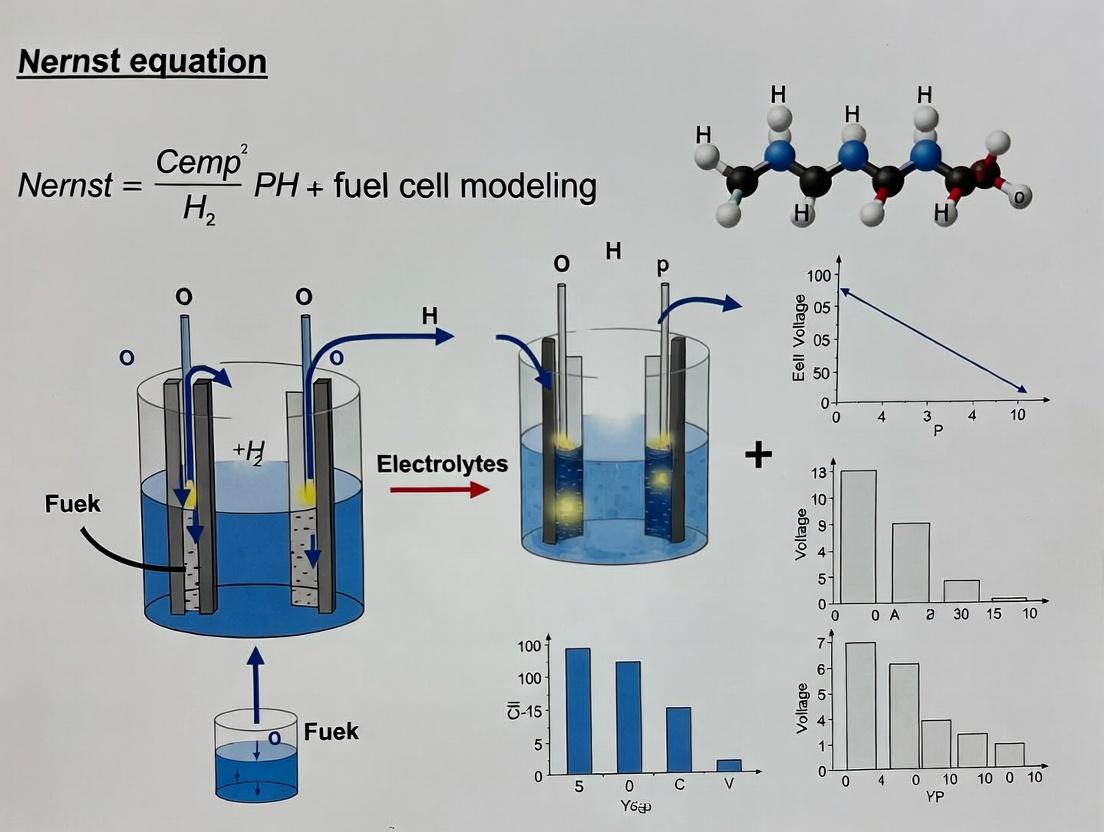
This article provides a detailed framework for applying the Nernst equation to fuel cell modeling, specifically tailored for biomedical and pharmaceutical research applications.
Modeling Fuel Cell Performance: A Comprehensive Guide to the Nernst Equation for Biomedical Researchers
Abstract
This article provides a detailed framework for applying the Nernst equation to fuel cell modeling, specifically tailored for biomedical and pharmaceutical research applications. We first establish the thermodynamic and electrochemical foundations of the equation. Next, we demonstrate its methodological application for simulating and predicting fuel cell voltage under various operating conditions, including biological contexts. We then address common challenges in model accuracy, data interpretation, and parameter optimization. Finally, we explore methods for validating Nernst-based models against experimental data and compare its utility with more complex modeling approaches. This guide empowers researchers to leverage this fundamental tool for developing and optimizing bio-electrochemical systems, such as enzymatic fuel cells for implantable devices or biosensors.
The Nernst Equation Demystified: Electrochemical Foundations for Fuel Cell Research
This application note serves as a practical and methodological companion to a broader thesis research program focused on Nernst equation-based modeling of fuel cell performance. A core thesis objective is to bridge the gap between theoretical electrochemical potential, as described by the Nernst equation for the hydrogen oxidation reaction (HOR) and oxygen reduction reaction (ORR), and the measured operational voltage of a single cell and, ultimately, a full stack. Understanding the voltage losses—activation, ohmic, and concentration overpotentials—that separate the theoretical thermodynamic voltage from the actual output is critical for validating and refining predictive models.
Core Electrochemical Principles & Quantitative Data
The theoretical open-circuit voltage (OCV) of a hydrogen fuel cell is derived from the Nernst equation for the overall cell reaction: H₂ + ½O₂ → H₂O.
Nernst Equation for a H₂/O₂ Fuel Cell:
E = E⁰ - (RT/2F) * ln( [H₂O] / ([H₂] * [O₂]^(1/2)) )
Where E⁰ is the standard cell potential (1.229 V at 25°C), R is the universal gas constant, T is temperature, and F is Faraday's constant.
Table 1: Theoretical Voltage and Key Loss Mechanisms
| Parameter | Symbol | Typical Value/Expression | Notes |
|---|---|---|---|
| Standard Potential (25°C) | E⁰ | 1.229 V | For liquid water product. |
| Reversible Thermal Voltage | E_th | ~1.18 V @ 80°C | Decreases with temperature. |
| Open Circuit Voltage (Measured) | OCV | 0.95 - 1.05 V | < E_th due to crossover/mixed potential. |
| Operating Voltage (Single Cell) | V_cell | 0.60 - 0.75 V | Under typical load (0.6-1.0 A/cm²). |
| Primary Voltage Losses | η_total | ηact + ηohm + η_conc | Summed overpotentials. |
| Activation Overpotential (Cathode) | η_act | ~0.3 - 0.4 V @ low current | Dominated by slow ORR kinetics. |
| Ohmic Overpotential | η_ohm | i * R_ohm | From membrane, contacts, electrodes. |
| Concentration Overpotential | η_conc | (RT/nF) ln(iL / (iL - i)) | Mass transport limitation at high i. |
Table 2: From Single Cell to Stack Voltage Parameters
| Component | Key Variable | Impact on Stack Voltage | Typical Value/Range |
|---|---|---|---|
| Single Cell Performance | V_cell @ i | Foundation for stack | 0.65 ± 0.1 V @ 1 A/cm² |
| Number of Cells in Series | N | Vstack = N * Vcell | 10 - 400+ cells |
| Stack Voltage Output | V_stack | N * V_cell | e.g., 6.5 V for 10-cell stack |
| Uniformity Factor | ΔV_cell (max-min) | Critical for efficiency/life | Target < 50 mV per cell |
| Stack Resistance | R_stack | ~N * (R_cell) | Causes η_ohm stack losses |
Experimental Protocols
Protocol 1: Polarization Curve Measurement for Single Cell Validation
Objective: To characterize the performance (V-i curve) of a single fuel cell, quantifying the three major loss regions for model input and validation. Materials: Single cell test station with integrated load, mass flow controllers, humidifiers, temperature controllers, and voltage/current sensors. Procedure:
- Cell Conditioning: Activate the membrane electrode assembly (MEA) by operating at 0.5 V for 1-2 hours with fully humidified H₂/air at 70°C.
- Set Baseline Conditions: Set cell temperature to 80°C. Anode (H₂) and cathode (air) stoichiometries to 2.0 and 2.5, respectively, at a reference current density (e.g., 1 A/cm²). Fully humidify both gases to 100% RH.
- Measure Open Circuit Voltage (OCV): With gases flowing, open the circuit and record stable OCV for 5 minutes.
- Potentiostatic Sweep (High Current): a. Set the electronic load to voltage control mode. b. From OCV down to 0.4 V, step in decrements of 0.02-0.05 V. c. Hold each voltage step for 60-90 seconds to reach steady-state. d. Record the average current density over the final 30 seconds of each step.
- Galvanostatic Sweep (Low Current - Activation Region): a. Switch the load to current control mode. b. From 0 A/cm² to the current density where voltage fell to ~0.85 V in step 4, step in small increments (e.g., 0.01 A/cm²). c. Hold each current step for 45-60 seconds. d. Record the average voltage over the final 20 seconds.
- Data Merging & Analysis: Combine the potentiostatic (high current) and galvanostatic (low current) data into a single V-i polarization curve. Plot voltage vs. current density. Use the derivative (dE/di) to identify the linear ohmic region and calculate area-specific resistance (ASR).
Protocol 2: Stack Voltage Uniformity Test
Objective: To measure individual cell voltages within a stack under operational load to assess uniformity, a critical factor for stack performance and durability. Materials: Fuel cell stack with cell voltage monitoring (CVM) system, test station capable of stack operation. Procedure:
- Instrumentation: Connect the CVM leads to each cell's anode and cathode bus tabs as per manufacturer instructions.
- Stack Start-up: Start the stack per its operational protocol (purge, humidify, start flows) and bring to idle load (e.g., 0.1 A/cm²) at nominal operating temperature.
- Steady-State Operation: Apply the target operational load (e.g., 0.7 A/cm²). Allow temperature, flows, and voltage to stabilize for 20 minutes.
- Voltage Snapshot: Record the voltage of every individual cell (Vn) and the total stack voltage (Vstack) simultaneously.
- Data Recording: Repeat step 4 at two additional load points (e.g., 0.3 A/cm² and 1.0 A/cm²).
- Uniformity Calculation: For each load point, calculate:
- Average cell voltage: Vavg = Vstack / N
- Maximum cell voltage deviation: ΔVmax = max\|Vn - V_avg\|
- Standard deviation of cell voltages.
Visualization: Pathways and Workflows
Title: Voltage Loss Breakdown in a Single Fuel Cell
Title: From Nernst Model to Stack Voltage Prediction
The Scientist's Toolkit: Research Reagent Solutions & Essential Materials
Table 3: Key Materials for Fuel Cell Electrochemistry Research
| Material / Solution | Function / Purpose | Specification Notes |
|---|---|---|
| Nafion Membranes | Proton exchange membrane (PEM). Conducts protons, separates gases. | Common types: Nafion 211, 212, 115. Thickness impacts ohmic resistance. |
| Catalyst Inks | Contains Pt/C (or alloy) catalyst, ionomer, solvents. Forms active electrode layers. | Pt loading (e.g., 0.1-0.4 mgPt/cm²) is key cost/performance factor. |
| Gas Diffusion Layers (GDLs) | Porous carbon paper or cloth. Distributes gas, removes water, conducts electrons. | Often coated with a microporous layer (MPL) for better water management. |
| Humidified H₂ / N₂ / Air | Reactant and inert gases for operation and testing. Precise humidity control is critical. | High purity (>99.99%). Humidification bottles or steam injectors used. |
| Single Cell Test Fixture | Hardware to house MEA, flow fields, and apply clamping pressure. | Materials: Graphite or coated metal flow fields. Precise torque control needed. |
| Cell Voltage Monitor (CVM) | System to measure voltage of each cell in a stack during operation. | Essential for diagnosing stack uniformity and failure points. |
| Electrochemical Impedance Spectrometer | Measures cell impedance across frequencies. Separates loss components (Rohm, Rct). | Used for detailed diagnosis beyond polarization curves. |
Application Notes
The Nernst equation is foundational for predicting open-circuit voltage (OCV) in electrochemical systems, particularly in fuel cell modeling. Within a thesis on advanced fuel cell research, its rigorous derivation from thermodynamic principles ensures model fidelity for energy conversion efficiency predictions, critical for material selection and system design. For researchers in adjacent fields like drug development, understanding this electrochemical potential is analogous to membrane potential calculations in neuropharmacology or ion-channel studies.
The derivation begins with the fundamental relationship between Gibbs free energy (ΔG) and electrical work for a reversible electrochemical cell: ΔG = -nFE where n is the number of electrons transferred, F is Faraday's constant, and E is the cell potential. Under non-standard conditions, the Gibbs free energy change relates to the reaction quotient (Q): ΔG = ΔG° + RT ln(Q) Combining these and substituting ΔG° = -nFE° yields the Nernst equation: E = E° - (RT/nF) ln(Q) For a generalized half-cell reaction: aA + ne⁻ ⇌ bB, the equation is expressed as: E = E° - (RT/nF) ln( [B]^b / [A]^a ) At 298.15 K (25°C), using base-10 logarithms, it simplifies to: E = E° - (0.05916 V / n) log( [B]^b / [A]^a )
Key Assumptions in Derivation:
- Reversibility: The electrochemical process is assumed to be thermodynamically reversible.
- Ideal Behavior: Activities of species can be approximated by their concentrations or partial pressures (ideal solutions/gases).
- Isothermal & Isobaric Conditions: The derivation assumes constant temperature and pressure.
- Single, Well-Defined Electrochemical Reaction: The equation applies to a specific redox couple.
Table 1: Core Constants and Variables in the Nernst Equation
| Symbol | Quantity | Typical Units | Value/Description |
|---|---|---|---|
| E | Cell Potential (EMF) | Volt (V) | Measured potential under given conditions. |
| E° | Standard Cell Potential | Volt (V) | Potential under standard state (1 M, 1 atm, 25°C). |
| R | Universal Gas Constant | J mol⁻¹ K⁻¹ | 8.314462618. |
| T | Absolute Temperature | Kelvin (K) | 298.15 K for standard simplified form. |
| n | Number of Electrons Transferred | Dimensionless | Stoichiometric coefficient from balanced redox reaction. |
| F | Faraday Constant | C mol⁻¹ | 96485.33212. |
| Q | Reaction Quotient | Dimensionless | Ratio of product activities to reactant activities. |
| ln / log | Natural / Base-10 Logarithm | - | Mathematical operators. |
Table 2: Nernst Potential Sensitivity for Common Fuel Cell Reactions at 25°C
| Reaction (Half-Cell) | Standard Potential (E°) vs. SHE | n | Nernst Equation Form (Simplified) | Sensitivity to 10x Concentration Change | |
|---|---|---|---|---|---|
| H₂ Oxidation (Acidic) | 2H⁺ + 2e⁻ ⇌ H₂ | 0.00 V | 2 | E = 0.00 - 0.059/2 * log(P_H₂/[H⁺]²) | ±29.58 mV per decade |
| O₂ Reduction (Acidic) | O₂ + 4H⁺ + 4e⁻ ⇌ 2H₂O | 1.23 V | 4 | E = 1.23 - 0.059/4 * log(1/(P_O₂*[H⁺]⁴)) | ±14.79 mV per decade |
| O₂ Reduction (Alkaline) | O₂ + 2H₂O + 4e⁻ ⇌ 4OH⁻ | 0.40 V | 4 | E = 0.40 - 0.059/4 * log([OH⁻]⁴/P_O₂) | ±14.79 mV per decade |
Experimental Protocols
Protocol 1: Empirical Validation of the Nernst Equation for a Hydrogen Electrode
Objective: To measure the potential of a Pt/H₂ electrode versus a Standard Hydrogen Electrode (SHE) at varying proton concentrations and confirm the Nernstian relationship.
Materials: See "The Scientist's Toolkit" below.
Procedure:
- Electrode Preparation: Activate the platinum foil working electrode by cycling its potential in 0.5 M H₂SO₄. Introduce hydrogen gas at 1 atm through the glass assembly, ensuring steady bubbling.
- Reference Electrode Setup: Calibrate the external reference electrode (Ag/AgCl or SCE) against a certified SHE or using standard buffer solutions.
- Solution Preparation: Prepare a series of HCl or buffer solutions with precisely known pH values (e.g., pH 1, 3, 5, 7) using high-purity water and reagents. Ionic strength may be adjusted with an inert salt (e.g., KCl).
- Measurement: Immerse the hydrogen electrode and the reference electrode in the first solution. Allow the potential to stabilize (5-10 mins). Measure the open-circuit potential (E) using a high-impedance potentiometer. Record temperature precisely.
- Data Collection: Repeat Step 4 for all prepared solutions.
- Analysis: For each measurement, calculate the theoretical Nernst potential using E_theoretical = 0.00 - (2.303RT/F) * pH, where 2.303RT/F is the pre-calculated slope (0.05916 V at 25°C). Plot measured E (vs. SHE) against pH. Perform linear regression; the slope should approximate the Nernstian factor (-59.16 mV/pH at 25°C).
Protocol 2: Determining Standard Potential (E°) via Concentration Cell
Objective: To determine the standard potential of an Mⁿ⁺/M metal couple using a concentration cell.
Procedure:
- Cell Assembly: Construct two identical electrodes from metal M (e.g., Cu). Place one in a solution of its ions at a known, high concentration (e.g., 1.0 M CuSO₄). Place the other in a solution of low concentration (e.g., 0.001 M CuSO₄). Use a salt bridge (KNO₃-agar) to complete the circuit.
- Measurement: Measure the cell potential (E_cell) at a known temperature. For a concentration cell, the overall reaction is Cu²⁺(high) → Cu²⁺(low).
- Calculation: Apply the Nernst equation: E_cell = 0 - (RT/2F) ln([Cu²⁺]_low / [Cu²⁺]_high). Since the formal E° for both half-cells is identical, it cancels. The measured E_cell depends only on the concentration ratio, allowing verification of the (RT/nF) factor.
- Extrapolation to E°: To find E° for Mⁿ⁺/M, measure the cell potential versus a SHE for the half-cell with 1.0 M Mⁿ⁺. This measured value is E°, assuming activity ~ concentration.
The Scientist's Toolkit
Table 3: Essential Research Reagent Solutions for Nernst Equation Validation
| Item | Function in Experiment |
|---|---|
| High-Impedance Potentiostat/Potentiometer | Measures open-circuit voltage without drawing significant current, preventing polarization and ensuring accurate equilibrium potential readings. |
| Platinum Working Electrode (with H₂ gas bubbler) | Serves as the inert, catalytic substrate for the hydrogen evolution/oxidation reaction (HER/HOR) in hydrogen electrode studies. |
| Stable Reference Electrode (e.g., Ag/AgCl, SCE) | Provides a constant, known reference potential against which the working electrode potential is measured. |
| Salt Bridge (KCl or KNO₃ in Agar) | Completes the electrical circuit between half-cells while minimizing liquid junction potential, allowing ion migration. |
| Standard pH Buffer Solutions | Provide solutions of known, stable hydrogen ion activity (pH) for calibrating and testing the Nernstian response of pH-sensitive electrodes. |
| High-Purity Inert Salts (e.g., KCl, KNO₃) | Used to maintain constant ionic strength across test solutions, ensuring activity coefficients remain relatively constant. |
| Ultra-Pure Water (18.2 MΩ·cm) | Minimizes contamination from ions that could interfere with potential measurements or alter solution activities. |
| Calibrated Temperature Controller | Maintains isothermal conditions during measurements, as the Nernst slope (RT/nF) is temperature-dependent. |
Visualizations
Diagram 1: Thermodynamic Derivation of the Nernst Equation (74 chars)
Diagram 2: Experimental Workflow for Nernst Equation Validation (75 chars)
Diagram 3: Nernst Equation Role in Fuel Cell Modeling Thesis (71 chars)
Within a broader thesis on Nernst equation-based fuel cell modeling, precise understanding of each equation variable and constant is paramount. The Nernst equation, ( E = E° - \frac{RT}{nF} \ln Q ), is the cornerstone for predicting open-circuit voltage (OCV) and understanding voltage losses under operational conditions. Accurate modeling directly informs material selection, system design, and performance optimization for next-generation energy conversion devices. This document provides detailed application notes and protocols for researchers, focusing on the empirical determination and application of these parameters.
Table 1: Core Constants in the Nernst Equation
| Symbol | Name | Value & Units | Physical Meaning in Fuel Cell Context |
|---|---|---|---|
| R | Universal Gas Constant | 8.314462618 J·mol⁻¹·K⁻¹ | Relates thermal energy to kinetic energy of molecules. Scales the temperature-dependent entropic contribution to cell potential. |
| F | Faraday Constant | 96485.33212 C·mol⁻¹ | Total charge of one mole of electrons. Converts molar flow of electrons (current) to electrical energy. |
| E° | Standard Cell Potential | Variable (V) | Ideal voltage at standard state (1 atm, 25°C, 1M for solutes). Intrinsic thermodynamic driving force for the cell reaction. |
Table 2: Key Experimental Variables
| Symbol | Name | Units | Role in Experiment & Modeling |
|---|---|---|---|
| E | Cell Potential | Volts (V) | The measured or predicted output voltage under non-standard conditions. The primary model output. |
| T | Temperature | Kelvin (K) | Critical operational variable. Affects kinetics, conductivity, and thermodynamic potential. |
| n | Number of Electrons | Dimensionless | Moles of electrons transferred per mole of fuel (e.g., n=2 for H₂). Defines the stoichiometry between current and reactant consumption. |
| Q | Reaction Quotient | Dimensionless | Ratio of activities of products to reactants. For H₂/O₂ fuel cell: ( Q = \frac{(P{H2O})}{(P{H2})^2 \cdot (P_{O2})} ). Links potential to operating pressures. |
Experimental Protocols
Protocol 1: Empirical Determination of E° for a H₂/O₂ Proton Exchange Membrane Fuel Cell (PEMFC) Objective: To experimentally determine the standard cell potential under controlled reference conditions. Methodology:
- Cell Conditioning: Activate a single PEMFC (Nafion membrane, Pt/C catalysts) at 80°C, 100% relative humidity, and constant current load for 24 hours.
- Reference State Establishment: Supply ultra-high purity (99.999%) H₂ and O₂ at 1.0 bar absolute pressure, saturated at 25°C. Maintain cell temperature at 25°C using a precision thermal controller.
- OCV Measurement: After 4 hours of equilibration, measure the open-circuit voltage using a high-impedance voltmeter (input impedance >1 GΩ) with a sampling rate of 1 Hz for 1 hour. Record the mean steady-state value.
- Calculation: The measured OCV under these defined standard-state conditions (1 bar, 25°C, pure gases, liquid water product) is taken as the empirical E° for that specific membrane-electrode assembly. Note: This differs from the theoretical maximum (1.229 V) due to catalyst-specific overpotentials and mixed potentials.
Protocol 2: Validating the Nernst Dependence on Reactant Partial Pressure (Variable Q) Objective: To correlate measured cell potential (E) with the reaction quotient (Q) by varying fuel/oxidant pressures. Methodology:
- Baseline: Establish steady operation per Protocol 1, Step 2 (1 bar H₂, 1 bar O₂, 25°C). Record OCV as ( E_{ref} ).
- Pressure Perturbation: Systematically vary the partial pressures. For example:
- Series A: Fix ( P{O2} ) at 1 bar, vary ( P{H2} ) to 0.5, 0.75, 1.5, and 2.0 bar.
- Series B: Fix ( P{H2} ) at 1 bar, vary ( P{O2} ) similarly.
- Allow 30 min stabilization at each new condition.
- Data Acquisition: At each condition, record OCV (E), temperature (T), and absolute pressures.
- Analysis: For each condition, calculate the theoretical ( Q ) and plot ( E ) vs. ( \frac{RT}{nF} \ln Q ). A linear fit with a slope of -1 and intercept of ( E° ) validates the Nernst relationship.
Mandatory Visualizations
Diagram Title: Nernst Equation Calculation Flow
Diagram Title: Pressure-Dependence Experimental Workflow
The Scientist's Toolkit: Research Reagent Solutions & Essential Materials
Table 3: Key Research Materials for Nernstian Analysis in Fuel Cells
| Item | Function/Explanation |
|---|---|
| High-Purity H₂ & O₂ Gas (99.999%) | Ensures defined reactant activities and eliminates voltage depression from impurities (e.g., CO). |
| Mass Flow Controllers (MFCs) | Precisely regulate and quantify reactant gas flow rates to the fuel cell. |
| Back-Pressure Regulators | Accurately control the absolute pressure at the anode and cathode, defining Q. |
| Temperature-Controlled Test Station | Maintains precise and uniform cell temperature (T), a critical variable in RT/nF. |
| Potentiostat / High-Impedance Voltmeter | Measures open-circuit voltage (E) without drawing significant current, ensuring accurate thermodynamic readings. |
| Humidification System | Controls water vapor partial pressure, which is critical for membrane conductivity and is a component of Q in vapor-phase cells. |
| Membrane Electrode Assembly (MEA) | The core cell component where the reaction (defining n) occurs. Catalyst loading impacts experimental E°. |
| Electrochemical Impedance Spectroscopy (EIS) Unit | Used in parallel to diagnose kinetic losses, ensuring measured OCV changes are truly Nernstian (thermodynamic) and not due to changing resistance. |
Application Notes
Within the framework of Nernst equation fuel cell modeling research, the reaction quotient (Q) serves as the critical operational link between the instantaneous concentrations of reactants and products and the measurable cell voltage (E). Unlike the equilibrium constant (K), which defines the thermodynamic endpoint, Q describes the system's status in real-time under non-standard conditions. For a generalized redox reaction: ( aA + bB \rightarrow cC + dD ), the Nernst equation is expressed as: [ E = E^0 - \frac{RT}{nF} \ln Q = E^0 - \frac{RT}{nF} \ln \left( \frac{[C]^c [D]^d}{[A]^a [B]^b} \right) ] where (E^0) is the standard cell potential. In fuel cells (e.g., PEMFCs), this translates directly to the dependence of output voltage on reactant (H₂, O₂) partial pressures and the concentration of products (H₂O). Monitoring Q through voltage measurement provides a non-invasive diagnostic for concentration overpotentials, catalyst activity, and membrane hydration status.
Key Quantitative Relationships
Table 1: Impact of Q on Fuel Cell Voltage (at 298 K)
| Reaction Quotient (Q) | Relation to K | Cell Voltage (E) vs. Standard (E⁰) | Physical State in Fuel Cell |
|---|---|---|---|
| Q < K (Q << 1) | Reactants in excess | E > E⁰ | High reactant feed, dry membrane |
| Q = K | At equilibrium | E = 0 (Cell "dead") | No net reaction, zero current |
| Q > K (Q >> 1) | Products in excess | E < E⁰ | Flooded cathode, low reactant supply |
Table 2: Nernst Equation Parameters for Common Half-Cells
| Half-Reaction | n (e⁻) | Standard Potential (E⁰ vs. SHE) | Q Expression (Ox/Red) |
|---|---|---|---|
| O₂ + 4H⁺ + 4e⁻ ⇌ 2H₂O | 4 | +1.229 V | 1/(P_O₂ • [H⁺]⁴) |
| 2H⁺ + 2e⁻ ⇌ H₂ | 2 | 0.000 V | P_H₂/[H⁺]² |
| Pd²⁺ + 2e⁻ ⇌ Pd | 2 | +0.915 V | 1/[Pd²⁺] |
Experimental Protocols
Protocol 1: Determining Q from In-Situ Voltage in an H₂/O₂ PEM Fuel Cell
Objective: To calculate the instantaneous reaction quotient (Q) for the cathode and anode during fuel cell operation by measuring cell voltage under varied reactant concentrations.
Materials & Setup:
- Single-cell PEMFC test station with temperature control.
- Mass flow controllers for H₂ and O₂ (or air).
- Humidification bottles for anode and cathode feeds.
- Potentiostat/Galvanostat with high-impedance voltage sensing.
- Back-pressure regulators on outlet streams.
- In-line dew point sensors for anode and cathode.
Procedure:
- Baseline Conditioning: Operate the cell at standard conditions (80°C, 100% RH, 1.5 bar abs, stoichiometry λ=2 for H₂ and λ=9.5 for air) at 0.5 A/cm² for 1 hour to stabilize.
- Voltage Measurement Series: a. Fix the current density at a chosen value (e.g., 0.2 A/cm²). b. Systematically vary the partial pressure of one reactant. For the cathode: Reduce O₂ partial pressure by diluting with N₂ or changing the back-pressure. Record the steady-state cell voltage (E) after 5 minutes at each step. c. Return to standard conditions and repeat for anode H₂ partial pressure.
- Data Calculation: a. Using the Nernst equation for the full cell: ( E = E^0 - \frac{RT}{4F} \ln Q{cell} ). b. Assume (E^0) is 1.229 V at 25°C (adjust for temperature using thermodynamic tables). c. Solve for (Q{cell}) at each step: ( Q{cell} = \exp\left( \frac{4F}{RT} (E^0 - E) \right) ). d. For a PEMFC, ( Q{cell} \approx \frac{[H2O]{cathode}^2}{(P{H2})^2 \cdot P{O2}} ), assuming unit activity for H⁺ in the hydrated membrane.
- Analysis: Plot Q vs. reactant partial pressure. Deviation from ideal theory indicates mass transport limitations or catalyst flooding.
Protocol 2: Calibrating Voltage-Based Concentration Sensing for Electrolyte Species
Objective: To establish a calibration curve relating measured half-cell potential to concentration of a redox-active species (e.g., Fe³⁺/Fe²⁺), thereby defining Q.
Materials & Setup:
- Three-electrode electrochemical cell (Working: Pt, Reference: SCE, Counter: Pt mesh).
- Potentiostat.
- Solutions of 0.1 M KCl as supporting electrolyte.
- Stock solutions of 0.1 M FeCl₃ and 0.1 M FeCl₂.
Procedure:
- Prepare 10 solutions with varying [Fe³⁺]/[Fe²⁺] ratios (from 0.01 to 100) while keeping the total iron concentration constant (e.g., 10 mM).
- For each solution, deoxygenate with N₂ for 10 minutes.
- Measure the open circuit potential (OCP) of the Pt working electrode vs. SCE. Allow potential to stabilize (±1 mV/min).
- Data Processing: a. The half-cell reaction is Fe³⁺ + e⁻ ⇌ Fe²⁺. b. The Nernst equation: ( E = E^{0'} - \frac{RT}{F} \ln Q = E^{0'} - \frac{RT}{F} \ln \frac{[Fe^{2+}]}{[Fe^{3+}]} ). c. Plot measured E vs. ( \ln([Fe^{2+}]/[Fe^{3+}]) ). The slope should be -RT/F (~ -59.2 mV/dec at 298K) and the intercept gives the formal potential (E^{0'}).
- Application: This calibration allows the use of this electrode as a sensor for Q (and thus concentration ratio) in unknown solutions by measuring OCP.
The Scientist's Toolkit
Table 3: Key Research Reagent Solutions & Materials
| Item | Function in Q/Voltage Experiments |
|---|---|
| Proton Exchange Membrane (e.g., Nafion 211) | Solid electrolyte for H⁺ conduction; defines the electrochemical cell environment. |
| High-Purity H₂ and O₂/Air Gas Cylinders with Mass Flow Controllers (MFCs) | Provide precise and variable reactant partial pressures to manipulate Q. |
| Potentiostat/Galvanostat (e.g., Bio-Logic VSP-300) | Accurately applies current and measures resulting voltage (or measures OCP) with high precision. |
| Saturated Calomel Electrode (SCE) or Ag/AgCl Reference Electrode | Provides stable reference potential for half-cell measurements in aqueous systems. |
| Dew Point Sensors/Humidity Probes | Quantify water vapor activity (a product in fuel cells), a critical component in Q. |
| Back-Pressure Regulators | Control total system pressure, directly affecting reactant partial pressures and Q. |
Visualizations
Title: From Concentrations to Voltage via Q and Nernst
Title: Fuel Cell Q Determination Protocol Workflow
Within a broader thesis on Nernst equation fuel cell modeling research, the Open-Circuit Voltage (OCV) stands as the fundamental thermodynamic potential. It represents the maximum voltage achievable by an electrochemical cell under ideal, equilibrium conditions with zero current flow. This application note details the experimental protocols and theoretical underpinnings for accurately determining and validating OCV as predicted by the Nernst equation, a cornerstone for researchers and scientists in energy and material development.
Theoretical Foundation: The Nernst Equation for OCV
For a generic fuel cell reaction ( aA + bB \rightarrow cC + dD ), the Nernst equation predicts the OCV (often denoted as ( E{cell} ) or ( E{OCV} )):
$$ E{OCV} = E^0 - \frac{RT}{nF} \ln \left( \frac{aC^c \cdot aD^d}{aA^a \cdot a_B^b} \right) $$
Where:
- ( E^0 ): Standard cell potential at standard conditions (298.15 K, 1 atm, 1 M).
- ( R ): Universal gas constant (8.314 J mol⁻¹ K⁻¹).
- ( T ): Absolute temperature in Kelvin.
- ( n ): Number of electrons transferred per reaction equivalent.
- ( F ): Faraday constant (96485 C mol⁻¹).
- ( a_i ): Activity of species ( i ) (often approximated by concentration or partial pressure for gases).
Application Notes & Key Considerations
Assumptions & Ideal Conditions
The Nernstian OCV prediction holds under strict assumptions:
- Electrochemical Equilibrium: No net current flow.
- Reversible Electrode Processes: Reactions are kinetically fast and reversible.
- No Mixed Potentials: Electrodes are not susceptible to parasitic side reactions.
- Ideal Behavior: Activities are accurately known; no concentration gradients.
- No Internal Shorts/Leakage: Infinite ionic resistance across the electrolyte.
Deviations in measured OCV from the Nernst prediction indicate non-ideal behavior, catalyst poisoning, fuel crossover, or short-circuiting.
Primary Applications in Research
- Catalyst Benchmarking: Comparing measured OCV to theoretical for new electrocatalysts.
- Membrane Integrity Testing: Fuel crossover reduces OCV; Nernst serves as a baseline.
- System Diagnostics: Identifying failure modes in fuel cell stacks.
- Model Validation: OCV is the foundational boundary condition in continuum-scale fuel cell models.
Experimental Protocols for OCV Measurement & Validation
Protocol 1: Standard H₂/O₂ PEM Fuel Cell OCV Measurement
Objective: To measure the steady-state OCV of a Proton Exchange Membrane (PEM) fuel cell and compare it to the Nernst-predicted value.
Materials: See Scientist's Toolkit in Section 6.
Pre-Experimental Setup:
- Assemble fuel cell with pretreated MEA, following torque specifications for bolts.
- Connect cell to test station gas lines, electrical leads, and temperature sensors.
- Conditioning: Activate catalyst by operating the cell at 0.5 V under H₂/air for 2-4 hours.
Procedure:
- Set cell temperature to desired value (e.g., 80°C). Allow to stabilize for 30 min.
- Supply humidified H₂ (100% RH) to anode and humidified O₂ (100% RH) to cathode.
- Flow rates: 200 sccm (anode), 300 sccm (cathode) at ambient pressure.
- Allow gases to purge for 15 minutes with outlet valves open.
- OCV Measurement: a. Connect a high-impedance voltmeter (>10 MΩ) across the cell terminals. b. With no external load, record voltage every second for 30 minutes. c. Calculate the average and standard deviation of the last 10 minutes of stable data.
- Data Recording: Record ( T_{cell} ), gas pressures (anode, cathode), gas composition, and humidity.
- Post-Measurement: Immediately after OCV reading, perform a cyclic voltammetry scan to check for catalyst health and absence of shorts.
Data Analysis:
- Calculate theoretical OCV using the Nernst equation with measured partial pressures.
- Compare measured vs. theoretical. A difference >~50 mV typically warrants investigation.
Protocol 2: OCV vs. Temperature Study for Nernst Validation
Objective: To experimentally verify the linear relationship between OCV and temperature (in Kelvin) as predicted by the Nernst equation.
Procedure:
- Follow Protocol 1 steps 1-3 for setup and conditioning.
- Set a baseline temperature (e.g., 40°C). Achieve stable OCV (Protocol 1, Step 3).
- Increment cell temperature in steps of 10°C up to 90°C. At each step, allow 45 min for thermal equilibration before taking a 10-minute stabilized OCV reading.
- Maintain constant gas humidification and pressure throughout.
Analysis:
- Plot measured OCV vs. T (K). Perform linear regression.
- Compare slope to theoretical slope from the Nernst term ( -\frac{RT}{nF} \ln(Q) ).
Data Presentation
Table 1: Theoretical OCV for H₂/O₂ PEM Fuel Cell at 80°C
| Parameter | Symbol | Value | Unit | Notes |
|---|---|---|---|---|
| Standard Potential | ( E^0 ) | 1.229 | V | at 25°C, 1 atm |
| Temperature | ( T ) | 353.15 | K | 80°C |
| Electrons Transferred | ( n ) | 2 | - | per H₂ molecule |
| H₂ Partial Pressure | ( P{H2} ) | 1.0 | atm | Assumed pure, dry |
| O₂ Partial Pressure | ( P{O2} ) | 1.0 | atm | Assumed pure, dry |
| Nernst OCV | ( E_{OCV} ) | 1.185 | V | Calculated for pure gases |
Table 2: Typical Measured vs. Theoretical OCV for Common Fuel Cells
| Fuel Cell Type | Anode Gas | Cathode Gas | Temp. (°C) | Theoretical OCV (V) | Typical Measured OCV (V) | Common Reason for Deviation |
|---|---|---|---|---|---|---|
| PEMFC | H₂ (pure) | O₂ (pure) | 80 | 1.185 | 1.15 - 1.18 | H₂ crossover, minor side reactions |
| PEMFC | H₂ (reformate) | Air | 80 | ~1.17 | 0.95 - 1.05 | CO poisoning, mixed potentials |
| SOFC | H₂ | Air | 800 | ~1.18 | 1.05 - 1.15 | Electronic leakage in electrolyte |
The Scientist's Toolkit: Research Reagent Solutions & Essential Materials
| Item/Reagent | Function/Brief Explanation |
|---|---|
| Membrane Electrode Assembly (MEA) | Core component: Proton-conducting membrane with catalyst layers (Pt/C). Defines reaction sites. |
| High-Impedance Voltmeter (Digital Multimeter) | Measures voltage with minimal current draw (<100 nA) to prevent polarization. |
| Environmental Test Station | Precisely controls gas flow, humidity, back-pressure, and cell temperature. |
| Ultra-High Purity Gases (H₂, O₂, N₂) | Minimize impurities that poison catalysts and alter Nernst potential. |
| Humidification Bottles/Bubblers | Saturate gas streams with water vapor to prevent membrane drying. |
| Torque Wrench | Ensures uniform compression of cell hardware, critical for consistent contact and sealing. |
| Reference Electrode (if applicable) | For half-cell OCV measurement, to decouple anode and cathode potentials. |
| Electrochemical Impedance Spectrometer (EIS) | Used post-OCV to diagnose internal resistance and fuel crossover. |
Visualizations
Diagram 1 Title: OCV Measurement & Validation Experimental Workflow
Diagram 2 Title: Logical Relationship from Nernst Inputs to Diagnostic Output
This document details application notes and protocols for biomedical devices rooted in Nernstian principles. The broader thesis posits that the Nernst equation is the foundational model for predicting open-circuit voltage and thermodynamic efficiency in fuel cells, including biological and implantable systems. Accurate modeling of electron transfer kinetics (Butler-Volmer) coupled with mass transport limitations is critical for designing efficient bio-electrochemical devices for power and sensing.
Application Notes
Enzymatic Bio-Fuel Cells (EBFCs) for Implantable Power
EBFCs utilize oxidoreductase enzymes (e.g., glucose oxidase, bilirubin oxidase) as biocatalysts on bioanodes and biocathodes. The Nernst equation models the potential difference generated from the concentration gradient of fuel (e.g., glucose) and oxidant (e.g., O₂) in physiological fluid.
- Key Challenge: Achieving high current density and long-term stability in vivo.
- Recent Advancements: Use of redox hydrogels and mediated electron transfer (MET) with osmium complexes to enhance electron shuttling and enzyme stability. Recent in vivo prototypes demonstrate power outputs sufficient for low-power sensors and drug delivery actuators.
Table 1: Recent Performance Metrics of Implantable Glucose/O₂ EBFCs
| System Configuration | Max Power Density (µW/cm²) | Operational Lifetime (in vivo) | Voltage Output (V) | Ref. Year |
|---|---|---|---|---|
| Carbon nanotube/Os-hydrogel anode & cathode | 43.5 ± 2.1 | 7 days (rat) | 0.57 @ 37°C | 2023 |
| Buckypaper with adsorbed enzymes | 120 | 1 hour (simulated body fluid) | 0.80 | 2024 |
| Microneedle array EBFC | 18.6 | 24 hours (ex vivo porcine skin) | 0.52 | 2023 |
Self-Powered Biosensing
A biosensor can be integrated with an EBFC, where the analyte of interest modulates the fuel cell's output (current/voltage). The Nernstian relationship between analyte concentration and potential shift is the transduction mechanism.
- Principle: The target analyte (inhibitor, co-substrate, or fuel) alters the enzymatic reaction rate, changing the local concentration of reactants/products, thereby shifting the electrode potential as per the Nernst equation.
- Example: A lactate biosensor where the anode uses lactate oxidase. The measured current is directly proportional to lactate concentration in sweat or blood.
Table 2: Characteristics of Nernstian-Based Self-Powered Biosensors
| Target Analyte | Biocatalyst | Linear Range | Detection Limit | Response Time | Medium |
|---|---|---|---|---|---|
| Glucose | Glucose dehydrogenase | 0.1 – 30 mM | 50 µM | <5 s | Interstitial fluid |
| Lactate | Lactate oxidase | 0.05 – 25 mM | 20 µM | ~10 s | Human sweat |
| Cholesterol | Cholesterol oxidase | 0.01 – 10 mM | 5 µM | ~30 s | Serum |
Implantable Power for Drug Delivery
Miniaturized EBFCs can power feedback-controlled implantable drug pumps. The Nernst-modeled voltage can trigger release mechanisms (e.g., electromechanical valves, electro-responsive hydrogels) when metabolite concentrations reach a threshold.
Experimental Protocols
Protocol 1: Fabrication and Testing of a Glucose/O₂ Redox-Hydrogel EBFC
Objective: To construct a membrane-less EBFC and characterize its power output using cyclic voltammetry and chronoamperometry. Materials: See Scientist's Toolkit. Procedure:
- Electrode Preparation: Polish glassy carbon electrodes (GCE, 3mm diameter) sequentially with 1.0, 0.3, and 0.05 µm alumina slurry. Sonicate in DI water and ethanol.
- Hydrogel Preparation: Prepare separate anodic and cathodic solutions.
- Anode Solution: Mix 10 µL glucose oxidase (GOx, 10 mg/mL), 10 µL of an osmium-based redox polymer (e.g., [Os(bpy)₂(PVI)₁₀Cl]Cl), and 5 µL of a cross-linker (e.g., polyethylene glycol diglycidyl ether, PEGDGE).
- Cathode Solution: Mix 10 µL bilirubin oxidase (BOD, 10 mg/mL) with its corresponding Os-polymer and PEGDGE.
- Electrode Modification: Pipette 5 µL of the anodic mixture onto a clean GCE. Repeat for the cathodic mixture on a second GCE. Allow to cure at 4°C for 24 hours in a humid chamber.
- Electrochemical Cell Assembly: Assemble in a stirred, air-saturated phosphate buffer (0.1 M, pH 7.4) containing 5 mM glucose at 37°C. Use the GOx electrode as the anode and BOD electrode as the cathode. Connect via an external circuit with a potentiostat.
- Performance Evaluation:
- Cyclic Voltammetry (CV): Scan each bioelectrode independently vs. Ag/AgCl reference from -0.2 to +0.6 V (anode) and +0.2 to +0.8 V (cathode) at 1 mV/s to confirm redox activity.
- Polarization Curve: Connect the full cell and use linear sweep voltammetry from open-circuit voltage (OCV) to 0 V at 0.1 mV/s. Record current.
- Power Calculation: Plot power (P = I x V) vs. voltage. The peak is the maximum power density.
Protocol 2: Calibration of a Self-Powered Lactate Biosensor
Objective: To derive a calibration curve for lactate concentration using an EBFC-based sensor. Procedure:
- Sensor Construction: Fabricate a lactate/O₂ EBFC using lactate oxidase (LOx) at the anode and BOD at the cathode, as in Protocol 1.
- Baseline Measurement: Immerse the EBFC in 10 mL of stirred, air-saturated phosphate buffer (0.1 M, pH 7.4) at 37°C. Record the steady-state short-circuit current (I_sc) under zero lactate conditions.
- Sparging & Standard Additions: Deoxygenate the buffer by sparging with N₂ for 15 minutes to minimize O₂ interference at the cathode. Maintain a gentle N₂ blanket.
- Add Lactate Standards: Sequentially add small volumes of a concentrated lactate stock solution to achieve increasing concentrations in the range of 0.05–25 mM. After each addition, allow the current to stabilize (≈60 s) and record I_sc.
- Data Analysis: Plot the steady-state I_sc vs. lactate concentration. Perform linear regression on the linear region. The slope represents the sensor sensitivity (µA/mM).
Mandatory Visualizations
Diagram Title: Bio-Fuel Cell Operational Workflow
Diagram Title: Thesis Research Pathway for Fuel Cell Modeling
The Scientist's Toolkit
Table 3: Key Research Reagent Solutions for EBFC Development
| Item | Function/Description | Example Product/Catalog |
|---|---|---|
| Oxidoreductase Enzymes | Biocatalysts for specific fuel/oxidant. Thermostable mutants are preferred. | Glucose oxidase from Aspergillus niger, Bilirubin oxidase from Myrothecium verrucaria. |
| Osmium-based Redox Polymers | Mediate electron transfer between enzyme active site and electrode. Provide a 3D hydrogel matrix. | [Os(4,4′-dimethyl-2,2′-bipyridine)₂(PVI)₁₀Cl]Cl (Anode polymer). |
| Cross-linker (PEGDGE) | Forms stable, cross-linked hydrogel network on electrode surface, entrapping enzymes and polymer. | Poly(ethylene glycol) diglycidyl ether (MW 500 Da). |
| Phosphate Buffer Salts (PBS) | Provides physiological pH (7.4) and ionic strength for in vitro testing. | 0.1 M Potassium Phosphate Buffer, pH 7.4. |
| Nafion Perfluorinated Resin | Cation-exchange polymer coating; can protect bioelectrode from fouling and interference. | 5% w/w solution in lower aliphatic alcohols. |
| Multi-Walled Carbon Nanotubes (MWCNTs) | High-surface-area electrode nanomaterial to increase enzyme loading and enhance electron transfer. | Carboxylated MWCNTs, 10 nm diameter. |
| Potentiostat/Galvanostat | Instrument for applying potential/current and measuring electrochemical response. | Biologic SP-300, Autolab PGSTAT204. |
Step-by-Step Guide: Applying the Nernst Equation in Fuel Cell Modeling and Simulation
Within the broader thesis on Nernst equation fuel cell modeling research, the accurate calculation of the standard cell potential (E°) is a foundational step. This potential, measured under standard conditions (298.15 K, 1 bar pressure, 1 M concentration for solutes), dictates the theoretical maximum voltage and spontaneous direction of an electrochemical cell. For researchers, including those in drug development where electrochemical sensors and biofuel cells are prevalent, proficiency in sourcing and applying thermodynamic data is crucial. This protocol details the methodologies for determining E° using standard reference tables.
The standard cell potential is calculated from the standard reduction potentials of the half-reactions: E°cell = E°cathode (reduction) - E°anode (oxidation)
The most authoritative and current source for standard reduction potentials is the IUPAC-sponsored "Standard Potentials in Aqueous Solutions" and online databases like the NIST Chemistry WebBook. For fuel cell modeling, data must be checked for consistency with the desired temperature and pH.
Table 1: Selected Standard Reduction Potentials at 298.15 K
| Half-Reaction (Reduction) | E° (V vs. SHE) | Common Application Context |
|---|---|---|
| O₂(g) + 4H⁺ + 4e⁻ ⇌ 2H₂O(l) | +1.229 | Acidic Environment Fuel Cell Cathode |
| O₂(g) + 2H₂O + 4e⁻ ⇌ 4OH⁻(aq) | +0.401 | Alkaline Environment Fuel Cell Cathode |
| 2H⁺ + 2e⁻ ⇌ H₂(g) | 0.000 by definition | Standard Hydrogen Electrode (SHE) |
| AgCl(s) + e⁻ ⇌ Ag(s) + Cl⁻ | +0.222 | Reference Electrode |
| Cu²⁺ + 2e⁻ ⇌ Cu(s) | +0.337 | Electrochemical Sensing |
| Fe³⁺ + e⁻ ⇌ Fe²⁺ | +0.771 | Redox Couple in Drug Metabolism |
Protocol: Calculating E° for a H₂/O₂ Proton Exchange Membrane Fuel Cell
This protocol outlines the steps to calculate the standard cell potential for a typical acidic fuel cell, a core component in thesis modeling work.
Objective: To determine the theoretical standard cell potential for the reaction: 2H₂(g) + O₂(g) → 2H₂O(l).
Materials & Reagents:
- Research Reagent Solutions & Essential Materials
- Standard Reference Tables: IUPAC or NIST thermodynamic data. Function: Provides authoritative E° values for half-reactions.
- Software: Spreadsheet (e.g., Excel, Google Sheets) or computational tool (Python with Pandas). Function: For data management and calculation.
- Electrochemical Series Chart: Function: Quick visual reference for relative reduction strengths.
- SHE Definition Documentation: Function: Ensishes calculation anchor to the standard zero point.
Procedure:
- Identify Half-Reactions:
- Cathode (Reduction): O₂(g) + 4H⁺(aq) + 4e⁻ → 2H₂O(l)
- Anode (Oxidation): 2H₂(g) → 4H⁺(aq) + 4e⁻ (This is the reverse of the standard H⁺/H₂ reduction).
Source Standard Potentials:
- Consult the latest IUPAC or NIST database.
- Record: E° for O₂ reduction to H₂O in acid: +1.229 V.
- Record: E° for 2H⁺/H₂ couple: 0.000 V by definition.
Apply the Calculation Formula:
- E°cell = E°cathode - E°anode
- The anode potential is the potential for the reaction as it occurs in the cell, which is the oxidation of H₂. Therefore, E°anode = -E°(H⁺/H₂) = -0.000 V.
- Calculation: E°cell = (+1.229 V) - (0.000 V) = +1.229 V.
Validate with Free Energy Data (Alternative Method):
- Source standard Gibbs free energy of formation (ΔfG°) for H₂O(l), O₂(g), and H₂(g) from the same thermodynamic tables.
- Calculate ΔrG° = ΣΔfG°(products) - ΣΔfG°(reactants). For the reaction, ΔrG° = 2ΔfG°[H₂O(l)].
- Use the relationship ΔrG° = -nFE° to solve for E°.
- Cross-check: The calculated E° should match the value from Step 3 within experimental uncertainty.
Protocol: Calculating E° for a Custom Redox Couple (e.g., in Biosensor Development)
Drug development researchers often characterize novel redox-active compounds.
Objective: To calculate E° for a novel compound "Redox-Drug" (RD) where RDox + 2e⁻ + 2H⁺ ⇌ RDredH₂.
Procedure:
- Set Up a Reference Electrode Experiment:
- Use a three-electrode cell (working, reference, counter).
- Prepare 1.0 mM solutions of both RDox and RDredH₂ in a pH 7.0 buffer (maintaining standard 1 M is often impractical for drugs; note this deviation).
- Use a saturated calomel electrode (SCE, E = +0.241 V vs. SHE) or Ag/AgCl as reference.
Measure the Formal Potential (E°'):
- Perform cyclic voltammetry.
- Identify the midpoint potential (E1/2) between the oxidation and reduction peaks. This is the formal potential E°' at pH 7.0.
Convert to Standard Potential (E°):
- Account for the pH difference from standard state (1 M H⁺, pH 0). Use the Nernst equation for the hydrogen ions involved.
- For a 2H⁺ coupled reaction: E°' ≈ E° - (0.05916/2)*log(1/[H⁺]²) at 298K. Therefore, E° ≈ E°' - 0.05916 * pH.
- Calculation: If E°' (pH 7.0) = +0.150 V vs. SHE, then E° ≈ 0.150 V - (0.05916 * 7) = -0.264 V vs. SHE.
Integration into Nernst Equation Fuel Cell Modeling
The calculated E° serves as the constant in the Nernst equation, which models the actual cell voltage (E) under non-standard conditions: E = E° - (RT/nF) * ln(Q) Where Q is the reaction quotient. Accurate E° is paramount for predictive model validity.
Title: E° Calculation Workflow for Nernst Model
The Scientist's Toolkit: Key Research Reagent Solutions & Materials
| Item | Function in E° Determination |
|---|---|
| Standard Hydrogen Electrode (SHE) Setup | The primary reference defining 0.000 V; used to calibrate all other potentials. |
| Secondary Reference Electrodes (Ag/AgCl, SCE) | Stable, practical reference electrodes with known, fixed potential vs. SHE for lab measurements. |
| High-Purity Buffer Solutions | Maintain constant pH during measurement of formal potentials (E°') for biochemical species. |
| Purified Redox Couple Solutions | Analyte solutions (e.g., K₃[Fe(CN)₆]/K₄[Fe(CN)₆]) for validating experimental setups and electrode function. |
| Inert Electrolyte Salt (e.g., KCl, KNO₃) | Provides ionic conductivity in solution without participating in redox reactions. |
| Electrochemical Workstation | Instrument for performing cyclic voltammetry, potentiometry, and other techniques to measure potentials. |
| Thermodynamic Database Subscription | Access to current, peer-reviewed E° and ΔfG° data (e.g., NIST, CRC Handbook). |
Within the broader thesis on advancing Nernst equation-based fuel cell modeling, a critical challenge is the accurate formulation of the reaction quotient (Q) for complex, non-ideal systems. The Nernst equation (E = E° - (RT/nF)lnQ) is the cornerstone for predicting cell potential under non-standard conditions. While straightforward for the H₂/O₂ fuel cell, deriving Q for microbial fuel cells (MFCs) and enzymatic biofuel cells (EBFCs) is complicated by heterogeneous biocatalysts, multi-step enzymatic pathways, and ill-defined metabolic substrates. This application note provides explicit Q formulations and associated experimental protocols to standardize this essential parameter across fuel cell types, thereby enhancing the predictive fidelity of thermodynamic models in electrochemical and bio-electrochemical research.
Reaction Quotient (Q) Formulations and Comparative Data
The reaction quotient Q is defined as the product of the activities of the products divided by the product of the activities of the reactants, each raised to the power of its stoichiometric coefficient. For dilute aqueous systems, concentrations (mol L⁻¹) and partial pressures (bar) are often used as approximations for activity.
Table 1: Reaction Quotient (Q) Formulations for Different Fuel Cell Types
| Fuel Cell Type | Overall Anode & Cathode Reaction | Formulated Reaction Quotient (Q) | Key Assumptions & Notes |
|---|---|---|---|
| H₂/O₂ (Acidic) | Anode: H₂ → 2H⁺ + 2e⁻ Cathode: ½O₂ + 2H⁺ + 2e⁻ → H₂O Overall: H₂ + ½O₂ → H₂O | Q = (a_H₂O) / (a_H₂ * a_O₂^(1/2)) ≈ 1 / (P_H₂ * P_O₂^(1/2)) |
For gaseous reactants: activity ≈ partial pressure (P, in bar). Water activity (a_H₂O) ≈ 1 for liquid water product. |
| Microbial (MFC)(Acetate Oxidation) | Anode: CH₃COO⁻ + 4H₂O → 2HCO₃⁻ + 9H⁺ + 8e⁻ Cathode: O₂ + 4H⁺ + 4e⁻ → 2H₂O Scaled Overall: CH₃COO⁻ + 2O₂ → 2HCO₃⁻ + H⁺ | Q = (a_HCO₃⁻^2 * a_H⁺) / (a_CH₃COO⁻ * a_O₂^2) |
Proton activity (pH) is critical. Bicarbonate (HCO₃⁻) concentration depends on buffer capacity and CO₂ partial pressure. |
| Enzymatic (EBFC)(Glucose/O₂) | Anode: Glucose → Gluconolactone + 2H⁺ + 2e⁻ Cathode: ½O₂ + 2H⁺ + 2e⁻ → H₂O Overall: Glucose + ½O₂ → Gluconolactone + H₂O | Q = (a_Gluconolactone * a_H₂O) / (a_Glucose * a_O₂^(1/2)) |
Gluconolactone often hydrolyzes to gluconic acid, altering Q. Enzyme kinetics (not just thermodynamics) often dominate cell voltage. |
Experimental Protocols for Determining Q Parameters
Protocol 3.1: Measuring Partial Pressures for H₂/O₂ Fuel Cell Q Calculation Objective: Determine the partial pressures of H₂ and O₂ at the catalyst surface for accurate Q input. Materials: Mass flow controllers (MFCs), back-pressure regulator, calibrated pressure transducer, humidifier system, electrochemical cell. Procedure:
- Calibrate all MFCs and pressure sensors using standard reference gases.
- Set the desired stoichiometric flow ratio (e.g., 1.5x for H₂, 2.0x for O₂) based on current density.
- Humidify both fuel and oxidant streams to the target dew point (e.g., 80°C) using temperature-controlled bubbler columns.
- Install a back-pressure regulator on the exhaust lines and set cell operating pressure (e.g., 1.5 bar absolute).
- Record the stabilized pressure readings. Calculate partial pressures: P_i = (MFC_set_flow_i / Total_outlet_flow) * (Absolute_pressure - Vapor_pressure_of_water).
- Input P_H₂ and P_O₂ into the Q expression in Table 1.
Protocol 3.2: Quantifying Species for Microbial Fuel Cell Q Calculation Objective: Measure concentrations of acetate, bicarbonate, and protons (pH) in an MFC anode chamber. Materials: HPLC system (with RI/UV detector), ion chromatograph, pH probe, anaerobic sampling syringe, phosphate buffer. Procedure:
- Anaerobic Sampling: Under constant nitrogen purge, extract 1 mL of anode electrolyte using a gas-tight syringe.
- Acetate & Bicarbonate Analysis: Filter sample (0.2 µm). Inject 10 µL into HPLC (Aminex HPX-87H column, 5 mM H₂SO₄ mobile phase, 0.6 mL/min, 45°C) for acetate. For bicarbonate, use ion chromatography (AS-11 HC column, KOH eluent gradient) or calculate from pH and pCO₂ (see step 3).
- pH and pCO₂: Measure pH in situ with a calibrated probe. To determine bicarbonate activity, use the Henderson-Hasselbalch equation: [HCO₃⁻] = K₁ * pCO₂ / [H⁺], where K₁ is the first apparent dissociation constant of carbonic acid. pCO₂ can be measured via a dissolved CO₂ sensor or assumed in equilibrium with the headspace.
- Calculate Q: Use concentrations from steps 2 & 3 as approximations for activities in the MFC Q expression from Table 1.
Protocol 3.3: Monitoring Substrate/Product for Enzymatic Fuel Cell Q Calculation Objective: Track glucose and gluconolactone/gluconate concentrations in an operating EBFC. Materials: Glucose oxidase (GOx) / laccase-based EBFC, electrochemical workstation, spectrophotometer, glucose assay kit (glucose oxidase-peroxidase chromogenic). Procedure:
- EBFC Operation: Construct EBFC with GOx anode (on mediated carbon felt) and laccase cathode. Immerse in stirred, buffered glucose solution (e.g., 10 mM, pH 7.4, 37°C).
- Kinetic Sampling: At regular intervals (0, 5, 15, 30 min), withdraw 100 µL aliquots.
- Glucose Quantification: Use a commercial glucose assay kit. Mix 10 µL sample with 200 µL assay reagent, incubate for 15 min at 37°C, measure absorbance at 540 nm. Calculate concentration from a standard curve.
- Gluconate Quantification: Gluconolactone rapidly hydrolyzes to gluconate. Measure gluconate via a gluconate kinase assay kit or by enzymatic conversion coupled to NADPH production (absorbance at 340 nm).
- Calculate Q: Use time-dependent concentrations of glucose and gluconate, and assume saturated O₂ (a_O₂ ≈ 0.2 mM) or measure with a Clark electrode, to compute Q.
Visualization of Q's Role in Nernstian Modeling
Diagram 1: Logical Pathway from Reaction to Cell Potential
Title: From Reaction Chemistry to Predicted Voltage
Diagram 2: Experimental Workflow for MFC Q Determination
Title: Microbial Fuel Cell Q Measurement Protocol
The Scientist's Toolkit: Key Research Reagent Solutions
Table 2: Essential Materials for Q-Formulation Experiments
| Item | Function in Q-Formulation Context |
|---|---|
| Precision Mass Flow Controllers (MFCs) | Precisely regulate and measure H₂ and O₂ gas flow rates for accurate partial pressure calculation in PEMFCs. |
| Back-Pressure Regulator | Maintains a constant total pressure in the fuel cell, essential for consistent gas-phase activity determination. |
| Anaerobic Sampling Syringe | Allows extraction of liquid samples from an MFC anode chamber without oxygen contamination, preserving analyte integrity. |
| HPLC with Ion-Exchange Columns | Quantifies concentrations of organic substrates (e.g., acetate) and ions (e.g., bicarbonate) for aqueous activity terms in Q. |
| Calibrated Micro-pH Electrode | Measures proton activity (a_H⁺ = 10^(-pH)), a direct and critical input variable for Q in bio-electrochemical systems. |
| Glucose/Gluconate Enzyme Assay Kits | Provide specific, spectrophotometric quantification of substrate and product concentrations for enzymatic fuel cell Q. |
| Dissolved O₂/CO₂ Electrodes (Clark-type) | Measures activity of dissolved gaseous species (a_O₂, pCO₂) in liquid electrolytes for Q calculation. |
| Standard Buffer Solutions (pH 4, 7, 10) | Essential for calibrating pH electrodes to ensure accurate H⁺ activity measurement. |
This application note is framed within a broader thesis on advanced Nernst equation modeling for Polymer Electrolyte Membrane Fuel Cells (PEMFCs). Accurate prediction of cell potential under operational conditions requires moving beyond standard state assumptions. This document provides practical protocols for determining and incorporating the partial pressures and concentrations of reactant gases (H₂, O₂/air) and product water into the Nernst equation, directly impacting the modeled reversible voltage, ( E ), given by: [ E = E^0 - \frac{RT}{nF} \ln \left( \frac{a{\text{products}}}{a{\text{reactants}}} \right) ] where activities ((a)) are effectively expressed via partial pressures for gases and concentrations for dissolved species.
Table 1: Critical Parameters for Nernst Equation Calculation in PEMFCs at 80°C (353 K)
| Parameter | Symbol | Value at 80°C | Unit | Notes |
|---|---|---|---|---|
| Standard Cell Potential | (E^0) | 1.185 | V | Temperature-dependent, calculated from ∆G. |
| Universal Gas Constant | (R) | 8.3144598 | J mol⁻¹ K⁻¹ | - |
| Faraday Constant | (F) | 96485.33289 | C mol⁻¹ | - |
| Number of Electrons | (n) | 4 | - | For O₂ + 4H⁺ + 4e⁻ → 2H₂O |
| Saturation Vapor Pressure of Water | (P{\text{H}2\text{O}}^\text{sat}) | ~47.4 | kPa | From Antoine equation. Crucial for gas hydration. |
Table 2: Example Inlet and Calculated Reactant Gas Partial Pressures (Fully Humidified at 80°C)
| Gas Stream | Total Pressure (kPa) | Inlet Mole Fraction | (P{\text{H}2\text{O}}) (kPa) | Dry Gas Partial Pressure (kPa) | Effective Partial Pressure in Catalyst Layer (kPa)* |
|---|---|---|---|---|---|
| H₂ (Anode) | 150 | 0.97 (H₂), 0.03 (H₂O) | 47.4 | ( (150 - 47.4) \times 0.97 = 99.5 ) | ~50-80 (Due to dilution & consumption) |
| Air (Cathode) | 150 | 0.21 (O₂), 0.79 (N₂), 0.03 (H₂O) | 47.4 | ( (150 - 47.4) \times 0.21 = 21.5 ) | ~10-18 (Due to dilution, consumption, flooding) |
Note: Effective partial pressures at the catalyst layer are lower due to transport resistance, consumption, and liquid water flooding. These are targets for experimental measurement.
Experimental Protocols
Protocol 1: Determination of Effective Reactant Partial Pressures at the Catalyst Layer Using Limiting Current
Objective: To empirically determine the effective partial pressure of oxygen ((P{O2}^{eff})) at the cathode catalyst layer under operating conditions. Principle: The limiting current ((iL)) for oxygen reduction is directly proportional to the bulk concentration of O₂ at the reaction site. By measuring (iL) under different inlet (P{O2}), the effective transport resistance and local pressure can be inferred.
Materials & Procedure:
- Setup: Operate a single-cell PEMFC with standard catalyst-coated membrane and calibrated mass flow controllers for gases.
- Humidification: Set gas humidifiers to the target cell temperature (e.g., 80°C) to ensure fully saturated inlet streams.
- Baseline Operation: Stabilize the cell at a low current density (0.1 A/cm²).
- Voltage Sweep: Perform a slow linear sweep voltammetry from open circuit voltage (OCV) down to 0.2 V at a low scan rate (e.g., 1 mV/s).
- Data Collection: Record the current where a sharp voltage drop occurs—this is the limiting current ((i_L)).
- Parameter Variation: Repeat steps 3-5 for different cathode total pressures (e.g., 100, 150, 200 kPa abs) and different inlet O₂ concentrations (e.g., using O₂/N₂ mixtures of 21%, 50%, 100%).
- Calculation: For each condition, the effective (P{O2}^{eff}) is related to the limiting current by: ( iL = n F (P{O2}^{eff} / \delta R T) D{O2}^{eff} ), where (\delta) is the effective diffusion layer thickness and (D{O2}^{eff}) is the effective diffusivity. Plot (iL) vs. inlet (P{O2}) (bulk). The deviation from linearity and the absolute value inform on transport losses and the effective partial pressure used in the Nernst equation.
Protocol 2: Incorporating Liquid Water Concentration via Water Activity Measurement
Objective: To account for the activity of liquid water product in the Nernst equation under high-current, flooded conditions. Principle: Water activity ((a{H2O})) is 1 for pure liquid water but can deviate in the ionomer phase of the catalyst layer due to solute effects or dilution. This influences the reversible potential.
Materials & Procedure:
- Reference Electrode Cell: Use a PEMFC with an embedded reversible hydrogen reference electrode (RHE) near the cathode.
- OCV Measurement at Flooding: Operate the cell at high current density (e.g., 1.5 A/cm²) to induce cathode flooding, then abruptly switch the load to open circuit.
- Potential Monitoring: Record the instantaneous OCV achieved. This OCV reflects the new equilibrium under flooded conditions.
- Nernst Analysis: The difference between the measured flooded OCV and the theoretical OCV (with (a{H2O}=1)) is used to solve for the actual water activity in the Nernst equation: ( \Delta E = \frac{RT}{nF} \ln(a{H2O}) ).
- Correlation: Correlate calculated (a{H2O}) with measured liquid water saturation levels via ex-situ imaging or electrochemical impedance spectroscopy.
Visualizations
Title: From Inlet Gas to Nernst Potential Model
Title: Gas Transport to Nernst Activity Pathway
The Scientist's Toolkit
Table 3: Key Research Reagent Solutions & Essential Materials
| Item | Function in Experiment | Example/Specification |
|---|---|---|
| Calibrated Mass Flow Controllers (MFCs) | Precisely control the volumetric flow rate and mixture ratio of inlet gases (H₂, N₂, O₂, air). | Bronkhorst or Alicat MFCs with ±0.5% RD accuracy. |
| Temperature-Controlled Humidification System | Saturates reactant gases with water vapor to a known relative humidity (RH), critical for calculating inlet partial pressures. | Dual-chamber bubbler or membrane humidifier with PID control. |
| Back-Pressure Regulators (Electronically Controlled) | Maintain precise absolute pressure at fuel cell outlet, directly setting total gas pressure for partial pressure calculations. | Tescom or Equilibrar EPR series. |
| Potentiostat/Galvanostat with Booster | Perform precise voltage sweeps (LSV) to measure limiting current and record high-accuracy OCV. | Metrohm Autolab PGSTAT302N or Biologic VSP-300 with 20A booster. |
| Reversible Hydrogen Electrode (RHE) Setup | Serve as an in-situ reference potential in flooded experiments to decouple anode and cathode potentials. | Custom cell with Pt wire in contact with wetted membrane and H₂ stream. |
| Standard Gas Mixtures | Provide known O₂ concentrations for calibrating limiting current vs. partial pressure relationships. | Certified cylinders of 1%, 21%, 50% O₂ in N₂ balance. |
| High-Frequency Resistance (HFR) Measurement Tool | Integrated into potentiostat, used to measure membrane resistance and infer hydration state. | Typically 1 kHz AC impedance. |
This document serves as an application note within a broader thesis on Nernst equation-based fuel cell modeling research. The objective is to provide a clear, experimentally-grounded protocol for building a predictive model that correlates operating voltage with the thermodynamic states of State-of-Charge (SOC, for batteries and reversible fuel cells) and Fuel Utilization (U_f, for conventional fuel cells). This framework is essential for researchers and scientists in energy systems development, where predictive voltage models inform system control, durability assessment, and performance optimization—analogous to dose-response modeling in therapeutic development.
Foundational Theory: The Nernst Equation
The reversible voltage (E) of an electrochemical cell is thermodynamically described by the Nernst equation. For a hydrogen-oxygen fuel cell, it is expressed as:
E = E⁰ - (RT / nF) * ln( (PH2O) / (PH2 * (P_O2)^(1/2) ) )
Where E⁰ is the standard reversible potential, R is the universal gas constant, T is temperature, n is the number of electrons transferred, F is Faraday's constant, and P_i are the partial pressures of reactants and products.
Both SOC (for energy storage) and U_f (for energy conversion) directly influence these partial pressures, thereby determining cell voltage.
Core Quantitative Relationships & Data Tables
Table 1: Key Variables and Their Impact on Cell Voltage
| Variable | Symbol | Unit | Relationship to Voltage (E) | Typical Experimental Range |
|---|---|---|---|---|
| State-of-Charge | SOC | % | E ∝ ln( SOC / (1 - SOC) ) for battery. For reversible fuel cell (RFC), SOC defines H2/O2 pressure. | 20% - 100% |
| Fuel Utilization | U_f | % | E ∝ ln( (1 - U_f) / (U_f)^(1/2) ) for H2 fuel cell (simplified). | 50% - 95% |
| Operating Temperature | T | K | Direct linear impact via (RT/nF) term; kinetic effects dominate at low T. | 323 - 1273 K |
| Oxidant Utilization | U_ox | % | Impacts oxygen partial pressure term: E ∝ (1/2)*ln(P_O2). | 50% - 95% |
| Current Density | i | A/cm² | Causes voltage loss (overpotential, η) via activation, ohmic, concentration losses. | 0 - 2.0 A/cm² |
Table 2: Sample Empirical Data from a Solid Oxide Fuel Cell (SOFC) at 1073 K
| Fuel Utilization (U_f) | Measured Voltage (V) | Nernst-Predicted Voltage (V) | Concentration Overpotential (V) |
|---|---|---|---|
| 0.50 | 0.85 | 0.91 | 0.06 |
| 0.70 | 0.82 | 0.87 | 0.05 |
| 0.85 | 0.78 | 0.82 | 0.04 |
| 0.95 | 0.71 | 0.74 | 0.03 |
Note: Data illustrates the trend; actual values are system-specific. Current density held constant at 0.5 A/cm².
Experimental Protocols
Protocol 4.1: Establishing the Voltage vs.U_f/SOC Baseline (Galvanostatic Mode)
Objective: To measure the open-circuit and operational voltage as a function of controlled fuel utilization or state-of-charge, isolating thermodynamic effects.
Materials: See "The Scientist's Toolkit" below.
Methodology:
- System Activation: Bring the fuel cell test station or battery cycler to the target operating temperature (e.g., 750°C for SOFC, 25°C for PEMFC/RFC) under inert gas flow (N₂/Ar).
- Fuel Introduction & OCV: Introduce humidified H₂ (e.g., 100 mL/min) and O₂/air to the respective electrodes. Record the stable Open-Circuit Voltage (OCV). Verify it aligns with the Nernst prediction for the given inlet gas composition.
- Galvanostatic Step Protocol: Set the electronic load to galvanostatic mode. Apply a sequence of constant current steps (e.g., 0.1, 0.2, 0.5 A/cm²).
- Control U_f/SOC: At each current step, calculate the required fuel flow rate to achieve target U_f values:
- Uf = (I / nF) / (Fuelinletmolarflowrate). Adjust
Fuel_inlet_molar_flow_rateto set Uf to 0.5, 0.6, 0.7, 0.8, 0.9. - For SOC in a reversible system, use an initial charging step to set SOC (e.g., 100%), then apply discharge currents while monitoring the change in gas pressure/composition to determine SOC dynamically.
- Uf = (I / nF) / (Fuelinletmolarflowrate). Adjust
- Data Acquisition: At each steady-state condition (voltage stable for ≥ 5 mins), record: Voltage (V), current (I), exact gas flow rates, temperature, and calculated U_f/SOC.
- Repetition: Repeat steps 3-5 for at least three different operating temperatures.
Protocol 4.2: Parameter Extraction for Semi-Empirical Voltage Model
Objective: To fit experimental V vs. U_f data to a modified Nernst equation incorporating overpotentials.
Methodology:
- Data Compilation: Use data from Protocol 4.1.
- Model Formulation: Employ a semi-empirical model: V(i, U_f) = ENernst(*Uf, T) - η_ohmic(i) - η_conc(i, *U_f) - ηact(i) where *ENernst* is calculated from actual gas partial pressures at the electrode.
- Ohmic Loss Extraction: Use Electrochemical Impedance Spectroscopy (EIS) at OCV and under load. The high-frequency real-axis intercept provides the area-specific ohmic resistance (RΩ). ηohmic = i * R_Ω.
- Concentration & Activation Fitting: At a fixed temperature, plot (ENernst - Vmeasured - ηohmic) vs. log(i). Use a linear regression at low current densities to extract the activation polarization parameters (Tafel slope). The deviation from linearity at high i and high *Uf* quantifies η_conc.
- Validation: Use 70% of the data for parameter fitting. Validate the model by predicting voltage for the remaining 30% of U_f/current conditions and calculate the Root Mean Square Error (RMSE).
Visualizing the Modeling Workflow
Diagram Title: Workflow for Building a Predictive Voltage Model
The Scientist's Toolkit: Key Research Reagent Solutions & Materials
Table 3: Essential Materials for Fuel Cell Voltage Modeling Experiments
| Item | Function / Relevance | Example Specification |
|---|---|---|
| Fuel Cell Test Station | Provides controlled gas flows, temperature, humidity, and electronic loading. Core experimental platform. | Multi-channel, with mass flow controllers (MFCs), humidifier, furnace, data logger. |
| Electrochemical Workstation | For precise impedance spectroscopy (EIS) to separate ohmic losses from polarization losses. | Capable of potentiostatic EIS from 100 kHz to 10 mHz. |
| Reference Electrodes | (For 3-electrode setups) Enables separation of anode and cathode overpotentials. | Pt/air or reversible hydrogen electrode (RHE) compatible with cell geometry. |
| High-Purity Gases | Reactants and diluents. Impurities drastically affect kinetics and Nernst potential. | H₂ (99.999%), O₂ (99.995%), N₂/Ar (99.999%), with in-line filters. |
| Humidification System | Controls water vapor partial pressure, critical for Nernst calculation and membrane hydration (PEMFC). | Temperature-controlled bubbler or steam injection system. |
| Calibrated Mass Flow Controllers (MFCs) | Precisely set gas flow rates to control U_f and oxidant utilization. | Calibrated for specific gases, range suitable for expected current densities. |
| Data Acquisition Software | Records synchronized time-series data of voltage, current, flows, and temperature. | Custom LabVIEW or commercial station software (e.g., Scribner Associates). |
| Model Fitting Software | Performs statistical regression and parameter extraction from experimental data. | Python (SciPy, lmfit), MATLAB, or OriginPro. |
The Nernst equation provides the theoretical, reversible potential of a fuel cell. However, real-world performance deviates significantly from this ideal due to various losses. This application note details the methodology for integrating fundamental loss models—activation, ohmic, and concentration—into the Nernstian framework to predict practical voltage and performance. This integration is a critical step in the broader thesis on developing high-fidelity, multi-physics fuel cell models for optimizing materials and operating conditions, with potential cross-over applications in bio-electrochemical systems relevant to pharmaceutical research (e.g., enzymatic fuel cells for biosensors or implantable power).
The practical fuel cell voltage (V_cell) is calculated by subtracting losses from the reversible voltage (E_Nernst).
Table 1: Summary of Basic Voltage Loss Models in Fuel Cell Modeling
| Loss Type | Governing Equation / Model | Key Variables | Typical Impact Region | ||||||
|---|---|---|---|---|---|---|---|---|---|
| Reversible Voltage | Nernst Equation: (E_{Nernst} = E^0 - \frac{RT}{nF}ln(\Pi)) | (E^0): Standard potential, T: Temp (K), n: e- per mole, F: Faraday const., (\Pi): Activity product | Baseline (no current) | ||||||
| Activation Loss (η_act) | Tafel Equation: (η{act} = \frac{RT}{αnF} ln(\frac{j}{j0})) | j: Current density, j_0: Exchange current density, α: Charge transfer coefficient | Low current density | ||||||
| Ohmic Loss (η_ohm) | Ohm's Law: (η{ohm} = j * ASR{ohm}) | ASR_ohm: Area Specific Resistance (ionic + electronic) | Mid to high current density | ||||||
| Concentration Loss (η_conc) | Simplified: (η{conc} = \frac{RT}{nF} ln(\frac{jL}{j_L - j})) | j_L: Limiting current density | High current density | ||||||
| Total Practical Voltage | (V{cell} = E{Nernst} - | η_{act} | - | η_{ohm} | - | η_{conc} | ) | Summation of all overpotentials | Full polarization curve |
Experimental Protocol: Polarization Curve Measurement for Model Validation
This protocol details the acquisition of experimental data to parameterize and validate the integrated loss model.
Objective: To measure the steady-state voltage-current (polarization) curve of a single PEM fuel cell.
Materials & Equipment:
- Single-cell PEM fuel cell test fixture (with graphite bipolar plates, gaskets)
- Fuel Cell Test Station equipped with:
- Mass Flow Controllers (MFCs) for H₂ and Air/O₂
- Temperature-controlled humidification bottles
- Electronic load bank
- Temperature sensors and pressure gauges
- Data acquisition system (voltmeter, ammeter)
- Hydrogen (H₂) and compressed air or oxygen (O₂) cylinders
- Deionized water for humidification
Procedure:
Cell Assembly & Conditioning:
- Assemble the Membrane Electrode Assembly (MEA) between bipolar plates with gaskets. Torque to specification.
- Connect the cell to the test station, ensuring proper gas and electrical connections.
- Condition the cell by running at a constant current (~0.2 A/cm²) for 2-4 hours under recommended gas flows (e.g., H₂/Air at 1.5/2.0 stoichiometry) at 60-80°C with full humidification to stabilize performance.
Baseline Measurement (E_OCV):
- Set operating conditions (e.g., cell temperature 70°C, anode/cathode dew points 68°C, backpressure 150 kPa abs).
- Supply H₂ and Air at a fixed stoichiometric ratio (λ=2.0 for both) at open circuit.
- Record the stable Open Circuit Voltage (OCV) as the experimental starting point.
Polarization Curve Acquisition:
- Set the electronic load to galvanostatic (constant current) mode.
- Starting from OCV, step incrementally through a series of current densities (e.g., 0, 0.01, 0.05, 0.1, 0.2, 0.4, 0.6, 0.8, 1.0, 1.2 A/cm²).
- At each step, hold the current constant for 3-5 minutes to allow voltage stabilization.
- Record the average cell voltage, temperature, and gas pressures at each stable point.
- Continue until the cell voltage drops below a cutoff limit (e.g., 0.3 V).
Data Processing:
- Plot cell voltage vs. current density.
- Use the low-current-density region to fit Tafel parameters (j_0, α).
- Use the linear mid-section slope to calculate the ASR_ohm.
- Use the high-current-density roll-off to estimate the limiting current density (j_L).
Logical Workflow: From Ideal Voltage to Integrated Model
Diagram Title: Workflow for Integrating Loss Models into Nernst Voltage
The Scientist's Toolkit: Key Research Reagent Solutions
Table 2: Essential Materials & Reagents for Fuel Cell Performance Experiments
| Item | Function / Rationale |
|---|---|
| Catalyst-Coated Membrane (CCM) or Gas Diffusion Electrode (GDE) | Core component containing the catalyst (Pt/C) and proton exchange membrane (Nafion). Directly determines kinetics and ohmic resistance. |
| Nafion Dispersion (e.g., D520) | Ionomer binder for catalyst layers and membrane reinforcement. Ensures proton conduction to active sites. |
| Carbon Paper/Cloth (GDL) | Gas Diffusion Layer. Distributes reactant gases, removes water, and conducts electrons. |
| Perfluorosulfonic Acid (PFSA) Membrane (e.g., Nafion 211) | Benchmark proton exchange membrane. Provides ionic conductivity and separates anode/cathode. |
| Platinum on Carbon (Pt/C) Catalyst | Standard electrocatalyst for hydrogen oxidation (HOR) and oxygen reduction (ORR) in PEMFCs. |
| High-Purity Hydrogen & Oxygen/Air | Reactant gases. Impurities (e.g., CO) can poison catalysts, skewing loss analysis. |
| Silicone/PTFE Gasket Material | Provides seal between bipolar plates and MEA, preventing gas leaks. |
| Bipolar Plates (Graphite or Metallic) | Distribute reactants across the cell surface, collect current, and manage heat/water. |
1. Introduction & Thesis Context This application note details the experimental and modeling protocols for characterizing PEMFC voltage under dynamic load, a critical parameter for system integration and durability. The work is framed within a broader thesis investigating the application and extension of the Nernst equation for real-time, operational fuel cell modeling. The core research question addresses the deviation between theoretical Nernst potential and measured cell voltage under load, quantifying losses through polarization analysis to inform advanced control algorithms and material development for pharmaceutical facility backup power systems.
2. Core Theoretical Model: The Nernst Equation and Polarization
The theoretical open-circuit voltage (OCV) of a single PEMFC is given by the Nernst equation:
E_Nernst = E^0 + (RT / 2F) * ln(P_H2 * sqrt(P_O2))
where E^0 is the standard cell potential, R is the universal gas constant, T is the absolute temperature, F is Faraday's constant, and P_H2 and P_O2 are the partial pressures of hydrogen and oxygen, respectively.
Under load, the operational cell voltage (V_cell) is reduced by polarization losses:
V_cell = E_Nernst - η_activation - η_ohmic - η_concentration
where η_activation is the activation overpotential (kinetic loss), η_ohmic is the ohmic overpotential (resistive loss), and η_concentration is the concentration overpotential (mass transport loss).
3. Experimental Protocol for Polarization Curve Acquisition
Objective: To empirically measure the voltage-current density relationship of a single PEMFC under controlled conditions.
3.1. Research Reagent Solutions & Key Materials
| Item | Specification/Composition | Function |
|---|---|---|
| Membrane Electrode Assembly (MEA) | 5 cm² active area, Nafion 212 membrane, 0.4/0.4 mg Pt cm⁻² loading | Core cell component where electrochemical reactions occur. |
| Gas Diffusion Layers (GDLs) | Sigracet 25BC or equivalent (carbon paper with microporous layer) | Facilitates gas transport to catalyst layers, manages liquid water, conducts electrons. |
| Bipolar Plates | Graphite or coated metal with serpentine flow fields | Distributes reactant gases, collects current, removes heat and water. |
| Humidification System | Two bubbler-type or membrane humidifiers | Controls the relative humidity of anode (H₂) and cathode (air/O₂) feeds. |
| Electronic Load | Programmable DC load, capable of constant current, voltage, and power modes | Applies variable electrical load to the cell to simulate demand. |
| Mass Flow Controllers (MFCs) | For H₂ and air/O₂, 0-500 sccm range | Precisely controls the stoichiometry of reactant gases. |
| Temperature Controller | Cartridge heaters with PID control in test station | Maintains precise and uniform cell operating temperature. |
| Data Acquisition System | Multichannel unit for voltage, current, temperature logging | Records experimental data at high frequency. |
3.2. Step-by-Step Methodology
- Cell Assembly: Assemble the single-cell fixture with the MEA sandwiched between two GDLs and bipolar plates. Torque bolts to a uniform specification (e.g., 5 Nm) to ensure consistent contact pressure.
- Leak Check: Pressurize gas lines (H₂ and N₂) to 1.5 bar absolute and submerge the assembled cell in water or use a soap solution to check for bubbles. Hold for 5 minutes; no leaks permitted.
- Break-in Procedure: Activate the MEA by operating the cell at 0.6 V, 70°C, with fully humidified H₂ and air at 1.2/2.0 stoichiometry for 12-24 hours until performance stabilizes (±5 mV over 1 hour).
- Polarization Curve Measurement: a. Set operating conditions: Cell Temperature = 70°C, Anode/Cathode Dew Points = 65°C (approx. 80% RH), Backpressures = 150 kPa abs. b. Set gas flows to constant stoichiometries (λH2 = 1.5, λAir = 2.0) relative to the target current density. c. Starting from open circuit, step the electronic load through a series of constant current holds. Recommended protocol: * OCV: Hold for 180s. * 0.1 A cm⁻² to 1.4 A cm⁻²: Increment by 0.1 A cm⁻², hold each step for 60s. * 1.5 A cm⁻² to 2.0 A cm⁻² (if possible): Increment by 0.1 A cm⁻², hold each step for 45s. d. Record the average voltage over the final 15s of each hold period. e. Safety Step: After the final point, immediately switch load to 0 A and purge the cell with inert N₂.
4. Data Presentation & Analysis
Table 1: Representative Polarization Data at T=70°C, RH=80%, P=150 kPa abs
| Current Density (A cm⁻²) | Measured Voltage (V) | Log10( | j | ) for Tafel Plot | Voltage Loss Type Dominant |
|---|---|---|---|---|---|
| 0.00 | 1.01 (OCV) | N/A | N/A | ||
| 0.05 | 0.85 | -1.30 | Activation | ||
| 0.20 | 0.75 | -0.70 | Activation/Ohmic | ||
| 0.50 | 0.68 | -0.30 | Ohmic | ||
| 1.00 | 0.62 | 0.00 | Ohmic | ||
| 1.50 | 0.55 | 0.18 | Concentration | ||
| 1.80 | 0.45 | 0.26 | Concentration |
Table 2: Extracted Model Parameters from Polarization Data
| Parameter | Symbol | Value | Method of Extraction |
|---|---|---|---|
| Ohmic Resistance | R_Ω | 0.08 Ω cm² | Slope of linear region (0.2-1.0 A cm⁻²) in V-I plot. |
| Exchange Current Density | j₀ | 0.001 A cm⁻² | Tafel plot extrapolation (Anode + Cathode). |
| Limiting Current Density | j_L | ~1.9 A cm⁻² | Intersection of concentration loss extrapolation with current axis. |
5. Protocols for Dynamic Load Cycling Objective: To model voltage response to a rapid change in load, simulating real-world demand.
5.1. Step Load Protocol:
- Maintain standard operating conditions (70°C, 80% RH, 150 kPa).
- Pre-condition the cell at a base load of 0.2 A cm⁻² for 300s.
- Apply a step increase to a target load of 1.0 A cm⁻².
- Hold for 120s, recording voltage at 10 Hz.
- Return to base load (0.2 A cm⁻²) for 180s.
- Repeat for 50 cycles to assess performance decay.
- Key Analysis: Model the instantaneous voltage drop (ohmic loss), the subsequent slower decay (transient concentration loss), and the steady-state recovery.
6. Visualization of Relationships and Workflows
Title: Components of Fuel Cell Voltage Loss
Title: PEMFC Voltage Modeling Experimental Workflow
Beyond the Ideal: Troubleshooting Nernst Model Limitations and Optimizing Input Parameters
This document provides application notes and experimental protocols for researchers investigating the limitations of the Nernst equation in fuel cell modeling, particularly under non-ideal conditions and in the presence of mixed potentials. The Nernst equation is foundational for predicting electrode potentials under equilibrium conditions. However, its assumptions of ideal behavior, single redox couple dominance, and negligible kinetic overpotentials often break down in practical fuel cell systems, leading to significant predictive errors. This work supports a broader thesis on developing more accurate, multi-physics fuel cell models.
Table 1: Common Non-Ideal Conditions Leading to Nernst Equation Deviation
| Condition | Cause of Deviation | Typical Magnitude of Potential Error | Relevant System |
|---|---|---|---|
| High Ionic Strength | Activity coefficients (γ) deviate from 1 due to electrostatic interactions. Activity (a=γC) ≠ Concentration (C). | 10 - 50 mV in >0.1 M electrolytes | PEMFC acid environment, Solid oxide fuel cell interfaces |
| Mixed Potentials | Multiple simultaneous redox reactions (e.g., fuel crossover and ORR) establish a compromise potential not described by any single Nernst equation. | 50 - 300 mV from theoretical OCV | Direct methanol fuel cells, Corroding electrodes |
| Concentration Gradients | Bulk concentration ≠ interfacial concentration due to mass transport limitations (diffusion, migration). | Varies with current; up to several hundred mV at limiting current | High-power density H₂/O₂ fuel cells |
| Kinetic Limitations | Finite charge-transfer rates require an activation overpotential (ηact). The electrode is not at equilibrium. | Described by Butler-Volmer; can be >100 mV even at modest currents | Low-temperature fuel cells, All systems under load |
| Non-Selective Electrodes | Electrode material catalyzes unintended side reactions (e.g., carbon corrosion, metal dissolution). | Potential drifts to values favoring side reactions | Cathodes in high-potential transients, Anodes with impure fuel |
Detailed Experimental Protocols
Protocol: Diagnosing Mixed Potentials at a Fuel Cell Cathode
Objective: To experimentally identify and quantify the contribution of mixed potentials (e.g., from oxygen reduction reaction (ORR) and methanol oxidation) to the observed open-circuit voltage (OCV) depression in a direct methanol fuel cell (DMFC).
Background: The theoretical OCV is predicted by the Nernst equation for the H₂/O₂ couple (~1.23 V at STP). In a DMFC, methanol crossover to the cathode creates a mixed potential, as the Pt cathode catalyzes both ORR and methanol oxidation, lowering the OCV.
Materials:
- Single-chamber DMFC test fixture with Nafion membrane.
- Pt/C or PtRu/C anode, Pt/C cathode.
- Methanol solution reservoir (e.g., 1.0 M).
- Oxygen and nitrogen gas supplies with mass flow controllers.
- Potentiostat/Galvanostat with high-impedance voltmeter.
- Rotating ring-disk electrode (RRDE) setup for ex-situ analysis.
Procedure:
- Cell Assembly & Conditioning: Assemble the DMFC with standard catalysts. Condition the cell by operating at a low constant current for 1 hour.
- Theoretical OCV Baseline: Feed the anode with nitrogen-saturated 1.0 M methanol and the cathode with humidified oxygen. Measure OCV (E_meas). This approximates the potential due to methanol oxidation only at the cathode (mixed potential state).
- ORR-Only Reference Potential: Switch the anode feed to nitrogen-saturated deionized water (no fuel). Feed the cathode with humidified oxygen. Measure OCV. This value (E_ORR) should be close to the theoretical Nernst potential for ORR, as no competing oxidation reaction exists.
- Ex-Situ RRDE Verification: a. Prepare a catalyst ink of the cathode material and coat it onto a Pt ring-glassy carbon disk electrode. b. In an electrochemical cell with 0.1 M HClO₄ electrolyte, saturate with N₂. Apply a potential to the ring to oxidize any methanol oxidation products (e.g., 1.2 V vs. RHE). c. Hold the disk at the measured OCV from Step 2 (E_meas). Introduce oxygen to the electrolyte while monitoring the ring current. A significant ring current indicates simultaneous production of methanol oxidation products at the disk, confirming a mixed potential.
Expected Outcome: Emeas (Step 2) will be significantly lower than EORR (Step 3). The RRDE experiment will show a positive ring current under O₂, providing direct evidence of concurrent oxidation and reduction reactions invalidating the single-couple Nernst assumption.
Protocol: Quantifying Non-Ideal Activity Effects in Concentrated Electrolytes
Objective: To measure the deviation between concentration-based and activity-based Nernst potentials for the Fe³⁺/Fe²⁺ couple in high-ionic-strength electrolytes.
Background: The Nernst equation uses activity (a). For dilute solutions, a ≈ concentration [C]. In concentrated fuel cell electrolytes (e.g., phosphoric acid), this fails. The measured potential E is: E = E⁰ + (RT/nF) ln( aFe³⁺ / aFe²⁺ ) = E⁰ + (RT/nF) ln( (γFe³⁺[Fe³⁺]) / (γFe²⁺[Fe²⁺]) ).
Materials:
- Potentiostat, glass electrochemical cell.
- Pt working electrode, Pt counter electrode, reference electrode (e.g., Ag/AgCl in fixed ionic strength).
- Solutions: 1.0 M H₂SO₄ (dilute control), 5.0 M NaCl or 8.0 M H₃PO₄ (concentrated test).
- Fe₂(SO₄)₃ and FeSO₄ salts.
- Ion activity meter (optional, for direct measurement of mean ionic activity).
Procedure:
- Prepare Dilute System: Create a 1:1 molar ratio solution of Fe³⁺ and Fe²⁺ (e.g., 10 mM each) in 1.0 M H₂SO₄. Measure the solution potential (E_meas,dilute) vs. the reference electrode.
- Calculate Theoretical Dilute Potential: Calculate the concentration-based Nernst potential (Ecalc,dilute) using the known formal potential E⁰' for the couple in 1.0 M H₂SO₄ and the actual concentrations. Emeas,dilute should closely match E_calc,dilute.
- Prepare Concentrated System: Create an identical 1:1 molar ratio solution of Fe³⁺ and Fe²⁺ in 5.0 M NaCl or 8.0 M H₃PO₄. Measure the solution potential (E_meas,conc).
- Calculate & Compare: Attempt to predict Emeas,conc using the concentration-based Nernst equation with the same E⁰' (this is the common pitfall). Observe the discrepancy (ΔE = Emeas,conc - E_calc,conc).
- Determine Activity Coefficient: Use the measured potential Emeas,conc to back-calculate the *ratio* of activity coefficients (γFe³⁺/γFe²⁺). Assume γFe³⁺ ≠ γ_Fe²⁺ due to different ionic charges.
Expected Outcome: ΔE will be significant (tens of mV). This experiment visually demonstrates that using concentration [C] in place of activity (a=γC) in concentrated solutions leads to incorrect Nernst predictions.
Visualizations
Diagram 1: Mixed Potential Formation at a DMFC Cathode
Diagram 2: Workflow for Identifying Nernst Equation Failure Modes
The Scientist's Toolkit
Table 2: Essential Research Reagents and Materials
| Item | Function in Nernst Failure Analysis |
|---|---|
| Rotating Ring-Disk Electrode (RRDE) | Critical tool for detecting reaction intermediates. The ring can be held at a potential to detect products of a parallel reaction occurring at the disk, providing direct evidence of mixed potentials. |
| Ionic Strength Adjuster (e.g., NaClO₄, KCl) | Inert salts used to systematically increase ionic strength without participating in redox reactions, allowing isolation of activity coefficient effects. |
| Luggin Capillary | A probe filled with electrolyte placed close to the working electrode to minimize error from solution resistance (iR drop) in potential measurements, especially in poorly conductive media. |
| Reversible Hydrogen Electrode (RHE) | A reference electrode whose potential is defined by the H⁺/H₂ equilibrium under specific conditions. Essential for reporting potentials in a system-relevant scale, especially when pH varies. |
| Micro-reference Electrode (e.g., miniature Ag/AgCl) | Used in confined spaces (e.g., near catalyst layers) or for localized potential measurements to identify concentration gradients and mixed potential zones. |
| Electrochemical Quartz Crystal Microbalance (EQCM) | Measures mass changes on an electrode surface in situ. Can detect non-faradaic processes (adsorption, corrosion) that alter the interfacial condition and invalidate the simple Nernst model. |
1. Introduction and Context Within advanced Nernst equation-based fuel cell modeling, the reversible cell potential is classically given by E = E⁰ - (RT/nF)ln(Q), where Q is the reaction quotient dependent on reactant/product concentrations. This framework assumes uniform concentrations at the electrode surface. However, under operational current loads, concentration polarization arises due to mass transport limitations, creating a gradient between bulk and surface concentrations (Cbulk vs. Csurface). Simple concentration dependence in the Nernst equation fails when Csurface → 0, leading to a precipitous drop in voltage—the limiting current density (iL). This application note details protocols to quantify this limitation and characterize the concentration overpotential (η_conc).
2. Quantitative Data Summary
Table 1: Key Parameters for Concentration Polarization Analysis
| Parameter | Symbol | Typical Unit | Description | Impact on η_conc |
|---|---|---|---|---|
| Limiting Current Density | i_L | A cm⁻² | Max current when C_surface→0 | Directly defines the polarization limit. |
| Bulk Concentration | C_b | mol cm⁻³ | Reactant concentration in flow field | Higher Cb increases iL. |
| Diffusion Layer Thickness | δ | cm | Effective boundary layer thickness | Thinner δ (e.g., via flow) increases i_L. |
| Diffusivity | D | cm² s⁻¹ | Species diffusivity in medium | Higher D increases i_L. |
| Charge Number | n | - | Electrons transferred per reaction | Affects sensitivity (η_conc ∝ 1/n). |
| Operating Current Density | i | A cm⁻² | Applied load | ηconc increases nonlinearly as i → iL. |
Table 2: Calculated Concentration Overpotential (η_conc) at Varying i/i_L Ratios
| i / i_L Ratio | ηconc = (RT/nF) * ln( iL / (i_L - i) ) (at 80°C, n=2) |
|---|---|
| 0.2 | 7.2 mV |
| 0.5 | 22.4 mV |
| 0.8 | 55.6 mV |
| 0.9 | 91.2 mV |
| 0.95 | 124.9 mV |
| 0.99 | 222.4 mV |
3. Experimental Protocol: Determination of Limiting Current Density (i_L)
Objective: To experimentally determine i_L for a fuel cell electrode and characterize concentration polarization.
Materials & Equipment:
- Single-cell fuel cell test station with temperature, humidity, and gas flow control.
- Potentiostat/Galvanostat with high-current capability.
- Custom fuel cell fixture with reference electrode capability (if possible).
- Mass flow controllers for reactant (H₂, O₂/air) and diluent (N₂, Ar) gases.
- Humidification bottles or membrane humidifiers.
- Data acquisition software.
Procedure:
- Cell Activation: Activate the membrane electrode assembly (MEA) per standard protocols (e.g., voltage cycling, constant current hold) until performance stabilizes.
- Establish Baseline: Operate at standard conditions (e.g., 80°C, 100% RH, 200 kPa abs backpressure) with pure H₂ and O₂ at high stoichiometries (>2) to minimize polarization. Record a high-frequency resistance (HFR)-corrected polarization curve.
- Diluent Introduction: Set the cathode to a fixed, high flow rate of pure O₂. For the anode (working electrode), set a fixed total flow rate. Begin with pure H₂.
- Steady-State I-V Acquisition: a. Hold the cell at a constant voltage and record the steady-state current. b. Decrement the voltage in steps (e.g., 20-50 mV steps). c. At each point, ensure current stability (>30-60 sec hold).
- Dilution Series: Gradually dilute the anode reactant stream (H₂) with an inert gas (N₂) while keeping total flow constant (e.g., from 100% H₂ to 5% H₂). Repeat Step 4 for each dilution level.
- Data Processing: a. Plot current density (i) vs. overpotential (η), where η = Ethermodynamic - Emeasured - ηohmic (i*HFR). b. For each dilution, identify the plateau current where further voltage decrease yields minimal current increase. This is the apparent iL for that bulk concentration. c. Validate using the equation: 1/i = 1/ik + 1/iL, where ik is the kinetic current. A plot of 1/i vs. 1/Cb (or inverse of dilution) should be linear, with the intercept yielding the intrinsic i_L.
4. The Scientist's Toolkit: Research Reagent Solutions
Table 3: Essential Materials for Concentration Polarization Studies
| Item | Function & Relevance |
|---|---|
| Nafion Membranes (e.g., N212, N115) | Proton exchange membrane; thickness affects gas crossover and water management, indirectly influencing concentration gradients. |
| Catalyst-Coated Membranes (CCMs) | Standardized electrodes with known Pt/C loading. Enables focus on mass transport, not kinetics. |
| Gas Diffusion Layers (GDLs) with Microporous Layer (MPL) | Critical for reactant distribution and water management. Hydrophobicity and pore structure define diffusion pathways. |
| Inert Diluent Gases (N₂, Ar, 4He) | For controlled dilution of reactant streams (H₂, O₂) to simulate low-concentration conditions without changing flow dynamics. |
| Electrochemical Impedance Spectroscopy (EIS) Equipment | To deconvolute charge transfer resistance from mass transport resistance at varying currents. |
| Humidity Sensors & Controllers | Precise control of reactant humidity is vital, as liquid water formation exacerbates concentration polarization by blocking pores. |
5. Visualization: Concentration Polarization in Fuel Cell Modeling
Diagram Title: Reactant Transport Pathway & Polarization Limit
Diagram Title: Voltage Loss Breakdown in Fuel Cell Model
This application note is framed within a broader thesis on advanced Nernst equation modeling for Polymer Electrolyte Membrane Fuel Cells (PEMFCs). The standard Nernst potential, E = E⁰ - (RT/nF)ln(Q), is fundamentally dependent on temperature (T) and implicitly on pressure via reactant activities. Inaccurate accounting for operational T and P variations leads to significant errors in predicting cell voltage, efficiency, and degradation rates. This document outlines the quantitative impact of these variables, provides correction strategies for high-fidelity modeling, and details experimental protocols for empirical validation.
Table 1: Impact of Temperature Variation on a Single H₂/O₂ PEMFC (at 1 bar)
| Parameter | Baseline (65°C) | Increase to 80°C | Decrease to 50°C | Primary Mechanism |
|---|---|---|---|---|
| Reversible Voltage (E_Nernst) | 1.18 V | -1.5 mV/°C ≈ 1.16 V | +1.5 mV/°C ≈ 1.20 V | Gibbs Free Energy (ΔG) dependence on T. |
| Kinetic Overpotential | Reference | Decreases by ~30-50% | Increases by ~50-100% | Enhanced catalyst kinetics & charge transfer. |
| Ohmic Overpotential | Reference | Decreases (↑ membrane conductivity) | Increases significantly (↓ conductivity) | Nafion membrane proton conductivity. |
| Mass Transport Limitation | Reference | Can increase (↑ water vapor pressure) | Can decrease (↓ flooding risk) | Change in water vapor saturation pressure. |
Table 2: Impact of Reactant Pressure Variation (at 65°C)
| Parameter | Baseline (1 bar abs) | Increase to 2 bar abs | Decrease to 0.8 bar abs | Correction Factor |
|---|---|---|---|---|
| H₂ Partial Pressure (a_H₂) | 1.0 | 2.0 | 0.8 | P_H₂^0.5 in Nernst term |
| O₂ Partial Pressure (a_O₂) | 0.21 (Air) | 0.42 | 0.168 | P_O₂^0.5 in Nernst term |
| Nernst Voltage Increase (ΔV) | 0 V | +(RT/4F)ln(4) ≈ +18 mV | -(RT/4F)ln(0.64) ≈ -5 mV | ΔV = (RT/4F)ln(P₂/P₁) |
Table 3: Combined Correction Strategy for Nernst Voltage
| Variable | Standard Nernst Form | Corrected High-Fidelity Form | Note |
|---|---|---|---|
| Temperature | E = E⁰(T_ref) - (RT/nF)ln(Q) | E = E⁰(T) - (RT/nF)ln(Q) | E⁰(T) = -ΔH(T)/nF + TΔS(T)/nF |
| Pressure (Activity) | Uses concentration | a_i = P_i / P⁰ for gases | P⁰ is standard state pressure (1 bar). |
| Humidity (H₂O activity) | Often omitted | Include a_H₂O^ν in Q | Critical for membrane hydration modeling. |
Experimental Protocols for Validation
Protocol 1: Isothermal Voltage-Temperature Characterization Objective: To empirically determine the temperature coefficient (dE/dT) of the reversible voltage and validate kinetic improvements. Materials: See "Scientist's Toolkit" below. Methodology:
- Cell Conditioning: Activate the MEA per manufacturer protocol (e.g., 24h break-in).
- Baseline Measurement: Set fuel cell test station to 65°C, 100% RH, 1 bar abs backpressure, H₂/Air at stoichiometric ratios of 1.5/2.0 at a low current density (0.1 A/cm²). Hold for 1 hour.
- Temperature Step: Increase cell temperature to 70°C. Hold for 45 mins for thermal and hydration equilibrium.
- Polarization Curve: Perform a slow galvanodynamic sweep from open circuit voltage (OCV) to 1.5 A/cm², recording voltage, current, and high-frequency resistance (HFR).
- Repeat: Repeat steps 3-4 for temperatures: 75°C, 80°C, then 60°C, 55°C.
- Data Analysis: Plot OCV vs. T. The slope is dE/dT. Extract kinetic region (Tafel plot) and ohmic region (HFR) for each T.
Protocol 2: Isobaric & Pressure-Swing OCV Analysis Objective: To quantify the impact of reactant pressure on OCV and compare to Nernstian prediction. Methodology:
- Stabilization: Stabilize cell at 65°C, 100% RH, with H₂/O₂ at 1.0 bar abs. Measure stable OCV (O₂ ensures no N₂ crossover interference).
- Anode Pressure Variation: Fix cathode pressure at 1.0 bar. Systematically vary anode pressure to: 0.7, 0.85, 1.0, 1.5, 2.0 bar. At each step, wait 15 mins, record OCV.
- Cathode Pressure Variation: Return anode to 1.0 bar. Vary cathode pressure similarly.
- Combined Variation: Perform a matrix of both pressures.
- Correlation: Plot ΔOCV vs. ln(P₂/P₁). Fit data to ΔV = (RT/nF)ln(r). Compare experimental 'n' to theoretical n=4.
Visualization of Relationships
Diagram 1: Nernst Voltage Sensitivity to Temperature & Pressure
Diagram 2: Protocol for Validating Temperature & Pressure Impact
The Scientist's Toolkit: Research Reagent Solutions
Table 4: Essential Materials for Fuel Cell T&P Validation Experiments
| Item | Function in Experiment | Key Specification/Note |
|---|---|---|
| Fuel Cell Test Station | Precise control and measurement of T, P, RH, gas flows, and electrical load. | Must have mass flow controllers, back-pressure regulators, humidifiers, and a capable potentiostat/galvanostat. |
| Single Cell Hardware | Houses the MEA and allows for temperature control. | Should have embedded temperature sensors and graphite/coated metallic flow fields. |
| Membrane Electrode Assembly (MEA) | The core fuel cell component where reactions occur. | Nafion-based membrane (e.g., 212, 211), Pt/C catalyst (0.2-0.5 mg/cm²). |
| Gaskets & Seals | Ensure gas-tight environment under varying T and P. | Materials like silicone or PTFE; thickness critical for compression. |
| Humidification System | Controls the activity of water (a_H₂O), a key Nernst variable. | Bubble or membrane humidifiers; requires precise temperature control. |
| High-Precision Pressure Transducers | Measure absolute reactant pressures at inlet/outlet. | Accuracy ≤ 0.25% FS for quantifying small OCV changes. |
| Electrochemical Impedance Spectroscopy (EIS) Module | Separates ohmic, kinetic, and mass transport losses at different T,P. | Integrated with test station for HFR measurement. |
| Calibrated Reference Thermocouple | Independent verification of cell temperature. | Placed directly on the bipolar plate surface. |
| Data Acquisition Software | Logs all parameters (V, I, T, P, RH, HFR) synchronously. | Custom scripts often required for pressure-swing protocols. |
Within the broader thesis on Nernst equation-based fuel cell modeling, a critical challenge arises when moving from ideal, pure hydrogen/oxygen systems to real-world applications. This is particularly acute in biomedical contexts where fuel cells can serve as implantable power sources or biosensors. The Nernstian ideal assumes pure reactants and a simple, well-defined electrolyte. However, biofluids (e.g., blood, interstitial fluid) are complex, impure electrolytes containing proteins, cells, and diverse redox-active species. Similarly, biofuels like glucose or lactate are impure within physiological media. These components cause electrode fouling, competitive redox reactions, and mixed potentials, drastically deviating actual cell performance from Nernst-predicted values. This application note details protocols to characterize and mitigate these effects.
Table 1: Key Impediments from Biofuels and Complex Media on Nernst-Modeled Performance
| Challenge | Primary Cause | Typical Impact on Voltage (vs. Theory) | Key Consequence for Model |
|---|---|---|---|
| Mixed Potential | Simultaneous oxidation of fuel (e.g., glucose) AND endogenous species (e.g., ascorbate, urate) | Cathode: -150 to -300 mV Anode: +100 to +200 mV | Invalidates single-reaction Nernst assumption for each electrode. |
| Electrode Fouling | Non-specific adsorption of proteins (e.g., albumin, fibrinogen) | Up to -50% decrease in OCV over 24-48 hrs. | Time-dependent decay of activity not captured by standard Nernst. |
| Electrolyte Impedance | Low, variable ionic strength; presence of insulating cells/biofragments | Ohmic losses increase by 10-50 Ω·cm². | Increases internal resistance (R) term, causing voltage drop (IR drop). |
| Fuel Crossover & Parasitic Reactions | Permeation of fuel to cathode (common in enzymatic FCs). | Can reduce cathode potential by 100-500 mV. | Creates internal shorting, negating thermodynamic assumptions. |
| pH & Buffer Instability | Local pH shifts at electrode surfaces due to reaction products. | ± 59 mV per ΔpH unit at 25°C (Nernstian shift). | [H⁺] in Nernst equation becomes a spatially/temporally variable unknown. |
Experimental Protocols
Protocol 3.1: Quantifying Mixed Potential in Biological Media
Aim: To measure the deviation from the theoretical Nernst potential due to competing redox couples. Materials: Potentiostat, 3-electrode cell (Working: Pt or modified electrode, Reference: Ag/AgCl (3M KCl), Counter: Pt wire), Phosphate Buffered Saline (PBS), Target fuel (e.g., 5 mM Glucose), Complex media (e.g., fetal bovine serum - FBS). Procedure:
- Baseline Measurement: In deaerated PBS (pH 7.4), record the open circuit potential (OCP) of the WE for 30 mins.
- Ideal Fuel Addition: Spike the PBS with fuel to final 5 mM. Record OCP for 60 mins. This approaches the theoretical Nernst potential for that fuel/electrode.
- Complex Media Test: Replace electrolyte with fresh, undiluted FBS. Record OCP for 30 mins.
- Fuel Spike in Complex Media: Add the same 5 mM fuel concentration to the FBS. Record OCP for 60 mins.
- Analysis: The stable OCP from Step 2 vs. Step 4 gives the mixed potential offset. The difference between Step 3 and Step 4 indicates the fuel's usable potential window in complex media.
Protocol 3.2: Assessing & Mitigating Biofouling
Aim: To evaluate performance decay and test antifouling coatings. Materials: Same as 3.1, plus coating materials (e.g., 0.1% w/v polyethylene glycol (PEG) thiol, 2 mM zwitterionic polymer). Procedure:
- Control Electrode Preparation: Clean Pt electrode via polishing and electrochemical cycling.
- Coated Electrode Preparation: Immerse clean Pt in coating solution for 12-24 hrs, rinse.
- Accelerated Fouling Test: Immerse both electrodes in 100% human serum. Periodically (0, 2, 6, 24, 48 hrs) remove, rinse gently, and transfer to a standard ferri/ferrocyanide redox probe in PBS.
- Electrochemical Analysis: Perform cyclic voltammetry (CV) (scan rate: 50 mV/s, range: -0.2 to +0.6V vs. Ag/AgCl). Monitor the peak current reduction and peak potential separation over time.
- Quantification: Calculate the percentage retention of electroactive area. Coated electrodes typically retain >80% area after 48 hrs, vs. <30% for bare Pt.
Diagrams
Diagram 1 (Title): Origin of Mixed Potential at Bioanode
Diagram 2 (Title): Biofouling Assessment Experimental Workflow
The Scientist's Toolkit: Research Reagent Solutions
Table 2: Essential Materials for Fuel Cell Research in Complex Media
| Item | Function & Rationale |
|---|---|
| Ag/AgCl Reference Electrode (3M KCl, Double Junction) | Provides stable potential in high-protein media; double junction prevents clogging/contamination. |
| Zwitterionic Polymer (e.g., Poly(sulfobetaine methacrylate)) | Forms a hydrophilic, neutrally-charged antifouling coating via grafting; resists non-specific adsorption. |
| PEG-Thiol (e.g., HS-C11-EG6-OH) | Forms a dense, hydrophilic self-assembled monolayer on Au electrodes to minimize fouling. |
| Nafion Perfluorinated Membrane | Used as a selective coating to reduce fuel crossover and block anionic interferents (e.g., urate). |
| Potassium Ferricyanide K₃[Fe(CN)₆] | Standard redox probe for quantifying electroactive surface area loss due to fouling. |
| Enzymatic Catalysts (e.g., Glucose Oxidase, Laccase) | For biofuel cells; provides specificity for target fuel, reducing mixed potential from direct oxidation. |
| Artificial Intermediaries (e.g., ABTS, Quinones) | Soluble redox mediators shuttle electrons from enzyme or fuel to electrode, bypassing surface fouling. |
| Dulbecco's Phosphate Buffered Saline (DPBS) | Standard, defined ionic background for control experiments before adding complex biological fluids. |
| Fetal Bovine Serum (FBS) or Human Serum | Representative complex biological medium containing proteins, salts, and redox-active species. |
Application Notes
This document details the application of sensitivity analysis within the context of Nernst-based proton exchange membrane fuel cell (PEMFC) modeling research. The objective is to systematically quantify the influence of uncertain input parameters (e.g., material properties, operating conditions) on model predictions (e.g., cell voltage, power density), thereby guiding experimental design, model reduction, and technology optimization. For researchers in drug development, these principles are directly analogous to determining which kinetic parameters or biological inputs most critically affect a pathway model's output.
A local, one-at-a-time (OAT) sensitivity analysis is often employed for initial screening due to its computational efficiency. However, for nonlinear, interactive systems typical of fuel cell models, a global variance-based sensitivity analysis (e.g., Sobol' indices) is required to capture interaction effects across the full input parameter space. Recent research (2023-2024) emphasizes coupling these analyses with machine learning surrogates to handle computationally expensive high-fidelity multiphysics models.
Table 1: Key Input Parameters for Nernst-Extended Fuel Cell Models and Their Typical Ranges
| Parameter | Symbol | Typical Range/Value | Description & Relevance |
|---|---|---|---|
| Operating Temperature | T | 323 - 353 K | Critically influences reaction kinetics, membrane conductivity, and Nernst potential. |
| Operating Pressure | P | 1 - 3 bar (abs) | Directly affects reactant concentrations and the reversible voltage via the Nernst equation. |
| Reactant Concentrations | cH₂, cO₂ | Variable | Local concentrations at the catalyst surface, dependent on flow rates and diffusion. |
| Exchange Current Density | i₀ | 10⁻⁷ - 10⁻³ A/cm² | Kinetic parameter for anode/cathode; major source of uncertainty in model. |
| Charge Transfer Coefficient | α | 0.2 - 0.5 | Determines the Tafel slope and sensitivity of activation overpotential to current. |
| Membrane Ionic Conductivity | σ_m | 1 - 10 S/m | Governs ohmic losses; highly dependent on hydration and temperature. |
| Limiting Current Density | i_L | 0.5 - 2.0 A/cm² | Represents mass transport limit; function of diffusion layer properties. |
Table 2: Sobol' Indices from a Global Sensitivity Analysis of a PEMFC Voltage Model
| Output Metric | Most Sensitive Parameter (First-Order Index) | Key Interactive Parameters (Total-Order Index > 0.1) | Notes |
|---|---|---|---|
| Cell Voltage at 0.8 A/cm² | Exchange Current Density (i₀): 0.62 | Operating Temperature (T): 0.31, Limiting Current (i_L): 0.18 | Kinetic parameters dominate at moderate current densities. |
| Peak Power Density | Limiting Current Density (i_L): 0.58 | Membrane Conductivity (σ_m): 0.25, T: 0.22 | Mass transport and ohmic losses become critical at high current. |
| Voltage Efficiency at 0.5 A/cm² | Operating Temperature (T): 0.51 | Charge Transfer Coeff. (α): 0.19, Pressure (P): 0.15 | Temperature strongly affects all loss mechanisms. |
Experimental Protocols
Protocol 1: Local (OAT) Sensitivity Analysis for Model Screening
- Define Baseline: Establish a set of nominal values for all
ninput parameters (see Table 1) from literature or calibrated data. - Perturb Inputs: For each parameter
xi, compute the model output at its nominal value, and atxi ± Δxi, whereΔxiis a small perturbation (e.g., ±1%, ±5%). Hold all other parameters at their nominal values. - Calculate Sensitivity Coefficient: For each parameter, compute the normalized local sensitivity index
S_local = (ΔY / Y_nom) / (Δxi / xi_nom). This represents the percent change in outputYper percent change inxi. - Rank Parameters: Rank parameters by the absolute magnitude of
S_local. This provides an initial, linear approximation of influence but may miss interactions.
Protocol 2: Global Variance-Based Sensitivity Analysis Using Sobol' Indices
- Define Probability Distributions: Assign a plausible probability distribution (e.g., uniform, normal) to each uncertain input parameter, defining its range of variation.
- Generate Sample Matrices: Using a quasi-random sequence (e.g., Sobol' sequence), generate two
(N x n)sample matricesAandB, whereNis the sample size (e.g., 1000-10000). Createnfurther matricesAB_i, where columniis fromAand all other columns are fromB. - Model Evaluation: Run the model for all rows in matrices
A,B, and eachAB_i, producing output vectorsY_A,Y_B, andY_ABi. - Variance Decomposition: Calculate the first-order (
Si) and total-order (STi) Sobol' indices using estimators based on the variance of the output and the variances of conditional expectations. For example:V[E(Y|Xi)] / V(Y)forSi.STicaptures the total effect, including all interactions. - Interpretation: A high
Siindicates a primary, independent influence. A large difference betweenSTiandSisignifies significant interaction effects with other parameters.
Visualizations
Diagram 1: One-at-a-time sensitivity analysis workflow (65 chars)
Diagram 2: Global variance-based sensitivity analysis steps (78 chars)
The Scientist's Toolkit: Research Reagent Solutions
| Item | Function in Sensitivity Analysis | Example/Specification |
|---|---|---|
| Global Sensitivity Analysis Library (GSA Lib) | Software package for computing Sobol' indices and other metrics. | SALib (Python) or Sensitivity package in R. Essential for Protocol 2. |
| Quasi-Random Sequence Generator | Creates efficient, space-filling input samples for global SA. | Sobol' sequence or Latin Hypercube Sampling within GSA libraries. |
| High-Performance Computing (HPC) Cluster Access | Enables thousands of model runs required for global SA in finite time. | Cloud-based compute instances or institutional HPC resources. |
| Surrogate Model (Metamodel) | A fast, approximate model (e.g., polynomial, neural network) trained on simulation data. | Gaussian Process Regression or Random Forest used as a surrogate for the full physics model to accelerate SA. |
| Parameter Calibration Dataset | High-quality experimental voltage-current (VI) data under varied conditions. | Required to define realistic nominal values and plausible uncertainty ranges (Table 1). |
| Uncertainty Quantification (UQ) Framework | Integrated software environment for linking parameter distributions to output uncertainty. | UQLab (MATLAB) or Chaospy (Python). |
Optimizing Model Parameters from Experimental OVC Data for System-Specific Calibration
Within a broader thesis on Nernst equation-based fuel cell modeling, the accurate prediction of cell potential under non-standard conditions is paramount. The Nernst equation, E = E⁰ - (RT/nF)ln(Q), requires precise knowledge of the standard potential (E⁰) and the number of electrons transferred (n) for specific electrochemical reactions. These parameters are often derived from textbook values, but system-specific variations in electrode composition, electrolyte, and cell design necessitate empirical calibration. This protocol details the acquisition of experimental Open-Circuit Voltage (OCV) data and its use in optimizing E⁰ and n for a given system, thereby enhancing the predictive fidelity of thermodynamic models in fuel cell research and related electrochemical biosensor development.
Core Experimental Protocol: OCV Measurement for Parameter Regression
Objective: To collect high-fidelity OCV data across a range of reactant concentrations for subsequent nonlinear regression of Nernst equation parameters.
Materials & Setup:
- Electrochemical Cell: A two- or three-electrode H-cell configuration, with compartments separated by an ion-exchange membrane.
- Working Electrode: Catalyst-coated gas diffusion electrode (e.g., Pt/C for H₂ oxidation).
- Counter Electrode: Pt mesh or carbon rod.
- Reference Electrode: Reversible Hydrogen Electrode (RHE) in the same electrolyte, connected via a Luggin capillary.
- Potentiostat/Galvanostat: High-impedance voltmeter for precise OCV measurement.
- Gas Delivery System: Mass flow controllers for accurate mixing of H₂, O₂, and inert gases (e.g., N₂).
- Thermostatic Bath: To maintain cell temperature (±0.5 °C).
- Electrolyte: System-specific (e.g., 0.1 M HClO₄ for PEMFC studies).
Procedure:
- System Activation: Purge both cell compartments with inert gas. Activate the catalyst layer by performing cyclic voltammetry (e.g., 50 cycles, 50 mV/s) in the supporting electrolyte under N₂.
- Baseline OCV: With inert gas flow on both sides, record the baseline potential for 300 s to ensure stability (< 1 mV/min drift).
- Anode Variation (Fixed Cathode): Fix the cathodic compartment with a pure O₂ flow (e.g., 50 sccm). For the anodic compartment, sequentially introduce H₂ mixtures with varying partial pressures (e.g., 0.2, 0.4, 0.6, 0.8, 1.0 atm balanced with N₂). At each condition, allow the OCV to stabilize for 600 s and record the average of the final 60 s.
- Cathode Variation (Fixed Anode): Fix the anodic compartment with pure H₂. Sequentially vary the O₂ partial pressure in the cathodic compartment.
- Temperature Variation (Optional): Repeat key concentration points at different controlled temperatures (e.g., 25°C, 40°C, 60°C) to regress thermodynamic parameters.
- Data Logging: Record for each point: OCV (V vs. RHE), partial pressures of H₂ and O₂, cell temperature, electrolyte pH, and stabilization time.
Data Fitting and Parameter Optimization Protocol
Objective: To determine the optimal E⁰ and n that minimize the error between experimental OCV and the Nernst model prediction.
Model Equation (for H₂/O₂ Fuel Cell):
OCV_pred = E⁰ - (RT / (n_e- F)) * ln( P_H₂ * sqrt(P_O₂) )
Where n_e- is the number of electrons per mole of H₂ (theoretically 2).
Fitting Procedure:
- Data Preparation: Tabulate experimental OCV_exp, P_H₂, P_O₂, and T.
- Initial Guesses: Set E⁰ initial to the theoretical standard potential (1.229 V at 25°C for H₂/O₂) and n initial to 2.
- Nonlinear Regression: Use a least-squares algorithm (e.g., Levenberg-Marquardt) to solve:
Minimize Σ [ OCV_exp - OCV_pred(E⁰, n) ]² - Goodness-of-Fit: Calculate the Root-Mean-Square Error (RMSE) and R². The optimized parameters are those yielding the minimal RMSE.
- Validation: Withhold one dataset (e.g., data from one temperature) from the fitting process. Use the optimized parameters to predict the OCV for this set and calculate the prediction error.
Data Presentation: Representative OCV Data and Fitted Parameters
Table 1: Experimental OCV Data for a Low-Temperature H₂/O₂ PEMFC (T = 25°C)
| P_H₂ (atm) | P_O₂ (atm) | OCV_exp (V vs. RHE) | OCV_pred (V) | Residual (mV) |
|---|---|---|---|---|
| 0.25 | 1.00 | 1.168 | 1.166 | +2.0 |
| 0.50 | 1.00 | 1.181 | 1.182 | -1.0 |
| 1.00 | 1.00 | 1.194 | 1.194 | 0.0 |
| 1.00 | 0.50 | 1.188 | 1.188 | 0.0 |
| 1.00 | 0.25 | 1.182 | 1.182 | 0.0 |
Table 2: Optimized Nernst Model Parameters from Nonlinear Regression
| Parameter | Theoretical Value | Optimized Value (95% CI) | Notes |
|---|---|---|---|
| E⁰ | 1.229 V | 1.210 V (± 0.005 V) | Reflects system-specific overpotentials. |
| n | 2.00 | 2.08 (± 0.03) | Slight deviation may indicate mixed potentials or minor side reactions. |
| RMSE | -- | 0.0012 V (1.2 mV) | Indicates excellent model fit. |
| R² | -- | 0.998 |
The Scientist's Toolkit: Key Research Reagent Solutions
Table 3: Essential Materials for OCV Calibration Experiments
| Item | Function & Specification |
|---|---|
| Nafion 117 Membrane | Proton-exchange membrane; provides ionic conductivity while separating reactants. Requires standard boiling pre-treatment in H₂O₂ and H₂SO₄. |
| 20-40% Pt/C Catalyst | High-surface-area catalyst for HOR and ORR reactions. Loaded at 0.2-0.5 mg Pt/cm² on gas diffusion layers. |
| 0.1 M Perchloric Acid (HClO₄) | Model acidic electrolyte; high purity minimizes anion adsorption interference on Pt surfaces. |
| High-Purity Gases (H₂, O₂, N₂) | H₂/O₂: Reactant gases. N₂: Purging and gas mixture balance. All gases must be >99.999% pure with hydrocarbon traps. |
| Reversible Hydrogen Electrode (RHE) | The reference electrode of choice; its potential is defined by the same H₂ partial pressure and pH as the working electrode compartment. |
| Toray Carbon Paper (TGP-H-060) | Hydrophobically treated gas diffusion layer; provides structural support and gas transport to the catalyst. |
Mandatory Visualizations
Diagram 1: OCV Data Acquisition and Model Calibration Workflow
Diagram 2: Logic of Parameter Optimization via Nonlinear Regression
Within the broader thesis on advanced fuel cell modeling, the Nernst equation provides a foundational thermodynamic description of the open-circuit voltage (OCV) as a function of reactant activities, temperature, and pressure. However, its limitations in describing real-world operational voltage under load, accounting for complex polarization losses, and capturing performance degradation mechanisms necessitate the integration of data-driven models. This document provides application notes and protocols for determining when and how to augment Nernst-based models with empirical fits.
Quantitative Data on Model Performance
The following table compares the predictive accuracy of pure Nernst-based models versus hybrid (Nernst + data-driven) models across common fuel cell operational scenarios.
Table 1: Comparison of Model Performance Under Different Conditions
| Condition / Parameter | Pure Nernst Model Prediction Error (RMSE, mV) | Hybrid Model Prediction Error (RMSE, mV) | Key Data-Driven Supplement |
|---|---|---|---|
| High Current Density (>1.5 A/cm²) | 180 - 250 | 30 - 50 | Voltage loss due to mass transport limitations. |
| Transient Start-Stop Cycling | 120 - 200 | 15 - 35 | Catalyst surface oxidation/reduction kinetics. |
| Low Humidity Operation | 90 - 150 | 20 - 40 | Membrane ionic conductivity as a function of water activity. |
| CO Contamination in H₂ Feed (<100 ppm) | 150 - 300 | 25 - 45 | Catalyst poisoning adsorption isotherms & kinetics. |
| Long-Term Degradation (>1000 hrs) | 300 - 500 | 50 - 100 | Empirical decay rates for electrochemical surface area (ECSA). |
Experimental Protocols
Protocol 1: Determining the Threshold for Mass Transport Supplementation
Objective: To identify the current density at which Nernst-based voltage predictions deviate significantly from measured data, defining the need for a data-driven mass transport loss term.
Materials: Single-cell PEMFC test station with controlled gas humidification, temperature, and back-pressure; high-precision electronic load; data acquisition system.
Procedure:
- Stabilize the fuel cell at standard conditions (e.g., 80°C cell temperature, 100% RH, 150 kPa abs).
- Set to OCV and record voltage for 5 minutes to confirm Nernst prediction baseline.
- Perform a slow galvanodynamic scan from OCV to the maximum safe current density (e.g., 0 to 2.0 A/cm² at 0.01 A/cm² per second).
- Record voltage, current, and high-frequency resistance (HFR) at 100 Hz.
- Calculate the theoretical Nernst voltage (
E_Nernst) for the bulk gas composition at each point. - Calculate the "excess loss":
V_excess = E_Nernst - V_measured - (i * ASR_ohmic), whereASR_ohmicis derived from HFR. - Plot
V_excessvs. current density (i). The point whereV_excessshows a non-linear, sharply increasing trend marks the threshold for adding a data-driven mass transport function (e.g., a non-linear fit ofV_excessvs.iorln(i)).
Protocol 2: Empirical Fitting for Catalyst Degradation Modeling
Objective: To develop a time-dependent empirical correction factor for the Nernst equation to account for catalyst degradation.
Materials: As in Protocol 1. Accelerated Stress Test (AST) protocol equipment.
Procedure:
- Characterize beginning-of-life (BOL) performance using a polarization curve (Protocol 1) and cyclic voltammetry for ECSA.
- Apply an AST (e.g., 0.6 to 0.95 V square waves, 3-second holds, 30k cycles).
- At defined intervals (e.g., every 5k cycles), pause the AST and perform a polarization curve and ECSA measurement under identical conditions as Step 1.
- For each interval, at a fixed, low current density (e.g., 0.1 A/cm²) where kinetics dominate, calculate the voltage loss:
ΔV_deg(t) = V_BOL - V_interval(t). - Plot
ΔV_deg(t)vs. time (or cycle number). Fit this data to an empirical decay model (e.g.,ΔV_deg = A * (1 - exp(-B*t)) + C*t). - The hybrid model voltage at time
tbecomes:V(t) = E_Nernst - i*ASR_ohmic - η_act - η_conc - ΔV_deg(t), whereΔV_deg(t)is the data-driven fit.
Visualizations
Model Integration Workflow
Decision Flow for Empirical Supplementation
The Scientist's Toolkit: Key Research Reagent Solutions
Table 2: Essential Materials for Hybrid Model Development
| Item | Function in Experiment |
|---|---|
| High-Purity H₂/O₂/N₂ Gases | Provide baseline reactant and purge gases for controlled Nernst validation and polarization loss studies. |
| CO/CO₂ Calibration Gas Mixtures (e.g., 100 ppm CO in H₂) | Introduce controlled contamination to study poisoning effects and fit empirical adsorption terms. |
| Nafion Membranes (various thicknesses) | Standard proton exchange membrane; thickness variation helps isolate and model ohmic loss components. |
| Pt/C Catalyst Inks (40-60 wt%) | Provide a consistent, well-characterized catalyst layer for decoupling kinetic losses from material variability. |
| Humidification & Temperature Control System | Precisely control gas dew points and cell temperature, critical for accurate Nernst predictions and water management studies. |
| Electrochemical Impedance Spectroscopy (EIS) Module | Deconvolute ohmic, charge-transfer, and mass transport resistances to inform which loss term requires empirical fitting. |
| Accelerated Stress Test (AST) Protocol Scripts | Standardized potential or load cycling routines to generate reproducible degradation data for empirical decay fitting. |
| Data Science Software (Python/R with scikit-learn, TensorFlow) | Platform for implementing machine learning algorithms (e.g., Gaussian Process Regression, Neural Networks) to fit complex, multi-variable empirical corrections. |
Validating Your Model: Comparing Nernst Predictions with Experiments and Advanced Simulations
Within the broader thesis on Nernst equation-based fuel cell modeling research, the experimental validation of predicted Open Circuit Voltage (OCV) is a critical step. OCV represents the maximum possible voltage of a fuel cell under zero-current conditions, directly derivable from thermodynamic principles via the Nernst equation. This Application Note details the protocols for accurate OCV measurement and its systematic comparison to model predictions, a process essential for researchers and scientists, including those in electrochemical drug development platforms.
Theoretical Framework: The Nernst Equation for OCV Prediction
The Nernst equation provides the theoretical OCV (EOCV,thermo) for a Hydrogen-Oxygen Proton Exchange Membrane Fuel Cell (PEMFC):
Where:
- E⁰: Standard reversible cell potential (~1.229 V at 25°C).
- R: Universal gas constant (8.314 J·mol⁻¹·K⁻¹).
- T: Absolute temperature (K).
- F: Faraday's constant (96485 C·mol⁻¹).
- P_i: Partial pressures of reactants/products.
- ΔEloss: Voltage loss due to crossover and mixed potential (empirically determined).
Predicted vs. Measured OCV Discrepancies
The thermodynamically predicted OCV is seldom achieved in practice. Key sources of discrepancy are summarized below:
Table 1: Sources of Discrepancy Between Theoretical and Measured OCV
| Source of Discrepancy | Typical Impact on OCV | Notes for Experimentalists |
|---|---|---|
| Fuel Crossover (H₂) | Lowers OCV by 10-30 mV | Dominant loss in thin-membrane PEMFCs. Function of T, P, membrane. |
| Mixed Potential at Cathode | Lowers OCV by 20-50 mV | Due to O₂ reduction on Pt and oxidation of crossed-over H₂. |
| Internal Shorts/Electronic Leakage | Can lower OCV significantly | Defective membrane electrode assembly (MEA). |
| Temperature & Pressure Measurement Error | Propagates through Nernst calc. | Requires calibrated sensors. |
| Impurities in Reactant Gases | Can raise or lower OCV | CO, CO₂ can poison catalysts. |
Experimental Protocol for OCV Measurement
Materials and Setup
Research Reagent Solutions & Essential Materials
Table 2: Key Research Reagent Solutions and Materials
| Item | Function & Specification |
|---|---|
| Single-Cell Fuel Cell Fixture | Test fixture with flow fields, current collectors, and heaters. Must be precisely torque-controlled. |
| Membrane Electrode Assembly (MEA) | Typically Nafion-based membrane with Pt/C catalyst layers (0.2-0.5 mg Pt/cm²). |
| Gas Supply System | Mass Flow Controllers (MFCs) for H₂ and Air/O₂. High-purity gases (99.99%+). Humidification bottles or steam injectors. |
| Environmental Chamber or Heated Plates | For precise temperature control of the cell. |
| High-Impedance Potentiostat / Electronic Load | Device capable of measuring voltage with >10¹⁰ Ω input impedance. |
| Data Acquisition System | For logging voltage, temperature, pressure over time. |
| Calibrated Pressure Transducers | Installed at cell inlet/outlet to measure absolute and differential pressure. |
| Calibrated Thermocouples or RTDs | For cell temperature measurement. |
| Reference Electrode (Optional but Recommended) | Reversible Hydrogen Electrode (RHE) placed near catalyst layer to decouple anode/cathode overpotentials. |
Step-by-Step Measurement Protocol
- Cell Conditioning: Activate MEA by operating the cell at 0.5 V under H₂/Air for 2-4 hours to ensure catalyst wetting and stable performance.
- Parameter Stabilization: Set cell temperature (e.g., 80°C), back-pressure (e.g., 150 kPa abs), and gas flows (H₂ and Air at stoichiometries > 5 to ensure excess supply). Achieve 100% relative humidity for both gases.
- Open Circuit Transition: Disconnect the electronic load to allow the cell to reach true open circuit. Monitor current to ensure it drops to zero.
- OCV Monitoring: Record cell voltage at a high sampling rate (e.g., 1 Hz) for a minimum of 30 minutes. The stable OCV is the average voltage over the final 10 minutes where the standard deviation is < ±0.5 mV.
- Repeat for Matrix: Repeat steps 2-4 across the desired experimental matrix (varying T, P, humidity, gas composition).
- Post-Test Validation: Perform a cyclic voltammetry scan to check for catalyst health and absence of shorts.
Data Logging and Stability Criteria
Table 3: Example OCV Stability Data (T_cell = 80°C, P = 150 kPa, 100% RH)
| Time Elapsed (min) | OCV (V) | Notes |
|---|---|---|
| 0 | 0.950 | Load disconnected. |
| 5 | 0.985 | Rising due to reactant re-equilibration. |
| 15 | 0.992 | Approaching steady-state. |
| 20 | 0.993 | |
| 25 | 0.993 | Stability Achieved (σ < 0.0005 V). |
| 30 | 0.993 | Final Recorded OCV |
Validation Protocol: Comparing Measured vs. Predicted OCV
Calculation of Predicted OCV
- Calculate the theoretical Nernst potential (ENernst) using measured partial pressures.
- Apply a constant empirical loss term (ΔEloss), determined from baseline characterization, to predict the achievable OCV:
E_OCV,pred = E_Nernst - ΔE_loss(where ΔEloss is ~0.15-0.25 V for typical PEMFCs).
Quantitative Comparison and Error Analysis
Calculate the absolute and percentage error between predicted and measured values. Perform a linear regression analysis across a dataset.
Table 4: Example Validation Data Set
| Condition (T, P) | Measured OCV (V) | Predicted OCV (V) | Absolute Error (mV) | % Error | Notes |
|---|---|---|---|---|---|
| 40°C, 101 kPa | 1.010 | 1.022 | -12 | -1.17% | Low crossover at low T. |
| 60°C, 150 kPa | 0.995 | 1.001 | -6 | -0.60% | |
| 80°C, 150 kPa | 0.993 | 0.998 | -5 | -0.50% | Primary operating point. |
| 80°C, 250 kPa | 1.005 | 1.010 | -5 | -0.50% | Increased pressure raises OCV. |
Visualizations
Workflow for OCV Validation
Factors Influencing Measured OCV
1. Introduction: Thesis Context Within the broader thesis on advanced fuel cell modeling, the Nernst equation provides a foundational thermodynamic relationship for predicting cell potential. However, its accuracy is compromised by non-ideal conditions, catalyst degradation, and impurity effects. This document details statistical protocols to quantify the discrepancy between Nernst-predicted and experimentally observed potentials, enabling robust model validation and informing catalyst development—a concern shared with pharmaceutical researchers assessing dose-response models.
2. Core Statistical Metrics for Error Quantification The following metrics are calculated from a dataset of N predicted (E_pred) and experimentally measured (E_meas) potentials.
Table 1: Key Statistical Error Metrics
| Metric | Formula | Interpretation in Fuel Cell Context |
|---|---|---|
| Mean Absolute Error (MAE) | $\frac{1}{N} \sum|E{pred} - E{meas}|$ | Average magnitude of voltage deviation. |
| Root Mean Square Error (RMSE) | $\sqrt{\frac{1}{N} \sum(E{pred} - E{meas})^2}$ | Weighted average error, sensitive to outliers (e.g., sudden catalyst poisoning). |
| Mean Absolute Percentage Error (MAPE) | $\frac{100\%}{N} \sum|\frac{E{pred} - E{meas}}{E_{meas}}|$ | Relative error, useful for comparing across different operating conditions. |
| Coefficient of Determination (R²) | $1 - \frac{\sum(E{meas} - E{pred})^2}{\sum(E{meas} - \bar{E}{meas})^2}$ | Proportion of variance in experimental data explained by the Nernst model. |
| Bland-Altman Limits of Agreement | $\bar{d} \pm 1.96sd$ where $d=E{pred}-E_{meas}$ | Estates the interval containing 95% of differences between model and experiment. |
3. Protocol: Systematic Error Assessment Workflow
Protocol 3.1: Data Collection for Error Analysis Objective: Generate paired data (E_pred, E_meas) under controlled conditions. Materials: Single-cell PEMFC test station, high-precision potentiostat/galvanostat, calibrated hydrogen/oxygen sources, humidity and temperature controllers. Procedure: 1. Condition the fuel cell at 80°C, 100% relative humidity for 2 hours. 2. Set reactant partial pressures (e.g., p_H2, p_O2) to a predefined series (e.g., 0.1, 0.5, 1.0, 2.0 atm). 3. At each condition, allow the cell to stabilize for 30 minutes. 4. Record the experimental open-circuit voltage (OCV) as E_meas. 5. Calculate the theoretical Nernst potential (E_pred) using the equation: E_pred = E⁰ - (RT/nF)ln(Q), where Q is the reaction quotient based on measured partial pressures. 6. Repeat steps 2-5 across a range of temperatures (60°C, 80°C, 100°C). 7. Record all data in a structured table (see Table 2 example).
Table 2: Example Data Collection Output
| Condition ID | T (°C) | p_H2 (atm) | p_O2 (atm) | E_meas (V) | E_pred (V) | Error (V) |
|---|---|---|---|---|---|---|
| 1 | 80 | 1.0 | 1.0 | 1.001 | 1.229 | -0.228 |
| 2 | 80 | 0.5 | 1.0 | 0.980 | 1.200 | -0.220 |
| 3 | 80 | 1.0 | 0.5 | 0.985 | 1.218 | -0.233 |
| ... | ... | ... | ... | ... | ... | ... |
Protocol 3.2: Residual Analysis & Hypothesis Testing Objective: Determine if model errors are systematic or random. Procedure: 1. Calculate residuals (Res = E_meas - E_pred). 2. Plot residuals vs. E_pred and vs. experimental variables (T, p). 3. Perform a Shapiro-Wilk test on the residuals to assess normality (α=0.05). 4. If non-normal, apply data transformation (e.g., Box-Cox) or switch to non-parametric tests. 5. Conduct a one-sample t-test (or Wilcoxon signed-rank test) to determine if the mean residual significantly differs from zero (indicating systematic bias).
4. Visualization of Methodologies
Title: Statistical Error Assessment Workflow
Title: Error Quantification Logic Pathway
5. The Scientist's Toolkit: Research Reagent Solutions
Table 3: Essential Materials for Fuel Cell Error Analysis
| Item | Function & Relevance |
|---|---|
| High-Purity H₂/O₂ Gas (≥99.999%) | Minimizes impurity-driven voltage losses (akin to using high-purity reagents in assay development). |
| Nafion Membrane (e.g., N-212) | Standard PEM electrolyte; batch consistency is critical for reproducible OCV. |
| Pt/C Catalyst Ink (e.g., 40% wt.) | Creates the reactive electrode layer; catalyst loading uniformity directly impacts error variance. |
| Potentiostat with High-Impedance Voltmeter (>10¹² Ω) | Accurately measures OCV without drawing current, analogous to a sensitive plate reader. |
| Environmental Test Chamber | Precisely controls temperature and humidity, eliminating environmental confounders. |
| Data Logging Software (e.g., LabVIEW, FuelCell) | Automates collection of paired (E_meas, T, p) data, ensuring timestamp alignment for analysis. |
| Statistical Software (e.g., R, Python with SciPy) | Performs error metric calculation, regression, and hypothesis testing. |
This application note is framed within a broader thesis focused on advancing the predictive accuracy and utility of fuel cell modeling. A core challenge lies in the accurate representation of cell voltage under varying operational conditions. Two primary approaches exist: first-principles models based on the Nernst equation and data-driven empirical voltage models. This analysis details their comparative advantages, disadvantages, and practical application protocols for researchers and development professionals in electrochemistry and related fields.
The Nernst Equation Model
The Nernst equation provides a thermodynamic description of the reversible cell potential (E) as a function of reactant/product activities (concentrations) and temperature. [ E = E^0 - \frac{RT}{nF} \ln(Q) ] Where (E^0) is the standard cell potential, (R) is the gas constant, (T) is temperature, (n) is the number of electrons transferred, (F) is Faraday's constant, and (Q) is the reaction quotient.
Empirical Voltage Models
These models use mathematical expressions fitted to experimental voltage-current (polarization) data. Common forms include polynomial fits, exponential decays, or semi-empirical equations incorporating terms for activation, ohmic, and concentration overpotentials (e.g., (V = E_0 - A \ln(i) - iR - m \exp(n i))).
Table 1: Core Comparative Analysis
| Aspect | Nernst Equation Model | Empirical Voltage Model |
|---|---|---|
| Theoretical Basis | First-principles thermodynamics. | Data-driven, phenomenological. |
| Primary Inputs | Standard potential, temperature, species concentrations. | Experimental polarization data (V-i curves). |
| Predictive Capability | Strong for equilibrium/reversible potential. Poor for operational voltage under load. | Excellent within fitted data range. Poor for extrapolation. |
| Key Advantages | Physically meaningful parameters (E⁰, n). Extrapolates well to new concentrations/temperatures. | Captures complex, combined overpotentials. Simple to compute in system models. |
| Key Disadvantages | Does not account for kinetic/transport losses. Requires knowledge of local species activities. | Parameters lack direct physical meaning. Requires extensive experimental data for each new system. |
| Computational Cost | Very low. | Low (after parameter fitting). Fitting process can be intensive. |
| Best Use Case | Predicting OCV, analyzing thermodynamic limits, concentration effect studies. | System-level simulation, control algorithm design, performance benchmarking. |
Table 2: Typical Parameter Ranges from Literature (Low-Temperature PEM Fuel Cell)
| Model/Parameter | Typical Value/Range | Notes/Source |
|---|---|---|
| Nernst: E⁰ (H₂/O₂) | ~1.23 V at 25°C | Theoretical standard potential. |
| Nernst: OCV Observed | 0.94 - 1.02 V | <1.23V due to fuel crossover/mixed potential. |
| Empirical: Exchange Current (i₀) | 10⁻⁶ - 10⁻³ A cm⁻² | Anode ~10⁻³, Cathode ~10⁻⁶ - 10⁻⁸ A cm⁻². |
| Empirical: Ohmic Res. (R) | 0.05 - 0.20 Ω cm² | Highly dependent on membrane hydration. |
| Empirical: Concentration Coeff. (m, n) | m: 1e-5 - 1e-3 V; n: 0.1 - 10 cm² A⁻¹ | Fit to high-current-density data. |
Experimental Protocols
Protocol 1: Acquiring Data for Empirical Model Fitting (Polarization Curve Measurement)
Objective: To generate a comprehensive voltage-current dataset for deriving empirical model parameters. Materials: See "Scientist's Toolkit" (Section 5). Workflow Diagram:
Title: Polarization Curve Measurement Workflow
Procedure:
- Assembly & Check: Assemble single cell or stack with torque according to specifications. Perform a pressure hold/leak check on gas flow fields.
- Conditioning: Activate the MEA by operating at a constant current (~0.2 A/cm²) for 1-2 hours or until performance stabilizes.
- Baseline Conditions: Set test station parameters: Cell temperature (e.g., 65°C), anode/cathode backpressure (e.g., 150 kPa abs), reactant humidification temperatures (100% RH typical), and stoichiometric flow rates (H₂: 1.5, Air: 2.0 at rated current).
- OCV Measurement: With gases flowing, record the OCV after 5 minutes of stabilization.
- Polarization Scan:
- Method A (Galvanostatic Step): Stepwise increase current density from zero to maximum (e.g., 0, 0.1, 0.2,... 1.5 A/cm²). Hold each step for 3-5 minutes to reach steady-state voltage.
- Method B (Potentiostatic Sweep): Not recommended for full curve due to instability at high current.
- Data Recording: At the end of each hold period, record the average voltage, current density, and note any operating parameters (inlet temps, pressures).
- Parameter Studies: Repeat steps 3-6 for different temperatures, pressures, or humidity levels to create a multi-dimensional dataset.
Protocol 2: Validating Nernst-Based Concentration Dependence
Objective: To isolate and verify the concentration-dependent voltage term predicted by the Nernst equation. Materials: Same as Protocol 1, plus calibrated gas mixers or mass flow controllers for dilute streams. Workflow Diagram:
Title: Nernst Concentration Dependence Validation
Procedure:
- Stable Base Conditions: Set cell temperature and back pressure to constant values. Use a high cathode air flow rate to minimize oxygen concentration changes.
- Constant Load: Apply a small, constant current density (e.g., 0.1 A/cm²) to maintain electrochemical activation while keeping ohmic losses stable.
- Anode Dilution: Using a gas mixing system, vary the hydrogen concentration in an inert diluent (e.g., N₂). Keep total anode gas flow rate constant. Use concentrations (x_H₂) like 100%, 50%, 25%, 10%.
- Voltage Measurement: For each concentration, allow voltage to stabilize for 5-10 minutes. Record the steady-state cell voltage.
- Data Analysis: Plot cell voltage (V) vs. the natural logarithm of H₂ mole fraction (ln(x_H₂)). Perform a linear fit.
- Model Comparison: The slope of the line should approximate (RT/2F) at the operating temperature. Significant deviation indicates limitations (e.g., high kinetic losses, hydrogen crossover) not captured by the simple Nernstian term.
Integrated Modeling Pathway
Title: Voltage Model Development and Validation Pathway
The Scientist's Toolkit
Table 3: Essential Research Reagent Solutions and Materials
| Item | Function / Description | Key Considerations |
|---|---|---|
| Single Cell Test Station | Provides controlled gas flows, temperature, humidity, and electronic load. Enables Protocol 1. | Must have mass flow control, humidification bottles, heated lines, and a programmable load. |
| Membrane Electrode Assembly (MEA) | Core fuel cell component. Contains catalyst layers, proton exchange membrane. | Catalyst loading (mg/cm² Pt) directly affects kinetics and cost. Membrane type (e.g., Nafion) dictates operating T/RH. |
| Gas Mixing System | Precisely blends pure H₂ with inert gas (N₂, Ar) for concentration studies (Protocol 2). | Calibrated mass flow controllers (MFCs) are essential for accuracy. |
| Electrochemical Impedance Spectroscopy (EIS) Module | Diagnoses loss contributions (ohmic, activation, mass transport). | Can be used to separate overpotentials for hybrid model refinement. |
| Reference Electrode (in-situ) | Allows measurement of individual electrode potentials within an operating cell. | Critical for decoupling anode and cathode losses but challenging to integrate. |
| Data Acquisition (DAQ) System | Logs voltage, current, T, P, flow rates at high frequency. | Synchronization of all signals is crucial for dynamic modeling. |
| Model Fitting Software | Performs regression analysis on polarization data to extract empirical parameters. | Tools: MATLAB Curve Fitting Toolbox, Python (SciPy), or specialized EC lab software. |
This document serves as Application Notes and Protocols within a broader thesis on Nernst equation-based fuel cell modeling research. The core thesis posits that while the Nernst equation provides a foundational thermodynamic description of single-cell open-circuit voltage, its direct application in predicting the performance of scaled-up stacks and integrated systems is insufficient. Effective scale-up requires integrating the Nernst potential with detailed descriptions of mass transport, charge transfer kinetics, and ohmic losses across multiple cells and supporting subsystems. These notes provide the experimental and computational methodologies to bridge this gap, targeting researchers and scientists in electrochemistry and energy system development.
Core Theoretical Framework: From Single Cell to Stack
The Nernst equation for a hydrogen-oxygen Proton Exchange Membrane Fuel Cell (PEMFC) under standard conditions is:
$$E = E^0 - \frac{RT}{2F} \ln \left( \frac{P{H2O}}{P{H2} \sqrt{P{O2}}} \right)$$
Where E is the reversible cell potential, E⁰ is the standard potential (1.229 V at 25°C), R is the universal gas constant, T is temperature, F is Faraday's constant, and P denotes the partial pressures of reactants and product.
At stack level (N cells in series), the ideal stack voltage is V_stack = N × E. However, real operational voltage under load (V_operational) deviates significantly due to polarization losses:
$$V{operational} = N \times (E - \eta{act} - \eta{ohm} - \eta{conc})$$
Where η_act is activation overpotential (kinetics), η_ohm is ohmic overpotential (resistance), and η_conc is concentration overpotential (mass transport). System-level modeling must further incorporate balance-of-plant (BoP) components like compressors, humidifiers, and thermal management, which affect the reactant conditions (P_H2, P_O2, T) fed into the Nernst equation.
Experimental Protocols for Parameterization
Protocol: Polarization Curve Acquisition for Single Cell and Stack
Objective: To empirically measure voltage-current relationship and derive loss parameters for model validation. Materials: Single-cell test station or multi-cell stack test station, electronic load, mass flow controllers, humidification bottles, temperature controllers, data acquisition system. Procedure:
- Conditioning: Activate cell/stack by holding at 0.6V for 2 hours with fully humidified gases at 80°C.
- Baseline OCV: Set stoichiometric ratios (H2: 1.5, Air: 2.0) at minimum flow, record Open Circuit Voltage (OCV) for 10 mins.
- Polarization Scan: In galvanostatic mode, increment current density from 0 to max (e.g., 2 A/cm²) in steps of 0.1 A/cm². Hold each step for 60s to achieve steady-state.
- Data Recording: Record average voltage, current, cathode/anode inlet and outlet pressures, temperatures at each step.
- Repeat: Conduct under three different cathode inlet pressures (150 kPa, 250 kPa, 350 kPa) and two temperatures (60°C, 80°C).
Protocol: Electrochemical Impedance Spectroscopy (EIS) for Loss Deconvolution
Objective: To separate activation, ohmic, and mass transport contributions. Procedure:
- Setup: Connect potentiostat/FRA to cell/stack. Set DC current to desired load point (e.g., 0.5 A/cm², 1.0 A/cm²).
- Measurement: Apply AC perturbation of 10 mV amplitude over frequency range 10 kHz to 0.1 Hz. Log impedance spectra.
- Analysis: Fit spectra to equivalent circuit model (e.g., R-(RQ)-(RQ)) to extract high-frequency resistance (HFR ~ ohmic), charge transfer resistance (R_ct ~ activation), and low-frequency diffusion element.
Table 1: Measured Polarization Parameters for a 5-Cell PEMFC Stack (80°C, 100% RH, 250 kPa abs)
| Current Density (A/cm²) | Avg. Cell Voltage (V) | Calculated η_act (V)* | Calculated η_ohm (V)* | Calculated η_conc (V)* | Stack Power (W) |
|---|---|---|---|---|---|
| 0.0 | 1.01 | 0.22 | 0.00 | 0.00 | 0.0 |
| 0.5 | 0.78 | 0.25 | 0.08 | 0.01 | 156.0 |
| 1.0 | 0.66 | 0.27 | 0.16 | 0.04 | 264.0 |
| 1.5 | 0.57 | 0.28 | 0.24 | 0.12 | 342.0 |
| 2.0 | 0.45 | 0.29 | 0.32 | 0.25 | 360.0 |
*ηact from Tafel analysis, ηohm from HFR, η_conc by difference. OCV calculated from Nernst: 1.17V; Measured: 1.01V (due to H2 crossover & minor shorting).
Table 2: Impact of Scaling on Key Performance Metrics (Model Predictions)
| Stack Scale (Number of Cells) | System Gross Power (kW) | Net Power (kW)* | System Efficiency (LHV) | BoP Power Consumption (kW) |
|---|---|---|---|---|
| 10 | 5.2 | 4.5 | 42% | 0.7 |
| 50 | 26.1 | 24.0 | 45% | 2.1 |
| 100 | 52.5 | 49.2 | 46% | 3.3 |
| 200 | 105.0 | 99.0 | 47% | 6.0 |
*Net Power = Gross Stack Power - BoP Consumption.
System-Level Modeling Workflow
Title: Fuel Cell System-Level Modeling Workflow
The Scientist's Toolkit: Research Reagent & Material Solutions
Table 3: Essential Materials for Nernst & Scale-Up Experimentation
| Item/Category | Example Product/Specification | Function in Research |
|---|---|---|
| Membrane Electrode Assembly (MEA) | Nafion N115/N212, Pt loading 0.2-0.4 mg/cm² | Core cell component where electrochemical reactions occur. Determines Nernst potential boundary via catalyst activity. |
| Bipolar Plates | Graphite or metallic (stainless steel 316L) with machined flow fields. | Distribute reactants, conduct current between cells, and provide structural support in a stack. |
| Gas Diffusion Layer (GDL) | Carbon paper or felt (e.g., SGL 29BC, Toray 090). | Facilitates gas transport to catalyst layer, manages water, and conducts electrons. Critical for concentration losses. |
| Humidification System | Temperature-controlled bubbler or membrane humidifier. | Controls reactant gas relative humidity, crucial for membrane proton conductivity and Nernst water partial pressure term. |
| Electronic Load Bank | Programmable DC load (e.g., 0-1000A, 0-60V range). | Applies controlled current/voltage loads to cell/stack to acquire polarization data and simulate operation. |
| Electrochemical Impedance Spectrometer | Potentiostat/FRA (e.g., Solartron, BioLogic). | Deconvolutes voltage loss mechanisms (activation, ohmic, mass transport) via frequency domain analysis. |
| Mass Flow Controllers (MFCs) | Bronkhorst or Alicat MFCs for H2, Air, N2. | Precisely control reactant stoichiometry and pressure, directly impacting partial pressures in the Nernst equation. |
| Data Acquisition (DAQ) System | National Instruments or similar multi-channel system. | Logs voltage (per cell), current, temperature, pressure data synchronously for model parameterization and validation. |
| Thermal Management Unit | Recirculating chiller/heater with coolant loops. | Controls stack operating temperature, a key variable in the Nernst equation and kinetic rates. |
| System Modeling Software | MATLAB/Simulink, Python SciPy, gPROMS, GT-POWER. | Platform for implementing coupled Nernst, polarization, and BoP models for scale-up simulation and optimization. |
Application Notes: Integrating the Nernst Equation in Advanced Fuel Cell Models
The Nernst equation, which describes the relationship between electrochemical potential and ion concentration, is a foundational principle for modeling voltage losses and species transport in fuel cells. In advanced Computational Fluid Dynamics (CFD) and multi-physics models, it is incorporated to predict local reaction rates, current density distribution, and overall cell performance under varying operational conditions.
Table 1: Key Parameters in Nernst Equation for PEM Fuel Cell Modeling
| Parameter | Symbol | Typical Value/Expression | Role in Model |
|---|---|---|---|
| Reversible Potential | E_rev | E° - (RT/nF) * ln(Q) | Baseline cell voltage under equilibrium |
| Standard Potential | E° | 1.229 V (PEMFC, 25°C) | Reference voltage at standard conditions |
| Gas Constant | R | 8.314 J/(mol·K) | Relates thermal energy to kinetic energy |
| Temperature | T | 323-353 K (Operational) | Critical for kinetics & conductivity |
| Number of Electrons | n | 2 (for H₂) | Stoichiometry of the redox reaction |
| Faraday's Constant | F | 96485 C/mol | Converts moles of electrons to current |
| Reaction Quotient | Q | (PH2O)/(PH2 * √P_O2) | Drives concentration overpotential |
Table 2: Multi-Physics Phenomena Coupled via Nernst Principles in CFD
| Physics Domain | Governing Equations | Coupling with Nernst Potential |
|---|---|---|
| Electrochemistry | Butler-Volmer Kinetics | Local overpotential η = φsolid - φelec - E_rev |
| Charge Transport | Ohm's Law in Electrodes & Membrane | Potential fields drive ion/electron flow |
| Mass Transport | Maxwell-Stefan / Fickian Diffusion | Species concentration directly alters E_rev via Q |
| Momentum Transport | Navier-Stokes | Flow fields determine local partial pressures |
| Heat Transfer | Energy Balance | Temperature (T) is a direct variable in E_rev |
Experimental Protocols for Validating Nernst-Based CFD Models
Protocol 2.1: Local Current Density Mapping for Model Validation
Objective: To experimentally measure the spatial distribution of current density across a Polymer Electrolyte Membrane Fuel Cell (PEMFC) active area for comparison with CFD model predictions incorporating the Nernst potential.
Materials: See "Research Reagent Solutions" below.
Methodology:
- Cell Assembly & Instrumentation:
- Assemble a single PEMFC with a segmented anode flow field and a standard cathode.
- Integrate a printed circuit board (PCB) with individual shunt resistors for each anode segment.
- Connect a high-resolution data acquisition system to measure voltage drop across each shunt.
- Operational Conditioning:
- Activate the membrane electrode assembly (MEA) via standard break-in protocol (e.g., hold at 0.6V for 2 hours with fully humidified H₂/Air).
- Set cell temperature to 80°C, with anode and cathode dew points at 75°C.
- Polarization Data Acquisition:
- For each desired operating point (e.g., 0.4, 0.6, 0.8 V overall cell voltage): a. Supply H₂ and Air at constant stoichiometries (e.g., 1.5 and 2.0 respectively). b. Allow system to stabilize for 10 minutes. c. Record the voltage drop across each shunt resistor simultaneously at 1 kHz for 60 seconds. d. Calculate local current for each segment: Ilocal = Vshunt / R_shunt.
- Concentration Variation Experiment:
- Fix overall cell voltage at 0.6V.
- Systematically vary cathode inlet oxygen concentration (using O₂/N₂ mixtures: 21%, 15%, 10%).
- At each concentration, repeat step 3.c-d.
- Data Processing:
- Average the 60-second data for each segment to obtain steady-state local current density.
- Create 2D contour plots of current density distribution.
- Compare experimental maps to CFD-predicted maps at identical boundary conditions.
Protocol 2.2: Limiting Current Measurement for Mass Transport Validation
Objective: To determine the oxygen mass transport limit and validate the concentration-dependent terms in the Nernst-based model.
Methodology:
- Configure for Low Oxygen Supply:
- Set cell temperature to 80°C, 100% RH.
- Supply anode with pure H₂ at high stoichiometry (≥ 2).
- Supply cathode with a low-oxygen mixture (e.g., 1% O₂ in N₂) at a high flow rate.
- Perform Voltage Sweep:
- Operate the cell in potentiostatic mode.
- Step the cell voltage from open circuit voltage (OCV) down to 0.1 V in 0.05 V increments.
- Hold each voltage for 3 minutes, recording average current over the final minute.
- Analysis:
- Plot current density vs. voltage.
- Identify the limiting current plateau, where current becomes independent of voltage.
- This limiting current (i_lim) is used to calibrate the effective diffusion coefficients in the CFD model's mass transport equations, which feed into the reaction quotient (Q) for the Nernst potential.
Visualization of Modeling Workflows
Title: CFD-Multi-Physics Coupling with Nernst
Title: Nernst Potential Calculation Loop in CFD
Research Reagent Solutions & Essential Materials
Table 3: Key Research Reagents and Materials for Fuel Cell Modeling Validation
| Item Name | Function/Benefit | Specification Notes |
|---|---|---|
| Nafion Membrane (e.g., N211, N212) | Proton exchange electrolyte; modeled as a charge transport domain. | Thickness impacts ohmic loss and water transport. |
| Pt/C Catalyst (Anode & Cathode) | Facilitates Hydrogen Oxidation (HOR) and Oxygen Reduction (ORR) reactions. | Loading (mg Pt/cm²) is a key input for kinetics. |
| Carbon Paper/Cloth Gas Diffusion Layer (GDL) | Facilitates gas transport, electron conduction, and water management. | Porosity & tortuosity are critical CFD inputs. |
| Segmented Cell Hardware | Enables experimental spatial current density measurement for model validation. | Must have isolated segments with individual current collection. |
| High-Purity H₂, O₂, N₂ Gases | Provide reactants and enable controlled concentration experiments. | Purity >99.99% to avoid catalyst poisoning. |
| Electronic Load & DAQ System | Controls cell voltage/current and acquires high-fidelity temporal data. | Requires high sampling rate for stable measurements. |
| Humidity/Temperature Controlled Test Station | Provides precise boundary conditions matching CFD inputs. | Must control dew points for both anode and cathode streams. |
| CFD/Multi-Physics Software (e.g., COMSOL, ANSYS Fluent with add-ons) | Platform for implementing coupled equations including the Nernst potential. | Requires electrochemical and porous media modules. |
Within the broader thesis on Nernst equation fuel cell modeling research, a parallel investigation reveals profound applicability in biomedical systems. The thermodynamic principles governing proton exchange membrane fuel cells (PEMFCs)—described by the Nernst equation—directly translate to modeling transmembrane ion potentials, drug ionization, and cellular bioenergetics. This document provides application notes and protocols for researchers to select between simplified Nernst-based models and complex, multi-parameter models for biomedical challenges such as drug transport, electrophysiology, and biomarker detection.
Model Comparison & Selection Guidelines
Table 1: Quantitative Comparison of Model Characteristics
| Feature | Nernst-Based Model (Simplified) | Complex Mechanistic Model (e.g., PBPK/PD, Multi-Ion Electrophysiology) |
|---|---|---|
| Core Equation | E = E⁰ - (RT/zF)ln(Q) (Nernst) or Δψ = (RT/zF) ln([C]out/[C]in) | Systems of ODEs/PDEs (e.g., Michaelis-Menten kinetics, Hodgkin-Huxley, Fickian diffusion) |
| Typical Parameters | 2-5 (Valence z, temperature, ion concentrations) | 10 - 100+ (Permeabilities, rate constants, compartment volumes) |
| Computational Cost | Low (analytical solution) | High (numerical solution required) |
| Primary Use Case | Equilibrium potentials, logD/P prediction, redox sensor calibration | Dynamic tissue distribution, action potential shaping, metabolic network flux |
| Assumptions | Rapid equilibrium, ideal solution, single dominant ion | Steady-state or pre-defined kinetics, homogeneous compartments |
| Best for Screening | Yes - High-throughput initial assessment | No - Resource-intensive |
| Best for Mechanistic Insight | Limited - Provides boundary condition | Yes - Captures system dynamics |
Table 2: Application-Specific Model Selection
| Biomedical Application | Recommended Model | Rationale & Key Output |
|---|---|---|
| Ion Channel Drug Effect (hERG screening) | Nerst-Based (Goldman-Hodgkin-Katz extension) | Predicts reversal potential shift; fast screening for pro-arrhythmic risk. |
| Oral Drug Absorption (pH partition) | Nernst (pH-dependent logP) | Estimates fraction ionized and jejunal permeability (Fa in Biopharmaceutics Classification System). |
| Mitochondrial Membrane Potential (ΔΨm) | Nernst (for TPP⁺ probes) | Quantifies ΔΨm from probe accumulation; critical for apoptosis studies. |
| Whole-Body Drug Distribution | Complex PBPK | Predicts time-dependent organ concentrations, informing dosing regimens. |
| Neuronal Action Potential Firing | Complex (Hodgkin-Huxley) | Models Na⁺/K⁺ channel gating dynamics, impossible with equilibrium models. |
| Tumor Redox State (ROS) | Nernst (for redox-sensitive dyes) | Calibrates fluorescence from reporters like roGFP to quantify oxidative stress. |
Experimental Protocols
Protocol 1: Determining Intracellular pH Using the Nernst Equation and BCECF-AM
Application: Measuring cytoplasmic pH shifts in response to drug treatment (e.g., metabolic inhibitors). Principle: The weak acid BCECF distributes across the membrane according to the pH gradient, predictable by a modified Nernst relation.
Materials: See "The Scientist's Toolkit" below. Procedure:
- Cell Seeding: Seed adherent cells (e.g., HeLa) on a glass-bottom 96-well plate at 70% confluence. Incubate 24h.
- Dye Loading: Replace medium with 5 µM BCECF-AM in Hanks' Balanced Salt Solution (HBSS). Incubate 30 min at 37°C, 5% CO₂.
- Rinsing: Rinse cells 3x with pre-warmed, dye-free HBSS.
- Calibration (Critical): a. Permeabilize cells in high-K⁺ calibration buffers (pH 6.5, 7.0, 7.5) containing 10 µM nigericin (K⁺/H⁺ ionophore). Incubate 5 min per buffer. b. At each pH, acquire fluorescence images (or plate reader data) at two excitation wavelengths: 440 nm (pH-insensitive isosbestic) and 490 nm (pH-sensitive).
- Experimental Measurement: Place treated/control cells in HBSS. Acquire dual-excitation fluorescence data.
- Data Analysis: a. Calculate the ratio R = I₄₉₀ / I₄₄₀ for each calibration point. Plot R vs. pH to generate a standard curve. b. For experimental samples, calculate R and use the standard curve to interpolate pHᵢₙ. c. Validate using the Nernst relationship: pHᵢₙ = pKₐ + log((R - Rₘᵢₙ)/(Rₘₐₓ - R)).
Protocol 2: Integrating Nernst Potential into a Complex Electrophysiology Model (Patch Clamp)
Application: Validating a computational Hodgkin-Huxley-type model for a cardiac myocyte with a new drug. Principle: The Nernst potential for K⁺, Na⁺, and Ca²⁺ provides the driving force (Em - Eion) for currents in the complex model.
Materials: Patch clamp rig, pipette puller, internal/external ion solutions, drug compound, simulation software (e.g., NEURON, MATLAB). Procedure:
- Calculate Equilibrium Potentials: For each major ion (K⁺, Na⁺, Ca²⁺, Cl⁻), measure internal (pipette) and external (bath) concentrations using ion-selective electrodes or known recipes. Calculate E_ion using the Nernst equation at experimental temperature (e.g., 37°C).
- Complex Model Setup: Implement a published cardiac myocyte model (e.g., Luo-Rudy). Input the calculated E_ion values as fixed parameters.
- Experimental Data Acquisition: Perform whole-cell patch clamp on the myocyte. Record action potentials and ionic currents under control conditions and after perfusion with the drug.
- Model Fitting & Comparison: a. In the complex model, adjust only the maximal conductance parameters (gNa, gK, etc.) to fit the control action potential shape. b. Introduce the drug effect into the model as a percentage block of specific conductance(s) (e.g., 30% block of I_Kr). c. Run the simulation and compare the in silico action potential prolongation (or shortening) to the experimental data. d. Iterate to refine the estimated drug block parameter. The fixed Nernst potentials ensure the driving force remains physiologically accurate.
Diagrams
Title: Decision Workflow for Model Selection
Title: Conceptual Translation from Fuel Cell to Biomedical Models
The Scientist's Toolkit
Table 3: Key Research Reagent Solutions
| Item | Function in Nernst/Complex Modeling | Example Product/Catalog |
|---|---|---|
| Ionophores | Clamp intracellular/extracellular ion ratios for Nernst calibration. | Nigericin (K⁺/H⁺), Valinomycin (K⁺), A23187 (Ca²⁺/Mg²⁺). |
| Fluorescent Rationetric Dyes | Measure ion concentrations or pH for empirical model input/validation. | BCECF-AM (pH), Fura-2 AM (Ca²⁺), SBFI-AM (Na⁺). |
| Ion-Selective Electrodes (ISE) | Directly measure ion activity in solution for calculating E_ion. | Micro-pipette ISE for K⁺, Na⁺, Cl⁻. |
| Lipid Bilayer Kit | Recreate simple membrane systems for testing Nernstian drug permeability. | Pre-formed planar lipid bilayer systems. |
| PBPK Modeling Software | Platform for building and solving complex physiological models. | GastroPlus, Simcyp, PK-Sim. |
| Electrophysiology Suite | Acquire experimental data to parameterize complex ion channel models. | Axon Instruments patch clamp systems with pCLAMP software. |
| High-Performance Computing (HPC) Access | Run complex, multi-compartment models with acceptable speed. | Local cluster or cloud-based (AWS, Google Cloud) GPU instances. |
Conclusion
The Nernst equation remains an indispensable, foundational tool for fuel cell modeling, providing critical insight into the thermodynamic maximum voltage and its dependence on operational state. For biomedical researchers, it offers a straightforward method to predict and analyze the performance of bio-electrochemical systems, from implantable power sources to diagnostic sensors. While its simplicity is a strength for initial design and understanding, its limitations in predicting actual performance under load must be acknowledged. Effective modeling involves using the Nernst equation to establish the ideal baseline, systematically troubleshooting deviations due to real-world losses, and validating predictions against controlled experiments. Future directions in biomedical fuel cell research will likely involve hybrid models that integrate the thermodynamic clarity of the Nernst equation with advanced, mechanistic descriptions of kinetic and mass transport losses specific to biological environments, ultimately accelerating the development of reliable and efficient bio-compatible power systems.