Faraday's 1833 Electrochemical Laws: Modern Biomedical Applications & Drug Development Implications
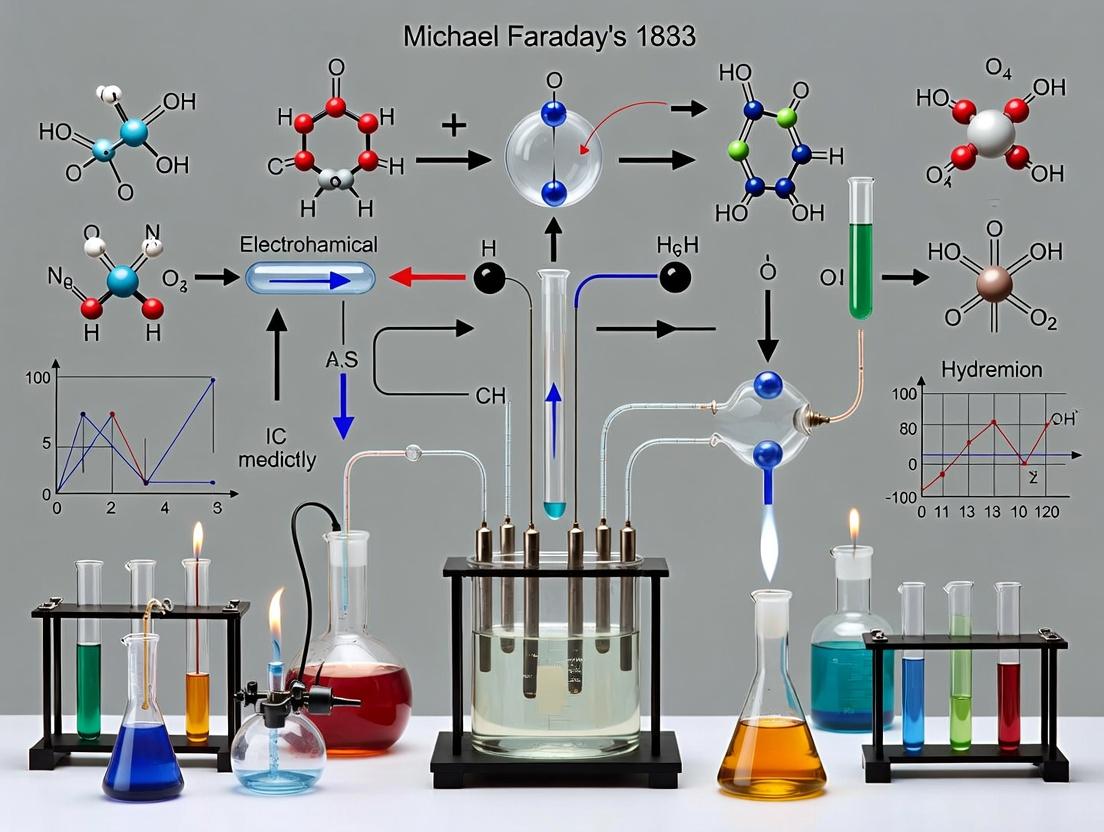
This article explores the enduring legacy of Michael Faraday's 1833 research on electrolysis and his formulation of the fundamental laws of electrochemistry.
Faraday's 1833 Electrochemical Laws: Modern Biomedical Applications & Drug Development Implications
Abstract
This article explores the enduring legacy of Michael Faraday's 1833 research on electrolysis and his formulation of the fundamental laws of electrochemistry. We analyze these foundational principles from a modern perspective, detailing their direct methodological applications in cutting-edge biomedical research, including drug delivery systems (e.g., iontophoresis), biosensor design, and electrochemical synthesis of active pharmaceutical ingredients (APIs). The article provides a framework for troubleshooting experimental electrochemistry, validates Faraday's laws against contemporary techniques, and examines comparative advantages over alternative methods. Targeted at researchers, scientists, and drug development professionals, this synthesis connects historical scientific rigor to present-day innovation in clinical and therapeutic contexts.
Faraday's 1833 Breakthrough: Deconstructing the Laws of Electrolysis for Modern Science
Michael Faraday’s 1833 research, culminating in the publication of his Seventh Series of Experimental Researches in Electricity, represents a foundational pillar in electrochemistry. Within the broader thesis of his electrochemical research, this work systematized the quantitative relationship between electrical charge and chemical change, establishing the laws of electrolysis. For modern researchers in fields like drug development, understanding the precision, methodology, and instrumental constraints of these experiments is crucial. It highlights the origin of principles governing ion transport, electrochemical synthesis, and the fundamental relationship between quantity of electricity and stoichiometry—concepts directly applicable to modern electrophysiology and pharmaceutical analysis.
Core Experimental Protocols & Quantitative Data
Faraday’s 1833 experiments were designed to isolate and measure the products of electrolysis relative to the quantity of electricity passed.
Protocol 1: Establishing the Law of Definite Electrochemical Action
Objective: To demonstrate that the mass of an element liberated at an electrode is directly proportional to the total electric charge passed through the circuit.
Methodology:
- Apparatus Setup: A simple voltaic battery (likely a Daniell cell variant for consistency) connected in series with an electrolytic cell and a "Volta-electrometer" (Faraday’s term for a water electrolysis device used as a coulometer).
- Electrolytic Cells: Multiple cells containing different compounds (e.g., solutions of silver nitrate, lead acetate, tin chloride) were connected in series, ensuring identical current passed through each.
- Procedure:
- Pre-weigh the cathode (typically a platinum plate) for cells with metal-depositing solutions.
- Pass a constant current for a measured duration. Time was measured using a clock.
- Disassemble the cells, dry the electrodes carefully, and re-weigh to determine the mass of substance deposited or liberated.
- Simultaneously, measure the volume of hydrogen and oxygen gas evolved in the Volta-electrometer.
- Control Measures: Experiments were repeated with varying current magnitudes and durations. The purity of materials and the absence of secondary reactions were carefully considered.
Protocol 2: Determining Electrochemical Equivalents
Objective: To establish the constant proportionality between mass and charge for different substances, leading to the concept of electrochemical equivalent.
Methodology:
- Using the series circuit method above, the mass m of substance liberated in one cell was compared to the mass of hydrogen m_H liberated in the coulometer.
- The ratio m / m_H was calculated. This ratio, when compared to the equivalent weight of the substance (known from chemical combining proportions), showed a direct correlation.
- Faraday used this to state that the chemical power of a current is constant, with the amount of action being "proportional to the quantity of electricity which passes."
The following table compiles key quantitative relationships inferred and demonstrated from Faraday’s published results.
Table 1: Electrochemical Equivalents Derived from Faraday's 1833 Observations
| Substance (Element Liberated) | Equivalent Weight (Faraday's Contemporary Values, relative to H=1) | Mass Liberated per Fixed Charge (Relative to Hydrogen = 1) | Observed Correlation |
|---|---|---|---|
| Hydrogen (in Volta-electrometer) | 1 | 1.000 (Standard) | Used as the reference coulometer. |
| Oxygen | 8 | ~8.0 | Mass ratio consistent with equivalent weight. |
| Chlorine | 35.5 | ~35.5 | Confirmed law for gaseous liberation. |
| Lead | 103.6 | ~103.6 | From lead acetate solution. |
| Tin | 57.9 | ~57.9 | From tin chloride solution. |
Table 2: Core Laws of Electrolysis as Formulated from 1833 Data
| Law Name | Mathematical Expression (Modern) | Experimental Basis from 1833 |
|---|---|---|
| First Law: Mass is proportional to charge. | m ∝ Q or m = Z * I * t | Varying time or current produced proportional change in mass deposited. |
| Second Law: For equal charge, mass is proportional to equivalent weight. | m ∝ M_eq | Series experiments showed fixed charge liberated masses in ratio of their chemical equivalents. |
| Constant of Proportionality: | F = Q / (n * moles) | Faraday's data allowed later calculation of the Faraday constant F. |
The Scientist's Toolkit: 1833 Research Reagent Solutions & Essential Materials
Table 3: Key Research Reagents and Materials in Faraday's 1833 Experiments
| Item | Function in the Experiment |
|---|---|
| Voltaic Pile / Battery | Primary DC power source. Provided a steady current for electrolysis. |
| Volta-Electrometer (Water Coulometer) | Crucial measurement device. Contained acidified water. The volume of H₂ and O₂ gas evolved provided a direct, quantitative measure of the total charge (Q) passed through the entire series circuit. |
| Platinum Electrodes | Inert conducting material. Used as electrodes in most cells, especially the coulometer, to prevent corrosion and side reactions. |
| Silver Nitrate (AgNO₃) Solution | Primary electrolyte for demonstrating precise metallic deposition. Silver's high atomic weight and clean reduction facilitated accurate gravimetry. |
| Lead Acetate Solution | Electrolyte for depositing a different metal (lead) to test the universality of the law. |
| Tin Chloride Solution | Another test electrolyte for metal deposition (tin). |
| Dilute Acid (e.g., Sulfuric) | Used to acidify water in the Volta-electrometer to increase conductivity and prevent polarization. |
| Precision Balance (Scale) | For gravimetric analysis of electrodes before and after electrolysis. Critical for obtaining quantitative mass data. |
| Calibrated Glass Tubes / Graduated Cylinders | For measuring the volume of gases evolved in the Volta-electrometer. |
Visualizing Experimental Workflow and Conceptual Relationships
Diagram 1: Faraday's 1833 Experimental Workflow & Analysis
Diagram 2: Logical Path from Research Goal to Fundamental Laws
Abstract This whitepaper provides a technical examination of Michael Faraday’s First Law of Electrolysis, established in his 1833 research series "Experimental Researches in Electricity." Within the broader thesis of his electrochemical research, this law represents the foundational quantitative pillar, establishing that the mass of a substance liberated at an electrode is directly proportional to the total electric charge passed through the electrolyte. This guide details the law's derivation, modern experimental validation protocols, and its critical applications in contemporary fields including analytical chemistry and pharmaceutical development.
Historical and Thesis Context
Michael Faraday's 1833 investigations were part of a systematic effort to establish quantitative relationships between electrical, chemical, and magnetic phenomena, opposing the prevailing fluid theories of electricity. His "Experimental Researches in Electricity" presented a series of meticulous experiments. The First and Second Laws of Electrolysis were pivotal within this broader thesis, demonstrating that electrochemical interaction was not infinite but governed by a strict, measurable law linking chemistry to electricity. This work provided the first clear evidence for the existence of discrete units of electric charge (later electrons) and atomic masses, though Faraday himself did not draw these conclusions.
Core Principle and Mathematical Formulation
Faraday's First Law is expressed as: m ∝ Q where m is the mass of substance deposited or liberated at an electrode, and Q is the total electric charge passed through the circuit.
Since charge (Q) is the product of current (I) and time (t), the law is commonly given as: m = k * I * t where k is the electrochemical equivalent (ECE) of the substance. The ECE is the mass of substance deposited per unit charge (e.g., kg/C).
The following table presents the electrochemical equivalents and related constants for elements common in electrolysis experiments and industrial applications.
Table 1: Electrochemical Equivalents and Faraday Constant Calculation
| Element | Atomic Mass (g/mol) | Valency (z) | ECE, k (mg/C) | ECE, k (g/A·h) |
|---|---|---|---|---|
| Silver (Ag) | 107.87 | 1 | 1.118 | 4.025 |
| Copper (Cu²⁺) | 63.55 | 2 | 0.329 | 1.186 |
| Zinc (Zn²⁺) | 65.38 | 2 | 0.339 | 1.220 |
| Hydrogen (H⁺) | 1.008 | 1 | 0.0104 | 0.0376 |
| Oxygen (O²⁻) | 16.00 | 2 | 0.0829 | 0.298 |
| Nickel (Ni²⁺) | 58.69 | 2 | 0.304 | 1.095 |
The constant of proportionality is universal when expressed as Faraday's Constant (F), which relates to the ECE through atomic mass (M) and valency (z): m = (M * Q) / (z * F).
- Faraday Constant (F): 96485.33212 C/mol (CODATA 2018)
- Relationship: k = M / (z * F)
Modern Experimental Protocol for Validation
Objective: To experimentally verify Faraday's First Law by depositing copper and measuring mass change vs. charge.
Materials: (See "The Scientist's Toolkit" below) Procedure:
- Electrode Preparation: Clean a pure copper cathode with dilute acid, rinse with distilled water and acetone, then dry and weigh precisely (m_initial).
- Electrolytic Cell Assembly: Prepare a 1.0 M solution of copper(II) sulfate (CuSO₄) acidified with 0.5 M sulfuric acid (H₂SO₄). Use a high-purity copper anode and the pre-weighed cathode. Connect in series with an ammeter and a DC power supply.
- Circuit Calibration: Verify ammeter accuracy with a certified digital multimeter. Ensure all connections are secure to prevent current fluctuation.
- Electrolysis Execution: Set the power supply to maintain a constant current (I), typically between 0.1 – 0.5 A. Record the exact current value and start a timer simultaneously. Maintain constant stirring and temperature control (25°C ± 1°C).
- Data Collection: Pass current for a measured time (t), sufficient to deposit 0.1–0.3 g of copper. Record time in seconds. Calculate charge passed: Q = I * t.
- Mass Measurement: Carefully remove the cathode, rinse with distilled water and acetone, dry thoroughly, and re-weigh (m_final).
- Calculation & Analysis: Determine mass deposited: m = mfinal – minitial. Calculate the experimental ECE: kexp = m / Q. Compare kexp to the theoretical value: ktheo = MCu / (z * F).
Validation Criterion: The experiment confirms Faraday's First Law if a plot of m vs. Q for different currents and times yields a straight line through the origin, and kexp agrees with ktheo within experimental uncertainty.
Visualizing the Electrolysis Process and Law
Diagram 1: Electrolysis circuit and proportional relationship.
The Scientist's Toolkit: Key Research Reagents & Materials
Table 2: Essential Materials for Faraday's Law Validation Experiment
| Item | Function | Specification Notes |
|---|---|---|
| High-Purity Copper Cathode | Electrode for metal deposition. Surface area must be known and consistent. | >99.99% purity, polished and etched prior to use. |
| Copper(II) Sulfate (CuSO₄) | Source of Cu²⁺ ions for reduction at the cathode. | ACS grade, dissolved in high-purity deionized water. |
| Sulfuric Acid (H₂SO₄) | Supporting electrolyte. Increases conductivity and prevents anode passivation. | Diluted to 0.5 M from concentrated stock. |
| DC Power Supply | Provides stable, adjustable direct current. | Must have constant current mode with precision of ±0.1% of reading. |
| Precision Analytical Balance | Measures mass change of the cathode. | Required sensitivity of 0.1 mg (0.0001 g). |
| Certified Digital Multimeter | Verifies and calibrates the circuit current measurement. | Used in series to validate the ammeter reading. |
Michael Faraday's 1833 investigations into electrolysis established the quantitative foundations of electrochemistry. Building upon his First Law (which states that the mass of substance liberated at an electrode is directly proportional to the quantity of electricity passed), Faraday formulated his Second Law: The masses of different substances liberated or deposited by the same quantity of electrical charge are proportional to their chemical equivalent weights. This seminal work, detailed in his Experimental Researches in Electricity, provided the first rigorous link between electricity, chemical change, and stoichiometry, predating the formal development of the mole concept by decades. This whitepaper re-examines this law through the modern lens of the mole and Avogadro's constant, providing a technical guide for its application in contemporary research, particularly in fields requiring precise electrochemical synthesis or analysis.
Theoretical Foundation
Mathematical Formulation
Faraday's Second Law is expressed as: [ \frac{m1}{m2} = \frac{E1}{E2} = \frac{(M1/z1)}{(M2/z2)} ] where ( m ) is the mass deposited, ( E ) is the equivalent weight, ( M ) is the molar mass, and ( z ) is the number of electrons transferred per ion (the charge number).
The combined law, incorporating the First Law, gives: [ m = \frac{Q}{F} \cdot \frac{M}{z} ] where ( Q ) is the total electric charge (in coulombs) and ( F ) is the Faraday constant (96,485.33212 C mol⁻¹). The Faraday constant represents the charge of one mole of electrons.
The Mole Concept Integration
The modern interpretation seamlessly integrates Faraday's empirical law with atomic theory:
- One mole of any substance contains Avogadro's number ((N_A)) of entities (atoms, molecules, ions).
- To deposit one mole of a substance requiring (z) electrons per ion, (z) moles of electrons are required.
- Therefore, the charge required is (z \cdot F). This unifies electrochemical equivalent (a mass per coulomb) with molar mass, providing a direct pathway for precise stoichiometric calculations in electrochemical reactions.
Quantitative Data: Electrochemical Equivalents
The following table summarizes the electrochemical equivalents for common elements/ions, derived from Faraday's Second Law and the modern constants.
Table 1: Electrochemical Equivalents of Selected Elements (at 100% Current Efficiency)
| Element / Ion | Molar Mass (M) [g mol⁻¹] | Charge Number (z) | Equivalent Weight (E = M/z) [g mol⁻¹] | Electrochemical Equivalent (E/F) [mg C⁻¹] |
|---|---|---|---|---|
| Silver (Ag⁺) | 107.87 | 1 | 107.87 | 1.1180 |
| Copper (Cu²⁺) | 63.55 | 2 | 31.775 | 0.3294 |
| Zinc (Zn²⁺) | 65.38 | 2 | 32.69 | 0.3388 |
| Aluminum (Al³⁺) | 26.98 | 3 | 8.993 | 0.09322 |
| Hydrogen (H⁺) | 1.008 | 1 | 1.008 | 0.01045 |
| Oxygen (O²⁻) | 16.00 | 2* | 8.00 | 0.08291 |
| Chlorine (Cl⁻) | 35.45 | 1 | 35.45 | 0.3674 |
*For oxygen liberation from water: ( 2H2O \rightarrow O2 + 4H^+ + 4e^- ), z=4 per O₂ molecule, so equivalent weight is M/4=8.00 g mol⁻¹.
Experimental Protocols
Protocol 1: Verification of Faraday's Second Law (Classical Coulometry)
Objective: To demonstrate that the masses of copper and silver deposited by the same quantity of electricity are in the ratio of their equivalent weights.
Materials: See "The Scientist's Toolkit" below. Method:
- Assemble two independent electrolytic cells in series: Cell A with a platinum cathode in 0.5M AgNO₃, Cell B with a copper cathode in 1.0M CuSO₄ (acidified with H₂SO₄).
- Pre-treat electrodes: Clean cathode in Cell B with dilute HNO₃, rinse, dry, and weigh precisely. In Cell A, ensure a clean, pre-weighed platinum cathode.
- Connect the cells in series with a stable DC power supply and a digital coulometer (or a standard resistor and voltmeter/ammeter for Q=∫I dt calculation).
- Pass a constant current (e.g., 10.0 mA) for a precisely measured duration (e.g., 1800 s, delivering Q = 18.0 C).
- Carefully remove cathodes, rinse gently with distilled water followed by acetone, dry thoroughly in a desiccator, and re-weigh.
- Calculate deposited masses ((m{Ag}), (m{Cu})).
- Compute the experimental ratio (m{Ag}/m{Cu}) and compare with the theoretical ratio (E{Ag}/E{Cu}) (107.87 / 31.775 = 3.395).
Protocol 2: Determination of Avogadro's Constant via Electrolysis (Modern Application)
Objective: To determine an experimental value for Avogadro's constant ((N_A)) using the Faraday constant and the charge of the electron (e).
Materials: Ultra-pure reagents, high-precision coulometer (resolution < 0.01%), analytical balance (0.001 mg), controlled environment chamber. Method:
- Use a silver coulometer. Anodize a pure silver anode in a AgNO₃ solution. The cathode is a pre-cleaned, precisely weighed platinum dish.
- Perform electrolysis under a constant, low current density to minimize dendrite formation. Maintain stable temperature (±0.1°C).
- Pass a precisely measured charge (Q) using a primary standard coulometer.
- Dissolve the deposited silver from the cathode in dilute HNO₃, and determine the mass ((m_{Ag})) via gravimetric analysis as AgCl for supreme accuracy.
- Calculate the number of moles of silver deposited: (n{Ag} = m{Ag} / M_{Ag}).
- Since each Ag⁺ ion requires one electron, the number of electrons transferred is (N = n{Ag} \cdot NA).
- The charge of one electron is (e = Q / N). With Q and (n{Ag}) known, and using the accepted value of (e) (1.602176634 × 10⁻¹⁹ C), solve for (NA): [ NA = \frac{Q}{e \cdot n{Ag}} ] This experiment historically provided crucial evidence linking macroscopic electrochemistry to atomic-scale charge.
Visualizing the Conceptual Framework
Title: Unification of Faraday's Law with Atomic Theory
Title: Experimental Protocol to Verify Faraday's Second Law
The Scientist's Toolkit: Key Research Reagent Solutions & Materials
Table 2: Essential Materials for Precise Electrolysis Experiments
| Item | Specification / Preparation | Function & Critical Notes |
|---|---|---|
| Silver Nitrate Electrolyte | 0.5 M AgNO₃ in deionized water. Use acidified solution (pH~2 with HNO₃) to prevent oxide formation. Stored in amber glass. | Provides Ag⁺ ions for deposition. High purity (>99.99%) is essential to avoid co-deposition of impurities. |
| Copper Sulfate Electrolyte | 1.0 M CuSO₄·5H₂O in deionized water, acidified with 0.5 M H₂SO₄. | Provides Cu²⁺ ions. Acidification prevents hydrolysis and ensures stable, smooth copper deposition. |
| Coulometer / Q Measurement | Digital integrator or standard resistor with calibrated voltmeter/ammeter. Precision > 0.1%. | Precisely measures the total charge (Q) passed, the fundamental independent variable. |
| Working Electrodes | Cathode for Ag: Platinum foil or mesh. Cathode for Cu: High-purity copper foil. Pre-cleaned (acid etch, sonication). | Substrate for mass deposition. Must be clean, dry, and precisely weighed. Platinum is inert for silver deposition. |
| Counter Electrodes (Anodes) | For Ag cell: Pure silver wire/foil. For Cu cell: Platinum or graphite. | Completes the circuit. In silver coulometry, a silver anode ensures electrolyte stability. |
| Drying Agent | Anhydrous silica gel or calcium chloride in a desiccator. | Ensures electrodes are completely dry before weighing to avoid mass error from moisture. |
| Rinsing Solvents | Sequence: Deionized water (to remove electrolyte), then acetone (analytical grade). | Removes electrolyte salts and promotes rapid, streak-free drying without residue. |
| Analytical Balance | Microbalance with 0.001 mg resolution (for N_A expt.) or 0.1 mg resolution (for teaching verification). | Accurately determines the small mass changes due to electrochemical deposition. |
Faraday's Second Law of Electrolysis remains a cornerstone of quantitative electrochemistry, providing an indispensable link between electrical energy and chemical transformation. Framed within his 1833 research, it was a prophetic empirical discovery that found its full theoretical explanation in the mole concept, Avogadro's constant, and the quantization of charge. For modern researchers and drug development professionals, mastery of this law is critical for applications ranging from the electrochemical synthesis of complex molecules and the precise coating of medical devices to analytical techniques like coulometric titration. The protocols and data presented herein offer a rigorous foundation for both validating this fundamental principle and harnessing it for advanced technological applications.
Introduction and Thesis Context This technical guide delineates the foundational terminology of electrochemistry, directly contextualized within Michael Faraday's seminal 1833 research "Experimental Researches in Electricity." It was in this work that Faraday, through meticulous quantitative experimentation, established the laws of electrolysis and, critically, introduced much of the core lexicon still used today. Framing these definitions within his original experimental logic provides not only historical accuracy but also a rigorous conceptual framework for modern researchers and drug development professionals, where principles of ion migration and redox reactions underpin techniques from patch-clamp electrophysiology to iontophoretic drug delivery.
Core Terminology: Definitions and Faraday's Context
- Electrolyte: A substance, often a liquid solution or molten salt, that produces ions and can conduct electricity by the movement of those ions. Faraday established that conduction in electrolytes was distinct from metallic conduction, necessitating chemical decomposition (electrolysis).
- Electrode: A conductor through which electric current enters or leaves an electrolyte medium. Faraday coined the term from the Greek words for "electron" (amber) and "hodos" (way).
- Anode: The electrode connected to the positive terminal of an external power source (the electrolytic cell convention). It is the site where oxidation occurs. Faraday's Definition: "The surface at which the electric current... enters: it is the way upwards... from which the acid, oxygen, &c., are evolved."
- Cathode: The electrode connected to the negative terminal of an external power source. It is the site where reduction occurs. Faraday's Definition: "That surface at which the current leaves the decomposing body: it is the way downwards... and gives exit to the combustible bodies, metals, alkalies, &c."
- Ion Migration: The movement of charged particles (ions) through the electrolyte under the influence of an applied electric field. Faraday's Contribution: He introduced the terms ion, cation (the species that migrates to the cathode), and anion (the species that migrates to the anode).
Quantitative Foundations: Faraday's Laws of Electrolysis (1833) Faraday's experiments established a precise quantitative relationship between electric charge passed through an electrolyte and the mass of substance altered at the electrodes. The data are summarized below.
Table 1: Summary of Faraday's Laws of Electrolysis
| Law | Formal Statement | Mathematical Expression | Faraday's Experimental Observation |
|---|---|---|---|
| First Law | The mass (m) of a substance altered at an electrode during electrolysis is directly proportional to the quantity of electric charge (Q) passed through the electrolyte. | m ∝ Q or m = (Q/F)(M/z) | For a given cell, mass of metal deposited ∝ current × time. |
| Second Law | For a given quantity of electric charge, the masses of different substances altered are proportional to their equivalent weights (molar mass M divided by the ion's charge number z). | m ∝ M / z | Comparing hydrogen, oxygen, silver, etc., the masses liberated by the same charge were in the ratio of their chemical equivalent weights. |
Table 2: Derived Constants and Modern Values
| Concept | Symbol | Value (Modern) | Description |
|---|---|---|---|
| Faraday Constant | F | 96,485.33212 C mol⁻¹ | The magnitude of electric charge per mole of electrons. |
| Electrochemical Equivalent | ε | ε = M / (zF) | The mass of a substance liberated by 1 Coulomb of charge. |
Experimental Protocol: Replication of Faraday's Key Experiment Aim: To verify Faraday's First Law by depositing copper from a copper sulfate solution. Methodology:
- Apparatus Setup: Assemble an electrolytic cell. Clean a copper cathode plate with dilute acid, rinse, dry, and weigh precisely (m_initial). Use a second copper plate as the anode. Prepare a 1.0 M solution of CuSO₄ in distilled water as the electrolyte.
- Circuit Assembly: Connect the cathode to the negative terminal and the anode to the positive terminal of a regulated DC power supply. Connect a precise ammeter in series and a voltmeter in parallel with the cell.
- Electrolysis: Immerse the electrodes in the electrolyte, ensuring they do not touch. Apply a constant current (I) of 0.50 A. Simultaneously start a timer. Maintain constant current for a precisely measured duration (t), e.g., 1800 seconds (30 minutes).
- Termination and Measurement: Stop the current. Carefully remove the cathode, rinse it gently with distilled water to remove any electrolyte, and dry it completely. Weigh the cathode again (m_final).
- Data Analysis:
- Calculate the total charge passed: Q = I × t (in Coulombs, C).
- Calculate the actual mass of copper deposited: mdeposited = mfinal - minitial.
- Calculate the theoretical mass predicted by Faraday's First Law: mtheoretical = (Q / F) × (MCu / z), where MCu = 63.546 g/mol and z = 2.
- Compare mdeposited to mtheoretical (typically >95% yield under controlled conditions).
The Scientist's Toolkit: Research Reagent Solutions for Electrochemistry Table 3: Essential Materials for Fundamental Electrolytic Experiments
| Item | Function/Explanation |
|---|---|
| Potassium Chloride (KCl), 3M Ag/AgCl Electrode Filling Solution | Provides a highly conductive, stable electrolyte for reference electrodes with reversible Cl⁻/AgCl redox couple. |
| Phosphate Buffered Saline (PBS), 1X | A standard isotonic, pH-buffered electrolyte for biologically relevant experiments. |
| Tetraethylammonium Tetrafluoroborate (TEABF₄) in Acetonitrile | A common supporting electrolyte in non-aqueous electrochemistry; provides ionic conductivity without interfering in redox reactions. |
| Nafion Perfluorinated Membrane | A proton-exchange membrane used to separate anode and cathode compartments while allowing specific ion (H⁺) migration. |
| High-Purity Metal Foils (Pt, Au, C) | Inert working electrode materials for studying redox processes without electrode degradation. |
Visualization: Ion Migration in an Electrolytic Cell
Diagram 2: Conceptual Workflow of Faraday's 1833 Research
1. Introduction and Thesis Context The quantitative laws of electrochemistry, first established by Michael Faraday in 1833, form the unshakable pillar upon which modern analytical and synthetic chemistry rests. Faraday's seminal research demonstrated that the mass of a substance altered at an electrode is directly proportional to the quantity of electricity passed, and that the masses of different substances liberated by the same quantity of electricity are proportional to their equivalent weights. This work, detailed in his "Experimental Researches in Electricity," provided the first rigorous link between macroscopic chemical change and the discrete nature of electric charge—a concept fully realized a century later with the understanding of the electron. This whitepaper reframes Faraday's foundational principles within a modern technical context, providing researchers and drug development professionals with the rigorous methodologies and quantitative frameworks essential for applications ranging from analytical electrochemistry to the synthesis of active pharmaceutical ingredients (APIs).
2. Fundamental Principles and Quantitative Relationships The core relationships derived from Faraday's work are encapsulated in two laws:
- Faraday's First Law: The mass ((m)) of a substance altered at an electrode during electrolysis is directly proportional to the total electric charge ((Q)) passed through the electrolyte.
- Faraday's Second Law: For a given quantity of electric charge, the mass of an elemental substance altered is proportional to its equivalent weight ((M/z)), where (M) is the molar mass and (z) is the number of electrons transferred per ion.
These are unified into the central equation: [ m = \frac{Q \times M}{F \times z} ] Where:
- (m) = mass of substance (grams)
- (Q) = total charge (Coulombs, C)
- (M) = molar mass (g mol⁻¹)
- (z) = number of electrons transferred per formula unit (dimensionless)
- (F) = Faraday constant (96485.33212 C mol⁻¹)
The charge ((Q)) is related to current ((I)) and time ((t)): (Q = I \times t).
The logical and mathematical relationships between these core concepts are visualized below.
Diagram 1: Faraday's Law Relationships
Table 1: Core Quantitative Constants & Variables
| Symbol | Quantity | Modern CODATA Value (Units) | Role in Calculation |
|---|---|---|---|
| F | Faraday Constant | 96,485.33212 C mol⁻¹ | Converts charge to moles of electrons. |
| Nₐ | Avogadro's Number | 6.02214076×10²³ mol⁻¹ | Relates moles to discrete entities. |
| e | Elementary Charge | 1.602176634×10⁻¹⁹ C | Fundamental unit of charge; F = Nₐ × e. |
| Q | Total Electric Charge | Variable (Coulomb, C) | Measured product of current and time. |
| z | Electron Stoichiometry | Variable (integer) | Dictates moles of substance per mole of e⁻. |
3. Experimental Protocols 3.1. Coulometric Determination of an Active Pharmaceutical Ingredient (API) This absolute method quantifies a substance directly via the charge required to completely electrolyze it.
- Objective: Precisely determine the concentration of an electroactive API (e.g., chlorpromazine) in solution.
- Principle: The API is exhaustively oxidized or reduced at the working electrode. The total charge consumed is measured and related to mass via Faraday's law.
- Protocol:
- Prepare a known volume (e.g., 50.0 mL) of the sample solution in a suitable supporting electrolyte (e.g., pH 7 phosphate buffer).
- Assemble a three-electrode cell: Platinum working electrode, platinum counter electrode, and Ag/AgCl reference electrode.
- Deoxygenate the solution by purging with high-purity nitrogen for 15 minutes.
- Apply a controlled potential sufficient to drive the complete electrode reaction of the API (e.g., +0.8 V vs. Ag/AgCl for oxidation).
- Monitor the cell current over time until it decays to a negligible background level (e.g., <1% of initial current).
- Integrate the current-time curve to obtain the total charge, (Q).
- Calculate the mass and concentration of the API: [ m{API} = \frac{Q \times M{API}}{F \times z} \quad;\quad C{API} = \frac{m{API}}{V \times M_{API}} = \frac{Q}{F \times z \times V} ]
3.2. Electrosynthesis of a Model Drug Metabolite This protocol demonstrates the use of controlled-potential electrolysis for synthetic scale-up.
- Objective: Synthesize N-acetyl-p-benzoquinone imine (NAPQI), the toxic metabolite of acetaminophen, via electrochemical oxidation.
- Principle: Acetaminophen is oxidized in a 2-electron, 2-proton process to form NAPQI.
- Protocol:
- Prepare a solution of acetaminophen (1.0 g) in a mixture of acetonitrile and aqueous buffer (e.g., 0.1 M acetate, pH 5.0).
- Use an H-cell separated by a cation-exchange membrane (e.g., Nafion). Fit the anode compartment with a carbon felt working electrode and the cathode with a platinum foil.
- Apply a constant potential +0.5 V above the oxidation peak potential of acetaminophen (determined via cyclic voltammetry).
- Monitor the reaction via HPLC or UV-Vis spectroscopy until the acetaminophen peak diminishes >95%.
- Terminate the electrolysis, record the total charge passed.
- Work up the anolyte solution by extraction and purification.
- Calculate the yield and current efficiency: [ \text{Theoretical Yield (mol)} = \frac{Q}{F \times z} \quad;\quad \text{Current Efficiency} = \frac{\text{Actual Yield}}{\text{Theoretical Yield}} \times 100\% ]
Diagram 2: Controlled-Potential Electrolysis Workflow
4. The Scientist's Toolkit: Key Research Reagent Solutions & Materials
Table 2: Essential Electrochemical Research Materials
| Item | Function & Specification |
|---|---|
| Supporting Electrolyte (e.g., Tetrabutylammonium hexafluorophosphate, TBAPF₆) | Provides ionic conductivity in non-aqueous solvents without participating in the electrode reaction. Must be electrochemically inert in the potential window of interest and highly purified. |
| Solvents (HPLC-grade Acetonitrile, Dichloromethane, purified Water) | Dissolves analyte and electrolyte. Must be dry and free of redox-active impurities. Often degassed prior to use. |
| Working Electrodes (Glassy Carbon, Platinum, Gold disks) | Site of the electron transfer reaction. Material chosen for its potential window, chemical inertness, and reproducibility. Routinely polished to a mirror finish. |
| Reference Electrodes (Ag/AgCl (aq), Saturated Calomel (SCE), Ferrocene/Fc⁺ (internal)) | Provides a stable, known potential against which the working electrode potential is controlled. Choice depends on solvent system. |
| Potentiostat/Galvanostat | The core instrument that applies a controlled potential (or current) between working and reference electrodes and measures the resulting current (or potential). |
| Faraday Cage | A grounded metal enclosure that shields the electrochemical cell from external electromagnetic interference, crucial for low-current measurements. |
5. Modern Data and Applications Recent research continues to validate and extend Faraday's principles in high-precision environments.
Table 3: Modern Validation & Application Data
| Application Context | Key Measurement | Result / Implication |
|---|---|---|
| Redefinition of the SI Ampere (2019) | Accurate determination of (F) via the Avogadro project (silicon sphere XRCD) and quantum Hall effect. | Fixed (F) as 96485.33212... C mol⁻¹, making coulometry an absolute analytical method. |
| Single-Entity Electrochemistry | Charge passed during the stochastic collision of a single nanoparticle. | (Q) for a single event corresponds to (z \times e), linking nano-scale phenomena to Faraday's macroscopic laws. |
| Electrosynthetic Scale-up | Current efficiency in the synthesis of a complex pharmaceutical intermediate. | Achieved 85% yield with 92% current efficiency, demonstrating synthetic utility and precise mass prediction from charge. |
| Battery Electrode Characterization | Charge (mAh/g) associated with Li⁺ intercalation in a cathode material. | Directly gives practical capacity and allows calculation of (z) for the redox process: (z = \frac{Q \times M}{F \times m}). |
6. Conclusion Michael Faraday's 1833 research established the immutable quantitative link between electrical charge and chemical change. Today, this link, formalized through the Faraday constant and electron stoichiometry, remains a cornerstone of quantitative science. For the modern researcher, mastery of these relationships is non-negotiable for designing precise analytical methods, executing efficient electrosyntheses, and characterizing advanced materials. The principles are as fundamental to electrochemistry as the conservation of mass is to all chemistry, providing a rigorous pathway from measured current to moles of electrons to the mass of substance produced or consumed.
Michael Faraday's 1833 publication, Experimental Researches in Electricity, marks the pivotal birth of quantitative electrochemical analysis. While his laws of electrolysis provided the foundational theoretical framework, it was the precise quantification of the relationship between electric current, time, and the mass of substances liberated at electrodes that established electrochemistry as a rigorous scientific discipline. This whitepaper contextualizes this 1833 breakthrough within Faraday's broader research program, detailing its enduring principles and modern experimental protocols for researchers in chemistry and drug development.
Faraday's Thesis and the Laws of Electrolysis
Faraday's overarching thesis sought to unify diverse electrical phenomena under common principles. His electrochemical research aimed to demonstrate that "chemical affinity" and electricity were manifestations of the same fundamental force. The 1833 quantification was not an isolated discovery but the core evidence for this thesis. The two laws are:
- The mass of a substance altered at an electrode during electrolysis is directly proportional to the quantity of electricity passed through the electrolyte.
- The masses of different substances altered by the passage of the same quantity of electricity are proportional to their equivalent weights.
These laws are encapsulated in the formula: [ m = (Q / F) \times (M / z) ] where m is mass, Q is charge, F is Faraday constant, M is molar mass, and z is charge number.
Table 1: Fundamental Electrochemical Constants Derivable from Faraday's Laws
| Constant/Concept | Symbol | Modern Value & Units | Significance from 1833 Context |
|---|---|---|---|
| Faraday Constant | F | 96,485.33212 C mol⁻¹ | The charge of one mole of electrons. Defines the quantized nature of electrochemistry. |
| Elementary Charge | e | 1.602176634 × 10⁻¹⁹ C | Not directly known to Faraday, but derivable from F/NA. The fundamental unit of electrochemical "action". |
| Electrochemical Equivalent | (M/z) | Variable (g mol⁻¹) | The mass of substance per mole of electrons. Directly measurable via controlled electrolysis. |
Table 2: Modern Analytical Techniques Rooted in Faraday's Principles
| Technique | Measured Variable (Q, m, t) | Primary Application | Relevance to Drug Development |
|---|---|---|---|
| Coulometry | Charge (Q) | Absolute determination of analyte mass. | Standardization of reference materials, purity analysis. |
| Electrogravimetry | Mass (m) | Precise quantitative separation and weighing of metals. | Heavy metal impurity testing in APIs. |
| Amperometry | Current (i) | Sensing and continuous monitoring of concentration. | Biosensors for in-vitro diagnostics, enzyme activity assays. |
Experimental Protocols: From 1833 to Modern Practice
Protocol 1: Classic Electrogravimetric Determination of Copper (Inspired by Faraday)
This protocol verifies Faraday's First Law by quantitatively depositing copper from solution.
Objective: To determine the electrochemical equivalent of copper and calculate the Faraday constant. Materials: See "The Scientist's Toolkit" below. Procedure:
- Clean and weigh the platinum cathode to constant mass.
- Assemble the electrolysis cell: Pt cathode, Pt anode, 0.5M CuSO₄ in 1M H₂SO₄ electrolyte.
- Connect electrodes to a constant current source in series with an ammeter.
- Electrolyze at a constant current (e.g., 0.500 A) for a precisely measured time (e.g., 1800 s). Record average current and time.
- Upon completion, carefully remove the cathode, rinse with distilled water and acetone, dry, and re-weigh.
- Calculate the mass of copper deposited (Δm).
- Calculate the total charge passed: Q = I × t.
- Calculate the experimental Faraday constant: F = (Q × MCu) / (Δm × zCu), where z_Cu = 2.
Protocol 2: Modern Microscale Coulometric Titration for Drug Molecule Analysis
This protocol applies Faraday's laws to quantify reactive functional groups in a drug candidate molecule.
Objective: To determine the number of reducible nitro groups in an aromatic drug candidate. Materials: See "The Scientist's Toolkit" below. Procedure:
- Dissolve a precisely known mass of the nitro-aromatic compound in a suitable anhydrous aprotic solvent (e.g., DMF with 0.1 M supporting electrolyte like TBAPF6).
- Fill a coulometric cell with the solution under inert atmosphere (N₂/Ar). Use a mercury pool or porous carbon as the working cathode, a Pt auxiliary electrode, and a non-aqueous reference electrode.
- Apply a controlled potential to the cathode sufficient to reduce the nitro groups to amines (determined via prior cyclic voltammetry, e.g., -1.2 V vs. Ag/Ag⁺).
- Electrolyze until the current decays to a background baseline (~1% of initial current).
- The integrated charge (Q) is automatically recorded by the potentiostat's software.
- Calculate moles of electrons consumed: n_e = Q / F.
- The number of nitro groups per molecule = (n_e / moles of compound) / 4 (or 6, depending on final reduction product stoichiometry).
Visualization of Core Concepts
Diagram 1: Logical Pathway from Thesis to Impact
Diagram 2: Classic Electrogravimetry Workflow
The Scientist's Toolkit
Table 3: Essential Research Reagent Solutions & Materials
| Item | Function & Specification | Relevance to Faraday's Principles |
|---|---|---|
| Platinum Electrodes | Inert, high-purity Pt foil or gauze for cathode/anode. | Faraday's key choice for inertness, ensuring mass change is solely from deposited analyte. |
| Constant Current/Potentiostat | Precision instrument to control I or E. Modern potentiostats enable coulometry. | Enables the precise measurement of Q (I×t), the core variable in Faraday's First Law. |
| Analytical Balance | Microbalance (0.01 mg precision). | Essential for accurate determination of Δm in electrogravimetry. |
| Supporting Electrolyte (e.g., TBAPF₆, H₂SO₄) | High-purity salt in solvent to provide conductivity and control ionic strength. | Minimizes IR drop, ensures current is carried by ions, not the analyte alone. |
| Inert Atmosphere Setup (N₂/Ar Glovebox/Schlenk) | Removes O₂ to prevent side reactions (oxidation/reduction). | Critical for modern organic/ drug electroanalysis, ensuring measured Q relates only to target reaction. |
| Faraday Cage | Enclosed, grounded metal mesh screen. | Shields sensitive low-current measurements from external electromagnetic noise. |
| Calibrated Coulometer | Device/software for integrating current over time. | Directly provides Q, the fundamental link between electrical and chemical change. |
From Principle to Practice: Applying Faraday's Laws in Biomedical Research & Drug Development
The quantitative interrogation of chemical species through electrical signals finds its seminal origin in the work of Michael Faraday. His 1833 research on electrolysis established the fundamental relationship between the quantity of electricity passed and the amount of substance altered at an electrode, enshrined in Faraday's Laws of Electrolysis. Modern electrochemical biosensors are a direct technological descendant of these principles. This guide details the contemporary framework for designing such biosensors and deriving analyte concentration from an electrochemical signal, a process rooted in Faraday's vision of quantifying electrochemical phenomena.
Core Principles: From Faraday's Laws to Sensor Output
Faraday's First Law states that the mass of a substance altered at an electrode during electrolysis is directly proportional to the quantity of electricity transferred. The Second Law states that the masses of different substances altered by the same quantity of electricity are proportional to their equivalent weights. For biosensors, this translates to a core premise: the measured current (charge per unit time) is often proportional to the rate of an electrochemical reaction involving the target analyte. The central challenge is engineering a biosensing interface where this current becomes a specific, quantifiable function of analyte concentration.
Key Quantitative Relationship: The faradaic current ( If ) in a controlled-potential experiment is described by the Cottrell equation for transient diffusion, or attains a steady-state under convection. For many biosensors utilizing amperometry, the steady-state current is: [ I{ss} = n F A D \frac{Cb}{\delta} ] where ( n ) is the number of electrons transferred per analyte molecule, ( F ) is Faraday's constant (96,485 C/mol), ( A ) is the electrode area, ( D ) is the diffusion coefficient, ( Cb ) is the bulk analyte concentration, and ( \delta ) is the diffusion layer thickness. Calibration translates ( I{ss} ) to ( Cb ).
Biosensor Architectures and Signaling Pathways
Electrochemical biosensors transduce a biorecognition event (e.g., antibody-antigen binding, enzyme-substrate reaction) into a measurable current, potential, or impedance change. The logical flow from analyte binding to signal generation follows defined pathways.
Diagram 1: Core Biosensor Signaling Cascade
Enzymatic Catalysis Pathway
Enzyme-based sensors (e.g., glucose oxidase) rely on catalytic turnover. The reaction sequence leading to a measurable current is:
Diagram 2: Enzymatic Electron Transfer with Mediator
Quantitative Calibration: Protocols and Data Analysis
The standard protocol for establishing the concentration-signal relationship is via a calibration curve.
Protocol: Amperometric Calibration Curve Generation
Objective: To derive a mathematical function relating steady-state current to analyte concentration.
Materials: See Scientist's Toolkit below.
Procedure:
- Electrode Preparation: Clean and precondition the working electrode according to manufacturer protocol (e.g., polishing for solid electrodes).
- Buffer Preparation: Prepare a degassed, well-stirred electrochemical buffer (e.g., 0.1 M PBS, pH 7.4).
- Baseline Measurement: Immerse the electrochemical cell (working, counter, reference electrodes) in buffer. Apply the designated operating potential and record the background current until stable.
- Standard Addition: Sequentially add known volumes of a concentrated analyte stock solution to the stirred buffer.
- Signal Measurement: After each addition, allow the current to reach a new steady-state (typically 30-60 seconds). Record the average current over a stable 10-second window.
- Data Correction: Subtract the initial background current from all measured values.
- Plotting & Fitting: Plot corrected current ((I)) vs. final analyte concentration ((C)). Fit data to an appropriate model (e.g., linear, sigmoidal).
Representative Calibration Data
Table 1: Simulated Calibration Data for a Glucose Biosensor (Amperometry, +0.5 V vs. Ag/AgCl)
| Glucose Concentration (mM) | Raw Signal (µA) | Background Corrected (µA) | Standard Deviation (n=3) |
|---|---|---|---|
| 0.0 | 0.05 | 0.00 | 0.01 |
| 1.0 | 1.25 | 1.20 | 0.08 |
| 2.0 | 2.45 | 2.40 | 0.12 |
| 5.0 | 5.95 | 5.90 | 0.15 |
| 10.0 | 11.80 | 11.75 | 0.22 |
Linear Fit: ( I(\mu A) = 1.18 \cdot C(mM) + 0.01 ) ; ( R^2 = 0.999 )
Table 2: Key Performance Metrics from Calibration
| Parameter | Value | Interpretation |
|---|---|---|
| Sensitivity | 1.18 µA/mM | Slope of the calibration curve. Indicates signal change per concentration unit. |
| Limit of Detection (LoD) | 0.05 mM | Calculated as 3.3σ/slope (σ: standard deviation of blank). Lowest detectable level. |
| Linear Range | 0.1-15 mM | Concentration range where response is linear (deviation <5%). |
| Response Time (t95) | ~25 s | Time to reach 95% of steady-state signal after sample introduction. |
Advanced Quantification: Binding Kinetics and Impedance
For affinity-based sensors (e.g., antibody sensors), quantification often involves modeling binding kinetics or measuring interfacial impedance changes.
Protocol: Kinetic Analysis for Affinity Biosensors
Objective: To determine analyte concentration by analyzing binding kinetics via electrochemical impedance spectroscopy (EIS).
Procedure:
- Interface Fabrication: Immobilize capture probe (antibody, DNA) onto a gold electrode.
- Baseline EIS: Measure impedance in buffer across a frequency range (e.g., 0.1 Hz to 100 kHz) at a fixed DC potential. Record the charge transfer resistance ((R_{ct}^{0})).
- Analyte Incubation: Expose the electrode to a sample containing analyte for a fixed time (t).
- Post-Binding EIS: Rinse electrode and measure new impedance in clean buffer to obtain (R_{ct}).
- Data Modeling: The change in (R{ct}) relates to surface coverage ((\theta)). For a pseudo-first-order binding model: [ \theta(t) = \frac{R{ct} - R{ct}^{0}}{R{ct}^{max} - R{ct}^{0}} = 1 - e^{-k Cb t} ] where (k) is the effective binding rate constant, and (C_b) is the bulk analyte concentration.
Diagram 3: EIS Kinetic Analysis Workflow
The Scientist's Toolkit: Essential Research Reagent Solutions
Table 3: Key Materials for Electrochemical Biosensor Development
| Reagent/Material | Function & Role in Quantification |
|---|---|
| Faraday Cage | Shields the electrochemical cell from external electromagnetic noise, ensuring signal fidelity for precise current measurement. |
| Potentiostat/Galvanostat | Instrument that applies a controlled potential/current and measures the resulting current/potential. Core hardware for readout. |
| Redox Mediators | Molecules (e.g., [Fe(CN)₆]³⁻/⁴⁻, Ferrocene derivatives) that shuttle electrons between biorecognition element and electrode. |
| Nafion Membrane | A perfluorinated ionomer used to coat electrodes, rejecting anionic interferents (e.g., ascorbate) and stabilizing the interface. |
| Streptavidin-Coated Beads | Magnetic or stationary beads used for immobilizing biotinylated biorecognition elements, enabling separation and concentration. |
| Standard Reference Electrode | (e.g., Ag/AgCl (3M KCl)) Provides a stable, known reference potential against which the working electrode potential is controlled. |
| Self-Assembled Monolayer (SAM) Kit | Alkane-thiol solutions for forming ordered monolayers on gold electrodes, providing a well-defined surface for probe immobilization. |
The foundational principle of controlled drug release via iontophoresis is elegantly encapsulated by the relationship Q = I · t, where the total charge (Q, in Coulombs) delivered is the product of current (I, in Amperes) and time (t, in seconds). This direct proportionality between delivered charge and the quantity of ionic substance transported is a direct application of Michael Faraday's First Law of Electrolysis (1833), which states that the mass of a substance altered at an electrode during electrolysis is proportional to the quantity of electricity transferred. Modern transdermal iontophoresis operationalizes Faraday's 19th-century electrochemical discovery, transforming it into a precise, programmable drug delivery platform where dosage is dictated by electrical parameters.
Core Principles & Quantitative Framework
Iontophoresis enhances the transport of charged drug molecules across biological barriers (primarily skin) via the application of a low-level external electrical field. The key transport mechanisms are:
- Electromigration: Direct repulsion of charged drug molecules from the active electrode of like polarity.
- Electroosmosis: Bulk solvent flow induced by the electric field, critical for neutral molecule transport and influenced by skin's net negative charge at physiological pH.
The quantitative prediction of drug delivery is primarily governed by Faraday's law, modified for transport efficiency:
M = (Q · t · M_w) / (z · F)
Where:
- M = Mass of drug delivered
- Q = Charge delivered (I · t)
- M_w = Molecular weight of the drug
- z = Valence (charge number) of the drug ion
- F = Faraday's constant (96,485 C/mol)
Table 1: Key Quantitative Parameters in Clinical/Experimental Iontophoresis
| Parameter | Typical Range | Impact on Dosage (Q = I·t) | Notes |
|---|---|---|---|
| Current (I) | 0.1 - 0.5 mA/cm² (clinical) | Direct linear driver of Q. | Higher densities risk skin irritation. Pulsed DC often preferred over continuous. |
| Time (t) | 10 min - 24 hours | Direct linear driver of Q. | Determines treatment duration and total dose. |
| Voltage | 0 - 50 V | Indirect driver; adjusts to maintain constant current against skin impedance. | Must stay below threshold for electrochemical burns. |
| Drug Efficiency (η) | 1 - 10% | Fraction of total charge carried by the drug ion. | Depends on competing ions, pH, molecular size. Critical for accurate dosing. |
Table 2: Example Iontophoretic Delivery Calculations for Common Drugs
| Drug (Ion) | Valence (z) | Molecular Weight (g/mol) | Target Dose (mg) | Required Charge (Q in mC)* | Protocol (I=0.3 mA, t in min) |
|---|---|---|---|---|---|
| Lidocaine (HCl) | +1 | 234.3 | 10 | 41.2 | 22.9 min |
| Fentanyl (Citrate) | +1 | 528.6 | 0.1 | 0.18 | 0.1 min |
| Dexamethasone (PO₄) | -1 | 516.4 | 5 | 25.0 | 13.9 min |
| Salicylate | -1 | 138.1 | 20 | 27.7 | 15.4 min |
*Calculated assuming 100% transport efficiency (η=1). Actual required charge will be higher (Qactual = Qcalc / η).
Experimental Protocols
Protocol 1: In Vitro Franz Cell Iontophoresis for Permeation Kinetics
Objective: To determine the steady-state flux (J_ss) and transport efficiency (η) of an ionic drug candidate. Materials: Vertical Franz diffusion cell, Ag/AgCl electrodes, donor solution (drug in buffer), receptor phase (PBS, pH 7.4), synthetic membrane or dermatomed skin, constant current source, HPLC. Procedure:
- Mount membrane between donor (anodal/cathodal based on drug charge) and receptor compartments.
- Fill donor with drug solution. Fill receptor with degassed PBS, maintain at 32°C with stirring.
- Insert electrodes: active in donor, return in receptor. Connect to constant current generator.
- Apply predefined current density (e.g., 0.3 mA/cm²) for 6-8 hours.
- Sample receptor phase at regular intervals. Analyze drug concentration via HPLC.
- Plot cumulative drug permeated vs. time. Slope gives Jss. Calculate η = (z·F·Jss) / I.
Protocol 2: In Vivo Pharmacokinetic Profiling
Objective: To correlate delivered charge with systemic plasma concentration. Materials: Animal model (e.g., rat, pig), iontophoretic patch/system, clinical current source, blood sampling equipment, LC-MS. Procedure:
- Shave and clean skin site. Apply drug-loaded hydrogel reservoir and active electrode.
- Apply return electrode at a distal site.
- Initiate current (e.g., 0.2 mA) for a fixed duration (t), recording total Q delivered.
- Collect serial blood samples over 24 hours.
- Analyze plasma for drug concentration via LC-MS.
- Calculate PK parameters (Cmax, Tmax, AUC). Plot AUC vs. Total Q to establish dosing correlation.
Visualization: Iontophoresis Workflow & Pathways
Title: Iontophoretic Drug Delivery Logic from Faraday's Law
Title: Experimental Path from Theory to Validated Delivery
The Scientist's Toolkit: Essential Research Reagents & Materials
Table 3: Key Research Reagent Solutions & Materials
| Item | Function / Role in Experiment | Key Considerations |
|---|---|---|
| Ag/AgCl Electrodes | Provide reversible, non-polarizable current injection. Minimize pH shifts and gas generation at skin interface. | Preferred over Pt or carbon for stable transdermal delivery. Requires chloride ions in formulation. |
| Hydrogel Reservoirs | Vehicle for drug and electrolyte. Maintains skin contact and provides medium for ion conduction. | Must be optimized for conductivity, drug stability, and biocompatibility. |
| Constant Current Source | Provides precise, time-controlled electrical input (I). The primary dosage control instrument. | Must deliver current independent of changing skin impedance. Clinical units have dose (Q) cut-offs. |
| Franz Diffusion Cell | Standard in vitro apparatus for measuring drug flux across excised skin or synthetic membranes. | Receptor chamber must be thermostated and stirred. Sampling port must be sealable. |
| Dermatomed Skin | Ex vivo human or animal skin of controlled thickness. Represents the primary transport barrier. | Thickness (200-400 μm), integrity, and storage conditions critically affect results. |
| Phosphate Buffered Saline (PBS) | Standard receptor phase and electrolyte solution. Maintains physiological pH and ionic strength. | Must be degassed to prevent bubble formation under current flow. |
| Competitive Ion Suppressors | Ions (e.g., Na⁺, Cl⁻) that compete with the drug for charge carriage. Their concentration must be minimized. | Use of ion-exchange membranes or tailored buffer systems can dramatically improve efficiency (η). |
In 1833, Michael Faraday's research on the laws of electrolysis established the foundational quantitative relationship between electric charge and chemical transformation. His first law states that the mass of a substance altered at an electrode is directly proportional to the quantity of electricity passed through the circuit. This principle of precise stoichiometric control, defined by the faradaic efficiency, is the cornerstone of modern organic electrosynthesis. Today, this paradigm enables the atom-efficient and sustainable synthesis of Active Pharmaceutical Ingredients (APIs) and their metabolites with unprecedented control, a direct technological evolution from Faraday's seminal work.
Core Principles: From Faraday's Laws to Modern API Synthesis
Faraday's second law correlates mass deposition to equivalent weight. In electrosynthesis, this translates to precise electron-counting as a reagent. This inherent stoichiometric control bypasses traditional redox reagents, minimizing byproduct formation—a critical advantage for complex, high-purity pharmaceuticals.
Key Quantitative Relationships:
- Faradaic Efficiency (FE):
FE (%) = (n * F * Δm / M) / Q * 100, wherenis moles of electrons per mole product,Fis Faraday's constant,Δmis product mass,Mis molar mass, andQis total charge. - Current Density: Dictates reaction rate and selectivity.
- Electrode Potential: Precisely controls the driving force for redox events.
Experimental Protocols in Pharmaceutical Electrosynthesis
Protocol 1: Flow Reactor for the Alkoxylation of a Drug Intermediate
This protocol exemplifies the synthesis of a key API precursor via C-H functionalization.
- Setup: Assemble a temperature-controlled, divided flow electrolysis cell (e.g., ElectroSyn cell). Anode: Pt-mesh (2 cm²). Cathode: carbon felt. Membrane: Nafion 117. Electrolyte: 0.1 M LiClO₄ in methanol/substrate mixture (0.05 M).
- Operation: Pump electrolyte at 2.0 mL/min. Apply constant current of 10 mA (j = 5 mA/cm²). Maintain temperature at 25°C.
- Monitoring: Monitor charge passed via coulometer. Track conversion by in-line UV/Vis or periodic HPLC sampling.
- Work-up: After passing 2.1 F/mol, divert flow to collection. Remove solvent in vacuo. Purify the residue via flash chromatography.
- Analysis: Determine yield by NMR. Calculate Faradaic Efficiency via HPLC using an internal standard.
Protocol 2: Paired Electrosynthesis of an API Metabolite
This protocol leverages both anode and cathode reactions in an undivided cell to synthesize a Phase I oxidative metabolite efficiently.
- Setup: In an undivided glass cell, place a reticulated vitreous carbon (RVC) anode and a Ni cathode. Add magnetic stir bar.
- Electrolyte Preparation: Dissolve the parent API (1.0 mmol) and NaOAc (2.0 mmol) in a 1:1 mixture of acetonitrile and pH 7.4 phosphate buffer (20 mL total).
- Electrolysis: Under nitrogen, apply a constant potential of +1.8 V vs. Ag/AgCl reference electrode. Stir vigorously at 500 rpm.
- Progress Tracking: Use thin-layer chromatography (TLC) every 15 min. Stop reaction upon complete substrate consumption (~3 F/mol total charge).
- Isolation: Quench by adding saturated NaHCO₃ solution. Extract with ethyl acetate (3 x 15 mL). Dry combined organics (MgSO₄), filter, and concentrate.
- Characterization: Purify by preparative HPLC. Confirm metabolite structure by LC-MS and ¹H-NMR. Compare with biologically derived sample.
Table 1: Comparative Performance of Electrosynthetic vs. Traditional Routes for Select API Transformations
| API/Intermediate | Transformation Type | Traditional Method (Yield, Purity) | Electrosynthetic Method (Yield, Purity, FE) | Key Advantage |
|---|---|---|---|---|
| Moxidectin Precursor | C-H Alkoxylation | Chemical Oxidant (72%, 88%) | Flow Electrolysis (89%, >99%, 85%) | Eliminates stoichiometric toxic oxidants (e.g., MnO₂) |
| Sitagliptin Metabolite | N-Oxidation | m-CPBA (81%, 91%) | Constant Potential (85%, 98%, 78%) | Superior regio-selectivity, ambient temperature |
| Loxapine Derivative | Dehydrogenation | DDQ, 80°C (75%, 90%) | Mediated Electrolysis (82%, 97%, 80%) | No over-oxidation, scalable in flow |
| β-Lactam Core | Anodic Cyclization | Hypervalent Iodine Reagent (65%, 85%) | Carbon Anode (78%, 96%, 70%) | Atom-efficient, simplified purification |
Table 2: Key Reagent Solutions & Materials (The Scientist's Toolkit)
| Item | Function & Rationale |
|---|---|
| Potentiostat/Galvanostat | Applies precise potential/current, the core instrument for controlling electron transfer stoichiometry per Faraday's laws. |
| Divided Electrolysis Cell (H-cell) | Separates anolyte and catholyte via a membrane (e.g., Nafion, glass frit), preventing cross-reduction/oxidation of products. |
| Undivided Cell with RVC Electrodes | High surface area electrodes for faster reactions in simple, scalable setups for paired electrolysis or robust transformations. |
| Supporting Electrolyte (e.g., NBu₄BF₄, LiClO₄) | Provides ionic conductivity in organic solvents; choice impacts solubility, overpotential, and product selectivity. |
| Mediator (e.g., TEMPO, Halide Salts) | Shuttles electrons between electrode and substrate, enabling lower overpotentials and protecting sensitive functional groups. |
| Flow Electrolysis Stack | Continuous processing unit offering superior heat/mass transfer, scalability, and intrinsic safety for pharma production. |
| Reference Electrode (Ag/AgCl) | Provides a stable, known potential against which the working electrode's potential is controlled and reported. |
| In-line FTIR or UV/Vis Analyzer | For real-time reaction monitoring in flow systems, enabling immediate feedback and control over conversion. |
Visualization of Pathways and Workflows
Title: From Faraday's Laws to Modern Pharma Electrosynthesis
Title: Generic Electrosynthesis Experimental Protocol Workflow
Title: Paired Electrolysis for API Metabolite Synthesis
The foundational principle of electroporation—using an electric field to induce transient permeability in a cell membrane—is a direct application of concepts pioneered by Michael Faraday in his 1833 research on electrochemical equivalence. Faraday's laws established the quantitative relationship between electrical charge passed through a system and the resultant chemical change at an electrode. This whitepaper transposes this core tenet to cellular biophysics, positing that the total electrical charge delivered (Q, the product of electric field strength (E), pulse duration (τ), and pathway conductivity) is the primary deterministic variable for membrane permeabilization, analogous to Faraday's first law. The "electrochemical change" in this context is the formation of aqueous pores.
Core Principles: Charge as the Driving Parameter
The electroporation process is governed by the induced transmembrane potential (ΔV_m), which, when exceeding a critical threshold (~0.2-1 V), triggers pore formation. While the electric field (E, in V/cm) is the initial driver, the cumulative effect—and thus the extent of permeability—is dictated by the charge delivered. This relationship can be expressed through key parameters summarized in Table 1.
Table 1: Key Electrical Parameters in Electroporation
| Parameter | Symbol | Typical Range (Mammalian Cells) | Role in Permeability |
|---|---|---|---|
| Electric Field Strength | E | 100 - 1500 V/cm | Initiates membrane charging; must exceed threshold. |
| Pulse Duration | τ | 10 µs - 100 ms | Determines energy and charge delivery time. |
| Number of Pulses | n | 1 - 100 | Allows cumulative effect and pore stabilization. |
| Total Charge Density | Q | 0.1 - 10 kC/m³ | Primary correlative to pore density & permeability. |
| Pulse Waveform | — | Exponential, Square, Bipolar | Affects efficiency and mode of pore formation. |
Quantitative Data on Charge vs. Permeability
The following tables consolidate experimental data linking electrical parameters to measurable biological outputs.
Table 2: Charge Delivery Correlates with Molecule Uptake
| Cell Line | Molecule | Optimal Q (kC/m³) | Efficiency (%) | Key Finding |
|---|---|---|---|---|
| HeLa | siRNA (20 kDa) | 1.2 | ~75 | Square wave (100 µs, 8 pulses) superior to exponential. |
| CHO-K1 | Plasmid DNA (5 kbp) | 2.5 | ~65 | Charge >2 kC/m³ needed for nuclear delivery markers. |
| Primary T-Cells | GFP mRNA | 0.8 | ~85 | Low charge, high field (500 V/cm) optimal for viability. |
| Neuroblastoma | Dextran (70 kDa) | 1.8 | ~90 | Uptake scales linearly with Q up to 2.0 kC/m³. |
Table 3: Impact of Charge on Cell Viability & Recovery
| Q (kC/m³) | Viability at 2h (%) | Viability at 24h (%) | Membrane Resealing (Half-time, s) |
|---|---|---|---|
| 0.5 | 98 | 96 | 30 |
| 1.0 | 95 | 92 | 45 |
| 2.0 | 85 | 78 | 120 |
| 4.0 | 60 | 40 | >300 (Irreversible) |
Experimental Protocols
Protocol 1: Standardized In Vitro Electroporation for Efficiency Quantification
- Cell Preparation: Harvest adherent cells at 80% confluency. Resuspend in low-conductivity electroporation buffer (e.g., 250 mM sucrose, 10 mM MgCl₂, 10 mM HEPES, pH 7.4) at 1-2 x 10⁷ cells/mL.
- Sample Loading: Mix 50 µL cell suspension with target molecule (e.g., 5 µg plasmid DNA, 2 µM siRNA). Transfer to a 2 mm gap cuvette.
- Charge-Calibrated Pulse Delivery: Using a square-wave electroporator, apply pulses. Pre-calculate total charge: Q = (V * τ * n * σ) / d, where V=voltage, τ=pulse width, n=number, σ=solution conductivity, d=electrode gap. Target a Q range of 0.5-2.5 kC/m³.
- Post-Pulse Handling: Incubate cells at 37°C for 10 minutes. Dilute 10-fold in complete media and transfer to culture plates.
- Analysis: Assess viability via flow cytometry (e.g., propidium iodide) at 2h. Quantify uptake via fluorescence (for labeled molecules) or functional assay (e.g., luciferase expression) at 24-48h.
Protocol 2: Determining Critical Charge Threshold via PI Uptake Kinetics
- Dye Loading: Resuspend cells in buffer containing 5 µM propidium iodide (PI).
- Real-Time Monitoring: Place cuvette in fluorometer-equipped electroporator. Set excitation/emission at 535/617 nm.
- Pulse Application: Apply a single square-wave pulse of increasing voltage (50 V increments) at fixed τ.
- Data Fitting: Record instantaneous fluorescence jump. Plot ΔFluorescence vs. Calculated Q. Fit with a sigmoidal curve. The inflection point defines the critical charge (Q_crit) for significant pore formation.
Visualizations
Diagram Title: Charge-Dependent Pathways in Electroporation
Diagram Title: Standard Electroporation & Analysis Workflow
The Scientist's Toolkit: Essential Research Reagent Solutions
| Item | Function & Relevance to Charge-Based Optimization |
|---|---|
| Low-Conductivity Electroporation Buffer (e.g., Sucrose-based) | Minimizes current/heat for a given voltage, allowing precise control over delivered charge (Q) and improving cell viability. |
| Square-Wave Electroporator | Provides precise control over voltage (E) and pulse duration (τ), enabling accurate calculation and delivery of target charge. |
| Propidium Iodide (PI) / YO-PRO-1 Dyes | Real-time, charge-dependent markers of membrane permeability. Fluorescence increase correlates directly with pore formation extent. |
| Cell Viability Assay Kits (e.g., MTT, Calcein AM) | Quantify the trade-off between delivered charge (permeability) and cytotoxicity. Critical for optimizing Q. |
| Standardized Gap Cuvettes (e.g., 2 mm, 4 mm) | Ensure consistent electrode distance (d), a key variable in calculating electric field (E=V/d) and resultant charge. |
| Conductivity Meter | Essential for measuring the conductivity (σ) of the cell suspension, a required variable for accurate charge (Q) calculation. |
The quantitative study of corrosion, the electrochemical degradation of metals, is rooted in the pioneering work of Michael Faraday. His 1833 research, crystallized in the laws of electrolysis, established the fundamental relationship between electrical charge, mass transfer, and chemical change. This provides the foundational principle for predicting the degradation of metallic implants: the rate of metal loss is stoichiometrically linked to the electrochemical current generated at the biointerface. Within the aggressive chloride-rich environment of the human body, predicting this degradation is critical for ensuring implant safety, longevity, and functional integration.
Electrochemical Fundamentals of Implant Degradation
Corrosion in physiological environments (approx. 37°C, pH 7.4, 0.15 M Cl⁻) is driven by coupled anodic (oxidation) and cathodic (reduction) reactions. Faraday's First Law directly enables the translation of measured current into mass loss or penetration rate.
Primary Reactions in Physiological Corrosion:
- Anodic Reaction (Metal Dissolution): M → Mⁿ⁺ + ne⁻
- Cathodic Reactions (in acidic/neutral media):
- 2H⁺ + 2e⁻ → H₂ (hydrogen evolution)
- O₂ + 2H₂O + 4e⁻ → 4OH⁻ (oxygen reduction - dominant in tissues)
The overall corrosion rate (CR) is calculated using Faraday's law:
CR (mpy) = (I_corr × K × EW) / (ρ × A)
Where:
- I_corr = Corrosion current (A)
- K = Constant (e.g., 1.288 × 10⁵ for mpy)
- EW = Equivalent weight of alloy (g/equivalent)
- ρ = Density (g/cm³)
- A = Exposed area (cm²)
Key Experimental Protocols forIn VitroPrediction
Potentiodynamic Polarization (ASTM G59)
This protocol establishes the baseline electrochemical behavior and extracts Tafel constants.
Methodology:
- Setup: A standard three-electrode cell (working electrode: implant sample, counter electrode: platinum or graphite, reference electrode: Saturated Calomel (SCE) or Ag/AgCl) is filled with a simulated physiological fluid (e.g., PBS, Hank's Balanced Salt Solution (HBSS)) at 37°C, deaerated or aerated as required.
- Open Circuit Potential (OCP): Monitor the sample's potential versus time until stabilization (typically ±2 mV/min for 1 hour).
- Polarization Scan: Initiate a potential sweep from approximately -250 mV vs. OCP to a defined anodic limit (e.g., +800 mV vs. OCP) or until a defined current density is reached. A reverse scan may be added for pitting susceptibility. Standard scan rate is 0.167 mV/s (ASTM G59).
- Data Analysis: The corrosion current density (icorr) is determined by Tafel extrapolation of the linear portions of the anodic and cathodic branches to the corrosion potential (Ecorr).
Electrochemical Impedance Spectroscopy (EIS)
This non-destructive technique models the electrical characteristics of the electrode/electrolyte interface and any surface films.
Methodology:
- Setup: Identical cell setup as 3.1. The sample is held at its stabilized OCP.
- Impedance Measurement: A small sinusoidal AC potential perturbation (typically ±10 mV rms) is applied over a wide frequency range (e.g., 100 kHz to 10 mHz).
- Data Fitting: The resulting impedance spectrum (Nyquist or Bode plot) is fitted to an equivalent electrical circuit (EEC) model (see Diagram 1). Key parameters include polarization resistance (Rp), which is inversely proportional to icorr, and capacitance of surface layers.
Immersion Testing & Ion Release Analysis (ISO 10993-15)
This long-term test measures cumulative degradation and ion release kinetics.
Methodology:
- Sample Preparation: Implant samples are sterilized, weighed, and measured for surface area.
- Immersion: Samples are immersed in a known volume of solution (e.g., HBSS, artificial saliva) in sealed, sterile containers. Containers are placed in an incubator at 37°C for durations ranging from 7 to 90+ days. The solution-to-surface-area ratio is standardized (e.g., 1 mL/cm²).
- Solution Analysis: At regular intervals, aliquots of solution are extracted and analyzed via Inductively Coupled Plasma Mass Spectrometry (ICP-MS) to quantify released metal ions (e.g., Ni²⁺, Cr³⁺, Co²⁺, Ti⁴⁺, Mg²⁺).
- Post-Immersion Analysis: Samples are removed, cleaned per ASTM G1, and re-weighed to determine mass loss. Surface morphology is analyzed via Scanning Electron Microscopy (SEM).
Fretting-Corrosion Testing
This protocol simulates degradation at modular junctions (e.g., hip stem-neck tapers).
Methodology:
- Setup: A custom tribo-electrochemical cell uses a potentiostat coupled with a mechanical testing system. One sample (cathode) is held under a controlled normal load against the working electrode (anode) submerged in electrolyte.
- Testing: The working electrode is polarized to a relevant potential (often OCP). A cyclic tangential micromotion (e.g., 10-100 µm displacement, 1-5 Hz) is applied.
- Monitoring: The anodic current is monitored in real-time. The synergistic effect is quantified by comparing the total charge passed (from current integration) to that from static corrosion and mechanical wear acting independently.
Table 1: Representative Corrosion Rates for Implant Alloys in Simulated Body Fluid (SBF)
| Alloy | Condition/Form | Test Method | Key Measured Parameter | Value (Mean ± SD or Range) | Reference Context (Year) |
|---|---|---|---|---|---|
| Ti-6Al-4V ELI | Wrought, polished | Potentiodynamic Polarization | i_corr (µA/cm²) | 0.007 ± 0.002 | Simulated Physiological Solution (2022) |
| CoCrMo (ASTM F1537) | As-cast, high-C | Potentiodynamic Polarization | i_corr (µA/cm²) | 0.15 ± 0.05 | Deaerated PBS, 37°C (2023) |
| 316L Stainless Steel | Annealed | Potentiodynamic Polarization | i_corr (µA/cm²) | 0.25 ± 0.10 | Aerated Ringer's Solution (2023) |
| WE43 Magnesium | Extruded, polished | Hydrogen Evolution (Immersion) | Degradation Rate (mm/yr) | 0.3 - 0.6 | Modified HBSS, 37°C (2024) |
| Nitinol (NiTi) | Superelastic, polished | EIS | Polarization Resistance, R_p (kΩ·cm²) | 450 - 800 | HBSS, at OCP (2022) |
Table 2: Ion Release Rates from Long-Term Immersion Testing (30 days, 37°C)
| Alloy | Primary Ions Released | Average Release Rate (µg/cm²/day) | Test Solution | Key Surface Analysis Post-Test |
|---|---|---|---|---|
| CoCrMo | Co²⁺, Cr³⁺, Mo⁶⁺ | Co: 0.05 - 0.15; Cr: 0.01 - 0.03 | PBS with Proteins | Thickened Cr-oxide passive layer |
| Ti-6Al-4V | Ti⁴⁺, Al³⁺, V⁴⁺ | Ti: <0.01; Al: ~0.001 | HBSS | Stable TiO₂ layer, minor pitting |
| WE43 Mg | Mg²⁺ | 20 - 40 | m-SBF | Heterogeneous layer of Ca-P-Mg products |
| Nitinol | Ni²⁺ | 0.02 - 0.10 (highly surface-dependent) | Saline | TiO₂-rich layer; Ni release spikes with localized breakdown |
Predictive Modeling & Signaling Pathways in Corrosion-Biology Interaction
Corrosion products (ions, particles) directly interact with biological pathways, influencing biocompatibility. Predicting in vivo degradation requires modeling these interactions.
Biological Response to Corrosion Products
Predictive Testing & Modeling Workflow
The Scientist's Toolkit: Key Reagents & Materials
Table 3: Essential Research Reagent Solutions for In Vitro Corrosion Prediction
| Item/Reagent | Function & Rationale |
|---|---|
| Hank's Balanced Salt Solution (HBSS) | A widely used, physiologically relevant electrolyte containing essential inorganic ions (Na⁺, K⁺, Ca²⁺, Mg²⁺, Cl⁻, HCO₃⁻, PO₄³⁻, SO₄²⁻), glucose, and pH buffers to mimic interstitial fluid. |
| Phosphate Buffered Saline (PBS) | A simpler chloride-containing solution useful for baseline electrochemical studies and controlling pH (typically 7.4). Lacks calcium, magnesium, and bicarbonate. |
| Dulbecco's Modified Eagle Medium (DMEM) + 10% FBS | Cell culture medium used for more biologically complex testing. The addition of Fetal Bovine Serum (FBS) introduces proteins (e.g., albumin) that can adsorb to surfaces and alter corrosion kinetics. |
| Artificial Synovial Fluid / Serum | Specialized solutions with specific protein (hyaluronic acid) and lipid content to simulate joint environments for orthopedic implant testing. |
| Deaeration/Aeration Apparatus | Controlled gas purging (N₂ for deaeration, O₂/air for aeration) to manipulate cathodic reaction kinetics, simulating ischemic or well-perfused tissue environments. |
| Ag/AgCl (in 3M KCl) Reference Electrode | A stable, common reference electrode for physiological measurements due to its consistent potential and compatibility with chloride-containing biological solutions. |
| Potentiostat/Galvanostat with FRA | The core instrument for applying potential/current and measuring electrochemical response. A Frequency Response Analyzer (FRA) is required for EIS measurements. |
| Inductively Coupled Plasma Mass Spectrometry (ICP-MS) | The gold-standard analytical technique for detecting and quantifying trace levels of metal ions released from implants into solution with high sensitivity (ppb-ppt range). |
| Standardized Immersion Cells | Chemically inert, temperature-controlled (37°C) vessels with defined sample mounting and electrolyte volume to ensure reproducibility in long-term tests (per ISO 10993-15). |
This technical guide explores the evolution of electrochemical analysis from Faraday’s foundational 1833 laws to modern microfluidic Lab-on-a-Chip (LOC) systems. Faraday's quantitative laws of electrolysis established the bedrock relationship between electrical charge and chemical transformation. Today, this principle is miniaturized and automated within microfluidic platforms, enabling precise, rapid, and high-throughput electrochemical analysis crucial for advanced research and drug development.
In 1833, Michael Faraday published his two laws of electrolysis, establishing the quantitative relationship between electrical charge and mass of substance altered at an electrode. This seminal work demonstrated that electrochemical reactions are governed by precise stoichiometry. Modern microfluidic electrochemical analysis directly operationalizes these principles by confining redox reactions within microfabricated channels and electrodes, allowing for ultrasensitive detection with minimal sample and reagent volumes.
Core Principles & Quantitative Foundations
Miniaturized electrochemical analysis transposes classical voltammetric and amperometric techniques into microfluidic architectures. Key advantages include reduced diffusion distances, enhanced mass transport, lower iR drop, and integration of sample preparation, separation, and detection.
Table 1: Quantitative Performance Metrics of Microfluidic Electrochemical vs. Macroscale Systems
| Parameter | Macro-scale Electroanalysis (Bulk Cell) | Microfluidic Electroanalysis (Typical LOC) | Improvement Factor / Implication |
|---|---|---|---|
| Sample Volume | 1-100 mL | 1 nL - 10 µL | 10^3 - 10^7 reduction |
| Electrode Surface Area | ~0.1 cm² | ~0.001 - 0.01 cm² | Enables spatial multiplexing |
| Diffusion Layer Thickness (δ) | ~100 µm | ~1-10 µm | Mass transport rate increase ~10-100x |
| Response Time (τ) | ~1-10 s | ~10-100 ms | Faster kinetic measurements |
| Limit of Detection (for common analytes) | ~1 µM | ~0.1 - 10 nM | 100-1000x sensitivity gain |
| Analyte Consumption (per test) | High | Pico- to femtomoles | Enables rare/expensive sample analysis |
| Throughput (Parallelization Potential) | Low | High (array designs) | Suited for high-throughput screening |
Essential Materials & Research Reagent Solutions
Table 2: The Scientist's Toolkit for Microfluidic Electrochemical Analysis
| Item | Function & Rationale |
|---|---|
| PDMS (Polydimethylsiloxane) | Elastomeric polymer for rapid prototyping of microfluidic channels via soft lithography; optically clear, gas-permeable. |
| SU-8 Photoresist | High-aspect-ratio epoxy-based negative photoresist for creating master molds on silicon wafers. |
| Microelectrodes (Au, Pt, C, Ag/AgCl) | Miniaturized working, counter, and reference electrodes; often fabricated via thin-film deposition (e.g., sputtering) and patterning. |
| Faradaic Electrochemical Probes | Redox mediators (e.g., [Fe(CN)₆]³⁻/⁴⁻, Ru(NH₃)₆³⁺) to validate system performance and study charge transfer kinetics. |
| Specific Enzyme/Ab-functionalized Beads | Immobilized biorecognition elements for selective capture and detection of target analytes (e.g., glucose oxidase for glucose). |
| Nafion Membrane | Cation-exchange polymer coating used to perm-selectively pre-concentrate cationic analytes or reject interferents. |
| Electrically Conductive Inks (Carbon/Ag) | For low-cost, printed electrode fabrication within disposable microfluidic chips. |
| Phosphate Buffered Saline (PBS) with KCl | Standard high-conductivity electrolyte solution to minimize solution resistance and provide stable electrochemical conditions. |
Detailed Experimental Protocols
Protocol 4.1: Fabrication of a Standard PDMS-based Microfluidic Electrochemical Cell
Objective: Create a laminated LOC device with integrated thin-film electrodes for cyclic voltammetry (CV).
Materials: Silicon wafer, SU-8 photoresist, PDMS kit (base & curing agent), AZ photoresist, Chrome (Cr, 10 nm), Gold (Au, 100 nm) targets for sputter, Acetone, Isopropanol, Oxygen Plasma Asher.
Procedure:
- Master Mold Fabrication: Spin-coat SU-8 onto a clean Si wafer to desired channel height (e.g., 50 µm). Soft bake, expose to UV through a channel-patterned photomask, post-exposure bake, and develop to create a positive-relief master mold.
- PDMS Channel Layer: Mix PDMS base and curing agent (10:1 ratio), degas, pour over master mold, and cure at 65°C for 2 hours. Peel off cured PDMS and cut to size. Inlet/outlet ports are created via biopsy punch.
- Electrode Fabrication: On a clean glass slide, pattern AZ photoresist for electrode design. Sputter-deposit a Cr adhesion layer (10 nm) followed by Au (100 nm). Lift off in acetone to define the three-electrode system (working, counter, reference) on the glass substrate.
- Device Bonding & Assembly: Treat the PDMS channel slab and the glass electrode substrate with oxygen plasma (30 s, 100 W). Immediately bring surfaces into conformal contact to form an irreversible seal, aligning channels over the electrodes.
- Fluidic & Electrical Interfacing: Insert polyethylene tubing into inlet/outlet ports. Connect electrode contact pads to a potentiostat via pogo-pin connectors or wire bonding.
Protocol 4.2: Analytical Detection of a Model Analytic via Amperometry
Objective: Quantify hydrogen peroxide (H₂O₂) generation from an on-chip enzyme-linked assay.
Materials: Fabricated PDMS/glass chip with Pt working electrode, Ag/AgCl reference, Pt counter. 0.1 M PBS (pH 7.4), 5 mM K₃[Fe(CN)₆] in PBS, Hydrogen Peroxide (H₂O₂) standards (1 µM – 1 mM), Potentiostat.
Procedure:
- Electrode Characterization: Fill chip with 5 mM [Fe(CN)₆]³⁻/⁴⁻. Perform CV from -0.1 to +0.5 V vs. Ag/AgCl at 50 mV/s. Verify characteristic redox peaks and stable baseline.
- Amperometric Calibration: Set potentiostat to a constant applied potential of +0.7 V vs. Ag/AgCl (optimal for H₂O₂ oxidation on Pt). Continuously flow PBS at 5 µL/min until a stable baseline current is achieved.
- Standard Addition: Introduce a series of H₂O₂ standards (e.g., 1, 5, 10, 50, 100 µM) sequentially via the inlet reservoir or injection loop. Record the steady-state current response after each addition.
- Data Analysis: Plot steady-state current (I_ss, in nA) versus H₂O₂ concentration (C, in µM). Perform linear regression. The slope is the sensitivity (nA/µM). Calculate limit of detection (LOD) as 3σ/slope, where σ is the standard deviation of the blank (PBS) signal.
Signaling Pathways & System Workflows
Diagram 1: Logical flow from Faraday's laws to modern LOC applications
Diagram 2: Typical microfluidic electrochemical assay workflow
Current Applications & Future Outlook
Applications are vast, spanning continuous monitoring of cell culture metabolites, detection of disease biomarkers (e.g., cardiac troponin, viral RNA), high-throughput pharmaceutical compound screening, and environmental toxin sensing. The field continues to evolve towards greater integration (sample-to-answer systems), use of novel nanomaterials (graphene, MXenes) to enhance electrode performance, and the development of fully disposable, point-of-care diagnostic devices. Each advancement remains a testament to the enduring and scalable relevance of Faraday’s foundational electrochemical principles.
Optimizing Electrochemical Experiments: Troubleshooting Deviations from Faraday's Laws
Michael Faraday's seminal 1833 research on electrolysis established the foundational laws linking electrical charge to chemical change. His quantitative work, delineating the relationship between current, time, and mass of substance liberated at an electrode, presupposed an ideal, 100% efficient transfer of electrons to the intended redox reaction. Modern electrochemical applications, from industrial synthesis to biomedical sensors and drug development, continually confront the reality that this ideal is seldom achieved. This whitepaper examines the core pitfalls that diverge from Faraday's ideal: side reactions that consume charge for unintended products, inefficient current distribution leading to localized overpotentials, and parasitic losses that dissipate energy as heat or through competing physical processes. Understanding and mitigating these pitfalls is critical for advancing electrochemical methodologies in scientific research and pharmaceutical development.
Side Reactions: The Chemical Competitors
Side reactions are electrochemical processes that occur in parallel with the desired reaction, consuming faradaic current and reducing the current efficiency (CE). In Faraday's copper deposition experiments, impurities could have led to hydrogen evolution alongside metal reduction.
Key Sources in Modern Context:
- Solvent/Electrolyte Decomposition: Water splitting (H₂/O₂ evolution) within its thermodynamic window is a common competitor.
- Electrode Dissolution: Oxidation of the working electrode itself (e.g., Pt, carbon) at high anodic potentials.
- Trace Contaminant Reduction/Oxidation: Reduction of O₂ dissolved in electrolyte or oxidation of organic impurities.
Experimental Protocol for Quantifying Side Reactions (Cyclic Voltammetry with Rotating Disk Electrode):
- Prepare a three-electrode cell with a clean, polished working electrode (e.g., glassy carbon RDE), Pt counter electrode, and stable reference electrode (e.g., Ag/AgCl).
- Degas the electrolyte solution (e.g., 0.1 M phosphate buffer, pH 7.4) by sparging with an inert gas (N₂ or Ar) for at least 20 minutes to remove dissolved O₂.
- Introduce the redox-active analyte of interest (e.g., 1 mM drug candidate molecule) into the solution.
- Perform CV scans at multiple rotation rates (e.g., 400 to 2500 rpm) across the relevant potential window.
- Analyze the limiting current (i_lim) vs. square root of rotation rate (ω^(1/2)) using the Levich equation. A deviation from linearity or a lower-than-theoretical slope indicates concurrent side reactions (e.g., catalytic side processes) affecting mass transport-limited current.
Table 1: Current Efficiency Losses from Common Side Reactions
| Side Reaction | Typical Potential Range (vs. SHE) | System Impact | Typical CE Loss* |
|---|---|---|---|
| Hydrogen Evolution (2H⁺ + 2e⁻ → H₂) | < 0.0 V (acidic) | Alters local pH, creates gas bubbles | 5-40% |
| Oxygen Evolution (2H₂O → O₂ + 4H⁺ + 4e⁻) | > 1.23 V | Oxidizes electrode, generates reactive oxygen species | 10-60% |
| Carbon Oxidation (C + 2H₂O → CO₂ + 4H⁺ + 4e⁻) | > 0.8 V (pH dep.) | Electrode corrosion, increased impedance | 5-30% |
| Metal Oxidation (e.g., Pt → Pt²⁺ + 2e⁻) | > 0.8 V | Electrode degradation, solution contamination | 1-15% |
*CE Loss is highly dependent on exact conditions (potential, pH, material).
Inefficient Current Distribution and Mass Transport
Faraday's early cells likely had simple, planar electrodes. In complex geometries (e.g., porous electrodes, microarrays, flow cells), current distribution is non-uniform, leading to areas of high local current density (causing side reactions) and areas of under-utilization.
Experimental Protocol for Mapping Current Distribution (Scanning Electrochemical Microscopy - SECM):
- Configure an SECM system with an ultramicroelectrode (UME) tip (e.g., 10 µm Pt disk), XYZ nanopositioners, and a bipotentiostat.
- Immerse the substrate electrode (the sample of interest) and tip in a solution containing a redox mediator (e.g., 1 mM ferrocenemethanol).
- Position the tip close to the substrate surface (≈ 1-2 tip diameters away) in feedback mode.
- Raster the tip across the substrate surface while applying a constant potential to oxidize the mediator at the tip.
- Monitor tip current as a function of XY position. Variations in current indicate topography and local electrochemical activity, mapping regions of high and low electron transfer efficiency.
Parasitic Losses: Non-Faradaic Energy Dissipation
These losses represent energy consumption that does not contribute to the faradaic process, reducing energy efficiency. They directly oppose Faraday's implicit assumption of direct charge-to-product conversion.
Primary Contributors:
- Ohmic Drop (iR Loss): Resistance from electrolyte, electrodes, and interfaces causes a voltage loss (V = iR), diverting energy to heat.
- Double-Layer Charging: A portion of the applied current charges the electrochemical double-layer capacitor at the electrode-electrolyte interface, rather than driving redox chemistry.
- Solution Resistance & Cell Design: Poor geometry and low conductivity electrolytes exacerbate iR losses.
Experimental Protocol for Quantifying Parasitic Losses (Electrochemical Impedance Spectroscopy - EIS):
- Set up a standard three-electrode cell with well-defined geometry.
- Apply a small AC voltage perturbation (e.g., 10 mV RMS) across a range of frequencies (e.g., 100 kHz to 0.1 Hz) at the relevant DC bias potential.
- Measure the current response and calculate impedance (Z).
- Fit the resulting Nyquist plot to an equivalent circuit model (e.g., [Rs(Cdl[R_ctW])]).
- Extract key parameters: Solution resistance (Rs) for ohmic losses, Double-layer capacitance (Cdl) for charging losses, and Charge-transfer resistance (R_ct) for kinetic limitations.
Table 2: Quantitative Impact of Parasitic Losses in a Model System
| Loss Mechanism | Measured Parameter | Typical Value in 0.1 M KCl | Consequence on Applied Potential* |
|---|---|---|---|
| Ohmic (iR) Loss | Solution Resistance (R_s) | 50-100 Ω (for typical cell) | +50 to +100 mV at 1 mA |
| Double-Layer Charging | Capacitance (C_dl) | 20-40 µF/cm² (glassy carbon) | Transient current not used for redox |
| Charge Transfer Limitation | Charge Transfer Resistance (R_ct) | Variable (1 Ω - 10 kΩ) | Additional overpotential required |
*Assuming a desired faradaic process requiring an applied potential Eapplied = Eeq + ηct + iRs, where η_ct is the activation overpotential.
The Scientist's Toolkit: Research Reagent Solutions
Table 3: Essential Materials for Mitigating Electrochemical Pitfalls
| Item | Function & Relevance to Pitfalls |
|---|---|
| High-Purity Supporting Electrolyte (e.g., TBAPF₆, LiClO₄) | Provides ionic conductivity while minimizing redox activity, reducing side reactions from electrolyte decomposition. |
| Ultra-Pure Solvents (HPLC grade, with molecular sieves) | Minimizes trace water and impurities that can undergo parasitic redox reactions. |
| Redox Mediators (e.g., Ferrocene, Ru(NH₃)₆³⁺) | Well-characterized, single-electron transfer probes for diagnosing mass transport and kinetic limitations. |
| Reference Electrode with Salt Bridge (e.g., Ag/AgCl in 3M KCl) | Provides stable, known potential, isolating reference electrolyte from test solution to prevent contamination. |
| Degassing Agent/System (Argon/N₂ gas sparging with gas dispersion tube) | Removes dissolved O₂, a primary source of side reactions (reduction to H₂O₂ or H₂O) in cathodic studies. |
| Potentiostat with iR Compensation (Positive Feedback or Current Interruption) | Actively corrects for ohmic drop losses, providing accurate potential control at the working electrode surface. |
| Ultramicroelectrode (UME) | Minimizes iR drop and double-layer charging currents due to small size, enabling studies in resistive media and fast scan rates. |
Visualizing Experimental Workflows and Relationships
Diagram 1: Pathways of Electrochemical Energy Distribution
Diagram 2: Workflow for Diagnosing Electrochemical Pitfalls
Michael Faraday's seminal 1833 research on electrolysis established the fundamental quantitative laws governing ionic conduction in solution. His work on the relationship between electric current, the quantity of substances liberated at electrodes, and the nature of the electrolyte itself provides the bedrock upon which modern optimization of biological electrolytes is built. While Faraday studied simple salt solutions, contemporary research extends these principles to complex, buffered biological systems where maintaining physiological function is paramount. This guide translates Faraday's foundational electrochemistry into actionable protocols for optimizing pH, conductivity, and buffer composition to stabilize proteins, nucleic acids, and cells in applications from in vitro assays to biopharmaceutical formulation.
Core Principles: From Ionic Conduction to Biological Fidelity
pH and Buffer Capacity
The pH of a solution determines the protonation state of biological macromolecules, directly influencing structure, solubility, and activity. A buffer's primary function is to resist pH change upon addition of acid or base. The Henderson-Hasselbalch equation is critical: [ \text{pH} = \text{pKa} + \log\left(\frac{[\text{A}^-]}{[\text{HA}]}\right) ] Effective buffering occurs within ±1 pH unit of the pKa.
Conductivity and Ionic Strength
Conductivity (κ) measures a solution's ability to conduct electric current, a direct descendant of Faraday's work on electrolytic conduction. It depends on ion concentrations (cᵢ) and their molar conductivities (λᵢ): [ \kappa \approx \sum ci \lambdai ] Ionic strength (I) accounts for all ions present: [ I = \frac{1}{2} \sum ci zi^2 ] where (z_i) is the ion's charge. High ionic strength can shield electrostatic interactions but may cause "salting-out" of proteins.
Buffer Selection Criteria
Selection extends beyond pKa to include:
- Biological Compatibility: Minimal enzyme inhibition or cellular toxicity.
- Temperature Sensitivity: ΔpKa/°C (e.g., Tris has a high dependence ~-0.031/°C).
- Metal Chelation: Buffers like phosphate can bind Ca²⁺ or Mg²⁺.
- UV Interference: For spectrophotometric assays.
Table 1: Common Biological Buffers and Their Properties
| Buffer Name | pKa at 25°C | Useful pH Range | Buffer Capacity (β)† | ΔpKa/°C | Key Considerations |
|---|---|---|---|---|---|
| Phosphate (PBS) | 2.14, 7.20, 12.67 | 5.8 - 8.0 | High | ~0.005 | Chelates divalent cations. High ionic strength. |
| HEPES | 7.48 | 6.8 - 8.2 | Moderate | -0.014 | Non-chelating. Good for cell culture. May form radicals under light. |
| Tris | 8.06 | 7.0 - 9.0 | Moderate | -0.031 | Significant temperature & concentration dependence. |
| MES | 6.15 | 5.5 - 6.7 | Moderate | -0.011 | Often used in chromatography and electrophoresis. |
| Acetate | 4.76 | 3.8 - 5.8 | Moderate | ~0.0002 | Volatile, useful in sample prep for MS. |
| Bicarbonate/CO₂ | 6.35, 10.33 | 6.0 - 8.0 (with CO₂) | System-dependent | - | Physiological gas system. Requires CO₂ control. |
† Buffer capacity (β) = moles of strong base needed to raise pH by 1 unit per liter of buffer.
Table 2: Conductivity of Common Ions in Aqueous Solution at 25°C
| Ion | Molar Conductivity (λ) - S·cm²/mol | Ion | Molar Conductivity (λ) - S·cm²/mol |
|---|---|---|---|
| H⁺ | 349.8 | OH⁻ | 199.1 |
| Na⁺ | 50.1 | Cl⁻ | 76.3 |
| K⁺ | 73.5 | CH₃COO⁻ | 40.9 |
| NH₄⁺ | 73.5 | HPO₄²⁻ | ~85* |
| Mg²⁺ | 106.0 | SO₄²⁻ | 160.0 |
| Ca²⁺ | 119.0 | HEPES⁻ | ~25* (estimated) |
*Approximate values for complex ions.
Experimental Protocols for Optimization
Protocol 1: Systematic pH and Conductivity Profiling for Enzyme Activity
Objective: Determine optimal pH and ionic strength for maximum enzymatic activity. Materials: Purified enzyme, substrate, universal buffer mixture (e.g., citrate-phosphate-borate), salts (NaCl, KCl), microplate reader. Procedure:
- Prepare a universal buffer system titrated across a pH range (e.g., 4.0-10.0 in 0.5 unit increments).
- For each pH condition, prepare sub-wells with varying ionic strength by adding NaCl (0, 50, 100, 150, 200 mM).
- Initiate reaction by adding enzyme to substrate in buffered wells (final volume 100 µL).
- Monitor product formation spectrophotometrically every 30 seconds for 10 minutes.
- Calculate initial velocity (V₀) for each well. Plot V₀ vs. pH (at each ionic strength) and V₀ vs. conductivity (at optimal pH). Optimal conditions are at the maxima.
Protocol 2: Buffer Capacity (β) Determination
Objective: Empirically measure a buffer's resistance to pH change. Materials: Test buffer (e.g., 20 mM HEPES, pH 7.4), standardized 0.1M NaOH, pH meter with fine electrode. Procedure:
- Stir 50 mL of buffer magnetically while monitoring pH.
- Using a micro-syringe, add small, known volumes (e.g., 10 µL) of 0.1M NaOH.
- Record the stable pH reading after each addition.
- Continue until the pH has shifted by >1.5 units.
- Plot moles of OH⁻ added per liter of buffer against pH. The slope of the linear region (Δn/ΔpH) is the buffer capacity β.
Protocol 3: Conductivity-Based Formulation Screening for mAb Stability
Objective: Identify formulation conductivity that minimizes monoclonal antibody aggregation. Materials: mAb stock, histidine buffer (20 mM), sucrose, NaCl, dynamic light scattering (DLS) instrument, conductivity meter. Procedure:
- Prepare formulations: Keep histidine (20 mM) and sucrose (8% w/v) constant. Vary NaCl to create conductivities of 5, 10, 15, 20, and 25 mS/cm. Adjust all to pH 6.0.
- Add mAb to each formulation for a final concentration of 5 mg/mL.
- Measure initial hydrodynamic radius (Rₕ) via DLS.
- Subject samples to accelerated stress (e.g., 40°C for 2 weeks).
- Measure Rₕ weekly. A significant increase indicates aggregation. The formulation with minimal Rₕ change is optimal.
Visualization of Concepts and Workflows
Diagram 1: Electrolyte Optimization Decision Workflow
Diagram 2: From Faraday's Laws to Biomolecule Stability
The Scientist's Toolkit: Essential Research Reagent Solutions
Table 3: Key Reagents for Electrolyte Optimization
| Reagent/Solution | Primary Function | Key Considerations |
|---|---|---|
| Universal Buffer Stocks (e.g., Citrate-Phosphate-Borate) | Enable broad pH screening without buffer change artifacts. | Ensure components do not interfere with the assay (e.g., borate with sugars). |
| High-Purity Buffer Components (HEPES, Tris, MES free acid/base) | Prepare buffers with minimal metal contamination. | Titrate with strong acid/base (HCl, NaOH) to target pH; confirm final conductivity. |
| Standard Salt Solutions (NaCl, KCl, (NH₄)₂SO₄ stocks at 1-4M) | Modulate ionic strength and conductivity systematically. | Use high-purity salts. Filter sterilize (0.22 µm) for cell work. |
| Osmolarity Adjusters (Glycerol, Sucrose, Trehalose) | Control osmotic pressure without significantly altering ionic strength. | Non-ionic. Can also act as chemical stabilizers for proteins. |
| Metal Cation Additives (MgCl₂, CaCl₂, ZnSO₄ stocks) | Essential cofactors for many enzymes and nucleic acids. | Prepare fresh, chelation by buffer (e.g., phosphate) can reduce bioavailability. |
| Reducing Agent Stocks (DTT, TCEP, β-Mercaptoethanol) | Maintain cysteine residues in reduced state. | TCEP is more stable and odorless. Add fresh prior to experiment. |
| Calibrated pH & Conductivity Standards | Ensure instrument accuracy for critical measurements. | Use at least 2-point calibration spanning your expected measurement range. |
| Concentrated Acid/Base for Titration (HCl, NaOH, KOH) | Precise pH adjustment of buffers. | Use low-CO₂ NaOH solutions or prepare fresh to avoid carbonate formation. |
Optimizing electrolyte conditions is a direct application of the electrochemical principles laid down by Michael Faraday. By systematically interrogating the interdependent variables of pH, buffer chemistry, and ionic strength—guided by quantitative measurements of conductivity and buffer capacity—researchers can create environments that maximize the stability and function of biological systems. This rigorous approach is critical for reproducible in vitro assays, successful biophysical characterization, and the development of stable biotherapeutic formulations.
Michael Faraday's seminal 1833 research on electrolysis established the quantitative laws governing the relationship between electric charge and mass of material transformed at an electrode. This foundational thesis—that the extent of electrochemical reaction is directly proportional to the total charge passed—provides the immutable framework for evaluating current efficiency, defined as the yield of a desired product relative to that predicted by Faraday's law. However, Faraday's laws do not predict the rate of reaction—the kinetics—which is profoundly influenced by the electrode's inherent material properties and its effective surface area. This guide explores how modern electrode engineering directly manipulates these parameters to optimize electrochemical processes critical to fields including electrosynthesis, energy storage, and analytical sensor development for drug discovery.
Fundamental Principles: Material and Area Effects
Electrode Material: The choice of material (e.g., Pt, C, Ni, boron-doped diamond) determines the overpotential for a given reaction—the extra voltage required to drive a reaction at a practical rate. This is governed by the material's work function, catalytic activity, and adsorption characteristics. A material with high catalytic activity lowers the activation energy barrier, increasing reaction kinetics at a lower applied potential.
Electrochemical Surface Area (ECSA): Unlike geometric area, ECSA represents the active, accessible surface area, often enhanced by nanostructuring or porous architectures. A larger ECSA reduces the current density (current per unit area) for a given total current, decreasing overpotential and mitigating side reactions, thereby improving current efficiency.
Quantitative Data & Comparative Analysis
Table 1: Impact of Electrode Material on Hydrogen Evolution Reaction (HER) Overpotential
| Electrode Material | Morphology | Overpotential @ -10 mA/cm² (mV in 1M H₂SO₄) | Tafel Slope (mV/dec) | Key Characteristic |
|---|---|---|---|---|
| Pt (Polycrystalline) | Smooth foil | ~30 | ~30 | Benchmark catalyst, low adsorption energy for H* |
| MoS₂ (2H phase) | Nanosheet array | ~180 | ~40-60 | Edge-site catalytic activity |
| Boron-Doped Diamond | Planar film | >500 | ~120-200 | Very wide potential window, inert |
| Glassy Carbon (GC) | Polished disk | ~450 | ~120 | Moderate window, reproducible surface |
Table 2: Effect of Surface Area Enhancement on Current Efficiency for Electrosynthesis
| Target Reaction | Electrode Base Material | ECSA Enhancement Method | Geometric Current Density | Current Efficiency (Enhanced vs. Flat) | Primary Reason for Change |
|---|---|---|---|---|---|
| CO₂ to CO | Ag | Nanoporous foam | 10 mA/cm²_geo | 92% vs. 85% | Lower local CO partial pressure, reduced poisoning |
| Glycerol to Dihydroxyacetone | Pt | Pt black coating | 5 mA/cm²_geo | 88% vs. 65% | Mass transport improvement, lowered potential for side reaction (O₂ evolution) |
| Drug Metabolite (Paracetamol Oxidation) | Carbon | Carbon nanotube forest | 0.1 mA/cm²_geo | 95% vs. 78% | Enhanced electron transfer kinetics, higher adsorption capacity |
Experimental Protocols for Characterization
Protocol 4.1: Measuring Electrochemical Surface Area (ECSA) via Under-Potential Deposition of Hydrogen (Cu UPD)
- Objective: To determine the active surface area of a Pt or other noble metal electrode.
- Reagents: 0.05M H₂SO₄ electrolyte, 0.05M CuSO₄ solution, high-purity Argon gas.
- Procedure:
- Polish the working electrode sequentially with 1.0, 0.3, and 0.05 µm alumina slurry. Rinse thoroughly with deionized water.
- Place the electrode in the 0.05M H₂SO₄ electrolyte. Dec oxygenate with Argon for 15 minutes.
- Perform Cyclic Voltammetry (CV) between -0.2 and 1.2 V vs. Ag/AgCl at 50 mV/s until a stable profile is obtained. The charge (QH) associated with hydrogen adsorption/desorption (typically -0.2 to 0.1 V) is integrated.
- Replace electrolyte with 0.05M H₂SO₄ + 0.05M CuSO₄. At open circuit, purge with Argon.
- Hold potential at 0.8 V for 2 mins to oxidize any contaminants. Step potential to 0.3 V for 5 mins to allow Cu²⁺ reduction to a monolayer of Cu.
- Perform an anodic linear sweep voltammetry from 0.3 V to 0.8 V at 10 mV/s. Integrate the charge (QCu) under the Cu stripping peak.
- Calculation: ECSA = QCu / (420 µC/cm²Pt), where 420 µC/cm² is the charge for monolayer Cu deposition on Pt. QH can also be used with a assumed value of 210 µC/cm²Pt for a smooth polycrystalline Pt surface.
Protocol 4.2: Evaluating Current Efficiency for an Electrosynthetic Reaction
- Objective: To quantify the Faradaic efficiency for a model reaction (e.g., ferricyanide reduction).
- Reagents: 0.1M K₃Fe(CN)₆, 1.0M KNO₃ supporting electrolyte, N₂ gas.
- Procedure:
- Construct an H-cell separated by an ion-exchange membrane. Fill both compartments with the 1.0M KNO₃ solution. Add 10mM K₃Fe(CN)₆ only to the cathode compartment.
- Insert a large Pt foil counter electrode in the anode compartment. Insert the test electrode (cathode) and a reference electrode (e.g., SCE) in the cathode compartment.
- Purge the catholyte with N₂ for 20 minutes.
- Perform bulk electrolysis at a constant applied potential (e.g., -0.1 V vs. SCE) sufficient for Fe(CN)₆³⁻ reduction. Record total charge passed (Qtotal) using a coulometer.
- After passing a known charge (e.g., corresponding to ~10% conversion), analyze the catholyte concentration of Fe(CN)₆⁴⁻ via UV-Vis spectroscopy at 420 nm.
- Calculation: Moles of product, n = C * V. Theoretical moles from Faraday's law, ntheo = Qtotal / (z * F). Current Efficiency (Faradaic Efficiency, FE) = (n / ntheo) * 100%.
Diagrams for Signaling Pathways and Workflows
Diagram 1: Electrode Development Workflow (82 chars)
Diagram 2: Material & Area Influence on Output (72 chars)
The Scientist's Toolkit: Key Research Reagent Solutions
Table 3: Essential Materials for Electrode Performance Studies
| Item Name & Common Supplier Examples | Function in Experiment |
|---|---|
| Alumina Polishing Suspensions (e.g., Buehler, Struers) | For achieving reproducible, contaminant-free mirror-finish electrode surfaces prior to nanostructuring or baseline studies. |
| Nafion Perfluorinated Resin Solution (e.g., Sigma-Aldrich, Fuel Cell Store) | A proton-conductive ionomer used to bind catalyst powders (e.g., Pt/C) to electrode substrates or to create uniform films. |
| High-Surface-Area Carbon Substrates (e.g., Sigracet Glassy Carbon Foam, Toray Carbon Paper) | Used as conductive, porous 3D substrates for loading active catalyst materials, dramatically increasing ECSA. |
| Standard Redox Probes (e.g., Potassium Ferricyanide, Ruthenium Hexamine) | Well-characterized, reversible redox couples used to measure electrode kinetics (electron transfer rate) and active area via CV. |
| Quasi-Reference Electrodes (e.g., Ag wire, Pt wire in non-aqueous systems) | Simple, inert reference electrodes for initial screening in non-aqueous or specialized electrolytes where traditional references are unsuitable. |
| Boron-Doped Diamond (BDD) Electrode (e.g., Metrohm, Windsor Scientific) | An electrode material with an extremely wide aqueous potential window and low background current, ideal for studying reactions at high overpotentials. |
| Ion-Exchange Membranes (e.g., Nafion 117, Fumasep FAB) | Used in divided cells (H-cells) to separate anolyte and catholyte, preventing cross-talk and enabling accurate product analysis for efficiency calculations. |
Managing Diffusion Limitations and Mass Transport in Viscous Biological Media
The seminal 1833 research of Michael Faraday on electrochemical laws, particularly his articulation of the relationship between electrical charge, mass, and the nature of substances undergoing reaction, established a foundational paradigm for quantifying transport phenomena. Faraday’s First Law of Electrolysis quantitatively links the mass of a substance liberated at an electrode to the quantity of electricity passed, implicitly emphasizing the critical role of reactant delivery to the electrode surface—a quintessential mass transport problem. Viewing modern challenges in viscous biological media through this Faradayian lens reframes them: just as the rate of electrochemical deposition is limited by ion arrival at the interface, the efficacy of a drug, the signal of a biosensor, or the outcome of a cellular assay in mucus, cytosol, or hydrogel-based tissues is governed by the diffusive flux of molecules. This whitepaper provides an in-depth technical guide to the principles, quantification, and experimental mitigation of diffusion limitations in these complex, viscosity-enhanced environments central to contemporary drug development and biological research.
Core Principles: Diffusion in High-Viscosity Environments
Fick's laws describe diffusion, but their application in biological matrices is complicated by microviscosity, tortuosity, binding sites, and steric hindrance. The Stokes-Einstein equation, which relates the diffusion coefficient (D) to temperature (T), solvent viscosity (η), and hydrodynamic radius (r), is a critical starting point:
D = kT / (6πηr)
where k is Boltzmann's constant. In biological media, the "effective" viscosity (η_eff) is often orders of magnitude greater than that of water. Key modifying factors include:
- Macro- vs. Microviscosity: Bulk viscosity may differ from local viscosity experienced by a probe molecule.
- Tortuosity (λ): A measure of the convoluted path length, reducing apparent diffusion: D_eff = D / λ².
- Partitioning (K): Unequal distribution of solute between the bulk solution and the matrix phase.
- Obstruction & Binding: Transient or permanent interactions that effectively immobilize solute.
Table 1: Diffusion Coefficients in Various Biological Media
| Medium | Approximate Viscosity (cP) | Probe Molecule (MW) | Measured D (cm²/s) | Reduction vs. Water |
|---|---|---|---|---|
| Water (reference) | 0.89 | Dextran (10 kDa) | ~2.0 x 10⁻⁶ | 1x (baseline) |
| Cytosol (mammalian cell) | 1-10 | GFP (27 kDa) | 5-50 x 10⁻⁸ | 4-40x |
| Lung Mucus | 100 - 10,000 | IgG (150 kDa) | 1-100 x 10⁻⁹ | 200-200,000x |
| Hyaluronic Acid Gel (1%) | 10 - 100 | Albumin (66 kDa) | 1-5 x 10⁻⁷ | 4-20x |
| Matrigel | 50 - 500 | 40 kDa Dextran | 0.5-5 x 10⁻⁷ | 4-40x |
Experimental Protocols for Characterizing Transport
Protocol 3.1: Fluorescence Recovery After Photobleaching (FRAP)
Objective: To measure the effective diffusion coefficient (D_eff) and mobile fraction of a fluorescent molecule within a viscous biological sample. Materials: Confocal or high-resolution fluorescence microscope, viscous biological sample (e.g., mucus, hydrogel, tissue slice), fluorescently labeled probe. Procedure:
- Sample Preparation: Incorporate the probe molecule into the medium. For cells, use transfection or microinjection.
- Baseline Imaging: Acquire a low-intensity baseline image of the region of interest (ROI).
- Photobleaching: Apply a high-intensity laser pulse to rapidly and irreversibly bleach fluorescence within a defined sub-region of the ROI.
- Recovery Monitoring: Immediately resume low-intensity imaging at regular intervals (e.g., 0.5-5 sec/frame) to monitor the influx of unbleached molecules into the bleached zone.
- Data Analysis: Plot fluorescence intensity within the bleached zone vs. time. Fit the recovery curve to an appropriate diffusion model (e.g., for a circular bleach spot) to extract D_eff and the mobile fraction.
Protocol 3.2: Microfluidic Diffusion Chamber Analysis
Objective: To directly visualize and quantify solute penetration across a defined interface with a viscous medium. Materials: Microfluidic device with parallel channels, syringe pumps, viscous biological gel (e.g., collagen), fluorescent tracer, time-lapse microscopy. Procedure:
- Device Priming: Load one channel with the viscous gel and allow it to polymerize/settle. The adjacent channel remains a fluid reservoir.
- Tracer Introduction: Introduce the fluorescent tracer into the fluid reservoir channel at a constant flow rate.
- Time-Lapse Imaging: Capture cross-sectional images of the gel/reservoir interface over time (minutes to hours).
- Concentration Profile Analysis: For each time point, measure fluorescence intensity as a function of distance from the interface. Fit the profiles to Fick's second law solution for a semi-infinite medium to determine D_eff.
Mitigation Strategies and Technological Solutions
Overcoming diffusion barriers requires strategic intervention at the molecular, formulation, and system levels.
Table 2: Strategic Approaches to Mitigate Diffusion Limitations
| Strategy | Mechanism | Example Application |
|---|---|---|
| Molecule Size Reduction | Decreases hydrodynamic radius (r), increasing D per Stokes-Einstein. | Fragment-based drug design; using nanobodies instead of full antibodies. |
| Mucolytic / Matrix Modulation | Reduces bulk viscosity (η) and network density. | Co-administration of N-acetylcysteine with inhaled therapeutics to disrupt mucus disulfide bonds. |
| Percolation Enhancement | Increases partitioning (K) into the matrix or uses carriers that "surf" along surfaces. | PEGylation to reduce non-specific binding; cationic carriers interacting with anionic mucins. |
| Active Transport | Uses external energy to drive motion, bypassing passive diffusion. | Magnetic nanoparticle guidance; acoustic forcing; electrophoretic delivery (directly invoking Faraday's principles). |
| Stirring / Convection | Replaces diffusion-limited transport with bulk flow. | Implantable pumps; controlled-release microspheres that create osmotic pressure gradients. |
The Scientist's Toolkit: Research Reagent Solutions
Table 3: Essential Materials for Studying Transport in Viscous Media
| Reagent / Material | Function & Rationale |
|---|---|
| Fluorescent Dextrans (various MW) | Inert, size-defined polysaccharide probes for calibrating and measuring pore size, tortuosity, and D_eff via FRAP or microscopy. |
| FRAP-validated Cell Lines | Cells expressing consistent levels of a fluorescent protein (e.g., GFP-actin) for standardized intracellular mobility assays. |
| Synthetic Mucus (e.g., Purified Mucin Gels) | Reproducible, composition-controlled mimics of native mucus for screening particle/drug penetration. |
| Tracers for Multiple Particle Tracking (MPT) | Monodisperse, inert nanoparticles (e.g., PEG-coated polystyrene beads) to map microrheology and heterogeneous diffusion landscapes. |
| Tunable Hydrogels (e.g., PEGDA, Alginate) | Polymers with controllable mesh size and chemistry to systematically study the impact of specific matrix properties on diffusion. |
| Microfluidic Diffusion Chambers | Lab-on-a-chip devices for creating stable concentration gradients and visualizing real-time penetration kinetics. |
Visualizing Concepts and Workflows
Diagram 1: Conceptual Framework for Managing Diffusion Limits
Diagram 2: FRAP Experimental Workflow
Michael Faraday's seminal 1833 research established the quantitative laws of electrolysis, framing electrochemistry around Faradaic charge transfer—the direct conversion of electrons to chemical change. This foundational work, however, implicitly delineated a boundary. Current arising from electron transfer across the electrode-electrolyte interface was deemed "Faradaic." All other interfacial phenomena were, by definition, non-Faradaic. Contemporary research recognizes that these non-Faradaic processes—specifically, capacitive charging currents and specific adsorption of species—are not mere artifacts but critical, governing factors in modern electrochemical analysis and applications, from biosensor design to drug development. This guide details their accounting, providing a necessary extension to Faraday's original electrochemical framework.
Core Principles: Distinguishing Faradaic from Non-Faradaic Current
Faradaic Current obeys Faraday's laws: it is directly proportional to the amount of reactant consumed or product generated at the electrode. It involves the breaking/forming of chemical bonds via heterogeneous electron transfer (e.g., Fe²⁺ → Fe³⁺ + e⁻).
Non-Faradaic Current does not involve net electron transfer across the interface and does not result in bulk chemical change. Its two primary components are:
- Capacitive (Charging) Current: Results from the rearrangement of ions and solvent dipoles at the electrode interface to form the electrical double layer (EDL). This process is analogous to charging a capacitor.
- Adsorption Current: Arises from the change in surface coverage of specifically adsorbed ions or molecules (which partially lose their solvation shell) during a potential scan. While adsorption may precede a Faradaic event, the current due to the adsorption/desorption process itself is non-Faradaic.
Quantitative Characterization & Data
The total observed current (i_total) in an experiment is the sum of Faradaic (i_F) and non-Faradaic (i_NF) components: i_total = i_F + i_NF
Non-Faradaic current is primarily a function of scan rate (v) and the double-layer capacitance (C_dl). For a linear potential sweep: i_NF ≈ C_dl * v
The following table summarizes key parameters and their typical values in aqueous systems.
Table 1: Quantitative Parameters of Non-Faradaic Processes
| Parameter | Symbol | Typical Range (Aqueous Electrolyte) | Description & Dependence |
|---|---|---|---|
| Double-Layer Capacitance | C_dl | 10–50 µF cm⁻² | Depends on electrode material, potential, electrolyte composition/ concentration. |
| Charging Current Density | i_c | Scales with C_dl v | Proportional to scan rate. Dominant at high v or low analyte concentration. |
| Potential of Zero Charge | E_pzc | Material specific (e.g., ~-0.05 V vs. SCE for Au) | Potential where C_dl is often at a minimum. Key reference for adsorption studies. |
| Adsorption Pseudocapacitance | C_φ | 10–400 µF cm⁻² | Due to adsorption; varies with potential and surface coverage (θ). |
Experimental Protocols for Deconvolution
Accurate measurement requires isolating i_F from i_NF. The following protocols are standard.
Background Subtraction in Cyclic Voltammetry
Objective: To obtain the Faradaic current of interest by subtracting the capacitive background. Method:
- Record a cyclic voltammogram (CV) of the system containing the redox-active analyte.
- In identical conditions (electrode, cell, scan rate), record a CV of only the supporting electrolyte (background).
- Digitally subtract the background current from the total current at each potential. Critical Note: This method assumes the double-layer structure is identical with and without analyte, which may fail if the analyte adsorbs or alters the interface.
Capacitance Measurement via Electrochemical Impedance Spectroscopy (EIS)
Objective: To directly measure C_dl across a potential window. Method:
- Apply a DC potential offset at the point of interest.
- Superimpose a small AC sinusoidal perturbation (e.g., 10 mV rms) over a wide frequency range (e.g., 100 kHz to 0.1 Hz).
- Fit the resulting Nyquist or Bode plot to an equivalent circuit model (e.g., a Randles circuit with a constant phase element, CPE). The extracted capacitance value represents C_dl.
Determination of Adsorption Isotherms
Objective: To quantify the extent of specific adsorption and its free energy. Method:
- Use a technique sensitive to surface coverage (e.g., chronocoulometry, subtractively normalized interfacial Fourier transform infrared spectroscopy (SNIFTIRS)).
- Measure the charge due specifically to adsorption (Q_ads) as a function of applied potential and bulk concentration (C_bulk).
- Fit the data (e.g., Q_ads vs. E or C_bulk) to an adsorption isotherm model (Langmuir, Frumkin) to obtain the Gibbs energy of adsorption (ΔG_ads).
Visualization of Concepts and Workflows
Current Deconvolution Hierarchy
Background Subtraction Protocol
The Scientist's Toolkit: Essential Research Reagents & Materials
Table 2: Key Reagents and Materials for Non-Faradaic Process Studies
| Item | Function & Rationale |
|---|---|
| High-Purity Inert Salts (e.g., KCl, NaClO₄, TBAPF₆) | Provide supporting electrolyte at known, high concentration (≥0.1 M) to minimize solution resistance and maintain a constant, well-defined ionic strength for double-layer formation. |
| Ultra-Pure Water/Solvents (HPLC grade, 18.2 MΩ·cm H₂O) | Eliminate Faradaic currents from trace impurities, ensuring the measured background is purely non-Faradaic. |
| Well-Defined Electrode Materials (e.g., Au, Pt, glassy carbon disks) | Electrodes with polished, clean, and reproducible surfaces are critical for consistent double-layer capacitance and adsorption studies. |
| Redox-Inactive Adsorbates (e.g., Tetraalkylammonium ions, specifically designed organothiols) | Model compounds for studying specific adsorption effects without overlapping Faradaic signals. |
| Potentiostat with EIS Capability | Required for applying controlled potentials and measuring current response with high fidelity, including impedance for capacitance measurement. |
| Faraday Cage | Shields the electrochemical cell from external electromagnetic noise, which is crucial for measuring low non-Faradaic currents accurately. |
Best Practices for Ensuring 100% Current Efficiency in Sensitive Bio-assays
The precise quantification of electroactive species is paramount to the sensitivity and accuracy of modern bio-assays, from glucose monitoring to electrochemical DNA detection. This precision is fundamentally rooted in the concept of current efficiency, defined as the ratio of the current observed for a specific electrochemical reaction to the theoretical current predicted by Faraday's laws. Achieving 100% current efficiency—where every electron measured corresponds to the intended redox event of the target analyte—is the cornerstone of a reliable, quantitative assay.
This pursuit directly extends the seminal work of Michael Faraday in 1833, whose Experimental Researches in Electricity established the quantitative laws of electrolysis. Faraday's First Law states that the mass of a substance altered at an electrode is directly proportional to the quantity of electricity transferred. His Second Law states that the masses of different substances altered by the same quantity of electricity are proportional to their equivalent weights. In bio-assays, the "substance altered" is our target biomarker, and the "quantity of electricity" is our measured current. Any deviation from 100% efficiency represents a violation of Faraday's law within our experimental system, introducing error from parasitic side reactions, non-faradaic currents, or incomplete redox conversion.
To ensure 100% current efficiency, one must systematically eliminate competing processes. The key sources of inefficiency are:
- Parasitic Faradaic Reactions: Competing redox events from impurities (e.g., trace metals, O₂) or system components (e.g., electrode material, buffer constituents).
- Double-Layer Charging Current (Capacitive Current): The non-faradaic current required to charge the electrode-solution interface, which dominates at fast scan rates and in low-concentration analyte scenarios.
- Mass Transport Limitations: Inefficient delivery of analyte to the electrode surface leads to kinetically controlled reactions, causing the observed current to fall below the theoretical diffusion-limited current.
- Chemical Coupling Side Reactions: In complex assays (e.g., enzymatic or sandwich immunoassays), the chemical signal generation step may not yield a 1:1 stoichiometry of electroactive product per target molecule.
- Electrode Fouling: Non-specific adsorption of proteins or other matrix components insulates the electrode, increasing impedance and reducing accessible active sites.
Strategic Best Practices and Methodologies
Electrode Selection and Pretreatment
Protocol: Anodic/Cathodic Electrochemical Activation of Glassy Carbon Electrodes (GCE).
- Polish the GCE sequentially with 1.0, 0.3, and 0.05 µm alumina slurry on a microcloth.
- Rinse thoroughly with deionized water and sonicate for 1 minute in a 1:1 water:ethanol bath.
- Electrochemically activate in 0.5 M H₂SO₄ by cycling from -0.5 V to +1.5 V (vs. Ag/AgCl) at 100 mV/s for 20 cycles. This creates a reproducible, hydrophilic, and oxide-free surface with optimal electron transfer kinetics.
- Validate via the redox probe method (see 3.3).
System Deoxygenation and Purification
Protocol: Inert Atmosphere Purging for Aqueous Bio-assays.
- Prepare electrolyte/buffer solution using ultrapure water (18.2 MΩ·cm) and high-purity salts.
- Sparge the solution vigorously with high-purity argon or nitrogen for a minimum of 20 minutes prior to experiment.
- Maintain a positive pressure of inert gas over the solution during the entire experiment to prevent oxygen ingress.
- For non-aqueous systems, use molecular sieves and/or passage through alumina columns to remove water and protic impurities.
Validation via Redox Probes
Protocol: Cyclic Voltammetry Validation of Current Efficiency.
- Prepare a 1.0 mM solution of a well-characterized, reversible redox probe (e.g., potassium ferricyanide, [Fe(CN)₆]³⁻/⁴⁻) in 1.0 M KCl supporting electrolyte.
- Using the pretreated electrode, perform cyclic voltammetry at slow scan rates (e.g., 10-50 mV/s).
- Measure the anodic peak current (iₚₐ) and cathodic peak current (iₚ꜀). A system approaching ideal behavior will have |iₚₐ/iₚ꜀| ≈ 1.
- Calculate the apparent electrode area using the Randles-Sevcik equation for a diffusion-controlled reversible system: iₚ = (2.69×10⁵) n³/² A D¹/² C ν¹/², where n=1, D=7.6×10⁻⁶ cm²/s for ferricyanide. Compare to geometric area. A clean, efficient system yields values within 5%.
Mass Transport Optimization
Protocol: Hydrodynamic Voltammetry for Mass Transport Control.
- Use a rotating disk electrode (RDE) or incorporate stirring in an amperometric setup.
- Perform experiments at controlled rotation speeds/stirring rates.
- The Levich equation for RDE, iₗ = 0.620 n F A D²/³ ω¹/² ν⁻¹/⁶ C, defines the mass-transport-limited current. Current independent of further increases in rotation speed confirms mass transport control, a prerequisite for 100% efficiency of the surface reaction.
- In static systems, use longer equilibration times and lower analyte concentrations relative to the diffusion layer thickness.
Signal Amplification with Stoichiometric Control
Protocol: Enzyme-Linked Redox Cycling for Assay Signal Amplification.
- In an alkaline phosphatase (ALP)-based immunoassay, use para-aminophenyl phosphate (pAPP) as the substrate.
- ALP catalyzes the conversion of pAPP to para-aminophenol (pAP).
- At the electrode, pAP is oxidized to para-quinone imine (pQI), generating the primary current.
- Introduce a low concentration of a reducing agent (e.g., triethanolamine or NADH) in solution to chemically reduce pQI back to pAP, establishing a redox cycle where each ALP-generated pAP molecule transfers multiple electrons.
- Critical: The reducing agent must be electro-inactive at the applied potential, and the cycle must be purely chemical-post-enzymatic to maintain the 1:1 link between target molecule and amplification factor.
Quantitative Data & Performance Metrics
Table 1: Impact of Pretreatment on Current Efficiency Metrics for a 1.0 mM [Fe(CN)₆]³⁻ Probe
| Electrode Condition | ΔEₚ (mV) | iₚₐ/iₚ꜀ | Calculated Area (cm²) | % Efficiency vs. Theory | ||
|---|---|---|---|---|---|---|
| Unpolished, Untreated | 120 | 0.72 | 0.082 | 65% | ||
| Mechanically Polished Only | 85 | 0.88 | 0.115 | 91% | ||
| Polished + Electrochemically Activated | 65 | 0.99 | 0.124 | 98% |
Table 2: Sources of Current Loss and Mitigation Strategies
| Source of Loss | Typical Current Loss | Mitigation Strategy | Post-Mitigation Residual Loss |
|---|---|---|---|
| Oxygen Reduction | 5-20% | Rigorous Argon Sparging | <1% |
| Double-Layer Charging | 10-90% (scan rate dependent) | Use Low Scan Rates, Background Subtraction | <5% (at 10 mV/s) |
| Mass Transport Limitation | Variable | Use Hydrodynamic Control (RDE) | ~0% (in Levich regime) |
| Electrode Fouling (in 10% serum) | 40-70% over 1 hr | Use PEGylated SAMs or Zwitterionic Coatings | <10% over 1 hr |
The Scientist's Toolkit: Research Reagent Solutions
Table 3: Essential Materials for High-Efficiency Electrochemical Bio-assays
| Item | Function & Rationale |
|---|---|
| Ultra-Pure Water (Type I, 18.2 MΩ·cm) | Eliminates ionic contaminants and trace redox-active impurities that contribute to background current. |
| High-Purity Inert Salt (e.g., KCl, TBAPF₆) | Provides ionic strength with minimal faradaic activity over a wide potential window. |
| Electrochemical Redox Probes (Ferrocene, Ferricyanide, Ru(NH₃)₆³⁺) | Well-characterized, reversible systems for validating electrode kinetics and calculating active area. |
| Self-Assembled Monolayer (SAM) Kits (e.g., Alkanethiols on Au) | Create reproducible, tunable electrode interfaces that resist fouling and can be functionalized. |
| Deoxygenation System (Argon/N₂ tank, gas purifiers, sparging needles) | Critical for removing O₂, the most common source of parasitic cathodic current in aqueous bio-assays. |
| Redox-Active Enzyme Substrates (pAPP, α-Naphthyl phosphate) | Generate electroactive products with favorable kinetics and minimal side-reaction pathways. |
| Chemical Redox Mediators (e.g., [Os(bpy)₃]²⁺/³⁺, Methylene Blue) | Shuttle electrons between biorecognition element (e.g., enzyme active site) and electrode, often with lower overpotentials. |
| Blocking Agents (BSA, Casein, Synthetic Blockers) | Passivate non-specific binding sites on electrodes and assay surfaces to prevent fouling. |
Visualizing Workflows and Relationships
Diagram 1: Workflow for optimizing bioassay current efficiency.
Diagram 2: Link between Faraday's law and bioassay efficiency.
Diagram 3: Enzyme-mediated redox cycling for amplified signal.
Validating Electrochemical Methods: Faraday vs. Modern Analytical Techniques
In 1833, Michael Faraday established the foundational laws of electrolysis, quantifying the relationship between electrical charge passed and the amount of substance transformed at an electrode. Today, his principles underpin modern organic electrosynthesis, a field experiencing a renaissance for its sustainable and precise activation of molecules. This whitepaper details a rigorous cross-validation methodology coupling controlled-potential electrolysis with High-Performance Liquid Chromatography/Mass Spectrometry (HPLC/MS) for the accurate determination of reaction yield. This approach is essential for researchers and drug development professionals requiring high-fidelity data in electrochemical reaction optimization and scale-up.
Core Methodology: Integrated Electrochemical-HPLC/MS Workflow
The accuracy of electrochemical yield determination is paramount. Relying solely on coulometry (charge consumption) can be misleading due to side reactions. Direct analytical validation is therefore required.
2.1 Detailed Experimental Protocols
A. Controlled-Potential Electrolysis (CPE) Protocol
- Objective: To drive the target redox reaction to completion at a defined working electrode potential.
- Apparatus: A standard three-electrode cell: Working Electrode (e.g., glassy carbon, Pt), Counter Electrode (e.g., Pt mesh), Reference Electrode (e.g., Ag/Ag⁺, SCE). A potentiostat for precise potential control.
- Procedure:
- Prepare an electrolyte solution (e.g., 0.1 M supporting electrolyte in anhydrous solvent) and add the substrate.
- Purge the cell with an inert gas (N₂ or Ar) for 10-15 minutes to remove oxygen.
- Initiate electrolysis by applying the pre-determined target potential to the working electrode vs. the reference.
- Monitor the current decay over time. Electrolysis is typically considered complete when the current drops to <5% of its initial value.
- Record the total charge (Q) passed, calculated by the potentiostat's software via integration of the current-time curve.
B. HPLC/MS Sampling & Analysis Protocol
- Objective: To quantify the consumption of starting material and formation of product(s) independently of charge measurement.
- Apparatus: HPLC system coupled to a Mass Spectrometer (e.g., Single Quadrupole or Time-of-Flight) with electrospray ionization (ESI).
- Pre-Electrolysis Calibration:
- Prepare a series of standard solutions of the starting material and anticipated product across a known concentration range.
- Analyze each via HPLC/MS using a developed method (see Table 1).
- Plot the integrated peak area (from the HPLC UV trace or MS extracted ion chromatogram) against concentration to create calibration curves for each compound.
- Post-Electrolysis Analysis:
- Upon completion of CPE, withdraw a precise aliquot (e.g., 100 µL) from the electrolysis cell.
- Optionally quench the reaction (if necessary) and dilute into an HPLC-compatible solvent.
- Inject the sample into the HPLC/MS system using the identical method as for calibration.
- Quantify the remaining starting material and product concentrations using the established calibration curves.
2.2 Data Cross-Validation The yield is calculated from both methods and compared:
- Coulometric Yield: Yield_coul = (n * F * [P]) / Q, where n is theoretical electrons/mole, F is Faraday's constant, [P] is moles of product, and Q is total charge.
- Chromatographic Yield: Yield_LC = ([P]_final / [P]_theoretical_max) * 100%, based on calibrated product concentration.
A close agreement between these values validates the Faradaic efficiency and mechanistic assumptions. Discrepancy indicates competing redox processes.
Table 1: Representative HPLC/MS Method Parameters for Electrolysis Product Analysis
| Parameter | Specification | Purpose/Note |
|---|---|---|
| Column | C18, 2.1 x 100 mm, 1.7 µm | Provides high-resolution separation of organic substrates/products. |
| Mobile Phase A | H₂O + 0.1% Formic Acid | Aqueous acidic phase for LC separation and positive-mode ESI MS sensitivity. |
| Mobile Phase B | Acetonitrile + 0.1% Formic Acid | Organic modifier for gradient elution. |
| Gradient | 5% B to 95% B over 10 min | Efficient elution of a wide polarity range. |
| Flow Rate | 0.4 mL/min | Optimal for ESI-MS coupling and column resolution. |
| Injection Vol. | 5 µL | Balances sensitivity and column loading. |
| MS Mode | ESI Positive/Negative | Selected based on analyte ionization. |
| Scan Range | m/z 50-1000 | Broad detection for unknowns and fragments. |
Table 2: Cross-Validation Data from a Model Anodic Oxidation Reaction
| Metric | Coulometric Determination | HPLC/MS Determination | Discrepancy | Interpretation |
|---|---|---|---|---|
| Product Yield | 87% | 85% | 2.3% | Excellent agreement; reaction is highly selective. |
| Charge Efficiency | 91% | N/A | N/A | High Faradaic efficiency. |
| Byproduct Detected | N/A | 8% (by area) | N/A | Minor side reaction identified by MS. |
| Effective n-value | 1.05 | N/A | N/A | Close to theoretical 1 e⁻ transfer. |
The Scientist's Toolkit: Key Research Reagent Solutions
Table 3: Essential Materials for Electrolysis-HPLC/MS Cross-Validation
| Item | Function & Technical Note |
|---|---|
| Potentiostat/Galvanostat | Applies controlled potential/current. Must have coulometry (charge integration) function and low-current sensitivity for analytical-scale reactions. |
| Anhydrous, Electropurified Solvent (e.g., MeCN, DMF) | Minimizes background current and interfering side-reactions (e.g., proton reduction). Often purified by alumina column and sparged. |
| Supporting Electrolyte (e.g., NBu₄PF₆, LiClO₄) | Provides ionic conductivity without participating in redox events. Must be inert, highly soluble, and HPLC/MS compatible. |
| Internal Standard for HPLC/MS (e.g., deuterated analog or stable structural analog) | Added post-reaction before analysis to correct for sample preparation and injection variability, improving quantification accuracy. |
| ESI Tuning Mix Solution | A standard containing known masses (e.g., NaTFA clusters) used to calibrate the mass spectrometer's m/z axis before analysis, ensuring accurate mass assignment. |
| Quenching Agent (e.g., methanol, acid, reductant) | Rapidly stops electrolysis at the precise sampling timepoint to "freeze" the reaction composition for accurate analysis. |
Visualizing the Workflow and Data Reconciliation
Title: Electrolysis-HPLC/MS Cross-Validation Workflow
Title: Yield Data Reconciliation Decision Tree
By rigorously applying Faraday's principles and cross-validating electrochemical data with orthogonal analytical quantification via HPLC/MS, researchers can achieve an unprecedented level of confidence in reaction yields. This methodology is critical for advancing robust, scalable, and efficient electrochemical transformations in complex synthetic endeavors, particularly in pharmaceutical development where precision is non-negotiable. The integrated workflow provides not only a yield but also a diagnostic toolkit for understanding reaction efficiency and selectivity.
The genesis of modern electrochemical synthesis can be traced directly to the quantitative foundations laid by Michael Faraday in 1833. His pioneering research on electrolysis, culminating in Faraday's Laws, established the fundamental relationship between electric charge and chemical transformation. This whitepaper frames the comparative analysis of contemporary synthetic methodologies within the context of Faraday's seminal work. While traditional organic synthesis has relied on the manipulation of chemical potentials via reagents, electrochemical synthesis realizes Faraday's principles by using electrons as traceless reagents, applied with precise control via an electric current.
Core Principles and Quantitative Comparison
Electrochemical synthesis employs an applied electrical potential to drive redox reactions at electrode surfaces (anode for oxidation, cathode for reduction). Traditional synthesis relies on stoichiometric chemical oxidants and reductants. The key differential is the reagent paradigm: electrons versus molecular compounds.
Table 1: High-Level Comparative Metrics
| Metric | Electrochemical Synthesis | Traditional Organic Synthesis (Typical) |
|---|---|---|
| Primary Reagent | Electrons (from power supply) | Stoichiometric chemical oxidants/reductants |
| Byproduct | Often hydrogen gas (at cathode) or oxygen/other ions (at anode) | Metal salts, spent oxidant/reductant molecules |
| Temperatures | Often ambient or mild (0-60°C) | Can range from cryogenic to >150°C |
| Step Economy | High; can perform redox without functional group protection | Variable; often requires multi-step sequences |
| Atom Economy | Very High (electron is traceless) | Low to Moderate (due to reagent residuals) |
| Inherent Safety | Avoids explosive/toxic redox agents | Can require handling of hazardous reagents |
| Scalability | Continuous flow reactors enable linear scale-up | Batch scaling presents heat/mixing challenges |
| Green Chemistry Score | Typically High | Typically Low to Moderate for redox steps |
Table 2: Performance Data for Model Reaction: Oxidation of Primary Alcohols to Aldehydes
| Parameter | Electrochemical Method (Mediated) | Traditional Method (Swern Oxidation) |
|---|---|---|
| Yield (%) | 85-92% | 75-85% |
| Reaction Time | 2-4 hours | 1-2 hours |
| Temperature | Room Temperature | -60°C to 0°C |
| Key Reagent/Catalyst | TEMPO (2,2,6,6-Tetramethylpiperidin-1-yl)oxyl, NaCl electrolyte | Oxalyl chloride, DMSO, Triethylamine |
| E-Factor (kg waste/kg product) | ~5-15 | ~25-50 |
| Selectivity | Excellent, over-oxidation to acid minimized | Good, but sensitive to conditions |
Detailed Experimental Protocols
Protocol 1: Electrochemical Oxidation of 4-Methoxybenzyl Alcohol to 4-Methoxybenzaldehyde
- Apparatus: Undivided electrochemical cell (50 mL), equipped with a graphite plate anode (2 x 2 cm) and a platinum plate cathode (2 x 2 cm). Magnetic stirrer, DC power supply, and thermocouple.
- Electrolyte Solution: Prepare 20 mL of a solution containing 4-methoxybenzyl alcohol (0.5 mmol, 69 mg), TEMPO (10 mol%, 0.05 mmol, 7.8 mg), and sodium bromide (1.0 mmol, 103 mg) in a mixture of acetonitrile/water (9:1, v/v).
- Procedure: Place the electrolyte solution in the cell. Immerse the electrodes, ensuring they are parallel and ~1 cm apart. Stir the solution vigorously. Apply a constant current of 10 mA (current density ~2.5 mA/cm²) at room temperature. Monitor the reaction by TLC or HPLC. The typical charge required is 2.1-2.2 F/mol. Upon completion (∼3 hours), dilute the reaction mixture with 30 mL of water and extract with ethyl acetate (3 x 20 mL). Dry the combined organic layers over anhydrous MgSO₄, filter, and concentrate under reduced pressure. Purify the residue by flash chromatography to obtain the pure aldehyde.
Protocol 2: Traditional Swern Oxidation of 4-Methoxybenzyl Alcohol
- Apparatus: 100 mL three-necked round-bottom flask equipped with a magnetic stir bar, thermometer, and argon inlet. Dry ice-acetone cooling bath.
- Reagents: Anhydrous dimethyl sulfoxide (DMSO, 2.2 mmol, 0.17 mL), oxalyl chloride (1.1 mmol, 0.095 mL), triethylamine (5.5 mmol, 0.77 mL), all under inert atmosphere. 4-Methoxybenzyl alcohol (1.0 mmol, 138 mg) in 2 mL dry dichloromethane (DCM).
- Procedure: Cool the flask to -60°C. Add oxalyl chloride dropwise to the stirred DMSO in DCM (2 mL). Stir for 15 minutes. Add the alcohol solution in DCM dropwise. Stir at -60°C for 30 minutes. Add triethylamine dropwise (exothermic, maintain temp < -50°C). After addition, allow the reaction to warm to room temperature over 1 hour. Quench by adding 10 mL of water. Extract with DCM (3 x 15 mL). Wash the combined organic layers with 1M HCl and brine. Dry over anhydrous MgSO₄, filter, and concentrate. Purify by flash chromatography.
Visualizations
The Scientist's Toolkit: Research Reagent Solutions
Table 3: Essential Materials for Electrosynthesis Experiments
| Item | Function & Explanation |
|---|---|
| Potentiostat/Galvanostat | The core instrument. A potentiostat controls the working electrode's potential vs. a reference, while a galvanostat controls the applied current. Essential for reproducible experimentation. |
| Electrochemical Cell | Reaction vessel. Divided cells (with a separator) prevent crossover of redox products. Undivided cells offer simplicity and are common for mediated reactions. |
| Working Electrode (Anode/Cathode) | The site of the substrate's redox transformation. Material choice (Pt, C, Ni, BDD) dictates overpotential and selectivity. |
| Counter Electrode | Completes the electrical circuit. Often Pt mesh or carbon rod. Reactions here should not interfere with the main process. |
| Reference Electrode (e.g., Ag/AgCl) | Provides a stable, known potential to which the working electrode is controlled, ensuring experimental consistency. |
| Supporting Electrolyte (e.g., TBAPF₆, LiClO₄) | Dissociates into ions, providing necessary conductivity in the solvent while being electro-inactive in the operating window. |
| Redox Mediator (e.g., TEMPO, Ni-bipyridine complexes) | Shuttles electrons between the electrode and substrate, lowering overpotentials and improving selectivity for complex molecules. |
| Anhydrous, Deoxygenated Solvent | Solvents like acetonitrile, DMF, or dichloromethane are purified to remove water/O₂, which can interfere with sensitive redox processes. |
| Flow Electrochemistry Reactor | For scale-up. A cell where reactants flow past electrodes, offering superior surface-area-to-volume ratio and efficient heat/mass transfer. |
Modern electrochemical methods are a direct intellectual and technical descendant of Michael Faraday's seminal 1833 research, which established the quantitative laws of electrolysis. Faraday's First Law posits that the mass of a substance altered at an electrode is directly proportional to the quantity of electricity transferred, while the Second Law relates mass to the substance's equivalent weight. This foundational work not only defined electrochemistry as a quantitative science but also laid the groundwork for the precise, electron-mediated control that characterizes today's advanced techniques. Within contemporary research—particularly in synthetic chemistry and drug development—electrochemistry is experiencing a renaissance, driven by three paramount advantages: its innate alignment with Green Chemistry principles, exceptional tunability, and unparalleled spatial-temporal control over reactions.
Core Advantages: A Technical Examination
Green Chemistry and Sustainability
Electrochemical reactions use electrons as traceless reagents, eliminating or drastically reducing the need for hazardous stoichiometric oxidants and reductants. This aligns with multiple principles of Green Chemistry, including waste prevention, safer solvents and auxiliaries, and inherently safer chemistry for accident prevention.
Table 1: Quantitative Comparison of Traditional vs. Electrochemical Synthesis of a Model API Intermediate (e.g., 5-Methyl-2-pyrrolidone)
| Parameter | Traditional Chemical Route (Using Stoichiometric Oxidant) | Electrochemical Route | % Improvement/Reduction |
|---|---|---|---|
| Step Economy | 3 steps (Oxidation, work-up, purification) | 1 step (direct anodic oxidation) | 66% fewer steps |
| Atom Economy | 45% | 92% | +47% |
| Estimated Process Mass Intensity (PMI) | 120 kg/kg product | 18 kg/kg product | 85% reduction |
| Hazardous Waste Generated | 85 kg/kg product (Contains heavy metal residues) | 2.5 kg/kg product (Mainly electrolyte salts) | 97% reduction |
| Energy Consumption | 850 MJ/kg product | 310 MJ/kg product | 64% reduction |
| Typical E-factor | 115 | 17 | 85% reduction |
Data sourced from recent process chemistry literature (2022-2024) on electroorganic synthesis.
Tunability of Reactivity
The applied electrode potential is a finely controllable parameter that dictates the thermodynamic driving force for electron transfer. By adjusting the potential, researchers can selectively target specific functional groups in complex molecules, enabling chemoselectivity that is difficult to achieve with chemical reagents. The reaction environment (electrode material, solvent, electrolyte, temperature) offers additional dimensions for optimization.
Table 2: Tunable Selectivity in Electrochemical Aromatic C-H Functionalization
| Target Bond Formation | Optimal Electrode Material | Key Tunable Parameter (Potential vs. Ag/AgCl) | Achievable Selectivity (Ratio) |
|---|---|---|---|
| C-O (Oxygenation) | Graphite felt | +1.8 V | 15:1 (para vs. ortho) |
| C-N (Amination) | Platinum mesh | +1.5 V | 20:1 (desired isomer vs. others) |
| C-C (Alkylation) | Glassy Carbon | -2.1 V (cathodic) | >99:1 (mono vs. dialkylation) |
| C-Halogen (Halogenation) | Boron-Doped Diamond (BDD) | +2.4 V | 50:1 (bromination vs. over-oxidation) |
Spatial-Temporal Control
Electrochemical reactions are confined to the electrode-electrolyte interface, allowing precise spatial control. Techniques like scanning electrochemical microscopy (SECM) and electrochemically mediated polymerization enable the patterning of surfaces at micro- to nanoscale resolutions. Temporal control is instantaneous; the reaction initiates and ceases with the application or removal of the potential/current.
Table 3: Spatial Resolution of Electrochemical Patterning Techniques
| Technique | Principle | Minimum Feature Size | Temporal Response | Key Application in Drug Development |
|---|---|---|---|---|
| Scanning Electrochemical Microscopy (SECM) | Localized feedback current from microelectrode. | 50 nm | Milliseconds | Mapping enzyme activity on cell surfaces. |
| Electrochemically Induced Polymerization | Local monomer oxidation at anode initiates growth. | 1 µm | Seconds | Fabricating drug-eluting conductive polymer implants. |
| Bipolar Electrochemistry | Wireless polarization of a conductive object. | 10 µm | Sub-second | High-throughput screening of catalyst libraries. |
| Localized Electroporation | High voltage pulses create transient pores. | Single Cell | Microseconds | Targeted intracellular delivery of nucleic acids. |
Experimental Protocols
Protocol: Constant Potential Electrolysis for Green Synthesis
Aim: To perform the anodic oxidation of a furan derivative to a cis-enedione, replacing a toxic chromium(VI)-based oxidation. Materials: See "The Scientist's Toolkit" below. Method:
- In a undivided electrochemical cell, add the furan substrate (10 mmol) and supporting electrolyte (tetrabutylammonium hexafluorophosphate, 0.1 M) to the solvent (dichloromethane/acetonitrile 4:1, 50 mL).
- Place the cell in a temperature-controlled bath at 25°C. Insert a graphite felt working electrode (2 cm²), a platinum coil counter electrode, and an Ag/AgNO₃ (0.01 M in MeCN) reference electrode.
- Connect to a potentiostat. Purge the solution with nitrogen for 15 minutes with constant stirring.
- Apply a constant potential of +1.7 V vs. the reference electrode. Monitor the current decay.
- Pass a total charge calculated via Faraday's law (n * F * moles of substrate; n=2). Typically requires 2-4 hours.
- Terminate electrolysis. Remove electrodes and concentrate the solution under reduced pressure.
- Purify the residue via flash chromatography to yield the desired enedione. Analysis: Yield is typically >85%. Purity is assessed by HPLC and NMR. Green metrics (PMI, E-factor) are calculated from input masses and yield.
Protocol: SECM for Mapping Cellular Redox Activity
Aim: To spatially map the efflux of glutathione from a monolayer of drug-resistant cancer cells. Materials: SECM workstation, Pt ultramicroelectrode (UME, 10 µm diameter), Ag/AgCl reference, Pt counter, cell culture dish with adherent cells, redox mediator (ferrocenemethanol), PBS buffer. Method:
- Culture cells in a standard Petri dish until 80% confluent.
- Fill dish with PBS containing 1 mM ferrocenemethanol. Position the UME ~20 µm above the cell monolayer using SECM's approach curve routine.
- Set the UME potential to +0.4 V vs. Ag/AgCl to oxidize ferrocenemethanol (Fc) to ferrocenium (Fc⁺).
- In "feedback mode," raster the UME across the cell surface. When Fc⁺ diffuses to the cell membrane, cellular glutathione (GSH) reduces it back to Fc, leading to a measurable current increase at the UME.
- The recorded current at each (x,y) point is proportional to local GSH efflux rate. Generate a 2D activity map.
- Treat cells with an experimental drug candidate and repeat scanning to observe changes in the redox map. Analysis: Current maps are processed with dedicated SECM software. Hotspots indicate zones of high GSH efflux, correlating with drug resistance mechanisms.
Mandatory Visualizations
Diagram Title: Electrochemical Advantage Framework from Faraday's Laws
Diagram Title: Constant Potential Electrolysis Green Synthesis Protocol
Diagram Title: SECM Feedback Mode for Cellular Redox Mapping
The Scientist's Toolkit: Essential Research Reagent Solutions
Table 4: Key Materials for Advanced Electrochemical Synthesis & Analysis
| Item | Function & Rationale | Example Product/Chemical |
|---|---|---|
| Potentiostat/Galvanostat | Core instrument for applying controlled potential/current and measuring electrochemical response. Essential for all quantitative work. | Biologic SP-300, Metrohm Autolab PGSTAT204 |
| Working Electrodes (Various) | The site of the target reaction. Material choice dictates selectivity, overpotential, and cost. | Glassy Carbon (general use), Pt foil (H₂ evolution), BDD (high oxidation power), Graphite felt (high surface area) |
| Reference Electrodes | Provides a stable, known potential against which the working electrode is controlled. | Ag/AgCl (aq.), Ag/AgNO₃ (non-aq.), Saturated Calomel Electrode (SCE) |
| Supporting Electrolyte | Dissociates to provide ionic conductivity in solution, minimizing resistive drop ("iR drop"). | Tetrabutylammonium hexafluorophosphate (NBu₄PF₆) for organic solvents; KCl or phosphate buffer for aqueous. |
| Redox Mediators | Shuttle electrons between electrode and substrate, lowering required overpotential and enabling indirect electrolysis. | TEMPO (oxidation), Aryl Bromides (reduction), Ferrocene (potential calibrant) |
| Electrochemical Cell | Holds reactants and electrodes. Divided cells prevent cross-reaction; undivided cells simplify setup. | IKA ElectraSyn 2.0 mL vial (undivided), Glass H-cell with glass frit (divided) |
| SECM Scanner & Probes | For spatial control/mapping. Precise XYZ positioning of microelectrodes over a surface. | Pt or Carbon fiber ultramicroelectrode (UME, 1-25 µm), piezoelectric positioner. |
| Conductive Polymer Precursors | Monomers for spatially controlled electrochemical deposition of biomaterial coatings. | 3,4-ethylenedioxythiophene (EDOT), Pyrrole, Aniline. |
| Deuterated Solvents for In-situ NMR | Allows real-time monitoring of electrochemical reactions by NMR spectroscopy for mechanistic studies. | Acetonitrile-d₃, Dichloromethane-d₂ with supporting electrolyte. |
Michael Faraday's seminal 1833 research on electrochemical equivalence established quantitative electrochemistry. His laws govern the relationship between electrical charge and mass deposited at an electrode. However, Faraday's methods, while foundational, were inherently limited to bulk material transformations. They could quantify total charge and mass but were blind to molecular identity, intermediate species, or real-time interfacial dynamics. This historical limitation frames the modern scope for optical and spectroscopic techniques, which extend our observational capacity beyond bulk phenomena to molecular-level, in situ, and non-invasive analysis. This guide delineates the scenarios where these methods become indispensable.
The following table summarizes core limitations of purely electrochemical (Faradaic) approaches and the corresponding advantages offered by optical/spectroscopic techniques.
Table 1: Limitations of Classical Electrochemical Analysis and Optical/Spectroscopic Advantages
| Aspect | Classical Electrochemical Limitation | Optical/Spectroscopic Advantage |
|---|---|---|
| Molecular Specificity | Measures current/charge sum from all redox events; cannot distinguish co-existing species with similar potentials. | Provides unique spectroscopic fingerprints (e.g., Raman shifts, UV-Vis absorbance peaks) for specific molecules, oxidation states, or functional groups. |
| Spatial Resolution | Provides data averaged over the entire electrode surface (macroscopic). | Enables mapping from micrometer (confocal microscopy) to nanometer (SNOM, TERS) scales. |
| Temporal Resolution | Limited by double-layer charging and mass transport; fast kinetics can be challenging to deconvolute. | Ultrafast spectroscopic methods (e.g., transient absorption) can probe events on femtosecond to picosecond timescales. |
| Non-Faradaic Processes | Generally insensitive to adsorption/desorption, conformational changes, or film swelling unless they alter impedance. | Directly probes via changes in plasmon resonance (SPR), refractive index (ellipsometry), or vibrational modes. |
| In Situ/Operando Capability | Excellent for in situ electrolyte current measurement, but blind to complementary chemical data. | Enables simultaneous collection of spectral and electrochemical data under operational conditions. |
| Interface Sensitivity | Indirectly probes the electrical double layer. | Surface-specific techniques (e.g., SFG, SHG) selectively report on molecules at the electrode-electrolyte interface. |
Key Methodologies and Protocols
This section details core experimental protocols where optical/spectroscopic methods are critical.
Protocol: In Situ Raman Spectroscopy for Electrocatalyst Characterization
Objective: To identify surface-adsorbed reaction intermediates and structural changes in a catalyst during operation. Materials: Electrochemical cell with optical window (e.g., quartz), working electrode (e.g., Pt nanoparticle catalyst), potentiostat, Raman spectrometer with laser excitation suitable for the electrode material (e.g., 532 nm or 785 nm to minimize fluorescence). Procedure:
- Mount the electrochemical cell on the Raman microscope stage. Align the laser focus on the electrode surface through the window.
- In an inert atmosphere, acquire a reference Raman spectrum of the electrode in a supporting electrolyte at open circuit potential.
- Apply a controlled potential sequence (e.g., linear sweep voltammetry) to the working electrode.
- Simultaneously, collect Raman spectra at each potential step or during the sweep using a synchronized acquisition protocol.
- Process spectra (background subtraction, cosmic ray removal). Identify peaks by comparison to reference spectra of proposed intermediates (e.g., *CO, *OH, *OOH on Pt). When Preferable: Essential for probing molecular intermediates in complex reactions like CO₂ reduction or oxygen evolution, where multiple pathways exist.
Protocol: Surface Plasmon Resonance (SPR) for Biomolecular Interaction Kinetics
Objective: To monitor real-time, label-free binding kinetics (association/dissociation rates) of a drug candidate to a target protein immobilized on an electrode surface. Materials: SPR instrument with integrated flow cell and electrochemical module, gold sensor chip, reagents for surface functionalization (e.g., carboxymethyl dextran, EDC/NHS), target protein, analyte (drug candidate), phosphate buffer saline (PBS). Procedure:
- Functionalize the gold SPR sensor chip to create a carboxymethylated dextran matrix.
- Immobilize the target protein onto the chip surface via amine coupling chemistry (activate with EDC/NHS, inject protein, deactivate with ethanolamine).
- Mount the chip in the electrochemical-SPR flow cell. Establish a stable baseline flow of PBS buffer.
- Introduce the analyte (drug candidate) at varying concentrations in a continuous flow, monitoring the SPR angle shift (proportional to mass adsorbed) in real-time.
- Switch back to buffer flow to monitor dissociation. Fit the resulting sensorgrams to a kinetic model (e.g., Langmuir 1:1) to extract ka (association rate) and kd (dissociation rate). When Preferable: Superior to impedance-based methods for high-throughput, label-free screening of binding affinities and kinetics in drug discovery.
Visualizations
Diagram 1: Decision Framework for Method Selection
Diagram 2: Integrated Spectroelectrochemical Workflow
The Scientist's Toolkit: Key Research Reagent Solutions
Table 2: Essential Materials for Optical Spectroelectrochemistry
| Item | Function |
|---|---|
| Optically Transparent Electrodes (OTEs) | Conduct electricity while allowing light transmission. Examples: Fluorine-doped Tin Oxide (FTO) glass, Indium Tin Oxide (ITO) glass, thin gold films on quartz. |
| Spectroelectrochemical Cell | A reaction vessel with ports for electrodes, gas purging, and optical access via windows (quartz, CaF₂). Enables in situ measurement. |
| Redox-Active Mediator Dyes | Molecules like methyl viologen or ferrocene derivatives used as internal spectroscopic probes of electrode potential in complex matrices. |
| Surface Functionalization Kits | For SPR/Bio-assays: kits containing sensor chips, cross-linkers (EDC/NHS), and buffers for reproducible biomolecule immobilization. |
| Nanoparticle Colloids | Standardized gold or silver nanoparticles for calibrating plasmonic techniques or as labels in electrochemical luminescence assays. |
| IR-Transparent Electrolytes | Such as deuterated solvents or specialized salts (e.g., TBAPF₆ in D₂O/ACN) to minimize background absorption in in situ FTIR. |
The quantitative foundation for modern electrochemistry was established by Michael Faraday in 1833 through his Laws of Electrolysis. The First Law states that the mass of a substance altered at an electrode is directly proportional to the quantity of electricity transferred. The Second Law states that the masses of different substances altered by the same quantity of electricity are proportional to their equivalent weights. In the context of transdermal drug delivery, these laws provide the fundamental principle for iontophoresis—a method that uses a small electric current to drive charged drug molecules across the skin's barrier. This case study applies Faraday’s principles to validate a novel active transdermal delivery system, ensuring precise, predictable, and controllable dosing.
The novel system employs a programmable iontophoretic controller. The total dose delivered (m) is governed by Faraday's First Law:
m = (Q * M) / (z * F)
where:
- m = mass of drug delivered (mg or µg)
- Q = total charge passed (Coulombs, C = Current (I) in Amperes × time (t) in seconds)
- M = molecular weight of the drug (g/mol)
- z = valence (charge number) of the drug ion
- F = Faraday constant (96485 C/mol)
Table 1: Core System Parameters & Derived Variables
| Parameter | Symbol | Unit | Role in Validation |
|---|---|---|---|
| Applied Current | I | mA (constant) or pattern | Primary independent variable. |
| Application Duration | t | minutes or hours | Defines treatment window with current. |
| Total Charge | Q | mC or C | Q = I * t. The direct proportionality factor for mass delivered (Faraday's 1st Law). |
| Drug Molar Mass | M | g/mol | Drug-specific property. |
| Drug Valence | z | dimensionless | Defines charge per molecule. Critical for calculating equivalent weight. |
| Faraday Constant | F | C/mol | Fundamental physical constant. |
| Theoretical Mass | m_theor | µg | Calculated via m_theor = (I*t*M)/(z*F). Predicted delivery benchmark. |
| Experimental Mass | m_exp | µg | Measured via analytical methods (e.g., HPLC). Key validation metric. |
| Delivery Efficiency | η | % | η = (m_exp / m_theor) * 100. Assesses system performance and losses. |
Experimental Protocol for In Vitro Validation
Objective: To validate the linear relationship between charge (Q) and mass delivered (m) for a model drug (e.g., Lidocaine HCL, z=+1) and determine system efficiency.
3.1. Materials & Reagent Solutions (The Scientist's Toolkit) Table 2: Essential Research Reagents & Materials
| Item | Function / Specification |
|---|---|
| Programmable Iontophoresis Device | Provides precise, constant current (e.g., 0.1 - 0.5 mA). |
| Ag/AgCl Electrodes | Non-polarizable electrodes to minimize pH shifts and ensure stable current. |
| Franz Diffusion Cell | Standard in vitro setup with donor and receptor compartments. |
| Synthetic Stratum Corneum Membrane | (e.g., Silastic membrane or dermatomed porcine skin) Represents the primary barrier. |
| Model Drug Solution | Charged API (e.g., 2% w/v Lidocaine HCL in purified water). |
| Receptor Fluid | Phosphate Buffered Saline (PBS, pH 7.4) with 0.01% Azide. Maintains sink condition. |
| High-Performance Liquid Chromatography (HPLC) System | For quantitative analysis of drug concentration in receptor fluid. |
| pH & Conductivity Meter | Monitors stability of the formulation and receptor fluid during experiment. |
3.2. Detailed Methodology
- Setup: Mount the synthetic membrane between the donor and receptor chambers of the Franz cell. Fill the receptor chamber with degassed PBS, ensuring no air bubbles at the membrane interface. Place the cell in a circulating water bath at 32±1°C.
- Loading: Add a precise volume (e.g., 1 mL) of the model drug solution to the donor chamber.
- Electrode Placement: Place the active electrode (same polarity as drug ion) in the donor solution. Place the return electrode in the receptor fluid (via a salt bridge if needed).
- Experimental Runs: Apply a constant current (e.g., 0.1, 0.2, 0.3, 0.4 mA) for a fixed duration (e.g., 4 hours). Include a passive control (0 mA) for diffusion-only baseline.
- Sampling: At predetermined intervals (e.g., hourly), sample an aliquot (e.g., 500 µL) from the receptor chamber and replace with fresh, pre-warmed PBS.
- Analysis: Quantify the drug amount in each sample using a validated HPLC-UV method. Calculate the cumulative mass delivered (
m_exp) at each time point. - Calculation & Comparison: For each current setting, calculate the total charge passed (Q). Using the known M, z, and F, calculate the
m_theor. Determine delivery efficiency (η).
Table 3: Example Validation Data Set (Simulated for Lidocaine HCL, M=234.3 g/mol, z=+1, t=4 hr)
| Applied Current (I) | Total Charge (Q) | Theoretical Mass (m_theor) | Experimental Mass (m_exp) | Efficiency (η) |
|---|---|---|---|---|
| 0.0 mA (Passive) | 0.0 C | 0.0 µg | 12.5 µg | N/A |
| 0.1 mA | 1.44 C | 349.8 µg | 315.2 µg | 90.1% |
| 0.2 mA | 2.88 C | 699.6 µg | 625.0 µg | 89.3% |
| 0.3 mA | 4.32 C | 1049.4 µg | 922.1 µg | 87.9% |
| 0.4 mA | 5.76 C | 1399.2 µg | 1189.3 µg | 85.0% |
Data Interpretation & Pathway Visualization
The data demonstrates a strong linear correlation between charge (Q) and mass delivered, affirming Faraday's First Law. Efficiency <100% is expected due to competitive ion transport, electrochemical side reactions, or minor drug binding.
Diagram Title: Validation Workflow from Faraday's Law to Experimental Data
Advanced Considerations: Faraday's Second Law & Formulation Science
In complex formulations containing multiple charged species, Faraday's Second Law becomes critical. The system's "transport number" (the fraction of total charge carried by the drug ion) must be maximized for efficiency. This involves optimizing formulation pH, ionic strength, and using specialized gelling agents to suppress competitive ion transport.
Diagram Title: Key Factors Influencing Delivery Efficiency
This systematic validation, grounded in Faraday's 1833 laws, confirms that the novel transdermal system operates as a predictable electrochemical platform. The linear dose-charge relationship enables precise in silico dosing control, a critical requirement for the development of next-generation active transdermal therapeutics for indications ranging from analgesia to hormone replacement.
The rigorous quantification of material transformations, first exemplified by Michael Faraday's 1833 laws of electrochemistry, established a paradigm for experimental precision that directly informs modern pre-clinical development. Faraday's insistence on measurable input-output relationships—where current, time, and deposited mass are inextricably linked—provides a foundational metaphor for today's imperative to benchmark the efficiency, scalability, and cost of translating discovery into viable drug candidates.
I. Defining the Core Performance Metrics
Faraday’s First Law correlates the mass of a substance altered at an electrode to the quantity of electricity used. This is the essence of Efficiency—maximizing output (quality data, translatable models) per unit input (reagents, time, capital). His Second Law introduces stoichiometry, relating mass to equivalent weight, mirroring Scalability, where processes must maintain integrity and predictability when amplified. The Cost is the total "charge" expended to achieve the desired therapeutic "mass."
Table 1: Key Pre-Clinical Benchmarking Metrics
| Metric Category | Specific Parameter | Ideal Target (Representative) | Industry Benchmark (2023-2024) |
|---|---|---|---|
| Efficiency | Hit-to-Lead Success Rate | >25% | 15-20% |
| Efficiency | In Vivo Study Model Predictive Value | >85% | 60-75% (varies by disease area) |
| Scalability | Parallel Compound Screening Capacity (daily) | 100k+ compounds | 50k-80k compounds (uHTS) |
| Scalability | Cell Culture Output for ADMET (liters/week) | 1000 L | 100-500 L |
| Cost | Cost per Pharmacokinetic (PK) Study (rodent) | < $15,000 | $18,000 - $25,000 |
| Cost | Average Cost of a Pre-Clinical FTE (Full-Time Equivalent) per year | < $250,000 | $280,000 - $350,000 |
II. Experimental Protocols for Benchmarking
Protocol 1: High-Throughput Screening (HTS) Efficiency Assay
- Objective: To quantify the signal-to-noise (Z'-factor) and hit confirmation rate of an HTS campaign.
- Methodology: A 384-well plate is seeded with target cells (e.g., HEK293 expressing a GPCR). Columns 1-2 and 23-24 receive high control (agonist) and low control (buffer). Remaining wells receive test compounds from a 100,000-member library at 10 µM. A fluorescence-based calcium flux assay is read after 60 minutes. Z'-factor is calculated: Z' = 1 - [3(σp + σn) / |μp - μn|]*, where σ/μ are standard deviation and mean of positive (p) and negative (n) controls. Primary hits (>3σ from mean of low control) progress to a 10-point dose-response confirmation.
- Benchmark: Z' > 0.7 indicates an excellent, robust assay suitable for HTS.
Protocol 2: In Vivo PK/PD Scalability and Cost Analysis
- Objective: To compare the resource utilization and data quality of manual vs. semi-automated serial blood sampling in rodents.
- Methodology: Two parallel groups of 24 Sprague-Dawley rats are dosed intravenously with a test compound. Cohort A (Manual): Teams of 3 technicians perform serial bleeds via tail vein or retro-orbital at 7 time points. Cohort B (Automated): Cannulated animals in a Culex NXT automated system provide automated serial sampling. Metrics recorded: total person-hours, sample volume accuracy, incidence of hemolysis, time-point deviation, and total cost (labor + equipment).
- Benchmark: Automated systems typically show a 40-60% reduction in technical FTE time and improved data consistency at scale.
III. Visualizing Key Workflows
Title: HTS Efficiency & Screening Workflow
Title: Scalability Decision in PK Studies
IV. The Scientist's Toolkit: Research Reagent Solutions
Table 2: Essential Reagents for Pre-Clinical Benchmarking
| Reagent / Material | Primary Function in Benchmarking | Key Consideration for Efficiency/Cost |
|---|---|---|
| iPSC-Derived Cells | Provide physiologically relevant, scalable models for toxicity and efficacy. | Batch-to-batch consistency is critical for assay reproducibility and long-term cost. |
| Cryopreserved Hepatocytes | Standardized cells for in vitro ADMET studies (CYP450 inhibition, clearance). | Thaw-and-use format reduces technician time vs. primary culture, improving throughput. |
| TR-FRET or Alphascreen Kits | Homogeneous, no-wash assays for high-throughput target engagement screening. | High signal-to-noise reduces data variability, increasing Z'-factor and confidence. |
| LC-MS/MS Ready Mobile Phases & Columns | Pre-formulated solvents and optimized columns for bioanalysis. | Reduces method development time and variability, accelerating PK study turnaround. |
| Cloud-Based ELN & Data Platforms | Centralized, searchable data management (e.g., Benchling, IDBS). | Enables real-time collaboration, reduces data siloing, and improves audit trail efficiency. |
| In Vitro 3D Organoid Models | Complex, multi-cellular systems for translational efficacy prediction. | Higher physiological relevance can reduce late-stage attrition, a major cost driver. |
V. Integrated Analysis and Future Directions
Just as Faraday's laws provided a deterministic framework for electrochemical engineering, modern pre-clinical benchmarking seeks to establish quantitative, predictive relationships between resource investment (cost, time) and de-risked candidate output. The integration of automated, data-rich platforms—from automated synthesis and screening to AI-driven PK prediction—is the modern embodiment of Faraday's principle, striving to maximize the "therapeutic yield" per unit of operational expenditure. The frontier lies in dynamically linking these benchmarked modules into a continuous, feedback-driven development loop, dramatically increasing the probability of technical and regulatory success.
Conclusion
Michael Faraday's 1833 electrochemical laws provide more than a historical footnote; they offer a robust, quantitative framework essential for modern biomedical innovation. From enabling precise control in drug delivery systems like iontophoresis to ensuring accuracy in diagnostic biosensors and facilitating sustainable electrosynthesis of pharmaceuticals, Faraday's principles remain foundational. Successful application requires meticulous troubleshooting to maintain current efficiency and validation against complementary analytical techniques. For researchers and drug development professionals, mastering these laws empowers the design of more effective, controlled, and efficient electrochemical tools. Future directions include the integration of Faraday's principles with advanced materials (e.g., nanomaterials for electrodes) and smart systems for personalized medicine, promising a new era of electrically mediated therapeutic and diagnostic platforms grounded in enduring scientific truth.