Electrolyte Depletion and SEI Growth: Interlinked Challenges in Modern Lithium-Ion Battery Aging
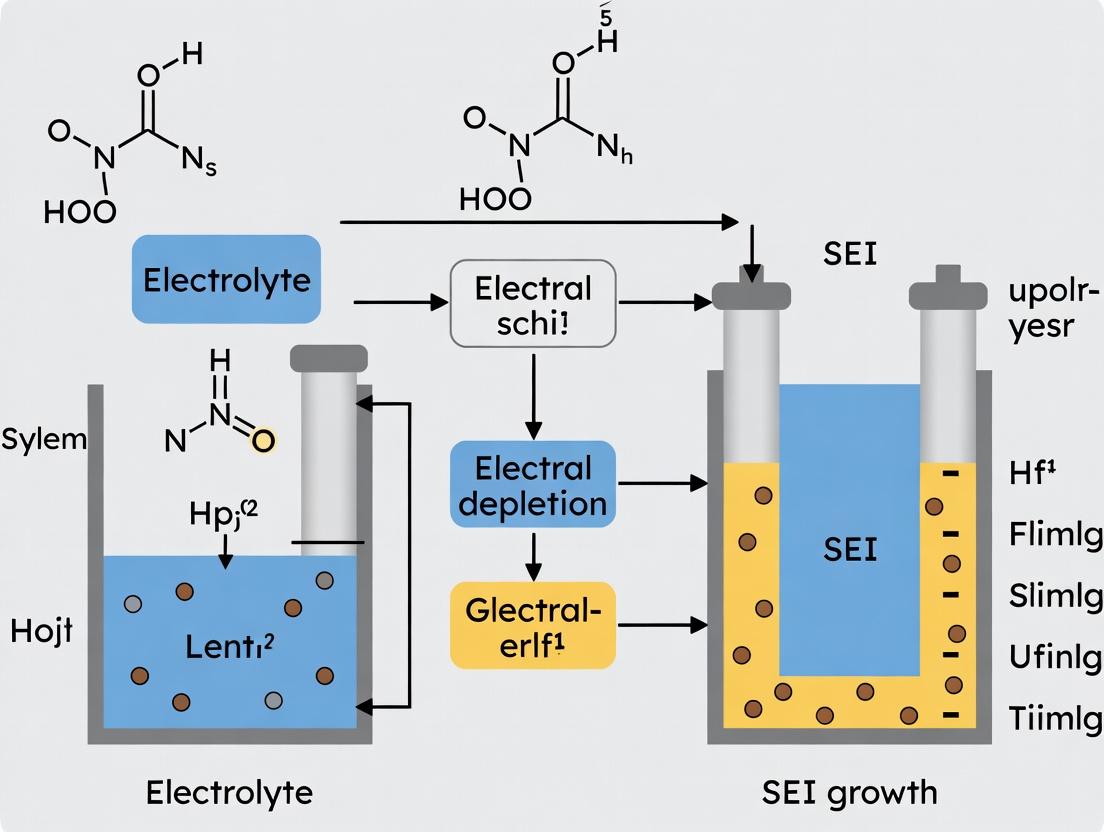
This article provides a comprehensive analysis of the interconnected mechanisms of electrolyte depletion and continuous solid-electrolyte interphase (SEI) growth, which are primary drivers of capacity fade and impedance rise in...
Electrolyte Depletion and SEI Growth: Interlinked Challenges in Modern Lithium-Ion Battery Aging
Abstract
This article provides a comprehensive analysis of the interconnected mechanisms of electrolyte depletion and continuous solid-electrolyte interphase (SEI) growth, which are primary drivers of capacity fade and impedance rise in lithium-ion batteries. Targeted at researchers, scientists, and development professionals, the content explores foundational chemical pathways, advanced diagnostic and mitigation methodologies, strategies for troubleshooting and system optimization, and comparative validation of emerging solutions. The scope encompasses recent research on quantifying irreversible lithium inventory loss, modeling SEI evolution, electrolyte formulation strategies, and advanced characterization techniques to guide the development of next-generation, long-life energy storage systems.
The Core Mechanisms: Unraveling the Chemistry of Lithium Loss and SEI Evolution
Title: Defining the Problem: How Electrolyte Depletion and SEI Growth Drive Capacity Fade
Troubleshooting Guides & FAQs
Q1: During long-term cycling of my Li-ion coin cell, I observe a rapid capacity fade and a sharp increase in cell polarization. What are the primary diagnostic experiments to confirm if electrolyte depletion is the root cause?
A: To diagnose electrolyte depletion, perform these experiments:
- Post-Mortem Analysis: In a glovebox, disassemble cycled cells. Visually inspect the separator for dry spots. Precisely measure the mass of the harvested separator and compare it to a fresh separator's mass after electrolyte soaking. A significant mass loss indicates solvent loss.
- Electrolyte Extraction & Quantification: Use a solvent like DMC to extract residual electrolyte from the cycled cell components. Analyze the extract via Gas Chromatography-Mass Spectrometry (GC-MS) to quantify remaining solvent and identify decomposition products.
- Ion Chromatography: Analyze the extracted electrolyte for Li⁺ concentration. A severe drop vs. fresh electrolyte confirms active Li⁺ inventory loss due to SEI consumption.
Experimental Protocol: Electrolyte Extraction & Quantification
- Materials: Cycled cell, anhydrous Dimethyl Carbonate (DMC), argon-filled glovebox, precision scale, GC-MS vial.
- Steps:
- Transfer the cycled cell to an argon glovebox (H₂O, O₂ < 0.1 ppm).
- Carefully disassemble the cell.
- Place the anode, cathode, and separator into a pre-weighed vial.
- Add 2.0 mL of DMC, seal the vial, and let it sit for 12 hours.
- Filter the solution into a new vial.
- Analyze 1 µL of the filtrate via GC-MS. Compare solvent peak areas to a calibration curve from fresh electrolyte.
Q2: My differential voltage (dV/dQ) analysis shows a steady shift in the anode staging peaks, suggesting loss of active lithium. How can I distinguish between lithium trapped in a growing SEI versus lithium consumed by electrolyte reduction on cathode surfaces?
A: This requires complementary characterization targeting each electrode:
- For Anode SEI Growth: Use Isotope Labeling coupled with Time-of-Flight Secondary Ion Mass Spectrometry (ToF-SIMS). Cycle cells with
³⁶S-labeled LiTFSI salt or¹³C-labeled carbonate solvents. Post-cycled ToF-SIMS depth profiling will map the isotopic signature, directly quantifying the contribution of salt vs. solvent to the SEI lithium inventory. - For Cathode-Electrolyte Interface (CEI) Consumption: Employ X-ray Photoelectron Spectroscopy (XPS) with in-situ Ar⁺ sputtering on harvested cathodes. Quantify the fluorine (F 1s) and phosphorus (P 2p) signals from decomposed LiPF₆ salt. A thick CEI rich in LiF/LiₓPFᵧO₂ correlates with Li⁺ consumption at the cathode.
Experimental Protocol: ToF-SIMS Sample Preparation for SEI Analysis
- Materials:
¹³C-labeled EC solvent, coin cell components, copper foil substrate, ToF-SIMS holder. - Steps:
- Prepare electrolyte using 1M LiPF₆ in
¹³C-EC:DMC (3:7 wt%). - Assemble CR2032 coin cells (e.g., Graphite vs. Li metal).
- Cycle cells at C/10 for 50 cycles.
- In a glovebox, extract the graphite anode, rinse gently with DMC, and dry.
- Mount a small piece of the anode on a ToF-SIMS holder using a copper tape transfer shuttle, ensuring no air exposure.
- Transfer the holder to the ToF-SIMS instrument via an argon-sealed transfer vessel.
- Prepare electrolyte using 1M LiPF₆ in
Q3: When testing high-nickel NMC cathodes, my cells exhibit severe gas generation and accelerated capacity fade. Is this linked to electrolyte oxidation and depletion?
A: Yes. High-voltage oxidation of carbonate solvents (EC, DMC) at the NMC surface generates CO₂ and CO gases, depleting solvent and increasing impedance.
- Diagnostic Test: Use In-situ Pressure Analysis or Operando Electrochemical Mass Spectrometry (OEMS). Seal cells in a pressure-tight fixture with a sensor or connect to a mass spectrometer gas inlet. Monitor pressure or gas evolution (O₂, CO₂, CO) during charging above 4.3V vs. Li⁺/Li.
- Mitigation Protocol: Replace a portion of the carbonate solvents with more oxidation-resistant compounds like Sulfolane or fluorinated carbonates. Include additives like lithium difluoro(oxalato)borate (LiDFOB) to form a protective CEI.
Q4: What are the best practices for accurately measuring SEI growth dynamics in-operando?
A: Rely on coupled electrochemical and physical measurement techniques.
- Electrochemical Quartz Crystal Microbalance (EQCM): Monitors mass change (ng/cm²) on an electrode surface in real-time. A continuous mass increase during hold at low potential indicates SEI growth.
- In-situ Electrochemical Impedance Spectroscopy (EIS): Track the increase in SEI resistance (R_SEI) via medium-frequency semicircle evolution in Nyquist plots over multiple cycles.
- Operando NMR: Can differentiate between Li⁺ in the SEI, in the electrolyte, and in the graphite lattice.
Table 1: Quantitative Data Summary of Common Failure Modes
| Failure Mode | Primary Signature | Typical Quantitative Loss per Cycle | Key Diagnostic Tool |
|---|---|---|---|
| Anode SEI Growth | Irreversible Li⁺ consumption | 0.1-0.5% of total capacity | Coulometric Titration, EQCM |
| Electrolyte Oxidation | Gas generation, CEI thickening | Solvent loss: 5-15% after 100 cycles @ 4.5V | OEMS, GC-MS, XPS |
| Transition Metal Dissolution | Anode SEI poisoning, cathode structural decay | Mn/Ni loss: 1-2% of total content | ICP-MS, TXM |
| Li Plating | Sudden capacity drop, low Coulombic efficiency | Plated Li: up to 20% of cycled charge at high rates | Post-mortem SEM, NMR |
The Scientist's Toolkit: Research Reagent Solutions
Table 2: Essential Materials for SEI/Electrolyte Studies
| Reagent/Material | Function & Rationale |
|---|---|
| ¹³C-labeled Ethylene Carbonate (EC) | Isotopic tracer to track the specific contribution of solvent reduction to SEI formation via ToF-SIMS or NMR. |
Lithium-6 (⁶Li) metal foil |
Enables ⁶Li NMR studies to differentiate Li environments in the SEI without interference from ⁷Li in the salt. |
| Vinylene Carbonate (VC) / Fluoroethylene Carbonate (FEC) | Common film-forming additives that polymerize to create a more stable, flexible SEI, reducing continual growth. |
| Lithium Difluoro(oxalato)borate (LiDFOB) | Dual-function additive that forms protective Boron- and Oxalate-rich interphases on both anode and cathode. |
| Deuterated Solvents (e.g., d₄-EC, d₆-DMC) | Allows for precise tracking of electrolyte decomposition pathways and quantification via NMR without H⁺ interference. |
| Micro-reference Electrode (e.g., Li ribbon) | Enables monitoring of individual electrode potentials in a full cell, critical for distinguishing anode vs. cathode polarization. |
Experimental Workflow & Pathway Diagrams
Diagram Title: Diagnostic Pathways for Capacity Fade Analysis
Diagram Title: SEI Growth and Electrolyte Oxidation Feedforward Loop
Technical Support Center: Troubleshooting Electrolyte Degradation
FAQ & Troubleshooting Guide
Q1: During long-term cycling of my Li-ion cell, I observe a rapid capacity fade and a significant increase in cell impedance. What is the most likely primary cause, and how can I confirm it?
A: The most likely cause is continuous electrolyte depletion due to reduction reactions at the anode, leading to solid electrolyte interphase (SEI) growth and lithium salt (e.g., LiPF₆) consumption. To confirm:
- Perform post-mortem analysis via Gas Chromatography-Mass Spectrometry (GC-MS) on extracted electrolyte to identify solvent decomposition products (e.g., ethylene, CO, CH₄, alkyl carbonates).
- Use Inductively Coupled Plasma Optical Emission Spectroscopy (ICP-OES) to measure lithium and transition metal (from cathode) concentrations in the electrolyte and on electrode surfaces.
- Measure the fluoride ion (F⁻) content via ion chromatography or a fluoride-selective electrode; increased F⁻ indicates LiPF₆ hydrolysis: LiPF₆ + H₂O → LiF + POF₃ + 2HF.
Experimental Protocol: Quantifying Salt Consumption via Ion Chromatography
- Cell Disassembly: In an argon-filled glovebox (<0.1 ppm H₂O/O₂), carefully disassemble the cycled cell.
- Electrolyte Extraction: Soak the separated anode and cathode in 2 mL of anhydrous dimethyl carbonate (DMC) each for 12 hours to extract residual electrolyte.
- Sample Preparation: Combine extracts, dilute 1:50 with ultra-pure water (18.2 MΩ·cm). Filter through a 0.2 μm nylon syringe filter.
- Analysis: Inject sample into an ion chromatograph equipped with a conductivity detector. Use an AS-11 HC column with a KOH eluent gradient (1-30 mM over 20 min). Quantify anions (F⁻, PF₆⁻, PO₂F₂⁻) against calibrated standards.
Q2: My differential electrochemical mass spectrometry (DEMS) data shows ethylene (C₂H₄) evolution during the first reduction cycle, but also in subsequent cycles. Shouldn't solvent reduction stop after a stable SEI forms?
A: Continuous ethylene evolution indicates ongoing solvent (e.g., ethylene carbonate, EC) decomposition. This is a key symptom of continuous SEI growth, a core thesis in addressing electrolyte depletion. The SEI is dynamic and not fully passivating. Causes include:
- Mechanical cracking: Volume changes in the anode (Si, Li metal) fracture the SEI, exposing fresh anode to electrolyte.
- Chemical dissolution: SEI components (e.g., lithium ethylene dicarbonate, LEDC) are soluble in electrolyte or react with HF.
- Electron tunneling: Through thin or defective SEI layers, enabling further reduction.
Q3: I suspect LiPF₆ decomposition is contributing to my cell failure. What are the key decomposition pathways and their signatures?
A: LiPF₆ decomposes via thermal and hydrolytic pathways, consuming the conductive salt and generating acidic species that accelerate side reactions.
Table 1: Primary LiPF₆ Decomposition Pathways & Signatures
| Pathway | Chemical Reaction | Key Signature/Product | Analytical Detection Method |
|---|---|---|---|
| Thermal Decomposition | LiPF₆ (s/l) ⇌ LiF (s) + PF₅ (g) | PF₅ gas, LiF precipitation | GC-MS (for PF₅), XRD/SEM-EDS (for LiF) |
| Hydrolytic Decomposition | LiPF₆ + H₂O → LiF + POF₃ + 2HF | HF gas, POF₃, F⁻ ions | Fluoride ISE, NMR (³¹P, ¹⁹F), IC |
| Secondary Reaction | PF₅ + H₂O → POF₃ + 2HF | POF₃ gas | GC-MS, NMR |
| Ester Reaction | POF₃ + ROH → OP(OR)₃ + HF | Dialkyl fluorophosphates | ³¹P NMR |
Experimental Protocol: Titrimetric Analysis of Acidic Decomposition Products (HF)
- Reagent Prep: Prepare 0.01 M NaOH in anhydrous ethanol with phenolphthalein indicator (1% in ethanol).
- Titration: In the glovebox, add 1 mL of extracted electrolyte to 10 mL of anhydrous ethanol. Titrate immediately with the NaOH solution until a persistent pale pink endpoint.
- Calculation: Acidic content (mmol/g) = (MNaOH * VNaOH) / massofelectrolyte_sample. This gives a total acid number, primarily reflecting HF.
Q4: What are the best practices to mitigate these degradation pathways in a research setting?
A: Mitigation strategies focus on electrolyte engineering:
- Additives: Incorporate 5-10 wt% additives like vinylene carbonate (VC), fluoroethylene carbonate (FEC), or lithium difluoro(oxalato)borate (LiDFOB). These reduce prior to bulk solvents, forming a more stable, flexible SEI.
- Salt Alternatives: Investigate salts like LiFSI or LiTFSI, though assess Al corrosion. Use dual-salt systems (e.g., LiPF₆ + LiDFOB) for synergistic effects.
- Solvent Blends: Reduce EC content and use linear carbonate/ester blends with higher reduction stability (e.g., ethyl methyl carbonate, methyl propionate).
- Proton Scavengers: Add compounds like hexamethyldisilazane (HMDS) to neutralize HF, breaking the acid-driven degradation cycle.
The Scientist's Toolkit: Research Reagent Solutions
Table 2: Essential Materials for Electrolyte Degradation Studies
| Reagent/Material | Function & Rationale |
|---|---|
| Anhydrous Ethylene Carbonate (EC) | Primary cyclic carbonate solvent. Forms effective but potentially continuous SEI. Must be <20 ppm H₂O. |
| Vinylene Carbonate (VC) Additive | Polymerizable additive. Reduces before EC, forming a poly(VC) SEI layer that limits further reduction and improves flexibility. |
| LiPF₆ Salt (Battery Grade) | Standard conductive salt. Source of Li⁺ ions. Studying its decomposition is central to understanding acid generation. |
| Deuterated Solvents (e.g., d⁴-EC, d-DMC) | Used for in-situ NMR studies to track decomposition pathways and identify species without interfering solvent signals. |
| Lithium Difluoro(oxalato)borate (LiDFOB) | Multifunctional salt/additive. Forms a robust B- and F-containing SEI and can neutralize HF, addressing both reduction and salt decay. |
| Molecular Sieves (3Å) | For in-bottle electrolyte drying post-synthesis. Maintains electrolyte purity during storage. |
| Fluoride Ion-Selective Electrode (ISE) | Directly measures free F⁻ concentration in electrolyte, a direct metric of LiPF₆ hydrolysis and degradation severity. |
Experimental Workflow & Pathway Diagrams
Title: Electrolyte Degradation Cascade in Li-ion Cells
Title: Post-Mortem Electrolyte Analysis Workflow
Technical Support Center: Troubleshooting SEI Experimentation
This support center addresses common experimental challenges within the broader research thesis focused on elucidating mechanisms of electrolyte depletion and continuous Solid Electrolyte Interphase (SEI) growth in lithium-ion batteries.
Frequently Asked Questions (FAQs)
Q1: During long-term cycling of my Li||NMC half-cell, I observe a sudden, sharp increase in polarization after ~200 cycles, followed by rapid capacity fade. Is this solely due to SEI growth? A1: While continuous SEI growth contributes, a sudden "knee-point" failure often indicates critical electrolyte depletion. The SEI consumes Li⁺ and electrolyte components (e.g., EC, LiPF₆). Once the electrolyte volume or salt concentration falls below a critical threshold, ion transport is severely hampered, causing drastic polarization. Diagnostic Step: Perform post-mortem IC-MS or NMR on the electrolyte to quantify remaining solvent and salt. Compare to a control cell cycled for fewer cycles.
Q2: My XPS analysis of the anode SEI shows a strong fluorine (F 1s) signal. Does this primarily indicate LiF, or could it be a result of salt decomposition? A2: A strong F signal is typically from LiF, a key SEI component. However, its origin is crucial for your model. It can form from:
- Reduction of LiPF₆ (especially at elevated temperatures or with trace H₂O): LiPF₆ → LiF + PF₅.
- Reduction of HF (from PF₆ hydrolysis): HF + Li⁺ + e⁻ → LiF + ½ H₂. Troubleshooting: Cross-reference with P 2p spectra. If phosphorus is present, it suggests direct LiPF₆ reduction. Correlate with cycling conditions (temperature, voltage) to identify the dominant pathway.
Q3: When attempting to model SEI growth using DFT calculations, how should I account for the potential-dependent reduction of ethylene carbonate (EC)? A3: The reduction pathway of EC shifts with potential. Your model must consider this:
- At higher potentials (near ~0.8 V vs. Li⁺/Li): One-electron reduction dominates, leading to (CH₂OCO₂Li)₂ and C₂H₄ gas.
- At lower potentials (< 0.8 V vs. Li⁺/Li): Two-electron reduction becomes favorable, producing Li₂CO₃ and C₂H₄. Protocol: For accurate modeling, first determine the equilibrium potential for your specific SEI component formation reactions using thermodynamic data, then apply an appropriate overpotential to simulate the operational condition of the anode.
Q4: My in situ EIS data shows the SEI resistance (RSEI) increasing, then periodically decreasing slightly before resuming growth. Is this an instrumentation error? A4: Not necessarily. This may reflect the dynamic, self-limiting, and reforming nature of the SEI. Mechanical cracking of the SEI layer (from volume changes) can temporarily lower RSEI, followed by re-healing via further electrolyte reduction. This is consistent with models of continuous growth. Validation: Synchronize EIS with coulombic efficiency (CE) measurements. A temporary dip in CE often coincides with the drop in R_SEI, indicating fresh reduction reactions to heal cracks.
Experimental Protocols & Data
Protocol 1: Quantifying Electrolyte Depletion via NMR
- Objective: Measure residual solvent and salt concentration post-cycling.
- Method:
- Disassemble cycled cell in an argon-filled glovebox.
- Extract the electrolyte by soaking the separator and electrodes in a known quantity of deuterated solvent (e.g., DMSO-d₆).
- Add a precise internal standard (e.g., dimethyl carbonate-d₆) to the extract.
- Analyze via ¹H and ¹⁹F NMR.
- Quantify concentrations by integrating solvent/standard peaks and comparing to a pre-cycled calibration curve.
Protocol 2: Differentiating SEI Components via XPS Sputter Depth Profiling
- Objective: Determine the layered structure of the SEI.
- Method:
- Transfer anode sample from glovebox to XPS via a sealed, inert transfer vessel.
- Acquire high-resolution spectra for C 1s, O 1s, F 1s, P 2p, and Li 1s.
- Use a low-energy Ar⁺ ion beam (e.g., 500 eV) to sputter the surface for 30-60 seconds.
- Repeat spectral acquisition. Iterate sputter/acquire cycles to build a depth profile.
- Deconvolute peaks (e.g., C 1s: C-C/C-H ~284.8 eV, C-O ~286.5 eV, C=O ~289-290 eV, Li₂CO₃ ~290 eV).
Quantitative Data Summary: Common SEI Components & Their Signatures Table 1: Key SEI Components and Analytical Signatures
| Component | Primary Formation Route | Key XPS Binding Energy (eV) | Common Morphology |
|---|---|---|---|
| Li₂CO₃ | 2e⁻ EC reduction | C 1s: ~290; O 1s: ~531.5 | Crystalline, inorganic |
| Lithium Alkoxides (ROLi) | 1e⁻ EC/Linear Carbonate reduction | O 1s: ~532-533 | Amorphous, organic |
| (CH₂OCO₂Li)₂ | 1e⁻ EC reduction | C 1s: ~289; O 1s: ~533.5 | Amorphous, organic |
| LiF | LiPF₆/HF reduction | F 1s: ~685 | Nanocrystalline, inorganic |
| Li₂O | Reduction of trace O₂/H₂O | O 1s: ~528-529 | Crystalline, inorganic |
The Scientist's Toolkit: Key Research Reagent Solutions
Table 2: Essential Materials for SEI & Electrolyte Depletion Studies
| Item | Function & Rationale |
|---|---|
| Deuterated Electrolyte Solvents (e.g., EC-d4, EMC-d10) | Enables precise quantification of solvent consumption via NMR without background interference. |
| ¹³C-labeled Ethylene Carbonate (¹³C-EC) | Tracks the specific fate of EC carbon atoms in the SEI using techniques like ¹³C MAS NMR or SIMS. |
| Hydrofluoric Acid (HF) Scavengers (e.g., Tris(trimethylsilyl)phosphite) | Added to electrolyte to differentiate LiF formation from LiPF₆ vs. HF pathways. |
| Reference Electrodes (e.g., Li₄Ti₅O₁₂ (LTO) at 1.55V vs. Li⁺/Li) | Provides stable potential reference in long-term cycling to accurately track anode polarization. |
| Isotopically Enriched Lithium Salt (⁶LiPF₆ or ⁷LiPF₆) | Allows distinction between SEI Li⁺ and cyclable Li⁺ via techniques like ⁶Li MAS NMR, clarifying Li⁺ inventory loss. |
Visualizations
Diagram 1: Key EC Reduction Pathways in SEI Formation
Diagram 2: SEI Growth & Electrolyte Depletion Feedback Loop
Technical Support & Troubleshooting Center
Context: This support center operates within a research thesis focused on mechanistic understanding and mitigation of electrolyte depletion and continuous SEI growth in lithium-ion batteries. The guides below address common experimental challenges in quantifying Li inventory loss and its root causes.
Frequently Asked Questions (FAQs)
Q1: During differential voltage analysis (dVA) of half-cell data, the plateau associated with anode delithiation is noisy or indistinct. What could be the cause and solution?
A: This is often due to insufficient electrode equilibration or excessive C-rate. The continuous SEI growth consumes Li+ and can distort the voltage profile.
- Troubleshooting Steps:
- Ensure a long enough relaxation period (≥ 1 hour) at the end of each half-cycle before starting the next.
- Re-test at a lower C-rate (e.g., C/20) to minimize kinetic polarization.
- Verify the reference electrode stability if used in a three-electrode setup.
- Consider if electrolyte depletion has become severe, altering the anode's thermodynamic behavior. A fresh electrolyte swap in a control cell can confirm.
Q2: When using ICP-OES to measure lithium in harvested electrodes, the results show high variance between replicates. How can I improve protocol consistency?
A: Incomplete digestion or inconsistent sample mass are primary culprits.
- Troubleshooting Steps:
- Sample Mass: Precisely weigh each electrode sample (aim for 5-10 mg) before digestion.
- Digestion Protocol: Use a mixture of concentrated HNO₃ and HCl (aqua regia) in a closed-vessel microwave digestion system. Ensure the digestion is complete (solution clear, no particles).
- Blank Control: Run digestion blanks and matrix-matched calibration standards to account for background Li and acid matrix effects.
- Replication: Increase to a minimum of n=5 technical replicates per electrode sample.
Q3: The plating/stripping Coulombic efficiency (CE) measurement from my symmetric Li||Li cell does not correlate with full-cell capacity fade. Why?
A: The Li metal in a symmetric cell provides an "infinite" reservoir, masking inventory loss effects seen in a full-cell with a fixed Li inventory (from the cathode).
- Troubleshooting Steps:
- Test Context: Use the symmetric cell data to understand plating morphology and local current density effects, not for direct inventory loss quantification.
- Primary Experiment: Shift focus to a "Li||NMC" half-cell with limited Li (e.g., thin Li foil) or, preferably, a "C||NMC" full-cell where the anode is the material under study (e.g., graphite, Si-C). The full-cell directly reflects the closed system where inventory loss is critical.
- Correlate Metrics: Cross-reference plating onset conditions (from voltage dips in dV/dQ analysis) with the calculated loss of cyclable Li from full-cell cycling.
Q4: My post-mortem SEM analysis of the anode shows ambiguous features. How can I better distinguish between SEI layers and plated Li metal?
Q5: How can I experimentally isolate the contribution of cathode degradation (e.g., transition metal dissolution) to total Li inventory loss from anode-side losses?
A: Implement a designed cell swap experiment.
- Experimental Protocol:
- Construct two identical full-cells (Cell A, Cell B) with fresh materials.
- Cycle both cells to a specific state-of-health (e.g., 80% capacity retention).
- Perform a careful post-mortem disassembly in an inert atmosphere.
- Re-assemble new cells: Pair Cell A's aged anode with a fresh cathode (Cell A-a). Pair Cell B's aged cathode with a fresh anode (Cell B-c).
- Re-measure the capacity of Cell A-a and Cell B-c. The capacity loss in Cell A-a is primarily due to anode-side Li loss (plating, SEI). The loss in Cell B-c is due to cathode-side degradation (structural disorder, loss of active material).
- The sum of losses from A-a and B-c will approximate the total loss from the original aged cell.
Table 1: Common Techniques for Quantifying Lithium Inventory Loss
| Technique | Primary Measurement | Probes This Loss Mechanism | Key Limitation |
|---|---|---|---|
| dQ/dV Analysis | Incremental capacity peaks | Loss of cyclable Li (LAM_Li) | Requires low C-rate, sensitive to voltage noise |
| Differential Voltage (dV/dQ) | Voltage vs. capacity slope | Li plating onset, LAM_Li | Needs a stable reference electrode for best results |
| ICP-OES/MS | Absolute Li mass in electrode | Total irreversibly trapped Li | Destructive; requires careful digestion |
| Isothermal Calorimetry | Heat flow during plating | Side reaction kinetics (SEI/Plating) | Complex setup; indirect quantification |
| Mass Titration | Electrode mass change | Net Li+ consumption via SEI/plating | Requires ultra-precise microbalance, controlled environment |
Table 2: Typical Experimental Parameters for Key Protocols
| Experiment | Suggested Cell Format | Cycling Protocol | Key Metric to Record | ||
|---|---|---|---|---|---|
| Plating Onset | 3-electrode (Ref: Li) | C/20 charge to 100% SoC, hold at 4.2V | Anode vs. Ref. potential; track time below 0V vs. Li/Li+ | ||
| Coulombic Inefficiency | Li | NMC (limited Li) | Charge/Discharge at C/10, 100 cycles | Cumulative CE = (Discharge Cap/Charge Cap)^N | |
| Post-Mortem Analysis | Full-cell (C | NMC) | Cycle to target capacity fade, then hold at 50% SoC | Electrode harvesting potential; rinse procedure (DMC) |
The Scientist's Toolkit: Research Reagent Solutions
| Item | Function & Relevance to Thesis |
|---|---|
| 1M LiPF₆ in EC:EMC (3:7 wt%) | Standard electrolyte baseline. Allows study of SEI growth without additive complications. |
| Fluoroethylene Carbonate (FEC) | Common SEI-forming additive. Used to study modification of SEI structure and its impact on Li plating propensity. |
| Lithium Bis(oxalato)borate (LiBOB) | Alternative salt/additive. Can form a more stable anode SEI and cathode CEI, potentially reducing TM dissolution. |
| DMC (Dimethyl Carbonate) Solvent | For post-mortem electrode rinsing. Removes residual Li salts without excessive SEI dissolution. |
| Deuterated DMC (d-DMC) & ¹³C-EC | Isotopically-labeled solvents. Critical for advanced analytical techniques (e.g., NMR, GC-MS) to track SEI growth mechanisms and electrolyte depletion pathways. |
| N-Methyl-2-pyrrolidone (NMP) | Solvent for cathode slurry preparation. Consistency here is key for reproducible electrode porosity and kinetics. |
| Polyvinylidene Fluoride (PVDF) Binder | Standard binder for electrode fabrication. Alternative binders (e.g., CMC/SBR) can influence SEI properties. |
Experimental Workflow & Pathway Diagrams
Title: Pathways from Aging to Li Loss and Capacity Fade
Title: Workflow for Quantifying Irreversible Lithium Loss
Troubleshooting Guides & FAQs
Q1: During long-term cycling of my full-cell NMC811|Gr, I observe a rapid, exponential increase in anode overpotential after ~200 cycles, but the cathode half-cell performance remains stable. What is the likely cause and how can I confirm it?
A: This is a classic symptom of electrolyte depletion and crosstalk-induced SEI growth. Cathode processes, specifically transition metal (TM) dissolution (e.g., Mn²⁺, Ni²⁺) and acidic species (HF, H⁺) generation from LiPF₆ salt decomposition at the high-voltage cathode, migrate to the anode. These species catalyze SEI decomposition and reformation, consuming Li⁺ and electrolyte, accelerating SEI growth, and increasing anode polarization.
- Confirmation Protocol: Post-mortem analysis of the graphite anode.
- Disassemble the cycled cell in an Ar-filled glovebox.
- Carefully rinse the anode with pure dimethyl carbonate (DMC) to remove residual salts.
- Analyze the anode surface using X-ray Photoelectron Spectroscopy (XPS). Look for the presence of TM fluorides (e.g., MnF₂, NiF₂) and an increased ratio of inorganic LiF to organic (R-OCO₂Li) components in the SEI compared to a control cell cycled with a Li-metal counter electrode.
- Measure the total lithium inventory via Inductively Coupled Plasma Mass Spectrometry (ICP-MS) of the dissolved anode. Correlate with electrolyte volume and salt concentration measurements from the cycled cell.
Q2: My differential capacity (dQ/dV) plots for the graphite anode show a gradual weakening and shift of the staging phase transition peaks. What does this indicate and what experiment can pinpoint the mechanism?
A: This indicates increased kinetic hindrance for Li⁺ intercalation, often due to a thickening, resistive SEI layer. Crosstalk from the cathode can be the accelerator.
- Diagnostic Experiment: Electrolyte Analysis and Symmetric Cell Testing.
- Electrolyte Sampling: Extract electrolyte from a cycled full-cell and a cycled cathode-half-cell (NMC811 vs. Li) at the same cycle number.
- ICP-MS: Quantify dissolved TM ion (Mn, Ni, Co) concentration in both electrolyte samples.
- Symmetric Cell Build: Construct two Gr|Gr symmetric cells. In one, use fresh electrolyte. In the other, use the electrolyte extracted from the cycled cathode-half-cell (rich in TMs but without anode degradation products).
- Test: Perform electrochemical impedance spectroscopy (EIS) and cycle the symmetric cells. A significantly faster growth of charge-transfer resistance (Rct) in the cell with "cathode-cycled" electrolyte directly confirms cathode-derived species are responsible for anode SEI degradation.
Q3: I suspect HF from cathode-driven LiPF₆ hydrolysis is a key crosstalk agent. How can I experimentally isolate and mitigate its effect?
A: You can use chemical scavengers and controlled additives.
- Mitigation Protocol: Additive Study with Reference Electrode.
- Control: Prepare a baseline electrolyte (e.g., 1M LiPF₆ in EC:EMC 3:7).
- Test Groups: a) Add 1-2 wt% TM scavenger (e.g., LiPO₂F₂, EDTA-based molecules). b) Add 1-2 wt% acid scavenger (e.g., vinylene carbonate (VC) derivatives, pyridine bases).
- Cell Build: Build three-electrode pouch cells (NMC811|Gr with Li-reference) for each electrolyte condition.
- Monitoring: Monitor the anode potential vs. Li/Li⁺ in-situ during long-term cycling. Track the divergence between full-cell voltage and anode potential. A smaller divergence in the scavenger-containing cells indicates suppressed anode polarization due to mitigated crosstalk. Post-mortem FTIR of the anode can show reduced LiF content in the SEI for the acid scavenger group.
Summary of Key Quantitative Data from Recent Studies (2023-2024)
Table 1: Impact of Cathode-Derived Species on Anode SEI Composition and Cell Performance
| Cathode Material | Cycling Conditions | Key Crosstalk Species Detected at Anode | Increase in Anode SEI Thickness (vs. Control) | Li⁺ Inventory Loss per Cycle | Primary Diagnostic Method |
|---|---|---|---|---|---|
| NMC811 (4.4V) | 45°C, 500 cycles | NiF₂, MnF₂, P-O-F species | ~250% (from 50 nm to ~175 nm) | 0.15% | Cryo-TEM, XPS, NMR |
| LNMO (5.0V) | RT, 300 cycles | Mn²⁺, HF/H⁺ | ~400% (from 30 nm to ~150 nm) | 0.3% | EIS, ICP-OES, AFM |
| LCO (4.5V) | 60°C, 200 cycles | Co²⁺, PF₅ (hydrolyzes to HF) | ~180% (from 40 nm to ~112 nm) | 0.2% | XPS, HPLC-MS |
| Control (LiFePO₄) | 4.0V, 45°C, 500 cycles | Negligible | ~30% (from 50 nm to ~65 nm) | 0.05% | Same as above |
Table 2: Efficacy of Mitigation Strategies Against Crosstalk
| Mitigation Strategy | Target Crosstalk Species | Reduction in SEI Growth Rate | Improvement in Cycle Life (Capacity Retention @ 80%) | Trade-off/Note |
|---|---|---|---|---|
| 2% LiPO₂F₂ Additive | TM ions, PF₅ | ~60% | +150 cycles | May form resistive cathode interface at high voltage. |
| 1% 3-Isocyanatopropyltriethoxysilane | HF, H⁺ | ~75% | +220 cycles | Effective SEI stabilizer, can increase initial impedance. |
| Cathode Coating (Li₂ZrO₃ on NMC) | TM dissolution, O₂ release | ~70% | +190 cycles | Adds processing complexity, may reduce energy density. |
| Anode Artificial SEI (LiPON coating) | Blocks species migration | ~90% | +300 cycles | High-cost, vapor deposition process. |
Experimental Protocols
Protocol 1: Quantifying Electrolyte Depletion and TM Dissolution Crosstalk Objective: To correlate cathode state-of-charge (SOC) with TM dissolution and subsequent anode SEI modification. Materials: See Scientist's Toolkit. Procedure:
- Prepare 50 identical NMC811|Gr pouch cells (e.g., 100 mAh).
- Divide into 5 groups. Cycle each group to a different upper cutoff voltage (4.2V, 4.3V, 4.4V, 4.5V, 4.6V) for 100 cycles.
- After cycling, disassemble cells in glovebox.
- For Electrolyte: Precisely measure the recovered electrolyte volume from each cell. Use ICP-MS to quantify Ni, Mn, Co content.
- For Anodes: Rinse graphite anodes with DMC. Perform XPS depth profiling on the SEI. Use Ar⁺ sputtering and quantify the F 1s (LiF/TM-F) and O 1s (organic/inorganic) peaks as a function of depth.
- Correlation: Plot upper cutoff voltage vs. (a) electrolyte volume loss, (b) TM concentration, and (c) inorganic SEI thickness at the anode.
Protocol 2: In-situ Monitoring of Anode Potential During Crosstalk Objective: To decouple anode and cathode degradation using a reference electrode. Materials: Three-electrode cell hardware, Li-reference wire, potentiostat with multi-channel capability. Procedure:
- Fabricate a three-electrode cell with NMC811 as working electrode (WE), graphite as counter electrode (CE), and a thin Li-metal ribbon as reference electrode (RE). Ensure precise positioning and separator isolation.
- Cycle the cell between 3.0-4.4V at C/3.
- Record simultaneously: (i) Full-cell voltage (WE vs. CE), (ii) Cathode potential (WE vs. RE), and (iii) Anode potential (CE vs. RE).
- The anode potential (vs. Li/Li⁺) will remain stable in a healthy cell. A gradual downward drift (more negative) indicates increasing Li⁺ intercalation overpotential due to SEI growth. A sudden shift may indicate Li plating.
- Correlate shifts in anode potential with voltage plateaus in the cathode potential profile that indicate cathode phase transitions or surface reconstructions.
Visualizations
Title: Electrode Crosstalk Mechanism Accelerating SEI Growth
Title: Diagnostic Workflow for Identifying Crosstalk
The Scientist's Toolkit: Key Research Reagent Solutions
| Item | Function in Crosstalk/SEI Research | Example Product/Chemical |
|---|---|---|
| LiPO₂F₂ (Lithium Difluorophosphate) | Dual-function additive. Scavenges PF₅ and HF, forms stable cathode and anode interface layers. | Sigma-Aldrich, 794248; Battery grade. |
| Vinylene Carbonate (VC) | Classic anode SEI modifier. Polymerizes on graphite, forming a flexible, HF-resistant layer. | Gotion, >99.9%, H₂O <10 ppm. |
| Tris(trimethylsilyl) Phosphite (TMSPi) | Effective HF and protic species scavenger. Also scavenges reactive oxygen species. | TCI Chemicals, >98.0%. |
| Lithium Bis(oxalato)borate (LiBOB) | Forms a stable, anion-derived SEI rich in B-O species, resistant to TM deposition and acid attack. | Suzhou Fluolyte, battery grade. |
| Deuterated Solvents (d-EC, d-EMC) | Enables precise tracking of electrolyte decomposition pathways and SEI component origins via NMR. | Cambridge Isotope Laboratories. |
| Reference Electrode Kit (Li-metal) | For in-situ monitoring of individual electrode potentials in a full-cell. Essential for decoupling degradation. | EL-CELL, PAT-Cell Kit. |
| Anode-Free Cu Foil Electrodes | Eliminates the complication of pre-existing anode SEI, allowing study of only cathode-driven SEI formation. | MTI Corporation, high-purity. |
| Isolated Electrolyte Chambers (H-cell) | Physically separates cathode and anode electrolytes while maintaining ionic contact. Directly tests migrant species. | Custom glassware or cell hardware. |
Advanced Diagnostics and Mitigation Strategies: From Characterization to Electrolyte Engineering
Technical Support Center: Troubleshooting Guides and FAQs
Context: This support center is designed to aid researchers investigating electrolyte depletion and continuous Solid Electrolyte Interphase (SEI) growth in battery systems. The following FAQs address common experimental challenges when applying advanced characterization techniques within this thesis framework.
FAQ & Troubleshooting Section
Q1: During in-situ XRD measurement of SEI formation, I observe a weak or diffuse signal from the expected crystalline SEI components (e.g., LiF, Li2O). What could be the cause and how can I resolve it? A: Weak signals often stem from the nanocrystalline or amorphous nature of the SEI, small quantities of material, or interference from the cell components.
- Troubleshooting Steps:
- Confirm Cell Geometry: Ensure your operando cell uses thin, X-ray transparent windows (e.g., Kapton, beryllium) and minimizes the path length through the electrolyte.
- Optimize Acquisition: Increase counting time per step and use a high-flux source (synchrotron if available). Consider grazing-incidence geometries if probing surface layers.
- Background Subtraction: Meticulously collect and subtract background spectra from the empty cell and cell components.
- Post-Process: Apply appropriate smoothing and background subtraction algorithms. Pair with a technique sensitive to amorphous phases (e.g., NMR).
Q2: In operando NMR studies of electrolyte depletion, my 7Li or 19F signals are broadened beyond detection upon cycling. How can I improve resolution? A: Signal broadening is typically due to paramagnetic species in the SEI or bulk magnetic susceptibility effects from heterogeneous cell materials.
- Troubleshooting Steps:
- Magnetic Compatibility: Re-design the electrochemical cell using only non-metallic, magnetically inert materials (e.g., PTFE, PEEK, glass fibers).
- Shimming: Implement an active shimming protocol specific to your operando cell geometry before each experiment.
- Pulse Sequences: Use magic-angle spinning (MAS) probes if feasible, or apply solid-echo sequences to recover broad signals.
- Reference: Use an external reference capillary for accurate chemical shift assignment amidst changing conditions.
Q3: My DEMS setup shows inconsistent Faradaic efficiency calculations and fails to detect certain volatile species (e.g., O2, C2H4) during SEI growth. What should I check? A: This indicates issues with the gas transport system, calibration, or spectrometer sensitivity.
- Troubleshooting Steps:
- Leak Check: Perform a full vacuum leak check on the DEMS system and the coupled electrochemical cell. Ensure all connections are gas-tight.
- Calibration: Re-calibrate the mass spectrometer using standard gas mixtures for each relevant species (e.g., H2, CO2, C2H4, O2). Calibrate the electrolyte flow rate if using a flow cell.
- Transport Delay: Account for the time delay between electrochemical event and MS detection by synchronizing data streams using an internal standard or spike.
- Ion Source: Clean the MS ion source and check the electron energy is optimized (typically 70 eV for standard fragmentation patterns).
Q4: Cryo-EM samples of the SEI layer consistently show beam damage, ice contamination, or poor contrast. What protocols improve sample preservation and imaging? A: This is critical for visualizing the native, labile structure of the SEI.
- Troubleshooting Steps:
- Sample Preparation: Use a dedicated plunge freezer under Ar atmosphere. Transfer the electrode directly from the discharged cell into the cryogen (ethane/propane mix) without washing, or with minimal, controlled washing to preserve soluble species.
- Ice Control: Maintain samples below -170 °C at all times during transfer and imaging. Use anti-contaminators in the microscope.
- Low-Dose Imaging: Use a direct electron detector and strictly follow low-dose imaging protocols (<20 e-/Ų total dose). Search and focus on areas adjacent to the area of interest.
- Contrast: For low-contrast organic SEI components, consider low acceleration voltages (e.g., 100 kV) and defocus contrast imaging carefully.
Experimental Protocols for Key Experiments
Protocol 1: Operando XRD for Monitoring Crystalline SEI Phase Evolution
- Cell Assembly: Assemble a custom operando XRD cell with a Be or Kapton X-ray window, Li metal anode, separator, and working electrode (e.g., Si or Graphite). Use a minimal, controlled volume of electrolyte.
- Synchrotron Setup: Align the cell on a diffractometer at a synchrotron beamline (e.g., λ ≈ 0.207 Å). Use a 2D detector.
- Data Collection: While applying a constant C-rate charge/discharge (e.g., C/10), collect diffraction patterns at fixed time or potential intervals (e.g., every 5 mV).
- Analysis: Integrate 2D patterns to 1D diffractograms. Perform Rietveld refinement or reference pattern matching to identify and quantify crystalline phases (LiF, Li2O, Li2CO3).
Protocol 2: In-Situ NMR for Quantifying Electrolyte Depletion and SEI Composition
- Cell Design: Construct a coin cell inside a cylindrical, MAS-compatible rotor using non-metallic components. Include a Li reference electrode.
- NMR Experiment: Insert the rotor into a magic-angle spinning probe. While spinning at 3-5 kHz, apply slow galvanostatic cycling.
- Data Acquisition: Acquire 1H, 7Li, 19F, and 13C NMR spectra sequentially at different states of charge using a rotor-synchronized pulse sequence.
- Quantification: Integrate peaks corresponding to solvent molecules (e.g., EC, DMC), decomposition products (e.g., LiEDC, LiF), and Li+ species. Use external standards for quantitative concentration analysis.
Protocol 3: DEMS for Tracking Gaseous Decomposition Products During SEI Formation
- System Setup: Couple a custom flow cell or micro-reference electrode cell to a calibrated mass spectrometer via a porous Teflon membrane interface.
- Calibration: Inject known fluxes of calibration gases (H2, C2H4, CO2) into the electrolyte stream to determine MS sensitivity factors for each species.
- Operando Experiment: Apply a linear voltage sweep (e.g., 3.0 V to 0.01 V vs. Li/Li+) to the working electrode while continuously recording the mass spectrometer signals (m/z = 2 for H2, 26 for C2H4, 44 for CO2, 32 for O2).
- Data Processing: Calculate the Faradaic efficiency for each gas by integrating the MS signal over time, applying the calibration factor, and comparing to the total charge passed.
Data Presentation Tables
Table 1: Comparison of SEI Characterization Techniques for Electrolyte Depletion Studies
| Technique | Spatial Resolution | Chemical Sensitivity | Temporal Resolution | Key Information for SEI/Electrolyte | Primary Limitation |
|---|---|---|---|---|---|
| In-Situ XRD | ~1 nm (crystallite size) | Low (crystalline phases only) | Minutes to Hours | Crystalline phase ID & quantity (LiF, Li2CO3) | Blind to amorphous SEI components |
| Operando NMR | Atomic-scale (local env.) | Very High (Li, F, H, C, P) | Minutes | Solvent consumption, Li+ speciation, SEI composition | Requires magnetically compatible cell |
| DEMS | N/A (bulk gas) | High for volatile species | Seconds | Gas evolution rates, Faradaic efficiency | Only detects volatile products |
| Cryo-EM | Atomic to ~1 nm | Low (Z-contrast) | N/A (ex-situ) | SEI morphology, layer thickness, porosity | Sample prep artifacts, beam sensitivity |
Table 2: Key Research Reagent Solutions for Operando SEI Studies
| Reagent/Material | Function in Experiment | Critical Consideration for SEI Research |
|---|---|---|
| Deuterated Electrolytes (e.g., d4-EC, d6-DMC) | Enables clear NMR signal separation between solvent decomposition products and native SEI species. | Essential for quantitative tracking of electrolyte depletion pathways. |
| Isotope-Labeled Solvents (e.g., 13C-EC, 18O-labeled) | Allows precise tracking of atom origins in gaseous (DEMS) and solid (NMR, XRD) decomposition products. | Crucial for elucidating reaction mechanisms of SEI formation. |
| Fluorinated Ether Diluents (e.g., HFE, TTE) | Used as an electrochemically inert, low-viscosity co-solvent to reduce electrolyte volume while maintaining conductivity for operando cells. | Minimizes background signals in XRD/NMR and improves DEMS gas transport. |
| Porous Electrode Supports (e.g., Glass Fiber, Carbon Paper) | Provides a high-surface-area, conductive substrate for model electrodes in DEMS and operando XRD cells. | Ensures uniform current distribution and sufficient signal for surface-sensitive techniques. |
| Cryo-EM Sample Preparation Kit (Plunge freezer, cryo-transfer holder, ethane/propane mix) | Preserves the native, hydrated state of the SEI for transmission electron microscopy analysis. | Must be used in an Ar-filled glovebox to prevent air exposure of sensitive SEI layers. |
Diagrams and Workflows
Title: Workflow for Multi-Technique Operando SEI Analysis
Title: Key SEI Formation Pathways Leading to Depletion
Technical Support Center: Troubleshooting Electrolyte Depletion & SEI Growth Experiments
Introduction This support center provides targeted guidance for researchers investigating advanced electrolyte formulations to mitigate chronic issues of electrolyte depletion and uncontrolled solid-electrolyte interphase (SEI) growth. The content is framed within a thesis focused on developing stable, next-generation electrolytes for long-life lithium metal and high-voltage batteries.
FAQs & Troubleshooting Guides
Q1: During cycling of a high-concentration electrolyte (HCE, e.g., 4M LiFSI in DMC), we observe severe cell polarization and rapid capacity fade after 50 cycles. What could be the cause? A: This is often due to incomplete salt dissolution or localized salt precipitation at high currents, leading to dynamic concentration gradients and "salt depletion" at the electrode surface. This increases impedance and accelerates parasitic reactions.
- Troubleshooting Steps:
- Verify Homogeneity: Ensure the electrolyte is stirred at 50-60°C for >24 hours. Visually inspect for undissolved crystals.
- Check Viscosity: HCEs are viscous. Confirm your cell configuration (e.g., separator type, electrode spacing) can accommodate poor wetting. Pre-wet separators for 2 hours before assembly.
- Electrochemical Check: Perform electrochemical impedance spectroscopy (EIS) at different cycle stages. A continuous increase in bulk resistance (Rb) suggests salt precipitation.
- Solution: Consider a localized high-concentration electrolyte (LHCE). Dilute your 4M LiFSI/DMC HCE with a 1:1.2 molar ratio of bis(2,2,2-trifluoroethyl) ether (BTFE). This maintains the solvation structure while reducing viscosity and cost. Re-test.
Q2: We are testing a novel sulfonamide-based salt (e.g., LiTFSM) for its SEI-stabilizing properties, but coin cells exhibit high interfacial resistance from the first cycle. A: High initial resistance typically points to poor Li+ ion dissociation or the formation of an excessively thick and resistive initial SEI.
- Troubleshooting Steps:
- Measure Ionic Conductivity: Use a conductivity meter. Compare to baseline LiPF₆. If conductivity is < 2 mS/cm at 25°C, ion mobility is low.
- Characterize SEI Composition: Perform X-ray photoelectron spectroscopy (XPS) on disassembled anodes. A dominant peak of insulating LiF or Li₂S without conductive LiₓN or organic components can explain high resistance.
- Solution: Employ a dual-salt system (e.g., 0.8M LiTFSM + 0.2M LiDFOB). The DFOB⁻ anion preferentially decomposes to form a more conductive, boron-rich SEI, lowering initial impedance while maintaining the novel salt's long-term benefits.
Q3: Adding a film-forming additive (e.g., vinylene carbonate, VC) to suppress continuous SEI growth works initially, but gas evolution is observed in pouch cells after formation cycles. A: Gas evolution is a common side effect of additive reduction/oxidation. VC can produce CO/H₂/CO₂ at high voltages or with certain cathode chemistries (NMC811).
- Troubleshooting Steps:
- Identify Gas Source: Use in-situ pressure measurement or GC-MS analysis of pouch cell gas. CO₂ suggests solvent/VC oxidation at high voltage.
- Check Voltage Window: If testing >4.3V vs. Li/Li⁺, VC oxidation is likely.
- Solution: Switch to or co-use a high-voltage compatible additive like 1,3,6-Hexanetricarbonitrile (HTCN) or lithium difluoro(oxalato)borate (LiDFOB). These form stable cathode electrolyte interphases (CEI) and modify the anode SEI with less gas generation.
Q4: When evaluating SEI growth over time via capacity retention curves, how can we quantitatively differentiate between active lithium loss (due to SEI) and electrolyte depletion? A: This requires a multi-method experimental protocol to deconvolute the two phenomena.
- Experimental Protocol: Differential Analysis of Capacity Fade
- Build Three-Electrode Cells: This allows monitoring anode and cathode potentials independently versus a Li reference.
- Perform Periodic Reference Electrode Testing (PRET): At set cycle intervals (e.g., every 10 cycles), pause cycling and perform a low-current (C/20) voltage hold step. Monitor the anode potential vs. Li/Li⁺. A continuous negative drift indicates increasing polarization due to thickening, resistive SEI.
- Post-Mortem Analysis: After cycling, disassemble cells in an Ar-filled glovebox.
- Measure electrolyte residue by weight difference of soaked separator pre- and post-rinsing with DMC.
- Analyze anode surface via SEM for thickness and via ICP-OES for metallic Li content (if using Li metal anodes).
- Correlate Data: Active Li loss correlates strongly with cumulative irreversible capacity and anode potential drift. Electrolyte depletion correlates with a sharp rise in cell polarization when electrolyte residue falls below a critical threshold (e.g., <10 µL/mAh of cell capacity).
Table 1: Performance Comparison of Electrolyte Formulation Strategies
| Strategy | Example Formulation | Avg. CE (Li|Cu) | Capacity Retention (NMC111|Li, 200 cycles) | Key SEI Component (XPS) | Main Drawback |
|---|---|---|---|---|---|
| Conventional | 1M LiPF₆ in EC/EMC (3:7) | 96.5% | 70% | Li₂O, ROLi, LiF | Continuous SEI growth, poor Li metal plating |
| High-Concentration (HCE) | 4M LiFSI in DME | 98.8% | 88% | LiF, Li₂NSO₂F (from FSI⁻) | High viscosity, cost, poor wetting |
| Localized HCE (LHCE) | 1.2M LiFSI in DME/BTFE (1:3 by mol) | 99.2% | 92% | LiF-rich, organic-LiFSI complexes | Slightly higher volatility from diluent |
| Novel Salt | 1M LiTFSM in EC/DEC | 97.8% | 82% | Li₂S, LiₓN, LiF | Moderate ionic conductivity |
| Functional Additive | 1M LiPF₆ EC/EMC + 2% LiDFOB + 1% LIHFPS | 99.1% | 90% | LiF, LiₓB, LiₓP (from DFOB⁻/HFPS⁻) | Optimized concentration window is narrow |
Table 2: Quantitative Metrics for Electrolyte Depletion in Li\|NMC622 Pouch Cells
| Cycling Protocol | Initial Electrolyte (g/Ah) | Electrolyte Consumed after 300 cycles (g/Ah) | Rate of Depletion (µg/cycle/Ah) | Corresponding Capacity Retention |
|---|---|---|---|---|
| C/3, 3.0-4.2V, 25°C | 3.0 | 1.8 | 4.0 | 78% |
| 1C, 3.0-4.4V, 45°C | 3.0 | 2.4 | 6.0 | 45% |
| C/3, 3.0-4.2V, 25°C (with 2% LIHFPS) | 3.0 | 2.2 | 2.7 | 85% |
Experimental Protocols
Protocol 1: Synthesis and Evaluation of a Localized High-Concentration Electrolyte (LHCE) Objective: To prepare a 1M LiFSI in DME/BTFE (1:3.5 mol ratio) LHCE and test its efficacy against Li dendrite growth. Materials: Lithium bis(fluorosulfonyl)imide (LiFSI, battery grade), 1,2-Dimethoxyethane (DME, anhydrous), Bis(2,2,2-trifluoroethyl) ether (BTFE, anhydrous), Ar-filled glovebox (H₂O, O₂ < 0.1 ppm). Procedure:
- Dry LiFSI at 120°C under vacuum for 24h.
- Inside the glovebox, weigh 1.26g LiFSI into a vial.
- Add 2.0g DME (solvent) and stir at 40°C until clear.
- Slowly add 7.34g BTFE (inert diluent) while stirring. The final solution is ~1M LiFSI.
- Assemble CR2032 coin cells with Li metal anode, Cu foil working electrode, and Celgard separator.
- Perform Li plating/stripping tests at 0.5 mA/cm² for 1 mAh/cm². Calculate Coulombic Efficiency (CE) over cycles.
Protocol 2: In-Situ Analysis of SEI Growth Using Electrochemical Quartz Crystal Microbalance (EQCM) Objective: To monitor mass change per unit area (µg/cm²) during the first SEI formation cycle. Materials: EQCM with Au-coated quartz crystal (5 MHz), potentiostat, electrolyte of interest, Li counter and reference electrodes. Procedure:
- Calibrate EQCM sensitivity in pure electrolyte using Sauerbrey equation.
- Set up a 3-electrode cell: Au-working, Li-counter, Li-reference.
- Run a linear sweep voltammetry (LSV) from OCV to 0.01V vs. Li/Li⁺ at 0.1 mV/s while simultaneously recording frequency change (Δf).
- Convert Δf to mass change (Δm). A continuous mass increase after the main reduction peak indicates ongoing SEI growth.
- Correlate mass gain with charge passed to estimate the apparent molar mass of reduction products.
Visualizations
Diagram 1: Pathways of Electrolyte Degradation and SEI Growth
Diagram 2: HCE vs. LHCE Solvation Structure & SEI
The Scientist's Toolkit: Essential Research Reagent Solutions
| Reagent/Material | Function & Rationale | Example Supplier/Product Code |
|---|---|---|
| LiFSI (Lithium bis(fluorosulfonyl)imide) | Novel salt for HCEs/LHCEs. Forms LiF-rich, stable SEI. High solubility and oxidative stability vs. LiPF₆. | Sigma-Aldrich, 792373 (battery grade) |
| Bis(2,2,2-trifluoroethyl) ether (BTFE) | Hydrofluoroether (HFE) diluent for LHCEs. Chemically inert, low polarity, reduces viscosity while preserving Li⁺ solvation structure. | TCI Chemicals, B3348 |
| Lithium difluoro(oxalato)borate (LiDFOB) | Multi-functional additive/co-salt. Forms superior B- and F-containing SEI/CEI simultaneously, suppresses gas, improves stability. | Suzhou Fluolyte, FL-089 |
| Vinylene Carbonate (VC) | Classic film-forming additive. Polymerizes on anode to form a flexible, polycarbonate-based SEI layer, suppressing solvent co-intercalation. | BASF, <99.97% battery grade |
| 1,3,6-Hexanetricarbonitrile (HTCN) | High-voltage cathode stabilizing additive. Forms a thin, uniform CEI on NMC surfaces, inhibiting transition metal dissolution and oxygen release. | Fujifilm Wako, 087-05171 |
| Electrolyte Solvent: Ester Carbonates | EC (ethylene carbonate): High dielectric constant, essential for SEI formation. DMC/EMC/DEC (linear): Lower viscosity co-solvents. | Gotion, "Battery grade" (H₂O <10ppm) |
| Three-Electrode Cell Hardware | Reference electrode integration (e.g., Li wire). Critical for deconvoluting anode and cathode overpotentials during cycling. | EL-CELL, PAT-Cell or custom Swagelok |
| Whatman Glass Fiber Separator (Grade GF/D) | High porosity and electrolyte uptake. Essential for accurate post-mortem electrolyte residue quantification via weighing. | Cytiva, 1823-025 |
Technical Support Center
Troubleshooting Guide: Common Experimental Failures
Issue 1: Inconsistent Coating Thickness During Atomic Layer Deposition (ALD)
- Problem: The artificial SEI layer shows high thickness variability across the electrode surface, leading to inconsistent electrochemical performance.
- Root Cause: Uneven precursor vapor flow, substrate temperature gradients, or incomplete purging cycles.
- Solution: Calibrate the ALD system's mass flow controllers. Ensure uniform substrate heating. Increase purge times between precursor pulses, especially for high-surface-area electrodes. Validate with ellipsometry on a test wafer.
Issue 2: Premature Electrolyte Decomposition Despite Coating
- Problem: Significant gas evolution and capacity fade occur in the first cycle, even with a protective coating applied.
- Root Cause: Pinholes or cracks in the coating layer, or chemical incompatibility between the coating material and the electrolyte solvent/salt.
- Solution: Implement a multi-layer or hybrid coating design (e.g., organic-inorganic composite). Characterize coating morphology with SEM. Test coating stability in electrolyte ex situ using XPS or FTIR before cell assembly.
Issue 3: Excessive Interfacial Resistance Post-Coating
- Problem: The coated electrode exhibits unacceptably high charge transfer resistance, impeding rate capability.
- Root Cause: The coating is too thick or is composed of a material with poor ionic conductivity.
- Solution: Optimize the number of ALD or coating cycles. Explore Li-ion conductive coating materials (e.g., Li₃PO₄, LiPON, LiAlO₂). Perform EIS to deconvolute RSEI and Rct.
Issue 4: Coating Delamination During Cycling
- Problem: The protective layer detaches from the electrode surface after several charge/discharge cycles.
- Root Cause: Poor adhesion due to mismatch in volume expansion or insufficient chemical bonding.
- Solution: Introduce a functional adhesive interlayer (e.g., a polydopamine primer). Design graded or flexible coatings (e.g., polymeric) that accommodate volume changes.
Frequently Asked Questions (FAQs)
Q1: How do I choose between an organic vs. inorganic artificial SEI material? A1: The choice depends on the electrode and failure mode. Inorganic coatings (e.g., Al₂O₃, Li₂ZrO₃) offer high mechanical strength and excellent barrier properties but may be brittle. Organic/polymer coatings (e.g., polycarbonates) provide better flexibility and adhesion to accommodate volume expansion. Often, a hybrid approach is optimal.
Q2: What is the most accurate method to measure artificial SEI thickness in situ? A2: In situ spectroscopic ellipsometry is the gold standard for real-time, non-destructive thickness measurement during film deposition. For post-mortem analysis on electrodes, high-resolution TEM cross-section imaging provides direct visualization, though it is a local measurement.
Q3: How can I differentiate between Li⁺ diffusion through the SEI and charge transfer kinetics? A3: Use electrochemical impedance spectroscopy (EIS) with distribution of relaxation times (DRT) analysis or fit the Nyquist plot with an appropriate equivalent circuit model. The high-frequency semicircle is typically attributed to Li⁺ migration through the SEI (RSEI//CPESEI), while the mid-frequency semicircle relates to charge transfer (Rct//CPEdl).
Q4: My research thesis focuses on mitigating electrolyte depletion. How do artificial SEI designs directly address this? A4: A stable, dense artificial SEI acts as a sacrificial barrier. It prevents direct, continuous contact between the reactive electrode and the electrolyte, thereby drastically reducing parasitic reactions that consume Li⁺ and solvent molecules. This directly curtails both electrolyte depletion and the continuous, consumptive growth of the native SEI.
Q5: What are key characterization techniques to validate artificial SEI functionality? A5:
| Technique | Primary Information | Relevance to Thesis |
|---|---|---|
| X-ray Photoelectron Spectroscopy (XPS) | Chemical composition & evolution of SEI layers. | Tracks electrolyte decomposition products and proves coating stability. |
| Electrochemical Impedance Spectroscopy (EIS) | Interfacial resistance (RSEI, Rct). | Quantifies resistance growth linked to SEI thickening & electrolyte depletion. |
| Cryogenic Electron Microscopy (cryo-EM) | Preserved morphology of SEI and coatings. | Visualizes native SEI suppression and coating integrity post-cycling. |
| Inductively Coupled Plasma Mass Spectrometry (ICP-MS) | Transition metal dissolution from cathodes. | Shows if cathode coatings prevent Mn/Ni/Co leaching, a major electrolyte depletion driver. |
| On-line Electrochemical Mass Spectrometry (OEMS) | Gaseous electrolyte decomposition products (e.g., CO₂, C₂H₄, H₂). | Directly measures the rate of electrolyte decomposition reactions. |
Experimental Protocol: ALD of Alumina (Al₂O₃) Artificial SEI on Silicon Anode
Objective: Apply a uniform, conformal Al₂O₃ coating (~2 nm) via ALD to suppress continuous SEI growth on Si nanoparticles.
Materials: Si nanoparticle electrode, Trimethylaluminum (TMA) precursor, Deionized H₂O precursor, N₂ carrier gas.
Procedure:
- Loading: Transfer the Si electrode into the ALD chamber under an inert atmosphere.
- Stabilization: Heat substrate to 150°C under a constant N₂ flow (200 sccm) for 1 hour.
- ALD Cycle: Execute the following cycle n times (n~20 for ~2 nm):
- TMA Dose: Pulse TMA for 0.1 s.
- Purge 1: Flow N₂ for 10 s to remove excess TMA and by-products.
- H₂O Dose: Pulse H₂O vapor for 0.1 s.
- Purge 2: Flow N₂ for 15 s to remove excess H₂O and by-products.
- Cooling: Cool the sample to <50°C under N₂ flow before removal.
- Validation: Measure coating thickness on a reference Si wafer using ellipsometry.
Research Reagent Solutions Toolkit
| Reagent/Material | Function in Artificial SEI Research |
|---|---|
| Trimethylaluminum (TMA) | Common ALD precursor for depositing Al₂O₃ inorganic barrier layers. |
| Lithium tert-butoxide (LiOtBu) | ALD precursor for depositing lithium-containing inorganic coatings (e.g., Li₂CO₃, LiAlO₂). |
| Vapor-Phase Infiltrated Polymer (e.g., PVDF) | Creates organic-inorganic hybrid coatings for enhanced toughness and adhesion. |
| Lithium bis(oxalato)borate (LiBOB) | Electrolyte additive that polymerizes to form a stable, Li⁺-conductive organic SEI component. |
| Fluoroethylene Carbonate (FEC) | Critical electrolyte additive for anodes; decomposes to form a flexible, LiF-rich protective layer. |
| Lithium Phosphorous Oxynitride (LiPON) Target | Sputtering target for depositing highly conductive, stable inorganic solid electrolyte coatings. |
| Polydopamine Precursor | Forms a universal, adhesive priming layer on various electrode surfaces to improve coating adhesion. |
Diagrams
Title: Key Failure Modes & Protective SEI Design Solutions
Title: Protocol: Artificial SEI Performance Validation Workflow
Technical Support Center
Troubleshooting Guide: TGC for Lithium Inventory Analysis
Issue 1: Low or Erratic Hydrogen Gas Evolution During Titration
- Symptoms: Inconsistent gas volume readings from the GC, leading to poor reproducibility in calculated Li loss.
- Potential Causes & Solutions:
- Cause A: Incomplete or slow reaction of residual Li with the proton donor (e.g., water, methanol).
- Solution: Ensure adequate reaction time (≥2 hours) and vigorous stirring. Confirm the proton donor is anhydrous and of high purity to avoid side reactions.
- Cause B: Leaks in the gas-tight reaction vessel or transfer lines to the GC.
- Solution: Perform a pressure-hold test on the system before each experiment. Check and replace O-rings and septum seals regularly.
- Cause C: GC detector (TCD) not properly calibrated for H₂.
- Solution: Run calibration curves using certified standard gas mixtures of H₂ in Ar before each sample batch.
- Cause A: Incomplete or slow reaction of residual Li with the proton donor (e.g., water, methanol).
Issue 2: Excessive Noise or Drift in Microcalorimetry Power-Time Curve
- Symptoms: Baseline is unstable, obscuring the low heat flow signal from SEI growth.
- Potential Causes & Solutions:
- Cause A: Temperature instability in the lab or calorimeter enclosure.
- Solution: Place the calorimeter in a dedicated, temperature-stabilized room (±0.1°C). Allow 24+ hours for instrument equilibration.
- Cause B: Poor electrical contact or thermoelectric effects from the cell connections.
- Solution: Use shielded, twisted-pair cables and ensure all cell contacts are secure and clean. Implement a proper electrical baseline subtraction protocol.
- Cause C: Vibration or air currents affecting the sensitive calorimeter ampoule.
- Solution: Install on an anti-vibration table and use the provided still-air enclosure or draft shield.
- Cause A: Temperature instability in the lab or calorimeter enclosure.
Issue 3: Discrepancy Between TGC and Microcalorimetry Data for Li Loss
- Symptoms: Quantified "Lost Li" from TGC does not align with cumulative heat from SEI-related reactions in microcalorimetry over the same cycle count.
- Potential Causes & Solutions:
- Cause A: TGC measures total, irreversible Li inventory loss, while microcalorimetry detects heat from both reversible and irreversible processes.
- Solution: Correlate data carefully. Subtract heat from reversible processes (entropic heat, ohmic heating) by analyzing baseline cycles or using a reference inert cell. Focus calorimetric Li loss correlation on the steady, continuous heat flow after initial SEI formation.
- Cause B: Side reactions not involving Li (e.g., electrolyte oxidation at cathode) produce heat but not H₂ gas.
- Solution: Use a combination of techniques. TGC specifically tracks Li metal or lithiated anode reactions. Cross-validate with periodic electrolyte sampling and analysis (e.g., HPLC) for depletion tracking.
- Cause A: TGC measures total, irreversible Li inventory loss, while microcalorimetry detects heat from both reversible and irreversible processes.
Frequently Asked Questions (FAQs)
Q1: Why choose TGC over simple coulombic efficiency measurements for Li inventory tracking? A: Coulombic efficiency (CE) gives an averaged performance metric but cannot distinguish between different Li loss mechanisms (SEI, dead Li, gas evolution). TGC provides an absolute, quantitative measure of the total active Li consumed by reaction with electrolyte. It is a direct chemical assay, making it critical for validating CE measurements and quantifying cumulative, irreversible capacity loss in the context of electrolyte depletion studies.
Q2: What is the typical detection limit for Li loss using Isothermal Microcalorimetry in a battery context? A: Modern high-precision microcalorimeters can detect heat flows as low as 0.05 µW. For a typical coin cell, this translates to sensitivity to side reactions consuming Li at a rate equivalent to a C-rate of approximately 1/100,000. This allows for the detection of very slow, continuous SEI growth processes that are central to long-term cycle life and electrolyte depletion research.
Q3: Can I use TGC on cells with graphite anodes, not just Li metal? A: Yes, but sample preparation is key. The graphite electrode must be carefully extracted and washed to remove residual salts. The titration then measures the amount of "lithiated" material (LiC₆) by reacting it with a proton donor. The evolved gas corresponds to "reversible Li" stored in the anode and "irreversible Li" trapped in the SEI. Comparison with the cell's known cycling history allows for the separation of these pools.
Q4: How do I correlate a specific heat flow signal from microcalorimetry to a particular degradation mechanism like SEI growth? A: This requires controlled experiments and the "The Scientist's Toolkit" below. The continuous, low-level exothermic heat flow (typically 1-10 µW/cm²) after the initial cycles is attributed to ongoing SEI growth. Its magnitude is directly linked to the rate of electrolyte reduction and Li⁺ consumption. By varying electrolyte formulations (e.g., with additives like FEC or VC) and measuring the corresponding change in this steady-state heat flow, you can directly quantify the efficacy of additives in suppressing SEI-related Li loss.
Data Presentation
Table 1: Comparison of Quantitative Methods for Li Inventory Tracking
| Method | What it Measures | Key Metric | Typical Detection Limit | Advantages | Disadvantages |
|---|---|---|---|---|---|
| Titration GC (TGC) | Total irreversibly lost Li (as Li metal, Li in SEI/Li inventory) | Volume of H₂ gas evolved | ~10 nmol Li | Absolute quantification; Direct chemical assay; Distinguishes Li loss from other fade. | Destructive; Requires careful gas handling; Measures total loss, not instantaneous rate. |
| Isothermal Microcalorimetry | Real-time heat flow from all reactions | Power (µW) | ~0.05 µW heat flow | Non-invasive; In-situ/operando; Provides kinetic data on side reactions. | Heat signals are convoluted; Requires meticulous calibration; Cannot speciate Li loss mechanism alone. |
| Coulombic Efficiency (CE) | Net reversible charge vs. discharged | Percentage (%) | ~0.01% (with precision cyclers) | Simple, standard cycling data. | Indirect; Averages all loss mechanisms; Cannot quantify cumulative loss without a reference. |
Table 2: Example Experimental Data from Combined Study on NMC622/Li Cells
| Cycle Number | Cumulative Li Loss (TGC) (mmol) | Avg. Steady Heat Flow (Microcal) (µW) | Electrolyte Volume Depletion (µL) | Post-mortem SEI Thickness (TEM) (nm) |
|---|---|---|---|---|
| 10 | 0.15 | 8.5 | 12 | 25 |
| 50 | 0.82 | 5.1 | 58 | 45 |
| 100 | 1.75 | 3.8 | 125 | 60 |
| 200 | 3.90 | 2.4 (near noise floor) | 280 (80% depleted) | 85 |
Experimental Protocols
Protocol 1: Titration Gas Chromatography (TGC) for Li Metal Anode Analysis
- Cell Dismantling: In an Ar-filled glovebox (<0.1 ppm H₂O/O₂), carefully disassemble the cycled cell.
- Anode Retrieval: Extract the Li metal anode and rinse gently in pure, anhydrous dimethyl carbonate (DMC) to remove residual LiPF₆ salt. Dry briefly.
- Titration Reaction: Immediately transfer the anode to a sealed, gas-tight reaction vial containing 5.0 mL of anhydrous methanol (CH₃OH). Ensure the vial is equipped with a magnetic stir bar and a septum port.
- Gas Evolution: Stir vigorously at 25°C for 2 hours to allow complete reaction: 2Li + 2CH₃OH → 2LiOCH₃ + H₂(g).
- Gas Sampling: Use a gas-tight syringe to extract 100 µL of the headspace gas from the reaction vial.
- GC Analysis: Inject the sample into a Gas Chromatograph equipped with a Thermal Conductivity Detector (GC-TCD). Use a Molecular Sieve column and Ar carrier gas. Quantify H₂ peak area against a pre-run calibration curve from standard H₂/Ar mixtures.
- Calculation: Calculate moles of Li consumed = 2 * (moles of H₂ detected).
Protocol 2: Isothermal Microcalorimetry for In-situ SEI Growth Monitoring
- Calorimeter Setup: Place the high-precision isothermal microcalorimeter (e.g., TAM IV) in a temperature-stabilized room. Allow it to equilibrate at the setpoint (e.g., 25.000°C) for at least 24 hours.
- Cell Preparation & Instrumentation: Construct a coin cell or pouch cell with instrumented leads. Critical: Include an identical, non-electroactive "dummy" cell filled with electrolyte for baseline heat subtraction.
- Baseline Measurement: Place both the active cell and the dummy cell in the calorimeter ampoules. Seal and allow the system to reach thermal equilibrium until a stable baseline is achieved (typically 3-6 hours). Record this baseline heat flow.
- In-situ Cycling: Initiate a galvanostatic cycling protocol (e.g., C/10 charge/discharge) on the active cell externally via a potentiostat, while both cells remain inside the calorimeter.
- Data Acquisition: Record the difference in heat flow between the active and dummy cells. The high-precision instrument will output a continuous µW-versus-time curve.
- Data Analysis: Isolate the continuous, non-cycling exothermic heat flow after the initial large peaks of SEI formation. This steady-state signal (in µW) is proportional to the rate of ongoing electrolyte reduction and SEI growth, providing a real-time metric for Li inventory loss.
Mandatory Visualization
Diagram Title: Combined TGC & Microcalorimetry Workflow for Li Inventory
Diagram Title: Degradation Pathways & Detection Methods
The Scientist's Toolkit: Research Reagent Solutions
| Reagent / Material | Function / Role | Critical Specification / Note |
|---|---|---|
| Anhydrous Methanol (CH₃OH) | Proton donor for TGC titration of Li metal. Reacts stoichiometrically to produce H₂. | Water content <10 ppm. Essential for accurate, side-reaction-free gas evolution. |
| Anhydrous Dimethyl Carbonate (DMC) | Solvent for rinsing electrodes post-cycled cell disassembly. | Water content <10 ppm. Removes LiPF₆ salt without reacting with residual Li. |
| Hydrogen in Argon Standard Gas | Calibration mixture for GC-TCD. | Certified ±1% accuracy. Required for generating the H₂ quantification curve. |
| Fluoroethylene Carbonate (FEC) Additive | Common SEI-forming electrolyte additive. Used in controlled experiments. | High Purity (>99.9%). Study variable to modulate SEI properties and heat flow. |
| Reference Electrolyte (e.g., 1M LiPF₆ in EC:EMC) | Baseline electrolyte for degradation studies. | Battery Grade, H₂O <10 ppm. Serves as the control formulation. |
| Calorimetric Dummy Cell | Matched, non-electroactive cell for baseline heat subtraction. | Identical geometry & electrolyte fill as active cell. Critical for isolating parasitic heat. |
| Gas-Tight Vials & Septa (e.g., CRVO) | For TGC reaction vessel. | Chemically resistant, rated for organics and pressure. Prevents H₂ leakage. |
| High-Precision Microcalorimeter (e.g., TAM IV) | Measures µW-level heat flows from battery cells. | Sensitivity <0.1 µW, stability ±0.0001°C. Enables in-situ degradation monitoring. |
Advanced Binders and Electrode Architectures to Mitrate Mechanical Stress and SEI Cracking Technical Support Center
Frequently Asked Questions (FAQs)
Q1: During coin cell cycling of our high-capacity Si-graphite composite anode, we observe a rapid capacity fade after the first 20 cycles, accompanied by a sharp increase in cell polarization. What is the likely failure mode?
- A1: This is characteristic of mechanical degradation. The large volume expansion of silicon particles (>300%) causes pulverization of the active material and cracking of the surrounding SEI. This exposes fresh electrode surface to the electrolyte, leading to continuous SEI growth and electrolyte depletion. The cracks also disrupt electronic pathways, increasing impedance (polarization). Review your binder system (see FAQ 2) and consider a stress-accommodating electrode architecture.
Q2: We are testing a polyacrylic acid (PAA) binder versus a conventional polyvinylidene fluoride (PVDF) binder for silicon oxide anodes. The electrode slurry with PAA is difficult to coat and shows poor adhesion after drying. How can we improve processability?
- A2: PAA binders rely on hydrogen bonding and require careful control of pH and solvent. Ensure you are using a neutralized PAA (e.g., partially converted to sodium salt, Na-PAA) to improve solubility and slurry rheology. Optimize the solid content and consider using a conductive carbon with a higher surface area to improve dispersion. A co-solvent system (water with a small amount of ethanol or NMP) can also enhance wetting and film formation.
Q3: Our in-situ pressure measurements show a continuous increase in stack pressure during the lithiation of a thick NMC811 cathode, even with advanced polymeric binders. Could this affect long-term stability?
- A3: Yes, significantly. While binders mitigate local particle stress, macroscopic stack pressure build-up from cumulative particle expansion can lead to delamination from the current collector, separator deformation, and accelerated electrolyte breakdown at high voltage. This contributes to both transition metal dissolution and electrolyte depletion. Consider integrating your binder with an electrode architecture that includes vertical channels or porous scaffolds to accommodate bulk expansion.
Q4: When implementing a 3D porous copper current collector for a lithium metal anode, we notice severe dendritic plating on the top surface, negating the benefits. What could be the cause?
- A4: This indicates inhomogeneous current distribution. The 3D architecture must be paired with a uniform SEI. The issue often stems from uneven wetting of the porous structure or an inadequate mechanical modulus in the artificial SEI/interlayer coating. Ensure complete electrolyte infiltration and consider applying a mechanically robust, ionically conductive coating (e.g., hybrid polymer-inorganic) uniformly throughout the 3D host to guide homogeneous lithium nucleation and plating.
Troubleshooting Guide
| Symptom | Possible Cause | Diagnostic Experiment | Recommended Solution |
|---|---|---|---|
| Sudden voltage noise/hiking during charge | Electrode fragmentation, loss of electrical contact. | Post-mortem SEM of electrode cross-section. Electrochemical Impedance Spectroscopy (EIS) tracking charge transfer resistance (Rct). | Switch to a tougher, more elastic binder (e.g., PAA-PVA hybrid, self-healing polymers). Reduce cycling rate (C-rate). |
| Gassing and swelling in pouch cells | SEI cracking & reformation consuming electrolyte, catalytic breakdown at cracked interfaces. | Gas Chromatography (GC) of pouch cell headspace. Measure electrolyte volume depletion post-mortem. | Implement a pre-lithiation or anode-forming protocol. Use electrolyte additives (FEC, LiDFOB) that form a flexible, stable SEI. |
| Linear capacity fade instead of abrupt failure | Continuous, stable SEI growth consuming lithium and electrolyte. | Quantify cumulative lithium inventory loss via differential voltage (dV/dQ) analysis. | Optimize electrolyte composition for a denser, more Li+ conductive SEI. Employ Li-rich cathode or pre-lithiated anode to compensate for initial loss. |
| Poor rate capability in thick electrodes | Binder blocking ion transport pathways, especially with ionically insulating binders. | Measure ionic conductivity of the dry composite electrode. Perform GITT (Galvanostatic Intermittent Titration Technique). | Use binders with intrinsic ionic conductivity (e.g., lithiated polymers) or incorporate hydrophilic/hydrophilic blocks to facilitate ion transport. |
Key Quantitative Data Summary
Table 1: Performance of Advanced Binder Systems in Si-based Anodes
| Binder System | Si Loading (mg/cm²) | Cycle Life (to 80% SOH) | Volume Expansion Mitigation | Key Mechanism |
|---|---|---|---|---|
| Conventional PVDF | 1.0 | < 50 cycles | Low | Weak van der Waals forces |
| PAA (Cross-linked) | 1.0 | 150 cycles | Medium | Strong H-bonding, covalent crosslinks |
| Self-Healing Polymer (e.g., PAA-Borax) | 1.2 | 200+ cycles | High | Dynamic reversible bonds |
| Conductive Polymer Binder (e.g., PEDOT:PSS) | 1.5 | 180 cycles | Medium-High | Combined ionic/electronic conductivity |
Table 2: Impact of Electrode Architecture on Stress Parameters
| Architecture | Porosity (%) | Peak Stack Pressure (MPa) | Capacity Retention (500 cycles) | Electrolyte Consumption (µL/mAh lost) |
|---|---|---|---|---|
| Conventional Dense Coating | 30 | 4.2 | 68% | 0.45 |
| Vertically Aligned Channels | 45 | 2.1 | 85% | 0.28 |
| 3D Micro-lattice Scaffold | 70 | 0.8 | 92% | 0.18 |
| Gradient Porosity Design | 30-60 | 1.5 | 88% | 0.22 |
Experimental Protocols
Protocol 1: Synthesis and Evaluation of a Self-Healing PAA-Based Binder. Objective: To create an electrode capable of repairing micro-cracks formed during cycling.
- Binder Solution Prep: Dissolve 0.5 g PAA (Mw ~450,000) in 9.5 g deionized water. Stir at 500 rpm, 60°C for 12h. Slowly add 0.05 g sodium tetraborate (borax) dissolved in 0.5 g warm water. Stir for an additional 2h to form dynamic borate ester cross-links.
- Slurry Preparation: Mix active material (e.g., Si@C, 80 wt%), conductive carbon (Super P, 10 wt%), and the prepared binder solution (10 wt% solid) in a planetary mixer. Adjust viscosity with water.
- Electrode Fabrication: Coat slurry onto copper foil using a doctor blade. Dry at 80°C in vacuum for 12h. Calender to desired density.
- Mechanical Test: Perform a nano-scratch test on the dry electrode film. Observe crack formation under SEM. Expose scratched area to a drop of electrolyte solvent (EC:DMC) and hold at 60°C for 1h. Re-image via SEM to assess crack closure.
- Electrochemical Test: Assemble coin cells (CR2032) vs. Li metal. Cycle at C/10 for formation, then C/3 for long-term cycling. Monitor differential capacity (dQ/dV) plots for peak shifts indicative of degradation.
Protocol 2: Fabrication of a Thick Cathode with Vertically Aligned Pores. Objective: To create macroscopic stress-relief channels in a high-loading NMC811 cathode.
- Ice-Templating Slurry: Prepare a standard NMC811 slurry with PVDF binder in NMP. Cool the slurry to 0°C.
- Directional Freezing: Pour slurry onto an aluminum current collector pre-cooled to -20°C. Control the temperature gradient using a cold finger apparatus. The slurry freezes unidirectionally, forming ice crystals aligned perpendicular to the foil.
- Freeze-Drying: Immediately transfer the coated foil to a freeze-dryer. Sublimate the ice crystals under vacuum for 48h, leaving behind aligned porous channels.
- Thermal Treatment: Heat the electrode at 200°C under vacuum to fully remove residual solvent and crystallize the binder.
- Characterization: Use X-ray computed tomography to visualize the channel structure. Measure in-situ strain using digital image correlation (DIC) during electrochemical cycling in a transparent cell.
The Scientist's Toolkit: Research Reagent Solutions
| Item | Function/Application | Example (Supplier) |
|---|---|---|
| Cross-linkable Binder (PAA or CMC) | Forms robust 3D network via covalent or ionic cross-links (e.g., with citric acid or Al³⁺ ions) to restrain particle expansion. | Sigma-Aldrich (Polyacrylic acid, Mw ~450,000) |
| Dynamic Bond-Containing Polymer | Enables self-healing of micro-cracks via reversible bonds (e.g., hydrogen, borate ester, Diels-Alder adducts). | Self-synthesized (PAA-borax, PVA-borax hydrogels) |
| Ionically Conductive Binder | Enhances Li⁺ transport within the composite electrode, improving rate performance in thick electrodes. | Heraeus (Clevios PH1000, PEDOT:PSS dispersion) |
| Fluoroethylene Carbonate (FEC) | Essential electrolyte additive that promotes formation of a flexible, LiF-rich SEI more resistant to cracking. | Sigma-Aldrich (Fluoroethylene carbonate, 99%) |
| Silane Coupling Agent | Improves adhesion between inorganic active particles and organic binder via silanol (-SiOH) groups. | Gelest ( (3-Aminopropyl)triethoxysilane, APTES) |
| Ceramic-Coated Separator | Provides mechanical barrier against dendrites, maintains integrity under stack pressure, and retains electrolyte. | Celgard (2325, Al₂O₃/PVDF-HFP coated) |
Visualizations
Troubleshooting Cell Failure and Optimizing Long-Term Performance
Technical Support Center
Troubleshooting Guides & FAQs
Q1: During constant-current cycling of my Li-ion cell, I observe a sudden, sharp drop in capacity and a rise in cell polarization. What is the most likely cause and how can I confirm it? A: A sudden drop is highly indicative of lithium plating. Confirm via:
- Post-mortem analysis: Disassemble cell in discharged state in an Ar-filled glovebox. Visual inspection of the anode for a grey, metallic sheen (plated Li) versus a uniform black color (healthy, lithiated graphite).
- Voltage plateau analysis: During a subsequent low-rate (C/20) charge, look for a distinct plateau at ~10 mV vs. Li/Li+ (signature of plated Li stripping).
- Differential Voltage (dV/dQ) analysis: A shift in the anode peak to higher voltages suggests loss of active lithium due to plating.
Q2: My cell shows a steady, continuous capacity fade over hundreds of cycles, with a gradual increase in impedance. What degradation modes are probable? A: This points to chronic degradation mechanisms:
- Continuous SEI Growth: The primary suspect. Consumes active Li+ and electrolyte, increasing anode resistance.
- Cathode Degradation: Particularly transition metal dissolution (e.g., Mn, Ni) and surface reconstruction, leading to active mass loss and cathode electrolyte interphase (CEI) growth.
Q3: How can I experimentally distinguish between capacity loss from continuous SEI growth versus cathode degradation? A: Implement a reference electrode experiment or perform half-cell pairing post-test.
- Build a 3-electrode cell to monitor anode and cathode potentials separately versus Li/Li+.
- Cycle the full cell to failure.
- Harvest the cathode and anode, then reassemble them vs. fresh Li metal counter electrodes.
- The capacity in the
Cathode vs. Lihalf-cell reveals remaining cathode capacity. - The capacity in the
Anode vs. Lihalf-cell reveals remaining lithium inventory (affected by SEI growth and plating). - Compare to the original full-cell capacity to apportion loss.
Q4: What analytical techniques are definitive for identifying cathode degradation products? A:
- X-ray Photoelectron Spectroscopy (XPS): Surface-sensitive analysis to detect CEI composition (e.g., LiF, LixPFyOz, polycarbonates) and cathode surface reduction (e.g., Ni2+ vs. Ni3+/4+).
- Transmission Electron Microscopy (TEM) with EDS: Direct imaging of surface reconstruction layers (e.g., rock salt phase on NMC) and elemental mapping for transition metal dissolution.
- Inductively Coupled Plasma Mass Spectrometry (ICP-MS): Quantify transition metal (Mn, Ni, Co) concentration in the electrolyte or on the separator/anode, confirming dissolution.
Q5: Within the context of electrolyte depletion research, how do I design an experiment to isolate its effect on SEI growth? A: Use an electrolyte reservoir cell or a controlled amount of electrolyte.
- Construct identical pouch cells with varying, precisely measured electrolyte volumes (e.g., 1.0x, 0.8x, 0.6x of standard pore-filling volume).
- Cycle all cells under identical conditions.
- Monitor capacity fade rate and impedance growth as a function of cycle number.
- Perform gas volume measurement via in-situ pressure or Archimedes' principle. Faster pressure rise in lean-electrolyte cells signals more parasitic reactions (SEI growth, gas evolution) accelerated by depletion.
- Post-mortem electrolyte extraction and NMR can quantify remaining salt and solvent amounts.
Key Experimental Protocols
Protocol 1: dV/dQ Analysis for Lithium Plating Detection
- Cycle the cell using a low constant current (C/20) to obtain a high-resolution voltage curve.
- Export the charge voltage (V) vs. capacity (Q) data.
- Numerically differentiate the data (ΔV/ΔQ) using a smoothing function to reduce noise.
- Plot dV/dQ vs. Voltage or Capacity.
- Identify the characteristic anode staging peaks. A shift of these peaks to higher voltage indicates loss of active lithium (consistent with plating or SEI growth). Correlate with a low-voltage stripping plateau during discharge for plating confirmation.
Protocol 2: Post-Mortem Half-Cell Remaining Capacity Test
- Cell Disassembly: Cycle full cell to end of life. Fully discharge to lower cutoff voltage. Transfer to an Argon glovebox (<0.1 ppm H2O/O2). Carefully disassemble cell.
- Electrode Harvesting: Extract the anode and cathode. Rinse gently with pure dimethyl carbonate (DMC) to remove residual LiPF6 salt. Dry under vacuum.
- Half-Cell Assembly: Punch electrodes. Assemble CR2032 coin cells using harvested electrode as working electrode, fresh Li metal as counter/reference, fresh electrolyte, and separator.
- Testing: Cycle the half-cells at low rate (C/10). The delivered capacity from the cathode half-cell is its remaining capacity. The delivered capacity from the anode half-cell is the remaining cyclable lithium inventory.
Protocol 3: Symmetric Cell Impedance Testing for SEI Resistance
- Harvest anodes (or cathodes) from fresh and cycled cells. Prepare two identical electrodes.
- Assemble a symmetric cell configuration: Electrode A | Separator + Electrolyte | Electrode B.
- Perform Electrochemical Impedance Spectroscopy (EIS) on the symmetric cell (e.g., 1 MHz to 10 mHz, 10 mV amplitude).
- The high-frequency intercept on the real axis represents the bulk electrolyte resistance. The diameter of the subsequent semicircle is attributed to the combined interfacial impedance (SEI or CEI) of the two electrodes. Compare fresh vs. cycled to quantify SEI growth.
Summarized Quantitative Data
Table 1: Diagnostic Signatures of Primary Degradation Modes
| Symptom / Metric | Lithium Plating | Continuous SEI Growth | Cathode Degradation (NMC Example) |
|---|---|---|---|
| Capacity Fade Pattern | Sudden, step-like loss | Steady, linear fade | Steady, linear or accelerating fade |
| Voltage Hysteresis | Large, sudden increase | Gradual increase | Gradual increase, especially at high SOC |
| Coulombic Efficiency | Sharp, temporary drop during plating event | Chronically below 100% (e.g., 99.7%) | Chronically below 100%, may correlate with O2 release |
| dV/dQ Peak Shift | Anode peaks shift to higher voltage | Anode peaks shift to higher voltage | Cathode peaks shift or diminish |
| Key Post-Mortem Visual | Metallic grey spots on anode | Thickened, sometimes brittle anode coating | Darkened cathode surface, transition metals on separator |
| EIS Change | Possible new low-frequency Warburg element | Increase in mid-frequency anode semicircle | Increase in mid-frequency cathode semicircle |
Table 2: Common Analytical Techniques & Their Outputs
| Technique | Primary Function | Key Output for Diagnosis |
|---|---|---|
| XPS | Surface chemical analysis | SEI/CEI composition (LiF, LixPOyFz, polymers), oxidation state of transition metals (Ni, Co) |
| SEM/EDS | Morphology & elemental mapping | Particle cracking, mossy Li deposits, Mn/Ni deposition on anode |
| TEM | Atomic-scale imaging of structure | Crystal lattice distortion, surface reconstruction layer thickness |
| ICP-MS | Trace element quantification | ppm levels of Mn, Ni, Co in electrolyte or on anode |
| NMR | Molecular structure & quantity in electrolyte | Concentration of remaining solvent (EC, DMC) and salt (LiPF6), decomposition products |
The Scientist's Toolkit: Research Reagent Solutions
| Item | Function & Relevance |
|---|---|
| Lithium Metal Chips (Fresh) | Essential for reconstructing post-mortem half-cells to measure remaining electrode capacity. |
| Anhydrous DMC Solvent | Used for rinsing harvested electrodes to remove conductive salt prior to surface analysis without damaging SEI/CEI. |
| Micro-Reference Electrode (Li wire) | Enables 3-electrode cell construction for decoupling anode and cathode overpotentials in situ. |
| Electrolyte with Isotope Tracers (e.g., 13C-labeled EC) | Allows precise tracking of SEI carbon origin via NMR or MS, quantifying decomposition pathways. |
| Cathode Active Materials (NMC811, NMC622, LCO) | Well-defined materials for controlled studies on the impact of composition (Ni content) on degradation. |
| Fluoroethylene Carbonate (FEC) Additive | Common SEI-forming additive used to modify SEI properties and compare stability vs. baseline electrolyte. |
| Polypropylene (PP) / Glass Fiber Separators | Inert separators for symmetric cell impedance testing to isolate electrode/electrolyte interface resistance. |
Diagrams
Diagram 1: Degradation Diagnosis Workflow
Diagram 2: Electrolyte Depletion & SEI Feedback Loop
Voltage Profile and Differential Analysis (dQ/dV) as Practical Diagnostic Tools
Technical Support Center: Troubleshooting Guides & FAQs
Frequently Asked Questions (FAQs)
Q1: In a long-term cycling experiment for SEI growth study, my voltage profile shows a sudden, sharp increase in polarization during the charge phase. What does this indicate? A1: A sudden increase in polarization (widening gap between charge and discharge plateaus) is a primary indicator of severe electrolyte depletion and/or cell dry-out. This increases internal resistance. Immediate diagnostic steps include:
- Perform dQ/dV analysis on the cycle where the shift began.
- Look for a sharp attenuation of the anode-related peaks (especially near 0.1-0.2V vs. Li/Li+), which suggests loss of active lithium due to excessive, resistive SEI growth.
- Correlate with a capacity fade curve; coupled "knee-point" fade and polarization suggest electrolyte limitation.
Q2: When analyzing dQ/dV plots for Li-ion cells, what does a gradual shift of all peaks to higher voltage values signify? A2: A uniform shift of all redox peaks to higher voltages indicates a rising cell impedance, often from continuous SEI growth increasing resistance at the anode interface. This is distinct from electrolyte depletion, which causes specific peak attenuation. The protocol is to measure the peak shift magnitude (ΔV) per cycle and plot it against cycle number to quantify SEI growth rate.
Q3: The characteristic lithium plating peak (~0.01V in dQ/dV) disappears from my analysis after 100 cycles. Is this a good sign? A3: No. The disappearance of the sharp lithium plating/stripping peak can be a critical warning sign. It may indicate that plated lithium has become "dead Li" (electrically isolated), ceasing to participate in the electrochemistry. This permanently consumes cycleable lithium and accelerates capacity fade. Cross-validate with Coulombic Efficiency (CE); a drop in CE concurrent with the peak's disappearance confirms dead Li formation.
Q4: How can I distinguish between capacity fade from SEI growth versus active material loss using these tools? A4: Use the differential analysis of the voltage profile (dV/dQ) on the discharge curve. SEI growth primarily consumes lithium, shifting the entire discharge curve to lower capacities but maintaining the relative positions and shapes of phase transition peaks. Active material loss (e.g., cathode degradation) will change the relative intensity or completely remove specific redox peaks in the dV/dQ plot.
Troubleshooting Guides
Issue: Noisy or Uninterpretable dQ/dV Curves
- Symptoms: Curves have high-frequency noise obscuring redox peaks.
- Root Cause: Insufficient data point resolution or excessive voltage step in cycling data.
- Solution:
- Protocol Adjustment: Set the cycler to a voltage step mode or a C-rate ≤ C/20 for diagnostic cycles, rather than constant current only.
- Data Processing: Apply a Savitzky-Golay filter to smooth the data without distorting peak shapes. Use a 5-21 point window depending on raw data density.
- Validation: Ensure the cumulative dQ/dV integral matches the total cycle capacity within 1%.
Issue: Inconsistent Voltage Profile Alignment Between Cycles
- Symptoms: Voltage plateaus "wander," making direct cycle-over-cycle comparison difficult.
- Root Cause: Reference electrode potential drift (in 3-electrode cells) or significant temperature fluctuations between cycles.
- Solution:
- Experimental Control: Perform experiments in a temperature-controlled environment (±0.5°C).
- Internal Reference: Use a known, stable redox couple in the voltage profile (e.g., a specific cathode phase transition) as an internal reference point to align curves.
- Calibration: For 3-electrode setups, regularly calibrate the reference electrode.
Table 1: dQ/dV Peak Signatures for Common Degradation Modes
| Degradation Mode | Primary dQ/dV Signature (Anode vs. Li/Li+) | Voltage Profile Signature | Typical Onset (Cycles) |
|---|---|---|---|
| Continuous SEI Growth | Gradual shift of anode peaks to higher voltage (e.g., +5-15 mV/cycle). | Increasing polarization, especially at mid-SOC. | 50+ |
| Electrolyte Depletion | Severe attenuation of all anode peaks below 0.3V. | "Knee-point" in capacity fade, sharp polarization rise. | 200+ (cell dependent) |
| Lithium Plating | Sharp peak at ~0.01V during charge. | Elevated charge curve "hump" at low voltage. | Can occur from cycle 1 under harsh conditions. |
| Active Cathode Loss | Attenuation or shift of cathode-specific peaks. | Loss of discharge voltage plateau length. | Varies by material. |
Table 2: Key Metrics from Voltage Profile Analysis
| Metric | Calculation | Diagnostic Meaning | Threshold for Concern |
|---|---|---|---|
| Mid-Voltage Polarization (ΔV_mid) | Vcharge(50% SOC) - Vdischarge(50% SOC) | Overall cell health & impedance. | Increase > 50% from baseline. |
| Charge Curve Knee Voltage | Inflection point at end of charge plateau. | Onset of electrolyte degradation/oxidation. | Shifting > 20 mV to lower voltage. |
| Anode Differential Voltage (dV/dQ) Peak Area | Integrated area under specific anode peak. | Relative quantity of active lithium for that phase. | Loss > 40% relative to cycle 5. |
Experimental Protocols
Protocol 1: Diagnostic Cycling for dQ/dV Analysis
- Cell Format: Use a 2-electrode coin or pouch cell with a Li-metal or stable Li-reference electrode.
- Cycle Parameters:
- Perform 5 formation cycles at C/10.
- Insert a diagnostic cycle every 25 cycles.
- Diagnostic Cycle: Charge/Discharge at C/20 with voltage data logging at intervals ≤ 1 mV.
- Data Processing:
- Export voltage (V) and capacity (Q) data.
- Calculate differential capacity: dQ/dV = (Q{n+1} - Q{n-1}) / (V{n+1} - V{n-1}).
- Plot dQ/dV vs. Voltage for each diagnostic cycle.
Protocol 2: Quantifying Electrolyte Depletion Onset
- Control Experiment: Prepare cells with standard electrolyte volume (e.g., 40 μL/mAh for coin cells).
- Starvation Experiment: Prepare identical cells with limited electrolyte (e.g., 20 μL/mAh).
- Testing: Cycle both sets under identical conditions (e.g., C/2, 3.0-4.2V).
- Analysis: Plot Mid-Voltage Polarization (ΔV_mid) vs. Cycle Number. The cycle number where the starvation curve deviates (increases slope) from the control identifies the electrolyte depletion onset point.
Visualizations
Diagram 1: dQ/dV Diagnostic Decision Workflow
Diagram 2: SEI Growth & Electrolyte Depletion Cascade
The Scientist's Toolkit: Research Reagent Solutions
Table 3: Essential Materials for Voltage Profile & dQ/dV Diagnostics
| Item | Function | Example Product/Chemical |
|---|---|---|
| High-Precision Battery Cycler | Enables data logging with the required voltage and capacity resolution (<1 mV) for reliable dQ/dV. | Biologic VMP-3, Arbin BT-5HC. |
| Reference Electrode | For 3-electrode setups to decouple anode and cathode voltage profiles. | Li-metal wire, LiFePO4 reference. |
| Electrolyte Additives (Control) | To study SEI modulation. Forms a more stable SEI, slowing growth. | Fluoroethylene Carbonate (FEC), Vinylene Carbonate (VC). |
| Isotope-Labeled Solvents | For post-mortem analysis to quantify SEI composition and growth sources. | 13C-labeled EC, D2-labeled solvents. |
| Data Processing Software | To perform smoothing, differentiation, and peak fitting on voltage-capacity data. | Python (SciPy, Pandas), MATLAB, Batdata. |
| Control Electrolyte (Base) | A well-characterized standard formulation for baseline experiments. | 1M LiPF6 in EC:EMC (3:7 wt%). |
Optimizing Formation Protocols to Build a Stable Initial SEI
Troubleshooting Guides & FAQs
Q1: During the first cycle formation, my cell exhibits unusually high and variable voltage polarization, leading to inconsistent SEI formation. What could be the cause? A: This is commonly linked to electrolyte decomposition kinetics being sensitive to minor moisture contamination. Even trace H₂O (e.g., >20 ppm) catalyzes excessive LiPF₆ hydrolysis, generating HF and Li₂O, which creates a heterogeneous, LiF-rich, and unstable initial SEI layer. Within our thesis on electrolyte depletion, this premature reaction consumes active Li⁺ and solvent, setting the stage for continuous, compensatory SEI growth later.
Protocol for Moisture Control:
- Assemble cells in an Ar-filled glovebox with <0.1 ppm H₂O and <0.1 ppm O₂.
- Prior to filling, bake cell components (cathode, anode, separator) at 120°C under dynamic vacuum (<10⁻³ Pa) for 24 hours.
- Use electrolytes with fresh, certified moisture content (<10 ppm). Consider adding 1-2 wt% vinylene carbonate (VC) as a preferential reduction additive to outcompete H₂O reactions.
Q2: My graphite/NMC811 cells show rapid capacity fade and increased DCIR after formation. Post-mortem analysis indicates thick, non-uniform SEI. Which formation protocol parameters are most critical? A: The C-rate, voltage ceiling, and temperature during the first few cycles are paramount. A protocol that is too aggressive leads to localized lithium plating and porous SEI. Our research into continuous SEI growth indicates that a slow, low-potential protocol promotes dense, inorganic-rich SEI, reducing long-term electrolyte depletion.
Optimized Formation Protocol (Example for Graphite/NMC811):
- Step 1 (Initial Wetting): Rest at 25°C for 12 hours after electrolyte filling.
- Step 2 (First Charge): Constant Current (CC) charge at C/20 to 3.0 V, then at C/50 to 4.2 V. Hold at 4.2 V until current drops below C/100.
- Step 3 (First Discharge & Subsequent Cycles): Discharge at C/20 to 3.0 V. Repeat for 2 more full cycles at C/10.
- Temperature: Maintain at 35°C ± 2°C for the entire formation process. This moderate temperature enhances Li⁺ diffusion for uniform SEI growth without accelerating side reactions.
Q3: How can I quantitatively compare the effectiveness of different SEI-forming electrolyte additives like VC, FEC, and LiDFOB? A: Electrochemical impedance spectroscopy (EIS) after formation cycles and Coulombic Efficiency (CE) tracking over extended cycling are key metrics. A stable, low-resistance SEI manifests as a small, stable semicircle in the mid-frequency range (attributed to SEI resistance, R_SEI) and a high, stable initial CE.
Comparative Data from Recent Studies:
| Additive (1 wt%) | Avg. R_SEI after formation (Ω·cm²) | 1st Cycle CE (%) | CE at Cycle 50 (%) | Dominant SEI Component (XPS) |
|---|---|---|---|---|
| Baseline (No Additive) | 45.2 | 85.5 | 99.1 | Li₂O, Li₂CO₃, ROLi |
| Vinylene Carbonate (VC) | 18.7 | 89.8 | 99.6 | Poly(VC), Li₂CO₃ |
| Fluoroethylene Carbonate (FEC) | 12.3 | 90.2 | 99.7 | LiF, Poly(FEC) |
| LiDFOB (1M in base electrolyte) | 15.9 | 91.5 | 99.8 | LiF, LiBO₂, B-F species |
Experimental Protocol for EIS Measurement:
- After formation cycles, rest the cell at 50% State of Charge (SOC) for 2 hours.
- Perform EIS using a potentiostat with a 10 mV amplitude over a frequency range of 100 kHz to 10 mHz.
- Fit the impedance spectra using an equivalent circuit model: R(CR)(CR) (Solution resistance, SEI layer, charge transfer).
Q4: From the electrolyte depletion thesis, how does initial SEI stability affect long-term cell performance? A: An unstable, porous initial SEI continuously cracks and reforms during cycling, perpetually consuming electrolyte (primarily solvent molecules and Li⁺ ions) to grow thicker. This leads to:
- Capacity Fade: Irreversible loss of active Li⁺ inventory.
- Increased Impedance: Thickened SEI hinders Li⁺ transport.
- Electrolyte Dry-Out: Depletion of solvent, leading to cell failure.
The goal of an optimized formation protocol is to create a dense, conductive, and mechanically stable initial SEI that minimizes further reaction, thereby arresting the cycle of electrolyte depletion and continuous SEI growth.
The Scientist's Toolkit: Key Research Reagent Solutions
| Item | Function & Rationale |
|---|---|
| Vinylene Carbonate (VC) | Polymerizable additive; reduces prior to solvent, forming a flexible polymeric SEI layer that accommodates volume changes. |
| Fluoroethylene Carbonate (FEC) | Reduces to form a LiF-rich SEI; LiF has high interfacial energy and electronic insulation, improving SEI stability and homogeneity. |
| Lithium Difluoro(oxalato)borate (LiDFOB) | Dual-function additive; forms a robust B- and F-containing SEI on the anode and a protective CEI on the cathode. |
| Lithium Bis(trifluoromethanesulfonyl)imide (LiTFSI) | Alternative salt with high thermal/electrochemical stability; used in studies to isolate solvent reduction effects from LiPF₆ decomposition. |
| Deuterated Solvents (e.g., d⁴-EC, d⁶-DMC) | Used in NMR studies to trace the decomposition pathways of solvents and quantify electrolyte consumption over time. |
| Isotope-Labeled ¹³C Carbonate | Enables precise tracking of carbonate reduction products in the SEI using techniques like ¹³C solid-state NMR. |
Experimental Workflow for SEI Analysis
Title: SEI Formation and Analysis Workflow
SEI Stability & Electrolyte Depletion Relationship
Title: Impact of Initial SEI Quality on Long-Term Cell Performance
Temperature and State-of-Charge Management Strategies to Suppress Parasitic Reactions
Technical Support Center: Troubleshooting & FAQs
FAQ 1: During calendar aging tests at elevated temperatures, we observe unexpected capacity fade even at low State-of-Charge (SOC). What could be the primary cause and how can we verify it? Answer: This is a classic symptom of temperature-accelerated parasitic reactions, notably electrolyte reduction at the anode. Even at low SOC, the anode potential may be low enough to drive these reactions, especially with common carbonate electrolytes like LiPF6 in EC/DEC.
- Troubleshooting Steps:
- Post-Test Analysis: Perform gas chromatography-mass spectrometry (GC-MS) on harvested electrolyte from control (25°C) and test (e.g., 45°C, 60°C) cells. Look for increased concentrations of reduction products like ethylene, ethane, and CO.
- Anode Characterization: Use X-ray photoelectron spectroscopy (XPS) on harvested anodes. A disproportionately thick SEI layer and the presence of lithium fluoride (LiF) or lithium alkoxides indicate continuous SEI growth and electrolyte decomposition.
- Isothermal Microcalorimetry (IMC): Measure the heat flow from cells held at a constant low SOC (e.g., 20%) at your test temperature. A sustained, non-zero heat flow confirms ongoing parasitic reactions.
FAQ 2: Our high-precision coulometry shows Coulombic Efficiency (CE) dropping below 99.9% during cycling at 100% SOC and 40°C. How do we isolate the contribution of SOC from temperature? Answer: A CE drop at high SOC and temperature points to cathode-electrolyte oxidative decomposition as a major parasitic pathway. You need a controlled experimental matrix to decouple the factors.
- Troubleshooting Protocol:
- Design a 2x2 Matrix: Test identical cells under four conditions: (25°C, 50% SOC), (25°C, 100% SOC), (40°C, 50% SOC), (40°C, 100% SOC). Use a Voltage Hold protocol instead of cycling to minimize variables.
- Perform Differential Voltage (dV/dQ) Analysis: After the hold period, run a slow, diagnostic C/20 cycle. Analyze the dV/dQ curves. A shift in the anode staging plateaus indicates active lithium loss. The magnitude of shift under each condition quantifies the combined impact of SOC and temperature.
- Electrolyte Analysis: Use NMR spectroscopy on electrolytes from these cells. The presence of oxidized species like aldehydes or carboxylic acids, particularly in the high SOC & high temperature sample, confirms cathode-side parasitic reactions.
FAQ 3: What is a robust experimental protocol to quantify the rate of SEI growth under different T-SOC combinations? Answer: The following protocol uses electrochemical impedance spectroscopy (EIS) and post-mortem analysis to quantify SEI growth.
Experimental Protocol: Quantifying SEI Growth Kinetics
- Cell Build: Assemble identical coin cells (e.g., NMC532/Graphite) with a controlled, fixed amount of electrolyte (e.g., 50 µL).
- Formation: Cycle all cells 3 times at C/20, 25°C between standard voltage limits (e.g., 3.0-4.2V).
- Baseline EIS: At 50% SOC (defined by voltage after a 5-hour rest), perform EIS from 100 kHz to 10 mHz at 25°C. Record the medium-frequency semicircle diameter (R
sei). - Aging Matrix: Assign cells to different aging conditions (e.g., 25°C, 35°C, 45°C) each at multiple SOCs (e.g., 20%, 50%, 80%, 100%). Use voltage holds in environmental chambers.
- Periodic Monitoring: At fixed intervals (e.g., 1, 2, 4 weeks), interrupt aging. Bring cells to 25°C, set to 50% SOC, and repeat EIS measurement.
- Termination & Analysis: After a set period (e.g., 8 weeks), disassemble cells in an Ar-filled glovebox. Wash and analyze anodes via SEM for thickness measurements and XPS for composition.
Quantitative Data Summary: Simulated Parasitic Reaction Rates
Table 1: Impact of Temperature and SOC on Parasitic Reaction Indicators in Li-ion Cells (Simulated Data Based on Literature Trends)
| Aging Condition | Capacity Retention after 30 days (%) | CE from Precision Cycling (%) | Rsei Increase (mΩ) |
Dominant Parasitic Reaction Identified |
|---|---|---|---|---|
| 25°C, 50% SOC | 99.8 | 99.97 | 5 | Very slow SEI maturation |
| 45°C, 20% SOC | 98.5 | 99.80 | 25 | Anode-side electrolyte reduction |
| 25°C, 100% SOC | 98.0 | 99.85 | 15 | Cathode electrolyte oxidation |
| 45°C, 100% SOC | 92.0 | 99.50 | 60 | Combined anodic/cathodic decomposition |
The Scientist's Toolkit: Key Research Reagent Solutions
Table 2: Essential Materials for Investigating Parasitic Reactions
| Item | Function & Relevance to Parasitic Reaction Studies |
|---|---|
| Isothermal Microcalorimeter (IMC) | Directly measures minute heat flows from parasitic reactions in operating cells, providing real-time kinetic data. |
| Lithium-13 Carbonate (¹³C-Li₂CO₃) Isotope Tracer | Added to electrolyte or electrode; traced via NMR post-test to uniquely identify SEI/Li plating decomposition products. |
| Fluoroethylene Carbonate (FEC) Additive | Common SEI-forming additive. Studying its consumption rate via HPLC at different T/SOC informs electrolyte depletion models. |
| Reference Electrode (e.g., Li-metal) | Enables separate monitoring of anode and cathode potentials during holds, critical for attributing reactions to a specific electrode. |
| Deuterated Solvents (e.g., d⁴-EC, d⁶-DMC) | Used in electrolyte formulation for post-mortem NMR analysis, simplifying spectra and improving identification of decomposition products. |
Visualization: Experimental Workflow & Reaction Pathways
Diagram 1: T-SOC Aging Study Workflow
Diagram 2: Key Parasitic Reaction Pathways
Technical Support & Troubleshooting Center
Frequently Asked Questions (FAQs)
Q1: During long-term cycling of a high-energy-density Li-metal cell, we observe a sudden, sharp voltage drop and capacity fade after a stable period. What is the most likely cause and how can we diagnose it? A1: This is a classic symptom of critical electrolyte depletion. The initial stability is maintained until the electrolyte reserve is consumed by continuous SEI growth and side reactions. Once the electrolyte drops below a critical volume, ion transport is severely hampered, leading to rapid failure.
- Diagnostic Protocol: Post-mortem analysis is required.
- Disassemble the failed cell in an argon-filled glovebox.
- Carefully separate the anode and measure the amount of free liquid electrolyte remaining via absorption weighing with a dry separator.
- Compare the remaining electrolyte weight to the initial filling weight to calculate total loss.
- Visually inspect the lithium anode for signs of "dry-out" and mossy, non-uniform deposition.
Q2: Our designed "lithium reservoir" structure fails to replenish active Li as intended. The reservoir remains intact but the cell still fails due to anode isolation. Why? A2: This indicates a failure in ionic connectivity between the reservoir and the active anode surface. The reservoir may be physically separated by a thick, passivating SEI layer, or the electrolyte pathway between them may be blocked.
- Troubleshooting Steps:
- Check Electrolyte Wetting: Ensure the reservoir architecture is fully wetted by the electrolyte. Increase electrolyte volume incrementally in control experiments.
- Analyze SEI Composition: Use X-ray Photoelectron Spectroscopy (XPS) depth profiling on both the active anode and reservoir surface. A consistently thick, inorganic-rich (e.g., LiF, Li₂O) SEI on the reservoir suggests ionic blockage.
- Modify Reservoir Interface: Pre-treat the reservoir surface with a thin, conductive coating (e.g., Au sputtering) or introduce an artificial SEI (e.g., Li₃PO₄) to facilitate Li-ion flux.
Q3: How do we accurately differentiate between capacity fade due to active lithium loss versus loss of electrolyte solvent? A3: This requires a combination of electrochemical and physicochemical measurements.
- Experimental Protocol for Differentiation:
- Electrochemical: Perform Li||Cu coulombic efficiency (CE) titration experiments. A low and decaying average CE (<99.5%) directly quantifies irreversible Li loss.
- Physicochemical: Implement isotope labeling or use a unique, inert tracer molecule in the electrolyte. After cycling, use Gas Chromatography-Mass Spectrometry (GC-MS) to quantify the amount of solvent remaining vs. the tracer. A decrease in solvent/tracer ratio confirms solvent depletion.
Q4: When testing the effect of increased electrolyte volume, cell performance improves initially but then leads to excessive gas formation and swelling. How can we mitigate this? A4: Excess electrolyte, while delaying depletion, can provide more solvent molecules for continuous reduction at the anode, exacerbating SEI growth and gas generation (e.g., from ethylene carbonate reduction).
- Mitigation Strategy:
- Optimize Salt Concentration: Move to a higher lithium salt concentration (e.g., from 1M to 3M) in the same solvent system. This reduces the proportion of free solvent molecules available for side reactions while maintaining ionic conductivity.
- Incorporate Functional Additives: Introduce additives like vinylene carbonate (VC) or fluoroethylene carbonate (FEC) which form a more stable, compact SEI, reducing ongoing consumption of both Li and electrolyte.
- Balance the Volume: Systematically vary the electrolyte amount (E/A ratio - electrolyte volume to anode capacity ratio) to find the minimum volume that supports stable cycling without swelling.
Key Experimental Protocols
Protocol 1: Quantifying Electrolyte Depletion Rate Objective: To measure the rate of electrolyte consumption per cycle in a Li||NMC622 cell. Materials: CR2032 coin cell parts, Li foil, NMC622 cathode (2 mAh/cm²), control electrolyte (1.2M LiPF₆ in EC:EMC 3:7), micro-syringe. Method:
- Precisely inject a known mass (e.g., 30 µL, record exact weight, W_initial) of electrolyte into the cell stack during assembly.
- Cycle the cell at C/3 between 3.0-4.3V at 25°C.
- After a predetermined number of cycles (N), disassemble the cell in a glovebox.
- Carefully recover the wet separator and electrodes. Use a dry, pre-weighed separator to blot and absorb all free liquid electrolyte from the components.
- Weigh the separator again to determine the mass of recovered electrolyte (W_recovered).
- Calculate depletion rate: (Winitial - Wrecovered) / N (µL/cycle or mg/cycle).
Protocol 2: Evaluating Lithium Reservoir Efficacy Objective: To test the effectiveness of a structured Li reservoir (e.g., a Li-powder composite layer behind the main anode) in prolonging cycle life. Materials: Dual-side anode: Side A (active interface): thin Li foil (20 µm); Side B (reservoir): Li-powder/Cu mesh composite. Cathode: High-loading Si-C composite (4 mAh/cm²). Method:
- Assemble full cell with limited electrolyte (E/A ratio = 2 g/Ah).
- Cycle under controlled pressure (2 MPa) at C/2.
- Monitor differential voltage (dQ/dV) profiles every 50 cycles. The shift in redox peaks indicates loss of active Li.
- Perform periodic reference performance tests (RPT) every 100 cycles: a slow C/20 cycle to assess remaining accessible capacity.
- Compare the point of sudden failure and the total capacity throughput against a control cell with a monolithic Li anode of equal total thickness.
Table 1: Impact of Electrolyte Volume (E/A Ratio) on Cycle Life
| E/A Ratio (g/Ah) | Average Coulombic Efficiency (%) | Cycles to 80% Capacity | Primary Failure Mode (Post-Mortem) |
|---|---|---|---|
| 1.5 | 99.40 | 45 | Severe electrolyte dry-out, anode isolation |
| 2.5 | 99.65 | 102 | Moderate electrolyte depletion, Li dendrite growth |
| 4.0 | 99.72 | 135 | Limited Li loss, particle cracking at cathode |
| 6.0 | 99.68 | 110 | Gas evolution, swelling, thick SEI |
Table 2: Performance of Different Lithium Reservoir Designs
| Reservoir Design | Ionic Conductivity to Main Anode (mS/cm) | Extra Cycle Life vs. Baseline | Reservoir Utilization Efficiency (%)* |
|---|---|---|---|
| Monolithic Li (Baseline) | N/A | 0 | N/A |
| 3D Li-Cu Foam Backing | 0.8 | +40% | ~35% |
| Gel Polymer Interlayer | 0.3 | +25% | ~15% |
| Artificial SEI-Coated Li Powder | 1.2 | +75% | ~60% |
*Utilization Efficiency = (Actual capacity delivered from reservoir / Theoretical capacity of reservoir) x 100
The Scientist's Toolkit: Key Research Reagent Solutions
| Reagent/Material | Primary Function in This Research Context |
|---|---|
| Lithium Bis(trifluoromethanesulfonyl)imide (LiTFSI) | A stable salt for high-concentration electrolyte formulations, promotes Li⁺ transport and can influence SEI composition. |
| Fluoroethylene Carbonate (FEC) | Essential additive. Forms a LiF-rich, elastic SEI layer on Li metal, mitigating continuous SEI growth and electrolyte consumption. |
| Diethyl Carbonate (DEC) / Dimethyl Carbonate (DMC) | Low-viscosity solvent co-components. Used to tune electrolyte viscosity and wetting properties for 3D reservoir structures. |
| Lithium Nitrate (LiNO₃) | Common additive for ether-based electrolytes. Promotes formation of a beneficial SEI/CEI, reducing Li dendrite growth. |
| Poly(vinylidene fluoride-co-hexafluoropropylene) (PVDF-HFP) | Gel polymer matrix. Used to create semi-solid electrolytes or reservoir interlayers to localize and retain electrolyte. |
| Copper Nanowire Foam | 3D current collector scaffold. Serves as a host for molten Li infusion to create structured, high-surface-area Li metal anodes with reservoir capacity. |
Experimental Workflow & Pathway Diagrams
Title: Workflow for Electrolyte & Reservoir Optimization Study
Title: Electrolyte Depletion Leading to Cell Failure Pathway
Benchmarking Solutions: Comparative Analysis of Materials and Strategies
Technical Support & Troubleshooting Center
This support center addresses common experimental challenges when comparing lithium salts in electrolyte depletion and SEI growth studies. The guidance is framed within a thesis investigating mechanisms to mitigate depletion and stabilize the electrode-electrolyte interface.
Frequently Asked Questions (FAQs)
Q1: During cycling tests with LiFSI-based electrolytes, we observe severe aluminum current collector corrosion at high voltages (>4.2V). What is the cause and solution? A1: LiFSI can corrode Al at high potentials due to anodic dissolution. This is a key disadvantage compared to LiPF6, which passivates Al. Solution: Use a small amount of LiPF6 (e.g., 0.1 M) as an additive with LiFSI to form a protective AlF₃ layer, or use pretreated/passivated Al current collectors. Ensure your experiment does not require holding at high voltage for extended periods.
Q2: When preparing LiTFSI-based electrolytes for low-temperature studies, we notice salt precipitation. How can we improve solubility and stability? A2: LiTFSI has lower solubility in carbonate solvents at low temperatures. Solution: Use solvent blends with linear carbonates (e.g., DMC, EMC) and ethers (e.g., DME) to improve low-temperature solubility. Ensure thorough stirring at 25°C before cooling. Consider using a molarity slightly below the saturation point at your target minimum temperature.
Q3: In SEI analysis experiments (XPS, ToF-SIMS), the SEI layer from LiFSI cells appears more heterogeneous. Is this an artifact? A3: Likely not an artifact. LiFSI promotes an inorganic-rich, more uniform SEI (high LiF content), while LiPF6-derived SEI is more organic and heterogeneous. Troubleshooting: Ensure consistent sample washing (with DMC solvent) and transfer time to the vacuum chamber to avoid atmospheric artifacts. The heterogeneity is a genuine finding related to different decomposition pathways.
Q4: Our impedance spectroscopy data for cells with new salts show an unexpected increase in RSEI after the 50th cycle. What could explain this? A4: Continuous SEI growth or "depletion" of the salt due to sustained decomposition can cause this. LiTFSI/LiFSI initially form a lower-resistance SEI but may deplete faster if electrolyte volume is limited. Action: Check your electrolyte-to-capacity ratio. Perform post-mortem ICP-OES on the anode to check for lithium inventory loss. Compare with LiPF6 control cells cycled under identical conditions.
Q5: We observe gassing in pouch cells using LiFSI, even at moderate temperatures (40°C). How can we mitigate this? A5: LiFSI is more thermally stable than LiPF6 but can react with water impurities or specific cathode surfaces (e.g., NMC811) to generate gas. Protocol: 1) Implement stricter solvent/ salt drying protocols (H2O < 10 ppm). 2) Add vinylene carbonate (VC) or lithium difluoro(oxalato)borate (LiDFOB) to suppress gas generation. 3. Consider using hermetic cell housings with pressure sensors for quantification.
Experimental Protocols
Protocol 1: Accelerated Depletion Test (Cycling & Salt Concentration Monitoring) Objective: Quantify the rate of lithium salt depletion for LiPF6 vs. LiFSI/LiTFSI under aggressive cycling. Materials: 2032 coin cells, LiNi0.8Mn0.1Co0.1O2 (NMC811) cathode, graphite anode, target electrolyte (1.2 M salt in EC:EMC 3:7 w/w). Method:
- Assemble cells with a controlled, minimal excess electrolyte (E/C ratio = 2.5 g/Ah).
- Cycle cells at C/3 rate between 3.0-4.4V at 45°C.
- Every 100 cycles, disassemble 3 cells per electrolyte group in an Ar-filled glovebox.
- Recover the electrolyte from the separator and electrodes via centrifugation.
- Quantify remaining lithium salt concentration using Ion Chromatography (IC). Calibrate with fresh electrolyte standards.
- Calculate depletion rate as % salt loss per cycle.
Protocol 2: SEI Growth Quantification via Post-Mortem Titration Objective: Measure the total amount of irreversible lithium trapped in the SEI for different salts. Materials: Cycled cells, 1.0 M HCl in deionized water, titration setup. Method:
- Fully discharge the cycled cell to 1.5V.
- Disassemble cell in glovebox. Isolate the graphite anode.
- Rinse anode gently with pure DMC to remove residual electrolyte salts.
- In a sealed container, immerse the anode in 20.00 mL of 1.0 M HCl. The acid will dissolve all SEI components (e.g., LiF, Li₂O, ROLi).
- Titrate the remaining HCl with a standardized 0.1 M NaOH solution using an automatic titrator.
- Calculate moles of H⁺ consumed = moles of lithium trapped in SEI. Normalize by anode surface area or initial capacity.
Research Reagent Solutions Toolkit
| Reagent/Material | Function in Experiment |
|---|---|
| LiPF6 (Baseline Salt) | Industry standard; provides Al passivation but hydrolytically unstable. Control for comparisons. |
| LiFSI (New Salt) | High conductivity & thermal stability. Promotes LiF-rich SEI. Study subject for depletion kinetics. |
| LiTFSI (New Salt) | Similar to LiFSI but lower cost. Used in low-T & ionic liquid studies. May corrode Al. |
| Ethylene Carbonate (EC) | High dielectric constant solvent, essential for graphite anode operation. Forms part of SEI. |
| Linear Carbonates (EMC/DMC) | Low viscosity co-solvents. Adjust viscosity/conductivity. DMC improves LiTFSI solubility. |
| Vinylene Carbonate (VC) Additive | Polymerizable SEI-forming additive. Used to stabilize interface and reduce gas in LiFSI cells. |
| Lithium Difluoro(oxalato)borate (LiDFOB) | Multifunctional additive. Suppresses Al corrosion, improves SEI, and reduces gas. |
| Aluminum Current Collector (Coated) | HF-treated or carbon-coated to resist corrosion from FSI⁻/TFSI⁻ anions at high voltage. |
| Whatman Glass Fiber Separator | Inert separator for post-cycled electrolyte recovery, minimal salt adsorption. |
Table 1: Fundamental Salt Properties
| Property | LiPF6 | LiFSI | LiTFSI |
|---|---|---|---|
| Molecular Weight (g/mol) | 151.91 | 187.07 | 287.09 |
| Conductivity* (mS/cm) | 10.8 | 14.2 | 9.5 |
| Thermal Decomp. Onset | ~80°C | ~200°C | ~360°C |
| Al Corrosion | No (Passivates) | Yes (>4.2V) | Yes (>4.2V) |
| Hydrolytic Stability | Low (HF generation) | Moderate | High |
| Typical SEI Component | Li₂CO₃, ROLi, LiF | LiF, Li₂O | LiF, Li₃N, Li₂S |
*Conductivity in 1.0 M EC:EMC (3:7) at 25°C.
Table 2: Performance in Depletion-Mitigation Experiments (Example Data)
| Metric (After 500 cycles, 45°C) | 1.2 M LiPF6 | 1.2 M LiFSI | 1.2 M LiTFSI |
|---|---|---|---|
| Capacity Retention (%) | 68.5 | 85.2 | 81.7 |
| Salt Depletion (% loss) | 41.2 | 28.5 | 32.1 |
| SEI Li⁺ Inventory Loss (mmol/m²) | 1.45 | 0.92 | 1.08 |
| RSEI Increase (Ω cm²) | 125 | 48 | 67 |
| Gas Volume (mL/Ah) | 0.35 | 0.15 | 0.08 |
Note: Gas volume for LiFSI can be significantly higher with moist electrodes or certain cathodes.
Diagrams
Title: Electrolyte Depletion Study Workflow
Title: Salt Depletion Logic Chain
Troubleshooting Guides & FAQs
FAQ 1: Unexpected Voltage Drop and Rapid Capacity Fade During Long-Term Cycling
- Q: In our NMC811||Graphite full-cell testing, we observe a severe voltage drop and >30% capacity loss within 100 cycles despite using 2% VC. What is the likely cause and solution?
- A: This is a classic symptom of electrolyte depletion and continuous, unstable SEI growth consuming lithium and active electrolyte components. VC alone may form an SEI that is insufficiently robust against the stress of high-nickel cathodes. Troubleshooting Steps: 1) Check for gassing, which indicates aggressive solvent decomposition. 2) Increase FEC content to 3-5% to form a more flexible, LiF-rich SEI. 3) Consider introducing 0.5-1.0% LiDFOB as a dual-function additive that stabilizes both the anode and cathode interfaces. 4) Move to a multi-component system (e.g., 1% VC + 2% FEC + 0.5% LiDFOB) for synergistic effects.
FAQ 2: Excessive Gas Generation in Pouch Cells After Formation
- Q: Our pouch cells with a new multi-additive blend (VC+FEC+LiDFOB) show severe swelling after the first formation cycle. How can we diagnose and mitigate this?
- A: Gas generation typically points to reductive decomposition of solvents or additives at the anode. LiDFOB, while beneficial, can produce gas if its reduction is not well-controlled. Troubleshooting Steps: 1) Verify the order of additive introduction and purity; impurities can exacerbate gassing. 2) Reduce the formation charge current (C/20 or slower) to allow for a more controlled SEI formation. 3) Adjust the ratio: try lowering LiDFOB to 0.3% and increasing FEC to 3%. 4) Implement a high-temperature aging step (e.g., 45°C for 24h) after formation to allow gas recombination, if the cell design permits.
FAQ 3: Poor Low-Temperature Performance with LiDFOB-Containing Electrolyte
- Q: Cells with LiDFOB additive show excellent room-temperature cycling but suffer from very high impedance and poor capacity delivery at -10°C. Why does this happen?
- A: LiDFOB generates BF3 and other boron-containing species that can lead to the precipitation of resistive LiF and LiBO2 compounds on the SEI if over-concentrated, increasing low-temperature impedance. Troubleshooting Steps: 1) Ensure the total concentration of LiDFOB does not exceed 1.0 wt%. 2) Pair LiDFOB with 1-2% succinonitrile (SN), which can plasticize the SEI and improve Li+ transport kinetics at low temperatures. 3) Characterize the SEI composition via XPS to confirm excessive LiF/LiBO2 buildup.
FAQ 4: Inconsistent Results When Replicating Literature Protocols for Multi-Component Systems
- Q: We are unable to replicate the reported cycling performance of a VC/FEC/LiDFOB triple-additive system from a key paper. Our coulombic efficiency remains low. What are the critical control points?
- A: Multi-component system efficacy is highly sensitive to trace water, mixing procedure, and formation protocol. Troubleshooting Steps: 1) Dry Your Salts and Additives: Ensure all electrolyte components are dried over molecular sieves (<20 ppm H2O). 2) Mixing Order: Always dissolve LiDFOB in the base salt (LiPF6) and solvents first, as it has lower solubility, then add VC and FEC. 3) Formation Voltage: For graphite anodes, ensure the lower cutoff voltage during the first formation cycle is strict (e.g., 0.05V vs. Li/Li+) to fully reduce the additives and form a complete SEI.
Table 1: Electrochemical Performance of Single Additives in NMC622||Graphite Pouch Cells (1C Cycling, 2.5-4.2V)
| Additive (wt%) | Capacity Retention @ 200 cycles | Avg. Coulombic Efficiency | SEI Resistance (Ω·cm²) after cycling |
|---|---|---|---|
| Baseline (None) | 68.2% | 99.65% | 45.7 |
| 2% VC | 79.5% | 99.82% | 28.3 |
| 2% FEC | 85.1% | 99.87% | 22.1 |
| 1% LiDFOB | 83.7% | 99.84% | 24.9 |
Table 2: Synergistic Effects of Multi-Component Additive Systems
| Additive System (wt%) | Capacity Retention @ 300 cycles | Rate Capability (@ 3C) | Gas Volume (mL/Ah) after 50 cycles |
|---|---|---|---|
| 2% VC | 72.3% | 89.1% | 0.12 |
| 1% VC + 2% FEC | 88.5% | 91.5% | 0.08 |
| 1% VC + 2% FEC + 0.5% LiDFOB | 94.2% | 95.8% | 0.05 |
Experimental Protocols
Protocol 1: Evaluating SEI Stability via High-Precision Coulombic Efficiency (HPC-E) Measurement
- Objective: Quantify irreversible lithium loss per cycle to assess SEI stability.
- Method:
- Assemble Li||Cu half-cells (CR2032 coin cell) with the candidate electrolyte.
- Cycle between 0V and 1V (vs. Li/Li+) at C/20 for 5 formation cycles.
- Perform 100 "limited lithium" cycles: Deposit a fixed, small amount of Li (e.g., 3 mAh/cm²) onto Cu, then strip until a 1V cutoff.
- Calculation: HPC-E = (Total Li Stripped Charge) / (Total Li Plated Charge) over the test. A value closer to 100% indicates less Li consumed in continuous SEI growth.
Protocol 2: Post-Mortem Analysis of SEI Composition via X-ray Photoelectron Spectroscopy (XPS)
- Objective: Determine the chemical composition of the SEI formed by different additives.
- Method:
- After cycling, disassemble cells in an Ar-filled glovebox (<0.1 ppm O2/H2O).
- Rinse the harvested graphite electrode with pure dimethyl carbonate (DMC) to remove residual LiPF6 and salts.
- Transfer the electrode to a vacuum-compatible, airtight transfer module without air exposure.
- Insert the module into the XPS system and perform depth profiling using Ar+ sputtering.
- Analyze peaks for F 1s (LiF, PVDF), O 1s (Li2O, ROLi), C 1s (C-C, C-O, C=O), B 1s (B-O, B-F), and P 2p (LixPFy, LixPOFy).
Visualizations
Diagram Title: Additive Mechanisms Combating SEI Growth
Diagram Title: Workflow for Additive Efficacy Evaluation
The Scientist's Toolkit: Research Reagent Solutions
| Item | Function in Experiment |
|---|---|
| Vinylene Carbonate (VC), 99.9% (Battery Grade) | Polymerizable additive that forms a flexible polycarbonate-based SEI on the anode, improving initial coulombic efficiency and cycle life. |
| Fluoroethylene Carbonate (FEC), >99.9% | Provides a source of fluorine for in-situ formation of LiF within the SEI, enhancing mechanical stability and suppressing solvent co-intercalation. |
| Lithium Difluoro(oxalato)borate (LiDFOB), 99.9% | Dual-function additive that decomposes to form a robust boron- and fluorine-containing interface on both anode and cathode, stabilizing against HF and transition metal dissolution. |
| Succinonitrile (SN), 99.5% | A solid plastic crystal used as a co-additive to improve ionic conductivity, especially at low temperatures, and to modify SEI morphology. |
| Molecular Sieves (3Å, 4Å) | Essential for drying organic solvents (EC, DMC, EMC) and electrolyte components to maintain water content below 10 ppm, preventing HF generation and parasitic reactions. |
| Hermetic Pouch Cell (Tri-Laminate) | Allows for volume change and gas measurement during long-term cycling and aging tests, critical for evaluating electrolyte consumption and swelling. |
| High-Precision Battery Cycler (µV accuracy) | Required for precise charge/discharge profiling, Coulombic efficiency measurements (HPC-E), and detecting subtle voltage plateaus associated with additive reduction. |
| Air-Tight XPS Transfer Module | Enables contamination-free transfer of air-sensitive cycled electrodes from a glovebox to the XPS chamber for accurate SEI composition analysis. |
Technical Support Center: Troubleshooting & FAQs
Frequently Asked Questions (FAQs)
Q1: During cycling of my Si half-cell, I observe a rapid capacity fade within the first 20 cycles. What is the most likely primary cause? A1: This is characteristic of accelerated electrolyte depletion. Silicon's large volume expansion (>300%) during lithiation continuously fractures and exposes fresh anode surface. This drives parasitic reactions that consume Li+ and electrolyte solvents to form new SEI, depleting both. The primary issue is irreversible lithium loss.
Q2: My coulombic efficiency (CE) never stabilizes above 99.5% and shows periodic dips. What does this indicate about SEI stability? A2: A sub-99.5% CE that does not stabilize indicates a chronically unstable SEI. The periodic dips correspond to crack formation during particle expansion, exposing fresh Si to the electrolyte. This triggers bursts of new SEI formation, consuming more Li+ and electrolyte. A stable SEI on Si typically requires a CE >99.7% sustained over many cycles.
Q3: What is the definitive experimental signature distinguishing Li inventory loss from active material loss as the fade mechanism? A3: Perform reference electrode testing or analyze differential voltage (dV/dQ) plots. A steady shift of the anode potential profile to higher voltages vs. Li/Li+ indicates increasing polarization due to Li+ depletion. Post-mortem ICP-MS on the electrolyte showing reduced Li concentration confirms inventory loss, while XRD on the anode showing persistent Si crystallinity points away from active material loss.
Q4: How can I confirm that my observed gas evolution is due to electrolyte reduction at the anode versus other side reactions? A4: Use in-situ pressure measurement (e.g., Archimedes' principle setup) or differential electrochemical mass spectrometry (DEMS). Key indicators for electrolyte reduction: gas (e.g., C2H4, H2) evolution correlates with low potential hold during lithiation and with each cycle's first lithiation step. Gas evolution that continues into the high-voltage plateau may indicate cathode-related reactions.
Troubleshooting Guides
Issue: Rapid Voltage Hysteresis Increase
- Symptoms: Growing gap between charge and discharge voltage profiles, reduced energy efficiency.
- Diagnosis: This signals increasing cell polarization. Likely causes are (1) Thickening, resistive SEI layer, or (2) Loss of ionic conductivity in the electrolyte due to depletion.
- Steps:
- Measure DC internal resistance (DCIR) at multiple states of charge (SOC) at cycles 1, 10, 50.
- Perform electrochemical impedance spectroscopy (EIS). A growing semicircle in the mid-frequency range (10 Hz - 1 kHz) indicates increasing SEI resistance.
- Analyze electrolyte post-cycle. Measure remaining LiPF6 salt concentration via titration (e.g., Karl Fischer for H2O, ion chromatography). Compare to baseline.
- Solution Path: If salt depletion >20%, reformulate electrolyte with higher salt concentration (e.g., >1.5M LiPF6) or add sacrificial Li salts. If SEI resistance dominates, introduce SEI-stabilizing additives (e.g., FEC, LiDFOB).
Issue: Sudden Failure After "Stable" Cycling
- Symptoms: Cell operates normally for N cycles, then experiences catastrophic failure (voltage drop, zero capacity).
- Diagnosis: This is often "depletion-induced failure." The cell consumes electrolyte components until a critical threshold is reached (e.g., electrolyte dry-out, complete Li+ depletion), causing a sharp discontinuity in performance.
- Steps:
- Perform post-mortem analysis in an argon-filled glovebox.
- Visually inspect separator. Look for dry spots or discoloration.
- Weigh cell components. Compare electrolyte weight recovered to initial filling weight.
- Check anode morphology. SEM may reveal massive particle pulverization and electrode delamination.
- Solution Path: Implement pre-lithiation strategies to supply excess Li inventory. Use pressure-calibrated cell fixtures to constrain electrode expansion and mitigate pulverization. Consider gel or solid-state electrolytes to eliminate bulk electrolyte depletion.
Table 1: Common Electrolyte Additives & Their Impact on SEI Stability and Depletion
| Additive (Typical Conc.) | Primary Function | Effect on Initial CE | SEI Composition (Key Species) | Impact on Electrolyte Depletion Rate (vs. baseline) | Key Trade-off |
|---|---|---|---|---|---|
| Fluoroethylene Carbonate (FEC) (5-10 wt%) | Forms flexible, LiF-rich SEI. | Increases by 5-15% | LiF, polycarbonates | Reduces by ~30-50% over 100 cycles | Can deplete fully; may increase gas at high voltage. |
| Vinylene Carbonate (VC) (2 wt%) | Polymerizes to form polyVC SEI. | Slight increase (~3-5%) | Poly(VC), Li2CO3 | Moderate reduction (~20%) | Forms a stiffer SEI, less effective for large expansion. |
| Lithium Difluoro(oxalato)borate (LiDFOB) (0.5-1M co-salt) | Forms B/F/O-rich, stable interphase on both electrodes. | Increases by 8-20% | LiF, LixBOyFz, Li2C2O4 | Significant reduction (~40-60%) | Higher cost, potential Al corrosion at high voltage. |
| Lithium Nitrate (LiNO3) (1-2 wt%) | Promotes N/O-rich, inorganic SEI. | Variable | Li3N, LiNxOy, Li2O | Reduces in ester-based electrolytes | Poor solubility in carbonates, incompatible with cathodes >4.0V. |
Table 2: Quantitative Metrics for SEI Instability & Depletion from In-Situ Techniques
| Technique | Measured Parameter | Stable SEI Indicator | Unstable/Depleting SEI Indicator | Typical Measurement Frequency |
|---|---|---|---|---|
| Operando Electrochemical Mass Spectrometry (OEMS) | Gas evolution rate (e.g., H2, C2H4) | Near-zero after formation cycles. | Continuous or periodic bursts synced with cycling. | 1 measurement / 10 min |
| In-situ Electrochemical Quartz Crystal Microbalance (EQCM) | Mass change per Li+ intercalated (Δm/ΔQ). | Constant, minimal mass gain after formation. | Continuous mass gain during cycling (irreversible SEI growth). | 1 measurement / second |
| Differential Voltage (dV/dQ) Analysis | Shift in anode peak positions (vs. Li/Li+). | Peaks remain at fixed voltage. | Anode peaks shift to higher voltage over cycles (increasing polarization). | Per cycle |
| Isothermal Microcalorimetry | Heat flow from side reactions. | Low, constant parasitic heat flow. | High, spiking heat flow during lithiation. | 1 measurement / second |
Experimental Protocols
Protocol 1: Measuring Electrolyte Depletion via Ion Chromatography
Objective: Quantify remaining Li+ and PF6- anion concentration in electrolyte after cycling. Materials: Cycled cell, argon glovebox (H2O, O2 < 0.1 ppm), glass syringe, 2 mL vials, acetonitrile (anhydrous), deionized water, ion chromatography system with conductivity detector. Procedure:
- Cell Disassembly: In the glovebox, carefully disassemble the cycled cell. Remove the separator using ceramic tweezers.
- Electrolyte Extraction: Place the separator in a pre-weighed vial. Add 1.0 mL of anhydrous acetonitrile to dissolve the electrolyte. Seal and vortex for 2 minutes.
- Sample Preparation: Dilute 100 µL of the extract with 900 µL of deionized water. Filter through a 0.22 µm nylon syringe filter into an IC vial.
- Calibration: Prepare calibration standards (e.g., 5, 10, 20, 50 ppm) from pure LiPF6 in the same acetonitrile/water matrix.
- Analysis: Run samples and standards on the IC. Use an anion column (e.g., Metrosep A Supp series) with carbonate/bicarbonate eluent for PF6-. Quantify Li+ using a cation column (e.g., Metrosep C series) with methanesulfonic acid eluent.
- Calculation: Compare the measured concentration to the known initial concentration to determine percentage depletion.
Protocol 2: In-Situ Pressure Measurement for Gas Evolution
Objective: Correlate gas evolution with cycling stages to identify parasitic reactions. Materials: Pouch cell or custom cell with gas port, pressure sensor (0-2 bar absolute, high precision), data logger, thermal chamber, battery cycler. Procedure:
- Cell Assembly: Assemble Si-based cell in a pouch or cell hardware with an integrated gas port/valve. Ensure hermetic sealing.
- Sensor Connection: Connect the cell's gas port via tubing to a calibrated pressure transducer inside the thermal chamber. Set chamber to test temperature (e.g., 25°C).
- Baseline Recording: Record initial pressure (P0) with the cell at open circuit voltage for 1 hour to establish thermal equilibrium.
- Synchronous Cycling & Logging: Initiate galvanostatic cycling (e.g., C/10 rate) on the battery tester. Simultaneously log pressure data at 1 Hz.
- Data Analysis: Plot pressure (ΔP = P - P0) vs. time and overlaid cell voltage. Identify pressure increases that correlate with specific electrochemical events (e.g., first lithiation, onset of delithiation). Use the ideal gas law to estimate moles of gas produced if headspace volume is known.
Visualization: Pathways & Workflows
SEI Instability Vicious Cycle on Silicon
Workflow for Diagnosing Si Anode Failure Modes
The Scientist's Toolkit: Research Reagent Solutions
Table 3: Essential Materials for Si Anode Electrolyte/SEI Research
| Item / Reagent | Function / Rationale | Example Supplier / Product Code |
|---|---|---|
| Fluoroethylene Carbonate (FEC) | Critical SEI-forming additive for Si. Promotes LiF-rich, more flexible interphase to accommodate volume change. | Sigma-Aldrich, 670220 |
| Lithium Bis(fluorosulfonyl)imide (LiFSI) | Alternative salt to LiPF6. Can form more stable SEI; often used in high-concentration electrolyte formulations for Si. | TCI Chemicals, L0865 |
| Lithium Difluoro(oxalato)borate (LiDFOB) | Dual-function additive/co-salt. Forms robust interphases on both anode and cathode, mitigating depletion. | Suzhou Yacoo Science, A-LDFOB |
| Reference Electrode (e.g., Li Metal) | Enables monitoring of individual electrode potentials in a 3-electrode cell to decouple anode/cathode degradation. | Honjo Metal, Li foil |
| Whatman Glass Fiber Separator (GF/D) | High-porosity separator to hold ample electrolyte for depletion studies; inert for post-mortem analysis. | Cytiva, 1823-025 |
| In-Situ ECC-Opto-Std Dummy Cell | Optical cell for in-situ microscopy of Si particle expansion/SEI cracking during cycling. | EL-CELL, ECC-Opto-Std |
| Deuterated Electrolyte Solvents (e.g., d-EC, d-EMC) | Enables detailed SEI composition analysis via ex-situ or in-situ NMR spectroscopy. | Cambridge Isotope, DLM-1137-1 |
| Cathode: Lithium Iron Phosphate (LiFePO4) | Low-voltage, stable cathode material. Minimizes cathode-side reactions to isolate Si anode degradation in full-cell studies. | Targray, LFP-P2 |
Technical Support Center: Troubleshooting Electrolyte Depletion & SEI Growth Experiments
Frequently Asked Questions (FAQs)
Q1: Our high-nickel NMC/graphite full cells show sudden capacity rollover and voltage divergence after ~300 cycles, despite stable performance initially. What is the likely root cause and how can we diagnose it? A: This is characteristic of critical electrolyte depletion, accelerated by transition metal (e.g., Ni, Mn) dissolution from the NMC cathode and subsequent crossover to the anode. Diagnosis protocol:
- Post-Mortem Analysis: Disassemble the cycled cell in an inert atmosphere. Visually inspect the separator; a pink or reddish hue indicates significant Mn/Ni deposition.
- Anode Surface Analysis: Perform XPS or TOF-SIMS on the anode to confirm the presence of transition metals within the SEI.
- Electrolyte Quantification: Use Gas Chromatography (GC) or NMR to measure the remaining volume of free liquid electrolyte. A reduction >40% of the initial fill is a key indicator.
Q2: In our silicon-dominant half-cells, we observe high initial Coulombic inefficiency (CE) that improves but never stabilizes, and capacity fade is continuous. How do we differentiate between reversible and irreversible lithium loss? A: Continuous CE <99.8% and parabolic capacity fade indicate continuous, irreversible SEI growth. Differentiation protocol:
- Lithium Inventory Tracking: Implement a reference electrode to monitor anode vs. cathode potential. Continuous shift in anode potential vs. Li/Li+ indicates increasing polarization from SEI thickening.
- Differential Voltage (dV/dQ) Analysis: Peak broadening and shifting in the dV/dQ plots for Si are direct signatures of increasing overpotentials from SEI growth and active Li loss.
- Isothermal Calorimetry: Measure heat flow during cycling. A steady, non-decaying parasitic heat signal is directly correlated with continuous SEI formation reactions.
Q3: What are the most effective electrolyte additives or systems to mitigate these issues in high-Nickel NMC/Si-C systems, based on recent literature? A: Recent research (2023-2024) points to dual-component electrolyte systems designed for cathode and anode stabilization.
| Additive/Component | Primary Function | Target Issue | Typical Concentration |
|---|---|---|---|
| Lithium difluoroxalate borate (LiDFOB) | Forms a robust, ion-conductive B/F-rich CEI on NMC and a flexible SEI on Si. | TM dissolution, electrolyte oxidative decomposition. | 1-2 wt.% |
| Lithium Nitrate (LiNO₃) | Promotes a beneficial, inorganic-rich (Li₃N, LiNₓOᵧ) SEI on Si, reducing cracking. | Continuous SEI growth on Si, low CE. | 2-5 wt.% (requires co-solvent) |
| Fluoroethylene Carbonate (FEC) | Forms a flexible, LiF-rich SEI layer on Si surfaces. | Particle pulverization, excessive SEI growth. | 5-10 wt.% |
| Tris(trimethylsilyl) Phosphite (TMSP) | Scavenges HF and PF₅, chelates dissolved transition metals before they reach the anode. | Acid attack, TM-induced SEI poisoning. | 1-2 wt.% |
Experimental Protocol: Quantifying Electrolyte Depletion via Headspace Gas Chromatography (HS-GC)
Objective: To accurately measure the remaining free solvent volume in a cycled pouch cell.
Materials:
- Cycled and uncycled (control) pouch cells.
- Ar-filled glovebox (H₂O & O₂ < 0.1 ppm).
- Gas-tight glass vials with septa caps.
- Headspace Gas Chromatograph with FID detector.
- Internal standard solution (e.g., 100 µL of 1000 ppm fluorobenzene in DMC).
Procedure:
- Cell Dismantling: Transfer the cycled and a fresh control cell to the glovebox.
- Electrolyte Extraction: Carefully open the cell pouch. Using a precision syringe, extract the separator stack and place it in a pre-weighed gas-tight vial. Seal the vial.
- Internal Standard Addition: Puncture the vial's septum and inject a known volume of internal standard solution. Re-seal.
- Equilibration: Heat the vial to 80°C for 30 minutes to equilibrate the solvent vapor in the headspace.
- GC Injection & Analysis: Inject a sample of the headspace gas into the GC. Compare the peak areas of the solvent (e.g., EC, EMC) against the internal standard peak.
- Quantification: Using a calibration curve prepared from known solvent/standard mixtures, calculate the absolute amount of each solvent remaining. Compare to the known initial fill mass/volume.
The Scientist's Toolkit: Key Research Reagent Solutions
| Item | Function in Research |
|---|---|
| Reference Electrodes (Li metal ring/wire) | Enables simultaneous monitoring of anode and cathode potentials vs. Li/Li+, critical for distinguishing polarization sources. |
| Isothermal Microcalorimeter | Measures minute heat flows from parasitic side reactions (SEI growth, gas evolution) during cycling. |
| Differential Voltage (dV/dQ) Analysis Software | Deconvolutes capacity-voltage data to identify phase transitions, loss of active material, and lithium inventory loss. |
| Online Electrochemical Mass Spectrometry (OEMS) | Identifies and quantifies gaseous decomposition products (e.g., H₂, CO, C₂H₄) in real-time during cycling. |
| Focused Ion Beam (FIB) - SEM | Prepares cross-sections and allows 3D reconstruction of electrode morphology, SEI thickness, and particle cracking. |
Visualization: Experimental Workflow for SEI & Electrolyte Analysis
Title: Integrated Workflow for Electrolyte and SEI Analysis
Visualization: Electrolyte Depletion & SEI Growth Pathways in NMC/Si Cells
Title: Failure Pathways from Electrolyte Depletion and SEI Growth
Technical Support & Troubleshooting Center
This support center provides guidance for common experimental challenges in electrolyte research, framed within our thesis on mitigating electrolyte depletion and continuous SEI growth.
Frequently Asked Questions (FAQs)
Q1: During long-term cycling of my high-nickel NMC//Si-graphite full cell, I observe a rapid capacity fade after ~200 cycles. Coulombic efficiency remains high (>99.5%), but cell swelling is evident. What is the most likely primary failure mechanism?
A1: Based on recent literature (2023-2024), this symptom profile strongly indicates lithium inventory loss due to continuous electrolyte depletion and SEI growth on the silicon-graphite anode. The high coulombic efficiency suggests minimal parasitic reactions at the cathode. The swelling is caused by gaseous decomposition products from electrolyte reduction. Primary troubleshooting steps should involve:
- Post-mortem Gas Chromatography-Mass Spectrometry (GC-MS) of the pouch cell headspace to identify decomposition gases (e.g., H₂, C₂H₄, CO₂).
- Electrolyte extraction and ¹⁹F NMR to quantify the loss of LiPF₆ and solvent molecules.
- Anode surface analysis via XPS depth profiling to measure SEI thickness and composition growth.
Q2: I am formulating a new low-cost electrolyte using LiPF₆ in EC/EMC with a fluorine-free diluent. The initial cycle life is poor. Which additive should I prioritize to improve cycle life without significantly increasing cost?
A2: For cost-conscious formulation targeting SEI stabilization, Lithium difluorophosphate (LiDFP or LiPO₂F₂) is the highest priority additive. Current research (2024) indicates it effectively forms a Li₃PO₄-F-rich, compact SEI at low concentrations (0.5-2 wt%), mitigating continuous growth. It is more cost-effective than many proprietary fluorine-rich additives. A secondary, low-concentration (0.5-1 wt%) addition of Vinylene Carbonate (VC) can further cross-link the SEI polymer network, but may increase gas evolution.
Q3: My impedance spectroscopy data shows a continuous rise in both anode and cathode charge-transfer resistance (Rₐₜ) throughout cycling. Does this point to electrolyte depletion or SEI growth?
A3: Continuous rise in both electrodes' Rₐₜ is a key signature of electrolyte depletion, specifically a decrease in free Li⁺ ion concentration. As the electrolyte is consumed to form SEI and CEI, the ionic conductivity of the bulk electrolyte drops, increasing the resistance for charge transfer at both interfaces. A rise predominantly in the anode's surface film resistance (Rₛf) would more specifically indicate SEI growth.
Experimental Protocols
Protocol 1: Quantifying Electrolyte Depletion via ¹⁹F NMR
- Objective: Quantify remaining LiPF₆ and fluorinated solvent/additives after cycling.
- Method:
- Electrolyte Extraction: Disassemble cycled cell in an Ar-filled glovebox. Soak electrode stack in anhydrous DMSO-d₆ (deuterated dimethyl sulfoxide) for 24 hours. Extract the solution.
- Internal Standard: Add a known quantity (e.g., 10 µL) of a fluorinated internal standard (e.g., Trifluorotoluene) to the extract.
- Analysis: Run ¹⁹F NMR spectroscopy. Integrate the peak for PF₆⁻ (from LiPF₆) at ~ -70 ppm and the peak from the internal standard.
- Calculation: Compare the PF₆⁻/internal standard ratio to a calibration curve from fresh electrolyte to determine the percentage of LiPF₆ remaining.
Protocol 2: Differential Voltage (dV/dQ) Analysis for Lithium Inventory Loss
- Objective: Distinguish active material loss from lithium inventory loss (electrolyte depletion).
- Method:
- Cycling: Cycle the cell at a very low, constant C-rate (C/20 or C/25) for both charge and discharge to approach equilibrium conditions.
- Data Collection: Record high-resolution voltage (V) and capacity (Q) data.
- Processing: Calculate the derivative dV/dQ vs. Q (or V).
- Interpretation: Align the "peak" or "feature" positions of the dV/dQ curves from cycle 2 and cycle N. A horizontal shift of the entire curve indicates loss of cyclable lithium (inventory loss). A change in the amplitude or shape of specific peaks indicates loss of active material at an electrode.
Table 1: Electrolyte Formulation Cost vs. Performance (Benchmarked to 1M LiPF₆ in EC/EMC=100%)
| Formulation | Relative Material Cost | Energy Density Impact | Cycle Life (NMC811//Gr, to 80% SOH) | Primary Failure Mode |
|---|---|---|---|---|
| 1M LiPF₆ in EC/EMC (Baseline) | 100% | Baseline | ~300 cycles | EC reduction, SEI growth |
| Baseline + 2% VC + 1% LiDFP | 118% | -1% (additive mass) | ~500 cycles | Transition metal dissolution |
| Baseline + 1% FEC + 1% LFO | 135% | -1.5% | ~700 cycles | Anode swelling at high temp |
| High-Salt Conc. (2M LiFSI in EC/DMC) | 310% | -4% (increased mass) | >1000 cycles | Cathode current collector corrosion |
| Localized High-Concentration (1.2M LiFSI in DME/BTFE) | 275% | -3% | >900 cycles | Diluent oxidation at high voltage |
Table 2: Diagnostic Techniques for Failure Analysis
| Technique | Samples Needed | Information Gained | Time/Cost |
|---|---|---|---|
| ICP-MS | Electrolyte extract | Metal (Mn, Ni, Co) dissolution from cathode | Medium |
| XPS Depth Profile | Anode/Cathode piece | SEI/CEI elemental composition & thickness | High |
| GC-MS | Cell gas pocket | Gaseous decomposition products | Low-Medium |
| EIS (Fitted) | Full cell or half-cell | Resistance of bulk, SEI, charge transfer | Low |
| dV/dQ Analysis | Cycling data file | Source of capacity loss (Li vs. material) | Very Low |
Visualizations
Title: Electrolyte Depletion & SEI Growth Failure Pathway
Title: Post-Cycling Failure Analysis Workflow
The Scientist's Toolkit: Key Research Reagent Solutions
| Item | Function & Rationale |
|---|---|
| LiPO₂F₂ (LiDFP) | Low-cost SEI-forming additive. Promotes formation of a LiF-Li₃PO₄ rich interface, reducing continuous Li⁺ consumption. |
| Fluoroethylene Carbonate (FEC) | Strong SEI-forming agent for Si-based anodes. Reduces ethylene carbonate reduction but can produce gas upon decomposition. |
| Deuterated Solvents (DMSO-d₆, DMC-d₆) | Used for NMR extraction studies. Allows quantitative tracking of specific protonated or fluorinated species without signal interference. |
| Trifluorotoluene (Internal Standard) | Chemically inert fluorinated compound for precise quantification of electrolyte components via ¹⁹F NMR. |
| Micro-reference Electrodes (Li ribbon) | Inserted into cell to decouple anode and cathode potentials during cycling, critical for assigning impedance changes. |
| Glass Fiber Separators | Used in coin cell experiments for high electrolyte retention, ensuring aging is not due to dry-out. |
Conclusion
Electrolyte depletion and continuous SEI growth are inextricably linked, presenting a complex, multi-faceted challenge central to lithium-ion battery longevity. A foundational understanding of the underlying chemical and electrochemical pathways is essential for developing effective diagnostics and interventions. The field is moving beyond simple observation towards precise quantification of lithium inventory and SEI evolution using advanced in-situ techniques. While electrolyte engineering with novel salts and additives shows significant promise, a holistic approach integrating optimized formation protocols, protective interfaces, and clever cell design is critical. Future directions must focus on closed-loop systems that self-heal or replenish active lithium, advanced modeling to predict lifetime under realistic conditions, and the development of characterization standards to fairly compare next-generation solutions. Successfully addressing these interlinked degradation modes is paramount for realizing the full potential of high-energy-density batteries in electric vehicles and grid storage.