Electrode-Electrolyte Interface Fundamentals: Challenges, Strategies, and Future Directions for Advanced Electrochemical Systems
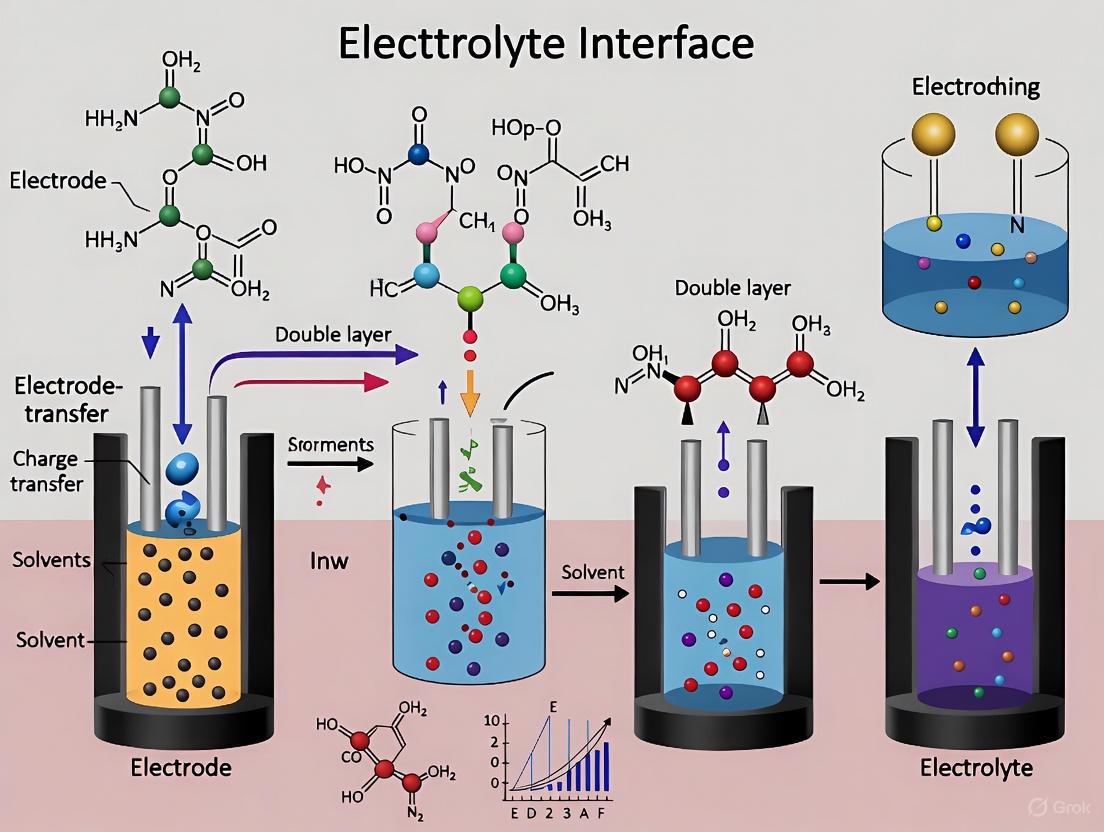
This article provides a comprehensive analysis of the fundamental principles, prevailing challenges, and cutting-edge optimization strategies at the electrode-electrolyte interface, a critical determinant of performance, safety, and longevity in electrochemical...
Electrode-Electrolyte Interface Fundamentals: Challenges, Strategies, and Future Directions for Advanced Electrochemical Systems
Abstract
This article provides a comprehensive analysis of the fundamental principles, prevailing challenges, and cutting-edge optimization strategies at the electrode-electrolyte interface, a critical determinant of performance, safety, and longevity in electrochemical devices. Drawing on the latest research, we explore foundational interfacial phenomena across diverse systems, including aqueous zinc-ion, lithium-metal, and all-solid-state batteries. The scope encompasses advanced methodological approaches for interface characterization, systematic troubleshooting of common failure modes such as dendrite growth and side reactions, and comparative validation of optimization techniques. Tailored for researchers and scientists in energy storage and conversion, this review consolidates critical insights to guide the rational design of stable, high-performance electrochemical interfaces for next-generation technologies.
Unraveling Electrode-Electrolyte Interface Chemistry and Core Challenges
The Critical Role of Interfacial Stability in Electrochemical Device Performance and Safety
The electrode-electrolyte interface (EEI) is a critical determinant of performance, longevity, and safety across electrochemical devices, particularly in energy storage systems. Interfacial instability leads to irreversible capacity fade, increased impedance, and catastrophic safety failures like thermal runaway. In all-solid-state batteries, unstable interfaces cause rapid performance degradation at high voltages, while in aqueous systems, interfacial issues manifest as dendrite formation and parasitic reactions. This whitepaper examines interfacial challenges across battery technologies, presents quantitative performance data, details experimental methodologies for interface characterization, and proposes stabilization strategies based on recent research advances. The fundamental insights presented herein aim to guide the development of next-generation electrochemical devices with enhanced reliability and safety profiles.
Fundamental Interfacial Challenges Across Electrochemical Systems
Solid-State Battery Interfaces
In all-solid-state Li-ion batteries (SSBs), interfacial instability becomes critically pronounced at high operating potentials (≥4.3 V). Research on LiNi0.83Co0.14Mn0.03O2 (NCM83)/Li3InCl6 (LIC) interfaces reveals that structural degradation occurs through multiple mechanisms: formation of a rock-salt phase on NCM83 surfaces (5 nm at 4.3 V, thickening to 12 nm at 4.5 V), accompanied by a 15 nm lattice distortion layer. X-ray absorption spectroscopy confirms Ni³⁺/⁴⁺ reduction to Ni²⁺, correlating directly with rock-salt phase formation. Simultaneously, parasitic interfacial reactions produce oxidized Cl and In species on the solid electrolyte, while cracking at the NCM83/LIC interface and within the electrolyte itself causes interfacial contact loss. These degradation mechanisms collectively accelerate performance degradation in SSBs operating at high potentials [1].
The chemical potential alignment at electrode-solid electrolyte interfaces fundamentally governs interfacial resistance. Studies using amorphous lithium phosphate (LPO) thin films with varying Li/P atomic ratios (2 to 9) demonstrate that interface bonding classifies into two distinct types: lithium-insertion bonding and lithium-extraction bonding. The lowest interfacial resistances (<10 Ω cm²) occur within a specific optimal Li/P atomic ratio range. Deviations from this range trigger reductive degradation of electrode materials or kinetically less reversible phase formation, substantially increasing interfacial resistance [2].
Aqueous System Interfaces
Aqueous zinc-ion batteries (AZIBs) face distinct interfacial challenges centered on the zinc anode. The primary degradation mechanisms include uncontrolled dendrite formation, sustained parasitic reactions, and sluggish reaction kinetics. These issues collectively undermine reversible capacity and cycling stability, presenting significant barriers to commercial implementation. The introduction of organic functional molecules at the interface has emerged as a promising strategy to stabilize the zinc anode-electrolyte interface and enhance overall electrode performance [3].
Metal-CO2 Battery Interfaces
In nonaqueous metal-CO2 batteries (MCBs), stability issues at the electrode-electrolyte interfaces present major development challenges. The electrolyte functions as the "blood" of the battery, affecting ionic conductivity, thermal stability, electrochemical stability window, and overall interfacial stability. The complex interfacial chemistry in MCBs requires sophisticated engineering of both electrolyte composition and electrode surfaces to achieve workable cycle life and energy efficiency [4].
Quantitative Analysis of Interfacial Instability
Table 1: Quantitative Characterization of Interfacial Degradation in NCM83/Li3InCl6 Solid-State Batteries
| Parameter | At 4.3 V vs. Li/Li⁺ | At 4.5 V vs. Li/Li⁺ | Characterization Method |
|---|---|---|---|
| Rock-salt phase thickness | 5 nm | 12 nm | HR-TEM |
| Lattice distortion layer | 15 nm | 15 nm | HR-TEM |
| Ni oxidation state change | Ni³⁺/⁴⁺ → Ni²⁺ | Ni³⁺/⁴⁺ → Ni²⁺ | XAS |
| Interfacial impedance | Significantly increased | More severely increased | AC impedance |
| Interface cracking | Observed | More pronounced | SEM |
Table 2: Interfacial Resistance versus Li/P Atomic Ratio in LPO/LCO Systems
| Li/P Atomic Ratio | Interfacial Resistance (Ω cm²) | Bonding Type | Interface Characteristics |
|---|---|---|---|
| 2.20 | >100 | Lithium-extraction | Excessive Li extraction, irreversible phases |
| 2.63 | <10 | Optimal range | Minimal side reactions |
| 5.24 | <10 | Optimal range | Minimal side reactions |
| 8.78 | >100 | Lithium-insertion | Reductive degradation of LCO |
Experimental Methodologies for Interface Characterization
Structural and Chemical Analysis Techniques
High-Resolution Transmission Electron Microscopy (HR-TEM) provides direct visualization of interfacial layers with atomic-scale resolution. For NCM83/LIC interfaces, prepare cross-sectional samples via focused ion beam (FIB) milling. Transfer samples to TEM grids and analyze at accelerating voltages of 200-300 kV to resolve crystallographic phases and measure interfacial layer thickness. Identify rock-salt and lattice distortion phases through lattice fringe analysis and Fast Fourier Transform (FFT) patterns [1].
X-ray Photoelectron Spectroscopy (XPS) enables chemical state analysis of interfacial species. For solid electrolyte interfaces, employ monochromatic Al Kα X-ray source (1486.6 eV) with spot size of 50-200 μm. Conduct depth profiling via argon ion sputtering (0.5-1 keV) to examine compositional changes across interfaces. Analyze core-level spectra (Cl 2p, In 3d, O 1s, Ni 2p) with charge referencing to C 1s at 284.8 eV to identify oxidized species formed during high-potential operation [1].
X-ray Absorption Spectroscopy (XAS) determines element-specific oxidation states and local coordination environments. Collect Ni K-edge spectra in fluorescence mode at synchrotron facilities. Process data through pre-edge background subtraction, edge normalization, and extended fine structure analysis. Use reference compounds (NiO, LiNiO₂) for oxidation state calibration to quantify Ni²⁺ formation during interfacial degradation [1].
Electrochemical Characterization Methods
Electrochemical Impedance Spectroscopy (EIS) quantifies interfacial resistance evolution. Apply sinusoidal potential perturbation of 10 mV amplitude across frequency range 1 MHz to 10 mHz. Analyze Nyquist plots using equivalent circuit modeling with dedicated elements for bulk, grain boundary, and interfacial contributions. Track resistance changes during cycling to correlate interfacial degradation with performance loss [1] [5].
Operando X-ray Diffraction (XRD) monitors structural evolution during electrochemical operation. Use transmission-mode configuration with high-energy X-rays for penetration through battery housings. Collect diffraction patterns continuously during charge-discharge cycling with time resolution of 5-10 minutes per pattern. Rietveld refinement quantifies phase fractions and lattice parameter changes, directly correlating structural transitions with voltage profiles [1] [5].
Diagram 1: Comprehensive experimental workflow for interfacial characterization in electrochemical systems
Advanced Interfacial Stabilization Strategies
Bilayer Passivation Architectures
In perovskite/silicon tandem solar cells, a bilayer passivation strategy addressing interfacial recombination demonstrates principles applicable to battery interfaces. This approach employs an ultrathin AlOx (~1 nm) layer deposited by atomic layer deposition (ALD) combined with a propane-1,3-diammonium iodide (PDAI₂) layer. The AlOx provides conformal surface defect passivation and inhibits ionic migration, while the PDAI₂ enhances n-type doping and improves charge extraction. This complementary functionality simultaneously addresses energy loss and stability challenges without compromising ionic transport dynamics [6].
Prelithiation Separator Engineering
For anode-free lithium batteries, multiscale interfacial stabilization via prelithiation separator engineering effectively addresses lithium inventory loss. A polyolefin separator integrated with a Li₂S@C sacrificial layer replenishes Li⁺ inventory during formation cycles while establishing a lithium polysulfide-containing cathode interface with high-voltage tolerance (to 4.5 V). This approach simultaneously stabilizes cathode interfacial chemistry and homogenizes lithium plating/stripping processes, enabling 1.22 Ah pouch cells with gravimetric/volumetric energy densities of 450 Wh kg⁻¹/1355 Wh L⁻¹ [5].
Safety Reinforced Layers
Safety Reinforced Layers (SRL) incorporate temperature-sensitive materials that actively mitigate thermal runaway risks. These layers typically consist of advanced materials like aerogels and phase change materials (PCMs) that suppress temperature rise and delay thermal runaway onset. The SRL mechanism involves rapid resistance increase when temperatures exceed safe thresholds (typically >100°C), effectively halting current flow and preventing further heat generation. This reversible protection system reduces explosion rates in impact scenarios by 53% while maintaining normal battery operation when temperatures stabilize [7].
Diagram 2: Interfacial degradation mechanisms and corresponding stabilization strategies
Research Reagent Solutions for Interface Studies
Table 3: Essential Research Reagents for Interfacial Stability Investigations
| Reagent/Material | Function/Application | Key Characteristics | Representative Use Cases |
|---|---|---|---|
| Li₃InCl₆ (LIC) | Halide solid electrolyte | High ionic conductivity, oxidative stability | NCM83 interface studies at high potentials [1] |
| Lithium Phosphate (LPO) | Model solid electrolyte | Tunable Li/P ratio (2-9), amorphous structure | Interface bonding mechanism studies [2] |
| Li₂S@C Composite | Prelithiation agent | 0.85 mAh cm⁻² capacity, generates protective LiPS | Anode-free cell Li⁺ inventory replenishment [5] |
| AlOx/PDAI₂ | Bilayer passivation | ALD-compatible, defect passivation + enhanced doping | Perovskite/ETL interface stabilization [6] |
| Aerogels/PCMs | Safety reinforced layers | Thermal management, phase change properties | Thermal runaway suppression in SRL [7] |
| Organic Functional Molecules | Aqueous interface modulation | Zinc anode stabilization, dendrite suppression | Aqueous zinc-ion battery interfaces [3] |
Interfacial stability remains a fundamental challenge limiting the performance, longevity, and safety of electrochemical devices. The complex degradation mechanisms occurring at electrode-electrolyte interfaces—including structural reconstruction, parasitic reactions, and contact loss—require sophisticated characterization methodologies and targeted stabilization approaches. Recent advances in bilayer passivation, prelithiation engineering, and safety-reinforced layers demonstrate that multiscale interfacial design can simultaneously address multiple degradation pathways. The research reagents and experimental protocols outlined provide a foundation for systematic investigation of interfacial phenomena. Future research directions should focus on operando characterization of buried interfaces, accelerated stability testing protocols, and machine-learning-assisted interface design to enable next-generation energy storage technologies with enhanced reliability and safety profiles.
The electrode-electrolyte interface represents one of the most critical yet complex domains in electrochemical systems, governing performance metrics across energy storage, conversion, and catalytic applications. This interfacial region, typically extending mere nanometers from the electrode surface, serves as the primary theater where solvation sheath dynamics, charge transfer kinetics, and interfacial reactions collectively determine system efficiency, stability, and functionality. Within the context of fundamental electrochemistry research, understanding these intertwined phenomena provides the foundational knowledge required to engineer next-generation electrochemical devices with enhanced capabilities.
Recent advances in computational modeling and characterization techniques have revealed that the traditional "solid electrolyte interphase" (SEI) theory alone cannot fully explain many observed electrochemical behaviors [8]. This recognition has spurred renewed investigation into the molecular-scale interactions occurring at electrode-electrolyte interfaces, particularly focusing on how solvation sheath structure dictates interfacial reactivity and charge transfer mechanisms. The dynamic reorganization of solvent molecules, anions, and cations within the electrical double layer creates a complex landscape where minimal energy pathways for electron and ion transfer are established, ultimately controlling reaction rates and selectivity [9].
This technical guide examines the fundamental principles and experimental methodologies for investigating key interfacial phenomena, with particular emphasis on the interrelationship between solvation sheath structure and charge transfer kinetics. By synthesizing insights from cutting-edge research across battery systems, catalytic particles, and computational modeling, we provide a comprehensive framework for researchers exploring electrode-electrolyte interface fundamentals.
Solvation Sheath Structure and Formation Dynamics
Fundamental Principles of Solvation
The solvation sheath constitutes the primary coordination sphere of ions in solution, consisting of solvent molecules and anions that directly interact with the central cation through various chemical forces. The formation of this sheath is driven by multiple interactions: coordination bonds between cation and solvent lone pairs, dipole interactions, hydrogen bonding, and van der Waals forces [8]. In typical battery electrolytes, for instance, Na+ ions exhibit coordination behaviors with carbonate-based solvents (ethylene carbonate, dimethyl carbonate) and anions (PF6-, FSI-, TFSI-) that dictate their transport properties and interfacial reactivity.
The geometric parameters and thermodynamic descriptors of solvation structures fundamentally influence interfacial phenomena. Key characteristics include coordination number (number of solvent molecules/anions in the primary sheath), solvation energy (energy change associated with solvation process), and desolvation energy (energy barrier for ion to shed its solvation sheath prior to interfacial transfer) [8]. These parameters collectively determine the kinetic facility of ion transfer across the electrode-electrolyte interface, with higher desolvation energies typically correlating with slower charge transfer kinetics.
Driving Forces and Design Principles
The formation of specific solvation structures follows thermodynamic principles governed by the balance between lattice energy (for salts) and solvation energy. The dissolution process for sodium salts follows a simplified Born-Haber cycle where ΔG = -U + ΔHh, with U representing lattice energy and ΔHh representing solvation energy [8]. This relationship explains why salts with weakly coordinating anions (WCAs)—where negative charge is delocalized across the anion structure—typically exhibit higher solubility in aprotic solvents, as reduced lattice energy lowers the thermodynamic barrier for dissolution.
Table 1: Key Characteristics of Common Sodium Salts in Battery Electrolytes
| Salt | Anion Type | Dissociation Constant | Oxidation Stability | Coordination Strength |
|---|---|---|---|---|
| NaClO₄ | Weakly coordinating | High | Moderate | Weak |
| NaPF₆ | Weakly coordinating | High | High | Weak |
| NaTFSI | Weakly coordinating | High | High | Weak |
| NaFSI | Moderate coordinating | High | Moderate | Moderate |
| NaF | Strongly coordinating | Low | High | Strong |
Recent electrolyte design strategies have leveraged these principles to manipulate solvation structures for enhanced electrochemical performance. Concentrated electrolytes, for instance, reduce the solvent-to-salt ratio, forcing anions into the cation solvation sheath and creating unique interfacial reaction pathways [8]. Similarly, the introduction of specific solvent mixtures with different donor numbers and dielectric constants enables tuning of the solvation structure to optimize desolvation kinetics and interfacial stability.
Charge Transfer Kinetics at Interfaces
Fundamental Charge Transfer Mechanisms
Charge transfer at electrode-electrolyte interfaces represents the central electrochemical process governing device performance. Recent multi-scale simulation techniques combining machine-learning-driven molecular dynamics and phase-field modeling have revealed the intricate relationship between atomic-scale charge distribution and macroscopic charge transfer kinetics [9]. At the most fundamental level, charge transfer involves the rearrangement of electrons and ions across the interface, a process sensitive to the local electrostatic environment and molecular orbital interactions.
The charge transfer kinetics are profoundly influenced by the electronic structure of both the electrode and electrolyte components. For instance, at lithium metal interfaces, the charge transfer process has been identified as the primary driver for bond cleavage reactions in electrolyte molecules [9]. Simulations demonstrate that as bonds in electrolyte molecules stretch and break near electrode surfaces, the atomic charges of the constituent atoms decrease, particularly when bond stretching initiates. This correlation suggests that charge transfer serves as the intrinsic driving force for bond cleavage in interfacial reactions, with the intensity of charge transfer approximately linearly correlating with bond length [9].
Modulating Charge Transfer Through Interface Engineering
The charge distribution at electrode-electrolyte interfaces can be deliberately modulated to control reaction pathways and kinetics. Studies on LiFSI salt decomposition at lithium metal interfaces demonstrate that applying an external charge source (simulating charged battery conditions) alters the bond cleavage sequence compared to uncharged interfaces [9]. Specifically, at uncharged interfaces, LiFSI decomposition follows an N-S bond cleavage pathway after initial F-S bond breaking, while at charged interfaces (~-2e total charge), the decomposition pathway shifts toward consecutive F-S bond cleavages.
This manipulation of decomposition pathways through charge distribution has direct implications for interfacial stability in electrochemical devices. The different cleavage sequences yield distinct interfacial products, with the pathway favored at charged interfaces producing a LiF-rich film that enhances cycle stability [9]. This exemplifies how understanding and engineering charge transfer kinetics enables the design of more stable interfaces for enhanced device performance.
Table 2: Charge Transfer Effects on Bond Cleavage Sequences in LiFSI at Lithium Metal Interfaces
| Interface Condition | Initial Cleavage | Secondary Cleavage | Resulting Products | Impact on Performance |
|---|---|---|---|---|
| Uncharged | F-S bond | N-S bond | SO₂ radicals | Standard decomposition |
| Charged (-2e) | F-S bond | F-S bond | LiF-rich film | Enhanced cycle stability |
Experimental and Computational Methodologies
Fabrication and Analysis of Model Systems
Well-controlled experimental systems enable precise investigation of interfacial phenomena. Catalytic Janus particles represent an excellent model system for studying boundary effects on interfacial dynamics. The fabrication process for these particles involves several meticulous steps: (1) sulfate latex polystyrene particles (3μm diameter) are washed with ultra-pure water five times before concentration to 9% wt./vol.; (2) a monolayer of particles is formed on a 20mm × 20mm silicon wafer; (3) platinum layers of varying thickness (3nm, 7nm, 10nm, 20nm, 35nm) are deposited via physical vapor deposition at a controlled rate of 2 Å/sec; (4) particles are removed from the wafer by sonication and washed with ultra-pure water; (5) finally, particles are suspended in hydrogen peroxide solution for surface activation before measurement [10].
For substrate preparation, researchers employ both untreated glass slides and plasma-cleaned variants. The plasma cleaning protocol involves sonicating slides in iso-propanol alcohol and acetone for 15 minutes each before air plasma treatment for 2 minutes [10]. Fluid cells are assembled by attaching secure seal spacers (diameter = 0.9mm, height = 0.12mm) onto the glass slides, with the inner lining marked with a hydrophobic pen to prevent particle loss. This meticulous preparation ensures reproducible interfaces for studying propulsion dynamics near boundaries.
Figure 1: Experimental workflow for Janus particle fabrication and analysis
Computational Approaches for Interface Characterization
Computational methods provide molecular-level insights into interfacial phenomena that are often inaccessible experimentally. Machine-learning-driven molecular dynamics based on moment tensor potential models with charges (QMTP) has emerged as a powerful approach for simulating electrochemical and chemical reactions at interfaces [9]. The QMTP development process involves: (1) generating diverse training structures covering various reaction coordinates; (2) performing ab initio calculations to obtain reference energies, forces, and atomic charges; (3) training the machine learning potential to reproduce quantum mechanical accuracy; (4) validating the model on test structures; and (5) performing extended molecular dynamics simulations to study reaction mechanisms.
These computational approaches enable researchers to disentangle the multiple intertwined chemical and electrochemical processes occurring at interfaces. For example, QMTP-MD simulations have revealed the spontaneous interfacial reaction process of LiPF₆ in carbonate solutions at lithium metal anodes, showing how PF₆⁻ anions are attracted to the Li surface and decompose via P-F bond breaking, leading to LiF formation and other products consistent with experimental observations [9]. Such simulations provide unprecedented insight into the transient reaction processes that occur on picosecond timescales, bridging the gap between theoretical predictions and experimental characterizations.
Figure 2: Workflow for machine learning potential development
Interplay Between Solvation Structure and Interfacial Reactions
Solvation-Dependent Reaction Pathways
The structure and composition of the solvation sheath directly dictate the reaction pathways available at electrode-electrolyte interfaces. In sodium ion batteries, for example, the solvation structure of Na⁺ ions influences not only ion transport but also the decomposition mechanisms of electrolyte components [8]. When the solvation sheath contains a higher proportion of solvent molecules relative to anions, solvent decomposition tends to dominate interfacial reactions, forming organic-rich interphases. Conversely, when anions are preferentially incorporated into the solvation sheath, anion decomposition creates inorganic-rich interphases with distinct mechanical and transport properties.
This solvation-dependent reactivity explains why concentrated electrolytes often enhance interfacial stability in metal-ion batteries. By reducing free solvent molecules and incorporating more anions into the cation solvation sheath, these electrolytes promote the formation of robust, inorganic-rich interphases that effectively passivate the electrode surface [8]. The strategic design of solvation structures through electrolyte concentration management, solvent selection, and additive engineering thus represents a powerful approach for controlling interfacial chemistry in electrochemical systems.
Interfacial Phenomena in Model Systems
Studies on catalytic Janus particles provide visual demonstration of how interfacial interactions govern dynamics in confined environments. These particles exhibit distinct "flooring" and "ceiling" behaviors depending on their cap thickness and the hydrogen peroxide concentration in solution [10]. Particles with lower platinum cap thicknesses (3nm) demonstrate higher velocities compared to those with thicker caps (35nm), with enhanced propulsion in 3 wt./vol.% peroxide versus 1 wt./vol.% solutions. Furthermore, heavier cap particles in lower peroxide concentrations show less "ceiling" behavior (movement along the top boundary) compared to lighter cap particles in higher peroxide concentrations [10].
These observations highlight the complex interplay between gravitational forces, catalytic activity, and hydrodynamic interactions at interfaces. The orientation of Janus particles near boundaries is influenced by gravitational torque on the denser platinum cap (22.50 g/cm³ compared to 1.05 g/cm³ for polystyrene), which suppresses rotational diffusion and can lead to orientational quenching where the cap points downward [10]. This orientational preference subsequently affects propulsion characteristics through modified interfacial interactions, demonstrating how multiple phenomena collectively determine system behavior.
The Scientist's Toolkit: Essential Research Reagents and Materials
Table 3: Key Research Reagents and Materials for Interfacial Phenomena Studies
| Reagent/Material | Specifications | Function in Research | Application Context |
|---|---|---|---|
| Polystyrene particles | 3μm diameter, sulfate latex | Model colloidal particles for interfacial studies | Janus particle fabrication [10] |
| Platinum target | 99.99% purity | Catalytic cap material for self-propelled particles | Physical vapor deposition for Janus particles [10] |
| Hydrogen peroxide | 30% wt./vol., ultrapure | Fuel for catalytic propulsion and surface activation | Janus particle experiments [10] |
| Silicon wafer | 20mm × 20mm, polished | Substrate for monolayer assembly | Janus particle fabrication [10] |
| Ethylene carbonate | Battery grade, anhydrous | Solvent for electrolyte formulations | Solvation structure studies [8] [9] |
| LiFSI salt | 99.9%, ultradry | Lithium salt for electrolyte preparation | Interface reaction studies [9] |
| Plasma cleaner | Air plasma, 2min treatment | Surface activation and cleaning | Substrate preparation [10] |
The intricate relationship between solvation sheath structure and charge transfer kinetics represents a fundamental aspect of electrode-electrolyte interfaces that crosses multiple domains of electrochemical research. From the deterministic motion of catalytic Janus particles near boundaries to the solvation-dependent reaction pathways in battery interfaces, the collective evidence underscores that interfacial phenomena emerge from the complex interplay of molecular structure, chemical forces, and charge distribution.
Future research in this field will likely focus on developing more sophisticated multi-scale modeling approaches that seamlessly connect quantum mechanical calculations of bond cleavage with macroscopic phase-field simulations of interfacial evolution. Similarly, advanced in situ characterization techniques with enhanced temporal and spatial resolution will be essential for validating computational predictions and providing direct experimental insight into transient interfacial processes. By continuing to bridge the gap between theoretical understanding and experimental observation across diverse electrochemical systems, researchers can establish universal design principles for engineering optimal interfaces in next-generation electrochemical technologies.
The electrode-electrolyte interface serves as the critical frontier where electrochemical reactions determine the performance, safety, and longevity of energy storage devices. In lithium-based and emerging battery technologies, the chemical/electrochemical reactions, structural/compositional characteristics, and thermodynamic/kinetic behaviors at this interface are of paramount importance for overall battery performance [11]. While interface science has been emphasized for many years, fundamental understanding of these complex phenomena continues to evolve, particularly as new battery chemistries emerge. The inherent instability at the anode-electrolyte interface (AEI) manifests through three primary failure modes: dendrite formation, parasitic reactions, and corrosion processes. These interconnected challenges represent the most significant barriers to developing next-generation batteries with enhanced safety and energy density.
In aqueous zinc-ion batteries (AZIBs), the anode interface faces particularly complex challenges due to the thermodynamic instability of zinc in aqueous environments [12]. The failure of the anode in AZIBs is a core issue limiting their cycle life and safety, mainly involving mechanisms such as zinc dendrite growth, hydrogen evolution reaction (HER), and corrosion and passivation [12]. Similar challenges persist in lithium-metal systems, where dendrite formation poses serious safety concerns, and in solid-state batteries, where interface incompatibility creates additional hurdles. Understanding the fundamental origins of these interface challenges provides the foundation for developing effective mitigation strategies across different battery chemistries.
Fundamental Mechanisms of Anode Interface Challenges
Dendrite Formation and Growth Mechanisms
Dendrite formation represents one of the most critical failure modes in battery systems, capable of causing internal short circuits and potentially catastrophic thermal runaway. The formation mechanism varies significantly between different metal anodes. Zinc dendrites typically exhibit two-dimensional hexagonal flakes resulting from the hexagonal close-packed (HCP) crystal structure, contrasting sharply with the ramified invasive structures with one-dimensional topologies common in lithium dendrites [13].
The initiation and growth of dendrites follow a complex interplay of thermodynamic and kinetic factors. In zinc-ion systems, research using in-situ scanning transmission X-ray microscopy (STXM) has revealed that in 50 mM ZnSO4 electrolyte, the initiation of moss/whisker dendrites is chemically controlled, while their continued growth over extended cycles is kinetically governed [14]. This morphological evolution directly impacts battery safety, as different dendrite structures exhibit varying abilities to penetrate separators. The rough surface of metal foils contributes to an uneven electric field distribution, creating a "sharp point effect" where protruding parts preferentially attract metal ion deposition, thereby accelerating dendrite formation [14].
Advanced characterization techniques have provided unprecedented insights into dendrite dynamics. In-situ optical microscopy observations reveal that during plating cycles, zinc dendrites begin as clusters growing at various sites on the electrode surface, with preferential deposition on convex regions compared to flat areas [14]. This inhomogeneous nucleation creates initial irregularities that amplify throughout cycling. The presence of undissolved "dead metal" or by-products after stripping cycles creates preferential deposition sites for subsequent cycles, establishing a self-perpetuating cycle of increasingly heterogeneous deposition [14].
Parasitic Reactions at the Anode Interface
Parasitic reactions consume active materials, reduce coulombic efficiency, and generate species that degrade battery performance. In aqueous zinc-ion batteries, the hydrogen evolution reaction (HER) represents the most significant parasitic reaction, where the thermodynamic equilibrium potential of H2O/H2 (0 V vs SHE) is higher than that of Zn2+/Zn (-0.76 V vs SHE), making the coexistence of Zn and H2O inherently unstable [14]. This thermodynamic driving force leads to spontaneous reactions that release H2 gas during operation.
The hydrogen evolution process has multifaceted detrimental effects. The accumulated H2 gas adhering to the anode surface physically blocks nucleation sites, further promoting heterogeneous deposition and dendrite growth [14]. Online gas chromatography analysis has confirmed H2 production during Zn2+ ion deposition in ZnSO4 electrolyte, directly linking HER to dendrite formation [14]. Additionally, local pH increases resulting from HER promote the formation of inert by-products like zinc oxide (ZnO) and zinc sulfate hydroxide hydrate (ZSH), which create diffusion barriers and increase interfacial resistance [14].
In non-aqueous systems, parasitic reactions differ but remain equally problematic. Lithium metal anodes suffer from continuous reactions with organic electrolytes, leading to thick, resistive solid-electrolyte interphase (SEI) layers that consume both lithium inventory and electrolyte components. These reactions are exacerbated by the high reducibility of lithium metal and the thermodynamic instability of conventional electrolyte formulations at low potentials.
Corrosion Processes and Passivation
Corrosion represents the third major challenge at anode interfaces, particularly prominent in aqueous battery systems. Zinc corrosion in aqueous electrolytes occurs through electrochemical dissolution, where zinc atoms oxidize to Zn2+ ions even during open-circuit conditions. This process is accelerated by the presence of water and dissolved oxygen, leading to continuous capacity loss and electrolyte consumption.
The corrosion process often leads to passivation, where insoluble corrosion products form a surface layer that can impede ion transport while failing to prevent further corrosion. In zinc systems, this typically manifests as the formation of zinc oxide/hydroxide layers with poor ionic conductivity. The passivation layer creates uneven current distribution, further promoting localized deposition and dendrite growth in a destructive feedback loop.
Table 1: Primary Anode Interface Challenges and Their Impacts
| Challenge | Fundamental Cause | Direct Consequences | System-wide Impacts |
|---|---|---|---|
| Dendrite Formation | Uneven ion flux, heterogeneous nucleation, tip-enhanced electric field | Internal short circuits, active material isolation | Safety hazards, rapid capacity fade, poor cycling stability |
| Parasitic Reactions (HER) | Thermodynamic instability of metal in electrolyte | Gas generation, pH changes, by-product formation | Coulombic efficiency loss, pressure buildup, electrolyte consumption |
| Corrosion & Passivation | Electrochemical oxidation in aqueous environments | Insoluble surface layers, active material loss | Increased impedance, self-discharge, reduced utilization |
Experimental Characterization Methodologies
In-situ/Operando Microscopy Techniques
Understanding the dynamic evolution of anode interfaces requires characterization techniques that can monitor processes in real-time under operational conditions. In-situ scanning transmission X-ray microscopy (STXM) has emerged as a powerful tool for investigating dendrite formation mechanisms due to its high spatial resolution, elemental selectivity, chemical sensitivity, and non-destructive nature [14]. The typical experimental setup for in-situ STXM involves using an aurum foil (Au) as the current collector on a Si3N4 window, with the battery electrolyte contained within a specially designed cell [14].
The STXM methodology enables researchers to monitor the stages, composition, and stability of metal deposition throughout plating/stripping cycles. This technique has revealed crucial insights about the relationship between SEI film characteristics and dendrite growth, demonstrating that a dense and stable SEI film is critical for inhibiting dendrite formation and growth [14]. The chemical mapping capabilities of STXM provide valuable information about the distribution of different species on the electrode surface, allowing researchers to identify hotspots for dendrite initiation and by-product accumulation.
Complementary techniques like in-situ optical microscopy offer direct visualization of dendrite morphology evolution. Experimental protocols typically involve assembling transparent electrochemical cells using glass slides or optical windows, enabling real-time observation of deposition patterns. These studies have documented how dendrites initiate as tiny uneven tips on the electrode surface, evolving into mossy structures over extended plating times [14]. The dissolution behavior during stripping can also be monitored, revealing the formation of "dead metal" that persists through cycles and serves as preferential nucleation sites in subsequent plating.
Analytical and Spectroscopic Methods
Beyond morphological characterization, understanding the chemical composition of interface layers is essential for addressing anode challenges. X-ray photoelectron spectroscopy (XPS) provides information about the elemental composition and chemical states within the SEI layer. Standard protocols involve harvesting electrodes from disassembled cells, careful washing to remove residual electrolytes, and rapid transfer to ultra-high vacuum chambers to minimize air exposure effects.
Fourier transform infrared spectroscopy (FTIR) complements XPS by identifying organic functional groups and molecular structures in interface layers. For zinc anodes modified with biopolymer coatings like chitosan, FTIR can confirm the presence of specific functional groups (amine, hydroxyl) and track chemical changes after processing such as laser carbonization [15]. Experimental parameters typically include attenuated total reflectance (ATR) mode for direct sampling, resolution of 4 cm⁻¹, and accumulation of 32-64 scans to ensure adequate signal-to-noise ratio.
X-ray diffraction (XRD) represents another essential technique for investigating crystallographic aspects of anode interfaces. For zinc anodes, XRD can identify preferred orientation development, such as the desirable (002) plane texture that resists dendrite growth [16]. Typical experimental parameters involve using Cu Kα radiation (λ = 1.5406 Å), scan range of 10-80° 2θ, and step size of 0.02°. In-situ XRD setups enable tracking of phase transformations during cycling, such as the transition between Zn (102) and ZnO (002) phases that occurs during charge/discharge cycles [14].
Table 2: Key Characterization Techniques for Anode Interface Studies
| Technique | Key Information | Experimental Considerations | Limitations |
|---|---|---|---|
| In-situ STXM | Chemical composition distribution, dendrite morphology | Requires synchrotron source, specialized electrochemical cells | Limited availability, complex data analysis |
| In-situ Optical Microscopy | Dendrite growth patterns, dissolution behavior | Transparent cells needed, resolution limits | Limited chemical information, surface observations only |
| XPS | Elemental composition, chemical states of SEI | Ultra-high vacuum required, sample transfer critical | Surface-sensitive only, possible beam damage |
| XRD | Crystalline phases, preferred orientation, by-products | In-situ cells available for dynamic studies | Limited to crystalline components, bulk averaging |
Mitigation Strategies and Interface Engineering
Electrolyte Engineering and Additives
Electrolyte modification represents one of the most versatile approaches for addressing anode interface challenges. Organic small-molecule additives have demonstrated exceptional effectiveness in aqueous zinc-ion batteries through multiple mechanisms, including inducing nucleation, electrostatic-shielding effects, in-situ SEI formation, adjusting solvation structure, regulating electrodeposition orientation, reconstructing electric double layers, altering hydrogen bond networks, and regulating pH [12]. The structural diversity, cost-effectiveness, and ease of regulation make these additives particularly attractive for large-scale applications.
The selection of additives follows specific design principles tailored to target specific failure mechanisms. Anionic corrosion inhibitors like 2-acrylamide-2-methylpropanesulfonic acid (AMPS) leverage strong polar groups (-SO₃H) to modulate the solvation structure of Zn²⁺ and the surface energy of the zinc substrate during deposition [16]. This mitigation behavior addresses uneven nucleation at grain boundaries and defects, facilitating ordered deposition along the (002) plane. Experimental implementation involves simply dissolving the additive (e.g., 50 mM concentration) in the base electrolyte (e.g., ZnSO₄ solution) before cell assembly [16].
Metallic additives represent another promising category, with materials like AgNO₃ spontaneously forming zincophilic interfaces on anode surfaces. The experimental protocol involves adding small quantities (e.g., 0.005 mol/L) of AgNO₃ to the electrolyte, which undergoes displacement reactions with zinc to create a hierarchically porous Ag interphase [17]. This interface offers abundant zinc nucleation sites and accommodation space, leading to uniform zinc plating/stripling with lower overpotentials while simultaneously isolating water molecules to suppress side reactions [17].
Surface Modification and Artificial Interphases
Surface engineering through ex-situ and in-situ modifications provides precise control over anode-electrolyte interactions. Ex-situ surface modification involves pre-treating the anode surface before cell assembly, creating artificial interphases that physically isolate the anode from the electrolyte while guiding uniform ion flux [13]. These approaches include applying protective coatings of inorganic compounds (CaCO₃, TiO₂, ZrO₂, ZnS), organic polymers (polyacrylonitrile, poly(2-vinylpyridine)), or biopolymers like chitosan [15].
The experimental methodology for ex-situ modification varies by material system. For biopolymer coatings like chitosan, the process typically involves formulating an aqueous chitosan solution, spray-coating it onto zinc foil to create a uniform thin layer, followed by laser-assisted carbonization to convert the polymer into a heteroatom-doped porous carbon layer [15]. This carbon structure provides multiple benefits: richness in heteroatoms like nitrogen and oxygen creates zincophilic properties; porosity enables controlled ion access; and mechanical stability resists dendrite penetration [15].
In-situ surface modification occurs during electrochemical activation, where electrolyte additives react to form protective layers on the anode surface. These approaches offer advantages of uniform coverage and strong adhesion to the substrate. For example, additives like 12-crown-4 ether facilitate the formation of dense and stable SEI films composed of compounds like Li₂S₂O₇ and Li₂CO₃, which significantly improve cycling performance [14]. The experimental implementation simply requires incorporating the additive into the electrolyte, with the protective layer forming during initial cycles.
Structural Design and Three-Dimensional Architectures
Structural design of anode materials represents a third strategic approach to mitigating interface challenges. Three-dimensional host structures including porous copper foams, carbon matrices, and other engineered substrates help redistribute ion flux and reduce local current density [17]. These architectures provide confined spaces that physically constrain dendrite growth while accommodating volume changes during cycling.
The experimental fabrication of three-dimensional anode structures employs various techniques. For copper foam@Zn anodes, the methodology involves electrodepositing zinc onto three-dimensional copper foam substrates, creating structures that effectively reduce local current density and suppress dendite growth [17]. While effective for dendite suppression, these approaches face challenges including complex fabrication processes, low volumetric energy density, and increased specific surface area that can exacerbate side reactions like corrosion and hydrogen evolution [17].
Alternative structural approaches include constructing composite interphases with large ion channels and strong metal affinity. For example, in-situ formed zinc hexacyanoferrate (HB-ZnHCF) interphases demonstrate high Zn²⁺ transference numbers, blocking water access while promoting rapid Zn²⁺ transport for uniform deposition [17]. The primary limitation of such approaches lies in the mechanical robustness of these interphases, which may crack during repeated plating/stripping cycles, eventually leading to dendite penetration [17].
The Scientist's Toolkit: Essential Research Reagents and Materials
Table 3: Key Research Reagents for Anode Interface Studies
| Reagent/Material | Function/Application | Example Usage | Performance Impact |
|---|---|---|---|
| Organic Small-Molecule Additives | Modulate solvation structure, form protective SEI, regulate deposition | 50 mM AMPS in ZnSO₄ electrolyte promotes (002) textured deposition [16] | Enables over 4500h cycling in Zn//Zn symmetric cells [16] |
| Metallic Salt Additives | Form zincophilic interphases via displacement reactions | 0.005 mol/L AgNO₃ forms porous Ag interphase on Zn [17] | Extends cycling to 4000h at 0.5 mA/cm² [17] |
| Biopolymer Coatings | Sustainable protective layers with functional groups | Chitosan spray-coated & laser-carbonized on Zn foil [15] | Achieves 3300h stability at 2.0 mA/cm² [15] |
| Crown Ether Additives | Create dense, stable SEI films via coordination chemistry | 5% 12-crown-4 in electrolyte forms Li₂S₂O₇/Li₂CO₃ SEI [14] | Enables 3900h cycle life in symmetric cells [14] |
| Inorganic Coatings | Physical barrier layers with high mechanical strength | CaCO₃, TiO₂, ZrO₂ protective coatings on Zn [15] | Isolate anode from electrolyte; suppress parasitic reactions [15] |
The fundamental challenges of dendrite formation, parasitic reactions, and corrosion at anode interfaces represent complex, interconnected phenomena that require multifaceted solutions. While significant progress has been made in understanding these mechanisms through advanced characterization techniques and in developing mitigation strategies through electrolyte engineering, surface modification, and structural design, considerable research challenges remain.
Future research directions should focus on developing synergistic approaches that simultaneously address multiple failure modes. The integration of computational modeling with experimental validation will accelerate the design of optimized interface structures and compositions. Additionally, greater emphasis on sustainable materials, including biodegradable polymers and low-environmental-impact processing methods, will support the development of environmentally responsible energy storage technologies.
The translation of laboratory innovations to commercially viable technologies requires attention to scalability, cost-effectiveness, and compatibility with existing manufacturing processes. Interface engineering strategies that employ simple processing methods like spray coating and one-step chemical treatments offer greater potential for large-scale implementation compared to complex, energy-intensive fabrication routes. As research continues to unravel the fundamental chemical origins of interface challenges, increasingly sophisticated and effective solutions will emerge to enable the next generation of high-performance, safe, and durable energy storage systems.
The electrode-electrolyte interface is a critical determinant of performance, longevity, and safety in advanced energy storage systems. Within this domain, the cathode interface presents particularly complex challenges, as its stability governs key degradation pathways that limit the practical realization of high-energy-density batteries. This technical guide examines three fundamental cathode interface challenges—sluggish kinetics, material dissolution, and structural degradation—within the broader context of electrode-electrolyte interface fundamentals research. These interconnected phenomena represent significant bottlenecks across multiple battery chemistries, from commercial lithium-ion systems to emerging solid-state, zinc-ion, and lithium-sulfur configurations. Understanding their underlying mechanisms and developing effective mitigation strategies is essential for advancing next-generation energy storage technologies for research and commercial applications.
Fundamental Challenges and Mechanisms
Sluggish Kinetics
Sluggish interfacial kinetics manifest as high impedance, limited rate capability, and reduced energy efficiency across battery platforms. In all-solid-state batteries, kinetic limitations dominate operational performance, where machine learning-driven molecular dynamics simulations reveal three primary impedance mechanisms: (1) interfacial reactions forming poorly conducting interphases, particularly with sulfide solid electrolytes; (2) formation of lithium-depleted regions that reduce available Li+ transport pathways; and (3) cation inter-diffusion that obstructs lithium transport channels and degrades cathode structure [18]. These kinetic barriers originate from chemical potential misalignment at the interface, which triggers undesirable side reactions during the electrode-solid electrolyte bonding process [2].
At the fundamental level, interface bonding can be classified as Li-insertion or Li-extraction types depending on the Li chemical potential (({\mu }_{{{{\rm{Li}}}}})) alignment. The formation of appropriate ranges of Li-inserted or Li-extracted electrode states is critical for attaining low-resistivity interfaces. Research demonstrates that interfacial resistances below 10 Ω cm² are achievable only within optimal Li/P atomic ratio ranges in amorphous solid electrolyte systems [2].
Material Dissolution
Material dissolution represents a pervasive degradation mechanism across aqueous and non-aqueous battery systems, involving the loss of active material from the cathode structure into the electrolyte:
- Transition Metal Dissolution: In layered lithium transition metal oxides (e.g., NMC), Mn³⁺ undergoes disproportionation reactions in acidic environments to form Mn²⁺, which dissolves into the electrolyte, distorting the cathode lattice and causing active material loss [19].
- Current Collector Corrosion: Aluminum current collectors corrode in the presence of HF generated from LiPF₆ decomposition and ethylene carbonate solvent breakdown, with dissolved Al³⁺ migrating to the anode and depositing during charging [19].
- Manganese Dissolution in AZIBs: In aqueous zinc-ion batteries, manganese-based cathodes experience Mn dissolution due to Jahn-Teller distortion and proton intercalation side reactions, leading to irreversible capacity fade [20].
The dissolution process is particularly severe under high-rate discharge conditions, where increased temperatures promote electrolyte decomposition and acidic species generation [19].
Structural Degradation
Structural degradation encompasses mechanical and chemical transformations that compromise cathode integrity:
- Microcrack Formation and Propagation: Ni-rich layered cathodes (Ni > 60%) experience anisotropic volume changes during charge/discharge cycles, particularly through the H2→H3 phase transition, which generates significant internal stress and causes microcrack formation [21]. These microcracks create electrolyte penetration pathways, further exacerbating surface degradation.
- Phase Transformations: Surface structural evolution from layered to rock-salt phases (NiO-like structure) occurs due to electrode surface oxidation by strongly oxidizing Ni³⁺/⁴⁺ species, creating electrochemically inactive regions that increase impedance [21].
- Particle Fracture: During high-rate discharge, cathode particles undergo mechanical damage through fatigue and fracture mechanisms, accelerated by repeated volume changes during lithium (de)intercalation [19].
Table 1: Quantitative Analysis of Cathode Interface Challenges Across Battery Platforms
| Challenge | Battery System | Quantitative Impact | Primary Characterization Methods |
|---|---|---|---|
| Sluggish Kinetics | All-solid-state (LiCoO₂/sulfide SE) | Interfacial resistance: 10-100+ Ω cm² [18] | EIS, Molecular Dynamics Simulations |
| Material Dissolution | NMC/Li Graphite (3C discharge) | Al deposition promotes SEI growth; ~20% capacity loss after 100 cycles [19] | ICP, EDS, Post-mortem SEM |
| Structural Degradation | Ni-rich NMC (x > 0.8) | Anisotropic volume change >2%; Microcrack propagation after 100 cycles [21] | In-situ XRD, TEM, XPS |
Experimental Methodologies and Protocols
Interface Resistance Quantification
Objective: Quantify cathode-solid electrolyte interfacial resistance in all-solid-state batteries.
Protocol:
- Thin-Film Device Fabrication: Deposit c-axis oriented LiCoO₂ (LCO) thin-film electrodes via RF magnetron sputtering on Pt/Ti/Si substrates [2].
- Solid Electrolyte Deposition: Fabricate amorphous lithium phosphate (LPO) films with controlled Li/P atomic ratios (2-9) using bias-induced RF magnetron sputtering under substrate cooling conditions (< -80°C) to ensure amorphous structure [2].
- Electrochemical Impedance Spectroscopy: Measure LCO/LPO interfacial resistance using symmetric cells with LCO/LPO/LCO configuration or Li/LPO/LCO half-cells. Apply AC amplitude of 10-50 mV over frequency range 1 MHz to 0.1 Hz at open circuit voltage (typically ~3.0 V) [2].
- Data Analysis: Fit impedance spectra using equivalent circuit models with dedicated elements for bulk electrolyte and interface contributions. The interfacial resistance is extracted from the semicircle diameter in the mid-frequency range.
Critical Parameters: Substrate temperature during deposition, Li/P atomic ratio in LPO, substrate bias voltage, and measurement potential significantly impact results [2].
Post-Mortem Dissolution Analysis
Objective: Quantify cathode current collector dissolution and transition metal deposition on anode.
Protocol:
- Cell Disassembly: After cycling under specified conditions (e.g., 1C, 2C, 3C discharge rates), disassemble cells in argon-filled glovebox (<0.1 ppm H₂O/O₂) [19].
- Electrode Harvesting: Carefully separate anode and cathode, rinsing with appropriate solvent (e.g., DMC for carbonate-based electrolytes) to remove residual salt.
- Elemental Analysis:
- Inductively Coupled Plasma (ICP): Digest electrode samples in concentrated acid (e.g., HNO₃), dilute, and analyze via ICP-OES/MS to quantify dissolved metal species (Al, Mn, Co, Ni) [19].
- Energy-Dispersive X-ray Spectroscopy (EDS): Map elemental distribution on electrode surfaces using SEM-EDS to identify deposition hotspots [19].
- Data Correlation: Correlate dissolution quantities with electrochemical performance metrics (capacity fade, impedance increase).
Validation: Cross-validate using multiple techniques; combine ICP quantitative data with EDS mapping for spatial distribution [19].
Structural Degradation Characterization
Objective: Analyze cathode particle fracture and phase transformations.
Protocol:
- In-situ/Operando X-ray Diffraction: Monitor crystal structure evolution during cycling using specialized electrochemical cells with X-ray transparent windows. Track lattice parameter changes, phase transitions, and texture development [21].
- Cross-Sectional SEM Analysis:
- Prepare electrode cross-sections via focused ion beam (FIB) milling or epoxy embedding/polishing.
- Image at multiple magnifications (1,000-50,000×) to identify microcracks, particle fractures, and interface delamination [21].
- Surface Analysis:
- X-ray Photoelectron Spectroscopy (XPS): Depth-profile cathode surfaces to quantify transition metal reduction and phase transformation layer thickness [21].
- Transmission Electron Microscopy (TEM): Prepare thin sections via FIB for high-resolution imaging and selected area electron diffraction to identify local phase transformations [21].
Diagram Title: Cathode Interface Analysis Workflow
Research Reagent Solutions and Essential Materials
Table 2: Essential Research Materials for Cathode Interface Studies
| Material/Reagent | Function/Application | Technical Specifications | Reference |
|---|---|---|---|
| LiCoO₂ Thin Films | Model cathode for interface studies | c-axis oriented, RF-sputtered, ~100-500 nm thickness | [2] |
| Amorphous LPO Electrolyte | Solid electrolyte with tunable μLi | Li/P ratio: 2-9, σLi+: ~4.7×10⁻⁷ S cm⁻¹, N/O: 0.01-0.03 | [2] |
| Tetramethylurea (TTMU) | Interface chemistry regulator for Zn-S batteries | Electrolyte additive (10%), alters reaction pathway, reduces energy barrier | [22] |
| HT Microspheres | Multifunctional flame-retardant additive for PEO-based SPE | Cross-linked HCCP/THEIC, enhances Li⁺ mobility, widens ESW to 4.7V | [23] |
| PEO-based Polymer Electrolyte | Solid polymer electrolyte matrix | MW=600,000, σLi+ ~10⁻⁴ S cm⁻¹ at 25°C, ESW ≤3.8V (unmodified) | [23] |
Advanced Mitigation Strategies
Interface Engineering Approaches
Artificial Interphase Layers: Designing controlled-composition interphases between cathode and electrolyte effectively suppresses side reactions. Optimal interfacial resistances below 10 Ω cm² are achieved through precise control of Li chemical potential alignment, preventing both reductive degradation (excess Li insertion) and kinetically irreversible phase formation (excessive Li extraction) [2].
Electrolyte Additives: Multifunctional additives like tetramethylurea (TTMU) in aqueous Zn-S systems preferentially adsorb on electrode surfaces, coordinate to metal ions, and alter reaction pathways to reduce energy barriers. This approach promotes uniform nucleation, accelerates reaction kinetics, and enhances reversibility [22].
Flame-Retardant Microspheres: Incorporating cross-linked microspheres (HT) in PEO-based electrolytes provides multiple benefits: suppresses crystallinity through hydrogen bonding and physical obstruction, provides Lewis acidic sites for Li salt dissociation, and enriches stable components (LiF, Li₃N, LixPOy) in CEI layers. This approach broadens the electrochemical stability window to 4.7V while improving safety [23].
Emerging Research Directions
Spin-Modulated Catalysis: Emerging research reveals that electrocatalytic activity is governed not only by charge-carrier availability and active-site density but also by electron spin states. Manipulating spin states through external magnetic fields, atomic coordination engineering, or surface spin filters presents a transformative strategy for enhancing conversion-type cathode performance, particularly in lithium-sulfur systems [24].
Machine Learning-Driven Interface Design: Molecular dynamics simulations powered by machine learning interatomic potentials enable long-timescale analysis of various cathode/solid electrolyte interfaces, providing atomic-level insights into kinetic mechanisms driving impedance. This approach establishes a powerful tool for designing next-generation solid-state batteries [18].
Diagram Title: Challenge-Solution Framework for Cathode Interfaces
Cathode interface challenges represent a complex, interconnected web of kinetic, chemical, and structural phenomena that fundamentally limit battery performance and longevity. The integration of advanced characterization methodologies, computational modeling, and innovative material strategies provides a multifaceted approach to addressing these challenges. As research progresses, the deliberate engineering of interface composition, architecture, and electronic structure will play an increasingly critical role in realizing next-generation energy storage systems with enhanced safety, durability, and energy density. The continued refinement of fundamental understanding through integrated experimental and theoretical approaches will accelerate the development of practical solutions to these persistent interface challenges.
Comparative Analysis of Interface Behavior Across Aqueous, Organic Liquid, and Solid-State Systems
The electrode-electrolyte interface is a critical determinant of performance, stability, and safety across electrochemical systems. While all such interfaces govern charge transfer and mass transport, their fundamental behaviors diverge significantly across aqueous, organic liquid, and solid-state systems. These differences arise from distinct ion-solvent interactions, interfacial structures, and charge transfer mechanisms that define each system's operational envelope. Understanding these variations is essential for advancing fundamental electrochemistry and designing next-generation energy storage and conversion devices. This review provides a systematic comparison of interface behaviors across these systems, highlighting key principles, characterization methodologies, and design strategies for interface engineering.
Fundamental Interface Properties and Challenges
The structure and composition of the electrode-electrolyte interface vary dramatically across system types, leading to distinct operational characteristics and failure mechanisms.
Table 1: Fundamental Characteristics of Electrode-Electrolyte Interfaces Across System Types
| System Property | Aqueous Systems | Organic Liquid Systems | Solid-State Systems |
|---|---|---|---|
| Interface Structure | Electric double layer with solvent separation | Complex multi-layer with SEI formation | Solid-solid contact with possible interphases |
| Primary Charge Carriers | H⁺, OH⁻, metal cations/anions | Li⁺, Na⁺, PF₆⁻, etc. | Li⁺, O²⁻, H⁺ (depending on electrolyte) |
| Typical Stability Window | ~1.23 V (thermodynamic) | ~3.0-4.5 V | ~3.0-5.0 V (material-dependent) |
| Key Challenges | Hydrogen evolution, oxygen evolution, corrosion | Unstable SEI, lithium dendrite growth, electrolyte decomposition | Interfacial resistance, chemical instability, mechanical stress |
| Dominant Interface Phenomena | Solvent reorganization, specific ion adsorption | SEI formation, concentration polarization, desolvation | Space charge layers, interdiffusion, grain boundary effects |
Aqueous System Interfaces
Aqueous electrolytes benefit from high ionic conductivity and environmental friendliness but suffer from a narrow electrochemical stability window theoretically limited to 1.23 V due to water electrolysis [4]. In practice, the window can be extended through overpotentials and specific ion effects. Recent research on hydrophobic solid-water interfaces has revealed unexpected ion behavior that challenges traditional paradigms based on air-water interfaces [25]. At graphene-water interfaces with NaCl electrolytes, spectroscopic studies combined with machine-learning molecular dynamics simulations show that ions can accumulate densely at the surface with minimal disruption to interfacial water structure, suggesting a distinct adsorption mechanism from established models [25].
In metal-CO₂ batteries using aqueous electrolytes, the system must be strategically designed to manage pH differences between anode and cathode chambers, often requiring bipolar membranes to maintain different pH environments on each side [4]. This configuration enables CO₂ conversion to value-added chemicals like CO and formic acid while facilitating energy storage.
Organic Liquid Electrolyte Interfaces
Organic liquid electrolytes dominate commercial lithium-ion batteries due to their wider operational voltage windows (~3.0-4.5 V), but introduce complex interface behavior centered on solid-electrolyte interphase (SEI) formation [4]. This SEI layer forms through reductive decomposition of electrolyte components and plays a crucial role in battery performance and longevity. An unstable SEI leads to continuous electrolyte consumption, capacity fade, and potential safety issues.
In nonaqueous metal-CO₂ batteries, organic electrolytes enable high energy density but face stability issues at electrode interfaces [4]. The electrolyte serves as the "blood" of the battery, requiring high ionic conductivity, thermal stability, and chemical/electrochemical compatibility with electrodes. These systems are particularly sensitive to interfacial evolution during cycling, which impacts CO₂ redox pathways and overall efficiency.
Solid-State Electrolyte Interfaces
All-solid-state batteries represent a promising direction with enhanced safety from non-flammable components, but introduce distinct interfacial challenges [26]. Solid-solid contacts between electrodes and electrolytes typically exhibit high interfacial resistance from poor physical contact and possible interdiffusion or side reactions. Sulfide-based solid electrolytes like Li₆PS₅Cl offer high ionic conductivity but limited electrochemical stability against high-voltage cathodes and lithium metal anodes [26]. Halide-based electrolytes (e.g., Li₃YCl₄Br₂) demonstrate better stability but still face interface degradation issues.
The chemical potential difference between electrodes and solid electrolytes drives interfacial reactions. For LiCoO₂ (LCO) combined with lithium phosphorus oxynitride (LiPON), both Li and O diffusion from LCO into LiPON can form resistive compounds like LiNO₂ while reducing Co on the LCO side [2]. Similarly, Fermi energy differences cause electron transfer upon bonding, reducing LCO and degrading its structure [2].
Experimental Methodologies for Interface Characterization
Spectroscopy Techniques
Heterodyne-detected vibrational sum-frequency generation (HD-SFG) spectroscopy provides molecular-level insights into interfacial water structure and orientation under confinement [27]. This technique selectively probes non-centrosymmetric environments, making it ideal for studying interfaces where bulk symmetry is broken. The method provides complex-valued χ⁽²⁾ spectra where the sign of the imaginary part reflects absolute molecular orientation.
Experimental Protocol: HD-SFG of Nanoconfined Water
- Sample Preparation: Create a two-dimensional nanoconfined water system via capillary condensation between atomically smooth CaF₂ and graphene monolayer [27]. Control relative humidity to tune confinement thickness.
- System Characterization: Verify graphene quality using Raman microscopy (absence of D-band at ~1350 cm⁻¹ indicates minimal defects). Confirm CaF₂ substrate flatness using atomic force microscopy (AFM).
- Measurement: Direct IR and visible laser beams through the CaF₂ substrate to the nanoconfined region. Scan IR frequency across O-H stretching region (3000-3600 cm⁻¹) while mixing with fixed visible frequency.
- Data Analysis: Extract imaginary part of χ⁽²⁾ spectrum. Compare with spectra from CaF₂/bulk water and bulk water/graphene interfaces to distinguish confinement effects from interfacial effects.
X-ray photoelectron spectroscopy (XPS) enables quantitative analysis of solid electrolyte interphases in both organic liquid and solid-state systems. For solid-state batteries, XPS can detect interdiffusion and side products at electrode-electrolyte interfaces [2].
Experimental Protocol: XPS of Solid-State Interfaces
- Interface Preparation: Deposit solid electrolyte thin films (e.g., lithium phosphate with varying Li/P ratios) on electrode materials using bias-induced RF magnetron sputtering [2].
- Surface Analysis: Perform XPS measurements with monochromatic Al Kα source. Analyze core-level spectra for Li 1s, P 2p, O 1s, and relevant electrode elements.
- Quantification: Determine atomic ratios from peak areas with appropriate sensitivity factors. Deconvolute O 1s spectra into bridging oxygen, non-bridging oxygen, and Li₂O components.
- Correlation with Performance: Measure electrochemical impedance to correlate interfacial resistance with chemical composition.
Electrochemical Characterization
Electrochemical impedance spectroscopy (EIS) quantifies interfacial resistance in solid-state systems. Symmetric cells (e.g., Li|electrolyte|Li) are subjected to small AC signals across a frequency range (typically 1 MHz to 0.1 Hz) to deconvolute bulk, grain boundary, and interfacial contributions [26].
Critical current density (CCD) measurements evaluate interfacial stability against lithium dendrite formation. The current density is progressively increased until sudden voltage fluctuations indicate dendrite penetration, defining the CCD limit [26].
Interface Engineering Strategies
Aqueous Interface Management
In aqueous metal-CO₂ batteries, interface engineering focuses on managing the distinct pH requirements of anode and cathode reactions. This is achieved through membrane separations that enable alkaline conditions at the zinc anode (for effectiveness) while maintaining neutral or weakly acidic conditions at the cathode to prevent CO₂ side reactions [4]. Advanced catalysts further enhance interface efficiency by promoting specific CO₂ conversion pathways.
Organic Liquid Electrolyte Optimization
For organic electrolytes, interface engineering centers on constructing stable SEI layers through:
- Electrolyte formulation: Tailoring salt concentrations, solvent combinations, and functional additives to promote beneficial SEI components [4].
- Anode surface modifications: Creating artificial interface layers or nanostructured surfaces to control SEI formation [4].
- Operational parameter control: Optimizing temperature, pressure, and charging protocols to maintain interface stability.
Solid-State Interface Enhancement
Solid-state systems employ multiple interface engineering approaches:
Table 2: Solid-State Interface Engineering Strategies
| Strategy | Approach | Mechanism | Example |
|---|---|---|---|
| Composite Electrolytes | Blending different solid electrolytes | Combines advantages of multiple materials; mitigates individual limitations | Li₃YCl₄Br₂:Li₆PS₅Cl blends prevent unfavorable interactions with Li metal [26] |
| Interface Layers | Introducing protective coatings between electrode and electrolyte | Prevents interdiffusion and side reactions; reduces interfacial resistance | Halide coatings on cathode materials [26] |
| Chemical Potential Control | Tuning Li content in solid electrolytes | Matches chemical potentials to minimize driving force for side reactions | Optimizing Li/P ratio in lithium phosphate electrolytes [2] |
| Mechanical Optimization | Applying pressure or designing compliant layers | Improves physical contact; accommodates volume changes during cycling | Pressurized stack assembly [26] |
For LiCoO₂ combined with lithium phosphate electrolytes, interface bonding is classified as either Li-insertion or Li-extraction type depending on the Li/P atomic ratio in the electrolyte [2]. The lowest interfacial resistances (<10 Ω cm² at 4.0 V and 25°C) occur within an optimal Li/P ratio range where neither excessive Li insertion (causing reductive degradation) nor excessive Li extraction (forming kinetically less reversible phases) dominates [2].
The Scientist's Toolkit: Essential Research Reagents and Materials
Table 3: Key Research Reagents and Materials for Interface Studies
| Material/Reagent | System Type | Function/Application | Key Characteristics |
|---|---|---|---|
| Li₆PS₅Cl (Argyrodite) | Solid-State | Sulfide solid electrolyte | High ionic conductivity (~10⁻³ S/cm); sensitive to moisture; limited voltage stability [26] |
| Li₃YCl₄Br₂ | Solid-State | Halide solid electrolyte | Good oxidation stability; compatible with high-voltage cathodes [26] |
| Lithium Phosphate (LPO) | Solid-State | Model amorphous electrolyte | Tunable Li/P ratio (2-9) enables chemical potential studies [2] |
| Tetraglyme-based Electrolyte | Organic Liquid | Solvent system for metal-CO₂ batteries | Modulates crystallization behavior of discharge products [4] |
| Bipolar Membranes | Aqueous | pH management in metal-CO₂ batteries | Maintains different pH environments in anode and cathode chambers [4] |
| Graphene Sheets | Fundamental Studies | Hydrophobic confinement surface | Atomically smooth; enables nanoconfinement studies [27] |
| CaF₂ Substrates | Fundamental Studies | Hydrophilic substrate for confinement | IR-transparent; atomically smooth surface [27] |
Computational and Modeling Approaches
Machine-learning molecular dynamics (ML-MD) simulations combine first-principles accuracy with extended timescales to model complex interface behavior. For hydrophobic solid-water interfaces, ML-MD has revealed that ions accumulate densely at graphene surfaces with minimal disruption to water orientation, challenging the air-water interface paradigm [25].
Physics-informed machine learning integrates physical principles with data-driven approaches to predict complex interface phenomena. For organic mixture permeation in polymer membranes, ML algorithms trained on diffusion and sorption data enable predictions of complex mixture behavior [28]. These models incorporate power law scaling between guest molar volume and diffusivity to enable reasonable extrapolation beyond the training dataset.
Mass transport modeling based on Maxwell-Stefan equations describes multi-component transport in swollen polymer membranes, accounting for thermodynamic driving forces and component coupling [28]. This approach enables prediction of membrane performance for complex organic liquid separations.
Visualization of Key Concepts
Diagram 1: Key Characteristics and Challenges Across Interface Types
Diagram 2: Experimental Workflow for HD-SFG Spectroscopy of Nanoconfined Water
The comparative analysis of interface behavior across aqueous, organic liquid, and solid-state systems reveals both universal principles and distinct characteristics. Aqueous interfaces benefit from high ionic conductivity but face fundamental voltage limitations, while organic liquid systems achieve wider operational windows through carefully engineered SEI layers. Solid-state systems offer safety advantages but require sophisticated interface engineering to overcome high resistance and chemical incompatibility. Across all systems, emerging techniques like HD-SFG spectroscopy and machine-learning-enhanced simulations provide unprecedented molecular-level insights into interface structure and dynamics. Future advances will depend on continued development of multi-scale characterization methods and computational models that bridge fundamental interface science with practical electrochemical device design.
Advanced Characterization and Engineering of Stable Electrochemical Interfaces
The performance and longevity of electrochemical devices, such as batteries and fuel cells, are fundamentally governed by the processes occurring at the electrode-electrolyte interface. This interface is dynamic, evolving in response to operational conditions like potential, current, and cycling. Understanding these changes is a core objective of fundamental electrode-electrolyte interface research. Traditional ex situ characterization methods, which analyze components post-operation, often fail to capture these transient states and can introduce artifacts through sample exposure to air or other non-operational environments. Consequently, in situ and operando techniques have become indispensable, allowing for the direct observation of interface evolution under functioning conditions [29] [30]. Among these, X-ray Absorption Spectroscopy (XAS) and Electrochemical Impedance Spectroscopy (EIS) provide complementary insights: XAS reveals atomic and electronic structure, while EIS quantifies interfacial reaction kinetics and mass transport. This technical guide details the methodologies and applications of these techniques for probing dynamic interface evolution, framed within the context of advanced energy storage research.
Theoretical Foundations of the Techniques
X-ray Absorption Spectroscopy (XAS)
XAS is an element-specific technique that probes the local electronic and geometric structure around an absorbing atom. It is uniquely suited for studying buried interfaces and amorphous phases that lack long-range order, making it ideal for investigating electrode surfaces and solid-electrolyte interphases (SEI) [31].
The technique is divided into two primary regions, each yielding distinct information, as summarized in the table below.
Table 1: Key Regions of an XAS Spectrum and Their Information Content
| Spectral Region | Energy Range | Primary Information | Key Analytical Applications |
|---|---|---|---|
| XANES(X-ray Absorption Near Edge Structure) | Near the absorption edge (≈ -20 eV to +50 eV) | Oxidation state, coordination chemistry, symmetry of vacant orbitals [31]. | Determining the average oxidation state of an element; identifying the presence of specific compounds or phases via fingerprinting. |
| EXAFS(Extended X-ray Absorption Fine Structure) | From ~50 eV to ~1000 eV above the edge | Local atomic structure: interatomic distances, coordination numbers, and identity of neighboring atoms [31]. | Probing changes in bond lengths during cycling; identifying the formation of new coordination environments at the interface. |
The interpretation of XAS data requires rigorous analysis. For XANES, the oxidation state can be determined by tracking the energy shift of the absorption edge. Methods include identifying the peak of the first derivative, the half-height of the normalized edge, or an integrated approach, with the latter being less sensitive to spectral noise [31]. For EXAFS, the oscillatory signal is transformed from energy to photoelectron wavenumber (k-space) and then Fourier-transformed to yield a pseudo-radial distribution function, which provides information on interatomic distances and coordination numbers [31].
Electrochemical Impedance Spectroscopy (EIS)
EIS is a powerful technique for characterizing the electrical properties of electrode-electrolyte interfaces and bulk materials. It involves applying a small amplitude sinusoidal voltage (or current) perturbation over a wide frequency range and measuring the current (or voltage) response. The resulting impedance data is used to deconvolute the contributions of various physical processes, each occurring at a characteristic timescale.
The analysis typically involves fitting the data to an equivalent circuit model, where circuit elements like resistors (R), capacitors (C), and constant phase elements (CPE) represent different electrochemical phenomena. For interface studies, key parameters obtained from EIS include:
- Interfacial (Charge Transfer) Resistance (Rct): Quantifies the kinetics of the Faradaic reaction at the interface. A lower Rct indicates faster reaction kinetics [2].
- Interface (SEI) Resistance: The resistance associated with ion conduction through the passivation layer on the electrode surface.
- Ionic Conductivity (σLi+): A bulk property of the electrolyte, which can be derived from the resistance measured between two blocking electrodes [2].
Table 2: Key Electrochemical Processes and Their Typical EIS Signatures
| Electrochemical Process | Frequency Range | Equivalent Circuit Element | Extracted Parameter |
|---|---|---|---|
| Ionic conduction in bulk electrolyte | High (> 10 kHz) | Resistor (Rb) | Ionic conductivity |
| Ion migration through surface film/SEI | Medium-High (10 kHz - 100 Hz) | Resistor (RSEI) in parallel with a Capacitor/CPE (CSEI) | SEI resistance and capacitance |
| Charge transfer at the electrode interface | Medium-Low (100 Hz - 0.1 Hz) | Resistor (Rct) in parallel with a Capacitor/CPE (Cdl) | Charge transfer resistance |
| Solid-state ion diffusion | Low (< 0.1 Hz) | Warburg element (W) | Chemical diffusion coefficient |
Experimental Protocols and Methodologies
Operando XAS for SEI Formation Studies
The following protocol, adapted from a study on silicon anodes, details how to use operando soft XAS in total electron yield (TEY) mode for interface-sensitive probing of SEI formation [32].
1. Objective: To track the potential-dependent chemical evolution of the SEI on an amorphous silicon (a-Si) anode during the first electrochemical cycle.
2. Materials and Cell Configuration:
- Working Electrode: Thin film of amorphous Silicon deposited on a current collector.
- Counter/Reference Electrode: Lithium metal.
- Electrolyte: 1 M LiPF6 in a mixture of ethylene carbonate/dimethyl carbonate (EC/DMC), with and without 10 wt% fluoroethylene carbonate (FEC) additive.
- Operando Cell: A dedicated, hermetically sealed electrochemical cell with an X-ray transparent window (e.g., silicon nitride membrane) [32].
3. Procedure:
- Step 1: Assemble the operando cell in an argon-filled glovebox to prevent air and moisture contamination.
- Step 2: Mount the cell on the synchrotron beamline and connect it to a potentiostat.
- Step 3: Apply a constant current (e.g., C/30 rate) to discharge (lithiate) the cell from the open-circuit voltage down to 0.1 V vs. Li/Li+, and then charge (delithiate) back to 2 V.
- Step 4: At predefined voltage intervals during cycling, acquire soft XAS spectra at the O K-edge, F K-edge, and Si K-edge in TEY mode. The TEY mode provides exceptional sensitivity (nm-scale) to the buried electrode-electrolyte interface [32].
- Step 5: Repeat the experiment using the FEC-containing electrolyte for comparison.
4. Data Analysis:
- Identification of Species: Compare the acquired XANES spectra with reference spectra of known compounds (e.g., LiF, Li2CO3, organic carbonates) to identify the chemical species forming at the interface.
- Tracking Evolution: Monitor the intensity changes of specific spectral features (e.g., the F K-edge peak for LiF) as a function of applied potential to determine the sequence of SEI formation.
- Key Finding: This specific study revealed that without FEC, LiF forms at ~0.6 V, followed by organic components at lower potentials. With FEC, SEI formation begins at a higher potential (~1.0 V), leading to a more stable interface and improved cycle life [32].
Diagram 1: Operando XAS Workflow for SEI Analysis.
In Situ EIS for Interface Resistance Tracking
This protocol outlines the use of in situ EIS to monitor the evolution of interfacial resistance in a solid-state battery, a critical parameter for performance.
1. Objective: To measure the interfacial resistance between a LiCoO2 (LCO) cathode and a solid-state electrolyte (lithium phosphate, LPO) and correlate it with the Li/P atomic ratio of the LPO [2].
2. Materials and Cell Configuration:
- Working Electrode: C-axis oriented LCO thin film.
- Solid Electrolyte: A series of amorphous LPO thin films with varying Li/P atomic ratios (e.g., from 2 to 9) deposited on the LCO.
- Counter Electrode: Lithium metal.
- Cell: Symmetric or half-cell configuration (e.g., Li/LPO/LCO) [2].
3. Procedure:
- Step 1: Fabricate the LCO/LPO interface using a controlled deposition technique like RF magnetron sputtering to ensure a uniform and clean interface.
- Step 2: Assemble the cell with lithium metal as the counter electrode.
- Step 3: At the open-circuit voltage (OCV) and a fixed temperature (e.g., 25°C), perform EIS measurements over a wide frequency range (e.g., 1 MHz to 0.1 Hz) with a small AC amplitude (e.g., 10 mV).
- Step 4: Repeat the EIS measurement for cells incorporating LPO films with different Li/P atomic ratios.
4. Data Analysis:
- Circuit Modeling: Fit the obtained Nyquist plots to an appropriate equivalent circuit. For a solid-state interface, a common model is a resistor for the bulk electrolyte (Rb) in series with a parallel (Rct//CPE) element representing the interface.
- Extract Parameters: Extract the interfacial resistance (Rct) from the diameter of the corresponding semicircle in the Nyquist plot.
- Correlation: Plot the extracted Rct against the Li/P atomic ratio of the LPO film.
- Key Finding: The study found that the interfacial resistance was minimized (< 10 Ω cm²) within an optimal range of Li/P ratios. Outside this range, resistance increased due to Li-insertion or Li-extraction induced degradation at the interface [2].
The Scientist's Toolkit: Essential Research Reagents and Materials
The following table catalogues key materials and their functions in experiments focused on electrode-electrolyte interfaces, as derived from the cited research.
Table 3: Essential Research Reagents and Materials for Interface Studies
| Material/Reagent | Function in Experiment | Example from Literature |
|---|---|---|
| Fluoroethylene Carbonate (FEC) | Electrolyte additive that preferentially reduces to form a stable, LiF-rich Solid Electrolyte Interphase (SEI) on anode surfaces, improving cycling performance [32]. | Used at 10 wt% in carbonate electrolytes to stabilize the SEI on silicon anodes, enabling >100 cycles [32]. |
| Lithium Phosphorus Oxynitride (LiPON) | A well-known amorphous thin-film solid-state electrolyte. Its Li+ conductivity and electrochemical stability window make it a model system for fundamental interface studies [2]. | Used as a solid electrolyte in thin-film battery studies to investigate interfacial resistance with LiCoO2 cathodes [2]. |
| Lithium Phosphate (LPO) Films | A variant of solid electrolyte with tunable Li/P atomic ratio, allowing systematic study of Li chemical potential impact on interfacial resistance [2]. | Films with Li/P ratios from 2 to 9 were synthesized to find the optimal ratio for minimal interfacial resistance with LiCoO2 (< 10 Ω cm²) [2]. |
| Lithium Metal | Serves as a common counter and reference electrode in half-cell configurations due to its high capacity and well-defined redox potential. | Used as the counter/reference electrode in both operando XAS [32] and in situ EIS [2] experiments. |
| Synchrotron-Grade X-ray Windows | Thin, X-ray transparent membranes (e.g., SiNx) that seal the operando cell while allowing the X-ray beam to probe the electrode interface [32]. | Critical component of the operando cell used for interface-sensitive TEY-XAS measurements of SEI formation [32]. |
Data Interpretation and Advanced Correlations
Quantitative Insights from In Situ Studies
The integration of XAS and EIS provides a multi-faceted view of the interface. The following table consolidates quantitative findings from key studies.
Table 4: Correlated Quantitative Findings from In Situ Studies
| Study Focus | Technique Used | Key Quantitative Finding | Impact on Interface Properties |
|---|---|---|---|
| SEI Formation on Si Anode [32] | Operando TEY-XAS | LiF formation onset: 0.6 V (without FEC) vs. 1.0 V (with FEC). Sequential formation of inorganic (LiF) then organic components. | FEC promotes earlier, more robust SEI formation, leading to rapid "healing" of defects and superior capacity retention (>100 cycles). |
| LCO/LPO Solid-State Interface [2] | In Situ EIS | Interfacial resistance (Rct) minimized to < 10 Ω cm² within an optimal Li/P atomic ratio range of the LPO electrolyte. | Li chemical potential mismatch causes Li-insertion or extraction at the interface, increasing resistance. Optimal alignment is crucial for low resistivity. |
| Ionic Conductivity of LPO [2] | EIS (Bulk Property) | Li+ conductivity (σLi+) of amorphous LPO films measured at ~3-5 × 10⁻⁷ S cm⁻¹. | Provides a baseline for deconvoluting bulk electrolyte resistance from interfacial resistance in EIS data analysis. |
Advanced X-ray Spectroscopies
Beyond conventional XAS, techniques with higher energy resolution are emerging to decipher more complex interfacial configurations.
- HERFD-XAS (High-Energy-Resolution Fluorescence-Detected XAS): Offers superior energy resolution by monitoring the fluorescence line at a specific emission energy, revealing finer electronic details that are obscured in conventional XAS [31].
- RIXS (Resonant Inelastic X-ray Scattering): Provides a two-dimensional map of electronic excitations, enabling the probing of low-energy excitations and the identification of adsorbed species and their interactions with the catalyst surface [31].
These advanced techniques are particularly powerful for probing the dynamic configuration of electrocatalysts at the solid-liquid interface, where distinguishing between reaction intermediates is crucial [31].
Diagram 2: Data Correlation for Interface Design.
In situ and operando techniques represent the frontier of fundamental electrode-electrolyte interface research. The synergistic application of XAS and EIS, as detailed in this guide, provides an unparalleled view of the dynamic chemical, structural, and electrical transformations at these critical junctures. XAS delivers element-specific snapshots of oxidation states and local coordination, while EIS quantifies the kinetic and resistive consequences of these structural changes. The insights gleaned—such as the potential-dependent sequencing of SEI components and the critical impact of Li chemical potential on solid-state interface resistance—are translating into rational design rules for next-generation electrochemical materials. As advanced spectroscopic methods like HERFD-XAS and RIXS become more accessible, and as data analysis is augmented by machine learning, our capacity to probe and ultimately control the complex dynamics of the electrode-electrolyte interface will be profoundly enhanced, accelerating the development of more efficient and durable energy storage systems.
Electrolyte engineering has emerged as a pivotal discipline for advancing secondary battery technologies, directly determining the stability and kinetics of the electrode-electrolyte interface. The performance of lithium-ion, sodium-ion, and other metal-based batteries is fundamentally governed by complex interfacial phenomena occurring at electrode surfaces, which are intrinsically linked to electrolyte composition and structure. This technical guide examines the core principles of electrolyte design, focusing on the rational selection of lithium/sodium salts, strategic use of functional additives, and precise modulation of solvation structure to control interfacial chemistry.
The electrode-electrolyte interface represents a critical frontier in battery research, where undesirable side reactions lead to capacity fade, impedance growth, and premature failure. By understanding the fundamental relationships between electrolyte composition, solvation structure, and interfacial properties, researchers can design optimized electrolyte systems that enable higher energy densities, longer cycle life, improved safety, and operation under extreme conditions. This review integrates recent advances in electrolyte engineering to provide a comprehensive framework for designing next-generation battery systems.
Salt Selection Strategies
The choice of lithium or sodium salt fundamentally influences nearly all aspects of electrolyte behavior, from ionic conductivity and electrochemical stability to interfacial layer formation. Salts determine the types of anions present in solution, which participate directly in solvation structures and decompose to form critical interface components.
Table 1: Comparison of Common Lithium Salts for Battery Electrolytes
| Salt Type | Anion Characteristics | Advantages | Limitations | Common Applications |
|---|---|---|---|---|
| LiPF₆ | Medium dissociation, moderate Lewis acidity | Good conductivity, forms stable SEI on graphite | Thermally unstable, generates HF | Commercial lithium-ion batteries |
| LiFSI | High dissociation ability, weak coordination | High conductivity, thermal stability | Aluminum current collector corrosion | High-performance LIBs, LMBs |
| LiTFSI | High dissociation ability, chemical inertness | Excellent thermal and electrochemical stability | Aluminum corrosion, high cost | Lithium metal batteries, high-temp applications |
| LiDFOB | Moderate dissociation, dual functional groups | Promotes superior SEI, wide ESW, boron cross-linking | Moderate conductivity, higher cost | Silicon anodes, high-voltage systems |
Table 2: Sodium Salt Options for SIB Electrolytes
| Salt | Formula | Concentration Range | Key Features | Performance Notes |
|---|---|---|---|---|
| Sodium bis(fluorosulfonyl)imide | NaFSI | 1-5 M | High solubility in ethers, forms NaF-rich SEI | Coulombic efficiency >99.3% at 5 M in DME [33] |
| Sodium hexafluorophosphate | NaPF₆ | 1-3 M | Standard salt, moderate stability | Used with DEGDME/DOL for high-voltage NVPF cathodes [33] |
| Sodium perchlorate | NaClO₄ | 1 M | High conductivity, oxidative nature | Forms ZnO passivation layer, raises deposition barrier [34] |
| Sodium triflate | NaOTf | 1-2 M | Hydrolytically stable, large anion | Regulates solvation structure, reduces desolvation energy [34] |
Recent research has demonstrated that high-concentration electrolytes (HCEs), typically exceeding 3 M, can fundamentally alter solvation structures and interfacial outcomes. In NaFSI/DME systems, increasing salt concentration from 1 M to 5 M dramatically reduces solvent-separated ion pairs (SSIPs) from approximately 45% to 5%, while increasing contact ion pairs (CIPs) and aggregates (AGGs) [33]. This shift in solvation structure redirects anion reduction pathways, leading to inorganic-rich solid electrolyte interphases (SEI) that enhance cycling stability.
Additive Engineering
Functional additives represent a highly efficient strategy for modulating electrolyte and interface properties without completely reformulating the base system. These compounds are typically used at low concentrations (0.1-5 wt%) but exert profound effects on interfacial chemistry.
Anode-Stabilizing Additives
Fluoroethylene carbonate (FEC) has become a cornerstone additive for silicon and lithium metal anodes. Its effectiveness stems from a higher reduction potential than carbonate solvents, leading to preferential decomposition that forms a flexible, LiF-rich SEI. This layer effectively accommodates volume changes in silicon anodes while suppressing dendrite growth on lithium metal. In sulfolane-based locally high-concentration electrolytes, FEC cooperates with LiDFOB to form an SEI with optimal organic-inorganic balance [35].
Lithium nitrate (LiNO₃) is widely employed in lithium metal batteries to modify SEI composition and morphology. Its reduction products (Li₃N, LiNₓOᵧ) enhance Li⁺ transport while suppressing dendritic deposition. In one study, LiNO₃ was incorporated at 1 wt% in a 2 M LiFSI/DME baseline electrolyte to stabilize both lithium metal anodes and high-voltage NCM811 cathodes [36].
Cathode and Solvation Modifiers
Pentafluoro(phenoxy)cyclotriphosphazene (FPPN) serves as a multifunctional additive that manipulates anion solvation competitiveness. At just 0.20 wt%, FPPN promotes a bifunctional SEI comprising an ion-conductive NaF-dominant inner layer and a mechanically resilient fluorocarbon outer stratum. This hierarchically structured interface enables exceptional cycling performance in sodium metal batteries, with 1400 hours of cycle life at -40°C and 3300 cycles with Na₃V₂(PO₄)₃ cathodes at -20°C [37].
Lithium difluoro(oxalato)borate (LiDFOB) functions as both a salt and additive that facilitates favorable interphase formation on both electrodes. In sulfolane-based LHCE, LiDFOB strengthens FEC-derived SEI by generating LiₓBFᵧ and LiBₓOᵧ species while triggering ring-opening polymerization of circular organic molecules to form long-chain organic polymers within the SEI [35]. Simultaneously, it contributes to a cathode electrolyte interphase (CEI) rich in high-energy B-F/B-O bonds and sulfur compounds, improving passivation and stability at high voltages.
Solvation Structure Modulation
The solvation structure of electrolytes—the specific arrangement of solvent molecules and anions around cations—fundamentally governs ion transport, desolvation kinetics, and interfacial reactions. Precise control over solvation structure has emerged as a powerful design strategy for next-generation electrolytes.
Localized High-Concentration Electrolytes (LHCEs)
LHCEs maintain the beneficial solvation chemistry of HCEs while mitigating their high viscosity and cost through the incorporation of non-coordinating diluents. In these systems, the diluent reduces overall viscosity without participating in the primary solvation shell, preserving the anion-rich coordination environment. Research has demonstrated that 1.0 M LiTFSI + 0.2 M LiDFOB in SL/HFE/FEC effectively addresses sulfone viscosity and wettability issues while forming robust interphases on both SiOx anodes and NCM811 cathodes [35].
Dipole-Dipole Interactions in Solvation Engineering
The dipole moment of diluent molecules plays a critical role in regulating solvation structures through dipole-dipole interactions with solvent molecules. Systematic investigation has revealed that diluents with higher dipole moments (e.g., TTE at 2.36 D) exhibit stronger binding energies with solvent molecules like DME, effectively weakening Li⁺-solvent coordination and reducing desolvation energy barriers [36]. This principle enables the design of electrolytes with enhanced transport kinetics and high-rate capability.
Diagram 1: Solvation engineering through dipole-dipole interactions. The strategic selection of diluents based on dipole moment enables manipulation of solvation structures and improved electrochemical performance.
Sodium-Ion Solvation Characteristics
While sharing conceptual similarities with lithium systems, sodium-ion electrolytes exhibit distinct solvation characteristics due to sodium's larger ionic radius (1.02 Å vs. 0.76 Å for Li⁺) and lower charge density. These differences result in weaker cation-solvent coordination strength, lower desolvation energies (158.2 kJ/mol for Na⁺ vs. 215.8 kJ/mol for Li⁺ in propylene carbonate), and altered preferences for CIPs and AGGs across concentration gradients [33]. Molecular dynamics simulations reveal that at 1 M concentration, NaFSI/DME electrolytes contain notably lower SSIP fractions (~45%) compared to typical lithium systems, with a higher prevalence of CIPs (~40%) and AGGs (~15%) [33].
Experimental Protocols
Materials:
- Lithium salts: LiTFSI, LiDFOB
- Solvents: Sulfolane (SL), HFE, FEC
- Atmosphere: Argon glove box (<0.1 ppm H₂O/O₂)
Procedure:
- Pre-dry all solvent components over molecular sieves and degas via freeze-pump-thaw cycling
- In an argon glove box, dissolve a specific amount of LiTFSI salt in SL solvent
- Stir the mixture continuously for 3 hours using a magnetic stirrer at room temperature until complete dissolution is achieved
- Sequentially add HFE and FEC co-solvents in the predetermined volume ratios
- Finally, add the LiDFOB additive (0.2 M) and stir for an additional hour to ensure homogeneous mixing
- Transfer the prepared electrolyte to an airtight container for storage; characterize within 24 hours
Characterization Methods:
- Electrochemical impedance spectroscopy for ionic conductivity measurement
- Linear sweep voltammetry to determine electrochemical stability window
- X-ray photoelectron spectroscopy for SEI composition analysis
- Molecular dynamics simulations for solvation structure visualization
System Setup:
- Employ GROMACS 2024.3 software package with OPLS-AA force field parameters
- Calculate atomic charges using RESP procedure at M062X/6-31+g(d,p) theory level
- Construct simulation boxes containing 500-800 solvent molecules for 1-5 M concentration range
- Implement periodic boundary conditions in all directions
Simulation Protocol:
- Energy minimization using steepest descent algorithm (50,000 steps maximum)
- Equilibration in NVT ensemble (300 K) for 2 ns using Nosé-Hoover thermostat
- Production run in NPT ensemble (300 K, 1 bar) for 20-50 ns using Parrinello-Rahman barostat
- Apply particle mesh Ewald method for long-range electrostatics with 1.2 nm cutoff
Analysis Methods:
- Radial distribution functions for cation-anion and cation-solvent interactions
- Cluster analysis to identify SSIPs, CIPs, and AGGs populations
- Mean squared displacement calculations for diffusion coefficients
- Density of states analysis from DFT calculations
The Scientist's Toolkit: Essential Research Reagents
Table 3: Key Research Reagents for Electrolyte Engineering Studies
| Reagent | Function/Application | Key Characteristics | Representative Use Cases | ||
|---|---|---|---|---|---|
| LiTFSI | Lithium salt for high-voltage and thermal stability | High dissociation constant, >4.5 V stability | Sulfolane-based LHCE for SiOx anodes [35] | ||
| LiDFOB | Multifunctional salt additive | Promotes cross-linked SEI, wide ESW | Co-salt in SL/HFE/FEC electrolyte (0.2 M) [35] | ||
| Sulfolane (SL) | High-voltage solvent component | High dielectric constant, thermal stability | Primary solvent in LHCE for 4.5 V SiOx | NCM811 cells [35] | |
| FEC | Anode interface modifier | Reduces at ~1.2 V vs. Li/Li⁺, forms LiF | Universal additive for silicon and lithium metal anodes | ||
| TTE diluent | Non-coordinating diluent for LHCE | Low polarity, miscible with carbonate/ether solvents | Creates micelle-like solvation structures [36] | ||
| DME solvent | Ether solvent for metal batteries | Good salt solubility, moderate viscosity | Solvent in 2 M LiFSI baseline electrolyte [36] | ||
| FPPN additive | Solvation structure modulator | Phosphazene core, fluorine functionality | 0.20 wt% additive for low-temperature SMBs [37] | ||
| NaFSI | Sodium salt for high-concentration electrolytes | High solubility in ethers, forms NaF-rich SEI | 5 M NaFSI/DME for high Coulombic efficiency [33] |
Electrolyte engineering represents a multifaceted approach to addressing fundamental challenges in advanced battery systems. Through strategic salt selection, targeted additive incorporation, and precise solvation structure modulation, researchers can design interphases with optimized properties for specific electrode materials and operating conditions. The continued development of structure-property relationships linking molecular-scale interactions to macroscopic electrochemical behavior will enable more rational electrolyte design paradigms. As battery technologies evolve toward higher energy densities, wider temperature operation, and extended service life, advanced electrolyte engineering will remain essential for realizing these performance benchmarks while maintaining safety and reliability.
The performance of electrochemical energy storage devices is fundamentally governed by the properties of the electrode-electrolyte interface, where key processes of charge transfer and ion transport occur. Electrode bulk and surface modification strategies have emerged as critical approaches for enhancing the stability, capacity, and longevity of advanced battery systems. These techniques, primarily encompassing coating, doping, and nanostructuring, address the intrinsic limitations of electrode materials by tailoring their chemical, structural, and interfacial properties. Within the broader context of electrode-electrolyte interface fundamentals research, these modifications serve to mitigate degradation mechanisms such as parasitic side reactions, transition metal dissolution, phase transitions, and mechanical fracture that plague high-energy-density systems [38] [39].
The significance of these strategies is particularly pronounced for nickel-rich layered oxide cathodes (LiNixMnyCo1−x−yO2, x ≥ 0.8), which offer high specific capacities (>200 mAh g−1) but suffer from rapid performance decay due to surface instability and bulk structural degradation [39] [40]. Similarly, next-generation systems including lithium-metal anodes and solid-state batteries face challenges at the electrode-electrolyte interface that necessitate precise material engineering [2] [41]. This technical guide provides a comprehensive examination of coating, doping, and nanostructuring methodologies, supported by experimental protocols, quantitative performance comparisons, and visualization of underlying mechanisms to equip researchers with practical knowledge for advancing electrode materials design.
Core Modification Strategies and Mechanisms
Surface Coating Strategies
Surface coating involves applying a protective layer on electrode particles to physically separate the active material from the electrolyte, thereby suppressing deleterious interfacial reactions. The coating layer functions through multiple mechanisms: (1) acting as a barrier to electrolyte infiltration; (2) serving as HF scavengers to neutralize acidic species; (3) inhibiting transition metal dissolution; and (4) improving interfacial ion transport when using ion-conductive coatings [42] [43].
Table 1: Performance Comparison of Surface Coating Materials
| Coating Material | Coating Method | Electrode Material | Capacity Retention Improvement | Key Mechanisms |
|---|---|---|---|---|
| Lu₂O₃/LixLuO₂ [38] | Two-step mixed calcination | Single-crystal NCM622 | ~95% after 100 cycles (4.3V) | Lattice oxygen stabilization, suppressed phase transitions |
| Self-consumption coating [42] | Mechanofusion (MF) | Polycrystalline NMC811 | ~88% vs 72% (pristine) after 200 cycles | Reduced charge heterogeneity, suppressed microcracking |
| Li₃PO₄ (LPO) [2] | Bias-induced RF sputtering | LiCoO₂ thin film | Interfacial resistance <10 Ω cm² | Optimal Li/P atomic ratio, reduced side reactions |
| Li₂CO₃ layer [40] | Quenching thermal processing | Ni-rich NMC | ~92% vs 80% (slow-cooled) at 4.5V after 100 cycles | Surface Ni reduction, reduced parasitic reactions |
Advanced coating techniques include atomic layer deposition (ALD) for ultrathin conformal layers, dry coating methods like mechanofusion for industrial scalability, and in-situ coating formation through thermal treatments [42] [40]. The coating thickness and uniformity critically influence effectiveness, with optimal ranges typically between 1-50 nm depending on the coating material and application.
Bulk Doping Strategies
Bulk doping involves incorporating foreign elements into the crystal lattice of electrode materials to enhance intrinsic structural stability and electronic properties. Doping elements strengthen the crystal structure by increasing Me-O bond energy, suppressing cation mixing (Li+/Ni²⁺), inhibiting phase transitions, and stabilizing lattice oxygen [38] [39].
Titanium (Ti) doping in Ni-rich cathodes demonstrates multiple beneficial effects: it increases transition metal-oxygen (TM-O) bond length, reduces covalency between (Ni, Mn, Co) and O, and provides good reversibility of the chemical environment that gives rise to superior oxygen reversibility [38]. The strong Ti-O bonds and unique extranuclear electron arrangement play critical roles in stabilizing lattice oxygen and improving lattice mismatch in single-crystal cathodes.
Table 2: Effectiveness of Different Doping Elements in Nickel-Rich NMC
| Doping Element | Atomic/Ionic Properties | Primary Effects | Impact on Capacity Retention |
|---|---|---|---|
| Ti⁴⁺ [38] | Ionic radius ~0.605 Å, high Me-O bond energy | Stabilizes lattice oxygen, suppresses H2-H3 phase transition, reduces cation mixing | >90% after 200 cycles in full cells |
| B³⁺ [39] | Small ionic radius | Strengthens lattice structure, improves cycle life | Notable improvement in high-voltage cycling |
| Zr⁴⁺ [39] | Large ionic radius, high bond strength | Pillar effect, stabilizes layered structure, reduces microstrain | Enhanced cycling stability at 4.4V |
| Na⁺ [39] | Large ionic radius, different valence | Increases interlayer spacing, facilitates Li⁺ diffusion | Improved rate capability |
Doping strategies can be categorized based on the site preference of dopants: cationic doping (replacing transition metal sites), anionic doping (replacing oxygen), or interstitial doping. The optimal doping concentration typically ranges from 0.5-2 mol%, as excessive doping may block Li⁺ diffusion pathways or reduce reversible capacity [39].
Nanostructuring and Combined Approaches
Nanostructuring focuses on engineering the architecture of electrode materials at the nanoscale to improve ionic/electronic transport and mitigate mechanical degradation. For polycrystalline secondary particles, grain engineering and morphology control can reduce anisotropic internal stress and minimize intergranular microcracking [42] [40]. Single-crystal cathode designs represent a significant advancement, eliminating grain boundaries and substantially improving cycling stability by preventing microcrack formation [38].
Integrated approaches combining multiple strategies often yield superior results. For instance, the dual modification of Ti bulk doping and rare earth Lu compound surface coating simultaneously addresses bulk structural stability and interfacial protection, comprehensively enhancing electrochemical performance [38]. Similarly, thermal processing techniques like quenching can manipulate elemental distribution to create favorable surface chemistry while maintaining bulk structural integrity [40].
Experimental Protocols and Methodologies
Integrated Coating and Doping Protocol
The following protocol details the preparation of single-crystal Ni-rich cathode material with Ti bulk doping and Lu₂O₃/LixLuO₂ surface coating, as demonstrated by Shen et al. [38]:
Synthesis Procedure:
- Precursor Preparation: Prepare single-crystal Ni₀.₆Co₀.₂Mn₀.₂(OH)₂ precursor using a hydroxide co-precipitation controlled crystallization method. Use 2 mol L⁻¹ nickel-cobalt-manganese sulfate mixed solution (Ni/Co/Mn molar ratio = 6/2/2), 4 mol L⁻¹ ammonia solution as chelating agent, and 8 mol L⁻¹ NaOH solution as precipitation agent. Maintain reactor at 50°C with stirring speed of 1000 rpm under N₂ atmosphere. Control pH at 11.5 and residence time at 15 hours.
- Ti Doping: Mix the precursor with nano-TiO₂ ethanol dispersion using a high-speed homogenizer to form a viscous slurry. The amount of ethanol solvent must be strictly controlled to ensure the slurry does not undergo solid-liquid separation.
- Lithiation and Calcination: Mix the TiO₂-coated precursor with LiOH·H₂O at a molar ratio of 1:1.05. Preheat at 500°C for 5 hours, then calcine at 900°C for 12 hours under oxygen atmosphere with a heating rate of 5°C min⁻¹.
- Lu Coating: Mix the obtained Ti-doped material with Lu(NO₃)₃ aqueous solution, then dry at 80°C for 12 hours. The Lu(NO₃)₃ reacts with surface residual lithium compounds during the water washing stage to form a uniform Lu₂O₃/LixLuO₂ coating layer.
- Post-treatment: Anneal the final product at 400°C for 5 hours under oxygen flow to crystallize the coating layer.
Characterization and Validation:
- Perform X-ray diffraction (XRD) with Rietveld refinement to confirm crystal structure and phase purity.
- Use scanning electron microscopy (SEM) and transmission electron microscopy (TEM) to examine morphology and coating uniformity.
- Conduct X-ray photoelectron spectroscopy (XPS) depth profiling to verify elemental distribution.
- Employ electrochemical impedance spectroscopy (EIS) to evaluate interfacial resistance.
Dry Surface Coating via Mechanofusion
The mechanofusion (MF) process offers a solvent-free, scalable approach for surface modification [42]:
Experimental Workflow:
- Material Preparation: Place Ni-rich NMC (Ni ≥80%) particles in the mechanofusion chamber. For "self-consumption coating," use only NMC particles without foreign materials, where small particles serve as guest and large particles as host.
- Processing Parameters: Set rotation speed to 3000-5000 rpm, with processing time of 30-60 minutes. The chamber design incorporates a press head that applies compressive forces against particles on the chamber wall, with a scraper that detaches particles after each rotation cycle.
- Optimization: Pause the fusion process periodically for intermediate mixing to ensure uniform coating across all particles. Extended processing time may be required for complete coverage.
- Validation: Characterize using cross-sectional SEM to confirm coating thickness (typically 160±20 nm). Analyze with synchrotron XRD to detect microstrain variations (increases from 0.0914% to 0.2114%) and local lattice disorder induced by the MF process.
Thermal Processing for Surface Modulation
Quenching thermal treatment manipulates elemental distribution in nickel-rich layered oxides [40]:
Protocol:
- Calcination: Heat the precursor material (e.g., LiNi₀.₈Mn₀.₁Co₀.₁O₂) to the peak calcination temperature (typically 750-850°C) under oxygen atmosphere.
- Quenching: Instead of slow cooling, rapidly quench the material from the calcination temperature to room temperature by directly removing it from the furnace and placing it on a heat sink.
- Characterization: Use soft X-ray absorption spectroscopy (XAS) in total electron yield (TEY) and fluorescence yield (FY) modes to probe surface and subsurface oxidation states. Perform STEM-EELS to measure thickness of surface reduction layer (3-5 nm for quenched vs. 1-2 nm for slow-cooled samples).
Modification Mechanisms and Interfacial Dynamics
The efficacy of electrode modification strategies stems from their ability to modulate fundamental interfacial processes and bulk structural evolution during electrochemical operation. The following diagrams illustrate key mechanisms and experimental workflows.
Integrated Modification Mechanism
Experimental Workflow for Electrode Modification
The Scientist's Toolkit: Research Reagent Solutions
Table 3: Essential Research Reagents for Electrode Modification Studies
| Reagent/Material | Function/Application | Key Characteristics | Representative Examples |
|---|---|---|---|
| Nano-TiO₂ [38] | Bulk doping precursor for Ni-rich cathodes | High Me-O bond energy, similar ionic radius to Ni/Co/Mn | Ti-doped NCM622, NCM811 |
| Lu(NO₃)₃ [38] | Surface coating precursor | Forms Lu₂O₃/LixLuO₂ coating, stabilizes interface | Coated single-crystal NCM |
| LiOH·H₂O [38] | Lithiation agent for NMC synthesis | Excess ratio (5%) compensates for Li volatility | All NMC cathode materials |
| Metal alkoxides (e.g., Al, Zr) [39] | Coating precursors for wet chemistry methods | Hydrolyze to form uniform metal oxide coatings | Al₂O₃-coated NMC, ZrO₂-coated NMC |
| Li₃PO₄ precursors [2] | Solid electrolyte coating for interface engineering | Forms ion-conductive layer, reduces interfacial resistance | LPO-coated LiCoO₂ |
| Multivalent cation salts [41] | Electrolyte additives for interface modification | Ca[TFSI]₂, Ba[TFSI]₂, La[TFSI]₃ alter solvation structure | Dual-cation electrolytes for Li-metal anodes |
| Transition metal sulfates [38] | Precursor synthesis for co-precipitation | NiSO₄, CoSO₄, MnSO₄ for hydroxide precursor preparation | Ni-rich NMC precursors |
Electrode bulk and surface modification strategies represent a cornerstone of advanced battery materials research, directly addressing the fundamental challenges at electrode-electrolyte interfaces. The integration of coating, doping, and nanostructuring approaches enables comprehensive optimization of both bulk structural stability and interfacial compatibility, leading to substantially improved electrochemical performance in terms of capacity retention, cycle life, and safety characteristics.
Future research directions should focus on precise atomic-scale control of modification layers, development of multifunctional coatings with complementary properties, and scalable manufacturing processes that can bridge laboratory innovations to industrial production. The understanding of interfacial phenomena at atomic levels through advanced in situ/operando characterization techniques will further guide the rational design of next-generation electrode materials [44]. As battery technologies evolve toward higher energy densities and more demanding operating conditions, the strategic integration of multiple modification approaches will remain essential for achieving stable electrode-electrolyte interfaces and unlocking the full potential of electrochemical energy storage systems.
The transition to all-solid-state batteries (ASSBs) represents a paradigm shift in energy storage technology, promising enhanced safety and higher energy density. The performance and viability of these systems are intrinsically governed by the electrode-electrolyte interface, a complex region where ion transport and stability dictate overall cell efficiency. This whitepaper provides a comprehensive analysis of the primary classes of solid electrolytes—sulfides, oxides, and halides—detailing their characteristic ion transport mechanisms and the interfacial challenges they present. By synthesizing recent advances in interface engineering and characterization techniques, this review aims to establish a foundational framework for the rational design of next-generation solid-state batteries, directly supporting broader thesis research on electrode-electrolyte interface fundamentals.
In all-solid-state batteries (ASSBs), the electrode-electrolyte interface replaces the liquid electrolyte's solid-electrolyte interphase (SEI) as the most critical determinant of performance. This solid-solid interface is not merely a physical boundary but a dynamic region where complex electrochemical and mechanical interactions occur. The fundamental challenge lies in achieving intimate physical contact between the solid electrolyte and electrode materials to facilitate efficient ion transport, while simultaneously ensuring chemical and electrochemical stability to prevent deleterious side reactions that degrade battery performance over time [45] [2].
The pursuit of ASSBs is driven by their potential safety advantages over conventional lithium-ion batteries with flammable organic liquid electrolytes. However, the formation of low-resistive electrode-solid electrolyte interfaces remains a fundamental challenge [2]. Interface problems begin during the initial bonding process where undesirable side reactions occur due to chemical potential differences between materials. The most mobile element during interface formation is lithium, as both electrode and electrolyte materials are designed with Li+ conductive properties. When the Li chemical potential (μLi) aligns at the interface, lithium concentration variations can trigger side reactions that form resistive interphases, ultimately compromising battery performance and cyclability [2].
Material Classes for Solid Electrolytes
Sulfide-Based Solid Electrolytes
Sulfide-based electrolytes represent one of the most promising material classes due to their high ionic conductivity, which can reach values comparable to or even exceeding those of organic liquid electrolytes (approximately 10 mS cm⁻¹ at room temperature) [2]. These materials typically feature soft mechanical properties that enable better interfacial contact with electrode materials under moderate pressure. Their processing advantages include cold-press capability, allowing for the creation of dense electrolyte layers without high-temperature sintering.
However, sulfide electrolytes present significant challenges including narrow electrochemical stability windows and chemical instability when in contact with electrode materials. When paired with high-voltage cathode materials, sulfides undergo oxidative decomposition, while their reduction instability against lithium metal anodes leads to the formation of resistive interphases [45]. Representative materials in this class include Li₁₀GeP₂S₁₂ (LGPS) and Li₁₀Si₀.₃PS₆.₇Cl₁.₈ (LSPSC), which demonstrate markedly different interfacial behaviors. Studies have revealed that Si/LSPSC interfaces maintain stable cycling over 300 cycles, while Si/LGPS interfaces suffer from rapid capacity decay due to continuous interfacial reactions that deplete the active lithium source [45].
Table 1: Characteristics of Major Solid Electrolyte Material Classes
| Material Class | Representative Compositions | Ionic Conductivity (S cm⁻¹) | Stability Window | Mechanical Properties | Key Challenges |
|---|---|---|---|---|---|
| Sulfide | Li₁₀GeP₂S₁₂ (LGPS), Li₁₀Si₀.₃PS₆.₇Cl₁.₈ (LSPSC) | ~10⁻² to 10⁻³ [2] | Narrow (anodic ~4V) [2] | Soft, ductile | Moisture sensitivity, interfacial reactions |
| Oxide | LiPON, LLZO, Perovskites (e.g., LLTO) | ~10⁻⁶ (LiPON) to 10⁻³ (LLZO) | Wide (>5V) | Hard, brittle | High sintering temperatures, poor contact |
| Halide | Chloride, bromide compositions | Varies by composition | Moderate | Intermediate | Hygroscopicity, cost of raw materials |
| Thin-Film Amorphous | Lithium phosphate (LPO) with varying Li/P ratios | 3-5×10⁻⁷ [2] | Application-dependent | Tunable with composition | Conductivity limitations |
Oxide-Based Solid Electrolytes
Oxide-based solid electrolytes are characterized by their excellent electrochemical stability and wide operating voltage windows, making them particularly suitable for high-voltage cathode applications. These materials generally exhibit superior chemical stability against electrode materials compared to sulfide counterparts, potentially enabling longer cycle life. The material class includes diverse structural families such as garnets (e.g., LLZO), NASICON-type structures, and perovskite-type materials (e.g., LLTO).
The primary challenges for oxide electrolytes stem from their inherent brittleness and high sintering temperatures required to achieve dense structures. Their rigid mechanical properties often lead to poor interfacial contact with electrodes, resulting in high interfacial resistance. Thin-film approaches using amorphous oxide electrolytes like lithium phosphorus oxynitride (LiPON) have demonstrated exceptional interfacial stability, enabling tens of thousands of cycles in thin-film battery configurations [2]. Recent research has focused on composite approaches and interface engineering to overcome the limitations of bulk oxide electrolytes.
Halide and Other Emerging Electrolyte Classes
Halide-based solid electrolytes have recently emerged as promising candidates with balanced properties between sulfides and oxides. These materials typically demonstrate moderate ionic conductivity combined with better oxidative stability compared to sulfide electrolytes. Their mechanical properties often fall between those of soft sulfides and hard oxides, potentially offering better processability than oxides while maintaining higher stability than sulfides.
The main limitations of halide electrolytes include hygroscopic nature and challenges associated with the cost of raw materials, particularly for rare earth-containing compositions. Other emerging material classes include thin-film amorphous systems such as lithium phosphate (LPO) with tunable Li/P atomic ratios, which enable systematic investigation of interface bonding mechanisms. Studies have demonstrated that the Li/P atomic ratio in LPO electrolytes significantly influences interfacial resistance, with optimal ratios achieving resistances below 10 Ω cm² [2].
Ion Transport Mechanisms
Ion transport in solid-state interfaces occurs through multiple coupled mechanisms that collectively determine overall ionic conductivity. The primary transport mechanism in crystalline solid electrolytes involves ion hopping between lattice sites, where the activation energy depends on the crystalline structure and the bottleneck sizes for ion migration. In amorphous solid electrolytes, ion transport occurs through distributed hopping sites with varying activation energies, creating a more complex transport landscape.
At the electrode-electrolyte interface, additional transport considerations include space charge effects that create localized electric fields altering ion transport kinetics. The chemical potential gradient of lithium across the interface drives interdiffusion and formation of interphase layers with distinct transport properties. Recent studies have revealed that interface bonding can be classified as Li-insertion or Li-extraction types depending on the relative lithium chemical potentials of the electrode and electrolyte materials [2]. The formation of appropriate ranges of Li-inserted or Li-extracted electrode states at the bonding interface is a major factor for attaining low-resistivity interfaces.
Table 2: Quantitative Interface Performance Metrics for Different Material Systems
| Material System | Interfacial Resistance (Ω cm²) | Cycle Life (Cycles) | Capacity Retention | Testing Conditions |
|---|---|---|---|---|
| Si/LSPSC/NMC811 [45] | Stable impedance (16-18 Ω) | >300 | 81.5% | Room temperature |
| Si/LGPS/NMC811 [45] | Increasing impedance (20-32 Ω) | 300 | 9.5% | Room temperature |
| LCO/LP-x (Optimal Li/P) [2] | <10 | N/A | N/A | 4.0 V, 25°C |
| LCO/LP-x (Suboptimal Li/P) [2] | >100 | N/A | N/A | 4.0 V, 25°C |
| LiPON-based thin films [2] | 8.6 (optimized) | Tens of thousands | High | Thin-film configuration |
Experimental Protocols for Interface Characterization
Cryogenic Electron Microscopy for Interface Analysis
Objective: To characterize the atomic-scale structure and composition of electrode-solid electrolyte interfaces while minimizing beam-induced damage.
Methodology:
- Cell Assembly and Cycling: Assemble ASSBs with configuration Si|LGPS|NMC811 or Si|LSPSC|NMC811. Cycle batteries between 2.6 V and 4.3 V to establish interface conditions [45].
- Cryogenic Sample Preparation: Transfer cycled batteries to an argon-filled glovebox (H₂O, O₂ < 0.1 ppm). Use cryogenic focused ion beam (cryo-FIB) milling at temperatures below -150°C to prepare electron-transparent lamellae of the interface regions [45].
- Cryogenic TEM Imaging: Transfer samples to a cryo-TEM holder without warming. Acquire high-resolution images, selected-area electron diffraction patterns, and energy-dispersive X-ray spectroscopy maps at cryogenic temperatures to minimize beam damage [45].
- Interface Analysis: Measure the thickness and characterize the microstructure of interfacial reaction layers. Identify crystalline phases present in the interphase and determine their spatial distribution [45].
Key Findings: Application of this protocol revealed two distinct interfacial structures: a thin (100-200 nm) interphase at Si/LSPSC interfaces comprising nanocrystalline Li₂S in an amorphous matrix, and a thick (10-20 μm) interphase at Si/LGPS interfaces containing needle-shaped Li₂S nanocrystals and LiGe precipitates [45].
Electrochemical Impedance Spectroscopy with Distribution of Relaxation Times Analysis
Objective: To decouple and quantify different resistance contributions at solid-state interfaces during electrochemical operation.
Methodology:
- In-situ EIS Measurement: Assemble symmetric or full cells with the interface of interest. Perform electrochemical impedance spectroscopy measurements at regular voltage intervals (e.g., 0.1 V steps) during charge-discharge cycles. Typical frequency range: 1 MHz to 10 mHz with 10 mV amplitude [45].
- DRT Transformation: Process the collected impedance data using Distribution of Relaxation Times (DRT) analysis to deconvolve overlapping time constants according to the equation: where γ(τ) represents the distribution function of relaxation times τ [45].
- Peak Assignment: Correlate specific DRT peaks with physical processes:
- τ = 10⁻⁶ s: Grain boundary resistance in solid electrolyte
- τ = 10⁻⁵ to 10⁻³ s: Contact losses from electrode volume changes
- τ = 10⁻³ to 10⁻¹ s: Li⁺ diffusion in interphase layers
- τ = 10⁻¹ to 1 s: Charge transfer resistance at interfaces [45]
- Evolution Tracking: Monitor changes in peak intensities and positions throughout cycling to identify degradation mechanisms.
Key Findings: This protocol revealed that capacity decay in Si/LGPS systems correlates with sustainable interfacial reactions consuming active lithium, rather than increasing interfacial impedance, challenging conventional understanding of ASSB failure mechanisms [45].
Tunable Electrolyte Composition for Interface Bonding Studies
Objective: To systematically investigate the effect of electrolyte lithium content on interfacial resistance and bonding mechanisms.
Methodology:
- Electrolyte Film Deposition: Prepare amorphous lithium phosphate (LPO) thin films with varying Li/P atomic ratios (2 to 9) using bias-induced RF magnetron sputtering. Maintain substrate temperature below 80°C to ensure amorphous structure [2].
- Surface Characterization: Quantify Li/P, O/P, and N/O atomic ratios using X-ray photoelectron spectroscopy (XPS). Analyze oxygen bonding environments through deconvolution of O 1s spectra into bridging oxygen (Ob), non-bridging oxygen (Onb), and Li₂O components [2].
- Interface Assembly: Deposit LPO films with controlled Li/P ratios onto c-axis oriented LiCoO₂ (LCO) thin-film electrodes. Ensure consistent deposition conditions and thickness across samples [2].
- Electrochemical Testing: Measure interfacial resistance using electrochemical impedance spectroscopy in Li/LPO/LCO cell configurations at 4.0 V and 25°C. Correlate resistance values with Li/P atomic ratios [2].
Key Findings: This approach identified optimal Li/P atomic ratio ranges achieving interfacial resistances below 10 Ω cm². Outside this range, excessive Li insertion causes reductive LCO degradation, while insufficient Li leads to irreversible phase formation from excessive Li extraction [2].
Research Reagent Solutions for Interface Studies
Table 3: Essential Materials and Reagents for Solid-State Interface Research
| Material/Reagent | Function/Application | Key Characteristics | Research Context |
|---|---|---|---|
| Li₁₀GeP₂S₁₂ (LGPS) | Sulfide solid electrolyte | High ionic conductivity (~10⁻² S cm⁻¹), interfacial instability | Model system for studying severe interfacial reactions [45] |
| Li₁₀Si₀.₃PS₆.₇Cl₁.₈ (LSPSC) | Sulfide solid electrolyte | Moderate conductivity, better interfacial stability | Reference system for stable interface formation [45] |
| Lithium Phosphate (LPO) with tunable Li/P ratio | Amorphous thin-film electrolyte | Variable Li chemical potential, composition-dependent properties | Investigating interface bonding mechanisms [2] |
| c-axis oriented LiCoO₂ (LCO) | Model electrode material | Well-defined crystallography, reference interface | Standardized interface studies [2] |
| NMC811 (LiNi₀.₈Mn₀.₁Co₀.₁O₂) | High-capacity cathode material | High energy density, interfacial challenges | Representative system for practical ASSBs [45] |
| Cryo-FIB preparation system | Sample preparation for TEM | Minimal beam damage, preserves native interface structure | Atomic-scale interface characterization [45] |
Visualization of Interface Failure Mechanisms
The development of high-performance solid-state batteries hinges on fundamental understanding and precise engineering of electrode-electrolyte interfaces. This review has established that interfacial phenomena—from the initial bonding process to long-term degradation—are governed by complex interplay between material chemistry, transport mechanisms, and mechanical properties. The emergence of advanced characterization techniques, particularly cryogenic electron microscopy, has revealed atomic-scale details of interface structures and enabled re-evaluation of traditional failure models.
Future research directions should prioritize the development of interface-specific design rules that account for chemical potential matching between materials. The classification of interface bonding into Li-insertion and Li-extraction types provides a valuable framework for material selection [2]. Additionally, the recognition that capacity decay can occur without significant impedance increase necessitates new diagnostic approaches that look beyond traditional resistance measurements [45]. Integration of computational materials design with high-throughput experimental validation will accelerate the discovery of optimal interface combinations, ultimately enabling the commercial realization of all-solid-state batteries with transformative performance characteristics.
The pursuit of higher energy density in electrochemical energy storage systems has intensified the focus on advanced battery chemistries, particularly those utilizing lithium metal anodes. A pivotal challenge impeding the practical application of such systems is the instability of the native solid electrolyte interphase (SEI) that forms spontaneously on reactive electrodes [46]. This innate SEI is typically heterogeneous, mechanically fragile, and prone to cracking during cycling, leading to detrimental consequences including dendritic growth, "dead Li" formation, and continuous electrolyte depletion through parasitic reactions [46] [47].
To circumvent these limitations, the concept of artificial SEI (ASEI) layers has emerged as a premeditated strategy to engineer stable, high-performance electrode-electrolyte interfaces. The core objective of an ASEI is to replace or supplement the naturally formed, unstable interphase with a deliberately constructed layer that governs the fundamental interactions at the electrode surface [48]. The efficacy of these functional interlayers is critically dependent on achieving low interfacial resistivity while maintaining mechanical integrity and electrochemical stability [2]. This whitepaper delineates the foundational design principles, material composition, and experimental methodologies for constructing such interfaces, providing a framework for their rational design within the broader context of electrode-electrolyte interface fundamentals research.
Core Design Principles for Artificial SEIs
The construction of an effective artificial SEI is guided by a set of interdependent principles aimed at mitigating the failure modes of natural SEIs. Based on the understanding of SEI failure mechanisms, three critical design rules have been identified as essential for a successful ASEI [46].
Mechanical Stability
The artificial interphase must possess sufficient mechanical robustness to withstand the significant volumetric changes during metal plating and stripping, and to physically suppress dendrite propagation. This can be achieved through either high structural strength or adaptive properties that allow the layer to accommodate strain without fracture. A mechanically stable ASEI prevents the exposure of fresh lithium to the electrolyte, thereby breaking the cycle of continuous SEI reformation and consumption [46].
Regulated Ion Transport
Spatially uniform lithium-ion transport is paramount for homogeneous metal deposition and the suppression of localized dendrite hotspots. An ideal ASEI should exhibit moderate and uniform ionic conductivity, with single-ion conducting properties being particularly desirable [46]. By ensuring that Li+ is the sole mobile charge carrier, concentration polarization is reduced, and the conditions for dendritic growth are effectively mitigated. The regulation of ion flux also involves the creation of beneficial ionic channels within the interphase layer [47].
Chemical Passivation
The ASEI must serve as a chemically inert barrier that isolates the reactive electrode from the electrolyte, preventing parasitic reactions that lead to capacity fade and low Coulombic efficiency. Effective passivation hinges on the thermodynamic stability of the ASEI components against the electrode metal and the operational voltage window of the electrolyte [46]. Components such as lithium fluoride (LiF) are highly valued for their exceptional passivation ability and high electronic resistance, which curtails further electrolyte decomposition [47].
Table 1: Core Design Principles and Functional Requirements for Artificial SEIs
| Design Principle | Key Function | Desired Material Properties | Target Outcome |
|---|---|---|---|
| Mechanical Stability | Accommodate volume change; Suppress dendrites | High strength or high adaptivity | No cracking; Long-term structural integrity |
| Regulated Ion Transport | Homogenize Li+ flux; Reduce polarization | Moderate, uniform Li+ conductivity; Single-ion conduction | Uniform Li deposition; No dendrite initiation |
| Chemical Passivation | Isolate electrode from electrolyte | Electronic insulation; Thermodynamic stability | Minimal parasitic reactions; High Coulombic efficiency |
Quantitative Performance of Representative ASEI Systems
Recent research has yielded several promising ASEI designs that embody the core principles. The following table summarizes the electrochemical performance of selected systems, demonstrating the efficacy of a rational design approach.
Table 2: Performance Metrics of Selected Artificial SEI Systems
| ASEI System / Composition | Synthesis Method | Test Configuration | Key Performance Metrics | Reference |
|---|---|---|---|---|
| Li-Mg/LiF Dual Layer | In-situ reaction of Li with MgF₂ | Li||Li symmetric cell | >2000 h cycle life (1 mA cm⁻²); Overpotential: 12.0 mV | [47] |
| Li-Mg/LiF Dual Layer | In-situ reaction of Li with MgF₂ | Li||LFP full cell | 84.6% capacity retention after 300 cycles at 1C | [47] |
| LPO with Optimal Li/P Ratio | Bias-induced RF sputtering | LCO|LPO|Li (SSB) | Interfacial resistance < 10 Ω cm² at 4.0 V | [2] |
| HT-PEO/PE Polymer Electrolyte | Crosslinked microsphere additive | NCM811|Li cell (4.3V) | 77.4% capacity retention after 100 cycles at 0.5C | [23] |
Detailed Experimental Protocols
The translation of design principles into functional interlayers requires precise synthetic and analytical methodologies. Below are detailed protocols for fabricating and characterizing two distinct types of high-performing ASEIs.
Protocol 1: Fabrication of a Dual-Functional LiF/Li-Mg Alloy ASEI
This protocol describes the creation of an ASEI via a facile surface chemistry route, resulting in a layer that combines the passivation effect of LiF with the lithiophilic properties of a Li-Mg alloy [47].
- Surface Preparation: Begin by mechanically polishing the lithium metal foil in an inert atmosphere glovebox (H₂O and O₂ < 1 ppm) to remove the native passivation layer and ensure a fresh, reactive surface.
- Precursor Solution Preparation: Prepare a 50 mM solution of magnesium fluoride (MgF₂) in anhydrous 1,2-dimethoxyethane (DME). Sonicate the mixture for 30 minutes to ensure complete dispersion.
- Surface Reaction: Immerse the freshly polished lithium foil into the MgF₂/DME solution for a predetermined period. The spontaneous replacement reaction
Li + MgF₂ → LiF + Mgwill occur at the interface, followed by an alloying reactionLi + Mg → Li₃Mg₇to form a Li-Mg solid solution alloy. - Post-treatment: After the reaction is complete, retrieve the modified lithium electrode (denoted as MF-Li) and rinse it gently with pure DME to remove any unreacted precursors or loosely adhered particles. Dry the electrode under vacuum at room temperature before cell assembly.
- Material Characterization:
- Scanning Electron Microscopy (SEM) & Energy Dispersive Spectroscopy (EDS): Characterize the surface morphology and confirm the homogeneous distribution of Mg and F elements. The cross-sectional view typically shows a dense artificial layer with a thickness of approximately 2.6 μm [47].
- X-ray Photoelectron Spectroscopy (XPS): Perform depth profiling to analyze the chemical composition. The F 1s spectrum should show a peak at 685.5 eV (LiF), and the Mg 1s spectrum should show a peak at 1303.6 eV (Mg⁰ in the Li-Mg alloy) [47].
- X-ray Diffraction (XRD): Verify the crystalline phases, identifying the presence of the Li₃Mg₇ alloy (PDF #65-6742) on the Li foil [47].
Protocol 2: Tuning Li/P Ratio in Amorphous LPO for Low-Resistivity Interfaces
This protocol outlines the synthesis of lithium phosphate (LPO) thin films with tunable Li chemical potential to achieve ultra-low interfacial resistance with oxide cathodes [2].
- Substrate Preparation: Prepare clean, c-axis oriented LiCoO₂ (LCO) thin-film electrodes deposited on Pt/Ti/Si substrates.
- LPO Deposition via Sputtering:
- Utilize a radio frequency (RF) magnetron sputtering system with a lithium phosphate (Li₃PO₄) target.
- Maintain the substrate holder at a cooled temperature of less than -80 °C (CL conditions) to ensure the formation of a uniformly amorphous film.
- Apply a substrate bias ranging from 0 V to -6 V during deposition. The negative bias is a critical parameter that controls the Li/P atomic ratio on the film surface, which varies from 1.75 to 8.78.
- Electrochemical Characterization:
- Fabricate symmetric or full-cell configurations for electrochemical impedance spectroscopy (EIS).
- Measure EIS at the open-circuit voltage (e.g., 4.0 V for LCO) over a frequency range (e.g., 1 MHz to 0.1 Hz) with a small AC amplitude.
- Fit the resulting Nyquist plot to an equivalent circuit to extract the specific interfacial resistance (Ω cm²). The lowest interfacial resistances (< 10 Ω cm²) are typically achieved within an optimal window of Li/P atomic ratios [2].
The Scientist's Toolkit: Essential Research Reagents and Materials
The following table catalogs key materials and their functions as derived from the cited experimental works, serving as a reference for researchers developing functional interlayers.
Table 3: Essential Research Reagents for Constructing Artificial SEIs
| Material / Reagent | Function in ASEI Research | Key Property Utilized |
|---|---|---|
| Magnesium Fluoride (MgF₂) | Precursor for in-situ formation of a dual-functional ASEI [47]. | Reacts with Li to form a synergetic layer of LiF (passivation) and Li-Mg alloy (lithiophilic sites). |
| Lithium Bis(trifluoromethanesulfonyl)imide (LiTFSI) | Common lithium salt in polymer and liquid electrolyte systems [23]. | Source of Li+ ions; its dissociation is promoted by Lewis acid sites. |
| Polyethylene Oxide (PEO) | Base matrix for solid polymer electrolytes (SPEs) [23]. | Good chain flexibility for ion transport; commercially available; easily modified. |
| Hexachlorophosphazene (HCCP) & Tris(2-hydroxyethyl) Isocyanurate (THEIC) | Crosslinkers for synthesizing multifunctional flame-retardant microspheres (HT) [23]. | Imparts flame retardancy and provides Lewis acid sites to enhance Li salt dissociation. |
| Lithium Phosphate (Li₃PO₄) Target | Sputtering target for depositing amorphous LPO thin films [2]. | Li-ion conducting solid electrolyte; its Li/P ratio can be tuned to control interfacial resistance. |
| Lithium Cobalt Oxide (LiCoO₂) Thin Film | Model cathode substrate for interface studies [2]. | Well-defined, oriented structure ideal for fundamental interface bonding research. |
The strategic implementation of functional interlayers and artificial SEIs represents a cornerstone in the development of next-generation batteries with high-energy-density metal anodes. The established design rules—mechanical stability, regulated ion transport, and effective chemical passivation—provide a robust framework for guiding future research. The experimental protocols and material toolkit presented herein offer a practical pathway for synthesizing and characterizing these critical components.
Future research directions will likely involve greater integration of computational modeling and machine learning to predict optimal material combinations and interfacial behaviors at multiple scales, from atomistic interactions to microstructural effects [49]. Furthermore, the exploration of multifunctional systems that combine, for example, flame-retardant properties with enhanced interfacial stability, as demonstrated by the HT microspheres in PEO, points toward a holistic design philosophy where the ASEI actively contributes to both performance and safety [23]. As the fundamental understanding of interface chemistry deepens, the rational design of low-resistivity interfaces will be instrumental in transitioning advanced battery concepts from laboratory research to practical application.
Diagnosing and Mitigating Interface Degradation and Failure Modes
Strategies for Suppressing Dendritic Growth and Ensuring Uniform Ion Deposition
The pursuit of higher energy density in rechargeable batteries has catalyzed a paradigm shift towards metal anode-based systems, most notably lithium metal batteries (LMBs). Lithium metal stands as an ideal anode material due to its ultra-high theoretical capacity (3860 mAh g⁻¹) and extremely negative electrochemical potential (-3.040 V vs. SHE) [50]. However, the widespread commercialization of these systems remains impeded by a fundamental challenge: the formation of lithium dendrites. These ramified, tree-like metallic structures propagate during repeated charge-discharge cycles, leading to irreversible capacity loss, safety hazards through internal short circuits, and eventual battery failure [50]. Within the broader context of electrode-electrolyte interface fundamentals research, this whitepaper provides a comprehensive technical guide to the mechanistic understanding and advanced strategies for suppressing dendritic growth and ensuring uniform metal ion deposition, thereby enabling the development of safe, high-performance next-generation batteries.
Fundamental Mechanisms of Dendrite Formation
The formation and growth of dendrites are governed by complex, interrelated electrochemical, transport, and mechanical phenomena at the electrode-electrolyte interface.
Nucleation and Early-Stage Growth
Dendrite formation initiates at the nucleation stage, where inherent surface inhomogeneities lead to an uneven distribution of the local current density. Regions with lower diffusion barriers or higher surface energy become preferential sites for lithium ion reduction. Once a protrusion forms, it creates a positive feedback loop: the tip experiences a concentrated electric field, further attracting incoming ions and accelerating localized growth into dendritic structures [50] [51]. This self-aggravating process is thermodynamically favorable and represents a primary failure mode in metal anode systems.
The Role of Electroconvection and Mass Transport
At high current densities, ion transport near the electrode is dominated by electromigration rather than diffusion. This leads to ion concentration polarization and the formation of a space-charge layer (SCL) near the electrode, where the electrolyte is locally depleted of ions [52]. The coupling of the imposed electric field with the charged fluid in the SCL generates large body forces, driving a hydrodynamic instability known as electroconvection. This phenomenon manifests as circulating, vortex-like flow patterns and is critically linked to the onset of morphological instability and dendrite growth [52]. The mass transfer mechanism during electrodeposition involves three primary processes: electromigration, convection, and diffusion [53].
Material-Centric Suppression Strategies
Electrolyte Engineering
Electrolyte formulation is a primary lever for modulating deposition behavior at the source.
- High-Concentration and Localized High-Concentration Electrolytes: Conventional electrolytes utilize moderately concentrated carbonate solvents (1–1.2 mol L⁻¹). Recent advances employ high-concentration electrolytes or localized high-concentration systems, which alter the Li⁺ solvation structure and generate robust, inorganic-rich solid electrolyte interphases (SEI). This leads to a more homogeneous Li⁺ flux and superior interfacial stability [50].
- Solid-State Electrolytes (SSEs): Replacing liquid electrolytes with solid counterparts provides a physical barrier to dendrite penetration. SSEs are broadly categorized into sulfide-based, oxide-based, and polymer-based systems, each with distinct advantages and challenges [54].
- Sulfide-based SSEs (e.g., Li₁₀GeP₂S₁₂) offer exceptional ionic conductivity (>10 mS·cm⁻¹ at room temperature) but suffer from poor mechanical strength and air sensitivity [54].
- Oxide-based SSEs (e.g., garnet-type Li₇La₃Zr₂O₁₂ or LLZO) exhibit excellent electrochemical stability and mechanical rigidity but often face issues with high interfacial resistance and brittleness [54].
- Polymer-based SSEs (e.g., PEO with LiTFSI salt) provide good flexibility and processability but are plagued by lower ionic conductivity at room temperature and limited electrochemical stability [54].
Table 1: Comparison of Major Solid Electrolyte Classes for Dendrite Suppression
| Electrolyte Class | Example Materials | Ionic Conductivity (RT) | Mechanical Modulus | Key Advantages | Key Challenges |
|---|---|---|---|---|---|
| Sulfide-Based | Li₁₀GeP₂S₁₂ (LGPS), Li₆PS₅Cl | >10⁻² S·cm⁻¹[cite:4] | Low/Moderate | Highest conductivity; good interfacial wettability | Chemically unstable (H₂S release); poor mechanical strength |
| Oxide-Based | Li₇La₃Zr₂O₁₂ (LLZO) | ~10⁻⁴ to 10⁻³ S·cm⁻¹[cite:4] | High | Excellent stability & mechanical strength; wide ESW | High interfacial resistance; brittle |
| Polymer-Based | PEO-LiTFSI | ~10⁻⁵ to 10⁻⁴ S·cm⁻¹[cite:4] | Low | High flexibility; easy processing | Low RT conductivity; limited thermal stability |
| Composite | PEO with LLZO fillers | ~10⁻⁴ S·cm⁻¹ | Tunable | Combines conductivity of fillers with flexibility of polymer | Phase compatibility; interfacial degradation |
Anode and Interface Engineering
Designing the anode structure and its interface is critical for guiding uniform deposition.
- Lithiophilic Hosts and 3D Current Collectors: Constructing three-dimensional porous hosts with lithiophilic sites (e.g., Au, Mg, ZnO) can guide lithium deposition inward and reduce the effective current density. For instance, a Au/Mg bilayer design confines Li nucleation to the Mg interface while the Au layer mechanically blocks dendrite penetration [50]. Similarly, hierarchical current collectors with microcavities and nanostructures enable inward Li growth and significantly improve cycling stability [50].
- Artificial SEI Layers: Creating a mechanically robust and ionically conductive artificial layer on the lithium metal surface can homogenize Li⁺ flux and prevent dendrite propagation. These engineered interphases, such as those formed using MgHPO₄ additives, have demonstrated high capacity retention (91.9% after 500 cycles at 5C) by stabilizing the electrode/electrolyte interface [50].
- Metal-Organic Framework (MOF) Composite Electrodes: Materials like Zr-based MOF-808 and its carbonized derivative can be optimized into a single-layer electrode to regulate lithium deposition behavior. This design leverages the ionic transport properties of the MOF with the conductivity of its carbonized form to enable bottom-up lithium plating and suppress surface accumulation, maintaining a low voltage hysteresis of 18.2 mV over 1250 hours [55].
Separator and External Field Innovations
- Ferroelectric Separators: An innovative approach involves using a mesoporous ferroelectric polymer membrane, such as Al₂O₃-coated P(VDF-TrFE), as a separator. When a dendrite protrusion compresses this membrane, it generates a positive piezoelectric polarization at the tip. This local potential actively repels positively charged metal ions (e.g., Zn²⁺, Li⁺), redistributing deposition to flatter regions and resulting in a featureless, dendrite-free anode surface [51].
- Cross-Flow Hydrodynamics: In liquid systems, applying forced convection tangential to the electrode surface (cross-flow) is highly effective. This flow supplies ions via lateral convection, attenuates electroconvective vortexes, and delays instability onset. Microfluidic studies have shown cross-flow can reduce dendrite height by 97.7% to 99.4% by maintaining a high steady-state current density (Jss) and reducing the current decay transition time (tss) [52].
Table 2: Quantitative Performance of Featured Dendrite Suppression Strategies
| Strategy Category | Specific Approach | Reported Performance Metric | Key Experimental Conditions |
|---|---|---|---|
| Electrolyte Additives | MgHPO₄ additive | 91.9% capacity retention after 500 cycles [50] | LiNi₀.₅Mn₁.₅O₄ cathode, 5C rate |
| Anode Host Design | MOF-808/C-MOF-808 composite electrode | Voltage hysteresis of 18.2 mV over 1250 h [55] | Symmetric cell cycling |
| External Field/Flow | Cross-flow in microfluidics | 97.7-99.4% reduction in dendrite height [52] | Cu/CuSO₄ system, 1.5 V, flow rate 200 µl/min |
| Solid-State Interface | LiPON/LCO interface engineering | Interfacial resistance <10 Ω cm² [2] | Thin-film battery, 4.0 V, 25°C |
Experimental Protocols and Methodologies
Protocol: Evaluating Dendrite Suppression via Cross-Flow
Objective: To quantify the effectiveness of forced convective flow in suppressing dendrite growth during metal electrodeposition.
- Cell Setup: Fabricate a microfluidic electrochemical cell with parallel planar metal foil electrodes (e.g., Cu or Zn). The channel height should be significantly smaller than its width to create a quasi-two-dimensional environment [52].
- Electrolyte Preparation: Prepare a dilute aqueous electrolyte solution (e.g., 0.02 M CuSO₄·5H₂O or ZnSO₄·7H₂O) [52].
- Flow and Potential Control: Use a precision syringe pump to introduce cross-flow at defined rates (e.g., 0 to 200 µL/min). Apply a constant DC bias (e.g., 1.5 V) using a potentiostat [52].
- In-Situ Monitoring: Simultaneously perform chronoamperometry to record current density and use an optical microscope with a high-speed camera to capture real-time evolution of electrode morphology and dendrite growth at regular intervals (e.g., every 10 seconds) [52].
- Data Analysis: Measure the maximum dendrite height (Hmax) and calculate the average growth rate (Ravg) from the slope of Hmax versus time. Correlate the dendrite morphology with the recorded current density profile, noting the steady-state current density (Jss) and the time to reach it (tss) [52].
Protocol: Constructing a MOF-Based Composite Anode
Objective: To fabricate and electrochemically characterize a single-layer MOF-composite electrode for uniform lithium deposition.
- Material Synthesis: Synthesize MOF-808 via a liquid-phase method. Obtain its carbonized derivative (C-MOF-808) through controlled pyrolysis [55].
- Slurry Preparation and Coating: Mix the pristine MOF-808 and C-MOF-808 in an optimized mass ratio to form a homogeneous slurry. Coat the slurry onto a current collector to create the single-layer composite electrode (e.g., M808/C-80) [55].
- Pre-lithiation: Electrochemically pre-lithiate the composite electrode to form a stable SEI and incorporate active lithium [55].
- Cell Assembly and Testing:
- Symmetric Cells: Assemble cells using two identical M808/C-80 electrodes. Cycle the cells under a constant current density to evaluate long-term plating/stripping stability and measure voltage hysteresis [55].
- Full Cells: Pair the M808/C-80 anode with a conventional cathode (e.g., LiFePO₄). Characterize the full cell using galvanostatic charge-discharge cycling to determine specific capacity, rate capability, and cycle life [55].
- Post-Mortem Analysis: After cycling, disassemble cells in an inert atmosphere and analyze the electrode surface using scanning electron microscopy (SEM) to confirm uniform and dense lithium deposition without dendrites [55].
The Scientist's Toolkit: Key Research Reagents and Materials
Table 3: Essential Research Reagents for Dendrite Suppression Studies
| Reagent/Material | Function/Application | Example Use Case |
|---|---|---|
| MOF-808 & C-MOF-808 | Tunable lithium host material for composite anodes. Provides balanced ionic and electronic conductivity. | Fabrication of single-layer composite electrodes for guided, bottom-up Li plating [55]. |
| P(VDF-TrFE) Copolymer | Ferroelectric polymer for active separator membranes. Generates piezoelectric potential under compression. | Creating mesoporous separators that actively suppress dendrite tips via charge repulsion [51]. |
| Lithium Phosphorus Oxynitride (LiPON) | Amorphous thin-film solid electrolyte for fundamental interface studies. | Sputter-deposited electrolyte in model thin-film battery systems to study interfacial resistance [2]. |
| High-Concentration Salt (e.g., LiTFSI) | Electrolyte component for modifying Li⁺ solvation structure and SEI composition. | Formulating electrolytes that promote formation of a robust, inorganic-rich SEI layer [50]. |
| MgHPO₄ Additive | Electrolyte additive for anode interface stabilization. | Enhancing electrode/electrolyte interface stability in high-voltage lithium metal batteries [50]. |
Diagnostic and Characterization Techniques
Advanced characterization is indispensable for elucidating dendrite formation mechanisms and validating suppression strategies.
- In Situ/Operando Microscopy and Spectroscopy: Techniques like in situ scanning electron microscopy (SEM) and optical microscopy allow for direct, real-time observation of lithium nucleation, growth, and morphological evolution under operational conditions [50] [52].
- Electrochemical Impedance Spectroscopy (EIS): This technique is vital for probing the resistance of the electrode-electrolyte interface. It is extensively used, for instance, to optimize the Li/P atomic ratio in solid electrolyte interfaces to achieve resistances below 10 Ω cm² [2].
- X-Ray Photoelectron Spectroscopy (XPS): Used for surface-sensitive elemental and chemical state analysis, crucial for characterizing the composition of artificial SEI layers and solid electrolyte surfaces [2].
Signaling Pathways and Conceptual Workflows
The following diagram illustrates the multi-faceted strategic approach to suppressing dendrites, integrating the mechanisms and methods discussed.
Ensuring uniform ion deposition and suppressing dendrites requires a holistic approach that spans electrolyte chemistry, anode architecture, interface engineering, and innovative external controls. No single strategy presents a universal solution; rather, the integration of multiple approaches—such as combining a stable solid electrolyte with a lithiophilic 3D host and an optimized charging protocol—holds the greatest promise. Future research directions will likely focus on dynamic, self-healing interfaces, hybrid electrolyte systems, and the application of advanced machine learning for real-time diagnostics and control. By deepening the fundamental understanding of interfacial phenomena and advancing the material and engineering strategies outlined in this guide, the path toward safe, high-energy-density metal anode batteries becomes markedly clearer.
The electrode-electrolyte interface is the critical battlefield where the performance and longevity of electrochemical devices are determined. In systems ranging from advanced batteries to electrocatalysts, interfacial side reactions such as hydrogen evolution and cathode dissolution persistently challenge operational efficiency and durability. These parasitic processes represent fundamental bottlenecks in the realization of next-generation energy storage and conversion technologies, consuming active materials, degrading components, and ultimately causing irreversible capacity loss. Understanding and mitigating these reactions is not merely an applied engineering challenge but a fundamental research problem requiring atomic- and molecular-level insights into interfacial phenomena.
This whitepaper examines the mechanistic origins of these detrimental processes and synthesizes recent advances in combatting them through innovative interface engineering strategies. Framed within the broader context of electrode-electrolyte interface fundamentals research, this analysis provides researchers with both theoretical frameworks and practical experimental approaches for stabilizing electrochemical interfaces against these pervasive failure modes.
Hydrogen Evolution Reaction: Mechanisms and Mitigation Strategies
Re-understanding Hydrogen Release Chemistry
The hydrogen evolution reaction (HER) has traditionally been viewed primarily through the lens of electrochemical kinetics during metal plating processes. However, recent findings reveal a more complex picture. In aqueous Zn metal batteries, non-negligible H₂ is generated during the stripping process due to chemical corrosion of the newly exposed Zn surface, challenging the conventional perception that H₂ release mainly originates from competition between HER and Zn plating [56].
This revised understanding necessitates new mitigation approaches. Systematic screening of organic additives has revealed a positive correlation between adsorption strength and hydrogen release inhibition capability [56]. Among these, cysteamine (MEA) has emerged as a particularly effective model additive, facilitating the in situ formation of a gradient solid electrolyte interphase (SEI) that acts as a chemical "barrier" to isolate interfacial water molecules from the electrode surface [56].
Advanced Modulation of Interfacial Water Networks
Beyond simple barrier formation, sophisticated modulation of the hydrogen-bond network at electrochemical interfaces represents a powerful strategy for controlling HER kinetics. Research on alkaline HER systems demonstrates that employing a porous amine cage as an interfacial modifier to Pt clusters in a confining configuration significantly enhances kinetics by facilitating charge transfer [57].
In situ electrochemical surface-enhanced Raman spectra combined with ab initio molecular dynamics simulations elucidate that the interaction between water and the -NH- moiety of the cage frame softens the H-bond network of interfacial water, increasing its flexibility for charge transfer [57]. Crucially, the -NH- moiety functions as a proton pump via the Grotthuss mechanism, lowering the kinetic barrier for hydrogen adsorption and effectively regenerating the reactive water layer on the Pt surface [57].
Table 1: Quantitative Performance Improvements from Hydrogen Evolution Mitigation Strategies
| Mitigation Strategy | System | Performance Improvement | Key Mechanism |
|---|---|---|---|
| Cysteamine (MEA) Additive | Aqueous Zn Metal Battery | Coulombic efficiency >99.5% over 4000 cycles vs. 98.1% over 189 cycles in control [56] | Gradient SEI formation isolating interfacial water |
| Porous Amine Cage Modifier | Alkaline HER on Pt | Tafel slope of 37 mV dec⁻¹ at pH = 13.0 [57] | H-bond network softening and Grotthuss-type proton transfer |
| Interfacial Water Masking Agent (IDE) | Aqueous Zn-ion Battery | 92.7% capacity retention after 2500 cycles; 79.4% after 4000 cycles for different cathodes [58] | Preferential adsorption at cathode-electrolyte interface displacing water |
Experimental Protocol: Evaluating Hydrogen Inhibition Effectiveness
Objective: Quantify the effectiveness of organic additives in suppressing hydrogen evolution in metal anode systems.
Materials:
- Electrochemical cell with reference, counter, and working electrodes
- Gas collection apparatus (e.g., inverted burette in electrolyte bath)
- Potentiostat/Galvanostat
- Zinc foil (99.9%) as working electrode
- 2M Zn(OTf)₂ electrolyte with and without 0.1M cysteamine additive
Procedure:
- Prepare symmetric cells (e.g., Zn‖Zn) with controlled surface area
- Subject cells to repeated plating/stripping cycles at relevant current density (e.g., 1 mA cm⁻²)
- Quantify evolved gas volume using calibrated collection apparatus throughout cycling
- Measure Coulombic efficiency over hundreds of cycles to assess long-term effectiveness
- Post-mortem characterize electrode surfaces using SEM and XPS to analyze SEI composition
Key Measurements:
- Hydrogen evolution rate (mL h⁻¹ cm⁻²)
- Coulombic efficiency evolution over cycling
- Tafel slope analysis for HER kinetics
- Activation energy for hydrogen adsorption
Cathode Dissolution: Mechanisms and Stabilization Approaches
Interfacial Water Masking Strategy
Cathode dissolution presents a particularly severe challenge in aqueous battery systems, especially for high-capacity vanadium-based cathodes. The dissolution mechanism primarily involves active bound water molecules attacking the vanadium oxide lattice during the charge/discharge process (V₂O₅ + 3H₂O → 2VO₂(OH)₂⁻ + 2H⁺) [58]. This process is exacerbated by the desolvation of hydrated [Zn(H₂O)ₓ]²⁺ ions at the cathode-electrolyte interface, which releases highly reactive bound water molecules.
The innovative interfacial water masking agent (IWMA) strategy addresses this challenge by employing molecules that preferentially adsorb at the cathode-electrolyte interface. Isosorbide dimethyl ether (IDE) serves as an exemplary IWMA, meeting three critical criteria: (1) capability to physically shield interfacial water through specific adsorption, (2) ability to form hydrogen bonds to restrict water activity in bulk solution, and (3) non-participation in the Zn²⁺ solvation structure to avoid increased desolvation energy [58].
Experimental validation demonstrates that IDE introduction significantly reduces V dissolution, as quantified by inductively coupled plasma-optical emission spectrometer (ICP-OES) measurements. In IDE-modified electrolytes, V-based cathodes exhibit remarkable longevity, exceeding 2500-4000 cycles at high current densities while maintaining substantial specific capacity [58].
Artificial Interface Engineering
Creating artificial solid electrolyte interfaces represents another established approach to mitigating cathode dissolution. Protective coatings including poly(3,4-ethylenedioxythiophene), HfO₂, ZnO, polyaniline, and Ti₃C₂Tₓ MXene have demonstrated effectiveness as barriers between cathode and electrolyte [58]. However, these approaches often involve intricate synthesis procedures such as atomic layer deposition, limiting their scalability and broad applicability.
Advanced characterization techniques reveal that the effectiveness of these artificial interfaces depends critically on their uniformity, ionic conductivity, and stability under operating conditions. The ideal coating must simultaneously block water access while permitting rapid ion transport—requirements that often necessitate precise thickness control at the nanoscale.
Table 2: Cathode Dissolution Mitigation Strategies and Their Characteristics
| Strategy | Key Materials | Advantages | Limitations |
|---|---|---|---|
| Interfacial Water Masking Agents | Isosorbide dimethyl ether (IDE), NMP, EG, DEC, TMP, DMA [58] | Simple implementation, maintains ion transport, reduces desolvation energy | Requires optimization of concentration and compatibility |
| Artificial SEI/Coating | PEDOT, HfO₂, ZnO, PANI, MXene [58] | Conformal protection, tunable properties | Complex deposition processes, potential ion transport limitation |
| High Concentration Electrolytes | Zn(OTf)₂ + NaClO₄, Zn(OTf)₂ + LiTFSI [58] | Suppresses Zn²⁺-H₂O interaction | High cost, viscosity, reduced energy density |
| Hydrophobic Intermediate Layers | Graphene, CNTs, C60 [59] | Excellent hydrophobicity, high conductivity | Dispersion challenges, potential structural damage from functionalization |
Experimental Protocol: Quantifying Cathode Dissolution
Objective: Systematically evaluate cathode dissolution rates and the effectiveness of mitigation strategies.
Materials:
- Cathode materials of interest (e.g., V₂O₅·nH₂O)
- Electrolytes with and without dissolution inhibitors
- Inductively coupled plasma-optical emission spectrometer (ICP-OES)
- Electrochemical cells with appropriate separators
- Scanning electron microscope with EDS capability
Procedure:
- Prepare identical cathode electrodes and immerse in electrolytes under study
- Age electrodes for predetermined periods (e.g., 7, 14, 21 days) under controlled temperature
- Extract electrolyte samples and quantify dissolved metal species concentration via ICP-OES
- Perform post-mortem SEM/EDS analysis of cathode surfaces to assess morphological changes and element distribution
- Complement with electrochemical testing: open-circuit voltage rest tests after full charge to measure recoverable capacity loss attributable to dissolution
Key Measurements:
- Dissolved metal concentration (ppm) over time
- Capacity retention during OCV rest tests
- Surface morphology evolution
- Elemental composition changes at cathode surface
The Scientist's Toolkit: Research Reagent Solutions
Table 3: Essential Research Reagents for Interfacial Stability Studies
| Reagent/Material | Function/Application | Key Characteristics | Representative Use |
|---|---|---|---|
| Cysteamine (MEA) | Hydrogen evolution suppressor in Zn batteries | Forms gradient SEI; strong adsorption to metal surfaces [56] | 0.1M in Zn(OTf)₂ electrolyte for aqueous Zn metal batteries |
| Porous Amine Cages | Interfacial modifier for HER catalysis | Softens H-bond network; enables Grotthuss proton transfer [57] | Confining configuration with Pt clusters for alkaline HER |
| Isosorbide Dimethyl Ether (IDE) | Interfacial water masking agent | Multiple hydrogen bond acceptors; symmetrical charge distribution [58] | 5% v/v in 2M Zn(OTf)₂ for V-based cathode stabilization |
| Graphene Suspension | Hydrophobic electron-ion exchanger | High contact angle (132.5°); excellent conductivity [59] | 1 mg/mL aqueous dispersion for solid-contact ion-selective electrodes |
| Vanadium-based Cathodes | High-capacity electrode material | Multi-electron redox reactions; multidimensional ion pathways [58] | V₂O₅·nH₂O and Zn₀.₂₅V₂O₅·nH₂O for aqueous Zn-ion battery studies |
| NaTFPB | Ionic additive in membrane formulations | Anion exchanger; controls membrane permselectivity [59] | 0.6 wt% in PVC-based ion-selective membranes |
The battle against interfacial side reactions requires a multidimensional approach that addresses both thermodynamic and kinetic aspects of electrode-electrolyte interfaces. The strategies discussed herein—from molecularly designed additives that form protective SEIs to innovative interfacial water masking agents that reconfigure local solvent structure—demonstrate the power of precise interfacial engineering in stabilizing electrochemical systems.
Future research directions should prioritize the development of multi-functional interface modifiers capable of simultaneously addressing hydrogen evolution and cathode dissolution while maintaining fast ion transport kinetics. Additionally, advancing operando characterization techniques will provide deeper insights into dynamic interface evolution under operating conditions, enabling more rational design of mitigation strategies. The integration of data-driven approaches and computational screening methods holds particular promise for accelerating the discovery of next-generation interface-stabilizing compounds tailored to specific electrochemical systems.
As these fundamental research advances translate to applied technologies, the control of electrode-electrolyte interfaces will continue to form the cornerstone of high-performance, durable electrochemical devices for energy storage and conversion.
The Solid Electrolyte Interphase (SEI) is a passivation layer spontaneously formed on anode surfaces during the initial cycling of lithium-ion batteries (LIBs) through the electrochemical reduction of electrolyte components [60]. This nanoscale layer, typically 10–15 nm thick, plays an outsized role in determining the overall performance, safety, and longevity of electrochemical energy storage systems [61]. Since its conceptualization by Peled in 1979, understanding and optimizing the SEI has remained a central focus of interface science in batteries [62] [60]. The critical importance of the SEI stems from its dual functions: it must act as an electronic insulator to prevent continuous electrolyte decomposition while serving as an ionic conductor to facilitate efficient Li+ transport [60].
In commercial lithium-ion batteries utilizing traditional carbonate-based electrolytes, the naturally formed SEI consists primarily of organic components from solvent decomposition. These organic species tend to be porous, mechanically weak, and susceptible to repeated cracking during cycling, leading to uncontrolled SEI growth, active lithium consumption, and capacity fade [62]. The instability is particularly pronounced in next-generation battery systems employing high-capacity anodes such as lithium metal, silicon, and transition metal compounds, which experience significant volume changes during cycling [62] [63]. This review comprehensively examines the composition-property-performance relationships in SEI layers, with emphasis on advanced characterization, artificial SEI design strategies, and experimental methodologies for interface engineering.
SEI Formation Mechanisms and Structural Models
Thermodynamic Foundations of SEI Formation
The formation of the SEI is fundamentally governed by the relative energy levels of electrolyte components and electrode electrochemical potentials. According to frontier molecular orbital theory, when the lowest unoccupied molecular orbital (LUMO) of an electrolyte component lies below the electrochemical potential of the anode (μA), that component will gain electrons from the anode and undergo reductive decomposition, forming the SEI layer [61]. Similarly, on the cathode side, oxidation occurs when the highest occupied molecular orbital (HOMO) of an electrolyte component exceeds the cathode's electrochemical potential (μC), leading to formation of the cathode electrolyte interphase (CEI) [61]. A critically important function of a stable SEI is to kinetically suppress further electrolyte decomposition by effectively expanding the electrochemical window of the electrolyte system [61].
The SEI formation process occurs in distinct stages, beginning with the electrochemical reduction of electrolyte components during initial cycling, followed by subsequent chemical reactions between these decomposition products [60]. This process results in a complex nanocomposite material containing both organic and inorganic species. The initial formation reactions are typically irreversible and consume active lithium, contributing to the so-called "first-cycle capacity loss" in lithium-ion batteries [60].
Evolution of SEI Structural Models
Over decades of research, several conceptual models have been proposed to describe the structure of the SEI, each reflecting the contemporary understanding and analytical capabilities of their time:
- The Peled Model (1979): Introduced the fundamental SEI concept based on a vacancies model derived from Schottky lattice defects [62].
- Two-Layer Model (1983): Proposed a dense inner layer adjacent to the electrode with a porous outer layer facing the electrolyte [62].
- Mosaic Model (1997): Described the SEI as a multicomponent structure with both organic and inorganic domains for carbon and lithium metal anodes [62] [61].
- Multilayer Model (1999): Demonstrated that electrolyte reduction on anode surfaces begins as non-selective but becomes more selective as decomposition products accumulate [62].
- Amorphous SEI Model (Recent): Emerging understanding of the SEI as primarily amorphous based on advanced characterization techniques [62].
Figure 1: Evolution of SEI structural models showing the progressive understanding of interface formation and composition.
SEI Composition and Structure-Property Relationships
Key Components and Their Functional Roles
The SEI is a complex nanocomposite comprising both organic and inorganic species derived from the decomposition of electrolyte components (salts, solvents, and additives). Each component contributes distinct functional properties to the interphase:
Inorganic Components (e.g., LiF, Li₂O, Li₃N, LiₓPOyFz):
- LiF: Exhibits high surface energy and promotes uniform lithium deposition; provides excellent electrochemical stability [64].
- Li₃N: Offers exceptionally high ionic conductivity, facilitating rapid Li+ transport [64].
- Li₂O: Contributes to mechanical strength but may reduce interfacial flexibility [64].
Organic Components (e.g., lithium alkyl carbonates (ROCO₂Li), polyethylene oxide (PEO)-like oligomers):
- Provide mechanical flexibility to accommodate electrode volume changes [62].
- Form porous structures that can facilitate ion transport but may allow electrolyte penetration [62].
- Typically exhibit lower ionic conductivity compared to inorganic components [62].
The optimal SEI composition balances these organic and inorganic phases to achieve simultaneous mechanical robustness, ionic conductivity, and electrochemical stability. Recent research utilizing interpretable machine learning on cryo-TEM datasets has revealed that higher contents of N, S, P, and F with reduced O content in the SEI correlate strongly with improved lithium deposition morphology [64].
Table 1: Key SEI Components and Their Functional Properties
| Component | Typical Sources | Key Properties | Impact on SEI Function |
|---|---|---|---|
| LiF | Decomposition of LiPF₆, FEC additives | High surface energy, excellent electrochemical stability | Promotes uniform Li deposition, enhances stability against reduction |
| Li₃N | LiNO₃ additive decomposition | Ultra-high ionic conductivity | Dramatically improves Li+ transport kinetics |
| Li₂O | Solvent/water reduction | High mechanical strength, moderate ionic conductivity | Increases stiffness but may reduce fracture toughness |
| Lithium Alkyl Carbonates (ROCO₂Li) | EC, DEC, EMC solvent reduction | Mechanical flexibility, moderate ionic conductivity | Provides elasticity but susceptible to continuous decomposition |
| Polyethylene Oxide (PEO)-like oligomers | Solvent polymerization | Viscoelastic properties, good interface contact | Accommodates volume changes, enhances electrode wetting |
Composition-Performance Relationships
The relationship between SEI composition and battery performance metrics is complex and multidimensional. Through SEI-omics approaches that combine cryo-TEM with machine learning, researchers have established quantitative correlations between elemental composition and deposition morphology [64]. The introduction of a unified morphology indicator λ (the ratio of Li's longitudinal growth length to its horizontal growth width) has enabled precise quantification of deposition patterns, with λ > 1 indicating dendritic growth and λ ≤ 1 representing spherical, desirable deposition [64].
Elemental Influence on Deposition Morphology:
- Nitrogen (N): Higher N content (particularly from LiNO₃, LiFSI, LiTFSI) strongly correlates with spherical lithium deposition (λ ≤ 1) [64].
- Fluorine (F): F-containing compounds (especially LiF) increase surface energy and guide uniform deposition [64].
- Oxygen (O): Excessive O content (particularly in inorganic forms) correlates with dendritic growth and should be minimized [64].
- Sulfur (S) and Phosphorus (P): These elements contribute to favorable deposition morphology when incorporated in appropriate compounds [64].
The spatial distribution of components also critically influences SEI function. A common effective architecture features a dense inorganic-rich inner layer adjacent to the electrode surface to facilitate homogeneous Li+ transport, with a more flexible organic-rich outer layer to accommodate volume changes and maintain structural integrity [62] [60].
Artificial SEI (Art-SEI) Design and Fabrication Strategies
Rationale for Artificial SEI Implementation
Artificial SEI (Art-SEI) layers are engineered interfaces designed to overcome the limitations of naturally formed SEI. Art-SEI strategies aim to either fully replace the natural SEI or integrate with it to form a composite interphase with enhanced properties [62]. The primary motivations for implementing Art-SEI include:
- Preventing continuous electrolyte decomposition and active lithium consumption [62]
- Suppressing lithium dendrite growth through uniform ionic flux [62] [64]
- Accommodating volume changes in high-capacity electrodes (Si, Li metal) [63]
- Improving low-temperature performance by enhancing Li+ transport kinetics [60]
- Enhancing thermal stability and safety characteristics [60]
Art-SEI design follows specific structure-property principles: organic-rich phases buffer volume changes while inorganic-rich phases provide superior ionic conductivity [62]. The optimal architecture often combines these features in a hybrid organic-inorganic nanocomposite.
Art-SEI Fabrication Methods
Table 2: Artificial SEI Fabrication Strategies and Their Characteristics
| Fabrication Method | Category | Key Materials | Advantages | Limitations |
|---|---|---|---|---|
| Atomic Layer Deposition (ALD) | Ex-situ | Metal oxides (Al₂O₃, ZnO), Li-containing compounds | Extreme uniformity, precise thickness control, excellent conformality | High vacuum requirements, relatively slow processing, limited scalability |
| Chemical Vapor Deposition (CVD) | Ex-situ | Polymer films, carbonaceous layers, inorganic coatings | Good conformality, moderate scalability | Potential high-temperature requirements, precursor complexity |
| Magnetron Sputtering | Ex-situ | Sulfide electrolytes, protective ceramic layers | High density, good adhesion, water vapor barrier properties [63] | Capital equipment costs, potential for film damage |
| Solution Casting | Ex-situ | Polymer-ceramic composites, hybrid materials | Scalability, low cost, compatibility with roll-to-roll processing | Potential solvent incompatibility, thickness control challenges |
| Electrochemical Pre-treatment | In-situ | LiF, Li₃N, from electrolyte additives | Simple implementation, good conformality, industrial compatibility | Limited control over precise composition, dependent on electrolyte |
| Additive Engineering | In-situ | FEC, VC, LiNO₃, novel fluorine compounds | Ease of integration, cost-effectiveness, scalable | Consumption during cycling, potential side effects at cathode |
Figure 2: Artificial SEI fabrication strategies categorized by implementation approach and methodology.
Additive Engineering for In-situ SEI Modification
Electrolyte additives represent the most commercially advanced approach for SEI engineering due to their simplicity and cost-effectiveness. These compounds are designed to have higher reduction potentials than base electrolyte components, ensuring preferential decomposition and incorporation into the SEI:
- Fluoroethylene Carbonate (FEC): Reduces to form LiF-rich SEI with enhanced stability, particularly beneficial for silicon anodes [60].
- Vinylene Carbonate (VC): Forms flexible polymeric species that improve SEI elasticity and fracture resistance [60].
- Lithium Nitrate (LiNO₃): Particularly effective in lithium-sulfur systems, forms Li₃N and LiNₓO_y species that enhance ionic conductivity [64].
- Novel Fluorine Compounds: Emerging additives that create multi-functional SEI layers with high F content for improved uniformity [62].
The additive selection must be optimized for specific electrode systems, as their effectiveness depends strongly on the electrochemical environment and decomposition pathways.
Advanced Characterization and Experimental Methodologies
Technique Selection for SEI Analysis
The nanoscale dimensions, air and moisture sensitivity, and dynamic nature of the SEI present significant characterization challenges. A multi-technique approach is essential for comprehensive understanding:
Table 3: Advanced Characterization Techniques for SEI Analysis
| Characterization Technique | Information Obtained | Spatial Resolution | Key Insights |
|---|---|---|---|
| Cryogenic Transmission Electron Microscopy (Cryo-TEM) | Morphology, crystal structure, component distribution | Atomic scale | Revealed mosaic structure of SEI; enabled direct visualization of Li deposition patterns [64] |
| X-ray Photoelectron Spectroscopy (XPS) | Elemental composition, chemical states, depth profiling | 10-100 μm (lateral) | Identified LiF, Li₂O, organic carbonates; depth profiling reveals layered structure [62] |
| Time-of-Flight Secondary Ion Mass Spectrometry (TOF-SIMS) | Molecular composition, 3D distribution, interfacial chemistry | 100 nm - 1 μm | Mapping of LiF, Li₃N distributions; revealed spatial heterogeneity [62] [61] |
| Atomic Force Microscopy (AFM) | Mechanical properties, morphology, modulus mapping | 1-10 nm | Measured Young's modulus variations; identified heterogeneous mechanical properties [60] |
| Tip-Enhanced Raman Spectroscopy (TERS) | Chemical composition, nanoscale heterogeneity | < 20 nm | Revealed nanoscale distribution of organic/inorganic phases [60] |
| Density Functional Theory (DFT) Calculations | Energetics, diffusion barriers, electronic structure | Atomic level | Predicted Li+ migration barriers through different SEI components [64] |
Experimental Workflow for SEI Optimization Studies
Figure 3: Integrated experimental-computational workflow for SEI optimization studies combining advanced characterization with machine learning.
The Scientist's Toolkit: Essential Research Reagents and Materials
Table 4: Key Research Reagents for SEI Studies
| Reagent Category | Specific Examples | Primary Function in SEI Research | Application Notes |
|---|---|---|---|
| Lithium Salts | LiPF₆, LiFSI, LiTFSI, LiBOB | Primary ion conductor; anion decomposition contributes to SEI | LiPF₆ provides LiF; LiFSI/LiTFSI provide N, S for conductive SEI [64] |
| Solvent Systems | EC, DEC, EMC, DMC | Solvation environment; decomposition forms organic SEI matrix | EC essential for graphite SEI; linear carbonates affect SEI compactness [61] |
| Film-Forming Additives | FEC, VC, LiNO₃, ES | Preferentially reduce to form protective SEI components | FEC for LiF-rich SEI; LiNO₃ for Li₃N in Li metal systems [64] [60] |
| Surface Modifiers | Silane coupling agents, phosphonates | Form artificial interface layers on electrode surfaces | Improve interface compatibility; reduce initial irreversible capacity [63] |
| Polymer Matrix Materials | PEO, PVDF, PMMA | Create flexible artificial SEI layers | Accommodate volume expansion; enhance mechanical integrity [62] |
| Inorganic Precursors | Metal alkoxides, Li₃N, LiF | Form protective inorganic artificial SEI components | Sputtering targets for magnetron deposition; ALD precursors [63] |
The optimization of the Solid Electrolyte Interphase represents a critical pathway toward realizing next-generation high-energy-density batteries. Through advanced characterization techniques and artificial SEI design strategies, significant progress has been made in understanding the complex composition-structure-property relationships that govern SEI function. The emerging paradigm emphasizes tailored multi-component SEIs with spatially organized architectures that combine the advantages of inorganic compounds (high ionic conductivity, mechanical strength) with those of organic species (flexibility, interface compatibility).
Future research directions will likely focus on several key areas: First, the integration of machine learning and SEI-omics approaches will enable accelerated discovery of optimal compositions and fabrication protocols [64]. Second, developing operando characterization techniques with higher spatial and temporal resolution will provide unprecedented insight into SEI formation and evolution dynamics [60]. Third, advancing multi-functional artificial SEIs that actively respond to electrochemical and mechanical stimuli will address the dynamic interface challenges in high-capacity electrode systems [62] [63].
As battery technologies continue to evolve toward higher energy densities, more extreme operating conditions, and diverse applications, the fundamental understanding and precise engineering of the electrode-electrolyte interphase will remain a cornerstone of electrochemical energy storage research. The strategies and methodologies outlined in this review provide a framework for systematic SEI optimization within the broader context of interface fundamentals research.
In the pursuit of next-generation solid-state batteries (SSBs) with high energy density and improved safety, silicon has emerged as a promising anode material due to its high theoretical specific capacity (3,590 mAh g⁻¹ for Li₃.₇₅Si), low lithiation potential, and low lithium dendrite risk [65]. However, the electrochemical performance of silicon anodes in SSBs is often poor, characterized by low actual specific capacity and rapid capacity decay, which hinders practical application. These failure modes are predominantly chemo-mechanical in nature, stemming from the substantial ~300% volume changes during lithiation and delithiation and the resulting instability at the electrode-electrolyte interface [65]. Understanding these failure mechanisms—the growth of resistive interphases and the formation of voids and cracks under stress—is fundamental to advancing the design of robust electrode-electrolyte interfaces. This guide synthesizes recent findings to provide an in-depth analysis of these mechanisms, supported by quantitative data, experimental protocols, and visual models, framed within the broader context of interfacial fundamentals research.
Quantitative Data on Failure Mechanisms
The failure of silicon-based anodes in solid-state batteries is quantifiable through key electrochemical and mechanical parameters. The data below summarize critical findings from recent investigations into composite and solid-electrolyte-free anodes.
Table 1: Quantitative Electrochemical and Mechanical Properties of Silicon Anodes in SSBs
| Parameter | Composite Si/LPSCl Anode | Solid-Electrolyte-Free Si Anode | Measurement Conditions & Notes |
|---|---|---|---|
| Theoretical Specific Capacity | 3,590 mAh g⁻¹ [65] | 3,590 mAh g⁻¹ [65] | Based on Li₃.₇₅Si at room temperature. |
| Volume Change | ~300% [65] | ~300% [65] | For the formation of Li₃.₇₅Si from Si. |
| Initial Ionic Conductivity (σᵢₒₙ) | 2.5 × 10⁻⁵ S cm⁻¹ [65] | Sufficient for high capacity [65] | Measured in a composite; decreases over time due to SEI. |
| Initial Electronic Conductivity (σₑₗ) | ~8 × 10⁻⁶ S cm⁻¹ [65] | Sufficient for high capacity [65] | Measured in a composite; remains relatively stable. |
| Interfacial Resistance Growth (Rᵢₙₜ) | Increases linearly with t⁰.⁵ [65] | Not the primary failure mode [65] | Slope k' = 10.1 Ω h⁻⁰.⁵ at 25°C and 50 MPa. |
| Maximum Principal Stress | Not Specified | -0.3 to 0.8 GPa [65] | Calculated at the 2D Si|LPSCl interface during delithiation. |
| Plastic Strain Increase | Not Specified | ~10% [65] | Occurs at the 2D interface during delithiation. |
| Void Formation | Less severe [65] | ~2 μm voids after first delithiation [65] | Caused by contact loss during delithiation. |
Table 2: Key Chemo-Mechanical Failure Mechanisms and Their Impact
| Failure Mechanism | Primary Anode Architecture | Root Cause | Consequence |
|---|---|---|---|
| SEI Growth & Resistance Increase | Composite Si/LPSCl | Reduction of LPSCl by lithiated silicon (LixSi) [65] | Fast capacity decay due to increased impedance and loss of ion percolation. |
| Void Formation & Contact Loss | Solid-Electrolyte-Free (2D Interface) | Delithiation-induced contraction and mechanical stress [65] | Rapid capacity decay due to loss of ionic and electronic contact. |
| Interfacial Element Diffusion | Composite Si/LPSCl | Chemical interaction at the Si|LPSCl interface, potentially involving native SiOx [65] | Decrease in ionic conductivity of the composite over time. |
Experimental Protocols for Investigation
A multi-faceted experimental approach is essential for elucidating the chemo-mechanical failure mechanisms in silicon anodes. The following protocols detail the key methodologies employed in this field.
Material Characterization and Interface Analysis
- Scanning Electron Microscopy (SEM): Used to investigate the microstructure of the anode and the formation of voids and cracks at the interface. Samples are typically prepared in an argon-filled glovebox and transferred via a vacuum-sealed holder to avoid air exposure. In situ or ex situ analyses are performed at different States of Charge (SoC) to track morphological evolution [65].
- Scanning Transmission Electron Microscopy (STEM): High-angle annular dark-field (HAADF)-STEM is used for atomic-scale to nanoscale characterization of the interface. This technique can reveal the presence of amorphous interlayers and surface impurities, such as the native SiOx layer (~20 nm thick) on Si particles. Average-background-subtraction filtering can help identify crystalline degradation products [65].
- X-ray Photoelectron Spectroscopy (XPS): Employed to determine the chemical composition of the Solid Electrolyte Interphase (SEI) at the Si|Li₆PS₅Cl interface. Electrodes are cycled for 1, 10, and 100 cycles, then retrieved and washed with a suitable solvent (e.g., isooctane) to remove residual salt. The samples must be transferred without air exposure, typically using a dedicated transfer vessel. XPS spectra (e.g., S2p, P2p, Si2p) are analyzed to identify the formation of new chemical species, such as the increase of "free" S²⁻ ions from the reduction of LPSCl [65].
Electrochemical Stability and Transport Property Analysis
- Three-Electrode Cell Electrochemical Impedance Spectroscopy (EIS): A cell with a configuration of In/InLi (Reference Electrode) | LPSCl (Separator) | Si/LPSCl (Working Electrode) is constructed. After discharging to a low potential (e.g., 0.02 V vs. Li+/Li), the cell is rested at the open-circuit voltage. EIS spectra are collected periodically (e.g., every hour) over an extended resting period (e.g., 17 hours). The impedance data, fitted with an appropriate equivalent circuit model, allows for the separation and quantification of the interfacial resistance (Rᵢₙₜ) growth, which follows a diffusion-controlled Wagner-type model [65].
- Symmetrical Cell DC Polarization: To split the ionic and electronic contributions in a composite electrode, a stainless steel | Si/LPSCl | stainless steel symmetrical cell is fabricated. A small DC voltage bias is applied, and the resulting current is measured. Using a transmission-line model to analyze the data, the partial ionic (σᵢₒₙ) and electronic (σₑₗ) conductivities of the composite can be calculated and monitored over time [65].
Theoretical Modeling
- Chemo-Mechanical Phase-Field Fracture Modeling: This simulation technique is used to model the stress evolution and fracture at the interface. The model incorporates the large deformation and volume change of the silicon anode during (de)lithiation, the elastic and plastic properties of the materials, and the cohesive strength of the interface. It can predict critical parameters like the maximum principal stress and plastic strain, which correlate with experimental observations of void formation [65].
- Density Functional Theory (DFT) Calculations: Used to evaluate the thermodynamic stability at the interface. For example, comparing the binding energy of Li with the solid electrolyte (e.g., LPSCl) versus Li with Si can provide a theoretical explanation for the preferential reduction of the solid electrolyte and the subsequent SEI formation at low potentials [65].
Visualizing Failure Mechanisms and Workflows
The following diagrams, created using the specified color palette and contrast rules, illustrate the core failure mechanisms and experimental workflows.
Chemo-Mechanical Failure Mechanisms at the Si Anode Interface
This diagram contrasts the primary failure mechanisms in composite and solid-electrolyte-free anode architectures.
Workflow for Investigating Interfacial Stability
This flowchart outlines a comprehensive experimental protocol for analyzing interfacial degradation.
The Scientist's Toolkit: Research Reagent Solutions
A successful investigation into silicon anode chemo-mechanics requires a specific set of materials and analytical tools. The following table details key components.
Table 3: Essential Materials and Tools for Silicon Anode Interface Research
| Item | Function & Rationale |
|---|---|
| Si Powder (with/without native SiOx) | The active anode material under investigation. The presence of a native SiOx surface layer (~20 nm) can influence the interfacial reactions and SEI composition [65]. |
| Li₆PS₅Cl (LPSCl) Solid Electrolyte | A common argyrodite sulfide solid electrolyte. Its reduction at low potentials against lithiated silicon is a primary cause of SEI formation in composite anodes [65]. |
| In/InLi Reference Electrode | A critical component in a 3-electrode cell setup. It enables the precise separation and measurement of impedance contributions from the anode (working electrode) alone, isolating it from the cathode and separator contributions [65]. |
| Glovebox (Ar atmosphere) | Essential for all cell fabrication, material handling, and sample preparation steps. Prevents degradation of moisture- and oxygen-sensitive materials like sulfide solid electrolytes and lithiated silicon [65]. |
| XPS System with Transfer Vessel | Allows for the chemical analysis of the electrode surface and interphase without exposure to air, which is crucial for obtaining accurate composition data of the SEI [65]. |
| SEM/STEM with Vacuum Transfer Holder | Enables high-resolution microstructural and morphological characterization of the anode and its interface with the solid electrolyte, tracking void formation and micro-cracks across cycling [65]. |
| Electrochemical Test Station (EIS) | Used to perform electrochemical impedance spectroscopy and other cycling tests. The data is fundamental for quantifying interfacial resistance growth and transport property decay [65]. |
| Phase-Field Simulation Software | Provides a computational framework for modeling the complex interplay between lithium diffusion, large mechanical stress, and fracture at the interface, offering predictive insights into failure [65]. |
The electrode-electrolyte interface (EEI) represents the critical boundary region governing charge transfer and degradation mechanisms in electrochemical energy systems [66]. This dynamic zone, far from being a simple static boundary, is a complex physico-chemical system where intense electric fields, steep concentration gradients, and rapid reaction kinetics dictate the performance, longevity, and safety of advanced batteries [67] [66]. Within the context of a broader thesis on interface fundamentals, this whitepaper examines the specific challenges and optimization strategies for two promising post-lithium-ion technologies: nonaqueous metal–CO2 batteries and aqueous zinc-ion batteries (AZIBs).
The operational principles of these systems are intrinsically linked to interfacial behavior. In metal–CO2 batteries, the interface must facilitate the complex multi-electron/proton transfer processes of CO2 reduction and evolution [68]. In AZIBs, the aqueous environment creates unique challenges involving water-induced parasitic reactions [12]. For both systems, achieving commercial viability necessitates precise interface engineering to control reaction pathways, suppress degradation mechanisms, and enable reversible electrochemistry. This guide provides a technical examination of current optimization strategies, experimental protocols, and research tools essential for advancing the fundamental understanding of these complex interfaces.
Fundamentals of the Electrode-Electrolyte Interface
Basic Structure and Thermodynamic Considerations
At its most fundamental level, the EEI is defined as the region where an electronic conductor (the electrode) meets an ionic conductor (the electrolyte) [66]. The performance characteristics of an electrochemical device—its power output, energy density, and lifespan—are profoundly influenced by the properties of this interface [66]. A well-behaved interface minimizes resistance to ion flow and charge transfer, enabling efficient device operation.
The formation of a double layer is a classical concept central to understanding EEI behavior. This layer forms due to the accumulation of charged species: charge accumulates on the electrode surface, while counter-ions arrange themselves in the electrolyte [66]. This creates a potential difference across the interface, driving ionic movement and influencing reaction rates. The precise structure of this double layer, often described by models involving the Helmholtz plane and diffuse layer, is essential for predicting ionic and electronic behavior near the electrode surface [66]. A key thermodynamic property is the potential of zero charge (pzc), the electrode potential at which the surface charge is zero. Knowledge of the pzc is a fundamental requirement for a detailed understanding of double-layer phenomena and related properties [69].
Interphase Formation and Kinetic Challenges
In practical battery systems, the electrolyte is often thermodynamically unstable at the operating potentials of the electrodes. This instability leads to electrolyte decomposition and the formation of a passivation layer, or interphase [67] [66]. The most well-known example is the Solid Electrolyte Interphase (SEI) on the anode of lithium-ion batteries. An ideal SEI is ionically conductive (allowing working ions to pass) but electronically insulating (preventing continuous electrolyte decomposition) [67]. A fragile, non-uniform, or resistive interphase leads to increased impedance, loss of active material, and safety hazards [66].
Electrochemical reactions at the EEI involve the transfer of electrons between the electrode and species in the electrolyte. The rate of these reactions is governed by charge transfer kinetics. Achieving a net reaction rate requires an overpotential, an additional voltage beyond the thermodynamic equilibrium potential, to overcome activation energy barriers at the interface [66]. High charge transfer resistance translates to large overpotentials, reducing overall device efficiency—a significant challenge in applications requiring high power density.
Interface Challenges and Optimization in Metal–CO2 Batteries
System Fundamentals and Interfacial Challenges
Metal–CO₂ batteries, particularly nonaqueous systems using Li, Na, or K metal anodes, hold great promise for their dual functionality in energy storage and CO₂ capture/conversion [68]. These batteries use a metal anode and CO₂ as the cathode active material, with a general discharge reaction involving metal oxidation and CO₂ reduction to form metal carbonates and carbon [68].
The development of these systems is plagued by severe interfacial instability [68]. The primary challenges include:
- Unstable Metal Anode/Electrolyte Interface: The high reactivity of alkali metal anodes (Li, Na, K) leads to continuous parasitic reactions with organic liquid electrolytes, consuming active material and increasing impedance [68].
- Cathode Passivation: The insulating nature of the discharge products (e.g., Li₂CO₃, C) forms a passivating layer on the cathode surface, leading to high polarization, poor reversibility, and low energy efficiency [68].
- Electrolyte Decomposition: The semi-open battery structure and high operating voltages can lead to decomposition of organic electrolytes, especially at the cathode where complex CO₂ reduction/evolution reactions occur [68].
Interface Optimization Strategies for Metal–CO2 Batteries
Optimization focuses on stabilizing both electrode interfaces through electrolyte engineering and the formation of protective interphases.
Table 1: Key Interface Optimization Strategies for Metal–CO2 Batteries
| Strategy | Mechanism | Key Findings | Impact on Performance |
|---|---|---|---|
| Gel Polymer Electrolytes [68] | Modulates crystallization behavior of discharge products (e.g., Li₂CO₃); combines liquid-like ion transport with solid-state stability. | Impregnating polymer matrix with tetraglyme-based liquid electrolyte [68]. | Substantially enhanced electrochemical performance compared to conventional liquid electrolytes [68]. |
| All-Solid-State Electrolytes [68] | Replaces flammable organic liquids with solid ion conductors; physically blocks dendrite growth. | First all-solid-state Na–CO₂ battery developed [68]; oxide-based solid electrolyte demonstrated over 50 cycles at 500 mAh g⁻¹ [68]. | Improved safety and exceptional cyclability [68]. |
| Electrolyte Formulation Tuning | Controls solvation structure and ion transport; manipulates CO₂ redox pathways at the cathode interface. | Design principles of electrolytes (e.g., salt concentration, solvent donor number) directly influence reaction mechanism [68]. | Enables higher Coulombic efficiency and cycle life [68]. |
Interface Challenges and Optimization in Aqueous Zinc-Ion Batteries
Failure Mechanisms at the Zinc Anode Interface
AZIBs are recognized as promising candidates for grid-scale storage due to their intrinsic safety, high ionic conductivity, and low cost [12]. However, their practical implementation is severely hindered by interfacial degradation at the zinc anode [12] [70]. The core failure mechanisms include:
- Zinc Dendrite Growth: Uneven Zn²⁺ flux and electric field distribution during plating leads to tip-preferential deposition and dendritic growth, which can puncture the separator causing short circuits [12].
- Parasitic Hydrogen Evolution Reaction (HER): The thermodynamic instability of zinc in aqueous solutions leads to water reduction, generating hydrogen gas [12] [70]. This consumes electrolyte, increases local pH, and causes porosity in the anode, compromising Coulombic efficiency.
- Corrosion and Passivation: The zinc metal reacts spontaneously with the aqueous electrolyte, leading to chemical corrosion and the formation of insulating passivation layers (e.g., Zn₄SO₄(OH)₆·xH₂O) that increase impedance and cause cell failure [12].
A critical insight from recent research is the role of the water-rich electrical double layer (EDL). This water-dominated interface is a primary culprit, facilitating HER and corrosion [70].
Interface Optimization via Organic Additive Engineering
Electrolyte additives, particularly organic small molecules, have emerged as a highly effective and scalable strategy to mitigate these interfacial challenges [12]. Their structural diversity and tunable functionalization allow them to operate through multiple mechanisms.
Table 2: Mechanisms of Organic Small-Molecule Additives in Aqueous Zinc-Ion Batteries
| Mechanism | Description | Example Additives |
|---|---|---|
| Solvation Structure Adjustment [12] | Additive molecules coordinate with Zn²⁺ to replace water molecules in the primary solvation sheath, reducing water activity. | Dimethyl sulfoxide (DMSO), urea [12]. |
| In Situ SEI Formation [12] | Additives participate in the formation of a stable, protective solid-electrolyte interphase on the zinc surface. | Monosodium glutamate [12]. |
| Electrostatic Shielding [12] | Cationic additive molecules adsorb on Zn protrusions, creating a electrostatic shield that promotes uniform Zn²⁺ deposition. | Metal ions (e.g., In³⁺) [12]. |
| Hydrogen Bond Network Alteration [12] | Additives reconstruct the hydrogen-bond network of bulk water, suppressing its reactivity. | Polysorbate (PS) [70], various alcohols [12]. |
| Electric Double Layer (EDL) Reconstruction [70] | Molecules chemisorb and form a directional arrangement at the interface, creating a water-shielding EDL. | Polysorbate (PS) [70]. |
A prominent example is the use of nonionic amphiphilic polysorbate (PS). This additive operates primarily by reconstructing the EDL and assisting in the formation of a stable organic-inorganic hybrid SEI [70]. PS molecules leverage zincophilic oxygen-containing groups and hydrophobic long carbon chains to selectively disrupt interfacial hydrogen-bond networks, suppressing water activity while preserving the native Zn²⁺ solvation structure [70]. This synergistic effect of a water-shielding EDL and a stable SEI significantly suppresses water-related side reactions and homogenizes Zn²⁺ flux, enabling ordered planar plating/stripping [70].
Experimental Protocols for Interface Characterization
A multi-faceted experimental approach is essential to probe the complex structure and dynamics of the EEI. The following protocols detail key methodologies for characterizing interfaces in AZIBs and Metal-CO₂ systems.
Protocol: Probing the Solvation Structure and Bulk Electrolyte Properties
Aim: To determine the interaction between electrolyte additives (e.g., Polysorbate) and Zn²⁺ ions in the bulk electrolyte, confirming that the primary mechanism is interfacial rather than solvation-sheath alteration [70].
Methodology:
- Nuclear Magnetic Resonance (NMR) Spectroscopy:
- Acquire
⁶⁷Znand¹⁷ONMR spectra of the baseline electrolyte (e.g., 1 M Zn(OTf)₂) and the additive-containing electrolyte. - Procedure: Load electrolytes into standard NMR tubes. Run
⁶⁷Znand¹⁷Oexperiments under quantitative conditions. Compare chemical shifts and peak shapes between samples. - Expected Outcome: No significant difference in the
⁶⁷Znand¹⁷Oresonances indicates weak interaction between the additive and Zn²⁺, confirming the primary solvation structure remains unchanged [70].
- Acquire
- Raman and Fourier Transform Infrared (FTIR) Spectroscopy:
- Procedure: Place a droplet of electrolyte between two salt plates (FTIR) or in a sealed capillary tube (Raman). Collect spectra focusing on key vibrational modes: v(S=O) and v(C–F) for OTf⁻ anion (FTIR), v(SO₃), v(CF₃), and v(Zn–O) for the Zn²⁺ solvation structure (Raman).
- Expected Outcome: Unchanged FTIR and Raman peaks for anion and Zn²⁺-related modes further confirm the unaltered primary solvation sheath. A blue shift in the ν(O–H) peak, however, indicates reconstructed hydrogen-bond interaction between the additive and H₂O [70].
- Molecular Dynamics (MD) Simulations:
- Procedure: Build simulation boxes containing electrolyte components with and without additive molecules. Run MD simulations using a validated force field. Calculate radial distribution functions (RDFs) and coordination numbers (CNs) for Zn²⁺ with surrounding species.
- Expected Outcome: A very weak RDF peak and a low coordination number for Zn²⁺-additive pairs, alongside unchanged CNs for Zn²⁺-H₂O and Zn²⁺-anion, provide computational validation of an unperturbed inner solvation shell [70].
Protocol: Analyzing Interfacial Properties and Electrode Stability
Aim: To evaluate the adsorption behavior of additives at the electrode interface and assess the resulting improvements in electrochemical stability.
Methodology:
- Zeta Potential and Contact Angle Measurements:
- Procedure: Measure the zeta potential of Zn powder or foil in contact with different electrolytes using an electrokinetic analyzer. Measure the contact angle of an electrolyte droplet on a polished Zn foil surface using a goniometer.
- Expected Outcome: An increase in zeta potential (e.g., from -7.89 mV to -2.03 mV) indicates stronger electrostatic adsorption of ions/additives on the Zn surface. A reduced contact angle (e.g., from 82.6° to 68.6°) indicates improved electrolyte wettability, conducive to uniform ion distribution [70].
- Linear Sweep Voltammetry (LSV):
- Procedure: Assemble a 3-electrode cell with Zn as working electrode, a stable counter electrode (e.g., Pt), and a reference electrode (e.g., SCE). Scan the potential towards negative and positive directions at a slow rate (e.g., 1 mV s⁻¹).
- Expected Outcome: The additive-containing electrolyte should show a reduced current for the Hydrogen Evolution Reaction (HER) at negative potentials and an increased onset potential for the Oxygen Evolution Reaction (OER) at positive potentials, indicating a suppressed water decomposition window [70].
- Symmetrical Cell Cycling:
- Procedure: Assemble a Zn||Zn symmetrical cell with the test electrolyte. Perform repeated Zn stripping/plating cycles at a fixed current density and areal capacity (e.g., 1 mA cm⁻², 1 mAh cm⁻²).
- Expected Outcome: A significantly extended cycle life (e.g., >8000 hours) with stable voltage profiles indicates effective suppression of dendrites and side reactions [70].
- Coulombic Efficiency (CE) Measurement in Zn||Cu Cells:
- Procedure: Assemble a Zn||Cu half-cell. Deposit a fixed amount of Zn onto the Cu substrate at a set current density, then strip the Zn back to a fixed cutoff voltage. The CE is calculated as the ratio of charge during stripping to that during plating.
- Expected Outcome: A high and stable average CE (e.g., 99.2% over 3900 cycles) confirms highly reversible Zn plating/stripping with minimal parasitic loss [70].
Visualization of Core Concepts and Workflows
The following diagrams, generated using DOT language, illustrate the fundamental failure mechanisms and stabilization strategies in these battery systems.
Zinc Anode Failure Mechanisms in Aqueous Electrolytes
Dual Mechanism of Polysorbate Additive in Stabilizing Zn Anode
Workflow for Electrode-Electrolyte Interface Characterization
The Scientist's Toolkit: Essential Research Reagents and Materials
Table 3: Key Research Reagent Solutions for Interface Studies
| Reagent/Material | Function in Research | Application Example |
|---|---|---|
| Polysorbate (PS) [70] | Nonionic amphiphilic additive for EDL and SEI engineering. | Forms a water-shielding EDL and assists in forming a stable hybrid SEI on Zn anodes in AZIBs [70]. |
| Polyethylene Oxide (PEO) [71] | Polymer matrix for solid/gel polymer electrolytes. | Used in gel polymer electrolytes for Metal-CO₂ batteries to modulate discharge product crystallization [68]; base for SPEs in solid-state batteries [71]. |
| LLZTO (Li₇La₃Zr₂₋ₓTaₓO₁₂) [71] | Oxide-based inorganic solid electrolyte. | Employed in solid-state Metal-CO₂ batteries and Li-metal batteries due to high ionic conductivity and wider electrochemical window [68] [71]. |
| Dimethyl Sulfoxide (DMSO) [12] | Organic small-molecule electrolyte additive. | Modifies Zn²⁺ solvation shell via coordination in AZIBs, enhancing ionic conductivity and reducing impedance [12]. |
| LiTFSI (Lithium bis(trifluoromethanesulfonyl)imide) | Lithium salt for organic and polymer electrolytes. | Common lithium salt in PEO-based solid polymer electrolytes and nonaqueous Metal-CO₂ battery electrolytes [68] [71]. |
| Zn(OTf)₂ (Zinc trifluoromethanesulfonate) | Zinc salt for aqueous electrolytes. | Used as the primary Zn²⁺ source in foundational studies of AZIB electrolyte formulations [70]. |
The optimization of the electrode-electrolyte interface is the cornerstone for advancing specialized battery systems like metal–CO₂ and aqueous zinc-ion batteries. The strategies explored—from the application of gel and solid-state electrolytes in Metal-CO₂ systems to the sophisticated molecular design of organic additives for AZIBs—highlight a common theme: the transition from passive acceptance to active design and control of the interfacial environment.
Future research directions will likely involve:
- Multi-functional Additive Design: Developing molecules that simultaneously address multiple failure mechanisms (e.g., combining solvation sheath modification, EDL reconstruction, and SEI formation in a single additive) [12].
- Advanced In Situ/Operando Characterization: Leveraging techniques like in situ electrochemical mass spectrometry and synchrotron X-ray imaging to observe interfacial dynamics in real-time under operating conditions.
- Multi-scale Computational Modeling: Bridging atomistic simulations (DFT, MD) with macroscopic continuum models to predict long-term interfacial evolution and degradation [69].
- Cross-system Learning: Applying knowledge of SEI formation from lithium-ion batteries to the nascent field of CEI (Cathode Electrolyte Interphase) for Metal-CO₂ cathodes and AZIB cathodes.
The fundamental insights gained from studying these specialized systems contribute significantly to the broader thesis of electrode-electrolyte interface research. A deep and predictive understanding of the EEI is not merely an academic pursuit but a practical imperative for enabling the next generation of sustainable, safe, and high-performance energy storage technologies.
Benchmarking Interface Performance and Validation in Full-Cell Configurations
The performance and longevity of advanced electrochemical and composite systems are fundamentally governed by the properties of their internal interfaces. Within the context of electrode-electrolyte interface fundamentals research, two metrics emerge as critical for a quantitative assessment: interfacial resistance and cycling stability. Interfacial resistance directly quantifies the kinetic hindrance to charge and mass transport across material boundaries, while cycling stability measures the durability of the interface against repeated electrochemical or mechanical stress. This whitepaper provides an in-depth technical guide on the quantitative methodologies and experimental protocols used to measure these pivotal parameters, drawing on recent advances across fields from energy storage to composite materials. The ability to accurately measure and interpret these metrics is a cornerstone in the rational design of next-generation devices, from solid-state batteries to high-performance composites.
Fundamental Concepts and Terminology
Defining the Core Metrics
- Interfacial Resistance (Rᵢₙₜ): A measure of the opposition to the flow of charge (ions or electrons) or heat across an interface between two distinct materials. It is quantitatively defined as the ratio of the driving force (e.g., voltage drop, temperature difference) to the resulting flux (e.g., current, heat flow). In thermal systems, it is expressed as Rᵢₙₜ = ΔT / q, where ΔT is the temperature jump across the interface and q is the heat flux [72]. In electrochemical systems, it often manifests as a voltage drop under current flow.
- Cycling Stability: A measure of the ability of a system, particularly an electrochemical cell, to retain its capacity and efficiency over repeated charge-discharge cycles. It is typically reported as the capacity retention percentage, calculated as (Capacityₙ / Capacityᵢₙᵢₜᵢₐₗ) × 100% after 'n' cycles [73].
- Interfacial Shear Strength (τ): A mechanical property critical for composite materials, representing the maximum shear stress an interface can withstand before debonding occurs. It can be calculated from measured interfacial parameters using established models like the Cox model [74].
The Critical Role of the Interface
The interface is often the performance-limiting component in complex material systems. In batteries, unstable electrode-electrolyte interfaces lead to continuous consumption of active lithium ions and electrolyte, increasing resistance and causing capacity fade [75]. In composite materials, the fiber-matrix interface dictates the efficiency of stress transfer and the overall mechanical durability [74]. Quantitative assessment of these interfaces is, therefore, not merely diagnostic but essential for predictive modeling and targeted improvement.
Quantitative Measurement Techniques
A range of sophisticated techniques enables the quantitative dissection of interface properties. The selection of a methodology depends on the nature of the interface (electrochemical, thermal, or mechanical) and the specific property of interest.
Table 1: Techniques for Quantitative Interface Assessment
| Technique | Measured Metric | Underlying Principle | Typical Application Context |
|---|---|---|---|
| Electrochemical Impedance Spectroscopy (EIS) | Interfacial Resistance (Rᵢₙₜ) | Applies a small AC potential over a range of frequencies to deconvolute the resistive and capacitive contributions of different cell components [76]. | Solid-state battery electrode-electrolyte interfaces [76]. |
| Fresnel Diffractive Radiography | Interfacial Thermal Resistance (Rᵢₙₜ) | Uses X-ray diffraction at an interface to reconstruct sub-micron density profiles, which are converted to temperature profiles to identify a temperature jump [72]. | Thermal barriers in high-energy-density matter (e.g., tungsten-plastic interfaces) [72]. |
| Atomic Force Microscopy - Quantitative Nanomechanical Mapping (AFM-QNM) | Interfacial Thickness & Modulus | Scans a probe across a surface while recording force curves to create high-resolution maps of mechanical properties, revealing interfacial gradient layers [74]. | Fiber-rubber composites; measures interfacial thickness and modulus for shear strength calculation [74]. |
| Galvanostatic Cycling | Cycling Stability (Capacity Retention) | Charges and discharges a battery at a constant current for hundreds of cycles, measuring the capacity and coulombic efficiency at each cycle [73]. | Lifetime assessment of lithium-metal batteries and high-voltage cathodes [73] [75]. |
| Single Fiber Pull-Out Test | Interfacial Shear Strength (τ) | Mechanically pulls a single fiber embedded in a matrix while measuring the force required for debonding, providing a direct measure of adhesion [74]. | Micron-fiber cord/elastomer composites [74]. |
The following workflow illustrates how these techniques are selected and applied based on the interface type and target metrics:
Detailed Experimental Protocols
Quantifying Interfacial Thermal Resistance in High-Energy-Density Matter
This protocol, derived from a study on tungsten-plastic interfaces, details the measurement of thermal resistance using Fresnel Diffractive Radiography [72].
1. Sample Preparation and Experimental Setup:
- Create a target comprising a tungsten wire (diameter ~17-20 µm) coated with a plastic layer (e.g., C₈H₄F₄).
- Isochorically heat the wire using 8.3 keV copper He-α X-rays, generated by a high-power laser (e.g., OMEGA 60), to create a hydrodynamically stable interface with a large thermal discontinuity.
2. Data Acquisition:
- Image the target at specific time delays (e.g., 2.3 ns, 4.0 ns) after heating using a 5.2 keV vanadium He-α X-ray source passed through a 1 µm-wide slit.
- Record the diffraction patterns on an X-ray framing camera positioned 1 meter away to capture the intricate fringe patterns generated at the interface.
3. Density and Temperature Profile Reconstruction:
- Use a forward-fitting method with Fresnel-Kirchoff integrals to create synthetic diffraction patterns from parameterized radial density profiles.
- Compare synthetic patterns with experimental data. Employ Bayesian inference and Markov-Chain Monte Carlo (MCMC) to determine the optimal density profile and its uncertainty.
- Assuming pressure equilibrium, convert the extracted density profile to a temperature profile using an Equation of State (e.g., Frankfurt EOS).
4. Extraction of Interfacial Thermal Resistance:
- The reconstructed temperature profile will show a distinct jump (ΔT) at the material interface. This discontinuity is the signature of interfacial thermal resistance.
- Quantify Rᵢₙₜ by simulating the heat and mass transport with a model that includes thermal conductivity coefficients for both materials and the interfacial resistance. The value of Rᵢₙₜ is varied until the simulated temperature profile matches the experimentally derived one within error bounds. A reported value is 3.7 × 10⁻⁹ ± 8 × 10⁻¹⁰ m²K/W [72].
Electrochemical Protocol: Measuring Cycling Stability in High-Voltage Li‖LiCoO₂ Cells
This protocol outlines the procedure for evaluating the cycling stability of a battery interface, a key metric for electrolyte and interface engineering [73].
1. Cell Assembly:
- Prepare the electrolyte, e.g., 1 M LiPF₆ in a mixture of fluorinated carbonates with dual additives (e.g., DFEC and TMSPi).
- Construct coin cells using a lithium metal anode, a separator, the prepared electrolyte, and a LiCoO₂ cathode.
2. Activation and Cycling:
- Activate the cell by performing 3 initial charge-discharge cycles at a low rate (e.g., 0.1C) to form stable SEI and CEI layers.
- Cycle the cell at the desired rate (e.g., 1C, where 1C = 274 mA g⁻¹) between specified voltage limits (e.g., 3.0 V - 4.6 V) using a constant current charger.
- Maintain the cell at a controlled temperature (e.g., 25°C) throughout the test.
3. Data Collection and Analysis:
- Record the charge and discharge capacity and the mid-point voltage for every cycle.
- Calculate the Coulombic Efficiency for each cycle: (Discharge Capacity / Charge Capacity) × 100%.
- Calculate the Capacity Retention after 'n' cycles: (Discharge Capacity at cycle n / Discharge Capacity at cycle 1) × 100%. A reported result is 81.6% capacity retention after 200 cycles at 4.6V [73].
- Perform post-mortem analysis on electrodes using techniques like X-ray diffraction (XRD) and scanning electron microscopy (SEM) to correlate performance loss with physical and chemical changes at the interface.
Mechanical Protocol: Quantifying Interfacial Shear Strength in Fiber-Composites
This protocol describes the measurement of interfacial shear strength in micron-fiber composites, combining advanced imaging and mechanical testing [74].
1. Sample Preparation and Polishing:
- Embed a single RFL-treated nylon fiber (e.g., 1400 dtex/2) in a standard rubber matrix and vulcanize.
- Achieve a flat, nanoscale-smooth surface for AFM analysis using a novel polishing approach:
- Mechanical Pretreatment: Use an ultramicrotome to reduce rubber thickness and mitigate thermal expansion mismatch.
- Ion Beam Polishing: Follow with triple ion beam polishing at optimized voltage and temperature to achieve a final surface roughness (Sa) < 5 nm without smearing.
2. AFM-QNM Measurement:
- Use an atomic force microscope (e.g., Bruker MultiMode 8) in Quantitative Nanomechanical Mapping (QNM) mode.
- Optimize parameters: probe spring constant, feedback values, and probe-sample interaction force.
- Scan the polished cross-section to obtain high-resolution maps of the Young's modulus across the fiber-rubber interface.
3. Data Extraction and Calculation:
- From the AFM-QNM modulus profile, quantitatively measure the interfacial thickness (the region of modulus gradient) and the modulus of the interphase.
- Calculate the interfacial shear strength (τ) using the Cox model, which incorporates the measured interfacial thickness and modulus. A reported value for a nylon 66/rubber composite is 5.63 MPa [74].
- Validate this result with a direct Single Fiber Pull-Out Test, where the force required for debonding is measured and τ is calculated.
Case Studies and Data Analysis
Case Study: Dual Additives Stabilize a High-Voltage Battery Interface
Objective: To improve the cycling stability of a Li‖LiCoO₂ cell operating at a high cut-off voltage of 4.6 V by stabilizing the electrode-electrolyte interfaces [73].
Experimental Approach: A baseline electrolyte (EDV) was compared against a modified electrolyte (TFDT) containing dual additives: DFEC (for the anode) and TMSPi (for the cathode). Li‖LiCoO₂ cells were cycled at 1C, and their performance was tracked.
Quantitative Results:
Table 2: Cycling Performance of Li‖LiCoO₂ Cells at 4.6V [73]
| Electrolyte | Initial Discharge Capacity (mAh g⁻¹) | Discharge Capacity after 100 cycles (mAh g⁻¹) | Capacity Retention after 100 cycles | Capacity Retention after 200 cycles | Average Coulombic Efficiency |
|---|---|---|---|---|---|
| EDV (Baseline) | 195.9 | 108.6 | ~55.4% | ~7% | ~87.8% |
| TFDT (Dual Additive) | 211.6 | 190.4 | ~90.0% | 81.6% | ~95.9% |
Analysis: The data unequivocally demonstrates the impact of interface stabilization. The TFDT electrolyte, via the formation of a stable SEI and an inorganic-rich CEI, dramatically reduces the rate of capacity fade. The higher Coulombic Efficiency indicates a more reversible electrochemical process with less parasitic reactivity at the interfaces. This case study shows how cycling stability quantitatively reflects interfacial health.
Case Study: Direct Measurement of Interfacial Thermal Resistance
Objective: To provide the first experimental evidence of a significant heat barrier (Interfacial Thermal Resistance) between two regions of high-energy-density matter [72].
Experimental Approach: A plastic-coated tungsten wire was laser-heated, and the evolving density profile at the interface was measured via Fresnel diffractive radiography at 2.3 ns and 4.0 ns. Density profiles were converted to temperature profiles.
Quantitative Results:
Table 3: Measured and Derived Parameters at the W/C₈H₄F₄ Interface [72]
| Parameter | Value at 2.3 ns | Unit |
|---|---|---|
| Pressure | 0.39 | Mbar |
| Central Tungsten Temperature | 18 | eV |
| Bulk Plastic Temperature | 0.3 | eV |
| Temperature Jump at Interface (ΔT) | ~6 | eV |
| Interfacial Thermal Resistance (Rᵢₙₜ) | 3.7 × 10⁻⁹ ± 8 × 10⁻¹⁰ | m²K/W |
| Thermal Conductivity (Tungsten, κ_W) | 590 ± 100 | W/m/K |
| Thermal Conductivity (Plastic, κ_CHF) | 910 ± 260 | W/m/K |
Analysis: The clear observation of a ~6 eV temperature discontinuity at the interface is direct proof of ITR. The quantitative value of Rᵢₙₜ was extracted by simulating the heat flow, demonstrating that even in systems with abundant free electrons, interfaces can present a substantial barrier to heat transport. This has profound implications for modeling and designing systems like inertial confinement fusion targets.
The Scientist's Toolkit: Key Research Reagent Solutions
The following table details essential materials and their functions as derived from the cited experimental research.
Table 4: Key Reagents and Materials for Interface Research
| Research Reagent / Material | Function in Interface Assessment | Example Application Context |
|---|---|---|
| trans-4,5-difluoro-1,3-dioxolan-2-one (DFEC) | Electrolyte additive; low LUMO energy causes preferential reduction on anode to form a stable Solid-Electrolyte Interphase (SEI), suppressing Li dendrite growth [73]. | High-voltage Li‖LiCoO₂ batteries [73]. |
| tri-(trimethylsilyl) phosphite (TMSPi) | Electrolyte additive; high HOMO energy causes preferential oxidation on cathode to form an inorganic-rich Cathode-Electrolyte Interphase (CEI), inhibiting cobalt dissolution [73]. | High-voltage Li‖LiCoO₂ batteries [73]. |
| Resorcinol-Formaldehyde-Latex (RFL) Dip | A standard surface treatment for synthetic fibers; functionalizes fiber surface to enhance chemical and mechanical adhesion to the rubber matrix [74]. | Nylon 66 fiber/rubber composites [74]. |
| Lithium bis(fluorosulfonyl)imide (LiFSI) | A conductive salt for electrolytes; enables high ionic conductivity but requires careful concentration control to minimize detrimental interfacial reactions that deplete active lithium [75]. | Lithium metal batteries (LMBs) [75]. |
| Poly(ethylene oxide) - PEO based Organic Solid Electrolyte (OSE) | Polymer matrix for solid-state batteries; offers flexibility and processability. Research focuses on balancing its ionic conductivity with mechanical strength and electrochemical stability at interfaces [76]. | All-solid-state lithium-metal batteries (ASSBs) [76]. |
| Sulfide-based Inorganic Solid Electrolyte (ISE) | Ceramic/solid electrolyte; offers high Li⁺ conductivity but suffers from brittleness and poor interfacial contact with electrodes, requiring specialized processing [76]. | All-solid-state lithium-metal batteries (ASSBs) [76]. |
The rigorous quantification of interfacial resistance and cycling stability is non-negotiable for advancing modern materials and electrochemistry. As demonstrated, techniques like Fresnel diffractive radiography, AFM-QNM, and long-term galvanostatic cycling provide the hard data required to move beyond qualitative descriptions. The case studies highlight that whether the goal is to manage extreme heat, prevent battery degradation, or create tougher composites, success is dictated by the fundamental properties of the interface. By adhering to the detailed experimental protocols and leveraging the identified research reagents, scientists and engineers can systematically diagnose interface-limited performance and rationally design more stable, efficient, and durable systems for a wide array of technological applications.
Comparative Evaluation of Electrolyte Formulations: From Conventional Salts to Multivalent Additives
The performance, longevity, and safety of electrochemical energy storage systems are fundamentally dictated by the properties of the electrolyte and the resulting electrode-electrolyte interface. This whitepaper provides a comparative evaluation of electrolyte formulations, contextualized within the broader research on interface fundamentals. The electrolyte serves as the ionic charge carrier, enabling reversible electrochemical reactions, yet its composition profoundly influences critical parameters including ionic conductivity, electrochemical stability window, thermal resilience, and the formation of the solid electrolyte interphase (SEI) [77]. The strategic selection of salts, solvents, and additives is therefore paramount for developing next-generation batteries capable of operating under extreme conditions and meeting the escalating demands of applications ranging from electric vehicles to grid storage [77] [78].
The evolution beyond traditional lithium-ion systems necessitates a deeper understanding of the complex interplay between electrolyte chemistry and interface stabilization. While conventional electrolytes based on LiPF₆ in carbonate solvents have dominated commercially, they exhibit significant limitations, including flammability, sensitivity to hydrolysis, and poor performance at temperature extremes [77]. This review systematically analyzes the progression from these conventional salts to advanced multivalent additives, with a focused discussion on their mechanistic roles in engineering stable interfaces to enhance high-rate cycling and wide-temperature operation [79].
Electrolyte Components and Design Principles
Conventional Lithium Salts
Conventional salts form the foundational ionic conductive medium in lithium-based batteries. Their properties dictate fundamental electrolyte behavior such as ionic conductivity, dissociation constants, and initial SEI formation capabilities.
Table 1: Comparison of Conventional Lithium Salts in Electrolyte Formulations
| Salt | Advantages | Disadvantages | Typical Application & Notes |
|---|---|---|---|
| LiPF₆ | Good balance of solubility & transport properties; Effective SEI formation ability [80]. | Poor thermal stability; Sensitivity to hydrolysis [80] [77]. | Industry standard for commercial Li-ion batteries [80]. |
| LiFSI | High ionic conductivity; Thermal stability [80]. | Corrosivity towards aluminum current collectors [80]. | Promising alternative; Conductivity can be improved by 82% with optimized solvents [80]. |
| LiBOB | Good thermal stability; Effective SEI stabilization [80]. | Low solubility and conductivity in carbonate solvents [80]. | Used as an additive or primary salt in specific formulations. |
| LiBF₄ | Thermal and chemical stability [80]. | Lower ionic conductivity compared to LiPF₆ [80]. | Found in the curated dataset of common salts [80]. |
| LiDFOB | Advantages in thermal stability and SEI stabilization [80]. | Suffers from low conductivity in carbonate-based solvents [80]. | Alternative salt; Conductivity can be improved by 172% with optimized solvents [80]. |
Solvent Systems
The solvent system dissolves the lithium salt and dictates the solvation structure and transport properties. The primary solvent classes include:
- Carbonates (Cyclic and Linear): Represent over 77% of solvents in commercial lithium-ion batteries due to their high dielectric constants and wide liquidus ranges [80]. Examples include ethylene carbonate (EC), dimethyl carbonate (DMC), and diethyl carbonate (DEC).
- Ethers: Often used in metal-CO₂ batteries and for enabling lithium metal anodes due to their reductive stability.
- Nitrites (e.g., Valeronitrile): Used in advanced formulations to enable high-rate cycling but require suppression of their decomposition via a robust SEI [79].
- Fluorinated Ethers/Esters: Primarily used as low-concentration co-solvents to enhance stability and safety, though often at the cost of reduced salt solubility [80].
Multivalent and Advanced Additives
Multivalent and advanced additives are incorporated in small quantities (typically < 5% by weight) to preferentially modulate the electrode-electrolyte interface and solvation structure, addressing specific failure modes.
Table 2: Multivalent and Advanced Additives for Interface Engineering
| Additive / Class | Primary Function | Impact on SEI/Performance | Experimental Evidence |
|---|---|---|---|
| NFSALi (Lithium Nonafluoro-1-butanesulfonate) | Forms a thinner, fluorine-rich, sulfur-containing SEI [79]. | Suppresses solvent decomposition; Enables high-rate (3C/5C) cycling at 55°C; Capacity retention of 66.88% after 200 cycles [79]. | Graphite‖NMC pouch cell in nitrile-assisted carbonate electrolyte [79]. |
| Ionic Liquids (ILs) | Serve as non-volatile, non-flammable co-solvents or additives. | Enhance thermal stability and widen the electrochemical window [77]. | Used in nonaqueous Al–CO₂ batteries as the preferred electrolyte [4]. |
| Concentrated "Water-in-Salt" Electrolytes | Expands the narrow electrochemical stability window of aqueous systems. | Suppresses hydrogen evolution, enabling higher voltage aqueous batteries [77]. | Emerging system for lithium and post-lithium chemistries [77]. |
| Multivalent Cation Additives | Not explicitly detailed in results, but function as interface modifiers in broader literature. | Can alter SEI composition and suppress dendrite growth. | Potential for use in systems like Mg–CO₂ and Zn–CO₂ batteries [4]. |
Experimental Protocols for Interface Analysis
A critical component of electrolyte evaluation is the rigorous characterization of the formed interfaces. The following protocols detail key methodologies for analyzing the SEI.
Protocol: SEI Characterization via X-ray Photoelectron Spectroscopy (XPS)
Objective: To determine the chemical composition and distribution of species within the Solid Electrolyte Interphase.
- Sample Preparation: Assemble coin cells or pouch cells with the experimental electrolyte formulation. Cycle the cells to the desired state of charge (SoC) or for a set number of cycles under controlled conditions.
- Cell Disassembly: In an inert argon-atmosphere glovebox (O₂ & H₂O < 0.1 ppm), carefully disassemble the cycled cell and extract the electrode of interest.
- Electrode Rinsing: Rinse the electrode with a pure dimethyl carbonate (DMC) solvent to remove residual lithium salts and solvent molecules, leaving behind the insoluble SEI components.
- Sample Transfer: Transfer the rinsed electrode to the XPS analysis chamber using a sealed, inert transfer vessel to prevent air exposure.
- Data Acquisition:
- Acquire survey spectra to identify all elements present (e.g., C, O, F, P, S, N, Li).
- Collect high-resolution spectra for identified elements to determine their chemical states (e.g., LiF, LixPOyFz, Li₂CO₃, organic ROLi).
- For depth profiling, use a low-energy Ar⁺ ion sputter gun to gently etch the SEI surface, acquiring high-resolution spectra at intervals to build a compositional depth profile.
- For spatial distribution analysis, employ Angular Resolved XPS (AR-XPS): collect spectra at different take-off angles (e.g., 15°, 30°, 45°, 90°). A higher signal from species detected at grazing angles indicates they are located closer to the SEI surface [81].
- Data Analysis: Quantify the atomic percentages of different species. Track the evolution of compounds like LiF and Li₂CO₃ as a function of sputter time (depth) or SoC to understand the "breathing effect" (SEI thickness variation with lithiation/delithiation) [81].
Protocol: Electrochemical Impedance Spectroscopy (EIS) for Interface Kinetics
Objective: To quantify the resistance to Li⁺ ion transfer at the electrode-electrolyte interface (Rₛₑᵢ) and track its evolution.
- Cell Configuration: Use a symmetric cell (e.g., Gr‖Gr or Li‖Li) or a half-cell configuration.
- Measurement Setup: After cell formation cycling, set the cell to a specific State of Charge (SoC). Apply a small AC perturbation signal (typically 10 mV) over a wide frequency range (e.g., 1 MHz to 10 mHz).
- Data Fitting: Model the obtained Nyquist plot using an equivalent electrical circuit. A common model includes the solution resistance (Rₛ), the SEI resistance (Rₛₑᵢ) with a constant phase element (CPEₛₑᵢ), and the charge transfer resistance (Rcₜ). The diameter of the semicircle in the mid-to-high frequency range is often associated with Rₛₑᵢ.
- Stability Assessment: Repeat the EIS measurement at regular intervals during long-term cycling to monitor the stability of the SEI. A stable or slowly increasing Rₛₑᵢ indicates a robust interface.
Protocol: Ionic Conductivity Measurement
Objective: To measure the ionic conductivity (IC) of a liquid electrolyte formulation.
- Cell Setup: Use a sealed conductivity cell with two parallel, inert blocking electrodes (e.g., platinum).
- Temperature Control: Place the cell in a temperature chamber set to the standard temperature for comparison (e.g., 25°C) [77].
- Measurement: Perform Electrochemical Impedance Spectroscopy (EIS) on the electrolyte-filled cell. The impedance will appear as a straight line in the Nyquist plot. The ionic conductivity (σ) is calculated as σ = L / (R * A), where L is the distance between electrodes, A is the area of the electrode, and R is the resistance obtained from the intercept of the line with the real axis.
- Machine Learning Integration: As demonstrated in recent studies, a curated dataset of 13,666 electrolyte formulations and their IC values can be used to fine-tune a chemical foundation model (e.g., SMI-TED-IC) to predict IC and accelerate the discovery of novel high-conductivity formulations [80].
The Scientist's Toolkit: Research Reagent Solutions
Table 3: Essential Materials for Electrolyte and Interface Research
| Research Reagent / Material | Function in Research |
|---|---|
| LiNonafluoro-1-butanesulfonate (NFSALi) | An additive used to engineer a thinner, fluorine-rich, and sulfur-containing SEI, enhancing high-rate and high-temperature performance [79]. |
| Lithium Bis(fluorosulfonyl)imide (LiFSI) | A high-conductivity salt studied as an alternative to LiPF₆. Target for optimization via machine learning to improve conductivity by 82% [80]. |
| Lithium Difluoro(oxalato)borate (LiDFOB) | A salt with good SEI-stabilizing ability. Target for solvent optimization to address its inherently low conductivity [80]. |
| Valeronitrile | A nitrile solvent used in advanced carbonate electrolytes to facilitate high-rate performance, but requires a stable SEI to suppress its decomposition [79]. |
| Nickel Foil (10 µm) | Used as an internal heating element in All-Climate Battery (ACB) designs to enable low-temperature operation without compromising high-temperature stability of the electrolyte [78]. |
| Poly(ethylene oxide) (PEO) | A foundational polymer for creating solid polymer and gel electrolytes, offering safety benefits but typically lower ionic conductivity at room temperature [77]. |
| Li₇La₃Zr₂O₁₂ (LLZO) | A garnet-type ceramic solid-state electrolyte, offering high stability and a wide electrochemical window, but facing challenges with interfacial resistance and brittleness [77]. |
Interface Engineering and Performance Correlation
The ultimate goal of electrolyte formulation is to engineer a stable, ionically conductive, and electronically insulating SEI. A fluorine-rich SEI, often derived from salts like LiFSI or additives like NFSALi, is known to enhance interfacial kinetics and mechanical stability, which is crucial for high-rate performance and operation at extreme temperatures [79]. The diagram below illustrates the logical pathway from electrolyte design to performance outcomes, grounded in the principles of interface engineering.
Electrolyte Design to Performance Pathway
The relationship between SEI characteristics and battery performance is quantifiable. For instance, the use of an NFSALi additive to create a fluorine-rich SEI directly resulted in a graphite‖NMC pouch cell retaining 66.88% of its capacity after 200 cycles under demanding conditions (3C charge/5C discharge at 55°C) [79]. Furthermore, the implementation of an internal nickel foil heater, while an engineering solution, works synergistically with thermally stable electrolytes to unlock performance in all-climate batteries, extending the functional temperature range from -50°C to 75°C [78]. The experimental workflow for developing and validating such advanced electrolytes is methodical and integrates both computational and empirical approaches.
Electrolyte Development Workflow
The comparative evaluation of electrolyte formulations reveals a clear trajectory from merely conducting ions to actively engineering the electrode-electrolyte interface for specific performance metrics. Conventional salts like LiPF₆, while foundational, are increasingly being supplemented or replaced by salts like LiFSI and LiDFOB, and strategically paired with multivalent additives like NFSALi to construct robust, inorganic-rich SEI layers [80] [79]. The critical insight is that no single component operates in isolation; the synergy between a thermally stable salt, a transport-optimized solvent system, and an interface-modulating additive is paramount for achieving breakthrough performance under extreme conditions of rate and temperature.
This whitepaper underscores that future advancements in electrolyte technology are inextricably linked to a fundamental understanding of interface science. Techniques like AR-XPS provide the necessary depth of analysis to move beyond compound identification to understanding SEI distribution and evolution [81]. Furthermore, the integration of machine learning models capable of navigating the vast combinatorial design space of formulations presents a transformative opportunity to accelerate the discovery of next-generation electrolytes [80]. As the demand for energy storage in extreme environments grows, the continued refinement of these interface-focused design principles will be essential for powering the future.
The anode-free battery configuration, characterized by a bare current collector on the negative electrode side during assembly, represents a pivotal advancement for maximizing energy density in next-generation storage systems [82] [83]. Unlike conventional lithium-metal batteries that employ excess lithium to compensate for irreversible losses, anode-free cells theoretically possess a negative-to-positive electrode capacity (N/P) ratio of 1:1, thereby eliminating redundant active materials and significantly increasing practical energy density [83]. However, this appealing configuration intensifies the criticality of electrode-electrolyte interface fundamentals, as even minimal inefficiencies in coulombic efficiency or capacity retention rapidly degrade overall performance [83]. The initial absence of an anode structure means the solid electrolyte interphase (SEI) forms entirely from electrolyte degradation products during the first charging cycle, making electrolyte composition and its interaction with the current collector the dominant factors governing cycle life [82]. Consequently, performance validation under practical conditions must prioritize interface stability, lithium deposition morphology, and the cumulative impact of side reactions that consume active lithium inventory. This technical guide establishes methodologies for quantifying these parameters within full-cell configurations, providing a framework for standardized assessment of anode-free systems grounded in interfacial science.
Electrode-Electrolyte Interface Fundamentals in Anode-Free Systems
Interfacial Processes During Lithium Plating and Stripping
In anode-free cells, the current collector serves as the substrate for lithium nucleation and growth during charging. The physicochemical properties of this collector—including its surface energy, crystallographic orientation, and chemical affinity for lithium—directly influence deposition kinetics and morphology [83]. Non-uniform lithium plating leads to dendritic structures that compromise safety and cyclability, while electrolyte decomposition at the freshly deposited lithium surface continuously consumes both electrolyte and active lithium ions [83]. The solid electrolyte interphase (SEI) that forms on the deposited lithium must therefore facilitate rapid ion transport while suppressing further electrolyte reduction. Research indicates that optimal SEI composition rich in inorganic compounds (e.g., LiF, Li3N) enhances interfacial stability and lithium-ion transport kinetics [82]. Furthermore, the solvation structure of the electrolyte, particularly the coordination of lithium ions with anions and solvent molecules, dictates the decomposition pathway and the resulting SEI composition [82]. Localized high-concentration electrolytes (LHCEs) have demonstrated exceptional performance by promoting anion-derived SEI layers that are thin, stable, and highly conductive [82].
Current Collector-Electrolyte Synergy
The current collector cannot be considered in isolation; its interaction with the electrolyte determines the overall interfacial landscape. Engineering the current collector with sodiophilic or lithiophilic sites (e.g., Au, Ag, Sn) reduces nucleation overpotential and promotes uniform lithium deposition [83]. Concurrently, electrolyte formulation must generate a protective SEI on both the planar current collector and the deposited lithium metal. This synergy is paramount in anode-free configurations where the same electrolyte must stabilize the high-energy cathode and the reactive lithium metal anode formed in situ. Cross-talk effects, where oxidation products at the cathode migrate to the anode and compromise interface stability, are particularly detrimental in anode-free systems due to the absence of excess lithium to buffer these reactions [82]. Therefore, performance validation must assess the stability of both electrode interfaces under realistic testing conditions.
Critical Performance Metrics and Quantitative Benchmarks
Performance validation of anode-free cells requires tracking specific quantitative metrics that reflect interface stability and capacity retention under practical conditions. The following parameters provide crucial insights into cell degradation mechanisms.
Table 1: Key Quantitative Metrics for Anode-Free Cell Validation
| Metric | Definition | Target Value | Testing Method |
|---|---|---|---|
| Capacity Retention | Percentage of initial capacity retained at a specific cycle | >80% after 100 cycles [82] | Full-cell cycling at specified C-rate |
| Coulombic Efficiency | Ratio of discharge to charge capacity per cycle | >99.7% average [83] | Full-cell cycling with precision coulometry |
| Interfacial Resistance | Resistance to ion transport across electrode-electrolyte interface | <10 Ω cm² [2] | Electrochemical impedance spectroscopy |
| Discharge Capacity at 20th Cycle (C~norm~^20^) | Discharge capacity at 20th cycle normalized to cathode theoretical capacity | Maximized [82] | Full-cell cycling |
| Cycle Life | Number of cycles until capacity drops to 80% of initial | >200 cycles [82] | Long-term full-cell cycling |
These metrics collectively provide a comprehensive view of interfacial health. For instance, a rapid decline in capacity retention coupled with low coulombic efficiency indicates irreversible lithium loss through side reactions or dead lithium formation. Conversely, increasing interfacial resistance suggests thickening of the SEI or formation of resistive decomposition products at the interface.
Table 2: Experimentally Demonstrated Performance of Anode-Free Systems
| Electrolyte System | Cell Configuration | Cycle Life | Average Coulombic Efficiency | Key Interface Features |
|---|---|---|---|---|
| Fluorinated Ether-based | Cu||LFP | >200 cycles | >99.7% | Anion-derived SEI, rich in LiF [82] |
| FEC/DEC/LiDFOB/LiBF4 | Cu||NMC | ~150 cycles | ~99.5% | Organic-inorganic hybrid SEI [82] |
| Localized High Concentration | Cu||LFP | >180 cycles | >99.6% | Solvation sheath rich in anions [82] |
Experimental Protocols for Full-Cell Validation
Standardized Cell Assembly and Testing Conditions
Materials and Equipment:
- Current Collectors: Copper foil (typically 10-20 μm thickness) with optional surface modifications [83]
- Cathodes: LiFePO₄ (LFP) or LiNi₀.₈Mn₀.₁Co₀.₁O₂ (NMC811) in fully reduced state [82] [83]
- Electrolytes: 1-2 M LiFSA in single or mixed solvents with optional additives [82]
- Cell Hardware: Standard coin cell (CR2032) or pouch cell configurations [82]
- Testing Equipment: Precision battery cycler with environmental chambers
Assembly Procedure:
- Current Collector Preparation: Cut copper foil into appropriate discs (typically 15 mm diameter for coin cells). Clean with mild acid (e.g., 0.1 M HCl) and ethanol to remove native oxides and contaminants [83].
- Cathode Preparation: Prepare cathodes with active material (LFP or NMC), conductive carbon, and binder in typical ratios of 90:5:5. For anode-free configuration, the cathode must be in a fully reduced state to serve as the sole lithium source [83].
- Cell Assembly: In an argon-filled glovebox (<0.1 ppm H₂O/O₂), assemble cells with the cathode, separator (e.g., Celgard 2325), copper current collector (negative electrode), and electrolyte (typically 40-100 μL for coin cells) [82].
- Formation Cycling: Subject cells to initial formation cycles at low current rates (e.g., 0.1C) to establish stable SEI on the deposited lithium [82].
Testing Protocol:
- Cycle Life Testing: Cycle cells between specified voltage limits (e.g., 2.5-4.2 V for LFP-based cells) at constant current corresponding to practical C-rates (e.g., 0.5C) at 25°C [82].
- Performance Tracking: Record capacity, coulombic efficiency, and voltage profiles at regular intervals (every 5-10 cycles).
- Endpoint Analysis: After testing, disassemble cells in glovebox for post-mortem analysis of electrode surfaces using SEM, XPS, or other techniques to characterize interfacial morphology and composition.
Advanced Characterization Techniques
Electrochemical Impedance Spectroscopy (EIS):
- Procedure: Measure impedance at open-circuit potential after formation and at regular intervals during cycling [2]
- Parameters: Frequency range: 100 kHz to 10 mHz, amplitude: 10 mV
- Analysis: Fit data to equivalent circuit models to separate bulk, SEI, and charge transfer resistances [2]
Interface Resistance Quantification:
- Method: Symmetric cell configuration or three-electrode setup
- Target: Interfacial resistance <10 Ω cm² for practical applications [2]
- Factors: Li/P atomic ratio in solid electrolytes significantly impacts interface resistance; optimal range achieves lowest values [2]
The following workflow diagram illustrates the comprehensive experimental methodology for validating anode-free full-cells:
The Scientist's Toolkit: Essential Research Reagents and Materials
Table 3: Key Research Reagent Solutions for Anode-Free Battery Research
| Category | Specific Examples | Function | Considerations |
|---|---|---|---|
| Lithium Salts | LiFSA, LiDFOB, LiBF4 [82] | Charge carrier; influences SEI composition | LiFSA promotes stable interface in ether solvents |
| Solvent Systems | Fluoroethylene carbonate (FEC), Diethyl carbonate (DEC), Fluorinated ethers [82] | Solvate lithium ions; determine oxidative stability | Ether solvents generally outperform carbonates for lithium metal |
| Current Collectors | Plain Cu foil, Surface-modified Cu (Au, Ag, Sn decorated) [83] | Lithium plating substrate; influences nucleation | Sodiophilic/lithiophilic sites reduce overpotential |
| Solid Electrolytes | Lithium phosphorus oxynitride (LiPON), Amorphous lithium phosphate (LPO) [2] | Ion conduction; physical barrier to dendrites | Li/P atomic ratio critically affects interface resistance |
| Cathode Materials | LiFePO₄ (LFP), LiNi₀.₈Mn₀.₁Co₀.₁O₂ (NMC811) [82] | Lithium source; determines energy density | Must be in fully reduced state for anode-free configuration |
| Characterization Tools | XPS, SEM, Electrochemical Impedance Spectroscopy [82] [2] | Interface analysis; performance validation | Post-mortem analysis essential for understanding failure |
Interface Engineering Strategies for Performance Enhancement
Current Collector Design Principles
Engineering the current collector represents a primary strategy for improving lithium deposition uniformity. Effective approaches include:
- Surface Modification: Decoration with lithiophilic materials (e.g., Au, Ag, Zn, Sn) to reduce nucleation overpotential and promote uniform plating [83]. These materials exhibit high binding energy with lithium atoms, facilitating homogeneous lithium distribution.
- Architectural Design: Three-dimensional porous structures that accommodate lithium deposition and minimize volume changes during cycling [83]. These architectures reduce local current density and mitigate dendrite formation.
- Chemical Functionalization: Introduction of specific functional groups that guide lithium ion flux and direct uniform deposition [83].
Electrolyte Formulation Strategies
Electrolyte design must address multiple interface-related challenges simultaneously:
- Localized High Concentration Electrolytes (LHCEs): Utilize high salt-to-solvent ratios with non-solvating diluents to promote anion-derived SEI formation while maintaining acceptable viscosity [82].
- Fluorinated Components: Incorporate fluorinated solvents and additives (e.g., FEC, fluorinated ethers) to enhance reduction stability and generate LiF-rich SEI layers with high interfacial energy [82].
- Multi-Salt Approaches: Combine salts (e.g., LiDFOB + LiBF4) to create synergistic interface stabilization effects through complementary decomposition products [82].
The following diagram illustrates the key interface engineering strategies and their functional relationships:
Performance validation of anode-free lithium metal batteries under practical conditions demands rigorous attention to electrode-electrolyte interface fundamentals. The methodologies outlined in this guide provide a framework for standardized assessment centered on quantitative metrics that reflect real-world performance. As research advances, the integration of computational approaches like active learning with high-throughput experimentation will accelerate the discovery of optimal electrolyte-current collector combinations [82]. Future validation protocols should incorporate more sophisticated in-situ characterization techniques and extend to wider temperature ranges and higher current densities to better simulate application conditions. Ultimately, the transition from laboratory-scale coin cells to practical pouch cells will require refined interface engineering strategies that maintain performance at larger formats and lower electrolyte volumes, bringing anode-free batteries closer to commercial realization.
Analyzing the Impact of Chemical Potential Alignment on Interfacial Resistance
In electrochemical systems, the electrode-electrolyte interface governs the efficiency of charge accumulation and transfer processes. A critical factor influencing this efficiency is the alignment of chemical potentials across the interface, which directly impacts the interfacial resistance—a key determinant of overall system performance. This interfacial resistance, often manifesting as a thermal or electrical barrier, can significantly impede heat and charge flow, affecting applications from energy storage to microelectronics.
Understanding and controlling chemical potential alignment is therefore fundamental to advancing electrode-electrolyte interface research. This guide provides an in-depth analysis of the theoretical principles, experimental methodologies, and computational approaches used to investigate this relationship, providing researchers with the tools to optimize interfacial properties in electrochemical devices.
Theoretical Foundations of Interfacial Phenomena
Defining Chemical and Electrochemical Potential
The electrochemical potential, ( \bar{\mu} ), of electrons in a material is identical to its Fermi level, ( EF ). It can be decomposed into a chemical contribution, ( \mu ), representing the standard chemical potential of electrons, and an electrostatic contribution, ( -e\phi ), defined by the material's inner or Galvani potential, ( \phi ) [69]. This relationship is expressed as: [ \bar{\mu} = EF = \mu - e\phi ] Although the absolute Galvani potential, ( \phi ), cannot be measured experimentally, its influence is profound. The measurable work function, ( \Phi ), representing the energy required to extract an electron from the bulk metal to a point in vacuum just outside its surface, is sensitive to the atomic structure of the material surface and differs from ( E_F ) by ( e\psi ), where ( \psi ) is the Volta potential [69].
The Potential of Zero Charge (pzc) and Its Significance
The Potential of Zero Charge (pzc) is a fundamental property where the electrode surface carries no net charge. At this potential, the charge density on the electrode surface is zero (( \psi = 0 )), and no charge accumulation occurs at the electrode-electrolyte interface in the absence of specific adsorption [69].
A critical relationship exists between the pzc and the work function, as described by: [ eE{pzc} = \Phi - \delta\chiM^0 + g{solv(dip)}^0 ] where ( - \delta\chiM^0 ) represents the change in the metal's surface potential due to electrolyte presence, and ( g_{solv(dip)}^0 ) accounts for the net orientation of solvent dipoles at the interface at the pzc [69]. This proportionality, first suggested by Frumkin, provides a crucial link between the electronic structure of an electrode and its electrochemical behavior.
Interfacial Thermal Resistance (ITR) Origins
Interfacial Thermal Resistance (ITR), also known as thermal boundary resistance, arises from impediments to heat transport across material boundaries. In solids, this resistance is mediated by mismatches in phonon modes and electron conductivities [72]. Recent experimental evidence confirms that significant ITR also occurs in high-energy-density matter between regions with highly different temperatures and electronic conductivities, such as between strongly heated tungsten and relatively cold plastic [72].
The ITR creates a measurable temperature discontinuity at interfaces. This phenomenon, first discussed by Fourier in 1822, has been observed at solid-solid, solid-gas, and solid-liquid interfaces, with far-reaching implications for microelectronics, battery design, and inertial confinement fusion [72].
Experimental Methodologies and Quantitative Analysis
Direct Measurement of Interfacial Thermal Resistance
Groundbreaking experiments at the OMEGA 60 laser facility have demonstrated direct measurement of ITR in high-energy-density matter. The experimental platform involved isochorically heating a plastic-coated tungsten wire with 8.3 keV copper He-α X-rays, creating a hydrodynamically stable interface with a large thermal discontinuity ideal for studying ITR [72].
Key Experimental Steps:
- Target Preparation: A tungsten wire coated with C₈H₄F₄ plastic was heated to 18 eV within a nanosecond, triggering rapid expansion until pressure equilibrium with the surrounding plastic was achieved [72].
- Diffractive Radiography: Fresnel diffractive radiography with a 5.2 keV vanadium He-α X-ray source tracked the evolution of density profiles. The small source size (1 μm-wide slit) and large propagation distance (1 m) generated diffraction-enhanced images with interference patterns appearing as vertical striations [72].
- Density Extraction: A forward-fitting method using Fresnel-Kirchoff integrals propagated X-rays through parameterized radial density profiles to create synthetic diffraction patterns compared with experimental data [72].
- Temperature Reconstruction: Density profiles were converted to temperature profiles considering pressure equilibrium, revealing a temperature discontinuity of approximately 6 eV at the interface—direct evidence of substantial ITR [72].
Table 1: Experimental Parameters for ITR Measurement
| Parameter | Value | Measurement Technique |
|---|---|---|
| Tungsten Temperature | 18 eV | Density profile reconstruction with FEOS |
| Plastic Temperature | 0.3 eV | Density profile reconstruction with FEOS |
| Interface Temperature Jump | ~6 eV | Bayesian inference from density profiles |
| Interfacial Thermal Resistance | ( 3.7 \times 10^{-9} \pm 8 \times 10^{-10} ) m²K/W | Bayesian analysis of heat and mass transport |
| Tungsten Thermal Conductivity | ( 590 \pm 100 ) W/m/K | Bayesian analysis of heat transport |
| Plastic Thermal Conductivity | ( 910 \pm 260 ) W/m/K | Bayesian analysis of heat transport |
| Pressure at 2.3 ns | 0.39 Mbar | Rankine-Hugoniot relationship & FEOS |
Electrochemical Characterization Techniques
For electrode-electrolyte interfaces, several experimental approaches enable the characterization of potential alignment and its impact on interfacial resistance:
- Capacitance-Potential Curves: Measuring charge density-potential relationships provides critical information about double-layer structure and charge accumulation at interfaces [69].
- Work Function Measurements: Using techniques like Kelvin probe force microscopy to determine the work function of emersed electrodes establishes the correlation between Φ and pzc [69].
- In-Situ Spectroscopy: Vibrational and X-ray spectroscopy methods monitor potential-dependent changes in interfacial structure and composition.
Table 2: Experimentally Determined Interfacial Thermal Resistance Values Across Systems
| Interface System | Interfacial Resistance, RCu/sl | Slag Film Thickness, ds (mm) | Context |
|---|---|---|---|
| Hanao & Kawamoto [40] | 0.4 | 1.0 | Plant measurements, ferrostatic pressure reduces air gap |
| Reference [41] | 0.4–0.6 | 0.2 | Simulation experiments |
| Reference [42] | 0.8 | 0.25 | Simulation experiments |
| Reference [43] | 0.7 | 0.3 | Simulation experiments |
| Reference [44] | 0.7 | 0.1 | Simulation experiments |
| Reference [45] | 0.5 | 0.1 | Simulation experiments |
Computational Modeling Approaches
Force-Field Based Molecular Dynamics Methods
Computational modeling provides atomic-level insights into electrochemical interfaces. Several force-field based molecular dynamics approaches have been developed to simulate the electrode potential and charging processes [69]:
- Fixed Charge Method (FCM): The simplest approximation where partial charges are added to surface atoms of the electrode to induce an electrochemical potential [69].
- Constant Potential Method (CPM): Allows dynamic response of electrode charges to maintain a constant potential, more accurately simulating electrochemical conditions [69].
- Electrochemical Dynamics with Implicit Degrees of Freedom (EchemDID): Incorporates implicit solvation and electronic structure effects to simulate electrochemical processes [69].
These methods face the challenge of accurately translating simulated applied voltage biases into realistic applied potentials, which requires careful incorporation of experimental pzc values and computed capacitances [69].
Modeling Interfacial Resistance
The impact of interfacial resistance on composite materials has been quantitatively described through analytical expressions. For the transverse conductivity of a long fiber composite with interfacial resistance, the Hasselman-Johnson model gives: [ C = \frac{(1-f) + R(1+f) + Bi(1-f)}{(1+f) + R(1-f) + Bi(1+f)} ] where ( C ) is the composite conductivity, ( f ) is the reinforcement content, ( R ) is the conductivity ratio, and ( Bi ) is the Biot number [84]. The corresponding equation for spherical reinforcing particles is: [ C = \frac{2(1-f) + R(1+2f) + 2Bi(1-f)}{(2+f) + R(1-f) + Bi(2+f)} ] The Biot number, ( Bi = K_r/(rh) ), where ( r ) is the fiber radius and ( h ) is the interfacial conductance, determines the significance of interfacial resistance. As ( Bi ) approaches zero, interfacial resistance effects become negligible, favored by low fiber conductivity, high interfacial conductance, and large fiber diameter [84].
Experimental Protocols for Interface Characterization
Protocol: Diffraction-Enhanced ITR Measurement
Objective: Quantify interfacial thermal resistance and temperature discontinuity in high-energy-density matter.
Materials:
- Tungsten wire (core material)
- C₈H₄F₄ plastic coating (shell material)
- OMEGA 60 laser facility with 8.3 keV copper He-α X-ray source
- Vanadium He-α X-ray source (5.2 keV) for radiography
- X-ray framing camera with 1 μm-wide slit
Procedure:
- Target Preparation: Mount plastic-coated tungsten wire in experimental chamber.
- Isochoric Heating: Apply 8.3 keV X-rays for 1 ns to heat tungsten core to 18 eV.
- Density Imaging: At delays of 2.3, 4.0, and 6.0 ns, image target with vanadium X-ray source through 1 μm slit.
- Data Processing: Mirror and average symmetric data to reduce noise.
- Forward Fitting: Use Fresnel-Kirchoff integrals to propagate X-rays through parameterized density profiles.
- Bayesian Inference: Apply Markov-Chain Monte Carlo to determine density uncertainty.
- Temperature Reconstruction: Convert density to temperature using Frankfurt Equation of State at pressure equilibrium.
- Parameter Extraction: Use Bayesian process to determine thermal conductivities and ITR by evolving profiles between time points.
Analysis: Identify temperature discontinuity at interface as evidence of ITR. Quantitative values obtained through Bayesian analysis of heat and mass transport simulations compared to experimental data [72].
Protocol: Electrochemical Potential of Zero Charge Determination
Objective: Experimentally determine the potential of zero charge for electrode-electrolyte system.
Materials:
- Working electrode (Pt, Au, or other material of interest)
- Reference electrode (standard hydrogen electrode or other stable reference)
- Potentiostat with high-impedance input
- Electrolyte solution with varying concentrations
- Kelvin probe apparatus (for emersed electrode measurements)
Procedure:
- Cell Assembly: Construct three-electrode cell with working, reference, and counter electrodes.
- Impedance Measurement: Record electrochemical impedance spectra at multiple DC potentials.
- Capacitance Extraction: Determine double-layer capacitance from high-frequency impedance data.
- pzc Identification: Identify potential where capacitance minimum occurs.
- Emersion Experiments (optional): Rapidly remove electrode from electrolyte under potential control.
- Work Function Measurement: Measure work function of emersed electrode using Kelvin probe.
- Correlation Analysis: Establish relationship between applied potential and measured work function.
Analysis: The potential where capacitance reaches a minimum corresponds to the pzc. For emersed electrodes, the work function should vary linearly with applied potential, with the pzc corresponding to the potential where the work function matches that measured in ultra-high vacuum [69].
Diagram: Experimental Workflow for Interfacial Resistance Analysis
Workflow for Interfacial Resistance Analysis
Diagram: Chemical Potential Alignment at Electrode-Electrolyte Interface
Chemical Potential Alignment at Interface
Research Reagent Solutions and Materials
Table 3: Essential Research Materials for Interfacial Studies
| Material/Reagent | Function/Application | Example Use Case |
|---|---|---|
| Platinum Group Metals (Pt, Au) | Model electrocatalysts with well-defined pzc | Fundamental studies of electrode-electrolyte interfaces [69] |
| Tungsten Wires | High-temperature, high-conductivity core material | ITR measurements in high-energy-density matter [72] |
| C₈H₄F₄ Parylene | Plastic coating with defined thermal properties | Shell material for creating thermal discontinuity [72] |
| Aprotic Organic Electrolytes | Solvents for nonaqueous electrochemistry | Metal-CO₂ battery systems [4] |
| Ionic Liquids (e.g., AlCl₃/[EMIm]Cl) | Wide electrochemical windows, low volatility | Electrolytes for metal-CO₂ batteries [4] |
| Gel Polymer Electrolytes | Interface stabilization, safety enhancement | Solid-state Li-CO₂ batteries [4] |
| Bipolar Membranes | pH maintenance in different compartments | Aqueous Zn-CO₂ batteries [4] |
The alignment of chemical potentials at electrode-electrolyte interfaces fundamentally controls interfacial resistance through multiple mechanisms: the relationship between work function and potential of zero charge, the resulting charge accumulation when potentials deviate from pzc, and the consequent formation of interfacial dipoles and barriers. Experimental techniques ranging from diffractive radiography in high-energy-density systems to electrochemical characterization in liquid environments provide direct evidence of temperature discontinuities and resistance phenomena. Computational approaches continue to advance our ability to model these complex interfaces, with force-field methods offering increasingly accurate representations of potential distributions and charge transfer barriers. Mastering chemical potential alignment represents a critical pathway toward optimizing interfacial properties in next-generation energy storage, conversion systems, and electronic devices, with ongoing research needed to bridge understanding across disparate material systems and environmental conditions.
The pursuit of higher energy density in advanced energy storage systems invariably involves complex trade-offs with interface stability and rate capability. This whitepaper examines these critical interdependencies through the lens of electrode-electrolyte interface fundamentals, drawing upon recent research across hybrid capacitors, metal-CO₂ batteries, and solid-state batteries. The analysis reveals that while architectural innovations like dense cathodes and redox additives can significantly boost energy density, they simultaneously introduce new electrochemical and chemo-mechanical challenges at interfaces. Experimental methodologies and mechanistic models provide a framework for understanding these trade-offs, offering guidance for the rational design of next-generation energy storage systems where interfacial stability is not merely preserved but optimized in concert with performance metrics.
The performance of electrochemical energy storage systems is governed by a fundamental triangle of competing metrics: energy density, power density (rate capability), and cycle life (interface stability). Optimizing one parameter often necessitates compromises in others, creating a central challenge for materials and interface science [85] [86]. The electrode-electrolyte interface serves as the critical battleground where these trade-offs are negotiated. Every electron and ion transfer reaction occurs within this nanoscale region, whose stability dictates the long-term viability of the entire system. This guide delves into the mechanistic origins of these trade-offs, exploring how modern research strategies are developing a more synergistic approach to interface engineering.
Mechanistic Trade-Offs in Emerging Energy Storage Systems
Redox Additives in Hybrid Capacitors
The introduction of redox additives, such as hydroquinone, into the electrolytes of carbon-based supercapacitors is a established strategy for enhancing energy density by introducing Faradaic reactions alongside the traditional double-layer capacitance [85]. However, this creates a direct trade-off between energy gains and cycling stability.
- Operational Regimes: Systems with redox additives can operate in either a Faradaic ("battery-like") regime or a capacitive ("capacitor-like") regime, distinguished by their potential-time curves. The Faradaic regime is favored for maximum energy density improvement but poses greater challenges for cycle stability [85].
- Key Trade-Off Levers:
- Concentration: Energy density increases with higher concentrations of redox species, but this can accelerate degradation mechanisms.
- Current Density: Higher imposed current densities improve rate capability but reduce the achievable energy density [85].
- Stabilization Cycles: Coulombic efficiency and spatial concentration of additives require a certain number of cycles to transition from a developing state to a steady state, impacting initial performance assessments [85].
Interface Challenges in Metal-CO₂ Batteries
Rechargeable nonaqueous metal-CO₂ batteries (e.g., Li, Na, K) represent a promising high-theoretical-energy-density technology for CO₂ conversion and energy storage. Their development, however, is severely hampered by instability at the electrode-electrolyte interfaces [4].
- Anode Interface: The high reactivity of nonaqueous metal anodes (Li, Na, K) leads to uncontrolled reactions with electrolytes, forming unstable solid electrolyte interphases (SEI) and dendritic growth, which compromise safety and cycle life.
- Cathode Interface: The electrochemical reduction and evolution of CO₂ involve complex multi-electron/proton transfers that are highly dependent on the local electrolyte environment and catalyst surface. Unstable interfaces lead to the undesired formation of insulating discharge products (e.g., Li₂CO₃), causing overpotentials and rapid capacity fade [4].
- Electrolyte as "Blood": The electrolyte's properties—ionic conductivity, electrochemical stability window (ESW), and solvation structure—are paramount. Designing a stable electrolyte that can withstand both the reductive metal anode and the oxidative CO₂ cathode is a primary challenge for improving cycle life without sacrificing the high energy density [4].
Dense Cathode Architectures for Solid-State Batteries
A paradigm shift in cathode design for solid-state batteries (SSBs) involves moving from composite cathodes to densely packed, crystallographically oriented cathode crystals, free of solid electrolyte and carbon additives [86].
- The Energy Density Advantage: This dense cathode architecture dramatically increases the volume fraction of cathode active material (CAM), such as LiCoO₂ (LCO). Research shows it can outperform composite cathodes by 98.7% in volumetric energy density and 32.9% in gravimetric energy density at 1C rates [86].
- The Stability and Rate Capability Penalty: This design creates new interfacial and transport constraints.
- Constrained Active Area: The electrochemically active area is restricted solely to the interface between the dense cathode and the solid electrolyte separator, creating a bottleneck for ion transport and increasing local current densities [86].
- Chemo-Mechanical Hotspots: Microstructural heterogeneities in the dense cathode lead to localized stress during (de)intercalation, forming electrochemical and mechanical hotspots. These hotspots are mechanistic pain points that accelerate degradation, impact structural integrity, and hinder rate capability [86].
- Interfacial Contact Loss: The cyclic volume changes of the CAM in a rigid solid-solid system can lead to progressive contact loss at the CAM/SE interface, increasing impedance and reducing utilizable capacity over cycles [86].
Quantitative Analysis of Performance Trade-Offs
Table 1: Performance Trade-Offs in Different Energy Storage System Architectures
| System Architecture | Energy Density Gain | Primary Stability/Rate Compromise | Key Limiting Mechanism |
|---|---|---|---|
| Hybrid Capacitor with Redox Additive [85] | Increases with [HQ] and lower current density | Reduced cycle stability; Coulombic efficiency requires cycles to stabilize | Transition between Faradaic and capacitive regimes; shuttling effect of redox species |
| Nonaqueous Li-CO₂ Battery [4] | High theoretical energy density | Very limited cycle life and low energy efficiency | Insulating Li₂CO₃ formation at cathode; unstable Li anode/electrolyte interface |
| SSB: Composite Cathode → Li Anode [86] | +19.4% Gravimetric, +18.8% Volumetric | Contact loss at CAM/SE interface; SE oxidation | Cyclic volume change of CAM; point contacts becoming hotspots |
| SSB: Dense LCO Cathode + Li Anode [86] | +16.6% Gravimetric, +33.6% Volumetric over composite | Poor rate capability; formation of chemo-mechanical hotspots | Ion transport bottleneck at single interface; microstructural heterogeneity |
Table 2: Key Research Reagent Solutions for Interface Engineering
| Research Reagent / Material | Function in Experimental Studies |
|---|---|
| Hydroquinone (Redox Additive) [85] | Introduces reversible Faradaic reactions in supercapacitor electrolytes to boost energy density. |
| Tetraglyme-based Liquid Electrolyte [4] | Used in gel polymer electrolytes for metal-CO₂ batteries to modulate crystallization of discharge products (e.g., Li₂CO₃). |
| LiCoO₂ (LCO) Single Crystals [86] | Model system for dense cathode architectures; enables study of crystallographic orientation ((003) vs. (104)/(110)) on Li+ transport. |
| Inorganic Solid Electrolyte (e.g., LLZO) [86] | Enables Li metal anodes in SSBs; its ionic conductivity and interfacial stability with CAM are critical design parameters. |
Experimental Methodologies for Probing Trade-Offs
Electrochemical Modeling of Redox Additives
A 1-dimensional electrochemical model that concurrently considers electric double-layer formation and surface reactions of redox additives can be employed. This model is used to simulate parameters such as:
- Temporal evolution of Coulombic efficiency over multiple cycles to identify transition from developing to steady state.
- Spatial concentration profiles of redox species (e.g., hydroquinone) within the electrode.
- Performance metrics (energy density, power density) as a function of controlled variables like redox additive concentration and imposed current density [85]. The output distinguishes between "capacitor-like" and "battery-like" operational regimes and helps identify the optimal balance for a given application.
Interface Engineering in Metal-CO₂ Batteries
Experimental protocols focus on constructing a stable electrode-electrolyte interface:
- Electrolyte Formulation: Designing nonaqueous electrolytes (organic liquid, gel polymer, or all-solid-state) with wide ESW and tailored solvation structures to promote stable SEI/CEI formation and efficient CO₂ redox pathways [4].
- Anode Protection: Engineering the metal anode surface through artificial SEI layers or 3D host structures to suppress dendrites and side reactions.
- Cathode Catalysis: Utilizing bifunctional catalysts (e.g., on carbon substrates) to lower the overpotential for CO₂ reduction and evolution reactions, preventing the build-up of insulating discharge products [4].
- Characterization: Post-mortem analysis using techniques like SEM, TEM, and XPS is critical to characterize the morphology and composition of discharge products and interphases.
Probing Chemo-Mechanics in Dense Cathodes
A combined modeling and experimental approach is essential to dissect the interplay in dense cathodes:
- Microstructural Modeling: Mesoscale models that capture the inherent anisotropy of oriented crystals and their interaction with the solid electrolyte are developed. These models simulate the spatiotemporal evolution of Li concentration, current distribution, and stress fields during operation [86].
- Identification of Hotspots: The models are used to pinpoint locations of high electrochemical reaction rates (electrochemical hotspots) and high stress concentrations (mechanical hotspots) that lead to performance decay [86].
- Experimental Validation: Performance is tested across a range of C-rates and cycle numbers. Advanced synchrotron X-ray diffraction and tomography can be used to experimentally validate the predicted microstructural degradation and contact loss.
Visualizing Core Concepts and Workflows
Dense Cathode Trade-off Mechanism
Interface Engineering Feedback Loop
The journey toward next-generation energy storage is not a simple pursuit of a single metric but a sophisticated balancing act across multiple performance parameters. As evidenced by research in hybrid capacitors, metal-CO₂ batteries, and solid-state batteries, gains in energy density achieved through novel architectures or chemistries are almost invariably accompanied by new challenges in interfacial stability and kinetics. The path forward lies in a fundamental and mechanistic understanding of the electrode-electrolyte interface. By leveraging combined modeling and experimental methodologies, researchers can transition from merely observing these trade-offs to actively managing them. The future of interface fundamentals research is the intelligent design of interfaces—where materials, morphology, and local chemistry are co-optimized to create systems where high energy density, high power, and long cycle life are not mutually exclusive but are synergistically achieved.
Conclusion
The performance and viability of next-generation electrochemical systems are intrinsically linked to the stability and efficiency of the electrode-electrolyte interface. This synthesis of fundamentals, methodologies, and optimization strategies underscores that a multi-faceted approach—encompassing electrolyte engineering, electrode modification, and the creation of functional interphases—is paramount to overcoming persistent challenges like dendrite growth and interfacial resistance. Future advancements will be driven by the development of in situ diagnostic tools, the rational design of interfaces guided by chemical potential control, and the exploration of novel electrolyte chemistries. Mastering interface science is not merely an academic pursuit but a critical enabler for safer, higher-energy-density, and longer-lasting energy storage and conversion devices, with profound implications for biomedical devices, electric vehicles, and grid-scale storage.
References
- 1. Electrochemical performance and interfacial stability in Ni- ... [https://www.sciencedirect.com/science/article/pii/S2949822825004496]
- 2. Chemical design rules for low-resistivity electrode ... [https://www.nature.com/articles/s43246-025-00870-8]
- 3. Regulating the interfacial stability of aqueous zinc-ion ... [https://pubs.rsc.org/en/content/articlelanding/2025/ta/d5ta05002b]
- 4. Understanding Electrolytes and Interface Chemistry for ... [https://pmc.ncbi.nlm.nih.gov/articles/PMC12170488/]
- 5. Multiscale interfacial stabilization via prelithiation separator ... [https://www.nature.com/articles/s41467-025-59521-8]
- 6. Interfacial design strategies for stable and high ... [https://www.nature.com/articles/s41467-025-64467-y]
- 7. Safety Reinforced Layers in 2025 Lithium Battery Innovations [https://www.large-battery.com/blog/safety-reinforced-layers-lithium-batteries/]
- 8. Electrolyte Solvation Structure Design for Sodium Ion Batteries - PMC [https://pmc.ncbi.nlm.nih.gov/articles/PMC9353483/]
- 9. Unraveling charge effects on interface reactions and ... [https://www.nature.com/articles/s41524-025-01615-4]
- 10. Coupled Interfacial Phenomena Suppress Propulsion in ... [https://arxiv.org/html/2509.14471v1]
- 11. Electrode–electrolyte interfaces in lithium-based batteries [https://pubs.rsc.org/en/content/articlelanding/2018/ee/c7ee02555f]
- 12. Interface regulation mechanisms and research progress of ... [https://www.sciencedirect.com/science/article/abs/pii/S2405829725004805]
- 13. Advanced design strategy in the anode-electrolyte ... [https://www.sciencedirect.com/science/article/abs/pii/S2352152X24024848]
- 14. Unraveling chemical origins of dendrite formation in zinc- ... [https://www.nature.com/articles/s41467-024-52651-5]
- 15. Bio‐Inspired Zinc Anodes: Mitigating Dendrite Formation ... [https://pmc.ncbi.nlm.nih.gov/articles/PMC12051777/]
- 16. Anionic corrosion inhibitors facilitate preferential Zn (002) ... [https://www.sciopen.com/article/10.26599/NR.2025.94907746]
- 17. Spontaneous Formation of a Zincphilic Ag Interphase for ... [https://www.mdpi.com/2313-0105/11/8/284]
- 18. Kinetic analysis of cathode-solid electrolyte interface in all ... [https://pubs.rsc.org/en/content/articlehtml/2025/ta/d5ta07200j]
- 19. Mechanism and analytical modeling of high-rate discharge ... [https://www.sciencedirect.com/science/article/abs/pii/S0306261925007780]
- 20. Advancements and Prospects in Cathode Materials for ... [https://pmc.ncbi.nlm.nih.gov/articles/PMC12566196/]
- 21. A comprehensive review of lithium-ion battery components ... [https://pubs.rsc.org/en/content/articlehtml/2025/ya/d5ya00065c]
- 22. Interface Chemistry and Reaction Pathway Regulation for ... [https://pubmed.ncbi.nlm.nih.gov/41194400/]
- 23. Development of stable electrode-electrolyte interfaces with ... [https://www.sciencedirect.com/science/article/abs/pii/S2352152X25030191]
- 24. Spin-modulated catalysis in sulfur cathodes for improved ... [https://www.nature.com/articles/s43246-025-00976-z]
- 25. Ion Behavior at Hydrophobic Solid-Water Interfaces [https://arxiv.org/abs/2511.13228]
- 26. Insights into the chemical and electrochemical behavior of ... [https://pubs.rsc.org/en/content/articlehtml/2025/ya/d4ya00618f]
- 27. Interfaces govern the structure of angstrom-scale confined ... [https://www.nature.com/articles/s41467-025-62625-w]
- 28. Data-driven predictions of complex organic mixture ... [https://www.nature.com/articles/s41467-023-40257-2]
- 29. In-situ insights into surface and interface evolution in ... [https://www.sciencedirect.com/science/article/abs/pii/S0925838825055999]
- 30. Best practices for in-situ and operando techniques within ... [https://pmc.ncbi.nlm.nih.gov/articles/PMC11911412/]
- 31. In situ X-ray spectroscopies beyond conventional X ... [https://www.nature.com/articles/s41467-023-42370-8]
- 32. Revealing solid electrolyte interphase formation through ... [https://www.nature.com/articles/s41467-022-33691-1]
- 33. Solvation structure-property relationships in high ... [https://www.sciencedirect.com/science/article/abs/pii/S0378775325020713]
- 34. Electrolyte engineering strategies for aqueous Zn-S batteries [https://www.nature.com/articles/s43246-025-00935-8]
- 35. Meticulous customization of electrolyte solvation structure ... [https://www.sciencedirect.com/science/article/abs/pii/S1385894725102325]
- 36. Solvation structure modulation via dipole–dipole interactions ... [https://pubs.rsc.org/en/content/articlehtml/2025/sc/d5sc02700d]
- 37. Manipulating anion solvation competitiveness via a ... [https://pubs.rsc.org/en/content/articlehtml/2025/ee/d5ee01919b]
- 38. Integrated strategy of bulk doping and surface coating to ... [https://www.sciencedirect.com/science/article/abs/pii/S1385894725036563]
- 39. Extensive comparison of doping and coating strategies for ... [https://www.sciencedirect.com/science/article/pii/S0378775322006334]
- 40. Thermal processing to modulate surface chemistry and ... [https://www.nature.com/articles/s41467-025-56075-7]
- 41. Stable functional electrode–electrolyte interface formed by ... [https://pubs.rsc.org/en/content/articlehtml/2025/ta/d4ta07531e]
- 42. Surface coating by mechanofusion modulates bulk ... [https://pmc.ncbi.nlm.nih.gov/articles/PMC9894257/]
- 43. Electrode Surface Modification → Term [https://energy.sustainability-directory.com/term/electrode-surface-modification/]
- 44. Revealing electrochemical interface dynamics at the atomic ... [https://www.the-innovation.org/article/doi/10.59717/j.xinn-mater.2025.100136]
- 45. Revealing interfacial failure mechanism of silicon based all ... [https://www.nature.com/articles/s41467-025-64697-0]
- 46. Design Principles of Artificial Solid Electrolyte Interphases ... [https://www.sciencedirect.com/science/article/pii/S2666386420301181]
- 47. A Dual Functional Artificial SEI Layer Based on a Facile ... [https://www.mdpi.com/1420-3049/27/16/5199]
- 48. Developing artificial solid-state interphase for Li metal ... [https://www.sciopen.com/article/10.26599/EMD.2023.9370005]
- 49. Computational Modelling of Electrode/Electrolyte Interfaces [https://www.intechopen.com/online-first/1210947]
- 50. Suppressing dendritic growth in lithium metal batteries [https://www.sciencedirect.com/science/article/abs/pii/S0378775325023560]
- 51. Active Dendrites Suppression by Ferroelectric Membrane ... [https://pmc.ncbi.nlm.nih.gov/articles/PMC11473704/]
- 52. Suppression of dendrite growth by cross-flow in microfluidics [https://pmc.ncbi.nlm.nih.gov/articles/PMC7895439/]
- 53. Metal ion transport and deposition behavior during ... [https://www.sciencedirect.com/science/article/abs/pii/S0378775325023687]
- 54. Recent Advances in Dendrite Suppression Strategies for ... [https://www.mdpi.com/2313-0105/11/8/304]
- 55. Zr-based-MOF composite electrode design enabling uniform ... [https://pubs.rsc.org/fr/content/articlehtml/2025/ta/d5ta06522d]
- 56. Re-understanding and mitigating hydrogen release ... [https://www.sciencedirect.com/science/article/pii/S2667141724001290]
- 57. Facilitating alkaline hydrogen evolution kinetics via ... [https://www.nature.com/articles/s41467-025-56962-z]
- 58. Mitigating cathodic dissolution through interfacial water ... [https://pubs.rsc.org/en/content/articlehtml/2024/ee/d3ee04208a]
- 59. Performance Comparison of Solid Lead Ion Electrodes with ... [https://www.mdpi.com/1424-8220/21/5/1663]
- 60. Structure and evolution of solid electrolyte interphase (SEI) ... [https://www.sciencedirect.com/science/article/abs/pii/S2468606925002060]
- 61. Comparison of Construction Strategies of Solid Electrolyte ... [https://pmc.ncbi.nlm.nih.gov/articles/PMC11478401/]
- 62. Recent progress of artificial SEI for high-energy lithium ... [https://www.sciencedirect.com/science/article/abs/pii/S2211285525005786]
- 63. Solid Electrolyte Interphase Stability in Silicon Anode Batteries [https://xray.greyb.com/ev-battery/silicon-anode-sei-stability]
- 64. Decoding single-crystal lithium growth through solid ... [https://www.nature.com/articles/s41467-025-62166-2]
- 65. Chemo-mechanical failure mechanisms of the silicon ... [https://www.nature.com/articles/s41563-023-01792-x]
- 66. Electrode Electrolyte Interface → Term [https://climate.sustainability-directory.com/term/electrode-electrolyte-interface/]
- 67. Electrode-Electrolyte Interface - an overview [https://www.sciencedirect.com/topics/chemistry/electrode-electrolyte-interface]
- 68. Understanding Electrolytes and Interface Chemistry for ... [https://link.springer.com/article/10.1007/s40820-025-01801-5]
- 69. Understanding electrochemical interfaces through ... [https://pmc.ncbi.nlm.nih.gov/articles/PMC11077530/]
- 70. Water-shielding electric double layer and stable interphase ... [https://www.nature.com/articles/s41467-025-59830-y]
- 71. A review of interface optimization strategies for solid ... [https://pmc.ncbi.nlm.nih.gov/articles/PMC12203239/]
- 72. Measurement of interfacial thermal resistance in high- ... [https://www.nature.com/articles/s41467-025-56051-1]
- 73. Stabilizing the electrode–electrolyte interface for high-voltage Li [https://pubs.rsc.org/en/content/articlehtml/2025/sc/d5sc03120f]
- 74. Quantitative study on the interfacial performance of micron- ... [https://www.sciencedirect.com/science/article/pii/S1359836825005268]
- 75. Interfacial reaction quantification enables long-cycling ... [https://www.nature.com/articles/s41565-025-01938-9]
- 76. A brief review of engineering “balance” challenges for ... [https://www.sciencedirect.com/science/article/abs/pii/S240582972500621X]
- 77. Next-generation electrolytes for advanced battery systems [https://www.sciencedirect.com/science/article/abs/pii/S2352152X25020274]
- 78. Proposed all-climate battery design could unlock stability in ... [https://www.psu.edu/news/engineering/story/proposed-all-climate-battery-design-could-unlock-stability-extreme-temps]
- 79. Engineering the solid electrolyte interphase for enhancing ... [https://pubs.rsc.org/en/content/articlelanding/2025/sc/d4sc07916g]
- 80. Chemical foundation model-guided design of high ionic ... [https://www.nature.com/articles/s41524-025-01774-4]
- 81. Characterization of the Solid Electrolyte Interface by X-ray ... [https://appliedenergyscience.lbl.gov/characterization-solid-electrolyte-interface-x-ray]
- 82. Active learning accelerates electrolyte solvent screening ... [https://www.nature.com/articles/s41467-025-63303-7]
- 83. The challenges and strategies towards high-performance ... [https://pubs.rsc.org/en/content/articlehtml/2025/sc/d4sc06630h]
- 84. sciencedirect.com/topics/engineering/ interfacial - resistance [https://www.sciencedirect.com/topics/engineering/interfacial-resistance]
- 85. Understanding the trade-off mechanisms of energy storage ... [https://www.sciencedirect.com/science/article/pii/S2949821X25000067]
- 86. Mechanistic trade-offs in dense cathode architectures for high ... [https://pubs.rsc.org/en/content/articlehtml/2025/eb/d5eb00133a]