Differential Pulse Voltammetry vs. Capillary Electrophoresis: A Modern Guide for Analytical Scientists
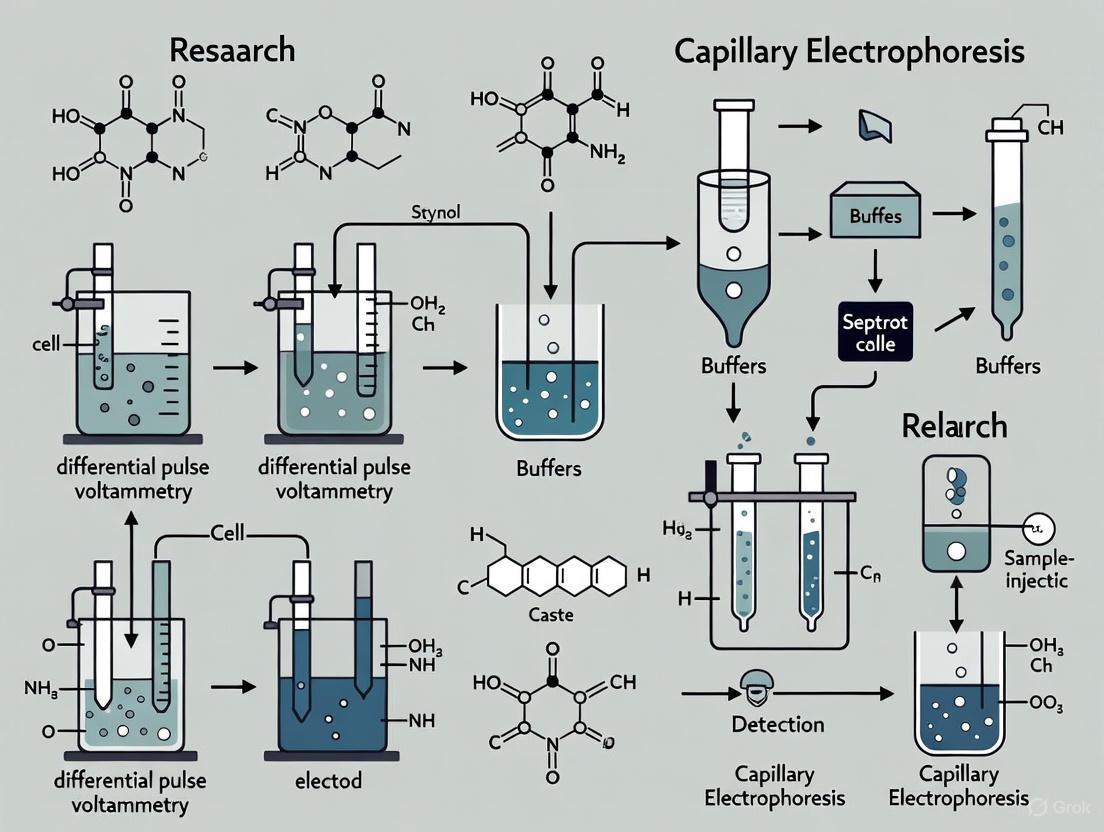
This article provides a comprehensive comparative analysis of Differential Pulse Voltammetry (DPV) and Capillary Electrophoresis (CE) for researchers and professionals in drug development and analytical science.
Differential Pulse Voltammetry vs. Capillary Electrophoresis: A Modern Guide for Analytical Scientists
Abstract
This article provides a comprehensive comparative analysis of Differential Pulse Voltammetry (DPV) and Capillary Electrophoresis (CE) for researchers and professionals in drug development and analytical science. It explores the fundamental principles and governing mechanisms of each technique, details their specific methodological applications in pharmaceutical and biomedical analysis, offers practical troubleshooting and optimization strategies, and delivers a rigorous validation and comparative assessment. By synthesizing recent advancements and real-world case studies, this guide serves as a strategic resource for selecting and implementing the most appropriate analytical technique for specific research and quality control objectives.
Core Principles: Unraveling the Mechanisms of DPV and CE
Differential Pulse Voltammetry (DPV) is a highly sensitive electroanalytical technique renowned for its ability to minimize non-faradaic background currents, thereby enabling the detection of analytes at very low concentrations, typically in the range of 10⁻⁶ to 10⁻⁹ mol·L⁻¹ [1]. As a pulse technique, DPV's core principle lies in its specific method of current sampling, which effectively discriminates against capacitive charging current, allowing the faradaic current of interest to be measured with high precision [2] [3]. This makes DPV a powerful tool in pharmaceutical sciences, environmental monitoring, and material characterization, particularly when compared to techniques like capillary electrophoresis, for its direct electrochemical information and often simpler instrumentation [4] [5].
Within the context of a broader thesis comparing electroanalytical methods, DPV stands out for its quantitative prowess and analytical sensitivity. While capillary electrophoresis (CE) excels at separating complex mixtures based on charge and size, DPV provides superior sensitivity for the direct detection and quantification of electroactive species, often without the need for complex separation procedures [6]. The ongoing innovation in DPV methodology, including its integration with advanced materials and data analysis techniques like machine learning, continues to expand its application space and solidify its role in modern analytical frameworks [7] [4].
Fundamental Principles and Pulse Sequence
The Core Mechanism of Signal Enhancement
The exceptional sensitivity of DPV stems from its strategic approach to current measurement. In electrochemical systems, the total current comprises both the faradaic current (from electron transfer of the analyte) and the capacitive (charging) current (from charging the electrode-solution interface). The faradaic current decays more slowly following a potential step, approximately as 1/√t (as described by the Cottrell equation), whereas the capacitive current decays exponentially [3] [1]. DPV capitalizes on this difference in decay rates by measuring the current just before a potential pulse is applied (Iᵣ) and again at the end of the pulse (If) [2]. The differential current, ΔI = If - Iᵣ, is then plotted against the applied base potential. Because the capacitive current is relatively stable between these two short, closely spaced sampling points, it is effectively subtracted out, leaving a signal dominated by the faradaic component [1]. This process significantly improves the signal-to-noise ratio and lowers the detection limit compared to other voltammetric techniques like cyclic voltammetry (CV) [4].
The DPV Pulse Sequence
The DPV waveform is generated by applying a series of potential pulses of fixed height and duration superimposed on a staircase base potential. The base potential increases in small increments between pulses [2]. Table 1 summarizes the key parameters that define a DPV experiment.
Table 1: Key Parameters in a Differential Pulse Voltammetry Experiment
| Parameter Group | Parameter Name | Symbol | Typical Values / Description |
|---|---|---|---|
| Sweep Limits | Segments | SN | 1 (standard), 2 or 3 (for cyclic variants) |
| Initial Potential | E_initial | Defines the starting potential of the scan | |
| Final Potential | E_final | Defines the ending potential of the scan | |
| Pulse Parameters | Pulse Height | PH / ΔE | 10 – 100 mV |
| Pulse Width | PW | ~50 ms | |
| Pulse Period | T | Time from the start of one pulse to the next | |
| Potential Increment | SH / E_step | ~2 mV | |
| Sampling Parameters | Pre-Pulse Sampling Width | T_DP, PRE | Time before pulse to sample Iᵣ |
| Post-Pulse Sampling Width | T_DP, POST | Time at end of pulse to sample I_f |
The following diagram illustrates the sequence of events and logical relationship of these parameters within a single DPV pulse.
Comparative Analytical Performance
To contextualize the performance of DPV, it is essential to compare it with other common voltammetric techniques. The peak current (I_p) in DPV and other methods can be described by characteristic equations, which directly relate to their sensitivity [1].
Table 2: Current Expressions and Key Features of Common Voltammetric Techniques
| Technique | Current Expression | Key Feature | Primary Use |
|---|---|---|---|
| Cyclic Voltammetry (CV) | ( I_p = -0.446 n^{3/2} A \sqrt{D \upsilon} C ) | Qualitative mechanistic studies | Revealing redox potentials and reaction kinetics. |
| Normal Pulse Voltammetry (NPV) | ( I_p = n F A C \sqrt{\frac{D}{\pi t}} ) | High sensitivity, minimal charging current. | Quantitative analysis of single analytes. |
| Differential Pulse Voltammetry (DPV) | ( I_p = n F A C \sqrt{\frac{D}{\pi t}} \left( -\text{tanh}\left( \frac{n F \Delta E}{4 R T} \right) \right) ) | Excellent sensitivity, minimized background. | Trace analysis of irreversible systems. |
| Square Wave Voltammetry (SWV) | ( I_p = 2.67 n F A C \sqrt{\frac{D}{\pi t}} ) | Very fast and sensitive. | Kinetic studies and reversible systems. |
Experimental data consistently demonstrates the superior sensitivity of pulse techniques like DPV. For instance, in a model experiment detecting ferrocyanide (([Fe(CN)_6]^{4-})) across a concentration range from 1.1 μmol·L⁻¹ to 1.1 mmol·L⁻¹, DPV showed a significantly higher sensitivity (slope of the calibration curve) compared to CV and NPV, and was comparable to the high sensitivity of SWV [1]. This quantitative advantage makes DPV the preferred choice for detecting trace levels of analytes in complex matrices, a common challenge in pharmaceutical and biomedical analysis [4].
Experimental Protocols
Protocol 1: Basic DPV Setup for a Standard Redox Probe
This protocol outlines the steps for a fundamental DPV experiment using potassium ferrocyanide, a common redox probe, to characterize electrode performance and validate the instrument.
1. Reagent and Solution Preparation:
- Prepare a 0.1 mol·L⁻¹ KCl solution in deionized water as the supporting electrolyte.
- Prepare a 1.0 mmol·L⁻¹ stock solution of (K4[Fe(CN)6]) in the 0.1 mol·L⁻¹ KCl solution.
- Prepare standard solutions of (K4[Fe(CN)6]) by serial dilution of the stock solution with the supporting electrolyte to cover a concentration range from 1 μmol·L⁻¹ to 1 mmol·L⁻¹.
2. Instrument and Electrode Setup:
- Use a standard three-electrode system: a Pt disk electrode (e.g., 2 mm diameter) as the working electrode, an Ag/AgCl reference electrode, and a Pt wire counter electrode.
- Place the electrodes in the electrochemical cell containing the standard solution.
- Connect the cell to a potentiostat (e.g., BioLogic VMP3 or similar).
3. Parameter Configuration in Software:
- Initial Potential (E_initial): -0.2 V (vs. Ag/AgCl)
- Final Potential (E_final): 0.6 V
- Pulse Height (PH): 50 mV
- Pulse Width (PW): 50 ms
- Potential Step (SH / E_step): 2 mV
- Step Time (St): 0.5 s
4. Execution and Data Collection:
- Initiate the experiment. The potentiostat will automatically apply the waveform.
- The output will be a plot of ΔI (μA) vs. the base potential (E, V).
- A well-defined peak should appear at the formal potential of the ([Fe(CN)_6]^{4-/3-}) couple (~0.22 V vs. Ag/AgCl).
5. Data Analysis:
- Record the peak current (I_p) for each standard concentration.
- Plot a calibration curve of I_p vs. concentration, which should be linear over the tested range.
- The slope of this curve represents the sensitivity of the method for ferrocyanide.
Protocol 2: DPV Determination of a Pharmaceutical Compound (e.g., Rhein)
This protocol is adapted from studies for the determination of bioactive molecules like rhein, demonstrating DPV's application in real-world pharmaceutical analysis [8].
1. Electrode Modification:
- Polish a glassy carbon electrode (GCE) sequentially with 1.0, 0.3, and 0.05 μm alumina slurry on a microcloth. Rinse thoroughly with deionized water.
- To prepare a multi-wall carbon nanotube (MWNT) composite film, disperse MWNTs in an aqueous solution of dihexadecyl phosphate (DHP).
- Deposit a fixed volume (e.g., 5 μL) of the MWNT-DHP dispersion onto the clean GCE surface and allow it to dry at room temperature. This creates the MWNT-DHP/GCE.
2. Preparation of Analyte and Buffer:
- Prepare a 0.1 mol·L⁻¹ acetate buffer (NaAc–HAc) at pH 4.5 as the supporting electrolyte.
- Prepare a stock solution of rhein in ethanol and subsequently dilute with the acetate buffer to the desired concentration range.
3. DPV Measurement:
- Immerse the modified MWNT-DHP/GCE, along with the reference and counter electrodes, in a cell containing the analyte solution in acetate buffer.
- Deoxygenate the solution by purging with high-purity nitrogen or argon for at least 10 minutes.
- Set the DPV parameters. A typical setup may include:
- Potential window: -0.20 V to -0.80 V (vs. SCE)
- Pulse Amplitude: 50 mV
- Pulse Width: 50 ms
- Scan Rate: 10 mV/s
- Run the DPV experiment. The electrocatalytic activity of the MWNTs will enhance the peak current for rhein's reduction.
4. Validation and Interference Study:
- Use the standard addition method for quantification in complex samples like extracts or biological fluids.
- To assess selectivity, test the influence of common interferents (e.g., inorganic ions, amino acids, structurally similar compounds) by adding them to the analyte solution and observing the change in the target peak current.
The Scientist's Toolkit: Research Reagent Solutions
Table 3: Essential Materials for DPV Experiments
| Item | Function / Description | Example Application |
|---|---|---|
| Potentiostat/Galvanostat | Instrument for applying potentials and measuring currents. | Core hardware for all DPV experiments [1]. |
| Three-Electrode System | Working, reference, and counter electrode setup for controlled potential. | Standard electrochemical cell configuration [2]. |
| Supporting Electrolyte (e.g., KCl, PBS) | Carries current and minimizes solution resistance. | Used in all experiments, e.g., 0.1 M KCl for ferrocyanide tests [1]. |
| Standard Redox Probes (e.g., (K4[Fe(CN)6])) | Well-characterized molecules for method validation and electrode characterization. | Calibrating system performance [1]. |
| Carbon Nanotubes (CNTs) | Nanomaterial for electrode modification; enhances surface area and electron transfer. | MWNT-DHP composite for sensitive detection of rhein [8]. |
| Polymer Membranes (e.g., DHP) | Used to create stable dispersions of nanomaterials and form modified electrodes. | Component of the MWNT-DHP composite film [8]. |
| Buffer Solutions (e.g., Acetate, Phosphate) | Maintain constant pH, which is critical for the redox behavior of many analytes. | Acetate buffer (pH 4.5) for rhein determination [8]. |
Advanced Applications and Future Perspectives
DPV continues to evolve, driven by advancements in waveform design and data analysis. A key frontier is the application of machine learning to navigate the intractably large search space of possible waveform parameters. For instance, the SeroOpt workflow employs Bayesian optimization to iteratively design and test rapid pulse voltammetry waveforms optimized for specific analytes like serotonin, significantly outperforming random or human-guided design approaches [7]. This data-driven paradigm represents a significant shift from traditional "guess-and-check" methods and can be generalized for various electroanalytical challenges.
Furthermore, innovations in fundamental theory continue to emerge. Concepts like "Genuine Differential Voltammetry" explore the possibility of defining a differential current from the intrinsic anodic and cathodic current components at a single potential, derived from the Butler-Volmer framework, offering new avenues for kinetic and analytical studies [9]. The integration of DPV with other techniques is also a growing trend. For example, capillary electrophoresis with electrochemical detection (CE-EC) combines the superior separation power of CE with the sensitive, direct detection of electroactive species by amperometry or voltammetry, including DPV [5] [6]. This hybrid approach is particularly powerful for analyzing complex mixtures of neurochemicals like dopamine, epinephrine, and serotonin in biomedical research, leveraging the strengths of both separation and electroanalysis.
Capillary Electrophoresis (CE) has emerged as a powerful analytical technique in pharmaceutical and biotechnology industries due to its exceptional efficiency, speed, and minimal sample consumption [10]. The technique separates analytes based on their charge-to-mass ratio using narrow-bore capillaries and high voltage to achieve ultra-high separation efficiencies that often exceed those of traditional chromatographic methods [10]. The fundamental separation mechanisms in CE are driven by two primary phenomena: electrophoretic mobility and electroosmotic flow [10]. Understanding the interplay between these forces is critical for optimizing separation performance, particularly in pharmaceutical applications where precision in analyzing active pharmaceutical ingredients, metabolites, and impurities is paramount [4].
This application note details the core principles, quantitative relationships, and practical methodologies for leveraging electroosmotic flow and electrophoretic mobility in CE, framed within a broader research context comparing CE with differential pulse voltammetry for drug development applications.
Fundamental Concepts and Quantitative Relationships
Electrophoretic Mobility (μₑₚ)
Electrophoretic mobility describes the movement of charged particles in an electric field and forms the basis for separation in CE [10]. The velocity of an ion (vₑₚ) is directly proportional to the field strength (E) and the ion's electrophoretic mobility (μₑₚ) [10]:
vₑₚ = μₑₚ × E
The electrophoretic mobility itself is determined by the analyte's charge (q) and the frictional drag (f) it experiences in the buffer [10]:
μₑₚ = q / f
The frictional drag is proportional to the ion size and buffer viscosity, with smaller, more highly charged ions exhibiting greater mobility [10]. For a spherical solute, the mobility can be approximated by:
μₑₚ = q / 6πηr [11]
where η is the viscosity of the media and r is the hydrodynamic radius of the analyte [11].
The pH of the buffer is crucial as it determines the ionization state and thus effective charge—especially important for amphoteric analytes like peptides and proteins [10].
Electroosmotic Flow (EOF)
Electroosmotic flow is the bulk movement of buffer solution through the capillary when an electric field is applied [12] [10]. In fused-silica capillaries, the inner wall contains silanol groups (–SiOH) that deprotonate at pH values above approximately 3, producing negatively charged surfaces (–SiO⁻) [10]. These charged surfaces attract positive counter-ions from the buffer, forming an electrical double layer (EDL) [12] [10].
When voltage is applied, the cations in the diffuse portion of the EDL migrate toward the cathode, dragging the entire buffer solution along through viscous forces [11] [12]. This creates a flow profile that is nearly plug-like, in contrast to the parabolic profile of pressure-driven flows, resulting in minimal band broadening and high separation efficiency [10].
The linear velocity of EOF (vₑₒ) can be described by the Helmholtz-Smoluchowski equation:
vₑₒ = εζE / 4πη [12]
where ε is the dielectric constant of the buffer solution, ζ is the zeta potential at the capillary wall, E is the electric field strength (V/L), and η is the viscosity of the buffer solution [12].
Net Analyte Motion
The net velocity of an analyte (vₙₑₜ) in CE is the vector sum of its electrophoretic mobility and the electroosmotic flow:
vₙₑₜ = vₑₚ + vₑₒ [10]
The measured electrophoretic mobility (μₘₑₐₛ) is a combination of the intrinsic electrophoretic mobility (μₑₚ) and the electroosmotic flow mobility (μₑₒ) [13]:
μₘₑₐₛ = μₑₚ + μₑₒ
This relationship means cations migrate fastest as both forces act in the same direction, anions migrate slowest as the forces oppose each other, and neutral compounds migrate solely at the EOF velocity [10].
Net analyte motion in CE separation
Parameter Optimization and Control
EOF Modulation Strategies
The magnitude and direction of EOF significantly impact separation efficiency and can be controlled through several parameters:
- Buffer pH: Higher pH (>6) increases silanol deprotonation, enhancing EOF toward cathode, while lower pH (<4) suppresses EOF by protonating silanol groups [10]
- Capillary wall coatings: Covalently bonded coatings (polyacrylamide, PEG) or dynamic coatings reduce or eliminate EOF by shielding silanol groups [10]
- Buffer additives: Cationic surfactants adsorb onto the capillary wall, potentially reversing the net charge and thus the EOF direction [10]
- Ionic strength: Increased ionic strength compresses the electrical double layer, reducing EOF velocity according to Equation 11.19 where velocity is inversely proportional to the square root of solution ionic strength [11]
Key Operational Parameters
The following parameters are critical for method development and optimization:
Table 1: Key CE Operational Parameters and Their Effects
| Parameter | Typical Range | Effect on Separation | Pharmaceutical Application Consideration |
|---|---|---|---|
| Buffer pH | 2.0 - 10.0 | Determinates analyte charge state and EOF magnitude | Critical for protein/peptide separations; affects stability of biologics |
| Voltage | 10 - 30 kV | Higher voltage speeds analysis but increases Joule heating | Optimize for sensitivity and resolution; monitor current for system suitability |
| Capillary Temperature | 15 - 40°C | Affects viscosity, mobility, and EOF reproducibility | Essential for method robustness; impacts drug stability during analysis |
| Buffer Ionic Strength | 10 - 200 mM | Higher concentration reduces EOF but increases current | Balance between efficiency and Joule heating; consider analyte solubility |
| Capillary Dimensions | 20 - 100 μm ID | Smaller diameters reduce Joule heating but decrease loading capacity | Match to sample availability; 50 μm ID common for pharmaceutical analysis |
Experimental Protocols
Standard CE Operating Protocol
Materials and Reagents:
- Fused silica capillary (50 μm ID, 30-60 cm total length)
- Appropriate buffer system (e.g., phosphate, borate, Tris)
- Standard solutions for system suitability
- Sample solutions (0.1-1.0 mg/mL in buffer or water)
Procedure:
Capillary Conditioning
- Flush new capillary with 1.0 M NaOH for 30 minutes at 1 bar
- Rinse with deionized water for 10 minutes at 1 bar
- Equilibrate with running buffer for 20 minutes at 1 bar
- For daily maintenance, repeat above sequence for 5 minutes each
Sample Injection
- Hydrodynamic Injection: Apply pressure (10-50 mbar) for 1-30 seconds
- Electrokinetic Injection: Apply voltage (5-10 kV) for 5-30 seconds
- Note: Electrokinetic injection may introduce bias based on analyte mobility [14]
Separation
- Apply separation voltage (10-30 kV) with appropriate polarity
- Maintain constant capillary temperature (25°C typical)
- Monitor current stability throughout separation
Detection
- UV detection: 200-214 nm for peptides/proteins, higher wavelengths for small molecules
- Alternative detection: LIF for high sensitivity, MS for identification
Capillary Storage
- Rinse with deionized water for 5 minutes
- For extended storage, purge with air and store dry
EOF Measurement Protocol
Objective: Determine electroosmotic flow mobility for method characterization
Procedure:
- Prepare a neutral marker solution (e.g., 0.1% acetone, DMSO, or mesityl oxide)
- Inject marker using standard injection conditions (typically hydrodynamic, 10 mbar for 5s)
- Perform separation at standard conditions (e.g., 15 kV, 25°C)
- Measure migration time of neutral marker (tₑₒ)
Calculate EOF mobility using: μₑₒ = Lₜ × L𝒹 / (tₑₒ × V) where Lₜ = total capillary length, L𝒹 = length to detector, V = applied voltage
Verify reproducibility across replicates (RSD < 2% typically acceptable)
CE method development and analysis workflow
The Scientist's Toolkit: Essential Research Reagents and Materials
Table 2: Key Research Reagent Solutions for CE Analysis
| Reagent/Material | Function | Application Notes |
|---|---|---|
| Fused Silica Capillaries | Separation channel with tunable surface chemistry | 20-100 μm ID; bare or coated (e.g., polyacrylamide for reduced protein adsorption) |
| Buffer Systems (Phosphate, Borate, Tris) | Maintain pH and ionic strength; conduct current | Choose pH based on analyte pI; include additives for specific separations |
| EOF Modifiers (Cationic surfactants, polymers) | Control magnitude/direction of electroosmotic flow | CTAB for EOF reversal; cellulose polymers for viscosity modification |
| Neutral EOF Markers (Acetone, DMSO, Mesityl Oxide) | Measure electroosmotic flow velocity | Essential for method characterization and transfer |
| Chiral Selectors (Cyclodextrins, Crown ethers) | Enable enantiomeric separations | Critical for chiral drug analysis; various derivatized cyclodextrins available |
| Capillary Coatings (Polyacrylamide, PEG, Polybrene) | Modify capillary surface to reduce analyte adsorption | Dynamic or permanent coatings; essential for protein analysis |
CE in Pharmaceutical Analysis: Applications and Advantages
Capillary electrophoresis provides significant advantages for pharmaceutical analysis, particularly for charged molecules including small molecule APIs, peptides, proteins, and nucleic acids [10]. Key applications include:
- Purity and Impurity Profiling: High efficiency separation of closely related substances including degradation products and synthetic impurities [10]
- Chiral Separations: Use of cyclodextrin-based buffers for efficient resolution of drug enantiomers [10]
- Biologics Characterization: Analysis of monoclonal antibody charge variants (cIEF) and size variants (CGE) [10]
- Drug Metabolism Studies: Monitoring of drug metabolites in biological fluids with minimal sample consumption [4]
Table 3: Comparison of CE with HPLC for Pharmaceutical Analysis
| Feature | Capillary Electrophoresis (CE) | High-Performance Liquid Chromatography (HPLC) |
|---|---|---|
| Separation Principle | Charge-to-mass ratio and size | Differential partitioning between phases |
| Driving Force | Electric field | Hydraulic pressure |
| Efficiency | 100,000–1,000,000 theoretical plates | 10,000–100,000 theoretical plates |
| Sample Consumption | Nanoliter volumes | Microliter to milliliter volumes |
| Mobile Phase | Simple aqueous buffers | Complex solvent mixtures |
| Best Suited For | Charged molecules (proteins, peptides, ions, nucleic acids) | Neutral or non-polar small molecules |
The minimal sample and solvent requirements, combined with exceptional resolving power, make CE particularly valuable for analyzing scarce or costly pharmaceutical compounds [10]. Its orthogonality to HPLC provides a complementary separation mechanism for complex mixture analysis [10].
Electroosmotic flow and electrophoretic mobility represent the fundamental forces governing separations in capillary electrophoresis. Through precise control of buffer chemistry, capillary surface properties, and operational parameters, researchers can optimize CE methods for specific pharmaceutical applications. The techniques outlined in this application note provide a foundation for robust CE method development, enabling high-resolution separation of pharmaceutical compounds with exceptional efficiency and minimal sample requirements.
The position of CE within the analytical toolkit is particularly strong for charged molecules, offering complementary separation mechanisms to techniques such as differential pulse voltammetry. As pharmaceutical analysis continues to evolve toward more complex molecules and personalized medicines, the principles of electroosmotic flow and electrophoretic mobility remain central to leveraging CE's full potential in drug development and quality control.
Differential Pulse Voltammetry (DPV) is a highly sensitive electrochemical technique renowned for its ability to quantify analytes at very low concentrations, often in the 10⁻⁸ to 10⁻⁹ M range [15] [16]. This pulse voltammetry method derives from linear sweep or staircase voltammetry but incorporates a series of regular voltage pulses superimposed on a linearly increasing baseline potential [15] [17]. The core principle of DPV lies in its differential current measurement, which effectively suppresses non-Faradaic (charging) background currents, thereby isolating and amplifying the Faradaic current associated with redox reactions [18] [17]. This characteristic makes DPV particularly valuable for analytical applications requiring high sensitivity and low limits of detection, including pharmaceutical analysis, environmental monitoring, and biomolecule sensing [18] [17]. Within the broader context of comparative analysis with capillary electrophoresis, understanding the fundamental governing equations of DPV is essential for researchers to leverage its complementary strengths in handling complex samples and discriminating between electrochemically active species with similar oxidation potentials [19] [16].
Fundamental Governing Equations
The analytical response in a DPV experiment is characterized by a peak-shaped voltammogram. The relationship between the peak current and the analyte concentration is the cornerstone of quantitative analysis using DPV.
Primary Current-Response Relationship
The peak current ((i_p)) in DPV is governed by the following fundamental equation, which directly links the measured signal to the properties of the analyte and the experimental parameters [18]:
[ip = \frac{nF A D^{1/2} C}{(\pi (tp - t'))^{1/2}} \left( \frac{1-\sigma}{1+\sigma} \right)]
where the term (\sigma) is defined as:
[\sigma = \exp\left(\frac{nF \Delta E}{2RT}\right)]
Table 1: Variables in the DPV Peak Current Equation
| Variable | Description | Typical Units |
|---|---|---|
| (i_p) | Peak Faradaic current | Amperes (A) |
| (n) | Number of electrons transferred in redox reaction | dimensionless |
| (F) | Faraday's constant (96,485 C/mol) | Coulombs per mole (C/mol) |
| (A) | Electrode surface area | square centimeters (cm²) |
| (D) | Diffusion coefficient of the analyte | square centimeters per second (cm²/s) |
| (C) | Bulk concentration of the analyte | moles per liter (mol/L) |
| (t_p) | Pulse width | seconds (s) |
| (t') | Time delay before current sampling | seconds (s) |
| (\Delta E) | Pulse amplitude | Volts (V) |
| (R) | Universal gas constant (8.314 J/mol·K) | Joules per mole Kelvin (J/mol·K) |
| (T) | Absolute temperature | Kelvin (K) |
For a reversible electrochemical system under controlled conditions, this equation can be simplified, showing that the peak current is directly proportional to the concentration of the electroactive species ((i_p \propto C)) [15]. This linear proportionality is the fundamental basis for quantitative determination using DPV.
Peak Potential and Shape Characteristics
The position and shape of the DPV peak provide qualitative information about the redox reaction.
Peak Potential ((Ep)): For a reversible redox reaction, the peak potential is related to the half-wave potential ((E{1/2})) and the pulse amplitude ((\Delta E)) by [20]: [Ep = E{1/2} - \frac{\Delta E}{2}] The half-wave potential is a characteristic value used for the qualitative identification of the analyte.
Peak Half-Width ((\Delta E{p/2})): For a reversible, diffusion-controlled reaction, the width of the peak at half its height is given by [18]: [ \Delta E{p/2} = \frac{3.52 RT}{nF} ] At 25°C, this simplifies to approximately (\frac{90.4}{n}) mV, which can be used to estimate the number of electrons involved in the redox process.
Experimental Protocol for Quantitative DPV Analysis
This protocol details the steps for determining an analyte using Differential Pulse Voltammetry, with epinephrine detection in a pharmaceutical sample used as a representative example [16].
Research Reagent Solutions and Materials
Table 2: Essential Reagents and Materials for DPV
| Item | Function / Specification |
|---|---|
| Potentiostat/Galvanostat | Instrument for applying potential and measuring current (e.g., AUTOLAB PGSTAT128N) [16]. |
| Three-Electrode Cell | Standard electrochemical cell setup [17]. |
| Glassy Carbon Working Electrode (GCE) | Solid working electrode (diameter 3 mm). Electrochemical inertness and conductivity make it a common choice [16]. |
| Reference Electrode | Ag/AgCl or Saturated Calomel Electrode (SCE). Maintains a constant reference potential for accurate measurements [16] [17]. |
| Counter Electrode | Platinum wire. Completes the electrical circuit in the cell [16]. |
| Tyrosinase (from Agaricus bisporus) | ≥1000 U mg⁻¹. Biorecognition element that catalyzes the oxidation of epinephrine [16]. |
| Epinephrine Hydrochloride (EP) | Analytical standard for preparing calibration solutions [16]. |
| Tetrabutylammonium-tetrafluoroborate (TBA-TFB) | Supporting electrolyte (0.1 M). Carries current while minimizing migration of the analyte [16]. |
| Dichloromethane | Solvent for electropolymerization [16]. |
| Phosphate Buffer (e.g., 0.1 M, pH 7.4) | Provides a stable pH environment for the biochemical reaction [16]. |
| Glutaraldehyde (GA) | Cross-linking agent for enzyme immobilization [16]. |
Step-by-Step Procedure
Electrode Pretreatment: Polish the bare Glassy Carbon Electrode (GCE) with a 50 nm alumina suspension on a microcloth. Rise thoroughly with double-distilled water to remove any residual polishing material [16].
Electrode Modification (Electropolymerization): a. Prepare a monomer solution by dissolving 1 mM of the chosen monomer (e.g., 4,4′-bis(2-methyl-3-butyn-2-ol)-2,2′-bithiophene) in dichloromethane containing 0.1 M TBA-TFB as the supporting electrolyte [16]. b. Immerse the clean GCE, along with the reference and counter electrodes, in the monomer solution. c. Perform Cyclic Voltammetry (CV) by scanning the potential of the GCE between 0.0 V and 1.4 V (vs. Ag/AgCl) for 10 cycles at a scan rate of 100 mV/s to deposit the polymer film (poly-4,4′-bBT) onto the electrode surface [16]. d. Remove the modified electrode (now GCE/poly-4,4′-bBT) and rinse it gently with clean dichloromethane.
Enzyme Immobilization: a. Physically adsorb tyrosinase onto the surface of the GCE/poly-4,4′-bBT electrode. b. Use a cross-linker such as glutaraldehyde (GA) to stabilize the enzyme layer and prevent its desorption during measurements [16]. The final biosensor is designated as GCE/poly-4,4′-bBT/Tyr.
DPV Instrumental Setup: Configure the potentiostat with the following typical DPV parameters, which can be optimized for the specific analyte [16] [17]:
- Initial/Final Potential: Set to bracket the expected redox potential of the analyte.
- Pulse Amplitude: 50 mV.
- Pulse Width: 50 ms.
- Scan Rate: 50 mV/s.
- Sample Period: Set to measure current at the end of each pulse.
Calibration Curve Generation: a. Prepare a series of standard solutions of epinephrine in phosphate buffer (e.g., 0.1 M, pH 7.4) across a concentration range (e.g., 1 μM to 200 μM) [16]. b. For each standard solution, perform a DPV scan using the GCE/poly-4,4′-bBT/Tyr biosensor. c. Record the peak current ((ip)) for each concentration. d. Plot a calibration curve of peak current ((ip)) versus epinephrine concentration (C). The plot should yield a linear relationship, allowing for the determination of unknown concentrations.
Sample Analysis: a. Prepare the pharmaceutical sample (e.g., appropriate dilution in the same phosphate buffer used for calibration) [16]. b. Run a DPV scan under identical experimental conditions. c. Measure the peak current and use the calibration curve to determine the concentration of epinephrine in the sample.
Relationship Logic in DPV
The analytical signal in DPV is the result of complex interactions between instrumental parameters and the physicochemical properties of the analyte. The following diagram illustrates the logical chain from these fundamental factors to the final measured peak current.
Comparative Analytical Performance: DPV vs. Capillary Electrophoresis
In the context of a broader thesis comparing electroanalytical techniques, it is crucial to understand how DPV performs relative to Capillary Electrophoresis with Amperometric Detection (CE-AD), particularly for the determination of active compounds in complex matrices like pharmaceuticals or feed samples [19].
Table 3: Comparison of DPV and CE-AD for Analytical Determinations
| Feature | Differential Pulse Voltammetry (DPV) | Capillary Electrophoresis with Amperometric Detection (CE-AD) |
|---|---|---|
| Core Principle | Measurement of differential Faradaic current at a pulsed potential [15] [17]. | Separation of ions by electrophoretic mobility followed by electrochemical detection at a fixed potential [19]. |
| Key Strength | High sensitivity and very low detection limits (nanomolar range); rapid analysis [19] [16]. | Superior separation efficiency for complex mixtures with multiple electroactive species [19]. |
| Handling Complex Samples | May require selective electrodes or modified surfaces to avoid interference [18] [16]. | Excellent for complex samples due to high-resolution separation prior to detection [19]. |
| Reported Performance (Nicarbazin) | Low micromolar LODs; successful determination below EU regulatory limits in feed [19]. | Low micromolar LODs; successful determination below EU regulatory limits in feed [19]. |
| Typical Analysis Time | Seconds to minutes [18]. | Longer than DPV due to the separation step [19]. |
| Complementary Role | Provides rapid, sensitive quantification for target analyses. | Enables determination in complex matrices where multiple interferences are present [19]. |
Critical Parameters and Troubleshooting
Successful implementation of DPV for quantitative analysis requires careful optimization of key parameters.
- Pulse Amplitude ((\Delta E)): Typically ranges from 5 to 100 mV [20] [17]. A larger amplitude generally increases the peak current and sensitivity but can decrease peak resolution and widen the peak base for irreversible systems [17].
- Pulse Width and Sample Time: The pulse duration (e.g., 50-100 ms) and the precise timing of current sampling are critical for allowing the capacitive current to decay while still measuring the Faradaic current [18] [17].
- Electrode Surface: The choice and modification of the working electrode are paramount. Modified electrodes, such as those with polymers or nanocomposites, can enhance electron transfer, improve sensitivity, and impart selectivity by minimizing fouling or interfering signals [18] [16].
The governing equations of Differential Pulse Voltammetry establish a direct and quantifiable link between the measured peak current and the concentration, diffusion coefficient, and electron-transfer properties of an analyte. The high sensitivity afforded by the differential current measurement and the minimization of capacitive current makes DPV a powerful standalone technique for trace analysis. When framed within a comparative research context against capillary electrophoresis, DPV serves as a rapid and highly sensitive quantification tool. Its value is maximized when used complementarily with a high-separation-efficiency technique like CE-AD, together providing a robust analytical toolkit for tackling complex challenges in pharmaceutical analysis and quality control.
Capillary Electrophoresis (CE) is a powerful analytical technique renowned for its high efficiency, minimal sample consumption, and rapid analysis times. Its application spans from pharmaceutical analysis to the study of biomolecular interactions. The separation dynamics in CE are governed by a delicate balance of several critical parameters, primarily the background electrolyte (BGE) pH, ionic strength, and capillary surface chemistry. These factors collectively control the electroosmotic flow (EOF) and the electrophoretic mobility of analytes, thereby determining the resolution, selectivity, and overall success of a separation. Within the context of evaluating analytical techniques for drug development, this document provides detailed application notes and protocols to systematically investigate and optimize these core parameters, offering a robust alternative or complement to electrochemical methods like differential pulse voltammetry.
Core Principles and Parameter Optimization
The separation mechanism in CE is a synergistic result of the EOF and the electrophoretic mobilities of the analytes. The following sections and tables summarize the role and optimization strategy for each key parameter.
Table 1: Core Parameters Controlling Separation Dynamics in CE
| Parameter | Primary Function | Impact on Separation | Optimal Range / Considerations |
|---|---|---|---|
| BGE pH | Controls ionization state of analytes & capillary silanol groups; regulates EOF [21]. | Determines analyte charge, mobility, and direction; critically affects selectivity for ionizable compounds [22] [21]. | 20-100 mM buffer concentration; select pH ±1.5 pKa for maximal selectivity change; >1.5 pKa from pKa for robust methods [22] [21]. |
| Ionic Strength | Influences electric field strength, EOF magnitude, and Joule heating [21]. | Higher ionic strength lowers EOF and electrophoretic velocity, can enhance efficiency but may cause band broadening if excessive [21]. | Must balance between efficiency and current/heat generation; typical concentration 20-100 mM [21]. |
| Capillary Surface Chemistry | Governs analyte-wall interactions and the stability of the EOF [21]. | Adsorption of basic analytes to silanol groups causes peak tailing; coatings suppress adsorption and stabilize EOF [21]. | Dynamic (flexible) or permanent (robust) coatings are chosen based on application needs and required reproducibility [21]. |
The Role of Buffer pH
The pH of the BGE is arguably the most powerful tool for manipulating selectivity in CE. It simultaneously affects the charge of the capillary wall, the charge of ionizable analytes, and consequently, the EOF.
- Mechanism of EOF Control: In a fused-silica capillary, silanol groups (Si-OH) ionize to SiO⁻ at pH values above approximately 3. This creates a negatively charged wall that attracts positively charged ions from the buffer, forming an electrical double layer. When voltage is applied, these cations migrate towards the cathode, dragging the bulk solution with them in a flow known as the EOF. The EOF increases with higher pH as more silanol groups become ionized [21].
- Effect on Analyte Mobility: For ionizable analytes, pH determines their net charge. For instance:
- Acidic analytes become deprotonated (negatively charged) at high pH, leading to faster migration towards the anode in normal polarity mode (or being overtaken by the EOF more slowly) [22].
- Basic analytes become protonated (positively charged) at low pH, leading to faster migration towards the cathode [22].
- The greatest change in mobility and retention occurs within ±1.5 pH units of the analyte's pKa, allowing for fine-tuned selectivity adjustments [22].
The Role of Ionic Strength
The ionic strength of the BGE, governed by the concentration of the buffer salt, directly impacts the electric current and the resulting Joule heating.
- Electric Field and Joule Heating: The applied voltage divided by the capillary length determines the electric field strength. The current that flows is proportional to the buffer's ionic strength. Higher ionic strength leads to higher current and increased Joule heating [21]. If not efficiently dissipated, this heat creates a radial temperature gradient, causing viscosity differences across the capillary. This results in band broadening and reduced separation efficiency [21].
- EOF and Electrostatic Interactions: Increased ionic strength compresses the electrical double layer at the capillary wall, which typically reduces the EOF velocity. It can also shield electrostatic interactions between analytes and the capillary wall, potentially reducing adsorption [21].
The Role of Capillary Surface Chemistry
The inner surface of the capillary is a critical, yet often overlooked, component in CE separations.
- Challenge of Adsorption: The untreated fused-silica wall contains ionizable silanol groups that can adsorb basic analytes and proteins, leading to peak tailing, poor efficiency, and irreproducible migration times [21].
- Coating Strategies: To mitigate this, various capillary coating strategies are employed:
- Dynamic Coatings: Additives like ionic polymers (e.g., Polybrene) or neutral polymers (e.g., hydroxypropyl methylcellulose) are added to the BGE. They adsorb to the capillary wall, neutralizing or reversing the surface charge and preventing analyte adsorption. This approach is flexible and easy to implement [21].
- Permanent Coatings: The capillary wall is chemically modified via covalent bonding of a polymer or silane derivative. This creates a stable, durable surface that is highly reproducible but more difficult and costly to prepare [21].
Experimental Protocols
Protocol 1: Systematic Investigation of BGE pH and Ionic Strength
This protocol outlines a method for optimizing the BGE composition using a design of experiments (DoE) approach.
I. Materials and Reagents
- CE Instrument: Any standard CE system with UV-Vis or DAD detection.
- Capillary: Untreated fused-silica capillary, 50 µm ID, 40/50 cm total/effective length.
- Chemicals: Analytical grade buffers (e.g., phosphate, borate, tris), sodium hydroxide, hydrochloric acid.
- Analytes: A test mixture containing both acidic and basic compounds with known pKa values (e.g., a series of substituted anilines [22]).
II. Procedure
- BGE Preparation: Prepare a series of 50 mM phosphate buffers across a pH range from 2.0 to 9.0. Adjust pH carefully using concentrated NaOH or HCl. For ionic strength investigation, prepare buffers at a fixed pH (e.g., 7.0) with concentrations of 20, 50, 100, and 150 mM.
- Capillary Conditioning: Before first use, flush a new capillary with 1 M NaOH for 30 min, followed by deionized water for 10 min, and then with the run buffer for 20 min. Between runs, flush with the BGE for 2-5 min.
- Sample Injection: Hydrodynamically inject the test mixture for 5 s at 50 mbar.
- Separation: Apply a separation voltage of +15 kV (normal polarity) at a constant temperature of 25°C.
- Data Collection: Monitor the current and record the electropherograms. Measure migration times, peak areas, and peak widths (for efficiency calculation) for all analytes.
III. Data Analysis
- Plot migration time vs. pH for each analyte to visualize the "separation window" and identify the pH for optimal selectivity.
- Plot peak efficiency (theoretical plates, N) vs. ionic strength to identify the concentration that provides the best compromise between efficiency and current/heat generation.
- Use statistical software to model the interaction effects of pH and ionic strength on critical resolution.
Table 2: Research Reagent Solutions for Core CE Experiments
| Reagent / Material | Function / Explanation | Example Application / Notes |
|---|---|---|
| Sodium Phosphate Buffer | A common BGE for controlling pH and ionic strength. | Used in fundamental studies of pH and ionic strength effects; stable over a wide pH range. |
| Sodium Dodecyl Sulphate (SDS) | Surfactant for forming micelles or microemulsions in electrokinetic chromatography [23]. | Essential for MEKC/MEEKC to separate neutral analytes; used above its critical micellar concentration. |
| Cyclodextrins (e.g., HP-β-CD) | Chiral selectors added to the BGE [21]. | Enable enantiomeric separation by forming transient diastereomeric complexes with chiral analytes. |
| Polybrene (Hexadimethrine bromide) | A cationic polymer for dynamic capillary coating [21]. | Adsorbs to the silica wall, reversing the EOF and suppressing adsorption of basic analytes. |
| n-Heptane & Butan-1-ol | Components of the oil phase and co-surfactant in MEEKC [23]. | Form the pseudo-stationary microemulsion droplets for separating highly hydrophobic compounds. |
Protocol 2: Evaluating Dynamic vs. Permanent Capillary Coatings
This protocol compares the performance of two common coating strategies for analyzing a basic peptide mixture.
I. Materials and Reagents
- CE Instrument: As in Protocol 1.
- Capillaries:
- Dynamic Coating: Untreated fused-silica capillary. Add 0.1% (w/v) Polybrene to the BGE.
- Permanent Coating: A commercially available covalently coated capillary (e.g., neutral coated).
- BGE: 50 mM tris-glycine buffer, pH 8.3.
- Sample: A mixture of basic peptides (e.g., 0.1 mg/mL each in deionized water).
II. Procedure
- Conditioning: For the dynamic coating capillary, condition with the Polybrene-containing BGE for 10 min. For the permanent coating, follow the manufacturer's instructions (typically a flush with BGE).
- Injection and Separation: Follow the same injection and separation conditions as in Protocol 1 for both capillaries.
- Reproducibility Test: Perform six consecutive injections of the peptide mixture in each capillary and record the migration times.
III. Data Analysis
- Compare the peak shape (symmetry) and theoretical plate count for a target peptide between the two coatings.
- Calculate the relative standard deviation (RSD%) of the migration times for the six runs to assess the reproducibility offered by each coating type.
Advanced Applications and Considerations
Addressing Conductivity Mismatch in Biomolecular Interaction Studies
A common challenge in affinity CE (ACE) and related techniques is the use of high-conductivity physiological sample buffers with a low-conductivity BGE. This mismatch can cause severe peak broadening, splitting, and distorted baselines, compromising the accuracy of binding constant determinations [24].
Mitigation Strategies:
- Minimize Injection Plug Length: Reducing the volume of the injected sample minimizes the length of the high-conductivity zone, reducing associated artifacts [24].
- Alternative Quantification Methods: When traditional peak integration is impossible, quantifying the "de-stacked" fraction of a labeled molecule (e.g., an aptamer) that escapes the sample zone can provide a viable alternative for calculating dissociation constants (Kd) [24].
Separation of Hydrophobic Compounds via MEEKC
For highly hydrophobic analytes like fenofibrate (log P ~5.2) and lumefantrine (log P >10), standard CE modes are insufficient. Microemulsion Electrokinetic Chromatography (MEEKC) is the method of choice [23].
Typical MEEKC Buffer Composition [23]:
- 7.69 mmol/L NaPO₄
- 115 mmol/L SDS (surfactant)
- 0.91% (v/v) n-Heptane (oil phase)
- 23.74% (v/v) Butan-1-ol (co-surfactant)
- 20.35% (v/v) Acetonitrile (organic modifier)
- 55% (v/v) H₂O
- pH adjusted to 8.49
This system creates oil-in-water microemulsion droplets that act as a pseudostationary phase, allowing for the partitioning and separation of neutral and hydrophobic compounds based on their hydrophobicity.
Visualization of Separation Dynamics and Optimization Workflow
The following diagram illustrates the logical relationships between core CE parameters, their effects on fundamental separation forces, and the resulting analytical outcomes.
CE Parameter Dynamics
This workflow provides a logical map for diagnosing separation issues and guiding method development. For instance, poor resolution between two acidic analytes could be addressed by adjusting the BGE pH to differentially alter their ionization (affecting Analyte Charge & Mobility) and thus the Selectivity.
The precise control of buffer pH, ionic strength, and capillary surface chemistry is fundamental to harnessing the full separation power of Capillary Electrophoresis. A deep understanding of how these parameters independently and synergistically control EOF and electrophoretic mobility allows researchers to develop robust, high-resolution methods for a wide array of applications, from small drug molecules to large biomolecular complexes. The protocols and guidelines provided here offer a systematic approach for optimizing these separation dynamics, ensuring reliable and reproducible results that are critical in drug development and other advanced research fields.
Electroanalytical techniques are indispensable in modern pharmaceutical research, offering high sensitivity, selectivity, and cost-effectiveness for drug development and quality control [4]. This article provides a detailed instrumentation overview of two powerful techniques with complementary strengths: Differential Pulse Voltammetry (DPV), known for its exceptional sensitivity in detecting trace amounts of electroactive species, and Capillary Electrophoresis (CE) with amperometric detection, which provides high separation efficiency for complex mixtures [19]. Understanding the key components, operational principles, and experimental protocols for these systems is crucial for researchers and drug development professionals seeking to select the optimal analytical approach for their specific applications, particularly in the analysis of pharmaceutical compounds and biological samples.
Differential Pulse Voltammetry (DPV) Instrumentation
Core Principles and Components
Differential Pulse Voltammetry is a potent electroanalytical technique designed to minimize non-faradaic (charging) background currents, thereby enhancing the measurement sensitivity for faradaic processes [25]. The technique employs a specific waveform consisting of a series of small potential pulses superimposed on a gradually changing baseline potential. Current is sampled twice per pulse—just before the pulse application and at the end of the pulse—and the difference between these two current measurements is plotted against the baseline potential, producing peaks at the formal potential of the redox reaction [25].
A complete DPV system integrates several key components:
- Potentiostat: The central instrument that controls the applied potential and measures the resulting current. Modern potentiostats offer high resolution for both applied potential and measured current, which is critical for the small signals often encountered in trace analysis [26].
- Electrochemical Cell: This houses the three-electrode configuration:
- Working Electrode (WE): The electrode where the reaction of interest occurs. Common materials include glassy carbon, gold, platinum, and screen-printed carbon electrodes (SPCEs), which can be modified with nanomaterials to enhance electrocatalytic properties and sensitivity [27].
- Counter Electrode (CE): Completes the electrical circuit, typically made from an inert material like platinum.
- Reference Electrode (RE): Maintains a stable, known potential against which the WE is controlled, such as Ag/AgCl or a silver quasi-reference electrode in screen-printed systems [27].
- Software: Controls the instrument, defines the pulse parameters, and performs data acquisition and analysis. Advanced software allows for automation, peak detection, and detailed data processing [25] [26].
Table 1: Key Technical Specifications of a Modern Potentiostat (Representative Example)
| Parameter | Specification (Low Range Model) | Specification (High Range Model) | Significance for DPV |
|---|---|---|---|
| Potential Range | ±3 V | ±6 V | Determines the window of redox potentials that can be accessed. |
| Current Ranges | 1 nA to 10 mA (8 ranges) | 100 nA to 100 mA (7 ranges) | Allows measurement of very small faradaic currents with high precision. |
| Applied Potential Accuracy | ≤ 0.2% ±1 mV offset | ≤ 0.2% ±1 mV offset | Ensures the applied pulse waveform is precise and reproducible. |
| Measured Current Resolution | 0.009% of Current Range (e.g., 92 fA on 1 nA range) | 0.009% of Current Range (e.g., 9.2 pA on 100 nA range) | Critical for resolving the small differential currents measured in DPV. |
DPV Experimental Protocol
The following protocol outlines a typical DPV experiment for the determination of an active pharmaceutical ingredient (API), such as the anticancer drug imatinib, using a modified screen-printed electrode [27].
Step 1: Electrode Preparation and Modification
- Materials: Screen-printed carbon electrode (SPCE), modification material (e.g., Nickel-Cobalt Layered Double Hydroxide Hollow Nanostructures - Ni-Co LDH HNSs), dispersion solvent (deionized water) [27].
- Procedure:
- Prepare a homogeneous suspension by dispersing 1 mg of Ni-Co LDH HNSs in 2 mL of deionized water using an ultrasonic bath for 20 minutes.
- Deposit a known volume (e.g., 2-5 µL) of the suspension onto the working electrode surface of the SPCE.
- Allow the solvent to evaporate completely at room temperature to form a stable modified layer (Ni-Co LDH HNSs/SPCE).
Step 2: Instrument and Parameter Setup
- Equipment Setup: Connect the potentiostat to a computer and initialize the control software (e.g., GPES, PSTrace). Install the (modified) SPCE in the cell holder or connect the individual electrodes to the potentiostat's leads (WE, RE, CE) [27].
- DPV Parameter Selection: Input the optimized parameters as determined for the analyte. The table below provides a general starting point and a specific example from the literature.
Table 2: DPV Experimental Parameters for Pharmaceutical Analysis
| Parameter | General Starting Range | Example: Imatinib Determination [27] |
|---|---|---|
| Initial/Final Potential | Dependent on analyte's redox potential | Adjusted to encompass oxidation peak at ~570 mV |
| Pulse Amplitude | 10 - 100 mV | 50 mV |
| Pulse Width | 10 - 100 ms | 50 ms |
| Step Height / Potential Increment | 1 - 10 mV | 4 mV |
| Scan Rate | 1 - 20 mV/s | 10 mV/s |
| Supporting Electrolyte | Phosphate Buffer (PBS), Acetate Buffer | 0.1 M PBS, pH 7.0 |
Step 3: Execution and Data Acquisition
- Place the electrochemical cell containing the supporting electrolyte and the analyte into the system.
- Initiate the experiment. The potentiostat will automatically execute the sequence: induction period → DPV pulse sequence → relaxation period [25] [28].
- The software records the differential current (∆I = Isample2 - Isample1) as a function of the applied baseline potential, generating a voltammogram with characteristic peaks.
Step 4: Data Analysis
- Identify the peak potential (E_p), which is characteristic of the analyte.
- Measure the peak current (Ip). For quantitative analysis, construct a calibration curve by plotting Ip against the concentration of the standard analyte solutions [27].
Capillary Electrophoresis with Amperometric Detection (CE-AD) Instrumentation
Core Principles and Components
Capillary Electrophoresis is a high-efficiency separation technique that separates ionic species based on their electrophoretic mobility under the influence of a high-voltage electric field. When coupled with amperometric detection (CE-AD), it provides a highly sensitive and selective method for analyzing electroactive compounds in complex mixtures, such as pharmaceutical formulations and biological samples [19]. The strength of CE-AD lies in its ability to separate components before detection, which is particularly advantageous when analyzing samples with multiple electroactive interferents [19].
A CE-AD system consists of several integrated modules:
- High-Voltage Power Supply: Generates a high voltage (typically 5-30 kV) to drive the electrophoretic separation.
- Capillary: A fused-silica tube of narrow internal diameter (e.g., 25-100 µm), where the separation occurs. The capillary wall chemistry and the composition of the background electrolyte (BGE) are critical for separation efficiency.
- Injection System: Introduces a precise, small volume (nL range) of the sample into the capillary, usually via hydrodynamic (pressure) or electrokinetic injection.
- Amperometric Detector: The detection system, which is a miniaturized electrochemical cell typically consisting of:
- Working Electrode: Often a microelectrode (e.g., carbon fiber, platinum, or gold disk) positioned at the capillary outlet. Its material and potential are chosen to detect the target analyte(s).
- Reference Electrode and Counter/Auxiliary Electrode: Complete the three-electrode potentiostatic system for the detector.
- Potentiostat: A dedicated potentiostat for the amperometric detector, which holds the working electrode at a constant potential and measures the resulting faradaic current as analytes elute from the capillary [19].
- Data Acquisition Software: Records the electropherogram, which is a plot of detector current versus time, displaying peaks for each separated analyte.
CE-AD Experimental Protocol
This protocol is generalized for the determination of electroactive pharmaceuticals, such as the coccidiostat nicarbazin, in non-aqueous media [19].
Step 1: Capillary and System Preparation
- Materials: Fused-silica capillary, background electrolyte (BGE) solution, solvents for rinsing.
- Procedure:
- If using a new capillary, condition it according to the manufacturer's instructions (e.g., flush with NaOH, water, and BGE).
- Before each run, flush the capillary with the BGE for a specified period (e.g., 2-5 minutes) to ensure a reproducible separation environment.
Step 2: Detector Preparation
- Working Electrode Preparation: Polish the micro-disc working electrode (e.g., carbon fiber) with an alumina slurry on a micro-polishing cloth to a mirror finish. Rinse thoroughly with deionized water.
- Alignment: Precisely align the working electrode with the capillary outlet to ensure optimal contact and detection efficiency. This is a critical step for achieving high sensitivity and reproducibility.
Step 3: Instrument and Parameter Setup
- CE Parameters: Set the separation voltage (e.g., 10-20 kV), injection pressure/time, and capillary temperature.
- Amperometric Detection Parameters: On the detector's potentiostat, set the detection potential. This is typically determined from a hydrodynamic voltammogram (HDV) to be on the limiting current plateau for the target analyte to ensure maximum sensitivity and stability.
Step 4: Execution and Data Acquisition
- Place vials containing the sample, BGE, and waste at the appropriate positions.
- Initiate the sequence: inject sample → apply separation voltage → begin amperometric detection.
- As separated analytes migrate past the detector, they are oxidized or reduced, generating a current signal. The software records these signals, producing an electropherogram.
Step 5: Data Analysis
- Identify analytes by their migration times.
- For quantification, measure the peak height or area and relate it to analyte concentration via a calibration curve.
The Scientist's Toolkit: Essential Research Reagent Solutions
The following table details key reagents, materials, and instruments essential for setting up and conducting DPV and CE-AD experiments in a pharmaceutical research context.
Table 3: Essential Research Reagent Solutions for DPV and CE-AD
| Item | Function / Application | Technique |
|---|---|---|
| Screen-Printed Carbon Electrodes (SPCEs) | Disposable, cost-effective working electrodes; easily modified for enhanced detection of specific pharmaceuticals. | DPV [27] |
| Nanostructured Modifiers (e.g., Ni-Co LDH) | Increase electroactive surface area and enhance electron transfer rates, improving sensitivity and lowering detection limits. | DPV [27] |
| Phosphate Buffer Salts (PBS) | Provide a consistent ionic strength and pH environment, crucial for controlling the electrochemical reaction and the proton-coupled electron transfer. | DPV, CE-AD |
| Potentiostat | Core instrument for applying potential waveforms and measuring nanoscale currents with high accuracy and resolution. | DPV, CE-AD [26] |
| Fused-Silica Capillary | The medium in which high-efficiency electrophoretic separation of complex sample components occurs. | CE-AD |
| Background Electrolyte (BGE) | The solution that fills the capillary; its composition (pH, ionic strength, additives) dictates the separation efficiency and selectivity. | CE-AD |
| Micro-disc Working Electrode (Carbon, Pt) | The sensor for amperometric detection in CE, designed for minimal dead volume and high sensitivity at the end of the separation capillary. | CE-AD |
DPV and CE-AD are powerful analytical techniques that offer distinct and complementary advantages for pharmaceutical analysis. DPV excels in rapid, direct, and highly sensitive quantification of electroactive species, making it ideal for targeted analysis where minimal background interference is present. In contrast, CE-AD provides superior resolving power for complex mixtures, allowing for the simultaneous determination of multiple electroactive analytes, which is often critical for drug impurity profiling or analysis in biological matrices [19]. The choice between these techniques depends on the specific analytical challenge: DPV for ultimate sensitivity in relatively simple matrices, and CE-AD for handling complex samples with multiple electroactive components. Advances in instrumentation, such as portable potentiostats and novel electrode materials, continue to expand the applicability of both techniques, paving the way for their increased use in drug development, quality control, and therapeutic monitoring [4] [29].
Practical Applications: Deploying DPV and CE in Pharmaceutical and Biomedical Analysis
Differential Pulse Voltammetry (DPV) is a highly sensitive electrochemical technique renowned for its ability to minimize non-Faradaic (charging) currents, thereby allowing for the precise quantification of electroactive species in complex matrices [2]. The core principle of DPV involves applying a series of small potential pulses superimposed on a linear baseline potential. The current is measured immediately before each pulse and again at the end of the pulse. The key analytical signal is the difference between these two current measurements, which effectively cancels out a significant portion of the background charging current, leading to superior sensitivity and lower detection limits compared to other voltammetric techniques [2]. This characteristic makes DPV particularly well-suited for the quantification of Active Pharmaceutical Ingredients (APIs) in pharmaceutical, clinical, and forensic samples.
The ongoing opioid crisis has highlighted the critical need for rapid and reliable screening methods for dangerous substances. The veterinary sedative xylazine has emerged as a pervasive adulterant in illicit opioids like fentanyl, creating a dangerous street drug known as "Tranq" [30]. Its presence complicates overdose treatments, as it does not respond to standard opioid antidotes like naloxone, and can cause severe skin necrosis [30]. Similarly, the monitoring of antibiotic concentrations, such as ciprofloxacin, is essential in therapeutic drug monitoring to ensure efficacy and prevent bacterial resistance [31]. This application note details robust DPV methodologies for the quantification of these two critical APIs, providing a comparative perspective against separation techniques like capillary electrophoresis.
Theoretical Background and Instrumentation
Fundamentals of Differential Pulse Voltammetry
In a standard DPV experiment, the potential waveform consists of a series of pulses with a fixed height (typically 10-100 mV) applied on a staircase ramp. Critical timing parameters include the pulse width (the duration of the pulse) and the pulse period (the time between the start of consecutive pulses) [2] [32]. Current sampling occurs during a narrow window at the end of the baseline period (pre-pulse) and again at the end of the potential pulse (post-pulse). The plotted voltammogram is the difference between these currents (Δi = ipost - ipre) versus the applied baseline potential, resulting in a peak-shaped profile where the peak height is directly proportional to the concentration of the analyte [2]. The peak potential (Ep) is characteristic of the specific redox reaction.
DPV versus Capillary Electrophoresis
While both DPV and Capillary Electrophoresis (CE) are powerful analytical tools, they operate on fundamentally different principles and offer distinct advantages, as summarized in the diagram below.
The selection between DPV and CE is dictated by the analytical problem. DPV excels in the direct, rapid, and sensitive quantification of specific electroactive APIs, making it ideal for targeted analysis. CE, in contrast, is a separation powerhouse, indispensable for resolving and identifying multiple components in a complex mixture, though it may require more sophisticated instrumentation and longer analysis times [6].
Case Study 1: Quantification of Xylazine
Analytical Challenge and DPV Solution
Xylazine is an electroactive veterinary sedative increasingly found as a lethal adulterant in street drugs [33] [30]. Its quantification is essential for forensic analysis and public health protection. A major challenge in its electrochemical detection is electrode fouling, which can rapidly degrade sensor performance [30]. The DPV method addresses this through optimized sensor design and sample preparation.
Detailed Experimental Protocol
The Scientist's Toolkit: Key Reagents and Materials
| Item | Function / Specification |
|---|---|
| Glassy Carbon Electrode (GCE) | Standard working electrode substrate [33]. |
| Carboxylic-Acid Functionalized MWCNTs | Nanomaterial modifier to enhance surface area, electron transfer, and sensitivity [30]. |
| β-Cyclodextrin (β-CD) | Selectivity enhancer that exploits host-guest interactions with the xylazine molecule [30]. |
| Polyurethane Membrane (e.g., Tecoflex) | Fouling-resistant layer to protect the electrode surface and improve sensor longevity [30]. |
| Lithium Perchlorate (LiClO₄) / Ethanol | Supporting electrolyte and solvent medium for standard analysis [33]. |
| Florisil Solid Phase Extraction (SPE) Cartridge | For sample clean-up and pre-concentration of xylazine from biological fluids like urine [33]. |
Protocol: DPV Detection of Xylazine in Simulated Street Tablets and Urine
Electrode Modification (Fouling-Resistant Sensor):
- Polish a bare Glassy Carbon Electrode (GCE, 3 mm diameter) with successive grades of alumina slurry (e.g., down to 0.3 µm) on a microcloth pad. Rinse thoroughly with deionized water and methanol between polishing steps [31] [30].
- Prepare a suspension of carboxylic-acid functionalized Multi-Walled Carbon Nanotubes (COOH-MWCNTs, 1 mg/mL) in a suitable solvent like dimethylformamide (DMF) and homogenize via sonication for 15 minutes [30].
- Deposit a precise volume (e.g., 7-10 µL) of the COOH-MWCNT suspension onto the clean GCE surface and allow it to dry at room temperature.
- Further modify the electrode by applying layers of β-cyclodextrin and a polyurethane membrane (e.g., Tecoflex) to create a fouling-resistant, selective sensor [30].
Sample Preparation:
- For simulated street tablets: Dissolve a known amount of the powdered sample in ethanol containing 0.1 M lithium perchlorate. Sonicate and filter if necessary [33].
- For urine samples: Perform a solid-phase extraction (SPE) using a Florisil cartridge. Acidity the urine sample, load it onto the conditioned cartridge, wash with a suitable solvent, and elute xylazine with a mixture of ethanol and lithium perchlorate solution. This step cleans the sample and pre-concentrates the analyte, achieving enrichment factors up to 25 [33].
Instrumental Parameters (DPV):
Analysis:
- Record DPV scans of the blank solution and the sample solutions.
- Identify xylazine by its characteristic oxidation peak potential (reported at approximately +0.9 V to +1.1 V vs. Ag/AgCl under these conditions) [30].
- Construct a calibration curve by plotting the peak current against the concentration of xylazine standard solutions. Use this curve to determine the concentration in the unknown samples.
The workflow for this analysis is streamlined as follows:
Analytical Performance Data
Table 1: Performance metrics for DPV-based quantification of Xylazine.
| Matrix | Linear Range (μg mL⁻¹) | Limit of Detection (LOD) | Limit of Quantification (LOQ) | Recovery (%) | Key Sensor Modification |
|---|---|---|---|---|---|
| Standard Solution | Up to 150 | ~0.05 μg mL⁻¹ [30] | 0.2 μg mL⁻¹ [33] | - | CNT/Cyclodextrin/Polyurethane [30] |
| Simulated Street Tablets | - | - | - | 87 - 108 % [33] | Bare GCE or Modified GCE [33] [30] |
| Urine (with SPE) | - | - | - | 87 - 108 % [33] | Bare GCE with sample clean-up [33] |
Case Study 2: Quantification of Ciprofloxacin
Analytical Challenge and DPV Solution
Ciprofloxacin (CIP) is a broad-spectrum fluoroquinolone antibiotic. Monitoring its concentration in pharmaceuticals, biological fluids (plasma, urine), and environmental samples is crucial for dosage control and therapeutic drug monitoring [31]. The DPV method provides a simple, cost-effective, and highly sensitive alternative to traditional chromatographic techniques for this task.
Detailed Experimental Protocol
The Scientist's Toolkit: Key Reagents and Materials
| Item | Function / Specification |
|---|---|
| Hierarchical Nanocomposite | eCNF/CNT/NiCo; enhances electrocatalytic activity and measurement sensitivity [31]. |
| Electrochemically Reduced Graphene Oxide (ErGO) | Carbon nanomaterial used in composite electrodes to increase electrochemically active surface area [34]. |
| Phosphate Buffer Saline (PBS), 50 mM, pH 6.8-7.4 | A common supporting electrolyte and dilution medium for biological and pharmaceutical samples [32] [31]. |
| DMF (N,N-Dimethylformamide) | Solvent for preparing nanomaterial suspensions for electrode modification [31]. |
Protocol: DPV Detection of Ciprofloxacin in Pharmaceuticals and Biological Fluids
Electrode Modification (eCNF/CNT/NiCo-GCE):
- Prepare the hierarchical nanocomposite modifier (electrospun carbon nanofibers with carbon nanotubes and NiCo nanoparticles) according to published procedures [31].
- Polish a GCE as described in the xylazine protocol.
- Create a suspension of the nanocomposite (1 mg/mL) in DMF and sonicate for 15 minutes to homogenize.
- Deposit 7.5 µL of this suspension onto the polished GCE surface and allow it to dry at room temperature for approximately 12 hours [31].
Sample Preparation:
- For pharmaceutical tablets: Crush tablets containing 500 mg CIP. Accurately weigh and dissolve the powder in a mixture of water and hydrochloric acid (4:1 ratio). Sonicate, then filter through a 0.45 µm syringe filter [31].
- For urine samples: Use commercially available freeze-dried urine. Reconstitute with distilled water and filter through a 0.45 µm filter [31].
- For plasma: Use commercial plasma. Dilute or perform a simple protein precipitation if necessary, followed by filtration [31].
- For antibiotic discs: Place the entire disc directly into the electrochemical cell containing 10 mL of supporting electrolyte [31].
Instrumental Parameters (DPV):
- The specific DPV parameters (potential window, pulse characteristics) should be optimized for the modified electrode. Generally, a scan from +0.8 V to +1.3 V vs. Ag/AgCl can be suitable for detecting CIP oxidation.
Analysis:
- Record the DPV voltammograms of blanks, standards, and samples.
- Identify the CIP oxidation peak.
- Use a standard calibration curve to determine the concentration in unknown samples.
The general workflow for ciprofloxacin analysis is consistent with the standard DPV approach, with the key differentiator being the electrode modification, as shown below:
Analytical Performance Data
Table 2: Performance metrics for DPV-based quantification of Ciprofloxacin using a modified GCE (eCNF/CNT/NiCo).
| Matrix | Linear Range (μmol L⁻¹) | Limit of Detection (LOD) | Sensitivity (μA μmol L⁻¹) | Recovery (%) |
|---|---|---|---|---|
| Standard Solution / Pharma | - | 6.0 μmol L⁻¹ [31] | 3.33 [31] | 94 - 104 % [31] |
| Urine | - | - | - | 94 - 104 % [31] |
| Plasma | - | - | - | 94 - 104 % [31] |
| Antibiotic Disc | - | - | - | 94 - 104 % [31] |
Table 3: Comparative electrode performance for nitrite detection as a model for nanomaterial-enhanced sensing [34].
| Electrode Modification | Electrochemically Active Area (cm²) | Linear Range (μM) | LOD (μM) | Sensitivity (μA μM⁻¹ cm⁻²) |
|---|---|---|---|---|
| AuNRs/ErGO/PEDOT:PSS/GCE | < 0.1510 | 0.8 - 100 | 0.20 | 0.0451 |
| AuNRs/MWCNT/PEDOT:PSS/GCE | 0.1510 | 0.2 - 100 | 0.08 | 0.0634 |
This application note demonstrates the robust capability of Differential Pulse Voltammetry for the sensitive and selective quantification of diverse Active Pharmaceutical Ingredients. The case studies on xylazine and ciprofloxacin showcase tailored approaches for tackling complex analytical challenges, from detecting a dangerous street drug adulterant to monitoring a critical antibiotic.
The key to a successful DPV method lies in the intelligent design of the sensor interface and sample preparation protocol. As evidenced, electrode modification with nanomaterials like carbon nanotubes, graphene, and metal nanoparticles, as well as the use of fouling-resistant membranes, dramatically enhances sensitivity, selectivity, and sensor longevity. For complex biological matrices, a simple solid-phase extraction clean-up and pre-concentration step can significantly improve reliability and detection limits.
When positioned within the broader thesis context of DPV versus capillary electrophoresis, DPV firmly establishes its niche. It is the technique of choice for rapid, cost-effective, and highly sensitive targeted analysis of specific electroactive APIs. Its simplicity and portability make it an ideal candidate for point-of-care testing, forensic field analysis, and quality control in pharmaceutical laboratories.
The rapid advancement of messenger RNA (mRNA) as a therapeutic modality, exemplified by its success in vaccines, necessitates robust analytical techniques for quality control. A critical aspect of this quality control is the precise assessment of mRNA integrity and purity, which directly impacts protein translation efficiency and therapeutic efficacy [35]. Traditional methods often fall short in providing the necessary resolution, speed, and reproducibility required for modern drug development pipelines. This application note details the implementation of capillary gel electrophoresis (CGE) as a powerful tool for high-throughput analysis of mRNA integrity and purity, a methodology highly relevant for comparisons with electrochemical techniques like differential pulse voltammetry (DPV) in analytical research [36]. The inherent sensitivity of mRNA to degradation, coupled with the challenges of analyzing encapsulated mRNA within lipid nanoparticles (LNPs), demands optimized and reliable workflows. We present a validated CGE protocol that ensures accurate characterization, supporting the development of high-quality mRNA-based therapeutics [36] [37].
Experimental Protocols
Optimized mRNA Release from Lipid Nanoparticles (LNPs)
A critical step for accurate analysis is the efficient release of mRNA from its LNP delivery system without inducing degradation. The following protocol is optimized to minimize sample preparation-related artifacts [36].
Materials:
- mRNA-LNP drug product
- Triton X-100 (10% v/v stock solution)
- Formamide (CE grade)
- Nuclease-free water (NFW)
- Vortex mixer and thermomixer capable of 800 rpm
Procedure:
- Detergent Treatment: Pipette 10 µL of the mRNA-LNP sample into a microcentrifuge tube. Add 15 µL of Triton X-100 stock solution to achieve a final concentration of 1.2%. Mix thoroughly by pipetting [36].
- Incubation: Place the tube in a thermomixer and incubate at room temperature with shaking at 800 rpm for 10 minutes. This step disrupts the LNP structure and releases the encapsulated mRNA [36].
- Dilution: Add 25 µL of nuclease-free water to the mixture and vortex briefly to combine.
- Denaturation: Add 50 µL of formamide (achieving a 50% final concentration) to denature the mRNA and disrupt higher-order structures. Incubate the mixture at room temperature for 10 minutes with shaking at 800 rpm [36].
- Analysis: The sample is now ready for injection onto the CGE system. It is critical to avoid heat incubation during this process, as exposure to 70°C for 10 minutes can degrade over 16% of the mRNA, severely compromising integrity analysis [36].
Capillary Gel Electrophoresis Analysis
This protocol describes the separation and analysis of the released mRNA using a multi-capillary CGE system for high-throughput assessment.
Materials:
Instrument Setup:
- Separation Conditions: Install the BFS capillary cartridge (8 x 30 cm). Use the separation matrix and conditions as specified in the RNA 9000 Purity & Integrity kit application guide [36].
- Detection: Set the laser-induced fluorescence (LIF) detector to excitation/emission wavelengths of 488 nm / 520 nm [36].
- Injection: For most samples, standard electrokinetic injection is suitable. However, for samples with low concentration or high salt content, use the preferred pressure injection method for more accurate and reliable results [36].
Data Analysis:
- Identify the main peak corresponding to the intact mRNA by comparing its migration time to the ssRNA ladder.
- Quantify the percentage of intact mRNA by integrating the area of the main peak relative to the total area of all peaks in the electropherogram. Degradation products and impurities will appear as shorter fragments with faster migration times [36].
Results and Discussion
Key Performance Metrics of the CGE Workflow
The optimized CGE method delivers high-performance analytics suitable for rigorous quality control.
Table 1: Performance Characteristics of the Optimized CGE Assay for mRNA Analysis [36]
| Parameter | Result | Significance |
|---|---|---|
| Assay Repeatability | <1% RSD (migration time & purity) | Ensures consistent and reliable data for lot-to-lot comparison and stability studies. |
| Linearity for Quantification | R² > 0.99 | Provides excellent quantification capabilities with precise and accurate measurements. |
| Linear Dynamic Range (LDR) | 2.1 orders of magnitude | Allows accurate analysis across a wide range of sample concentrations. |
| Analysis Time (BioPhase 8800) | 8 samples in ~25 minutes | Enables true high-throughput processing, far surpassing single-capillary systems. |
| Impact of Heat (70°C, 10 min) | >16% mRNA degradation | Validates the critical nature of the room-temperature protocol for preserving integrity. |
Comparison with Electrochemical Techniques
This CGE workflow provides a distinct approach compared to electrochemical methods like DPV, which are often explored for analytical applications. While DPV is a powerful technique for detecting electroactive species with high sensitivity, as demonstrated in studies on nicarbazin [19] and heavy metals [38], its direct application for intact, large biomolecules like mRNA is limited. CGE excels in separating species based on size and charge, making it ideal for directly resolving and quantifying full-length mRNA from its truncated or degraded impurities. This separation power is crucial for assessing a critical quality attribute (CQA) like integrity. The complementary nature of these techniques underscores the importance of selecting the appropriate analytical tool based on the target analyte and the specific quality attribute being measured.
The Scientist's Toolkit: Essential Research Reagents and Materials
A successful CGE analysis relies on a set of specific reagents and materials.
Table 2: Key Research Reagent Solutions for mRNA Integrity Analysis by CGE [36] [37]
| Item | Function / Role | Example / Specification |
|---|---|---|
| CGE Analysis Kit | Provides optimized gel matrix, stain, and standards for reproducible separation. | RNA 9000 Purity & Integrity Kit (SCIEX) [37] |
| Detergent | Disrupts lipid nanoparticles (LNPs) to release encapsulated mRNA for analysis. | Triton X-100 (0.2%-1.2% final conc.) [36] [37] |
| Denaturant | Disrupts mRNA secondary structures to ensure accurate size-based separation. | Formamide (CE grade, 50% final conc.) [36] |
| mRNA Ladder | Serves as a size standard for method qualification and peak identification. | ssRNA Ladder (part of RNA 9000 kit) [36] |
| Nuclease-Free Water | Prevents RNA degradation by nucleases during sample preparation. | Certified nuclease-free, molecular biology grade [36] |
| Multi-Capillary System | Enables high-throughput analysis, dramatically increasing lab efficiency. | BioPhase 8800 system (8 capillaries) [36] [37] |
Workflow Visualization
The following diagram illustrates the optimized end-to-end process for analyzing mRNA integrity in LNPs using capillary electrophoresis, highlighting critical control points.
The CGE workflow detailed in this application note provides a robust, high-throughput, and reproducible platform for assessing the integrity and purity of mRNA therapeutics. The optimized sample preparation protocol, which avoids heat-induced degradation, is paramount for obtaining accurate analytical results that truly reflect the quality of the product. This methodology offers a direct and powerful solution for a key analytical challenge in mRNA drug development and serves as a robust comparator in the broader landscape of analytical techniques, including differential pulse voltammetry. By implementing this protocol, researchers and drug development professionals can significantly enhance their quality control processes, thereby supporting the advancement of safe and effective mRNA-based medicines.
Electrochemical sensor development has been revolutionized by the integration of advanced nanomaterials and modified electrode platforms, particularly for differential pulse voltammetry (DPV) applications. This protocol examines the strategic advantages of DPV-based sensing platforms compared to capillary electrophoresis (CE) methods within pharmaceutical and clinical analysis contexts. We demonstrate that nanomaterial-enhanced DPV electrodes achieve exceptional sensitivity, selectivity, and practical utility for detecting pharmaceuticals, neurotransmitters, and environmental contaminants. The documented experimental protocols and performance metrics establish DPV as a superior analytical approach for drug development applications requiring rapid, sensitive, and cost-effective analysis.
The evolving landscape of analytical chemistry in pharmaceutical and clinical settings demands techniques that balance sensitivity, selectivity, speed, and cost-effectiveness. Within this domain, differential pulse voltammetry (DPV) and capillary electrophoresis (CE) represent two powerful yet fundamentally different approaches.
CE functions as a powerful separation technique, capable of resolving complex mixtures in minimal sample volumes. When coupled with mass spectrometry (MS), CE provides exceptional identification capabilities for thousands of compounds, making it valuable for metabolomics and proteomics [39]. However, this hyphenated technique often involves expensive instrumentation, complex operational protocols, and significant maintenance requirements, creating logistical and economic constraints that limit its scope and frequency of testing [5]. The essential components and workflow of a CE-MS system are delineated in the following diagram:
In contrast, DPV is an electrochemical technique that excels at direct detection and quantification of electroactive species without requiring complex separation steps. Recent advancements leveraging nanomaterial-modified electrodes have dramatically enhanced DPV's sensitivity and selectivity, enabling its application to complex biological and pharmaceutical matrices. The core strength of DPV lies in its pulse waveform that minimizes capacitive current, thereby significantly improving the signal-to-noise ratio for low-concentration detection [40]. The subsequent sections provide detailed protocols and performance data demonstrating DPV's capabilities as a robust, sensitive, and economically viable platform complementary to CE-based methods.
Experimental Protocols for Nanomaterial-Modified DPV Sensors
Synthesis of Nanocomposite Materials
Protocol 1: Synthesis of Ni-Co Multilayer Nanowires (MLNWs) for Antiviral Drug Detection
- Objective: To fabricate Ni-Co MLNWs for modifying carbon paste electrodes to sensitively detect valganciclovir [41].
- Materials: Nickel salt (e.g., NiSO₄), Cobalt salt (e.g., CoSO₄), Carbon paste electrode (CPE), Electrochemical deposition cell.
- Procedure:
- Prepare an aqueous deposition solution containing 0.1 M NiSO₄ and 0.1 M CoSO₄.
- Utilize a three-electrode system with a CPE as the working electrode, Ag/AgCl reference electrode, and Pt counter electrode.
- Perform electrochemical deposition using a programmed sequence of potentials or currents to alternately deposit Ni and Co layers.
- Apply a double-pulse potential waveform: a more negative potential for Ni deposition followed by a less negative potential for Co deposition, repeated for multiple cycles.
- After deposition, rinse the modified electrode (Co–Ni(MLNW)/CPE) thoroughly with deionized water and dry at room temperature.
- Key Parameters: The multilayer structure is achieved by controlling the pulse duration and potential, which dictates layer thickness and composition.
Protocol 2: Preparation of α-Fe₂O₃/Reduced Graphene Oxide (rGO) Nanocomposite
- Objective: To create a core-enhanced carbon interface for ultra-sensitive antibiotic detection [42].
- Materials: Graphite powder, FeCl₃, Hydrazine hydrate, Teflon-lined autoclave.
- Procedure:
- Synthesize Graphene Oxide (GO) from graphite powder using a modified Hummers' method.
- Chemically reduce GO to rGO using hydrazine hydrate under mild heating.
- In parallel, prepare an Fe(OH)₃ precursor from an aqueous FeCl₃ solution treated with NaOH.
- Combine the rGO suspension with the Fe(OH)₃ precursor and transfer to a Teflon-lined autoclave.
- Subject the mixture to hydrothermal treatment at 180°C for 12 hours.
- Collect the resulting α-Fe₂O₃/rGO nanocomposite by filtration, wash, and dry.
- Key Parameters: The hydrothermal treatment temperature and duration are critical for the in-situ anchoring and crystalline growth of α-Fe₂O₃ nanoparticles on the rGO framework.
Protocol 3: In-situ Polymerization for GO/SiO₂@PANI Nanocomposite
- Objective: To synthesize a composite for neurotransmitter sensing leveraging the synergistic properties of graphene, silica, and a conducting polymer [43].
- Materials: Graphene Oxide (GO), Tetraethylorthosilicate (TEOS), Aniline, Ammonium persulfate (APS).
- Procedure:
- Synthesize SiO₂ nanoparticles via a hydrothermal method using TEOS as a precursor in an ethanol/water solution with ammonium hydroxide as a catalyst.
- Combine the synthesized SiO₂ nanoparticles with a GO suspension in water and stir thoroughly.
- Add aniline monomer to the GO/SiO₂ mixture under acidic conditions.
- Initiate polymerization by slowly adding an oxidant, Ammonium Persulfate (APS), with constant stirring.
- Continue stirring for several hours until the polymerization is complete, indicated by a color change.
- Filter the resulting GO/SiO₂@PANI composite, wash with water and ethanol, and dry.
- Key Parameters: The order of addition and the oxidant-to-monomer ratio are crucial for ensuring uniform coating of PANI on the GO/SiO₂ surface.
Electrode Modification and Sensor Fabrication
Protocol 4: Drop-Casting Modification of Screen-Printed Electrodes
- Objective: To immobilize nanostructured materials on electrode surfaces for drug sensing [27].
- Materials: Screen-printed carbon electrode (SPCE), Synthesized nanomaterial (e.g., Ni-Co LDH HNSs), Deionized water, Ultrasonic bath.
- Procedure:
- Prepare a homogeneous suspension by dispersing 1 mg of the nanomaterial (e.g., Ni-Co Layered Double Hydroxide Hollow Nanostructures) in 2 mL of deionized water.
- Place the mixture in an ultrasonic bath for 20 minutes to achieve a uniform dispersion.
- Using a micropipette, cast a precise volume (e.g., 5-10 µL) of the suspension onto the working electrode surface of the SPCE.
- Allow the solvent to evaporate at room temperature or under mild heating, leaving a thin, uniform film of the nanomaterial on the electrode surface.
- The modified electrode (e.g., Ni-Co LDH HNSs/SPCE) is ready for use after drying.
- Key Parameters: The concentration of the nanomaterial suspension and the volume cast are optimized to obtain a reproducible and non-cracking film.
DPV Measurement Optimization
Protocol 5: Response Surface Methodology (RSM) for DPV Parameter Optimization
- Objective: To systematically optimize DPV parameters (pulse amplitude, pulse time, step potential) for maximal sensor response [44].
- Materials: Fabricated sensor, Analyte solution, Potentiostat with DPV capability, Statistical software.
- Procedure:
- Identify critical DPV parameters to optimize (e.g., pulse amplitude, pulse duration, step potential, scan rate).
- Design an experiment, such as a Box-Behnken design, which requires fewer runs than a full factorial design.
- Run the DPV measurements for each set of parameters in the experimental design.
- Record the peak current response as the dependent variable.
- Fit the data to a quadratic model and generate response surfaces to visualize the effects of parameters and their interactions.
- Identify the optimum combination of parameters that yields the highest peak current and validate the model experimentally.
- Key Parameters: RSM efficiently reveals interaction effects between parameters that are missed in one-factor-at-a-time experiments.
The workflow for fabricating and optimizing a nanomaterial-modified DPV sensor is summarized below:
Performance Metrics and Analytical Applications
The efficacy of DPV sensors incorporating nanomaterial-modified electrodes is demonstrated by their exceptional analytical performance across diverse applications. The following table summarizes quantitative data for recently developed sensors.
Table 1: Analytical Performance of Recent Nanomaterial-Modified DPV Sensors
| Target Analyte | Sensor Material | Linear Range | Limit of Detection (LOD) | Application in Real Samples | Ref. |
|---|---|---|---|---|---|
| Valganciclovir (Antiviral) | Ni-Co Multilayer Nanowire / Carbon Paste | 0.1 - 2000 nM | 0.03 nM | Human plasma (97.9% recovery) | [41] |
| Metronidazole (Antibiotic) | α-Fe₂O₃ / Reduced Graphene Oxide | 8.0 - 10.0 µM | 2.80 µM | Human urine, Pharmaceutical formulations | [42] |
| Dopamine (Neurotransmitter) | Polyaniline / GO / Silica | 2 - 12 µM | 1.7 µM | Synthetic urine | [43] |
| Imatinib (Anticancer drug) | Ni-Co Layered Double Hydroxide / SPCE | 0.008 - 90.0 µM | 0.005 µM | Pharmaceutical products | [27] |
| Hydroquinone & Catechol (Environmental phenols) | T1C modified GC Electrode | Not Specified | Not Specified | Sea, river, and tap water | [44] |
These sensors demonstrate remarkable sensitivity, with LODs reaching sub-nanomolar levels, which is crucial for monitoring low drug concentrations in pharmacokinetic studies. Furthermore, their successful application in complex matrices like human plasma and urine underscores their selectivity and robustness, attributed to the synergistic effects of the nanomaterials. For instance, the Ni-Co MLNW sensor not only achieved a wide linear range but also a high recovery rate in human plasma, validating its clinical utility [41]. The use of screen-printed platforms (e.g., for Imatinib) further highlights the potential for developing portable, cost-effective diagnostic tools [27].
The Scientist's Toolkit: Essential Research Reagents and Materials
The development and implementation of high-performance DPV sensors rely on a specific set of functional materials and reagents.
Table 2: Key Research Reagent Solutions for DPV Sensor Development
| Reagent/Material | Function in Sensor Development | Example Use Case |
|---|---|---|
| Graphene Oxide (GO) & Reduced GO (rGO) | Provides a high surface area platform; enhances electron transfer; improves adsorption of analytes via π-π interactions. | Used in α-Fe₂O₃/rGO for metronidazole detection and in GO/SiO₂@PANI for dopamine sensing [42] [43]. |
| Metal Nanoparticles (Ni, Co, Pt, Au) | Imparts electrocatalytic properties; facilitates electron transfer; can be used to create multilayer or core-shell structures. | Ni-Co multilayer nanowires for valganciclovir detection; Pt NPs used in biosensors for glutamate and pesticides [41] [45]. |
| Layered Double Hydroxides (LDHs) | Offers a unique layered structure with high redox activity, large surface area, and ion-exchange capacity. | Ni-Co LDH hollow nanostructures for the sensitive detection of the anticancer drug Imatinib [27]. |
| Conducting Polymers (e.g., Polyaniline - PANI) | Increases conductivity; provides a porous matrix for immobilization; can be easily synthesized and modified. | Combined with GO/SiO₂ to form a composite for dopamine detection, improving conductivity and stability [43]. |
| Screen-Printed Electrodes (SPEs) | Enable mass production, miniaturization, and portability of sensors; ideal for disposable, on-site testing. | Served as the substrate for modification with Ni-Co LDH HNSs for Imatinib determination [27]. |
This protocol has detailed the materials, methods, and performance metrics underlying modern DPV sensor development. The integration of sophisticated nanomaterials—including multilayer nanowires, hybrid core-shell structures, and conductive polymers—has propelled DPV to the forefront of analytical techniques for pharmaceutical and clinical analysis. The documented protocols for synthesis, modification, and optimization provide a reproducible roadmap for developing highly sensitive and selective detection platforms. When framed within the broader context of analytical research, DPV, with its superior sensitivity, minimal sample preparation, and potential for portability, presents a compelling and powerful alternative to more cumbersome techniques like capillary electrophoresis, particularly for routine drug monitoring and point-of-care diagnostic applications. The continuous innovation in nanomaterial science promises to further expand the capabilities and applications of DPV-based sensing strategies.
The characterization of biologics—complex molecules including proteins, peptides, and nucleic acids—demands analytical techniques capable of resolving subtle differences in charge, size, and structure. Within a broader research framework comparing differential pulse voltammetry (DPV) and capillary electrophoresis (CE), this application note focuses on the distinctive capabilities of CE platforms. While DPV excels in trace-level detection of electroactive species with high sensitivity and effective background current discrimination [18] [3], CE provides orthogonal separation capabilities based on charge-to-mass ratios and electrophoretic mobility under the influence of an electric field [46] [47]. This document details specific CE methodologies and applications tailored to the stringent requirements of biologics characterization throughout the drug development lifecycle, where demonstrating product quality, consistency, and control is paramount [48].
Principles of Capillary Electrophoresis
Capillary electrophoresis separates analytes within a narrow-bore fused silica capillary filled with a conductive buffer solution. The core separation mechanism is electrophoretic mobility, which depends on the analyte's charge, size, and shape, as well as the solvent's viscosity [47]. When high voltage is applied, cations migrate toward the cathode and anions toward the anode. The electroosmotic flow (EOF)—the bulk flow of liquid through the capillary—also significantly impacts separation efficiency [47].
The instrumentation consists of several key components: a fused silica capillary, two buffer reservoirs with electrodes (anode and cathode) connected to a high-voltage power supply, an injection system, a detector, and a thermostatic system to maintain constant temperature [47]. Samples are typically introduced via electrokinetic, vacuum, or gravity injection. As separated analytes pass through the detector, data is recorded as an electropherogram, where peaks represent separated components with distinct migration times [47].
Figure 1: CE Workflow and Instrumentation. The process begins with minimal sample introduction, followed by high-voltage separation within the capillary, detection of separated analytes, and final data output as an electropherogram.
CE Modes for Biomolecule Analysis
Various CE modes have been developed to address specific separation challenges in biologics characterization. The selection of an appropriate mode depends on the physicochemical properties of the analytes and the required information.
Common Separation Modes
- Capillary Zone Electrophoresis: The most straightforward and widely used mode, separating molecules in a free solution based on their charge-to-mass ratio [46] [47]. It is particularly effective for proteins and peptides.
- Capillary Gel Electrophoresis: Utilizes a capillary filled with a gel or polymer network that acts as a molecular sieve. Separation is primarily based on molecular size, making it ideal for nucleic acid analysis and protein sizing [47].
- Capillary Isoelectric Focusing: Separates proteins and peptides based on their isoelectric point by creating a pH gradient within the capillary. Analytes migrate until they reach the pH region where they carry no net charge [47]. This technique is excellent for resolving charge variants.
- Micellar Electrokinetic Chromatography: Employs a surfactant added to the buffer at concentrations above the critical micellar concentration to form micelles. This mode can separate both charged and neutral molecules based on their distribution between the aqueous phase and the micellar pseudo-stationary phase [47].
Table 1: CE Modes and Their Primary Applications in Biologics Characterization
| CE Mode | Separation Mechanism | Primary Applications in Biologics |
|---|---|---|
| Capillary Zone Electrophoresis (CZE) | Charge-to-mass ratio [46] | Protein and peptide analysis, charge variant characterization [46] [47] |
| Capillary Gel Electrophoresis (CGE) | Molecular size [47] | Nucleic acid fragment analysis, protein aggregation/size variants [47] |
| Capillary Isoelectric Focusing (CIEF) | Isoelectric point (pI) [47] | High-resolution separation of protein charge variants [47] |
| Micellar Electrokinetic Chromatography (MEKC) | Partitioning between aqueous and micellar phases [47] | Analysis of small molecules, both charged and neutral [47] |
CE Applications in Biologics Workflow
Capillary electrophoresis provides critical analytical capabilities throughout the biologics development continuum, from early research to quality control.
Protein and Peptide Analysis
CE is indispensable for the analysis of protein-based therapeutics. It can separate proteins and peptides based on their charge-to-mass ratios [46]. The capillary isoelectric focusing method is specifically designed to separate proteins according to their isoelectric points, providing a powerful tool for monitoring charge heterogeneity resulting from post-translational modifications such as deamidation, glycosylation, or sialylation [47]. Furthermore, CE serves as a micropreparative technique for isolating peptides from protease digests, facilitating further structural characterization [46].
Nucleic Acid Characterization
For nucleic acid-based therapeutics, capillary gel electrophoresis offers high-resolution size-based separation comparable to traditional slab gel electrophoresis but with superior quantitation, automation, and throughput [47]. This mode is routinely used for DNA fragment analysis, including the application in forensic science to separate and detect short tandem repeat alleles [47]. It is also a gold standard for quality control of oligonucleotides.
Purity and Impurity Analysis
The high separation efficiency of CE makes it ideal for monitoring product purity and identifying process-related impurities. It can resolve closely related variants and degradants that are challenging for other separation techniques. This capability is crucial for biologics characterization, where demonstrating control over product-related substances and impurities is a regulatory requirement [48] [49].
Detailed Experimental Protocols
Protocol: Capillary Zone Electrophoresis of Proteins and Peptides
This protocol describes the separation of proteins and peptides based on charge-to-mass ratios using a bare fused silica capillary [46].
Materials and Reagents:
- Fused silica capillary (50 µm inner diameter, 40-60 cm total length)
- Running buffer: 20-100 mM phosphate or borate buffer, pH 2.5-9.0 (optimize pH for target analytes)
- Sample buffer: Dilute in running buffer or a low ionic strength buffer
- 0.1 M Sodium hydroxide for capillary conditioning
- High-purity water
Instrumentation Setup:
- Install the capillary in the cartridge according to the manufacturer's instructions.
- Set the detector wavelength to 200-220 nm for peptides and 280 nm for proteins.
- Set the thermostat temperature to 25°C.
Step-by-Step Procedure:
- Capillary Conditioning: Flush capillary with 0.1 M NaOH for 10 minutes, followed by high-purity water for 5 minutes, and finally with running buffer for 10 minutes.
- Sample Preparation: Dilute protein or peptide samples to a concentration of 0.1-1 mg/mL in an appropriate solvent (e.g., running buffer or water).
- Sample Injection: Inject sample hydrodynamically using pressure (e.g., 0.5 psi for 5-30 seconds) or electrokinetically (e.g., 5 kV for 5-20 seconds).
- Separation: Apply a separation voltage of 10-30 kV (typical current < 50 µA). Monitor the current for stability.
- Capillary Regeneration: Between runs, flush capillary with running buffer for 2-3 minutes. For storage, flush with water and then air.
Optimization Notes:
- Buffer pH is a critical parameter—it affects the analyte's charge and the electroosmotic flow.
- Buffer ionic strength influences separation efficiency and Joule heating.
- Additives such as organic solvents or salts can be used to improve resolution and prevent adsorption [46].
Protocol: Capillary Gel Electrophoresis for Nucleic Acids
This protocol is optimized for the size-based separation of DNA fragments using a polymer matrix-filled capillary [47].
Materials and Reagents:
- Commercial gel-filled capillary or capillary with a replaceable polymer matrix
- Gel electrophoresis running buffer (commercial kits recommended)
- DNA size standards
- Intercalating dye (if using fluorescence detection)
Instrumentation Setup:
- Use a capillary dedicated to gel electrophoresis.
- For fluorescence detection, set the excitation and emission wavelengths appropriate for the intercalating dye.
- Set the thermostat temperature to 20-25°C.
Step-by-Step Procedure:
- System Preparation: Install the capillary and prime with fresh polymer matrix according to the manufacturer's instructions.
- Sample Preparation: Mix DNA samples with an internal standard if required and denature if necessary (e.g., for DNA sequencing).
- Sample Injection: Inject electrokinetically (1-5 kV for 10-30 seconds) to favor the introduction of charged DNA molecules.
- Separation: Apply a separation voltage of 10-15 kV with reversed polarity (cathode at the detector side).
- Data Analysis: Plot migration time against the log of the molecular weight of standards to create a calibration curve for unknown sample sizing.
Troubleshooting:
- Poor resolution: Replace the polymer matrix; check for capillary degradation.
- Low signal: Confirm detector settings; check sample integrity and concentration.
The Scientist's Toolkit: Key Reagent Solutions
Table 2: Essential Reagents and Materials for Capillary Electrophoresis
| Item/Category | Function/Application | Examples & Notes |
|---|---|---|
| Fused Silica Capillaries | The separation channel where electrophoresis occurs. | Various inner diameters (25-100 µm) and lengths; coatings available to suppress protein adsorption. |
| Running Buffers | Create the pH and ionic environment for separation. | Phosphate, borate, Tris-based; pH critical for CZE and CIEF [47]. |
| Polymer Matrices | Acts as a molecular sieve for size-based separation. | Linear polyacrylamide, dextran; used in CGE for nucleic acids and proteins [47]. |
| Ampholytes | Generate the pH gradient for CIEF. | Commercial blends covering specific pH ranges (e.g., pH 3-10). |
| Surfactants | Form micelles for MEKC or modify capillary surface. | Sodium dodecyl sulfate (SDS) above critical micellar concentration [47]. |
CE in the Context of DPV Comparison
Understanding the position of CE within the analytical landscape requires comparison with other powerful techniques like differential pulse voltammetry.
Figure 2: Complementary Roles of CE and DPV. CE is fundamentally a separation technique, while DPV is a highly sensitive detection method for electroactive species; together they provide orthogonal data for comprehensive characterization.
While CE separates biomolecules based on physicochemical properties like charge and size, differential pulse voltammetry is an electrochemical technique that applies small amplitude potential pulses on a linear ramp to measure faradaic current from redox-active compounds [18]. A key advantage of DPV is its minimization of capacitive current, leading to lower detection limits and enhanced sensitivity, making it suitable for discriminating analytes with similar oxidation potentials, such as ascorbic acid and dopamine [18] [3]. However, its application is generally restricted to electroactive species.
In contrast, CE offers a broader applicability for separating diverse biomolecules regardless of their electrochemical activity. The techniques are highly complementary: CE provides high-resolution separation of complex mixtures, while DPV offers ultrasensitive and selective detection for specific redox-active analytes. The choice between them depends on the analytical question—CE is ideal for profiling and purity analysis, whereas DPV excels in quantitative trace-level detection of specific electroactive molecules.
In the regulated environment of biopharmaceutical development, analytical methods must support product understanding and control. Regulatory guidelines emphasize the need for appropriate characterization, with the level of detail submitted being appropriate to the phase of investigation [48]. CE is well-positioned to meet these requirements, providing robust data on critical quality attributes.
For biologics, demonstrating control over process-related impurities is essential. While validation studies can sometimes justify the omission of routine testing for some impurities, proteinaceous impurities like host cell proteins typically require routine monitoring [49]. CE methods, with their high resolution, can be part of this control strategy. Furthermore, for biosimilar development, CE data is crucial for demonstrating analytical biosimilarity to the reference product [49].
In conclusion, capillary electrophoresis represents a versatile and powerful toolkit for the comprehensive characterization of biologics. Its ability to separate proteins, peptides, and nucleic acids based on multiple attributes with high efficiency makes it indispensable in biopharmaceutical development. When applied strategically alongside other techniques like differential pulse voltammetry, CE provides critical data to ensure the safety, quality, and efficacy of complex biological therapeutics.
Capillary Electrophoresis with Electrochemical Detection (CE-EC) represents a powerful hybrid analytical technique that combines the high separation efficiency of capillary electrophoresis with the sensitivity and selectivity of electrochemical detection. This synergy creates a robust platform for the analysis of electroactive compounds across diverse fields, from pharmaceutical analysis to environmental monitoring [5]. The technique is particularly valued for its ability to handle small sample volumes (nL peak volumes) while achieving excellent concentration limits of detection, typically in the μM to pM range with millisecond time resolution [50]. In the context of comparative analytical research, CE-EC emerges as a complementary technique to methods like differential pulse voltammetry (DPV), each offering distinct advantages for specific analytical scenarios [51].
The fundamental principle of CE-EC involves the separation of analytes based on their electrophoretic mobility within a narrow capillary under the influence of a high-voltage field, followed by detection via electrochemical reactions at a suitably chosen working electrode. This coupling presents unique technical challenges, particularly regarding the decoupling of the high separation voltage from the sensitive electrochemical detection system, which has led to the development of various innovative cell designs and configurations [50].
CE-EC Configurations and Cell Designs
The performance of CE-EC systems heavily depends on the configuration of the electrochemical cell, which must effectively address the fundamental challenge of isolating the high voltage used for separation from the low-potential electrochemical detection system. Researchers have developed several established configurations, each with distinct advantages and limitations.
Table 1: Comparison of Primary CE-EC Detection Configurations
| Configuration | Description | Key Advantages | Typical Applications | Limitations |
|---|---|---|---|---|
| End-Capillary (End-Channel) | Working electrode positioned tens of micrometers from capillary exit [50]. | Ease of use; minimal setup complexity; good reproducibility [50]. | Environmental analysis; herbal medicine; biological samples [50]. | Partial exposure to separation voltage; higher detection limits (~μM) [50]. |
| In-Capillary (On-Column) | Working electrode inserted into capillary with enlarged internal diameter [50]. | Complete isolation from separation voltage; enhanced sensitivity [50]. | Determination of biogenic amines; peptide analysis with derivatization [50]. | Requires precise fabrication (HF etching); more complex setup [50]. |
| Off-Capillary (Off-Channel/Decoupler) | Uses additional pathway (e.g., porous junction) to ground separation current before detection [50]. | Effective decoupling; wide electrode material choice. | Analysis of easily oxidizable compounds; capillary LC-EC [50]. | Potential band-broadening at decoupler; added system complexity. |
For microchip separations, these configurations adapt to on-chip formats, categorized as end-channel, off-channel, and in-channel detectors, with end-channel remaining the most widely used mode due to its practical implementation advantages [50]. The evolution of pre-aligned EC cells and specialized capillary-electrode holders has significantly improved reproducibility and ease of use for end-capillary detection schemes [50].
Quantitative Performance Data
The analytical performance of CE-EC systems varies significantly based on the configuration, electrode material, and specific application. The following table summarizes representative performance metrics from the literature.
Table 2: Quantitative Performance Data for CE-EC Applications
| Analyte Class | Specific Analytes | CE-EC Configuration | Electrode Material | Reported LOD | Linear Range | Reference |
|---|---|---|---|---|---|---|
| Biogenic Amines | Metabolites from fruit fly | In-capillary MEKC-EC | Carbon-fiber microelectrode | Not specified (sub-μM sensitivity) | - | [50] |
| Neurotransmitters | Model neurotransmitters | CE-EC with Nafion decoupler | Carbon-nanotube-paste electrode | Improved vs. classical carbon-paste | - | [50] |
| Pharmaceuticals | Diclofenac (DCF) | Potentiometric sensor | Hg|Hg2(DCF)2|graphite pellet | 32 μM | 50 μM to 10 mM | [52] |
| Herbicides | Atrazine | Potentiometric sensor | Molecularly imprinted polymer membrane | 30 μM | 30 μM to 1 mM | [52] |
| Toxic Compounds | Hydrazine derivatives | CE-EC in non-aqueous media | Chemically modified electrodes | 1-2 orders lower than aqueous systems | - | [50] |
The data demonstrates CE-EC's versatility across various analyte classes. The ability to achieve sub-micromolar detection limits for biologically relevant compounds like neurotransmitters highlights the technique's sensitivity, while the application to pharmaceutical compounds in complex matrices underscores its practical utility in real-world analyses [50] [52].
Detailed Experimental Protocols
Protocol 1: CE-EC with End-Capillary Detection for Catecholamines
Principle: This protocol describes the determination of catecholamines in biological samples using end-capillary configuration with amperometric detection, suitable for researchers analyzing neurotransmitters in microdialysates or tissue homogenates.
Reagents and Solutions:
- Background Electrolyte (BGE): 20 mM phosphate buffer, pH 7.4
- Standard Solutions: 1 mM stock solutions of dopamine, norepinephrine, epinephrine in 0.1 M perchloric acid
- Internal Standard: 1 mM dihydroxybenzylamine in 0.1 M perchloric acid
- Capillary Conditioning: 0.1 M NaOH, deionized water, BGE
Procedure:
- Capillary Preparation: Cut a 50 μm i.d. fused silica capillary to 50 cm length (40 cm to detection window). Install in CE system with detection window aligned.
- Electrode Alignment: Position 300 μm diameter glassy carbon working electrode directly opposite capillary outlet with 50 μm gap using micropositioner. Place Ag/AgCl reference electrode and platinum counter electrode in detection cell.
- Capillary Conditioning: Flush sequentially with 0.1 M NaOH (10 min), deionized water (5 min), and BGE (10 min) at 20 psi.
- System Setup: Apply separation voltage of 15 kV. Set electrochemical detector to amperometric mode with applied potential of +0.7 V vs. Ag/AgCl.
- Sample Injection: Hydrodynamically inject sample for 5 s at 0.5 psi.
- Separation and Detection: Perform separation at 15 kV. Record electropherograms with data acquisition rate of 10 Hz.
- Between Runs: Flush capillary with BGE for 2 min between injections.
Critical Notes:
- Maintain stable temperature (25°C) throughout analysis
- Degas all solutions with helium or nitrogen before use
- Check electrode alignment regularly using microscope
- Monitor baseline stability; repolish electrode if noise increases significantly
Protocol 2: In-Capillary CE-EC with Post-Column Derivatization
Principle: This protocol details the determination of non-electroactive peptides using in-capillary detection with post-column biuret derivatization, enabling analysis of biologically important peptides that lack intrinsic electrochemical activity.
Reagents and Solutions:
- Separation Buffer: 25 mM borate buffer, pH 9.2
- Derivatization Reagent: 2 mM CuSO₄ in 100 mM NaOH
- Peptide Standards: 0.1 mg/mL vasopressin and bradykinin in separation buffer
- Capillary: 25 μm i.d. fused silica with etched detection region
Procedure:
- System Configuration: Assemble post-column reactor using fluorinated ethylene propylene (FEP) tubing (10 cm × 100 μm i.d.) connected to separation capillary via low-dead-volume connector.
- Electrode Placement: Insert 7 μm carbon-fiber microelectrode into etched detection region of capillary (50 μm i.d. section) using micropositioner.
- Reagent Delivery: Use syringe pump to deliver derivatization reagent at 0.5 μL/min, merging with capillary effluent via T-connector.
- Derivatization Reaction: Allow 15 s reaction time in post-column reactor before electrochemical detection.
- Electrochemical Detection: Apply pulsed amperometric detection waveform with E₁ = +0.6 V (t = 200 ms), E₂ = +1.0 V (t = 200 ms), E₃ = -0.2 V (t = 400 ms).
- Separation Conditions: Apply 20 kV separation voltage with hydrodynamic injection (10 s at 0.5 psi).
- Data Collection: Record peaks with 5 Hz data acquisition rate.
Critical Notes:
- Use pulse dampener on derivatization reagent line to minimize flow fluctuations
- Optimize reactor length to balance derivatization efficiency and band broadening
- Prepare fresh derivatization reagent daily
- Condition new electrode by cycling potential 20 times in blank buffer
Research Reagent Solutions
The performance of CE-EC methods depends critically on the careful selection of reagents and materials. The following table outlines essential components and their specific functions in CE-EC analyses.
Table 3: Essential Research Reagents and Materials for CE-EC
| Reagent/Material | Function/Application | Notes for Researchers |
|---|---|---|
| Carbon-fiber microelectrodes | In-capillary detection for biogenic amines [50]. | ~7 μm diameter; offer minimal band broadening; suitable for single-cell analysis. |
| Glassy-carbon-disk electrodes | End-capillary detection in environmental and biological analysis [50]. | 300 μm diameter common; require regular polishing with alumina slurry. |
| Carbon-nanotube-paste electrodes | Electrocatalytic detection of neurotransmitters [50]. | Provide improved LODs; prepare by mixing 20-50 nm MWCNT with mineral oil. |
| Nafion decoupler | Isolate separation current in off-column detection [50]. | Cation-exchange membrane; prevents voltage reaching working electrode. |
| Copper electrodes | Specific detection of carbohydrates, alcohols, amines [50]. | Used with pulsed amperometric detection to prevent fouling. |
| Molecularly imprinted polymers | Selective recognition in potentiometric sensors (e.g., atrazine) [51]. | Create artificial recognition sites; enhance selectivity for target molecules. |
| Aluminum(III) porphyrins | Fluoride-selective ionophores in potentiometric sensors [50]. | "Picket fence" structure prevents dimerization; eliminates super-Nernstian behavior. |
| Non-aqueous solvents | Extend potential window for analytes with large overpotentials [53]. | Enable detection of compounds with high oxidation potentials; improve LODs for hydrazines. |
CE-EC Workflow and Signaling Pathways
The following diagram illustrates the generalized workflow for a CE-EC analysis, from sample preparation through data analysis, highlighting key decision points and alternative pathways for different analytical scenarios.
Diagram 1: CE-EC Experimental Workflow and Decision Pathway illustrating the sequential steps from sample preparation to results reporting, with key decision points for configuration and electrode selection highlighted with color-coded pathways.
Advanced Applications and Methodologies
Sports Drug Testing and Anti-Doping Analysis
CE-EC has emerged as a promising platform for sports drug testing, addressing the need for rapid, cost-effective, and high-throughput screening that complements the confirmatory power of mass spectrometry [5]. The technique's primary value in this context lies in its potential for decentralized testing, filling a critical detection gap created by the logistical and economic constraints of conventional MS-based methods [5]. Recent advances have focused on developing portable, on-site CE-EC devices that could revolutionize anti-doping strategies by shifting from centralized detection to widespread, real-time deterrence [5].
Key technological innovations driving this application include nanomaterial-modified electrodes for enhanced sensitivity, molecularly imprinted polymers for superior selectivity toward specific banned substances, and miniaturization into lab-on-a-chip formats for high-throughput analysis [5]. Advanced detection modalities such as pulsed amperometric detection and capacitively coupled contactless conductivity detection have further expanded the range of detectable compounds, addressing the diverse chemical properties of performance-enhancing substances [5].
Analysis of Complex Biological Samples
The application of CE-EC to complex biological matrices presents significant challenges, primarily related to matrix effects that can interfere with separation and detection [50] [5]. Researchers have developed sophisticated strategies to address these challenges, including the use of selective electrode materials and sample pre-treatment methodologies. For instance, the determination of biogenic amines and their metabolites in individual fruit fly heads demonstrates the exceptional sensitivity achievable with in-capillary detection schemes [50].
Similarly, the analysis of peptides in microdialysates from rat brain structures highlights the technique's capability for monitoring neurochemical dynamics in vivo [50]. These applications typically employ specialized configurations, such as post-column reactors for derivatization of non-electroactive compounds, enabling the expansion of CE-EC to a broader range of biologically relevant molecules [50]. The integration of micellar electrokinetic chromatography (MEKC) with electrochemical detection has further extended the technique's applicability to both charged and neutral species in complex biological samples [50].
Comparative Analysis: CE-EC vs. Differential Pulse Voltammetry
Within the broader context of electrochemical analysis techniques, CE-EC and differential pulse voltammetry (DPV) represent complementary approaches with distinct strengths and applications. While DPV excels in direct quantitative analysis of electroactive compounds without separation, CE-EC provides the added dimension of high-resolution separation preceding detection [51].
This fundamental difference dictates their respective domains of application: DPV is ideally suited for relatively pure samples or when analyzing specific target compounds with minimal interference, while CE-EC shines when dealing with complex mixtures where multiple electroactive compounds coexist [51]. The separation capability of CE-EC eliminates ambiguities in peak assignment that can challenge DPV when analyzing complex biological or environmental samples [51] [50].
Recent comparative studies suggest that the choice between these techniques should be guided by the specific analytical requirements, including sample complexity, required detection limits, and available instrumentation [51]. In some advanced applications, researchers have employed these techniques in tandem, leveraging DPV for rapid screening and CE-EC for detailed characterization of complex samples, thereby maximizing the strengths of both approaches [51].
Advanced Strategies: Optimizing Performance and Troubleshooting Common Challenges
Differential Pulse Voltammetry (DPV) is a highly sensitive electrochemical technique renowned for its low detection limits and excellent signal-to-noise ratio, making it indispensable for quantifying trace-level analytes in pharmaceutical and environmental analysis. This protocol details the systematic optimization of three critical DPV parameters—pulse amplitude, pulse duration, and scan rate—to achieve maximum analytical sensitivity. The guidelines are framed within a comparative research context with capillary electrophoresis (CE), another high-resolution separation technique. A solid understanding of DPV principles and methodical parameter optimization are crucial for developing robust analytical methods that leverage DPV's superior sensitivity for challenging applications in drug development and quality control.
Differential Pulse Voltammetry (DPV) is a powerful voltammetric technique where small amplitude potential pulses are superimposed on a linear baseline potential ramp. The current is measured immediately before the pulse application and at the end of each pulse. The difference between these two currents is plotted against the baseline potential, resulting in peak-shaped voltammograms where the peak current is proportional to analyte concentration [18] [54]. This differential current measurement effectively cancels out the capacitive background current, allowing for the enhancement of the Faradaic current related to the redox reaction. This makes DPV exceptionally sensitive and capable of detecting analytes at very low concentrations [54].
The superior sensitivity of DPV is often contrasted with the high separation efficiency of Capillary Electrophoresis (CE). While CE excels at resolving complex mixtures based on charge and size under the influence of an electric field [55] [21], DPV provides a direct and highly sensitive quantitative tool for electroactive species. The two techniques can be complementary; for instance, CE can separate complex mixtures, and DPV can be used as a highly sensitive detection method for specific compounds. The optimization of CE methods often focuses on parameters like background electrolyte (BGE) composition, pH, and concentration to manage electroosmotic flow and electrophoretic mobility [55] [56] [21]. In contrast, DPV optimization centers on electronic pulse parameters to maximize signal-to-noise for quantification.
The Scientist's Toolkit: Essential Reagents and Materials
Table 1: Key research reagents and solutions for DPV experiments.
| Item | Function/Description |
|---|---|
| Supporting Electrolyte (e.g., Phosphate Buffer, Britton-Robinson Buffer) | Carries current, defines pH and ionic strength, and can influence electrochemical reaction mechanisms [57]. |
| Internal Standard (e.g., Mesityl Oxide) | Used in some protocols to verify migration times and system performance [55]. |
| Working Electrode (e.g., Glassy Carbon Electrode (GCE), Boron-Doped Diamond Electrode (BDDE)) | The surface where the electrochemical reaction occurs. BDDE offers a wide potential window and low background current [57]. |
| Reference Electrode (e.g., Ag/AgCl) | Provides a stable and known reference potential for the electrochemical cell. |
| Counter Electrode (e.g., Platinum Wire) | Completes the electrical circuit in the three-electrode setup. |
| Electrode Polishing Kit (Alumina or Diamond Slurries) | For renewing the solid electrode surface to ensure reproducibility between measurements. |
Critical DPV Parameters and Optimization Guidelines
The sensitivity, resolution, and speed of a DPV analysis are directly controlled by its instrumental parameters. The following section provides a detailed explanation and optimization strategy for the three key parameters.
Pulse Amplitude
Definition: The potential difference (in mV or V) between the baseline and the top of the applied pulse [54].
Effect on Signal:
- Linear Effect: Increasing the pulse amplitude generally leads to a larger peak current, thereby improving the signal-to-noise ratio and sensitivity [54] [38].
- Quadratic Effect & Trade-offs: Beyond an optimal value, a larger amplitude causes peak broadening and can shift the peak potential. This is detrimental when simultaneously detecting multiple analytes with similar redox potentials, as it reduces resolution [54]. A study optimizing lead(II) detection found the quantitative effect of pulse amplitude to be quadratic, with an optimum value that must be identified experimentally [38].
Optimization Protocol:
- Keep other parameters (pulse width, scan rate) constant.
- Record DPV curves for a standard analyte solution at different pulse amplitudes (e.g., 10 mV to 100 mV).
- Plot the peak height and the peak width at half-height against the pulse amplitude.
- Select the amplitude that offers the best compromise between high peak current and minimal peak broadening.
Pulse Width (Duration)
Definition: The duration of time (in milliseconds) for which the pulse amplitude is applied [54].
Effect on Signal:
- A longer pulse width typically results in narrower peaks, which enhances the resolution for separating multiple analytes [54].
- The trade-off is an increase in the total analysis time.
Optimization Protocol:
- Keep pulse amplitude and scan rate constant.
- Record DPV curves for a standard solution at different pulse widths (e.g., 5 ms to 100 ms).
- Assess the impact on peak shape and resolution. For a single analyte, a longer pulse width may be preferred for a sharper peak. For mixtures, the pulse width must be optimized to achieve baseline separation.
Scan Rate
Definition: The rate (in mV/s) at which the baseline potential is increased [54].
Effect on Signal:
- A faster scan rate reduces the total analysis time.
- However, increasing the scan rate generally leads to wider peaks, which can compromise the ability to detect multiple analytes simultaneously, especially those with similar peak potentials [54].
Optimization Protocol:
- Keep pulse amplitude and pulse width constant.
- Record DPV curves at different scan rates.
- Evaluate the trade-off between analysis time and peak resolution. For quantitative single-analyte work, a moderate to fast scan rate may be acceptable. For complex mixtures, a slower scan rate is often necessary to maintain resolution.
Parameter Interdependence and Experimental Design
It is critical to understand that these parameters do not act independently. There are significant interactions between them, and optimizing one parameter in isolation may not yield the global optimum [38]. A one-variable-at-a-time approach is simple but can be time-consuming and may miss these interactions.
A more efficient strategy is the use of Response Surface Methodology (RSM) such as Box-Behnken Design (BBD) or Central Composite Design (CCD). These are multivariate statistical techniques that:
- Systemically vary all parameters simultaneously.
- Identify significant parameters and their interactions.
- Build a mathematical model to predict the optimal parameter set for a maximum response (e.g., peak current) [38]. A study on lead(II) determination successfully used a BBD to find significant parameters and interactions, leading to superior detection limits and reproducibility compared to non-optimized conditions [38].
Experimental Protocol: Systematic DPV Optimization
This protocol provides a step-by-step guide for optimizing DPV parameters using a standard solution of your target analyte.
Materials and Equipment
- Potentiostat/Galvanostat with DPV capability.
- Standard three-electrode system: Working Electrode (e.g., GCE), Reference Electrode (e.g., Ag/AgCl), and Counter Electrode (e.g., Pt wire).
- Supporting electrolyte solution (e.g., 0.1 M Phosphate Buffer, pH 7.0).
- Stock solution of the target analyte.
Step-by-Step Procedure
- Electrode Preparation: Polish the working electrode according to the manufacturer's instructions (e.g., with 0.05 µm alumina slurry on a polishing pad), then rinse thoroughly with deionized water.
- Solution Preparation: Prepare a standard solution of the analyte in the chosen supporting electrolyte. Degas the solution with an inert gas (e.g., N₂ or Ar) for 5-10 minutes to remove dissolved oxygen if it interferes with the measurement.
- Initial Parameter Setup: Place the electrodes in the cell, initiate the software, and set initial DPV parameters to moderate values (e.g., Pulse Amplitude: 50 mV, Pulse Width: 50 ms, Scan Rate: 50 mV/s, Step Potential: 1 mV).
- Preliminary Scan: Run a DPV scan over a potential window where the analyte is known to oxidize/reduce to confirm a response.
- Systematic Optimization:
- Option A (One-Variable-at-a-Time): Vary one parameter across a predefined range while holding the others constant. Record the peak current and peak width for each run. Repeat for each parameter.
- Option B (Design of Experiments): Use statistical software to generate an experimental design (e.g., a Box-Behnken Design with 3 factors). Run the experiments in the randomized order proposed by the design and record the peak current as the response.
- Data Analysis:
- For Option A, plot the responses (peak current, peak width) against each parameter to find the optimal value.
- For Option B, fit the data to a quadratic model, perform analysis of variance (ANOVA) to identify significant terms, and use the model's optimization function to find the parameter set that maximizes peak current.
- Validation: Confirm the optimized parameters by running the DPV analysis again and checking for the expected performance in sensitivity, peak shape, and reproducibility.
Workflow Diagram
The following diagram illustrates the logical workflow for the DPV optimization process.
Data Presentation and Analysis
Table 2: Summary of DPV parameter effects and optimization targets.
| Parameter | Primary Effect on Sensitivity | Primary Effect on Resolution | Optimization Goal |
|---|---|---|---|
| Pulse Amplitude | Increases peak current, but can cause broadening at high values [54] [38]. | High amplitudes reduce resolution by widening peaks [54]. | Find value that maximizes current without excessive broadening. |
| Pulse Width | Has little direct effect on background signal [54]. | Longer duration narrows peaks, improving resolution [54]. | Find value that provides narrowest stable peak. |
| Scan Rate | Faster rates can hide small currents in shorter measurement times. | Faster rates widen peaks, reducing resolution [54]. | Balance analysis speed with required resolution. |
Comparative Analysis: DPV vs. Capillary Electrophoresis
Table 3: Comparing DPV and CE as core analytical techniques.
| Aspect | Differential Pulse Voltammetry (DPV) | Capillary Electrophoresis (CE) |
|---|---|---|
| Fundamental Principle | Measurement of Faradaic current from redox reactions at an electrode surface [18] [54]. | Separation based on charge-to-size ratio and electrophoretic mobility in a capillary under an electric field [55] [21]. |
| Primary Strength | Ultra-high sensitivity and low detection limits for electroactive species [54]. | High-efficiency separation of complex mixtures (ions, biomolecules) [56] [21]. |
| Key Optimized Parameters | Pulse amplitude, pulse width, scan rate [54] [38]. | BGE type/concentration, pH, capillary surface modification, applied voltage [55] [21]. |
| Typical Analysis Time | Seconds to minutes (can be slow with optimized parameters) [54]. | Minutes [55]. |
| Sample Consumption | Low | Very low (nanoliters) [56]. |
| Complementary Role | Ideal for sensitive quantification after separation or in relatively simple matrices. | Ideal for resolving complex samples before targeted quantification. |
This application note establishes that the meticulous optimization of pulse amplitude, pulse width, and scan rate is fundamental to harnessing the full analytical potential of Differential Pulse Voltammetry. By understanding the individual and interactive effects of these parameters, researchers can significantly enhance method sensitivity and resolution. The comparative framework with Capillary Electrophoresis highlights that DPV's core strength lies in its exceptional sensitivity for quantification, making it a powerful tool for researchers and drug development professionals requiring precise measurement of trace-level electroactive compounds. Employing a structured, statistically guided optimization protocol, such as Response Surface Methodology, is highly recommended for developing robust, high-performance DPV methods.
Capillary electrophoresis (CE) has become an indispensable technique in modern analytical laboratories, offering high-resolution separation for complex matrices ranging from pharmaceuticals to biologics and small molecules [21]. The accuracy, precision, and efficiency of CE analyses are critically dependent on a systematic approach to method development, particularly through the optimization of two fundamental components: the background electrolyte (BGE) and the capillary coating [21]. Unlike traditional chromatographic techniques, CE relies on the sophisticated manipulation of electroosmotic flow (EOF) and electrophoretic mobility, making parameter optimization paramount for success [21].
This application note provides a detailed framework for the systematic development and optimization of CE methods, with special emphasis on BGE composition and capillary surface modification. Within the broader context of analytical technique comparison, CE offers complementary separation mechanisms to voltammetric methods, particularly for analytes where charge-to-size ratio provides better differentiation than electrochemical properties alone [4]. The protocols outlined herein are designed to enable researchers to develop robust, reproducible CE methods for challenging separations in pharmaceutical and biological applications.
Theoretical Foundations
The Role of Background Electrolyte in Separation Efficiency
The background electrolyte serves as the primary medium for electrophoretic separation, directly influencing electric field strength, EOF magnitude and stability, and analyte electrophoretic mobility [21]. A poorly optimized BGE can lead to peak broadening, poor resolution, or excessive analysis times, while a properly formulated BGE achieves baseline separation of critical components with acceptable speed [21].
Key BGE functions include:
- pH control: Determines ionization state of analytes and capillary wall silanol groups
- Conductivity management: Regulates current and Joule heating effects
- Selectivity manipulation: Through additives that interact with specific analytes
- Buffering capacity: Resists pH changes from electrolysis at electrodes [58]
Capillary Coatings and Their Impact on Performance
The fused-silica capillary wall contains ionizable silanol groups that can adsorb basic analytes like proteins and peptides, resulting in peak tailing, decreased efficiency, and poor reproducibility [21] [59]. Capillary coating strategies address this fundamental challenge through two primary approaches:
Dynamic coatings involve additives in the BGE that temporarily adsorb to the capillary wall, forming a protective layer that neutralizes or reverses charge. These are easy to implement and flexible but require constant replenishment [21].
Permanent coatings involve chemical modification of silanol groups through covalent bonding of polymers or silane derivatives. These offer high stability and robust reproducibility but are more difficult to implement and have higher initial costs [21].
Recent advancements include zwitterionic coatings that bear equal numbers of cationic and anionic groups, promoting formation of a surface hydration layer through solvation of charged terminal groups. These have demonstrated exceptional antifouling properties and EOF stabilization for protein separations [59].
Systematic Optimization Strategies
Background Electrolyte Optimization
The BGE composition is arguably the most significant factor governing separation success in CE. Systematic optimization should address multiple parameters in a logical sequence.
pH Optimization Strategy
The BGE pH determines the ionization state of both analytes and capillary wall silanol groups, directly affecting electrophoretic mobility and EOF [21]. A general starting point is selecting pH at least two units away from analyte pKa values to ensure complete protonation or deprotonation [58].
Experimental Protocol: pH Scoping
- Prepare BGE solutions across a pH range (e.g., 2.0-10.0 in 1.0 unit increments)
- Use 25-50 mM concentration of a standard buffer (phosphate for low pH, borate for high pH)
- Maintain constant voltage (15-20 kV) and temperature (25°C)
- Inject standard analyte mixture and monitor migration times, resolution, and efficiency
- Identify pH regions providing adequate separation for further refinement
As demonstrated in opioid-neurotensin hybrid peptide separation, lowering pH to 2.5 significantly accelerated migration and improved resolution of structurally similar compounds [60].
Buffer Concentration and Ionic Strength Effects
Buffer concentration affects both electrophoretic velocity and efficiency. Increasing ionic strength generally lowers electrophoretic velocity and enhances efficiency by reducing Joule heating, but excessively high ionic strength can suppress EOF and increase current [21].
Experimental Protocol: Concentration Optimization
- Prepare BGE at optimal pH with concentrations from 10-100 mM in 10-20 mM increments
- Monitor current at each concentration to ensure linear relationship with voltage
- Evaluate separation efficiency, resolution, and analysis time
- Select concentration providing best compromise between efficiency and analysis speed
For pharmaceutical hydrochloride separation, 75 mM phosphate buffer at pH 9.0 provided optimal resolution with acceptable migration times [55].
Additives for Selectivity Manipulation
Various additives can be incorporated to enhance separation selectivity:
Chiral selectors: Cyclodextrins (neutral or charged) for enantiomer separation [21] Ion-pairing reagents: Ionic surfactants like SDS for micellar electrokinetic chromatography (MEKC) [21] Organic modifiers: Methanol, acetonitrile, or isopropanol to alter hydrophobicity [21] Micelle formers: Deoxycholic acid for separation of neutral analytes [56]
Table 1: Common BGE Additives and Their Applications
| Additive Type | Specific Examples | Concentration Range | Primary Application |
|---|---|---|---|
| Chiral Selectors | Cyclodextrins (α, β, γ) | 1-50 mM | Enantiomer separation |
| Surfactants | SDS, CTAB, Deoxycholic acid | 10-100 mM | MEKC, ion-pairing |
| Organic Modifiers | Methanol, Acetonitrile | 5-25% (v/v) | Hydrophobicity adjustment |
| Ionic Liquids | BMIM-PF6, EMIM-BF4 | 1-20 mM | Efficiency enhancement |
Capillary Coating Selection and Evaluation
Capillary coating prevents analyte adsorption and controls EOF, critically impacting separation reproducibility, especially for proteins and basic compounds [59].
Coating Selection Protocol
Step 1: Coating Strategy Decision
- For method development flexibility: Choose dynamic coatings
- For long-term reproducibility: Choose permanent covalent coatings
- For protein analysis: Consider zwitterionic coatings specifically [59]
Step 2: Performance Evaluation
- Measure EOF mobility across relevant pH range using neutral markers
- Analyze standard protein mixture (e.g., lysozyme, ribonuclease A, myoglobin)
- Calculate separation efficiency (theoretical plates) at different voltages [59]
- Assess run-to-run and capillary-to-capillary reproducibility
Step 3: Long-term Stability Assessment
- Monitor EOF change over 50-100 runs
- Evaluate retention of separation efficiency for standard mixtures
- Document coating lifetime under optimal storage conditions
Recent research demonstrates that zwitterionic sulfobetaine silane (SBSi) coatings exhibit superior antifouling properties and enable efficient protein mixture separation compared to uncoated fused silica [59].
Advanced Method Development Approaches
Design of Experiments for Systematic Optimization
Traditional one-variable-at-a-time optimization fails to account for parameter interactions. Design of Experiments (DoE) provides a more efficient approach for identifying optimal conditions and understanding factor interactions [56] [55].
Central Composite Design Application: For pharmaceutical contaminant separation, a three-factor CCD with five levels effectively optimized BGE concentration, pH, and applied voltage [55]. The model identified optimal conditions of 75 mM phosphate, pH 9.0, and 10 kV applied voltage, achieving separation of four hydrochlorides within five minutes [55].
Table 2: DoE Optimization Results for Pharmaceutical Hydrochlorides [55]
| Response Factor | Optimal Value | p-value | R² | Adj. R² |
|---|---|---|---|---|
| Resolution 1 (MET.HCl/PHEN.HCl) | 4.2 | <0.0001 | 0.902 | 0.874 |
| Resolution 2 (PHEN.HCl/MEX.HCl) | 3.8 | 0.0008 | 0.516 | 0.423 |
| Resolution 3 (MEX.HCl/RAN.HCl) | 5.1 | <0.0001 | 0.673 | 0.588 |
| Total Migration Time | 4.8 min | <0.0001 | 0.843 | 0.787 |
For lichen metabolite analysis, a DoE approach optimized boric acid concentration, deoxycholic acid concentration, methanol content, and buffer pH simultaneously [56]. The optimal conditions used 60 mM boric acid, 70 mM deoxycholic acid, and 14% methanol at pH 9.6 [56].
Method Validation and Robustness Testing
After identifying optimal conditions through systematic optimization, method validation ensures reliability for intended applications.
Robustness Testing Protocol:
- Deliberately vary critical parameters (BGE pH ± 0.2, concentration ± 10%, temperature ± 2°C)
- Evaluate impact on resolution, migration time, and peak area
- Establish system suitability criteria for routine application
- Document acceptable operating ranges for each parameter
For the opioid-neurotensin hybrid peptide method, validation demonstrated excellent linearity (R² = 0.9991-0.9999), baseline resolution (Rs = 1.4), and quantification limits of approximately 35 ng/mL [60].
CE Method Development Workflow
The following diagram illustrates the systematic workflow for CE method development, integrating BGE optimization and capillary coating selection:
Systematic CE Method Development Workflow
Comparative Analysis: CE in Pharmaceutical Applications
Within the broader context of analytical technique comparison, CE offers distinct advantages for certain pharmaceutical applications compared to voltammetric methods. While techniques like differential pulse voltammetry excel in sensitivity for electroactive compounds, CE provides superior separation capability for complex mixtures with similar electrochemical properties but differing charge-to-size ratios [4].
Case Study: Challenging Peptide Separation The separation of PK20 and [Ile9]PK20 opioid-neurotensin hybrid peptides exemplifies CE's unique capabilities. These decapeptides differ by only one amino acid (Tle→Ile) and possess identical molecular weights, making separation by traditional LC methods challenging [60]. CE successfully resolved these compounds based on subtle conformational differences affecting their charge-to-size ratio, achieving baseline resolution (Rs = 1.4) in only 6 minutes using 25 mM phosphate buffer at pH 2.5 [60].
Table 3: Method Performance Comparison: CE vs. Voltammetry
| Parameter | Capillary Electrophoresis | Differential Pulse Voltammetry |
|---|---|---|
| Separation Mechanism | Charge-to-size ratio | Electrochemical activity |
| Separation Efficiency | High (10⁵-10⁶ theoretical plates) | Not applicable |
| Sample Consumption | Low (nanoliter injections) | Low (microliter volumes) |
| Primary Applications | Charged/chargeable analytes, complex mixtures | Electroactive compounds, redox studies |
| Complementary Use | Characterizing mixtures with similar redox potentials | Quantifying CE-separated fractions |
Essential Materials and Reagents
The Scientist's Toolkit: Critical reagents and materials for CE method development.
Table 4: Essential Research Reagent Solutions for CE Method Development
| Reagent/Material | Function/Purpose | Example Applications |
|---|---|---|
| Phosphate Buffer | Low-UV absorbance BGE for acidic to neutral pH | Pharmaceutical compounds, small molecules [58] |
| Borate Buffer | Low-UV absorbance BGE for basic pH | Carbohydrates, acidic analytes [58] |
| Cyclodextrins | Chiral selectors for enantiomer separation | Chiral pharmaceuticals, isomers [21] |
| SDS Surfactant | Micelle formation for MEKC | Neutral compounds, complex mixtures [21] |
| Zwitterionic Coating | Permanent capillary coating for protein analysis | Proteins, basic analytes, adhesion-prone compounds [59] |
| Dynamic Coating Additives | EOF modification and adsorption prevention | Basic drugs, peptides, proteins [21] |
| Organic Modifiers | Solvent properties and selectivity adjustment | Hydrophobic compounds, complex natural products [56] |
Troubleshooting Common Challenges
Managing Joule Heating Effects
Joule heating, generated by current passage through the electrolyte, creates radial temperature gradients leading to band broadening [21].
Mitigation Strategies:
- Optimize BGE concentration to balance conductivity and buffering capacity
- Use internal capillary cooling systems effectively
- Apply voltage programming to maintain stable current
- Consider zwitterionic buffers with lower conductivity [58]
Addressing Sensitivity Limitations
CE's small injection volumes can challenge detection sensitivity.
Enhancement Approaches:
- Implement field-amplified sample stacking (FASS) for concentration
- Use large volume injection with stacking mechanisms
- Apply in-capillary preconcentration techniques
- Consider alternative detection methods (LIF, MS) for specific applications [61]
Systematic optimization of background electrolyte and capillary coating represents the foundation of robust CE method development. Through strategic BGE formulation—carefully controlling pH, concentration, and additives—and appropriate capillary surface modification, researchers can overcome common separation challenges and leverage CE's full potential for pharmaceutical and biological analysis.
The structured approach outlined in this application note, incorporating modern optimization strategies like DoE, provides a reliable framework for developing CE methods that offer orthogonal separation mechanisms to voltammetric techniques. As CE continues to evolve through advancements in capillary coatings and buffer systems, its role in comprehensive analytical workflows will further expand, particularly for challenging separations where charge-based discrimination provides unique advantages over other analytical modalities.
Matrix effects pose a significant challenge in quantitative bioanalysis, adversely affecting accuracy, reproducibility, and sensitivity by causing ionization suppression or enhancement when co-eluting compounds interfere with the detection process [62] [63]. These effects are particularly problematic in complex matrices such as biological fluids, environmental samples, and pharmaceutical formulations, where interfering compounds ranging from hydrophilic inorganic salts to hydrophobic molecules like proteins and phospholipids can significantly impact method performance [62]. The core of the matrix effects problem lies in the alteration of the analytical signal not by the analyte itself, but by other components present in the sample matrix.
The mitigation of matrix effects follows two primary strategic pathways: minimization through physical removal of interfering substances or improved separation, and compensation through calibration techniques that account for these effects [62]. The choice between these approaches often depends on the required sensitivity of the analysis and the availability of appropriate blank matrices for calibration [62]. When sensitivity is crucial, analysts typically focus on minimizing matrix effects through parameter optimization and cleanup procedures. Conversely, when blank matrices are available, compensation through calibration approaches becomes viable.
This application note provides a comprehensive framework for mitigating matrix effects in both capillary electrophoresis (CE) and differential pulse voltammetry (DPV), with particular emphasis on sample cleanup and preconcentration techniques applicable to each methodology. The protocols and strategies outlined herein are designed to assist researchers in developing robust analytical methods capable of delivering reliable data even when analyzing complex sample matrices.
Assessment and Evaluation of Matrix Effects
Before implementing mitigation strategies, it is essential to properly evaluate and quantify matrix effects. Several established methods exist for this purpose, each with distinct advantages and limitations.
Table 1: Methods for Assessing Matrix Effects
| Method Name | Description | Output | Limitations | References |
|---|---|---|---|---|
| Post-column Infusion | Continuous infusion of analyte during LC-MS analysis of blank matrix extract | Qualitative identification of ionization suppression/enhancement regions | Only qualitative; labor-intensive; requires specialized equipment | [62] |
| Post-extraction Spike | Comparison of analyte response in neat solution versus matrix spiked post-extraction | Quantitative measurement of matrix effects at specific concentrations | Requires blank matrix; single concentration level | [62] |
| Slope Ratio Analysis | Comparison of calibration slopes in pure standards versus matrix-matched standards | Semi-quantitative assessment across concentration range | Only semi-quantitative; requires multiple concentration levels | [62] |
The post-column infusion method, initially described by Bonfiglio et al., provides a qualitative assessment of matrix effects by identifying retention time zones most susceptible to ionization suppression or enhancement [62]. This approach is particularly valuable during method development as it helps identify problematic regions in the chromatogram where analyte elution should be avoided.
For quantitative assessment, the post-extraction spike method compares the analytical response of an analyte in a pure standard solution with the response of the same analyte spiked into a blank matrix extract [62]. The matrix effect (ME) is typically calculated as follows:
ME (%) = (Response in matrix / Response in standard) × 100%
Values significantly different from 100% indicate either suppression (<100%) or enhancement (>100%) of the analytical signal.
Sample Cleanup Techniques for Matrix Effect Mitigation
General Principles and Common Approaches
Effective sample cleanup is fundamental to minimizing matrix effects across all analytical techniques. The primary objective is to selectively remove interfering compounds while maintaining high recovery of the target analytes. The optimal cleanup strategy depends on the specific analytical technique, sample matrix, and target analytes.
Table 2: Sample Cleanup Techniques for Matrix Effect Mitigation
| Technique | Principle | Effectiveness | Limitations | Suitable Techniques |
|---|---|---|---|---|
| Selective Extraction | Utilizes molecular recognition for targeted analyte extraction | High when selective ligands are available | Limited commercial availability; development intensive | LC-MS, CE, DPV |
| Dilution | Reduces concentration of interfering compounds | Moderate; dependent on dilution factor | Reduces analyte concentration; limited by sensitivity | All techniques |
| Protein Precipitation | Removes proteins through organic solvent or acid addition | Effective for protein removal | May not remove other interferents; can dilute sample | LC-MS, DPV |
| Liquid-Liquid Extraction | Partitioning between immiscible solvents based on polarity | Good for lipophilic interferents | May co-extract interferents with similar polarity | LC-MS, DPV |
| Solid-Phase Extraction | Selective retention on functionalized sorbents | High with optimized conditions | Method development intensive; cost considerations | LC-MS, CE, DPV |
Selective Extraction and Molecular Imprinted Polymers
The development of molecular imprinted technology (MIP) provides promising opportunities for selective extraction, offering high recovery percentages and significantly reduced matrix effects [62]. MIPs are synthetic polymers with specific recognition sites complementary to the target analyte in shape, size, and functional groups. These materials function as artificial antibodies, providing exceptional selectivity during the extraction process.
While MIP technology shows tremendous potential for minimizing matrix effects, its commercial availability remains limited, often requiring custom synthesis for specific applications [62]. The implementation of MIP-based extraction typically involves:
- Selection of appropriate functional monomers that interact specifically with the target analyte
- Optimization of polymerization conditions to create specific binding cavities
- Evaluation of binding capacity and selectivity against structurally similar compounds
- Integration into extraction workflows compatible with the subsequent analytical technique
Technique-Specific Preconcentration and Matrix Effect Mitigation
Capillary Electrophoresis Methods
Preconcentration techniques in CE primarily focus on manipulating the electrophoretic properties of analytes to concentrate them within the capillary, thereby improving detection limits without exacerbating matrix effects.
Field-Amplified Sample Stacking (FASS)
FASS capitalizes on differences in electrophoretic mobility between low-conductivity sample zones and high-conductivity background electrolyte (BGE) [64]. When analytes dissolved in low-conductivity matrix (such as water) encounter the high-conductivity BGE, they slow down dramatically at the boundary, resulting in stacking into a narrow zone. The stacking efficiency in FASS is governed by the equation:
vss = qE/f
where vss is the steady-state velocity, q is the charge on the particle, E is the field strength, and f is the frictional coefficient [64].
Protocol: Field-Amplified Sample Stacking in CE
- Capillary Conditioning: Rinse capillary with 0.1 M NaOH for 10 min, followed by deionized water for 5 min, and finally with BGE for 10 min.
- Sample Preparation: Dissolve samples in low-conductivity matrix (deionized water or diluted buffer) with ionic strength at least 10-fold lower than BGE.
- Hydrodynamic Injection: Inject sample at 0.5 psi for 5-30 s, depending on desired sensitivity.
- Voltage Application: Apply separation voltage (typically 15-30 kV) with positive polarity at the injection end.
- Detection: Monitor analyte peaks with UV or electrochemical detection.
To enhance stacking efficiency, Chien and Burgi described injecting a water plug into the capillary immediately prior to sample injection [64]. Further improvements can be achieved by injecting a high-viscosity plug (such as ethylene glycol) before the water plug, which acts as a trap to slow electrophoretic velocity of analytes [64].
Large-Volume Sample Stacking with Polarity Switching
This technique allows injection of much larger sample volumes than conventional FASS by reversing voltage polarity after sample injection. The process involves:
- Hydrodynamic injection of a large sample volume (up to 90% of capillary length)
- Application of reverse polarity to stack analytes at the boundary between sample and BGE
- Switching to normal polarity once stacking is complete to initiate separation
This approach can achieve sensitivity enhancements up to 1000-fold, making it particularly valuable for analyzing trace compounds in complex matrices [64].
Differential Pulse Voltammetry Methods
In DPV, matrix effect mitigation focuses on electrode modification and optimization of electrochemical parameters to enhance selectivity and minimize interference from co-existing compounds.
Electrode Modification with Conductive Polymers
Electrode modification with conductive polymers such as polythiophene derivatives creates selective interfaces that can significantly reduce matrix effects while enhancing sensitivity. These polymers function as both immobilization matrices for biological recognition elements and electron transfer mediators.
Protocol: Glassy Carbon Electrode Modification with Poly-Thiophene for DPV
Electrode Pretreatment:
- Polish glassy carbon electrode (GCE, 3 mm diameter) with 50 nm alumina suspension
- Rinse thoroughly with double-distilled water
- Dry at room temperature
Polymer Film Electrodeposition:
- Prepare monomer solution: 1 mM 4,4′-bis(2-methyl-3-butyn-2-ol)-2,2′-bithiophene in dichloromethane with 0.1 M tetrabutylammonium-tetrafluoroborate as supporting electrolyte
- Using cyclic voltammetry, scan potential between 0.0–1.4 V vs. Ag/AgCl for 10 cycles at 100 mV s⁻¹
- Rinse modified electrode with dichloromethane to remove unreacted monomer
Enzyme Immobilization (for biosensor applications):
- Apply 10 μL of tyrosinase solution (1 mg mL⁻¹ in phosphate buffer, pH 7.0) to polymer-modified electrode
- Cross-link with 2.5% glutaraldehyde vapor for 30 min
- Rinse with buffer to remove loosely bound enzyme
This modification protocol resulted in a biosensor with wide linear range (1–200 μM), low detection limit (0.18 nM), and high selectivity against common interferents like ascorbic acid and uric acid [16].
Optimization of DPV Parameters
Strategic optimization of DPV parameters can significantly mitigate matrix effects:
- Pulse amplitude: Optimize between 10-100 mV to enhance selectivity
- Step potential: Typically 2-10 mV to balance resolution and analysis time
- Pulse duration: 10-100 ms to discriminate against capacitive current
- Supporting electrolyte: Selection based on pH and ionic strength requirements
Comparative studies have demonstrated that DPV generally provides superior sensitivity and better discrimination against matrix effects compared to chronoamperometry, making it the technique of choice for analysis in complex matrices [16].
Comparative Performance and Applications
Quantitative Comparison of Techniques
Table 3: Performance Comparison of DPV and CE with Preconcentration Techniques
| Technique | Linear Range | Limit of Detection | Sensitivity Enhancement | Matrix Effect Reduction | Analysis Time |
|---|---|---|---|---|---|
| DPV with modified electrode | 1-200 μM (epinephrine) | 0.18 nM (epinephrine) | High through surface modification | High with selective polymers | 5-10 min |
| CE with FASS | Compound-dependent | 10-1000× improvement vs. standard injection | 100-1000× | Moderate to high | 10-30 min |
| CE with LVSS | Compound-dependent | Allows large volume injection | Up to 1000× | Moderate | 15-40 min |
| HPLC-MS with SIL-IS | Wide dynamic range | Compound-dependent | N/A | High with matched IS | 10-30 min |
Case Study: Analysis of Neurotransmitters
A direct comparison of DPV and CE for epinephrine analysis demonstrated that DPV with poly-4,4′-bBT/tyrosinase modified electrode provided a wide linear range (1-200 μM) with exceptionally low detection limit (0.18 nM) and high stability (49 days) [16]. The modified electrode showed excellent selectivity in the presence of common interfering species like ascorbic acid, uric acid, norepinephrine, and dopamine, making it suitable for complex biological matrices.
In comparison, CE with FASS preconcentration achieved similar sensitivity but required careful optimization of buffer composition and sample matrix to maintain reproducibility [64]. The main advantage of CE techniques lies in their high separation efficiency, which can resolve complex mixtures that might challenge voltammetric methods.
The Scientist's Toolkit: Essential Research Reagents
Table 4: Essential Reagents for Matrix Effect Mitigation Studies
| Reagent/Material | Function/Application | Technique | Notes |
|---|---|---|---|
| Stable Isotope-Labeled Internal Standards (SIL-IS) | Compensation of matrix effects through identical chemical properties | LC-MS | Gold standard for compensation; expensive |
| Molecularly Imprinted Polymers (MIPs) | Selective extraction of target analytes | All techniques | High selectivity; limited commercial availability |
| Conductive Polymers (e.g., poly-thiophene) | Electrode modification for enhanced selectivity | DPV | Improves sensitivity and reduces fouling |
| Tetrabutylammonium salts | Supporting electrolytes for electrochemical studies | DPV | Provides conductivity in organic solvents |
| Britton-Robinson Buffer | Versatile buffer for wide pH range studies | DPV, CE | pH 2-12 range; useful for redox mechanism studies |
| Cross-linking reagents (e.g., glutaraldehyde) | Enzyme immobilization on electrode surfaces | DPV (biosensors) | Stabilizes biological recognition elements |
| Field-amplified stacking solutions | Low-conductivity matrices for sample stacking | CE | Critical for FASS preconcentration |
Integrated Workflow for Matrix Effect Mitigation
Concluding Remarks
Effective mitigation of matrix effects requires a systematic approach that begins with thorough assessment and follows strategically selected pathways based on analytical requirements. For sensitivity-critical applications, minimization through sample cleanup and preconcentration techniques provides the most reliable approach. When sensitivity requirements are less stringent, compensation through appropriate calibration strategies offers a practical solution.
The complementary strengths of DPV and CE provide analysts with versatile tools for addressing matrix effects in diverse sample types. DPV with appropriately modified electrodes offers exceptional sensitivity and selectivity for electroactive compounds, while CE with various stacking techniques provides high-resolution separation combined with effective preconcentration.
By implementing the protocols and strategies outlined in this application note, researchers can develop robust analytical methods capable of producing reliable data even when working with challenging sample matrices. The continued development of selective extraction materials and enhanced preconcentration techniques will further improve our ability to mitigate matrix effects in both electrochemical and separation-based analytical methods.
Reproducibility is a fundamental prerequisite for scientific progress and the adoption of analytical techniques in clinical and pharmaceutical settings. In the comparative study of Differential Pulse Voltammetry (DPV) and Capillary Electrophoresis (CE), two distinct challenges emerge as significant threats to data reliability: electrode fouling in DPV and Joule heating in CE. Electrode fouling, caused by the non-specific adsorption of macromolecules or oxidation products on the sensor surface, leads to passivation, which degrades sensor sensitivity, accuracy, and operational lifespan [65]. Conversely, in CE, Joule heating refers to the heat generated when current passes through the electrolyte within the capillary, resulting in temperature gradients that cause band broadening, reduced separation efficiency, and migration time variability [66]. This application note details standardized protocols for mitigating these issues to enhance the reproducibility of data in drug development research.
Controlling Electrode Fouling in Differential Pulse Voltammetry (DPV)
Principles of DPV and Fouling Challenges
DPV is a highly sensitive voltammetric technique that minimizes non-Faradaic (charging) current by measuring the difference in current before and after applying a small potential pulse. This yields a peak-shaped voltammogram where the peak current is typically proportional to the concentration of the electroactive species [2] [17]. However, the performance of non-enzymatic DPV sensors in complex biological media is often hampered by electrode fouling from the adsorption of proteins or reaction products, leading to signal drift and poor reproducibility [65].
Protocol: Fabrication of a Fouling-Resistant DPV Sensor
Aim: To construct a robust, fouling-resistant electrochemical sensor using a composite of a covalent organic framework (COF TpPA-1) and carboxylic multi-walled carbon nanotubes (CNT) for the reproducible detection of uric acid (UA) and β-nicotinamide adenine dinucleotide (NADH) in serum [65].
Materials and Reagents
- COF TpPA-1: Sourced from commercial suppliers (e.g., Nanjing XFNano Materials Tech Co., Ltd). Serves as a hydrophilic, porous scaffold to disperse CNTs and provide antifouling properties.
- Carboxylic Multi-walled Carbon Nanotubes (CNT): From commercial suppliers (e.g., Nanjing XFNano Materials Tech Co., Ltd). Provides high electrical conductivity and electrocatalytic activity.
- Ultrapure Water: Dispersion solvent.
- Phosphate Buffered Saline (PBS): (0.1 M, pH 7.4) as the supporting electrolyte.
- Analytes: NADH, UA, Dopamine (DA), Ascorbic Acid (AA), Glucose, Glutathione (GSH), and Bovine Serum Albumin (BSA) can be obtained from Sigma-Aldrich.
- Glassy Carbon Electrode (GCE): Working electrode.
- Polishing Supplies: Alumina slurry (e.g., 0.3 and 0.05 µm).
Equipment
- Potentiostat (e.g., PalmSens Emstat 3, Gamry Instruments Interface or Reference Families) [17] [34].
- Standard three-electrode cell: Modified GCE as working electrode, Ag/AgCl reference electrode, and Pt wire counter electrode.
- Ultrasonic bath.
- Scanning Electron Microscope (SEM), Transmission Electron Microscope (TEM), Contact Angle Goniometer.
Procedure
- Electrode Pre-treatment: Polish the GCE sequentially with 0.3 µm and 0.05 µm alumina slurry on a microcloth. Rinse thoroughly with ultrapure water and dry under a nitrogen stream.
- Composite Dispersion: Disperse 1 mg of COF TpPA-1 and 1 mg of CNT in 1 mL of ultrapure water. Subject the mixture to ultrasonication for 60 minutes to achieve a homogeneous black dispersion.
- Electrode Modification: Pipette 5 µL of the COF-CNT dispersion onto the polished surface of the GCE. Allow it to dry under ambient conditions to form the COF-CNT/GCE sensor.
DPV Measurement Parameters for NADH/UA Detection [65] [2] [17] Configure the DPV experiment on the potentiostat using the following typical parameters:
- Initial Potential: -0.2 V (vs. Ag/AgCl)
- Final Potential: +0.6 V (vs. Ag/AgCl)
- Pulse Amplitude: 50 mV
- Pulse Width: 50 ms
- Pulse Period: 200 ms
- Step Increment: 4 mV
Antifouling Validation To test antifouling performance, incubate the modified electrode in a solution containing 1 mg/mL BSA for 30 minutes. Subsequently, record DPV signals in a solution containing the target analytes (e.g., NADH or UA) and compare the peak current and potential to those obtained before BSA exposure. A stable signal indicates excellent fouling resistance [65].
Performance Data of the COF-CNT Modified Sensor
The table below summarizes the electroanalytical performance of the COF-CNT/GCE for detecting key biomolecules.
Table 1: Analytical performance of the COF-CNT/GCE sensor for NADH and UA detection.
| Analyte | Linear Range (μM) | Limit of Detection (LOD, μM) | Sensitivity | Reference |
|---|---|---|---|---|
| NADH | 1 - 100 | 0.5 | Not specified | [65] |
| Uric Acid (UA) | 1 - 300 | 0.3 | Not specified | [65] |
Table 2: Comparison of sensor performance with different electrode modifiers for nitrite detection, illustrating the impact of material choice.
| Electrode Modifier | Linear Range (μM) | LOD (μM) | Sensitivity (μA μM⁻¹ cm⁻²) | Reference |
|---|---|---|---|---|
| AuNRs/ErGO/PEDOT:PSS/GCE | 0.8 - 100 | 0.2 | 0.0451 | [34] |
| AuNRs/MWCNT/PEDOT:PSS/GCE | 0.2 - 100 | 0.08 | 0.0634 | [34] |
The following workflow diagram illustrates the key steps in the fabrication and testing of the fouling-resistant DPV sensor.
Diagram 1: Workflow for fabricating and validating a fouling-resistant DPV sensor.
The Scientist's Toolkit: Key Research Reagent Solutions
The table below lists essential materials for developing fouling-resistant DPV sensors as discussed in this note.
Table 3: Key reagents and materials for fabricating fouling-resistant electrochemical sensors.
| Material/Reagent | Function/Application | Example Use Case |
|---|---|---|
| Covalent Organic Frameworks (COFs) | Hydrophilic, porous scaffold to improve dispersion of carbon materials and provide antifouling properties. | COF TpPA-1 used to disperse CNTs and resist protein adsorption [65]. |
| Carbon Nanotubes (CNTs) | Enhance electrical conductivity and electrocatalytic activity of the electrode interface. | MWCNTs used in composites to increase electroactive area and sensitivity [65] [34]. |
| Gold Nanorods (AuNRs) | Nanomaterials with high surface area and fast electron transfer ability to boost sensor signal. | AuNRs composited with MWCNTs for sensitive nitrite detection [34]. |
| Conductive Polymers (e.g., PEDOT:PSS) | Improve film formation, stability, and charge transfer on the electrode surface. | PEDOT:PSS used with AuNRs and carbon materials for nitrite sensing [34]. |
| Molecularly Imprinted Polymers (MIPs) | Synthetic recognition elements providing high selectivity for specific biomarkers. | MIPs used as stable, artificial antibody layers in biosensors [67]. |
Addressing Joule Heating in Capillary Electrophoresis
The Impact of Joule Heating on Reproducibility
Joule heating is a critical phenomenon in CE where the electrical current through the buffer solution inside the capillary generates heat. If not effectively controlled, this heat creates a parabolic temperature gradient across the capillary diameter (radial temperature profile), leading to viscosity differences. This results in band broadening of analyte peaks, changes in migration times, and reduced separation efficiency, all of which severely compromise the reproducibility of analyses [66].
Protocol: Mitigating Joule Heating for Reproducible CE Separations
Aim: To establish a CE method with minimized Joule heating effects for highly reproducible separations, suitable for the analysis of pharmaceutical compounds.
Materials and Reagents
- Fused Silica Capillary: e.g., 50 µm internal diameter (ID), 365 µm outer diameter (OD).
- Background Electrolyte (BGE): Selection depends on the analyte. Common choices are phosphate or borate buffers.
- Temperature-Controlled Cassette: An integral part of the CE instrument.
- Ultrapure Water.
Equipment
- Capillary Electrophoresis System with active cooling (e.g., liquid or forced-air cooling).
- pH Meter.
- Ultrasonic Bath.
Procedure
- Capillary Conditioning: For a new capillary, flush sequentially with 1 M NaOH for 30 minutes, ultrapure water for 10 minutes, and Background Electrolyte (BGE) for 20 minutes.
- Buffer Optimization: Prepare the BGE at the desired concentration and pH. Critical Step: The buffer concentration and ionic strength directly influence current and heat generation. A systematic approach is required to balance efficiency and heating.
- Instrument Setup:
- Install the capillary in the temperature-controlled cassette.
- Set the cartridge temperature to a defined, stable setpoint (e.g., 25 °C). Active cooling is essential to dissipate heat.
- Fill both inlet and outlet vials with the BGE.
- Current Monitoring: Apply the separation voltage and observe the generated current.
- A stable current indicates effective temperature control.
- A continuously rising or fluctuating current can be a sign of excessive Joule heating or bubble formation.
- Method Development and Validation:
- Perform initial runs at lower voltages (e.g., 10-15 kV) and monitor the baseline for stability.
- Gradually increase the voltage while assessing the impact on separation efficiency (theoretical plates) and migration time reproducibility.
- The optimal voltage is the highest that can be applied without causing significant baseline drift or a loss of resolution due to heating effects.
The logical relationship between key parameters and their impact on the final CE readout is summarized below.
Diagram 2: The cause-and-effect relationship of parameters influencing Joule heating and data reproducibility in CE.
Achieving high reproducibility in analytical techniques is paramount for their acceptance in drug development. This note provides standardized protocols to address two major obstacles: electrode fouling in DPV and Joule heating in CE. The implementation of advanced materials like COF-CNT composites offers a robust and effective strategy for fabricating DPV sensors that maintain their performance in complex, fouling-inducing media like human serum. Simultaneously, a meticulous approach to buffer selection, voltage application, and active temperature control is critical for mitigating Joule heating and ensuring reproducible CE separations. By systematically applying these strategies, researchers and scientists can significantly enhance the reliability of their data in comparative studies of these powerful analytical platforms.
Leveraging AI and Machine Learning for Automated Method Optimization and Data Analysis
The integration of Artificial Intelligence (AI) and Machine Learning (ML) is revolutionizing analytical techniques, enabling unprecedented levels of automation, efficiency, and insight. This is particularly impactful in the comparison of differential pulse voltammetry (DPV) and capillary electrophoresis (CE), two powerful methods for separation and quantification in chemical and biological research. For researchers and drug development professionals, leveraging AI and ML is transitioning from a competitive advantage to a necessity for handling complex datasets, optimizing methods beyond human intuition, and accelerating the path to discovery. This document provides detailed application notes and protocols for applying these computational tools to enhance methodological rigor and analytical output in voltammetry and electrophoresis research.
AI and ML in Capillary Electrophoresis
Capillary Electrophoresis is recognized as a powerful separation technique due to its cost-effectiveness and speed. However, it faces challenges related to reproducibility and complex method development [68] [69]. The integration of AI and ML is directly tackling these issues.
Key Application Areas
AI and ML tools are being deployed across several critical aspects of CE:
- Peak Recognition and Deconvolution: ML algorithms excel at identifying and resolving co-migrating peaks, reducing analysis ambiguity.
- Retention Time Forecasting: Predictive models can accurately forecast analyte migration times, streamlining method development.
- Signal Correction and Data Analysis: Automated systems correct for baseline drift and instrumental noise, enhancing data quality.
- Quality Control with Predictive Maintenance: AI models monitor system performance to predict and prevent instrument failures [68].
The integration extends into nano-CE, pushing the boundaries of sensitivity and application range. Comparisons between conventional and AI-based CE show significant improvements in method robustness, analytical performance, and operational efficiency [68] [69].
Detailed Protocol: ML-Assisted CE Method Optimization
Objective: To develop and optimize a CE separation method for a mixture of analytes using machine learning, reducing the traditional method development timeline.
Materials and Reagents:
- CE Instrumentation: A capillary electrophoresis system with a UV or DAD detector.
- Capillary: Uncoated fused-silica capillary (e.g., 50 µm inner diameter, 50 cm total length).
- Background Electrolyte (BGE) Components: Analytical grade reagents (e.g., phosphate buffer, borate buffer).
- Analyte Standards: Pure standards of the target analytes.
- Software: Python/R environment with scikit-learn or an equivalent ML library for data modeling.
Procedure:
- Experimental Design (DoE):
- Identify critical factors influencing separation (e.g., pH of BGE, buffer concentration, applied voltage, capillary temperature).
- Define a range for each factor based on preliminary knowledge or literature.
- Use a DoE approach (e.g., Central Composite Design, Box-Behnken) to generate a set of experimental conditions. This design efficiently explores the multi-dimensional parameter space with a minimal number of experiments.
Data Collection:
- Execute the CE experiments as per the DoE matrix.
- For each run, record the resulting critical resolution (Rs) between the most difficult-to-separate analyte pair and the total analysis time as key performance indicators.
Model Building and Training:
- Input the experimental parameters (pH, concentration, voltage, temperature) as features (X) into an ML model.
- Input the corresponding performance indicators (resolution, analysis time) as targets (y).
- Train a predictive model, such as a Random Forest regressor or a Gaussian Process model, to learn the complex relationship between the input parameters and the output separation quality.
Method Optimization and Prediction:
- Use the trained model to predict the separation outcomes for a vast number of untested parameter combinations within the defined ranges.
- Identify the parameter set that the model predicts will yield the optimal balance of high resolution and short analysis time.
- Validate the model's prediction by performing a CE experiment under the recommended optimal conditions.
Troubleshooting:
- Poor Model Performance: If the model's predictions are inaccurate, ensure the initial DoE adequately covers the parameter space. Consider increasing the number of initial training experiments.
- Overfitting: Use cross-validation during model training to ensure the model generalizes well to new data, not just the data it was trained on.
AI and ML in Electroanalytical Chemistry (Differential Pulse Voltammetry)
The design of voltammetry waveforms, including those for DPV, has historically relied on established pre-patterned waveforms and heuristic, "guess-and-check" approaches. This imposes limitations on the accuracy, selectivity, and robustness of analysis, especially for challenging analytes like neurotransmitters in complex biological environments [7].
Case Study: SeroOpt for Serotonin Detection
A pioneering example is SeroOpt, a machine-learning-guided workflow using Bayesian optimization to design optimized rapid-pulse voltammetry waveforms for the detection of serotonin [7]. Serotonin is a challenging target due to its low physiological concentrations, coexistence with interferents, and fouling of electrode surfaces.
Key Workflow Advantages:
- Navigates Intractable Search Spaces: Bayesian optimization efficiently explores the prohibitively large combinatorial space of possible waveform parameters (step potentials, lengths, order, hold times) [7].
- Data-Driven and Adaptive: The workflow iteratively uses experimental data to update its model, honing in on high-performing waveforms with fewer experiments compared to random or human-guided searches [7].
- Interpretable Logic: Interpretation of the "black box" optimizer revealed that the logic of machine-learning-guided waveform design reflected established domain knowledge, building confidence in the approach [7].
- Generalizable: The SeroOpt approach is straightforwardly generalizable to all single- and multi-analyte problems requiring optimized electrochemical waveforms, including DPV [7].
Detailed Protocol: Bayesian Optimization of DPV Waveforms
Objective: To optimize a DPV waveform (pulse amplitude, pulse width, step potential) for the selective and sensitive detection of a target analyte.
Materials and Reagents:
- Potentiostat: A computer-controlled potentiostat capable of running user-defined DPV waveforms.
- Working Electrode: Relevant to the application (e.g., glassy carbon, carbon fiber microelectrode, screen-printed electrode).
- Reference and Counter Electrodes: (e.g., Ag/AgCl reference electrode, platinum wire counter electrode).
- Electrolyte Solution: Supporting electrolyte (e.g., PBS, phosphate buffer).
- Analyte Solution: Standard solution of the target analyte.
- Software: Python environment with Bayesian optimization libraries (e.g., Scikit-Optimize, AX Platform).
Procedure:
- Define the Objective Function:
- The objective function is the experimental metric to be maximized or minimized. For DPV, this is typically the peak signal-to-noise ratio (SNR) or the peak current for the target analyte.
Set the Search Space:
- Define the bounds for each DPV parameter to be optimized. For example:
- Pulse Amplitude: 10 to 100 mV
- Pulse Width: 10 to 100 ms
- Step Potential: 1 to 10 mV
- Define the bounds for each DPV parameter to be optimized. For example:
Initialize the Optimizer:
- Run an initial set of DPV experiments (e.g., 5-10) with randomly selected parameters within the defined bounds. This provides the first set of training data (parameters -> SNR) for the surrogate model.
Iterative Optimization Loop:
- Surrogate Model: The Bayesian optimization algorithm uses the collected data to build a probabilistic model (surrogate) of the objective function.
- Acquisition Function: An acquisition function (e.g., Expected Improvement), using the surrogate model, suggests the next most promising set of waveform parameters to test.
- Experimental Evaluation: Run a DPV experiment with the suggested parameters and measure the actual SNR.
- Update: Add the new data point (parameters, SNR) to the training set.
- Repeat this loop for a predetermined number of iterations or until performance converges to a satisfactory level.
Validation:
- Perform a final DPV experiment using the optimized waveform parameters and validate its performance against a standard waveform using a separate validation set of samples.
Troubleshooting:
- Slow Convergence: If the optimizer is slow to find an optimum, review the defined search space; it may be too broad. Also, consider using a different acquisition function.
- Electrode Fouling: For analytes prone to fouling, include a cleaning step in the waveform or between measurements to maintain consistent electrode performance throughout the optimization.
The table below summarizes a comparison between conventional and AI/ML-enhanced approaches for CE and DPV, synthesizing information from the reviewed literature.
Table 1: Comparison of Conventional and AI/ML-Enhanced Analytical Methods
| Aspect | Conventional Capillary Electrophoresis | AI/ML-Enhanced Capillary Electrophoresis | Conventional Voltammetry (e.g., DPV) | AI/ML-Enhanced Voltammetry (e.g., SeroOpt) |
|---|---|---|---|---|
| Method Development | Relies on one-factor-at-a-time experimentation, time-consuming [68] | Uses DoE and predictive models for rapid, multi-parameter optimization [68] | Relies on pre-patterned waveforms and heuristic, guess-and-check approaches [7] | Employs data-driven Bayesian optimization to navigate large parameter spaces [7] |
| Peak/Analyte Identification | Manual or simple algorithm-based peak detection, struggles with co-migrating peaks [68] | ML-powered deconvolution and peak recognition for complex samples [68] | Manual analysis of voltammograms; difficulty distinguishing analytes with similar redox potentials | Supervised regression models (e.g., PLSR, neural networks) distinguish analytes from current-time fingerprints [7] |
| Reproducibility & Robustness | Suffers from reproducibility challenges [68] | Enhanced via signal correction and predictive quality control [68] | Variable due to electrode fouling and subjective waveform design | Optimized waveforms are systematically designed for robustness and reduced fouling [7] |
| Key Challenge Addressed | Long method development time, sub-optimal separations | Automation of optimization, handling of complex samples | Lack of design principles, poor selectivity for complex mixtures | Systematic discovery of high-performance, non-intuitive waveforms [7] |
The Scientist's Toolkit: Essential Research Reagents and Materials
The following table details key reagents and materials essential for conducting experiments in CE and DPV, particularly when employing AI/ML optimization workflows.
Table 2: Essential Research Reagent Solutions and Materials
| Item Name | Function/Application | Example & Specifications |
|---|---|---|
| Background Electrolyte (BGE) | The medium that carries the current and defines the pH/ionicity for separations in CE. | Phosphate buffer (e.g., 20-100 mM, pH 7.0-9.0); Borate buffer [68]. The specific composition is a key optimization parameter for AI/ML models. |
| Fused-Silica Capillary | The separation channel for CE. Its dimensions and coating directly impact efficiency. | 50 µm inner diameter, 360 µm outer diameter, 40-60 cm effective length. A core consumable in CE [68]. |
| Supporting Electrolyte | Carries current and minimizes resistive (iR) drop in voltammetric cells, ensuring electrochemical reactions are driven by the applied potential. | Phosphate Buffered Saline (PBS, 0.1 M) for biological applications; Lithium perchlorate in non-aqueous systems. |
| Carbon Fiber Microelectrode | The working electrode for in vivo or high-spatial-resolution electroanalysis. Prized for its small size and favorable electrochemistry. | Cylindrical or disk electrode, 5-10 µm diameter. Often used in neurotransmitter detection studies like the SeroOpt case [7]. |
| Bayesian Optimization Software | The computational engine for adaptive experimental design and parameter optimization. | Python libraries such as Scikit-Optimize or AX Platform. Essential for implementing workflows like SeroOpt [7]. |
| Analyte Standards | Pure substances used for calibration, method development, and training ML models. | Serotonin hydrochloride, Dopamine hydrochloride, etc. Purity >98% is typically required for accurate quantitative work. |
Workflow Visualization with DOT Scripts
The following diagrams, generated using Graphviz DOT language, illustrate the core logical workflows for the AI/ML-enhanced protocols described in this document. The color palette and contrast ratios adhere to the specified guidelines.
AI-Assisted CE Optimization
Bayesian Optimization for DPV
Head-to-Head Comparison: Validating Analytical Performance and Selecting the Right Tool
Electroanalytical and separation techniques are cornerstone methodologies in modern pharmaceutical and biomedical research. The selection of an appropriate analytical platform is critical for method development, impacting sensitivity, selectivity, speed, and cost. This application note provides a structured comparison between Differential Pulse Voltammetry (DPV), a highly sensitive electrochemical technique, and Capillary Electrophoresis (CE), a powerful separation method, focusing on key figures of merit. The data and protocols herein are designed to assist researchers and drug development professionals in making informed decisions for analytical method selection, particularly for the quantification of small molecules, neurotransmitters, and pharmaceuticals in complex matrices.
Theoretical Principles and Instrumentation
Fundamentals of Differential Pulse Voltammetry (DPV)
DPV is a pulse voltammetric technique renowned for its exceptional sensitivity and low limits of detection, often in the nanomolar range [17]. Its operational principle involves applying a series of small-amplitude potential pulses (typically 10–100 mV) superimposed upon a linear staircase potential ramp [18]. The current is sampled twice for each pulse: immediately before the pulse application (I1) and at the end of the pulse (I2). The plotted signal is the difference between these two currents (ΔI = I2 - I1) [17]. This differential current measurement effectively suppresses the non-Faradaic (charging) background current, as it decays rapidly and contributes almost equally to both I1 and I2. This process isolates the Faradaic current, which is concentration-dependent, resulting in a peak-shaped voltammogram where the peak height is proportional to the analyte concentration [17] [18]. DPV is particularly advantageous for discriminating analytes with similar oxidation potentials and is ideally suited for trace analysis [18].
Fundamentals of Capillary Electrophoresis with Electrochemical Detection (CE-EC)
Capillary Electrophoresis separates ions based on their electrophoretic mobility under the influence of an applied electric field within a fused-silica capillary. When coupled with electrochemical detection (EC), particularly in the context of this research, it forms a versatile platform known as CE-EC [5]. The separation mechanism relies on the differential migration of charged species in a conductive buffer. The electrochemical detector, often positioned at the capillary outlet, then quantifies the separated analytes based on their redox properties. Advances in this field include the integration of nanomaterial-modified electrodes to enhance sensitivity and the miniaturization of systems into lab-on-a-chip formats for high-throughput analysis [5]. A primary strength of CE-EC is its ability to resolve complex mixtures, a task that can be challenging for standalone electrochemical techniques when faced with interfering compounds possessing overlapping redox potentials.
Comparative Performance Analysis: Figures of Merit
The following tables summarize the analytical performance of recent DPV and CE-based sensors for various analytes, as documented in recent literature.
Table 1: Performance Figures of Merit for Recent DPV-Based Sensors
| Analyte | Sensor Material / Electrode | Linear Range (μM) | Limit of Detection (LOD) | Precision (RSD%) / Reproducibility | Reference / Context |
|---|---|---|---|---|---|
| Dopamine (DA) | AgNP/f-MWCNT/Poly(L-Cysteine)/PGE | 0.1 - 5.0 & 10 - 1000 | 0.068 μM | 4.14% (Repeatability) | [70] |
| Dopamine (DA) | Fe5-ZIF-8/GCE | 0.05 - 20 | 0.035 μM | Information Not Specified | [71] |
| Dopamine (DA) | Cs–MoS2 Nanocomposite/SPE | 0–40 & 40–440 | 0.8 μM | Excellent reproducibility stated | [72] |
| Epinephrine (EP) | GCE/poly-4,4′-bBT/Tyrosinase | 1–20 & 30–200 | 0.18 nM & 1.03 nM | High reproducibility, stable for 49 days | [16] |
| Riociguat (RIO) | MIP-based Sensor / GCE | 0.01 - 1000 | 0.78 nM | Information Not Specified | [73] |
| Ciprofloxacin (CIP) | Ce-BTC MOF / Modified Electrode | 0.2 - 20 | Low LOD, value not specified | RSD < 3.5% (Reproducibility) | [74] |
Table 2: Performance and Characteristics of Capillary Electrophoresis with Electrochemical Detection (CE-EC)
| Attribute | Description / Performance | Reference / Context |
|---|---|---|
| Primary Role | Acts as a complementary technology to MS, suitable for high-throughput screening and on-site testing. | [5] |
| Key Advantages | Rapid analysis, cost-effectiveness, adaptability for on-site testing, high resolution of complex mixtures. | [5] |
| Technological Advances | Use of nanomaterial-modified electrodes, MIPs, lab-on-a-chip miniaturization, pulsed amperometric detection. | [5] |
| Reported Challenges | Sensitivity relative to MS, matrix effects in biological samples, need for robust validated methods. | [5] |
| Application Context | Sports drug testing (anti-doping), filling a detection gap where MS is logistically or economically constrained. | [5] |
Critical Comparison of Figures of Merit
Limit of Detection (LOD): DPV demonstrates exceptional sensitivity, consistently achieving LODs in the nanomolar to sub-nanomolar range for various analytes, as evidenced by the 0.18 nM for epinephrine and 0.78 nM for Riociguat [16] [73]. CE-EC is recognized for its sensitivity, though its primary advantage lies in its separational power rather than competing for the absolute lowest LOD with the most sensitive DPV configurations [5].
Linear Range: DPV sensors frequently exhibit wide linear dynamic ranges, sometimes spanning several orders of magnitude (e.g., 0.01–1000 μM for Riociguat) [73]. This is highly beneficial for analyzing samples with varying concentration levels without requiring dilution.
Precision: Well-designed DPV sensors show high repeatability and reproducibility, with Relative Standard Deviation (RSD) values often below 5% [70] [74]. The precision of CE-EC can be influenced by factors such as capillary conditioning and sample matrix, underscoring the need for robust method validation [5].
Detailed Experimental Protocols
Protocol: DPV Determination of Dopamine Using an AgNP/f-MWCNT/Poly(L-Cysteine) Modified PGE
This protocol details the fabrication of a highly sensitive and selective disposable sensor for dopamine [70].
Research Reagent Solutions
Table 3: Essential Reagents and Materials for Dopamine Sensor
| Reagent/Material | Function / Explanation |
|---|---|
| Pen Graphite Electrode (PGE) | Disposable working electrode substrate; provides a cost-effective and stable platform for modification. |
| Functionalized MWCNTs (f-MWCNTs) | Enhance electron transfer, increase electroactive surface area, and improve mechanical strength of the sensor. |
| Silver Nitrate (AgNO3) | Precursor for Silver Nanoparticles (AgNPs); AgNPs enhance catalytic activity and electrical conductivity. |
| L-Cysteine | Monomer for electropolymerization into Poly(L-Cysteine); forms a stable film with electroactive thiol groups that improve selectivity. |
| Phosphate Buffered Saline (PBS) 0.1 M (pH 7.4) | Supporting electrolyte; provides a consistent ionic strength and pH for electrochemical measurements. |
| Dopamine Hydrochloride | Target analyte stock solution. |
Step-by-Step Procedure
Electrode Pre-treatment: Clean the PGE surface by rinsing with distilled water and perform cyclic voltammetry (CV) in a suitable supporting electrolyte (e.g., 0.5 M H₂SO₄) until a stable CV profile is obtained.
Sensor Fabrication (Single-step electrodeposition): Immerse the cleaned PGE in an aqueous solution containing the hybrid material precursors: typically, a mixture of f-MWCNTs, AgNO₃ (source of AgNPs), and L-Cysteine. Using a potentiostat, apply a fixed potential or scan through a defined potential window via CV to simultaneously deposit and polymerize the hybrid nanocomposite (AgNPs/f-MWCNT/Poly(L-Cysteine)) onto the PGE surface.
Sensor Characterization: Characterize the modified electrode (AgNP/f-MWCNT/Poly(L-Cysteine)/PGE) using CV and Electrochemical Impedance Spectroscopy (EIS) in a standard redox probe like [Fe(CN)₆]³⁻/⁴⁻ to confirm enhanced electron transfer properties. The surface morphology can be analyzed by SEM-EDS [70].
DPV Measurement and Calibration:
- Prepare a series of standard dopamine solutions in 0.1 M PBS (pH 7.4).
- Record DPV curves for each standard solution. Typical DPV parameters may include: pulse amplitude of 50 mV, pulse width of 50 ms, and a step potential of 4 mV [70] [71].
- Measure the oxidation peak current for dopamine (typically observed around +0.15 V vs. Ag/AgCl).
- Construct a calibration curve by plotting the peak current (μA) versus dopamine concentration (μM). Perform linear regression analysis to determine the slope, linear range, and LOD (calculated as 3.3 × σ/S, where σ is the standard deviation of the blank and S is the slope of the calibration curve).
Interference and Real Sample Analysis: To validate selectivity, test the sensor in the presence of potential interferents like ascorbic acid and uric acid. For real-sample analysis, dilute biological fluids or pharmaceutical preparations in the supporting electrolyte and use the standard addition method to quantify dopamine concentration.
Protocol: General Workflow for Capillary Electrophoresis with Electrochemical Detection (CE-EC)
This protocol outlines the generic steps for analyzing bioactive compounds, such as neurotransmitters or pharmaceuticals, using CE-EC [5].
Research Reagent Solutions
Table 4: Essential Reagents and Materials for CE-EC
| Reagent/Material | Function / Explanation |
|---|---|
| Fused-Silica Capillary | Separation channel where analytes are resolved based on electrophoretic mobility. |
| Background Electrolyte (BGE) / Running Buffer | A conductive buffer (e.g., phosphate or borate) that carries the current and defines the separation environment (pH, ionic strength). |
| Nanomaterial-modified Electrode (e.g., Carbon Nanotube, Graphene) | Working electrode for detection; nanomaterials enhance sensitivity and selectivity for the target analyte. |
| Standard Solutions of Analytes | For method development and calibration. |
| Internal Standard | A compound with similar properties to the analyte used to correct for injection and detection variability. |
Step-by-Step Procedure
Capillary Conditioning: Before first use, flush the new capillary sequentially with 1 M NaOH for 30-60 minutes, deionized water for 10-20 minutes, and the running buffer for 10-20 minutes. Daily conditioning starts with a flush of 0.1 M NaOH, followed by water and running buffer.
Sample Preparation: Prepare samples and standards in a matrix compatible with the BGE, ideally at a lower ionic strength than the BGE. Filter samples through a 0.22 μm or 0.45 μm membrane to prevent capillary clogging.
Sample Introduction (Injection): Introduce the sample into the capillary hydrodynamically (by pressure) or electrokinetically (by voltage). Electrokinetic injection is highly selective for charged analytes but can introduce bias.
Separation: Apply a high voltage (typically 10-30 kV) across the capillary to drive the separation. The separation voltage and buffer composition (pH, ionic strength, additives) are optimized to resolve the compounds of interest.
Electrochemical Detection (EC): As separated analytes elute from the capillary, they are detected at the working electrode. The potential of this electrode is held at a constant value (amperometry) or scanned (as in DPV) to oxidize or reduce the analytes, generating a measurable current signal proportional to concentration.
Data Analysis: Identify analytes based on their migration time. Quantify them by constructing a calibration curve of peak area (or height) versus concentration.
Experimental Workflow Visualization
The following diagrams illustrate the logical sequence of operations for the two primary techniques discussed.
Diagram 1: DPV Sensor Development and Analysis Workflow.
Diagram 2: Capillary Electrophoresis-Electrochemical Detection Workflow.
This application note provides a direct comparison of the figures of merit for Differential Pulse Voltammetry and Capillary Electrophoresis. DPV excels in scenarios demanding ultra-high sensitivity and low limits of detection for electroactive species, offering a relatively simple, cost-effective, and rapid analytical platform. The integration of advanced nanomaterials further enhances its performance and selectivity. In contrast, CE-EC shines in applications requiring the high-resolution separation of complex mixtures, such as multicomponent pharmaceutical assays or biological samples with numerous interfering compounds. Its role as a complementary screening tool to mass spectrometry is well-established.
The choice between these two powerful techniques is not a matter of superiority but of strategic application. Researchers should base their selection on the specific analytical requirements: the nature of the sample matrix, the number of target analytes, the required detection limits, and the available resources. A synergistic approach, where CE-EC is used for separation and a DPV-like detection mode is employed at the capillary outlet, represents a powerful hybrid technique combining the strengths of both methods.
In the realm of modern pharmaceutical analysis, the combination of separation science and electrochemical detection provides a powerful toolkit for addressing complex analytical challenges. Capillary Electrophoresis (CE) and Differential Pulse Voltammetry (DPV) represent two complementary techniques that excel in different yet interconnected domains. CE offers high-efficiency separation of compounds in complex mixtures, while DPV provides exceptional sensitivity for quantification of electroactive species. Their complementary nature is increasingly leveraged in advanced analytical workflows, where CE separates analytes of interest and DPV, often employed as a detection method within CE systems, enables their sensitive quantification [51] [6]. This article delineates the specific applications, advantages, and operational protocols for each technique, providing a structured framework for method selection in pharmaceutical research and development.
Technique Fundamentals and Comparative Advantages
Core Principles and Distinct Strengths
Differential Pulse Voltammetry (DPV) is an electrochemical technique renowned for its exceptional sensitivity in quantifying electroactive compounds. The method applies small, regular potential pulses superimposed on a linear potential ramp, measuring the current immediately before each pulse and at the end of the pulse. This differential current measurement effectively minimizes non-faradaic background currents, leading to very low detection limits and high resolution for analytes with closely spaced redox potentials [4] [75]. DPV is particularly valued for its ability to detect trace-level concentrations in complex matrices like biological fluids, environmental samples, and pharmaceutical formulations with minimal sample preparation [76] [77].
Capillary Electrophoresis (CE) is a separation technique that leverages the differential migration of charged analytes under the influence of an electric field within a narrow-bore capillary. Separation is based on the analyte's charge-to-size ratio in combination with its interaction with the background electrolyte or capillary wall. CE offers high separation efficiency, generating hundreds of thousands of theoretical plates, rapid analysis times, and minimal sample and solvent consumption [78] [79]. Its versatility allows for the separation of a wide range of molecules, from small ions to large biomolecules, making it indispensable for analyzing complex mixtures where component resolution is paramount.
Direct Technique Comparison
The table below summarizes the key characteristics of DPV and CE to guide analytical strategy and technique selection.
Table 1: Comparative Analysis of DPV and CE for Pharmaceutical Applications
| Characteristic | Differential Pulse Voltammetry (DPV) | Capillary Electrophoresis (CE) |
|---|---|---|
| Primary Function | Sensitive quantification of electroactive species | High-efficiency separation of charged/charged species |
| Key Strength | Excellent sensitivity and low detection limits | High resolution and peak capacity |
| Analysis Time | Typically rapid (minutes) | Ranges from minutes to tens ofminutes |
| Sample Volume | Microliter volumes | Nanoliter to microliter injection volumes |
| Multi-analyte Capability | Limited; best for single or few well-resolved analytes | Excellent for complex mixtures |
| Matrix Tolerance | Low; often requires sample cleanup or modified electrodes | Moderate; can handle complex matrices with sample prep |
| Instrument Cost | Relatively low | Moderate to high |
Application Domains and Decision Framework
When to Choose DPV for Quantification
DPV is the preferred technique when the analytical requirement centers on achieving the lowest possible detection limit for one or a few known electroactive compounds, even in the presence of a complex sample matrix. Its pulse waveform is specifically designed to suppress capacitive background current, which is the key to its superior sensitivity compared to other voltammetric techniques like cyclic voltammetry [4].
Typical application scenarios include:
- Therapeutic Drug Monitoring (TDM): Quantifying trace levels of drugs in biological fluids such as serum, urine, or plasma. For instance, DPV has been successfully applied for the detection of Cabotegravir, an HIV integrase inhibitor, in biological and environmental samples using modified electrodes, showcasing its utility for pharmacokinetic studies [76].
- Antioxidant Capacity Assessment: Measuring the total antioxidant power or profiling individual redox-active compounds in dietary supplements and food products. DPV's ability to distinguish between different antioxidants based on their oxidation potentials allows for a detailed assessment of redox activity in complex samples [75].
- Impurity and Degradant Profiling: Detecting and quantifying low-level impurities or degradation products in active pharmaceutical ingredients (APIs) and finished drug products, where the target analytes are electroactive [4].
When to Choose CE for Separation
CE should be selected when the primary challenge is resolving multiple components in a mixture. Its unparalleled separation efficiency makes it ideal for applications where compounds are structurally similar or exist in a complex matrix.
Typical application scenarios include:
- Chiral Separation: Resolving enantiomers of chiral pharmaceuticals, which is critical since different enantiomers can possess distinct pharmacological activities and safety profiles. The high efficiency of CE allows for baseline separation of enantiomers using chiral selectors like cyclodextrins in the background electrolyte [78].
- Biopharmaceutical Characterization: Analyzing the charge heterogeneity of large biomolecules like monoclonal antibodies, which is essential for ensuring the quality, safety, and efficacy of biologics and biosimilars [79].
- Simultaneous Multi-analyte Determination: Separating and quantifying several analytes in a single run. A prime example is the simultaneous separation and detection of neurotransmitters like dopamine, epinephrine, and serotonin in biological samples using a CE system with amperometric detection, a method closely related to DPV [6].
Integrated CE-DPV Workflows
The most powerful applications often involve coupling the separation power of CE with the sensitive detection of DPV (or amperometric detection, which shares a similar principle). In this configuration, CE first resolves the components of a mixture, which then pass through an electrochemical detector where a potential (for DPV) is applied to oxidize or reduce the analytes, generating a quantifiable current signal [51] [6]. This hybrid approach is ideal for complex samples containing multiple electroactive species that co-migrate or have overlapping signals in a standalone DPV experiment.
Experimental Protocols
Protocol 1: DPV for Drug Quantification using a Modified Electrode
This protocol outlines the determination of Cabotegravir (CAB) using a Zeolitic Imidazolate Framework-12 (ZIF-12) modified glassy carbon electrode (GCE), as derived from a recent comparative study of ZIF-based sensors [76].
1. Electrode Modification:
- Polishing: Begin by polishing a bare GCE with successive slurries of 1.0 µm and 0.5 µm alumina powder on a microcloth. Rinse thoroughly with deionized water and ethanol between each polish.
- Modification: Disperse 2.0 mg of synthesized ZIF-12 powder in 1.0 mL of DMF. Sonicate for 30 minutes to obtain a homogeneous suspension.
- Coating: Deposit 8.0 µL of the ZIF-12 suspension onto the polished surface of the GCE and allow it to dry at room temperature, forming the ZIF-12/GCE sensor.
2. Instrumentation and Parameters:
- Equipment: Potentiostat equipped with a standard three-electrode system.
- Electrodes: ZIF-12/GCE (Working Electrode), Ag/AgCl (Reference Electrode), Platinum wire (Counter Electrode).
- DPV Parameters: Potential window: +0.4 to +1.2 V (vs. Ag/AgCl). Pulse amplitude: 50 mV. Pulse width: 50 ms. Scan rate: 20 mV/s. Step potential: 10 mV. Equilibrium time: 10 s.
3. Measurement Procedure:
- Transfer 10 mL of the supporting electrolyte (e.g., 0.1 M phosphate buffer, pH 7.0) into the electrochemical cell.
- Deoxygenate the solution by purging with high-purity nitrogen or argon for 600 seconds.
- Record a background DPV scan in the pure supporting electrolyte.
- Introduce the CAB standard or sample solution into the cell.
- Record the DPV response under the specified parameters.
- Measure the oxidation peak current, typically observed around ~0.75 V (vs. Ag/AgCl) for CAB [76].
4. Calibration and Analysis:
- Construct a calibration curve by plotting the peak current intensity against the concentration of CAB standards.
- Use the resulting linear equation (y = mx + c) to quantify the unknown concentration of CAB in samples.
Protocol 2: CE with Amperometric Detection for Neurotransmitters
This protocol describes the simultaneous separation and detection of dopamine (DA), epinephrine (EP), and serotonin (5-HT) using a simplified, decoupler-free paper microchip CE device with in-channel amperometric detection [6].
1. Microchip Fabrication:
- Microchannel Preparation: Design a straight channel pattern using drawing software. Print the design on a Whatman chromatography paper substrate using a wax printer. Heat the printed paper on a hotplate at 150°C for 120 seconds to allow the wax to penetrate, creating hydrophobic barriers that define the hydrophilic microchannel.
- Electrode Integration: Fabricate a three-electrode system (carbon working electrode, Ag/AgCl reference, carbon counter electrode) on a glass slide using screen-printing technology with carbon paste.
- Assembly: Align and press the paper microchannel onto the glass slide bearing the screen-printed electrodes, ensuring the end of the separation channel is positioned over the working electrode for in-channel detection.
2. Instrumentation and Separation Parameters:
- CE Power Supply: High-voltage DC power supply.
- Detection: Potentiostat for amperometric detection.
- Background Electrolyte: 50 mM Phosphate Buffer Saline (PBS), pH 7.0, containing 0.9% NaCl.
- Separation Voltage: Apply +1.5 kV across the 50 mm long separation channel.
- Detection Potential: Set the working electrode to +0.8 V (vs. on-chip Ag/AgCl) for the oxidation of the target neurochemicals.
3. Measurement Procedure:
- Pipette 20 µL of the running buffer into the two buffer reservoirs at each end of the paper channel.
- Introduce a 2 µL sample mixture containing DA, EP, and 5-HT into the sample inlet.
- Apply the separation voltage (+1.5 kV) to initiate electrophoretic migration.
- Simultaneously, record the amperometric current at the working electrode held at +0.8 V.
- The analytes will separate and reach the detector at different migration times, typically within 650 seconds [6].
4. Data Analysis:
- Identify each analyte based on its characteristic migration time.
- Quantify the concentration by measuring the peak height or area in the electropherogram and comparing it to a calibration curve constructed from standard solutions.
The Scientist's Toolkit: Essential Research Reagents and Materials
Table 2: Key Reagents and Materials for DPV and CE Experiments
| Item | Function/Application | Example from Protocols |
|---|---|---|
| Glassy Carbon Electrode (GCE) | Versatile working electrode for DPV; provides a clean, renewable surface. | Base transducer for ZIF-12 modification in CAB sensing [76]. |
| Zeolitic Imidazolate Frameworks (ZIFs) | Porous nanomaterials for electrode modification; enhance surface area and selectivity. | ZIF-12 boosts the sensitivity and selectivity of the GCE for CAB detection [76]. |
| Screen-Printed Carbon Electrodes | Disposable, integrated electrode systems; ideal for miniaturized and portable devices. | Used for in-channel amperometric detection in the paper microchip CE [6]. |
| Phosphate Buffer Saline (PBS) | A common supporting electrolyte and CE running buffer; maintains stable pH and ionic strength. | Used as the background electrolyte (pH 7.0) in both DPV (0.1 M) and CE (50 mM) protocols [76] [6]. |
| Whatman Chromatography Paper | Cellulose-based substrate for fabricating microfluidic channels via wax printing. | Serves as the sieving matrix and platform for the CE microchip [6]. |
| Chiral Selectors (e.g., Cyclodextrins) | Added to the CE background electrolyte to enable enantiomeric separations. | Allows resolution of chiral drug enantiomers based on host-guest interactions [78]. |
Workflow and Decision Pathway Visualization
The following diagram illustrates the logical decision-making process for selecting between DPV and CE based on the analytical goal, and outlines the core workflow for an integrated CE-DPV approach.
Diagram 1: Technique Selection and Integrated Workflow
DPV and CE are not competing techniques but rather complementary pillars of a modern analytical strategy. DPV stands out for its unrivalled sensitivity in targeted quantification of electroactive species, whereas CE excels at resolving complex mixtures with high efficiency. The decision to deploy one or the other hinges on a clear understanding of the primary analytical challenge: is it separation or quantification? For the most demanding applications involving complex mixtures of electroactive analytes, their integration into a single CE-DPV workflow represents a powerful synergy, combining high-resolution separation with highly sensitive detection. This strategic approach empowers researchers to navigate the intricate analytical demands of contemporary drug development, from discovery and quality control to therapeutic monitoring.
Nicarbazin is an anticoccidial drug widely used in poultry farming to control coccidiosis, an infectious disease caused by Eimeria protozoa that damages the intestinal tract of birds [80]. The drug is an equimolar complex of 4,4'-dinitrocarbanilide (DNC) and 2-hydroxy-4,6-dimethylpyrimidine (HDP), with DNC serving as the more persistent residue and thus the official marker residue for analytical monitoring in edible tissues [81] [82]. Global regulatory authorities, including the Codex Alimentarius Commission and the European Union, have established maximum residue limits (MRLs) for nicarbazin, typically set at 200 μg/kg for chicken muscle and other tissues [81] [82].
This case study presents a direct comparative investigation of two analytical techniques for determining nicarbazin in non-aqueous media: Differential Pulse Voltammetry (DPV) and Capillary Electrophoresis with Amperometric Detection (CE-AD). The research addresses the need for robust, sensitive, and complementary analytical methods to monitor nicarbazin residues, ensuring compliance with food safety regulations and supporting quality control processes in veterinary drug analysis [51].
Differential Pulse Voltammetry (DPV)
DPV is a highly sensitive electrochemical technique particularly suited for analyzing electrochemically reducible organic compounds like nicarbazin. The technique applies small, regular voltage pulses superimposed on a linear potential ramp, measuring the current immediately before each pulse and at the end of each pulse. The difference between these current measurements is plotted against the applied potential, resulting in a peak-shaped voltammogram where the peak current is proportional to the analyte concentration [83].
Key advantages of DPV include:
- High sensitivity with submicromolar limits of quantitation
- Excellent selectivity due to the pulsed potential waveform that minimizes charging current
- Applicability to compounds containing electrochemically reducible functional groups such as nitro groups present in the DNC molecule [83]
For nicarbazin determination, DPV leverages the reduction of the nitro functional groups (-NO₂) in the DNC component, which undergoes a reversible, multi-electron transfer process in non-aqueous media [51].
Capillary Electrophoresis with Amperometric Detection (CE-AD)
CE-AD combines the high separation efficiency of capillary electrophoresis with the sensitivity and selectivity of amperometric detection. In this technique, analytes are separated based on their electrophoretic mobility under an applied electric field within a capillary tube. The separated compounds then reach a detection zone where they undergo electrochemical reaction at the working electrode surface, generating a current signal proportional to their concentration [51].
Key advantages of CE-AD include:
- Exceptional separation efficiency providing high resolution of complex mixtures
- Small sample volume requirements (typically nanoliters)
- Compatibility with various detection strategies including amperometric detection
- Minimal solvent consumption making it environmentally friendly
Experimental Protocols
Instrumentation and Materials
Common Materials
- Nicarbazin standard (Sigma-Aldrich, ≥95% purity)
- HPLC-grade acetonitrile and methanol (Merck KGaA)
- Dimethyl sulfoxide (DMSO) for standard preparation
- Supporting electrolytes: Tetrabutylammonium perchlorate (TBAP) for non-aqueous electrochemical studies
- Nitrogen gas (99.99%) for deaeration of solutions [81] [84]
DPV Experimental Setup
- Potentiostat/Galvanostat with three-electrode configuration
- Working electrode: Silver solid amalgam electrode (m-AgSAE) [83]
- Reference electrode: Ag/AgCl (3M KCl)
- Counter electrode: Platinum wire
- Electrochemical cell: 10 mL volume with nitrogen gas inlet
- Software for data acquisition and analysis [83]
CE-AD Experimental Setup
- Capillary electrophoresis system with amperometric detection
- Fused silica capillary: 50 μm i.d., 75 cm total length (50 cm to detection)
- Working electrode: 300 μm diameter carbon disc electrode
- High voltage power supply: ±30 kV capability
- Data acquisition system with current amplification [51]
Detailed Methodology
Sample Preparation Protocol
- Standard solution preparation: Dissolve nicarbazin standard in DMSO to prepare 1 mg/mL stock solution. Store at -20°C protected from light.
- Working standard preparation: Dilute stock solution with acetonitrile to required concentrations (0.1-100 μM) immediately before analysis.
- Supporting electrolyte preparation: Dissolve 0.1 M TBAP in acetonitrile for DPV studies.
- Background electrolyte preparation: Prepare 20 mM phosphate buffer in acetonitrile-water (80:20, v/v) for CE-AD studies.
DPV Experimental Procedure
- Electrode pretreatment: Polish m-AgSAE electrode on alumina slurry (0.05 μm) for 60 seconds, rinse with deionized water, then with acetonitrile.
- Electrochemical activation: Activate electrode in 0.1 M TBAP/acetonitrile by applying -1.5 V for 300 s, then cycle between -0.5 V and -1.5 V at 100 mV/s until stable voltammogram obtained.
- Solution transfer: Transfer 5 mL of supporting electrolyte with appropriate nicarbazin concentration to electrochemical cell.
- Decxygenation: Purge solution with nitrogen gas for 300 s before measurements.
- DPV parameter setting:
- Initial potential: -0.5 V
- Final potential: -1.5 V
- Pulse amplitude: 50 mV
- Pulse width: 50 ms
- Step height: 5 mV
- Step time: 500 ms
- Measurement: Record DPV curves from -0.5 V to -1.5 V.
- Data analysis: Measure peak current at approximately -1.1 V vs. Ag/AgCl for quantification.
CE-AD Experimental Procedure
- Capillary conditioning: Flush capillary sequentially with:
- 1 M NaOH for 30 min
- Deionized water for 20 min
- Background electrolyte for 30 min
- Detection electrode alignment: Align carbon working electrode carefully with capillary outlet using micromanipulator.
- Sample injection: Hydrodynamically inject sample for 5 s at 0.5 psi.
- Separation parameters:
- Separation voltage: +20 kV
- Temperature: 25°C
- Detection potential: +1.2 V vs. Ag/AgCl
- Data collection: Record electrophoregram for 15 min.
- Between-run rinsing: Rinse capillary with background electrolyte for 3 min between runs.
Calibration and Quantification
- Prepare calibration standards in concentration range of 0.1-50 μM in triplicate.
- Analyze blank solutions to confirm absence of interference.
- Plot peak current (DPV) or peak area (CE-AD) versus concentration.
- Calculate regression parameters and verify linearity (R² > 0.995).
Results and Discussion
Comparative Analytical Performance
The analytical performance of both techniques was systematically evaluated for nicarbazin determination in non-aqueous media. The following table summarizes the key analytical parameters obtained in this comparative study:
Table 1: Comparative analytical performance of DPV and CE-AD for nicarbazin determination
| Analytical Parameter | DPV | CE-AD |
|---|---|---|
| Linear range (μM) | 0.5-50 | 0.1-40 |
| Limit of detection (LOD, μM) | 0.15 | 0.03 |
| Limit of quantification (LOQ, μM) | 0.50 | 0.10 |
| Repeatability (RSD%, n=6) | 2.5% | 3.8% |
| Intermediate precision (RSD%, n=3 days) | 4.2% | 5.1% |
| Recovery in fortified samples | 98.5% | 102.3% |
| Analysis time per sample | ~5 min | ~12 min |
DPV Analysis of Nicarbazin
DPV analysis of nicarbazin in acetonitrile media exhibited a well-defined reduction peak at approximately -1.1 V vs. Ag/AgCl, corresponding to the multi-electron reduction of the nitro groups in the DNC molecule. The voltammetric response showed excellent linearity across the concentration range of 0.5-50 μM, with a correlation coefficient of 0.9987. The limit of detection was determined to be 0.15 μM, based on a signal-to-noise ratio of 3:1.
The silver amalgam electrode demonstrated excellent stability in non-aqueous media, with minimal passivation effects observed during continuous measurements. The electrode surface could be easily renewed by simple polishing and electrochemical activation, providing consistent results over multiple measurements [83].
CE-AD Analysis of Nicarbazin
CE-AD provided efficient separation and sensitive detection of nicarbazin with a migration time of 8.2 ± 0.3 minutes. The method showed superior sensitivity with a LOD of 0.03 μM, attributed to the efficient focusing effect at the capillary-detector interface and the favorable redox behavior of DNC at the carbon electrode. The response was linear from 0.1 to 40 μM with a correlation coefficient of 0.9992.
The CE-AD method demonstrated excellent selectivity, with no interference from potential matrix components in fortified samples. The recovery of nicarbazin from spiked samples was 102.3%, indicating minimal matrix effects and accurate quantification capability [51].
Complementary Aspects and Applications
The two techniques demonstrated complementary characteristics for nicarbazin analysis:
- DPV offers rapid analysis with simple instrumentation, making it suitable for high-throughput screening and quality control applications where rapid results are prioritized.
- CE-AD provides higher sensitivity and separation capability, making it more appropriate for confirmatory analysis and situations where complex matrices need to be resolved.
Both techniques avoid the need for extensive sample preparation commonly required in chromatographic methods such as HPLC-MS/MS, which typically involves cryogenic homogenization, multiple extraction steps with acetonitrile, filtration, and sometimes solid-phase extraction clean-up [81] [85].
The Scientist's Toolkit: Essential Research Reagents and Materials
Table 2: Key research reagent solutions for nicarbazin analysis in non-aqueous media
| Reagent/Material | Function/Application | Specifications |
|---|---|---|
| 4,4'-Dinitrocarbanilide (DNC) | Analytical standard for calibration | ≥95% purity, store protected from light at -20°C |
| Silver Solid Amalgam Electrode (m-AgSAE) | Working electrode for voltammetry | 1 mm diameter, polish with 0.05 μm alumina slurry |
| Tetrabutylammonium perchlorate (TBAP) | Supporting electrolyte for non-aqueous electrochemistry | ≥99% purity, dry before use |
| Acetonitrile (HPLC grade) | Primary solvent for non-aqueous studies | Low water content (<0.01%), store over molecular sieves |
| Fused silica capillary | Separation channel for CE | 50 μm i.d., 375 μm o.d., 75 cm total length |
| Carbon disc electrode | Working electrode for amperometric detection | 300 μm diameter, polish before each use |
Method Visualization
Experimental Workflow Diagram
Nicarbazin Electrochemical Reduction Pathway
This comparative study demonstrates that both Differential Pulse Voltammetry and Capillary Electrophoresis with Amperometric Detection provide effective analytical platforms for determining nicarbazin in non-aqueous media. DPV offers advantages in terms of analysis speed and instrumental simplicity, while CE-AD provides superior sensitivity and separation capability.
The complementary nature of these techniques allows analytical chemists to select the most appropriate method based on specific application requirements. DPV serves as an excellent screening tool for rapid quality control assessments, while CE-AD provides confirmatory analysis with heightened sensitivity and selectivity. Both methods represent valuable additions to the analytical chemistry toolbox for veterinary drug residue monitoring, contributing to enhanced food safety and regulatory compliance.
The accurate quantification of analytes in complex matrices such as biological fluids, food, and pharmaceutical formulations is a cornerstone of analytical chemistry, with significant implications for drug development, clinical diagnostics, and food safety. Techniques like differential pulse voltammetry (DPV) and capillary electrophoresis (CE) are increasingly employed due to their sensitivity, selectivity, and cost-effectiveness. However, these techniques are susceptible to matrix effects (MEs), where other components in the sample alter the analytical signal, potentially compromising accuracy, precision, and method robustness [62] [5]. This application note provides detailed protocols and validation strategies to overcome these challenges, framed within a comparative study of DPV and CE.
Understanding and Evaluating Matrix Effects
Matrix effects are defined as the combined influence of all sample components other than the analyte on the measurement. In mass spectrometry, this often manifests as ion suppression or enhancement, but similar phenomena can affect other techniques by altering electrochemical response or electrophoretic mobility [62].
Strategies for Managing Matrix Effects
Strategies can be categorized into minimizing effects during sample preparation/analysis or compensating for them during calibration [62]:
- Minimization Strategies: Crucial when high sensitivity is required.
- MS Parameter Adjustment: Optimizing source temperatures and gas flows.
- Chromatographic Optimization: Improving separation to prevent co-elution of the analyte with interferents.
- Sample Clean-up: Employing selective extraction techniques (e.g., Solid-Phase Extraction).
- Compensation Strategies: Used when a blank matrix is available or for endogenous compounds.
- Isotope-Labeled Internal Standards: Ideal for compensating for both preparation and ionization variability.
- Matrix-Matched Calibration: Using calibration standards prepared in a blank matrix.
- Surrogate Matrices: Employing an alternative matrix with demonstrated similar behavior [62].
Experimental Protocols for Matrix Effect Evaluation
Early evaluation of MEs is critical for developing a rugged method. The following table summarizes the primary techniques [62]:
Table 1: Methods for Evaluating Matrix Effects
| Method Name | Description | Output | Key Limitations |
|---|---|---|---|
| Post-Column Infusion | A blank matrix extract is injected into the LC system while the analyte is infused post-column via a T-piece. | A qualitative profile showing regions of ion suppression/enhancement across the chromatogram. | Qualitative only; does not provide a numerical value for ME [62]. |
| Post-Extraction Spike | The response of a neat standard solution is compared to the response of the analyte spiked into a blank matrix extract at the same concentration. | A quantitative measure of ME, calculated as (Response of spiked extract / Response of neat standard) × 100%. |
Requires a blank matrix, which is not always available [62]. |
| Slope Ratio Analysis | Calibration curves are prepared in a solvent and in the matrix. The ratio of their slopes provides a measure of the ME across a concentration range. | A semi-quantitative screening of ME over the method's working range. | Semi-quantitative; does not replace a full quantitative validation [62]. |
Detailed Protocol: Post-Column Infusion for LC-MS
- Setup: Connect a syringe pump containing a standard solution of the analyte (e.g., 1 µg/mL) to a T-piece between the HPLC column outlet and the MS ionization source.
- Infusion: Start a constant infusion of the standard at a low flow rate (e.g., 10 µL/min).
- Chromatography: Inject a blank, extracted sample matrix onto the HPLC system and run the analytical method's gradient.
- Data Analysis: Monitor the total ion chromatogram (TIC) or selected reaction monitoring (SRM) trace for the infused analyte. A stable signal indicates no ME. A depression in the signal indicates ion suppression; an increase indicates ion enhancement [62].
Application Notes & Experimental Protocols
Protocol 1: Determination of Paracetamol in Serum by Differential Pulse Voltammetry (DPV)
This protocol is adapted from a study using a stevensite-modified carbon paste electrode (Stv-CPE) for detecting paracetamol (PCT) in biological samples [86].
Aim: To provide a sensitive and selective voltammetric method for determining PCT in human serum.
Key Experimental Parameters:
- Electrode: Stevensite-modified carbon paste electrode (Stv-CPE).
- Technique: Differential Pulse Voltammetry (DPV).
- Supporting Electrolyte: 0.1 M Phosphate Buffer Saline (PBS), pH 6.7.
- Linear Range: 0.6 – 100 µM.
- Limit of Detection (LOD): 0.2 µM.
- Limit of Quantification (LOQ): 0.5 µM [86].
Detailed Workflow:
Electrode Preparation:
- Mix graphite powder and stevensite clay mineral at an optimal ratio (e.g., 15% w/w Stv).
- Add paraffin oil to form a homogeneous paste.
- Pack the paste into an electrode body (e.g., a Teflon tube with electrical contact).
- Polish the electrode surface on a smooth paper before each use.
Sample Preparation (Human Serum):
- Dilute the serum sample with the supporting electrolyte (PBS, pH 6.7) at a 1:1 ratio.
- Centrifuge the mixture at high speed (e.g., 10,000 rpm for 10 minutes) to precipitate proteins.
- Transfer the clear supernatant to the electrochemical cell for analysis.
DPV Analysis:
- Place the prepared Stv-CPE, along with a reference electrode (e.g., Ag/AgCl) and a counter electrode (e.g., platinum wire), into the electrochemical cell containing the sample solution.
- Apply an accumulation potential (e.g., 0 V) for 4 minutes under stirring to pre-concentrate PCT on the electrode surface.
- Record the DPV signal from a suitable starting potential to an ending potential (e.g., 0.0 to 0.8 V vs. Ag/AgCl) using the following parameters:
- Pulse amplitude: 50 mV
- Pulse width: 50 ms
- Scan rate: 20 mV/s
- Measure the oxidation peak current of PCT, which typically appears around 0.4-0.5 V (vs. Ag/AgCl) under these conditions.
Quantification:
- Construct a calibration curve by plotting the peak current against the concentration of PCT standards in PBS.
- Determine the unknown concentration of PCT in the serum sample by interpolating its peak current onto the calibration curve.
The Scientist's Toolkit: Research Reagent Solutions
Table 2: Essential Materials for DPV-based Paracetamol Detection
| Item | Function/Description |
|---|---|
| Stevensite Clay | Electrode modifier; enhances electrocatalytic activity and sensitivity due to high surface area and adsorption capacity [86]. |
| Graphite Powder | Conductive base material for the carbon paste electrode. |
| Paraffin Oil | Binder for the carbon paste, providing a cohesive mixture. |
| Phosphate Buffer Saline (PBS) | Supporting electrolyte; maintains constant pH and ionic strength. |
| Paracetamol Standard | High-purity reference material for calibration and validation. |
Diagram 1: DPV Analysis Workflow
Protocol 2: Analysis of Compounds in Biological Fluids by Capillary Electrophoresis with Electrochemical Detection (CE-EC)
This protocol outlines the use of CE-EC as a complementary technique to MS for high-throughput screening and on-site testing, for example, in sports drug testing [5].
Aim: To separate and detect analytes in complex biological matrices like urine or plasma using CE-EC.
Key Experimental Parameters:
- Separation Technique: Capillary Electrophoresis.
- Detection: Electrochemical Detection (often amperometric).
- Capillary: Uncoated or modified fused-silica capillary (e.g., 50 µm i.d., 50 cm length).
- Background Electrolyte (BGE): Dependent on analyte; e.g., borate or phosphate buffer.
- Working Electrode: Carbon, gold, or chemically modified electrodes (e.g., with nanomaterials for enhanced sensitivity) [5].
Detailed Workflow:
Capillary Conditioning:
- Before first use, flush the capillary sequentially with 1.0 M NaOH for 30 minutes, deionized water for 10 minutes, and the run buffer (BGE) for 20 minutes.
- Between runs, flush the capillary with the run buffer for 2-3 minutes to ensure reproducibility.
Sample Preparation:
- For biological fluids like urine, dilute the sample with deionized water or the BGE (e.g., 1:5 dilution) and filter through a 0.22 µm membrane.
- For plasma, protein precipitation with acetonitrile (1:2 ratio) followed by centrifugation and collection of the supernatant is typically required.
CE-EC Analysis:
- Place the inlet of the capillary into the sample vial and apply a hydrostatic or electrokinetic injection (e.g., 10 kV for 10 s).
- Place the inlet into the BGE vial and apply the separation voltage (e.g., 15-25 kV).
- As analytes migrate and elute from the capillary, detect them at the working electrode held at a constant oxidizing potential (e.g., +0.8 to +1.0 V vs. Ag/AgCl reference electrode).
- Record the electropherogram (current vs. migration time).
Quantification:
- Construct a calibration curve by plotting peak area (or height) against the concentration of standard solutions.
- Identify analytes based on their migration time and quantify them using the calibration curve.
The Scientist's Toolkit: Research Reagent Solutions
Table 3: Essential Materials for CE-EC Analysis
| Item | Function/Description |
|---|---|
| Fused-Silica Capillary | The separation channel where electrophoresis occurs. |
| Background Electrolyte (BGE) | The run buffer that defines pH, ionic strength, and separation efficiency. |
| Nanomaterial-modified Electrode | Working electrode; enhances sensitivity and selectivity for detection (e.g., carbon nanotubes) [5]. |
| High Voltage Power Supply | Provides the electric field for both sample injection and electrophoretic separation. |
| Amperometric Detector | Measures the current generated by the oxidation/reduction of analytes at the working electrode. |
Diagram 2: CE-EC Analysis Workflow
Validation Parameters for Complex Matrices
A holistic approach to method validation, including measurement uncertainty and accuracy profiles, is recommended to ensure fitness-for-purpose [87]. The table below summarizes key validation parameters and how they are assessed in the context of complex matrices.
Table 4: Key Validation Parameters and Assessment Methods
| Validation Parameter | Definition | Assessment in Complex Matrices |
|---|---|---|
| Selectivity/Specificity | The ability to unequivocally assess the analyte in the presence of other components. | Analyze blank matrices from at least 6 different sources. No significant interference should be observed at the retention/migration time of the analyte. |
| Linearity & Calibration | The ability to obtain test results proportional to the analyte concentration. | Use matrix-matched calibration standards. The correlation coefficient (r) is typically >0.99. Evaluate residual plots for goodness-of-fit. |
| Accuracy (Trueness) | The closeness of agreement between the measured value and the true value. | Recover known amounts of analyte spiked into the matrix (e.g., at 3 concentration levels). Compare measured value to accepted reference value if available. |
| Precision | The closeness of agreement between a series of measurements. | Measure repeatability (intra-day) and intermediate precision (inter-day, different analysts) using multiple homogenous sample aliquots. Expressed as %RSD. |
| Limit of Detection (LOD) | The lowest amount of analyte that can be detected. | Signal-to-noise ratio of 3:1, or LOD = 3.3 × (SD of the response / slope of the calibration curve). |
| Limit of Quantification (LOQ) | The lowest amount of analyte that can be quantified with acceptable accuracy and precision. | Signal-to-noise ratio of 10:1, or LOQ = 10 × (SD of the response / slope of the calibration curve). Must be validated with spiked samples at the LOQ (accuracy and precision ≤ 20%). |
| Matrix Effect | The direct or indirect alteration or interference in response due to the sample matrix. | Quantitatively evaluate using the post-extraction spike method or slope ratio analysis (see Table 1). Ideally, the ME should be between 85-115%. |
The reliable analysis of compounds in complex matrices requires a meticulous approach to method development and validation. Techniques like DPV and CE-EC offer powerful, complementary alternatives to traditional methods like LC-MS. Success hinges on a thorough investigation of matrix effects from the outset and the implementation of robust strategies to minimize or compensate for them. By adhering to the detailed protocols and validation frameworks outlined in this document, researchers can develop methods that are precise, accurate, and fit-for-purpose in pharmaceutical, bio-analytical, and food testing laboratories.
The selection of an appropriate analytical technique is a critical step in the experimental design process, directly impacting data quality, operational efficiency, and research outcomes. This document provides a structured framework for researchers and drug development professionals comparing Differential Pulse Voltammetry (DPV) and Capillary Electrophoresis (CE). These two techniques serve distinct yet sometimes overlapping roles in the analysis of pharmaceuticals, biomolecules, and other analytes. DPV is a highly sensitive electrochemical method ideal for detecting electroactive species at low concentrations, often used in drug monitoring and sensor development [3] [88]. CE is a powerful separation technique that excels at high-resolution partitioning of DNA, proteins, peptides, and small molecules based on their charge and size [89] [90]. The following sections provide a quantitative comparison, detailed experimental protocols, and a decision framework to guide scientists in selecting the most appropriate method based on the specific requirements of throughput, cost, and ease of use.
Technical Comparison: DPV vs. Capillary Electrophoresis
A direct comparison of the core characteristics of DPV and CE reveals their inherent strengths and suitability for different laboratory applications.
Table 1: Core Characteristics Comparison
| Aspect | Differential Pulse Voltammetry (DPV) | Capillary Electrophoresis (CE) |
|---|---|---|
| Primary Principle | Measurement of faradaic current after potential pulses to quantify electroactive species [3] [91] | Separation of ions based on charge and size under an electric field within a narrow capillary [89] [92] |
| Key Strength | Extreme sensitivity for trace analysis; low detection limits (nM to pM range) [3] [88] | High-resolution separation of complex mixtures; single-base-pair resolution for DNA [89] |
| Typical Analysis Time | Seconds to minutes [91] | Minutes [92] |
| Automation Capability | Can be automated, but often used in standalone or sensor-integrated setups | Fully automatable for high-throughput analysis [89] [92] |
| Sample Consumption | Very low (microliters) [88] | Very low (nanoliters to microliters) [92] |
| Consumables & Cost | Lower equipment cost; electrodes and buffer solutions are primary consumables [88] | Higher equipment cost; capillaries and specialized polymers are key consumables [92] |
Table 2: Practical Considerations for Technique Selection
| Parameter | Differential Pulse Voltammetry (DPV) | Capillary Electrophoresis (CE) |
|---|---|---|
| Optimal Use Cases | Quantification of specific electroactive drugs, trace metal detection, enzyme activity assays [88] [93] | DNA sequencing, fragment analysis, protein/peptide purity checks, pharmaceutical quality control [89] [90] |
| Throughput | Moderate; suitable for low-to-moderate sample numbers | High, especially with multi-capillary instruments [89] |
| Ease of Use | Requires electrode preparation and optimization of pulse parameters [8] | High ease of use post-setup; minimal manual handling when automated [89] |
| Quantification | Excellent, direct quantitative data from current response [3] [91] | Excellent, based on peak area/height of detected species [89] |
| Method Development | Focus on electrode selection, buffer pH, and pulse parameters [88] | Focus on buffer composition, capillary type, voltage, and temperature [90] |
Experimental Protocols
Detailed Protocol: Determination of an Antibiotic by DPV
This protocol outlines the determination of Spiramycin Adipate (SPA) in dosage forms and biological samples using a Differential Pulse Voltammetry (DPV) method with an activated glassy carbon electrode (AGCE) [88].
Research Reagent Solutions
Table 3: Essential Reagents and Materials for DPV Protocol
| Item | Function / Specification |
|---|---|
| Glassy Carbon Electrode (GCE) | Working electrode (3 mm diameter). Provides an inert, reproducible surface for electron transfer [88]. |
| Phosphate Buffer (0.1 M, pH 7.0) | Supporting electrolyte and activation medium. Provides ionic strength and controls pH [88]. |
| Alumina Slurry (0.05 μm) | For mechanical polishing of the GCE surface to ensure cleanliness and reproducibility [88]. |
| Spiramycin Adipate (SPA) Standard | Primary analyte for creating calibration curves and validating the method [88]. |
| Electrochemical Workstation | Instrument capable of performing Cyclic Voltammetry (CV) and Differential Pulse Voltammetry (DPV) [88]. |
Step-by-Step Procedure
- Electrode Preparation: Polish the bare GCE with 0.05 μm alumina slurry on a micro-cloth. Rinse thoroughly with ethanol and double-distilled water. Clean the electrode in an ultrasonic bath for 2 minutes in water, followed by 2 minutes in ethanol [88].
- Electrochemical Activation: Immerse the polished GCE in 0.1 M phosphate buffer (pH 7.0). Perform electrochemical activation by running Cyclic Voltammetry (CV) by scanning the potential between -1.5 V and +2.5 V (vs. Ag/AgCl) at a scan rate of 100 mV/s for 5 continuous cycles. This process creates an activated GCE (AGCE) with enhanced electrocatalytic properties. Rinse the AGCE with water and store in pH 7.0 phosphate buffer when not in use [88].
- Sample Preparation:
- Pharmaceutical Preparation: Accurately weigh and dissolve the content of a pharmaceutical packet (e.g., Spiramycin 150) in double-distilled water to obtain a stock solution. Dilute to the desired concentration with the supporting electrolyte [88].
- Biological Fluids (Urine/Milk): Dilute urine or milk samples with the supporting electrolyte (e.g., phosphate buffer). No extensive pre-treatment is required beyond dilution and filtration if necessary [88].
- DPV Measurement: Transfer the sample or standard solution to the electrochemical cell. Using the AGCE as the working electrode, record the DPV signal under the optimized parameters. Typical parameters may include: a modulation amplitude of 50 mV, a step potential of 4 mV, and a scan rate of 20 mV/s. The oxidation peak current for SPA is measured at approximately +0.9 V (vs. Ag/AgCl) [88].
- Quantification: Construct a calibration curve by plotting the peak current against the concentration of SPA standard solutions. Use the linear regression equation from this curve to determine the concentration of SPA in unknown samples [88].
The workflow for this DPV protocol is summarized in the following diagram:
Detailed Protocol: Analysis of Therapeutic Peptides by Capillary Electrophoresis
This protocol describes the use of CE for the analysis of therapeutic peptides, a key application in biopharmaceutical quality control and bioanalysis [90].
Research Reagent Solutions
Table 4: Essential Reagents and Materials for CE Protocol
| Item | Function / Specification |
|---|---|
| Fused Silica Capillary | Separation channel. Typical dimensions: 50 μm internal diameter, 30-60 cm total length. |
| Background Electrolyte (BGE) | Running buffer. Composition is critical (e.g., phosphate or borate buffers, often with modifiers like SDS or organic solvents) [90]. |
| Therapeutic Peptide Standards | For system suitability testing and calibration. |
| Pressure Source | For automated injection of sample and buffer, and for capillary rinsing. |
| High-Voltage Power Supply | To apply the electric field (typically 10-30 kV) for separation. |
| Detector | UV/VIS, fluorescence, or Mass Spectrometer (CE-MS) for analyte detection [90]. |
Step-by-Step Procedure
- Capillary Conditioning: Before first use and periodically, rinse a new capillary with 1 M sodium hydroxide for 20-30 minutes, followed by double-distilled water for 10 minutes, and finally with the background electrolyte (BGE) for another 10-20 minutes. For daily use, a shorter rinse sequence with BGE is sufficient [90].
- Sample Preparation: Dissolve or dilute therapeutic peptide samples in an appropriate solvent, ideally the BGE or a low-ionic-strength solution. Filter samples through a 0.22 μm or 0.45 μm membrane to prevent capillary blockage.
- Sample Injection: Introduce the sample into the capillary. Hydrodynamic injection (applying pressure to the sample vial) is common. For example, inject at 0.5 psi for 5-10 seconds. Electrokinetic injection (applying voltage) is an alternative [89].
- Separation: Apply a high voltage (e.g., 15-25 kV) across the capillary to achieve separation. The specific voltage and temperature are optimized for the peptide mixture. Monitor the current for stability.
- Detection: Detect the separated peptides as they pass the detector. UV detection at 200-214 nm is standard for the peptide bond. The output is an electropherogram with peaks corresponding to different peptides or impurities [90].
- Capillary Rinsing: After the run, rinse the capillary with the BGE to prepare for the next analysis. For storage, rinse with water and leave the capillary dry or filled with water.
The workflow for this CE protocol is summarized in the following diagram:
The Scientist's Decision Framework
Choosing between DPV and CE hinges on the primary analytical question and operational constraints. The following framework, visualized in the diagram below, guides this decision.
Key Decision Nodes Explained:
- Analyte Electroactivity: DPV is only applicable if the target molecule or a derivative of it can undergo oxidation or reduction at the electrode surface. If not, CE or other separation techniques must be considered [3] [8].
- Trace Quantification vs. Complex Separation: If the analytical problem centers on detecting a specific substance at very low concentrations (e.g., drug residues in food or biomarkers in biofluids), DPV's superior sensitivity makes it the preferred choice [88]. If the goal is to resolve a mixture of components, like confirming the purity of a therapeutic peptide or performing genetic fragment analysis, CE's high resolution is indispensable [89] [90].
- Throughput and Sample Volume: CE, especially in automated multi-capillary instruments, generally offers higher throughput for routine analysis of many samples. Both techniques are excellent for low sample volumes, but CE's nanoliter injection volumes are particularly advantageous for precious samples [89] [92].
- Budgetary Constraints: The initial capital investment for a full CE system is typically higher than for a basic electrochemical workstation required for DPV. This can be a deciding factor for smaller labs or for dedicated, specific applications where a sensor-based approach is feasible [88] [92].
Both Differential Pulse Voltammetry and Capillary Electrophoresis are powerful analytical techniques that occupy distinct niches in the researcher's toolkit. DPV is the technique of choice for highly sensitive, quantitative detection of electroactive species, offering low cost and rapid results, making it ideal for targeted assays, sensor development, and trace analysis. In contrast, CE excels at high-resolution separation of complex mixtures, providing unparalleled efficiency for applications in genomics, proteomics, and pharmaceutical quality control, albeit with a higher initial instrument cost.
The optimal choice is not a matter of which technique is universally better, but which is more appropriate for the specific analytical challenge at hand. By applying the structured framework based on throughput needs, cost considerations, and ease-of-use requirements, scientists can make informed, practical decisions that optimize research outcomes and resource allocation.
Conclusion
Differential Pulse Voltammetry and Capillary Electrophoresis are not competing techniques but powerful complementary tools in the modern analytical arsenal. DPV excels in the highly sensitive and selective quantification of electroactive species, particularly with advancements in sensor materials, while CE offers unparalleled resolution for the separation of complex biomolecular mixtures. The future of these techniques lies in their continued miniaturization, integration with mass spectrometry, increased automation via AI-driven optimization, and development of portable devices for point-of-care and on-site testing. For researchers in drug development, a synergistic approach that leverages the unique strengths of each method will be crucial for addressing evolving challenges in pharmaceutical analysis, from characterizing complex biologics like mRNA therapeutics to ensuring drug safety through rigorous quality control.
References
- 1. SWV, DPV & NPV Electroanalysis & Electrochemistry Sensor [https://www.biologic.net/documents/sensor-pulsed-techniques-swv-dpv-npv-electroanalysis-electrochemistry-sensor-application-note-67/]
- 2. Differential Pulse Voltammetry (DPV) [https://pineresearch.com/support-article/differential-pulse-voltammetry-dpv/]
- 3. Perspective—Advances in Voltammetric Methods for the ... [https://pmc.ncbi.nlm.nih.gov/articles/PMC11024638/]
- 4. Electroanalysis Advances in Pharmaceutical Sciences [https://www.mdpi.com/2673-4532/6/2/12]
- 5. Capillary Electrophoresis with Electrochemical Detection [https://www.sciencedirect.com/science/article/pii/S1452398125003050]
- 6. A decoupler-free simple paper microchip capillary ... [https://pubs.rsc.org/en/content/articlehtml/2020/ra/d0ra03526b]
- 7. Machine-learning-guided design of electroanalytical pulse ... [https://pubs.rsc.org/en/content/articlehtml/2025/dd/d5dd00005j]
- 8. Study on the electrochemical behavior and differential ... [https://www.sciencedirect.com/science/article/abs/pii/S156753940600082X]
- 9. Genuine differential voltammetry [https://www.sciencedirect.com/science/article/abs/pii/S0039914024009391]
- 10. Capillary Electrophoresis: Principles and Applications [https://www.labx.com/resources/capillary-electrophoresis-principles-and-applications/5637]
- 11. Electroosmosis - an overview [https://www.sciencedirect.com/topics/neuroscience/electroosmosis]
- 12. Electroosmotic pumps and their applications in microfluidic ... [https://pmc.ncbi.nlm.nih.gov/articles/PMC2756694/]
- 13. Electrophoretic Mobility - an overview [https://www.sciencedirect.com/topics/chemistry/electrophoretic-mobility]
- 14. 3.6: Capillary Electrophoresis [https://chem.libretexts.org/Bookshelves/Analytical_Chemistry/Physical_Methods_in_Chemistry_and_Nano_Science_(Barron)/03%3A_Principles_of_Gas_Chromatography/3.06%3A_Capillary_Electrophoresis]
- 15. Differential pulse voltammetry [https://en.wikipedia.org/wiki/Differential_pulse_voltammetry]
- 16. Differential pulse voltammetry and chronoamperometry as ... [https://pmc.ncbi.nlm.nih.gov/articles/PMC9446417/]
- 17. Differential Pulse Voltammetry (DPV) [https://www.gamry.com/resources-2/gamry-blog/high-sensitivity-analysis-with-gamry/]
- 18. Differential Pulse Voltammetry - an overview [https://www.sciencedirect.com/topics/chemistry/differential-pulse-voltammetry]
- 19. Comparative electrochemical study of oxidative nicarbazin ... [https://pubmed.ncbi.nlm.nih.gov/39965380/]
- 20. Differential Pulse Voltammetry (DPV) [https://www.palmsens.com/knowledgebase-article/differential-pulse-voltammetry-dpv/]
- 21. Method Development for Capillary Electrophoresis [https://www.labx.com/resources/method-development-for-capillary-electrophoresis-optimization-strategies/5638]
- 22. Back to Basics: The Role of pH in Retention and Selectivity [https://www.chromatographyonline.com/view/back-basics-role-ph-retention-and-selectivity]
- 23. Electrokinetic Chromatography‐based Micro Methods for ... [https://pmc.ncbi.nlm.nih.gov/articles/PMC12007571/]
- 24. Quantifying Biomolecular Interactions in High‐Conductivity ... [https://pmc.ncbi.nlm.nih.gov/articles/PMC12504146/]
- 25. Differential Pulse Voltammetry (DPV) [https://pineresearch.com/uncategorized/pine-aftermath-echem-differential-pulse-voltammetry/]
- 26. EmStat4S [https://www.palmsens.com/product/emstat4s/]
- 27. Development of Modified Electrode-Based Electrochemical ... [https://www.chemmethod.com/article_219801.html]
- 28. Normal Pulse Voltammetry (NPV) [https://pineresearch.com/support-article/normal-pulse-voltammetry-npv/]
- 29. Integrated and turnkey custom-built multiplexed portable ... [https://pubs.rsc.org/en/content/articlehtml/2025/lc/d5lc00732a]
- 30. Fouling-Resistant Voltammetric Xylazine Sensors for ... [https://www.mdpi.com/2305-6304/12/11/791]
- 31. Electrochemical Sensor Based on the Hierarchical Carbon ... [https://www.mdpi.com/2077-0375/13/7/682]
- 32. Detection of Common White Powders Using Bare Glassy ... [http://article.sapub.org/10.5923.j.chemistry.20241404.01.html]
- 33. A comprehensive electrochemical characterization and ... [https://www.sciencedirect.com/science/article/pii/S0039914025001961]
- 34. Comparison of the analytical performance of two different ... [https://pubs.rsc.org/en/content/articlehtml/2024/ra/d4ra04629c]
- 35. Current Analytical Strategies for mRNA-Based Therapeutics [https://pmc.ncbi.nlm.nih.gov/articles/PMC11990077/]
- 36. LNP drug products by capillary gel electrophoresis (CGE) [https://sciex.com/tech-notes/biopharma/mrna-release-improvement-for-mrna-integrity-analysis-in-mrna-lnp-drug]
- 37. Discover high-quality mRNA integrity and purity assessments [https://www.linkedin.com/pulse/discover-high-quality-mrna-integrity-hkvbe]
- 38. Application of Box-Behnken designs in parameters ... [https://www.nature.com/articles/s41598-017-03030-2]
- 39. Capillary electrophoresis as a sample separation step to ... [https://www.sciencedirect.com/science/article/abs/pii/S0165993623001802]
- 40. Differential Pulse Voltammetry in Practice [https://www.numberanalytics.com/blog/differential-pulse-voltammetry-in-practice]
- 41. determination of valganciclovir via Ni–Co multilayer... Sensitive [https://pubs.rsc.org/en/content/articlelanding/2025/ra/d4ra08155b]
- 42. Electrochemical sensor based on α-Fe 2 O 3 /rGO core ... [https://www.nature.com/articles/s41598-025-19377-w]
- 43. Differential pulse voltametric detection of dopamine using ... [https://pubs.rsc.org/ja/content/articlehtml/2025/ra/d5ra00714c]
- 44. A new modified electrode for the simultaneous ... [https://www.sciencedirect.com/science/article/abs/pii/S2213343725028519]
- 45. Recent advances in platinum nanoparticle-based ... [https://link.springer.com/article/10.1007/s44373-025-00047-5]
- 46. Capillary electrophoresis of proteins and peptides [https://pubmed.ncbi.nlm.nih.gov/18429100/]
- 47. Capillary Electrophoresis: Overview & Applications [https://www.excedr.com/resources/capillary-electrophoresis-overview]
- 48. FDA IND CMC Requirements for Biologics: A 2025 ... [https://scxcmc.com/fda-ind-cmc-requirements-for-biologics/]
- 49. Questions and answers for biological medicinal products [https://www.ema.europa.eu/en/human-regulatory-overview/research-and-development/scientific-guidelines/biological-guidelines/questions-answers-biological-medicinal-products]
- 50. Electrochemical and optical detectors for capillary and chip ... [https://pmc.ncbi.nlm.nih.gov/articles/PMC1832263/]
- 51. Comparative electrochemical study of oxidative nicarbazin ... [https://www.sciencedirect.com/science/article/pii/S0039914025002152]
- 52. Electrochemical Sensors - PMC [https://pmc.ncbi.nlm.nih.gov/articles/PMC3565541/]
- 53. Cardinality estimation (CE) feedback - SQL Server [https://learn.microsoft.com/en-us/sql/relational-databases/performance/intelligent-query-processing-cardinality-estimation-feedback?view=sql-server-ver17]
- 54. Differential Pulse Voltammetry [https://maciassensors.com/differential-pulse-voltammetry/]
- 55. Optimization of Capillary Electrophoresis by Central ... [https://www.mdpi.com/2076-3298/12/1/22]
- 56. Capillary Electrophoresis Optimization for Metabolite ... [https://pmc.ncbi.nlm.nih.gov/articles/PMC12112299/]
- 57. Voltammetric Determination of the Total Content ... [https://www.mdpi.com/1420-3049/30/3/751]
- 58. Method Development in Capillary Electrophoresis (CE) [https://www.sepscience.com/method-development-in-capillary-electrophoresis-ce-selecting-your-background-electrolyte-7133]
- 59. Evaluation of zwitterionic silica monolayer as new coating ... [https://www.sciencedirect.com/science/article/abs/pii/S0021967325008568]
- 60. Capillary Electrophoresis as a Useful Tool to Separate ... [https://pmc.ncbi.nlm.nih.gov/articles/PMC12609530/]
- 61. Development of a Low-Cost and Easy-Assembly Capillary ... [https://pmc.ncbi.nlm.nih.gov/articles/PMC11939447/]
- 62. Compensate for or Minimize Matrix Effects? Strategies ... [https://pmc.ncbi.nlm.nih.gov/articles/PMC7412464/]
- 63. Strategies for the Detection and Elimination of Matrix ... [https://www.chromatographyonline.com/view/strategies-detection-and-elimination-matrix-effects-quantitative-lc-ms-analysis]
- 64. On-line preconcentration methods for capillary ... [https://pmc.ncbi.nlm.nih.gov/articles/PMC2519813/]
- 65. Fouling-resistant electrode for electrochemical sensing ... [https://www.sciencedirect.com/science/article/abs/pii/S003991402300913X]
- 66. oulu.fi/en/projects/ joule - heating -effects-ionosphere-thermosphere... [https://www.oulu.fi/en/projects/joule-heating-effects-ionosphere-thermosphere-coupling-and-neutral-density-join]
- 67. Molecularly imprinted polymer based electrochemical ... [https://www.sciencedirect.com/science/article/pii/S2666831920300187]
- 68. Advances in artificial intelligence and machine learning in ... [https://pubmed.ncbi.nlm.nih.gov/41231066/]
- 69. Advances in artificial intelligence and machine learning in ... [https://pubs.rsc.org/en/content/articlelanding/2025/ay/d5ay01500f]
- 70. Sensitive, low cost and disposable electrochemical ... [https://link.springer.com/article/10.1007/s00339-025-08534-7]
- 71. Non-enzymatic dopamine detection using iron doped ZIF-8 ... [https://pubs.rsc.org/en/content/articlehtml/2025/ra/d4ra03307h]
- 72. Advanced 2D MoS 2 –chitosan nanocomposites for ultra ... [https://pubs.rsc.org/en/content/articlehtml/2025/ma/d5ma00133a]
- 73. Investigation of electrochemical behaviour and ... [https://www.sciencedirect.com/science/article/abs/pii/S0013468624010636]
- 74. Facile fabrication of a Ce-BTC MOF-modified electrode for ... [https://www.sciencedirect.com/science/article/abs/pii/S0026265X25028358]
- 75. Eco-Friendly Voltammetric Techniques for Assessing ... [https://www.mdpi.com/2673-6918/5/4/51]
- 76. Comparative assessment of ZIF-based electrochemical ... [https://www.sciencedirect.com/science/article/abs/pii/S0026265X25015656]
- 77. Doxorubicin determination using two novel voltammetric ... [https://www.sciencedirect.com/science/article/abs/pii/S0013468619320511]
- 78. Emerging Developments in Separation Techniques and ... [https://www.mdpi.com/1420-3049/28/17/6175]
- 79. Biopharmaceutical analysis — current analytical ... [https://link.springer.com/article/10.1007/s00216-025-06036-2]
- 80. Preparation and identification of an anti-nicarbazin ... [https://pmc.ncbi.nlm.nih.gov/articles/PMC9201177/]
- 81. Determination and Identification of Nicarbazin ... [https://pmc.ncbi.nlm.nih.gov/articles/PMC9247702/]
- 82. Determination of the residue levels of nicarbazin and ... [https://journals.plos.org/plosone/article?id=10.1371/journal.pone.0181755]
- 83. Voltammetric and amperometric applications of silver ... [https://www.sciencedirect.com/science/article/abs/pii/S0165993623005034]
- 84. Efficient HPLC method for the determination of nicarbazin ... [https://www.sciencedirect.com/science/article/abs/pii/S1570023205003983]
- 85. Simple and efficient UPLC-ESI-MS/MS method for multi- ... [https://www.sciencedirect.com/science/article/abs/pii/S0956713523002153]
- 86. Electrochemical Kinetics and Detection of Paracetamol by Stevensite-Modified Carbon Paste Electrode in Biological Fluids and Pharmaceutical Formulations [https://www.mdpi.com/1422-0067/24/14/11269]
- 87. A practical guide to analytical method validation, including ... [https://www.sciencedirect.com/science/article/pii/S0165993607000118]
- 88. Green and cost-effective voltammetric assay for spiramycin ... [https://pmc.ncbi.nlm.nih.gov/articles/PMC9809205/]
- 89. What are the applications of capillary ? electrophoresis [https://www.thermofisher.com/us/en/home/life-science/sequencing/sequencing-learning-center/capillary-electrophoresis-information/capillary-electrophoresis-applications.html]
- 90. in the analysis of therapeutic... Capillary electrophoresis [https://pubmed.ncbi.nlm.nih.gov/37705480/]
- 91. Voltammetry - an overview [https://www.sciencedirect.com/topics/materials-science/voltammetry]
- 92. vs Gel Capillary : Electrophoresis ... Electrophoresis Comparing [https://www.labmanager.com/capillary-electrophoresis-vs-gel-electrophoresis-comparing-separation-techniques-33684]
- 93. Quantitative Electrochemical Detection of Cathepsin B Activity ... [https://pmc.ncbi.nlm.nih.gov/articles/PMC3943551/]