Decoding Internal Resistance: A Comprehensive Analysis of Sources and Measurement in Li-ion Batteries for Advanced Research
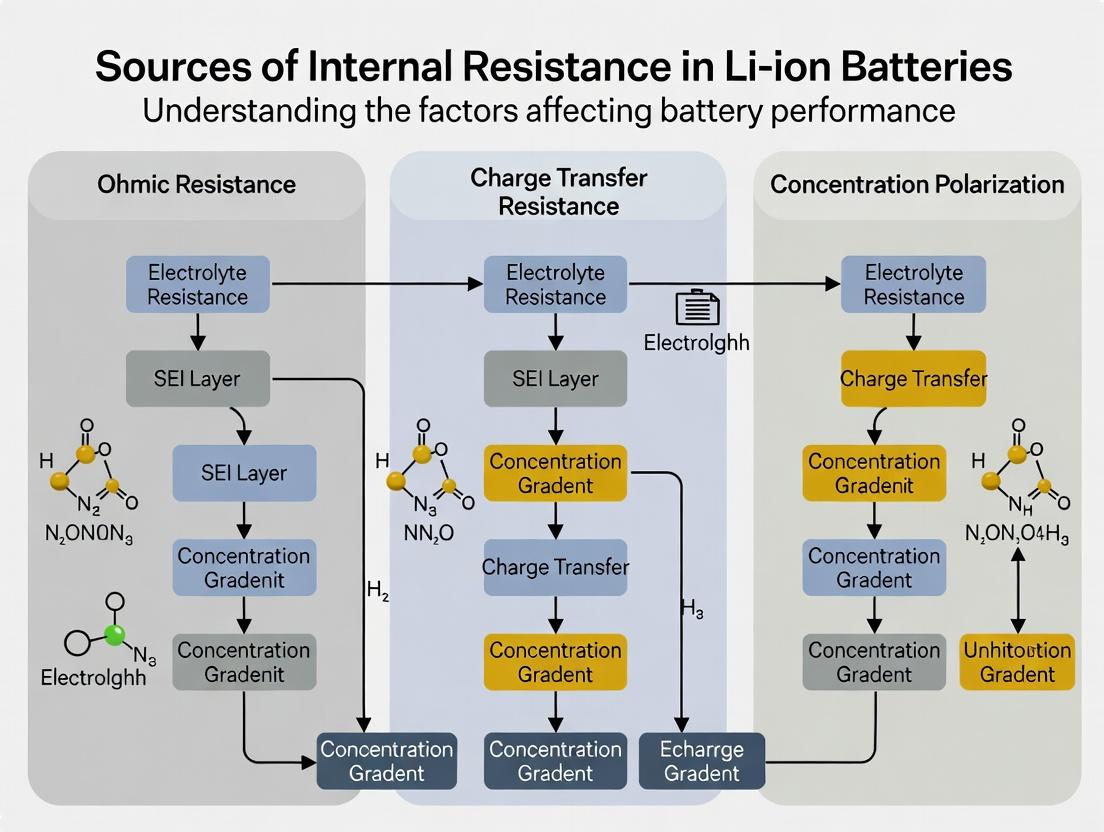
This article provides a detailed, systematic examination of the fundamental sources of internal resistance (IR) in Li-ion batteries, tailored for researchers and development professionals.
Decoding Internal Resistance: A Comprehensive Analysis of Sources and Measurement in Li-ion Batteries for Advanced Research
Abstract
This article provides a detailed, systematic examination of the fundamental sources of internal resistance (IR) in Li-ion batteries, tailored for researchers and development professionals. It explores the core physicochemical origins of ohmic, charge-transfer, and diffusion resistances across cell components. The content details state-of-the-art electrochemical techniques (EIS, DC-IR) for accurate IR quantification, analyzes failure modes and material/design strategies for resistance mitigation, and offers a critical comparison of measurement protocols and data interpretation. The synthesis provides actionable insights for optimizing battery performance, longevity, and reliability in biomedical and advanced technological applications.
The Physics and Chemistry Behind the Barrier: Deconstructing Fundamental Sources of Li-ion Battery Internal Resistance
Within the critical research on Sources of internal resistance in Li-ion batteries, a precise and operational definition of its components is paramount. Internal resistance (IR) is not a singular, static parameter but a composite of distinct physical and electrochemical phenomena that evolve with battery state, age, and operating conditions. This whitepaper deconstructs IR into its core concepts—Ohmic, Polarization, and Total Resistance—providing researchers with the conceptual framework and experimental toolkit necessary to isolate, quantify, and interrogate each source. This dissection is essential for diagnosing performance limitations, guiding material development (e.g., for electrodes and electrolytes), and predicting battery lifespan.
Core Resistance Concepts: Definitions and Origins
- Ohmic Resistance (RΩ): The purely resistive component arising from the ionic resistance of the electrolyte and separator, and the electronic resistance of electrodes, current collectors, and terminals. It obeys Ohm's Law instantaneously, is frequency-independent, and manifests primarily as an immediate voltage drop upon current application.
- Polarization Resistance (Rpol): The collective kinetic and mass transport limitations causing deviation from equilibrium potential. It is current- and time-dependent, encompassing:
- Charge Transfer Resistance (Rct): Resistance to Faradaic reactions at the electrode/electrolyte interface.
- Diffusion Resistance (Rdiff or Warburg): Resistance due to solid-state and liquid-phase diffusion of ions.
- Surface Layer Resistance (RSEI/RCEI): Resistance from Solid-Electrolyte Interphase (SEI) and Cathode-Electrolyte Interphase (CEI) films.
- Total Internal Resistance (Rtotal): The sum of all resistive components, measurable as the instantaneous voltage change divided by the applied current. Its value is protocol-dependent (e.g., pulse duration, state of charge - SOC, temperature).
Table 1: Quantitative Comparison of Internal Resistance Components in a Typical Commercial 18650 Li-ion Battery
| Resistance Component | Typical Value Range (mΩ) | Primary Governing Factors | Measurement Technique(s) |
|---|---|---|---|
| Ohmic (RΩ) | 10 - 30 | Electrolyte conductivity, separator porosity/thickness, Al/Cu foil thickness. | High-Frequency AC Impedance (≥1 kHz), Current Interrupt (initial ΔV). |
| Charge Transfer (Rct) | 5 - 50 (SOC/T-dependent) | Reaction kinetics, electrode active material, temperature. | Electrochemical Impedance Spectroscopy (EIS, mid-frequency arc). |
| Diffusion (Warburg) | Variable with √time | Li+ diffusion coeff. in active material & electrolyte, particle size. | EIS (low-frequency 45° line), Galvanostatic Intermittent Titration (GITT). |
| Surface Layer (RSEI) | 5 - 100 (increases with aging) | Electrolyte composition, cycling history, temperature. | EIS (semicircle at high-mid frequency, often overlaps with Rct). |
| Total (Rtotal, 10s pulse) | 30 - 150 | All of the above, plus current magnitude and pulse duration. | Hybrid Pulse Power Characterization (HPPC), DC Pulse Discharge. |
Key Experimental Protocols for Deconvolution
Protocol 1: Electrochemical Impedance Spectroscopy (EIS) for Component Separation
- Objective: To separate Ohmic, charge transfer, and diffusion resistances via their characteristic time constants.
- Methodology:
- Cell Stabilization: Hold test cell at a defined SOC and temperature until OCV stabilizes (±1 mV over 30 mins).
- Impedance Measurement: Apply a sinusoidal voltage/current perturbation (typically 5-10 mV amplitude) over a frequency range from 100 kHz to 10 mHz.
- Data Fitting: Fit the obtained Nyquist plot to an equivalent electrical circuit model (e.g., R(QR)(QR)W) using complex non-linear least squares (CNLS) algorithms. RΩ is the high-frequency real-axis intercept, Rct and RSEI are derived from diameters of respective semicircles, and diffusion parameters from the low-frequency Warburg element.
Protocol 2: Hybrid Pulse Power Characterization (HPPC) for Total & Pulse Resistance
- Objective: To measure total DC internal resistance under dynamic conditions relevant to application.
- Methodology:
- SOC Definition: Fully charge the cell, then discharge to a target SOC (e.g., 80%).
- Pulse Sequence: Apply a discharge current pulse (typically 1C or 5C rate) for 10 seconds, followed by a 40-second rest, then a regen charge pulse of lower magnitude (e.g., 0.75C) for 10 seconds.
- Resistance Calculation: Rtotal, discharge = (Vbefore pulse - Vat end of pulse) / Ipulse. This value includes both Ohmic and polarization contributions for that pulse duration.
Visualization of Concepts and Methods
Diagram 1: Internal Resistance Components & Measurement Techniques
Diagram 2: EIS Workflow for Resistance Deconvolution
The Scientist's Toolkit: Essential Research Reagents & Materials
Table 2: Key Research Reagent Solutions for Li-ion Internal Resistance Studies
| Item | Function & Relevance to Internal Resistance Research |
|---|---|
| Reference Electrode (e.g., Li-metal foil) | Enables half-cell or 3-electrode cell construction to isolate anode and cathode contributions to total polarization. |
| Electrolyte Salts (LiPF6, LiFSI) | Primary source of Li+ ions. Concentration and choice of anion directly impact ionic conductivity (Ohmic R) and SEI stability (RSEI). |
| Solvent Blends (EC/DMC, EC/EMC) | Determine electrolyte viscosity, dielectric constant, and operational temperature window, affecting both RΩ and Rct. |
| SEI Formation Additives (FEC, VC) | Form stable, low-resistance interphases on anode surfaces, critically controlling the evolution of RSEI during cycling. |
| Conductive Binders (e.g., CMC/SBR, PAA) | Influence electronic wiring within composite electrodes, affecting electronic Ohmic losses and active material utilization. |
| Ionic Liquid Additives | Used as co-solvents to enhance thermal stability and modify interfacial charge transfer kinetics (Rct). |
| Single Crystal LiNixMnyCozO2 (NMC) | Advanced cathode material with reduced grain boundaries, offering a model system to study intrinsic charge transfer and diffusion resistance with fewer microstructural defects. |
Within the broader investigation of internal resistance sources in Li-ion batteries, the electrolyte and the Solid Electrolyte Interphase (SEI) constitute a critical, dynamic subsystem. Their contributions to polarization and cell impedance are multifaceted, spanning bulk ionic conduction, interfacial charge transfer kinetics, and the resistive nature of passivation layers. This whitepaper provides a technical dissection of these contributions, focusing on quantitative metrics, experimental methodologies, and essential research tools for deconvolution of their individual impacts on overall cell resistance.
Core Mechanisms & Quantitative Benchmarks
Bulk Electrolyte Ionic Conductivity
Ionic conductivity (σ) is the fundamental property dictating bulk electrolyte resistance. It is governed by the concentration (c), charge (z), and mobility (µ) of ionic species: σ = Σ ci * |zi| * F * µ_i. Optimal conductivity balances high Li⁺ transference number (tLi⁺) with sufficient dissociation and low viscosity.
Table 1: Benchmark Ionic Conductivity of Common Electrolyte Systems
| Electrolyte System | Composition (Typical) | Conductivity @ 25°C (mS/cm) | Dominant Charge Carrier(s) | Primary Limitation |
|---|---|---|---|---|
| Conventional Carbonate | 1M LiPF₆ in EC:DMC (1:1 vol) | ~10-12 | Li⁺, PF₆⁻ | Thermal/chemical stability |
| Concentrated Electrolyte | 4M LiFSI in DME | ~8-10 | Anion-rich clusters, Li⁺ | Viscosity, cost |
| Solid Polymer | PEO-LiTFSI (EO:Li=20:1) | 0.01-0.1 @ 60°C | Li⁺ (coupled to polymer segmental motion) | Low room-temp conductivity |
| Inorganic Ceramic | Li₁₀GeP₂S₁₂ (LGPS) | ~10-40 | Li⁺ (single ion conductor) | Anode interfacial instability |
Li⁺ Transport Number (Transference Number)
The Li⁺ transference number (tLi⁺) defines the fraction of current carried by Li⁺ ions. A low tLi⁺ leads to concentration polarization and salt depletion/gradient at high currents, a significant source of internal resistance.
Table 2: Experimental tLi⁺ Values for Select Electrolytes
| Electrolyte | Method | tLi⁺ (Reported) | Temperature | Reference Technique | ||
|---|---|---|---|---|---|---|
| 1M LiPF₆ in EC:EMC | Bruce-Vincent (DC Polarization + EIS) | 0.2 - 0.3 | 25°C | Symmetric Li | Li cell | |
| 1M LiTFSI in Pyr₁₃FSI Ionic Liquid | Pulsed Field Gradient NMR | 0.4 - 0.5 | 25°C | Direct ion mobility measurement | ||
| PEO₂₀LiTFSI | Bruce-Vincent (with concentration correction) | ~0.2 | 60°C | Potentiostatic polarization |
SEI Growth & Its Resistive Contribution
The SEI is a composite, ionically conductive but electronically insulating layer. Its growth, both during formation cycling and throughout cell life, contributes a resistive overpotential. The effective ionic conductivity of the SEI (σ_SEI) is orders of magnitude lower than the bulk electrolyte, typically ranging from 10⁻⁶ to 10⁻⁸ S/cm. Its growth often follows a mixed diffusion-limited kinetics, described by models accounting for both solvent diffusion and electron tunneling.
Experimental Protocols for Deconvolution
Protocol: Electrochemical Impedance Spectroscopy (EIS) for SEI Resistance
Objective: Quantify the resistance of the SEI layer (RSEI) and charge transfer resistance (Rct) separately from bulk electrolyte resistance (R_Ω).
- Cell Setup: Construct a symmetric Li||Li or Li||Cu coin cell, or a half-cell with a well-defined working electrode (e.g., graphite).
- SEI Formation: Cycle the cell 1-5 times at C/10 to form a stable SEI.
- EIS Measurement: Apply a sinusoidal voltage perturbation (5-10 mV amplitude) over a frequency range from 1 MHz to 10 mHz at the open-circuit potential.
- Data Fitting: Use an equivalent circuit model. A common model is: RΩ + (RSEI // CPESEI) + (Rct // CPEdl) + W (Warburg element). Fit the spectrum using non-linear least squares software (e.g., ZView, EC-Lab). RSEI is typically identified in the mid-frequency semicircle.
Protocol: Determination of Li⁺ Transference Number (tLi⁺)
Method: Bruce-Vincent Method with EIS Correction (Potentiostatic Polarization)
- Cell Assembly: Construct a symmetric Li||Li cell with the electrolyte of interest.
- Initial Impedance: Measure the initial interfacial resistance (R_i⁰) via EIS.
- DC Polarization: Apply a small constant potential step (ΔV = 10-30 mV) and monitor the current until a steady-state current (I_ss) is reached (typically several hours).
- Final Impedance: Immediately after polarization, measure the final interfacial resistance (R_i^ss).
- Calculation: Use the equation accounting for concentration polarization: tLi⁺ = [Iss (ΔV - I₀ Ri⁰)] / [I₀ (ΔV - Iss Ri^ss)] where I₀ is the initial current.
Protocol: In Situ Monitoring of SEI Growth via Quartz Crystal Microbalance (QCM)
Objective: Correlate SEI mass deposition with electrochemical data.
- Sensor Preparation: Coat an Au-coated QCM sensor with a thin film of the active material (e.g., evaporated graphite).
- Electrochemical-QCM Setup: Integrate the sensor as the working electrode in a custom cell filled with electrolyte. Connect to both an electrochemical workstation and a QCM impedance analyzer.
- Simultaneous Measurement: Perform cyclic voltammetry or galvanostatic cycling while continuously monitoring the resonance frequency shift (Δf).
- Data Analysis: Use the Sauerbrey equation (Δm = -C * Δf, where C is the mass sensitivity constant) to calculate mass change per area. Correlate mass jumps with specific reduction peaks to identify SEI-forming reactions.
The Scientist's Toolkit: Key Research Reagents & Materials
Table 3: Essential Materials for Electrolyte/SEI Resistance Studies
| Material / Reagent | Function & Rationale |
|---|---|
| Lithium Bis(trifluoromethanesulfonyl)imide (LiTFSI) | Thermally stable salt with high solubility; used in polymer and ionic liquid electrolytes for fundamental transport studies. |
| Ethylene Carbonate (EC) & Fluoroethylene Carbonate (FEC) | EC is essential for graphite anode SEI formation. FEC is a common additive that promotes a more stable, LiF-rich SEI, lowering interfacial resistance. |
| Lithium Hexafluorophosphate (LiPF₆) | Industry standard salt; studies require control of moisture (<20 ppm) as hydrolysis products (HF, LiF) critically affect SEI composition and resistance. |
| Reference Electrolyte (e.g., 1M LiPF₆ in EC:DMC) | Benchmark for comparative studies of ionic conductivity and interfacial stability. |
| Microporous Separator (Celgard 2325) | Standard separator for liquid electrolyte cells; its porosity and tortuosity factor are needed for accurate modeling of bulk ion transport. |
| Sodium Polysulfide (Na₂Sₓ) or Lithium Nitrate (LiNO₃) | Additives for Li-S batteries to modify SEI/CEI and mitigate polysulfide shuttle, a major source of resistance growth. |
| Deuterated Solvents (e.g., d⁴-EC, d⁶-DMC) | Essential for in-situ NMR studies to elucidate Li⁺ solvation structure and decomposition pathways without interfering proton signals. |
Visualizing Relationships & Workflows
Title: Hierarchy of Electrolyte & SEI Resistance Sources
Title: Experimental Workflow for Li+ Transference Number Measurement
Title: SEI Structure and Dynamic Growth at the Anode Interface
Within the broader thesis on sources of internal resistance in Li-ion batteries, electrode-level resistances constitute a critical, multi-faceted component. This technical guide provides an in-depth analysis of three core contributors at the electrode scale: the charge transfer and solid-state diffusion kinetics of the active material, the electronic and ionic conductivity of the binder network, and the physical/electrical contact resistance at particle-to-particle interfaces. Understanding and quantifying these resistances is paramount for advancing high-power, long-life energy storage systems, with direct implications for research in next-generation battery materials and systems.
The internal resistance (impedance) of a Li-ion battery is a superposition of resistances originating from various physical and electrochemical processes across multiple length scales. Electrode-level phenomena are central, as they govern the local kinetics and transport that directly impact cell-level performance metrics such as power density, rate capability, and efficiency. This guide deconstructs the electrode into its three primary resistive elements: the active material particles, the polymeric binder matrix, and the inter-particle contacts, each with distinct governing mechanisms and characterization methodologies.
Active Material Kinetics
The kinetic limitations within the active material particles arise from two sequential processes: charge transfer at the electrode/electrolyte interface and solid-state diffusion within the particle bulk.
Charge Transfer Resistance (Rct)
This is the resistance associated with the electrochemical reaction of lithium ion insertion/de-insertion at the particle surface. It is governed by the Butler-Volmer equation and is highly sensitive to temperature, electrolyte composition, and the state of charge (SOC).
Solid-State Diffusion Resistance (Rdiff)
After surface charge transfer, lithium must diffuse through the solid crystal lattice of the active material. This Warburg-type resistance dominates at low frequencies and is a function of particle size, morphology, and the chemical diffusion coefficient of Li+ in the host material.
Table 1: Typical Kinetic Parameters for Common Active Materials
| Active Material | Average Charge Transfer Resistance (Rct) [Ω cm²] | Chemical Diffusion Coefficient (DLi) [cm²/s] | Dominant Kinetic Limitation |
|---|---|---|---|
| Graphite (C6) | 20 - 60 | 10⁻¹⁰ – 10⁻¹² | Mixed (Rct & Rdiff) |
| Lithium Cobalt Oxide (LCO) | 50 - 150 | 10⁻⁹ – 10⁻¹¹ | Charge Transfer |
| Lithium Iron Phosphate (LFP) | 1 - 20 | 10⁻¹⁴ – 10⁻¹⁶ | Solid-State Diffusion |
| Lithium Nickel Manganese Cobalt Oxide (NMC622) | 30 - 100 | 10⁻¹⁰ – 10⁻¹² | Charge Transfer |
| Lithium Titanate (LTO) | 5 - 15 | 10⁻⁹ – 10⁻¹² | Charge Transfer |
Note: Values are highly dependent on electrode formulation, electrolyte, and testing conditions.
Experimental Protocol: Electrochemical Impedance Spectroscopy (EIS) for Kinetic Analysis
Objective: To deconvolute Rct and Rdiff from the total electrode impedance. Method:
- Cell Assembly: Assymetric coin cells (Li metal as counter/reference electrode) or symmetric cells with identical working electrodes are prepared with the electrode of interest.
- Stabilization: The cell is cycled 3-5 times at a low C-rate (e.g., C/10) to form a stable SEI.
- Potential Hold: The cell is held at a specific SOC (e.g., 50%) for 4+ hours to reach equilibrium.
- EIS Measurement: Using a potentiostat, a sinusoidal voltage perturbation (typically 5-10 mV amplitude) is applied over a frequency range from 100 kHz to 10 mHz.
- Data Fitting: The resulting Nyquist plot is fitted to an equivalent circuit model (e.g., R(CR)(RW)) to extract Rct (semicircle) and parameters related to Rdiff (low-frequency Warburg tail).
Title: EIS Workflow for Electrode Kinetics
Binder Network Resistance
The binder (e.g., PVDF, CMC, SBR) is crucial for mechanical integrity but introduces resistive pathways for both ions and electrons.
Ionic Resistance
The binder can block electrolyte penetration and create tortuous ion transport paths within the porous electrode, contributing to ionic resistance.
Electronic Resistance
Most traditional binders are electronic insulators. Conductive additives (e.g., carbon black, CNTs) are required to establish a percolating electronic network. The distribution and contact quality of these additives with the active material are critical.
Table 2: Properties and Resistive Impact of Common Binder Systems
| Binder System | Primary Function | Ionic Conductivity | Electronic Conductivity (Needs Additive) | Typical Loading (wt%) |
|---|---|---|---|---|
| Polyvinylidene Fluoride (PVDF) | Adhesion, Electrochemical Stability | Low | None (Insulator) | 2 - 5 |
| Carboxymethyl Cellulose (CMC) | Aqueous Processing, Dispersion | Moderate (Hydrophilic) | None (Insulator) | 1 - 3 |
| Styrene-Butadiene Rubber (SBR) | Flexibility, Adhesion | Low | None (Insulator) | 1 - 3 |
| Conductive Polymer (e.g., PEDOT:PSS) | Adhesion + Conduction | Moderate | Intrinsically Conductive (10⁻¹ - 10² S/cm) | 1 - 5 |
| PVDF + Carbon Black Composite | Adhesion + Conduction | Low | Yes (Percolation Network) | 2 - 4 (Binder) |
Experimental Protocol: 4-Point Probe Electronic Conductivity Measurement
Objective: To measure the in-plane electronic conductivity of a freestanding electrode film. Method:
- Film Preparation: A slurry of active material, binder, and conductive additive is cast onto a non-adhesive substrate (e.g., glass) and dried to form a freestanding film.
- Sample Cutting: The film is cut into a rectangular bar of known dimensions (length L, width W, thickness T).
- Probe Alignment: A linear four-point probe head is placed on the film surface. A constant DC current (I) is applied through the outer two probes.
- Voltage Measurement: The voltage drop (V) is measured between the inner two probes.
- Calculation: The sheet resistance Rs = (V/I) * k (geometric correction factor). The bulk conductivity σ = 1 / (Rs * T).
Particle-to-Particle Contact Resistance
This resistance occurs at the interfaces between active material particles (and between particles and conductive additives). It is highly sensitive to calendaring pressure, particle shape, and surface chemistry.
Nature of Contact Resistance
It comprises a constriction resistance (due to limited actual contact area) and a possible tunneling resistance (if a thin insulating layer, like oxide or binder, exists between particles).
Influence of Electrode Manufacturing
Calendaring reduces contact resistance by increasing the contact area but can also break particles and reduce porosity, affecting ion transport.
Table 3: Quantitative Impact of Calendaring on Contact Resistance
| Electrode Material | Porosity Before (%) | Porosity After (%) | Calendaring Pressure (MPa) | Estimated Contact Resistance Reduction |
|---|---|---|---|---|
| Graphite Anode | 45 | 30 | 50 | ~40% |
| Graphite Anode | 45 | 20 | 100 | ~65% |
| NMC Cathode | 40 | 25 | 50 | ~35% |
| NMC Cathode | 40 | 15 | 100 | ~55% |
Experimental Protocol: Pressurized Impedance Measurement
Objective: To directly correlate applied pressure with particle-to-particle contact resistance. Method:
- Cell Design: A custom test cell is used where a controlled and measurable uniaxial pressure can be applied to the electrode stack.
- Baseline Measurement: EIS is performed on the cell at a minimal, standardized pressure (e.g., 0.5 MPa).
- Incremental Pressurization: The pressure is increased in defined steps (e.g., 10, 25, 50, 100 MPa). At each step, the cell is allowed to relax for 15 minutes, and EIS is measured.
- Analysis: The high-frequency intercept of the Nyquist plot (often associated with ohmic resistance, RΩ, which includes contact contributions) is plotted versus applied pressure. The trend quantifies the pressure-dependence of contact resistance.
Title: Hierarchy of Electrode Resistance Sources
The Scientist's Toolkit: Key Research Reagent Solutions
Table 4: Essential Materials for Electrode Resistance Research
| Item / Reagent | Function / Role in Research | Key Consideration |
|---|---|---|
| Polyvinylidene Fluoride (PVDF) | Standard polymeric binder for NMP-based slurries. Provides adhesion. | Requires toxic solvent (NMP); insulating. |
| Carboxymethyl Cellulose (CMC) / SBR | Aqueous binder system for anodes. CMC disperses, SBR binds. | Eco-friendly; pH control critical. |
| Carbon Black (Super P, C65) | Standard conductive additive. Forms percolating electronic network. | Dispersion quality is paramount. |
| Carbon Nanotubes (CNTs) | 1D conductive additive. Lower percolation threshold than carbon black. | Can form bundles; functionalization aids dispersion. |
| Ethylene Carbonate / Diethyl Carbonate (EC/DEC) | Standard liquid electrolyte solvent blend. Medium for ion transport. | LiPF₶ salt concentration affects conductivity. |
| Lithium Hexafluorophosphate (LiPF₆) | Standard conducting salt in Li-ion electrolytes. Source of Li⁺ ions. | Hygroscopic; requires dry room handling. |
| Poly(3,4-ethylenedioxythiophene):Poly(styrene sulfonate) (PEDOT:PSS) | Intrinsically conductive polymer binder. Can replace insulator binder + carbon. | Conductivity varies with formulation and post-treatment. |
| Custom Pressure Cell Fixture | Applies calibrated pressure to electrode during measurement. | Essential for studying contact resistance. |
| Electrochemical Impedance Spectrometer (Potentiostat) | Measures impedance across frequency spectrum. Primary tool for kinetic analysis. | Must have low-current and low-frequency capability. |
Within the broader research on sources of internal resistance (IR) in Li-ion batteries, the contribution from current collectors (CCs) and tab design is significant yet frequently undervalued. While active materials and electrolyte chemistry dominate research focus, the metallic components responsible for electron transport introduce substantial ohmic losses that degrade power density, efficiency, and thermal management. This whitepaper provides an in-depth technical analysis of these components as critical sources of IR.
Fundamentals of Ohmic Loss in Current Collectors
Ohmic loss (P_loss = I²R) in CCs arises from their inherent electrical resistivity, geometry, and interfacial contacts. Aluminum (cathode) and copper (anode) foils are standard, but their thin-film design (typically 6-20 µm) presents a trade-off between resistive loss, mass, and mechanical integrity.
Table 1: Intrinsic Properties of Standard Current Collector Materials
| Material | Density (g/cm³) | Electrical Resistivity (µΩ·cm at 20°C) | Typical Thickness (µm) | Areal Mass (mg/cm²) |
|---|---|---|---|---|
| Copper (Cu) | 8.96 | 1.68 | 6-10 | 5.38-8.96 |
| Aluminum (Al) | 2.70 | 2.65 | 10-20 | 2.70-5.40 |
| Aluminum Alloy (AA1100) | 2.71 | 2.90 | 15-20 | 4.07-5.42 |
| Coated Cu (Carbon) | ~8.96 | ~1.68 (bulk) | 8+coating | >5.38 |
Tab Design and Its Impact on Current Distribution
The tab—the conductive bridge between the CC jellyroll/stack and the external terminal—is a major bottleneck. Poor design creates non-uniform current distribution, leading to localized heating, accelerated degradation, and increased effective IR.
Key Design Parameters:
- Tab Location: Single/multiple tabs, opposing vs. unilateral.
- Tab Geometry: Size, shape (e.g., straight, angled, winged).
- Tab Material & Joining: Welding (ultrasonic, laser) or mechanical clamping integrity.
Table 2: Quantitative Impact of Tab Design on Cell Resistance
| Tab Configuration | Relative Increase in AC-IR (1kHz) (%) | Current Density Hotspot Factor | Preferred Application |
|---|---|---|---|
| Single Tab (Unilateral) | Baseline (0%) | 3.5 - 5.0 | Low-power, consumer cylindrical |
| Dual Tabs (Opposing) | -15 to -25 | 1.8 - 2.2 | High-power pouch/ prismatic |
| Multi-Tab (≥4, Distributed) | -30 to -40 | 1.2 - 1.5 | EV/Stationary storage modules |
| Full Tab (Edge Collection) | -40 to -50 | ~1.1 | Ultra-high power cells |
Experimental Protocols for Characterization
Protocol: Four-Point Probe Measurement of Current Collector Sheet Resistance
Objective: Accurately measure the sheet resistance (R_s) of metallic foils independent of contact resistance. Materials: Four-point probe head, precision current source, nanovoltmeter, micro-positioning stage, sample foil (≥ 2cm x 2cm). Procedure:
- Place foil on flat, insulating surface.
- Lower four collinear probes onto sample with equal spacing (s).
- Inject a known DC current (I) between the outer two probes.
- Measure the voltage drop (V) between the inner two probes.
- Calculate sheet resistance: R_s = (π/ln2) * (V/I) for thin samples >> probe spacing.
- Repeat across 10 locations for uniformity assessment.
Protocol: DC Polarization for Total Ohmic Loss Measurement
Objective: Isolate the pure ohmic resistance component of a full cell or CC-subassembly. Materials: Battery cycler with high sampling rate, climate chamber, test cell. Procedure:
- Condition cell at 50% State of Charge (SOC).
- Apply a short, high-current pulse (e.g., 3C rate for 10 seconds).
- Record the instantaneous voltage drop (ΔV) at the moment of current application (t=0⁺).
- Calculate ohmic resistance: R_Ω = ΔV / I.
- This R_Ω includes contributions from CCs, tabs, electrolytes, and interfaces.
Protocol: Lock-in Thermography for Current Distribution Mapping
Objective: Visualize spatial inhomogeneity in current flow due to tab design. Materials: Infrared camera, lock-in amplifier, power amplifier, cell with transparent window. Procedure:
- Apply a sinusoidal current excitation to the cell at frequency f (e.g., 0.1-10 Hz).
- Synchronize IR camera recording with the lock-in amplifier reference signal.
- Measure the in-phase component of the thermal response, which correlates with local Joule heating (I²R).
- Process data to generate a 2D map of current density distribution across the CC surface.
Diagram 1: DC Polarization Resistance Measurement Workflow
Advanced Materials and Design Strategies
Lightweight CCs: Use of perforated or patterned foils to reduce mass while maintaining conductive pathways. Surface-Treated CCs: Coatings (carbon, conductive polymer) to enhance adhesion and reduce interfacial resistance with the electrode slurry. Composite CCs: Ultra-thin metal layers on polymer substrates (e.g., Al-PET-Al) for flexible cells. Tabless Designs: Implementations like Tesla's 'Tabless' (actually a distributed tab wound into a spiral) to minimize current path length.
Table 3: Emerging Current Collector Technologies & Performance
| Technology | Description | Target IR Reduction vs. Std. Foil | Key Challenge |
|---|---|---|---|
| Carbon-Coated Al | Nanocarbon layer on Al foil | 20-30% (at interface) | Coating cost & uniformity |
| Metal Mesh (Cu, Al) | Open conductive grid | 15-25% (weight-normalized) | Slurry infiltration & handling |
| Graphene-Augmented CC | Graphene layer as current spreader | Up to 40% (theoretical) | Scalable deposition |
| Ultrathin Cu (<6µm) | Rolled electrodeposited Cu | 10-15% (by mass) | Mechanical fragility |
The Scientist's Toolkit: Key Research Reagents & Materials
Table 4: Essential Materials for Current Collector & Tab Research
| Item | Function/Application | Key Consideration |
|---|---|---|
| High-Purity Rolled Annealed (RA) Cu Foil | Baseline anode CC material. Low surface roughness reduces IR. | Specify oxygen-free grade for consistent resistivity. |
| Battery-Grade Al Foil (AA1xxx series) | Baseline cathode CC material. | Ensure consistent temper (soft annealed) for coating. |
| Ultrasonic Welder (20-40 kHz) | Joining multiple tabs or CC layers. Creates solid-state bond. | Optimize amplitude, force, and energy for foil thickness. |
| Conductive Silver Epoxy | Creating low-resistance electrical contacts for testing. | Use two-part, fast-curing epoxy for reliable connections. |
| Micro-Ruler & Calipers | Precise measurement of tab geometry and placement. | Measurement accuracy critical for modeling inputs. |
| Electrode Slurry (Custom) | For coating test CCs; adhesion affects interfacial IR. | Binder choice (PVDF vs. CMC/SBR) impacts contact. |
| Infrared (IR) Thermal Camera | Mapping temperature distribution during cycling. | High frame rate needed for pulse experiments. |
| Potentiostat/Galvanostat with EIS | Electrochemical Impedance Spectroscopy (EIS) for deconvoluting IR components. | Use frequencies from 100 kHz to 0.1 Hz. |
Diagram 2: Internal Resistance Components Hierarchy
Current collectors and tab design are not passive components but active, defining elements in the overall internal resistance profile of a Li-ion battery. Optimizing their material properties, geometry, and integration through precise experimental characterization can yield significant gains in power performance and energy efficiency, complementing advances in electrochemistry. A holistic research approach to IR must explicitly include these "overlooked contributors" to achieve next-generation battery performance targets.
This whitepaper, situated within a broader thesis on sources of internal resistance in Li-ion batteries, elucidates the fundamental and interdependent roles of electrochemical kinetics and ionic conductivity as functions of temperature. Internal resistance (IR) is a critical performance and safety metric, governing power capability, efficiency, and thermal management. Its temperature dependence is not a singular phenomenon but a complex convolution of charge-transfer kinetics at the electrode-electrolyte interfaces and the transport properties of ions within the electrolyte and active materials. This guide provides a technical dissection of these relationships, methodologies for their quantification, and their collective impact on overall cell impedance.
Theoretical Framework: Components of Internal Resistance
The total internal resistance (Rtotal) of a Li-ion cell is a sum of several temperature-sensitive contributions:
- Ohmic Resistance (RΩ): Includes electronic resistance of current collectors, electrodes, and leads, and ionic resistance of the electrolyte and separator. Ionic conductivity (σ) exhibits strong Arrhenius-type temperature dependence.
- Charge-Transfer Resistance (Rct): Arises from the kinetics of the Faradaic reaction at the electrode/electrolyte interface. Governed by the Butler-Volmer equation, its rate constant has an exponential relationship with temperature.
- Solid-Electrolyte Interphase (SEI) Resistance (RSEI): The resistance of the passivation layer on anode materials. Its ionic conductivity and stability are highly temperature-dependent.
- Mass Transport/Diffusion Resistance (Rdiff): Related to the diffusion of Li+ within the electrolyte and active material particles. Diffusivity (D) follows an Arrhenius relationship.
The interplay is summarized in the logical pathway below.
Diagram 1: Temperature Dependence of Internal Resistance Components
Quantitative Data on Temperature Dependence
Recent studies (2023-2024) quantify the impact of temperature on key parameters. The data below is synthesized from peer-reviewed literature on NMC622/Gr pouch cells and typical liquid carbonate electrolytes.
Table 1: Arrhenius Activation Energies for Key Processes
| Process | Material/Interface | Typical Activation Energy (Ea) | Temperature Range | Key Impact on IR |
|---|---|---|---|---|
| Li+ Diffusion in Bulk Electrolyte | 1M LiPF6 in EC:EMC | 0.15 - 0.18 eV | -20°C to 60°C | Dominates RΩ at low T |
| Charge Transfer at Cathode | NMC622/Electrolyte | 0.55 - 0.70 eV | 0°C to 40°C | Dominates Rct at mid T |
| Charge Transfer at Anode | Graphite/Electrolyte | 0.60 - 0.75 eV | 0°C to 40°C | Major component of Rct |
| Li+ Diffusion in SEI | Graphite SEI Layer | 0.60 - 0.80 eV | < 10°C | Governs low-T RSEI |
| SEI Degradation/Reformation | Graphite SEI | > 0.80 eV | > 50°C | Causes irreversible RSEI rise |
Table 2: Percentage Increase in Total Internal Resistance Relative to 25°C
| Temperature | IR Increase (%) (1C Pulse, 50% SOC) | Dominant Resistance Contributor |
|---|---|---|
| -20°C | 250% - 400% | RΩ (Electrolyte Conductivity) |
| 0°C | 80% - 150% | Rct & RΩ |
| 10°C | 30% - 60% | Rct |
| 40°C | -10% to -20% | All components reduced |
| 60°C | -25% to -40% (Initial) | All components reduced (but degradation accelerates) |
Experimental Protocols for Deconvolution
Electrochemical Impedance Spectroscopy (EIS) with Temperature Cycling
Objective: To separate RΩ, Rct, and RSEI and determine their individual activation energies. Protocol:
- Cell Conditioning: Cycle cell (e.g., NMC/Graphite pouch) 5 times at C/10 at 25°C to form stable SEI.
- Thermostating: Place cell in an environmental chamber with ±0.5°C stability.
- State of Charge (SOC) Control: Bring cell to specific SOC (e.g., 50%) using a low constant current (C/20).
- EIS Measurement Sequence: a. Stabilize at target temperature (T1, e.g., -10°C) for 2 hours. b. Apply a 10 mV RMS sinusoidal perturbation from 100 kHz to 10 mHz. c. Record Nyquist plot. d. Increment temperature (e.g., in 10°C steps from -10°C to 60°C). Repeat steps a-c.
- Data Analysis: Fit spectra with equivalent circuit model (e.g., R(QR)(QR)) to extract RΩ, RSEI, Rct.
- Activation Energy: Plot ln(1/R) vs. 1/T for each component; slope = -Ea/R.
Diagram 2: EIS Temperature Dependence Experimental Workflow
DC Internal Resistance (DCIR) Pulse Measurement
Objective: To measure total apparent IR under realistic load conditions as a function of temperature and SOC. Protocol:
- Thermal Equilibration: Condition cell at target temperature for 4 hours.
- SOC Set-Point: Use a potentiostatic or very slow galvanostatic step to a defined SOC.
- Pulse Application: Apply a short, high-current pulse (e.g., 5C for 10 seconds).
- Voltage Response Measurement: Record voltage drop (ΔV) at the instant of pulse application (primarily RΩ) and the quasi-steady-state slope (reflecting Rct+Rdiff).
- Calculation: DCIR = ΔV / I. Perform at multiple temperatures (-30°C to 60°C) and SOCs (10%, 50%, 90%).
The Scientist's Toolkit: Research Reagent Solutions
Table 3: Essential Materials for Temperature-Dependent IR Research
| Item | Function & Relevance to Temperature Studies |
|---|---|
| High-Precision Environmental Chamber | Provides stable, uniform temperature control (±0.1°C) for kinetic and transport studies. Critical for Arrhenius analysis. |
| Electrochemical Impedance Analyzer | Measures complex impedance over wide frequency range to deconvolute individual resistance components. |
| Coin Cell or Pouch Cell Hardware | For constructing controlled test cells with minimal external resistance. |
| Lithium Hexafluorophosphate (LiPF6) | Standard conducting salt. Its dissociation constant and transport number are strongly T-dependent. |
| Ethylene Carbonate (EC) / Ethyl Methyl Carbonate (EMC) | Baseline electrolyte solvent system. Low-temperature conductivity is dictated by EC:EMC ratio and viscosity. |
| Reference Electrodes (e.g., Li-metal) | Enables separate monitoring of anode and cathode potentials, crucial for assigning Rct contributions. |
| Isothermal Microcalorimeter | Measures heat flow from cells. Coupled with IR data, it quantifies irreversible heat generation (I2R). |
| Solid-State NMR with Variable-T Probe | Probes local Li+ mobility and coordination environment within electrodes/SEI as a function of T. |
Quantifying the Invisible: Advanced Methodologies for Measuring and Analyzing Internal Resistance
Electrochemical Impedance Spectroscopy (EIS) is a fundamental technique for deconvoluting the sources of internal resistance in Li-ion batteries. This whitepaper provides an in-depth guide to interpreting Nyquist plots and constructing equivalent circuit models to isolate and quantify resistance contributions from charge transfer, solid-electrolyte interphase (SEI), and diffusion processes. Framed within advanced battery research, this guide details protocols and analytical methods critical for researchers in material science and energy storage development.
The performance, longevity, and safety of Li-ion batteries are intrinsically linked to their internal resistance. This resistance is not a single entity but a sum of contributions from various physicochemical processes. EIS is a non-destructive, powerful technique that applies a small sinusoidal perturbation over a wide frequency range to probe these processes. By analyzing the impedance response, researchers can identify and quantify distinct sources of polarization loss, informing electrode design, electrolyte formulation, and state-of-health diagnostics.
Fundamental Principles of EIS
EIS measures the complex impedance Z(ω) = Z' + jZ'', where Z' is the real (resistive) component and Z'' is the imaginary (reactive) component, as a function of frequency (ω). A typical EIS experiment on a Li-ion half-cell (e.g., Li-metal vs. LiFePO₄) spans frequencies from millihertz (mHz) to megahertz (MHz), capturing processes from slow diffusion to fast electronic conduction.
Interpreting the Nyquist Plot for Li-Ion Batteries
The Nyquist plot (-Z'' vs. Z') is the primary visual tool. A classic spectrum for a Li-ion battery with a porous electrode features specific regions.
Nyquist Plot Feature Identification Workflow
- High-Frequency Intercept (RΩ): Represents the ohmic resistance from electrolyte ionic conductivity, separator, and cell geometry.
- High-to-Mid Frequency Semicircle(s): Often one or two depressed semicircles corresponding to the resistance and capacitance of the SEI layer (higher frequency) and the charge-transfer (CT) process at the electrode-electrolyte interface (lower frequency).
- Low-Frequency Warburg Tail (45° line): Signifies semi-infinite linear diffusion of Li-ions in the electrode material.
- Low-Frequency Region (near vertical line): Represents finite-length diffusion (Li-ion intercalation) or capacitive behavior.
Table 1: Characteristic Frequency Ranges and Corresponding Processes in Li-ion EIS
| Frequency Range | Typical Process | Physical Origin | Spectral Feature in Nyquist Plot |
|---|---|---|---|
| >100 kHz | Electronic conduction, inductance | Leads, wires, cell fixture | Inductive loop (negative Z'') |
| 10 kHz - 1 kHz | Ionic conduction, particle contact | Electrolyte, separator, pores | High-frequency intercept on Z' axis |
| 10 kHz - 100 Hz | Li⁺ migration through SEI | SEI layer resistance & capacitance | First depressed semicircle |
| 100 Hz - 1 Hz | Charge Transfer (CT) | Electron transfer at interface | Second depressed semicircle |
| 1 Hz - 0.01 Hz | Solid-state diffusion | Li-ion diffusion in active material | Warburg tail (45° slope) |
| <0.01 Hz | Intercalation capacitance, finite diffusion | Bulk storage, concentration limits | Near-vertical line |
An Equivalent Circuit Model (ECM) uses an assembly of passive electrical elements (resistors R, capacitors C, constant phase elements CPE, Warburg elements W) to physically represent the electrochemical system. Fitting the EIS data to an ECM quantifies each resistance component.
ECM Elements and Their Electrochemical Correlates
Experimental Protocol for EIS Measurement on Li-ion Cells
Objective: To acquire impedance data for quantifying internal resistance sources in a Li-ion coin cell (CR2032) under a defined state of charge (SOC).
Materials & Equipment: See "The Scientist's Toolkit" below. Procedure:
- Cell Preparation & Stabilization: Assemble a Li-ion half-cell (e.g., LiNi₀.₈Mn₀.₁Co₀.₁O₂ vs. Li-metal) in an Ar-filled glovebox. After assembly, rest the cell for 12 hours. Cycle the cell for 3 formation cycles at C/10.
- SOC Conditioning: Charge or discharge the cell to the desired SOC (e.g., 50% SOC) using a constant-current-constant-voltage (CCCV) protocol. Hold at the voltage cutoff until the current drops to C/50.
- Open Circuit Potential (OCP) Stabilization: Allow the cell to rest at open circuit for a minimum of 2 hours to ensure voltage stabilization (<1 mV change over 10 minutes).
- EIS Measurement Setup: Connect the cell to the potentiostat in a 2-electrode configuration. Set the temperature control to 25.0 ± 0.1 °C.
- Parameter Configuration: Apply a sinusoidal potential perturbation with an amplitude of 10 mV (RMS) over a frequency range from 1 MHz to 10 mHz. Log 10 points per frequency decade.
- Data Acquisition & Validation: Run the measurement. Validate data quality by ensuring linearity (checking that the impedance is independent of perturbation amplitude) and stability (running a second measurement to verify reproducibility).
- Post-Measurement: Fit the acquired data to a suitable ECM using non-linear least squares (NLLS) fitting software (e.g., ZView, EC-Lab).
The Scientist's Toolkit: Research Reagent Solutions
Table 2: Essential Materials for EIS Research on Li-ion Batteries
| Item | Function & Rationale |
|---|---|
| Potentiostat/Galvanostat with FRA | Core instrument for applying potential/current perturbation and measuring the phase-sensitive response. Frequency Response Analyzer (FRA) module is essential. |
| Environmental Chamber | Provides precise temperature control (±0.1°C), as kinetics and resistances are highly temperature-dependent. |
| Electrochemical Cell (e.g., coin cell fixture) | A reproducible, low-inductance cell fixture for 2 or 3-electrode measurements. Must be compatible with glovebox assembly. |
| High-Purity Electrolyte (e.g., 1M LiPF₆ in EC:EMC) | Standard electrolyte with known conductivity. Must be anhydrous (<20 ppm H₂O) to prevent side reactions that distort EIS. |
| Reference Electrode (e.g., Li-metal ring) | For 3-electrode setups, essential for isolating anode and cathode impedance. |
| CPE (Constant Phase Element) Fitting Software | Specialized software (e.g., ZView, EC-Lab, RelaxIS) for robust NLLS fitting of complex ECMs with distributed elements. |
| Standard Resistor/Capacitor Calibration Kit | For validating potentiostat accuracy and cable compensation before measurement. |
Data Analysis & Interpretation: A Case Study
Fitted parameters from a representative NMC532/Li half-cell at 50% SOC and 25°C.
Table 3: Fitted Equivalent Circuit Parameters for NMC532 Cathode
| Circuit Element | Fitted Value (Ohms or Derived) | Electrochemical Process | Contribution to Total Polarization |
|---|---|---|---|
| RΩ | 2.1 Ω | Ohmic (Electrolyte/Contact) | 12% |
| RSEI | 5.3 Ω | Li⁺ conduction through cathode electrolyte interphase (CEI) | 30% |
| RCT | 8.9 Ω | Charge transfer at NMC surface | 51% |
| Ws (σ) | 15.7 Ω s⁻⁰·⁵ | Solid-state diffusion in NMC particles | (Kinetic limitation at high C-rate) |
| CPEDL-T | 1.7e-5 F s^(α-1) | Double-layer capacitance | - |
| CPEDL-α | 0.89 | Surface heterogeneity index | - |
Interpretation: In this example, the charge-transfer resistance (RCT) is the dominant polarization source at 50% SOC, suggesting that interfacial kinetics, rather than bulk electrolyte conduction or SEI, are the primary limitation. The Warburg coefficient σ provides a metric for solid-state diffusion, which becomes limiting at very low frequencies or high current rates.
Advanced Considerations and Pitfalls
- Linearity, Stability, and Causality (Kramers-Kronig): Always test for and validate these fundamental assumptions. Non-linearity can arise from large excitation amplitudes.
- Distribution of Relaxation Times (DRT): An emerging, model-free analysis method that can deconvolute overlapping time constants more effectively than traditional ECMs, revealing more detailed processes.
- In-Situ vs. Ex-Situ: In-situ EIS during cycling provides dynamic resistance evolution but is complicated by changing SOC and overpotentials.
- Temperature Dependence: Conducting EIS at multiple temperatures allows calculation of activation energies for RCT and RΩ, providing mechanistic insight.
Mastering EIS, from Nyquist plot interpretation to sophisticated ECM and DRT analysis, is indispensable for pinpointing the sources of internal resistance in Li-ion batteries. This deep dive provides the framework for researchers to design rigorous experiments, select appropriate models, and extract quantitative data on SEI growth, charge-transfer kinetics, and diffusion limitations. This knowledge directly fuels advancements in high-power batteries, fast-charging protocols, and longevity predictions, forming a critical pillar in the thesis of next-generation energy storage research.
Within the broader research thesis on the myriad sources of internal resistance in lithium-ion (Li-ion) batteries, accurate measurement and characterization techniques are paramount. DC Internal Resistance (DC-IR) measurement is a critical methodology for assessing the cumulative, multi-source voltage drop (Ohmic, charge transfer, and diffusion overpotentials) of a cell under load. This in-depth guide focuses on two core experimental techniques: the Pulse Power method and the standardized Hybrid Pulse Power Characterization (HPPC) test. These protocols enable researchers to quantify resistance values that directly correlate with performance limitations, power fade, thermal behavior, and state-of-health (SOH).
Core Techniques and Methodologies
Pulse Power Technique
This fundamental method measures DC-IR by applying a short, constant-current pulse to a cell at a specified State of Charge (SOC) and temperature.
Experimental Protocol:
- Cell Conditioning: The test cell is stabilized at a defined temperature (e.g., 25°C ± 0.5°C) in a thermal chamber.
- SOC Setting: The cell is charged or discharged to the target SOC (e.g., 50%) using a standard constant-current constant-voltage (CCCV) protocol, followed by a sufficient rest period (often 1-2 hours) to achieve equilibrium.
- Pulse Application: A high-precision battery cycler applies a discharge current pulse (
I_pulse) for a short duration (t_pulse, typically 10-30 seconds). The magnitude ofI_pulseis often defined by the C-rate (e.g., 1C, 5C). - Data Acquisition: Voltage is sampled at a high frequency (e.g., 10 Hz or higher). Key voltages are recorded: the immediate voltage drop at the start of the pulse (
V_0) and the voltage at the end of the pulse (V_t). - Calculation: DC-IR is calculated using Ohm's Law:
R_DC = (V_0 - V_t) / I_pulse. The value represents the total polarization resistance at that specific SOC, temperature, and pulse duration.
Hybrid Pulse Power Characterization (HPPC)
HPPC is a standardized, more comprehensive test profile defined in the U.S. Department of Energy Battery Test Manual. It evaluates both available discharge power and regenerative charge power acceptance capability as a function of SOC.
Experimental Protocol:
- Reference Performance Test (RPT): Initially, the cell's capacity is determined via a low-rate (e.g., C/3) full discharge.
- SOC Schedule: The test is performed at discrete SOC points (e.g., 90%, 80%, ..., 10%) across the usable voltage window.
- Pulse Profile at Each SOC: a. Rest: Cell rests for 1 hour at the defined SOC. b. Discharge Pulse: A constant-current discharge pulse (typically 10 seconds at a 5C or higher rate) is applied. c. Rest: A 40-second rest period. d. Regenerative Charge Pulse: A constant-current charge pulse (typically 10 seconds at a 4C or 75% of the discharge pulse current) is applied. e. Rest: A final rest period (e.g., 1 hour).
- Power Calculation: Using the measured voltage response, minimum and maximum cell voltages, and the pulse currents, the available discharge power (
P_discharge = I_discharge * V_min) and charge acceptance power (P_charge = I_charge * V_max) are calculated. - DC-IR Calculation: Resistance for discharge (
R_dis) and charge (R_chg) is determined from the respective voltage steps at the beginning and end of each 10-second pulse.
Data Presentation
Table 1: Typical DC-IR Values from Pulse Power Tests for Different Li-ion Chemistries
| Cell Chemistry | SOC (%) | Temperature (°C) | Pulse Duration (s) | Pulse Current (C-rate) | Typical DC-IR (mΩ) | Primary Resistance Source Probed |
|---|---|---|---|---|---|---|
| NMC111/Graphite | 50 | 25 | 10 | 5C | ~12-18 | Ohmic + Charge Transfer |
| LFP/Graphite | 50 | 25 | 10 | 5C | ~20-30 | Ohmic + Charge Transfer |
| NCA/Graphite | 50 | 0 | 30 | 1C | ~40-60 | Charge Transfer + Diffusion |
| LCO/Graphite | 80 | 25 | 10 | 3C | ~8-15 | Ohmic |
Table 2: HPPC-Derived Power and Resistance Metrics (Example for a 2.2 Ah NMC Cell)
| Test SOC (%) | Discharge Pulse Current (A) | Discharge Resistance, R_dis (mΩ) | Available Discharge Power (W) | Charge Pulse Current (A) | Charge Resistance, R_chg (mΩ) | Regenerative Power (W) |
|---|---|---|---|---|---|---|
| 90 | 11.0 | 10.5 | 35.1 | 8.8 | 8.8 | 33.9 |
| 70 | 11.0 | 11.2 | 33.8 | 8.8 | 9.5 | 32.6 |
| 50 | 11.0 | 12.8 | 32.0 | 8.8 | 10.8 | 30.9 |
| 30 | 11.0 | 15.5 | 29.2 | 8.8 | 13.0 | 28.4 |
| 10 | 11.0 | 25.0 | 22.0 | 8.8 | 20.5 | 23.1 |
Diagram 1: HPPC Test Pulse Sequence
Diagram 2: Sources of Internal Resistance in Li-ion Cells
The Scientist's Toolkit: Essential Research Reagent Solutions & Materials
Table 3: Key Materials and Equipment for DC-IR and HPPC Experiments
| Item | Function & Relevance |
|---|---|
| High-Precision Battery Cycler | Applies controlled charge/discharge pulses with accurate voltage/current measurement (e.g., ±0.02% of full scale). Essential for generating reliable ΔV data. |
| Environmental Thermal Chamber | Maintains cells at a constant, precise temperature (±0.1°C). Temperature is a critical variable affecting all resistance sources (ionic conductivity, reaction kinetics). |
| Electrochemical Cell (Coin, Pouch, Cylindrical) | The device under test (DUT). Cell format and design (electrode area, current collectors) directly influence absolute IR values. |
| Electrolyte Solution (LiPF₆ in EC/DMC) | Standard Li-ion battery electrolyte. Its ionic conductivity is a primary contributor to Ohmic resistance (RΩ). Variations (e.g., LiFSI, additives) are studied to reduce RΩ. |
| Reference Electrode (e.g., Li-metal) | Enables separation of anode and cathode polarization contributions to total cell resistance, pinpointing the dominant source. |
| Electrode Materials (NMC, LFP, Graphite, etc.) | Active materials whose intrinsic properties (electronic conductivity, particle size, morphology) govern charge transfer and diffusion resistances. |
| Electrochemical Impedance Spectroscopy (EIS) Instrument | Often used complementarily to deconvolute the DC-IR value into its individual frequency-domain components (RΩ, Rct, Warburg). |
| Battery Modeling & Simulation Software (e.g., COMSOL, GT-AutoLion) | Used to simulate HPPC profiles and fit model parameters to experimental data, extracting detailed kinetic and transport properties. |
In-Situ vs. Ex-Situ Measurement Strategies for Research and Quality Control
The investigation of Sources of Internal Resistance in Li-Ion Batteries necessitates precise measurement of electrochemical and physical properties. The choice between in-situ (real-time, within the operational cell) and ex-situ (post-mortem, outside the cell) strategies is critical. In-situ methods provide dynamic, operando data but are often complex. Ex-situ methods offer high-resolution, detailed analysis but may introduce artifacts from cell disassembly. This guide details both approaches for researchers in battery science and related fields like pharmaceutical development where similar analytical dichotomies exist.
Core Comparative Analysis: In-Situ vs. Ex-Situ
Quantitative Comparison of Key Characteristics
The following table summarizes the fundamental quantitative and qualitative differences between the two strategies.
Table 1: Comparative Analysis of In-Situ and Ex-Situ Strategies
| Characteristic | In-Situ Strategy | Ex-Situ Strategy |
|---|---|---|
| Temporal Resolution | Milliseconds to seconds | Hours to days (sample prep dominates) |
| Spatial Resolution | Typically lower (cell-level to µm) | Very high (µm to nm with SEM/TEM) |
| Representative Data | Dynamic, under real operating conditions | Static, at a specific state-of-charge (SOC) |
| Risk of Artifacts | Low (no disassembly) | High (from air exposure, electrolyte removal, washing) |
| Measurement Complexity | High (specialized cells, simultaneous techniques) | Moderate (standard analytical equipment) |
| Cost per Analysis | High (specialized equipment) | Moderate to Low |
| Throughput | Low to Moderate | Moderate to High |
| Common Techniques | EIS, XRD, Raman, Neutron Diffraction | SEM, TEM, XPS, XRD (on extracted electrodes) |
Table 2: Mapping Strategies to Resistance Sources in Li-Ion Batteries
| Resistance Source | Preferred Strategy | Key Measurable Parameters | Rationale |
|---|---|---|---|
| Ohmic (Electrolyte, Contacts) | In-Situ | Ionic conductivity, contact resistance via EIS | Requires intact cell under current flow. |
| Charge Transfer (Electrode Kinetics) | In-Situ | Charge transfer resistance (Rct) via EIS | Highly dependent on voltage/SOC and temperature in real time. |
| Solid Electrolyte Interphase (SEI) | Combined | SEI thickness, composition (XPS, TEM - Ex-Situ); SEI growth dynamics (EIS - In-Situ) | Ex-Situ provides chemistry, In-Situ provides evolution. |
| Diffusion (Li+ in bulk) | In-Situ | Warburg coefficient via EIS, GITT | Measures transport in functioning electrode architecture. |
| Particle Cracking & Degradation | Combined | Morphology (SEM - Ex-Situ); Crack propagation (Acoustic Emission - In-Situ) | Ex-Situ for high-res imaging, In-Situ for initiation timing. |
Detailed Experimental Protocols
Protocol: In-Situ Electrochemical Impedance Spectroscopy (EIS) for RctTracking
- Objective: Monitor the evolution of charge-transfer resistance during cycling.
- Materials: Swagelok-type or pouch cell with reference electrode, potentiostat/EIS spectrometer, climate chamber.
- Procedure:
- Assemble a coin or pouch cell with Li-metal as both counter and reference electrode, and the working electrode of interest.
- Place cell in a temperature-controlled chamber (e.g., 25°C ± 0.5°C).
- Cycle the cell to a desired State-of-Charge (SOC) (e.g., 50% SOC).
- Apply a small AC perturbation (typically 5-10 mV) over a frequency range (e.g., 200 kHz to 10 mHz) at the open-circuit potential.
- Fit the obtained Nyquist plot using an equivalent circuit model (e.g., R(QR)(QR)) to extract the charge-transfer resistance (Rct).
- Repeat steps 3-5 at different cycle numbers or SOC points.
Protocol: Ex-Situ X-ray Photoelectron Spectroscopy (XPS) for SEI Analysis
- Objective: Determine the chemical composition of the Solid Electrolyte Interphase.
- Materials: Argon-filled glovebox (H2O, O2 < 0.1 ppm), XPS system with ultra-high vacuum (UHV) transfer chamber, DMC solvent for washing.
- Procedure:
- In the glovebox, disassemble the cycled battery at a specific SOC.
- Carefully extract the electrode of interest.
- Gently wash the electrode with pure dimethyl carbonate (DMC) to remove residual LiPF6 salt.
- Dry the electrode under vacuum inside the glovebox antechamber.
- Transfer the electrode to the XPS instrument using a sealed, inert transfer vessel without air exposure.
- Acquire survey and high-resolution spectra (e.g., C 1s, O 1s, F 1s, P 2p). Use Ar+ sputtering for depth profiling.
- Analyze peak positions and areas to identify compounds (e.g., Li2CO3, LiF, P-O-F species).
Visualization of Method Selection and Workflow
Diagram 1: Decision Flow for Measurement Strategy Selection (91 chars)
Diagram 2: Comparative Workflows for EIS and XPS Analysis (85 chars)
The Scientist's Toolkit: Essential Research Reagents & Materials
Table 3: Key Reagent Solutions for Li-Ion Battery Resistance Analysis
| Item | Function / Application | Critical Specification |
|---|---|---|
| 1M LiPF6 in EC:DMC (1:1) | Standard liquid electrolyte for cell testing. | Battery grade, H2O content < 20 ppm. |
| Dimethyl Carbonate (DMC) | Solvent for washing cycled electrodes (Ex-Situ). | Anhydrous, 99.9%, for battery analysis. |
| Lithium Metal Foil | Counter/reference electrode for half-cell studies. | Thickness > 200 µm, low Na content. |
| N-Methyl-2-pyrrolidone (NMP) | Solvent for casting electrode slurries. | Anhydrous, 99.5%. |
| Polyvinylidene Fluoride (PVDF) | Binder for electrode fabrication. | High molecular weight, battery grade. |
| Conductive Carbon (e.g., Super P) | Conductive additive in composite electrodes. | High surface area, low impurity. |
| Electrolyte for XPS Transfer | Inert medium for Ex-Situ sample transfer. | Ultra-pure ionic liquid or solid Li salt. |
| Reference Electrode (e.g., Li-foil) | Essential for 3-electrode in-situ cell design. | Clean, freshly rolled surface. |
| Glass Fiber Separator | Electrically insulating, electrolyte reservoir in cells. | Thickness 260-680 µm, high porosity. |
Within the broader thesis on Sources of internal resistance in Li-ion batteries, precise decoupling of the individual resistive contributions is paramount. The total internal resistance (R_total) is a composite of four primary components: bulk electrolyte resistance (R_b), solid-electrolyte interphase resistance (R_SEI), charge transfer resistance (R_ct), and diffusion resistance (R_diff). Accurately isolating and quantifying these elements is critical for researchers and scientists developing next-generation battery chemistries and materials, including those in pharmaceutical drug development where battery reliability for medical devices is essential.
Core Resistance Components: Definitions and Characteristics
Table 1: Core Components of Li-ion Battery Internal Resistance
| Component | Symbol | Physical Origin | Typical Frequency Range (EIS) | Key Influencing Factors |
|---|---|---|---|---|
| Bulk Resistance | R_b | Ionic conductivity of electrolyte and separator. | Very high (>10 kHz) | Electrolyte composition, concentration, temperature. |
| SEI Resistance | R_SEI | Ionic conduction through the passivation layer on anode. | High (10 kHz - 100 Hz) | Formation cycles, electrolyte additives, temperature. |
| Charge Transfer Resistance | R_ct | Kinetics of electron/ion transfer at electrode interface. | Medium (100 Hz - 0.1 Hz) | Temperature, electrode material, state of charge (SOC). |
| Diffusion Resistance | R_diff (Warburg) | Mass transport of Li+ in electrolyte and solid particles. | Low (<0.1 Hz) | Particle size, SOC, temperature, electrode thickness. |
Primary Experimental Protocol: Electrochemical Impedance Spectroscopy (EIS)
EIS is the cornerstone technique for decoupling these resistances.
Detailed Methodology
- Cell Preparation: A two-electrode coin cell (Li-metal as counter/reference, working electrode of interest) or a three-electrode cell is assembled in an argon-filled glovebox.
- Formation Cycling: The cell undergoes 2-5 slow formation cycles (e.g., C/10) to stabilize the SEI.
- Measurement Conditions: The cell is brought to a specific State of Charge (SOC) (e.g., 50% SOC) and held at a constant potential until the current stabilizes (< C/100).
- EIS Acquisition: Using a potentiostat, a small sinusoidal voltage perturbation (typically 5-10 mV amplitude) is applied across a wide frequency range (e.g., 1 MHz to 0.01 Hz). The current response is measured to calculate impedance (Z).
- Data Fitting: The obtained Nyquist plot is fitted to an Equivalent Circuit Model (ECM) using non-linear least squares (NLLS) fitting software (e.g., ZView, EC-Lab).
Equivalent Circuit Model and Data Interpretation
The standard ECM is a modified Randles circuit.
Diagram 1: Modified Randles Equivalent Circuit Model
Interpretation Workflow: The Nyquist plot features distinct regions. The high-frequency real-axis intercept gives R_b. The subsequent semicircle(s) correspond to parallel RC elements (R_SEI//CPE_SEI and R_ct//C_dl). The low-frequency 45° line represents the Warburg diffusion element (W).
Diagram 2: EIS Nyquist Plot Interpretation Workflow
Supporting Experimental Protocols for Validation
Galvanostatic Intermittent Titration Technique (GITT)
Protocol: Apply a constant current pulse for a short duration (e.g., C/5 for 300s), followed by a long relaxation period (e.g., 2h) to reach equilibrium. Measure the voltage transient. Data Interpretation: The instantaneous voltage drop (ΔVinst) relates to *Rb + RSEI + Rct. The slope of the voltage vs. √time curve during the pulse is used to calculate the Li+ diffusion coefficient, informing on *R_diff contributions.
Current Interrupt (CI) Method
Protocol: During constant current charge/discharge, abruptly interrupt the current and record the voltage decay at high sampling speed. Data Interpretation: The immediate voltage jump (IR drop) corresponds to R_b. The subsequent slower relaxation stages can be deconvoluted to estimate R_SEI and R_ct.
Table 2: Quantitative Data from Model Li(NMC)/Graphite Cell at 25°C, 50% SOC
| Resistance Component | Value (Ω cm²) | Measurement Technique | Key Condition Note |
|---|---|---|---|
| Bulk Resistance (R_b) | 2.5 ± 0.3 | EIS (1 MHz intercept) | 1.0 M LiPF6 in EC:EMC (3:7) |
| SEI Resistance (R_SEI) | 8.1 ± 1.2 | EIS (1st semicircle fit) | After 5 formation cycles |
| Charge Transfer (R_ct) | 15.4 ± 2.0 | EIS (2nd semicircle fit) | Cathode-electrolyte interface |
| Diffusion (R_diff) | Variable (Warburg) | EIS/GITT | SOC-dependent |
The Scientist's Toolkit: Key Research Reagent Solutions
Table 3: Essential Materials and Reagents for Resistance Decoupling Studies
| Item | Function & Rationale |
|---|---|
| Potentiostat/Galvanostat with EIS Module | Core instrument for applying perturbations and measuring precise current/voltage responses. |
| Electrochemical Cell (3-electrode) | Enables isolation and study of working electrode potentials without counter electrode interference. |
| Li-metal Reference Electrode | Provides a stable potential reference in 3-electrode setups for accurate interfacial measurements. |
| Standard Liquid Electrolyte (e.g., 1M LiPF6 in EC:DMC) | A well-characterized baseline for comparing resistive contributions of new materials. |
| CPE (Constant Phase Element) Software | Essential for accurate fitting of non-ideal, depressed semicircles in EIS data (replaces ideal capacitor). |
| Novel Electrolyte Additives (e.g., FEC, VC) | Used to study their specific effect on modulating R_SEI formation and resistance. |
| Active Electrode Materials (e.g., NMC811, SiO_x) | Test substrates with known challenges (e.g., transition metal dissolution, large volume expansion) to study resistance evolution. |
| High-Precision Battery Cycler | For executing controlled formation cycles and bringing cells to precise SOC before EIS measurements. |
Correlating IR Measurements with Cycle Life and State-of-Health (SOH) Prognostics
Internal resistance (IR) in Li-ion batteries is a critical parameter composed of multiple sources: ohmic resistance from electrodes, electrolytes, and contacts; charge transfer resistance at electrode-electrolyte interfaces; and diffusion resistance related to mass transport of ions. A precise understanding of these components is essential for correlating IR measurements with long-term cycle life and accurate State-of-Health (SOH) prognostics. This whitepaper situates itself within the broader thesis that deconvoluting and tracking the individual sources of IR—rather than relying on a single lumped value—provides a more robust foundation for predictive battery management systems (BMS) and accelerated longevity testing.
Fundamental Mechanisms: IR Components and Their Evolution
The total internal resistance (Rtotal) can be modeled as the sum of its primary constituents:
- Ohmic Resistance (RΩ): Arises from ionic conductivity of the electrolyte and electronic conductivity of electrodes, current collectors, and terminals. It is relatively stable but can increase due to electrolyte depletion or dry-out.
- Charge Transfer Resistance (Rct): Occurs at the electrode-electrolyte interface during the Faradaic reaction. It is highly sensitive to temperature and State-of-Charge (SOC). Growth signifies Solid Electrolyte Interphase (SEI) layer thickening and active material loss.
- Diffusion Resistance (Rdiff): Related to the diffusion of lithium ions within the active material particles and through the electrolyte. Increases significantly with electrode degradation and pore clogging.
The evolution of these components directly dictates capacity fade and power fade, which together define SOH: SOH = (Current Maximum Capacity / Initial Nominal Capacity) × 100%. IR growth is a leading indicator of SOH decline.
Quantitative Data: Correlations Between IR Metrics and Degradation
Table 1: Representative Correlations Between IR Increase and SOH/Cycle Life from Literature
| Battery Chemistry | Test Conditions | IR Measurement Method | IR Increase at 20% Capacity Fade | Correlation (R²) IR vs. Cycles | Key Degradation Mode Linked to IR |
|---|---|---|---|---|---|
| NMC532/Graphite | 1C, 25°C, 100% DoD | DC Pulse (10s) | 40-60% | 0.92-0.97 | SEI growth, particle cracking (↑Rct, ↑Rdiff) |
| LFP/Graphite | 1C, 45°C, 100% DoD | EIS @ 50% SOC | 25-40% | 0.85-0.90 | Contact loss, electrolyte oxidation (↑RΩ) |
| NCA/Graphite | 2C, 25°C, 80% DoD | HPPC (18s pulse) | 50-80% | 0.95-0.98 | Cathode structural disordering, SEI (↑Rct) |
| NMC811/Si-C | 0.5C, 30°C, 100% DoD | EIS (Full Spectrum) | 70-100% | 0.88-0.94 | Severe anode volume changes, SEI instability (↑RΩ, ↑Rct) |
Table 2: Typical EIS Fitting Parameters (Nyquist) for a Fresh vs. Aged NMC Cell
| Component | Fresh Cell (mΩ) | Aged Cell (20% Fade) (mΩ) | Primary Source |
|---|---|---|---|
| RΩ (High-Freq Intercept) | 2.5 | 3.1 | Electrolyte, contacts |
| RSEI (High-Freq Semicircle) | 5.0 | 15.0 | SEI layer resistance |
| Rct (Mid-Freq Semicircle) | 10.0 | 25.0 | Charge transfer at interface |
| Wdiff (Low-Freq Warburg) | 5.0 (σ) | 12.0 (σ) | Solid-state diffusion |
Experimental Protocols for IR-SOH Correlation Studies
Protocol 1: Reference Performance Test (RPT) with Hybrid Pulse Power Characterization (HPPC)
Objective: To measure DC internal resistance (DCIR) at various SOCs and temperatures periodically during cycle life testing. Methodology:
- Cell Conditioning: Cycle cell 3 times at C/10 to establish baseline capacity at test temperature (e.g., 25°C).
- SOC Adjustment: Charge cell to a target SOC (e.g., 50%) using a CC-CV protocol.
- Pulse Application: Apply a discharge current pulse (e.g., 1C or 5C) for a defined duration (typically 10-30s).
- DCIR Calculation: DCIR = ΔV / ΔI, where ΔV is the instantaneous voltage drop at the pulse start (ohmic) or the total drop at end of pulse (total resistance).
- SOC & Temp Mapping: Repeat steps 2-4 at multiple SOC points (e.g., 90%, 50%, 10%) and temperatures (e.g., 0°C, 25°C, 45°C).
- Periodic Intervals: Perform full RPT after every 50-100 cycles of aging. Correlate DCIR growth rate with capacity fade.
Protocol 2: Electrochemical Impedance Spectroscopy (EIS) for Component-Resolved IR
Objective: To deconvolute total IR into RΩ, Rct, and Rdiff contributions. Methodology:
- Cell Stabilization: Hold cell at a fixed SOC (e.g., 50%) and temperature (±0.1°C) until OCV stabilizes (<1 mV/h change).
- EIS Measurement: Apply a sinusoidal voltage perturbation (typically 5-10 mV amplitude) across a frequency range from 10 kHz to 10 mHz.
- Equivalent Circuit Modeling: Fit the obtained Nyquist plot to an appropriate circuit model (e.g., RΩ + RSEI/CPESEI + Rct/CPEdl + Wdiff).
- Parameter Tracking: Monitor the fitted values for each resistor across aging cycles. The growth in Rct and the Warburg coefficient (σ) are strong SOH predictors.
Visualization of Core Concepts and Workflows
IR Measurement Fusion for SOH Prognostics (79 chars)
EIS Workflow for Resolving IR Components (73 chars)
The Scientist's Toolkit: Essential Research Reagents & Materials
Table 3: Key Research Reagent Solutions and Materials for IR-SOH Studies
| Item/Category | Function & Relevance | Example Specifications/Notes |
|---|---|---|
| Reference Electrodes | Enables half-cell EIS to decouple anode and cathode contributions to total IR. Critical for source attribution. | Li-metal reference; micro-reference electrodes (e.g., Li4Ti5O12) for in-situ studies. |
| Electrolyte Additives | Used to engineer the SEI/CEI. Studying their effect on Rct growth rate is key to longevity. | Vinylene Carbonate (VC), Fluoroethylene Carbonate (FEC), LiDFOB. Concentration typically 0.5-2% wt. |
| Symmetric Cells | Isolates the impedance contribution of a single electrode (anode or cathode). | Electrode harvested from full cell vs. fresh Li-metal. Measures kinetics and SEI evolution. |
| Isothermal Calorimetry Chamber | Maintains precise temperature (±0.05°C) during EIS and cycling. Temperature is a dominant variable for IR. | Essential for separating thermal effects from degradation-induced IR increase. |
| High-Precision Potentiostat/Galvanostat with EIS | Primary instrument for applying perturbations and measuring voltage/current response. | Minimum frequency: 1 mHz. Current resolution: <1 nA. Required for accurate low-frequency diffusion data. |
| Electrolyte Salts & Solvents | Baseline formulation for controlled studies on IR sources (e.g., conductivity vs. concentration). | 1M LiPF6 in EC:EMC (3:7 wt%). Alternative salts (LiFSI) for high-temp/low-IR studies. |
Mitigating Resistance: Diagnostic Strategies and Material Solutions for Performance Enhancement
Within the broader thesis on Sources of internal resistance in Li-ion batteries, the core objective is to map and quantify the degradation mechanisms that increase cell impedance. Internal resistance (IR) is a cumulative metric reflecting the sum of ohmic resistance (electrolyte, electrodes, current collectors), charge transfer resistance, and solid-electrolyte interphase (SEI) resistance. This document provides a failure mode analysis detailing how specific stressors—aging, cycling, and abuse—preferentially exacerbate distinct components of IR, ultimately defining cell performance fade and safety margins.
Aging, Cycling, and Abuse Conditions: Mechanisms and Impact
Calendar Aging (Storage at Elevated State-of-Charge)
- Primary Mechanism: Continuous, time-driven parasitic reactions at the electrode/electrolyte interfaces.
- Key IR Contributor: Growth of the Solid-Electrolyte Interphase (SEI) on the anode, increasing its ionic resistance. Metallic dissolution from the cathode (e.g., Mn, Co) and subsequent deposition on the anode can catalyze further SEI growth.
- Impact: Primarily increases charge transfer resistance and SEI-related diffusion resistance. This is non-reversible and accumulates over time.
Electrochemical Cycling (Capacity Throughput)
- Primary Mechanism: Strain and micro-cracking of active materials (both cathode and anode) due to repeated lithiation/delithiation, coupled with ongoing SEI evolution.
- Key IR Contributor: Loss of electrical contact between particles and with the current collector (increased ohmic resistance). Particle cracking exposes fresh surfaces, leading to continuous SEI reformation and electrolyte consumption. Cathode structural degradation also increases its charge transfer resistance.
- Impact: Increases all components of IR (ohmic, charge transfer, diffusion). Severity is strongly dependent on C-rate, depth of discharge (DOD), and voltage window.
Abuse Conditions (Thermal, Electrical, Mechanical)
- Thermal Abuse: Elevated temperatures (>60°C) accelerate all parasitic reactions. Low temperatures (<0°C) cause electrolyte freezing/sluggish ion transport, drastically increasing ohmic and charge transfer resistance.
- Electrical Abuse: Overcharge leads to cathode structural degradation, electrolyte oxidation, and lithium plating. Lithium plating creates a high-resistance metallic layer, blocks anode pores, and can lead to internal shorts. High-current pulsing can cause localized heating and delamination.
- Mechanical Abuse: Crush or penetration causes internal short circuits, localized joule heating, and physical separation of components, leading to a sudden, catastrophic drop in resistance followed by failure.
Table 1: Impact of Stressors on Components of Internal Resistance
| Stressor Condition | Example Protocol | Primary IR Component Affected | Typical Quantified Increase (vs. Fresh Cell) | Key Measurement Technique |
|---|---|---|---|---|
| Calendar Aging | Storage at 45°C, 100% SOC for 3 months | SEI/Anode CT Resistance | 50% - 200% | Electrochemical Impedance Spectroscopy (EIS) |
| Cycling (High DOD) | 1C Cycle, 0-100% DOD, 25°C, 500 cycles | Particle Contact Ohmic Resistance | 100% - 300% | EIS, DC Internal Resistance (DCIR) |
| Cycling (High Rate) | 2C Charge/Discharge, 25-75% DOD, 25°C, 1000 cycles | Charge Transfer Resistance (both electrodes) | 80% - 150% | EIS, Galvanostatic Intermittent Titration (GITT) |
| Low-Temperature Operation | Discharge at 0.5C, -20°C | Electrolyte Ohmic & Anode CT Resistance | 300% - 1000% (transient) | DCIR at Temperature |
| Overcharge Abuse | Charge to 150% SOC at C/10 | Cathode Degradation & Lithium Plating | Variable, often leads to runaway | EIS Post-Test, Destructive Physical Analysis (DPA) |
Table 2: Post-Mortem Analysis Correlations with IR Increase
| Observed Physical/Chemical Change | Associated Stressor | Direct Consequence on IR |
|---|---|---|
| Thickened, inorganic-rich SEI layer (>100 nm) | Calendar Aging, High Voltage | Increased anode diffusion resistance |
| Cathode active material particle cracking | High-Rate Cycling, Overcharge | Increased cathode charge transfer resistance |
| Delamination of electrode coating from current collector | High-Rate Cycling, Mechanical Stress | Increased ohmic resistance |
| Presence of metallic Li dendrites or mossy plating | Low-Temp Charging, Overcharge, High Rate | New conductive pathways (short) & blocked anode porosity |
| Electrolyte depletion/dry-out | Long-term Cycling, High Temp | Increased ohmic resistance across cell |
Experimental Protocols for Key Analyses
Protocol: Electrochemical Impedance Spectroscopy (EIS) for Deconvolution
- Objective: To separate and quantify individual contributions (ohmic, SEI, charge transfer, diffusion) to total cell impedance.
- Methodology:
- Stabilize cell at defined SOC (e.g., 50%) and temperature (e.g., 25°C).
- Apply a small sinusoidal voltage perturbation (typically 5-10 mV amplitude) across a wide frequency range (e.g., 10 kHz to 10 mHz).
- Measure the current response and phase shift to calculate complex impedance.
- Fit the resulting Nyquist plot to an equivalent circuit model (e.g., R(QR)(QR)(W) for anode|separator|cathode).
- Analysis: Track changes in specific circuit element values (e.g., RSEI, Rct) over stressor application time/cycles.
Protocol: DC Internal Resistance (DCIR) Pulse Testing
- Objective: To measure the total apparent resistance under simulated load conditions.
- Methodology:
- At a specified SOC and temperature, apply a constant current discharge pulse of known magnitude (Ipulse) and duration (Δt, e.g., 10s).
- Record the immediate voltage drop (ΔV) at the pulse start (ohmic component) and the slope of the voltage change during the pulse (kinetic/polarization components).
- Calculate DCIR as ΔV / Ipulse.
- Analysis: Perform at multiple SOCs and temperatures to create a performance map. Monitor DCIR growth over cycle life.
Protocol: Post-Mortem Analysis for Correlation
- Objective: To physically and chemically validate hypothesized degradation modes.
- Methodology:
- Disassembly: In an inert atmosphere (Ar glovebox), carefully disassemble the cycled/stressed cell.
- Electrode Harvesting: Extract anode and cathode sheets. Rinse with dimethyl carbonate (DMC) to remove residual salts.
- Characterization:
- SEM/EDS: For morphology (cracks, plating) and elemental mapping (transition metal deposition).
- XPS/FTIR: For SEI composition and thickness estimation.
- XRD: For cathode crystal structure changes.
- ICP-MS: For quantifying dissolved metals in electrolyte.
Visualization of Failure Pathways
Title: Primary Stressors Lead to Increased Internal Resistance and Failure.
The Scientist's Toolkit: Key Research Reagent Solutions
Table 3: Essential Materials for Internal Resistance Degradation Studies
| Item / Reagent | Function in Research | Key Consideration |
|---|---|---|
| Reference Electrodes (e.g., Li metal) | Enables half-cell or three-electrode measurements to deconvolute anode vs. cathode contributions to total IR. | Must be stable and compatible with the cell chemistry. Requires precise placement. |
| Stable Liquid Electrolyte (e.g., 1M LiPF6 in EC:EMC) | Baseline medium for ion transport. Variations (salts, solvents, additives) are used to study their specific impact on SEI formation and IR growth. | Purity (water, HF content) is critical for reproducible aging studies. |
| SEI-Forming Additives (e.g., FEC, VC) | Investigate their role in forming a stable, low-resistance SEI to mitigate IR growth from calendar and cycle aging. | Concentration optimization (1-5 wt%) is required; can have side effects at cathode. |
| High-Precision Potentiostat/Galvanostat with EIS | Primary instrument for applying electrical stressors and performing EIS/DCIR measurements. | Frequency range and current resolution are critical specifications. |
| Inert Atmosphere Glovebox (Ar, H2O <1 ppm) | Essential for safe disassembly of cycled cells and preparation of samples for post-mortem analysis without air exposure. | Maintains integrity of air-sensitive components (lithiated anodes, electrolytes). |
| Coin Cell or Pouch Cell Hardware | Standardized formats for controlled experimentation. Pouch cells allow for incorporation of reference electrodes. | Quality of seals and uniformity of components affect baseline IR. |
Within the comprehensive study of Li-ion battery internal resistance (IR) sources, electrolyte composition is a critical, tunable parameter. IR, contributing to voltage drop and heat generation, originates from multiple sources: ohmic resistance (ionic conductivity of electrolyte, electrode bulk), charge transfer resistance (Rct at electrode/electrolyte interfaces), and mass transport resistance (ion diffusion in electrolyte and electrodes). Electrolyte engineering directly targets the ionic conductivity and the stability of the electrode-electrolyte interfaces, thereby reducing both ohmic and charge transfer resistances. This technical guide details advanced strategies—additives, concentrated electrolytes, and novel salts—to engineer electrolytes for lower IR, enhanced rate capability, and longer cycle life.
Electrolyte Additives for Interfacial Stabilization
Additives are compounds (typically ≤5 wt%) that selectively modify the solid electrolyte interphase (SEI) and cathode electrolyte interphase (CEI).
Mechanism: They preferentially oxidize/reduce before the base electrolyte, forming a robust, ionically conductive but electronically insulating layer. This reduces Rct by facilitating Li+ transport and suppresses continuous electrolyte decomposition.
Key Additives and Data
Table 1: Common Electrolyte Additives for Lowering Interface Resistance
| Additive (Formula) | Primary Function | Typical Conc. | Effect on Rct (vs. baseline) | Key Reactive Pathway |
|---|---|---|---|---|
| Fluoroethylene Carbonate (FEC) | Anode SEI former | 1-5 wt% | Reduction by ~50% (Si anodes) | Electrochemical reduction to form LiF, polycarbonates |
| Vinylene Carbonate (VC) | Anode SEI/Cathode CEI former | 1-2 wt% | Reduction by 30-40% (Graphite) | Radical polymerization upon reduction |
| Lithium Difluorophosphate (LiDFP) | Dual-function (SEI/CEI) | 1-2 wt% | Reduction by up to 60% (NMC811) | Reactions with PF6- and solvent to form Li3PO4, LiF |
| 1,3,2-Dioxathiolane 2,2-dioxide (DTD) | Sulfate-based SEI modifier | 0.5-2 wt% | Reduction by ~35% (High Voltage) | Forms organic sulfates improving Li+ conductivity |
| Tris(trimethylsilyl) Phosphite (TMSP) | Cathode CEI former, HF scavenger | 1 wt% | Cathode Rct reduction by ~50% | Scavenges HF, forms protective P-O containing layer |
Experimental Protocol: Evaluating Additive Efficacy via Electrochemical Impedance Spectroscopy (EIS)
Objective: Quantify the reduction in charge transfer resistance (Rct) imparted by an additive.
Materials:
- Coin cell components (CR2032)
- Working electrode (e.g., Si-graphite composite, NMC811)
- Li foil counter electrode
- Control electrolyte: 1M LiPF6 in EC:EMC (3:7 wt%)
- Test electrolyte: Control + X wt% additive (e.g., 2% FEC)
- Separator (Celgard 2325)
- Glove box (Ar atmosphere, H2O/O2 < 0.1 ppm)
Procedure:
- Cell Assembly: Assemble coin cells with electrodes, separator, and 80 µL of electrolyte in an Ar-filled glove box.
- Formation Cycling: Cycle cells at C/10 for 2 cycles between specified voltage limits to form SEI/CEI.
- EIS Measurement:
- After formation, hold cell at 50% State of Charge (SOC).
- Apply a sinusoidal voltage perturbation of 10 mV amplitude over a frequency range from 1 MHz to 10 mHz.
- Measure impedance response.
- Data Fitting: Fit the obtained Nyquist plot to an equivalent circuit model (e.g., R(QR)(QR)) to extract the ohmic resistance (RΩ) and charge transfer resistance (Rct).
- Comparison: Compare fitted Rct values for control and additive-containing cells.
Diagram 1: Additive Mechanism for IR Reduction
Concentrated Electrolytes
Moving beyond conventional ~1M salt concentrations, "high-concentration electrolytes" (HCE, >3M) and localized high-concentration electrolytes (LHCE) fundamentally alter the Li+ solvation structure.
Mechanism: At high salt/solvent ratios, all solvent molecules coordinate with Li+, leaving no free solvent to participate in detrimental reactions. This creates an anion-derived, inorganic-rich interphase, drastically reducing Rct and improving oxidative stability.
Key Data and Compositions
Table 2: Concentrated Electrolyte Formulations and Properties
| Electrolyte Type | Example Formulation | Ionic Conductivity (25°C) | Primary Interphase Composition | Typical Rct Reduction |
|---|---|---|---|---|
| Conventional | 1M LiPF6 in EC:DEC | ~10 mS/cm | Organic (Li2CO3, ROLi) | Baseline |
| HCE | 4M LiFSI in DME | ~5-8 mS/cm | Inorganic (LiF, Li2O) | >70% |
| LHCE | 1.2M LiFSI in DME:BTTE (1:3 by mol) | ~4-6 mS/cm | Inorganic (LiF-rich) | >65% |
Note: DME = 1,2-dimethoxyethane; BTTE = bis(2,2,2-trifluoroethyl) ether; Conductivity trade-off exists but is offset by superior interfacial kinetics.
Experimental Protocol: Formulating and Testing a Localized HCE
Objective: Synthesize an LHCE and evaluate its rate performance versus a conventional electrolyte.
Materials:
- Salt: Lithium bis(fluorosulfonyl)imide (LiFSI)
- Solvent: 1,2-Dimethoxyethane (DME)
- Diluent: Bis(2,2,2-trifluoroethyl) ether (BTTE)
- Standard electrolyte: 1M LiPF6 in EC:EMC (3:7)
- LiNi0.8Mn0.1Co0.1O2 (NMC811) cathode, Graphite anode.
Procedure:
- LHCE Preparation: In an Ar-glove box, dissolve LiFSI in DME to make a 4M HCE solution. Then add BTTE diluent to this HCE with a molar ratio of HCE:BTTE = 1:3. Stir vigorously to obtain a homogeneous LHCE.
- Cell Fabrication: Assemble NMC811||Graphite pouch cells (e.g., 100 mAh) with both LHCE and standard electrolyte.
- Formation: Charge/discharge at C/20 for 1 cycle.
- Rate Test: Charge cells at C/3 constant current to 4.3V, then hold at constant voltage. Discharge at increasing rates: C/5, C/2, 1C, 2C, 3C. Record discharge capacity and mid-point voltage at each rate.
- IR Calculation: Calculate the area-specific resistance (ASR) from the voltage drop (ΔV) at the beginning of each discharge pulse: ASR = ΔV / current density. Compare ASR for LHCE vs. standard.
Diagram 2: LHCE Formulation and Impact Pathway
Novel Salts
Developing new lithium salts aims to improve ionic conductivity, anodic stability, and thermal stability compared to the industry-standard LiPF6.
Mechanism: Salts influence IR via:
- Ionic Conductivity: Dictates bulk electrolyte ohmic resistance.
- Anion Stability: Determines oxidation potential and CEI quality on cathodes.
- Lewis Acidity: Affects transition metal dissolution.
Comparison of Novel Salts
Table 3: Properties of Novel Lithium Salts for Lower IR
| Lithium Salt | Abbrev. | Ionic Conductivity* (mS/cm) | Thermal Stability | Key Advantage for IR Reduction | Challenge |
|---|---|---|---|---|---|
| LiPF6 | - | ~10 (in EC:DMC) | Poor | Industry standard, good Al passivation | Hydrolyzes to HF |
| LiFSI | LiFSI | ~15 (in EC:DMC) | Good | High conductivity, stable SEI | Corrodes Al at high V |
| Lithium Bis(oxalato)borate | LiBOB | ~4 (in EC:DMC) | Excellent | Forms stable SEI, no HF | Low solubility & conductivity |
| Lithium Difluoro(oxalato)borate | LiDFOB | ~8 (in EC:DMC) | Good | Combines LiBOB/LiPF6 benefits, good SEI | Moderate cost |
| Lithium (Fluorosulfonyl)(trifluoromethanesulfonyl)imide | LiFTFSI | ~12 (in EC:DMC) | Good | High oxidation stability (>5.5V) | High cost, viscosity |
*Conductivity is solvent-dependent; values are approximate for 1M solutions in carbonate blends.
Experimental Protocol: Assessing Ionic Conductivity of Novel Salts
Objective: Measure the bulk ionic conductivity of electrolytes with novel salts.
Materials:
- Novel salt (e.g., LiFSI, LiDFOB)
- Base solvent blend (e.g., EC:EMC 3:7 wt%)
- Conductivity cell with two parallel Pt electrodes (constant cell constant)
- Impedance analyzer
- Constant temperature bath.
Procedure:
- Electrolyte Preparation: Dry salts and solvents thoroughly. Prepare 1M solutions of each salt (LiPF6, LiFSI, LiDFOB) in the base solvent within a glove box.
- Cell Setup: Fill the conductivity cell with the electrolyte. Assemble in a sealed, temperature-controlled chamber.
- EIS Measurement: Set chamber to 25°C. Allow temperature to equilibrate. Perform EIS from 1 MHz to 100 Hz with a 10 mV AC amplitude.
- Data Analysis: The Nyquist plot will show a linear spike. The intersection of the spike with the real Z' axis at high frequency gives the bulk resistance (Rb). Calculate conductivity (σ) using: σ = K / Rb, where K is the cell constant (determined via calibration with a standard KCl solution).
- Comparison: Tabulate σ for all salts.
The Scientist's Toolkit: Key Research Reagent Solutions
Table 4: Essential Materials for Electrolyte Engineering Research
| Reagent/Material | Function/Application | Key Consideration |
|---|---|---|
| Lithium Hexafluorophosphate (LiPF6) | Baseline salt for comparative studies. | Highly hygroscopic; store & handle in dry atmosphere. |
| Lithium Bis(fluorosulfonyl)imide (LiFSI) | Salt for HCE/LHCE formulations and high-conductivity studies. | Can corrode Al current collector >4.3V; requires additives or coatings. |
| Fluoroethylene Carbonate (FEC) | Essential SEI-forming additive for Si, Sn, or high-voltage anodes. | Optimal concentration is critical; excess can increase viscosity and gas generation. |
| Vinylene Carbonate (VC) | Universal SEI promoter for graphite anodes. | Polymerization can form a thick, resistive layer if overused. |
| 1,2-Dimethoxyethane (DME) | Solvent for concentrated electrolytes (coordinates strongly with Li+). | Low boiling point; not stable against graphite anode alone. |
| Bis(2,2,2-trifluoroethyl) ether (BTTE) | Inert diluent for formulating LHCEs. | Low polarity and Li+ solubility; must be mixed with HCE. |
| Anhydrous Carbonate Solvents (EC, EMC, DEC) | Base solvents for conventional electrolytes. | Water content must be <10 ppm for reliable electrochemical testing. |
| Whatman Glass Fiber Separators | For high electrolyte uptake studies, especially with viscous HCEs. | High porosity reduces overall cell resistance in research setups. |
| Aluminum Clad Sealed Vials | For long-term storage of prepared electrolytes. | Prevents moisture ingress and solvent evaporation. |
Within the broader thesis on sources of internal resistance in Li-ion batteries, electrode design is a critical frontier. Internal resistance, a primary source of power loss and heat generation, stems from ionic resistance within the electrolyte and electrode pores, electronic resistance through the solid matrix, and charge-transfer resistance at the interfaces. This whitepaper details how the synergistic optimization of binder systems, conductive additives, and engineered porosity directly addresses these resistive components, thereby enhancing rate capability, cycle life, and energy density.
Binder Selection: Adhesion, Conduction, and Mechanics
The binder, traditionally viewed as an inert glue, is now recognized as a dynamic component influencing ionic conduction, electrode mechanics, and solid-electrolyte interphase (SEI) stability. Its selection directly impacts electronic and ionic resistive pathways.
Key Binder Classes and Properties:
| Binder Type | Example Materials | Key Functional Properties | Impact on Internal Resistance | Typical Loading (wt.%) |
|---|---|---|---|---|
| Inert Non-Conductive | Polyvinylidene fluoride (PVDF) | Good electrochemical stability, requires NMP solvent | High electronic resistance; pure binder phase is insulating | 2-10% |
| Aqueous Processing | Carboxymethyl cellulose (CMC), Styrene-Butadiene Rubber (SBR) | Water-soluble, environmentally benign, often forms rigid films | CMC can offer some Li⁺ conduction; SBR is elastic, reducing cracking | 1-5% |
| Conductive Binders | PEDOT:PSS, Polyaniline (PANI) | Intrinsic electronic conductivity, dispersive ability | Reduces need for carbon black, lowers electronic resistance | 1-3% |
| Functional Binders | Cross-linkable polymers, Self-Healing polymers | In-situ polymerization, adaptive mechanical properties | Maintains particle contact during cycling, stabilizing interfacial resistance | 1-5% |
Experimental Protocol: Adhesion Strength & Electrochemical Stability Test
- Electrode Fabrication: Prepare a slurry with active material (e.g., NMC622), conductive carbon, and the candidate binder at a fixed solid ratio. Coat onto a current collector (Cu for anode, Al for cathode).
- Peel Test (90°): Adhere a standardized tape to the coated electrode surface. Mount in a tensile tester and measure the force required to peel the coating from the current collector at a 90° angle. Report adhesion strength in N/m.
- Electrochemical Window: Prepare a binder-only film on a Pt working electrode. Using a 3-electrode cell with Li metal counter/reference electrodes, perform cyclic voltammetry (e.g., 0.01-4.5V vs. Li/Li⁺, 0.1 mV/s). The stable, non-Faradaic region indicates the electrochemical stability window.
Conductive Additives: Architecting the Electron Highway
Conductive additives form a percolating network for electron transport, critically lowering the electronic resistance of the composite electrode, especially in low-conductivity active materials like LiFePO₄ or high-loading electrodes.
Taxonomy of Conductive Additives:
| Additive Type | Specific Examples | Morphology | Primary Function & Benefit | Typical Loading (wt.%) | Conductivity (S/cm) |
|---|---|---|---|---|---|
| Zero-Dimensional | Carbon Black (Super P, Ketjenblack) | Nanoparticle aggregates | Forms point contacts, low cost, high surface area | 1-5% | 1-10 |
| One-Dimensional | Carbon Nanotubes (CNTs), Vapor-Grown Carbon Fibers (VGCF) | Fibers, tubes | Creates long-range conductive bridges, mechanical reinforcement | 0.5-3% | 10³-10⁴ (SWCNT) |
| Two-Dimensional | Graphene, Graphene Nano Platelets (GNP) | Sheets, platelets | Wraps particles, provides 2D conductive plane, high aspect ratio | 0.5-5% | 10³-10⁵ |
| Hybrid Networks | CNT+CB, Graphene+CB | Mixed dimensionality | Combines short- and long-range conduction, optimizes percolation | Varies | Varies |
Experimental Protocol: Percolation Threshold and Network Resistivity
- Matrix Preparation: Create a series of slurry samples with a fixed amount of inert matrix material (e.g., silica or inactive ceramic) and varying weight percentages (e.g., 0.5%, 1%, 2%, 4%, 6%) of the conductive additive. Use a common solvent and binder.
- Film Casting: Cast the slurries onto insulating substrates (e.g., glass) to form free-standing films of uniform thickness.
- Four-Point Probe Measurement: After drying, measure the DC electronic conductivity of each film using a four-point probe station. Plot conductivity vs. additive wt.%.
- Data Analysis: Identify the percolation threshold—the critical concentration where conductivity rises abruptly by orders of magnitude. Model with power-law fitting: σ ∝ (p - pc)^t, where p is concentration, pc is threshold.
Porosity Engineering: Tuning the Ionic Conduit
Electrode porosity governs Li⁺ ion transport within the electrolyte-filled pores. Optimal pore architecture minimizes ionic resistance, ensures uniform current distribution, and accommodates active material volume changes.
Targeted Porosity Parameters:
| Parameter | Definition & Ideal Range | Influence on Internal Resistance | Measurement Technique |
|---|---|---|---|
| Total Porosity (ε) | Volume fraction of pores. Typical: 20-40% for cathodes, 30-50% for anodes. | Low ε increases tortuosity, raising ionic resistance. High ε reduces volumetric energy density. | Mercury Intrusion Porosimetry (MIP), Helium Pycnometry. |
| Pore Size Distribution | Range of pore diameters (macropores >50 nm, mesopores 2-50 nm). | Macropores act as ion highways; mesopores increase surface area. Bimodal distribution often optimal. | MIP, Gas Adsorption (BET). |
| Tortuosity (τ) | Measure of path winding: τ = (L_eff / L)^2. Ideal: as low as 1.5-3. | Directly impacts effective ionic conductivity: σeff = (ε/τ) * σelectrolyte. | Electrochemical Impedance Spectroscopy (EIS) with symmetric cells, X-ray tomography reconstruction. |
| Gradient Porosity | Porosity varies through electrode thickness (e.g., higher at separator interface). | Reduces ionic resistance near separator, improving rate performance. | Sequential casting, tomography. |
Experimental Protocol: Tortuosity Measurement via EIS
- Symmetric Cell Assembly: Fabricate two identical electrodes. Assemble them into a cell with a separator soaked in electrolyte, facing each other (electrode|separator|electrode).
- Electrochemical Impedance Spectroscopy (EIS): Measure impedance over a high-frequency range (e.g., 1 MHz to 0.1 Hz) at a state of charge where the electrode exhibits minimal charge-transfer resistance (e.g., 50% SOC).
- Data Fitting: The high-frequency intercept with the real axis in the Nyquist plot represents the total ionic resistance of the pore electrolyte (R_ion). The low-frequency vertical line represents blocking electrode behavior.
- Calculation: Use the relation τ = (Rion * A * σbulk * ε) / L, where A is electrode area, L is thickness, σ_bulk is bulk electrolyte conductivity, and ε is the independently measured porosity.
The Scientist's Toolkit: Research Reagent Solutions
| Item / Reagent | Primary Function | Key Consideration for Resistance |
|---|---|---|
| Polyvinylidene Fluoride (PVDF, HSV900) | Binder for cathodes/anodes requiring strong adhesion and wide voltage window. | Electrically insulating; necessitates robust conductive network. |
| Carboxymethyl Cellulose (CMC, DS ~0.7) | Aqueous binder and thickener; provides rigid, fracture-resistant matrix. | Can chelate Li⁺, slightly enhancing local ionic conductivity. |
| Poly(3,4-ethylenedioxythiophene):poly(styrene sulfonate) (PEDOT:PSS) | Conductive polymer binder; provides both binding and electronic conduction. | Reduces/eliminates carbon black requirement; pH can affect stability. |
| Ketjenblack EC-600JD | High-structure conductive carbon black; forms a low-percolation-threshold network. | Extremely high surface area (>1200 m²/g) can increase electrolyte decomposition. |
| Single-Walled Carbon Nanotubes (SWCNTs, Tuball) | 1D conductive additive; forms a fibrous, mechanically strong network at low loadings. | Dispersion is critical; bundling reduces efficacy. Functionalization can aid dispersion but may hurt conductivity. |
| Graphene Oxide (GO) Dispersion | Precursor for in-situ reduced graphene oxide networks; can act as a dispersant and binder. | Reduction process (thermal, chemical) determines final conductivity and defect density. |
| Polystyrene (PS) Microsphere Template (e.g., 500 nm diam.) | Sacrificial pore former for engineered porosity. | Removed via pyrolysis or solvent leaching; size defines macropore dimensions. |
| 1M LiPF₆ in EC:EMC (3:7 vol.) with 2% VC | Standard liquid electrolyte for testing. | Electrolyte conductivity (σbulk ~10 mS/cm) is the baseline for calculating σeff. |
| N-Methyl-2-pyrrolidone (NMP, anhydrous) | Polar aprotic solvent for PVDF processing. | Hygroscopic; water content >50 ppm can cause LiPF₆ hydrolysis, increasing resistance. |
Integrated Optimization & Synergistic Effects
The ultimate goal is the co-optimization of these elements. For example, a conductive binder (e.g., PEDOT:PSS) can reduce the required amount of carbon black, freeing up volume for higher active material loading or engineered porosity. Similarly, a bimodal pore structure (created using a pore former) can be stabilized against collapse during cycling by a resilient, cross-linked binder.
Diagram 1: Synergistic Optimization Pathways for Electrode Design (100 chars)
Diagram 2: Electrode Fabrication & Characterization Feedback Loop (100 chars)
Optimizing the trifecta of binder selection, conductive additives, and porosity engineering is a materials-centric strategy to systematically dismantle the sources of internal resistance in Li-ion batteries. This guide provides the frameworks, data, and methodologies to enable researchers to design next-generation electrodes that push the boundaries of power, energy, and longevity. The path forward lies in multifunctional materials (e.g., conductive binders) and precisely architected, hierarchical electrode structures that are tailored for specific cell chemistries and performance requirements.
Within the broader thesis on Sources of Internal Resistance in Li-ion Batteries, interfacial phenomena constitute a dominant and pervasive contributor. The internal resistance (Rint) of a cell, directly impacting power density, efficiency, and cycle life, arises from multiple sources: bulk ionic/electronic transport, charge transfer at electrodes, and interfacial impedance. The latter is primarily governed by the intrinsic Solid Electrolyte Interphase (SEI) on anode materials, particularly graphite and silicon. A native, inhomogeneous SEI leads to high and unstable interfacial resistance, continuous electrolyte consumption, and active Li+ loss. This whitepaper details advanced interface engineering strategies—Artificial SEI, Surface Coatings, and Prelithiation—designed to rationally control these interfaces, thereby suppressing parasitic reactions and reducing Rint.
Core Strategies and Quantitative Comparison
Artificial SEI (A-SEI)
An A-SEI is a pre-formed, homogeneous, and ionically conductive layer applied to the anode prior to cell assembly. Its function is to replace or supplement the native SEI with a more stable, low-resistance barrier.
Key Mechanisms:
- Uniform Li+ Flux: Promotes homogeneous plating/stripping, reducing localized current densities.
- Mechanical Robustness: Accommodates volume changes (especially for Si anodes).
- Electrochemical Stability: Widens the electrolyte's electrochemical window, preventing continuous reduction.
Common Materials & Performance Data:
Table 1: Performance Metrics of Selected Artificial SEI Materials on Graphite Anodes
| Material System | Deposition Method | Ionic Conductivity (S cm⁻¹) | Charge Transfer Resistance (Ω cm²) Reduction | Cycle Life Improvement (vs. control) |
|---|---|---|---|---|
| LiF-rich Layer | ALD / Spray Coating | ~10⁻⁸ | ~60% | 200% after 500 cycles |
| Lithium Polyacrylate | Solution Casting | ~10⁻⁶ | ~50% | 180% after 300 cycles |
| Hybrid Organic-Inorganic (e.g., LiPON-like) | Magnetron Sputtering | ~10⁻⁶ | ~70% | 250% after 1000 cycles |
| Li2SiO3 | Sol-Gel Coating | ~10⁻⁷ | ~55% | 160% after 400 cycles |
Surface Coatings (Cathode & Anode)
While A-SEI targets anodes, surface coatings are critical for cathodes (e.g., NMC, LCO) to mitigate transition metal dissolution, oxygen loss, and associated interfacial side reactions that increase polarization resistance.
Key Mechanisms:
- Physical Barrier: Isolates active material from corrosive electrolyte.
- HF Scavenging: Neutralizes acidic species (e.g., Al2O3, ZrO2 coatings).
- Electronic Insulator/Ionic Conductor: Prevents electron transfer to electrolyte while allowing Li+ transport.
Table 2: Impact of Cathode Surface Coatings on NMC811 Performance
| Coating Material | Optimal Thickness (nm) | Capacity Retention (4.3V, 25°C, 300 cycles) | Voltage Decay Reduction | Rct Growth Inhibition |
|---|---|---|---|---|
| Uncoated | - | 68% | High | None |
| Al2O3 (ALD) | 2-5 | 88% | ~40% | >50% |
| Li3PO4 | 10-20 | 92% | ~60% | >70% |
| Li2ZrO3 | 5-10 | 90% | ~50% | >60% |
Prelithiation Techniques
Prelithiation addresses active lithium inventory loss during initial SEI formation, directly reducing the irreversible capacity and lowering overall cell impedance by ensuring a balanced state-of-charge.
Technical Approaches:
- Anode Prelithiation: Direct contact with stabilized Li metal foil, SLMP (Stabilized Lithium Metal Powder), or electrochemical plating.
- Cathode Prelithiation: Use of Li-rich additives (e.g., Li2NiO2, Li5FeO4) that release Li+ upon initial charge.
- Electrochemical Prelithiation: External short-circuiting or controlled discharging of a Li source against the electrode.
Table 3: Comparison of Prelithiation Methods for Silicon-Based Anodes
| Method | Process Description | Irreversible Capacity Loss Compensation | Practical Challenges | Typical Efficiency Gain |
|---|---|---|---|---|
| Stabilized Li Metal Powder (SLMP) | Dry powder applied to electrode surface. | Up to 20% | Moisture sensitivity, uniform distribution. | 8-12% increase in full-cell energy density. |
| Electrochemical Plating | Li metal plated onto electrode from external Li source. | Tunable, up to 100% of loss. | Requires additional equipment, solvent co-intercalation risk. | 10-15% increase. |
| Contact Prelithiation | Roll-pressing with Li foil. | 5-15% | Sticky Li foil, thickness control. | 5-10% increase. |
| Additive-based (Cathode) | Li-rich additive in cathode. | Compensates for total cell loss. | May release gas, reduce cathode energy density. | 5-8% increase. |
Experimental Protocols
Protocol: Atomic Layer Deposition (ALD) of Al2O3on NMC Cathode
Objective: Apply a conformal, nanoscale Al2O3 coating to mitigate interfacial resistance growth.
- Electrode Preparation: Prepare NMC811 electrodes (94% AM, 3% C65, 3% PVDF on Al foil). Dry at 120°C under vacuum for 12h.
- ALD Precursor Setup: Place electrodes in ALD reactor. Use Trimethylaluminum (TMA) as Al precursor and deionized H2O as oxygen source. Pulse sequence: TMA pulse (0.1s) → N2 purge (10s) → H2O pulse (0.1s) → N2 purge (10s). This is 1 cycle.
- Coating: Run for 10-20 cycles at 150°C. Each cycle deposits ~0.11 nm of Al2O3, targeting 1-2 nm final thickness.
- Post-treatment: Anneal coated electrodes at 300°C for 2h in air to improve crystallinity and ionic conductivity.
- Characterization: Use TEM for thickness verification, EIS for interfacial resistance (Rct) measurement, and long-term cycling in half/full cells.
Protocol: Fabrication of a Polymer-Ceramic Hybrid Artificial SEI on Si Anodes
Objective: Create an elastic yet Li+-conductive A-SEI to accommodate Si volume expansion.
- Solution Preparation: Dissolve 0.5g Poly(vinylidene fluoride-co-hexafluoropropylene) (PVDF-HFP) in 10ml anhydrous N-Methyl-2-pyrrolidone (NMP). Add 0.5g Li1.5Al0.5Ge1.5(PO4)3 (LAGP) powder (<100 nm) and 0.05g LiNO3. Sonicate for 2h to form a homogeneous slurry.
- Coating: Use a doctor blade to coat the slurry onto pre-fabricated SiOx/C composite electrode. Target wet thickness of 50 µm.
- Drying & Curing: Dry at 80°C for 6h in an Ar-filled glovebox antechamber to evaporate NMP. Then transfer to a vacuum oven and cure at 120°C for 24h.
- Calendering: Lightly calendar the electrode to ensure good adhesion of the A-SEI layer to the active material.
- Cell Assembly & Formation: Assemble CR2032 coin cells vs. Li metal. Use a formation protocol of 3 cycles at C/20 with upper cutoff of 0.01V vs. Li/Li+ to stabilize the interface.
Protocol: Electrochemical Prelithiation of Graphite Anodes
Objective: Precisely compensate for the first-cycle irreversible capacity loss.
- Setup: In an Ar-filled glovebox, assemble a temporary three-electrode cell. Working electrode: Graphite electrode. Counter/Reference electrode: Pure Li metal foil. Electrolyte: Standard 1M LiPF6 in EC:EMC (3:7).
- Prelithiation: Use a potentiostat/galvanostat. Discharge (lithiate) the graphite electrode at a constant current of C/20 to a specific capacity (e.g., 100 mAh/g) or to a set potential (e.g., 0.1V vs. Li/Li+).
- Rest & Disassembly: Hold at the cutoff potential for 5h to allow potential equilibration. Disassemble the temporary cell.
- Anode Recovery: Carefully rinse the prelithiated graphite electrode with fresh, pure DMC solvent to remove residual Li salts and electrolyte.
- Full Cell Assembly: Immediately assemble the prelithiated graphite anode with a conventional cathode (e.g., NMC) into a full cell. No additional formation cycle is required.
The Scientist's Toolkit: Research Reagent Solutions
Table 4: Essential Materials for Interface Engineering Research
| Reagent/Material | Function/Application | Key Property |
|---|---|---|
| Trimethylaluminum (TMA) | Precursor for ALD of Al2O3 coatings. | Highly reactive, enables low-temperature growth of conformal films. |
| Lithium bis(trifluoromethanesulfonyl)imide (LiTFSI) | Li+ salt for polymeric A-SEI formulations. | High dissociation constant, promotes ionic conductivity in polymers. |
| Stabilized Lithium Metal Powder (SLMP, from Livent) | Additive for direct anode prelithiation. | Dry, passivated Li particles that react upon electrolyte contact. |
| Lithium 5-Ferroate (Li5FeO4) | Cathode prelithiation additive. | High theoretical Li donation capacity (>700 mAh/g). |
| LiPON (Lithium Phosphorous Oxynitride) | Sputtering target for thin-film A-SEI. | High Li+ conductivity and electrochemical stability. |
| Vinylene Carbonate (VC) / Fluoroethylene Carbonate (FEC) | Electrolyte additives for in-situ SEI modification. | Polymerize to form a more stable, flexible SEI layer. |
| Succinonitrile (SN) | Plastic crystal for composite A-SEI. | High dielectric constant, solid-state Li+ transport medium. |
Visualizations
Interface Engineering Logic Flow (65 chars)
ALD Coating Process Workflow (67 chars)
This whitepaper examines system-level thermal management strategies as a critical intervention for mitigating the rise of internal resistance (IR) in lithium-ion batteries. The broader thesis of ongoing research identifies multiple, interrelated sources of internal resistance, including solid-electrolyte interphase (SEI) growth, electrolyte degradation, particle cracking, and lithium plating. Crucially, the kinetics of these degradation mechanisms are exponentially accelerated by non-optimal operating temperatures, both high and low. Therefore, controlling cell temperature is not merely a safety or performance consideration but a fundamental lever for preserving electrochemical integrity and minimizing the irreversible increase in IR over the battery's lifecycle.
Core Thermal Management System (TMS) Architectures
Quantitative performance data for prevalent TMS approaches are summarized in Table 1. Selection depends on application-specific demands for heat flux, uniformity, complexity, and weight.
Table 1: Comparison of Primary Thermal Management System Architectures
| TMS Type | Max. Heat Flux (W/cm²) | Temp. Uniformity (ΔTmax) | Key Advantages | Key Limitations | Typical Applications |
|---|---|---|---|---|---|
| Air Cooling (Passive) | ~0.1 | >5°C | Simple, low cost, reliable | Low cooling capacity, poor uniformity | Low-power portable electronics, early EVs |
| Air Cooling (Forced) | ~0.5 | 3-5°C | Enhanced capacity, moderate cost | Fan power consumption, noise | Consumer laptops, some EVs/PHEVs |
| Liquid Cooling (Cold Plate) | ~1.0 | 3-7°C | High cooling capacity, compact | Medium complexity, leakage risk | High-performance computing, many BEVs |
| Liquid Cooling (Direct/Immersion) | >1.5 | <2°C | Excellent uniformity, very high capacity | High complexity, dielectric fluid required | Extreme fast charging, race EVs |
| Refrigeration (Vapor Compression) | >1.0 | 1-3°C | Sub-ambient cooling, precise control | Very high complexity & energy cost | Lab prototypes, specialized military |
| Phase Change Material (PCM) | Latent: ~0.3 | <1°C (during phase change) | Passive, excellent isothermal behavior | Limited duration, adds mass/volume | Thermal buffering for peak loads |
Experimental Protocol: Evaluating TMS Efficacy on IR Growth
A standard laboratory protocol to quantify the impact of a TMS on long-term IR evolution is as follows:
Objective: To measure the growth of internal resistance in Li-ion pouch cells under stressful cycling conditions with and without an active TMS. Materials:
- Li-ion pouch cells (e.g., NMC532/Graphite, 5 Ah).
- Thermal chamber (for baseline uncontrolled temperature).
- Prototype TMS (e.g., liquid cold plate with PID controller).
- Battery cycler with HPPC (Hybrid Pulse Power Characterization) capability.
- Thermocouples (minimum 4 per cell: surface center and edges).
- Data acquisition system.
Methodology:
- Characterization: Perform initial HPPC tests at 25°C at multiple State-of-Charge (SOC) points (e.g., 100%, 80%, 50%, 20%) to establish baseline DC-IR.
- Grouping: Divide cells into two statistically identical groups: "Control" (thermally uncontrolled) and "TMS" (maintained at 25±2°C).
- Stress Cycling: Subject all cells to an accelerated aging protocol:
- Cycle: 1C constant current discharge, followed by 1C constant current charge.
- Ambient: Perform cycling in a 35°C ambient environment.
- TMS Setpoint: Maintain the "TMS" group at 25°C.
- Interval Testing: Every 100 cycles, pause the test. Bring all cells to a standardized 25°C environment. Repeat the full HPPC characterization from Step 1.
- Analysis: Plot DC-IR (from HPPC) versus cycle count for both groups. The difference in slope quantifies the IR-mitigation benefit of the TMS. Post-mortem analysis (e.g., SEM, EIS, XRD) can link reduced IR growth to suppressed degradation modes.
System-Level Control Logic and Integration
Effective thermal management requires intelligent control that responds to operational demands and cell state.
Diagram Title: Hierarchical Battery Thermal Management Control Logic
The Scientist's Toolkit: Key Research Reagent Solutions
Table 2: Essential Materials for Experimental TMS & IR Research
| Item / Reagent | Function in Research Context |
|---|---|
| Pouch Cell with Reference Electrode | Enables direct measurement of anode vs. cathode potentials during thermal stress, critical for detecting lithium plating (a major IR source). |
| Electrochemical Impedance Spectroscopy (EIS) Analyzer | Deconvolutes different components of internal resistance (SEI, charge transfer, diffusion) at varying temperatures. |
| Isothermal Battery Calorimeter | Precisely measures heat generation (Q̇) of a cell under load, providing essential data for TMS design and validating degradation models. |
| Dielectric Coolant (e.g., Galden, Mineral Oil) | Allows for direct immersion cooling experiments to study the ultimate limits of thermal uniformity on degradation. |
| Micro-Thermocouples / Fiber Bragg Grating Sensors | For internal cell temperature measurement, providing ground truth data for thermal models. |
| Phase Change Material (PCM) Composites | Used to study passive thermal buffering and its effect on reducing peak temperatures during high C-rate cycles. |
| Electrolyte with Thermal-Stable Salts/LiBOB | A research reagent to decouple the effects of temperature from electrolyte-specific degradation pathways affecting IR. |
| Active Battery Fixture with Thermal Control | A lab-scale cold plate or oven that allows precise temperature control during cycling and HPPC testing. |
Advanced System Strategies: Paths for Optimization
Beyond basic cooling, advanced system-level strategies integrate thermal control with electrical and chemical management.
Diagram Title: Multi-Modal Optimization for IR Control
System-level thermal management is an indispensable engineering discipline for controlling the fundamental electrothermal kinetics that govern internal resistance growth in Li-ion batteries. As research continues to elucidate the precise temperature dependencies of each degradation source, TMS design must evolve from simple cooling to integrated, intelligent systems. By tightly controlling temperature and its gradients, researchers and engineers can directly suppress the primary exothermic reactions and mechanical failures that lead to irreversible power and energy fade, thereby validating thermal strategy as a cornerstone of battery longevity and safety.
Benchmarking Resistance: Comparative Analysis of Chemistries, Protocols, and Model Validation
Within the broader thesis on sources of internal resistance (IR) in Li-ion batteries, this guide provides a detailed technical analysis of the chemistry-specific impedance profiles for prominent cathode materials—Lithium Nickel Manganese Cobalt Oxide (NMC), Lithium Iron Phosphate (LFP), Lithium Manganese Oxide (LMO)—and next-generation anode materials, primarily Silicon (Si) and Lithium-metal (Li-metal). Internal resistance is a critical performance parameter, governing power density, energy efficiency, thermal management, and cycle life. Its origins are multifaceted, encompassing electronic, ionic, and charge-transfer resistances, each heavily influenced by the intrinsic electrochemical and morphological properties of the active materials.
Cathode Chemistry IR Profiles
Lithium Nickel Manganese Cobalt Oxide (NMC)
NMC (e.g., NMC811, NMC622, NMC111) offers high energy density but presents complex IR characteristics. The resistance evolution is dominated by:
- Cation Mixing: Li+/Ni2+ disordering in the layered structure hinders Li+ diffusion, increasing bulk ionic resistance.
- Surface Reconstruction: High Ni-content surfaces undergo reduction to rock-salt phases, creating a passivating layer with high charge-transfer resistance (Rct).
- Transition Metal Dissolution: Particularly Mn and Ni dissolution, exacerbated at high voltages (>4.3V) and temperatures, migrates to the anode, degrading the Solid Electrolyte Interphase (SEI) and increasing overall cell resistance.
- Particle Cracking: Repeated anisotropic lattice volume changes induce microcracks, exposing fresh surfaces to electrolyte and worsening surface layer growth.
Lithium Iron Phosphate (LFP)
The olivine-structured LFP is renowned for its flat voltage plateau and safety. Its IR profile is distinct:
- Low Electronic Conductivity: Intrinsically poor electron conduction necessitates extensive carbon coating; otherwise, electronic resistance dominates.
- One-Dimensional Ionic Diffusion: Li+ migration occurs through 1D channels, making ionic conductivity highly sensitive to crystal defects and particle orientation.
- Minimal Phase Transformation Strain: The two-phase (FePO4/LiFePO4) reaction occurs via a coherent interface with minimal lattice mismatch, leading to very stable interfacial resistance over cycling.
- Voltage Hysteresis: The phase-boundary movement contributes to a significant but stable polarization resistance.
Lithium Manganese Oxide (Spinel LMO)
The spinel LMO features a 3D lithium diffusion network, offering high power.
- Jahn-Teller Distortion: Mn3+ ions cause a tetragonal distortion at low states of charge, particularly at particle surfaces, disrupting the spinel structure and drastically increasing ionic resistance.
- Manganese Dissolution: Acidic electrolyte impurities (e.g., HF) catalyze Mn dissolution, especially at elevated temperatures (>50°C). Lost Mn degrades both cathode and anode SEI, causing severe Rct rise and capacity fade.
- Electrolyte Oxidation: High operating voltage (~4.0V) can accelerate electrolyte oxidation at the cathode surface, increasing interfacial resistance.
Table 1: Quantitative IR Characteristics of Common Cathodes (Typical Values)
| Material | Typical Composition | Charge Transfer Resistance (Rct) after 500 cycles (Ω·cm²) | Ionic Diffusion Coefficient (D_Li+, cm²/s) | Primary IR Source | Voltage Window (vs. Li/Li+) |
|---|---|---|---|---|---|
| NMC | LiNi0.8Mn0.1Co0.1O2 | Increase from ~20 to >100 | ~10⁻¹⁰ - 10⁻¹² | Surface Reconstruction & TM Dissolution | 3.0 - 4.3 |
| LFP | LiFePO4 | Stable at ~50-100 | ~10⁻¹⁴ - 10⁻¹⁶ | Electronic Resistance / Phase Boundary | 3.0 - 3.45 |
| LMO | LiMn2O4 | Increase from ~10 to >200 | ~10⁻⁹ - 10⁻¹¹ | Jahn-Teller Distortion & Mn Dissolution | 3.5 - 4.3 |
Next-Generation Anode IR Profiles
Silicon (Si) Anodes
Si offers a 10x higher theoretical capacity than graphite but suffers from extreme volume changes (>300%).
- Particle Fracturing: Repeated expansion/contraction pulverizes active material, breaking electronic percolation paths, dramatically increasing electronic resistance.
- Unstable SEI: Continuous exposure of fresh Si surfaces to electrolyte leads to thick, inhomogeneous, and unstable SEI growth. This consumes Li+ and electrolyte, causing exponential growth in interfacial resistance (Rsei) and low Coulombic efficiency.
- Lithiation Kinetics: The solid-state amorphization and crystallization processes during (de)lithiation contribute to significant kinetic overpotential.
Lithium-Metal (Li-metal) Anodes
The "holy grail" anode faces profound IR challenges rooted in its reactivity and morphology.
- Unstable SEI/CEI: The native SEI on Li is mechanically fragile and chemically heterogeneous, leading to continuous breakdown and reformation ("dynamic SEI"). This process dominates the interfacial resistance.
- Dendrite Formation: Locally enhanced current density at dendrite tips creates hotspots with non-linear, potentially dangerous, impedance behavior.
- "Dead Li" Formation: Detached Li dendrites or particles become electronically isolated, increasing the overall resistance and depleting active lithium inventory.
Table 2: Quantitative IR Challenges of Next-Gen Anodes
| Material | Theoretical Capacity (mAh/g) | Volume Change | SEI Resistance (R_sei) Growth | Primary IR Source | Critical Challenge |
|---|---|---|---|---|---|
| Graphite (Baseline) | 372 | ~10% | Moderate, stabilizes | Li+ diffusion in SEI | N/A |
| Silicon (Si) | 3579 (Li15Si4) | >300% | Severe, continuous | Particle Fracture & Unstable SEI | Cycling Stability |
| Lithium Metal (Li) | 3860 | Infinite | Extreme, dynamic | Unstable SEI & Dendrite Formation | Safety & Efficiency |
Experimental Protocols for Electrochemical Impedance Spectroscopy (EIS) Analysis
Protocol 1: Three-Electrode Cell EIS for Component-Specific IR
- Objective: Decouple cathode and anode contributions to total cell impedance.
- Cell Setup: Assemble a Swagelok-type or custom three-electrode cell with a Li-metal reference electrode. The working electrode is the material of interest (e.g., NMC), the counter electrode is Li-metal or a stable material, and the reference is Li-metal.
- Electrolyte: Use standard electrolyte (e.g., 1M LiPF6 in EC:EMC 3:7 vol% with additives).
- Procedure:
- Cycle the cell for 3 formation cycles at C/10.
- Bring the cell to a defined State of Charge (SOC, e.g., 50%).
- Allow a 2-hour open-circuit voltage (OCV) relaxation period.
- Perform EIS measurement on the Working vs. Reference electrode pair using a potentiostat (e.g., Bio-Logic VMP-3).
- Settings: Frequency range: 1 MHz to 10 mHz; AC amplitude: 10 mV; DC bias: OCV at that SOC.
- Data Analysis: Fit the obtained Nyquist plot using equivalent circuit models (e.g., R(QR)(QR)) to extract series resistance (Rs), SEI resistance (Rsei), charge-transfer resistance (Rct), and Warburg diffusion element.
Protocol 2: Symmetric Cell EIS for Interface Stability
- Objective: Isolate the interfacial resistance evolution of an electrode material (especially anodes).
- Cell Setup: Assemble a coin cell (CR2032) with two identical electrodes (e.g., two Si-composite electrodes, or two Li-metal disks).
- Electrolyte: Use the electrolyte formulation under test.
- Procedure:
- Assemble the cell in an Ar-filled glovebox.
- Apply a small stack pressure (e.g., 2 MPa for Li-metal).
- Measure initial EIS (1 MHz to 0.1 Hz, 5 mV amplitude).
- Cycle the symmetric cell with a fixed charge/discharge capacity (e.g., 1 mAh/cm² for Li) at a constant current density.
- At regular intervals (every X cycles), pause cycling and repeat the EIS measurement.
- Data Analysis: The diameter of the high-to-medium frequency semicircle in the Nyquist plot corresponds directly to twice the interfacial impedance of a single electrode. Tracking its growth quantifies interface instability.
Visualizations
The Scientist's Toolkit: Key Research Reagent Solutions
Table 3: Essential Materials for Advanced Battery Electrode Research
| Reagent / Material | Function & Rationale |
|---|---|
| Vinylene Carbonate (VC) / Fluoroethylene Carbonate (FEC) | Essential electrolyte additives. Form stable, flexible SEI on high-volume-change anodes (Si, Li-metal) and suppress cathode electrolyte oxidation, reducing interfacial resistance growth. |
| LiNO₃ (Lithium Nitrate) | Crucial additive for Li-metal and Li-S batteries. Promotes the formation of a Li3N-rich, ionically conductive SEI, suppressing dendrite growth and reducing Rct. |
| Single Crystal NMC Particles | Research-grade cathode material with reduced grain boundaries. Mitigates microcracking and surface reconstruction, enabling study of intrinsic bulk vs. intergranular resistance. |
| Structured Silicon Composites (e.g., Si@C yolk-shell) | Model materials to study the effect of engineered void space on accommodating volume expansion, directly correlating structure with stable SEI and electronic contact. |
| Lithium Bis(fluorosulfonyl)imide (LiFSI) Salt | Alternative to LiPF₆. Offers higher conductivity and stability against hydrolysis, used in research to formulate advanced electrolytes for lower bulk resistance and stable interfaces. |
| Reference Electrodes (e.g., Li₄Ti₅O₁₂, Li-metal) | Critical for three-electrode cells to deconvolute anode and cathode potentials, allowing precise assignment of impedance contributions. |
Within the broader thesis on Sources of internal resistance in Li-ion batteries, standardized testing protocols are not merely administrative tools but foundational scientific instruments. They provide the controlled, reproducible conditions necessary to deconvolute the complex, multi-scale contributions to internal resistance (IR). These contributions—ohmic, charge transfer, and diffusion-related polarizations—originate from distinct physico-chemical phenomena within electrodes, electrolytes, and interfaces. Disparate, non-standardized testing methodologies across academia and industry have historically led to data that is often irreproducible and incomparable, severely hindering the identification, quantification, and mitigation of specific resistance sources. This review critically examines the key standards from the International Electrotechnical Commission (IEC), SAE International, and the United States Advanced Battery Consortium (USABC) to establish a rigorous framework for internal resistance research.
Core Standards for Resistance Characterization
The following standards provide methodologies to measure various metrics related to performance and, either directly or indirectly, internal resistance.
Table 1: Key Standards for Battery Testing Relevant to Internal Resistance
| Standard Body | Standard Code | Primary Focus | Direct IR Measurement Method(s) | Key Parameters for IR Analysis |
|---|---|---|---|---|
| International Electrotechnical Commission (IEC) | IEC 62660-1 | Performance for automotive propulsion | Hybrid Pulse Power Characterization (HPPC) | DC Internal Resistance (DC-IR) at specified SOC, temperature. |
| SAE International | J1798 | Recommended Practice for Performance Rating | Discharge Pulse Power Capability | Power density, which inversely relates to DC-IR. |
| United States Advanced Battery Consortium (USABC) | USABC Electric Vehicle Battery Test Procedures Manual | Comprehensive performance evaluation | Detailed HPPC, AC Impedance Spectroscopy (EIS) | DC-IR, Pulse Power Capability, AC Impedance spectra. |
Detailed Experimental Protocols for IR Deconvolution
Hybrid Pulse Power Characterization (HPPC) – per USABC/IEC 62660
Objective: To determine the DC Internal Resistance (DC-IR) and available power windows over state-of-charge (SOC) and temperature.
Detailed Methodology:
- Cell Conditioning: Stabilize the cell at the test temperature (e.g., -30°C to +45°C per USABC) in an environmental chamber for a minimum of 5 hours.
- Initial SOC Adjustment: Charge the cell to 100% SOC using the standard constant-current-constant-voltage (CCCV) protocol specified for the cell.
- SOC Increment: Discharge the cell by a defined SOC increment (typically 10%).
- Pulse Sequence: Apply a sequence of pulses at this SOC plateau: a. Discharge Pulse: Apply a constant-current discharge pulse (e.g., 5C or power-equivalent current) for 10 seconds. b. Rest: Allow a 40-second open-circuit rest period. c. Regeneration (Charge) Pulse: Apply a constant-current charge pulse (typically 75% of the discharge pulse magnitude) for 10 seconds. d. Rest: Allow a final 40-second rest.
- Voltage Monitoring: Record voltage at a high sampling rate (>10 Hz) throughout the sequence.
- Iteration: Repeat steps 3-5 until the lower cut-off voltage/SOC is reached.
- Data Analysis for DC-IR:
- Discharge Resistance (Rdisch):
R_disch = (V_initial - V_min_during_pulse) / I_pulse - Charge/Regen Resistance (Rchg):
R_chg = (V_max_during_pulse - V_initial) / I_pulse - Plot Rdisch and Rchg vs. SOC and temperature.
- Discharge Resistance (Rdisch):
Electrochemical Impedance Spectroscopy (EIS) – Referenced in USABC Manual
Objective: To separate the frequency-dependent components of internal resistance (ohmic, charge transfer, diffusion).
Detailed Methodology:
- Cell Stabilization: Bring cell to a precise target SOC (e.g., 50%) and hold at constant temperature (±0.5°C) until voltage drift is minimal (<1 mV/min).
- Instrument Setup: Connect potentiostat/galvanostat with frequency response analyzer. Configure for a sinusoidal voltage perturbation amplitude (typically 5-10 mV RMS) across a frequency range (e.g., 10 kHz to 10 mHz).
- Measurement: Execute the frequency sweep, measuring the real (Z') and imaginary (-Z'') impedance components at each frequency.
- Data Validation: Ensure data linearity (Kramers-Kronig compliance) and stationarity.
- Equivalent Circuit Modeling (ECM):
- Fit the impedance spectrum to an ECM, such as:
R_Ω + R_CT / (1 + (jω * R_CT * C_DL)) + Z_W - RΩ (Ohmic Resistance): Represents electrolyte, separator, and contact resistances.
- RCT (Charge Transfer Resistance): Represents the kinetic resistance of electrochemical reactions at the electrode/electrolyte interface.
- CDL (Double Layer Capacitance): Associated with the electrode/electrolyte interface.
- ZW (Warburg Impedance): Represents diffusion-related resistance.
- Fit the impedance spectrum to an ECM, such as:
Title: Linking Internal Resistance Sources to Standardized Test Protocols
The Scientist's Toolkit: Key Research Reagent Solutions
Table 2: Essential Materials for Standardized Li-ion Battery Resistance Research
| Category | Item / Reagent Solution | Function & Rationale |
|---|---|---|
| Cell Hardware | Coin Cell (CR2032) or Pouch Cell Hardware | Provides standardized, reproducible form factors for lab-scale electrode testing (coin) or small-format cell builds (pouch). |
| Electrode Components | NMC622 Powder, Graphite Powder, PVDF Binder, Conductive Carbon (e.g., Super P) | Industry-standard active and inactive materials for constructing working electrodes with controlled composition. |
| Electrolyte | 1M LiPF6 in EC:EMC (3:7 vol%) | A ubiquitous baseline electrolyte formulation. Variations (e.g., LiFSI salts, FEC/VC additives) are used to study their specific impact on interfacial (R_CT) and ohmic resistance. |
| Separator | Celgard 2325 or 2500 (PP/PE/PP) | Standard polyolefin trilayer separator. Its porosity and wettability directly influence electrolyte ion transport and thus R_Ω. |
| Reference Electrode | Lithium Metal Ribbon | Used in 3-electrode cell configurations to deconvolute anode and cathode contributions to total cell impedance, critical for pinpointing R_CT sources. |
| Calibration Materials | Electrochemical Impedance Standard (e.g., 1kΩ resistor//2µF capacitor) | Validates the accuracy and frequency response of the EIS measurement system before cell testing. |
Within the broader thesis on "Sources of internal resistance in Li-ion batteries," isolating and quantifying individual resistance contributions—such as charge transfer, solid electrolyte interphase (SEI) impedance, and ionic diffusion—is paramount. A single analytical technique provides a limited, often ambiguous view. This whitepaper advocates for a cross-method validation framework, correlating data from Electrochemical Impedance Spectroscopy (EIS), Direct Current Internal Resistance (DC-IR) measurements, and thermal profiling to deconvolute the complex, interdependent sources of internal resistance. This robust, multi-physics approach is critical for researchers and scientists developing next-generation batteries and evaluating material-level interventions.
Core Methodologies and Protocols
Electrochemical Impedance Spectroscopy (EIS)
Objective: To resolve frequency-dependent contributions to total impedance. Protocol:
- Cell Conditioning: Cycle the cell (e.g., NMC532/Graphite) 3 times between specified voltage limits (e.g., 3.0-4.2V) at C/10 to establish a stable SEI.
- State-of-Charge (SOC) Definition: Bring the cell to the target SOC (e.g., 50%) and hold at the open-circuit voltage (OCV) for 2 hours to achieve equilibrium.
- Measurement: Apply a sinusoidal voltage perturbation with amplitude of 5-10 mV (rms) over a frequency range from 100 kHz to 10 mHz. Perform measurements at multiple SOCs (e.g., 20%, 50%, 80%) and temperatures (e.g., 0°C, 25°C, 45°C).
- Data Fitting: Fit the resulting Nyquist plot to an equivalent circuit model (e.g., R(QR)(QR)) using complex nonlinear least squares (CNLS) algorithms.
Direct Current Internal Resistance (DC-IR)
Objective: To measure the total ohmic and polarization resistance under load. Protocol:
- Pulse Test: At a defined SOC and temperature, apply a constant current discharge pulse (e.g., 1C or 3C) for a duration of 10-30 seconds.
- Voltage Response: Record the instantaneous voltage drop (ΔV) at the beginning (primarily ohmic) and the quasi-steady-state drop at the end of the pulse (total polarization).
- Calculation: Calculate the ohmic resistance (RΩ = ΔVinstantaneous / I) and the total DC-IR (RDC = ΔVsteady / I).
- Multi-SOC/Temperature Mapping: Repeat across the same SOC and temperature matrix as EIS.
Thermal Profiling
Objective: To correlate heat generation (irreversible losses) with electrochemical resistance. Protocol:
- Instrumentation: Equip a cell with multiple surface thermocouples (e.g., at the can, terminal) and place it in an adiabatic calorimeter or highly insulated chamber.
- Synchronous Testing: During the DC-IR pulse test, synchronously record temperature at a high sampling rate (≥1 Hz).
- Heat Calculation: Calculate the instantaneous heat generation rate (Q) using the simplified expression: Q = I * (Vocv - Vt) ≈ I² * RDC, where Vocv is the open-circuit voltage and V_t is the terminal voltage under load.
- Calorimetric Validation: For validation, compare integrated heat from temperature rise (using cell heat capacity) with the integrated electrical energy loss (∫I*(Vocv-Vt) dt).
Data Correlation and Interpretation
Correlation across these methods transforms isolated data points into a coherent mechanistic story.
Table 1: Correlated Data Matrix at 25°C, 50% SOC for an NMC/Graphite Cell
| Parameter | EIS-Derived Value | DC-IR-Derived Value | Thermal Correlation | Probable Resistance Source |
|---|---|---|---|---|
| Ohmic Resistance (mΩ) | R_s = 2.1 (from HF intercept) | R_Ω = 2.3 (instantaneous ΔV) | Directly correlates with rapid temp jump at pulse start. | Electrolyte ionic conductivity, electrode & current collector resistivity. |
| Charge Transfer Res (mΩ) | R_ct = 8.5 (mid-frequency semicircle) | Rpol(ct) ≈ 8.7 (RDC - R_Ω) | Strongly correlates with main heating phase; varies with T per Arrhenius law. | Kinetics of redox reaction at electrode/electrolyte interface. |
| Diffusion Impedance (mΩ) | W = 5.0 (low-frequency Warburg tail) | N/A (not fully resolved in short pulse) | Correlates with prolonged, slow temperature rise during extended polarization. | Solid-state Li⁺ diffusion in active materials. |
| Total Effective Res (mΩ) | Rtotal = Rs + R_ct + W ≈ 15.6 | R_DC = 11.0 (10s pulse) | Total heat generated (∫I²R_DC dt) matches calorimetric measurement within ±5%. | Aggregate of all sources. |
Interpretation: Discrepancies, such as the lower RDC versus total EIS impedance, are informative. EIS sums all processes across frequencies, while DC-IR reflects a specific timescale. The correlation with thermal data validates that the measured resistances represent true irreversible losses. For example, a rise in Rct at low temperatures observed in EIS will be mirrored by increased DC-IR and a quantifiably higher heat generation rate per ampere.
Visualizing the Cross-Validation Workflow
Diagram Title: Cross-Method Validation Workflow for Battery Resistance Analysis
The Scientist's Toolkit: Essential Research Reagent Solutions
Table 2: Key Materials and Reagents for Cross-Method Analysis
| Item | Function & Relevance |
|---|---|
| Reference Electrodes (e.g., Li-metal) | Enables half-cell EIS to isolate anode/cathode contributions to total resistance. |
| Precision Frequency Response Analyzer (FRA) | Core instrument for accurate EIS measurements across a wide frequency range. |
| Potentiostat/Galvanostat with Booster | Provides precise current control for both EIS and high-current DC-IR pulse tests. |
| Adiabatic Calorimeter (e.g., Accelerating Rate Calorimeter - ARC) | Gold-standard for measuring heat generation under near-adiabatic conditions. |
| High-Precision Thermocouples (T-Type, K-Type) | For accurate surface temperature monitoring synchronized with electrochemical events. |
| Controlled-Temperature Environmental Chamber | Essential for performing correlated measurements across a defined temperature range. |
| Stable Liquid Electrolyte (e.g., 1M LiPF6 in EC:EMC) | Standardized electrolyte formulation to control variable of ionic conductivity. |
| Equivalent Circuit Modeling Software (e.g., ZView, RelaxIS) | For deconvoluting EIS spectra into physically meaningful circuit parameters. |
| Synchronous Data Acquisition (DAQ) System | To timestamp and correlate electrical, thermal, and potential data streams. |
Within the broader thesis on sources of internal resistance in Li-ion batteries, computational modeling and simulation serve as a critical bridge between experimental observation and mechanistic understanding. Internal resistance, a key determinant of battery power, efficiency, and lifespan, stems from complex, coupled electrochemical, thermal, and physical processes. Validating experimental data—such as from electrochemical impedance spectroscopy (EIS) or voltage relaxation—with multi-physics and machine learning (ML) models is essential for deconvoluting these sources and guiding material and cell design.
Core Modeling Paradigms for Internal Resistance
Physics-Based Models
These models are grounded in first principles, describing mass transport, charge transfer, and thermodynamics via partial differential equations (PDEs).
- Pseudo-Two-Dimensional (P2D) Model: The standard continuum model, resolving Li-ion diffusion in solid particles (Fick's law) and electrolyte (concentrated solution theory), coupled with electrochemical kinetics (Butler-Volmer equation) and potential distributions.
- Single Particle Model (SPM): A simplified version of the P2D model, assuming each electrode behaves as a single spherical particle. Useful for fast simulation but less accurate at high currents.
- Thermal-Electrochemical Coupled Models: Extend P2D/SPM with energy balance equations to capture heat generation from ohmic losses, reaction entropy, and reversible/irreversible processes.
- Resistance-Source Breakdown: Physics-based models intrinsically separate contributions:
- Ohmic Resistance (RΩ): From electrolyte, separator, and current collectors.
- Charge Transfer Resistance (Rct): At the electrode-electrolyte interface.
- Solid-Electrolyte Interphase (SEI) Resistance: Treated as a resistive film.
- Diffusional Resistance (Warburg element): From solid-state and electrolyte Li-ion diffusion.
Machine Learning (ML) Models
ML models learn patterns directly from data, offering a complementary approach to physics-based simulation, especially for complex, non-linear degradation.
- Surrogate Models: Trained on high-fidelity physics-based simulation data to create fast-executing approximations (emulators) for design optimization and control.
- Direct Data-Driven Models: Learn the relationship between operational conditions (current, temperature, state-of-charge) and internal resistance metrics (e.g., DCIR, EIS spectra) directly from experimental cell cycling data.
- Hybrid Physics-Informed Neural Networks (PINNs): Incorporate governing physical laws (PDEs) as soft constraints into the neural network's loss function, ensuring predictions are physically plausible even with sparse data.
Validation Workflow: Integrating Experiment and Simulation
A robust validation protocol ensures models accurately reflect real-world battery behavior.
Experimental Protocol for Data Acquisition
A. Electrochemical Impedance Spectroscopy (EIS) for Resistance Deconvolution
- Objective: Obtain frequency-dependent impedance to separate internal resistance components.
- Protocol:
- Cell Conditioning: Cycle the Li-ion cell (e.g., 18650 or pouch) 2-3 times at C/10 rate to stabilize formation.
- State Definition: Bring the cell to a defined State of Charge (SOC) (e.g., 50%) and allow a sufficient rest period (>4 hours) for voltage equilibration.
- Measurement: Apply a small sinusoidal voltage perturbation (typically 5-10 mV amplitude) across a frequency range (e.g., 100 kHz to 10 mHz) using a potentiostat/galvanostat with FRA.
- Temperature Control: Perform in a thermal chamber at specified temperatures (e.g., 0°C, 25°C, 45°C).
- Data Output: Complex impedance (Z(ω) = Z' + jZ'') is recorded. Equivalent Circuit Model (ECM) fitting (e.g., using ZView) extracts RΩ, Rct, Warburg coefficients.
B. Hybrid Pulse Power Characterization (HPPC) for DC Internal Resistance (DCIR)
- Objective: Measure practical DC internal resistance at different SOCs and currents.
- Protocol:
- At a fixed temperature, discharge the cell to the target SOC (e.g., in 10% increments).
- Apply a discharge pulse (e.g., 1C or 5C) for 10 seconds.
- Rest for 40 seconds.
- Apply a charge pulse of equal magnitude for 10 seconds.
- Calculate DCIR: ΔV / I, where ΔV is the instantaneous voltage change at the pulse start.
Model Calibration and Validation Protocol
- Parameter Identification: Use experimental data (e.g., low-current discharge curves, EIS at one SOC) to calibrate unknown physical parameters (e.g., diffusion coefficients, reaction rate constants) via optimization algorithms.
- Forward Simulation: Run the calibrated physics-based or ML model to predict cell behavior under different conditions than those used for calibration (e.g., a higher C-rate or a different temperature).
- Quantitative Validation: Compare simulation outputs (voltage vs. time, EIS Nyquist plot) against held-out experimental data using quantitative metrics (see Table 1).
- Iterative Refinement: Discrepancies guide model refinement (e.g., adding SEI growth dynamics, incorporating particle cracking) or ML model retraining.
Quantitative Data & Performance Metrics
Table 1: Common Metrics for Model Validation Against Experimental Data
| Metric | Formula | Interpretation in Battery Context |
|---|---|---|
| Root Mean Square Error (RMSE) | √[Σ(Vexp - Vsim)²/N] | Overall voltage prediction accuracy during a drive cycle. |
| Mean Absolute Percentage Error (MAPE) | (100%/N) Σ |(Vexp - Vsim)/V_exp| | Relative error, useful across different SOC ranges. |
| R-squared (R²) | 1 - [Σ(Vexp - Vsim)² / Σ(Vexp - Vmean)²] | Proportion of variance in experimental data explained by the model. |
| EIS Spectrum RMSE (Real/Imag) | √[Σ((Z'exp - Z'sim)² + (Z''exp - Z''sim)²)/N] | Accuracy in predicting electrochemical impedance shape. |
Table 2: Example Model Performance Comparison on Li-ion Cell Discharge Data
| Model Type | Specific Model | Calibration Data | Validation Test | RMSE (mV) | Key Resistance Sources Captured |
|---|---|---|---|---|---|
| Physics-Based | Enhanced P2D with SEI | C/20 discharge, 25°C EIS | 1C discharge, 0°C | 22.4 | Ohmic, Charge Transfer, SEI, Diffusion |
| Machine Learning | Long Short-Term Memory (LSTM) Network | 500 cycles of variable load profiles | HPPC pulse sequence | 15.7 | Empirical, aggregates all sources |
| Hybrid | Physics-Informed Neural Network (PINN) | Sparse EIS data & P2D equations | Full EIS spectrum at new SOC | 8.3 | Physically consistent RΩ, Rct, Warburg |
Visualization of Key Workflows and Relationships
Model Validation Workflow for Battery Resistance
Resistance Sources in a Physics-Based Model
The Scientist's Toolkit: Key Research Reagents & Materials
Table 3: Essential Materials for Experimental Internal Resistance Studies
| Item | Function & Relevance to Resistance Studies |
|---|---|
| Potentiostat/Galvanostat with FRA | Essential for performing precise EIS and pulse measurements. Frequency response analyzer (FRA) is critical for impedance spectroscopy. |
| Environmental Thermal Chamber | Controls temperature for studying its profound impact on all resistance components (e.g., Arrhenius behavior of Rct). |
| Reference Electrode (e.g., Li-metal) | Enables separate measurement of anode and cathode potentials in a 3-electrode cell, crucial for attributing resistance to a specific electrode. |
| High-Precision Battery Cycler | For consistent formation cycling, SOC adjustment, and long-term degradation studies that affect resistance growth. |
| Electrolyte with Varied Conductivity | Formulations with different LiPF₆ concentrations or additives allow direct experimental probing of electrolyte ohmic resistance. |
| Structured Electrodes | Electrodes with controlled porosity, particle size, or coatings help isolate the impact of morphology on ionic/electronic resistance. |
| Symmetric Cells | Cells with identical electrodes simplify the study of interface-specific resistance (e.g., SEI growth on anode). |
| Operando Cells (e.g., with XRD, NMR) | Advanced setups for correlating electrochemical resistance measurements with real-time structural or chemical changes. |
Within the broader thesis on sources of internal resistance in Li-ion batteries, this case study examines how internal resistance (IR) is fundamentally engineered and manifests as the primary differentiator between high-power (HP) and high-energy (HE) cell designs. IR is not merely a parasitic parameter but a deliberate design target, stemming from constitutive component choices and architectural decisions.
The total cell IR ((R{internal})) is an aggregate of ohmic ((R{\Omega})), charge-transfer ((R{ct})), and diffusion ((R{diff})) resistances from multiple components:
- Anode & Cathode: Electronic resistance of active materials, binders, and conductors; ionic resistance within the electrode porosity; charge-transfer resistance at the particle/electrolyte interface.
- Electrolyte: Ionic conductivity, influenced by Li-salt concentration, solvent type, and additives.
- Separator: Ionic resistance proportional to thickness and tortuosity.
- Current Collectors: Electronic resistance of Al (cathode) and Cu (anode) foils.
- Interfaces & Contacts: Contact resistance at tab-joints, particle-to-particle junctions, and solid-electrolyte interphase (SEI) layers.
HP designs minimize all (R) components for high current bursts, while HE designs prioritize volumetric capacity, often accepting higher (R) for sustained, low-current operation.
Quantitative Comparison of HP vs. HE Cell Design Parameters
The following table summarizes typical design choices and their direct impact on internal resistance sources.
Table 1: Design Parameter Comparison & Impact on Internal Resistance
| Design Parameter | High-Energy (HE) Cell Design | High-Power (HP) Cell Design | Primary Impact on IR Source |
|---|---|---|---|
| Electrode Thickness | 80 - 150 µm | 30 - 70 µm | ↓ (R{diff}) & (R{\Omega}) (ionic) in HP |
| Active Material | High-Capacity (e.g., NCM811, Si-blend anodes) | High-Rate Capable (e.g., NCM111, LTO, surface-modified graphite) | ↓ (R{ct}) & (R{diff}) in HP |
| Conductive Additive % | 1 - 3 wt% | 3 - 8 wt% | ↓ Electronic (R_{\Omega}) in HP |
| Binder Content | Lower (~1-2%) | Often higher for mechanical stability | Minimal direct impact |
| Current Collector | Standard foil (6-10 µm) | Possibly thinner or coated foil | ↓ (R_{\Omega}) (electronic) in HP |
| Separator Thickness | ~12-20 µm (for safety/energy) | ~9-16 µm (low tortuosity) | ↓ (R_{\Omega}) (ionic) in HP |
| Electrolyte Conductivity | Standard (~10 mS/cm) | Enhanced Li-salt concentration/additives | ↓ (R{\Omega}) & (R{ct}) in HP |
| Nominal Cell IR (DC) | 5 - 50 mΩ (for 18650) | 1 - 15 mΩ (for 18650) | Resultant Metric |
Experimental Protocol: Electrochemical Impedance Spectroscopy (EIS) for Deconvoluting IR
EIS is the critical technique for decomposing total IR into its constituent parts.
Protocol:
- Cell Conditioning: Cycle the test cell (HP or HE design) 3 times at C/10 to form a stable SEI.
- State of Charge (SOC) Set: Bring the cell to a defined SOC (e.g., 50%) and allow a sufficient rest period (≥2 hours) for voltage stabilization.
- Equipment Setup: Connect the cell to a potentiostat within a temperature-controlled environment (e.g., 25°C ± 0.5°C). Use a 4-terminal connection to eliminate lead resistance.
- Measurement: Apply a sinusoidal voltage perturbation with amplitude of 5-10 mV (to ensure linearity) over a frequency range from 100 kHz to 10 mHz. Log the impedance (Z) and phase shift (θ) at each frequency.
- Data Fitting: Fit the resulting Nyquist plot to an equivalent circuit model (e.g., (R{\Omega} + R{ct}/CPE{dl} + W) ) using non-linear least squares software to extract (R{\Omega}), (R{ct}), and Warburg coefficient (related to (R{diff})).
Table 2: Typical EIS Fitted Parameters at 25°C, 50% SOC
| Cell Type | (R_{\Omega}) (mΩ) | (R_{ct}) (mΩ) | Warburg Coefficient (Ω s⁻⁰·⁵) |
|---|---|---|---|
| High-Energy (NCA/Graphite) | 12 | 45 | 25 |
| High-Power (NMC111/LTO) | 5 | 8 | 6 |
Signaling Pathways in IR Evolution
The degradation of a cell, leading to irreversible IR increase, follows defined chemical "pathways."
Title: Chemical Pathways Leading to Permanent Internal Resistance Increase
Workflow for Correlating Design to IR Performance
A systematic research workflow links material choices to measurable IR outcomes.
Title: Research Workflow for Design-to-IR Performance Analysis
The Scientist's Toolkit: Key Research Reagent Solutions
Table 3: Essential Materials for Internal Resistance Research
| Research Reagent / Material | Primary Function in IR Studies |
|---|---|
| Reference Electrodes (Li-metal ring/wire) | Enables half-cell EIS to isolate anode/cathode contributions to total cell (R_{ct}). |
| Electrolytes with Varying Li-salt Concentration (e.g., 1M vs. 2M LiPF₆ in EC/EMC) | Probes the ionic conductivity component ((R{\Omega})) and its link to (R{ct}). |
| High-Purity, Low-Resistance Current Collectors (e.g., Carbon-coated Al foil) | Isolates and minimizes the electronic (R_{\Omega}) component for accurate material study. |
| Controlled-Porosity Separators (e.g., Celgard series with measured tortuosity) | Standardizes the ionic (R_{\Omega}) contribution across experiments for comparability. |
| Conductive Additive Blends (e.g., Super P C65, KS-6 graphite, CNTs) | Allows systematic study of percolation network and electronic (R_{\Omega}) in composite electrodes. |
| Stabilized Lithium Metal Powder (SLMP) | Used to pre-lithiate anodes, ensuring consistent initial SOC and SEI, critical for reproducible (R_{ct}) measurements. |
Internal resistance is the definitive fingerprint of a cell's design philosophy. HP cells achieve low IR through thin electrodes, high-rate materials, and abundant conduction pathways, optimizing for (R{\Omega}) and (R{ct}). HE cells, focused on maximum capacity per volume, inherently exhibit higher (R{diff}) and (R{ct}). For researchers, deconvoluting IR via EIS and linking it back to material and architectural choices is essential for advancing battery technology tailored to specific application demands, from rapid-charge vehicles to long-duration energy storage.
Conclusion
Internal resistance is not a single property but a complex, dynamic sum of intertwined physicochemical processes dictating Li-ion battery performance and lifespan. A foundational understanding of its sources—from ion transport in the electrolyte to electronic wiring in electrodes—is crucial. Mastery of advanced electrochemical methodologies enables precise diagnosis and quantification, which in turn informs targeted material and design optimizations for resistance mitigation. Comparative studies reveal that optimal strategies are highly chemistry- and application-dependent. For biomedical research, where device reliability and longevity are paramount (e.g., in implantables, portable diagnostics), minimizing and monitoring internal resistance is critical. Future directions must focus on in-operando advanced diagnostics, the development of ultra-low-resistance interfaces for next-generation chemistries like solid-state batteries, and the integration of real-time IR metrics into battery management systems for predictive health monitoring, directly impacting the safety and efficacy of biomedical energy solutions.