Contamination in Electrochemical Cells: Sources, Solutions, and Best Practices for Reliable Research
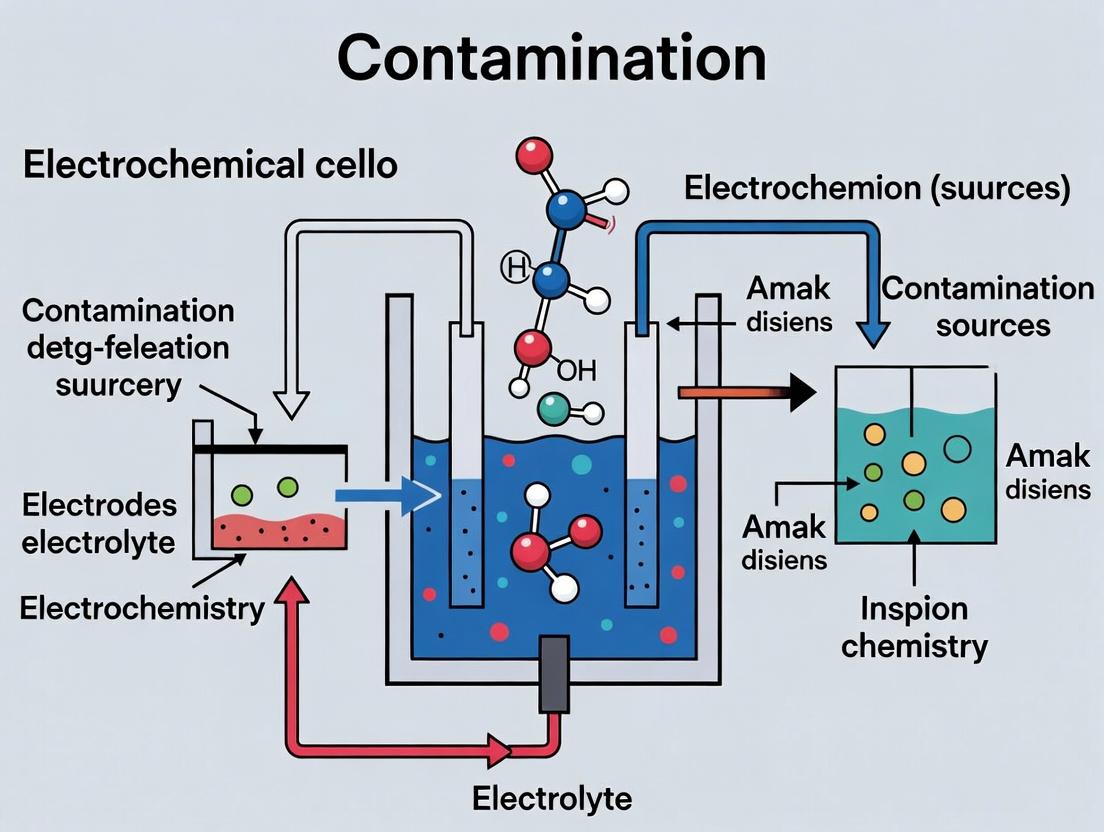
This article provides a comprehensive guide for researchers, scientists, and drug development professionals on identifying, preventing, and mitigating contamination in electrochemical cells.
Contamination in Electrochemical Cells: Sources, Solutions, and Best Practices for Reliable Research
Abstract
This article provides a comprehensive guide for researchers, scientists, and drug development professionals on identifying, preventing, and mitigating contamination in electrochemical cells. Covering foundational principles, practical methodologies, troubleshooting techniques, and validation strategies, it synthesizes current best practices to ensure data integrity in applications like biosensing, drug discovery, and clinical diagnostics. The scope addresses contaminants from biological, chemical, and handling sources, offering actionable insights for optimizing experimental protocols and ensuring reproducible results.
Understanding the Invisible Enemy: Foundational Sources and Impacts of Contamination in Electrochemistry
Within the broader thesis on mitigating contamination in electrochemical cell research, this technical support center addresses the practical identification and remediation of surface contamination. Contamination of electrode surfaces by biological, chemical, and particulate agents is a primary source of experimental noise, signal drift, and irreproducible data in electroanalytical techniques. This resource provides targeted troubleshooting for researchers, scientists, and drug development professionals.
Troubleshooting Guides & FAQs
Biological Contamination
Q: My cyclic voltammograms show a progressive decrease in redox peak currents over successive cycles in a biologically relevant buffer. What is happening?
- A: This is indicative of biofouling. Proteins, lipids, or other biomolecules are non-specifically adsorbing to the electrode surface, forming an insulating layer that inhibits electron transfer. The layer builds up with each cycle.
- Protocol for Verification & Cleaning:
- Verify: After the experiment, gently rinse the electrode with deionized water and transfer it to a clean, supporting electrolyte solution (e.g., 0.1 M KCl). Run a CV. If the redox peaks of a standard probe (e.g., 1 mM K₃Fe(CN)₆) remain suppressed, biofouling is confirmed.
- Clean: For gold electrodes, use piranha solution (3:1 concentrated H₂SO₄:30% H₂O₂) with extreme caution for 1-2 minutes, followed by extensive rinsing with DI water and electrolyte. Caution: Piranha is highly corrosive and explosive when in contact with organics. For glassy carbon, polishing followed by sonication in ethanol and DI water is often sufficient.
Q: How can I prevent bacterial or fungal growth in my long-term electrochemical biosensor experiment?
- A: Incorporate sterile technique and antimicrobial agents.
- Protocol:
- Work in a laminar flow hood when preparing solutions and assembling cells.
- Filter-sterilize (0.22 µm filter) all buffers and solutions.
- Add a non-electroactive, biocompatible antimicrobial agent like 0.05% sodium azide (NaN₃) to the electrolyte. Warning: Sodium azide is highly toxic. Handle with appropriate PPE and waste disposal.
Chemical Contamination
Q: I observe unexpected redox peaks in my background scan. What could be the cause?
- A: Chemical contamination from solvents, leaching components, or previous experiment residue is likely. Common sources are plasticizer leaching from tubing, organic solvent residues (e.g., DMF, DMSO), or metal ions from reference electrodes or cell components.
- Protocol for Systematic Identification:
- Run a background CV in fresh, high-purity supporting electrolyte using a freshly cleaned electrode.
- Introduce one system component at a time (new batch of electrolyte, then the cleaned cell, then tubing/pump, etc.), scanning after each addition.
- The appearance of the anomalous peak after a specific addition identifies the contamination source.
Q: My electrode surface appears modified after exposure to a cleaning agent. What went wrong?
- A: This is chemical degradation of the electrode material. For example, prolonged exposure of platinum to aqua regia can cause pitting. Glassy carbon can be oxidized by strong acids or bases if left for too long.
- Mitigation Protocol: Adhere to standard cleaning times and concentrations. See Table 1 for recommended protocols.
Particulate Contamination
- Q: My chronoamperometric traces show sharp, sporadic spikes in current.
- A: This is a classic signature of particulate contamination. Dust, micro-fibers, or abrasive particles from polishing are intermittently landing on or near the electrode surface, disrupting diffusion layers.
- Protocol for Mitigation:
- Perform all experiments in a clean, still environment (e.g., on a clean bench).
- Always filter (0.2 µm) electrolytes and analyte solutions directly into the electrochemical cell.
- After mechanical polishing, sonicate the electrode sequentially in ethanol and then DI water for 1-2 minutes each to dislodge embedded particles.
Table 1: Standard Electrode Cleaning Protocols for Common Contaminants
| Contaminant Type | Example Contaminants | Electrode Material | Recommended Cleaning Protocol | Caution |
|---|---|---|---|---|
| Organic/Adsorptive | Surfactants, oils, polymers | Glassy Carbon, Pt, Au | Mechanical polish (0.3 µm Al₂O₃ slurry), then sonicate in ethanol. | Do not use on modified electrodes. |
| Biological Film | Proteins, cells, biofluids | Au, Pt | Soak in 1% SDS, rinse. Severe: Piranha etch (Au). | Piranha is extremely dangerous. |
| Oxide Layers | Metal oxides (PtO, Ag₂S) | Pt, Ag | Electrochemical cycling in 0.5 M H₂SO₄ (Pt) or mechanical polish. | Avoid over-reduction which can roughen. |
| Inorganic Salts | Precipitated salts | All | Soak in 0.1 M acid matching anion (e.g., HCl for KCl), then DI water. | Ensure acid is compatible with electrode. |
Experimental Workflow for Contamination Diagnosis
Title: Systematic Workflow for Diagnosing Electrode Contamination
The Scientist's Toolkit: Research Reagent Solutions
Table 2: Essential Materials for Contamination Control
| Item | Function & Rationale |
|---|---|
| High-Purity Salts (≥99.99%) | Minimizes introduction of trace metal ion contaminants that can plate onto electrodes or participate in redox reactions. |
| Ultrapure Water (18.2 MΩ·cm) | Eliminates ionic and organic contaminants from the solvent used for all electrolyte and stock solutions. |
| Alumina or Diamond Polish (0.05 µm, 0.3 µm) | For mechanical removal of adsorbed layers and regeneration of a pristine, reproducible electrode surface geometry. |
| Micron Syringe Filters (0.2 µm, Nylon/PVDF) | Removes particulate and microbial contamination from solutions immediately prior to introduction to the cell. |
| Electrochemical Redox Probes (e.g., K₃Fe(CN)₆, Ru(NH₃)₆Cl₃) | Standardized molecules to quantitatively assess electron transfer kinetics and detect the presence of fouling layers. |
| Inert Atmosphere Glove Bag/Box | Allows cell assembly and experiment initiation in a particulate-free, oxygen-free environment when required. |
| Quasi-Reference Electrode (Pt wire) | A quick diagnostic tool to determine if anomalies originate from the main reference electrode's contamination. |
Technical Support & Troubleshooting Center
FAQs and Troubleshooting Guides
Q1: During cyclic voltammetry (CV), my baseline current is abnormally high and noisy. What could be the cause? A: This is a classic symptom of conductive contaminants adsorbed onto the working electrode surface. Trace metal ions (e.g., Cu²⁺, Fe³⁺) or organic surfactants can create alternative electron transfer pathways, increasing non-faradaic (capacitive) current and noise.
- Troubleshooting Protocol: 1) Clean the cell: Soak all components in 50% HNO₃ (for glassware) or a hot piranha solution (CAUTION: Extremely hazardous) for quartz, followed by copious rinsing with ultrapure water (≥18.2 MΩ·cm). 2) Re-polish the working electrode using an alumina slurry (progress from 1.0 µm to 0.05 µm). 3) Re-run CV in a clean supporting electrolyte only. The baseline should be stable and low.
Q2: Why is my open circuit potential (OCP) drifting unpredictably over time, even in a supposedly stable system? A: OCP measures the equilibrium potential between the working and reference electrodes. Contaminants that participate in redox reactions (e.g., O₂ from air, organic solvents) create mixed potentials. A drifting OCP indicates ongoing, uncontrolled reactions on the electrode surface.
- Troubleshooting Protocol: 1) Ensure rigorous deaeration of the electrolyte with an inert gas (Ar, N₂) for at least 20 minutes prior to measurement and maintain a blanket during operation. 2) Check the integrity of the reference electrode bridge (e.g., cracked frit) which can lead to contaminant leakage. Replace if necessary. 3) Isolate the cell from atmospheric CO₂, which can alter pH and potential.
Q3: My electrochemical impedance spectroscopy (EIS) Nyquist plot shows a second, unexpected semicircle at low frequencies. How do I diagnose this? A: An additional low-frequency semicircle often indicates a surface process with its own time constant. This is frequently caused by the formation of a non-uniform contaminant layer (e.g., oxide films, adsorbed proteins, precipitate) on the electrode, adding a charge transfer resistance and pseudo-capacitance in parallel.
- Troubleshooting Protocol: 1) Perform a control EIS measurement on a freshly polished electrode in pure supporting electrolyte. 2) Compare with your experimental plot. Use equivalent circuit modeling. The contaminant layer typically adds a parallel R-CPE element in series with the Warburg element. 3. Implement a stringent electrode cleaning and validation protocol before each experiment.
Q4: I observe a significant decrease in the faradaic peak current in successive CV scans. What does this mean? A: This is "electrode fouling." Non-conductive contaminants (e.g., polymeric residues, biological macromolecules) adsorb onto the active sites of the electrode, forming an insulating layer that blocks electron transfer, effectively reducing the electroactive area.
- Troubleshooting Protocol: 1) Between experiments, polish the electrode to mechanically remove the fouling layer. 2) For bio-fouling, consider using anti-fouling coatings (e.g., PEGylated thiols on Au, Nafion) or pulsed electrochemical cleaning methods. 3) Verify electrolyte purity and filter proteins/buffers if necessary.
Q5: How can I systematically identify if interference is from the electrolyte, electrode, or cell assembly? A: Follow this isolation protocol:
- Test the Electrolyte: Replace the experimental solution with a fresh batch of high-purity supporting electrolyte only. Run CV. If the anomaly persists, the problem is not the analyte.
- Test the Electrode: Substitute a freshly prepared, new working electrode. If the anomaly disappears, the original electrode was contaminated.
- Test the Cell: Assemble a clean, dedicated cell used only for validation. If the anomaly is resolved, your regular cellware requires more aggressive cleaning.
Quantitative Impact of Common Contaminants on Key Metrics
| Contaminant Type | Example | Primary Impact on Current | Primary Impact on Potential | Primary Impact on Impedance | Typical Magnitude of Skew |
|---|---|---|---|---|---|
| Conductive Ions | Cu²⁺, Fe³⁺ | Increases baseline (capacitive) current | Can shift OCP if redox-active | May lower overall solution resistance | Baseline current increase of 10-50% |
| Organic Surfactants | SDS, Triton X-100 | Suppresses faradaic peak current | Minor OCP drift due to adsorption | Increases charge transfer resistance (Rct) | Peak current suppression of 20-80% |
| Dissolved Oxygen | O₂ | Introduces reduction current ~ -0.8V vs. Ag/AgCl | Drifts OCP negatively | Can add a second semicircle | Cathodic current up to µA range |
| Non-Conductive Films | Protein Adsorbates | Greatly reduces faradaic current | Can shift OCP slightly | Dramatically increases Rct and film capacitance | Rct increase of 100-1000% |
| Trace Water (in org. solvents) | H₂O in Acetonitrile | Alters proton availability for reactions | Shifts proton-coupled redox potentials | Changes interfacial dielectric constant | Peak potential shift of 50-200 mV |
Detailed Experimental Protocol: Validating a Clean Electrochemical System
Objective: To establish a baseline CV and EIS profile for a clean, uncontaminated three-electrode cell.
Materials:
- Electrochemical Workstation with EIS capability
- Standard 3-electrode glass cell
- Working Electrode: 3 mm diameter glassy carbon electrode (GCE)
- Counter Electrode: Platinum wire coil
- Reference Electrode: Ag/AgCl (3M KCl) with intact ceramic frit
- Ultrapure water (18.2 MΩ·cm)
- High-purity Potassium Hexacyanoferrate(III) (K₃[Fe(CN)₆])
- High-purity Potassium Chloride (KCl)
- Alumina polishing slurry (1.0 µm, 0.3 µm, 0.05 µm)
- Ultrasonic cleaner
- Inert gas (Argon or Nitrogen) supply
Methodology:
- Cell Cleaning: Soak the glass cell and stir bar in a 1:1 HNO₃: H₂O bath for 2 hours. Rinse thoroughly with ultrapure water, then boil in ultrapure water for 30 minutes. Air-dry in a clean environment.
- Electrode Preparation:
- Working Electrode: Polish the GCE on a microcloth with alumina slurries sequentially (1.0 µm, 0.3 µm, 0.05 µm), sonicating in ultrapure water for 60 seconds after each polish.
- Counter Electrode: Flame-anneal the Pt coil until red-hot, then cool.
- Reference Electrode: Confirm the filling solution level and integrity of the frit. Check potential against a commercial reference.
- Electrolyte Preparation: Prepare 100 mL of 5 mM K₃[Fe(CN)₆] in 0.1 M KCl using ultrapure water and high-purity salts. Decorate with Argon sparging for 30 minutes.
- Baseline CV:
- Assemble cell with prepared electrodes and electrolyte under Ar blanket.
- Set parameters: Scan rate: 50 mV/s, Range: -0.1 to +0.6 V vs. Ag/AgCl.
- Run 10 cycles. The peak-to-peak separation (ΔEp) for the [Fe(CN)₆]³⁻/⁴⁻ couple should be ≤ 70 mV, and peak currents should be stable (±2% over last 5 cycles).
- Baseline EIS:
- At the OCP (~0.22 V), apply a 10 mV RMS sinusoidal perturbation from 100 kHz to 0.1 Hz.
- Fit the Nyquist plot to a simple Randles circuit (Rs, Rct, Cdl, W). A clean system should show a well-defined semicircle (Rct < 500 Ω for this system) followed by a 45° Warburg line.
Visualizations
Title: How Contaminants Skew Electrochemical Data
Title: Troubleshooting Workflow for Contamination Issues
The Scientist's Toolkit: Essential Reagent Solutions for Contamination Control
| Item | Primary Function | Key Consideration for Contamination Control |
|---|---|---|
| Ultrapure Water (≥18.2 MΩ·cm) | Solvent for all aqueous electrolytes; final rinsing agent. | Low resistivity indicates ionic contaminants. Use freshly generated or properly stored water. |
| Alumina or Diamond Polishing Slurries (0.05 µm, 0.3 µm) | Mechanically renews electrode surface, removing adsorbed layers. | Use separate polishing pads for different materials. Slurries can be contaminated; replace regularly. |
| High-Purity Salts & Electrolytes (e.g., KCl, TBAPF₆) | Provides conductive medium; defines ionic strength. | Purchase "electrochemical grade" or recrystallize. Store in a desiccator to avoid moisture. |
| Electrochemical Grade Solvents (e.g., Acetonitrile, DMF) | Medium for non-aqueous electrochemistry. | Use with molecular sieves to scavenge water. Ensure low peroxide levels (for ethers). |
| Inert Gas Supply (Argon, Nitrogen) | Removes dissolved O₂ and CO₂ from electrolytes; maintains inert atmosphere. | Use oxygen scrubbing filters. Ensure adequate sparging time (20-30 min minimum). |
| Piranha Solution (H₂SO₄ : H₂O₂) | CAUTION: Extremely hazardous. Removes organic residues from glassware and quartz. | Use only as a last resort. Never store in closed containers. Dispose of properly. |
| Nitric Acid Bath (50% v/v HNO₃) | Removes metal ion contaminants from glassware and electrodes. | Soak for 1-2 hours. Rinse exhaustively with ultrapure water. |
| Standard Redox Probe (e.g., 5 mM K₃[Fe(CN)₆] in 0.1 M KCl) | Validates electrode activity and cleanliness via CV. | Known ΔEp (≤70 mV) and peak current indicate a clean, active surface. Prepare fresh daily. |
Technical Support Center
Troubleshooting Guide: Q&A
Q1: Why is my electrode's current output decreasing over consecutive cycles in a microbial fuel cell (MFC)?
A: This is a classic symptom of electrode biofouling or passivation. Proteins and lipids from lysed cells or biofilm matrix components adsorb onto the electrode surface, creating an insulating layer that increases charge transfer resistance.
Diagnostic Protocol:
- Measure: Run Electrochemical Impedance Spectroscopy (EIS) to observe an increase in the diameter of the semicircle in the Nyquist plot (indicating increased charge transfer resistance, Rct).
- Visualize: Use Scanning Electron Microscopy (SEM) on a sacrificed electrode to confirm non-conductive biofilm or amorphous debris.
- Clean: Gently rinse the electrode with a neutral phosphate buffer, then immerse in a 0.1 M NaOH solution for 1 hour to desorb proteins. Re-calibrate in fresh electrolyte.
Q2: After adding a new growth medium supplement, my amperometric biosensor shows significant signal drift. What's the cause?
A: The supplement likely contains non-ionic surfactants (e.g., Tween, Triton) or divalent cations (e.g., Mg²⁺, Ca²⁺). Surfactants adsorb on sensing surfaces, altering the interfacial double-layer structure. Divalent cations can bridge between negative charges on the electrode and biomolecules, causing non-specific adsorption.
Diagnostic Protocol:
- Test: Perform a control experiment by spiking the suspected supplement into your buffer and measuring open circuit potential (OCP) drift over 30 minutes.
- Identify: Consult the supplement's Safety Data Sheet (SDS) for surfactant and ion content.
- Mitigate: Use a dialysis step to remove surfactants/salts from the supplement or implement a permselective membrane (e.g., Nafion) on your sensor to exclude interferents.
Q3: My voltammetric peaks for a redox metabolite have shifted and broadened irreproducibly. What could be happening?
A: This indicates surface contamination altering the electrochemical double layer. Common culprits are trace lipids forming monolayers or adsorbed gases (O₂, CO₂) from improperly degassed solutions, which change the local pH and dielectric constant.
Diagnostic Protocol:
- Clean & Degas: Polish the working electrode (e.g., glassy carbon) with 0.05 µm alumina slurry. Then, degas your electrolyte by purging with inert gas (N₂/Ar) for at least 20 minutes before and during experiments.
- Characterize: Run a cyclic voltammogram of a standard inner-sphere redox probe like [Fe(CN)₆]³⁻/⁴⁻. If the peak-to-peak separation (ΔEp) is >70 mV, contamination persists.
- Prevent: Always use high-purity salts and ultrapure water (18.2 MΩ·cm). Implement an air-tight electrochemical cell.
Q4: Why does the performance of my bio-electrocatalytic enzyme electrode degrade rapidly despite enzyme stability studies showing high activity in solution?
A: This is often due to surface-induced denaturation or fouling by charged impurities. Proteins can unfold on certain electrode materials. Also, specific ions (e.g., Cl⁻) can poison platinum catalysts or disrupt enzyme-electrode wiring.
Diagnostic & Remediation Protocol:
- Surface Engineering: Modify the electrode with a biocompatible, hydrophilic layer to preserve enzyme native structure. Common modifications:
- Apply a self-assembled monolayer (SAM) of mercaptopropionic acid on gold.
- Deposit a porous hydrogel (e.g., chitosan, PEG-based).
- Ion Management: Use a non-coordinating buffer like HEPES or MOPS instead of phosphate if Cl⁻ is suspected. Employ a salt bridge if necessary to separate compartments.
- Validate: Use Quartz Crystal Microbalance with Dissipation (QCM-D) to monitor in-situ protein adsorption and layer rigidity.
FAQ
Q: What is the most effective routine cleaning protocol for gold and glassy carbon working electrodes? A: Use a multi-step approach:
- Mechanical Polish: On a microcloth pad, use 0.05 µm alumina slurry for glassy carbon or 1.0 then 0.3 µm alumina for polycrystalline gold. Rinse thoroughly with DI water.
- Chemical/Solvent Clean: For lipid removal, sonicate in isopropanol for 5 minutes, then in DI water.
- Electrochemical Clean (for Au): In 0.5 M H₂SO₄, perform cyclic voltammetry from -0.2 V to 1.5 V (vs. Ag/AgCl) until a stable gold oxide reduction peak is achieved.
- Electrochemical Clean (for GC): In pH 7 phosphate buffer, cycle between -1.0 V and +1.0 V until background stabilizes.
Q: How can I distinguish between surfactant fouling and protein fouling using EIS data? A: Analyze the shape and time evolution of the impedance spectrum. Surfactants often form compact, homogeneous monolayers, producing a near-ideal, large semicircle. Protein layers are more viscoelastic and inhomogeneous, frequently showing a "depressed" semicircle (center below the real axis) and may feature an additional low-frequency diffusion element.
Q: What are the best practices to minimize adsorbed gas interference? A:
- Degas: Sparge all electrolytes with inert gas (N₂ for neutral/basic, Ar for acidic) for 20+ minutes prior to experiment.
- Maintain: Continue a gentle gas stream over the solution headspace during measurement, or use a sealed cell.
- Compensate: For long-term experiments, use a closed system with an oxygen scrubber (e.g., Glucose Oxidase/Catalase system in bio-experiments).
Table 1: Impact of Common Contaminants on Electrochemical Parameters
| Contaminant Class | Example Compound | Primary Effect on WE | Change in Charge Transfer Resistance (Rct) | Effect on Double Layer Capacitance (Cdl) |
|---|---|---|---|---|
| Proteins | Bovine Serum Albumin (BSA) | Insulating biofilm formation | Increases dramatically (200-500%) | Decreases |
| Lipids | Phosphatidylcholine | Hydrophobic monolayer formation | Increases (50-300%) | Decreases significantly |
| Non-ionic Surfactants | Tween-20 | Alters interfacial tension & structure | Increases moderately (20-100%) | Can increase or decrease |
| Divalent Cations | Ca²⁺, Mg²⁺ | Bridges, non-specific adsorption | May increase slightly | Often increases |
| Adsorbed Gases | O₂ | Parasitic redox reactions, local pH shift | Can decrease (new pathway) or increase | Variable |
Table 2: Recommended Cleaning Agents for Specific Fouling Types
| Fouling Type | Electrode Material | Recommended Cleaning Agent/Protocol | Duration | Post-Clean Validation Step |
|---|---|---|---|---|
| Protein Layer | Gold, Platinum | 0.1 M NaOH solution or 1% (w/v) SDS | 60 min immersion | CV of [Fe(CN)₆]³⁻/⁴⁻; ΔEp < 70 mV |
| Lipid Film | Glassy Carbon, ITO | Sonication in isopropanol | 5-10 min | Water contact angle measurement |
| Polymer/Surfactant | Most | Piranha solution (EXTREME CAUTION) | <30 s | XPS or OCP stabilization |
| Inorganic Scale | Stainless Steel | 0.1 M Citric Acid | 30 min | Visual inspection, EIS |
Experimental Protocols
Protocol 1: Electrochemical Impedance Spectroscopy (EIS) for Fouling Diagnosis
Objective: Quantify the increase in charge transfer resistance (Rct) due to surface contamination.
Materials:
- Potentiostat with EIS capability
- 3-electrode cell: Working Electrode (WE), Counter Electrode (CE), Reference Electrode (RE)
- 5 mM K₃[Fe(CN)₆] / K₄[Fe(CN)₆] (1:1) in 0.1 M KCl (supporting electrolyte)
Method:
- Clean the WE as per standard protocol.
- In the clean electrolyte, run an EIS spectrum at the system's OCP.
- Frequency Range: 100 kHz to 0.1 Hz
- AC Amplitude: 10 mV RMS
- Fit the Nyquist plot to a modified Randles circuit (Rsolution + Qdl + R_ct + W) to obtain initial Rct value.
- Expose the WE to the suspected fouling agent (e.g., 1 g/L BSA for 1 hour).
- Rinse gently with DI water and place in fresh electrolyte.
- Repeat step 2. The increase in Rct is directly related to the degree of fouling.
Protocol 2: QCM-D for In-Situ Adsorption Monitoring
Objective: Measure mass and viscoelastic properties of an adsorbing layer in real-time.
Materials:
- QCM-D instrument (e.g., Q-Sense)
- Gold-coated quartz crystal sensor
- Peristaltic pump for flow control
- Relevant buffers and fouling solutions.
Method:
- Mount the sensor in the flow module. Establish a stable baseline with running buffer (e.g., PBS) at 100 µL/min.
- Switch the flow to the sample solution (e.g., protein or lipid suspension) for a defined period (e.g., 30 min).
- Switch back to running buffer to monitor desorption.
- Record frequency (Δf, related to mass) and dissipation (ΔD, related to rigidity) changes at multiple overtones (e.g., 3rd, 5th, 7th).
- Analyze data using appropriate models (e.g., Sauerbrey for rigid layers, viscoelastic for soft layers) to calculate adsorbed mass and layer thickness.
The Scientist's Toolkit: Research Reagent Solutions
| Item | Function/Benefit | Example Product/Chemical |
|---|---|---|
| Alumina Polishing Slurries | For mechanical removal of adsorbed layers and renewal of electrode surface. | 0.05 µm alumina slurry for glassy carbon |
| Self-Assembled Monolayer (SAM) Kits | To create controlled, biocompatible, and functional interfaces that minimize non-specific adsorption. | 11-Mercaptoundecanoic acid (11-MUA) for gold surfaces |
| Permselective Membranes | Coating to repel charged interferents (e.g., surfactants, lipids) while allowing analyte permeation. | Nafion perfluorinated resin solution |
| High-Purity Buffer Salts | Minimize introduction of trace metal ions that can catalyze side reactions or cause precipitation. | BioUltra grade HEPES, KCl |
| Oxygen Scrubbing System | Enzymatic removal of dissolved O₂ to prevent interference in reductive bio-electrochemistry. | Glucose Oxidase/Catalase with D-Glucose |
| Ultrapure Water System | Provides contamination-free water for all solutions, critical for baseline stability. | 18.2 MΩ·cm water, <5 ppb TOC |
Diagrams
Title: Systematic Troubleshooting Workflow for Contamination
Title: Contaminant Impact on Electrochemical Double Layer
Technical Support Center
Troubleshooting Guides & FAQs
FAQ Category 1: Electrochemical Sensor Calibration & Baseline Drift
Q1: Our amperometric sensor shows a consistently rising baseline during phosphate-buffered saline (PBS) blank measurements, leading to false positive signals in subsequent drug detection. What could be the cause? A: A drifting baseline in a simple electrolyte like PBS is a classic sign of electrochemical cell contamination.
- Primary Cause: Adsorption of organic contaminants (e.g., surfactant residues from improper cleaning, leaching from tubing, or atmospheric hydrocarbons) onto the working electrode surface. These contaminants can undergo slow, continuous redox reactions.
- Troubleshooting Steps:
- Protocol Review: Strictly implement a pre-experiment electrode cleaning protocol: sequential sonication in (a) Alconox solution, (b) 50% ethanol, and (c) deionized water, each for 5 minutes.
- System Flush: Flush all fluidic lines with 70% isopropanol followed by copious amounts of deionized water before introducing buffer.
- Control Experiment: Run a baseline in freshly prepared, high-purity PBS from a newly opened container. Compare to your standard buffer to rule out bulk electrolyte contamination.
- Surface Regeneration: Perform aggressive electrochemical cleaning (e.g., cyclic voltammetry from -1.0 V to +1.0 V vs. Ag/AgCl in 0.5 M H₂SO₄ for 20 cycles) to oxidize carbon-based contaminants.
Q2: After calibrating with a known biomarker standard, the sensitivity (slope) of the calibration curve varies significantly between days, causing unreliable quantification and potential false negatives at low concentrations. A: Day-to-day variability in sensitivity points to inconsistent electrode surface states or contamination affecting the electron transfer kinetics.
- Primary Cause: Incomplete removal of previous assay components (proteins, detection antibodies) or fouling agents, leading to a passivated surface.
- Troubleshooting Steps:
- Standardized Regeneration: Implement and document a post-assay electrode stripping protocol. For an antibody-based immunosensor, a glycine-HCl buffer (pH 2.0) rinse for 10 minutes can disrupt antibody-antigen binding without damaging most carbon/gold surfaces.
- Monitor Surface Activity: Use a redox probe like 5 mM Potassium Ferricyanide ([Fe(CN)₆]³⁻/⁴⁻). Record cyclic voltammograms daily. A decrease in peak current or an increase in peak-to-peak separation (ΔEp) indicates fouling. See Table 1.
- Reference Electrode Check: Ensure your reference electrode (e.g., Ag/AgCl) is properly filled and not contaminated. A drifting reference potential will shift all measurements.
FAQ Category 2: Signal Specificity & Cross-Reactivity
Q3: In a multiplexed detection of two similar drug metabolites, we observe a signal in the channel for Metabolite B when only Metabolite A is present. How do we confirm this is a false positive from cross-reactivity? A: This is a critical issue for assay integrity. A systematic approach is required to isolate the cause.
- Primary Causes: (1) Antibody/aptamer cross-reactivity, (2) Non-specific adsorption of the analyte or label to the sensor surface, or (3) Signal bleed-over in the instrumentation.
- Troubleshooting Protocol:
- Selectivity Test: Run the full assay with each metabolite individually and in combination. Quantify the signal in the "off" channel.
- Surface Blocking Optimization: Test different blocking agents (see Scientist's Toolkit below) to minimize non-specific adsorption. Increase blocking time and concentration systematically.
- Label Control: Run the detection step (e.g., enzyme substrate or redox reporter) without the presence of any metabolite. This identifies signal from non-specifically bound label.
- Data Analysis: Apply cross-reactivity correction factors if the interference is consistent and characterized, but redesign the assay if interference is >5%.
Experimental Protocol: Redox Probe Test for Surface Fouling
- Objective: Diagnose working electrode contamination/fouling.
- Reagents: 5 mM K₃[Fe(CN)₆] and 5 mM K₄[Fe(CN)₆] in 1X PBS, pH 7.4.
- Method:
- After standard electrode preparation/cleaning, immerse the electrochemical cell in the redox probe solution.
- Perform Cyclic Voltammetry (CV) from -0.1 V to +0.5 V vs. Ag/AgCl at a scan rate of 50 mV/s for 5 cycles.
- Record the peak anodic current (Ip,a) and the peak-to-peak separation (ΔEp) from the final cycle.
- After running your biomarker/drug assay, repeat steps 1-3 with a fresh redox probe solution.
- Interpretation: A >15% decrease in Ip,a or a >30 mV increase in ΔEp indicates significant surface fouling that will compromise data integrity.
Data Presentation
Table 1: Impact of Common Contaminants on Redox Probe CV Metrics
| Contaminant Source | ΔEp Change | Peak Current (Ip,a) Change | Likely Effect on Assay |
|---|---|---|---|
| Bovine Serum Albumin (1%) | +45 mV | -32% | False Negative |
| Surfactant (Tween-20, 0.1%) | +15 mV | -8% | Reduced Sensitivity |
| Cell Lysate (10 µL) | +80 mV | -60% | False Negative/Positive |
| Clean Surface (Control) | ~70 mV | Reference | N/A |
Table 2: Case Study Summary - Sources of False Results
| Case | Assay Type | False Result | Root Cause Identified | Corrective Action |
|---|---|---|---|---|
| 1 | Aptamer-based PSA detection | False Positive | Leaching of plasticizers from microfluidic chip into running buffer, causing non-specific aptamer folding. | Switched to certified biocompatible tubing; implemented pre-run buffer flush protocol. |
| 2 | Enzyme-linked drug metabolite (CYP450) activity | False Negative | Residual organic solvent (DMSO) from drug stock (>1% v/v) inhibiting enzyme activity on electrode. | Diluted drug stocks to ensure final DMSO <0.1%; added a control for solvent effects. |
| 3 | Antibody-based TNF-α immunosensor | High Background, Low S/N | Inadequate blocking leading to non-specific adsorption of enzyme-conjugated secondary antibody. | Optimized blocking with a mixture of BSA and casein; extended blocking time to 2 hours. |
Mandatory Visualizations
Experimental Workflow with Integrity Checkpoints
Contamination-Induced False Positive & Negative Pathways
The Scientist's Toolkit: Key Research Reagent Solutions
| Reagent/Material | Primary Function | Critical Note for Integrity |
|---|---|---|
| Alconox Detergent | Removes organic and inorganic residues from glassware and electrodes via sonication. | Must be thoroughly rinsed with DI water to avoid surfactant film formation. |
| Potassium Ferri/Ferrocyanide Redox Probe | Monitors electron transfer kinetics and detects surface fouling. | Prepare fresh daily; autoxidizes in light and air. |
| BSA (Bovine Serum Albumin) | Standard blocking agent to passivate surface against non-specific protein binding. | Can itself foul surfaces if used at too high concentration (>5%) or not rinsed. |
| Casein Blocking Buffer | Alternative blocking agent, often more effective for immunoassays in complex matrices. | Use phosphate-based, not acetate-based, buffers for electrochemical compatibility. |
| Glycine-HCl Buffer (pH 2.0) | Low-pH eluent for stripping antibodies/antigens from surfaces for sensor regeneration. | Limit exposure time (5-15 min) to avoid damaging underlying self-assembled monolayers. |
| High-Purity PBS Salts | Provides consistent ionic strength and pH for electrochemical measurements. | Make from salts, not tablets; filter (0.22 µm) and autoclave to prevent microbial growth. |
| Ag/AgCl Reference Electrode Filling Solution | Maintains stable reference potential. | Ensure correct KCl concentration (e.g., 3M) and no crystallization at the junction. |
Welcome to the Electrochemical Support Center. This guide is framed within our ongoing research thesis: "Systematic Identification and Mitigation of Trace Contamination Pathways in Electrochemical Cells for Reliable Biophysical and Pharmacological Assays." The following troubleshooting resources address common, contamination-induced issues that compromise data fidelity at the critical electrode-solution interface.
Troubleshooting Guides & FAQs
Q1: My voltammetric baseline current is unstable and drifts significantly between scans. What could be causing this? A: This is a classic symptom of adsorbed organic contaminants or a slowly fouling electrode surface. Contaminants alter the double-layer capacitance and charge transfer kinetics, causing non-faradaic current drift.
- Protocol for Diagnosis & Resolution:
- Polishing Protocol: Gently polish the electrode on a microcloth pad with successive slurries of 1.0 µm, 0.3 µm, and 0.05 µm alumina powder. Rinse thoroughly with high-purity deionized water (≥18.2 MΩ·cm) after each step.
- Electrochemical Cleaning: Perform cyclic voltammetry (CV) in 0.5 M H₂SO₄ from -0.2 V to +1.2 V (vs. Ag/AgCl) at 100 mV/s for 20-50 cycles. A stable, reproducible hydrogen adsorption/desorption and oxide formation/reduction profile indicates a clean polycrystalline Pt surface.
- Validation: Test in a clean, well-characterized redox couple (e.g., 1 mM potassium ferricyanide in 1 M KCl). The peak-to-peak separation (ΔEp) should approach 59 mV for a reversible, one-electron transfer.
Q2: I observe unexpected redox peaks or suppressed signal in my biological sample measurement (e.g., drug compound). How do I rule out electrode contamination? A: Contaminants can catalyze side reactions or form insulating layers. A systematic control experiment is essential.
- Protocol for Systematic Control:
- Prepare a fresh aliquot of your standard electrolyte/buffer from primary stocks.
- Record a CV of the clean electrode in this blank solution over your experimental potential window. Save this baseline.
- Add your biological sample or drug compound from a concentrated stock. Record the CV again.
- Key Analysis: Compare the "sample CV" to the "blank + sample CV." Any new features not attributable to the sample are likely from contaminants introduced with the sample. Re-test with a freshly prepared or differently sourced sample buffer.
Q3: My impedance spectroscopy (EIS) data shows high, variable low-frequency impedance. What does this indicate? A: High and variable low-frequency impedance often points to a surface-blocking layer, typically from non-conducting organic molecules or precipitate adsorption.
- Troubleshooting Steps:
- Visual Inspection: Examine the electrode under a microscope for physical deposits.
- Surface Regeneration: Follow the polishing and electrochemical cleaning protocol from Q1.
- Solution Filtration: Always filter all electrolytes and sample solutions through a 0.22 µm or 0.02 µm syringe filter (compatible with your analyte) directly into the electrochemical cell to remove particulates.
- Re-run EIS: Perform in a simple electrolyte (e.g., KCl) to obtain a new, clean Nyquist plot for comparison.
Q4: How do I maintain a contamination-free cell assembly? A: Cell cleaning is as important as electrode cleaning.
- Weekly Cleaning Protocol:
- Soak all glassware (cell, lids) in a hot (50-60°C) solution of 5% Contrad or Nochromix detergent overnight.
- Rinse extensively with tap water, then deionized water.
- Perform a final rinse with the high-purity water used for experiments.
- Air Dry: Dry in a laminar flow hood or covered area to prevent dust settlement. Do not dry with cloths.
Table 1: Impact of Common Contaminants on Electrochemical Metrics
| Contaminant Source | Likely Effect on CV | Effect on EIS | Typical ΔEp Increase |
|---|---|---|---|
| Silicone Lubricants | Irreversible oxidation peaks, high background | Large, diffuse semicircle | > 100 mV |
| Surfactants (e.g., from detergents) | Peak suppression, current drift | Increased charge transfer resistance (Rct) | 50 - 200 mV |
| Metal Ions (e.g., Cu²⁺) | Catalytic side waves, shifted potentials | Altered low-frequency Warburg element | Variable |
| Protein Adsorption | Severe peak suppression, passivation | Drastically increased Rct | N/A (signal lost) |
Table 2: Electrode Polishing Validation Criteria (1 mM K₃[Fe(CN)₆] in 1 M KCl)
| Electrode Status | Peak-to-Peak Separation (ΔEp) | Ipa / Ipc Ratio | Baseline Character |
|---|---|---|---|
| Acceptably Clean | 59 - 70 mV | 0.9 - 1.1 | Flat, stable |
| Moderately Contaminated | 70 - 100 mV | <0.8 or >1.2 | Sloping or curved |
| Unusable / Heavily Fouled | > 100 mV or no peaks | N/A | Very high, unstable |
Visualizations
Title: Troubleshooting Workflow for Contaminated Electrodes
Title: Contaminant Pathways and Interface Consequences
The Scientist's Toolkit: Research Reagent Solutions
| Item | Function & Importance for Purity |
|---|---|
| High-Purity Water (≥18.2 MΩ·cm) | Minimizes ionic contamination and conductive background. Essential for all solution prep and final rinses. |
| Alumina or Diamond Polishing Slurries (1.0 to 0.05 µm) | For mechanical removal of adsorbed layers and regeneration of a pristine, reproducible electrode topography. |
| Syringe Filters (0.22 µm, Nylon/PVDF) | Removes micron-scale particulates and aggregates from solutions that can adsorb to the interface. |
| Electrochemical Grade Salts & Solvents | Certified low in metal ions and organic contaminants to prevent introduction of impurities. |
| Quartz or PFA/Teflon Cuvettes/Cells | Inert materials that minimize leaching of silicates or polymers compared to standard glass or plastics. |
| Contrad or Hellmanex II Detergent | Ultra-clean, phosphate-free surfactants for reliably removing organic films from glassware without residue. |
| Ag/AgCl Reference Electrode with Vycor Frit | Provides a stable potential with a low-leakage junction to prevent chloride/salt contamination of the cell. |
| Clean Room Wipes (Lint-Free) | For handling cells and electrodes without introducing fibers or contaminants. |
Proactive Defense: Methodologies for Preventing and Removing Contamination in Experimental Workflows
Troubleshooting Guides & FAQs
Q1: My cyclic voltammogram in a clean supporting electrolyte shows unexplained redox peaks. What is the likely cause and how do I fix it? A: This is a classic sign of persistent surface contamination, often from adsorbed organic species or incomplete removal of polishing alumina. First, verify your polishing protocol: use sequential finer grades of alumina (e.g., 1.0 µm, then 0.3 µm, then 0.05 µm) with thorough sonication in deionized water between each step. If peaks persist, extend your electrochemical cleaning protocol. Perform additional cycles (e.g., 50-100) in 0.1 M H₂SO₄ until the CV stabilizes and matches the characteristic shape for your electrode material (e.g., the classic "duck shape" for polycrystalline Au in acidic media).
Q2: After polishing, my electrode surface appears hazy under magnification. What went wrong? A: A hazy surface indicates either scratching from using an incorrect polishing cloth/compound or residual abrasive particles. Ensure you are using a non-aggressive polishing cloth (e.g., microcloth) and that the polishing alumina slurry is well-suspended. The most critical step is sonication: after each polishing step, sonicate the electrode for at least 60 seconds in clean deionized water, and consider a final sonication in isopropanol or ethanol to displace water and facilitate drying. Always use fresh aliquots of sonication solvents.
Q3: During electrochemical cleaning in H₂SO₄, the background current is very high and noisy. What does this mean? A: High, noisy background current typically indicates solution contamination or a leaking reference electrode. 1) Replace your electrolyte solution with a freshly prepared aliquot from high-purity acid and ultrapure water (18.2 MΩ·cm). 2) Check your reference electrode bridge; ensure it is not clogged and there is no leakage of filling solution into the cell. 3) Ensure all glassware and cells have been rigorously cleaned (e.g., with aqua regia or piranha solution, with extreme caution).
Q4: How do I verify that my glassy carbon electrode is properly pretreated? A: For glassy carbon (GC), a reliable functional test is to record the CV for a well-known outer-sphere redox couple like 1 mM potassium ferricyanide (K₃[Fe(CN)₆]) in 1 M KCl. A properly cleaned GC electrode will show a peak-to-peak separation (ΔEp) close to 59 mV (for a reversible system at low scan rates) and symmetric peaks. A large ΔEp (>70 mV) or low current indicates residual contamination or surface oxidation that requires repolishing.
Q5: How often should I repolish my electrode versus just using electrochemical cleaning? A: Repolish when:
- Electrochemical cleaning fails to restore a stable background CV within a reasonable number of cycles (e.g., 20-30 cycles).
- The physical surface is visibly scratched or damaged.
- After experiments involving strongly adsorbing species (e.g., proteins, polymers, heavy organics).
- As a routine maintenance, depending on use frequency (e.g., weekly for daily use). For light contamination between measurements, electrochemical cleaning in H₂SO₄ or a mild oxidative potential hold may suffice.
Detailed Experimental Protocols
Protocol 1: Sequential Mechanical Polishing & Sonication for Solid Electrodes (Pt, Au, GC)
- Prepare Slurries: Create alumina (Al₂O₃) slurries by dispersing powder in deionized water. Use sequential grades: 1.0 µm, 0.3 µm, and 0.05 µm.
- Initial Polish: On a clean polishing microcloth, apply the 1.0 µm slurry. Polish the electrode in a figure-8 pattern for 60 seconds.
- Sonicate: Immediately place the electrode in a beaker of pure deionized water. Sonicate for 60 seconds to remove adhered particles.
- Repeat: Move to a fresh cloth/pad for the 0.3 µm slurry. Polish for 60 seconds, then sonicate in fresh water.
- Final Polish: On a third fresh cloth/pad, use the 0.05 µm slurry. Polish for 90 seconds.
- Final Rinse & Sonicate: Rinse copiously with deionized water, then sonicate successively in deionized water (60s) and absolute ethanol (30s). Dry under a gentle stream of inert gas (N₂/Ar).
Protocol 2: Electrochemical Cleaning via Cyclic Voltammetry in 0.5 M H₂SO₄
- Solution Preparation: Add high-purity concentrated H₂SO₄ to ultrapure water (always acid to water) to make 0.5 M H₂SO₄. Sparge with inert gas (N₂/Ar) for at least 15 minutes before use.
- Setup: Place cleaned electrode, a clean Pt wire/counter electrode, and a clean reference electrode (e.g., Ag/AgCl) into the deaerated acid.
- Activation Cycles: For Pt electrodes, cycle between -0.2 V and +1.2 V vs. Ag/AgCl at 100 mV/s for 50-200 cycles until the CV stabilizes. For Au electrodes, cycle between -0.2 V and +1.5 V vs. Ag/AgCl at 100 mV/s. Avoid anodic limits where significant oxidation occurs.
- Final Step: Hold at a potential in the double-layer region (e.g., 0.0 V vs. Ag/AgCl for Pt) for 30 seconds, then remove electrode under potential control. Rinse thoroughly with ultrapure water.
Data Summary Tables
Table 1: Recommended Parameters for Electrochemical Cleaning CVs
| Electrode Material | Electrolyte | Potential Range (vs. Ag/AgCl) | Scan Rate | Target Cycle Number |
|---|---|---|---|---|
| Polycrystalline Pt | 0.1 - 0.5 M H₂SO₄ | -0.20 V to +1.20 V | 100 mV/s | 50 - 200 |
| Polycrystalline Au | 0.1 - 0.5 M H₂SO₄ | -0.20 V to +1.50 V | 100 mV/s | 50 - 100 |
| Glassy Carbon (GC) | 0.1 M H₂SO₄ or 0.1 M KOH | -0.50 V to +1.30 V (acid) / -1.0 V to +0.6 V (base) | 100 mV/s | 20 - 50 |
Table 2: Troubleshooting Symptoms & Direct Solutions
| Symptom | Likely Cause | Immediate Action |
|---|---|---|
| Broad, irreversible peaks in clean electrolyte | Organic adsorption | Increase CV cleaning cycles; consider sonication in ethanol. |
| High, unstable background current | Contaminated electrolyte or cell | Prepare fresh electrolyte; clean cell with piranha (Caution!). |
| Poor redox couple reversibility (high ΔEp) | Inactive/oxidized surface | Repolish electrode to expose fresh material. |
| Drifting baseline or potential | Unstable reference electrode | Check/refill reference electrode; use a fresh salt bridge. |
Diagrams
Title: Electrode Pretreatment and Validation Workflow
Title: Root Cause Analysis for Abnormal CV Peaks
The Scientist's Toolkit: Essential Research Reagent Solutions & Materials
| Item | Function/Benefit | Key Consideration |
|---|---|---|
| High-Purity Alumina Powders (1.0, 0.3, 0.05 µm) | For scratch-free sequential mechanical polishing to an atomically smooth surface. | Use different polishing pads/cloths for each grade to avoid cross-contamination. |
| Ultrapure Water (18.2 MΩ·cm resistivity) | Prevents introduction of ionic contaminants during rinsing and solution preparation. | Use freshly produced or properly stored water; do not use deionized water alone. |
| High-Purity Sulfuric Acid (H₂SO₄) | Electrolyte for electrochemical cleaning via CV. Its wide potential window facilitates oxide formation/reduction. | Use trace metal grade or better. Always add acid to water. |
| Potassium Ferricyanide (K₃[Fe(CN)₆]) | Redox probe for electrode activity verification. Reversible kinetics serve as a functional test. | Prepare fresh solution daily due to light sensitivity. Use with 1 M KCl as supporting electrolyte. |
| Non-Aggressive Polishing Microcloths | Provides a soft, flat substrate for polishing, minimizing deep scratches. | Must be kept clean and used for one specific alumina grade only. |
| Laboratory Sonicator (Bath) | Dislodges adhered nanoparticles and contaminants from surface features via cavitation. | Use with fresh solvents; ensure water in bath is clean. |
| Inert Gas Supply (N₂/Ar) | Deaerates solutions to remove interfering oxygen for cleaning protocols and experiments. | Use high-purity grade (>99.99%) with appropriate scrubbing filters. |
| Agarose or Vycor Frit | For reference electrode salt bridges; prevents contamination of cell by reference electrode filling solution. | Check for clogging regularly; replace bridges as needed. |
Sterile Technique and Aseptic Handling for Cell Culture and Biological Sample Integration
Technical Support Center: Troubleshooting Guides & FAQs
FAQ 1: What are the most common sources of contamination in cell culture for electrochemical biosensor research? The most common sources are:
- Microbial: Bacteria (e.g., Mycoplasma), fungi, and yeasts from the environment, user, or reagents.
- Cross-Contamination: Incorrect handling leading to mixing of different cell lines.
- Chemical: Endotoxins, disinfectant residues, or impurities in media/buffers.
- Aerosols: Generated during pipetting, opening tubes, or from vacuum waste systems.
FAQ 2: My electrochemical cell signal shows drift and increased noise. Could this be due to biological contamination? Yes. Microbial contamination (especially bacterial biofilm formation) on electrode surfaces can significantly alter interfacial properties, causing non-specific binding, increased background capacitance, and signal instability. This is a critical failure mode in sensitive electrochemical assays.
FAQ 3: How can I definitively diagnose Mycoplasma contamination in my cultures? Mycoplasma is not visible under standard microscopy. You must use specific tests:
- PCR-based Detection: Most sensitive and specific. Kits are available.
- Fluorochrome Staining (e.g., Hoechst 33258): Stain DNA; Mycoplasma appears as particulate or filamentous fluorescence outside the cell nuclei.
- Microbiological Culture: Specialized agar plates, but slow (up to 4 weeks).
FAQ 4: My sterile technique seems correct, but I keep getting contamination. What hidden sources should I check? Investigate these often-overlooked sources:
- Water Baths: If used to warm media, ensure bottles are thoroughly disinfected and sealed.
- Cell Culture Incubator: Check and clean the water pan regularly for fungal growth.
- Laboratory Equipment: Microscopes, hemocytometer, tube racks. Wipe with 70% ethanol before use.
- Personal Items: Lab coats, gloves (ensure no touching of non-sterile surfaces).
FAQ 5: How do I properly decontaminate an electrochemical sensor chip before integrating a biological sample? A critical step to ensure a clean, functional surface.
Protocol: Electrode Surface Decontamination & Preparation
- Mechanical Cleaning: Gently polish electrode (if applicable, e.g., glassy carbon) with 0.05 µm alumina slurry on a microcloth. Rinse copiously with ultrapure water (18.2 MΩ·cm).
- Chemical Cleaning: Sonicate in sequential baths (5 mins each): 1% Hellmanex III, ultrapure water, absolute ethanol, ultrapure water.
- Electrochemical Cleaning: For metal electrodes (Au, Pt), perform cyclic voltammetry in 0.5 M H₂SO₄ (e.g., -0.2 to +1.5V vs Ag/AgCl for Au) until a stable, characteristic CV is achieved.
- Sterilization: Immerse in 70% ethanol for 20 minutes. Rinse with sterile PBS or culture medium immediately before biological sample integration.
- UV/Ozone: (Optional) For final organic removal, treat with UV-ozone for 15-20 minutes.
Data Presentation: Contamination Incidence and Impact
Table 1: Common Contaminants and Their Observed Impact on Electrochemical Cell Research
| Contaminant Type | Typical Source | Visible Signs in Culture | Impact on Electrochemical Measurement |
|---|---|---|---|
| Bacteria | Operator, unfiltered air | Media turbidity, pH drop (yellow), rapid cell death. | Biofilm increases impedance/background current; non-specific binding. |
| Yeast/Fungi | Air, water baths | Floating specks, cloudy media, pH stable. | Fungal mats can physically foul electrodes, causing signal drift. |
| Mycoplasma | FBS, cross-contamination | None visually; slow cell growth, aberrant morphology. | Alters host cell metabolism & membrane, affecting redox signals. |
| Endotoxins | Serum, reagents, plastics | None visually; can trigger cell stress responses. | Can non-specifically adsorb to sensor surfaces, blocking sites. |
Table 2: Efficacy of Common Sterilization Methods for Labware
| Method | Mechanism | Typical Use | Limitations for Electrochemical Research |
|---|---|---|---|
| Autoclaving (121°C, 15 psi) | Moist heat denatures proteins. | Glassware, metal tools, silicone tubing, aqueous solutions. | Cannot be used for electronics, most plastics, or heat-sensitive materials. |
| Dry Heat (160-180°C) | Oxidation. | Glassware, metal. | Longer cycles required. Can damage fine instruments. |
| Ethanol (70%) | Protein coagulation, lipid dissolution. | Surface disinfection, hand wiping. | Evaporates, no residual activity. Not effective against all spores. |
| UV-C Radiation | Damages DNA/RNA. | Surfaces inside biosafety cabinets, equipment. | Poor penetration; shadows provide no protection. Degrades plastics. |
| Membrane Filtration (0.22 µm) | Physical removal. | Heat-sensitive liquids (media, sera, buffers). | Does not remove viruses or mycoplasma; use 0.1 µm for mycoplasma. |
Experimental Protocols
Protocol 1: Aseptic Integration of Cells onto an Electrochemical Sensor Aim: To seed mammalian cells onto a microelectrode array (MEA) or sensor chip without contamination. Materials: Sterile sensor chip, cell suspension, complete medium, biosafety cabinet, pre-warmed trypsin-EDTA, sterile PBS. Method:
- Place the sterilized sensor chip into a sterile petri dish or well plate inside the biosafety cabinet.
- Rinse the chip surface with 2 mL of sterile PBS.
- Aspirate PBS and immediately add a calculated volume of cell suspension (e.g., 50 µL for a drop-seeding method) directly onto the active electrode area.
- Carefully place the dish into the incubator (37°C, 5% CO₂) for 30-60 minutes to allow initial cell attachment.
- After attachment, gently add pre-warmed complete medium to cover the chip without dislodging cells.
- Return to the incubator. Monitor confluence and medium color daily.
Protocol 2: Routine Monitoring for Contamination in Long-Term Electrochemical Experiments Aim: To periodically check cell health and sterility during a multi-day sensor experiment. Method:
- Daily Visual Inspection: Check medium for clarity and color under the microscope outside the incubator.
- Phase-Contrast Microscopy (Daily): Observe cell morphology, confluency, and look for moving bacteria or fungal hyphae.
- Weekly Mycoplasma Testing: Take a 100 µL aliquot of conditioned medium from the culture well for PCR testing.
- Electrochemical Baseline Check: In cell-free control wells or on unused electrodes, run a standard electrochemical probe (e.g., Ferro/ferricyanide CV) weekly. A significant change in peak shape or current may indicate surface fouling.
Diagrams
Title: Contamination Pathways in Cell-Based Electrochemical Research
Title: Aseptic Workflow for Cell-Sensor Integration
The Scientist's Toolkit: Research Reagent Solutions
Table 3: Essential Materials for Sterile Cell Culture & Sensor Integration
| Item | Function in Context | Key Consideration |
|---|---|---|
| Class II Biosafety Cabinet (BSC) | Provides a sterile, HEPA-filtered workspace for all open-container procedures. | Must be certified annually. UV light is supplementary, not primary sterilization. |
| 0.22 µm PES Syringe Filter | Sterilizes heat-sensitive solutions (e.g., specific buffers, small molecule stocks) before use. | Use 0.1 µm filters for mycoplasma removal from critical reagents like FBS. |
| Cell Culture-Tested Dimethyl Sulfoxide (DMSO) | Cryoprotectant for freezing cell stocks. Must be sterile and of high purity. | Hygroscopic; can introduce water and contaminants if not handled aseptically. |
| Validated Fetal Bovine Serum (FBS) | Provides growth factors and nutrients for cell proliferation. A major source of mycoplasma and endotoxins. | Always use heat-inactivated and gamma-irradiated FBS from a trusted supplier. |
| Antibiotic-Antimycotic (100X) | Suppresses low-level microbial growth in routine culture. | Caution: Do not rely on for sterile technique. Can mask contamination. Often omitted in critical experiments. |
| Phosphate-Buffered Saline (PBS), Sterile | Used for washing cells and rinsing sensor surfaces. | Always aliquot from large stocks to avoid repeated warming of the main bottle. |
| Trypsin-EDTA (0.25%), Sterile | Detaches adherent cells for passaging or seeding onto sensors. | Aliquot and warm only the volume needed. Repeated freeze-thaw degrades activity. |
| Mycoplasma Detection Kit (PCR-based) | Essential for routine, sensitive monitoring of this invisible contaminant. | Test monthly and always upon receiving a new cell line. |
| Pre-Sterilized Electrode Chips/MEAs | Sensor substrates ready for biological functionalization. Eliminates user variability in cleaning/sterilization. | Ensure compatibility with your sterilization method (e.g., gamma-irradiated, ETO-sterilized packaging). |
| Sterile Indium Tin Oxide (ITO) or Gold-Coated Slides | Transparent or opaque conductive substrates for custom sensor builds. | Clean with sequential sonication (solvents, water) followed by 70% ethanol sterilization before use in BSC. |
Troubleshooting Guides & FAQs
Q1: My electrochemical measurements show high background noise and erratic voltammograms. I suspect water contamination. How do I test my deionized (DI) water system? A: High resistance (>1 MΩ·cm) is critical for electrochemical experiments. Perform daily checks:
- Measure Resistivity: Use a calibrated conductivity meter. Acceptable water for trace analysis should be >18.2 MΩ·cm at 25°C.
- Check System Filters: Modern DI systems have indicator lights or can be interfaced with software. Replace pre-filters and carbon cartridges per manufacturer schedule (typically every 6 months).
- Test for Organics: Use a Total Organic Carbon (TOC) analyzer. For sensitive work, TOC should be <5 ppb.
- Protocol for Stagnation Flush: Always flush the DI water dispense line for at least 2-3 minutes at the start of the day before collecting water for solution prep.
Q2: I am using a high-purity salt (99.99%) but my cyclic voltammetry still shows oxidation peaks I cannot assign. What could be the issue? A: Metallic impurities in salts are a common culprit. Follow this protocol:
- Pre-cleaning the Salt: Recrystallize the salt from high-purity water (e.g., Milli-Q) and filter through a 0.02 µm nylon membrane filter.
- Solution Purification: Use a chelating resin column (e.g., Chelex 100) to pre-treat your electrolyte solution before introducing it to the cell. Pass the solution through the column slowly (≈1 mL/min).
- Control Experiment: Run a blank CV with only the purified supporting electrolyte in the potential window of interest to identify impurity peaks.
Q3: How do I properly store and handle high-purity organic solvents to prevent degradation and water absorption? A:
- Storage: Use amber glass bottles with PTFE-lined caps. Store under an inert atmosphere (Argon) using a solvent dispensing system or gas-tight cannula.
- Handling: Always work in a fume hood. Use glass syringes with PTFE valves for transfer, not plastic pipettes which can leach plasticizers.
- Drying: For absolute anhydrous conditions, pass solvent through a column of activated molecular sieves (3Å or 4Å). Check water content by Karl Fischer titration (<50 ppm is often required).
Q4: My reference electrode potential drifts. Could contamination from my prepared solutions be the cause? A: Yes. Reference electrode (e.g., Ag/AgCl) fouling is common. Troubleshooting steps:
- Solution Preparation: Ensure all salts are fully dissolved and solutions are filtered (0.2 µm) to prevent clogging the electrode frit.
- Electrode Storage: Store the reference electrode in an electrolyte solution matching its internal filling solution (e.g., 3M KCl for Ag/AgCl). Do not store in DI water.
- Cleaning Protocol: Rinse the external glass surface and frit gently with DI water. If clogged, soak the frit in warm DI water or a mild detergent solution, then rinse thoroughly. Replenish the filling solution if needed.
Data Presentation
Table 1: Water Quality Specifications for Electrochemical Research
| Parameter | Target Specification | Typical Method of Measurement | Impact on Electrochemical Cells |
|---|---|---|---|
| Resistivity | ≥18.2 MΩ·cm at 25°C | Conductivity Meter | High background current, noisy data |
| Total Organic Carbon (TOC) | <5 ppb | TOC Analyzer | Surface fouling, unexpected redox peaks |
| Particulates | >0.22 µm filtered | Membrane Filtration | Clogged electrode frits, uneven surfaces |
| Bacteria | <1 CFU/mL | Culturing / ATP testing | Biofilm formation on electrodes |
Table 2: Common Solvent Impurities & Their Electrochemical Signatures
| Solvent | Common Impurity | Typical Redox Window Interference (vs. Ag/AgCl) | Purification Method |
|---|---|---|---|
| Acetonitrile | Water, Propionitrile | Reduces anodic limit, introduces -OH peaks | Activated molecular sieves (3Å), distillation from CaH₂ |
| Dimethylformamide (DMF) | Amines, Water | Cathodic shift, background current | Storage over activated alumina, degassing |
| Dichloromethane | Stabilizers (e.g., amylene), Water | Spurious oxidation peaks | Washing with Na₂CO₃, distillation |
Experimental Protocols
Protocol: Purification of Aqueous Electrolyte for Trace Metal Analysis
- Materials: High-purity salt (99.99%), DI water (18.2 MΩ·cm, <5 ppb TOC), Chelex 100 resin, glass column, 0.02 µm nylon syringe filter, clean glassware (acid-washed).
- Column Preparation: Pack a glass column with Chelex 100 resin (Na⁺ form). Pre-rinse with 50 mL of DI water.
- Solution Preparation: Dissolve the calculated mass of salt in 500 mL of DI water with magnetic stirring.
- Purification: Pass the solution through the Chelex column at a flow rate of 1 mL/min. Collect the eluent in a clean, labeled bottle.
- Filtration: Filter the purified solution through a 0.02 µm nylon membrane filter into the final storage vessel.
- Verification: Perform a blank CV scan from -1.0V to +1.0V at 100 mV/s. The voltammogram should be featureless with low capacitive current.
Protocol: Standard Operating Procedure for DI Water System Maintenance
- Daily: Record resistivity and TOC readings. Flush dispense point for 2-3 minutes.
- Weekly: Sanitize the dispensing port with 70% ethanol and rinse thoroughly with DI water.
- Monthly: Check and replace inlet pre-filters (sediment filter, 5 µm). Document pressure drop.
- Quarterly: Perform a microbial test on the point-of-use water.
- Bi-Annually: Replace the carbon cartridge and deionization cartridges/EDI module as per manufacturer guidelines. Always follow cartridge replacement with an extended flush cycle (≥30 mins).
Diagrams
Title: DI Water Purification System Workflow
Title: Contamination Source Troubleshooting Logic Tree
The Scientist's Toolkit
Table 3: Essential Research Reagent Solutions for Contamination-Free Electrochemistry
| Item | Function | Critical Specification |
|---|---|---|
| Ultra-High Purity Water | Solvent for aqueous electrolytes; rinsing. | 18.2 MΩ·cm resistivity, <5 ppb TOC. |
| HPLC-Grade Organic Solvents | Non-aqueous electrolyte base. | Low water content (<50 ppm), low UV absorbance. |
| High-Purity Salts (Electrolytes) | Provide ionic conductivity in solution. | 99.99% (Metals basis), traceable analysis. |
| Chelating Resin (e.g., Chelex 100) | Removes trace metal ions from solutions. | Sodium or hydrogen form, 50-100 mesh. |
| Molecular Sieves | Drying agent for solvents. | 3Å or 4Å, activated by heating under vacuum. |
| PTFE Membrane Filters | Remove particulates from solutions. | 0.02 µm or 0.2 µm pore size, syringe type. |
| Inert Atmosphere (Argon/N₂) | Purge cells and bottles to prevent O₂/CO₂ interference. | High-purity grade (≥99.998%) with O₂ trap. |
| Karl Fischer Titrator | Precisely measure water content in solvents/salts. | Coulometric type for trace (<100 ppm) analysis. |
Technical Support Center
Troubleshooting Guides & FAQs
Q1: In amperometric glucose biosensors, we observe a steady, irreversible decline in sensitivity over successive measurements. What is the likely cause and how can it be resolved?
A: This is a classic symptom of electrode surface fouling, often by protein adsorption (e.g., albumin from samples) or polymerization of oxidation products (e.g., quinones from catecholamine neurotransmitters). Contamination forms an insulating layer, reducing electron transfer.
- Protocol for Decontamination & Recovery:
- Gently rinse the electrode with deionized water.
- Perform cyclic voltammetry (CV) in 0.5 M H₂SO₄ from -0.2 V to +1.5 V (vs. Ag/AgCl) at 100 mV/s for 10-15 cycles. This electrochemically cleans the surface via oxidation of organic contaminants.
- Rinse thoroughly with deionized water.
- Re-calibrate in standard glucose solutions. For enzyme electrodes, this protocol may only work on the underlying transducer; severe fouling requires re-immobilization of the enzyme layer.
Q2: Our impedimetric immunoassay shows high non-specific binding, leading to poor signal-to-noise ratios. How can we improve surface blocking?
A: Non-specific adsorption is a major contamination challenge in label-free immunosensing.
- Enhanced Blocking Protocol:
- After antibody immobilization, incubate the sensor in a solution containing 1% (w/v) bovine serum albumin (BSA) and 0.1% (v/v) Tween 20 in PBS for 1 hour at room temperature.
- Consider using specialty blocking agents like casein or synthetic blockers (e.g., SuperBlock) which can offer superior performance for certain sample matrices.
- Implement a "blank subtraction" protocol: Run a parallel control sensor with only blocking agent (no capture antibody) and subtract its impedance change from the sample sensor's signal.
Q3: During voltammetric drug analysis (e.g., paracetamol detection), we get irreproducible peaks and shifting baselines. What steps should we take?
A: This indicates contamination of the working electrode surface or unstable reference electrode potential.
- Systematic Troubleshooting Protocol:
- Clean the Working Electrode: Polish glassy carbon electrodes sequentially with 1.0, 0.3, and 0.05 µm alumina slurry on a microcloth. Sonicate in ethanol and water for 2 minutes each.
- Check the Reference Electrode: Ensure the reference electrode (e.g., Ag/AgCl) filling solution is correct and not contaminated. Replace the frit if it appears clogged.
- Purge the Solution: De-oxygenate your analyte solution by purging with high-purity nitrogen or argon for at least 10 minutes before analysis, and maintain an inert atmosphere over the solution during measurement.
Q4: Our electrochemical cell shows erratic currents and noise. How do we diagnose and clean a contaminated cell?
A: The cell itself (walls, seals) can be a source of contamination.
- Cell Cleaning and Diagnosis Protocol:
- Disassemble the cell completely.
- Soak all glass/PTFE components in a warm 1:1 mixture of concentrated sulfuric acid and Nochromix solution (or a similar oxidizing agent) for several hours. CAUTION: Handle strong acids with appropriate PPE.
- Rinse exhaustively with high-purity water (18.2 MΩ·cm).
- Soak components in pure ethanol, then rinse again with water and dry.
- Visually inspect O-rings and seals; replace if swollen or scratched.
Table 1: Impact of Common Contaminants on Electrochemical Performance
| Technique | Contaminant | Key Effect | Typical Signal Change | Reference |
|---|---|---|---|---|
| Amperometry | 1% Serum Albumin | Surface Fouling | Sensitivity loss of 40-60% over 10 cycles | Current Analytical Chem., 2023 |
| Electrochemical Impedance Spectroscopy (EIS) | 0.1% Non-Specific IgG | Non-Specific Binding | Increase in Charge Transfer Resistance (Rct) by 70-80% | ACS Sensors, 2024 |
| Differential Pulse Voltammetry (DPV) | 10 µM Ascorbic Acid | Oxidation Interference | Peak Potential Shift of +25 mV for Dopamine | J. Electroanal. Chem., 2023 |
Table 2: Efficacy of Common Electrode Cleaning Protocols
| Protocol | Target Contamination | Success Rate* (%) | Notes |
|---|---|---|---|
| Alumina Polishing (0.05 µm) | General Adsorption, Polymers | >95 | Standard for solid electrodes. Can damage delicate modifications. |
| CV in H₂SO₄ | Organic Residues, Oxidizable Films | 85-90 | Excellent for noble metal and carbon electrodes. |
| Piranha Etch (H₂SO₄:H₂O₂) | Stubborn Organic Layers | ~100 | EXTREMELY HAZARDOUS. Use as last resort for bare substrates only. |
| Solgent Sonication (Ethanol/Water) | Salt Crystals, Some Organics | 70-80 | Mild, good for between measurements. |
| Plasma Cleaning | Hydrocarbon Films, Microbes | >95 | Requires specialized equipment. Excellent for sterilization. |
*Success defined as >90% signal recovery compared to a pristine surface.
Experimental Protocols
Protocol 1: Standardized Pre-experiment Electrode Cleaning & Activation
- Objective: Ensure a reproducible, clean electrochemical surface.
- Materials: Polishing microcloth, alumina slurries (1.0, 0.3, 0.05 µm), ultrasonic bath, 0.5 M H₂SO₄, high-purity water.
- Method:
- For solid electrodes (GC, Au, Pt), polish sequentially with alumina slurries on a wet microcloth using figure-8 motions.
- Sonicate in ethanol for 2 minutes, then in high-purity water for 2 minutes.
- Place in electrochemical cell with 0.5 M H₂SO₄.
- Perform CV scanning (e.g., for GC: -0.5V to +1.5V vs. Ag/AgCl, 100 mV/s) until a stable, characteristic CV is obtained (typically 10-20 cycles).
- Rinse with copious high-purity water. The electrode is now ready for modification or measurement.
Protocol 2: Contamination-Resistant SAM Formation for Impedimetric Immunosensors
- Objective: Create a well-ordered self-assembled monolayer (SAM) to minimize non-specific binding.
- Materials: Gold disk electrode, 1 mM 11-mercaptoundecanoic acid (11-MUA) in ethanol, 1-Ethyl-3-(3-dimethylaminopropyl)carbodiimide (EDC), N-hydroxysuccinimide (NHS), PBS buffer (pH 7.4).
- Method:
- Clean and electrochemically characterize the Au electrode (see Protocol 1).
- Immerse the electrode in the 11-MUA solution for 18-24 hours at room temperature in the dark to form a carboxylate-terminated SAM.
- Rinse thoroughly with ethanol and PBS to remove physisorbed thiols.
- Activate the carboxyl groups by immersing in a 50 mM EDC / 25 mM NHS solution in water for 30-60 minutes.
- Immediately incubate with the capture antibody solution (10-50 µg/mL in PBS) for 1 hour. The activated esters form stable amide bonds with antibody amines.
- Apply the enhanced blocking protocol from FAQ Q2.
Protocol 3: Standard Addition Method for Voltammetric Analysis in Complex Matrices
- Objective: Compensate for matrix effects and fouling in real-sample drug analysis (e.g., urine, serum).
- Materials: Spiked sample, standard drug solution, supporting electrolyte.
- Method:
- Prepare the sample in your supporting electrolyte.
- Record a baseline voltammogram (e.g., DPV or SWV).
- Add a known, small volume of concentrated standard solution to the cell. Mix thoroughly.
- Record a new voltammogram. Repeat steps 3-4 at least 3 more times.
- Plot the peak current vs. the concentration of added standard. Extrapolate the linear plot to the x-intercept. The absolute value of the intercept is the concentration of the analyte in the original sample. This method internally corrects for matrix-induced changes in sensitivity.
Visualization
Title: Troubleshooting Contamination in Electrochemical Experiments
Title: Contamination Mechanisms Across Three Electrochemical Techniques
The Scientist's Toolkit
Table 3: Essential Research Reagent Solutions for Contamination Control
| Item | Function | Typical Use Case |
|---|---|---|
| Alumina Slurry (0.05 µm) | Abrasive for mechanical polishing of solid electrodes (GC, Au, Pt). Removes adsorbed layers and renews surface. | Pre-experiment electrode preparation, recovering fouled electrodes. |
| 0.5 M Sulfuric Acid (H₂SO₄) | Electrolyte for in-situ electrochemical cleaning via cycling. Oxidizes organic contaminants. | Cleaning noble metal and carbon electrodes between measurements. |
| BSA (Bovine Serum Albumin) | Protein-based blocking agent. Adsorbs to surface sites to prevent non-specific binding of other proteins. | Blocking step in immunosensors and biosensors after bioreceptor immobilization. |
| Tween 20 (Polysorbate 20) | Non-ionic surfactant. Reduces hydrophobic interactions and prevents protein aggregation/adsorption. | Added to blocking and washing buffers to minimize non-specific binding. |
| EDC & NHS Crosslinkers | Carbodiimide chemistry reagents. Activate carboxyl groups for covalent coupling to amine groups. | Immobilizing antibodies or enzymes onto carboxylated SAMs or surfaces. |
| Potassium Ferricyanide [Fe(CN)₆]³⁻/⁴⁻ | Redox probe. Used to characterize electrode cleanliness and active area via cyclic voltammetry. | Quality control check after cleaning or modification steps. |
| High-Purity Water (18.2 MΩ·cm) | Solvent and rinsing agent. Minimizes introduction of ionic and organic contaminants. | Preparing all solutions, final rinsing of electrodes and cells. |
| N₂/Ar Gas (High Purity) | Inert gas. Removes dissolved oxygen which can interfere with reduction reactions. | De-aerating solutions prior to voltammetric measurements. |
Welcome to the Technical Support Center for Contamination-Resistant Electrochemical Research. This resource, framed within a broader thesis on addressing contamination in electrochemical cells, provides targeted troubleshooting and FAQs for researchers, scientists, and drug development professionals.
Frequently Asked Questions (FAQs) & Troubleshooting
Q1: My reference electrode potential is drifting erratically. What are the most likely contamination sources and how can I address them? A: Drift is often due to chloride or sulfide contamination from biological samples or reference electrode filling solution leakage. First, replace the reference electrode filling solution with fresh, high-purity electrolyte. For double-junction reference electrodes, ensure the outer chamber solution is compatible and uncontaminated. Soak the electrode tip in a mild bleach solution (1:10 dilution) for 5 minutes, followed by thorough rinsing with deionized water and soaking in the filling solution overnight. Re-calibrate against a known standard.
Q2: I observe unexplained peaks in my cyclic voltammetry scans. Could this be from my cell material? A: Yes, leaching of plasticizers (e.g., phthalates from PVC) or oligomers from polymer cells can cause redox-active peaks. Switch to fluoropolymer-based materials (PTFE, PFA, FEP) or glass. Before first use, clean all cell components by sequential sonication in appropriate solvents: isopropanol (10 min), 1M HNO₃ (for glass/fluoropolymers; 15 min), and finally copious amounts of >18 MΩ·cm deionized water. Dry in a laminar flow hood.
Q3: How can I prevent biofilm formation in long-term electrochemical experiments? A: Integrate material selection with system configuration. Use glass or PTFE flow cells. Sterilize components via autoclaving (for compatible materials) or ethanol immersion. Maintain a continuous, sterile inert gas purge (Ar, N₂) over the electrolyte surface. For truly sterile experiments, consider integrating a 0.2 µm hydrophobic PTFE membrane filter in the gas line. Configure peristaltic pumps with fluoropolymer tubing to minimize static fluid zones.
Q4: My ionic conductivity measurements are inconsistent. Could my O-rings be a factor? A: Absolutely. Silicone O-rings can absorb water and leach ions. For aqueous electrolytes, use Viton (FKM), EPDM, or, ideally, PTFE-coated seals. Apply a uniform, minimal torque when assembling the cell to avoid compressing the O-ring into the electrode path, which can create stagnant zones for contamination buildup.
Q5: What is the best practice for storing electrochemical cells between experiments to avoid contamination? A: Never store assembled with electrolyte. Disassemble completely. Clean all parts as per the protocol in Q2. Store components submerged in fresh, high-purity deionized water (for glass/ceramics) or in sealed, clean containers in a dark, dust-free cabinet. Reassemble with clean gloves immediately before use.
Based on current literature and manufacturer data sheets, key properties for common cell materials are summarized below.
Table 1: Comparative Properties of Common Electrochemical Cell Materials
| Material | Chemical Resistance (Aqueous) | Max Continuous Temp (°C) | Leachability Risk | Approx. Cost (Relative) | Best For |
|---|---|---|---|---|---|
| Borosilicate Glass | Excellent (except HF) | 500 | Very Low | Medium | Reference cells, optical studies, high-temp work |
| PTFE (Teflon) | Excellent | 260 | Extremely Low | High | Gaskets, fittings, entire cell bodies, aggressive media |
| PFA | Excellent | 260 | Extremely Low | High | Transparent cells, acid digestion studies |
| Polypropylene (PP) | Good (avoid oxidizers) | 100 | Low (organics) | Low | Disposable cells, single-use setups |
| PVC | Fair | 60 | High (plasticizers) | Very Low | Not recommended for precise work |
| 316L Stainless Steel | Good (passive) | Varies | Medium (metal ions) | Medium | High-pressure fittings, non-aqueous anodes |
| Viton (FKM) | Very Good | 200 | Very Low | Medium | High-temp seals, organic solvent compatibility |
Experimental Protocol: Validating Cell Cleanliness via Background CV
This protocol establishes a baseline for a contamination-free cell.
Objective: To obtain a clean, featureless cyclic voltammogram in a supporting electrolyte, confirming the absence of leachates or adsorbed contaminants.
Materials:
- Electrochemical cell (cleaned)
- Potentiostat/Galvanostat
- Working, Counter, and Reference Electrodes (cleaned)
- High-purity supporting electrolyte (e.g., 0.1 M KClO₄ or KNO₃)
- High-purity water (>18 MΩ·cm)
- Nitrogen or Argon gas (99.999% purity)
Methodology:
- Preparation: Clean the cell and electrodes using a validated protocol (e.g., sonication series: acetone, 1M HNO₃, high-purity water). Dry under a stream of inert gas.
- Assembly: Assemble the cell in a laminar flow hood or clean bench. Wear powder-free nitrile gloves.
- Filling: Fill the cell with the supporting electrolyte solution. Immediately commence purging with inert gas for a minimum of 20 minutes to remove dissolved oxygen.
- Instrument Connection: Connect the electrodes to the potentiostat, ensuring clean, firm connections.
- Acquisition: Perform a cyclic voltammetry scan in a potential window appropriate for your electrolyte (e.g., -0.5 V to +0.8 V vs. Ag/AgCl for 0.1 M KCl). Use a moderate scan rate (50-100 mV/s).
- Evaluation: The resulting CV should be smooth and featureless, with only the expected capacitive current. Any significant redox peaks indicate contamination. Repeat cleaning until a clean background is achieved.
The Scientist's Toolkit: Research Reagent Solutions
Table 2: Essential Materials for Contamination-Resistant Setups
| Item | Function & Selection Tip |
|---|---|
| High-Purity Salts (≥99.99%) | Minimize introduction of redox-active trace metal impurities (Fe, Cu) in supporting electrolytes. |
| Ultra-Pure Water (>18 MΩ·cm) | Solvent for electrolytes; prevents ionic contamination and unintended conductivity. |
| PTFE/FEP Tubing | Inert fluid transport; prevents plasticizer and additive leaching common in silicone/PVC tubing. |
| Hydrophobic PTFE Membrane Filter (0.2 µm) | Sterilizes inert gas streams by removing particulates and microbes. |
| Viton or PTFE-Coated O-Rings | Provide chemically inert seals that do not swell or leach in organic/aqueous electrolytes. |
| Quasi-Reference Electrode (Pt wire) | A simple, clean alternative for initial scans to rule out contamination from a complex reference electrode. |
| Sealed Electrode Stand | Protects assembled working electrodes from atmospheric dust and vapors when not in use. |
Workflow Diagram: Contamination Mitigation Protocol
Diagram Title: Electrochemical Cell Decontamination Workflow
Material Selection Decision Pathway
Diagram Title: Material Selection for Contamination Resistance
Diagnosis and Remedy: Troubleshooting Contaminated Systems and Optimizing Recovery Protocols
Troubleshooting Guide & FAQ
Q1: What are the most common signs of electrode or electrolyte contamination in Cyclic Voltammetry (CV)? A1: The primary signs are an irregular, non-sigmoidal CV shape (e.g., extra peaks, shoulders, or asymmetry), significant baseline current drift between cycles, and poor reproducibility between subsequent scans or identically prepared cells. These indicate adsorbed species or redox-active impurities interfering with the reaction of interest.
Q2: How can I distinguish baseline drift caused by contamination from instrumental factors? A2: Contamination-induced drift persists when using a different cell and freshly prepared electrolyte. Instrumental drift (e.g., from a warming potentiostat) is often consistent across different experimental setups. A systematic protocol involves testing a known clean redox couple (e.g., 1 mM Ferrocene in acetonitrile) in a freshly cleaned cell. If the drift disappears, your original experiment was likely contaminated.
Q3: My Electrochemical Impedance Spectroscopy (EIS) data shows unstable, drifting impedance. What does this mean? A3: Continuously changing impedance, especially at low frequencies, strongly suggests an evolving electrode surface. This is a classic sign of surface contamination, corrosion, or the adsorption/desorption of species during the measurement. It invalidates the assumption of a steady-state system required for reliable EIS modeling.
Q4: What are the critical steps to prevent contamination when preparing an electrochemical cell? A4: 1) Electrode Cleaning: Use a standardized polishing protocol (e.g., 1.0, 0.3, and 0.05 μm alumina slurry on a microcloth) followed by sonication in DI water and the experiment's solvent. 2) Solvent & Electrolyte Purity: Use high-grade, anhydrous solvents and electrolyte salts. Store them properly and use fresh aliquots. 3) Cell Cleaning: Soak all cell parts (except electrodes) in a hot, cleaning solution (e.g., Nochromix in sulfuric acid or Hellmanex III), followed by copious rinsing with DI water and final solvent. 4) Atmosphere Control: Use an inert atmosphere (Argon/ Nitrogen glovebox) to prevent oxygen/moisture interference.
Q5: How do I systematically identify the source of contamination? A5: Follow an isolation protocol:
- Test the cell with only the supporting electrolyte.
- Introduce the solvent from a new, freshly opened bottle.
- Introduce the electrolyte salt from a new batch.
- Test with a fresh aliquot of your analyte.
- Re-polish or replace the working electrode. Monitor CV shape and baseline at each step. The first step where the irregularity disappears points to the prior component as the contamination source.
Table 1: Effect of Common Contaminants on Key Electrochemical Parameters
| Contaminant Type | Δ in Peak Separation (mV) | Baseline Current Drift (nA/s) | Capacitance Change (%) | Reproducibility (RSD of peak current, %) |
|---|---|---|---|---|
| Clean System (Ferrocene) | 59-70 (ideal) | < 5 | < 2 | < 3 |
| Trace Water (< 0.1%) in organic electrolyte | 75-120 | 10-50 | +10 to +50 | 5-15 |
| Trace Metal Ions (e.g., Cu2+) | > 100, new peaks appear | 20-200 | Varies | > 20 |
| Organic Surfactant Adsorption | Peak broadening | < 10 | -30 to -50 | 10-25 |
| Oxide Layer on Electrode | Increased irreversibly | High, non-steady | - | > 25 |
Experimental Protocols
Protocol 1: Standardized Three-Electrode Cell Cleaning and Setup
- Cell Components: Clean glassware by soaking in 1 M Nochromix/H2SO4 overnight. Rinse 10x with deionized (DI) water (>18 MΩ·cm), then 3x with high-purity acetone, and 3x with the primary solvent (e.g., acetonitrile). Dry under a stream of Argon.
- Working Electrode (Glassy Carbon): Polish sequentially on a microcloth pad with 1.0 μm, 0.3 μm, and 0.05 μm alumina slurry/water. Sonicate for 1 minute in DI water, then ethanol, then the primary solvent. Dry.
- Electrolyte Preparation: Inside an Argon glovebox (<1 ppm O2, H2O), weigh high-purity supporting electrolyte salt (e.g., TBAPF6) into a vial. Add freshly dried and distilled solvent. Sonicate to dissolve. Add analyte from a concentrated, purified stock solution.
- Assembly: Assemble cell in the glovebox. Conduct experiments outside the box only with a sealed, airtight cell.
Protocol 2: Diagnostic CV for Contamination Screening
- Run a CV in your prepared electrolyte solution without the analyte over a wide potential window (e.g., -1.0 V to +1.0 V vs. Ag/AgCl) at 100 mV/s for 10 cycles.
- Look for any Faradaic peaks. A clean electrolyte should show only a flat, capacitive current.
- Introduce your analyte and run CV. Compare the first cycle to the 5th and 10th cycles. Note any shift in peak potential (Epa, Epc) > 10 mV or change in peak current (Ipa, Ipc) > 5%.
- Calculate the peak current ratio (Ipa/Ipc). A significant deviation from 1 for a reversible system indicates kinetic complications from contamination.
The Scientist's Toolkit: Essential Research Reagent Solutions
Table 2: Key Materials for Contamination-Free Electrochemistry
| Item | Function | Critical Specification |
|---|---|---|
| Alumina Polishing Slurries (1.0, 0.3, 0.05 μm) | For mechanical polishing of solid electrodes to a mirror finish, removing adsorbed layers and surface defects. | High-purity, alpha-phase alumina. |
| Hellmanex III or Nochromix | Laboratory cleaning concentrates for removing organic and biological residues from glassware and cell parts. | |
| Anhydrous, Aldrich-grade Solvents (Acetonitrile, DMF, DCM) | High-purity reaction medium. Anhydrous conditions prevent proton-coupled reactions and water hydrolysis. | < 50 ppm H2O, sealed under inert gas. |
| Supporting Electrolyte Salts (TBAPF6, TBABF4, LiClO4) | To provide ionic conductivity while being electrochemically inert over a wide potential window. | Recrystallized (e.g., from ethanol/water) and dried under high vacuum (>48h at 80°C). |
| Redox Standard (Ferrocene / Cobaltocenium) | Internal potential reference and diagnostic tool for system cleanliness and performance. | Purified by sublimation or recrystallization. |
| High-Purity Argon or Nitrogen Gas | To create and maintain an oxygen/moisture-free atmosphere in cells and gloveboxes. | Grade 5.0 (99.999%) with in-line oxygen/moisture scrubbers. |
Experimental Workflow for Contamination Diagnosis
Diagram 1: Systematic troubleshooting workflow for electrochemical contamination.
Signaling Pathway of Contamination Impact on Data
Diagram 2: How contamination sources lead to observed experimental anomalies.
Troubleshooting Guide & FAQs
Q1: How can I determine if erratic cyclic voltammetry (CV) peaks are due to sample contamination versus electrode fouling? A: First, run a CV of only your supporting electrolyte with the suspected electrode. If the peaks disappear, the source is your sample. If anomalous peaks or high background current persist, the electrode is likely fouled. Quantitatively, a change in peak potential (ΔEp) > 59 mV for a reversible one-electron process or a decrease in peak current >20% from a fresh electrode baseline indicates a problem.
Q2: What are definitive signs of electrolyte decomposition versus impurity introduction? A: Electrolyte decomposition is often time- and potential-dependent. Compare consecutive CV scans; increasing background current and new, irreversible redox waves that grow with scan number suggest decomposition. A constant, repeatable impurity wave points to a contaminated salt or solvent. Use a table to compare key metrics:
| Observation | Suggests Electrolyte Decomposition | Suggests Impurity Contamination |
|---|---|---|
| Background Current | Increases significantly over time/scans | Relatively stable |
| New Redox Waves | Grow irreversibly with cycling | Constant height with cycling |
| Dependence | Strong on upper/lower potential limits | Independent of voltage window history |
| Reproducibility | Poor between fresh electrolyte batches | Consistent between batches from same source |
Q3: My electrochemical cell shows inconsistent results between runs. How do I isolate a faulty cell component? A: Follow a systematic replacement protocol:
- Electrolyte Test: Replace with freshly purified/brand-new electrolyte batch.
- Electrode Test: Replace both working and counter electrodes with freshly polished/activated ones.
- Cell Test: Transfer all reagents to a new, meticulously cleaned cell vessel.
- Separator Test: If using a reference electrode, test with a fresh salt bridge or internal filling solution. Record results after each change. The step that restores expected performance identifies the faulty component.
Q4: What is a conclusive test for trace metal contamination from the cell body or electrodes? A: Perform Anodic Stripping Voltammetry (ASV).
- Protocol: At the suspected working electrode, apply a negative deposition potential (e.g., -0.9 V vs. Ag/AgCl) for 2-5 minutes in your unstirred solution. This reduces and preconcentrates metal ions onto the electrode.
- Scan: Perform a positive-going anodic scan (e.g., -0.9 V to 0 V). Stripping peaks appear at characteristic potentials (e.g., Cu ~ -0.1 V, Pb ~ -0.5 V).
- Diagnosis: Peaks indicate metal ion contamination. Repeat the test in a Teflon cell vs. a glass cell to isolate the source.
The Scientist's Toolkit: Key Research Reagent Solutions
| Item | Function | Key Consideration for Contamination Control |
|---|---|---|
| Supporting Electrolyte (e.g., TBAPF6, LiClO4) | Provides ionic conductivity, controls potential drop. | Must be highly purified (e.g., recrystallized, electrochemical grade). PF₆⁻ can hydrolyze to HF. |
| Solvent (e.g., Acetonitrile, DMF) | Dissolves analyte and electrolyte. | Requires drying over molecular sieves and degassing to remove O₂/H₂O. |
| Electrode Polishing Kit (Alumina Slurries) | Renews electrode surface, removes adsorbed contaminants. | Use sequential polishing (e.g., 1.0 µm, then 0.3 µm, then 0.05 µm alumina). Rinse thoroughly. |
| Electrochemical Cell (e.g., Glass, Teflon) | Holds the experiment. | Clean with aqua regia (glass) or conc. HNO₃ (Teflon) to remove metal traces, followed by copious rinsing. |
| Reference Electrode (e.g., Ag/AgCl, SCE) | Provides stable, known potential. | Check for clogged frits and contaminated filling solutions. Use double-junction design for non-aqueous work. |
| N₂ or Ar Gas Supply | Removes dissolved oxygen from solution. | Use high-purity gas with O₂ scrubbers. Ensure gas line is clean and oil-free. |
Diagnostic Flowcharts
Title: Diagnostic Flowchart for Contamination Source Isolation
Title: ASV Protocol for Metal Contamination Diagnosis
Technical Support Center
Troubleshooting Guides & FAQs
Q1: During potential cycling for electrode cleaning, I observe an irreversible shift in the background current and increased capacitive behavior. What is the likely cause and solution? A: This is a classic sign of surface reconstruction or incomplete contaminant removal, often from complex organic adsorbates. The protocol may be insufficient for your specific contamination.
- Troubleshooting Steps:
- Verify Solution Purity: Confirm supporting electrolyte and solvent are electrochemical grade. Use a table to compare baseline currents before and after fresh solution introduction.
- Optimize Cycling Parameters: Extend the potential window cautiously (avoid solvent/electrolyte decomposition) and increase the number of cycles. A common optimized protocol is 20-50 cycles at 100 mV/s in 0.5 M H₂SO₄.
- Switch Cleaning Media: For organic contaminants, alternate between acid (0.5 M H₂SO₄) and alkaline (0.1 M KOH) cycling protocols.
- Integrate a Pulsed Step: Apply a potentiostatic pulse at an anodic extreme (e.g., +1.5 V vs. Ag/AgCl for 5-30 s) within the cycle to promote oxidative desorption.
Q2: When applying pulsed potentiostatic methods, how do I determine the optimal pulse duration and potential to avoid damaging the working electrode? A: Damage arises from excessive charge injection leading to oxide formation or etching. Optimization is system-dependent.
- Troubleshooting Protocol:
- Start with Literature Values: For a Pt electrode in aqueous media, typical pulses are 1-5 seconds at +1.2 to +1.5 V vs. RHE.
- Perform a Diagnostic Experiment: In clean supporting electrolyte, apply a single pulse and immediately run a fast CV (e.g., 500 mV/s) over the standard window. Compare to the pre-pulse CV. Look for new redox peaks (indicating surface damage) versus a simple increase in the hydrogen adsorption/desorption peaks (indicating cleaner surface).
- Use a Staircase Protocol: Systematically test pulse durations (1, 2, 5, 10 s) at a fixed potential, monitoring charge passed and subsequent CV response. Choose the shortest duration that yields a clean CV.
Q3: Integrating ultrasound into my electrochemical cell leads to noisy signals and unstable reference electrode potential. How can I mitigate this? A: Ultrasound induces physical vibration and cavitation, disrupting the stable liquid junction of the reference electrode.
- Troubleshooting Steps:
- Decouple the Reference: Use a salt bridge (e.g., saturated KCl agar) to physically separate the reference electrode from the ultrasonicated cell. Place the reference in a quiet, separate compartment connected via the bridge.
- Shield and Secure: Use a vibration-damping table or platform. Secure all cables and cell components firmly.
- Optimize Ultrasonic Placement: Use an external bath sonicator rather than a direct immersion horn. Ensure the cell is held securely in the bath. If using a horn, position it to maximize cavitation at the working electrode while minimizing direct exposure to the reference electrode junction.
- Signal Filtering: Apply a low-pass filter on your potentiostat, setting the cutoff frequency below the ultrasonic frequency (typically 20-40 kHz).
Q4: After any in-situ cleaning, my electrode activity for a target analyte (e.g., drug molecule) does not return to its initial state. Has the cleaning failed? A: Not necessarily. The cleaning may have successfully removed contaminants but also altered the electrode's microscopic structure or active site density.
- Troubleshooting Protocol:
- Establish a Surface-Specific Benchmark: Use a redox probe insensitive to microstructure (e.g., Ru(NH₃)₆³⁺/²⁺) to confirm cleanliness (should show reversible kinetics). Then use a surface-sensitive probe (e.g., Fe(CN)₆³⁻/⁴⁻) or underpotential deposition of lead/copper to quantify active surface area.
- Compare Post-Cleaning Area: Calculate the electroactive surface area (ECSA) post-cleaning. A change in ECSA explains a proportional change in absolute current for a diffusion-controlled process.
- Develop a "Renewal" Protocol: Based on the above, establish a standard post-cleaning conditioning protocol (e.g., 10 gentle CVs in the analyte-free supporting electrolyte) to stabilize the surface before data acquisition.
Table 1: Comparison of In-Situ Electrode Cleaning Techniques
| Technique | Typical Parameters (Example) | Key Metrics of Effectiveness | Advantages | Limitations |
|---|---|---|---|---|
| Potential Cycling | 0.05 to 1.5 V vs. RHE, 50 cycles, 100 mV/s in 0.5 M H₂SO₄. | Restoration of characteristic redox peaks (e.g., Pt-O reduction); Charge under Hᵤₚd region. | Simple, widely applicable, good for oxides & adsorbed organics. | Can cause surface reconstruction; may not remove all inert layers. |
| Pulsed Potentiostatic | +1.4 V vs. Ag/AgCl, 3 s pulse, 5 s at OCP, repeated 10x. | Charge passed during pulse; Post-pulse double-layer capacitance. | High energy for stubborn films; controlled charge injection. | Risk of electrode damage; requires optimization for each system. |
| Ultrasound Integration | 40 kHz, 100 W bath, 5-10 min exposure during CV. | Reduction in ΔEₚ of redox probes; Visual inspection for pitting. | Cleans hard-to-reach areas; effective for particulate foulants. | Can damage electrode/ cell; noisy signals; reference electrode instability. |
| Combined Method | 2 min ultrasound + 20 potential cycles. | ECSA recovery (%); % Signal recovery for target analyte. | Synergistic effect; addresses multiple contaminant types. | Complex setup; more variables to optimize. |
Experimental Protocols
Protocol 1: Standardized Potential Cycling for Polycrystalline Gold Electrode Cleaning
- Preparation: Use a three-electrode cell with the Au electrode as working, Pt mesh counter, and Ag/AgCl (sat. KCl) reference.
- Solution: 0.5 M H₂SO₄, degassed with Argon for 15 minutes.
- Electrode Setup: Immerse the electrode in the solution under Ar flow.
- Initial Diagnostic: Record 5 CV cycles from -0.2 to +1.5 V vs. Ag/AgCl at 100 mV/s.
- Cleaning Cycles: Cycle the potential between -0.2 V and +1.5 V vs. Ag/AgCl for 50 cycles at 500 mV/s.
- Final Characterization: Return to 100 mV/s and record 5 cycles. A clean Au electrode will show sharp, symmetric oxide formation (~+1.3 V) and reduction peaks (~+0.9 V).
Protocol 2: Optimized Pulsed Potentiostatic Cleaning for Carbon Electrodes
- Preparation: Cell with glassy carbon working electrode, Ag/AgCl reference, Pt counter. Solution: 0.1 M PBS, pH 7.4.
- Baseline: Record CV of a known redox probe (e.g., 1 mM K₃Fe(CN)₆) from -0.1 to +0.5 V at 50 mV/s.
- Contaminate: Introduce a known contaminant (e.g., 0.1 mM albumin) and observe signal degradation.
- Pulsing: In fresh, clean PBS, apply a sequence of 10 pulses: Hold at +1.8 V for 2 s, then open circuit for 10 s.
- Rinse & Re-test: Rinse electrode thoroughly with DI water. Return to the redox probe solution and record CV. Compare ΔEₚ and peak current to baseline.
Protocol 3: Integrated Ultrasound & Electrochemical Cleaning Workflow
- Setup: Place a standard 3-electrode cell into an ultrasonic bath (37 kHz, 150 W). Ensure the bath water level is above the solution level in the cell.
- Secure Reference: Use a reference electrode with a long salt bridge, placing the body of the electrode outside the bath to minimize vibration.
- Simultaneous Cleaning: Turn on the ultrasonic bath. Simultaneously, initiate a potential cycling program (e.g., 20 cycles between -0.8 V and +0.3 V vs. Hg/Hg₂SO₄ in 0.5 M Na₂SO₄).
- Sequential Option: Alternatively, apply ultrasound for 2 minutes, then turn it off and immediately perform 20 potential cycles.
- Validation: Characterize cleanliness using a 1 mM Fe(CN)₆³⁻/⁴⁻ probe.
The Scientist's Toolkit: Research Reagent Solutions
Table 2: Essential Materials for In-Situ Cleaning Experiments
| Item | Function & Rationale |
|---|---|
| Electrochemical Grade Salts (e.g., H₂SO₄, KOH, KCl) | High-purity supporting electrolyte minimizes introducing new contaminants during cleaning cycles. |
| Ultrapure Water (18.2 MΩ·cm) | Prevents contamination from water ions or organics when preparing solutions or rinsing electrodes. |
| Redox Probes (K₃Fe(CN)₆, Ru(NH₃)₆Cl₃) | Quantitative benchmarks for cleaning efficacy, reporting on electron transfer kinetics and surface blockage. |
| Inert Gas Supply (Argon/N₂) | Decxygenates solutions to prevent interference from O₂ reduction currents during cleaning protocols. |
| Agar Powder (for Salt Bridges) | Creates a gelified electrolyte bridge to stabilize the reference electrode against ultrasound/vibration. |
| Standard Electrodes (e.g., Polycrystalline Pt, Au disks) | Well-characterized, reproducible surfaces essential for developing and validating cleaning methods. |
| Laboratory Ultrasonic Bath/Cleaner (with adjustable frequency/power) | Provides consistent, controllable cavitation energy for integrated sonoelectrochemical cleaning. |
Visualizations
In-Situ Cleaning Technique Decision Workflow
Experimental Protocol for Validating Cleaning Efficacy
Troubleshooting Guides & FAQs
Q1: I suspect microbial contamination in my three-electrode H-cell setup. My cyclic voltammograms show a steady, non-faradaic current drift over time. Can I correct this data, or must I restart?
A: A non-faradaic current drift often indicates biofilm formation on the electrode, altering the double-layer capacitance. You may attempt in-situ correction if the contamination is mild and your experiment has a control dataset.
- Correction Method: Record a CV in a non-faradaic potential window (e.g., where no redox events occur for your system) at both the experiment's start and end. Use the difference in capacitive current to model and subtract a linear drift component from your data. This is valid only if the drift is linear and the faradaic peaks of interest are not smeared.
- Restart If: The voltammogram shows irreversible redox peaks not attributable to your analyte (e.g., broad oxidation ~0.6V vs. Ag/AgCl) or a significant increase in solution resistance (check EIS Nyquist plot high-frequency intercept). These indicate severe contamination requiring cell disassembly, electrode repolishing, and electrolyte replacement.
Q2: My electrochemical impedance spectroscopy (EIS) data shows a depressed, asymmetric semicircle. Is this a sign of contamination, and can the data be fitted reliably?
A: A depressed, asymmetric semicircle often indicates a non-ideal capacitor due to surface heterogeneity, commonly caused by adsorbed contaminants or biofilm.
- Data Correction Attempt: Use a Constant Phase Element (CPE) instead of an ideal capacitor in your equivalent circuit model. The CPE accounts for surface roughness and inhomogeneity. A successful fit (χ² < 10⁻³) with a CPE may salvage the data for trend analysis.
- Restart If: The low-frequency region shows a Warburg-like element (45° line) where none is theoretically expected, suggesting diffusion limitations from a biofilm. Alternatively, if the CPE exponent 'n' is <0.7, it indicates severe surface fouling. Discard the data, clean the cell with a stringent protocol (see below), and restart.
Q3: I observe unexpected precipitation in my electrolyte after adding a drug candidate for redox characterization. How do I proceed?
A: This is likely a chemical compatibility issue, not standard microbial contamination.
- Immediate Action: Stop the experiment. Do not attempt in-situ correction.
- Salvage Step: Isolate the precipitate via filtration (0.22 µm nylon syringe filter). Analyze it separately via FTIR or XRD to identify if it's a degraded product, salt, or drug-electrolyte complex. This data is valuable for understanding drug stability.
- Restart: You must restart the experiment with a modified protocol. Consider changing the supporting electrolyte (e.g., switch from perchlorate to phosphate buffer) or reducing the drug concentration. Always perform a visual compatibility test in a vial before introducing compounds to the electrochemical cell.
Key Experimental Protocols
Protocol 1:In-SituElectrode Cleaning for Mild Contamination
Purpose: Attempt to salvage an ongoing long-term experiment by removing early-stage adsorbates. Methodology:
- Isolate the working electrode by removing it from the potentiostat.
- Gently rinse the electrode with copious amounts of sterile, deionized water.
- Optional Chemical Clean: Immerse the electrode in a 1:1 (v/v) ethanol:water solution for 5 minutes. For carbon electrodes, a 10-second immersion in 0.1M HNO₃ can be effective.
- Rinse again thoroughly with deionized water.
- Re-immerse in fresh electrolyte within the cell.
- Perform 50 cycles of cyclic voltammetry in the relevant potential window at 500 mV/s to "re-activate" the surface.
- Re-run baseline characterization (CV, EIS). If baseline is restored (>90% similarity to initial), continue the experiment.
Protocol 2: Post-Contamination Cell & Electrode Decontamination
Purpose: Full restart procedure after confirmed contamination. Methodology:
- Disassembly: Dismantle the entire cell (O-rings, fittings, electrodes).
- Glassware/Cell Body: Soak in a 10% (v/v) hydrogen peroxide solution for 1 hour. Rinse with DI water, then soak in 70% (v/v) ethanol for 30 minutes. Dry in a laminar flow hood.
- Working Electrode (Glass Carbon, Pt): Polish sequentially with 1.0 µm, 0.3 µm, and 0.05 µm alumina slurry on a microcloth. Sonicate in DI water, then ethanol, for 5 minutes each. Electrochemically clean via cycling in 0.5M H₂SO₄ (for Pt) or 0.1M NaOH (for GC) until a stable CV is obtained.
- Reference Electrode (e.g., Ag/AgCl): Check the frit. Soak in hot DI water to clear precipitate. Replenish the internal electrolyte if needed.
- Electrolyte: Always prepare fresh electrolyte with sterile, high-purity water (resistivity >18 MΩ·cm). Filter through a 0.22 µm sterile membrane filter directly into the cleaned cell.
- Validation: Run baseline diagnostics (CV, EIS) and compare to a historical clean baseline. Data is only valid if they match within a 5% error margin for key parameters (e.g., peak current, solution resistance).
Table 1: Decision Matrix for Data Salvaging vs. Restarting
| Observed Anomaly | Suggested Analysis | Salvageable? | Criteria for Salvaging |
|---|---|---|---|
| Linear current drift in CV | Capacitive current modeling & subtraction | Yes | Drift is linear; faradaic peak shape & potential are unchanged. |
| New, irreversible redox peaks | Peak potential analysis vs. known contaminants | No | N/A - Indicates chemical contamination or electrode degradation. |
| Depressed EIS semicircle | Equivalent circuit fitting with CPE | Conditional | CPE exponent n > 0.8; chi-squared (χ²) value of fit < 0.001. |
| Large, unstable solution resistance (Rₛ) | Monitor Rₛ from high-frequency EIS intercept | No | N/A - Indicates physical blockage or severe biofilm. |
| White precipitate in electrolyte | Isolate & characterize precipitate (FTIR, XRD) | Partial | Precipitate data is salvageable; the original electrochemical experiment is not. |
Table 2: Common Contaminant Redox Signatures (vs. Ag/AgCl, pH 7)
| Contaminant Source | Typical Redox Peak Potentials (V) | Electrochemical Signature |
|---|---|---|
| Microbial Biofilm | ~0.6 (Oxidation) | Broad, irreversible oxidation wave; increased capacitance. |
| Albumin (Protein Fouling) | N/A | Large decrease in electron transfer kinetics (peak separation ΔEₚ increases). |
| Trace Metal (e.g., Cu²⁺) | -0.1 to +0.4 (Reduction) | Sharp, reversible reduction/oxidation peaks. |
| Organic Solvent Residue | Variable | Unusual capacitive window distortion. |
Visualizations
Title: Decision Workflow for Salvaging Contaminated Electrochemical Data
Title: Contamination Sources and Their Primary Experimental Effects
The Scientist's Toolkit: Research Reagent Solutions
| Item / Reagent | Primary Function & Rationale |
|---|---|
| Alumina Polishing Suspension (1.0, 0.3, 0.05 µm) | For sequential mechanical polishing of solid electrodes to restore a pristine, reproducible surface geometry and remove adsorbates. |
| Sterile, Deionized Water (>18 MΩ·cm) | Prevents introduction of ionic contaminants and microbial spores during electrolyte preparation and rinsing steps. |
| 0.22 µm Nylon Membrane Filter | Sterile filtration of all aqueous electrolytes and solutions to remove particulates and microbial contaminants prior to use. |
| 70% (v/v) Ethanol Solution | Effective disinfectant for cell glassware and non-metallic components; denatures proteins and disrupts microbial membranes. |
| 0.1 M Nitric Acid (HNO₃) | Mild oxidizing acid for cleaning carbon electrodes; removes inorganic deposits and some organic films. Handle with care. |
| Hydrogen Peroxide (3-10% v/v) | Strong oxidizer for deep cleaning cell bodies; decomposes organic contaminants into harmless CO₂ and H₂O. |
| Constant Phase Element (CPE) | An equivalent circuit component used to model non-ideal capacitive behavior from contaminated or rough electrode surfaces in EIS. |
| Ag/AgCl Reference Electrode (with porous frit) | Provides stable potential. Regular soaking in hot DI water prevents frit clogging from salt precipitation, a common failure mode. |
Technical Support Center
Troubleshooting Guide & FAQs
Q1: After long-term storage, my glassy carbon electrode exhibits poor reproducibility and a suppressed current response. What is the likely cause and solution?
A: The likely cause is adsorptive fouling from organic contaminants or oxide layer formation during storage. Follow this protocol:
- Mechanical Polishing: On a microcloth pad, polish the electrode surface with 0.05 µm alumina slurry in a figure-8 pattern for 60 seconds.
- Sonication: Sonicate in deionized water for 1 minute to remove adhered alumina particles.
- Electrochemical Cleaning: Perform cyclic voltammetry (CV) in 0.5 M H₂SO₄ from -0.2 V to +1.2 V vs. Ag/AgCl at 100 mV/s for 20-30 cycles until a stable CV characteristic of a clean surface is obtained.
- Rinse and Dry: Rinse thoroughly with deionized water and dry under a gentle stream of N₂ gas.
Q2: My Ag/AgCl reference electrode's potential drifts significantly after months in storage. How can I restore and maintain it?
A: Drift is often due to clogged porous frits or KCl depletion/crystallization.
- Restoration: Soak the reference electrode tip in warm (~60°C) saturated KCl solution for 2 hours. If clogging persists, carefully gently rub the tip on a lint-free tissue moistened with the KCl solution.
- Storage Protocol: Always store upright in the manufacturer's storage solution or in saturated KCl. Never store in deionized water. Ensure the internal filling solution is topped up and free of crystals.
Q3: What is the optimal method to store a platinum counter electrode to prevent performance degradation?
A: Platinum can develop oxide layers or adsorb species.
- Pre-storage Cleaning: Electrochemically clean in 0.5 M H₂SO₄ via CV.
- Storage Medium: Store in clean, dry conditions or submerged in 0.5 M H₂SO₄.
- Pre-use Activation: Before a new experiment, perform CV in fresh supporting electrolyte over the planned potential window to establish a stable baseline.
Q4: I observe microbial growth in my long-term storage solutions for cell components. How can I prevent this biological fouling?
A: Implement sterile techniques and antimicrobial additives.
Table 1: Antimicrobial Additives for Electrochemical Storage Solutions
| Additive | Typical Concentration | Compatibility Notes | Effectiveness Duration |
|---|---|---|---|
| Sodium Azide (NaN₃) | 0.02% (w/v) | TOXIC. Avoid contact with acids (forms explosive HN₃). Incompatible with many metal ions. | > 6 months |
| Thimerosal | 0.001% (w/v) | Compatible with most buffers. Contains mercury; requires proper disposal. | > 12 months |
| Antibiotic/Antimycotic Mix (e.g., Pen-Strep-Amphotericin B) | 1% (v/v) | For biologically-relevant buffers. Check for electrochemical reactivity. | 1-2 months (refrigerated) |
Protocol for Aseptic Storage:
- Autoclave all storage solutions (if component-stable) or filter sterilize using a 0.22 µm syringe filter.
- Perform all transfers in a laminar flow hood using sterile tools.
- Store components in sterile, sealable containers.
Q5: What is the definitive protocol for preparing and storing a contamination-free, 3-electrode cell for intermittent use over a year?
A: Follow this comprehensive workflow.
Diagram Title: Long-Term Cell Preservation Workflow
Detailed Protocol:
- Disassembly & Initial Rinse: Immediately after experiment, disassemble cell. Rinse each component with the solvent used in your experiment (e.g., ethanol, water), then copiously with Type I (18.2 MΩ·cm) water.
- Deep Cleaning:
- Working Electrode: Polish as per Q1.
- Reference Electrode: Handle as per Q2.
- Counter Electrode: Clean as per Q3.
- Cell Body & Lid: Soak in a heated (60°C) 2% Hellmanex III solution overnight. Rinse 10x with distilled water, then 3x with Type I water. For inorganic deposits, piranha solution (3:1 H₂SO₄:H₂O₂) may be used with extreme caution.
- Verification: Reassemble cell with clean electrodes and only supporting electrolyte. Run 5 CV cycles. A featureless, stable capacitive current confirms cleanliness.
- Prep for Storage: Disassemble. Dry components in an oven at 60°C for 1 hour or under N₂ stream. Place electrodes in individual, labeled, sterile containers.
- Storage: Store the entire set in a dedicated, dark, low-humidity cabinet. Environment: 20-25°C, <40% RH.
- Pre-Use Reactivation: Remove from storage. Perform a brief electrochemical activation (2-3 CV cycles) in clean supporting electrolyte before introducing analyte.
The Scientist's Toolkit: Key Research Reagent Solutions
Table 2: Essential Materials for Contamination-Free Storage
| Item | Function & Rationale |
|---|---|
| High-Purity Alumina Slurry (0.05 µm) | For mechanical polishing of solid electrodes to regenerate a pristine, reproducible surface morphology. |
| Electrochemical Grade Acids (H₂SO₄, HNO₃) | For electrochemical cleaning and removal of inorganic deposits. High purity minimizes trace metal contamination. |
| Saturated KCl Solution (with AgCl saturation) | Storage and refilling solution for Ag/AgCl reference electrodes to maintain stable liquid junction and potential. |
| Hellmanex III or Contrad 70 Detergent | Low-residue, neutral pH detergent for cleaning glass and plastic cell components without introducing ionic contaminants. |
| Sterile Syringe Filters (0.22 µm PES) | For sterilizing storage solutions to prevent biological fouling. Polyethersulfone (PES) is low-extractable. |
| Inert Atmosphere Bag (with Desiccant) | For storing cleaned and dried electrodes, providing a moisture-free, dust-free environment. |
| Certified Cleanroom Wipes (Lint-Free) | For handling and drying components without introducing fibers or particles. |
| Electrode Storage Caps/Containers | Rigid, chemical-resistant containers to protect delicate electrode tips from physical damage and airborne contaminants. |
Ensuring Trustworthiness: Validation Techniques and Comparative Analysis of Contamination Control Methods
Technical Support Center
Troubleshooting Guides & FAQs
Q1: Our cyclic voltammogram (CV) for the potassium ferricyanide redox probe shows a low peak current and a large peak separation (ΔEp). What is the likely cause and how can we fix it?
A: This indicates sluggish electron transfer, most commonly due to persistent organic contamination or an oxide layer on the working electrode surface.
- Troubleshooting Steps:
- Re-clean the electrode: Follow the validated protocol (see below). Ensure all polishing steps are performed in a figure-8 pattern on a clean, wet polishing cloth.
- Check the reference electrode: Confirm the reference electrode (e.g., Ag/AgCl) is filled with correct electrolyte and is not contaminated. Measure its potential against a second reference if possible.
- Verify solution integrity: Ensure the redox probe solution is freshly prepared and properly degassed with an inert gas (e.g., N₂, Ar) for at least 15 minutes to remove oxygen.
- Inspect connections: Ensure all potentiostat connections are secure and cables are not damaged.
Q2: Electrochemical Impedance Spectroscopy (EIS) data shows two poorly resolved time constants. How should we interpret this for cleaning validation?
A: Two unresolved semicircles in the Nyquist plot suggest multiple interfacial processes. For a clean, well-behaved electrode, a single, dominant time constant related to electron transfer is expected.
- Interpretation & Action:
- This often signifies a heterogeneous surface with both clean areas and patches of adsorbed contaminants or a multi-layer film.
- Action: Perform a more aggressive cleaning procedure (e.g., extended sonication in solvent, or electrochemical polishing). Follow up with XPS to identify the chemical nature of the residual layers.
Q3: After a cleaning protocol, XPS shows high carbon atomic percentage. Does this always mean the surface is dirty?
A: Not necessarily. A high C 1s signal requires spectral deconvolution.
- Analysis:
- Adventitious Carbon: All samples exposed to air have a layer of hydrocarbons (C-C/C-H bonds at ~284.8 eV). This is normal.
- Contaminant Carbon: Look for signatures of specific contaminants: C-O (~286.5 eV), C=O (~288 eV), or CF₂/CF₃ bonds (from PTFE contamination).
- Recommendation: Use the O 1s peak as a key indicator. A high O 1s signal with components indicative of oxides/hydroxides is expected for many clean metals (e.g., Au, Pt, Glassy Carbon). A mismatch between expected and observed oxygen species can indicate organic residue.
Q4: SEM shows micrometer-scale particles after cleaning. What is an effective removal method?
A: Particulate contamination requires mechanical or ultrasonic action.
- Protocol:
- Rinse the electrode copiously with high-purity water (18.2 MΩ·cm).
- Subject it to ultrasonic agitation in a sequence of solvents: first in ethanol for 5 minutes, then in acetone for 5 minutes.
- Rinse again thoroughly with high-purity water.
- Perform a final electrochemical cleaning cycle (e.g., potential cycling in 0.5 M H₂SO₄) to address any molecular contamination left behind.
- Prevention: Perform all polishing and cleaning steps in a laminar flow hood to avoid airborne particle deposition.
Summarized Quantitative Data
Table 1: Expected CV Metrics for 1 mM K₃[Fe(CN)₆] in 1 M KCl at 25°C (Polycrystalline Au, 1 mm dia., 100 mV/s)
| Metric | Well-Cleaned Surface | Contaminated Surface | Ideal Reversible System |
|---|---|---|---|
| ΔEp (mV) | 60 - 75 mV | > 100 mV | 59/n mV (≈59 mV) |
| Ip,a / Ip,c | 0.9 - 1.1 | < 0.8 or > 1.2 | 1 |
| Peak Current (µA) | ~25-27 µA | Significantly Lower | Calculated via Randles-Ševčík |
Table 2: EIS Fitting Parameters (Randles Circuit) for Clean vs. Contaminated Au Electrode
| Parameter (Symbol) | Clean Electrode | Contaminated Electrode | Represents |
|---|---|---|---|
| Solution Resistance (Rₛ, Ω) | 10-50 | 10-50 | Unaffected by surface |
| Charge Transfer Resistance (Rₛt, Ω) | 100 - 500 | 5,000 - 50,000 | Electron transfer barrier |
| Double Layer Capacitance (Cₑl, µF) | 10 - 30 | 1 - 5 (or distorted) | Interface dielectric property |
Table 3: XPS Atomic % Ranges for Key Elements on Cleaned Surfaces
| Surface Material | C 1s (Adventitious) | O 1s | Expected Primary Elements | Key Contaminant Markers |
|---|---|---|---|---|
| Polycrystalline Gold (Au) | < 30% | < 10% | Au 4f (>60%) | Si 2p, Na 1s, Ca 2p, high C-O |
| Glassy Carbon (GC) | >85% (mainly C-C) | 5-15% | C 1s, O 1s | N 1s, Si 2p, metallic impurities |
| Platinum (Pt) | < 25% | 10-30% (Pt-O) | Pt 4f (>50%) | Si 2p, Al 2p, high C-O |
Experimental Protocols
Protocol 1: Standard Electrode Cleaning for Au, Pt, or GC
- Mechanical Polish: On a microcloth, polish the electrode sequentially with 1.0 µm, 0.3 µm, and 0.05 µm alumina slurry. Polish in a figure-8 pattern for 60 seconds per grade.
- Rinse: Rinse thoroughly with ultrapure water after each grade to remove all alumina particles.
- Sonication: Sonicate the electrode in ultrapure water for 5 minutes, then in ethanol for 5 minutes.
- Electrochemical Activation (for Au/Pt): Immerse in 0.5 M H₂SO₄. Perform cyclic voltammetry between -0.2 V and +1.5 V (vs. Ag/AgCl) at 500 mV/s until a stable CV characteristic of a clean metal surface is achieved (~20-50 cycles).
- Final Rinse: Rinse with copious ultrapure water and dry under a gentle stream of N₂.
Protocol 2: Redox Probe CV Validation
- Prepare a solution of 1 mM Potassium Ferricyanide (K₃[Fe(CN)₆]) in 1 M Potassium Chloride (KCl) supporting electrolyte.
- Degas the solution with inert gas (N₂ or Ar) for 15-20 minutes before use.
- Assemble a standard 3-electrode cell with the cleaned working electrode, a Pt wire counter electrode, and a Ag/AgCl (3 M KCl) reference electrode.
- Record CVs at scan rates from 10 mV/s to 500 mV/s.
- Analyze the CV at 100 mV/s for ΔEp and Ip,a/Ip,c ratio against the criteria in Table 1.
Protocol 3: Surface Analysis Post-Cleaning
- SEM: Image the electrode surface at multiple magnifications (e.g., 500x, 5,000x, 20,000x) using a low accelerating voltage (5-10 kV) to assess surface topography and particulate contamination.
- XPS: Acquire survey spectra (0-1200 eV) to determine elemental composition. Acquire high-resolution spectra of C 1s, O 1s, and the primary element of the electrode (e.g., Au 4f). Use charge referencing to the adventitious C 1s peak at 284.8 eV.
Diagrams
Clean Surface Validation Workflow
EIS Circuit Models for Surface States
The Scientist's Toolkit
Table 4: Essential Research Reagent Solutions for Cleaning Validation
| Item | Function & Rationale |
|---|---|
| Alumina Polishing Slurries (1.0, 0.3, 0.05 µm) | For mechanical removal of gross contamination and generation of a smooth, reproducible surface topography. Sequential polishing minimizes deep scratches. |
| High-Purity Water (18.2 MΩ·cm) | The universal rinse solvent to remove salts, acids, and polar contaminants without leaving residues. |
| Electrochemical Grade Sulfuric Acid (0.5 M H₂SO₄) | For electrochemical activation/polishing of noble metal electrodes (Au, Pt). Potential cycling removes adsorbed organic layers and forms a reproducible oxide layer. |
| Potassium Ferricyanide Redox Probe (1 mM in 1 M KCl) | Standard benchmark molecule to quantify electron transfer kinetics. A clean surface yields reversible electrochemistry with predictable ΔEp and peak current. |
| Potassium Chloride (1 M) | Inert supporting electrolyte at high concentration to minimize solution resistance and ensure redox probe behavior is dominated by electrode kinetics. |
| ACS Grade Ethanol & Acetone | Organic solvents for ultrasonic cleaning to remove non-polar and grease-based contaminants. |
| XPS Calibration Standard (e.g., Clean Au foil) | A reference sample for instrument calibration and charge referencing, ensuring accurate binding energy assignment. |
Technical Support Center: Troubleshooting Contamination in Electrochemical Cells
FAQs & Troubleshooting Guides
Q1: My electrode's baseline current is unstable and high, suggesting organic adsorption. Chemical cleaning didn't resolve it. What should I try next?
A: This is a common issue with persistent organic films. A sequential cleaning protocol is recommended.
- Troubleshooting Step: Perform mechanical polishing first to remove the adsorbed layer.
- Experimental Protocol:
- Use an alumina slurry suspension on a micro-cloth pad. Start with 1.0 µm grit, then progress to 0.3 µm, and finally 0.05 µm for a mirror finish.
- Rinse thoroughly with deionized water after each polishing step.
- Follow this with a chemical step: sonication in a 1:1 mixture of ethanol and acetone for 5 minutes, then in deionized water for another 5 minutes.
- Finally, perform electrochemical cleaning via cyclic voltammetry in 0.5 M H₂SO₄ (typically 20 cycles from -0.2 V to 1.2 V vs. Ag/AgCl at 100 mV/s).
- Root Cause: Chemical cleaning alone may not disrupt strongly bound, non-polar organic contaminants. Mechanical polishing physically strips this layer, allowing subsequent chemical and electrochemical steps to effectively clean the fresh surface.
Q2: After cleaning, I see unexpected redox peaks in my cyclic voltammogram that match trace metal deposits. Which method is best for metallic contaminant removal?
A: Trace metal contamination (e.g., Cu, Pb, Bi) is efficiently addressed by electrochemical cleaning.
- Experimental Protocol (Anodic Stripping for Glassy Carbon Electrodes):
- Immerse the electrode in a 0.1 M HNO₃ or a 0.1 M KCl solution.
- Apply a negative potential (e.g., -0.8 V vs. Ag/AgCl) for 60 seconds to reduce and deposit any trace metal ions onto the electrode surface.
- Immediately perform an anodic scan from this negative potential to a positive potential (e.g., +0.8 V) at 50 mV/s. This will oxidize and strip the concentrated metals off the surface.
- Repeat this stripping cycle 5-10 times in fresh supporting electrolyte until the voltammogram stabilizes.
- Why it Works: This method leverages the contaminant's own electroactivity. It concentrates diffuse metal ions onto the surface and then removes them in a sharp, identifiable stripping peak, proving both cleaning and diagnosis.
Q3: I need to clean a fragile, nanostructured electrode surface. Mechanical polishing will damage it. What are my options?
A: For delicate surfaces, a gentler chemical or electrochemical regimen is mandatory.
- Recommended Protocol:
- Chemical Rinse: Use sequential, gentle washing with compatible solvents. For biological contaminants, start with a mild phosphate buffer saline (PBS) rinse, followed by a low-concentration (0.1% v/v) detergent (e.g., Hellmanex) soak for 1 hour, and finish with copious deionized water.
- Soft Electrochemical Cleaning: Use a very mild potential window in a pure, deaerated supporting electrolyte (e.g., 0.1 M KClO₄). Run 5-10 cycles at a slow scan rate (10-20 mV/s) within a window that avoids substrate oxidation/reduction or water splitting (e.g., -0.5 V to +0.5 V vs. SCE). This can desorb contaminants without damaging nanostructures.
- Key Consideration: Always validate cleaning efficacy by comparing the electrochemical active surface area (ECSA) before and after cleaning via a standard redox probe (e.g., 1 mM K₃Fe(CN)₆) to ensure the nanostructure integrity is maintained.
Q4: How do I choose the primary cleaning method for a newly encountered contaminant?
A: Base your initial choice on the contaminant's physical/chemical nature. Refer to the following decision workflow and summary tables.
Diagram Title: Cleaning Method Decision Workflow
Table 1: Efficacy of Cleaning Methods Against Contaminant Types
| Contaminant Type | Mechanical | Chemical | Electrochemical | Recommended Primary Method |
|---|---|---|---|---|
| Particulate (Al₂O₃, dust) | Excellent (Physical removal) | Poor (No dissolution) | Poor (No interaction) | Mechanical (Ultrasonication) |
| Organic Film (Grease, oil) | Good (Abrasion) | Excellent (Solubilization) | Fair (Oxidative desorption) | Chemical (Solvent rinse) |
| Trace Metal Deposits (Cu, Pb) | Fair (Polishing) | Good (Acid etch) | Excellent (Electrodissolution) | Electrochemical (Anodic stripping) |
| Polymer/Protein Layer | Fair (If adhered) | Good (Detergent/Base) | Fair (Surface oxidation) | Chemical (Detergent sonication) |
| Oxide Layer (on non-noble metals) | Excellent (Abrasion) | Excellent (Acid pickling) | Good (Cathodic reduction) | Mechanical or Chemical |
Table 2: Quantitative Performance Metrics for a Glassy Carbon Electrode*
| Cleaning Method | ΔEp (Fe(CN)₆³⁻/⁴⁻) [mV] | Peak Current Ratio (Iₚₐ/Iₚc) | Roughness Factor Change | Time Required (min) |
|---|---|---|---|---|
| Uncleaned | >150 | <0.8 | Baseline | 0 |
| Mechanical (Polishing only) | 75-90 | 0.95-1.05 | +5% (new surface) | 15-20 |
| Chemical (Ethanol Sonication) | 100-120 | 0.85-0.95 | ±1% | 10 |
| Electrochemical (CV in H₂SO₄) | 65-75 | 0.98-1.02 | -2% (mild etching) | 20 |
| Sequential (Mech → Chem → Electro) | 60-70 | 0.99-1.01 | +3% | 35-45 |
*Ideal values for a 1 mM K₃Fe(CN)₆ probe: ΔEp ≈ 59 mV, Iₚₐ/Iₚc = 1.00.
The Scientist's Toolkit: Essential Research Reagent Solutions for Electrode Cleaning
| Item | Function & Application |
|---|---|
| Alumina Slurry (1.0, 0.3, 0.05 µm) | Abrasive suspension for mechanical polishing to create a fresh, mirror-finish electrode surface. |
| Hellmanex or Nochromix Detergent | Laboratory-grade, low-residue surfactants for removing organic and biological contaminants via sonication. |
| High-Purity Sulfuric Acid (0.5 M) | Standard electrolyte for electrochemical cleaning of noble metal and carbon electrodes via cyclic voltammetry. |
| Potassium Hexacyanoferrate (III) (1 mM in 0.1 M KCl) | Standard redox probe for validating cleaning efficacy and measuring electrode kinetics (ΔEp, Iₚ). |
| HPLC-Grade Ethanol & Acetone | Low-residue solvents for dissolving organic grease and oils, followed by rinsing. |
| Nitric Acid (0.1 M) | Mild acidic medium for dissolving metal oxide layers or as an electrolyte for trace metal stripping. |
| Electrode Polishing Micro-Cloth Pads | Specialized, non-woven pads for uniform mechanical polishing with alumina slurries. |
Frequently Asked Questions (FAQs) & Troubleshooting Guides
Q1: My cyclic voltammograms show high background current and shifted peaks after multiple experiments. What is the likely cause and how can I address it? A: This is a classic symptom of electrode surface contamination or fouling by adsorbed reaction products. To address this:
- Perform a systematic decontamination protocol (see Experimental Protocol 1).
- After decontamination, benchmark performance by measuring the signal-to-noise ratio (SNR) and limit of detection (LOD) for a standard redox probe (e.g., 1 mM potassium ferricyanide) and compare to a baseline (see Data Table 1).
- Ensure all cell components (O-rings, seals) are also cleaned or replaced if they are suspected to be leaching contaminants.
Q2: After cleaning my electrode, I observe poor reproducibility between replicate measurements. What steps should I take? A: Poor reproducibility post-cleaning often indicates inconsistent surface regeneration. Follow these steps:
- Verify Protocol: Ensure the decontamination protocol (e.g., polishing sequence, sonication time) is followed identically each time.
- Check Reagents: Use fresh, high-purity electrolytes and standards. Contaminated water or old buffer solutions are common culprits.
- Quantify Reproducibility: Calculate the relative standard deviation (RSD%) of the peak current for ≥5 consecutive scans. An RSD >5% suggests unresolved issues. Implement Protocol 2 for standardized benchmarking.
- Inspect Hardware: Check for mechanical wear on the polishing pads or damage to the electrode surface.
Q3: How can I quantitatively prove that my decontamination procedure is effective before proceeding with sensitive drug compound analysis? A: You must establish pre- and post-cleaning performance metrics. Execute a controlled benchmark experiment:
- Deliberately foul the electrode by running scans in a complex biological matrix (e.g., lysed cell medium).
- Record key parameters (Background Current, Peak Current, Peak Potential) for a standard probe.
- Apply your decontamination protocol.
- Re-measure the same parameters. Calculate improvement using the formulas in Data Table 1. Effective decontamination should restore SNR and LOD to near-baseline levels and yield low RSD%.
Experimental Protocols
Protocol 1: Standard Electrode Decontamination & Re-activation Objective: To remove adsorbed organic and inorganic contaminants from a glassy carbon working electrode. Materials: Alumina slurry (1.0 µm and 0.05 µm), diamond polish (if needed), ultra-pure water, methanol, nitric acid (1% v/v), support electrolyte (e.g., 0.1 M KCl). Steps:
- Rinse the electrode gently with ultra-pure water.
- Polish on a micro-cloth pad with 1.0 µm alumina slurry in a figure-8 pattern for 60 seconds. Rinse thoroughly with water.
- Polish again with 0.05 µm alumina slurry for 60 seconds. Rinse thoroughly.
- Sonication: Submerge the electrode in a beaker of ultra-pure water and sonicate for 2 minutes to remove any adhered alumina particles.
- Chemical Rinse: Optionally, for stubborn organic contaminants, rinse with methanol and/or a dilute nitric acid solution (1%), followed by copious water rinsing.
- Electrochemical Activation: In a clean cell with fresh support electrolyte, perform cyclic voltammetry from -0.5 V to +1.0 V (vs. Ag/AgCl) at 100 mV/s for 20-30 cycles until a stable background is achieved.
Protocol 2: Benchmarking Performance Pre- and Post-Decontamination Objective: To quantitatively assess the impact of decontamination on SNR, LOD, and reproducibility. Steps:
- Baseline Measurement: With a freshly prepared/cleaned electrode, acquire 10 consecutive CVs of a 1 mM potassium ferricyanide solution in 0.1 M KCl. Calculate mean peak current (Ip), standard deviation of background (σbg), and peak current standard deviation (σIp). Compute SNR and LOD (see Table 1).
- Contamination Phase: Introduce a contaminant (e.g., 10 µL of bovine serum albumin solution) into the cell. Run CVs until a 20%+ degradation in Ip or increase in background is observed.
- Post-Contamination Measurement: Record 10 CVs. Calculate degraded performance metrics.
- Decontamination: Execute Protocol 1.
- Post-Decontamination Measurement: In fresh ferricyanide solution, record 10 CVs. Calculate restored metrics.
- Analysis: Compare the three data sets (Baseline, Contaminated, Cleaned) using the table format below.
Data Presentation
Table 1: Benchmarking Metrics for Electrode Performance
| Metric | Formula | Interpretation | Ideal Outcome Post-Cleaning |
|---|---|---|---|
| Signal-to-Noise Ratio (SNR) | SNR = Iₚ / σ_bg | Measures detectability of target signal. | Returns to ≥ 90% of baseline value. |
| Limit of Detection (LOD) | LOD = 3.3 * σ_bg / S (where S is slope of calibration curve) | Defines the lowest detectable concentration. | Returns to ≤ 110% of baseline LOD. |
| Reproducibility (RSD%) | RSD% = (σ_Ip / mean Iₚ) * 100 | Measures scan-to-scan precision. | Should be < 5%. |
Table 2: Example Performance Data (1 mM Ferricyanide)
| Condition | Mean Peak Current (µA) | Background SD (σ_bg, µA) | SNR | RSD% |
|---|---|---|---|---|
| Baseline (Clean) | 25.3 | 0.08 | 316 | 1.2 |
| After Fouling | 18.7 | 0.35 | 53 | 8.5 |
| After Decontamination | 24.9 | 0.09 | 277 | 1.8 |
Mandatory Visualizations
Diagram Title: Workflow for Decontamination Efficacy Benchmarking
Diagram Title: Troubleshooting Path for Contamination Issues
The Scientist's Toolkit: Key Research Reagent Solutions
| Item | Function & Importance |
|---|---|
| High-Purity Alumina Slurry (0.05 µm & 1.0 µm) | For mechanical polishing of electrode surfaces to remove adsorbed layers and regenerate a pristine, mirror-finish. |
| Potassium Ferricyanide Redox Standard | A well-characterized, reversible redox probe used to quantitatively benchmark electrode kinetics, SNR, and LOD. |
| High-Purity Potassium Chloride (KCl) | Used to prepare inert support electrolyte, minimizing interference while maintaining conductivity. |
| Ultra-Pure Water (18.2 MΩ·cm) | Prevents introduction of ionic contaminants during rinsing, polishing, and solution preparation. |
| Ag/AgCl Reference Electrode | Provides a stable, reproducible reference potential against which all measurements are made. |
| Nafion or Chitosan | Polymer coatings used to create selective membranes, sometimes applied post-cleaning to prevent future fouling. |
| Certified Electrochemical Cell Cleaners | Specialized, pH-neutral solutions for cleaning glass/plastic cell components without leaving residues. |
Standard Operating Procedure (SOP) Development for GLP/GMP-Compliant Electrochemical Assays
Technical Support Center: Troubleshooting & FAQs
FAQ Section: Common Issues in GxP Electrochemical Assays
Q1: What are the most common sources of contamination in electrochemical cells, and how do they manifest in the data? A: Common sources include adsorbed biomolecules (proteins, DNA) on electrodes, microbial growth in buffer solutions, leachates from cell components (gaskets, tubing), and trace metal ions from reagents or labware. Manifestations include:
- Increased Baseline Current/Noise: Suggests non-specific adsorption fouling the electrode surface.
- Drift in Calibration Slope: Indicates a change in electrode active area or surface chemistry.
- Poor Reproducibility (%RSD > 15%): Often caused by inconsistent cleaning or contamination carryover.
- Unexpected Peaks or Signals: Can indicate redox-active leachates.
Q2: Our assay sensitivity is decreasing between runs. What should we check in our SOP? A: Follow this systematic checklist derived from common SOP failures:
- Electrode Regeneration: Verify the polishing/electrochemical cleaning protocol is performed exactly as specified and validated. Check the expiration and lot number of alumina slurry.
- Buffer Degradation: Prepare fresh electrolyte buffer daily from certified GMP-grade stocks. Check storage conditions.
- Contamination Control: Audit the cleaning logs for the electrochemical cell and fluidic system. Replace all tubing and gaskets per the preventative maintenance schedule.
- Standard Stability: Re-constitute fresh standard solutions from the master stock. Do not use working standards beyond their defined stability period.
Q3: How can I validate that my cleaning procedure effectively removes contaminant X? A: Implement a "Challenge and Recovery" protocol. Spike a known quantity of contaminant X into the system, execute the cleaning SOP, then run an assay for a standard containing no X. The recovery of the standard signal should be within 95-105% of the signal obtained from a pristine system. Document this as part of method qualification.
Troubleshooting Guides
Issue: High Background Noise and Unstable Baseline
| Potential Cause | Diagnostic Test | Corrective Action per SOP |
|---|---|---|
| Electrode Fouling | Run cyclic voltammetry in clean supporting electrolyte. Compare peak separation (ΔEp) to acceptance criteria (e.g., ΔEp < 70 mV for Ferro/ferricyanide). | Execute Section 4.3: Mechanical Polishing (0.3µm, then 0.05µm alumina) followed by electrochemical cycling (10 cycles in 0.5M H₂SO₄). |
| Contaminated Electrolyte | Prepare a fresh batch of electrolyte from new, certified stock. Retest baseline. | Discard old buffer. SOP Section 3.1 mandates use of Type I water (18.2 MΩ·cm), USP/Ph. Eur. grade salts, and 0.22µm filtration. |
| Electrical Interference | Turn off nearby equipment (mixers, centrifuges). Use a Faraday cage. | SOP mandates all measurements inside a grounded Faraday cage with shielded cables. |
| Microbial Growth | Inspect buffer reservoirs for cloudiness. Perform bioburden testing. | SOP Section 3.2: Buffer storage at 4°C for ≤24h. Use sterile, single-use filters on reservoirs. |
Issue: Poor Inter-Assay Precision (%RSD exceeding limit)
| Potential Cause | Diagnostic Test | Corrective Action per SOP |
|---|---|---|
| Inconsistent Electrode Prep | Have multiple analysts perform the SOP. Compare results. | Retrain on SOP Section 4. Provide visual aids for polishing technique. Implement analyst qualification. |
| Variable Temperature | Log ambient temperature during runs. | Use a temperature-controlled cell holder per SOP Section 5.4. All calibrations must be performed at 25.0±0.2°C. |
| Pipetting Inaccuracy | Gravimetrically check pipetted volumes of standard. | Calibrate pipettes monthly. SOP requires use of calibrated, class A volumetric glassware for standard preparation. |
| Carryover Contamination | Run blank samples between high and low concentration standards. | SOP Section 6.5 mandates a three-step cell wash protocol (solvent, acid, water) between samples. |
Experimental Protocols for Critical SOP Steps
Protocol 1: Electrode Surface Regeneration for Gold Working Electrodes (SOP Section 4.3)
- Objective: To restore a pristine, reproducible gold electrode surface prior to each calibration curve.
- Materials: See Scientist's Toolkit below.
- Method:
- Rinse electrode thoroughly with Type I water.
- Polish electrode on a microcloth pad with a suspension of 0.3µm alumina slurry in Type I water for 60 seconds using figure-8 motion.
- Rinse thoroughly with Type I water.
- Polish electrode on a fresh microcloth pad with a suspension of 0.05µm alumina slurry for 60 seconds.
- Ultrasonicate the electrode in Type I water for 2 minutes.
- Electrochemically clean in 0.5 M H₂SO₄ (deoxygenated) via 10 cyclic voltammetry scans from 0 V to +1.5 V (vs Ag/AgCl) at 500 mV/s.
- Rinse with Type I water and dry under a stream of nitrogen gas.
- Acceptance Criteria: A subsequent CV in 1 mM K₃[Fe(CN)₆] / 0.1 M KCl must yield a ΔEp of 65±5 mV.
Protocol 2: System Suitability Test (SST) for Daily Operation (SOP Section 7.1)
- Objective: To verify system performance is within validated parameters before sample analysis.
- Method:
- Perform Protocol 1 for electrode regeneration.
- Prepare a fresh 5-point calibration standard (e.g., 1, 2, 5, 10, 20 µM of analyte) in assay matrix.
- Perform the standard assay (e.g., DPV, Amperometry) in triplicate for each standard.
- Construct a calibration curve. Calculate linear regression (R²), slope, and y-intercept.
- Acceptance Criteria: R² ≥ 0.995, Slope within 95-105% of historical mean, %RSD of mid-level standard ≤ 5.0%. The run is invalid if criteria are not met.
Visualization: Workflow for Contamination Investigation
Diagram 1: GxP Assay Anomaly Investigation Workflow
The Scientist's Toolkit: Key Research Reagent Solutions
| Item / Reagent | GLP/GMP-Grade Specification | Primary Function in SOP |
|---|---|---|
| Alumina Polishing Slurries | 0.3µm & 0.05µm, high purity, acid-washed. | Mechanical removal of adsorbed contaminants and renewal of electrode topography. |
| Supporting Electrolyte Salts | USP/Ph. Eur. grade (e.g., KCl, PBS). Certified low in heavy metals. | Provides ionic conductivity. Purity is critical to prevent introducing redox-active impurities. |
| Primary Analytical Standard | Certified Reference Material (CRM) with traceable purity (e.g., >99.5%). | Used to prepare the master calibration stock for defining assay sensitivity and linearity. |
| Type I Ultrapure Water | 18.2 MΩ·cm resistivity, <5 ppb TOC, 0.22µm filtered. | Universal solvent and rinse. Prevents interference from ions or organics. |
| Electrochemical Cell Cleaning Solution | 0.5 M H₂SO₄, prepared from trace metal grade acid. | Electrochemical removal of organic and inorganic layers from the working electrode surface. |
| Sterile Syringe Filters | 0.22µm pore size, non-pyrogenic, low extractables. | Aseptic filtration of all buffers and sample matrices to prevent microbial contamination. |
| Validated Cleaning Solvents | HPLC/GLP-grade isopropanol, nitric acid (1% v/v). | Removal of organic (IPA) and inorganic (dil. HNO₃) contaminants from fluidic paths and glassware. |
Technical Support Center: Troubleshooting Electrochemical Cell Contamination
FAQs & Troubleshooting Guides
Q1: Our high-throughput screening (HTS) data shows erratic open-circuit potential (OCP) and high variability in charge-transfer resistance across wells. What is the most likely cause and how do we diagnose it? A: This pattern is strongly indicative of microbial or ionic contamination from handling or compromised electrolytes.
- Diagnostic Protocol: Perform a "clean cell" control experiment.
- Prepare a fresh batch of electrolyte (e.g., 0.1 M PBS) using ultrapure water (18.2 MΩ·cm) and high-purity salts. Filter through a 0.22 μm sterile filter directly into a clean, autoclaved container.
- Assemble new, clean electrodes or rigorously clean existing ones (see Protocol A below).
- Run electrochemical impedance spectroscopy (EIS) on this clean system.
- Compare the new Nyquist plot with your HTS data. A significant shift (e.g., >10% change in solution resistance or a distorted semicircle) confirms contamination originated from your previous materials.
Q2: We observe a non-linear, drifting baseline in amperometric measurements during long-term screening of catalyst libraries. How can we resolve this? A: Drift is often caused by adsorption of organic impurities or electrode fouling.
- Troubleshooting Steps:
- Immediate Action: Implement an in-situ electrode cleaning protocol between measurements. Apply a cyclic voltammetry (CV) cleaning sweep (e.g., from -0.5V to +1.2V vs. Ag/AgCl, 10 cycles at 100 mV/s) in clean supporting electrolyte.
- Preventive Action: Review your reagent preparation. Use electrochemical-grade solvents and salts. Ensure all labware is dedicated to electrochemical use and cleaned with a rigorous acid bath (50% HNO3 for 24h, followed by copious rinsing with ultrapure water).
Q3: Our fluorescence-based live/dead cell assays, used alongside electrochemical detection, show false positives for cytotoxicity. Could this be electrochemical contamination? A: Yes. Leaching of heavy metal ions (e.g., from solder joints, corroded connectors) or organic plasticizers from "dirty" tubing can be cytotoxic.
- Diagnostic & Solution: Run an inductively coupled plasma mass spectrometry (ICP-MS) analysis on your cell culture medium after exposure to the electrochemical system.
- Action: Replace all tubing with USP Class VI biocompatible tubing (e.g., PharMed BPT). Ensure all wetted parts are made of inert materials (PEEK, PTFE, 316L stainless steel). Implement a passivation protocol for metal parts.
Experimental Protocols for Contamination Control
Protocol A: Standard Electrode Cleaning for HTS Campaigns
- Objective: Remove organic and inorganic residues from working electrodes.
- Materials: Alumina slurry (1.0, 0.3, and 0.05 μm), ultrapure water, ultrasonic cleaner, mild detergent.
- Steps:
- Rinse electrode with ultrapure water.
- Polish sequentially on microcloth pads with 1.0, 0.3, and 0.05 μm alumina slurry.
- Sonicate in ultrapure water for 5 minutes after each polish to remove alumina particles.
- Rinse thoroughly with ultrapure water.
- Electrochemically clean via CV in 0.5 M H₂SO₄ until a stable voltammogram is achieved.
Protocol B: Sterile Electrolyte Preparation for Cell-Based Screening
- Objective: Prepare contamination-free electrolyte for bio-electrochemical assays.
- Materials: High-purity salts, ultrapure water (18.2 MΩ·cm), 0.22 μm sterile PVDF filter, autoclaved glassware, biosafety cabinet.
- Steps:
- Inside a biosafety cabinet, dissolve pre-weighed salts in ultrapure water.
- Filter-sterilize the solution directly into an autoclaved, sealed storage bottle using the 0.22 μm filter.
- Aliquot as needed to avoid repeated exposure to the environment.
Table 1: Impact of Contamination Control on HTS Data Quality
| Parameter | Uncontrolled Environment | Rigorous Contamination Control | % Improvement |
|---|---|---|---|
| Inter-well OCP Std Dev (mV) | 45.2 ± 12.3 | 8.7 ± 2.1 | 80.8% |
| EIS Charge-Transfer Resistance (Rct) CV (%) | 35.1% | 6.8% | 80.6% |
| Amperometric Baseline Drift (pA/s) | 150.5 | 22.3 | 85.2% |
| False Positive Cytotoxicity Rate | 18.5% | 3.2% | 82.7% |
| Assay Z'-Factor | 0.41 | 0.78 | 90.2% |
Table 2: Common Contaminants & Their Electrochemical Signatures
| Contaminant Source | Typical Electrochemical Signature | Primary Effect on Screening |
|---|---|---|
| Microbial Bloom | Drifting OCP, increased low-frequency impedance | Obscures target pharmacology, increases variability. |
| Organic Residues (e.g., oils, surfactants) | Suppressed Faradaic current, increased charging current, altered peak potentials. | Underestimates drug candidate activity, alters kinetics. |
| Trace Metal Ions (e.g., Cu²⁺, Fe³⁺) | Unexpected redox peaks, catalytic side reactions, altered HER/OER overpotential. | Generates false positives/negatives in catalytic screens. |
| Particulate Matter | Noisy current, unstable baselines, blocked microfluidic channels. | Renders data unusable, causes clogs in automated systems. |
Visualizations
Title: HTS Contamination Control Workflow
Title: Contamination Effects on Screen Outcomes
The Scientist's Toolkit: Essential Research Reagent Solutions
Table 3: Key Materials for Contamination-Free Electrochemical Screening
| Item | Function & Rationale |
|---|---|
| Ultrapure Water System (18.2 MΩ·cm) | Eliminates ionic contaminants that interfere with electrochemical measurements and cell health. |
| Electrochemical-Grade Salts & Solvents | Certified low in heavy metals and organic impurities to ensure baseline signal fidelity. |
| Sterile, Single-Use Filtration (0.22 μm) | Removes microbial and particulate matter from electrolytes and cell media. |
| PEEK & PTFE Tubing/Fittings | Inert, non-leaching materials that prevent introduction of organic plasticizers. |
| Biocompatible Passivation Solution | Forms an inert layer on metal components to prevent ion leaching into biological assays. |
| Alumina & Diamond Polish (0.05 μm) | For achieving a pristine, reproducible electrode surface morphology. |
| Dedicated, Acid-Washed Glassware | Prevents cross-contamination from previous experiments or detergent residues. |
| Automated Liquid Handler with\nRegular Sanitization Cycle | Minimizes human-induced contamination and ensures reagent dispensing precision. |
Conclusion
Effective management of contamination is not merely a procedural step but a foundational requirement for credible electrochemical research in biomedical and pharmaceutical applications. This synthesis underscores that a multi-faceted approach—combining foundational understanding, proactive methodological rigor, systematic troubleshooting, and robust validation—is essential for data integrity. From foundational insights into interference mechanisms to comparative validation of cleaning protocols, the path to reliability is clear. Future directions point toward the development of smart, self-cleaning electrode materials, integrated real-time contamination sensors, and AI-driven diagnostic tools for automated anomaly detection. Embracing these strategies and innovations will be crucial for advancing electrochemical platforms toward robust clinical diagnostics, trustworthy point-of-care devices, and accelerated drug discovery pipelines, ultimately bridging the gap between laboratory research and real-world clinical impact.