Beyond Equilibrium: How Current Flow Impacts Nernst Equation Accuracy in Electrophysiology and Drug Screening
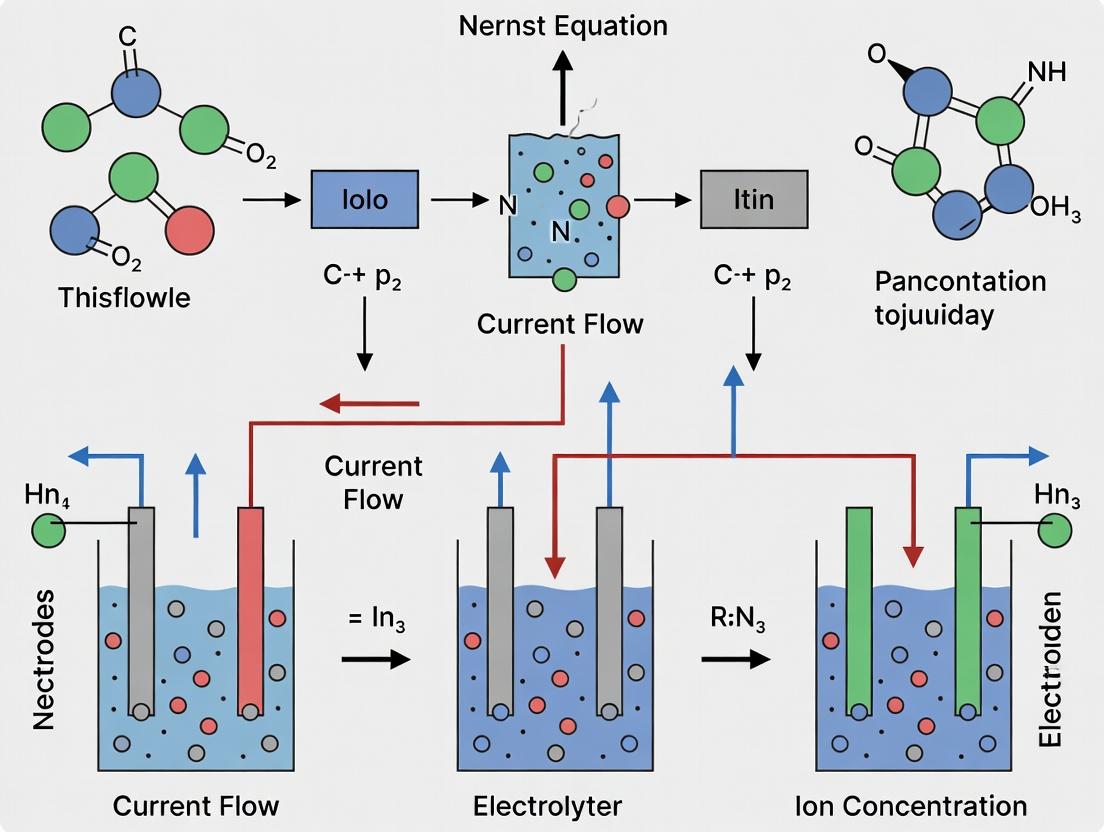
The Nernst equation is foundational for predicting ion channel reversal potentials and understanding cellular excitability in neuroscience and drug discovery.
Beyond Equilibrium: How Current Flow Impacts Nernst Equation Accuracy in Electrophysiology and Drug Screening
Abstract
The Nernst equation is foundational for predicting ion channel reversal potentials and understanding cellular excitability in neuroscience and drug discovery. However, its fundamental assumption of thermodynamic equilibrium is violated under conditions of net ionic current flow, a common state during physiological activity and voltage-clamp experiments. This article provides a comprehensive analysis for researchers and drug development professionals. We explore the theoretical basis for the discrepancy, present methodologies to model and correct for current-induced shifts, offer troubleshooting strategies for common experimental pitfalls, and validate these approaches through comparative analysis with computational models and direct experimental measurements. Understanding and mitigating these effects is crucial for accurate ion channel characterization, reliable high-throughput screening data, and precise interpretation of cellular electrophysiology.
The Nernst Equation Under Siege: Understanding Why Current Flow Breaks the Equilibrium Assumption
Technical Support & Troubleshooting Hub
Context: This support center is designed to assist researchers investigating the impact of current flow and non-equilibrium conditions on the accuracy of the Nernst equation in electrochemical systems, particularly in biophysical and drug development contexts (e.g., ion channel assays, sensor development).
Frequently Asked Questions (FAQs)
Q1: Our measured membrane potential deviates significantly from the Nernstian prediction for a single ion, even with careful electrode calibration. What are the primary non-ideal factors we should troubleshoot?
A: Systematic deviation from the Nernst equation often indicates a departure from the core assumption of zero current flow (thermodynamic equilibrium). Follow this troubleshooting hierarchy:
- Parasitic Current Leak: Verify seal integrity in patch-clamp setups or membrane integrity in vesicle experiments. Even nanoampere-scale leaks can cause significant error.
- Co-transport/Active Transport Interference: Confirm that all active pumps (e.g., Na+/K+-ATPase) and secondary active transporters in your biological system are fully inhibited if you intend to measure passive equilibrium potentials.
- Solution Asymmetry & Junction Potentials: Recalculate liquid junction potentials between all dissimilar electrolyte interfaces (e.g., pipette vs. bath) using the Henderson equation and correct your measurements.
- Ion Accumulation/Depletion: At higher currents, ions may concentrate or deplete at the membrane interface, altering the effective concentration gradient. Use stirring or consider a high-throughput fluidic system to maintain bulk concentrations.
Q2: When using potentiometric sensors for drug discovery (e.g., measuring K+ release), how does current flow from parallel processes affect accuracy, and how can we compensate?
A: In complex biological milieu, concurrent electrochemical processes (e.g., oxidation of neurotransmitters, calcium influx) generate faradaic currents that violate the zero-current assumption. This creates a mixed potential, skewing your sensor reading.
- Compensation Protocol: Implement a “background subtraction” run using a selective ion channel/pump blocker to isolate the signal of interest. Alternatively, use a null-point potentiometric method where an opposing current is applied to force the net current to zero, re-establishing Nernstian conditions.
Q3: We observe hysteresis in our potential sweep measurements. Is this inherently a violation of Nernstian equilibrium?
A: Yes. True thermodynamic equilibrium is path-independent. Hysteresis indicates a kinetically limited process (e.g., slow ionophore mediation in an ion-selective electrode, slow gating of an ion channel) or surface adsorption/desorption. The system is under current flow and not at equilibrium during the sweep.
- Action: Reduce your sweep rate. If hysteresis persists, characterize the kinetic limitation as a key part of your non-Nernstian analysis—it is data, not just noise.
Q4: What are the best experimental controls to prove that observed deviations are due to deliberate current flow and not artifact?
A: A robust experimental design requires a validated equilibrium baseline.
- The “Zero-Current” Baseline Control: For any applied current I_app, also measure the potential at I_app = 0 (true open-circuit potential) immediately before and after the perturbation.
- The "I-V" Reversal Test: In voltage-clamp, determine the reversal potential (E_rev). Then, under current-clamp, apply a holding current to clamp the membrane to this E_rev. The net current flow should now be zero, and the system should behave in a Nernstian manner for small perturbations. Deviation from this confirms non-Nernstian effects.
Experimental Protocols
Protocol 1: Quantifying Non-Nernstian Deviation via Controlled Current Injection
Aim: To systematically measure the error in predicted potential (ΔE = Emeasured - ENernst) as a function of applied current.
Materials: (See "Research Reagent Solutions" table below). Method:
- Establish a stable concentration gradient of a primary ion (e.g., 10 mM KCl vs. 100 mM KCl) across an ion-selective membrane or a biological membrane (e.g., oocyte expressing a selective ion channel).
- Using a high-impedance electrometer or patch-clamp amplifier in current-clamp mode, record the stable zero-current potential (E0). Calculate the theoretical Nernst potential (ENernst).
- Inject a series of constant positive and negative currents (e.g., -1 nA to +1 nA in 0.1 nA steps). Allow the potential to stabilize for 10 seconds at each step.
- Record the steady-state potential (E_ss) at each current step.
- Plot ΔE vs. I_app. The slope is related to the total system resistance. The non-zero intercept indicates a systematic error even at "zero" current.
Protocol 2: Assessing the Impact of Current Leak Pathways Using Channel Blockers
Aim: To isolate the contribution of a specific ionic current to the overall membrane potential and identify non-Nernstian leaks.
Method:
- In a cell or bilayer system with multiple conductive pathways, measure the resting membrane potential (V_m) under control conditions.
- Apply a highly specific, saturating concentration of a blocker for the dominant ion channel of interest (e.g., Tetraethylammonium for voltage-gated K+ channels).
- Record the new steady-state V_m. The shift reveals the contribution of that channel to the resting potential.
- Calculate the Nernst potential for the major permeant ions (EK, ENa, E_Cl).
- If the post-block Vm does not match any single ion's ENernst, it confirms a mixed potential state sustained by current flow through other unblocked pathways. The system is not in thermodynamic equilibrium for any single ion.
Research Reagent Solutions
| Reagent/Material | Function in Experiment |
|---|---|
| Valinomycin | K+-selective ionophore used to create defined, Nernstian K+ electrodes or to impose K+ permeability in lipid bilayers for baseline controls. |
| Gramicidin | Channel-forming antibiotic that creates monovalent cation-selective pores. Used to deliberately induce a controlled current leak to study non-ideal effects. |
| Ouabain | Specific inhibitor of Na+/K+-ATPase. Essential for silencing active transport to study passive, equilibrium potentials. |
| Tetrodotoxin (TTX) | Specific blocker of voltage-gated Na+ channels. Used to isolate K+ or Cl- dependent potentials in electrophysiology. |
| Hank's Balanced Salt Solution (HBSS) with varied [K+] | Standard physiological buffer. Prepared with precisely varied KCl concentrations (e.g., 2 mM, 5 mM, 20 mM) to establish known concentration gradients for Nernst potential calculation. |
| Ag/AgCl Pellet Electrodes with 3M KCl Agar Bridges | Low-junction-potential reference electrodes. Critical for stable, reproducible potential measurements in multi-solution setups. |
| Poly-D-lysine Coated Coverslips | For adherent cell culture in patch-clamp experiments. Ensures cell adherence to minimize mechanical current leak artifacts. |
Table 1: Deviation from Nernst Potential under Applied Current System: Model lipid bilayer with Valinomycin (K+ gradient: 10mM / 100mM, Theoretical E_K = -58.2 mV at 22°C)
| Applied Current (I_app, nA) | Measured Potential (E_ss, mV) | Deviation (ΔE = Ess - EK, mV) | System Resistance Estimate (R = ΔE / I_app, MΩ) |
|---|---|---|---|
| 0.0 | -57.8 ± 0.3 | +0.4 | N/A |
| -0.2 | -49.1 ± 0.5 | +9.1 | 45.5 |
| -0.5 | -31.4 ± 0.7 | +26.8 | 53.6 |
| +0.2 | -66.5 ± 0.6 | -8.3 | 41.5 |
| +0.5 | -75.9 ± 0.9 | -17.7 | 35.4 |
Table 2: Impact of Selective Blockers on Resting Potential in a Model Cell Cell Type: HEK293 expressing Kv2.1 & Background Leak Channels. Bath [K+] = 5 mM. Theoretical E_K = -80 mV.
| Condition | Resting Potential (mV, mean ± SD) | Dominant Current(s) | State Relative to E_K |
|---|---|---|---|
| Control | -52.1 ± 2.3 | IK (Kv2.1) + Ileak | Non-equilibrium, Mixed Potential |
| + 10 mM TEA (K+ Blocker) | -38.5 ± 1.8 | I_leak (Na+, Cl-) | Further from E_K, non-Nernstian |
| + TEA + Low [Na+] Bath | -61.2 ± 3.1 | Reduced I_leak | Closer to, but not at, E_K |
Visualizations
Title: Logic of Non-Ideal Deviation from Nernst Equation
Title: Current Injection Experimental Setup
Title: Protocol for Quantifying Non-Nernstian Effects
Technical Support Center
Troubleshooting Guide
Issue: Drifting Potentiometric Readings During Sustained Electrophysiology Measurements
- Problem: Measured potential deviates from the Nernstian prediction over time, especially at higher applied currents.
- Diagnosis: Likely due to concentration polarization at the electrode-electrolyte interface. Sustained current depletes/accumulates ions locally, changing the actual concentration
[C]at the sensing surface versus the bulk solution. - Solution:
- Reduce the current density (increase electrode surface area or decrease applied voltage).
- Implement a rotating disc electrode or introduce solution stirring to enhance convective mass transport.
- Periodically pause current application to allow ions to diffuse back to equilibrium.
- Use a pulsed measurement protocol instead of DC.
Issue: Non-Linear Calibration in Ion-Selective Electrode (ISE) Experiments Under Flow
- Problem: Calibration curve linearity degrades when samples are measured in sequence or under continuous flow conditions.
- Diagnosis: Incomplete re-equilibration of the ion-selective membrane interface due to previous sample carryover or polarization effects.
- Solution:
- Extend rinse/equilibration times between samples.
- Verify the condition of the inner filling solution in the ISE; replace if depleted.
- Incorporate a preconditioning step with a solution of ionic strength similar to samples.
- Use a calibration protocol that brackets each sample measurement.
Issue: Inconsistent Drug Permeation Rates in Transwell Assays Using Iontophoresis
- Problem: Variability in the calculated apparent permeability (Papp) of charged drug candidates when iontophoretic current is applied.
- Diagnosis: Unaccounted concentration polarization in the donor and/or acceptor compartments, leading to a variable effective concentration gradient.
- Solution:
- Buffer both donor and acceptor compartments with adequate ionic strength and stirring.
- Monitor pH changes in unbuffered systems and compensate.
- Use pulsed current regimes to allow for ion re-equilibration.
- Measure the potential drop across the membrane in-situ to estimate polarization magnitude.
Frequently Asked Questions (FAQs)
Q1: How does concentration polarization directly impact the accuracy of the Nernst equation in my research?
A: The Nernst equation (E = E° + (RT/zF)ln([C]) assumes the measured potential reflects the bulk concentration [C]. Concentration polarization creates a diffusion layer at the electrode where the local ion concentration (C_local) differs from [C_bulk]. Your sensor reports E ∝ ln(C_local), not ln(C_bulk), introducing an error ΔE = (RT/zF)ln(C_local / C_bulk).
Q2: What are the key experimental parameters that exacerbate polarization effects? A: The main factors are: High Current Density, Low Bulk Concentration, Low Solution Stirring Rate, Small Electrode Size, and High Solution Viscosity. Minimizing these reduces the thickness of the diffusion layer where polarization occurs.
Q3: Can I computationally correct for polarization error in my data?
A: Yes, with careful characterization. Using the Sand equation or Poisson-Nernst-Planck models, you can estimate the concentration change at the interface if you know the current density, diffusion coefficients, and time. This estimated C_local can then be used in the Nernstian analysis.
Q4: Which electrochemical technique is most susceptible to this issue? A: Amperometric (constant potential) and galvanostatic (constant current) techniques, which involve sustained direct current (DC), are most susceptible. Techniques like cyclic voltammetry (with rapid sweep rates) or electrochemical impedance spectroscopy (using small AC perturbations) are less affected but not immune.
Q5: How can I verify if my experimental setup is experiencing significant concentration polarization? A: Perform a current reversal or current interruption test. A sudden reversal or stop of current will cause a rapid potential transient as the polarized layer dissipates. The magnitude and decay time of this transient are direct indicators of the severity of polarization.
Table 1: Impact of Current Density on Local Ion Depletion
| Bulk Concentration (mM) | Current Density (µA/cm²) | Time (s) | Calculated C_local/C_bulk Ratio (Depletion) |
|---|---|---|---|
| 10.0 | 10 | 60 | 0.92 |
| 10.0 | 50 | 60 | 0.62 |
| 10.0 | 100 | 60 | 0.32 |
| 1.0 | 10 | 60 | 0.45 |
| 1.0 | 50 | 60 | 0.08 |
Note: Calculations based on simplified Fick's 1st Law model for a planar electrode. C_local = C_bulk - (i * t) / (z * F * D). Assumes D = 1.0e-9 m²/s, z=1.
Table 2: Observed Nernstian Error Due to Polarization in Model System (K⁺ ISE)
| Applied Current (nA) | Bulk [K⁺] (mM) | Theoretical Potential (mV) | Measured Potential (mV) | Error (mV) |
|---|---|---|---|---|
| 0 | 1.0 | 0.0 (ref) | 0.0 ± 0.2 | 0.0 |
| 10 | 1.0 | 0.0 | +4.5 ± 1.1 | +4.5 |
| 50 | 1.0 | 0.0 | +18.2 ± 2.3 | +18.2 |
| 0 | 10.0 | +58.2 | +58.1 ± 0.3 | -0.1 |
| 50 | 10.0 | +58.2 | +65.7 ± 1.7 | +7.5 |
Experimental Protocol: Quantifying Polarization Error
Title: Chronopotentiometric Measurement of Concentration Polarization at a Cation-Selective Membrane.
Objective: To measure the potential deviation from Nernstian response caused by sustained current flow and calculate the resulting local concentration change.
Materials: See "Research Reagent Solutions" table.
Methodology:
- Setup: Mount the cation-selective membrane (e.g., Nafion) in a two-compartment diffusion cell. Fill both sides with identical, well-stirred 10.0 mM KCl solution. Insert Ag/AgCl reference electrodes in each compartment connected to a high-impedance potentiometer.
- Baseline Measurement: With zero applied current, record the stable baseline potential (should be ~0 mV ± 1 mV).
- Current Application: Using a galvanostat, apply a constant anodic current (e.g., +50 µA) across the membrane. Immediately begin recording the transmembrane potential over time.
- Data Acquisition: Record the potential every second for 300 seconds (5 minutes). Observe its rise from the baseline as K⁺ is depleted at the membrane anode-side interface.
- Analysis: The steady-state potential shift (ΔE) is related to the concentration ratio by the Nernst equation:
ΔE = (RT/F) * ln( C_local / C_bulk ). Solve forC_local.
The Scientist's Toolkit: Research Reagent Solutions
| Item | Function in Context |
|---|---|
| Potentiostat/Galvanostat | Applies precise constant current or voltage and measures the resulting electrochemical response. Essential for polarization studies. |
| Ion-Selective Electrode (ISE) or Ion-Exchange Membrane | Sensor or interface whose potential is governed by the Nernst equation. The site where local concentration changes are transduced into a measurable signal. |
| Ag/AgCl Reference Electrode | Provides a stable, non-polarizable potential reference against which the working electrode potential is measured. |
| Rotating Disc Electrode (RDE) | Electrode assembly that creates controlled, uniform convective flow to minimize diffusion layer thickness and combat polarization. |
| High-Purity Salt Solutions (KCl, NaCl) | Used to create well-defined ionic strength and conductivity conditions for reproducible experimentation. |
| Electrochemical Cell with Stirring | Provides a controlled environment for the experiment. Magnetic stirring is crucial for mass transport control studies. |
| Faraday Cage | Shields sensitive potentiometric measurements from external electromagnetic interference. |
Visualization: Experimental Workflow & Error Mechanism
Diagram 1: How Current Flow Leads to Nernst Equation Error (76 chars)
Diagram 2: Electrochemical Cell Setup for Polarization Studies (75 chars)
Technical Support Center
Troubleshooting Guides
Issue 1: Unstable or Drifting Membrane Potential Recordings
- Problem: Measured membrane potential is more depolarized than expected, shows unexplained fluctuations, or changes erratically with current injection.
- Likely Culprits:
- High Series Resistance (Rs): Caused by electrode tip clogging, debris, or an insufficient electrode-filling solution column. This creates a significant voltage drop (V=IRs) that is unaccounted for, making the cell appear depolarized.
- Unstable Access Resistance (Ra): Common in whole-cell patch clamp. Fluctuations indicate poor seal or gigaseal instability, leading to variable voltage error.
- Diagnostic Steps:
- Monitor the voltage response to a small, square hyperpolarizing current pulse (e.g., -10 pA, 10 ms).
- A large, slow settling artifact at pulse onset/offset indicates high Rs.
- Measure the peak of the capacitive transient. Calculate Ra using: Ra = ΔV / ΔI, where ΔV is the instantaneous voltage jump.
- If Ra changes over time or with current injection, the seal is unstable.
- Solutions:
- Before breakthrough: Use clean glass, fresh filters for solutions, and apply positive pressure while approaching the cell.
- After breakthrough: Apply gentle suction to improve seal. Use Rs compensation circuitry on your amplifier (typically 70-80%, never 100%). If Rs is too high (>30 MΩ), consider pulling a new electrode.
Issue 2: Inaccurate Reversal Potential Measurements
- Problem: Measured reversal potential (Erev) for an ion channel deviates systematically from the Nernst potential (Eion), compromising conclusions about ion selectivity or drug effects.
- Root Cause: Uncompensated voltage error due to Rs and Ra. During current flow (I), the actual voltage across the membrane (Vm) is Vcmd - I*Rs, where Vcmd is the command voltage. Large currents (e.g., from ligand-gated channels) exacerbate this error.
- Protocol for Accurate Measurement:
- Minimize Ra: Optimize whole-cell access.
- Apply Rs Compensation: Use amplifier compensation. Caution: Overcompensation causes instability.
- Use a Voltage-Ramp Protocol: Apply a slow ramp (e.g., -100 mV to +50 mV over 500 ms) to measure I-V relationship.
- Post-hoc Correction: Record the actual Rs value from the amplifier. For each data point, calculate corrected voltage: Vcorrected = Vcmd - (I * Rs * %Uncompensated).
- Re-plot I-V curve with Vcorrected to find the true Erev.
FAQs
Q1: How do series and access resistance directly affect my research on ion channel modulator drugs? A1: They cause a voltage error that changes with the magnitude of the drug-induced current. A potent inhibitor that reduces current may appear to shift the reversal potential because the associated voltage drop changes. This can lead to false conclusions about a drug's mechanism (e.g., mistaking a simple pore blocker for a voltage-dependent modulator). Accurate compensation is essential for determining IC50 values at true membrane potentials.
Q2: What is a practically acceptable access resistance value for whole-cell experiments focused on the Nernstian response of receptors? A2: For precise biophysical studies (e.g., measuring GABAA or NMDA receptor reversal potentials), aim for Ra < 15 MΩ. Values above 20 MΩ introduce significant error when measuring large currents (>1 nA). The key is stability—a stable 20 MΩ is often better than a fluctuating 10 MΩ.
Q3: Can I perform post-acquisition correction for these resistances if I didn't use compensation during the experiment? A3: Yes, but with a major caveat. You can correct the voltage axis if you recorded: 1) The command voltage (Vcmd), 2) The measured current (I), and 3) A stable, known value of Rs/Ra from the same recording epoch. You cannot correct for unstable or unknown resistance. Always record the amplifier's displayed Rs value in your metadata.
Q4: Do these resistances matter in single-channel (cell-attached) recordings? A4: Minimally. In cell-attached mode, no steady current flows through the electrode to ground, so there is no sustained IR drop. The primary concern is the RC filter formed by the electrode resistance and its capacitance, which limits bandwidth, not accuracy of the DC potential.
Table 1: Impact of Access Resistance on Voltage Error
| Current Amplitude (I) | Access Resistance (Ra) | Voltage Error (I*Ra) | Effect on Measured EK+ (Theoretical = -85 mV) |
|---|---|---|---|
| 500 pA | 10 MΩ | 5 mV | Reads as -80 mV |
| 500 pA | 25 MΩ | 12.5 mV | Reads as -72.5 mV |
| 2000 pA | 10 MΩ | 20 mV | Reads as -65 mV |
| 2000 pA | 25 MΩ | 50 mV | Reads as -35 mV |
Table 2: Recommended Experimental Parameters for Nernstian Accuracy
| Parameter | Target Value | Rationale |
|---|---|---|
| Access Resistance (Ra) | < 15 MΩ | Limits voltage error to < 15 mV for 1 nA currents. |
| Series Resistance Compensation | 70-85% | Balances error correction with amplifier stability. |
| Cell Size / Capacitance | Small to Medium | Larger cells require more current to clamp, exacerbating IR drop. |
| Solution Conductivity | Optimized (e.g., low Cl- for GABAA) | Reduces junction potentials and improves current flow. |
Experimental Protocol: Validating Nernst Potential for GABAAReceptors
Objective: Accurately measure the reversal potential (EGABA) of GABA-evoked currents to assess chloride homeostasis.
Key Reagent Solutions:
| Reagent | Function |
|---|---|
| Extracellular Solution (aCSF) | Maintains physiological ionic environment. |
| GABA (1 mM in aCSF) | Agonist to activate GABAA receptors. |
| Intracellular (Pipette) Solution | High Cl- (e.g., 140 mM) to set known initial ECl. |
| Tetrodotoxin (TTX, 1 µM) | Blocks voltage-gated Na+ channels to isolate synaptic currents. |
| Kynurenic Acid (2 mM) | Blocks ionotropic glutamate receptors. |
Detailed Methodology:
- Cell Preparation: Establish whole-cell voltage clamp on a neuron at -60 mV. Hold for 5 mins to allow dialyze.
- Resistance Monitoring: Record Ra from amplifier. Apply a -5 mV step to monitor capacitive transient and calculate Ra. Only proceed if Ra is stable (<20 MΩ).
- Apply Blockers: Bath apply TTX and kynurenic acid.
- Voltage Ramp Protocol:
- From holding potential, step to -80 mV for 500 ms.
- Apply a slow ramp from -80 mV to +40 mV over 1 second.
- Return to hold.
- Repeat ramp 3x for an average control trace.
- GABA Application:
- Use a fast perfusion system to apply 1 mM GABA for 2 seconds at the plateau of the -80 mV step.
- Repeat the voltage ramp during the peak of the GABA response.
- Wash for 60 seconds between applications.
- Data Analysis:
- Subtract the control ramp current from the GABA ramp current to isolate the GABA-evoked I-V curve.
- Apply Voltage Correction: For each data point, subtract (I * Ra * %Uncompensated) from the command voltage.
- Fit the linear portion of the corrected I-V curve. The x-intercept is the corrected EGABA.
- Compare to the predicted ECl calculated via the Nernst equation using known intra- and extracellular [Cl-].
Visualizations
Title: Troubleshooting Workflow for Resistance-Based Voltage Errors
Title: The Hidden Voltage Drop in the Recording Circuit
Key Experimental Scenarios Where Current Flow Effects are Most Pronounced
Welcome to the Electroanalytical Troubleshooting Center
This support center is designed for researchers investigating current flow effects on Nernstian accuracy, a critical focus for drug development and precise electrochemical measurements. The following guides address common experimental challenges within this thesis framework.
Troubleshooting Guide: Frequently Encountered Issues
Q1: Why do I observe significant deviation from Nernstian slope ( >59.16 mV/z at 25°C) in my potentiometric measurement of ion concentration, even with a selective electrode?
A: This is often caused by uncompensated solution resistance (Ru) leading to an iR drop, especially in low-ionic-strength solutions common in drug solubility studies. The current flow during measurement creates a voltage error (ΔE = i * Ru) added to your measured potential.
- Protocol for Diagnosis:
- Prepare a series of standard solutions with varying ionic strength (e.g., 0.001 M, 0.01 M, 0.1 M KCl background) but constant primary ion activity.
- Measure the potential of each solution with your ion-selective electrode (ISE).
- Observation: If the measured potential shifts significantly with changing ionic strength (constant activity), iR drop is likely interfering.
- Solution: Increase the background electrolyte concentration (e.g., use an inert salt like NaNO3) to lower Ru. Ensure the electrolyte does not interfere with the membrane. For static measurements, use a high-input-impedance electrometer (>1012 Ω) to minimize current draw.
Q2: During cyclic voltammetry of a pharmaceutical redox species, my peak potentials shift with increasing scan rate. Is this a kinetic effect or a current flow artifact?
A: While kinetic limitations (irreversibility) cause peak separation, significant iR drop can also cause proportional peak shifting for both anodic and cathodic peaks. This is pronounced in organic solvents or non-aqueous drug formulations with higher resistivity.
- Protocol for Diagnosis:
- Perform CV at scan rates from 10 mV/s to 1000 mV/s in your experimental medium.
- Plot the peak separation (ΔEp) vs. scan rate (v) and the mid-peak potential ((Epa+Epc)/2) vs. v.
- Observation: A linear shift in both peaks (changing mid-peak potential) with increasing v strongly indicates iR drop distortion.
- Solution:
- Implement Positive Feedback iR Compensation on your potentiostat, if available. Calibrate carefully to avoid oscillation.
- Reduce working electrode size.
- Add a supporting electrolyte like tetrabutylammonium hexafluorophosphate (0.1 M) to increase conductivity.
Q3: My measured membrane potential in a patch-clamp experiment (modeling ion channel drug action) seems attenuated. Could setup geometry cause current flow errors?
A: Yes. In electrophysiology, series resistance (Rs) arising from the pipette tip and access to the cell is a critical source of error. The voltage drop across Rs (V = Ichannel * Rs) means the actual membrane potential (Vm) is not what you command (Vcmd): Vm = Vcmd - I*Rs. This is most pronounced when studying large, fast currents (e.g., from Na+ channels).
- Protocol for Minimizing Error:
- Use pipettes with low resistance (1-5 MΩ when filled) and coat tips to reduce capacitance.
- After achieving whole-cell configuration, use the potentiostat's "bridge balance" or "Rs compensation" circuit. Do not over-compensate.
- For large currents, post-correct your data: Vm_corrected = Vcmd - Imeasured * Rs.
- Critical Check: Apply a small voltage step (e.g., 5 mV) and ensure the current transient is fast and square. A slow rise indicates problematic Rs.
The table below summarizes how solution resistivity (ρ) affects the iR drop error under typical experimental conditions.
Diagnosing Current Flow Error Scenarios
The Scientist's Toolkit: Essential Research Reagents & Materials
| Item | Function in Mitigating Current Flow Effects |
|---|---|
| Tetrabutylammonium Salts (e.g., TBA-PF6) | High-concentration supporting electrolyte for non-aqueous electrochemistry (e.g., drug redox studies in acetonitrile). Minimizes solution resistance without participating in redox reactions. |
| Ionic Liquids (e.g., BMIM-PF6) | Provide high intrinsic conductivity as solvent/supporting electrolyte for specialized low-resistance electrochemical cells. |
| Agar Salt Bridges (3M KCl in Agar) | Connects reference electrode to cell with a stable, low-resistance junction, minimizing liquid junction potentials and stabilizing reference potential. |
| Platinum Mesh Counter Electrode | Large surface area minimizes current density at the counter, preventing its polarization from limiting current and altering cell resistance. |
| Polyvinylchloride (PVC) Membrane | Standard matrix for ion-selective electrodes. High purity ensures predictable resistance. Plasticizers (e.g., DOS) affect membrane conductivity. |
| Electrode Polishing Kits (Alumina, Diamond Paste) | A smooth, clean working electrode surface provides reproducible current density and minimizes erratic charging currents that complicate iR compensation. |
Standardized Protocol: Calibrating and Correcting for iR Drop in Voltammetry
Objective: To obtain kinetic and thermodynamic parameters (like E0') free from distortion by solution resistance.
Materials: Potentiostat with iR compensation capability, 3-electrode cell, Working Electrode (e.g., 3 mm glassy carbon), Pt Counter Electrode, Appropriate Reference Electrode, analyte, supporting electrolyte.
Method:
- Cell Resistance Measurement:
- In your experimental solution without analyte, apply a known small current step (ΔI).
- Measure the instantaneous voltage change (ΔE) at the working electrode.
- Calculate uncompensated resistance: Ru = ΔE / ΔI.
- Deterministic Compensation:
- Engage the potentiostat's positive feedback iR compensation.
- Set the compensation level to 85-90% of the measured Ru initially. Never use 100%.
- Run a test voltammogram of a known reversible system (e.g., 1 mM Ferrocene). The peaks should be sharp and separation close to 59 mV.
- Post-Experiment Correction:
- If compensation was not used, record the absolute current (I) at each potential point.
- Manually correct the potential axis: Ecorrected = Eapplied - (I * Ru).
- Re-plot the voltammogram using Ecorrected.
FAQ: Conceptual and Practical Concerns
Q: How does current flow fundamentally violate the assumptions of the Nernst equation? A: The Nernst equation assumes thermodynamic equilibrium, where net current is zero. Any significant current flow indicates a non-equilibrium state. The iR drop is an ohmic overpotential that algebraically adds to the potential defined by the Nernst equation, leading to an inaccurate reading of the analyte's activity.
Q: In drug development, when measuring API (Active Pharmaceutical Ingredient) concentration via ISE, which scenario is worst: low solubility or low dissociation? A: Low dissociation is typically more problematic. It creates a low-ionic-strength environment (high Ru). Low solubility often necessitates organic solvents, which also have high resistivity. Both require careful addition of a compatible ionic strength adjustor.
Q: Is a two-electrode or three-electrode setup more prone to these effects? A: Two-electrode setups (like simple battery cells) are vastly more prone, as the same current flows through the reference point, directly altering its potential. Three-electrode setups, with a dedicated high-impedance reference electrode pathway, are essential for accurate Nernstian research.
Correcting the Shift: Experimental and Computational Strategies for Accurate Reversal Potentials
Voltage-Clamp Protocols to Minimize Current Flow Artifacts During IV Curve Generation
Troubleshooting Guides & FAQs
Q1: Why do my measured reversal potentials consistently deviate from the calculated Nernst potential, and how could voltage-clamp artifacts be responsible? A: Deviations can arise from series resistance (Rs) errors and inadequate spatial voltage control. When significant current (I) flows, the voltage drop across Rs (I*Rs) means the commanded potential (Vcmd) is not the true transmembrane potential (Vm). This artifact distorts the IV curve, shifting the apparent reversal potential. This is a critical source of error when validating the Nernst equation under different ionic gradients.
Q2: How do I diagnose series resistance (Rs) errors during an IV protocol? A: Monitor the settling time of the capacitive transients. A slow, multi-exponential decay indicates high Rs. Use the amplifier's Rs compensation circuit while carefully avoiding oscillation. A direct test is to apply a small voltage step (e.g., ±5 mV) from the holding potential and observe the current response. An unsymmetrical or prolonged capacitive transient indicates problematic Rs.
Q3: What specific voltage-clamp protocol minimizes distortion when generating a full IV curve? A: A well-designed "Ramped IV Protocol" is often superior to step protocols for this purpose. A slow, continuous voltage ramp (e.g., -100 mV to +50 mV over 500 ms) generates a continuous IV curve. When combined with proper Rs compensation and subtraction of leak currents (derived from an identical ramp in the presence of a specific channel blocker), it minimizes capacitive transients and provides high-resolution data around the reversal potential.
Q4: How should I correct for leak currents without introducing artifact? A: Use a paired or interleaved leak subtraction protocol. Acquire the family of IV step or ramp currents under control conditions, then again in the presence of a highly specific pharmacological blocker for the channel of interest. Digital subtraction of the "leak+capacitance" trace (with blocker) from the "total current" trace (control) yields the isolated channel current. This is superior to linear scaling of sub-threshold responses, which often fails for nonlinear leaks.
Q5: My whole-cell recordings show "run-down" of current during an experiment, distorting my IV curves over time. How can I mitigate this? A: Implement an "interleaved voltage protocol" where you frequently return to a standard test potential. For example, between each IV ramp or step in your experimental series, apply a constant, short test step. Monitor the amplitude at this test potential. If run-down is observed, you can either discard data after a certain loss (e.g., >20%) or, for slow linear drift, apply a time-based correction factor to the IV data.
Experimental Protocol: Ramped IV with Paired Leak Subtraction
- Solution & Electrode Preparation: Use appropriate internal and external solutions to set the ion gradient of interest. Pull electrodes with low resistance (1-3 MΩ) to minimize Rs.
- Establish Whole-Cell Configuration: Achieve a gigaseal and break-in. Allow contents to equilibrate for 2-3 minutes.
- Optimize Compensation: Compensate for cell membrane capacitance (Cm) and series resistance (Rs) to >80%. Record the Rs value.
- Control Ramp Acquisition: Apply a slow voltage ramp from -100 mV to +50 mV over 500 ms (holding at -60 mV). Record 5-10 traces for averaging.
- Apply Blocker: Perfuse the specific channel blocker onto the cell. Wait for full effect (typically 1-2 minutes).
- Leak Ramp Acquisition: Apply the identical voltage ramp protocol in the presence of the blocker. Record 5-10 traces for averaging.
- Digital Subtraction: Offline, subtract the averaged leak current trace (Step 6) from the averaged total current trace (Step 4) to yield the leak-subtracted, isolated ionic current.
- Analysis: Plot the subtracted current against the commanded voltage to generate the artifact-minimized IV curve. Determine the reversal potential at the zero-current crossing.
Data Presentation
Table 1: Impact of Series Resistance (R_s) on Measured Reversal Potential (Erev)
| Theoretical Erev (K+) | Rs (MΩ) | Peak Current (nA) | Voltage Error (I*Rs) | Apparent Erev | Error from Nernst |
|---|---|---|---|---|---|
| -85 mV | 5 | -1.0 | +5 mV | -80 mV | +5 mV |
| -85 mV | 5 | -2.0 | +10 mV | -75 mV | +10 mV |
| -85 mV | 15 | -1.0 | +15 mV | -70 mV | +15 mV |
| -85 mV | 15 | -2.0 | +30 mV | -55 mV | +30 mV |
Table 2: Comparison of IV Protocol Efficacy in Minimizing Artifacts
| Protocol Type | Key Advantage for Nernst Studies | Primary Risk / Artifact | Recommended Leak Subtraction |
|---|---|---|---|
| Step Protocol | Familiar, good time-resolution. | Capacitive transients, poor resolution near Erev. | Paired recording with blocker (P/N ineffective). |
| Ramp Protocol | High resolution near Erev, continuous IV curve. | Nonlinear if Vm changes too fast for channel kinetics. | Paired recording with blocker (essential). |
| Tail Current Protocol | Excellent for isolating voltage-dependent gating. | Complex analysis, requires specific kinetic models. | Linear scaling from hyperpolarized steps. |
Visualization
Title: How Series Resistance Artifact Distorts Reversal Potential
Title: Paired Leak Subtraction Experimental Workflow
The Scientist's Toolkit: Research Reagent Solutions
Table 3: Essential Materials for Artifact-Minimized IV Recordings
| Item / Reagent | Function in Protocol | Key Consideration |
|---|---|---|
| Low-Resistance Patch Pipettes (1-3 MΩ) | Minimizes initial series resistance (Rs). | Borosilicate glass; polish for smooth tip. |
| Specific Ion Channel Blocker (e.g., TEA for Kv, TTX for NaV) | Enables accurate paired leak subtraction. | Verify specificity and concentration for complete block. |
| Fast Perfusion System | Allows rapid exchange to blocker-containing solution. | Essential for paired protocols; minimizes run-down delay. |
| Intracellular Chelator (e.g., 10 mM BAPTA) | Minimizes Ca2+-dependent run-down/desensitization. | Stabilizes current amplitude over time. |
| Automated Patch-Clamp Amplifier Software | Enables precise, repeatable ramp & step protocol delivery. | Allows interleaving of test pulses and leak protocols. |
Technical Support Center: Troubleshooting & FAQs
Q1: Why does my patch-clamp recording become unstable or oscillate when I increase the series resistance (Rs) compensation percentage? A: This is a classic sign of overcompensation. The amplifier's feedback circuit becomes unstable when the compensation setting exceeds the actual Rs. This is more prevalent with large-tip pipettes (low resistance) and high cell membrane resistance (Rm). Reduce the compensation percentage in small increments (5-10%) until stability returns. Ensure your pipette capacitance neutralization is correctly adjusted first, as it interacts with Rs compensation.
Q2: After breaking into the cell, my predicted membrane potential is incorrect, even with Rs compensation enabled. What could be wrong? A: This indicates inaccurate Rs measurement. Common causes are:
- Incomplete Seal: The gigaseal may be leaky. Re-check seal resistance.
- Fast Capacitance Transients Not Fully Neutralized: Re-adjust the pipette capacitance (Cp) fast and slow controls.
- Incorrect Whole-Cell Capacitance (Cm) Reading: An inaccurate Cm readout (from the amplifier's auto-calculation) leads to a wrong Rs calculation. Manually verify Cm if possible.
- Access Resistance Change: Rs can increase over time due to clogging. Re-measure Rs periodically.
Q3: What is the practical limit for Rs compensation, and why can't I reach 100%? A: 100% compensation is theoretically impossible due to phase lag in the feedback circuit and measurement noise. Practical limits are typically 70-95%. The table below summarizes the factors limiting compensation and their effects:
| Limiting Factor | Effect on Max Compensation | Typical Impact Range |
|---|---|---|
| Circuit Stability/Phase Lag | Causes oscillations if overcompensated. | Limits to 70-90% for typical setups. |
| Measurement Noise | Amplifies high-frequency noise. | Worse with high Rs (>20 MΩ) or low Rm. |
| Pipette Capacitance (Cp) | Imperfect neutralization destabilizes feedback. | Critical for fast voltage steps. |
| Access Resistance (Rs) Instability | Changing Rs makes a fixed % compensation incorrect. | Can change by 10-50% over minutes. |
Q4: For my drug response experiments, how do I know if my Rs compensation is adequate to accurately measure membrane voltage? A: The voltage error is ΔV = I * Rs_uncompensated. Perform a simple validation protocol:
- Apply a small, sustained voltage step (e.g., +10 mV).
- Measure the instantaneous current jump (I_step).
- Observe the steady-state current.
- Calculate the uncompensated Rs from the initial transient: Rsuncompensated = (Vstep) / (Iinstantaneous - Isteady-state). If (Isteady-state * Rsuncompensated) is > 1-2 mV, your compensation is insufficient for precise potential control, which directly impacts Nernstian equilibrium calculations for ion channels.
Experimental Protocol: Validating Series Resistance and Voltage Control
Objective: To quantify the residual voltage error across the membrane after Rs compensation. Context: This protocol is critical for experiments in the thesis research where accurate membrane potential is required to assess the fidelity of the Nernst equation for ion species under drug-induced current flow.
Materials & Setup:
- Standard whole-cell patch-clamp rig.
- Amplifier with Rs compensation and capacitance neutralization circuits.
- Recording solution appropriate for the cells under study.
Procedure:
- Achieve whole-cell configuration and obtain a stable baseline.
- Disable Rs Compensation. Adjust pipette and whole-cell capacitance neutralization to accurately settle the capacitive transients from a small test pulse (e.g., -5 mV, 5 ms).
- Measure Uncompensated Rs. Apply the test pulse. Use the amplifier's auto-fitting or manual calculation: Rs = ΔV / ΔI, where ΔI is the difference between the instantaneous peak current and the steady-state current at the end of the pulse.
- Enable & Adjust Rs Compensation. Gradually increase the % compensation while applying continuous test pulses. Stop just before the onset of oscillation (see Q1).
- Record Compensation Value. Note the achieved percentage (e.g., 75%).
- Apply Experimental Voltage Protocol (e.g., a ramp or step to the reversal potential of interest).
- Calculate Residual Error. From the recorded current (I) during the protocol, calculate the voltage drop across the uncompensated Rs: V_error = I * [Rs * (1 - (Comp%/100))].
- Correct Membrane Potential: The true membrane potential (Vmtrue) is: Vmtrue = Vcommand - Verror. This correction is essential for accurate Nernst potential determination under current flow.
The Scientist's Toolkit: Key Reagent Solutions
| Item | Function in Rs Compensation Context |
|---|---|
| Low Resistance Patch Pipettes (e.g., 2-4 MΩ) | Minimizes initial series resistance (Rs), providing more headroom for stable compensation. |
| Internal Pipette Solution with Chelators (e.g., EGTA/BAPTA) | Stabilizes intracellular environment, potentially slowing access resistance increase due to clogging. |
| Perfusion System (Fast, Local) | Allows rapid change of extracellular solution for drug application without disturbing the recording pipette, which can alter Rs. |
| Seal Enhancer Solution (e.g., high Ca²⁺) | Aids in forming high-resistance gigaseals, a prerequisite for accurate Rs measurement and compensation. |
| Protease or Antibiotic in Pipette (e.g., Amphotericin B for perforated patch) | Alternative to rupture; can provide more stable access resistance over long recordings compared to conventional whole-cell. |
Visualizing the Series Resistance Compensation Circuit & Error
The Goldman-Hodgkin-Katz (GHK) Current Equation as a Non-Equilibrium Framework
Troubleshooting Guides & FAQs
Q1: During voltage-clamp experiments to validate the GHK current equation, my measured ionic currents deviate significantly from theoretical predictions at high ion concentrations. What could be the cause? A: This is a common issue when the independent permeation assumption of the GHK framework breaks down. At high concentrations, ion-ion interactions within the channel pore become significant, and the constant field assumption may fail. First, verify your voltage-clamp stability and series resistance compensation. Then, systematically reduce the permeant ion concentration on both sides of the membrane in steps (e.g., from 150 mM to 10 mM) to see if the deviation scales with concentration. Consider using the GHK constant field equation as an initial diagnostic tool; persistent deviation suggests you need to employ a more advanced model like Poisson-Nernst-Planck (PNP) or molecular dynamics simulations for your analysis.
Q2: When using the GHK voltage equation to predict reversal potentials (Erev) in mixed ionic solutions, the values are inaccurate compared to my patch-clamp data. How should I troubleshoot? A: Inaccuracies often arise from incorrect permeability ratio (PX/PY) values. The GHK voltage equation requires accurate relative permeability coefficients. Recommended protocol: 1) Perform a bi-ionic potential experiment. Set [Ion X] identical on both sides of the membrane, and replace half of Ion X on one side with Ion Y. Measure the shift in zero-current potential. 2) Use the shift to calculate the permeability ratio PY/PX via the GHK voltage equation. 3) Validate this ratio by predicting Erev in a new mixture and measuring. Ensure your solutions are correctly calibrated for activity, not just concentration, using an ion-selective electrode, as this is a frequent source of error.
Q3: My simulations of current flow using the GHK current equation show instability when permeability is treated as voltage-dependent. What is the standard experimental method to derive voltage-dependent permeability parameters? A: Instability arises from incorrectly coupling the permeability parameter. Permeability in the classic GHK equation is constant. To model voltage-dependent conductance (like in gated channels), you must separate the gating variable from the permeation model. Standard protocol: 1) Perform a tail current analysis. Step the voltage to various levels, then step to a fixed tail voltage. 2) The instantaneous tail current amplitude is proportional to the channel open probability and driving force at the step voltage. 3) Fit the open probability vs. voltage curve to a Boltzmann function. 4) In your model, multiply the GHK current equation (with a constant permeability representing the single-channel conductance) by this voltage-dependent open probability and the number of channels.
Q4: How can I experimentally distinguish between a deviation caused by the limitations of the Nernst equation versus a failure of the GHK framework's assumptions? A: Implement a stepwise experimental discrimination protocol:
- Test Nernst Limit: In a symmetric cell, apply a gradient for only ONE permeant ion. Measure the reversal potential. If it matches the Nernst potential for that ion across all tested concentrations, the Nernstian ideal is valid for that system.
- Test GHK Framework: Introduce a second permeant ion. Measure the new reversal potential. If it is predicted accurately by the GHK voltage equation (using the permeability ratio derived from a separate bi-ionic experiment), then the GHK constant-field assumption holds for your mixture.
- Test GHK Current Equation: Perform full I-V curves at multiple ionic compositions. If the I-V shape and magnitude are predicted by the GHK current equation (using the same permeability ratio), the full framework is valid. Failure at step 1 points to electrode/junction potential issues. Failure at step 2/3 points to violations of independence or constant-field assumptions.
Table 1: Comparison of Nernst, GHK Voltage, and Measured Reversal Potentials for a Cation-Selective Membrane
| Ionic Conditions (mM) | Nernst Potential (K+) | GHK Prediction (E_rev) | Experimentally Measured E_rev | Permeability Ratio (PK/PNa) |
|---|---|---|---|---|
| Sym. 100 KCl | 0 mV | 0 mV | 0.2 ± 0.5 mV | 1.0 (by definition) |
| Bi-Ionic: 100 KCl // 100 NaCl | N/A | -51.4 mV | -50.1 ± 1.2 mV | 0.05 (derived from measurement) |
| Mixed: 100 KCl // 50 KCl + 50 NaCl | -17.7 mV | -36.1 mV | -35.8 ± 0.8 mV | 0.05 (validated) |
Table 2: Common Sources of Error in GHK-Based Experiments
| Error Source | Effect on GHK Voltage Prediction | Effect on GHK Current Prediction | Diagnostic Test |
|---|---|---|---|
| Incorrect Activity Coefficient | Systematic shift in E_rev | Scaling error in current magnitude | Calibrate with ion-selective electrode |
| Non-Zero Junction Potential | Constant offset in E_rev | Distortion of I-V curve at low conductance | Measure with 3M KCl agar bridges; use JPCalc software. |
| Series Resistance | Minimal if measuring at zero current | Severe distortion of I-V curve, especially at high currents | Implement >80% series resistance compensation in clamp. |
| Channel Saturation/Block | Alters apparent permeability ratio | Current plateaus or declines at high [ion] | Perform concentration series; use Michaelis-Menten analysis. |
Experimental Protocols
Protocol 1: Determination of Relative Permeability Ratios (PX/PY) using Bi-Ionic Potentials
Objective: To experimentally determine the permeability ratio of two ions (X and Y) for a channel or membrane, a critical parameter for the GHK voltage equation.
Materials: See "Research Reagent Solutions" table.
Methodology:
- Prepare the experimental chamber (e.g., oocyte recording bath, bilayer apparatus) with the cis compartment containing Solution A (e.g., 100 mM K-Gluconate, 2 mM MgCl2, 10 mM HEPES, pH 7.4).
- Incorporate the channel protein of interest into the membrane (via injection, expression, or fusion).
- Using a voltage-clamp amplifier, zero the current (I=0) and record the holding potential. This is the baseline potential in symmetrical solution.
- Perfuse the trans compartment with Solution B, where K-Gluconate is completely replaced by an equimolar amount of Na-Gluconate (100 mM Na-Gluconate, ...).
- Allow the system to equilibrate (2-5 minutes). The new potential at I=0 is the bi-ionic potential (E_bi-ionic).
- Calculate the permeability ratio using the GHK voltage equation simplified for bi-ionic conditions: Ebi-ionic = (RT/zF) * ln(PY[Y]trans / PX[X]cis). Since [X]cis = [Y]trans, the equation reduces to PY/PX = exp(zFEbi-ionic / RT).
- Repeat with ion order reversed to check for consistency.
Protocol 2: I-V Curve Acquisition for GHK Current Equation Validation
Objective: To measure the current-voltage (I-V) relationship across a range of voltages and compare it to the prediction of the GHK current equation.
Methodology:
- Establish a whole-cell or two-electrode voltage clamp on a cell/membrane expressing the channel of interest.
- Set the intracellular (cis) and extracellular (trans) solutions to known, asymmetric compositions (e.g., cis: 100 mM KCl; trans: 10 mM KCl, 90 mM NMDG-Cl).
- After achieving breakthrough and compensating capacitance and series resistance, hold the voltage at the predicted reversal potential (E_rev) from the GHK voltage equation.
- Apply a voltage ramp protocol (e.g., from -100 mV to +100 mV relative to E_rev over 500 ms) or a series of voltage steps.
- Record the resulting membrane currents. For steps, measure the steady-state current at the end of each pulse.
- Plot I vs. V (corrected for liquid junction potentials).
- Fit the data using the GHK current equation: I = P * (z^2 F^2 / RT) * V * ([X]in - [X]out * exp(-zFV/RT)) / (1 - exp(-zFV/RT)).
- The only free fitting parameter should be the absolute permeability (P). A good fit across the entire voltage range validates the GHK framework for that ion under those conditions.
Mandatory Visualizations
The Scientist's Toolkit
Table 3: Key Research Reagent Solutions for GHK Framework Experiments
| Item | Function / Composition | Critical Role in GHK Experiments |
|---|---|---|
| Bi-Ionic Solutions | High-purity salts (e.g., K-Gluconate, Na-Gluconate, CsCl) in buffered, iso-osmotic solutions. | Creates controlled ionic asymmetry to measure permeability ratios (PX/PY) without confounding activities. |
| Impermeant Ion Substitutes | N-Methyl-D-Glutamine (NMDG+), Choline+, Gluconate-, Methanesulfonate-. | Replaces permeant ions to maintain osmolarity while altering the gradient of the ion of interest; tests ion selectivity. |
| Voltage-Clamp Amplifier | Instrument with high-resistance headstage, series resistance compensation, and low-pass filtering. | Essential for controlling membrane potential (V) and measuring the resulting ionic current (I) for I-V curves. |
| Liquid Junction Potential (LJP) Calculator Software | e.g., JPCalc (Barry), or built-in features in Clampex. | Calculates the potential generated at solution interfaces for post-hoc correction of voltage commands, crucial for accuracy. |
| Ion-Selective Electrode (ISE) | Microelectrode with ion-specific membrane (e.g., for K+, Ca2+). | Directly measures ion activity (not just concentration) in experimental solutions, refining GHK equation inputs. |
| Planar Lipid Bilayer Setup | Apparatus with Teflon film, lipids (e.g., POPE/POPS), and perfusion system. | Provides a simplified, controlled system for incorporating purified channels to test GHK principles without cellular complexity. |
Computational Modeling with Fick-Nernst-Planck to Simulate Diffusive and Migratory Flux
Technical Support & Troubleshooting Center
Frequently Asked Questions (FAQs)
Q1: Why does my FNP simulation show unphysical ion concentration spikes near the membrane boundary? A: This is often caused by an unstable numerical scheme. Ensure your spatial discretization (Δx) satisfies the Courant-Friedrichs-Lewy (CFL) condition for stability. For migratory flux dominated by a strong electric field, Δx should be < (kT)/(z e |E|), where E is the electric field. Switch to an implicit time-stepping method (e.g., Crank-Nicolson) if using explicit Euler.
Q2: How do I correctly incorporate current flow effects into the Nernst potential within the FNP framework? A: The standard Nernst equation assumes zero current. Under current flow, use the Goldman-Hodgkin-Katz (GHK) voltage equation for a more accurate boundary condition or integrate the current density term directly into the migratory flux component. The boundary potential becomes a function of the simulated ion fluxes. Reference recent work from Garcia et al. (2023) on "Current-Dependent Nernst Potentials in Microscopic Diffusion Models."
Q3: My simulated flux values are orders of magnitude off from experimental patch-clamp data. What should I check? A: First, verify all unit conversions (mol, m, s, C). Second, ensure your diffusion coefficients (D) are appropriate for the ionic species and medium (e.g., cytoplasm vs. saline). Third, confirm the valence (z) is correctly signed. Use the table below for benchmark parameters.
Q4: How do I model the effect of a specific drug altering channel conductivity in the FNP model? A: Model the drug effect as a concentration-dependent scaling factor (0 to 1) on the permeability (P) term in the boundary condition or as a direct modifier of the migratory flux coefficient (u = D z F / R T). Implement this as a time-varying parameter if the drug application is dynamic.
Key Parameter Reference Table
| Parameter | Symbol | Typical Value for K⁺ | Typical Value for Na⁺ | Units | Notes |
|---|---|---|---|---|---|
| Diffusion Coefficient (in aqueous cytosol) | D | 1.96e-9 | 1.33e-9 | m²/s | Highly temperature and viscosity dependent. |
| Valence | z | +1 | +1 | - | Sign is critical for migratory flux direction. |
| Mobility | u | 7.62e-8 | 5.19e-8 | m²/(V·s) | Calculated via Nernst-Einstein: u = DzF/(R*T). |
| Faraday Constant | F | 96485.33212 | 96485.33212 | C/mol | Constant. |
| Universal Gas Constant | R | 8.314462618 | 8.314462618 | J/(mol·K) | Constant. |
| Temperature (Physiological) | T | 310.15 | 310.15 | K | 37°C. Often held constant. |
| Permeability (GHK, typical cell membrane) | P | 1.0e-6 - 1.0e-5 | 1.0e-7 - 1.0e-6 | m/s | The primary target for drug effect modeling. |
Experimental Protocol: Validating FNP Model Against Patch-Clamp Data
This protocol is framed within thesis research on quantifying current flow effects on membrane potential accuracy.
1. Objective: To calibrate and validate a 1D FNP model of K⁺ flux across a neuronal membrane under an applied voltage clamp.
2. Materials & Reagents:
- Computational Model: Custom FNP solver (e.g., in Python with FiPy, MATLAB, or C++).
- Reference Data: Whole-cell patch-clamp recording of K⁺ current (Iₖ) in response to voltage steps (-80 mV to +40 mV) from a hippocampal neuron.
- Bath Solution: Standard extracellular saline (in mM: 140 NaCl, 5 KCl, 2 CaCl₂, 1 MgCl₂, 10 HEPES, 10 Glucose, pH 7.4).
3. Methodology: 1. Geometry Definition: Model a 1D spatial domain representing the cytosol (0 ≤ x ≤ L, L=10 μm), with the membrane at x=L. 2. Initial Conditions: Set uniform intracellular [K⁺] = 150 mM. Extracellular [K⁺] = 5 mM (fixed boundary at x=L). 3. Boundary Conditions: * At x=0 (cell interior): Zero-flux (symmetry) boundary. * At x=L (membrane): Use the GHK current equation to relate flux to transmembrane potential (Vₘ), which is set by the voltage-clamp protocol. Critical Step: For the thesis, implement both the standard Nernst potential (zero-current) and a current-corrected version in separate simulations. 4. Parameter Input: Use diffusion coefficient D for K⁺ in cytoplasm (see table). Set permeability P as a free fitting parameter. 5. Simulation Execution: Run the time-dependent FNP simulation for each voltage step, outputting the total K⁺ flux at the membrane over time. 6. Data Fitting & Validation: Convert simulated flux to current (I = z * F * J). Adjust membrane permeability P to minimize the sum-squared error between simulated and experimental Iₖ for all voltage steps. Use a subset of data for fitting, reserve a separate set for validation.
4. Analysis: * Plot simulated I-V curve against experimental data. * Quantify the error reduction achieved by using a current-corrected boundary potential versus the standard Nernst potential, especially at large depolarizing voltages where current flow is high.
The Scientist's Toolkit: Research Reagent Solutions
| Item | Function in FNP Modeling Context |
|---|---|
| FiPy (Python PDE Solver) | Finite volume PDE solver. Essential for implementing and solving the coupled FNP equations numerically. |
| NEURON Simulation Environment | Specialized simulator for computational neuroscience. Allows embedding of FNP models into larger, morphologically detailed neuron models. |
| Ionophore Cocktails (e.g., Valinomycin) | Used in calibration experiments to create highly selective ion membranes, providing ideal data to validate the migratory flux term in isolation. |
| Tetrodotoxin (TTX) / Tetraethylammonium (TEA) | Specific channel blockers. Used experimentally to isolate Na⁺ or K⁺ currents, providing clean data for single-species FNP model validation. |
| Membrane Permeabilization Agents (e.g., β-escin) | Creates pores for diffusive equilibration. Useful for experiments measuring intracellular diffusion coefficients (D) for model parameterization. |
Workflow and Pathway Diagrams
Title: FNP Model Calibration & Validation Workflow
Title: FNP Equation Breakdown and Nernst Relation
Technical Support Center: Troubleshooting Guides & FAQs
Frequently Asked Questions
Q1: During high-throughput screening of ion channel modulators, our calculated reversal potential (E_rev) values are inconsistent between cell populations, even for the same channel type. What could be the cause? A: This is a common issue in HTS patch clamp. Primary causes include:
- Inadequate series resistance (Rs) compensation: Uncompensated Rs causes a voltage error (Verror = Ip * Rs), distorting the I-V curve and shifting the apparent Erev. In HTS, where seal quality can vary, this is a major factor.
- Unstable liquid junction potentials (LJP): Differences in pipette and bath solution ionic composition, if not calculated and corrected for, directly offset the measured membrane potential. Automated solution changes in HTS can exacerbate LJP instability.
- Run-down or run-up of channel activity: Over the course of a screening campaign, changes in intracellular milieu (e.g., phosphatase/kinase activity) can alter channel gating and permeability, affecting E_rev.
- Inaccurate estimation of ionic concentrations: The Nernst equation assumes accurate knowledge of intra- and extracellular ion concentrations. Cytoplasmic ion accumulation or depletion during whole-cell recording can invalidate this assumption.
Q2: How can we validate that our measured E_rev accurately reflects the true ionic reversal potential and is not distorted by current flow or series resistance? A: Implement the following validation protocol:
- Perform an I-V protocol with sufficient voltage steps around the expected E_rev (e.g., -40mV to +40mV for a cation channel near 0mV).
- Fit the data points immediately around the current crossover point with a linear regression. The x-intercept is the measured E_rev.
- Apply a standard ion substitution experiment (see Experimental Protocol 1 below). If the measured E_rev shifts as predicted by the Nernst equation for the primary permeant ion, the measurement is likely valid.
- Check for linearity. The I-V relationship should be linear at voltages near E_rev. Curvature suggests contamination from other voltage-dependent processes or poor compensation.
Q3: Our automated patch clamp system shows a persistent drift in E_rev for control compounds over a plate. Is this a technical artifact? A: Yes, systematic drift across a plate often points to technical issues:
- Solution Evaporation: Check that the plate sealer is effective. Evaporation increases ion concentrations, altering E_rev.
- Temperature Gradients: Ensure the plate is thermally equilibrated. The Nernst equation is temperature-dependent (RT/zF).
- Clogging of Microfluidic Pathways: In some systems, partial clogs can slowly alter perfusion rates and local concentrations.
- Electrode Degradation: Batch variation or aging of planar chip electrodes can affect parameters.
Troubleshooting Guide: E_rev Determination
| Symptom | Possible Cause | Diagnostic Test | Corrective Action |
|---|---|---|---|
| E_rev is more positive than Nernst prediction for K+ | 1. Contamination with external Na+ or Ca2+.2. Inadequate LJP correction.3. Low intracellular [K+]. | Substitute external NaCl with NMDG-Cl. If E_rev shifts negative, cation contamination is confirmed. | 1. Use ion-specific inhibitors in bath.2. Re-calculate LJP with correct solution recipes.3. Confirm pipette [K+] is correct and >140mM. |
| E_rev is unstable during recording | 1. Changing Rs due to seal degradation.2. Real changes in [ion]{in} due to dialysis/activity. | Monitor Rs and holding current continuously. A correlated drift indicates Rs issue. | 1. Re-optimize seal resistance protocol.2. Use perforated patch mode to maintain intracellular milieu.3. Use slower voltage ramps. |
| High variance in E_rev between cells | 1. Variable cytoplasmic ion content in cell line.2. Inconsistent access resistance.3. Plate or chip lot variability. | Run a control compound (e.g., specific channel opener) on every plate/row. | 1. Use a cell line with stable, homogeneous expression.2. Implement strict QC criteria for access resistance (e.g., <15 MΩ).3. Normalize E_rev to plate controls. |
Data Presentation: Key Quantitative Parameters
Table 1: Impact of Common Errors on Calculated Erev (for K+ Channel, Theoretical EK = -85mV at 25°C)
| Error Source | Magnitude of Error | Resultant Apparent E_rev | Percent Error in ΔE_rev |
|---|---|---|---|
| 10 mV Uncorrected LJP | +10 mV | -75 mV | ~100% shift |
| 5 MΩ Uncompensated R_s at 200 pA holding current | +1 mV | -84 mV | 10% shift |
| 10% underestimate of pipette [K+] | +5.6 mV | -79.4 mV | 56% shift |
| 5°C temperature increase | -1.4 mV (due to RT/F) | -86.4 mV | 14% shift (relative to sensitivity) |
Table 2: Recommended QC Thresholds for HTS E_rev Determination
| Parameter | Acceptance Criterion | Reason |
|---|---|---|
| Series Resistance (R_s) | < 15 MΩ, >80% compensated | Minimizes voltage clamp error |
| Seal Resistance | > 1 GΩ | Ensures signal fidelity and stable access |
| E_rev of Control Channel | Within ±5 mV of theoretical Nernst value | Validates system and solutions |
| Slope of I-V near E_rev (Chord Conductance) | R² > 0.98 for linear fit | Ensures reliable intercept determination |
Experimental Protocols
Protocol 1: Validating E_rev via Ion Substitution
- Purpose: To confirm the ion selectivity and the accuracy of the E_rev measurement.
- Method:
- Establish whole-cell configuration on cells expressing the target channel.
- Using standard intra- and extracellular solutions, run an I-V protocol (e.g., -100mV to +50mV, 10mV steps). Determine the control Erev by linear interpolation.
- Completely perfuse the bath with a modified solution where the major permeant ion X+ is replaced by an impermeant ion (e.g., replace NaCl with NMDG-Cl, or KCl with CsCl).
- Immediately repeat the I-V protocol.
- The measured Erev should shift according to the Nernst equation for ion X+. A lack of shift indicates the current is not carried by X+ or that the measurement is compromised.
Protocol 2: Reliable E_rev Determination in HTS Workflow
- Purpose: A standardized step-by-step method for robust E_rev determination in automated systems.
- Method:
- Solution Preparation: Precisely measure osmolarity of all solutions. Calculate and note LJPs for all solution pairs using software (e.g., JPCalcW). Apply correction on amplifier.
- Cell Selection: Only attempt break-in on cells with a seal resistance >1 GΩ.
- Capacitance & R_s Compensation: After break-in, use the amplifier's automatic compensation functions. Manually verify and adjust if necessary. Re-compensate periodically.
- Voltage Protocol: Apply a slow ramp protocol (e.g., -120 mV to +60 mV over 500 ms) from a holding potential at the suspected Erev. Alternatively, use a step protocol with small increments (±20 mV in 2 mV steps) around the expected Erev.
- Data Analysis: Isolate the leak-subtracted current. For the voltage window ±15 mV around the zero-current point, perform a linear regression (I = g * (V - Erev)). The x-intercept is the Erev. Discard data if the R² of the fit is <0.98.
Visualizations
Diagram Title: Workflow for Determining Reversal Potential in HTS Patch Clamp
Diagram Title: Distortion of Theoretical Nernst Potential by Experimental Factors
The Scientist's Toolkit: Research Reagent Solutions
Table 3: Essential Materials for Accurate E_rev Determination
| Item | Function & Rationale | Example/Note |
|---|---|---|
| Low-LJP Pipette Solution | Minimizes uncorrectable junction potentials. Uses salts like KCl, CsCl, or K-gluconate with Cl- as main anion. | 140 mM KCl, 10 mM HEPES, 5 mM EGTA, pH 7.2 with KOH. |
| Ion Substitution Solutions | Validates ion selectivity of measured current. Replaces primary permeant ion with impermeant species. | NMDG-Cl-based external solution to replace Na⁺ or K⁺. |
| Specific Channel Agonists/Antagonists | Pharmacological isolation of the target current from endogenous currents. | Use TTX for NaV channels, TEA for KV channels, to confirm identity of measured I. |
| Perforated Patch Agents | Maintains native intracellular ionic composition, preventing dialysis artifacts. | Amphotericin B or gramicidin for cation-selective pores. |
| LJP Calculation Software | Accurately corrects for junction potential offset before seal formation. | JPCalcW (built into pCLAMP) or LJP Calculator web apps. |
| Automated Patch Clamp Chip/Plate | Provides consistent, high-throughput cell access. Surface chemistry is critical for seal stability. | Nanion's Orbit, Sophion's Qube, or Molecular Devices' IonFlux systems. |
| External Solution with HEPES Buffer | Maintains stable pH without introducing permeant ions or forming junctions with CO2. | 150 mM NaCl, 4 mM KCl, 2 mM CaCl2, 1 mM MgCl2, 10 mM HEPES, pH 7.4. |
Diagnosing and Mitigating Nernstian Errors: A Troubleshooting Guide for Electrophysiologists
Technical Support Center
Troubleshooting Guide: Electrophysiology & Nernst Equation Discrepancies
Issue 1: Asymmetric Current-Voltage (I-V) Curves Q: Why is my I-V curve from a voltage-gated ion channel recording asymmetrical around the expected reversal potential (Erev), and what does this indicate? A: An asymmetrical I-V curve, where the slope conductance differs on either side of Erev, is a red flag for compromised experimental conditions. It suggests the presence of a significant series resistance (Rs) error, a space-clamp failure in voltage clamp, or contamination from other ionic currents. This asymmetry invalidates the assumption of a linear ohmic relationship near Erev, leading to inaccurate calculation of the ion's driving force and, consequently, errors in testing the Nernst equation. A symmetrical, linear I-V relationship around the measured Erev is a prerequisite for accurate Nernstian analysis.
Issue 2: Drifting Reversal Potentials Q: My calculated reversal potential for potassium (EK) drifts positively over time during a whole-cell patch-clamp experiment, despite a stable internal solution. What could be the cause? A: A drifting Erev is a critical indicator of current flow-induced ion concentration changes. In the standard whole-cell configuration, the small volume of the pipette cytoplasm dialyzes the cell, but insufficient buffering or large, prolonged currents can alter the local ion concentration in the submembrane domain. For example, outward K+ current depletes intracellular K+ near the membrane, making it less negative than the predicted E_K based on bulk concentrations. This directly challenges the core assumption of the Nernst equation—that measured potentials reflect static, bulk concentrations.
Issue 3: Discrepancy Between Measured and Calculated Nernst Potential Q: My measured E_rev for chloride is consistently 15 mV less negative than the value calculated from my pipette and bath solutions using the Nernst equation. Is my channel impermeant to another ion? A: Before investigating alternative permeabilities, systematically rule out artifacts. This discrepancy is a key red flag. Follow this diagnostic workflow:
- Check Junction Potentials: Have you accurately calculated and corrected for liquid junction potentials (LJPs) at the bath and pipette electrodes? An uncorrected LJP can cause a constant offset.
- Assess Series Resistance: Is your series resistance (Rs) uncompensated or too high? A large Rs causes a voltage error (Verror = I * Rs) that is current-dependent, distorting the I-V curve and shifting the *apparent* Erev.
- Evaluate Stability: Is the potential drifting? If so, see Issue #2 regarding concentration changes.
- Re-evaluate Solutions: Confirm the accuracy of all solution compositions and temperature.
FAQs on Current Flow Effects
Q: How does current flow specifically affect the accuracy of the Nernst equation in a real cell? A: The Nernst equation assumes equilibrium (zero net current) and homogeneous ion concentrations. During electrophysiological recordings, the passage of current (I) across the membrane:
- Alters Local Ion Concentrations: Sustained current fluxes ions across the membrane, changing subsurface concentrations ([ion]sub) from the bulk concentrations ([ion]bulk) used in the Nernst calculation.
- Creates Voltage Gradients: In non-spherical cells (e.g., neurons with dendrites), inadequate space clamp allows non-uniform membrane potentials, so the measured potential isn't the true potential at the channel location.
- Introduces Ohmic Drops: Uncompensated series resistance (Rs) creates a voltage drop (I*Rs) between the pipette interior and the cell interior, meaning the commanded voltage (Vcmd) ≠ the true membrane potential (Vm).
Q: What are the essential experimental controls to validate Nernstian behavior in my system? A:
- Full I-V Protocol: Generate a detailed I-V curve, don't just measure at two potentials. The linear region must cross the voltage axis at the predicted E_rev.
- Solution Exchange: Demonstrating a shift in E_rev that follows the Nernst prediction when the external ion concentration is changed is the strongest validation (see Protocol below).
- Pharmacological Isolation: Ensure the current of interest is isolated using specific blockers.
- Series Resistance Monitoring & Compensation: Routinely monitor Rs and compensate 70-85% (with prediction/correction) to minimize voltage errors.
- Internal Solution Buffering: Use high-concentration, mobile buffers (e.g., 10 mM EGTA or BAPTA for Ca2+) and ions with matching mobility (e.g., Methanesulfonate instead of Cl-) to minimize concentration changes.
Experimental Protocols
Protocol 1: Validating Nernstian Shift for a Cation Channel Objective: To confirm that a channel is selectively permeable to Ion X by observing the shift in its reversal potential when the external concentration of X ([X]_o) is changed. Method:
- Establish whole-cell voltage clamp on your cell expressing the channel of interest.
- Using a perfusion system, bathe the cell in Solution A with known [X]_o (e.g., 5 mM).
- Apply a voltage ramp protocol (e.g., -100 mV to +50 mV over 500 ms) from a holding potential near the expected E_rev.
- Isolate the channel current pharmacologically.
- Plot the I-V curve. Fit a line to the linear portion near the zero-current crossing to determine the measured Erev (Erev_A).
- Rapidly switch the perfusion to Solution B, where [X]_o is altered by a known factor (e.g., 20 mM).
- Repeat the ramp protocol to determine the new measured Erev (Erev_B).
- Calculation: The theoretical shift is calculated using the Nernst equation: ΔErev (theoretical) = (RT/zF) * ln( [X]oB / [X]oA ). Compare this to the measured shift: ΔErev (measured) = ErevB - ErevA.
- Validation: A measured shift within ~5% of the theoretical Nernstian shift confirms selective permeability and a well-controlled experiment.
Protocol 2: Diagnosing Series Resistance Artifacts in I-V Curves Objective: To determine if asymmetry in an I-V curve is caused by series resistance (Rs) error. Method:
- Record a family of ionic currents in response to voltage steps.
- Plot the peak or steady-state I-V relationship. Note asymmetry.
- Measure the series resistance (Rs) from your amplifier's readout or a brief voltage step.
- Calculate the voltage error for each data point: V_error = I * Rs.
- Create a corrected voltage axis: Vcorrected = Vcommand - V_error.
- Re-plot the I-V data using V_corrected on the x-axis.
- Interpretation: If the asymmetry is significantly reduced and the curve becomes more linear, the distortion was primarily due to Rs error. You must improve Rs compensation, use smaller cells, or reduce current magnitude.
Data Presentation
Table 1: Impact of Common Artifacts on Measured Reversal Potential
| Artifact | Effect on I-V Curve | Effect on Measured E_rev | Primary Diagnostic Test |
|---|---|---|---|
| High Series Resistance (Rs) | Asymmetry; flattening at large currents | Shifts along voltage axis in a current-dependent manner | Plot I-V with corrected voltage (V_cmd - I*Rs) |
| Inadequate Space Clamp | Non-linear, "rounded" I-V; inability to invert current | Unstable or inaccurate measurement | Use isolated spherical cells; switch to perforated patch |
| Ion Depletion/Accumulation | Drift of E_rev over time; reduced slope conductance | Progressive deviation from calculated Nernst potential | Monitor E_rev stability over time with repeated ramps |
| Liquid Junction Potential (LJP) | Parallel shift of entire I-V curve | Constant offset from true E_rev | Calculate LJP using software (e.g., JPCalc) and correct |
| Contaminating Current | Altered shape, extra inflection points | Deviation towards E_rev of contaminant ion | Apply specific pharmacological blockers |
Table 2: Research Reagent Solutions for Reliable Nernstian Analysis
| Reagent / Material | Function & Rationale |
|---|---|
| Low-Resistance Patch Pipettes (1-3 MΩ) | Minimizes series resistance (Rs) and improves voltage clamp speed and fidelity. |
| CsF-based or CsCl-based Internal Solution | Blocks K+ currents, isolating the current of interest. Fluoride (F-) helps seal formation and inhibits some phosphatases. |
| Ionic Substitutes (e.g., NMDG+, Gluconate-) | To isolate specific ion permeabilities while maintaining osmolarity and ionic strength. |
| Specific Channel Toxins/Blockers (e.g., TTX, TEA, 4-AP) | Pharmacological isolation of the target current from endogenous currents. |
| High-Capacity Perfusion System | Enables rapid (<1 sec) external solution exchange for clean Nernst shift experiments. |
| Mobile Chelators (e.g., 10 mM BAPTA) | Buffers intracellular Ca2+ or other divalents, preventing secondary current activation and concentration changes. |
Visualizations
Diagram Title: Relationship Between Nernst Assumptions, Artifacts, and Red Flags
Diagram Title: Diagnostic Workflow for Nernst Equation Discrepancies
Optimizing Electrode and Pipette Design to Reduce Series Resistance
Troubleshooting Guides & FAQs
Q1: During whole-cell patch-clamp, my access resistance (Ra) is unstable and creeps upward shortly after achieving the seal. What is the most likely cause and how can I fix it? A: This is often caused by pipette tip clogging or partial seal formation around the pipette tip. Debris or a small piece of membrane can partially occlude the tip.
- Troubleshooting Steps:
- Apply positive pressure: Before touching the cell, maintain gentle positive pressure in the pipette.
- Optimize pipette solution: Filter (0.2 µm) all internal solutions immediately before filling the pipette to remove particulates.
- Use a clean bath: Ensure your bath solution is clean and free of debris. Consider using a perfusion system.
- Modify tip geometry: Use a faster, more consistent pull to produce a sharper, smoother tip. Consider fire-polishing if working with large cells.
- Apply "zap" or "buzz": After seal formation, use your amplifier's brief, high-voltage pulse to clear the tip.
Q2: My measured series resistance (Rs) is too high (>20 MΩ) for adequate voltage clamp. What design factors should I optimize first? A: High Rs compromises voltage clamp speed and accuracy, distorting kinetic measurements. Optimize these pipette parameters:
- Primary Factor: Tip Diameter. A larger inner diameter (ID) drastically lowers Rs. Use the largest tip compatible with your cell size.
- Secondary Factor: Taper Geometry. A shorter, blunter taper from shoulder to tip reduces resistance.
- Solution Conductivity: Increase the molarity of your pipette solution (e.g., using KCl vs. K-gluconate) to lower resistivity.
Table 1: Impact of Pipette Design on Series Resistance
| Design Parameter | Change to Reduce Rs | Typical Quantitative Effect | Trade-off / Consideration |
|---|---|---|---|
| Tip Inner Diameter (ID) | Increase | Rs ∝ 1 / (ID^2) | Larger tip may damage smaller cells; faster dialysis. |
| Taper Length & Angle | Shorter, Blunter Taper | Can reduce Rs by 30-50% compared to long, sharp taper | May reduce sealing success rate on delicate cells. |
| Solution Resistivity | Use high [Cl-] salts (e.g., KCl) | 150mM KCl: ~30 Ω·cm vs. 150mM K-Gluconate: ~70 Ω·cm | Alters ionic reversal potentials; may not be physiologically relevant. |
| Pipette Fill Level | Keep back-fill consistent | Inconsistent fill can add 1-5 MΩ variability | Ensure no air bubbles between solution and Ag/AgCl wire. |
Q3: How do I accurately compensate for series resistance, and what are the limits? A: Use your amplifier's Rs compensation circuit (prediction & correction).
- Protocol:
- Achieve whole-cell configuration.
- Measure Rs: Use a small, instantaneous voltage step (e.g., -5 mV). Rs = (Amplitude of Capacitive Transient) / (Step Current).
- Compensate: Adjust the amplifier's % Correction (typically 70-90%). Never use 100% as it can cause oscillation.
- Monitor: Re-check Rs periodically during the experiment.
- Critical Limit: Compensation is effective only for voltage errors due to Rs during the clamp. It does not correct for space clamp issues in electrically complex cells or errors in the liquid junction potential (LJP), which must be calculated and corrected separately.
Q4: My Ag/AgCl electrode exhibits drift and unstable potentials, affecting my Nernstian calculations. How do I stabilize it? A: This indicates a degraded or poorly chlorided wire, introducing variable junction potentials.
- Troubleshooting Protocol:
- Re-chloride the wire: Clean a silver wire with ethanol, then immerse the tip in household bleach (or perform electrophoretic chloriding in HCl) until it turns a uniform matte gray/black.
- Use a stable reference: For the bath electrode, use a commercial agar/KCl bridge or a Warner-type "bilayer" cup to isolate the Ag/AgCl from the bath solution, preventing contamination by drugs or ions.
- Match chloride concentrations: Keep the chloride concentration in the pipette and bath electrode solutions as similar as possible to minimize liquid junction potential shifts.
Thesis Context: Addressing Current Flow Effects on Nernst Equation Accuracy
Accurate measurement of reversal potentials (Erev) to validate the Nernst equation is fundamental to ion channel research and pharmacology. A primary source of systematic error is an uncompensated voltage drop (V = I * Rs) across the series resistance. This error directly shifts the *apparent* Erev, leading to inaccurate calculations of ion selectivity or drug effects. This support content details the practical optimization of the electrode-pipette-cell electrical pathway to minimize Rs, thereby preserving the fidelity of the commanded membrane potential and ensuring the accuracy of Nernstian analysis in your thesis research.
Experimental Protocol: Systematic Measurement of Pipette Resistance & Tip Potential
Objective: Characterize pipette properties before cell contact. Materials: See "Scientist's Toolkit" below. Method:
- Fabrication: Pull a borosilicate glass capillary to your desired parameters using a laser or filament puller.
- Back-filling: Using a fine-gauge microloader tip, fill the pipette shank 1/3 with filtered internal solution.
- Front-filling: Dip the tip briefly (< 1 sec) into the internal solution to fill the taper via capillary action.
- Insert Electrode: Gently insert the chlorided Ag/AgCl wire, ensuring no air bubbles are trapped.
- Mount & Pressurize: Mount the pipette in the holder, apply slight positive pressure (10-20 mbar), and immerse the tip in the standard bath solution.
- Measure: Apply a small test pulse (e.g., -5 mV, 10 ms). The resulting square current trace shows:
- Instantaneous Jump: Ohm's law gives pipette resistance (Rpip). Rpip = (Voltage Step) / (Instantaneous Current).
- Slow Decay: Capacitive charging of the pipette glass.
- DC Offset: The tip potential. Use amplifier's "Pipette Offset" to null this to zero.
- Record & Proceed: Document R_pip. A stable value indicates a clean, unclogged tip ready for seal formation.
The Scientist's Toolkit: Key Reagent Solutions & Materials
| Item | Function & Rationale |
|---|---|
| Borosilicate Glass Capillaries (w/ filament) | Standard material for patch pipettes. Provides good electrical properties and consistency for heating-based pulling. |
| 0.2 µm Syringe Filter | Essential for removing particulates from internal (pipette) solutions that cause tip clogging. |
| High-Purity KCl / NaCl Salts | For preparing low-resistivity internal and external solutions to minimize Rs. |
| Agar (3-4%) in 3M KCl | For making stable reference electrode bridges, isolating the Ag/AgCl from test solutions. |
| Silver Wire (99.99%) | For fabricating chlorided electrodes. High purity ensures stable, low-noise potentials. |
| Sylgard 184 or RTV615 | Dielectric elastomer used for near-tip coating to reduce pipette capacitance and improve seal stability. |
Visualizations
Title: Error Pathway from High Series Resistance
Title: Patch Pipette Optimization Workflow
Troubleshooting Guide & FAQs
Q1: My measured reversal potential consistently deviates from the theoretical Nernst potential. Could unstable bulk concentrations due to current flow (uncompensated series resistance) be the cause? A: Yes. Electrode current can deplete or accumulate ions near the membrane, altering the local concentration perceived by the channel from the assumed bulk concentration. This is critical for Nernstian calculations. To diagnose:
- Check Series Resistance (Rs): High Rs exacerbates the issue. Ensure Rs is minimized and compensated appropriately (typically 70-80%).
- Monitor Current Magnitude: Larger currents (>1 nA) increase ion flux.
- Protocol: Use a voltage ramp or steps while measuring a known Nernstian current (e.g., through a selective channel). Compare the measured reversal potential shift with different perfusion rates.
Q2: How do I determine the minimum perfusion rate needed to stabilize bath concentrations for my specific experiment? A: The required flow rate depends on chamber geometry, electrode current, and the ion's diffusion coefficient. A general calculation:
- Protocol:
- Estimate ion flux at the membrane: J = I / (z F), where I is current, z is ion valence, F is Faraday's constant.
- Calculate the steady-state concentration change (ΔC) in an unstirred layer without perfusion: ΔC ≈ J * δ / D, where δ is unstirred layer thickness, D is diffusion coefficient.
- To limit ΔC to <1%, the perfusion replenishment rate must exceed the depletion rate. Use the table below as a starting guide for common chamber volumes.
Table 1: Recommended Minimum Perfusion Rates Based on Chamber Volume & Current
| Chamber Volume (µL) | Small Currents (<0.5 nA) | Large Currents (>2 nA) | Critical Ion (e.g., low [Ca²⁺]) |
|---|---|---|---|
| 100 - 200 | 0.5 - 1 mL/min | 2 - 4 mL/min | 3 - 5 mL/min |
| 500 - 1000 | 1 - 2 mL/min | 4 - 6 mL/min | 6 - 10 mL/min |
Q3: What bath solution composition factors are most important to minimize current-induced artifacts? A: Key factors are ionic strength, buffering capacity, and the use of inert ions.
- High Ionic Strength: A high background concentration of inert ions (e.g., NMG+, Cs+) reduces the proportional change in concentration of the ion of interest for a given current.
- Mobile Buffers: For Ca²⁺ or H⁺ experiments, use fast, mobile buffers (e.g., BAPTA, not EGTA) to facilitate redistribution.
- Protocol for Solution Design:
- Identify the ion carrying the primary current.
- Prepare a solution with at least 10x higher concentration of an inert, impermeant ion with the same charge.
- Add physiological concentrations of the ion of interest.
- Validate by measuring reversal potentials at multiple perfusion rates.
Q4: My fast perfusion system causes turbulence and unstable recordings. How can I optimize it? A: This indicates mismatch between inflow and outflow.
- Protocol for System Balancing:
- Suction Control: Use a vacuum regulator or adjustable suction line. Place the outflow line opposite the inflow.
- Calibration: Use a dye (e.g., fast green) in the inflow solution. Visually adjust suction until the solution boundary is sharp and stable with minimal mixing.
- Solution Level: Maintain a constant bath level via a feedback-controlled suction or a wick. A stable meniscus is critical for series resistance.
Visualization: Experimental Workflow for Diagnosing Current-Induced Shifts
The Scientist's Toolkit: Key Research Reagent Solutions
| Item | Function & Rationale |
|---|---|
| N-Methyl-D-Glutamine (NMDG) Chloride | Inert, impermeant cation used to replace Na⁺ or K⁺. Provides high ionic strength without contributing to membrane currents, stabilizing bulk cation concentration. |
| Cesium Chloride (CsCl) | Common inert internal cation for patch pipettes. Blocks K⁺ channels, simplifying currents, and can be used externally to increase inert ionic strength. |
| Fast Mobile Buffers (e.g., BAPTA for Ca²⁺) | Chelators with fast on/off rates. Mitigate local depletion/accumulation of buffered ions by rapidly redistributing them via diffusion. |
| Sucrose | Osmotic balancer. Used to replace ionic compounds while maintaining osmolarity, allowing reduction of specific ion concentrations without lowering ionic strength excessively. |
| Impermeant Anions (e.g., Methanesulfonate, Gluconate) | Replace permeable anions like Cl⁻ to isolate cationic currents. Minimize changes in local anion concentration during current flow. |
| Peristaltic Pump Tubing (High-Grade Silicon) | Provides steady, pulse-free perfusion critical for maintaining a constant fluid level and stable series resistance during long recordings. |
Troubleshooting Guides & FAQs
FAQ 1: My post-hoc correction for voltage-clamp data appears to overcompensate, leading to implausible Nernst potentials. What could be the cause?
Answer: This is often due to an inaccurate series resistance (Rs) measurement. Post-hoc algorithms like the "Rs correction" subtract I*Rs from the measured membrane potential. If Rs is overestimated, the correction will be too large. First, re-verify Rs from your amplifier's compensation circuit readings at the experiment's temperature. Ensure the compensation was performed immediately before the recording. Second, check for "ringing" or instability after compensation, which can indicate overcompensation. Use a lower target percentage (70-80%) for prediction/neutralization. If the issue persists, apply a stepped correction protocol to validate Rs empirically.
FAQ 2: When applying a liquid junction potential (LJP) correction post-hoc, which formula should I use, and how do I validate it?
Answer: For most physiological solutions, use the generalized Henderson equation or the simplified Planck equation. The choice depends on ion mobility values. We recommend using established software like JPCalc (Barry, 1994) or LJPcalc within pClamp. To validate:
- Measure the reversal potential of a known current (e.g., GABA_A receptor-mediated) with and without your LJP correction.
- Compare the corrected reversal to the theoretical Nernst potential. A persistent offset indicates an error in your LJP calculation, often from incorrect ion activity coefficients or mobilities. See Table 1 for common mobility values.
FAQ 3: My post-hoc correction workflow seems to increase variance in my data set. Is this normal?
Answer: Some increase in variance is expected as correction algorithms "un-mask" underlying biological variability previously obscured by systematic error. However, a dramatic increase suggests an error. The most common cause is applying a single correction factor (e.g., an average LJP) to a data set where the factor varied (e.g., due to slight changes in pipette tip geometry or bath solution level). Implement a per-recording correction protocol. Calculate LJP or R_s individually for each cell based on that day's measured bath conductivity and pipette parameters.
Key Experimental Protocols
Protocol 1: Empirical Series Resistance (R_s) Validation for Post-Hoc Correction
Purpose: To obtain an accurate R_s value for offline voltage error correction when online amplifier compensation is incomplete or unstable.
Materials: Standard whole-cell patch-clamp rig, cell, amplifier.
Method:
- Achieve whole-cell configuration and set holding potential (V_hold) to the desired test potential.
- Apply a small, brief hyperpolarizing voltage step (e.g., -5 mV, 5 ms).
- Record the resulting capacitive transient current.
- Fit the decay of the capacitive transient with a single exponential. The time constant (τ) is the product of Rs and the cell membrane capacitance (Cm): τ = Rs * Cm.
- Calculate C_m from the integral of the capacitive transient divided by the voltage step size.
- Calculate validated Rs: Rs = τ / C_m.
- Use this Rs value in the post-hoc correction formula: Vcorrected = Vcommand - (I * Rs).
Protocol 2: Direct Measurement of Liquid Junction Potential (LJP) for Validation
Purpose: To empirically measure the LJP between pipette and bath solutions to validate theoretical calculations.
Materials: Two beakers, 3M KCl agar bridge, Ag/AgCl electrode, high-impedance voltmeter, bath and pipette solutions.
Method:
- Fill one beaker with your pipette solution and the other with your bath solution.
- Connect the two beakers via a 3M KCl agar bridge to minimize junction potentials at the bridge.
- Place an identical Ag/AgCl electrode in each beaker, connected to the voltmeter.
- Record the steady-state voltage difference. This is the measured LJP (V_meas).
- Compare Vmeas to the calculated LJP (Vcalc) from software. The sign of V_meas indicates which solution is more positive.
- If |Vmeas - Vcalc| > 1 mV, re-check your solution compositions, ionic activities, and mobility values used in the calculation.
Data Presentation
Table 1: Common Ion Mobilities (λ, 10^-8 m^2 s^-1 V^-1) for LJP Calculation at 25°C
| Ion | Mobility (λ) | Notes for Use |
|---|---|---|
| K⁺ | 7.62 | Use for K⁺-based intracellular solutions. |
| Na⁺ | 5.19 | Primary cation in standard extracellular solutions. |
| Cl⁻ | 7.91 | Dominant anion in many solutions. Activity crucial. |
| Cs⁺ | 8.01 | Common intracellular cation for blocking K⁺ channels. |
| Ca²⁺ | 6.17 | Use with activity coefficient ~0.85 for 2-10 mM. |
| HEPES⁻ | ~2.0 | Estimated. Significant error source if ignored. |
Table 2: Comparison of Post-Hoc Correction Algorithms
| Algorithm | Primary Use | Key Inputs | Mathematical Formula | Limitations |
|---|---|---|---|---|
| Series Resistance (R_s) Correction | Voltage-clamp error | Measured R_s, Membrane Current (I) | Vtrue = Vcmd - (I * R_s) | Assumes R_s is constant and linear. |
| Liquid Junction Potential (LJP) Correction | All potentials | Solution compositions, Ion mobilities | Vcorr = Vobs - E_LJP | Sensitive to inaccurate mobility/activity data. |
| Capacitance Subtraction (P/N) | Leak & capacitive current | Multiple voltage steps | Ileak = Σ(IP1...I_Pn)/n | Can subtract non-linear leak. |
| Membrane Potential (V_m) Offset | Current-clamp zeroing | True V_m post-break-in | Vcorr = Vobs - V_offset | Requires accurate immediate measurement. |
The Scientist's Toolkit: Research Reagent Solutions
| Item | Function in Post-Hoc Correction Context |
|---|---|
| 3M KCl Agar Bridges | Provides a stable, low-junction potential salt bridge for empirical LJP measurement between solution beakers. |
| High-Purity Salts (KCl, NaCl, CsCl) | Ensures accurate solution composition and ionic strength, critical for calculating ion activities in LJP formulas. |
| JPCalc or pClamp Software | Contains validated algorithms and ion mobility databases to calculate expected LJP between defined solutions. |
| Patch-Clamp Amplifier with Compensation Circuitry | Provides the initial, online Rs and Cm values which serve as the starting point for post-hoc validation and correction. |
| Data Acquisition Software with Offline Analysis (e.g., Clampfit, Igor Pro) | Platform for implementing custom post-hoc correction scripts and batch-processing experimental data. |
Visualizations
Post-Hoc Correction Workflow for Accurate Vm
Error Sources in Nernst Potential Measurement
This technical support center addresses common challenges when performing control experiments to isolate and quantify the impact of current flow on Nernst potential measurements, a critical step for ensuring data accuracy in electrochemical biosensing and ion-channel research.
Frequently Asked Questions (FAQs)
Q1: Our measured membrane potential consistently deviates from the theoretical Nernst potential for a given ion gradient. How do we determine if current flow from our measurement system is the primary cause? A: Implement a "zero-current" verification test. Disconnect the experimental cell/bilayer and replace it with a precision resistor (e.g., 1 GΩ). Use your voltage-clamp or potentiostat to apply a known voltage step. If the measured current is non-zero, it indicates a system offset current. This current, when applied to your high-resistance cell, will generate a significant voltage error (Ohm's Law: Verror = Ioffset * R_cell).
Q2: What control experiment can isolate the contribution of electrode polarization impedance? A: Perform Electrochemical Impedance Spectroscopy (EIS) in symmetrical, non-faradaic buffer solutions. Compare the impedance spectra with and without your cell membrane/bilayer model system. A significant low-frequency impedance rise in the full system points to polarization effects distorting DC potential measurements.
Q3: How can we validate that our salt-bridge or reference electrode is not introducing a liquid junction potential that changes with current flow? A: Execute a bi-ionic potential reversal test. Set up two identical reference electrodes with salt bridges in separate chambers. Initially, fill both with the same electrolyte (e.g., 3M KCl). Measure the offset potential (should be ~0 mV). Then, replace the electrolyte in one bridge with a different solution (e.g., 1M NaCl). The new measured potential is the liquid junction potential. Repeat measurement under small applied currents to see if it shifts.
Q4: When using fluorescent voltage-sensitive dyes in conjunction with electrode measurements, how do we control for dye-induced photocurrents? A: Conduct a illumination-only control. Load the cell with the voltage-sensitive dye but use a pharmacological cocktail to block all endogenous ion channels/pumps. Measure the membrane potential while applying your standard illumination protocol. Any systematic shift indicates a light-induced artifact (e.g., photochemistry, heating) that must be corrected for.
Troubleshooting Guides
Issue: Unstable baseline potential that drifts over time, worsening with any applied current.
- Check 1: Contamination. Replace all electrolyte solutions with freshly prepared, filtered batches. Re-prepare salt bridges.
- Check 2: Electrode Stability. Re-chloride silver/silver chloride wires or replace reference electrode filling solution.
- Check 3: Grounding & Shielding. Ensure the Faraday cage is secure, all instruments share a common ground point, and cables are away from AC power lines.
- Protocol: Run a sealed, electrode-only system in buffer for 30 minutes. Acceptable drift is < ±0.1 mV/min.
Issue: The measured effect of applied current on Nernst potential is non-linear and not reproducible.
- Check 1: System Compliance Voltage. Verify your amplifier can supply the required voltage to drive the desired current through your high-resistance cell. Voltage compliance should be > |Idesired * Rcell|.
- Check 2: Electrode Surface Area. For current-passing electrodes, ensure the surface area is sufficiently large to avoid extreme current densities that cause rapid polarization or bubble formation.
- Check 3: Solution Resistivity. Measure the resistivity of your buffers. A low-ionic-strength solution will have high resistance, leading to large IR drops that can be mistaken for membrane potential changes.
- Protocol: Perform a current-voltage (I-V) protocol on your cell from -100 pA to +100 pA in steps. The relationship should be linear in the absence of active channels. Non-linearity at low currents indicates a setup issue.
Table 1: Typical Error Magnitudes from Common Artifact Sources
| Artifact Source | Typical Magnitude | Condition | Corrective Action |
|---|---|---|---|
| Amplifier Input Offset Current | 0.1 - 10 pA | Direct measurement | Electronic nulling or software subtraction. |
| Liquid Junction Potential | 1 - 30 mV | Different electrolyte concentrations | Use high-concentration KCl bridges or calculate/ correct. |
| Electrode Polarization | 5 - 50 mV | Low-frequency DC current flow | Use non-polarizable electrodes (Ag/AgCl). |
| Solution Access Resistance (IR Drop) | 1 - 100 mV | High current (>1 nA) in low ionic strength | Use high-concentration buffers; measure & compensate. |
| Photocurrent from Dye Illumination | 0.5 - 5 mV | High-intensity epi-illumination | Reduce intensity; use optimal filter sets. |
Table 2: Key Control Experiment Results & Acceptable Thresholds
| Control Experiment | Direct Output | Acceptable Threshold for Nernst Studies | Indicates Problem If... | ||||
|---|---|---|---|---|---|---|---|
| Zero-Current Test (on 1 GΩ resistor) | Measured Current (I_offset) | I_offset | < 0.5 pA | I_offset | > 1 pA | ||
| Electrode Symmetry Potential | Potential Difference (ΔV_sym) | ΔV_sym | < ±0.5 mV | ΔV_sym | > ±2 mV | ||
| Bath Resistance Measurement | Resistance (R_bath) | Stable, matches calculated value | Changes >10% during experiment. | ||||
| Illumination-Only Control | Potential Shift (ΔV_light) | ΔV_light | < 0.1 mV | ΔV_light | > 0.5 mV |
Experimental Protocols
Protocol 1: System Offset Current Measurement
- Turn on all equipment (amplifier, digitizer, computer) and allow 30 minutes for thermal stabilization.
- Disconnect the headstage from the experimental chamber.
- Connect the headstage input to a precision 1.0 GΩ ±1% resistor, which is itself connected to the ground.
- Set the amplifier to voltage-clamp mode, holding at 0 mV.
- Record the current for 60 seconds at a 10 kHz sampling rate. Apply a digital low-pass filter at 1 kHz.
- Calculate the mean (offset) and standard deviation (noise) of the recorded current.
- Analysis: The mean value is your I_offset. For a 1 GΩ cell, an I_offset of 1 pA will introduce a 1 mV steady-state error.
Protocol 2: EIS for Polarization Assessment
- Prepare a standard electrochemical cell with two identical Ag/AgCl electrodes in 100 mM KCl, PBS, or your experimental buffer.
- Connect the cell to a potentiostat capable of EIS measurements.
- Set the DC potential to 0 V vs open circuit. Apply an AC sinusoidal perturbation with an amplitude of 10 mV RMS.
- Sweep the frequency from 100 kHz to 0.1 Hz, collecting 10 points per decade.
- Fit the resulting Nyquist plot to a simplified Randles circuit model to extract the solution resistance (Rs) and charge-transfer resistance (Rct).
- Analysis: A low Rct (< 10 kΩ) indicates a non-polarizable, well-behaved electrode. A high Rct suggests significant polarization impedance.
Visualizations
Diagram 1: Current-Induced Error Pathways in Nernst Measurement
Diagram 2: Control Experiment Workflow for System Validation
The Scientist's Toolkit: Key Research Reagent Solutions
| Item | Function & Rationale |
|---|---|
| High-Purity KCl (3M Solution) | For stable, low-junction-potential salt bridges and reference electrode filling. Minimizes liquid junction potential drift. |
| Chlorinated Silver Wire (Ag/AgCl) | A reversible, non-polarizable electrode. Provides a stable electrochemical interface for current injection and potential sensing. |
| Valinomycin (K⁺ Ionophore) | A positive control reagent. Added to lipid bilayers or cells to impose a known, selective K⁺ permeability, allowing validation of the Nernstian response. |
| Tetrodotoxin (TTX) & Tetraethylammonium (TEA) | Voltage-gated ion channel blockers. Used in control experiments to pharmacologically isolate the system, eliminating endogenous currents. |
| Voltage-Sensitive Dye (e.g., Di-8-ANEPPS) | Optical probe for parallel membrane potential measurement. Provides a secondary, non-electrical readout to cross-validate electrode data. |
| Proton Ionophore (e.g., CCCP) | Used to collapse pH gradients in vesicles or compartments, controlling for H⁺-driven potentials that may confound the target ion measurement. |
| Low-Density Lipid Bilayer Formation Kit | Enables creation of simplified model membranes for foundational experiments without complex cellular machinery. |
Benchmarking Accuracy: Validating Corrections Against Direct Measurements and Advanced Models
Troubleshooting Guides & FAQs
Q1: Our corrected Nernst calculations consistently yield intracellular ion concentrations that are 15-20% lower than those measured directly with ion-selective microelectrodes (ISMs). What could be the cause?
A: This systematic discrepancy is a classic symptom of unaccounted current flow effects. The Nernst equation assumes thermodynamic equilibrium, but in live cells, ion pumps, transporters, and background membrane currents create a steady-state, not an equilibrium. The resulting net current flow alters the membrane potential from the true Nernst potential for that ion. Troubleshooting Steps:
- Verify Membrane Integrity: Ensure the cell membrane seal or impalement is stable. A leak will artifactually pull the measured potential toward 0 mV.
- Measure Input Resistance (Rin): Use a current-clamp protocol. A low Rin indicates a significant conductive pathway (leak or open channels), exacerbating current flow errors.
- Apply Correction Method: Use the Goldman-Hodgkin-Katz (GHK) current equation or the "null current" method to correct the Nernst potential. This requires knowing the membrane's permeability (Pion) to the ion of interest and the concentrations of all major permeable ions.
Q2: Our ion-selective microelectrode readings are unstable and drift significantly over minutes. How can we improve signal stability?
A: ISM instability often stems from electrode or reference electrode issues.
- Check ISM Filling: Ensure the liquid ion exchanger (LIX) column is continuous with no air bubbles. The back-filling solution must be compatible and free of contaminants.
- Reference Electrode Junction Potential: Use a stable, low-junction-potential reference (e.g., 3M KCl Ag/AgCl bridge). Keep it close to the cell. Ensure the agar/KCl bridge is fresh.
- Electrical Shielding: Enclose the setup in a Faraday cage. Use shielded cables and ensure all grounds are connected to a single point to reduce 50/60 Hz noise.
- Calibration: Perform a 3-point calibration (high, low, and zero ion) immediately before and after the experiment. Drift >5 mV between calibrations invalidates the data.
Q3: When attempting to correct the Nernst potential using the GHK equation, we cannot obtain a reliable estimate of relative permeability (Pion/PK). What experimental protocol can we use?
A: Perform a "Bi-Ionic" Potential experiment.
- Protocol:
- Bathe the cell in a solution where the major permeant ion (e.g., Na+) is replaced with an impermeant ion (e.g., NMDG+ or choline+), leaving only K+ and the ion of interest (X+) as permeable cations.
- Measure the membrane potential (Vm).
- The GHK voltage equation simplifies to: Vm = (RT/zF) * ln( (PK[K+]o + PX[X+]o) / (PK[K+]i + PX[X+]i) ).
- With known [K+]o and [K+]i, and assuming PK=1, you can solve for PX/PK from the measured Vm.
Q4: In drug development, why is it critical to resolve discrepancies between Nernst-based and ISM-based ion concentration estimates?
A: Many drug targets are ion channels or transporters. An inaccurate estimate of the electrochemical driving force (based on the Nernst potential) can lead to:
- Misinterpretation of Mechanism: Incorrectly classifying a drug as an open-channel blocker vs. a gating modifier.
- Faulty Potency (IC50/EC50) Calculations: The driving force affects the rate of ion permeation. An uncorrected potential leads to errors in quantifying drug-channel interaction.
- Poor In Vitro to In Vivo Translation: Current flow effects are more pronounced in cells with high background conductance, a common scenario in disease models.
Data Presentation
Table 1: Comparison of Intracellular [K+] Estimation Methods in Cultured Neurons
| Method | Principle | Estimated [K+]i (mM) | Key Assumptions/Limitations | Typical Setup Time |
|---|---|---|---|---|
| Uncorrected Nernst | Vm = (RT/F) ln([K+]o/[K+]i) | ~85-100 mM | Zero current for K+, no other permeant ions. Highly error-prone in physiological conditions. | Minutes |
| GHK-Corrected Nernst | Vm derived from GHK current equation | ~120-135 mM | Requires knowledge of relative permeabilities (PNa/PK, PCl/PK). Sensitive to permeability estimates. | Hours (incl. permeability tests) |
| Direct ISM | Direct potentiometric measurement | ~140-150 mM | Requires stable, calibrated microelectrode. Measures activity, not concentration. Susceptible to drift and interference. | 1-2 Hours (electrode prep) |
Table 2: Impact of Current Flow on Nernst Potential Accuracy (Simulated Data)
| Simulated Background Na+ Conductance (gNa/gK) | True [K+]i (mM) | Apparent [K+]i from Nernst (mM) | Error (%) |
|---|---|---|---|
| 0.0 (Ideal) | 150.0 | 150.0 | 0.0 |
| 0.1 (Low) | 150.0 | 131.5 | -12.3 |
| 0.2 (Moderate) | 150.0 | 117.4 | -21.7 |
| 0.5 (High) | 150.0 | 92.6 | -38.3 |
Assumptions: [K+]o = 5 mM, Vm calculated via GHK, PNa/PK = 0.05, constant field.
Experimental Protocols
Protocol: Simultaneous Measurement with ISM and Current Clamp for Nernst Correction Objective: To directly compare ISM-measured ion activity with the membrane potential-derived Nernst potential under controlled current flow.
- Fabricate a Double-Barreled Microelectrode: One barrel is filled with a K+ LIX (Cocktail B, Sigma) for ion sensing. The other barrel is filled with 3M KCl for measuring membrane potential (Vm).
- Calibrate ISM: In three standard solutions (e.g., 10, 100, 500 mM KCl + background electrolyte). Accept electrodes with a Nernstian slope >50 mV/decade.
- Cell Impalement: Impale a single cell in your preparation using a micromanipulator.
- Record Baseline: Simultaneously record Vm and the ISM potential (VISM). The differential signal (VISM - Vm) is proportional to log([K+]i).
- Induce Current Flow: Use the current-clamp amplifier to inject a series of small hyperpolarizing and depolarizing currents (e.g., ±20 pA, 500 ms).
- Data Analysis: Plot Vm vs. injected current (I) to determine input resistance (Rin). Observe how the differential signal (VISM - Vm) changes with current flow. Use the GHK equation to model the shift.
Protocol: Validating Permeability Ratios for GHK Correction using Whole-Cell Patch Clamp Objective: Obtain accurate PNa/PK ratios for use in Nernst correction models.
- Establish Whole-Cell Configuration: On your target cell, achieve a GΩ seal and rupture the membrane to establish whole-cell access.
- Voltage Clamp Protocol: Hold the cell at -60 mV. Apply a voltage ramp from -100 mV to +40 mV over 500 ms.
- Solution Exchange:
- Internal (Pipette) Solution: High K+ (e.g., 140 mM KCl).
- External Solutions: a. Control: 140 mM NaCl, 5 mM KCl. b. Test: 145 mM KCl, 0 mM NaCl (or replaced with NMDG-Cl).
- Record IV Curves: Record the whole-cell current in both solutions. The reversal potential (Erev) shift between the two conditions is used to calculate PNa/PK via the GHK voltage equation.
- Calculation: Erev = (RT/F) * ln( (PK[K+]o + PNa[Na+]o) / (PK[K+]i + PNa[Na+]i) ). Solve for PNa/PK using the two Erev values.
Visualizations
Title: Troubleshooting Nernst & ISM Measurement Discrepancy Workflow
Title: GHK Voltage Equation & Variable Definitions
The Scientist's Toolkit: Key Research Reagent Solutions
| Item | Function/Composition Example | Purpose in Experiment |
|---|---|---|
| Liquid Ion Exchanger (LIX) | e.g., Fluka/Cocktail A (K+), Cocktail B (Ca2+) | The sensing component of an ISM. Selectively binds the target ion, creating a potential proportional to its activity. |
| Ionophore | e.g., Valinomycin (K+), A23187 (Ca2+/Mg2+) | Can be used in LIX or added to media to make membranes permeable to specific ions for calibration or manipulation. |
| Low-Resistance Reference Electrode | 3M KCl Agar Bridge connected to Ag/AgCl pellet. | Provides a stable, low-junction-potential reference point for all electrophysiological measurements. |
| Intracellular Pipette Solution | e.g., 140 mM KCl, 2 mM MgCl2, 10 mM HEPES, 5 mM EGTA, pH 7.2. | Mimics the intracellular ionic environment in whole-cell patch clamp. Composition is critical for controlling driving forces. |
| Impermeant Ion Substitute | e.g., N-Methyl-D-glucamine (NMDG+), Choline+, Gluconate- | Replaces a permeant ion in external solutions to isolate the permeability of other ions (e.g., for bi-ionic potential experiments). |
| Channel/Transporter Blockers | e.g., Ouabain (Na+/K+ pump), Bumetanide (NKCC1), Ba2+ (K+ channels) | Pharmacologically inhibit specific conductive pathways to quantify their contribution to current flow and Vm. |
| Calibration Standards | Solutions with precisely known ion activities (e.g., 1, 10, 100 mM KCl + 150 mM LiCl background). | Essential for calibrating ISMs before and after experiments to ensure accuracy and detect drift. |
Technical Support Center
Troubleshooting Guides & FAQs
Q1: My FEM simulation diverges when applying a high voltage boundary condition. What could be the cause and how can I fix it? A: This is typically caused by a failure in the nonlinear solver due to strong convection dominance at high potentials. Implement the following steps:
- Increase Mesh Density at Electrodes: Use boundary layer meshing to resolve the steep concentration gradients in the electric double layer.
- Use a Segregated Solver Approach: Solve for the electric potential and ion concentrations in separate, sequentially coupled steps instead of a fully coupled approach.
- Employ a Robust Time-Stepping Strategy: For transient simulations, start with a very small time step and use an adaptive algorithm that increases the step size only after convergence is achieved.
- Apply Potential Ramp: Instead of applying the final high voltage instantly, ramp it up over several simulation steps.
Q2: My model results show unphysical ion concentrations (negative values or extreme peaks). How do I address this? A: This indicates a violation of mass conservation or a mismatch in flux definitions.
- Review Boundary Fluxes: Ensure all Neumann (flux) boundary conditions are consistent with the Nernst-Planck-Poisson system. A common error is omitting the migration term in the flux condition at an electrode.
- Activate Stabilization: In your FEM software, enable streamline diffusion or Petrov-Galerkin stabilization for the Nernst-Planck equations to handle high Péclet numbers.
- Check Initial Conditions: Initial concentrations must be positive and consistent with bulk electrolyte conditions far from boundaries.
- Implement a Log-Formulation: Reformulate the Nernst-Planck equation using the logarithm of concentration as the dependent variable. This inherently prevents negative values.
Q3: How do I accurately model the electrode-electrolyte interface to study its impact on Nernstian potential deviations? A: The interface requires special treatment beyond the bulk Nernst-Planck-Poisson equations.
- Incorporate a Stern Layer: Model the compact (Stern) layer as a thin, linear dielectric region adjacent to the electrode where no ions are present. This prevents the "classical" Poisson-Boltzmann model from predicting infinite concentration at the surface.
- Use Butler-Volmer or Marcus Kinetics: For Faradaic reactions, replace simple Dirichlet boundaries with flux boundaries governed by electrochemical kinetics. This links current density to surface overpotential and concentration.
- Parameter Sensitivity: Perform a sensitivity analysis on key interface parameters (e.g., Stern layer capacitance, reaction rate constants) to quantify their effect on simulated potential.
Q4: The simulation is computationally expensive. What are the key meshing and solver strategies to improve performance? A:
- Use 2D Axisymmetric Geometry: If your experimental setup is cylindrical (e.g., a microelectrode), always model in 2D axisymmetric coordinates.
- Implement Adaptive Mesh Refinement: Start with a coarse mesh and use an error estimator to refine only in regions of high gradient (near electrodes).
- Exploit Symmetry: Model only one-half or one-quarter of the domain if geometry and boundary conditions permit.
- Choose Efficient Solvers: For the linearized systems, use preconditioned iterative solvers (e.g., GMRES with a multigrid preconditioner) rather than direct solvers for large 3D problems.
Key Quantitative Data in Electrochemical FEM
Table 1: Critical Physical Parameters for Ion Transport Modeling
| Parameter | Symbol | Typical Range / Value | Notes for Model Setup |
|---|---|---|---|
| Diffusion Coefficient | D_i | 10⁻⁹ to 10⁻¹⁰ m²/s | Use measured values for specific ions. Significantly affects depletion layer thickness. |
| Electrolyte Concentration | c_bulk | 1 mM to 1 M | Defines the Debye length (λ_D) and initial/boundary conditions. |
| Applied Potential | ΔV | ±0.01 to ±1 V | High potentials (>0.2 V) often require advanced nonlinear solvers. |
| Debye Length | λ_D | ~0.3 nm (1M) to ~10 nm (1mM) | Calculated as √(εr ε0 kB T / (2 cbulk q²)). Determines required mesh size near surfaces. |
| Charge Transfer Coefficient | α | 0.3 - 0.7 | For Butler-Volmer kinetics. Asymmetry affects I-V curve shape. |
| Stern Layer Capacitance | C_Stern | 0.1 - 0.3 F/m² | Affects the partitioning of potential drop at the interface. |
Table 2: Common FEM Solver Settings for Nernst-Planck-Poisson Problems
| Solver Component | Recommended Setting | Purpose |
|---|---|---|
| Nonlinear Solver | Newton-Raphson | Fast convergence for moderately nonlinear problems. |
| Damping/Relaxation | Adaptive damping | Prevents divergence in early iterations. |
| Time Stepping (Transient) | BDF (Backward Differentiation Formula) order 2 | Stable for stiff systems. |
| Linear Solver | Direct (PARDISO, MUMPS) for small/2D; Iterative (GMRES) for large/3D | Balances memory and speed. |
| Preconditioner | Geometric or Algebraic Multigrid | Essential for efficiency with iterative solvers. |
Experimental Protocols for Model Validation
Protocol 1: Validating Steady-State Depletion with Microband Electrode Chronoamperometry This protocol provides data to calibrate diffusion and migration parameters.
- Fabricate/Use a Planar Microband Electrode (e.g., Pt, width 5-50 µm).
- Prepare a well-known electrolyte (e.g., 1 mM K₃Fe(CN)₆ in 1 M KCl). KCl provides excess supporting electrolyte to suppress migration.
- Apply a step potential from a value where no reaction occurs to a potential sufficient for diffusion-limited reduction of Fe(CN)₆³⁻.
- Record the chronoamperometric current until a steady-state is reached (current plateaus).
- Simulate the identical 2D geometry in your FEM software.
- Use the known bulk concentration and literature diffusion coefficient as inputs.
- Apply the same potential step. For the boundary condition, set surface concentration of the active ion to zero (diffusion-limited condition).
- Run the simulation to steady-state.
- Compare the simulated steady-state limiting current with the analytical value (e.g., from the Shoup-Szabo equation) and your experimental data. Adjust the simulated
Dwithin reasonable bounds to fit if necessary.
Protocol 2: Probing Ion Accumulation with Electrochemical Impedance Spectroscopy (EIS) This protocol validates the dynamic response of the double layer and nearby diffusion layer.
- Use a symmetric cell with two identical blocking electrodes (e.g., gold) and a binary electrolyte (e.g., 10 mM NaCl).
- Perform EIS measurement from high frequency (100 kHz) to low frequency (0.1 Hz) at zero DC bias. Use a small AC amplitude (10 mV).
- In the FEM model,
- Set up a 1D geometry representing the distance between the two electrodes.
- Use the Poisson-Nernst-Planck equations without reaction source terms (blocking electrodes).
- Apply a small sinusoidal voltage perturbation at one boundary and ground the other.
- Perform a frequency domain study or a time-domain study with Fourier transform.
- Extract the simulated complex impedance
Z(ω)and plot the Nyquist plot. - Compare with experimental data. The shape of the low-frequency "diffusive tail" in the Nyquist plot is highly sensitive to the correctness of the coupled ion transport model.
The Scientist's Toolkit: Research Reagent Solutions
Table 3: Essential Materials for Experimental Validation of Ion Transport Models
| Item | Function in Validation Experiments |
|---|---|
| Potassium Ferricyanide (K₃[Fe(CN)₆]) | A classic, reversible redox couple. Used as an active ion to study depletion under supporting electrolyte conditions. |
| Potassium Chloride (KCl) | Common inert supporting electrolyte at high concentration (e.g., 0.1-1 M) to minimize migration effects and provide constant ionic strength. |
| Sodium Chloride (NaCl) or Tetrabutylammonium Hexafluorophosphate (TBAPF₆) | Binary electrolyte for studies without supporting electrolyte, where migration is significant and must be modeled. |
| Ultra-Microelectrodes (Disk, Band, Hemisphere) | Generate spherical/cylindrical diffusion fields, reaching steady-state quickly. Simplify FEM geometry and reduce simulation time. |
| Ag/AgCl Reference Electrode (with porous frit) | Provides a stable, known potential in a three-electrode setup to accurately control the working electrode potential in experiments. |
| Electrochemical Cell with Precise Spacing | A cell with defined electrode geometry (e.g., parallel plates) simplifies the creation of an accurate matching FEM geometry. |
Computational Workflow & Pathway Diagrams
Title: FEM Workflow for Nernst-Planck-Poisson Systems
Title: Thesis Research Logic: FEM Links Observation to Cause
Technical Support Center
FAQs & Troubleshooting
Q1: In my voltage-clamp experiments on NaV1.7, the measured reversal potential (E_rev) shifts negatively when I apply large inward current protocols. Is this an artifact or a real biophysical phenomenon?
A1: This is a documented phenomenon, not solely an artifact. While series resistance (R_s) error is a primary contributor, recent research indicates that significant inward Na+ current can locally deplete intracellular Na+ concentration ([Na+]i) near the membrane, temporarily altering the true driving force. The classical Nernst equation assumes bulk concentrations are unchanging, which fails under these conditions.
- Troubleshooting Steps:
- Quantify and Compensate Rs: Use your amplifier's series resistance compensation feature to >85%. Monitor the voltage error on a dedicated channel.
- Reduce Current Magnitude: If Erev normalizes with smaller currents, concentration change is likely.
- Validate with Protocol: Use tail current protocols (see below) to isolate the instantaneous current-voltage relationship at the moment of channel opening, minimizing time for ion accumulation/depletion.
Q2: How can I experimentally distinguish between a series resistance artifact and a genuine shift due to local ion depletion?
A2: Implement a tail current analysis protocol.
- Experimental Protocol: Tail Current Analysis for Erev
- Step 1: From a holding potential of -120 mV, apply a brief depolarizing step to 0 mV for 0.5-1 ms to fully activate NaV channels.
- Step 2: Immediately step to a range of test potentials (e.g., from +30 mV to -90 mV in 10 mV increments).
- Step 3: Measure the instantaneous tail current amplitude at the very beginning of each test step. This current flows before significant ion concentration changes can occur.
- Step 4: Plot the tail current amplitude versus the test potential. The x-intercept (zero current) gives a more accurate reversal potential, less contaminated by Rs and depletion effects.
Q3: What computational corrections should I consider for my data when the Nernst equation seems inaccurate?
A3: Incorporate the Goldman-Hodgkin-Katz (GHK) current equation or a modified Nernst-Planck-Poisson framework in your analysis for more accuracy under large currents.
- Key Consideration: The GHK constant field equation accounts for the permeability ratio and the independent movement of ions under an electric field, providing a better fit for current-voltage relationships when concentrations are not in equilibrium. For dynamic concentration changes, computational modeling (e.g., in NEURON or Python) using a multi-compartment model with diffusion is required.
Q4: My drug compound shows a voltage-dependent block, but the IC50 shifts when I re-calculate driving force using a measured E_rev. Which value should I use?
A4: Use the measured E_rev from a tail current protocol at the relevant drug concentration for accurate pharmacology.
- Reason: Many NaV blockers are use-dependent. The drug itself may alter permeation or local ion concentrations, making the theoretical Nernst potential invalid. Accurate driving force calculation is critical for determining the voltage-dependence of block.
Table 1: Factors Affecting Measured NaV Reversal Potential
| Factor | Mechanism | Effect on Measured E_rev | Mitigation Strategy |
|---|---|---|---|
| Series Resistance (R_s) | Voltage error proportional to I * R_s | Shifts E_negatively for inward currents | R_s compensation >85%; use whole-cell recordings with low access resistance. |
| Intracellular Na+ Depletion | Large inward current reduces [Na+]i at the submembrane space. | Shifts E_negatively | Reduce current magnitude; use tail current protocols; increase intracellular buffer volume. |
| Extracellular Na+ Accumulation | Large inward current increases [Na+]o in confined spaces (e.g., synaptic cleft). | Shifts E_positively | Use rapid perfusion systems; reduce current magnitude. |
| Ionic Selectivity Changes | Mutations or drug effects altering Na+/K+ permeability ratio (PNa/PK). | Alters E_from theoretical value | Perform bi-ionic potential measurements. |
Table 2: Comparison of Equilibrium Potentials vs. Measured Reversal Potentials
| Condition | Theoretical Nernst E_Na (mV) | Typical Measured E_rev (mV) | Proposed Primary Cause of Discrepancy |
|---|---|---|---|
| Low Inward Current (< 1 nA) | +60 to +65 | +58 to +62 | Minor R_s error, instrument offset. |
| High Inward Current (> 5 nA) | +60 to +65 | +40 to +55 | Significant R_s error combined with local [Na+]i depletion. |
| High Current + R_s Comp. | +60 to +65 | +50 to +58 | Predominantly local [Na+]i depletion. |
| With Pore-Blocking Drug | +60 to +65 | Variable (often shifted) | Altered ion permeation and possible altered local gradients. |
Experimental Protocols
Protocol 1: Accurate Reversal Potential Measurement with Tail Currents Objective: To determine the NaV reversal potential while minimizing errors from series resistance and ion concentration changes. Solutions:
- Internal (Pipette): 10 mM NaF, 105 mM CsF, 20 mM CsCl, 10 mM EGTA, 10 mM HEPES (pH 7.3 with CsOH). Cs+ blocks K+ currents.
- External (Bath): 140 mM NaCl, 2 mM CaCl2, 1 mM MgCl2, 10 mM HEPES, 10 mM Glucose (pH 7.4 with NaOH). Procedure:
- Establish whole-cell voltage clamp on the cell (HEK293 expressing NaV, neuron, etc.).
- Set holding potential to -120 mV.
- Apply a 0.5 ms depolarizing prepulse to 0 mV to activate channels.
- Within 50 μs, step to a series of test potentials (from +30 mV to -90 mV). Repeat for each test voltage.
- Measure the instantaneous tail current amplitude at the start of the test step.
- Plot tail current amplitude vs. test potential. Fit a linear regression. The x-intercept is the reversal potential.
Protocol 2: Assessing Local Ion Depletion Objective: To confirm the role of intracellular Na+ depletion in E_rev shifts. Modification: Repeat Protocol 1 with two different intracellular solutions:
- Condition A: Standard low [Na+]i (10 mM).
- Condition B: High buffering capacity [Na+]i (30 mM Na+, with 10 mM Na+ buffer like sodium citrate). Expected Outcome: The shift in E_rev with large prepulses will be less pronounced in Condition B, supporting the depletion hypothesis.
Visualizations
Title: Causes of Measured Reversal Potential Shifts
Title: Tail Current Protocol for Accurate E_rev Measurement
The Scientist's Toolkit: Key Research Reagent Solutions
| Item | Function in NaV Reversal Potential Studies |
|---|---|
| CsF/CsCl-based Internal Solution | Substitutes for K+ to eliminate contaminating potassium currents, isolating Na+ current. |
| Na+ Buffers (e.g., Sodium Citrate) | Helps stabilize intracellular Na+ concentration near the membrane, mitigating depletion effects. |
| TTX (Tetrodotoxin) | High-affinity pore blocker used as a positive control for Na+ current isolation and subtraction. |
| Series Resistance Compensation | Not a reagent, but a critical tool. Electronic amplifier feature to minimize voltage error. |
| Rapid Perfusion System | Ensures rapid exchange of extracellular solution, preventing extracellular ion accumulation. |
| Low Resistance Patch Pipettes (< 3 MΩ) | Facilitates low access resistance (Ra) for better voltage clamp and reduced Rs error. |
Troubleshooting Guides & FAQs
Q1: During a dose-response assay, our calculated IC50 values show high variability between replicates. What are the most common sources of error? A1: High variability often stems from:
- Liquid Handling Inaccuracy: Uncalibrated pipettes or automated dispensers cause volumetric errors, distorting concentration series.
- Compound Solubility & Stability: Precipitation or degradation in DMSO or assay buffer creates unknown actual concentrations.
- Edge Effects in Microplates: Uneven evaporation or temperature in plate readers, especially in outer wells.
- Cell Passage Number Variability: Changes in cell health or receptor expression over passages alter response baselines.
- Incorrect Baseline Correction: Failing to account for background fluorescence or luminescence drift.
Q2: How can an inaccurate Nernst potential calculation directly impact potency estimates for ion channel targets? A2: For voltage-gated or ligand-gated ion channels, the driving force for ions is set by the Nernst potential. An incorrect reversal potential (E_rev) due to:
- Ignoring liquid junction potentials.
- Using incorrect ionic activity coefficients.
- Not accounting for current flow effects on ion gradients. This will distort the measured current amplitude in electrophysiology assays (e.g., patch clamp). A shifted current-voltage (I-V) relationship leads to miscalculation of compound-mediated inhibition, producing erroneous IC50 values from voltage-clamp data.
Q3: What are the best practices to minimize systematic error in preparing compound dilution series? A3:
- Serial Dilution Method: Use intermediate dilution steps in assay-compatible buffer, not just DMSO, to prevent non-linear solvent effects.
- Calibration: Perform regular calibration of all liquid handling devices.
- Control Plates: Include a full plate of control compounds (reference agonist/antagonist) to monitor assay performance and plate-to-plate variation.
- Replicate Strategy: Use intra-plate replicates (minimum n=3) and perform independent experiments on different days (N≥2).
Q4: Our SPR (Surface Plasmon Resonance) data for a small-molecule binder yields an anomalously high KD. Could this be linked to the experimental setup? A4: Yes. A calculated KD that is weaker than expected can arise from:
- Mass Transport Limitation: If the compound's association rate is very fast, the observed binding may be limited by diffusion to the chip surface, not the actual binding kinetics. This depresses the measured association rate (ka), skewing KD.
- Incorrect Ligand Immobilization Level: Too high a ligand density can cause steric hindrance or rebinding effects.
- Reference Surface Subtraction Errors: Inadequate referencing can fail to remove bulk solvent effect signals.
Table 1: Common Error Sources and Their Typical Impact on IC50 Shift
| Error Source | Assay Type | Typical Direction of IC50 Error | Magnitude of Potential Shift |
|---|---|---|---|
| 10% Volumetric Error (Dilution) | Biochemical (Enzyme) | Overestimation (Higher IC50) | Up to 2-fold |
| Compound Precipitation (>10 µM) | Cellular Viability | Underestimation (Lower IC50) | 3 to 10-fold |
| Edge Effect (Temperature Gradient) | Cellular Reporter | Variable (Over/Under) | Up to 1.5-fold |
| Uncorrected Liquid Junction Potential (10 mV) | Electrophysiology | Underestimation for cations | Up to 2-fold* |
| Mass Transport Limitation | SPR/BLI Kinetics | Overestimation (Weaker KD) | 10 to 100-fold |
*Dependent on valence of permeant ion.
Table 2: Recommended QC Metrics for Dose-Response Assays
| Parameter | Acceptable Range | Action Threshold |
|---|---|---|
| Z'-Factor (Controls) | > 0.5 | Assay valid; < 0.5 requires re-optimization |
| Hill Slope (nH) | 0.8 - 1.2 | Investigate if outside range: suggests cooperative binding or assay artifact |
| R² of Fit (4PL) | > 0.98 | Refit or exclude outliers if < 0.95 |
| Signal Window (Dynamic Range) | > 10-fold | Proceed with caution if < 5-fold |
Experimental Protocols
Protocol 1: Accurate Preparation of Compound Dose-Response Series Objective: Generate an 11-point, half-log dilution series with minimal systematic error. Materials: Compound stock (10 mM in DMSO), source plate (e.g., 96-well polypropylene), assay buffer, DMSO, calibrated electronic pipettes.
- Intermediate Stock: Dilute 10 mM DMSO stock to 1 mM in assay buffer (e.g., 5 µL stock + 45 µL buffer). Vortex thoroughly.
- Serial Dilution: In the source plate, add 60 µL of assay buffer to wells 2-11. Add 120 µL of the 1 mM intermediate stock to well 1.
- Perform a 1:3 serial dilution. Transfer 30 µL from well 1 to well 2, mix thoroughly (pipette mixing 5x), then transfer 30 µL from well 2 to well 3. Continue through well 10. Discard 30 µL from well 10. Well 11 is a buffer-only control.
- Final Plate Formatting: Transfer 10 µL from each source well to corresponding assay plate wells containing cells or enzyme mix. Final DMSO concentration should be constant (e.g., 0.1%).
- Controls: Include vehicle (DMSO) control wells and reference inhibitor control wells on each plate.
Protocol 2: Correcting for Liquid Junction Potentials in Patch Clamp Experiments Objective: Measure the true reversal potential for accurate Nernst potential calculation. Materials: Patch clamp setup, recording electrodes, bath and pipette solutions, 3M KCl agar bridge.
- Zero Current Method: After achieving whole-cell configuration, switch to voltage-clamp mode. Set the command potential to 0 mV.
- Measure Junction Potential: Briefly open the bath ground to the amplifier. The offset current reflects the liquid junction potential between the bath solution and the ground electrode (agar bridge).
- Application: Use the amplifier's junction potential correction circuit to null this offset. Alternatively, calculate the potential using the Henderson equation and apply a post-hoc correction to all commanded voltages.
- Validation: Record I-V relationship for a known ionic condition (e.g., high K+ symmetric) to confirm the corrected reversal potential matches the theoretical Nernst potential.
Diagrams
Diagram 1: Error Propagation in IC50 Determination Workflow
Diagram 2: Current Flow Impact on Nernst Potential in Patch Clamp
The Scientist's Toolkit: Research Reagent Solutions
| Item | Function in Context | Key Consideration |
|---|---|---|
| Electronic Multichannel Pipettes | Accurate, reproducible transfer of compound dilution series. | Requires regular calibration and servicing. Use low-retention tips. |
| Low-Adhesion Microplates | Housing for serial dilutions; minimizes compound binding to plastic. | Use polypropylene for storage, assay-optimized plates (e.g., TC-treated) for cellular assays. |
| Cell Passage Tracking Software | Monitors cell line health and authenticity across experiments. | High passage numbers can alter target expression and assay windows. |
| Reference Inhibitor/Agonist | Acts as a positive control for every assay plate to validate performance. | Must have a well-characterized, literature-reported potency in the specific assay format. |
| Data Analysis Software (e.g., Prism, Origin) | Performs nonlinear regression (4PL) to fit dose-response data and compute IC50. | Must correctly handle weighting, constraining parameters, and outlier detection. |
| Agar Salt Bridges (3M KCl) | Provides a stable, low-junction potential ground connection in electrophysiology. | Critical for accurate voltage control and measurement of reversal potentials. |
Troubleshooting Guide & FAQs
Q1: My measured membrane potential deviates significantly from the Nernst potential for K⁺, even with a highly selective ion channel. What could be wrong? A: This is a classic sign of current flow effects. The Nernst equation assumes equilibrium (zero net current). If other ion channels are open or your recording setup introduces a leak, current flows, disrupting equilibrium. First, verify seal integrity in patch-clamp setups. Second, pharmacologically block all other major ion channels (e.g., use TTX for Na⁺, TEA for K⁺) to isolate your channel of interest. Third, use voltage-clamp to hold at the calculated E_K and measure the net current; if it's not zero, equilibrium is not met.
Q2: Under what experimental conditions is the Nernst prediction most reliable? A: The Nernst equation is most reliable under true equilibrium conditions. This is best achieved in:
- Bilayer Experiments: With a single, highly selective ion channel and identical solutions on both sides except for the ion of interest.
- Resting Potential Measurements: In cells with very high resting permeability to only one ion (e.g., red blood cells for K⁺).
- Post-Pharmacological Isolation: After complete block of all other conductive pathways and confirmation of zero membrane current at the predicted potential.
Q3: I suspect ion concentration gradients are not stable during my experiment. How can I verify and correct for this? A: This is common in small cells or with prolonged recording. Use ion-sensitive fluorescent dyes (e.g., PBFI for K⁺) to monitor intracellular concentration dynamically. Incorporate these measurements into a modified Goldman-Hodgkin-Katz (GHK) equation for a more accurate, time-dependent prediction. Ensure your bath solution is vigorously perfused to maintain external concentration.
Q4: When must I absolutely move beyond the standard Nernst equation? A: You need alternative methods in these key scenarios:
- Multiple Conductances: When more than one type of ion channel is open (the norm in most physiological states). Use the Goldman-Hodgkin-Katz (GHK) voltage equation.
- Active Transport: When electrogenic pumps (e.g., Na⁺/K⁺-ATPase) contribute directly to membrane potential. Incorporate pump current (I_p) into a steady-state model:
V_m = (g_K*E_K + g_Na*E_Na + g_Cl*E_Cl + I_p)/(g_K + g_Na + g_Cl). - Rapid Signaling: During action potentials or synaptic potentials where conductances and concentrations change dynamically. Use computational modeling (Hodgkin-Huxley type).
Q5: How do I quantitatively diagnose the impact of current flow on my Nernstian measurement? A: Perform an IV (Current-Voltage) relationship protocol.
- Voltage-clamp the cell.
- Step the voltage through a range spanning the predicted Nernst potential.
- Plot the measured current against the voltage.
- The reversal potential (where current crosses zero) is the actual equilibrium potential. The difference between this measured reversal potential and the calculated Nernst potential quantifies the error induced by current flow/unaccounted permeabilities.
Table 1: Comparison of Membrane Potential Prediction Models
| Model | Key Assumption | When to Use | Primary Limitation |
|---|---|---|---|
| Nernst Equation | Equilibrium for a single ion | Isolated, perfectly selective channel; validating ion selectivity. | Fails with multiple concurrent conductances or active pumps. |
| Goldman-Hodgkin-Katz (GHK) | Constant electric field; multiple ions at steady-state. | Resting potential with known relative permeabilities (PK, PNa, P_Cl). | Assumes independence & constant permeability. |
| GHK with Pump Current | Steady-state with active electrogenic transport. | Cells with significant pump activity (e.g., cardiomyocytes, epithelia). | Requires accurate measurement of pump current (I_p). |
| Dynamic Computational Models | Conductances change with voltage/time. | Simulating action potentials, synaptic potentials, and pathological states. | Highly complex; requires extensive parameterization. |
Experimental Protocol: Validating Nernstian Behavior for a Potassium Channel
Objective: To determine if a recombinant potassium channel (e.g., Kir2.1) exhibits ideal Nernstian behavior and to quantify the impact of parallel leak currents.
Materials & Solutions:
- Cell Line: HEK293 cells expressing Kir2.1.
- Internal (Pipette) Solution (mM): 140 KCl, 10 HEPES, 5 EGTA, 2 MgCl₂, pH 7.2 with KOH. Function: Sets known intracellular [K⁺] and chelates Ca²⁺.
- External Solutions: High K⁺ (140 mM KCl, 10 HEPES, 2 CaCl₂, 1 MgCl₂) and Low K⁺ (5 mM KCl, 135 NaCl, 10 HEPES, 2 CaCl₂, 1 MgCl₂). Function: Creates defined K⁺ concentration gradients.
- Pharmacological Agents: Tetraethylammonium chloride (TEA, 10 mM) – positive control blocker; Barium chloride (BaCl₂, 1 mM) – specific Kir blocker.
- Equipment: Patch-clamp amplifier, digitizer, vibration-isolation table, microforge for pipette fabrication.
Methodology:
- Establish Whole-Cell Patch Clamp on a transfected cell using the internal solution and the high K⁺ external solution.
- Record IV Curve: Hold at 0 mV. Step voltage from -100 mV to +40 mV in 10 mV increments. Record the steady-state current.
- Switch External Solution to low K⁺ solution. Allow equilibrium (2 mins). Repeat step 2.
- Apply Leak Correction: In the presence of saturating BaCl₂ (2 mM), record the linear leak IV curve. Subtract this from the IV curves obtained in steps 2 and 3.
- Data Analysis: For each IV curve, fit the linear portion of the inward current. The x-intercept is the reversal potential (E_rev). Plot the measured
E_revagainst the log of external [K⁺]. Fit with a line. The slope is the measured Nernstian slope (ideal: ~58 mV per 10-fold change at 22°C).
The Scientist's Toolkit: Key Research Reagent Solutions
Table 2: Essential Materials for Nernst/Electrophysiology Studies
| Item | Function & Rationale |
|---|---|
| Ionophores (e.g., Valinomycin for K⁺) | Creates perfect K⁺ selectivity in membranes, serving as a positive control to validate Nernstian response in any system. |
| Specific Channel Blockers (TTX, TEA, Ba²⁺, 4-AP) | Pharmacologically isolates the conductance of interest by eliminating parallel current pathways. |
| Ion-Sensitive Fluorescent Dyes (SBFI for Na⁺, PBFI for K⁺) | Monitors real-time changes in intracellular ion concentration, critical for verifying stable gradients. |
| Electrogenic Pump Inhibitors (Ouabain for Na⁺/K⁺ ATPase) | Quantifies the contribution of active transport to membrane potential by measuring the shift upon inhibition. |
| Symport/ Antiport Modulators (Bumetanide for NKCC1) | Controls secondary effects on ion concentrations by coupled transporters. |
| Low-Resistance Patch Pipettes (<5 MΩ) | Minimizes series resistance error, which can cause significant voltage clamp errors and distort reversal potential measurements. |
Visualizations
Diagram Title: Troubleshooting Nernst Equation Deviations
Diagram Title: Experimental IV Protocol Workflow
Diagram Title: Choosing the Right Membrane Potential Model
Conclusion
The accuracy of the Nernst equation is not merely an academic concern but a critical factor influencing data integrity in ion channel research and drug development. As synthesized from our exploration, the equilibrium assumption fails under net current flow due to concentration polarization and uncompensated series resistance, leading to measurable errors in reversal potential. Methodological corrections, including optimized voltage-clamp protocols, rigorous series resistance compensation, and the application of non-equilibrium models like GHK, are essential tools for mitigation. Troubleshooting these artifacts requires a systematic approach to experimental design and data interpretation. Validation studies confirm that while the classical Nernst equation provides a vital baseline, its application in dynamic physiological and pharmacological contexts demands careful scrutiny and correction. Future directions point towards the integration of real-time computational corrections in data acquisition software and the development of standardized validation protocols for high-content screening platforms, ensuring that electrophysiological data underpinning biomedical research and clinical translation is both precise and reliable.